1technation.com
Vol. 17
SEPTEMBER 2026
ADVANCING THE BIOMEDICAL / HTM PROFESSIONAL
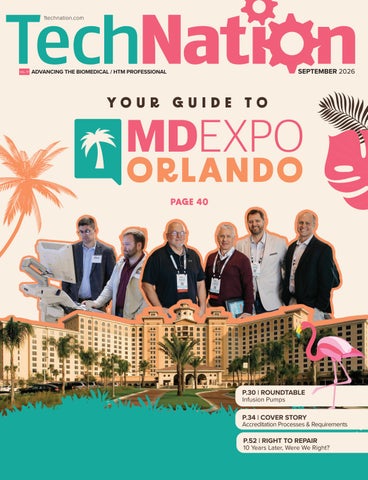
YOUR GUIDE TO
ORLANDO PAGE 40
P.30 | ROUNDTABLE Infusion Pumps
P.34 | COVER STORY
Accreditation Processes & Requirements
P.52 | RIGHT TO REPAIR
10 Years Later, Were We Right?
Siemens Artis Q & Zee Siemens Force CT Siemens Revelation 3D Tomo GE Pristina 3D Tomo NEW COURSES NOW AVAILABLE GE Philips 450W MRI Family Azurion Siemens Artis Q & Zee Siemens Force CT Explore our 60+ training courses at Siemens Revelation 3D Tomo https://rsti-training.com GE Pristina 3D Tomo GE 450W MRI Family Explore our 60+ training courses at https://rsti-training.com
TURN YOUR SKILL SET INTO SUPPLEMENTAL INCOME. ON YOUR TERMS. For gig technicians earning on the side, and ISOs looking to win work beyond their current network.
Why Technicians Are Joining Downtime Trace:
+113% GROWTH IN AVAILABLE WORK
MAR 2026
•
Work That Finds You: Get instantly notified through our mobile app when local facilities need specific make/model expertise that matches your profile.
•
You Choose What to Take On: Review the scope, timing, and payout before you ever submit a bid.
•
Control Your Schedule: Work when you want. Set your service radius and adjust if you travel.
•
Get Paid in Days, Not Months: We handle the payment workflow. Approved labor and parts payouts happen in days.
•
Build Your Reputation: All completed service tickets require mandatory reviews from customers that will help you win future work.
•
No Contracts or Gatekeepers: Free to join. You only take the jobs that make sense for you.
FEB 2026 JAN 2026 DEC 2025
AVAILABLE SERVICE REQUESTS In just four months, the volume of service requests submitted by healthcare facilities on Downtime Trace has more than doubled. The demand for qualified HTM technicians is real, and it is growing fast.
BUILT BY A TECHNICIAN, FOR TECHNICIANS. Founded by a technician who understands the frustration of working after-hours while hospitals overpay for legacy service contracts. Downtime Trace is a mobile app and service marketplace designed to connect you directly with the facilities that need your help. When a hospital submits a "Trace Ticket," you submit a standard bid with your estimated arrival time and hourly rate. The facility compares options and chooses the best fit. It is a clear path to supplemental income, giving you more access to work, more control over what you take on, and faster payments.
Create your free provider profile and start seeing service requests today! Scan the QR Code or visit DowntimeTrace.com to get started
Contactus@DowntimeTrace.com Linkedin.com/Company/Downtime-Trace Facebook.com/DowntimeTrace
PRESCOTT’S MED BE EQUIPPED FOR BETTER
SERVICE • PARTS • SALES • RENTALS PRESCOTT’S MED HAS YOU COVERED.
ON-SITE SERVICE: SURGICAL MICROSCOPES ANESTHESIA MACHINES STERILIZERS & WASHERS
DEPOT SOLUTIONS: PATIENT MONITORS INFUSION PUMPS ESUs, 02 BLENDERS
PRESCOTTSMED.COM
EXPERIENCE DRIVEN BY
PRECISION The world’s largest independent vaporizer service provider, delivering calibration, repair, and preventive maintenance with zero OR downtime.
QUALITY
PATIENT SAFETY
KNOWLEDGE
Upholding the highest quality standards with ISO13485: 2016 certification specific to medical device.
Patient and operative safety is at the forefront of all processes and procedures.
Unparalleled industry experience standing over 40 years.
VAPORIZER SERVICE EXCHANGE
giving your facility reliable, clinically accurate vaporizers exactly when you need them most.
Little to no operating room downtime Elimination of valuable anesthetic wastage Maintaining vaporizer compliance Patient Safety Employee health and safety
RELIABLE EQUIPMENT. ZERO HASSLE.THAT’S THE G.A.S. DIFFERENCE. SCAN HERE and connect with us!
1-800-717-5955
info@gas-worldwide.us www.generalanestheticservices.com
One probe restored Countless lives touched
Elevate Patient Care Rely on Innovatus Imaging
Let's meet at MDExpo in Orlando, Oct. 13 - 15 Booth 401
844-687-5100
innovatusimaging.com
CONTENTS P.12 SPOTLIGHT p.12 Professional of the Month: Anecyia Shields p.14 Department of the Month: Lake Charles Memorial Health System HTM Department p.16 Next Gen: Benjamin Reneau P.18 INDUSTRY UPDATES p.18 News & Notes p.20 TechNation Pulse p.21 Ribbon Cutting p.22 AAMI Update
34 P.25 THE BENCH p.25 Tools of the Trade: Healthmark, A Getinge company p.26 Biomed 101 p.28 Webinar Wednesday FEATURE ARTICLES p.30 Roundtable: Infusion Pumps p.34 Cover Story: Accreditation Processes & Requirements p.40 Guide to MD Expo Orlando
30
P.44 EXPERT ADVICE p.44 Cybersecurity p.46 MedWrench Guru p.50 The Massey Method p.52 Right to Repair
TechNation (Vol. 17, Issue #9) September 2026 is published monthly by MD Publishing, 1155 Senoia Road, Ste. 200 Tyrone, GA 30290. TechNation magazine is dedicated to providing medical equipment service professionals with comprehensive, reliable, information concerning medical equipment, parts, service and supplies. It is published monthly by MD Publishing, Inc. Subscriptions are available free of charge to qualified individuals within the United States. Publisher reserves the right to determine qualification for free subscriptions. Every precaution is taken to ensure accuracy of content; however, the information, opinions, and statements expressed in the articles and advertisements herein are those of the writer and/or advertiser, and not necessarily those of the publisher. ©2026
September 2026 | TechNation 9
PUBLISHER
John M. Krieg
VICE PRESIDENT
Kristin Leavoy
VICE PRESIDENT BUSINESS DEVELOPMENT
Jayme McKelvey
EDITORIAL
John Wallace
CONTRIBUTORS
K. Richard Douglas Joie Marhefka Steven J. Yelton Garrett Seeley Nathan Proctor Carol Davis-Smith Eric Massey Gay Gordon-Byrne Dave Francoeur Andrew Whyte James Linton Christopher Walters
DIRECTOR OF CLIENT SERVICES
Megan Cabot
ACCOUNT EXECUTIVE
Warren Kaufman
ART DEPARTMENT
Karlee Gower Taylor Hayes Alicia Brown
DIGITAL SERVICES
Cindy Galindo Kennedy Krieg Haley Harris
EVENTS
Kristin Leavoy Sydney Krieg
WEBINARS
Linda Hasluem
HTMJOBS.COM
Sydney Krieg
ACCOUNTING
Diane Costea
CIRCULATION
Stephanie Cote
55 P.55 BREAKROOM p.55 It’s Showtime p.56 Service Index p.59 Alphabetical Index p.60 Preferred Vendors
Like us on Facebook Follow us on LinkedIn
EDITORIAL BOARD Rob Bundick, Director HTM & Biomedical Engineering, ProHealth Care
Subscribe to TechNation TV
Carol Davis-Smith, CCE, FACCE, AAMIF, Owner/ President of Carol Davis-Smith & Associates, LLC Nadia ElKaissi, CHTM, Biomedical Engineer, HTM, VA Central Office (19HTM) Bryant Hawkins Sr., Site Manager, Children’s Hospital of New Orleans Earl Morris Jr., BMET, Director of Clinical Engineering, Harrison County Hospital Leticia Reynolds, Clinical Engineering Operations Manager at UCHealth Parkview Medical Center
10 TechNation | September 2026
MD Publishing / TechNation Magazine 1155 Senoia Rd, Ste. 200, Tyrone, GA 30290 800.906.3373 • Fax: 770.632.9090 Email: info@mdpublishing.com www.mdpublishing.com
Proud supporters of
a
Learn
M
e
Sc
to
or
n
Build In-House Expertise. Reduce Downtime. LEADERSHIP & PROFESSIONAL SKILLS
DENTAL EQUIPMENT HANDS-ON TRAINING
PRODUCT-SPECIFIC HANDS-ON TRAINING
ONLINE & HANDS-ON PROGRAMS
2 Weeks Online, 1 Week In-Person
Customization Options Available
Communication & Customer Service Course Customized Leadership Training
Infusion Pumps Patient Monitors Telemetry Systems Oxygen Blenders Electrosurgical Units (ESU) Patient Beds & OR Tables Defibrillators/ECG Tabletop Sterilizers Ventilators
Dental Bootcamp (2 Weeks InPerson) Dental Repair Technician 100300 Series (1 Week In-Person)
Biomed to Imaging (B2I) Biomedical Imaging & Information Systems (BIIS) Medical Device Integration (MDI) Medical Equipment Technician 100-300 Series Radiological Safety MRI Safety Biomedical Information Systems Analyzing & Design Linear Accelerators - Beginner through Intermediate
Hands-On, Hybrid, and Customizable HTM Training Programs MORE INFORMATION: 210-233-1102 TRAINING@CBET.EDU CBET.EDU/CBET-B2B-SERVICES/
FLEXIBLE, INTEREST-FREE PAYMENT PLANS AVAILABLE.
SPOTLIGHT
PROFESSIONAL OF THE MONTH Anecyia Shields
S
BY K. RICHARD DOUGLAS ometimes the wisdom of an older family member can point us in the right direction. There can be just as much wisdom in taking their advice.
Anecyia Shields, a biomed tech II in the HTM department at UT Southwestern Medical Center, is among those who listen to and benefit from an older generation. “My great-grandfather first sparked my interest in engineering when I was a little girl. He would always tell me that I was going to be an engineer one day. As I got older, I wanted to live out that vision, but I wasn’t sure what type of engineering I wanted to pursue. After seeing several family members face health challenges, I found myself drawn to biomedical engineering because it connected two important parts of my life,” she says. Shields says that entering the biomed field gave her a way to pursue the path her great-grandfather always saw for her while staying connected to experiences that had impacted her family. “Today, I carry a piece of those experiences with me every day, and they continue to motivate me in the work that I do,” she says. Shields earned her bachelor’s degree in biomedical engineering from the University of North Texas. “My education provided me with the foundational principles of engineering, including critical thinking, problem-solving and understanding how engineering concepts apply to healthcare. During my senior year, I interned with my current organization, where I gained hands-on experience working with medical equipment in a hospital setting,” she says. Shields says that while the degree taught her the engineering principles behind the technology, the internship allowed her to apply that knowledge in the real world by learning equipment management, troubleshooting and the day-to-day responsibilities of the HTM profession. “The combination of both experiences helped prepare me 12 TechNation | September 2026
for my career and ultimately led to a full-time position after graduation,” she adds. After entering biomed full time, Shields expanded her duties. “Over time, I took on additional responsibilities, including serving as a liaison for equipment-related projects. Most recently, I was appointed team lead, overseeing inventory management and supporting departmental initiatives. I was also selected to participate in a company-wide leadership development program, an opportunity that allowed me to further strengthen my leadership skills and professional growth,” she says. Today, her specialty area is project management. “I enjoy being involved in projects from start to finish, whether it’s bringing in new equipment, improving processes or helping move department initiatives forward. I like keeping things organized, working with different teams, and making sure everything comes together successfully,” Shields says. MAKING A POSITIVE IMPACT Shields says that tackling the challenges that come with special projects is not the only obstacle she faces. “One of the biggest challenges I have faced has been being the youngest member of my department. While I have always been confident, I have worked hard to ensure my voice, ideas and value are recognized,” she says. Shields says that throughout her career she has had the
opportunity to lead and contribute to several impactful projects. “I created our department’s internship program, spearheaded a complete inventory revamp project and played a key role in the Alaris fleet rollout. I also serve as a liaison for select equipment rollouts, coordinating testing and implementation efforts to ensure successful integration,” she says. Shields also serves as a resource for new projects in that position. Off the clock, Shields enjoys spending time with friends, family, her dog and taking time for self-care. She says that she was outnumbered growing up. “I am the oldest girl in a family of five siblings with all my younger siblings being boys. Growing up in that role taught me how to be strong, resilient and lead by example. It has played a significant role in shaping the person and professional I am today,” she says. In 2023, she says she was honored to receive the Innovation Award for Support Services. Shields describes herself as a determined person who is always looking for opportunities to learn, grow and contribute. “I bring passion, creativity and fresh ideas to everything I do, and I am excited to continue making a positive impact within the HTM profession,” she says. There is no doubt that she will and her accomplishments will do her great-grandfather proud.
BIOMETRICS FAVORITE BOOK:
“The Four Agreements” by Stewart Levine.
FAVORITE MOVIE: “Sinners”
FAVORITE FOOD:
Any meal my mom, great-grandma or Nana cooks.
HIDDEN TALENT:
A little bit of a comedian.
FAVORITE PART OF BEING A BIOMED? Knowing that every day I am part of bringing a positive outcome for healthcare.
Away from work, Anecyia Shields enjoys spending time with friends, family, her dog and taking time for self-care.
September 2026 | TechNation 13
SPOTLIGHT
DEPARTMENT OF THE MONTH
Lake Charles Memorial Health System HTM Department
L
BY K. RICHARD DOUGLAS
ake Charles is a city in southwest Louisiana that is considered the “festival capital of Louisiana” hosting more than 75 events annually. Central to fulfilling the healthcare needs of the city’s residents and visitors is the Lake Charles Memorial Health System (LCMHS).
Lake Charles Memorial Hospital is the main campus of the Lake Charles Memorial Health System. The hospital was established in 1952 and serves southwest Louisiana. Today, the hospital includes 315 licensed acute care beds. Managing the medical equipment assets for the system is the Lake Charles Memorial Health System Healthcare Technology Management (HTM) Department. Overseeing the department is Chief Information Officer Steve Stanic. The department’s director is Barrett W. Bartlett, CBET. The leadership team also includes HTM Site Supervisor Qais Deeb (main campus/radiology) and HTM Site Supervisor Austin Hebert, CBET (women’s campus and clinics). Additional team members are Perioperative HTM Tech Jeramy Leblanc; HTM Tech II Tyler Nugent, CBET (respiratory); HTM Tech II Aaron Gary (cardiology EKG and MUSE management); HTM Tech II Mary Begnaud; HTM Tech I Jimmy Dang; and HTM Intern Maddie Roux. 14 TechNation | September 2026
Bartlett says that the health system operates three acutecare campuses plus a freestanding behavioral health hospital, supported by a broad network of clinics and specialty services. “It is the only locally owned regional health system in Lake Charles,” he says. The HTM team is responsible for equipment assets across several hospitals and clinics. Some of those facilities include three acute-care campuses plus a freestanding behavioral health hospital, supported by a broad network of clinics and specialty services. In addition to the main campus are the 52-bed Lake Charles Memorial Hospital for Women and the 42-bed Archer Institute, a behavioral health hospital. There is also the Moss Memorial Health Clinic, a primary care clinic serving patients regardless of financial status. The system also includes 35 clinic sites across more than 21 locations in the region and more than 100 physicians and more than 120 employed providers across the Memorial Medical Group. “HTM services are provided within a hybrid model based on technician competencies/training and governance of service contracts. We promote a first response model that requires dispatch and evaluation of a faulty device by the HTM department followed by the appropriate escalation where required,” Bartlett says. He says that the department is a MediMizer shop, utilizing the CMMS for full operational support including work orders, scheduling, reporting and employee management.
AN EPIC UPGRADE A major accomplishment for any HTM department is facilitating the transition to an EPIC system. “When our hospital made the strategic decision to transition from an aging EMR platform to EPIC, the scale of the undertaking was immediately clear. I was appointed as project sponsor for the integrated systems workstream – an effort that would touch nearly every corner of our clinical technology ecosystem. The scope was vast: patient monitoring, fetal monitoring, monitor gateways, telemetry, ventilators, blood gas analyzers, anesthesia systems, EKG workflows and a long list of smaller but equally critical modalities,” Bartlett says. He explains that what followed was one of the most ambitious integration efforts the organization had ever taken on. “Working side‑by‑side with our HTM and ITS teams, vendor partners, project managers, and clinical stakeholders, we built a modern, cohesive integration architecture designed to operate seamlessly within EPIC. The result was transformative. We not only achieved full interoperability across all targeted systems – we supported a 300 percent increase in integrated medical devices, creating a more connected, data‑driven environment for clinicians and patients alike,” Bartlett adds. He says that the challenge was immense for the HTM and integrated systems departments as well as the entire organization. “EMR transitions are notoriously complex, and this one required deep collaboration, relentless problem‑solving and a shared commitment to the mission. Yet the experience also offered something invaluable: the opportunity to fully invest ourselves in a project that would redefine how our hospital delivers care,” Bartlett says. He says that looking back, the success of the initiative wasn’t just measured in interfaces built or connected devices. It was measured in the strength of cross‑department partnerships, the resilience of our teams and the pride of knowing we helped lay the technological foundation for the next era of patient care. As if an EHR overhaul wasn’t enough, a more ongoing task the HTM team performs is the data‑driven evaluation and acquisition of new medical equipment and technology. “Because we work closely with administration and clinical teams throughout the year, our team gains a uniquely
comprehensive perspective — one shaped by daily relationships with frontline staff and a system‑wide view of emerging technology opportunities,” Bartlett says. He says that the department’s approach is intentionally collaborative and methodical. “We involve clinical stakeholders at every stage of the decision‑making process, using multiple product demos, structured surveys, hands‑on clinical trial periods, and detailed statistical and historical evaluations to ensure that every option is thoroughly vetted. This process not only strengthens buy‑in – it ensures that the final selection aligns with real clinical workflows, technical requirements and long‑term financial stewardship,” Bartlett says. This year, the team has been deeply engaged in three major capital initiatives: an entire facility nurse call upgrade, a cath lab upgrade and an MRI addition. “Each of these efforts has required extensive evaluation, interviews and feedback sessions with stakeholders across multiple disciplines. Our goal is always the same: to identify solutions that meet the complete spectrum of needs – from clinical functionality and patient safety to serviceability, interoperability and total cost of ownership,” Bartlett says. He says that ultimately, this rigorous, relationship‑driven process is one of the strengths of the HTM program. “By combining technical expertise with structured analysis and deep clinical engagement, we ensure that every technology decision supports safe, efficient and future‑ready patient care,” he adds. Bartlett says that beyond the workplace, team members are active members and participants in AAMI, and monthly TechNation readers. “Locally, our department supports community outreach initiatives through the organization that include STEM-H Camp (an annual camp for students who are interested in the STEMHealthcare field) and the Window to Healthcare program that allows local high school or university students to experience healthcare alongside one of the many professionals that we have,” he says. Down in the Bayou State, members of the Lake Charles Memorial Health System HTM Department are upgrading their facilities and staying involved in the community.
Back row (left to right), Jeramy Leblanc, Barrett W. Bartlett (CBET), Aaron Gary. Front row, Tyler Nugent (CBET), Qais Deeb
Back row (left to right), Tyler Nugent (CBET), Aaron Gary, Barrett W. Bartlett (CBET), Jeramy Leblanc. Front row, Qais Deeb, Mary Begnaud, Austin Hebert (CBET). Not Shown: Jimmy Dang, Maddie Roux September 2026 | TechNation 15
SPOTLIGHT
NEXT GEN POWERED BY YP AT MD
B
Benjamin Reneau
enjamin Reneau is a biomedical equipment tech at Tampa General Hospital in Tampa, Florida. His HTM education includes an Associate of Science in clinical engineering and several certifications, including multiple Hill-Rom bed-specific certifications as well as certifications for the Stryker Altrix System and Philips PIC iX System.
TechNation recently found out more about this promising member of HTM’s next generation. Q: WHERE DID YOU GROW UP? A: I moved around a lot as a kid because I was part of a military family. I’d like to say Honolulu, Hawaii, but I recently moved to Tampa from Washington State, where I lived for 13 years. Q: WHERE DID YOU RECEIVE YOUR HTM TRAINING/ EDUCATION? A: I went to Bates Technical College in Tacoma, Washington. Q: HOW DID YOU FIRST DISCOVER HTM? A: I had never even heard of it until I enrolled in school. My guidance counselor told me about it. It sounded interesting, so I decided to give it a try. As it turned out, I really enjoyed it. Q: HOW DID YOU CHOOSE TO GET INTO THIS FIELD? A: It’s a bit of a funny story. Once I got out of the U.S. Army, I was an automotive detailer. I even ran my own business on the side for a while. I did that for almost five years, installing tint, PPF and vinyl wraps. Then, I got laid off and decided to go back to school since I had the time. Originally, I was planning on becoming an electrician, but the program was full. That’s when the guidance counselor told me I could either wait or try out the clinical engineering program, and I didn’t want to wait. I had an amazing professor who really piqued my interest in clinical engineering. I ended up excelling in the program, graduating with a 4.0 GPA. I was invited into the honors society, started tutoring and received the President’s Award every quarter. I had never done that well in school before. I give a lot of credit to my amazing professor, Abdalkhuddus Uriet, or Professor Kuddus, as we called him. 16 TechNation | September 2026
Q: WHAT DO YOU LIKE MOST ABOUT YOUR POSITION? A: The never-ending opportunity to learn new things. I’ve always been interested in learning how things work, and especially in fixing them. I take a great sense of pride in everything I manage to repair successfully. Q: WHAT INTERESTS YOU THE MOST ABOUT HTM? A: The room for growth and specialization, and the feeling of making a difference in a patient’s life, even if it’s something as simple as fixing a TV. Q: WHAT HAS BEEN YOUR GREATEST ACCOMPLISHMENT IN YOUR FIELD THUS FAR? A: Honestly, it’s getting the role I currently have. Before this, I was a field tech and didn’t enjoy all the driving and the hours I spent stuck in traffic. Getting this position gave me the opportunity to focus more on the work I enjoy. Q: WHAT GOALS DO YOU HAVE FOR YOURSELF IN THE NEXT 5 YEARS? A: Ultimately, I’d like to specialize in the field and earn my CBET certification. Dialysis has always been very interesting to me, and it’s an area I’d like to explore further.
FUN FACTS FAVORITE HOBBY: Anything with wheels. I grew up working on cars, and now I have three cars and a motorcycle. FAVORITE SHOW OR MOVIE: “Pulp Fiction” FAVORITE MEAL: Chicken Cordon Bleu WHAT WOULD YOUR SUPERPOWER BE? Omnilingualism 1 THING ON YOUR BUCKET LIST? Sail across the Atlantic Ocean to Italy. SOMETHING YOUR CO-WORKERS DON’T KNOW ABOUT YOU: I had a lot of unusual pets as a kid, including frogs, lizards, spiders, scorpions and snakes. For a long time, I also had guinea pigs. These days, I just have cats.
INDUSTRY UPDATES
NEWS & NOTES Updates from the HTM Industry RIGHT TO REPAIR LAWSUIT FILED IN TEXAS On April 21, Marshall Shannon, director of operations at Image Technology Consulting LLC, filed the lawsuit Shannon v. Philips North America LLC, Case No. 3:26-cv01276-B-BW, in the U.S. District Court for the Northern District of Texas. Image Technology Consulting LLC is an independent service organization (ISO) described on its website as “the leading third-party parts and service provider, specializing in Philips and Siemens equipment, while providing superior support for all major OEM systems.” The lawsuit claims that restrictions on Philips MR scanner software are illegal because they prevent ISOs from servicing the diagnostic imaging devices. The filing states that OEMs must remove software restrictions that prevent access to servicing information and maintenance menus, citing federal FDA regulations. The filing asks the court to order Philips to change its policies. Gay Gordon-Byrne, executive director at The Repair Association, said, “OEMs are blowing smoke because their arguments do not pass the smell test.” She explained that broken equipment doesn’t work until repaired.
“Adding limitations on access to repair materials only delays the repair process and delays access to equipment,” Gordon-Byrne said. “Slow repair is dangerous when equipment is needed for patient care. During the pandemic there was national concern about repairing ventilators on a timely basis. Concern has waned because COVID isn’t killing as many people – not because ventilator repair got better.” Claims of cybersecurity concerns also appear to be false claims from Gordon-Byrne’s perspective. “Cybersecurity has nothing to do with repair. It sounds scary but isn’t the real world. If a product is broken it doesn’t connect to a network. It is access through the working network to working products that allows for cyber risk. When asked for examples – which we have done for more than a decade, the answer is always ‘I’ll get back to you.’ We’d sure like to know how to help improve cybersecurity.” She added that “broken hardware has nothing to do with component or product performance. A functional spare part is identical to the original.” Philips declined to comment on the lawsuit.
ANNUAL HTM CONFERENCE STARTS SEPTEMBER 9 Healthcare technology management (HTM) professionals from across the Upper Midwest are invited to register for the 2026 North Central Biomedical Association (NCBA) Annual Conference, scheduled for September 9-11 at Madden’s Resort on Gull Lake in Brainerd, Minnesota. Attendees are encouraged to arrive on September 8. The annual event brings together biomedical equipment technicians, clinical engineers, students, healthcare technology leaders and industry partners for several days of continuing education, networking and hands-on interaction with exhibitors serving the HTM community. Educational sessions, a vendor show and social networking opportunities are planned throughout the conference, 18 TechNation | September 2026
providing attendees with valuable opportunities to expand their technical knowledge and connect with peers from Minnesota, North Dakota, South Dakota and Iowa. NCBA also will continue its longstanding commitment to workforce development by awarding two $500 scholarships to eligible HTM students during its business meeting. The scholarships are intended to support the next generation of biomedical professionals. Additional information, including the educational schedule, lodging details and registration, is available on the NCBA website at ncbiomed.org.
PHOENIX DATA SYSTEMS ANNOUNCES 41ST AIMS USER CONFERENCE Phoenix Data Systems will host its 41st annual AIMS User Conference November 8-11, 2026, at the Gaylord Texan Resort & Convention Center in Grapevine, Texas. Designed for AIMS 3 users, healthcare technology management professionals and organizational leaders, the conference offers a unique opportunity to connect with industry peers, gain hands-on experience and explore the latest advancements in healthcare asset management technology. Attendees will have access to: • Live demonstrations and hands-on training
• Expert-led educational sessions • New feature previews and implementation tips • Customer insights and peer networking opportunities • Open Q&A sessions with AIMS 3 experts • Analytics and consulting discussions • CEUs toward AAMI ACI certification Conference registration includes access to all conference sessions, materials, meals and attendee networking opportunities. Email AIMSconference@goaims.com for event details.
JOINT COMMISSION OFFERS RESPONSIBLE USE OF AI IN HEALTHCARE CERTIFICATION Joint Commission has announced the launch of its new Responsible Use of AI in Healthcare (RUAIH) certification. RUAIH delivers on a promise made in 2025 when the organization released initial guidance to help U.S. health systems safely and effectively implement AI, which was developed after Joint Commission convened more than 20 key coalitions and groups with expertise in healthcare and technology. “Joint Commission’s goal is to provide governance support for delivering the safest and highest quality care for U.S. health systems across the care continuum. With more than 80% of physicians currently using AI in professional settings, there is a fast-growing need for universal standards for implementing this transformational technology in responsible ways,” said Jonathan B. Perlin, M.D., Ph.D., president and CEO, Joint Commission. “AI has the potential to unlock discoveries and improve quality, safety and operating efficiency. With this new certification, Joint Commission is providing healthcare organizations with the blueprint for safely and appropriately using AI.”
While AI tools are proving to be increasingly revolutionary, the use of AI also inevitably comes with some risk, from data privacy and security, to data inaccuracies, to lack of transparency in the AI decisionmaking process, and more. At its core, RUAIH recognizes that responsible AI use is not only a technology issue – it is a patient safety, quality, governance, privacy and trust issue. RUAIH is a voluntary certification program designed to recognize organizations in the U.S. that demonstrate they have the governance, safeguards, monitoring processes and education in place to use AI responsibly in healthcare settings. The certification focuses on the safe, reliable, transparent and ethical use of AI by healthcare organizations. It does not validate or certify individual AI products or tools. The certification standards are organized around five major areas: governance; effective data management; risk and bias reduction; monitoring, evaluating, and validating safety performance, effectiveness, and responsible use; and transparency, education and training.
September 2026 | TechNation 19
INDUSTRY UPDATES
The latest news and events from TechNation NEW TECHNATION MERCHANDISE STORE LAUNCHED Healthcare technology management professionals now have a new way to show their TechNation pride. TechNation has launched its official online merchandise store, offering branded apparel, drinkware and accessories designed for the HTM community. The TechNation Shop features a variety of products, including T-shirts, polos, hoodies, hats, tumblers, mugs, bags and other branded merchandise that lets biomeds, clinical engineers and HTM leaders represent their profession both on and off the job. The store also offers gift ideas for colleagues, department recognition, conferences and industry events. Whether you’re attending an HTM Mixer, MD Expo, AAMI eXchange or simply working in your shop or hospital, the merchandise provides an opportunity to showcase your connection to the TechNation community while supporting the industry’s leading media brand. New products and seasonal items will be added throughout the year. To browse the complete collection or place an order, visit the TechNation Shop at https://shop.1technation.com/.
2027 MD EXPO & HTM MIXER LOCATIONS ANNOUNCED Healthcare technology management (HTM) and imaging professionals have multiple opportunities to connect, learn and network as MD Publishing has announced its lineup of conferences and regional events for 2026 and 2027. The schedule begins with MD Expo Orlando, Oct. 13-15, 2026, in Orlando, Florida. Supported by the Florida Biomedical Society (FBS), the conference will bring together biomedical equipment technicians, clinical engineers, healthcare technology leaders and industry partners for continuing education, networking, an exhibit hall and leadership development. The Imaging Conference & Expo (ICE) is set for Feb. 26-28, 2027, in Fort Worth, Texas. The event is the only conference dedicated exclusively to imaging directors, radiology administrators, radiologic technologists and imaging engineers, offering specialized education, networking and exhibits focused on the imaging community.
20 TechNation | September 2026
Additional events on the schedule include: • MD Expo Las Vegas – April 13-15, 2027, Las Vegas, NV • HTM Mixer Midwest – May 20-21, 2027, Kansas City, MO • HTM Mixer Nashville – Aug. 5-6, 2027, Nashville, TN • MD Expo New Orleans – Oct. 17-19, 2027, New Orleans, LA Each event is designed to provide healthcare technology professionals with educational sessions, networking opportunities and access to the latest products, services and industry innovations. Whether attendees are looking to earn continuing education, connect with peers or explore emerging technologies, the conference lineup offers opportunities throughout the year for professionals across the HTM and imaging communities. For registration information, hotel details and updates on all upcoming events, visit MDExpo.com/upcoming-events.
INDUSTRY UPDATES
RIBBON CUTTING
C
B Technologies (CBT) helps organizations design, deploy and support Connected Worker solutions that connect frontline employees with the people, information and systems they need – without taking their hands or attention away from the work.
“Our solutions combine handsfree RealWear wearable computers with applications for remote expert assistance, training, skills validation, inspection, maintenance and workflow documentation,” CEO Kelly Ireland said. “We also provide use-case discovery, solution design, systems integration, device deployment, user training, adoption services and ongoing managed support. Where appropriate, we integrate the wearable endpoint with enterprise platforms such as ServiceNow, Microsoft, SAP, Maximo and other asset-management or workflow systems.” “I am especially excited about the work we are doing in healthcare technology management. We are helping healthcare organizations explore how wearables can connect technicians in the field with centralized cyber, engineering and equipment-support teams,” she added. “A technician can share exactly what they are seeing, receive guidance from a remote specialist, document the repair and access relevant information while continuing to work hands-free. This has the potential to improve first-time fix rates, reduce travel, accelerate repairs and increase equipment availability.” TechNation Editor John Wallace recently interviewed Ireland to find out more about CBT and how it can assist HTM professionals. Q: HOW DOES YOUR COMPANY STAND OUT IN THE MEDICAL EQUIPMENT FIELD? IRELAND: CBT is not simply a hardware reseller. We approach wearable technology as an enterprise endpoint and as one component of a much broader digital-transformation strategy. Our work begins with the operational problem – not the device. We spend time with frontline employees, HTM leaders, cybersecurity teams, educators and other stakeholders to understand how work is actually being performed. We then design the technology, workflow, integrations, training and support model around the people who will use it. This is especially important in healthcare, where technology must fit within established security, privacy, safety and clinical requirements. Our team brings decades of experience in
enterprise IT, edge technology, networking, security and large-scale deployment. We combine that technical background with a practical understanding of frontline adoption. Our goal is not to complete a demonstration or leave a customer in a perpetual pilot. We establish measurable objectives at the beginning, validate the business and operational value and create a realistic path from an initial use case to an enterprise-scale program. Q: WHAT IS ON THE HORIZON FOR YOUR COMPANY? IRELAND: We believe the next phase of Connected Worker technology will be much larger than remote video collaboration. Wearable devices will increasingly become intelligent endpoints that securely connect frontline work with enterprise data, artificial intelligence, asset-management platforms and organizational knowledge. For CBT, the immediate goal is to continue expanding our healthcare programs, particularly within HTM, clinical engineering, workforce training and competency validation. We are also building managed-service offerings that can support customers throughout the entire life cycle – from device provisioning and onboarding to application support, fleet management, workflow optimization and enterprise integration. Another important focus is knowledge capture. Healthcare organizations are facing the retirement of highly experienced employees at the same time they are struggling to recruit and train the next generation of technicians. Wearable technology can help preserve institutional knowledge, make expertise available across multiple locations and provide newer employees with structured support while they build experience. Ultimately, we want to establish a repeatable Connected Worker model that healthcare organizations can use across facilities, departments and regions rather than treating every deployment as a separate technology project. Q: IS THERE ANYTHING ELSE YOU WOULD LIKE OUR READERS TO KNOW? IRELAND: The most important lesson we have learned is that Connected Worker technology is not intended to replace skilled technicians. It is designed to strengthen and extend their capabilities. For more information, visit: cbtechinc.com.
September 2026 | TechNation 21
INDUSTRY UPDATES
AAMI UPDATE
Discovering HTM: California Students Learn from Local Pros
F
or years, it has felt as if healthcare technology management (HTM) is a best-kept secret. A rewarding occupation, ideal for building one’s technical skills and job security, is tucked away in the basement of health systems across the United States. Now, however, HTM pros in California are eager to share this secret with the next generation of prospective technicians.
California, visiting classrooms and career fairs with portable devices, hands-on presentations and information pamphlets developed by CMIA and AAMI. Each of CMIA’s nine chapters throughout California will conduct at least two student outreach events per year, for a statewide goal of 18 events annually. “By introducing students to the field while they are still considering education and career options, we hope to build greater awareness and attract a new generation of professionals to the industry,” Velick explained.
“The current shortage of qualified HTM professionals makes early outreach especially important,” said Jason Velick, chair of the California Medical Instrumentation Association. CMIA, a member of AAMI’s HTM Association Leaders group, has launched a new initiative specifically aimed at introducing career paths of the HTM profession as early as possible to students entering the U.S. workforce. Members of CMIA will be traveling around the state of
EARNING STUDENT INTEREST The effort is already underway, with representatives from the CMIA Silicon Valley Chapter having visited El Cerrito High School, located in El Cerrito, California, in July. There, HTM consultant and DeVry University Biomedical Engineering Technology Professor Najib Azhar joined with Sayed Sayedi, a student at Chabot College, to show students the kinds of devices HTM professionals will regularly maintain for hospitals and clinics. The pair
22 TechNation | September 2026
demonstrated how troubleshooting test equipment is used to maintain the accuracy and efficacy of the devices and instruments used for patient care. “A great deal of interest was generated as students checked their heart rate, blood pressure, blood oxygen and temperature. The use of test and calibration equipment – a patient simulator and defibrillator analyzer – was also demonstrated,” Azhar explained. “We had several engaging conversations and encouraged students to explore what AAMI.org and CMIA.org have to offer.” The students were also given an opportunity to peruse several books that have proven important to Azhar’s own career path as both an HTM expert and educator of the next generation: 1. Introduction to the Medical Device Industry: A Career in Medical Devices 2. Career as a Biomedical Equipment Technician 3. Biomedical Engineering Made Understandable: A Teen’s Introduction to Biomedical Engineering 4. Bio-Medical Engineering: Principles, Technologies, and Clinical Applications 5. Artificial Intelligence in Healthcare “The first three books were relevant to the high school attendees, but the last two gave them a taste of exciting things to come,” Azhar said. “What drives us to introduce students to HTM is the growing need to develop the profession’s future workforce,” Velick added. “Ultimately, patient safety is at stake. We are working to ensure that our hospitals are able to function continuously and without interruption of workflow demands.” WHAT COMES NEXT Of course, student interest alone isn’t going to create a new generation of HTM professionals. Fortunately for the students Azhar spoke with, CMIA has created an online portal listing California HTM programs and AAMI student resources, outlining clear next steps for students looking to dive into the HTM field. Unfortunately, not all U.S. regions are as well-resourced as the Golden State. AAMI Vice President of HTM Danielle McGeary said the HTM field faces a steep challenge in its dwindling U.S. education and training pipeline. Around the U.S., two-year biomedical equipment technician (BMET) programs are closing their doors. With 23 programs lost since 2020, many states no longer have an educational institution offering a two-year degree in the HTM field. Hospitals are also under stress. As health system budgets and reimbursements shrink, the prospect of training new HTM professionals to replace retiring HTM gurus has become increasingly daunting. “We need HTM associations across the U.S. to step up – just as CMIA has – to drive a new wave of student interest in the HTM field,” McGeary noted. “Whether you plan to attend a career fair, give a classroom presentation, or even tour students around your department, AAMI can provide resources to share why the HTM profession is so rewarding.” Interested parties are encouraged to visit aami.org’s HTM Resources page.
LENDING A HELPING HAND AT EVERY STEP. Diagnostic Solutions is a customer service based parts provider that specializes in all imaging modalities and manufacturers. Created to offer hospitals and ISO’s a cost effective and time saving solution for ordering imaging replacement parts, equipment moves, ultrasound probe repair and on-site service.
Contact us today, we are confident you will see us as THE Parts Solution!
diagnostic-solutions.com
330.296.9729 September 2026 | TechNation 23
Deliver a Clear View with
EndoPro-Cam
®
Inspect and document rigid scope image quality for maintenance and quality assurance activities hmark.com 800.521.6224
Identify Image Quality Issues Document with Confidence Standardize Workflow
Explore EndoPro-Cam
Disclaimer: Intended for inspection and documentation of rigid endoscope image output during maintenance and quality assurance activities. Not intended for patient examination, diagnosis, treatment, or intraoperative use.
Scan to explore how the EndoPro-Cam can support your rigid scope inspection process.
THE BENCH
TOOLS OF THE TRADE Healthmark, A Getinge company EndoPro-Cam
LIVE DEMO:
SEPTEMBER 16 at 2 PM ET Registration on WebinarWednesday.live Eligible for 1 CE credit from the ACI.
Designed for inspection of rigid endoscope image quality, the EndoPro-Cam® is a portable endoscopic video system that provides 1080p high-definition imaging for visual assessment of rigid endoscopes outside of patient use. Featuring a 4.3-inch LCD monitor in a lightweight, ergonomic design, the EndoPro-Cam supports both image capture and video recording. It also includes a test pattern card that enables users to view a standardized test pattern through a rigid endoscope to visually assess image resolution, color reproduction and image artifacts such as dark spots. The EndoPro-Cam is intended solely for equipment inspection and documentation. It is not intended for patient examination, diagnosis, treatment or intraoperative use. To learn more visit hmark.com/product/endopro-cam.
September 2026 | TechNation 25
THE BENCH
BIOMED 101
Importance of Human Interaction in a World of Computer Disconnect
T
BY JOE DEATER, CBET
he call comes in and on the other end is a unit clerk letting you know that there is a piece of equipment at their desk with a red tag on it that says “BROKEN.” You attempt to gather more information from the unit clerk and they have none to give. They don’t even know what the device is, let alone what is broken on it. You ask them to place a work order for it through the online portal, but they do not have time to do that either. “Sorry got to go. There’s a code blue being called! Click!”
We all have taken those calls. What do you do next? Do you turn to your coworkers frustrated and angry because the person could not tell you more information and refused to at least put in a work order? Do you do nothing until a work order comes in? Or do you take a moment and understand the situation. The unit clerk was handed the equipment by someone else who may or may not have been the person who discovered the failure on that piece of equipment. Understanding that their priority at the end of the call was a 26 TechNation | September 2026
patient’s life is important. They most likely could not answer your questions about something they know nothing about other than what they already told you. This is where you remove yourself from the desk, go to that department and make a physical appearance. You locate the piece of equipment and talk with someone – face to face. Yup, I know we don’t like to do this. However, it is probably one of our most important tasks. It is important to actually make an appearance to the people we work with and for in the facility. Many things will happen at that time. The same unit clerk, time permitting, can be taught about the equipment in question. You can ask a charge nurse if they have any more details about the piece of equipment. You might even find the person who originally realized the unit was not working correctly. This approach cultivates a human connection. An opportunity to move beyond a voice on the other end of a phone or a computer-generated lifeless work order. The people we work for now have a face and a human being to go with the name that they may or may not remember from the phone call. You now have an opportunity to teach about the equipment they see and interpret in their language what they witnessed as being wrong with it.
An HTM professional who does this repeatedly builds a relationship and trust develops between the pro and the staff. In a world of computers, video calls, chat messages, text messages and emails, the human factor still rules. When a nurse, aide or unit clerk can see a physical person trying to help them it leads to a trust factor. Even if you have a bad initial experience with someone, it is an experience and they will remember that you were trying to help them. They will remember the effort to help even if it frustrated both of you. Odds are that the person will remember you next time and the situation will be calmer and better. They will ask you a question and be more willing to talk with you. First impressions go a long way but second, third, 20th impressions can nullify that first impression and sometimes that initial sour experience can turn into respectful long-term work relationships. We quite often find ourselves as the interpreters for the clinical staff. We must take their vocabulary and what they call something and interpret it into tech speak. An example is the Bovie was not cauterizing as it should or the telemetry box at the bedside isn’t communicating to the patient records. As biomeds we know what these descriptions actually mean and how to translate it into what is going on with the equipment and what it is really called. In some cases, biomeds can take a couple of minutes to explain what is going on and fix it on the
spot. They become a superhero. Sometimes the device will have to be taken back to the shop to contact tech support when translating from clinical speak to tech speak can solve the issue. All these interactions are part of the human factor. As biomeds, we must maintain that human connection. Going out and rounding daily or going to the floors and picking up equipment offers an opportunity to make a human connection that is vital to our work. It often leads to trust and even friendships. In a world that is getting increasingly disconnected, the human interaction is even more important, not just as biomeds but as humans. We can be introverted and say we just want to stay in the basement, but human nature thrives on human interaction. Our DNA is written as such. We came from hunter-gatherers. We know that clinical staff members never trust the computers and electronics that they work with every day. However, they do trust those of us that are there to help them, the biomeds who take care of the devices so that they can take care of the patients. Joe Deater, CBET, is a BMET III with Munson Healthcare and an adjunct instructor at Northwestern Michigan College.
Healthcare Costs Are Rising. Your Equipment Service Spend Doesn’t Have To. Many hospitals are losing margin in places they can’t easily see—fragmented service models, legacy OEM contracts, and limited visibility into total equipment service costs. RENOVO helps healthcare organizations take control through: • Consolidated, multi-vendor service management • Full operational and financial transparency • Flexible in-house, hybrid, or outsourced support models • Strategic reduction of unnecessary service contracts • Stronger uptime, compliance and asset performance • Improved capital planning through actionable data insights The result? Lower total cost of service. Improved uptime. Smarter decisions. Stronger margins.
Rising costs. Labor shortages. Fragmented Vendors. It’s time to rethink how HTM service is structured.
Start with a no-cost current-state assessment. See where your service model can work smarter.
Renovo1.com | 844.473.6686
September 2026 | TechNation 27
THE BENCH
CLICK. WATCH. EARN.
Watch these webinars on-demand
TECHNATION’S WEBINAR WEDNESDAY HIGHLIGHTS HTM TRENDS From artificial intelligence and workforce development to advanced test equipment, recent Webinar Wednesday educational sessions provided healthcare technology management (HTM) professionals with practical insights into technologies and strategies shaping the future of the profession. Eligible for ACI continuing education credit, the webinars explored how HTM teams can strengthen service delivery, prepare for emerging challenges and evaluate new tools designed to improve equipment testing and performance.
AI AGENTS TRANSFORMING HTM Ascendo AI examined how artificial intelligence is moving beyond traditional chatbots to support clinical engineering and HTM organizations during the webinar, “Beyond Break-Fix: How AI Agents Are Transforming Clinical Engineering and Healthcare Technology Management.” Presented by Karpagam “Kay” Narayanan and Ramki Pitchuiyer, the session focused on AI-powered agents designed to capture institutional knowledge, accelerate troubleshooting and help address workforce shortages as experienced biomeds retire. Speakers emphasized that AI is intended to augment technicians rather than replace them, while helping newer professionals gain access to decades of service expertise. The presenters also explored 28 TechNation | September 2026
how AI agents can improve issue resolution, support technician development and help organizations meet growing service demands in increasingly complex healthcare environments. Attendees praised the session for providing a practical look at AI’s role in HTM. “I think it is a good glimpse into the future of where our field is going,” said Scott Davis, BMET II at Cleveland Clinic Akron General. Hermon Mussie, a biomed at WellSpan, added, “This webinar introduced me to how AI can be used in the biomedical field … it gave me a better understanding of AI tools and their potential applications.”
BUILDING A PROACTIVE SERVICE ORGANIZATION GE HealthCare presenters Aaron Goryl and Chris Clawson encouraged HTM professionals to move beyond reactive maintenance during the webinar, “Ready, Not Reactive: How Healthcare Organizations Can Rebuild Service and Skills for What’s Next.” The presentation addressed staffing shortages, connected medical devices, cybersecurity considerations and the need for competency-based workforce development. The speakers encouraged organizations to
adopt proactive life cycle planning and invest in leadership development to improve equipment uptime while preparing service teams for rapidly evolving technologies. Participants said the webinar reinforced the importance of planning ahead. James Dubois, HTM at UVM/TSP Brattleboro Memorial Hospital, said the session underscored the value of “planning and training,” while Walter Carrillo, biomedical equipment specialist III at MedStar Georgetown University Hospital, noted, “It is important to keep up with today’s technological advances.”
IMT ANALYTICS SHOWCASES CITREX H5 IMT Analytics demonstrated its portable CITREX H5 Gas Flow Analyzer during a TechNation Tools of the Trade Live Demo, highlighting the device’s capabilities for testing ventilators, anesthesia machines and other medical equipment that generates gas flow and pressure. Managing Director Daniel Benz demonstrated features including bi-directional flow measurement, pressure and oxygen testing, Bluetooth connectivity and wireless data monitoring. The session also highlighted workflow tools designed to improve testing efficiency and reduce setup time. Attendees said the demonstration delivered practical value. “Provided perspective and information on resources and tools that are available,” said Lacie Wiggam, a clinical engineer with TRIMEDX. Sal Cruz, director of clinical engineering at Cook Children’s Medical Center, said, “It will definitely help my team.” Ladd DaFoe, a senior biomedical technician at Emplify Health by Gundersen, said the webinar “will assist in providing comprehensive testing of my ventilators.” Brian Evans, a biomedical technician at Lee Memorial Hospital, added that the demonstration “showed me options for test equipment for our department’s next purchase.” Visit WebinarWednesday.live for on-demand viewing options and a list of upcoming webinars.
September 2026 | TechNation 29
ROUNDTABLE
ROUNDTABLE
I
Infusion Pumps
nfusion pumps remain among the most critical and widely used medical devices in today’s healthcare environment, placing increased demands on healthcare technology management (HTM) professionals to ensure safety, reliability and performance. As health systems expand, device connectivity grows and software-driven technologies continue to evolve, managing infusion pump fleets has become more complex than ever.
In this TechNation Roundtable, three industry experts share their perspectives on the trends shaping infusion pump management in the years ahead. Participants in this roundtable article on infusion pumps are: • Elite Biomedical Solutions Chief Service Officer Glenn Schneider; • PartsSource Director of Biomedical Sales Dave Olexa; and • USOC Medical Infusion Pump Lead Tech Jeremy Sommer.
30 TechNation | September 2026
Q: AS HEALTHCARE SYSTEMS CONTINUE TO STANDARDIZE EQUIPMENT ACROSS MULTIPLE FACILITIES, WHAT STRATEGIES HAVE PROVEN MOST EFFECTIVE FOR MANAGING LARGE INFUSION PUMP FLEETS? SCHNEIDER: Standardizing an infusion pump fleet across multiple facilities creates several efficiencies. Training costs decrease because staff work with fewer device brands, while shared parts inventory allows facilities to support one another when supplies run low, reducing downtime and expense. A single service team can also support the fleet organization-wide, lowering resource needs and creating an entry-level pathway for new technicians. In my time as a director, I found that moving from a fixed PM month to a floating PM schedule reduced the time spent retesting recently repaired devices and searching for pumps due for preventive maintenance.
OLEXA: Effective fleet management requires standardized workflows for preventive maintenance and software updates across all facilities in the health system. Second, implement a robust inventory management system to track infusion pump parts across locations – this allows facilities to share stock when others face shortages, which prevents backorder impacts. Third, establish standardized training programs for clinical and biomedical staff to ensure consistent device operation. Finally, develop relationships with both OEM services and qualified independent depot repair providers. For example, we’ve helped healthcare systems reduce repair turnaround from 2-3 months down to 2-3 weeks when they leverage secondary repair sources, saving significant money and improving equipment availability. SOMMER: Inventory Management Software (IMS) allows for real-time tracking of devices both on and off-site, while keeping all applicable unit details in a centralized location that is easily accessible by authorized personnel. Using IMS moves away from the unreliable nature of multiple spreadsheets, which must be manually updated and may not be synchronized across facilities. Q: CONNECTIVITY HAS BECOME INCREASINGLY IMPORTANT FOR INFUSION PUMPS. WHAT CHALLENGES AND OPPORTUNITIES HAVE YOU SEEN WITH WIRELESS COMMUNICATION, INTEROPERABILITY AND INTEGRATION WITH HOSPITAL SYSTEMS? SCHNEIDER: Wireless communication and interoperability have created significant opportunities for infusion pump management. Pushing drug library updates wirelessly, rather than through a wired connection, saves considerable time and gives HTM technicians access to the manufacturer’s server, which improves visibility into pump status and location. Interoperability can also improve safety by reducing the potential for human error, but it may add steps to repair and PM processes to confirm functionality. Because these systems often use barcodes, typically tied to the serial number, to program devices through the EMR, any serial number change during repair must be carefully managed to prevent the wrong pump from being programmed, increasing patient safety risk. OLEXA: Wireless connectivity is transforming infusion pump management by enabling automated drug library updates and software deployments rather than manual updates at each bedside. However, we’re seeing real challenges. When the Hospira Plum 360 was first rolled out, many health systems experienced Wi-Fi issues while loading drug libraries. This created concerns about using secondary market repair providers. Over the past couple of years, however, secondary repair vendors have identified and resolved these challenges. Today, they are an excellent source for faster turnaround times and meaningful cost savings. Beyond technical issues, reliable wireless coverage across hospital campuses remains inconsistent, and seamless integration with EHR and medication management systems requires extensive coordination between vendors, pharmacy departments and clinical engineering teams. Cybersecurity is equally critical. The opportunity is significant: successful connectivity implementation drives real-time medication safety, reduces therapy interruptions and provides performance data that can predict failures before they occur.
SOMMER: The challenge of properly trained personnel. HTM professionals are quickly becoming IT technicians as infusion pumps join the growing number of devices becoming wireless connected. While the ability to update software, install new drug libraries and switch from one patient’s needs to another seamlessly is absolutely invaluable, it can come at a sharp price when downtime increases because of: • reluctance to embrace new technologies; • confusion and frustration in applications and processes; • a basic misunderstanding of principles; and • a lack of on-site support for network related connectivity issues. While boundless opportunities exist to continue to expand the connectivity of infusion pumps, the challenge of keeping professionals up to date with the latest and greatest will always be lurking in the shadows. Q: WHEN EVALUATING WHETHER TO REPAIR, REPLACE OR UPGRADE INFUSION PUMPS, WHAT FACTORS SHOULD HEALTHCARE ORGANIZATIONS CONSIDER TO MAXIMIZE VALUE AND MINIMIZE RISK? SCHNEIDER: When deciding whether to repair, replace or upgrade infusion pumps, organizations should look beyond the initial purchase price and evaluate total cost of ownership, safety capabilities and technical compatibility across the enterprise. Financially, repair costs should be weighed against replacement value, with replacement often considered when repairs exceed 50 to 60 percent of the device’s value. Parts availability, failure frequency, battery support and access to OEM or qualified third-party repair options are also important. Reliable aftermarket sources for discontinued parts can extend fleet life by many years. From a safety and risk perspective, organizations should consider dose error reduction capabilities, EMR integration, recall history, wireless security protocols, server operating system support and the strength of the vulnerability management program. OLEXA: Several critical factors drive these decisions. First, assess parts availability and repair turnaround time. If your primary vendor is experiencing backorders, independent repair providers may offer better value and speed. Second, evaluate total cost of ownership rather than upfront price. Third, consider the age and remaining lifespan of the device – mid-life cycle equipment is often worth repairing. Fourth, assess nursing and clinical staff training costs associated with new equipment. Fifth, review the equipment’s reliability history and failure modes. Finally, implement a structured life cycle management plan that keeps you ahead of failures rather than constantly reacting. This approach improves budgeting predictability, reduces clinical risk from sudden unavailability and helps healthcare organizations avoid supply constraints. SOMMER: Every facility is more than likely to have its own standardized procedures put in place when it comes to making the decision to upgrade devices, outright replace units or to have them repaired. A few factors I find invaluable when I’m considering making purchases, upgrading equipment or having repairs performed: • Reliability & Dependability: Has the facility/manufacturer initiated any recalls? Has the manufacturer implemented new and unproven technologies? Is the vendor ISO September 2026 | TechNation 31
ROUNDTABLE certified? Have I had success with previous models in past experiences with this manufacturer? • Integration: How easily does this equipment integrate into my facility? Is it a seamless transition or is training necessary? Is this equipment compatible with current inhouse devices? • Necessity: Is there a need or demand for replacement? A need or demand for upgrade? Does the cost of repair justify replacing the unit? Q: LOOKING AHEAD, WHAT TECHNOLOGICAL ADVANCEMENTS OR INDUSTRY TRENDS DO YOU EXPECT WILL HAVE THE GREATEST IMPACT ON INFUSION PUMP MANAGEMENT OVER THE NEXT THREE TO FIVE YEARS? SCHNEIDER: Over the next three to five years, infusion pump management will shift from standalone device support to a more digitally connected model. As more care moves from hospitals to home and remote settings, technical teams will need to manage pumps as part of integrated systems rather than individual devices. AI-driven predictive maintenance, using real-time telemetry such as motor strain or battery impedance changes, will help identify pumps for service before clinical failures occur and reduce field failures. That same data can support automated parts ordering to speed repair turnaround, while remote patching and cybersecurity updates will become increasingly common while pumps remain in users’ hands. OLEXA: We’re seeing three transformative trends. First, artificial intelligence and data analytics will enable predictive maintenance. Performance metrics collected during routine use can identify pumps at risk of failure before alarms occur, dramatically reducing downtime. Second, the right to repair movement is gaining legislative traction, which will increase healthcare organizations’ ability to work with qualified secondary vendors, manage costs and reduce dependence on single-source OEM services. Third, infusion pump management is becoming increasingly data-driven, allowing healthcare organizations to make more informed operational and financial decisions. Organizations that invest in strong asset management practices, leverage data-driven decision-making, and foster cross-functional teamwork between clinical, pharmacy and biomedical teams will be
Glenn Schneider Elite Biomedical Solutions
best positioned to maximize the value of their infusion pump investments. SOMMER: Artificial intelligence (AI) and its ability to make quick decisions and minimize incidents and issues that arise via human error is immensely tantalizing across all industries, healthcare is not immune to its appeal. AI’s ability to successfully forecast trends and foresee turbulence on the horizon certainly could be invaluable. Time will ultimately be the judge as to whether this impact is received negatively or positively, regardless, the impact will be great. Q: IS THERE ANYTHING ELSE REGARDING INFUSION PUMPS THAT YOU WOULD LIKE TO SHARE WITH THE TECHNATION COMMUNITY? OLEXA: Yes. I’d emphasize two points. First, don’t let OEM backorders and lead-time pressures drive procurement decisions. When Baxter first rolled out the Sigma Spectrum, repair turnaround times reached 6-8 months, with repair costs climbing to approximately $850 per device. Those challenges were a major factor in PartsSource launching and expanding its depot repair program. We identified strategic repair partners that could service Sigma Spectrum pumps for approximately $450 per repair with turnaround times measured in weeks instead of months. Many health systems took advantage of the program with great success. From there, we expanded our flat-rate infusion repair offerings and eventually added additional modalities. Today, we have more than 900 flat-rate repair services available in our catalog. Second, the healthcare industry should support the ability of qualified independent service organizations and clinical engineering departments to repair and maintain infusion pumps. A 2018 FDA study concluded that thirdparty servicers provide the same level of quality as OEM technicians and are critical to the functioning of the U.S. healthcare system. Restricting access to repair information, parts and tools creates artificial supply constraints that harm patient care and inflate costs. SOMMER: The future of HTM is bright and exciting! Many new ideas and innovations are becoming mainstream, while many others recently implemented have had smashing success. We are on the crest of a new era of HTM professionalism, so buckle up and enjoy the ride.
Dave Olexa PartsSource
Jeremy Sommer USOC Medical
You asked for an end-to-end imaging equipment solution at a value.
626 DELIVERS IT.
165+ Our number of expert, full-time, engineers on staff ready for service.
We are your multi-modality, multimanufacturer service and support solution.
Remote Diagnostic Solution.
ISO 13485:2016 Certified
CCMC-1 Cyber Certified.
Acquisitions to expand our services to our customers.
The World Moves Fast. We Move Faster.
™
800.516.0990 www.weare626.com
COVER STORY
Accreditation Processes & Requirements
34 TechNation | September 2026
COVER STORY
B
By K Richard Douglas
eginning in January of this year, the Joint Commission streamlined a number of its regulations to better align with the Centers for Medicare & Medicaid Services (CMS) Conditions of Participation (COPs). The initial changes updated the manuals for hospitals and critical access hospitals. Most of the changes are related to nomenclature along with a large number of reductions in requirements. The Joint Commission says that Accreditation 360 (A360) removes “more than 700 (714) requirements from the hospital accreditation program, which builds on the reduction of 400 requirements announced in 2023.” Approximately 82 percent of U.S. hospitals are accredited by the Joint Commission. If the organization discovers deficiencies during an inspection, it will take a collaborative approach with the facility to implement a corrective action plan. Compliance is a big deal and a big cost for healthcare facilities with annual costs for personnel and compliance activities accounting for millions of dollars annually. In some areas, such as infection prevention, many hospitals still fall short. A360 seeks sustained performance in all areas that are evaluated. A360 was first announced by the Joint Commission in June of 2025. The organization states that A360 “focuses on outcome measures for certification, provides better support and more efficiently shares leading practices across the healthcare ecosystem.” It is the Joint Commission’s first major evolution to the accreditation process in 61 years. The primary goal of the new approach is that it “aims to reduce burden on clinicians and health systems while maintaining rigor and sharpening the focus on quality and safety areas that matter, all in service of delivering better patient care,” according to the Joint Commission. Another component of A360 is an updated Survey Process Guide (SPG). The new guide replaces the existing Survey Activity Guide (SAG) and aligns with the Medicare State Operations Manual. The new guide is the same guide that will be used by surveyors, according to the organization. The chapter entitled “Environment of Care” has been eliminated and replaced by “Physical Environment.”
New regulations focus on “continuous improvement and competencies.” The process for a hospital to become accredited and certified is not just a one-time event or even limited to an annual review. It is an ongoing process of improvement to quality of care and safety that is the foundation of A360 as it attempts to streamline and simplify the process. Joint Commission certifications have shifted to a focus on outcome measures with a special emphasis on maternity care, cardiovascular procedural care, hip and knee procedural care and spine procedural care. For the HTM department, there is little impact from the Joint Commission’s changes, but the evolution of the accreditation process and associated expectations is instructive for all members of healthcare. When an HTM professional considers the changes that were instituted beginning this year, the important thing to consider is that preparation for a visit by a surveyor remains useful knowledge. Leveraging the existing technology that is available in the HTM department can facilitate this preparation. “The most important thing to know is that no HTM requirements whatsoever have been eliminated. Keep doing what you’ve been doing,” says Matthew F. Baretich, PE, Ph.D., president of Baretich Engineering in Colorado. He says that what the Joint Commission has done concerning HTM is to remove from its standards any language that is not explicitly in the Centers for Medicare & Medicaid Services (CMS) Conditions of Participation (COPs). However, all requirements that have been “removed” have simply been moved elsewhere. The Joint Commission has a set of standards that provide goals for hospitals to improve safety, quality and outcomes. These National Performance Goals (NPGs) provide a measurable framework for hospitals. The organization describes these goals as “14 highpriority topics that are measurable, actionable and organized to make it easier for hospitals to track progress and improve outcomes on key areas of patient safety and quality care.” The goal remains patient safety and quality of care. Beginning January 1, 2026, the Joint Commission’s NPG chapter for hospitals and critical access hospitals replaced the former National Patient Safety Goals (NPSG) chapter. The goals include a culture of safety, prioritizing infection prevention and control, reducing the risk of suicide, a
September 2026 | TechNation 35
COVER STORY
medication management program and an emergency management program. ONLINE RESOURCES With the shuffling of the regulations, requirements and focus, what resources can HTM reference for guidance and what should be done with any current equipment management plan? Baretich says to see how the requirements have been relocated, go to the Joint Commission website (www. jointcommission.org) and search for “Critical Access Hospital and Hospital Requirements Streamlined to Reduce Burden.” “There you’ll find a set of lengthy documents (which cover all hospital requirements, not just HTM). Download the documents to see how things have been restructured. You might try AI tools to help sort things out,” he suggests. He says that one of the files available for download is the Survey Process Guide (SPG). It describes how the accreditation survey will be conducted. Biomeds can search that document for HTM-related terms.
“I’m often asked by clients if HTM programs should drop the Medical Equipment Management Plan (MEMP) because there is technically no longer a requirement to have one. My advice is to keep what you’ve got for now. If you really want to, you could update the numbering for standards and elements of performance, but my suggestion is simply to add a note to your existing MEMP saying that you are temporarily retaining the old numbering system. That will show you’re aware of the A360 changes,” Baretich suggests. SURVEY PREPARATION A presentation at the November 2025 MD Expo in Dallas provided a comprehensive overview of how an HTM department can assess and ensure its readiness for inspection. In the presentation, Damion Schinnerer, MBA, MM, MA, director of purchased services and capital for CHC Supply Trust, covered several strategies to help an HTM department prepare for a surveyor visit. Joint Commission-accredited inspections are performed routinely and are unannounced, so preparation and organization can be the difference between panic and a smooth interaction with the surveyor. Schinnerer believes that compliance can benefit from proper use of a CMMS. He says that technology allows easier preparation for surveys. “I believe the most crucial part of maintaining compliance is the proper and effective use of PCR codes. They are generally overlooked or misused, creating chaos and confusion in your CMMS and regulatory reporting,” he says. Schinnerer says that PCR codes are crucial because they provide the CMMS with a consistent way to document, track and verify maintenance actions associated with an alternative equipment maintenance (AEM) program. “In healthcare, that documentation is often what shows auditors that your AEM decisions are risk-based, followed as written, and supported by maintenance history rather than guesswork,” he says. Schinnerer adds that a well-structured PCR code system helps maintenance teams do three things at once: standardize work orders; verify inspection and testing completion; and create a defensible compliance record. “When equipment is managed under AEM, the facility must maintain policies, procedures and documentation supporting the program, and it must follow the activities and frequencies it sets for itself. PCR codes make that evidence easier to capture inside the CMMS instead of scattering it across paper forms, emails or technician notes,” Schinnerer says. He says that they also help confirm that the AEM is being applied correctly to the right assets. “That matters because not every device should qualify for AEM treatment, and some categories, such as equipment governed by other rules or new assets without enough maintenance history, may require stricter
COVER STORY
manufacturer-based maintenance. By tying a PCR code to each corrective and preventive maintenance task, your CMMS can show whether the work was performed in accordance with standard manufacturer guidance or an approved AEM pathway,” Schinnerer says. He says that for compliance, the biggest value is traceability. “If surveyors ask how a specific device was maintained, the CMMS should be able to show the asset history, the assigned maintenance method, the completed work, and the date and frequency of service. CMS guidance emphasizes that hospitals electing AEM must support the program with documentation and adhere strictly to the maintenance activities they establish. PCR coding strengthens that trail by making every action searchable and auditable,” Schinnerer explains. Driving the point home, Schinnerer says that PCR codes also improve operational consistency. “They reduce variation between technicians, help supervisors spot missed tasks, and make reporting easier for quality, safety and accreditation reviews. In practice, that means fewer compliance gaps, faster audits and better confidence that the equipment is safe and maintained as intended,” he says. Schinnerer says that, in short, PCR codes are not just administrative labels. They are the backbone of a CMMSdriven AEM program because they connect maintenance execution, compliance proof and equipment safety in one reliable record. He says that it is wise to be prepared and have information in a format that allows for quick access and availability. He says the quick availability of the information that the inspector is asking about will help them to move on to the next topic and hasten that particular item. This also can prevent opening a can of worms or bringing up a concern that forces the inspector to go down a rabbit hole, according to Schinnerer. In addition to PCR codes, Schinnerer says that cable management is one example of the merging of IT and biomed and the focus of a surveyor might land on cabling that brings up a concern. It is better to get the right-length cables because if it looks right, it works right, the inspector will simply move on. When preparing for an inspection, Schinnerer says that it helps when techs make work orders look the same. This can be done through standardized checklists and canned
nomenclature; the process can be streamlined. If everyone has the same orientation, an inspector will see concise and consistent text. This streamlines processes even when it doesn’t involve an inspection. Examples are label placement, with the label door-facing, or PM stickers being bigger on beds and stretchers, so clinicians are needed to assist. He says that the ability to scan a barcode to determine service history is a big plus. There are also simple things like avoiding residue build-up from old stickers and keeping surfaces clean. Organization is important. Schinnerer says that when an inspector asks for a piece of material, many biomeds will run back to the biomed department and start a two-hour search looking for the requested information when some preparation would allow much quicker access. WHAT IS NOT MENTIONED It is important to be aware of what is included and what changed in A360. However, there are some items missing from the new regs. One of the things lacking is a requirement to have a MEMP, according to Samantha Jacques, Ph.D., FACHE, AAMIF, FACCE, vice president of clinical engineering at McLaren Health in Michigan. Jacques also says AEM is not mentioned, although it is still asked about in the Survey Guide. She also says there are no “specific requirements around equipment such as sterilizers, quality testing of imaging equipment, etc.” An exception that may bear attention is in the area of staffing. “Most HTM groups don’t do the competency assessments upon hiring. Some do it every three years, but overall, the competency assessment pieces are new pieces most programs need to put in place,” Jacques says. THE PRIMARY FOCUS It is a good practice for employees to be aware of any changes that are enacted by the Joint Commission since most healthcare facilities are accredited by the organization. “While the HTM requirements have not fundamentally changed, requirements for other hospital functions certainly have. The Joint Commission is working to break down silos and focus hospital leadership on outcomes rather than structures and processes,” Baretich says.
New Joint Commission certification standards emphasize outcome measures in four specific areas: maternity care, cardiovascular procedural care, hip and knee procedural care, and spine procedural care.
September 2026 | TechNation 37
CLICK. WATCH. EARN! All webinars, podcast, and product demos are eligible for 1 CE credit from the ACI.
LIVE WEBINARS
ON- DE MAND SPONSORED BY
SEPTEMBER 2 SPONSORED
BETTER TOGETHER
BY
How Agentic AI Is Amplifying The HTM Workforce
SEPTEMBER 9
SPONSORED BY
SPONSORED BY
SEPTEMBER 16 TOOLS OF THE TRADE LED BY
SEPTEMBER 23 ROUNDTABLE INFUSION PUMPS
CT ADVANCEMENTS: What Changed in the Last Five Years
ROUNDTABLE ON TRAINING SPONSORED BY
SEPTEMBER 30 SPONSORED BY
FOR ALL WEBINARS VISIT WEBINARWEDNESDAY.LIVE
TOOLS OF THE TRADE: EPA-4100 External Pace Analyzer
OZARK BIOMEDICAL
YOUR SINGLE SOURCE FOR PARTS AND DEPOT REPAIR
StatSpin Express 2, 3, 4
We have a complete line of parts as well as service available.
THE SHOW FOR BIOMEDICAL/HTM PROFESSIONALS
GUIDE TO
ORLANDO
O C T O B E R 1 3-15 , 2 0 2 6 MD Expo Orlando has been approved for up to 8 CEUs by the ACI.
WELCOME RECEPTION Help kick off MD Expo at the Welcome Reception — networking excellence uniting exhibitors and attendees!
40 TechNation | September 2026
EXHIBIT HALL
LUNCH & LEARN
FINALE PARTY
Over five hours of exhibit hall time to meet with over 100 world-class vendors!
Join us for a complimentary lunch while you have a chance to dive into the latest HTM insights!
Join fellow HTM professionals for great food, drinks, music and networking as we celebrate a successful conference. Neon attire encouraged!
*For hospital attendees only
M
D Expo returns to Orlando this October, bringing together biomedical and healthcare technology management (HTM) professionals from across the country for three days of education, networking and hands-on product demos. Powered by TechNation and proudly supported by the Florida Biomedical Society, the 2026 Orlando show continues the event’s mission: advancing the biomedical/HTM profession through community and shared expertise. The show opens Tuesday, October 13, with registration, exhibitor setup and a Welcome Reception that brings attendees and exhibitors together to kick things off. Wednesday and Thursday are built around a full slate of accredited education sessions (pending ACI approval), more than five hours of dedicated Exhibit Hall time with over 100 world-class vendors, and a calendar of signature events — including the invitationonly Leadership Summit, the Reverse Expo, Lunch & Learn, Young Professionals at MD Expo and the Neon Nights Finale Party closing out the conference Thursday evening. Registration is free for hospital employees, healthcare facility staff and active military/students using VIP pass code MDE26-Orlando; non-hospital employees can attend for $500, which includes all educational seminars, Exhibit Hall access and networking events. ON THE EDUCATION TRACK Education is the backbone of MD Expo, and the 2026 Orlando agenda (pending ACI approval) reads like a snapshot of everything keeping HTM leaders up at night. Wednesday opens with a run on career and imaging fundamentals: Andres Cacino of Block Imaging traces how AI and digital platforms have reshaped medical imaging and what that means for the biomedical professionals who service it, while AUS’s James Rickner offers a divide-and-conquer approach to ultrasound troubleshooting that applies across OEM platforms. Cybersecurity and risk get equal billing, with Travis Jeffries and Allen Sickels of First Health Advisory unpacking the challenge of securing connected medical devices inside enterprise networks, and Southeastern Biomedical’s Boyd Campbell making the case that disciplined documentation is itself a risk-management tool. Capital planning surfaces repeatedly, too: Staritas principal Marc Schlessinger argues HTM should be driving capital decisions rather than reacting to them, a theme picked up later by Equiply CEO Oscar Misla, who reframes replacement planning as a predictable system rather than a fire drill. The workforce conversation runs through both days. Dustin Telford and Pete Larose take a myth-busting approach to Alternative Equipment Maintenance, separating CMS guidance from industry folklore, while sessions from Brian and Claire Wilson, D’Juan James, and Allison Woolford tackle the softer skills of the job — bridging HTM and IT, moving from technician to manager, and leading through staffing shortages. Thursday closes out with a look at where the field is headed: TRIMEDX’s Shawn Molloy walks through practical, survey-ready ways HTM teams are already using AI, and a panel moderated by Bryant Hawkins digs into the industry’s workforce pipeline problem and what groups like Elevate HTM
and HTM Forward are doing about it. Threaded throughout are sessions on right to repair, ISO 13485 certification, interoperability standards and power quality — enough range that most attendees will walk away having to choose between two good options in the same time slot. The full session list and speaker lineup are posted at mdexpo.com. WHY ATTEND Beyond the education sessions, MD Expo Orlando is built around the events that make the HTM community what it is — the conversations in the hallway, the introductions on the show floor and the celebration at the end of it all. Welcome Reception Tuesday, 4–5:30 p.m.: Attendees and exhibitors kick off the show together with the Welcome Reception, the first chance to network before the education and Exhibit Hall get underway. Exhibit Hall Over five hours of dedicated floor time across the show to connect with more than 100 world-class vendors — from imaging and test equipment to CMMS platforms and repair services. Reverse Expo Wednesday, 10 a.m.–12:30p.m. (invitation only): Flips the usual dynamic, giving HTM leaders the floor to share priorities directly with vendors and solution providers. Young Professionals at MD Expo Wednesday, 5–6 p.m.: A dedicated networking session connecting the next generation of biomedical/HTM talent with peers and mentors in the field. Lunch & Learn Wednesday, 12:30–2 p.m. (hospital attendees only): A complimentary lunch paired with the latest HTM insights, included with registration. Neon Nights Finale Party Thursday, 6 p.m.: Food, drinks, music and networking to close out the show. Neon attire encouraged.
NEON NIGHTS FINALE PARTY
THURSDAY 6 PM Join fellow HTM professionals for great food, drinks, music and networking as we celebrate a successful conference. Neon attire encouraged! sp o n so re d by :
September 2026 | TechNation 41
“The MD Expo was nothing short of incredible. From meaningful connections to impactful conversations, it’s clear our industry is moving forward together, anchored in innovation and sailing toward better service for the patients and communities we support.” — Ian Rickerby, Director of Business Development
REGISTER NOW AT MDEXPO.COM
SCHEDULE
01 TUESDAY 02 WEDNESDAY 03 THURSDAY 1:00 PM
Registration Opens
3:00-6:00 PM Exhibitor Set-up 4:00-5:30 PM Welcome Reception
(attendees and exhibitors invited)
sponsored by
6:00 PM
Leadership Summit Dinner*
sponsored by
*Leadership Summit events are by invitation only
7:00 AM
Registration Opens
7:00 AM
Registration Opens
7:00-8:00 AM
Leadership Summit Breakfast*
8:00-9:00 AM
Education
8:00-9:30 AM
Leadership Summit*
9:30-10:30 AM
Education
8:00 AM-2:00 PM
Exhibitor Set-up
11:00 AM-12:00 PM
Education
8:30-9:30 AM
Education
12:00-2:30 PM
Exhibit Hall
10:00 AM-12:30 PM
Reverse Expo**
2:45-3:45 PM
Education
10:00-11:00 AM
Education
4:00-5:00 PM
Education
11:30 AM-12:30 PM
Education
5:00-6:00 PM
Happy Hour
12:30-2:00 PM
Lunch & Learn
6:00 PM
Neon Nights Finale Party
2:00-5:00 PM
Exhibit Hall Grand Opening
5:00-6:00 PM
Young Professionals at MD Expo
(attendee-only event)
sponsored by
**Reverse Expo by invitation only
sponsored by
SCHEDULE SUBJECT TO CHANGE
DON’T MISS THE FINAL MD EXPO OF 2026 ROSEN SHINGLE CREEK 9939 Universal Blvd. Orlando, FL 32819 HOTEL: Group Rate: $229 Deadline for Group Rate: Sept. 11, 2026 Phone: 407-996-6338 Reservations: (866) 996-6338
AIRPORT: Orlando International Airport (MCO) - 10.9 mi
PARKING: All prices are for day and overnight guests and are subject to change.
Self-Parking Price: $27 Valet Parking Price: $36 Scan to book your room
September 2026 | TechNation 43
EXPERT ADVICE
CYBERSECURITY Staying in Step: A Dance Between Teams in Cybersecurity Project Management
T
BY TIARA I. RUSSELL PTAK he operational side of managing cybersecurity projects can best be described as a dance between clinical end users, the vendor and the health technology management (HTM) department. If your project isn’t properly choreographed, and you are freestyling with little to no experience, your dance between the services can result in stepping on someone’s foot.
In everyday life, a misstep might cause a moment of embarrassment. In a hospital environment, however, an uncoordinated project effort, such as remotely accessing another department’s servers or workstations without proper notification, can lead to a genuine disruption of patient care. HTM clinical engineers are responsible for executing infrastructure and technology projects with minimal to no disruption to patient care. This requires clear, proactive communication with all appropriate stakeholders throughout the hospital to prevent any disruption in their projects or workflows. When the team plans and executes the choreography together, most operational issues associated with these projects can be avoided. The following is a real-life example from an ongoing project in a department. It illustrates how even a well-planned initiative can still lead to unanticipated operational effects if the right stakeholders are not involved.
ACL MIGRATION COORDINATION’S DOWNSTREAM EFFECTS An HTM department partnered with the facility office of information technology (OIT) to migrate its Access Control Lists (ACLs) to firewalls. Previously, the process relied on editing individual ACL rules to regulate user access and safeguard against cybersecurity threats. As the network grew, with more medical devices/virtual local area networks (VLANs), the switches responsible for storing and enforcing those ACL rules began running low on space. This storage, known as ternary content addressable memory (TCAM), can be thought of as the “notebook” a network switch uses to jot down every rule it needs to check traffic against; once that notebook fills up, the switch can no longer add new rules without risking dropped connections or degraded performance. With TCAM already 44 TechNation | September 2026
operating at 90% capacity, the facility needed a more scalable way to manage access rules before running out of room entirely. The migration to a centralized management of access rules not only streamlined access management but also helped relieve pressure on the facility’s TCAM, giving the network room to grow. During the planning phase, the team identified all stakeholders with immediate technical responsibilities for the project. HTM and OIT met to confirm the independent objectives, the action items assigned to each stakeholder and the validation plan to confirm the migration’s success. Clinical end users were notified of the scheduled migration times for each affected VLAN. Everyone understood their part to stay on rhythm. Technical stakeholders raised questions and received answers in a timely manner, building a foundation of trust among the group. The kickoff meeting, however, marked only the beginning of a longer coordination effort. As planning progressed, the teams recognized that the migration could potentially impact ongoing vulnerability management. Because each ACL and connected medical device represented a unique configuration, any disruption to network traffic risked interrupting communication paths and vulnerability scans across the medical device fleet. Following the migration, HTM, OIT and clinical end users worked together to validate and verify success. HTM and OIT confirmed that connectivity remained intact for all targeted systems using the new centralized firewall’s logging tools, while clinical end users reported any issues that arose during the transition. Executing cybersecurity projects successfully extends well beyond the technical implementation itself. It requires close coordination across departments to sustain a facility’s cybersecurity posture without compromising patient care. Whether scheduling maintenance windows or validating ACL or firewall changes, every step has an operational impact. In healthcare, the best outcome is when everyone knows the routine, because the goal isn’t to steal the show, it’s to make sure every stakeholder keeps in step. Tiara I. Russell Ptak is a staff biomedical engineer with the VHA Office of Healthcare Technology Management (19HTM), U.S. Department of Veterans Affairs.
MEDICAL EQUIPMENT SALES AND SERVICE
BIOMEDS
On-Site Test Equipment TM Calibration
HELPING BIOMEDS
MEDICAL EQUIPMENT SALES AND SERVICE
BIOMEDS BIOMEDS HELPING BIOMEDS HELPING BIOMEDS
On-Site Test Equipment TM TM Calibration
ON-SITE ON-SITE TEST EQUIPMENT Eliminate shipping costs TEST ECALIBRATION QUIPMENT CALIBRATION Reduce down time
Increase productivity MEDICAL EQUIPMENT SALES AND SERVICE
MEDICAL EQUIPMENT SALES AND SERVICE
SERVICING DEFIBRILLATORS, VITAL Call or email us today to learn how we can work for you. SIGNshipping MONITORS, EKG/ECG’S, Eliminate costs VENTILATORS, PUMPS, Toll-free: 888.310.7322 • info@sebiomedical.com • www.sebiomedical.com AED’S, & MANY MORE! Reduce down time
ON-SITE www.sebiomedical.com
TEST EQUIPMENT CALIBRATION Increase productivity
September 2026 | TechNation MEDICAL EQUIPMENT SALES AND SERVICE
45
EXPERT ADVICE
Troubleshooting Tips
E
BY CHRIS WALTERS
very tech should know how to troubleshoot. Even if you’re not a bench or repair tech, basic troubleshooting doesn’t need to be down to the component level. Sometimes the issue may be something that doesn’t require the device to be hauled back to the shop for repair, expensive parts, etc.
There are many reasons a device fails or is reported as “not working” or “broken.” The three biggest, and most common issues we come across in the field, or even at your bench, are user error, power source failure (batteries, wall power) or physical damage (which technically is a user error). Here are some questions to ask: • Is the user operating the device correctly? Were they properly in-serviced/trained? • Are they utilizing the proper accessories? Did they attempt to repair it themselves? • Is the battery charged, holding charge, present? • Is the power cord plugged into a valid electrical outlet and the device? Is there power at the outlet?
46 TechNation | September 2026
• Was the device dropped, kicked, stabbed with an IV pole, burnt, bitten, soaked, etc. (this list could go on forever)? In-service or user training is half of our job (there are a lot of “half our job” categories that defy basic math). In the field we will often come across a user that was trained by the previous user, who received their training from the previous person, etc. This approach may result in multiple generations of users doing it wrong. Or, a user that is just guessing because they have no idea where to get training. Well, biomed to the rescue. Biomeds can put on a cape and pull out the user manual. The customer should have a copy of the manual. I believe the code is to have a copy of the operator’s manual accessible as either a physical copy or a PDF version that is accessible via a phone, tablet, etc. A properly trained user can eliminate half of the service calls. Often enough we’ll find someone using the wrong accessories or cleaning chemicals. How to use the device, how to maintain the device (clean it, care for it, store it, etc.) and when to call biomed is important information for users to obtain. A user trying to fix the device sometimes creates more issues and more work for biomed.
As an example, I have a cadaver lift that came in from a site, someone(s) tried to fix it, rewired it and then left it chopped up. Adding more time to my troubleshooting is having to pull a sad little schematic and retrace everything. Then, I can start to figure out which component(s) have failed. I chalk this up to user error and physical damage. This is also the kind of stuff I make YouTube videos for. There is never a shortage of content. When you have eliminated the user as the problem, physical damage and power issues, we get into the fun part of this career. Really the first step is getting a problem description, verifying it and getting a proper understanding of it. Ask the customer what the user saw, and what they were doing at the time of the error. Sometimes this ends up being either “it’s broken” with no further description or the user isn’t available. Knowing the exact conditions when the error occurred goes a long way in duplicating it. If you can’t duplicate the error, how can you fix the error? Now that you have the problem description, you need to understand it. This means understanding how the device works and what would have caused the issue. The objective is to find and solve the issue as quickly as possible so the device can be put back into service. Parts may need to be sourced, ordered, etc. So, we want to take as few steps as possible. Duplicating the error aids in this. Also understanding how to divide a circuit in half. Designing and
HERE FOR LIFE!
CELEBRATING
30 YEARS
1 9 9 6 - 2 02 6
knowing what tests to do to help eliminate a number of possible causes will cut down on the time spent troubleshooting. We don’t have all day, nor will the customer pay you for an obscene amount of time to troubleshoot. Determine if the problem is electrical or mechanical. I’ve seen technicians try to trace and test every component under the sun. It’s an absurd waste of valuable time. An example might be, “It doesn’t turn on.” So, is it not turning on because of a lack of electricity? Is it because the electricity can’t pass a specific component? Check the outlet, the power cord, the fuses, etc., or go to the back of the power entry module, or even the power supply connection, and check power there. Now checking there will automatically test all of the individual components, thus telling you the problem is with them or not with them. That will take five seconds, instead of 5-10 minutes. You’ve now saved time on this repair, as well as made yourself appear more efficient. Service manuals will give you specific steps for testing specific issues; they may not help you isolate the issue, that part is up to you. Not all service manuals are available for free or even purchase. (Remember the right to repair bill that still isn’t being honored by some greedy manufacturers?) Even the days of having a thorough schematic are out the window. Being able to fully understand a device is key in this process.
30 YEARS STRONG. RELIABLE. SKILLED. READY. Since 1996, healthcare facilities have relied on MultiMedical Systems to strengthen their healthcare technology management programs by maintaining uptime, reducing stress on internal teams, and protecting patient care. MMS delivers clinical engineering and biomedical solutions HTM teams count on. Biomed & HTM Staffing
Infusion Device PMs
Medical Equipment Maintenance & Repair
Surgical & Endoscope Repair
We’re celebrating three decades of dependable HTM support and we’re just getting started.
888-492-3400
MultiMedicalSystems.com September 2026 | TechNation 47
REACH FOR THE WRENCH PARTNER
MedWrench
nt? No accou ! em No probl xploring ds & start e Sign up in secon
BUZZ OVER and see us! MD Expo Orlando BOOTH #102
Unlock your full potential with online forums, service manuals and product pages.
WE BUY AND SELL PRE-OWNED MEDICAL IMAGING EQUIPMENT.
SPICE UP YOUR INBOX
GE, TOSHIBA, PHILIPS, SIEMENS AND MORE!
Sign up for the weekly TechNation newsletter and get a first look at magazines, promos, webinars, MD Expos, and more! 1technation.com/technation-newsletter-subscription/
SERVICES WE PROVIDE:
SERVICES WE PROVIDE: - - DISTRIBUTOR FOR CUSTOM CUSTOM DISTRIBUTOR FOR BUILT SURGICAL TABLES BUILT SURGICAL TABLES
Device Support You Can Count On.
-- DEINSTALL ALL DEINSTALL ALL MANUFACTURERS MANUFACTURES & & MODALITIES MODALITIES
ALL MANUFACTURERS MANUFACTURES ALL & & MODALITIES MODALITIES PUTTING CUSTOMERS FIRST, SINCE 1987
✓ Infusion Pump Support ✓ Refurbished Equipment ✓ Ultrasound Support ✓ Fetal Transducers ✓ PowerMATE® ✓ Telemetry
admin@intxray.com 508.730.9544 or 508.559.9441 InternationalXrayBrokers.com
WOMAN OWNED BUSINESS 826A
September 2026 | TechNation 49
EXPERT ADVICE
The Massey Method High-Performance Habits for HTM Leaders
I
BY ERIC MASSEY n 2020, my body sent me a message I could not ignore. I ended up in the ER with panic attacks.
From the outside, I looked like a high performer. I answered every call. I jumped on every issue the moment it came in. I said yes to everyone. Customers loved my responsiveness. My calendar was packed. I was busy every minute of every day. But I was not performing. I was surviving. And eventually, I was not even doing that. The habits that I thought were making me a great leader were quietly destroying my health, my clarity and my effectiveness. It took hitting a wall that hard to make me stop and rebuild from the ground up. What I built on the other side of that experience are the habits I now use every day and the same ones I coach leaders on across my region. They are not complicated. But they require discipline. And they work. HABIT 1: PROTECT YOUR CLARITY Clarity is the foundation of high performance. Without it, everything suffers. Your decisions, your communication and your ability to lead under pressure. When I was reactive, jumping from call to call and task to task, I could not think straight. I was making decisions with a clouded mind and wondering why nothing felt right. That is not a workload problem. That is a clarity problem. Clarity comes from structure. High-performing HTM leaders protect it by: • Starting each day with intention. Knowing the two or 50 TechNation | September 2026
three outcomes that matter most before opening email or taking a call. • Blocking the first hours of the morning for high-impact, high-focus work before the day fragments. • Saying no or not yet. When a request does not align with what matters most that day. A leader with a clear head makes better decisions, leads calmer teams and solves problems faster. Clarity is not a luxury. It is a performance requirement. HABIT 2: OWN YOUR CALENDAR BEFORE IT OWNS YOU I have never met an HTM leader who said they were not busy. I have met plenty who were not productive. Busy and productive are not the same thing. Busy means motion. Productive means results. Leaders who confuse the two spend their days in a constant state of activity and end them wondering why nothing significant got done. The shift I made, and the one I coach my directors on, is living off the calendar intentionally. Not letting the day happen to you but designing it in advance and holding onto that design. In practice, this looks like: • Blocking the first three hours of every morning for priority work, no calls, no email, no interruptions • Scheduling a dedicated 30- to 60-minute communication window after the morning block to respond to messages intentionally rather than reactively • Treating scheduled time blocks as non-negotiable commitments the same way you would a customer meeting or a regulatory deadline. I have watched directors implement this structure and
transform how they lead. The most important work gets done first. Reactive patterns break. Leaders become calmer, more focused and more effective inside work and outside of it. Your calendar is either a tool you control or a force that controls you. High performers choose the former. HABIT 3: BUILD YOUR NETWORK BEFORE YOU NEED IT One of the highest-value habits I have built over my career is intentional networking, and it is one of the most underutilized habits in HTM leadership. Most leaders think of networking as a career tool. I think of it as an operational asset. I attend conferences like MD Expo, local biomed shows and AAMI with a specific purpose: to learn how other leaders operate and to identify vendors who can fill gaps in my service delivery plans. When a device goes down and my team needs support, I already know exactly who to call – because I built that relationship before the crisis, not during it. Intentional networking produces three things: • Operational readiness – knowing the right vendors and partners before you need them, so gaps in your service delivery plan are already covered. • Perspective – seeing how other leaders approach challenges gives you ideas, frameworks and solutions you would never develop in isolation. • A trusted peer group – leaders who understand your world and can be a resource when things get hard. High-performing leaders do not wait until they are in a crisis to build relationships. They invest in their network consistently so that when the moment comes, the foundation is already there. HABIT 4: BUILD SYSTEMS, NOT JUST SCHEDULES Scheduling your time is important. But high performers go deeper: they build systems that make their performance repeatable. In HTM, we understand systems. Preventive maintenance schedules exist because we know equipment performs best when maintained consistently. Leadership works the same way. Systems that high-performing HTM leaders build and protect: • A weekly planning rhythm – a consistent time each week to review priorities, assess progress and set the week’s direction before it starts. • A communication system – defined windows for responding rather than constant availability, so thinking is never interrupted by noise.
“
• Vendor escalation paths built directly into your asset management system if possible. When a device goes down, your team should know who to call without having to ask. • Service delivery plans are accessible to the entire team, not just leadership. Visibility creates accountability and speeds response. • Critical device alerts that keep customers and all stakeholders informed in real time during repairs. Proactive communication protects trust. • A coaching rhythm. Scheduled one-on-ones with each direct report focused not just on operations but on their growth as leaders. Alongside systems, high-performing leaders look for every opportunity to automate repeatable processes. If a task happens the same way every time, it should not require manual effort every time. Automation frees your team to focus on the work that actually requires human judgment, and it removes the risk of things falling through the cracks when people are stretched thin. Systems and automation together remove the need to make the same decisions over and over. They free up mental energy for the work that actually requires your leadership. FINAL THOUGHT The habits that make a great HTM technician – responsiveness, urgency, constant availability – can quietly become the habits that limit an HTM leader. I learned that the hard way. High performance in leadership is not about doing more. It is about protecting clarity, owning your time, building your network and creating systems that make excellence repeatable. These are not overnight changes. They are daily disciplines. And the leaders who commit to them do not just perform better at work they lead better lives. Pick one habit from this article. Build it into next week. Then, build on it. That is how high performance is built one intentional decision at a time. Eric Massey is the regional director of operations with Intelas and founder of The Massey Method.
High performance in leadership is not about doing more. It is about protecting clarity, owning your time, building your network and creating systems that make excellence repeatable. September 2026 | TechNation 51
EXPERT ADVICE
1
YEARS LATER RIGHT TO REPAIR Were We Right?
I
BY DAVID FRANCOEUR still remember when “Right to Repair” was little more than an idea discussed in conference rooms after meetings had officially ended.
At the time, the conversation wasn’t about politics or legislation. It wasn’t about manufacturers versus independent service organizations, or hospitals versus vendors. It was about something much simpler: whether qualified biomedical professionals should have the ability to keep life-saving medical equipment operating safely and effectively for the patients who depend on it. Few of us imagined those conversations would eventually make their way to Capitol Hill, into FDA discussions, across boardrooms, through state legislatures and onto the agendas of healthcare executives throughout the country. Yet that’s exactly what happened. Over the past decade, I have had the privilege of participating in many of those discussions – meeting with members of Congress, congressional staff, federal agencies, manufacturers, healthcare systems, independent service organizations, professional associations and countless HTM professionals. While opinions often differed, one objective remained remarkably consistent: protecting patients while ensuring healthcare organizations could responsibly maintain the technology they rely upon every day. Looking back now, I find myself asking a simple question. Were we right? The answer isn’t simply yes. It’s more nuanced than that.
52 TechNation | September 2026
WE WERE RIGHT ABOUT CHOICE From the beginning, supporters of Right to Repair believed hospitals deserved meaningful choices in how they maintained their medical equipment. We believed that competency – not the logo on a technician’s shirt – should define who is qualified to perform service. We believed that when qualified professionals have access to appropriate service information, parts, tools and training, patients ultimately benefit through improved equipment availability, faster response times and greater operational flexibility. Time has largely validated those beliefs. Healthcare providers have become increasingly sophisticated consumers of service. Rather than asking who performs the work, they ask a far better question: “Can you demonstrate quality, compliance, safety, cybersecurity, responsiveness and value?” WE DIDN’T PREDICT HOW QUICKLY TECHNOLOGY WOULD CHANGE If we underestimated anything, it was the speed at which medical technology would evolve. Today’s devices are no longer isolated pieces of equipment. They exist within connected hospital ecosystems where software updates, cybersecurity protections, cloud connectivity, artificial intelligence and remote diagnostics have become just as important as replacing a failed circuit board. Repair has become far more than repairing. Today it also means validating software integrity, protecting patient data, maintaining cybersecurity, documenting
configuration changes and understanding increasingly sophisticated digital ecosystems. Those changes have altered the discussion – and appropriately so. Manufacturers have legitimate concerns. ISOs have legitimate concerns. Hospitals have legitimate concerns. Patient safety requires that all of them be heard. SOMETHING ELSE CHANGED Perhaps the greatest surprise wasn’t technological. It was relational. A decade ago, conversations often felt adversarial. Today, I see something different. Manufacturers are increasingly recognizing the value that qualified independent service organizations provide, particularly as hospitals struggle with workforce shortages, aging equipment and growing financial pressures. Likewise, the ISO community has matured significantly. The best organizations understand that access is not an entitlement. It is earned through documented quality systems, technician competency, regulatory compliance, cybersecurity awareness, transparency and accountability. Trust has become the new currency. THE CHALLENGE WE DIDN’T SEE COMING As I reflect on the past decade, I believe the next chapter of Right to Repair isn’t simply about access to information, parts or software. It’s about people. Healthcare technology management is facing one of the greatest workforce challenges in its history. Hospitals, manufacturers and independent service organizations are all searching for the same highly skilled technicians while the amount and complexity of medical equipment continue to grow at an unprecedented pace. Quite simply, there are not enough qualified professionals entering our field to meet the demand. That reality changes the conversation. The question is no longer, “Who should repair the equipment?” The question is, “How do we ensure there are enough qualified professionals to maintain the medical technology patients depend upon every day?” This is not an OEM problem, it is not an ISO problem; it is not a hospital problem; it is our profession’s challenge – and solving it will require all of us. The installed base of medical technology continues to grow in both volume and complexity, yet the pipeline of qualified HTM professionals is not keeping pace. That imbalance should concern every stakeholder in healthcare. If we truly believe patient safety comes first, then we must collectively invest in developing the next generation of HTM professionals. Manufacturers, healthcare providers, independent service organizations, educators, professional associations and policymakers all have a role to play. The future of healthcare technology management will not be defined solely by the technology we create. It will be defined by the people we prepare to maintain it. If we continue to approach this challenge independently rather than collectively,
none of us will fully succeed. More importantly, patients ultimately bear the consequences when critical medical equipment cannot be maintained by a qualified workforce. THE NEXT DECADE If there is one lesson I’ve learned from participating in this journey, it is that Right to Repair was never really about repair. It has always been about resilience. It’s about giving hospitals the flexibility to care for patients regardless of who manufactured the equipment. It’s about ensuring that a ventilator, infusion pump, imaging system or patient monitor is available when a clinician needs it – not when a contract allows it. It’s about creating an environment where manufacturers, healthcare providers, regulators, policymakers and independent service organizations work together because each brings expertise that strengthens the healthcare system. The future of Right to Repair will not be determined solely by legislation. It will be determined by trust, trust built through competence, trust reinforced through transparency, trust sustained through measurable outcomes. Looking back over the past 10 years, I believe we were right to begin the conversation. What I didn’t fully appreciate then, and appreciate deeply today, is that the greatest achievement of the Right to Repair movement may not be expanded access. It may be that we’ve finally begun building the partnerships necessary to ensure that patient care remains at the center of everything we do, and if that’s where this journey has brought us, then perhaps the next decade will prove even more meaningful than the last. The next question is even more important The question is no longer whether hospitals should have the right to repair their medical equipment. The question is whether all of us – manufacturers, healthcare providers, regulators, policymakers and independent service organizations – are willing to work together to ensure patients receive the safest, most reliable care possible. If we can answer that question with the same passion we’ve brought to the last decade, the future of healthcare technology management has never looked brighter. Perhaps the greatest opportunity before us isn’t debating who has the right to repair. It’s ensuring there are enough skilled professionals with the education, tools, mentorship and support to do it well. If the past decade was about gaining access, the next decade must be about growing the workforce. Because regardless of whether a technician wears the logo of a hospital, an OEM or an ISO, every properly maintained device represents something far more important than a successful repair. It represents a patient receiving the care they deserve. Dave Francoeur is the COO of iMed Biomedical Inc. and has more than 30 years of industry experience.
September 2026 | TechNation 53
54 TechNation | September 2026
BREAKROOM
OCT 13-15, 2026
Showtime! IT’S
MD EXPO ORLANDO
ORLANDO
(FLIP UPSIDE DOWN FOR ANSWERS)
1. What is the name of the street popular for its nightlife? A. East Colonial Drive B. Church Street C. International Drive D. South Orange Avenue 2. What is the name of the lake located in Downtown Orlando? A. Lake Chadwick B. Lake Holden C. Lake Underhill D. Lake Eola 3. What is the name of the NBA team located in Orlando? A. Orlando Magic B. Orlando Storm C. Orlando Lions D. Orlando Thunder 4. How many people visit Disney World each day? A. 10,000 B. 25,000 C. 50,000 D. 75,000
things to do!
1
EAT, DRINK, BE MERRY AT DISNEY SPRINGS
2
TAKE A HOT AIR BALLOON RIDE
3
CHECK OUT UNIVERSAL CITYWALK
4
TAKE AN EVERGLADES AIRBOAT TOUR
5
GO KAYAKING
Disney Springs is not a theme park so, no, we are not misleading you. Disney Springs is a massive shopping, dining, and entertainment district that is totally free to visit. It’s home to some great restaurants for all budgets and preferences, like: The Boathouse, Wine Bar George, The Chicken Guy and many more!
If the hot air balloon attraction at Disney Springs got you thinking, why not try the real thing? Hot air ballooning is so much fun and definitely one of the most unique things to do in Orlando besides theme parks!
Universal CityWalk is Universal Studios’ answer to Disney Springs — a shopping, dining, entertainment district near the Universal Orlando theme parks. It, too, is home to such big name restaurants as: Bubba Gump Shrimp Co., Jimmy Buffett’s Margaritaville, Voodoo Doughnut and more.
In Orlando you can take guided airboat tours of the headwaters of the Florida Everglades. You’ll see alligators in their natural habitat along with all kinds of other Florida wildlife, all while riding along in a thrilling airboat driven by knowledgeable guides.
Kayaking is a fun activity in Orlando! There’s so much wildlife and so many interesting areas that are accessible only by kayak. 1.B. CHURCH STREET ; 2. D. LAKE EOLA; 3. A. ORLANDO MAGIC; 4. C. 50,000
trivia:
NON THEME PARK
September 2026 | TechNation 55
SERVICE INDEX
https://prescottsmed.com/ • 833-423-3786
USOC Medical usocmedical.com • 855-888-8762
Soma Tech Intl
6
P P
Calibration
3
P P
General Anesthetic Services
Cardiology Southeastern Biomedical, Inc
62
admarneuro.com • 728-900-3969
General Anesthetic Services
Pronk Technologies, Inc.
P P
pronktech.com • 800-609-9802
27,47
SPBS TruAsset, LLC
P P P
diagnostic-solutions.com • 330-296-9729
International X-Ray Brokers Maull Biomedical Training
62
ohmslawfoundation.org •
Metropolis International, LLC 62
interlightus.com • 800-743-0005
P
Biomedical
interlightus.com • 800-743-0005
J2S Medical www.j2smedical.com • 844-342-5527
Maull Biomedical Training maullbiomedicaltraining.com • 440-724-7511
PartsSource, Inc. partssource.com • 877-497-6412
Pronk Technologies, Inc. pronktech.com • 800-609-9802
Renovo Solutions renovo1.com • 844-4RENOVO
Soma Tech Intl somatechnology.com • 800-438-7662
RSTI rsti-training.com • 800-229-7784
61,64 11
626 Holdings weare626.com • 800-516-0991
P
7 62
P
60
P P
54 17
P P P P P P
2,45,60 27,47
P P P
61
Maull Biomedical Training maullbiomedicaltraining.com • 440-724-7511
College of Biomedical Equipment Technology cbet.edu • 210-233-1102
Renovo Solutions renovo1.com • 844-4RENOVO
4
P P P
33
P P
54
P P P
Soma Tech Intl somatechnology.com • 800-438-7662
27,47
CM Parts Plus cmpartsplus.com • 877-267-2784
Diagnostic Solutions diagnostic-solutions.com • 330-296-9729
Innovatus Imaging innovatusimaging.com • 844-687-5100 internationalxraybrokers.com • 508-559-9441
P
P P P
61
P P
54
P P
23
P P
Diagnostic Imaging
International X-Ray Brokers 49
11
Defibrillator
International X-Ray Brokers
56 TechNation | September 2026
P P P
Cyber Security
C-Arm internationalxraybrokers.com • 508-559-9441
P P
Contrast Media Injectors
College of Biomedical Equipment Technology
Interlight
23
61
Metropolismedical.com • 718-371-6026
Interlight
P P
54
maullbiomedicaltraining.com • 440-724-7511
Batteries
54
49
internationalxraybrokers.com • 508-559-9441
OHMS Law Foundation
generalanestheticservices.com • 800-717-5955
CM Parts Plus Diagnostic Solutions
Association
General Anesthetic Services
Computed Tomography cmpartsplus.com • 877-267-2784
29
truasset.com • 214-276-1280
29
truasset.com • 214-276-1280
61
spbs.com • 800-713-2396
2,45,60
TruAsset, LLC
7
generalanestheticservices.com • 800-717-5955
cbet.edu • 210-233-1102
P P
CMMS
Admar Neuro
BCGroupStore.com • 314-638-3800
45
sebiomedical.com/ • 828-396-6010
Asset Management
BC Group International, Inc
P P
7
generalanestheticservices.com • 800-717-5955
62
ohmslawfoundation.org •
61
somatechnology.com • 800-438-7662
Apparel OHMS Law Foundation
TRAINING
Prescott’s Med
7
SERVICE
generalanestheticservices.com • 800-717-5955
renovo1.com • 844-4RENOVO
61
Metropolismedical.com • 718-371-6026
General Anesthetic Services
PARTS
Metropolis International, LLC
Anesthesia
Renovo Solutions
Company Info
AD PAGE
TRAINING
SERVICE
PARTS
AD PAGE
Company Info
8 49
P P P
Education/Training College of Biomedical Equipment Technology cbet.edu • 210-233-1102
Maull Biomedical Training RSTI rsti-training.com • 800-229-7784
Webinar Wednesday http://webinarwednesday.live/ •
P
4
P
MRI
38
P
cmpartsplus.com • 877-267-2784
P P
24
Metropolis International, LLC
49
aiv-inc.com • 888-587-6759
Admar Neuro
elitebiomedicalsolutions.com • 855-291-6701
J2S Medical www.j2smedical.com • 844-342-5527
P P
Diagnostic Solutions diagnostic-solutions.com • 330-296-9729
60
P P
Downtime Trace
usocmedical.com • 855-888-8762
P P
MedWrench
P P
PartsSource, Inc.
www.MedWrench.com • partssource.com • 877-497-6412
3
AIV
P P
aiv-inc.com • 888-587-6759
BC Group International, Inc BCGroupStore.com • 314-638-3800
11 7
Labratory Ozark Biomedical ozarkbiomedical.com • 800-457-7576
P
Elite Biomedical Solutions elitebiomedicalsolutions.com • 855-291-6701
PM Biomedical pmbiomedical.com • 800-777-6474
Prescott’s Med 39
P P
59
P
61
P P
54
P P
23
P P
8 49 61
62
P P
23
P P
49
5
P
48 17
P P P
49
P P
Patient Monitors
Laboratory College of Biomedical Equipment Technology
P P
Online Resource downtimetrace.com •
2,45,60
USOC Medical
internationalxraybrokers.com • 508-559-9441
P P P
6
https://prescottsmed.com/ • 833-423-3786
International X-Ray Brokers
63
61,62
Prescott’s Med
6
Nuclear Medicine
61,64
Elite Biomedical Solutions
P P P
Neurodiagnostics
P P
admarneuro.com • 728-900-3969
AIV
generalanestheticservices.com • 800-717-5955
Diagnostic Solutions
internationalxraybrokers.com • 508-559-9441
Infusion Pumps
General Anesthetic Services
CM Parts Plus
Metropolismedical.com • 718-371-6026
hmark.com • 800-521-6224
cbet.edu • 210-233-1102
somatechnology.com • 800-438-7662
innovatusimaging.com • 844-687-5100
7
Healthmark Industries
pronktech.com • 800-609-9802
www.bmesco.com • 888-828-2637
Innovatus Imaging
Infection Control
Pronk Technologies, Inc.
https://prescottsmed.com/ • 833-423-3786
International X-Ray Brokers
generalanestheticservices.com • 800-717-5955
pmbiomedical.com • 800-777-6474
Prescott’s Med
Soma Tech Intl
General General Anesthetic Services
4
Microscopes
BMES
24
hmark.com • 800-521-6224
PM Biomedical
rsti-training.com • 800-229-7784
diagnostic-solutions.com • 330-296-9729
Healthmark Industries
BCGroupStore.com • 314-638-3800
RSTI
P
Endoscopy
BC Group International, Inc
Mammography
Monitors/CRTs 11 54
maullbiomedicaltraining.com • 440-724-7511
TRAINING
27,47
SERVICE
P P P
partssource.com • 877-497-6412
PARTS
17
Company Info
AD PAGE
P P P
PartsSource, Inc.
renovo1.com • 844-4RENOVO
TRAINING
54
maullbiomedicaltraining.com • 440-724-7511
Renovo Solutions
SERVICE
Maull Biomedical Training
PARTS
AD PAGE
Company Info
https://prescottsmed.com/ • 833-423-3786
Pronk Technologies, Inc. pronktech.com • 800-609-9802
61,64 63
P P P
61,62
P P P
6
P P
2,45,60
P
September 2026 | TechNation 57
Refurbish Admar Neuro admarneuro.com • 728-900-3969
General Anesthetic Services generalanestheticservices.com • 800-717-5955
Innovatus Imaging innovatusimaging.com • 844-687-5100
generalanestheticservices.com • 800-717-5955
J2S Medical www.j2smedical.com • 844-342-5527
usocmedical.com • 855-888-8762
62
P P
7 8
7
admarneuro.com • 728-900-3969
AIV aiv-inc.com • 888-587-6759
BC Group International, Inc BCGroupStore.com • 314-638-3800
CM Parts Plus cmpartsplus.com • 877-267-2784
Elite Biomedical Solutions elitebiomedicalsolutions.com • 855-291-6701
General Anesthetic Services generalanestheticservices.com • 800-717-5955
Innovatus Imaging innovatusimaging.com • 844-687-5100
International X-Ray Brokers internationalxraybrokers.com • 508-559-9441
PM Biomedical pmbiomedical.com • 800-777-6474
Soma Tech Intl somatechnology.com • 800-438-7662
SPBS spbs.com • 800-713-2396
aiv-inc.com • 888-587-6759
Diagnostic Solutions diagnostic-solutions.com • 330-296-9729
Elite Biomedical Solutions elitebiomedicalsolutions.com • 855-291-6701
General Anesthetic Services generalanestheticservices.com • 800-717-5955
J2S Medical www.j2smedical.com • 844-342-5527
58 TechNation | September 2026
P P
3
TruAsset, LLC truasset.com • 214-276-1280
29
Sterilizers Prescott’s Med
6
P P
Surgical
60
General Anesthetic Services generalanestheticservices.com • 800-717-5955
62 49
P P P P
61,64 54
P P
63
P P P
aiv-inc.com • 888-587-6759
Elite Biomedical Solutions elitebiomedicalsolutions.com • 855-291-6701
PM Biomedical pmbiomedical.com • 800-777-6474
USOC Medical usocmedical.com • 855-888-8762
BC Group International, Inc BCGroupStore.com • 314-638-3800
General Anesthetic Services
8
Healthmark Industries
49
Pronk Technologies, Inc.
P P
61 61
generalanestheticservices.com • 800-717-5955 hmark.com • 800-521-6224 pronktech.com • 800-609-9802
Southeastern Biomedical, Inc sebiomedical.com/ • 828-396-6010
Interlight interlightus.com • 800-743-0005
admarneuro.com • 728-900-3969
23
P P
innovatusimaging.com • 844-687-5100
63
P P P
Metropolis International, LLC
60
63
P P P
61,62
P P P
3
P P
61,64
P P
7 24
P P
2,45,60
P P
45
P P
62
P
62
P P
Ultrasound
P P
7
P P
Tubes/Bulbs
Admar Neuro 49
49
Test Equipment
7
61,62
7
Telemetry AIV
Replacement Parts AIV
61,62
P P P
Software
https://prescottsmed.com/ • 833-423-3786
Repair Admar Neuro
pmbiomedical.com • 800-777-6474
USOC Medical
Rental/Leasing General Anesthetic Services
PM Biomedical
17
TRAINING
P P
partssource.com • 877-497-6412
SERVICE
3
PartsSource, Inc.
PARTS
P P
Company Info
AD PAGE
usocmedical.com • 855-888-8762
45
TRAINING
USOC Medical
SERVICE
sebiomedical.com/ • 828-396-6010
PARTS
Southeastern Biomedical, Inc
AD PAGE
Company Info
Innovatus Imaging
8
X-Ray Metropolismedical.com • 718-371-6026
RSTI rsti-training.com • 800-229-7784
61 4
P P P
ALPHABETICAL INDEX 626 Holdings……………………………………………33
MedWrench……………………………………………48
Admar Neuro……………………………………………62
Metropolis International, LLC……………………………61
AIV………………………………………………………49
OHMS Law Foundation…………………………………62
BC Group International, Inc……………………… 61,64
Ozark Biomedical………………………………………39
BMES……………………………………………………59
PartsSource, Inc.…………………………………………17
CM Parts Plus ……………………………………………54
PM Biomedical…………………………………… 61,62
College of Biomedical Equipment Technology…………11
Prescott’s Med………………………………………… 6
Diagnostic Solutions……………………………………23
Pronk Technologies, Inc. ……………………… 2,45,60
Downtime Trace………………………………………… 5
Renovo Solutions………………………………… 27,47
Elite Biomedical Solutions………………………………63
RSTI……………………………………………………… 4
General Anesthetic Services…………………………… 7
Soma Tech Intl…………………………………………61
Healthmark Industries…………………………………24
Southeastern Biomedical, Inc…………………………45
Innovatus Imaging……………………………………… 8
SPBS……………………………………………………61
Interlight…………………………………………………62
TruAsset, LLC……………………………………………29
International X-Ray Brokers……………………………49
USOC Medical…………………………………………… 3
J2S Medical……………………………………………60
Webinar Wednesday……………………………………38
Maull Biomedical Training………………………………54
Your Equipment Deserves a Quicker Repair Turnaround In the field, a technician is limited by the parts available. At BMES, every device enters a facility stocked with parts and ready for any repair required. 3–5 DAY TURNAROUND
95% REPAIR SUCCESS RATE
Our Louisville facility sits minutes
A controlled environment and
from UPS Worldport with
specialized team consistently
thousands of parts on hand to fix
outperform what’s possible on-site.
your device. Ship it in. Get it back faster than waiting for parts.
STANDARDIZED PROCESS
$ FLAT-RATE PRICING
stations. The same quality checks
The same technicians. The same test
No bench fees. No invoice
applied to every device through our
surprises. Just a clear rate and
7-Step Critical Care Process.
a repaired device.
Keeping Equipment Healthy for Patient Care.
Initiate Your Repair – bmesco.com September 2026 | TechNation 59
PREFERRED VENDORS
Admar Neuro admarneuro.com • 728-900-3969 BC Group bcgroupstore.com • 314-638-3800 Interlight interlightus.com • 800-743-0005 J2S Medical j2smedical.com • 844.DIAL.J2S Metropolis International metropolismedical.com • 718-371-6026 OHMS Law Foundation ohmslawfoundation.org PM Biomedical pmbiomedical.com • 800-777-6474 Pronk Technologies, Inc. pronktech.com • 800-609-9802 SOMA Tech somatechnology.com • 800-438-7662 SPBS spbs.com • 800-713-2396
BECOME A PREFERRED VENDOR SCAN TO LEARN MORE
60 TechNation | September 2026
TEAMS NATIONWIDE FIELD SERVICE MAINTENANCE & REPAIR COMPREHENSIVE IN-HOUSE SERVICES
WE’RE SEEKING SKILLED WE’RE SEEKING SKILLED PROFESSIONALS WE’RE SEEKING TO SKILLED PROFESSIONALS TO JOIN OUR HTM SERVICE TECHNICIAN PROFESSIONALS TO JOIN OUR HTM SERVICE TEAMS NATIONWIDE PERKS JOIN OUR HTM SERVICE SKILLED WE’RE SEEKING TEAMS NATIONWIDE TEAMS NATIONWIDE
WE’RE SEEKING SKILLED PROFESSIONALS TO JOIN OUR HTM SERVICE TEAMS NATIONWIDE PROFESSIONALS TO
PREFERRED VENDORS
SOAR HIGHER
with a Refurbished system from Metropolis
FIELD SERVICE
FIELD SERVICE & MAINTENANCE JOIN OUR HTM SERVICE PROFESSIONAL FIELD SERVICE
Field Service Maintenance & Repair REPAIR COMPREHENSIVE MAINTENANCE & REPAIR
GROWTH MAINTENANCE & REPAIR TEAMS NATIONWIDE
COMPREHENSIVE FINANCIAL IN-HOUSE COMPREHENSIVE IN-HOUSE SERVICES PROTECTION & IN-HOUSE FIELD SERVICE SERVICES RETIREMENT SERVICES MAINTENANCE & TECHNICIAN PLANNING TECHNICIAN PERKS REPAIR TECHNICIAN PERKS HEALTH AND PERKS
Comprehensive In-House Services
We’re on LinkedIn!
Looking for a company that delivers performance and reliability mile after mile? We will help you soar your business to new levels.
Technician Perks
WELLNESS COMPREHENSIVE PROFESSIONAL PROFESSIONAL BENEFITS GROWTH IN-HOUSE PROFESSIONAL GROWTH GROWTH SERVICES FINANCIAL FINANCIAL PROTECTION & FINANCIAL PROTECTION RETIREMENT & PROTECTION & RETIREMENT PLANNING TECHNICIAN RETIREMENT PLANNING PERKS PLANNING HEALTH AND HEALTH AND WELLNESS HEALTH AND WELLNESS BENEFITS www.spbs.com/careers WELLNESS BENEFITS BENEFITS PROFESSIONAL
Professional Growth
Financial Protection & RetirementQUESTIONS? Planning Health and Wellness Benefits GROWTH
(800) 713-2396
QUESTIONS? QUESTIONS? FINANCIAL QUESTIONS?
www.spbs.com/careers PROTECTION & www.spbs.com/careers RETIREMENT www.spbs.com/careers (800) 713-2396 PLANNING (800) 713-2396 (800) 713-2396
CALL TODAY 718-371-6026 C-Arms•Bone Densitometers CT •Mammography MRI•Nuclear Medicine Radiographic Rooms•R/F Rooms•Ultrasound•X-Ray
FOLLOW US:
linkedin.com/company/iamtechnation
HEALTH AND WELLNESS BENEFITS
QUESTIONS? www.spbs.com/careers (800) 713-2396
September 2026 | TechNation 61
PREFERRED VENDORS
POWER THE
FUTURE
TV
OHMS LAW FOUNDATION IS A REGISTERED 501 (C) (3) NONPROFIT ORGANIZATION DEDICATED TO SUPPORTING THE NEXT GENERATION OF BIOMEDICAL EQUIPMENT TECHNICIANS (BMETS)
SCHOLARSHIP FUND
CERTIFICATION SUPPORT
MENTORSHIP & OUTREACH
Check out our Tube Channel for YouT more information and exclusive content!
BE THE CURRENT. AMPLIFY POTENTIAL. BUILD THE FUTURE.
DONATE TODAY!
OHMSLAWFOUNDATION.ORG EMAIL:
chacetorres@ohmslawfoundation.org FOUNDATION PARTNER:
ohmslawfoundation.org/foundationpartners
Email Jeff Van Etten, Sales Director jeffrey@interlightus.com
62 TechNation | September 2026
Repairs get you through today. Training prepares you for tomorrow.
Through expert depot repair and Elite Edge training, we're helping healthcare organizations build stronger teams, not just fix equipment.
Shop Elite
Train Elite
Repair Elite