1technation.com
Vol. 17
OCTOBER 2026
ADVANCING THE BIOMEDICAL / HTM PROFESSIONAL
The Right Stuff
What It Takes to Become
a Military BMET page 38
2027 Tech Choice Award Finalists Announced!
VOTE NOW! Page 46 P.29 | TOOLS OF THE TRADE AI-Powered Workforce Intelligence Platform P.34 | ROUNDTABLE Defibrillators & AEDs P.76 | PREFERRED VENDORS Your Parts and Service Resource
OCTOBER FOCUS
OCTOBER FOCUS
READY WHEN
CARE CAN'T WAIT.
READY WHEN PATIENT-READY CABLES
CARE CAN'T WAIT.
In stock. Ready to ship. Ready for what's next.
FAST SHIPPING
RIGHT PART GUARANTEE
PATIENT-READY CABLES InONE stock. ReadyTHE to ship. ReadyYOUR for what's SOURCE. CABLES TEAMnext. NEEDS. ECG & EKG CABLES
SpO2 SENSORS & EXTENSIONS
IBP CABLES
NIBP HOSES & ACCESSORIES
SPECIALTY MONITORING
FAST SHIPPING RIGHT PART GUARANTEE
EVERY CONNECTION ONE SOURCE. THE CABLES YOUR TEAM NEEDS. COUNTS.
Reliable patient-monitoring cables help keep
your equipment ready and your teams moving.
ECG & EKG SpO2 SENSORS CABLES & EXTENSIONS SHOP ALL CABLES >
IBP CABLES
NIBP HOSES & ACCESSORIES
SPECIALTY usocmedical.com MONITORING 1-855-888-USOC
Quality you trust. Service you deserve.
Siemens Revelation 3D Tomo GE Pristina 3D Tomo GE 450W MRI Family
NEW COURSES NOW AVAILABLE Philips Azurion Explore our 60+Artis trainingQcourses at Siemens & Zee Siemens Force CT https://rsti-training.com Siemens Revelation 3D Tomo GE Pristina 3D Tomo GE 450W MRI Family Explore our 60+ training courses at https://rsti-training.com
PRESCOTT’S MED BE EQUIPPED FOR BETTER
ON-SITE SERVICE
SURGICAL MICROSCOPES ANESTHESIA MACHINES STERILIZERS & WASHERS
DEPOT SOLUTIONS
PATIENT MONITORS INFUSION PUMPS ESUs, 02 BLENDERS
SERVICE • PARTS • SALES • RENTALS EVERYTHING YOU NEED. EVEN MORE THAN YOU EXPECT.
PRESCOTTSMED.COM
TURN YOUR HTM SKILLSET INTO SUPPLEMENTAL INCOME. UNDERSTAND YOUR VALUE WITH DOWNTIME TRACE. Service requests from healthcare facilities near you, sent straight to your phone. You pick the ones worth bidding. FOR INDEPENDENT HTM TECHS, IN-HOUSE BIOMEDS TAKING OUTSIDE WORK, AND ISOS. ANY MAKE. ANY MODEL .
HOW DOWNTIME TRACE WORKS FOR SERVICE PROVIDERS:
1
YOU GET THE BLAST Service requests from healthcare facilities near you, sent straight to your phone. You pick the ones worth bidding.
2 YOU NAME YOUR PRICE
Review the scope and submit your bid with your rate and ETA.
3 YOU SHOW UP READY
Message the customer directly in the app to sort out access, parts, and timing. Then go do the work.
4 YOU GET PAID AND RATED
Close the ticket. Once the facility approves and rates your service, we’ll deposit your final pay in 3 to 5 business days.
“My first experience using the Downtime Trace platform went very well. One of the best features, once I got the hang of it, is the chat link between the customer and I. I was able to send pictures and short videos to the customer of what I was seeing with their system.”
Download on the App Store
Get it on Google Play
-Independent Gig Technician on Downtime Trace
Free to register. No contracts. You choose your timeline and hourly rate. DowntimeTrace.com | Talk to our team at contactus@downtimetrace.com
One probe restored Countless lives touched
Elevate Patient Care Rely on Innovatus Imaging
Let's meet at MDExpo in Orlando, Oct. 13 - 15 Booth 401
844-687-5100
innovatusimaging.com
CONTENTS P.12 SPOTLIGHT p.12 Professional of the Month: Corey Weeden p.14 Department of the Month: Children’s Wisconsin Clinical Engineering Department P.17 INDUSTRY UPDATES p.17 News & Notes p.22 TechNation Pulse p.25 Ribbon Cutting: Contrast Injector Solutions p.26 AAMI Update
38 P.29 THE BENCH p.29 Tools of the Trade: SkillNet / PartsSource p.30 Biomed 101 p.32 Webinar Wednesday FEATURE ARTICLES p.34 Roundtable: Defibrillators & AEDs p.38 Cover Story: The Right Stuff: What it takes to Become a Military BMET p.46 2027 Tech Choice Nominees
34
P.52 EXPERT ADVICE p.52 Cybersecurity p.54 MedWrench Guru p.58 Right to Repair p.62 Renovo Solutions: Sponsored Content p.64 The Massey Method
TechNation (Vol. 17, Issue #10) October 2026 is published monthly by MD Publishing, 1155 Senoia Road, Ste. 200 Tyrone, GA 30290. TechNation magazine is dedicated to providing medical equipment service professionals with comprehensive, reliable, information concerning medical equipment, parts, service and supplies. It is published monthly by MD Publishing, Inc. Subscriptions are available free of charge to qualified individuals within the United States. Publisher reserves the right to determine qualification for free subscriptions. Every precaution is taken to ensure accuracy of content; however, the information, opinions, and statements expressed in the articles and advertisements herein are those of the writer and/or advertiser, and not necessarily those of the publisher. ©2026
October 2026 | TechNation 9
PUBLISHER
John M. Krieg
VICE PRESIDENT
Kristin Leavoy
VICE PRESIDENT BUSINESS DEVELOPMENT
Jayme McKelvey
EDITORIAL
John Wallace
CONTRIBUTORS
K. Richard Douglas Joie Marhefka Steven J. Yelton Garrett Seeley Nathan Proctor Carol Davis-Smith Eric Massey Gay Gordon-Byrne Dave Francoeur Andrew Whyte James Linton Christopher Walters
DIRECTOR OF CLIENT SERVICES
Megan Cabot
ACCOUNT EXECUTIVE
Warren Kaufman
ART DEPARTMENT
Karlee Gower Taylor Hayes Alicia Brown
DIGITAL SERVICES
Cindy Galindo Kennedy Krieg Haley Harris
EVENTS
Kristin Leavoy Sydney Krieg
WEBINARS
Linda Hasluem
HTMJOBS.COM
Sydney Krieg
ACCOUNTING
Diane Costea
CIRCULATION
Stephanie Cote
70 P.67 BREAKROOM p.67 The Social p.70 HTM Mixer Northwest p.72 Service Index p.75 Alphabetical Index p.76 Preferred Vendors
Like us on Facebook Follow us on LinkedIn
EDITORIAL BOARD Rob Bundick, Director HTM & Biomedical Engineering, ProHealth Care
Subscribe to TechNation TV
Carol Davis-Smith, CCE, FACCE, AAMIF, Owner/ President of Carol Davis-Smith & Associates, LLC Nadia ElKaissi, CHTM, Biomedical Engineer, HTM, VA Central Office (19HTM) Bryant Hawkins Sr., Site Manager, Children’s Hospital of New Orleans Earl Morris Jr., BMET, Director of Clinical Engineering, Harrison County Hospital Leticia Reynolds, Clinical Engineering Operations Manager at UCHealth Parkview Medical Center
10 TechNation | October 2026
MD Publishing / TechNation Magazine 1155 Senoia Rd, Ste. 200, Tyrone, GA 30290 800.906.3373 • Fax: 770.632.9090 Email: info@mdpublishing.com www.mdpublishing.com
Proud supporters of
a
M
e
Sc
Learn
or
n
to
Build In-House Expertise. Reduce Downtime. LEADERSHIP & PROFESSIONAL SKILLS
DENTAL EQUIPMENT HANDS-ON TRAINING
PRODUCT-SPECIFIC HANDS-ON TRAINING
ONLINE & HANDS-ON PROGRAMS
2 Weeks Online, 1 Week In-Person
Customization Options Available
Communication & Customer Service Course Customized Leadership Training
Infusion Pumps Patient Monitors Telemetry Systems Oxygen Blenders Electrosurgical Units (ESU) Patient Beds & OR Tables Defibrillators/ECG Tabletop Sterilizers Ventilators
Dental Bootcamp (2 Weeks InPerson) Dental Repair Technician 100300 Series (1 Week In-Person)
Biomed to Imaging (B2I) Biomedical Imaging & Information Systems (BIIS) Medical Device Integration (MDI) Medical Equipment Technician 100-300 Series Radiological Safety MRI Safety Biomedical Information Systems Analyzing & Design Linear Accelerators - Beginner through Intermediate
Hands-On, Hybrid, and Customizable HTM Training Programs MORE INFORMATION: 210-233-1102 TRAINING@CBET.EDU CBET.EDU/CBET-B2B-SERVICES/
FLEXIBLE, INTEREST-FREE PAYMENT PLANS AVAILABLE.
SPOTLIGHT
PROFESSIONAL OF THE MONTH Corey Weeden
C
BY K. RICHARD DOUGLAS orey Weeden is a biomedical equipment support specialist with the Department of Veterans Affairs in Pueblo, Colorado. Weeden entered the United States Air Force right out of high school and spent 10 years working on the electrical systems in aircraft. Toward the end of his military service, he began looking for a career field in the public sector. “I was looking to transition my maintenance skills from activeduty Air Force to a civilian career. Biomed sounded interesting,” he says. He attended the Department of Defense (DoD) biomed school located at Sheppard Air Force Base, Texas. “I graduated as the Honor Graduate from the DoD
Biomedical Equipment Maintenance Technical Training Course in May 2009,” Weeden says. He also earned an Associate of Applied Science in Biomedical Technology in 2010 from Community College of the Air Force. Weeden has held a mix of biomed jobs and responsibilities since he completed his Air Force training. From August of 2009 to April of 2013, he held the position of biomedical Non-Commissioned Officer In Charge139th AES Air National Guard. During that time, Weeden also worked as a biomedical facilities engineer with Crystal Run Healthcare in Middletown, New York, from November of 2009 to June 2014. Fifteen years ago, Weeden characterized his work in biomed in humble terms. “I’m not really anyone special. I enjoy my job, do it to the best of my ability and work hard to keep the patients and staff as safe as possible,” he told TechNation in 2011. At the time, he was dividing his time between a civilian biomed job and his duties in the Air National Guard. Later, from June of 2014 to February of 2017, he worked as a biomed II at UCHealth Memorial Hospital in Colorado Springs, Colorado. Next, he moved into a more specialized position, working as an ancillary systems analyst at UCHealth working with device integration and other projects from February 2017 to June of 2021. Weeden’s career continued on an upward track. He became a biomed operations manager with Parkview Hospital in Pueblo, Colorado, and then ascended to director of biomed/PACS at Parkview Hospital. He has held his current position as biomedical equipment support specialist with the Department of Veterans Affairs in Pueblo since December of 2023. His areas of specialty include device integration and sterilization equipment. IMPLEMENTING PROJECT SKILLS With varied experience, specialized training and
12 TechNation | October 2026
management experience, Weeden’s opportunities to take on projects have been plentiful. “I have been involved in multiple projects involving bringing on new clinics and hospitals, including evaluating current technology and equipment needs,” Weeden says. He says that the specific duties included understanding current technology implementation, identifying changes in equipment and configuration, updating backend configuration in middleware, updating device configurations and testing workflows. He says that he helped ensure a seamless transition into the existing hospital system. In another project, Weeden coordinated with an original equipment manufacturer (OEM) where his device integration experience helped the facility reduce medication errors during an infusion pump project. “I have helped implement new technology that allows the EMR to program infusion pumps based on the orders, reducing infusion errors,” he explains. The project included working with the vendor on server configurations, working with the server team to stand up the servers, working with pharmacy and related IT teams to ensure devices were connecting and being programmed correctly and understanding and testing end user workflows. In another project, that required a similar skill set, Weeden helped implement technology to not only send ventilator data to the EMR, but also send alarms to the RTs (respiratory therapists), allowing for faster response time and intervention. “Worked with [the] middleware vendor to configure the server to have two simultaneous outputs. Worked with multiple teams to test any external ventilator reporting hardware. Worked with vendor on configuration of alarm notifications to [the] respiratory therapy staff and reduced response time for ventilator related issues,” he says. Weeden has also served as a project manager for the installation/upgrade of an X-ray system. “[I] assisted in writing and updating the Statement of Work. Scheduled planning meetings. Oversight of vendor work for removal, construction and installation of new X-ray. Coordinated training dates, ensured [the] new X-ray project ran smoothly by following up on milestones,” he says. Off the job, Weeden enjoys laser engraving, wood turning, reading, writing and playing PC games. He has three children ages 16-20. In addition to being featured in TechNation in 2011, Weeden has more recently been featured in the Marquis Who’s Who Biographical publication in June of 2026. With 17 years in the biomed field, the Department of Veterans Affairs benefits from his extensive experience.
BIOMETRICS FAVORITE MOVIE:
“House on Haunted Hill” starring Vincent Price
FAVORITE FOOD: Pepperoni pizza
HIDDEN TALENT: I’m good with animals
FAVORITE PART OF BEING A BIOMED? Solving difficult problems and learning new things
WHY DO YOU READ TECHNATION? Education and networking
WHAT’S ON YOUR BENCH?
Coffee, water, stress ball, phone and notepad
October 2026 | TechNation 13
SPOTLIGHT
DEPARTMENT OF THE MONTH
Children’s Wisconsin Clinical Engineering Department
C
BY K. RICHARD DOUGLAS
hildren’s Wisconsin in Milwaukee, Wisconsin, is the region’s only independent healthcare system dedicated solely to the health and well-being of children. The system partners with the Medical College of Wisconsin.
The Children’s Wisconsin Clinical Engineering Department includes 26 members. The team’s director is Ann Rovito. Mike Thompson, CBET, CCNA, is the supervisor. Dan Collins is a senior clinical engineer and Amanda Ferr, CBET, is a clinical engineer. The department also includes 12 biomed technicians, two biomedical equipment specialists, three imaging specialists, a clinical engineering aide, administrative assistant and two interns. “CE’s official scope of service is defined as providing technical support services related to medical equipment needs for all hospital departments, including all departments at 22 off-site locations. This service extends to our ambulatory surgery center, Children’s Medical Group primary care clinics, specialty care clinics, Children’s Research Institute and NICU and pediatrics units at ThedaCare in Neenah, Wisconsin,” Rovito says. Beyond the flagship 306-bed Milwaukee hospital, Children’s 14 TechNation | October 2026
Wisconsin, the health system includes an ambulatory surgery center, primary care clinics, specialty care locations, urgent care centers and mental and behavioral health services. COMING THROUGH THE ‘PERFECT STORM’ The department has forged ahead with challenging projects despite challenging headwinds that have impacted healthcare in recent years. “The last five or so years have been anything but boring, rather a master class in project management, staffing resilience and creative problem solving, all while navigating COVID-era supply chain disruptions and significant workforce turnover. I can only describe it as the perfect storm for CE/HTM. The Milwaukee Campus Improvement Project (MCIP) was a multi-year, multimillion-dollar campus expansion and modernization project to support the use of advancing technologies and improve operational efficiencies. Nearly all members of the team were involved in the facility renovations and the expansion of clinical spaces,” Rovito says. She says that a signature component of the project was the addition of the Craig Yabuki Tower, a six-story, 237,000-squarefoot expansion of specialty and surgical services as well as a mental health walk-in clinic that expanded access to urgent mental and behavioral health services for children. “Surgical services underwent a complete redesign that not only included cosmetic modernization but also a huge technological facelift for all operating suites, advances that
allow us to be ready to grow as new technologies present themselves,” Rovito says. The MCIP included the addition of the 155,000-square-foot Skywalk Building that includes a new 50-bed emergency department and Level 1 trauma center relocated to the front of the hospital. “An unexpected crossover of the MCIP project occurred as the team led a full, system-wide replacement of our patient monitoring system and network, moving from one vendor to another. What started as a one-year project gradually evolved into a four- to five-year lesson in healthcare construction, stakeholder management and the reality that no major capital project ever meets its expected timeline. As MCIP began to wind down and our monitoring project accelerated across critical care units (144 beds) and our operating rooms, another major project arrived right on cue,” Rovito explains. It just so happened that the epilepsy monitoring and sleep lab system replacements launched at nearly the same time, reinforcing a lesson the team has learned repeatedly: in HTM, major projects rarely – if ever – wait patiently for one another to finish. Embedded within these planned projects were numerous challenges and occasions where the department needed to problem-solve. “Opening a new emergency department and Level 1 trauma center while continuing to provide care in the existing space was one of those projects that looked much simpler on paper. The goal was clear: maintain our ability to provide the full spectrum of emergent and trauma care while simultaneously preparing a brand-new clinical environment for patients,” Rovito says. She says that through extensive planning with clinical and planning partners, the team developed a staged and phased approach that allowed equipment to be deployed and tested before patients arrived. “By pre-populating designated care spaces and carefully phasing the move, we were able to support uninterrupted clinical operations in the existing department while making sure the new space was fully equipped and ready to care for patients
the moment it opened. The success of the transition showcased Children’s values of collaboration, purpose and innovation between CE, our clinical partners, facilities, IS, construction partners and so many other teams,” Rovito adds. Another challenge involved a fleet of feeding pumps that struggled to consistently deliver highly viscous feeds. BMET Katie Fischer devised a plan and addressed the issue head on. “Rather than accepting the issue as a limitation of the technology, one of our technicians partnered closely with nutrition services and nursing staff to better understand the problem and identify a solution. Over the course of several months, she led extensive testing using feeds of varying viscosities, ranging from water-thin solutions to the thickest formulas used in patient care. The evaluation also included assessing the performance of different delivery cassettes and comparing competing products through similar testing and clinical trials,” Rovito says. After compiling and analyzing the data, Fischer presented her findings and recommendations to nursing leadership. The data collected from her work provided the confidence needed to make an informed decision that led to the selection of a new feeding pump that delivered improved accuracy and more reliable performance across the full range of feed viscosities. “It was a great example of how CE/HTM can partner with clinical teams, the real-world problems they face, and being able to solve operational challenges and improve patient care through a data-driven approach,” Rovito adds. The Children’s Wisconsin Clinical Engineering Department is also among the hundreds of departments throughout the nation that are very aware of staffing issues caused by retirements and other factors. Despite losing staff members with 137 years of combined experience in recent years, the Children’s Wisconsin Clinical Engineering Department has persevered and continued to support the needs of the health system with professionalism and dedication. The department’s vital work plays a critical role in providing quality healthcare to the youngest of patients throughout the region.
October 2026 | TechNation 15
Contact Us (866) 507-4793 apmsales@philips.com allpartsmedical.com
PARTS, TRAINING, TECH SUPPORT Across All Major OEMs
Cath Lab & C-Arm
General X-Ray
CT
MRI
Portable X-Ray
Ultrasound
Biomed
1.1% valid warranty return rate
100+ in-house systems for testing every part
65,000+ parts in-stock and ready to ship
24/7/365 expert technical & customer support
INDUSTRY UPDATES
NEWS & NOTES Updates from the HTM Industry
OHMS LAW FOUNDATION AWARDS $24,500 AND COUNTING Ohms Law Foundation founder Chace Torres recently shared an exclusive update on the nonprofit organization as it celebrates its first anniversary. The foundation exists to support students, professionals, and underserved communities through scholarships, certification funding, and educational outreach. It is designed to elevate the people behind the machines that keep healthcare running. Torres said he knew in his heart that the idea to create Ohms Law Foundation would be a success, but he is “pleasantly surprised” at how fast the nonprofit has grown in its first year. “I believed in the idea. Everyone knows this is a huge issue, and everyone has banded together,” Torres added. “It is an issue that I and the board care too much about for it not to be successful.” One important mark of the foundation’s success is the 23 individuals who have received scholarships for education purposes. The foundation has awarded $24,500 in scholarships as of July 29, 2026. The scholarship application process is simple and open to everyone on the Ohms Law Foundation website. Individuals seeking a biomedical degree, certification or classes to prepare for a certification test are encouraged to apply. “The reason the foundation exists is to give out scholarships,” Torres explained. Scholarship funding comes from 13 foundation partners, the sale of Ohms Law Foundation merchandise and donations including in-kind donations. Merchandise sales provide about 5% of the funding. Torres said additional funding will soon come from federal grants. The 13 foundation partners are iMed Biomedical, Bearded Biomed, Mars Bio-med Processes Inc., iServe Biomedical, PM Biomedical, TechNation, CURE Biomedical, Elite Biomedical, ISS Solutions, Interlight, Cadmet, Satius Medical and Trimedx. Companies and individuals interested in becoming a foundation partner can find more information on the website OhmsLawFoundation.org/ The website also offers T-shirts for several biomed associations, and the proceeds go directly to the association. Members of state associations can purchase a shirt with their
association’s logo on it to promote the organization or to wear at the annual conference. Such a purchase supports the association twofold via awareness when the shirt is worn and financially. The foundation’s work also includes the National Biomedical Education Collaborative (NBEC) designed to assist biomedical degree programs in a variety of ways, including co-applications for grants and to provide items needed to keep the programs up and running for the next generation of HTM professionals. The Ohms Law Foundation website offers many tools for current and future biomeds, including a college map showing where biomed programs are available. Torres is also proud to share that Ohms Law Foundation is recognized as a nonprofit awarded Platinum Transparency by the watchdog group Candid.com. The foundation is also fortunate to have well-respected board members. Torres said the board members are well known and provide an extra layer of credibility to the foundation. The board members are Chace Torres, Rhiannon Thurmond, Sydney Humes, Jemal Nelson, Jake Powell and Matt Lau. For more information, visit ohmslawfoundation.org/ October 2026 | TechNation 17
INDUSTRY UPDATES AMIRIX MAMMOGRAPHY TUBE VALIDATED AND CERTIFIED Amirix Imaging has announced the publication of an independent white paper evaluating its LM33-T X-ray tube’s performance in the Hologic Selenia Dimensions mammography system. Stefan Stryker, Ph.D., carried out the assessment, which is available for download at AmirixImaging.com. The white paper is a technical evaluation of the installed replacement tube measured against the OEM Varex M-113T. The evaluation, which is not a product announcement, used the same American College of Radiology (ACR) quality control guidelines that determine routine acceptance in accredited mammography facilities. Breast imaging and mammography are particularly tightly regulated. Independent assessments matter because they increase the likelihood that patients will receive the correct diagnosis and report from radiologists. Systems in clinical practice must submit to periodic control testing via medical physicists’ surveys to ensure they offer a suitable level of performance. Equipment that degrades image quality or alters automatic exposure control behavior can cause a facility to fall out of compliance. New regulatory approaches are shaping how imaging departments replace components; simply swapping an old part for a new one is no longer acceptable. Historically, clinical access to publicly available performance data has been limited, and many radiographers had to rely on vendor-supplied specifications or their own post-installation testing to verify compliance. Now live testing is the standard methodology. The new white paper validating Amirix’s tube for Hologic’s mammography systems addresses that gap for this tube and system specifically. It documents the full testing methodology and acceptance criteria and evaluates the results, giving medical physicists and imaging directors the technical records they need to weigh system quality independently, without simple summaries or claims. The evaluation compared performance between the Amirix LM33-T and the OEM Varex M-113T on the Selenia Dimensions system. Testing methodology followed Hologic’s internal quality control procedures in conjunction with the ACR’s, and acceptance criteria were drawn from published tolerances applicable to each test performed. The evaluation covered: • kVp accuracy and reproducibility across the clinical range • Radiation output, including output consistency • Beam quality, assessed through half-value layer (HVL) measurement across applicable target/filter combinations • Focal spot size • Radiation leakage • Automatic exposure control (AEC) performance, including response across phantom thicknesses • Image quality, evaluated using ACR phantom scoring • Signal-to-noise ratio (SNR) • Contrast-to-noise ratio (CNR) 18 TechNation | October 2026
The results reveal that the Amirix LM33-T had performance equivalent to the OEM tube, or within applicable specifications. Beam quality, radiation output, and kVp accuracy were all within acceptable tolerances. Radiation leakage was below applicable limits, and AEC behavior was consistent across the phantom thicknesses tested. Focal spot size was on specification, and SNR and CNR were comparable to the Varex M-113T. These results confirm that the Amirix LM33-T is a suitable tube for Hologic Selenia Dimensions mammography equipment. The white paper is clear about its limitations and scope: it did not measure long-term durability or tube life, and it was evaluated only against established quality control criteria at the time of testing. Amirix Imaging said, “It was important for us that the LM33-T underwent proper testing in the way that a facility’s own physicist would measure it. We do not agree with the idea that service engineers and physicists should have to take a manufacturer’s word for how a component behaves once installed. They should have living proof. Now the LM33-T has been tested against Hologic’s internal quality control, as well as ACR guidelines and the official OEM tube. The results have been published in full, and there is a statement of what the study did not examine. We think this is the standard that all industries’ suppliers should be held to.” Many healthcare and medical professionals stand to benefit from the white paper, according to Amirix Imaging, including radiology administrators, biomedical engineering teams and independent service organizations. It is useful for any institution seeking affordable Hologic Selenia Dimensions tube replacement options. The paper, including test conditions, methodology and results, is available in full for download at AmirixImaging.com, including Stryker’s full conclusions and commentary.
TRUASSET CMMS SOFTWARE COMMUNICATES WITH BC GROUP’S MYBC CONNECT TruAsset continuously evolves to meet the dynamic needs of healthcare organizations. As the industry shifts, TruAsset expands its integration offering with the platforms its customers already rely on – streamlining workflows for HTM professionals, increasing efficiency in the preventive maintenance process and delivering solid reporting through the CMMS. TruAsset now integrates directly with BC Group’s myBC Connect workflow automation software, giving clients of both platforms a seamless path to automating preventive maintenance testing. By configuring matching procedures in TruAsset and myBC Connect, automated test results transfer directly into a TruAsset work order at the push of a button. Setup on both systems takes just minutes, allowing biomedical engineering technicians to simplify the PM and documentation process – and reclaim valuable time.
2027 TECH CHOICE AWARDS
VOTING NOW OPEN
VOTING IS OPEN THROUGH JANUARY 4 Go to Page 46 or scan here for the list of 2027 nominees.
SCAN TO VOTE
Th e 2027 W re nchi es
October 2026 | TechNation 19
INDUSTRY UPDATES
TRIMEDX UNVEILS NEW BRAND
LENDING A HELPING HAND AT EVERY STEP. Diagnostic Solutions is a customer service based parts provider that specializes in all imaging modalities and manufacturers. Created to offer hospitals and ISO’s a cost effective and time saving solution for ordering imaging replacement parts, equipment moves, ultrasound probe repair and on-site service.
Contact us today, we are confident you will see us as THE Parts Solution!
diagnostic-solutions.com
330.296.9729 20 TechNation | October 2026
Trimedx has introduced an evolved brand that better reflects the company it has become and the future it is helping shape across healthcare technology management, according to a recent press release. “The evolution clarifies Trimedx’s market positioning and creates a more unified way to communicate the company’s broad portfolio of expert services, technology and performance intelligence,” it states. Over the last several years, the release adds that Trimedx has expanded its scale, strengthened its capabilities, deepened its technology investments and built the industry’s “most comprehensive clinical asset dataset.” With more than 7.4 million device records, 27-plus years of longitudinal insight, and visibility into 90-95% of active U.S. medical equipment, that foundation powers TMX, the company’s technology platform for performance intelligence. “Together, these capabilities help health systems maintain, optimize, protect and locate their clinical assets through an increasingly connected technology and services platform. This progress is grounded in the work of 3,900 Trimedx associates whose expertise, service, and commitment to clients continue to shape the company’s impact,” the release states. The updated brand also better communicates how Trimedx supports healthcare organizations through a connected combination of clinical engineering expertise, clinical asset management capabilities, cybersecurity services, and AI-native insights that drive enterprisewide performance. “This evolution reflects the company Trimedx has already become,” says Trimedx CEO Neil de Crescenzo. “As healthcare organizations face increasing operational complexity, they need partners who can help them unlock more value from their clinical assets through a combination of deep expertise, intelligent technology, and a clear focus on performance. Our updated brand better communicates that broader story to the market.” This evolution does not change the foundation of the business. Clinical engineering, clinical asset management, and cybersecurity remain core to Trimedx services and central to the value the company delivers to clients every day through the expertise and commitment of its associates, the release states. “The new brand and architecture create greater clarity about the full scope of Trimedx’s services and technology, as well as the futurefocused role it continues to build in the market,” it adds. “This is about making it easier for clients, partners, and the broader market to understand the full value Trimedx delivers today,” says Chief Commercial Officer Ted Dunham. “We are building on a strong foundation and expressing our capabilities in a way that better matches the needs of modern healthcare organizations.”
Healthcare Costs Are Rising. Your Equipment Service Spend Doesn’t Have To. Many hospitals are losing margin in places they can’t see —fragmented service models, legacy OEM contracts, and limited visibility into total equipment service costs. RENOVO helps healthcare organizations take control through:
Rising costs. Labor shortages. Fragmented Vendors. It’s time to rethink how HTM service is structured.
• Consolidated, multi-vendor service management • Full operational and financial transparency • Flexible in-house, hybrid, or outsourced support models • Reduction of unnecessary service contracts • Stronger uptime, compliance and asset performance • Improved capital planning through actionable data insight The result? Lower total cost of service. Improved uptime. Smarter decisions. Stronger margins. Start with a no-cost current-state assessment. See where your service model can work smarter.
Renovo1.com | 844.473.6686
Biomedical equipment is the heartbeat of your medical facility. You can’t afford downtime.
We repair the devices you depend on back to patient-ready condition.
Patient Monitors Modules Telemetry Fetal Transducers Infusion Pumps and more
Initiate Your Repair – bmesco.com October 2026 | TechNation 21
INDUSTRY UPDATES
The latest news and events from TechNation READY, SET, LET’S GLOW! PACK YOUR NEON FOR MD EXPO ORLANDO Before you zip up your suitcase for MD Expo Orlando, check that packing list one more time. Business cards? Check. Comfortable shoes? Check. Something neon? You’re going to want that, too! MD Expo Orlando is turning up the color for the Neon Nights Finale Party, sponsored by AIV Inc., and attendees are encouraged to get into the theme for one epic night of music, fun and celebration with the HTM community. Neon Nights kicks off at 6 p.m. Thursday, Oct. 15, as MD Expo wraps up the conference with a finale designed around neon energy, good vibes, great music and epic memories. The party’s motto says it best: “Ready, Set, Let’s Glow!” And that means it’s time to have a little fun with your conference wardrobe. You don’t need to arrive looking like a human glow stick – unless, of course, you want to! Just make sure your suitcase includes something that lets you join in on the Neon Nights theme. Need inspiration? Pack a bright neon shirt or dress, fluorescent sneakers, colorful sunglasses, glow-worthy jewelry, bold socks, a neon hat or other electric accessories. Pink, orange, yellow, turquoise and purple all fit right into the party’s colorful retro-neon aesthetic. Go big with a head-to-toe neon look or keep it simple with a few bright accessories. Can you say multiple glow sticks? The goal is to have fun with it. After days of education, exhibits and networking, Neon Nights is your chance to hit the dance floor, enjoy the music and celebrate another MD Expo with friends and colleagues from across the HTM community.
NEON NIGHTS FINALE PARTY
THURSDAY 6 PM Join fellow HTM professionals for great food, drinks, music and networking as we celebrate a successful conference. Neon attire encouraged! s p o n s o re d by :
And helping MD Expo turn up the glow is AIV Inc., the official sponsor of the Neon Nights Finale Party. AIV provides medical device repair services, replacement parts and accessories to support biomedical and clinical engineering professionals. Learn more about the company at AIV-Inc.com. So, while you’re planning what to pack for Orlando, save a little suitcase space for something bright. Pack the neon. Bring the good vibes. We’ll see you on the dance floor! For more information visit MDExpo.com
TECHNATION OPENS NOMINATIONS FOR 2027 40 UNDER 40 TechNation is seeking the next generation of leaders making a difference in HTM. Nominations are now open for the 2027 TechNation 40 Under 40, and HTM professionals are encouraged to nominate an outstanding colleague – or themselves – for recognition. The annual program celebrates emerging professionals making an impact through their accomplishments, leadership and contributions to HTM. The 2026 class recognized 40 professionals chosen for their achievements and influence on their organizations, colleagues and the profession’s future, representing the field’s depth and diversity, including biomedical engineers, imaging service professionals, cybersecurity specialists, managers and directors. Now TechNation is looking for the 2027 class. Know a young professional who consistently goes above and beyond, has earned certifications, taken on new responsibilities, developed an innovative solution or become a leader others rely on? Nominate them. And don’t overlook your own accomplishments – self-nominations are welcome. The form asks why the individual should be recognized, including accomplishments, awards, certifications and how HTM has impacted them. Honoree information will be featured in TechNation. Nominations are open through April 23, 2027, and members of the 2027 class are expected to be contacted in May. Submit a nomination at 1TechNation.com/2027-40-under-40. 22 TechNation | October 2026
MAKE PROFESSIONAL DEVELOPMENT PART OF YOUR 2027 GOALS As HTM professionals begin looking toward 2027, now is a good time to think beyond day-to-day priorities and set goals for professional growth. Whether the objective is expanding technical knowledge, earning continuing education credits, strengthening a professional network, discovering new solutions or advancing into a leadership role, attending industry events can help biomeds turn those goals into action. MD Expo and its related events offer several opportunities throughout 2027 for HTM professionals to invest in themselves and their careers. The first event of 2027 is the Imaging Conference & Expo, Feb. 26-28 in Fort Worth, Texas. For biomeds looking to strengthen their imaging expertise or take on greater responsibility for sophisticated diagnostic equipment, the event provides access to imaging-focused education, industry experts and vendors. It can also help attendees better understand emerging technologies and service strategies while connecting with peers who face similar challenges. Find out more at AttendICE.com. Next, MD Expo Las Vegas, April 13-15, offers a broader HTM experience. Educational sessions can help attendees build technical, management and leadership skills, while the exhibit hall provides an opportunity to evaluate products, services and potential partners. Networking with fellow HTM professionals can be equally valuable, giving biomeds a chance to exchange ideas about staffing, equipment management, cybersecurity, career development and other challenges facing today’s departments. Get the details at MDExpo. com. For professionals who prefer a more focused regional experience, HTM Mixer Midwest, May 20-21 in Kansas City, Missouri, and HTM Mixer Nashville, Aug. 5-6 in Nashville, Tennessee, provide additional opportunities to learn and make industry connections. These events can be especially useful for goals such as expanding a peer network, finding new resources, sharing best practices and bringing fresh ideas back to the department. The year’s event calendar culminates with MD Expo New Orleans, Oct. 17-19. By that point, attendees can use the event not only to continue their professional development, but also to assess progress on their 2027 goals, gather ideas for the coming year and strengthen relationships with colleagues and industry partners. Industry events can support many of the goals biomeds and HTM departments commonly set: improving equipment uptime, controlling service costs, developing technical expertise, identifying reliable vendors, improving regulatory readiness, strengthening cybersecurity knowledge, recruiting and retaining talent, and preparing team members for leadership opportunities. The value comes not just from what happens in the classroom, but also from conversations with peers, hands-on exposure to solutions and the opportunity to learn how other HTM departments are solving similar problems. As you set your professional goals for 2027, consider adding one more item to the list: get involved in the HTM community. Attend an educational session. Meet five new peers. Find a solution to a persistent department challenge. Learn about a technology outside your current specialty. Talk with someone whose career is a few steps ahead of yours. Make attending an industry event one professionaldevelopment goal that can help accomplish several others. October 2026 | TechNation 23
POWER THE
FUTURE
OHMS LAW FOUNDATION IS A REGISTERED 501 (C) (3) NONPROFIT ORGANIZATION DEDICATED TO
SUPPORTING THE NEXT GENERATION OF BIOMEDICAL EQUIPMENT TECHNICIANS (BMETS)
SCHOLARSHIP FUND
CERTIFICATION SUPPORT
BE THE CURRENT. AMPLIFY POTENTIAL. BUILD THE FUTURE.
MENTORSHIP & OUTREACH
DONATE TODAY!
OHMSLAWFOUNDATION.ORG EMAIL: chacetorres@ohmslawfoundation.org FOUNDATION PARTNER: ohmslawfoundation.org/foundationpartners
INDUSTRY UPDATES
RIBBON CUTTING
C
ontrast Injector Solutions (CIS) provides replacement components for high-failure applications in late-model and end of life injectors and is actively expanding its product portfolio beyond these critical wear items. The company’s long-term strategy is to increase coverage across additional injector platforms by supporting a broader range of manufacturers, introducing components for new injector models and expanding overall serviceable part availability to meet evolving market demands. Through these efforts, CIS aims to reduce laboratory downtime, extend the operational service life of injector systems and provide customers with cost-effective solutions that improve equipment reliability and long-term performance. TechNation recently had the opportunity to interview CIS founder and CEO Jonathan Clarke about the company and plans for the future. Q: HOW DOES YOUR COMPANY STAND OUT IN THE MEDICAL EQUIPMENT FIELD? CLARKE: Clarke has long been a trusted name in the injector industry, with decades of experience supporting injector testing, service and repair. Our goal is to leverage that expertise and reputation to deliver highquality, cost-effective replacement components that extend the operational life of end-of-life injector systems and help customers maximize the value of their existing equipment. We recognize that sourcing replacement parts for legacy injector platforms can be challenging due to the limited number of qualified suppliers. By applying Clarke’s engineering expertise, supplier network and technical resources, we are committed to identifying, developing and sourcing hard-to-find components that keep end-oflife injectors operating reliably for years to come.
Q: WHAT IS ON THE HORIZON FOR YOUR COMPANY? DO YOU HAVE ANY GOALS YOU WOULD LIKE TO ACHIEVE IN THE NEAR FUTURE? CLARKE: CIS is committed to keeping late-model contrast injectors operational by providing reliable replacement components that support continued system performance. Equipment downtime can disrupt clinical workflows, impact patient care and result in significant replacement costs. Supporting end-of-life injector platforms with dependable parts solutions is essential to maximizing equipment availability and extending system service life. Looking ahead, CIS is focused on building a nationwide service network through strategic partnerships with qualified service providers. By combining a trusted service network with high-quality CIS replacement components, we aim to deliver a comprehensive, cost-effective support solution that helps healthcare providers maintain critical injector systems well beyond their original service life. Q: IS THERE ANYTHING ELSE YOU WOULD LIKE TECHNATION READERS TO KNOW? CLARKE: CIS is a veteran-owned and operated company with more than 14 years of hands-on experience servicing injector systems from the industry’s leading manufacturers, including Bayer/Medrad, ACIST/Bracco and Mallinckrodt/ Liebel-Flarsheim. This experience has given us a deep understanding of the operational demands hospitals and imaging labs face, and the critical importance of minimizing equipment downtime to support uninterrupted patient care. We recognize that injector failures require an immediate response, and that the urgency of these situations is often underestimated in the industry. Our commitment is to provide high-quality, cost-effective replacement parts and responsive support that restore equipment quickly, maximize system uptime and extend the service life of end-of-life injector platforms. Through technical expertise, dependable products and customerfocused service, CIS delivers practical solutions healthcare providers can rely on. For more information, visit injector-solutions.com October 2026 | TechNation 25
INDUSTRY UPDATES
2027
FT. LAUDERDALE, FL | JUNE 4-7
AAMI UPDATE
The Latest From AAMI and HOSA, International Partnerships, eXchange 2027
T
he 2026 eXchange has wrapped up, but the Association for the Advancement of Medical Instrumentation’s work is far from over. Over the past several months, AAMI has been hard at work supporting the healthcare technology management (HTM) community at home and abroad.
AAMI & HOSA PROMOTE HTM What began as a pilot program expected to attract 50 students ended with nearly 1,500 young, ambitious and HTM-savvy competitors representing 38 states. In June, the best of them took the stage at Lucas Oil Stadium in Indianapolis. At the HOSA-Future Health Professionals’ International Leadership Conference, AAMI and the College of Biomedical Equipment Technology (CBET) presented awards for the inaugural BMET secondary track for high school students and BMET post-secondary competition track for college students. 67 students – the top qualifiers from state-level competitions nationwide – went head-to-head to compare their knowledge and capabilities as prospective HTM
26 TechNation | October 2026
professionals. Medals were awarded to finalists in the high school and collegiate divisions. HOSA-Future Health Professionals International Leadership Conference’s BMET track was developed through a partnership between AAMI, the College of Biomedical Equipment Technology and the American Healthcare Apprenticeships. The track challenges students by focusing on knowledge and engineering skills. Students who complete the track are also set on a path toward AAMI’s Certified Associate in Biomedical Technology (CABT) certification, a nationally recognized credential in healthcare technology management that can open doors to a career in biomedical equipment technology. “At the start of the year, we were told we’d be lucky to get 50 students nationally in a pilot year,” said Danielle McGeary, vice president of HTM at AAMI, who presented awards at the ceremony. “We ended up with nearly 1,500 students competing across 38 states.” “Now that the track is in place, we need HTM professionals to get involved with their local chapters and regional and state-level competitions to promote the track and explain to students, parents, teachers and HOSA advisors what the BMET track is and why our field is important to healthcare,” McGeary added.
AAMI EXPANDS CERTIFICATION TO SAUDI ARABIA AAMI’s ongoing collaboration with the Kingdom of Saudi Arabia (KSA) continues with the initial offering of the KSA CHTM Prep Course. This program for Saudi biomedical engineers and specialists is supported by the Kingdom’s most senior HTM leadership, including senior leadership from regulatory bodies, the national cluster structure, the military and security hospital systems, and the leading academic centers. In addition, AAMI has been invited to the Global Health Exposition in Riyadh this October to sign an MOU with the Ministry of Health, expanding the program across KSA. The first CBET program in Saudi Arabia is accepting enrollments now and will launch later this year. AAMI EXCHANGE 2027 COMING SOON The 2027 AAMI eXchange will be in Fort Lauderdale, Florida! This is a chance to: • Be a voice of innovation in the field. AAMI has sought out the best of the best to lead conversations on emerging trends, challenges, and solutions in HTM and healthcare sterile processing. Your insights, lessons learned and
stories of innovation can inspire and guide the community. • Boost your career by attending or presenting. Both presenters and attendees can earn CEUs, enhance their professional credibility and mingle with thought leaders in the HTM community. • Expand your impact by sharing ideas and solutions with more than 2,000 professionals representing the full spectrum of health technology, sterile processing and sterility assurance professionals, engineers, cybersecurity experts, administrators, regulators and more. Education sessions at AAMI eXchange will cover: • AI & the Future of HTM • Cybersecurity & Connected Medical Devices • Building the HTM Workforce • Operations, Leadership & Best Practices • Innovation in Health Technology • Sterile Processing & Sterility Assurance • Dental Technology & Equipment Management • Vendor & HTM Collaboration You can find more information at aami.org/events.
Ready to purchase MRI & CT parts? Used-live tested • Refurbished
(512) 477-1500
parts@keimedicalimaging.com
Half Page KEI ad 2026 - MDPublishing.indd 1
1/14/2026 8:30:45 PM
October 2026 | TechNation 27
CLICK. WATCH. EARN! All webinars, podcast, and product demos are eligible for 1 CE credit from the ACI.
LIVE WEBINARS OCTOBER 7 TOOLS OF THE TRADE LED BY
OCTOBER 14 SPONSORED BY
OCTOBER 21 SPONSORED BY
OCTOBER 28 SPONSORED BY
FOR ALL WEBINARS VISIT WEBINARWEDNESDAY.LIVE
ON- DE MAND ROUNDTABLE ON INFUSION PUMPS TOOLS OF THE TRADE
SPONSORED BY
EndoPro-Cam®: Take the Guesswork Out of Rigid Scope Inspection
BEYOND “TESTED”
SPONSORED BY
Understanding Diagnostic Imaging Parts Quality, Condition Classification, and FDA Regulatory Expectations
BETTER TOGETHER
SPONSORED BY
How Agentic AI Is Amplifying The HTM Workforce
A Smarter Investment in Healthcare Cyber Resilience: Why security spending only matters when it changes clinical outcomes
SPONSORED BY
THE BENCH
TOOLS OF THE TRADE SkillNet AI-Powered Workforce Intelligence Platform
LIVE DEMO:
OCTOBER 7 at 2 PM ET Registration on WebinarWednesday.live Eligible for 1 CE credit from the ACI.
SkillNet, a PartsSource company, is an AI-powered workforce intelligence platform built specifically for HTM professionals and their health system employer. It replaces the spreadsheets, disconnected training records, and manual processes many HTM departments use today with one system for understanding and developing their HTM workforce. At the center is Skills Intelligence. SkillNet creates a professional transcript for each technician’s equipment skills, proficiency, certifications, training, experience and accomplishments. Technicians can see what equipment they’re ready to support, identify skill gaps and training needs and find internal experts. The SkillNet Transcript is a digital record for each technician’s capabilities and career development. For health systems, this means dramatically less time and better data. Stop spending time maintaining spreadsheets, tracking certification and training records, or manually preparing reports. SkillNet provides leaders with an up-to-date view of workforce capabilities and helps improve audit readiness by organizing skills, certifications, CEUs, OJT and training documentation in one place. SkillNet also turns skills data into development opportunities. Technicians can receive recommended training, including PartsSource training content and RSTI instructor-led technical training, based on the skills they need to develop. Leader Development helps identify and prepare future HTM leaders, while Spend Management connects workforce capabilities with service spending to uncover opportunities to bring more work in-house. For technicians, the benefit is simple: less administrative work, more recognition, better access to training, and clearer opportunities to grow their careers. For more information visit skillnet.ai. October 2026 | TechNation 29
THE BENCH
BIOMED 101
AI Saved Us Money. Legal Saved Us Time. ‘Magic Bullet’ Cut Contract Review Time by 70%
I
BY MARK COOKSEY n my previous Biomed 101 “Using AI to Negotiate Smarter HTM Service Contracts,” I described how artificial intelligence (AI) helped our team evaluate more than 160 service contracts, benchmark pricing, strengthen vendor negotiations and contribute more than $750,000 in documented savings. Since that article was written, our projected savings have surpassed $1 million.
Those results were significant. But as often happens in Lean Six Sigma projects, solving one problem simply revealed the next opportunity. Negotiated savings only become real savings when contracts are executed. As our team became more efficient at contract analysis and negotiations, a new challenge emerged. Contracts were getting negotiated faster, but they were not getting finalized any faster. The bottleneck had moved. AI fundamentally changed how we approached service contract renewals. Instead of manually reviewing every proposal, we used AI to: • Summarize contract language • Compare service coverage • Draft vendor responses
30 TechNation | October 2026
• Create leadership summaries • Analyze pricing against ECRI benchmarks Reviews that once required days could often be completed in minutes. Negotiations became more consistent, leadership gained better visibility into risk and costs, and our team shifted from passive renewals to active contract management. We found ourselves in an unusual situation. Vendors were responding faster. Negotiations were closing faster. Leadership was making decisions faster. Yet contracts still seemed to disappear into a black hole after submission. Overall cycle times remained stubbornly long. Vendors were constantly asking for status updates to submitted proposals. We had done our due diligence internally and forwarded proposals to our legal department for final review and approval. The bottleneck was no longer clinical engineering. The bottleneck was no longer the vendor. The bottleneck was contract execution. Rather than speculate, we followed a core Lean principle: Genchi Genbutsu, which means “go and see for yourself.” I scheduled a meeting with Norton’s lead corporate contract attorney to walk through the process step-by-step. I thought I knew what happened after clinical engineering submitted a contract for review. I didn’t.
Within minutes of our face-to-face meeting, it became clear that legal viewed contract renewals very differently than we did. Clinical engineering saw a renewal as an extension of an existing agreement. Legal often saw it as a completely new contract and that distinction changed everything. From our perspective, the equipment, service scope, pricing structure and vendor relationship frequently remained the same. From legal’s perspective, the vendor’s proposal arrived as a brand-new document filled with standard terms and conditions that required review. Every renewal initiated a lengthy review process. What we initially viewed as a legal bottleneck turned out to be a process design issue.
The issue wasn’t Legal. The issue wasn’t the vendor. The issue was the process. That realization led us to ask: What would allow contract renewals to move through legal more quickly without increasing organizational risk? The answer became one of the most impactful process improvements we have implemented. Legal introduced what our team now jokingly calls the “Magic Bullet.” The solution was a contractual tiebreaker known as a notwithstanding clause. Think of it as a contractual override switch. This simple clause establishes that when a conflict exists between a previously approved Master Services Agreement (MSA) and a new renewal proposal, the previously negotiated MSA remains the controlling agreement. A simplified example looks like this: “Notwithstanding anything to the contrary contained in this proposal, quotation, renewal, amendment, or vendor standard terms and conditions, the parties agree that Master Services Agreement #XXXX dated XX/XX/XXXX shall remain the controlling agreement.” The concept was elegantly simple. Vendors could continue using their standard contract templates. Norton retained the protection of previously negotiated terms and conditions. Legal could focus on actual business changes instead of rereading boilerplate language that had already been negotiated and approved. Instead of reviewing every page, legal could focus on: • Pricing changes • Coverage changes • Equipment additions • Service-level modifications • Material business risks Everything else defaulted back to the approved MSA. Everybody won. That conversation became the foundation for what we now refer to as the Fast Pass Process.
Under Fast Pass, qualifying renewals follow a structured path: 1. Reference the previously executed master service agreement. 2. Include approved notwithstanding language. 3. Identify pricing changes. 4. Highlight coverage modifications. 5. Document any exceptions. 6. Limit review to changes beyond the MSA. For the first time, renewals could be treated like renewals rather than entirely new contracts. Now AI helps accelerate the final approval process. It helps us compare current and prior agreements and identify “Fast Pass” contracts. It helps create executive summaries and highlight changes. It also helps draft communications to legal and vendors. And, it supports insertion of approved notwithstanding language. Rather than requiring stakeholders to sort through dozens of pages of contract language, AI helps everyone focus on the handful of items that actually changed. This follows another important Lean principle: “Experts should spend their time managing exceptions, not repetitive work.” One of the first lessons I learned as a Lean Six Sigma practitioner and coach was simple: don’t assume you know the process – go see it for yourself. When our contract review cycle remained stubbornly high, I initially assumed the delay was somewhere in the legal department. The reality was different. Legal wasn’t the problem. The vendors weren’t the problem. The process was the problem. AI helped us negotiate smarter and identify a new bottleneck. The breakthrough happened when we sat down face-to-face with our legal team and asked a simple question: “What would help move these renewals faster without increasing risk?” That conversation led to a solution that reduced review turnaround time by 70%. The lesson wasn’t really about AI. It was about collaboration. Too often, we view departments like legal, finance, supply chain and IT as approval steps rather than process partners. When we take the time to understand their challenges, constraints and objectives, we often discover opportunities that would otherwise remain hidden. AI may have helped us find the opportunity. A conversation helped us solve it. And sometimes that’s where the most meaningful improvements begin. Mark Cooksey is a medical device quality engineer with Norton Healthcare Clinical Engineering. October 2026 | TechNation 31
THE BENCH
CLICK. WATCH. EARN.
Watch these webinars on-demand
HTM EXPERTS DISCUSS TRAINING, TECHNOLOGY & ASSET MANAGEMENT From workforce development and modern CMMS platforms to medical device telemetry and advanced test equipment, recent TechNation Webinar Wednesday educational sessions provided healthcare technology management (HTM) professionals with practical insights into technologies and strategies affecting the profession. The webinars explored how HTM teams can strengthen technician development, make better use of equipment data, modernize maintenance operations and evaluate new testing technologies. Each webinar is available for on-demand viewing at WebinarWednesday.live and is eligible for 1 CE credit from the ACI.
TRAINING FOR THE NEXT GENERATION OF HTM One recent Webinar Wednesday Roundtable brought together HTM leaders to discuss training, workforce development and the changing demands placed on today’s biomeds. The session featured Donald Armstrong, CBET, CHTM, CABT, CRES, technical training program manager at Renovo Solutions, and Glenn Schneider, chief service officer at Elite Biomedical Solutions. TechNation Editor John Wallace moderated the discussion. The panelists examined how training must evolve as
32 TechNation | October 2026
medical technology becomes increasingly connected and complex. Topics included agentic artificial intelligence, the Internet of Medical Things (IoMT), cybersecurity and the need to bridge the gap between traditional equipment maintenance skills and the knowledge technicians need to support emerging technologies. The discussion also addressed the business value of upskilling, onboarding, internal training programs, mentoring and opportunities for students to gain hands-on experience. Panelists encouraged HTM leaders to look beyond the immediate cost of education and consider how technician development can strengthen support for clinical teams and sophisticated medical equipment. Attendees emphasized the importance of preparing technicians for the future. “We need to keep abreast of emerging technologies to pass this information on to our teams,” said John Kimple, a BMET III at Nationwide Children’s Hospital. Lori Clifford, area manager at Renovo, highlighted mentoring as another important component of workforce development. “Various methods exist to mentor and train upcoming BMETs. Feeding their interest is the key to career success,” Clifford said. MODERN CMMS PLATFORMS SUPPORT STRATEGIC DECISIONS Another Webinar Wednesday Roundtable examined how computerized maintenance management systems (CMMS)
have evolved beyond basic work-order platforms to become enterprise tools supporting strategic decision-making, regulatory compliance and operational efficiency. Wallace moderated the discussion with Greg Scott, vice president of IT at Renovo Solutions; Joe Stockman, director of product design at FSI; and Al Gresch, vice president of HTM consulting at Phoenix Data Systems. Panelists emphasized the importance of complete, standardized and reliable CMMS data. They discussed how inaccurate inventories, inconsistent documentation and outdated records can affect reporting, compliance and long-term planning. The conversation also covered FDA recalls and safety advisories, automation of maintenance workflows and the potential for artificial intelligence and advanced analytics to improve efficiency and decisionmaking. Attendees said the discussion reinforced the value of using CMMS platforms strategically. “My biggest takeaway was the importance of using a CMMS effectively to improve maintenance planning, reduce equipment downtime, and support better decision-making,” said Elsa Rauf, biomedical engineer at Memon Memorial. Don Tucker, director of biomedical engineering at Intelas Health (Northside Hospital-Gwinnett and Duluth), offered a concise recommendation: “Ensure your inventory data is accurate, properly managed and updated.”
MEDICAL DEVICE TELEMETRY IMPROVES ASSET MANAGEMENT Claroty Field CTO-CISO Skip Sorrels explored how hospitals can use data they already collect to improve equipment management during the webinar, “Lost, Found, and Optimized: How Medical Device Telemetry Solves an Operational Puzzle.” Sponsored by Claroty, the session examined how connected medical device telemetry can help healthcare organizations improve asset utilization, strengthen capital planning and reduce the amount of time staff spend searching for equipment. Sorrels encouraged attendees to look beyond the cybersecurity applications of connected device data and use that information to gain operational insights. By analyzing network infrastructure data, organizations can better understand how devices are used, where they are located and who is responsible for them. Strategies discussed
included measuring fleet utilization, comparing utilization against industry benchmarks, locating misplaced equipment and assigning devices to role-based owners. Attendees praised Webinar Wednesday for providing relevant education for HTM professionals. Victor Pablico, a biomedical technician at Kaiser Foundation Hospital, called the series “a great place to learn about and discover advances in HTM.” Alan Nicewarner, CBET, of BSWH McKinney, described it as “a useful biomed tool.”
BC GROUP SHOWCASES EXTERNAL PACER ANALYZER BC Group International showcased its EPA-4100 External Pacer Analyzer during a TechNation Tools of the Trade Live Demo, giving attendees an in-depth look at external pacing concepts and the analyzer’s capabilities for testing and troubleshooting pacing systems. Justin Barbour, director of business development at BC Group International, combined a clinical overview of cardiac pacing with a live demonstration of the EPA-4100. He reviewed transcutaneous and transvenous pacing and explained concepts including atrial and ventricular pacing, demand modes, sensing, capture and atrioventricular timing. The demonstration highlighted the analyzer’s touchscreen interface, preconfigured pacer profiles, atrial and ventricular measurement capabilities, ECG connectivity and tools for testing and troubleshooting external pacing systems. Attendees said the presentation provided technical and clinical value. “Auto testing could be a game changer,” said Wayne Katayama, a biomed at Straub Benioff Medical Center. Mitch Hoffman, CBET, a BMET III with Parkview Health System, said the session demonstrated “how advanced these devices have come, and it was a good physiological lesson too.” Andrew Dellavalle, biomed supervisor at Middlesex Health, also praised the combination of clinical education and product demonstration, saying Barbour provided “valuable clinical context” while showing how easy the analyzer is to use. Visit WebinarWednesday.live for ondemand viewing options and a list of upcoming webinars. October 2026 | TechNation 33
ROUNDTABLE
ROUNDTABLE Defibrillators & AEDs
W
hen a patient’s life depends on a defibrillator or automated external defibrillator (AED), there is little room for uncertainty about whether the device will perform as intended. For healthcare technology management (HTM) professionals, keeping these mission-critical devices deploymentready requires much more than routine preventive maintenance. Battery and electrode management, accurate performance testing, documentation, staff communication and life cycle planning all play important roles in maintaining a reliable fleet. TechNation collected expert insights on defibrillator and AED management, including testing best practices, consumables, collaboration with clinical teams and emerging trends that could shape how HTM departments support these lifesaving devices for this roundtable article. Participating in this roundtable article are Fluke Biomedical Sales Engineer Jamie Spragis and Rigel Medical Business Development Manager-Americas Lewis Lennard.
34 TechNation | October 2026
Q: DEFIBRILLATORS AND AEDS ARE AMONG THE MOST MISSION-CRITICAL DEVICES IN HEALTHCARE. WHAT STRATEGIES DO YOU RECOMMEND FOR ENSURING THESE DEVICES REMAIN DEPLOYMENT-READY AND FULLY COMPLIANT ACROSS AN ORGANIZATION? SPRAGIS: Preventive maintenance and inventory verification is the most important strategy you can take with defibrillators and AEDs. Preventive maintenance helps ensure the device is working and ready to perform when needed. Asset inventory certification ensures the defibrillator/AED is in the location and accounted for. LENNARD: Preventive maintenance needs to go beyond confirming that a defibrillator powers on and passes its own self-test. Using a calibrated defibrillator analyzer, HTM teams can independently verify delivered energy, charge time, synchronization and, where applicable, pacing performance. Regular testing provides confidence that the device will perform as expected when it is actually needed. Q: BATTERIES, ELECTRODES AND ACCESSORIES ALL HAVE FINITE SERVICE LIVES. WHAT BEST PRACTICES DO YOU RECOMMEND FOR MANAGING CONSUMABLES AND REDUCING THE RISK OF EXPIRED OR UNAVAILABLE COMPONENTS?
SPRAGIS: Always add a task in your procedure to verify the battery replacement date and expiration of the pads. It is very important to document both pads and battery dates to ensure they get replaced at intervals instead of at failure. LENNARD: Batteries, paddles, cables and electrodes should be considered part of the complete defibrillator system rather than managed separately. Expiration dates and replacement intervals should ideally be tracked within the facility’s asset management system, with alerts before action is required. Functional testing alongside visual inspections can also help identify issues that might otherwise only become apparent during clinical use. Q: AS HEALTHCARE ORGANIZATIONS EVALUATE NEW DEFIBRILLATOR TECHNOLOGIES, WHAT FEATURES OR CAPABILITIES SHOULD HTM PROFESSIONALS CONSIDER BEYOND THE INITIAL PURCHASE PRICE? SPRAGIS: The defibrillator technology has not really changed since we went from monophasic to biphasic. What has changed is the number of options for vitals monitoring. Making sure you have the right instruments to fully test all parameters of the defibrillator is key. LENNARD: HTM should consider the total cost and complexity of supporting the equipment throughout its life
cycle. That includes batteries and accessories, serviceability, manufacturer support and whether existing test equipment can support the required waveforms, energy levels and pacing technologies. From our perspective developing the Rigel UniPulse 400, we’ve also seen how important portability and ease of use are when HTM teams need to test a large and varied fleet. Q: WHAT ROLE DOES COLLABORATION BETWEEN HTM, CLINICAL STAFF, EMERGENCY PREPAREDNESS TEAMS AND FACILITY MANAGEMENT PLAY IN ENSURING SUCCESSFUL DEFIBRILLATOR AND AED PROGRAMS? SPRAGIS: HTM professionals play a very important role with clinical staff. Not only can they perform extensive preventive maintenance but also can provide regular defibrillator/AED in services to ensure the staff is knowledgeable and ready to execute when the time comes. Hospital staff are always changing, that is why we need to maintain a great relationship with all clinical leadership. HTM professionals also can play a big role in new employee orientation. LENNARD: Technical performance is only one part of ensuring a defibrillator is ready for use. Clinical teams may perform routine or daily checks, while HTM provides scheduled maintenance and independent performance verification. Clear ownership and communication between October 2026 | TechNation 35
ROUNDTABLE these groups help ensure problems are identified early and devices remain genuinely deploymentready. Q: LOOKING AHEAD, WHAT EMERGING TECHNOLOGIES, REGULATORY CHANGES OR INDUSTRY TRENDS DO YOU BELIEVE WILL HAVE THE GREATEST IMPACT ON THE MANAGEMENT OF DEFIBRILLATORS AND AEDS OVER THE NEXT THREE TO FIVE YEARS? SPRAGIS: Documentation is always the best practice. Building a preventive maintenance checklist to match OEM procedures will help ensure compliance every time. Making sure all PMs are completed within the interval and having a solution when you have defibrillator PMs that become non-compliant. Communication back to the staff is also very important. We must communicate when we have removed a defibrillator/AED from the department. If we fail to communicate that we have removed the defibrillator and the staff is unaware, this can cause a critical error when a life is dependent on it. LENNARD: One of the biggest changes we’re seeing is the expectation for better connectivity and test-data management. HTM departments increasingly want test results that can be saved, transferred and ultimately integrated into their CMMS without significant manual entry. I think better traceability and easier integration with hospital systems will become increasingly important alongside the measurement itself. Q: WHAT ELSE SHOULD HTM PROFESSIONALS BE AWARE OF WHEN IT COMES TO DEFIBRILLATORS AND AEDS?
Jamie Spragis Fluke Biomedical Sales Engineer
Lewis Lennard Rigel Medical Business Development
36 TechNation | October 2026
SPRAGIS: HTM professionals have a wealth of knowledge about the defibrillators/AEDs in their hospital. Use it to your advantage, perform extensive PMs, ensure all batteries and consumables are ready to go and document, document, document. LENNARD: Testing AEDs can present some unique challenges compared with conventional defibrillators, particularly because certain electrodes and accessories are intended for single use and testing can affect their future availability for clinical use. HTM teams therefore need to understand the manufacturer’s recommended test procedure and use appropriate simulation and test equipment without unnecessarily consuming clinical accessories. At the same time, independent performance verification remains important for confirming energy delivery and ensuring the device is genuinely ready when needed.
FAST, RELIABLE BIOMEDICAL REPAIR WHEN EQUIPMENT CAN’T WAIT Flat-rate repair, exchange parts, and expert technical support to keep critical medical equipment running.
READY-TO-SHIP
AVAILABILITY
GE Telemetry case kits Dash and B Series monitor bezels Reconditioned GE Transmitters
REPAIR SUPPORT: • • • • • •
Patient Monitors Telemetry Systems Gas Analyzers Physiological Modules Central Monitoring Transmitters
Need repair support now? Call (844) 656-9418 www.brcsrepair.com
WHY CHOOSE US? • • • •
Certified technicians Fast turnaround Quality parts, proven service Telemetry case kits and B-Series front bezels in stock • 90-day repair warranty • 1-year refurbished warranty ISO 13485:2016
October 2026 | TechNation 37
COVER STORY
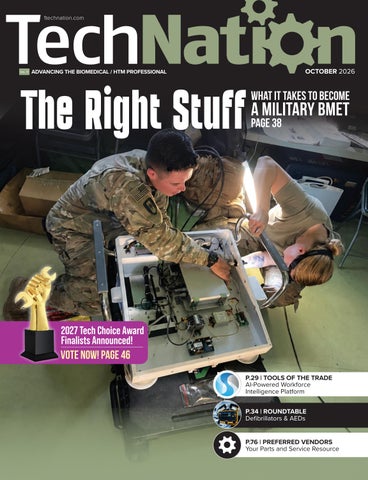
THE RIGHT STUFF: WHAT IT TAKES TO BECOME A MILITARY BMET BY K. RICHARD DOUGLAS
An Army Biomedical Equipment Technician student troubleshoots an anesthesia unit in the Surgical Equipment course laboratory at the Medical Education and Training Campus on Joint Base San Antonio-Fort Sam Houston, Texas. 38 TechNation | October 2026
T
he branches of the military offer a number of jobs and career paths that provide quality training for an occupation that might transfer effectively to civilian life. The U.S. Army and Marine Corps officially use the term Military Occupational Specialty most often referred to as MOS. The U.S. Air Force and Space Force use the term Air Force Specialty Code or AFSC. The U.S. Navy and Coast Guard use ratings and the Navy Enlisted Classification system. Individuals entering the military must assess their strengths and the subjects they did well in during high school or college. They also need to be mindful of their personal interests such as helping people, solving puzzles or using technical skills. Jobs can vary significantly, from intelligence analysis to aircraft maintenance to public affairs. This is true whether the military is a long-term career or a steppingstone to a civilian job. As is the case with many occupations available through the military, a biomedical equipment technician (BMET) assignment includes intense training and a satisfying occupation that can carry over into civilian life. The TechNation/AAMI 2025 State of HTM Survey, earlier this year, found that 25.6 percent reported having received their biomed training in the military. The survey also found that about 2.5 percent reported being active duty or reservists. NOT A SHORT EQUIPMENT-REPAIR COURSE The military’s tri-service biomed training program has evolved over the years. It was initially located at Sheppard Air Force Base in Wichita Falls, Texas. In 2010, it moved to Fort Sam Houston in San Antonio, Texas. It is located on Joint Base San Antonio-Fort Sam Houston, Texas. The program provides soldiers, airmen and sailors with an intense hands-on training program with access to cutting-edge technology. Part of the Medical Education & Training Campus (METC), students attend a state-of-the-art Department of Defense (DoD) healthcare education campus; the biomed program is one of 49 academic courses. The program graduates about 400 BMETs annually. “The BMET Training Course is a tri-service course for Army, Air Force and Navy personnel. Army and Air Force students are here for 44 weeks of full-time training. The current Navy pipeline is 60 weeks, which includes 41 weeks of consolidated training with the Army and Air Force. The Army’s and Air Force’s service-specific training is three weeks, while the Navy’s is 16 weeks,” says Aleksandr K. Manuylidi, CW2, MS, course director of the BMET Training Course at Fort Sam Houston. While the Navy’s course has the longest first phase, Manuylidi says that some courses have a second phase at a military hospital.
COVER STORY He says that the standard academic day is generally 0800-1700 (8a.m.-5p.m.), Monday through Friday. Students complete 12 consolidated modules with classmates from all three services, with the occasional international student and a service-specific 13th module. “The course depends heavily on practical laboratory instruction. Students do not merely study theory; they inspect, troubleshoot, calibrate, service and repair representative medical equipment under instructor supervision,” Manuylidi says. Training includes a wide variety of skills and topics including: • Electrical and electronic fundamentals • Medical-device safety • Inspection, maintenance, troubleshooting, calibration, service and repair • Test equipment and technical documentation • Work-order management and data quality • Physiological monitoring equipment • Dental and sterilization equipment • Surgical and medical-support equipment • Diagnostic imaging systems • Medical-device information technology and networking • Deployable medical equipment • Advanced imaging equipment in the Navy-specific portion “The course is full-time and conducted in a group-lockstep format, combining classroom instruction, demonstrations and extensive hands-on laboratory training,” Manuylidi says. He says that each military service determines eligibility. “For example, all Navy students are prior Corpsmen with years of Navy experience. Students are generally initialentry personnel, prior-service reclassification students, or Reserve and National Guard personnel assigned to the appropriate biomedical equipment specialty. It is not an open-enrollment civilian technical program,” Manuylidi says. He explains that initial-entry students generally live in service-managed barracks or dormitories. Housing arrangements for prior-service students may differ. The program has evolved as the biomed field itself has evolved, adapting to new technologies and responsibilities. “Our roles as BMETs have expanded beyond traditional electronic and mechanical repairs. Modern medical devices increasingly depend on software, network connectivity, digital data and integration with healthcare information systems. The curriculum has therefore placed greater emphasis on medical-device information technology, networking fundamentals, cybersecurity awareness, digital imaging, software-supported troubleshooting, and the management of interconnected systems,” Manuylidi says. He says that at the same time, students must still master the electrical, mechanical, physiological and safety fundamentals required to maintain medical equipment in both fixed and deployable treatment facilities. October 2026 | TechNation 39
COVER STORY Keeping the curriculum up-to-date is no easy task with input from many stakeholders. “Keeping the curriculum current and relevant can be a lengthy process. We have to coordinate with all three services and agree on which tasks need to be taught with which equipment. We have to justify how much funding, space, equipment, and instructors we will need. Then we need to develop the curriculum, create the bugs and implement them into the equipment, and the list goes on. The added difficulty is that 90 percent of our staff are military, which means they have to move every three years; there is constant turnover,” Manuylidi says. INSIGHTS FROM METC STUDENTS Current METC biomed students found their way to the biomed training in a variety of different ways. “From an early age, I was drawn to the biomedical field. I dreamt of becoming a physician, and that passion led me to pursue a Bachelor of Science in Biological Sciences. Along the way I developed a strong interest in technology and learned full-stack programming, discovering how much I enjoyed solving complex, technical problems. After graduating, I pursued a career in web development. However, meeting increased competition due to widespread layoffs within the tech industry, I was unable to secure employment at the time. Seeking opportunities for growth, I decided to join the U.S. Air Force instead,” says Airman First Class Kaegan O’Hara. He says that becoming a BMET was the perfect fit for him. “It combines my passion for healthcare with my interest in technology, allowing me to apply both my scientific background and technical skills in a way that directly supports patient care. Knowing that the equipment I maintain helps medical professionals deliver safe and effective patient care gives me a strong sense of purpose and reinforces that
Air Force Staff Sgt. Tasha Delong, a Biomedical Equipment Technician instructor at the Medical Education and Training Campus on Joint Base San Antonio-Fort Sam Houston, Texas, conducts a review for students in her Diagnostic Imaging I Clinical Applications course. 40 TechNation | October 2026
I chose the right career path,” O’Hara says. Air Force biomed students are joined by their Army counterparts at the METC campus. “When my time as an active-duty infantryman was nearing the end, I had to decide if I wanted to continue that path for another few years or look into other MOS options. I didn’t know what I wanted to do. The infantry lifestyle was fun, rewarding and challenging however it was getting old very fast. I decided I’d see what opportunities the Army National Guard had to offer and the retention NCO said he had gone through a BMET program, and by pure luck, that was how I found out what the 68A MOS was. Within a week I signed the new contract, and I am happy for the chance to find something new and that I can see myself doing as a career,” says Corporal Mark Lang. He says that the first five years in the Army were focused on training for combat. “I was counting the days until I could be a civilian again, and today, I am learning to troubleshoot complex medical equipment and devices that can improve and even save lives. A change I never imagined would happen, but I am grateful for it every day. The training I have received through the BMET course will lead me into a direct career path in the civilian sector that I can be proud of,” Lang says. One of the METC school’s Navy biomed students already had logged plenty of time in the presence of biomeds. “I’ve had the pleasure of serving 12 years so far as a General Duty/8404 Corpsman. I’ve worked in clinics, hospitals, BAS’s and onboard the USNS Comfort Hospital ship. Although I enjoy patient care, the job opportunities are limited when we retire as a General Duty Corpsman. The amount of skills we learn while we’re in doesn’t directly transfer to the civilian sector. You’re required to pursue further education when you get out in order to put those skills to use,” says HM2 Ken Hartzog, Petty Officer 2nd Class.
Kelsey Kane says the main priority was to always keep the mission moving, one repair at a time. In Army Medical Maintenance, every component matters, every repair matters, and ultimately, every life matters.
COVER STORY He wanted to gain a skill set while still on active duty that will directly transfer to another career once he retires. “Working alongside the BMETs on my ship gave me a better insight as to what they do and how the work they do benefits everyone in the medical field. With it being such a small community, and the fact I can get hands-on with all different levels of equipment every day, it made me want to pursue the school even more. It’s been the best decision I’ve made in my career so far,” Hartzog says. He says that his favorite part of the METC biomed program is the instructors. “All of them have their own experiences throughout their careers and can give us insights on how the job actually is outside of what we learn in the schoolhouse. They are very knowledgeable and are willing to go above and beyond to make sure we understand the material. They truly care about making sure the next generation of BMETs will be ready to take their places after they retire,” Hartzog adds. O’Hara says he enjoys working hands-on with a wide variety of medical equipment. “Before becoming a BMET student, I never realized how many different types of medical devices are used in healthcare. Learning how each one functions and how to troubleshoot problems has been one of the most rewarding aspects of the program. One of the most challenging aspects of the program are the preventative maintenance (PM) tests. PMs require us to work efficiently without sacrificing attention to detail. It can be easy to overlook something if you lose focus. This experience has taught me the value of staying disciplined and methodical, even when working under strict time constraints,” he says. Lang likes that the instructors are proficient at getting students to think critically about the problems that they encounter and teaching them how to find solutions instead of just telling them how to fix it.
“They are helpful with letting you ask questions and explaining it in different ways depending on your skill level. The more you put into this program the more you will get out of it. The most challenging aspect of this program is its accelerated pace. There are a lot of exams, progress checks and objectives to pass in short periods of time. You must adjust on the fly but after being here for a while you learn to adapt and trust yourself and the course,” Lang says of the program.
Army Biomedical Equipment Technician students troubleshoot a dental panoramic x-ray system in the Diagnostic Imaging I course laboratory at the Medical Education and Training Campus on Joint Base San AntonioFort Sam Houston, Texas.
An Army student takes a closer look at a dental X-ray system.
TRANSITIONING TO CIVILIAN SUCCESS Military biomed training can provide benefits and a vocation beyond active military service. Representing a large portion of the HTM field, many military-trained biomeds have added long civilian careers including many who have transitioned to leadership positions. “I initially planned to join the military as a medic while pursuing a nursing degree, with the goal of using military education benefits to continue my nursing education after completing my service commitment. However, there were no medic positions available within the timeframe which I wanted to enlist. I was offered opportunities in other medical specialties, and based on my ASVAB scores, I qualified for the biomedical equipment technician program. I accepted the opportunity, and that decision ultimately launched my career in healthcare technology management (HTM), a field for which I developed a strong passion and purpose,” says Angela Bennett, MBA, CHTM, CLSSGB, network director for Trimedx at Our Lady of the Lake Health System. She says that her military BMET training provided significant benefits during her service and throughout her civilian career. “While serving in the military, I supported the operation and maintenance of medical equipment in field hospital environments. Field hospitals present unique challenges
October 2026 | TechNation 41
COVER STORY
Angela Bennett
Ken Hartzog
Kelsey Kane
Mark Lang
that differ considerably from traditional healthcare facilities, requiring adaptability, teamwork and problemsolving under demanding conditions. In these environments, service members and local civilians often rely on fully operational medical equipment to receive critical care. Knowing that my work directly contributed to patient care and mission readiness was both rewarding and fulfilling,” Bennett says. Kelsey Kane, clinical engineering team lead at Duke Raleigh Hospital in Raleigh, North Carolina, joined the United States Army in 2018. She is the first member of her family to serve. “After taking the ASVAB, I had several career fields to choose from, but one stood out – 68A, Biomedical Equipment Technician. To be honest, I had very little idea what the job actually entailed or what my day-today responsibilities would be. My decision was almost entirely based on instinct. I figured that an 11-month technical school had to mean valuable credentials and the opportunity for a rewarding career, and I took the leap,” she says. She began her journey by completing Basic Combat Training at Fort Sill, Oklahoma, before moving to the METC campus to attend Advanced Individual Training (AIT) at the Army’s biomedical equipment technician schoolhouse. “My experience as an Army biomedical equipment technician taught me that success in this profession extends far beyond technical expertise. It demands adaptability, critical thinking, leadership and the ability to transition between vastly different responsibilities at a moment’s notice. Whether repairing lifesaving equipment, preparing for deployment, supporting large-scale medical operations or briefing senior leaders, every day required wearing multiple hats and remaining mission-
focused. That versatility is what makes Army biomeds unique – and it’s one of the reasons I’m proud to have been one,” Kane says. Another current HTM leader recalled signing up with the military initially for a different reason. “Truth be told, I joined the military for the military experience, not because of the job field. I was only 16 when I signed my papers and needed my parents’ permission. My mother was actually the one who pointed out that the job would translate well to a civilian career when I got out. That realization didn’t mean much to me at the time, but the fulfillment I found in the work is what convinced me to stay after my first contract – even though I had originally wanted to be a combat engineer,” says Nathan “Alex” Collins, CHTM, CBET, DSL, site manager for TRIMEDX in the healthcare technology management department at SSM DePaul Health Center in Bridgeton, Missouri. Collins attended the 68A Army biomed program at the METC school. “I also attended the 670A Warrant basic course for the health services maintenance course,” he says. Bennett says that on the civilian side, the skills gained through military training continue to provide tremendous value. “Transitioning from a military environment to a civilian healthcare system involves a significant cultural and operational shift, often moving from smaller field operations to large, complex hospital networks. The ability to think critically, adapt quickly and make informed decisions under pressure has proven invaluable throughout that transition,” she says. Bennett also says that military service provides a strong foundation in leadership, accountability and teamwork. “Ultimately, the military BMET
Aleksandr K. Manuylidi
“I am learning to troubleshoot complex medical equipment and devices that can improve and even save lives. A change I never imagined would happen, but I am grateful for it every day.” Kaegan O’Hara 42 TechNation | October 2026
- Corporal Mark Lang
COVER STORY program provides the building blocks for a successful career by developing both technical expertise and leadership capabilities that can be expanded upon throughout one’s professional journey,” she adds. Collins says that there is a certain fearlessness in militarytrained techs and that mentality often carries over when military techs leave active duty. “They’re used to working through problems with the resources available to them – whether that’s manuals, technical documentation or the knowledge of those around them. As a manager, I’ve seen people approach unfamiliar equipment in different ways, but military-trained techs will often be comfortable opening the manual, giving it a shot, and then having a supervisor, senior technician or manager verify that everything was done correctly. Once they’ve validated the work, they’re ready to move on to the next challenge. I think that confidence, resourcefulness and willingness to keep learning are some of the biggest strengths military-trained technicians bring to the field,” he says. Kane says that since transitioning from the military to the civilian side of clinical engineering, she has found that her military biomedical training has been one of the strongest foundations she could have received.
“The Army provided me with extensive hands-on experience across a wide range of medical equipment, while also emphasizing troubleshooting under pressure, mission readiness, accountability, and adaptability. Beyond the technical skills, it also developed my leadership abilities, communication and critical thinking – skills that have been invaluable in the hospital environment,” she says. Kane says that one of the biggest benefits of military training is the emphasis on standardized processes, documentation and preventive maintenance, all of which translate extremely well to civilian healthcare. It should come as no surprise that military-trained biomeds have excelled to such a great degree. As Manuylidi points out, the scope and intensity of the METC BMET training are designed to produce top-tier biomeds. “This is not a short equipment-repair course. The Army and Air Force programs involve roughly 1,750 instructional hours, while the Navy pipeline reaches approximately 2,400 hours. Students move from electrical fundamentals to sophisticated medical systems within a highly structured, full-time program,” he says. Patients and clinicians have more than one reason to say “thank you for your service” to an active-duty or military-trained civilian biomed. Nothing less than top-tier training is expected and provided.
Biomedical Equipment Technician course instructor, Petty Officer 1st Class Francine Pique, demonstrates the functions of a mammography machine for students in the Mammography Imaging Systems course at the Medical Education and Training Campus on Joint Base San Antonio-Fort Sam Houston.
October 2026 | TechNation 43
TECHNATI • A niche job board for the HTM and imaging communities powered by TechNation.
• 4000+ actively looking biomedical and imaging professionals.
» Completely free and confidential registration and application process.
Breaking News:
THE FUTURE OF HTM JOBS IS HERE.
TECHNATI htmjobs@mdpublishing.com for posting inquiries htmjobs.com to register today
ION TIMES • The fastest growing HTM talent network in the country.
• 350+ open opportunities throughout the United States.
» A variety of posting options ranging from single-job postings to 12-month unlimited memberships.
“My HR department advertised on various government sites and our web site but we did not get a single applicant in over 120 days. Fairbanks Alaska is hard to recruit for but I took out an ad on HTM Jobs and got two good applicants in less than 30 days. I am hiring them both. Thanks HTM Jobs.” - D. Anderson, Tanana Chiefs Conference
ION TIMES Featured Employers: Agiliti, Block Imaging, Intelas Health, Renovo Solutions, Trimedx and more!
TECH CHOICE AWARDS
The Wrenchies
FINALISTS SCAN TO VOTE ONLINE VOTING OPEN THROUGH JANUARY 4, 2027
Th e 2027 W re nchi e s 46 TechNation | October 2026
TECH CHOICE AWARDS
ICON of the Year
SPONSORED BY:
DALE COVER
DAVE FRANCOEUR
President (Retired)
Radiological Service Training Institute (RSTI)
Rose from imaging educator to President/COO during nearly three decades at RSTI, training generations of HTM professionals and continuing to share his expertise after retirement.
SANDY D. MORFORD CCE, Founder
RENOVO SOLUTIONS Spanning 45+ years in HTM, helped found two organizations and built RENOVO into a national provider, creating 700+ employment opportunities and lasting careers.
MM, CBET, CHTM
MATT BARETICH P.E., Ph.D., Owner
Baretich Engineering and Director - Lower Mainland Biomedical Engineering Nearly 50 years advancing HTM through forensic engineering, clinical engineering program improvement, problem-solving, mentorship, publications and education, while sharing expertise with future generations.
LARGE DEPARTMENT of the Year St. Elizabeth Healthcare Clinical Engineering Department
Insourced 85% of systemwide repairs and preventive maintenance, generating $2M+ in 2025 savings with another $500,000 projected while reducing downtime and vendor dependence.
Healthcare Technology Management, UT Southwestern Medical Center
Transformed HTM into an enterprise-level operation, automating workflows across tens of thousands of assets while pioneering predictive imaging analytics, cybersecurity monitoring and complex repair insourcing.
Driven by collaboration and patient care, this finalist challenges convention, advances meaningful regulatory change, strengthens HTM, and creates opportunities for future industry professionals and leaders.
WANDA LEGATE
SVP of Customer Success and Contracts
Tri-Imaging Solutions
Founded AllParts Medical and JET Imaging, shaping HTM through three decades of entrepreneurship, mentorship and relationship-building while creating careers and opportunities for the next generation. SPONSORED BY:
Clinical Engineering Department, Cedars-Sinai Medical Center
Trimedx Clinical Engineering Services at University of Chicago Medicine and Ingalls Memorial Hospital TRIMEDX’s clinical engineering team manages 50,000 devices, maintains over 99% uptime, and uses practical innovation and strong partnerships to support safe, reliable patient care daily.
Supports 34,000+ medical assets, completed 50,000+ maintenance activities, participated in 150+ safety investigations and managed approximately 50 recalls while advancing systemwide technology integration.
Clinical Engineering Department, University of Miami Health System
Clinical Engineering scaled to support 40,000 devices across 123 sites, achieving ISO 13485 certification, strengthening cybersecurity, developing talent, enhancing patient safety, and building operational resilience.
SMALL/MIDSIZE DEPARTMENT of the Year Orlando VA Healthcare System HTM Department
Durham VA Healthcare System HTM Service 21-person HTM team supports a 300-bed facility and 11 off-site clinics, cross-trains specialists, and delivers major cancer, hybrid OR and clinic expansion projects.
Clinical Engineering Team AdventHealth Altamonte
Clinical Engineering Dept. Children’s Wisconsin
Maintained patient-care support through major workforce changes, advanced three newer technicians into specialist roles, earned two CBET certifications, and successfully supported two Joint Commission surveys.
Orlando VA Medical Center Manages $200M+ in medical equipment across 12 locations, advancing modernization, preventive maintenance and rapid-response support to improve uptime, patient safety and Veteran care.
Clarksburg Biomedical Engineering VA Clarksburg Healthcare System
SPONSORED BY: October 2026 | TechNation 47
TECH CHOICE AWARDS
PROFESSIONAL of the Year SAMANTHA JACQUES
D’JUAN JAMES
Ph.D., FACHE, AAMIF, VP
McLaren Health Care
Leads cybersecurity across a 13-hospital system, reducing medical device risk 30%+, while driving national initiatives addressing legacy devices, AI, supply chains and systemic risk.
EDGAR ORTEGA Director of HTM
Sodexo Elevates HTM as a strategic healthcare partner, develops in-house technical expertise, strengthens clinical collaboration, and extends his impact through humanitarian medical equipment support internationally.
DESIREE NIELSEN President of Arizona HTM Association, Technology Analyst II Mayo Clinic As AZHTM President, she nearly doubled membership, expanded statewide engagement, modernized association operations and strengthened Arizona’s HTM community through collaboration, innovation and leadership.
MILITARY BMET of the Year Lead BMET - Catholic Health Initiatives
JOSHUA THOMAS
Clinical Engineer Advent Health Orlando
Corporate Director of Biomedical Engineering Corewell Health
Leads HTM across 23 hospitals, generating $10M+ in savings and cost avoidance while advancing operational standardization, technology governance, workforce development and HTM visibility.
JOSH VIRNOCHE
AAMIF, CHTM, CBET, Director of HTM
Southwestern Medical Center Army-trained HTM leader who transformed operations, raised clinical satisfaction from 12% to 95%, advanced cybersecurity and predictive analytics, and championed patient-centered service nationwide.
SPONSORED BY:
KEVIN FLORES
JAMIE MCCOLLUM BMET - US Air Force Reserve
SPONSORED BY:
DAVID MOEN
Shop Foreman - FT. Belvoir Community Hospital U.S. Navy and BMET Kaiser Permanente
BMET Instructor, - Defense Health Agency and Hospital Corpsman U.S. Navy
NATHAN RHOADES First Sergeant
U.S. Army
INDUSTRY IMPACT AWARD RHIANNON M. THURMOND VP, OHM’s Law Foundation
Field Service Engineer, Samsung HME
Fundraising helped deliver more than $30,500 in HTM scholarships, benefiting 30-plus students, while outreach, mentorship, certification support, partnerships, and career awareness strengthened workforce pathways nationwide.
JUSTIN BARBOUR
Medical Test Equipment Sales BC Group Better Biomed YouTube Channel & BMETWork.com
SYDNEY HUMES CARLSON
Business Development Executive, PartsSource Director of Business Development, Ohms Law Foundation Worked alongside 100+ HTM teams, founded HTM Career Connect, supported multiple industry associations, and advances the profession through advocacy, networking, education and scholarships.
SPONSORED BY: 48 TechNation | October 2026
JOSE ANTONIO ZAMBRANO JR. CMIA, Member at Large CBET, Adjunct Instructor Dedicated 14+ years to CMIA, educated 100+ students, developed educational resources and scholarships, and mentors emerging professionals to strengthen HTM’s future workforce and leadership.
BEN DUFFIELD MAGEE
Technical Operations Manager
Innovative Radiology
Advances imaging service through expert radiology parts repair and technical support, while educating engineers and sharing expertise that strengthens HTM professionals and supports patient care.
TECH CHOICE AWARDS
DIRECTOR/MANAGER of the Year
SPONSORED BY:
MICHAEL GREENWOOD
JORDAN BOLAND
CHTM, East Regional Manager, Clinical Engineering
CCE, CHTM, VISN 10 HTM Chief
Department of Veterans Affairs - VHA Led HTM teams through FEHR transitions at 10 VA medical centers in five months, pioneering scalable strategies while championing staff development, operations and workforce support.
ANN ROVITO
Director, Clinical Engineering Children’s Wisconsin Led through a 25% staffing deficit and loss of 137 years’ experience, built new HTM talent pipelines, and earned 2023 Notable Leader in Healthcare recognition.
ANJU CHAUDHARI Chief Biomedical Engineer VA Puget Sound Health Care System Raised departmental KPI from approximately 50% to 90%, directly led 18 employees, strengthened PM compliance, and managed major technology upgrades across VA Puget Sound.
Penn State Health
Leads 10 clinical engineering technicians across two hospitals and multiple locations, improving equipment uptime, service responsiveness and operational efficiency while developing future HTM leaders.
DAVE PETTERS
Executive Director, Clinical Engineering AdventHealth
SPONSORED BY:
Women in Leadership Award SONALI KAMALASANAN
TOMISHA JOHNSON
CHTM, HTM Biomed Manager UT Southwestern Medical Center
CHTM, CBET, Director HTM
Children’s Healthcare of Atlanta Leads 74+ HTM professionals across three hospitals and 50+ locations, implemented ISO standards, commissioned a major pediatric hospital, and advances sustainable healthcare technology globally.
JESSYKA WRIGHT
CBET, Resident Regional Manager
Intelas Health
Led and mentored 60+ professionals across 17 critical-care hospitals and 80,000+ devices, delivering 18% revenue growth, 30% PBIT and $2M+ OEM contract internalization.
AMY ANNE FISCHER Clinical Engineering Training Program Manager AdventHealth Built division-wide clinical engineering programs for workforce development, training, internships, KPI reporting and operational accountability, strengthening future talent, leadership and sustainable HTM growth.
Pioneered clinical engineering at UT Southwestern as its first clinical engineer, building systemwide standards, performance measures and a sustainable leadership framework designed to endure beyond her tenure.
MEGAN FRIEL
Director, VHA Office of Healthcare Technology Management U.S. Department of Veterans Affairs Leads 2,100+ VHA HTM professionals supporting 900,000+ devices, generating $740M+ savings, while overseeing 15 national workgroups and launching mentorship with 70+ pairings.
EDUCATOR/TRAINER of the Year STEVE MAULL
JOIE MARHEFKA
Biomedical Engineering Technology Faculty
Owner
Maull Biomedical Training Trained 2,600+ BMETs across 13 contrast injector models, pioneered HTM injector training and third-party service software, and is advancing remote education through virtual reality.
ISAIAH LEDESMA
Practicum Coordinator/Instructor Biomedical Engineering Technology, St. Philip’s College
15 years of HTM experience, expanded enrollment from 24 to 36 students, maintained CBET certification eight years, and earned TechNation’s 2023 40 Under 40 honor.
JIM RICKNER Director of Service and Training Advanced Ultrasound Systems Trained thousands of HTM professionals over 15 years, taught hundreds of ultrasound service classes, created AAMI-approved curricula, and volunteered hundreds of hours supporting HTM education.
Penn State New Kensington Educated 80+ HTM graduates over 10 years, expanded internships and STEM outreach, and modernized curriculum with AI, virtual reality and augmented reality technologies.
DONALD CORMIER
Instructor Northeastern Wisconsin Technical College
SPONSORED BY: October 2026 | TechNation 49
TECH CHOICE AWARDS
HUMANITARIAN of the Year STEVE VANDERZEE
JOHNNY DUONG
Biomedical Technician Medical Bridges
Ambassador Board Member
Chicago, PROJECT C.U.R.E. 40-year HTM veteran and Project C.U.R.E. Ambassador who supports global equipment donations, served in Ghana, and helped prepare 120+ devices for the 2026 Repair-a-Thon.
BRIAN A. GORE
Engineering Specialist Duke University Health System Completed eight medical missions supporting lifesaving surgeries in Uganda and Honduras, trains local HTM staff, and redirects surplus medical supplies to communities worldwide.
SCOTT SKINNER Board Secretary, SOS International; Founder & Principal, HTMPOWER; Assistant Professor, University of Louisville Leads SOS International efforts redirecting hundreds of thousands of pounds of medical supplies annually, while serving youth, science, healthcare leadership, blood donation and wildlife causes.
ASSOCIATION of the Year
HEARTLAND BIOMEDICAL ASSOC.
Strengthens HTM through quarterly education, annual events, clinical partnerships, career fairs, scholarships and hands-on skills training focused on developing the profession’s next generation.
Uses his biomedical expertise to support Medical Bridges’ global humanitarian mission, helping ensure medical equipment is safe, reliable and ready to support underserved communities worldwide.
DAVID BUCKLIN Technical Support Supervisor & Field Engineer Samaritan’s Purse
SPONSORED BY:
INDIANA BIOMEDICAL SOCIETY
HTMA-OH
Welcomed 300+ attendees from five+ states, launched cross-state collaboration, provides free CBET preparation for 10 technicians, and delivers continuing education through AAMI partnerships.
SPONSORED BY:
WASHINGTON STATE BIOMEDICAL ASSOC. Connects Washington’s HTM community through education, workshops, conferences and industry partnerships, advancing professional development, collaboration, emerging technology knowledge and recognition of HTM’s value.
Awarded $20,000+ in scholarships since the 1990s, builds HTM’s student pipeline through national partnerships, and connects 200+ attendees and up to 80 exhibitors annually.
COLORADO ASSOC. OF BIOMEDICAL EQUIPMENT TECHNICIANS
CABMET provides professional development, an annual symposium, bi-monthly educational dinner meetings and STEM scholarships for students.
VENDOR of the Year Specializing exclusively in ultrasound for 30+ years, MW Imaging delivers ISO-certified quality, a below-2% parts and repair failure rate, and 24/7 technical support.
Manages 25,000+ medical assets, restored 1,200+ ventilators in three weeks, and sustained Level 1 trauma operations for six months without a single day of downtime. 50 TechNation | October 2026
Developed GE HealthCare’s In-House HTM strategy, empowering healthcare organizations through service models, self-performance capabilities, analytics and partnerships that improve equipment uptime and workforce productivity. SPONSORED BY:
Pioneered multiple first-of-their-kind portable HTM testing technologies, while Pronk Mobilize reduces testing and documentation time 25-50%, giving technicians more time for hands-on service.
Delivers 400% average ROI while supporting 650M+ square feet, tracking 5M+ assets across 1,300+ hospital segments, with tools improving HTM efficiency and compliance.
TECH CHOICE AWARDS
YP of the Year HEATHER FIELDS
CHRISTOPHER MENDOZA
Deputy Chief of HTM Bay Pines Veteran Affairs Healthcare System Deployed three Da Vinci robots, managed $9M+ in equipment purchases, led HTM through two hurricanes, and earned national and VA clinical engineering honors.
ELI ENCINAS HTM Biomed
Texas Health Resources Demonstrates emerging HTM leadership by mentoring and training a new biomed, transferring technical knowledge, professional standards and hands-on experience to strengthen the profession’s future.
MultiMedical Systems
ANGELA BENNETT MBA, CHTM, CLSSGB, Network Director Our Lady of the Lake Health System, Trimedx Rising from Army BMET to network director, she delivers measurable results while investing in mentorship, workforce development, industry education, and HTM’s next generation. SPONSORED BY:
Expanded HTM training to 200+ employees, drove 15% toward advanced credentials, built tools saving hundreds of thousands, and strengthened ISO 13485 quality systems.
SARAH AVINGTON
Biomedical Engineering
Technician II St. Joseph’s Hospital
Leads HTM outreach within her hospital while serving as BAAMI Secretary and FBS representative, connecting students, vendors and professionals to strengthen the biomed community.
Scan here to read the full bio of each nominee and to vote!
SCAN TO VOTE
VOTE NOW THROUGH JANUARY 4, 2027!
Th e 2027 W re nch ie s October 2026 | TechNation 51
EXPERT ADVICE
CYBERSECURITY From Far, Far Away: Remote Connectivity Protections at the VA
I
BY KARAN BHULA magine you are finally home after an exhausting day of work. As you get ready to sleep, you suddenly remember that you forgot to submit a deliverable due tonight for your project team, impacting thousands of patients. You rush to get your laptop and PIV card, log in, and with a click of a few buttons, your worries disappear.
Whether you’re at home or thousands of miles away from work, remote connectivity is an integral technological tool that bridges the vast distances across time zones. Consequently, using sensitive patient information within such an important and powerful tool makes it a target for unauthorized access attempts, especially in an ever-changing cybersecurity environment. From threat actors, ransomware, phishing and extortion to malware, high-risk organizations such as hospitals and healthcare institutions must ensure their safeguards comply. As a result, strong encryption is necessary to protect patient data as the complexity of threats continues to propagate and evolve!
52 TechNation | October 2026
HOW CAN A VA EMPLOYEE CONNECT REMOTELY? In the VA world of remote connectivity, there are three main remote-access tools for staff and contractors to securely connect to the VA network using their Government-Furnished Equipment (GFE) or Non-GFE: Azure Virtual Desktop (AVD), Citrix Access Gateway (CAG), and Cisco AnyConnect VPN (RESCUE). Although all these tools require PIV/CAC multi-factor authentication, AVD and CAG can only be used for non-GFE whereas RESCUE is intended for GFE. These tools can be used in conjunction with VA collaboration tools such as Microsoft Teams and Webex, although a recent mandate has removed contractors’ ability to take remote control of a Teams session on a medical device/system unless they have a PIVauthenticated Teams account. RECENT REMOTE ACCESS INCIDENTS To best understand the importance of encrypting sensitive patient information, we must acknowledge recent large-scale mistakes involving compromised patient data. On June 8, 2026, iRhythm verified that a threat actor had unauthorized access to specific third-party applications, causing their
incident response plan to go immediately into effect. Although the specifics of the data are undisclosed and there were no detrimental implications for the medical devices, sensitive PHI was compromised from said applications. Another data breach was on March 11, 2026, where Stryker was significantly hit and about 200,000 devices were remotely wiped. Over 50 terabytes of PHI was lost in the matter of seconds, forcing healthcare systems to immediately stop using the Stryker devices and carry out an immediate incident response. Lastly, another data breach was on September 22, 2025, with Medical Computer Business Services (MCBS). Although the method of unauthorized access is unknown, over one million patients’ PHI was compromised. Despite the company only being a medical financial institution, this is a prime example of ensuring encryption safeguards are in place and always enforced. HOW DO WE STAY PROTECTED? To ensure protection when using AVD, CAG and RESCUE, various mandatory standards and requirements are intended to be followed. VA Directive 6512 states that only sensitive information can be transmitted wirelessly by following FIPS 140-2 or FIPS 140-3 standards. As a result, remote connectivity platforms must be used for VA business only with guest Wi-Fi only used for leisure. Additionally, VA Directive 6513 discusses criteria in how external connections are secured to and from the VA networking infrastructures, in which remote connectivity must abide by. Cybersecurity & Infrastructure Security Agency (CISA) Trusted Internet Connection (TIC) 3.0 initiative acts as a best-practice guidance book for security controls and risk mitigation, allowing proper traffic and VA router management of remote connectivity. Lastly, a huge requirement is the Zero Trust Cybersecurity Principle, which is supported by the need-to-know principle; users knowing the least amount of information required to do their duties. In fact, within this strategy, no user, network or system is trusted to ensure risk mitigation and security are at its fullest extent. Within the VA, the Vendor Remote Access, Veterans Integrated Service Network Medical Device Protection Plan (VISN MDPP) POCs, VA Central Office-Cybersecurity, and the Specialized Device Security Division (SDSD) teams all work together toward the same mission: safety and privacy of the patients. Effectively, all these standards, safeguards and strategies create a complex web of protection against moving threats to allow remote access and mitigation steps for staff and VA contractors. It is our responsibility to be aware, diligent and proactive in mitigating risks associated with remote connectivity, protecting the privacy of those we serve. Karan Bhula is a TCF Biomedical Engineer in Healthcare Technology Management with the U.S. Department of Veterans Affairs, VA Ann Arbor Healthcare System. October 2026 | TechNation 53
EXPERT ADVICE
What I Learned from My First HTM Conference
W BY JAMES LINTON
alking into my first HTM conference, I felt both excited and overwhelmed – after all, it was an MD Expo in Vegas! The registration desk was buzzing, the vendor hall was alive with flashing displays, and the schedule was packed with acronyms and session titles that promised to cover everything from cybersecurity to infusion pump safety. For someone new to the professional conference scene, it was a lot to take in. But by the end of those few days, I walked away with lessons that shaped how I approach my career, my students and my community. I suggest thinking of your first conference not as a checklist of sessions to attend, but as an immersion experience. It’s a chance to see the field in its full scope, to connect with people who live and breathe HTM, and to bring home ideas that can actually change your daily work. Here’s what stood out to me.
54 TechNation | October 2026
NETWORKING IS EASIER THAN IT LOOKS Before attending, I worried about networking. I pictured awkward conversations and forced small talk. What I found was the opposite. Most people at HTM conferences are eager to share what they do, what challenges they’re facing and what they’ve learned. I suggest starting with simple, honest questions: • “What do you work on?” • “Which session are you most excited about?” • “What’s one thing you’ve learned so far?” These openers lead naturally into conversations. I met a BMET from a rural hospital who explained how they manage with limited resources, and a manager from a large academic center who shared how they structure their PM program. Both perspectives gave me insights I wouldn’t have found in a manual. VENDORS ARE TEACHERS TOO At first glance, vendor booths look like sales pitches. But I quickly realized they’re also classrooms. I suggest approaching vendors with curiosity, not skepticism. Ask them to walk you through how their device handles
HTM is bigger than any one shop or hospital. It’s a community. And the more you engage,
the more you grow. common failure modes. Ask what error codes they see most often in the field. Ask what mistakes technicians make when servicing their equipment. One vendor showed me a hidden service menu on a monitor that I’d never seen before. Another explained why a certain calibration step often fails if the device hasn’t been warmed up properly. These weren’t sales tactics – they were practical insights I could take back to my shop and my students. SESSIONS ARE ONLY HALF THE VALUE The formal sessions are valuable, but I suggest leaving space in your schedule for informal conversations. Some of my best learning happened in hallways, at coffee stations or in the line before a keynote. Those unscripted chats revealed what was really on people’s minds: staffing shortages, cybersecurity headaches and creative workarounds for stubborn devices. I also suggest not overloading your schedule. Pick a few sessions that align with your current challenges or future goals and give yourself permission to skip others in favor of networking. The conference isn’t about collecting slides – it’s about building perspective. TAKE NOTES YOU’LL ACTUALLY USE Conferences flood you with information. I suggest splitting your notes into three categories: 1. Do now: actionable items you can implement within two weeks. For me, this included updating a PM checklist with a vendor-recommended inspection step. 2. Explore: ideas worth researching further. One example was piloting condition-based PM for high-use devices. 3. People: contacts you want to follow up with. I suggest writing down not just names, but what you talked about. A quick follow-up email after the conference cements the connection. This system keeps you from coming home with a notebook full of ideas that never get used. MAKE ONE CHANGE AT HOME, NOT 10 It’s tempting to return from a conference with a dozen new
ideas and try to implement them all. I suggest choosing one high-impact change, communicating it clearly and measuring its effect. For example, after my first conference, I introduced a new way of documenting calibration results that made audits smoother. It was a small change, but it built credibility and momentum. CONFERENCES CALIBRATE YOUR CAREER PATH If you’re considering a specialization – imaging, anesthesia, networked monitoring – I suggest attending sessions and vendor demos tied to that path. Ask working specialists what skills they wish they had earlier and what certifications actually helped. Their answers can save you years of wandering. For me, the conference confirmed that teaching and mentorship were central to my career. Seeing panels where educators and leaders shared their approaches gave me a roadmap for how I could contribute beyond the bench. CONFIDENCE GROWS WITH PARTICIPATION That first conference taught me that HTM is bigger than any one shop or hospital. It’s a community. And the more you engage, the more you grow. I suggest encouraging students and new techs to attend early in their careers. Even if they don’t understand every acronym, the exposure accelerates their growth and builds confidence. FINAL THOUGHT My first HTM conference wasn’t just an event – it was a turning point. It showed me that the field is alive with ideas, challenges and people who care deeply about patient safety and professional growth. If you’re preparing for your first conference, I suggest approaching it with curiosity, openness and a willingness to follow up afterward. You’ll come home not just with notes, but with connections and confidence that will carry you forward. James Linton, MIM, PMP, CMBB, AAMIF, is a biomedical engineering technology professor/coordinator with St. Clair College. October 2026 | TechNation 55
REACH FOR THE WRENCH PARTNER
MedWrench
nt? No accou ! em No probl xploring ds & start e Sign up in secon
BUZZ OVER and see us! MD Expo Orlando BOOTH #102
Unlock your full potential with online forums, service manuals and product pages.
56 TechNation | October 2026
Deliver a Clear View with
EndoPro-Cam
®
Inspect and document rigid scope image quality for maintenance and quality assurance activities hmark.com 800.521.6224
Identify Image Quality Issues Document with Confidence Standardize Workflow
Explore EndoPro-Cam
Disclaimer: Intended for inspection and documentation of rigid endoscope image output during maintenance and quality assurance activities. Not intended for patient examination, diagnosis, treatment, or intraoperative use.
Scan to explore how the EndoPro-Cam can support your rigid scope inspection process.
EXPERT ADVICE
RIGHT TO REPAIR Same Stuff - Different Covers
A
BY GAY GORDON-BYRNE
recent outstanding article by ACCE explored Right to Repair for medical devices. Bottom line, timely repair is essential to patient care. This necessitates that equipment necessary for diagnosis and care be ready for use at a moment’s notice. Despite the obvious need for pro-active and continuous repair programs, opponents continue to peddle the notion that keeping equipment in a constant state of readiness is so difficult and challenging that only the original equipment manufacturer (OEM) technician is capable of providing repair services. Readers know this to be a giant exaggeration. Not repairing things until the OEM finds it is convenient to show up is just an excuse for being unprepared. 58 TechNation | October 2026
We know this to be an exaggeration because OEMs need to be able to make fast and complete in-warranty repairs of their own equipment using their own technicians. Warranty repair costs are documented and visible to investors. Because this information is visible in financial statements – OEMs avoid lying. Projections of repair needs are reconciled against actual expenses and reported in financial statements. It’s the corrections that keep OEMs honest. It is increasingly easy to collect and review financial reporting with the assistance of AI. The other argument made routinely by both AdvaMed, and now HIMSS, is that repair technicians will modify equipment and fail to report it. There is no financial upside to surreptitiously modding equipment in a medical setting. No one gets a payday bonus for failing to fix equipment according to OEM standards. Biomeds and independents alike would lose their jobs. The FDA studied this allegation in 2018 and did not find evidence that this is the case – but
OEMs continue to make the same statements without any evidence. The audience for this nonsense is state legislators – not healthcare professionals. The 2018 report affirmed the high quality of in-house and independent repair while pointing out that the evidence for poor quality repairs points towards sloppy remanufacturing and not repair. State legislatures have the ability to require access to repair materials under general business law without any reference to “remanufacturing.” Common statutes for complaints about incomplete or poorly completed work still apply. Remanufacturing is a different business from repair. Biomeds don’t remanufacture – they repair so that equipment works up to OEM specifications. Companies that rebuild/remanufacture products might repair some items, but compliance with regulations still falls to the buyer in the same manner as buying and deploying a used car with a rebuilt engine. Ten states now have active laws which are having the expected impact of improved access to competition for repair services. Several state legislators are now encouraged by the success of wheelchair right to repair laws to take on more medical items in addition to computers, cellphones, cars and appliances. Regulations taking effect in the EU add repairability requirements. U.S. versions of repair studies done in the EU are now underway. Laws in Canada, the U.K. and elsewhere are in the process of adding international requirements. The fight for Right to Repair will continue to expand as people discover that repairing things is part of the rights we all have as owners and not renters. The third major development is the progress of Military Right to Repair under the National Defense Authorization Act (“NDAA”). Our military is demanding that Congress provide the opportunity of self-repair to the Armed Forces. The House has already approved the measure, and it appears likely that the Senate will do the same in coming weeks. Even if the Right to Repair provisions of the NDAA for 2027 are stripped by the Senate – the genie is out of the bottle. Excuses for monopolizing repair are increasingly seen as flimsy. Car owners are resisting the idea that fixing cars harms the intellectual property of manufacturers. By the same logic – fixing imaging equipment doesn’t pilfer intellectual property displayed on a dashboard. Fights over the REPAIR Act for cars have served to clarify that restrictions on repair are not the result of OEMs being the good guys and helping customers but rather the bad guys
that are seeking to extract more money just to use the vehicle. Big auto executives tried to explain to Congress that people shouldn’t fix their stuff and laid a political egg. While the automotive REPAIR Act might not pass in Congress it is clear that people expect to be able to fix their stuff. “Stuff” is just parts. Digital parts just do math. Repairing or replacing a failed part does nothing to alter the applications, data or security of the software. It is legal to read repair manuals, just not legal to make copies. This is why one of the legislative requirements is for OEMs to provide repair documentation along with technical updates. Technical updates are corrections to software flaws, not enhancements. Patents are not proliferated by buying new or used parts. This is why Right to Repair legislation does not allow limitation of use of parts that are already owned. OEMs got paid in full in the first sale – they don’t get another fee when someone buys a used part. This is called the “First Sale Doctrine” in current law. Patents protect the manufacturing of parts – not use. OEMs do not lose any rights. Many people assume some trade secrets are provided in repair materials, particularly diagrams. Trade secret law is very clear – the OEM has to protect their secrets in order to claim them as secrets. Printing manuals and diagrams for distribution to OEM technicians eliminates the secrecy claim. Most actual trade secrets are for business plans, not repair. If you can create a diagram using your own eyes – it’s not a secret. We fight against these notions in every setting. This is the identical argument made by John Deere in opposition to allowing farmers to fix their tractors and businesses to fix their trucks, mixers, computers and cash registers. Repair materials have to be readily available at all times so that a necessary procedure isn’t delayed. Just as farmers cannot schedule rain delays – hospitals cannot schedule car wrecks and infections to align with OEM technician visits. There is no such thing as “preventative maintenance” other than in the sense that periodically dusting fans and doing regular oil changes helps extend the useful life of products. Breakdowns are fundamentally random and repair services must be prepared for random needs. Gay Gordon-Byrne is executive director of The Repair Association, a role she’s held since it was founded in 2013. October 2026 | TechNation 59
OZARK BIOMEDICAL
YOUR SINGLE SOURCE FOR PARTS AND DEPOT REPAIR
StatSpin Express 2, 3, 4
We have a complete line of parts as well as service available.
THE SHOW FOR BIOMEDICAL/HTM PROFESSIONALS
ORLANDO
O C T O B E R 1 3-15 , 2 0 2 6 MD Expo Orlando has been approved for up to 8 CEUs by the ACI. WELCOME RECEPTION Help kick off MD Expo at the Welcome Reception — networking excellence uniting exhibitors and attendees!
EXHIBIT HALL
LUNCH & LEARN
FINALE PARTY
Over five hours of exhibit hall time to meet with over 100 world-class vendors!
Join us for a complimentary lunch while you have a chance to dive into the latest HTM insights!
Join fellow HTM professionals for great food, drinks, music and networking as we celebrate a successful conference. Neon attire encouraged!
*For hospital attendees only
REGISTER NOW
AT MDEXPO.COM
EXPERT ADVICE
The Surveyors Are Here. Now What? BY ISRAEL GARCIA AND NICOLE PALMER 62 TechNation | October 2026
T
SPONSORED CONTENT here are few phrases in healthcare that can raise your heart rate faster than: “The surveyors are on-site.”
Suddenly the hospital feels different. People start walking a little faster. Someone’s looking for a work order from three years ago. Coffee gets left on desks. And somewhere in the biomed department, somebody quietly mutters: “Well ... here we go.” The funny thing is, by the time surveyors walk through the front door, there’s very little you can do to prepare. The work that matters happened weeks, months, even years, before they arrived. That’s why the best survey strategy isn’t a last-minute scramble. It’s building confidence all year long. SURVEYS DON’T FAIL HOSPITALS ... PROCESSES DO Surveyors aren’t looking for perfection. They’re looking for consistency. Can you explain your process? Can you show them the documentation? Does your inventory match what’s actually sitting on the floor? Can your team confidently answer questions without having to “go check on that?” Those are the moments that separate a smooth survey from a stressful one. Because here’s the reality ... if your team is frantically pulling reports while a surveyor waits, you’re already playing defense. DON’T WAIT UNTIL SURVEY WEEK TO FIND THE HOLES One of the best investments a hospital can make is pretending the survey has already started. Conduct a mock survey. Randomly pull assets. Trace equipment from the floor back to your CMMS. Review PM documentation. Walk departments. Ask uncomfortable questions before someone else does. It isn’t about finding fault. It’s about finding opportunities while you still have time to fix them. At Multimedical Systems (MMS), we’ve found that these small “stress tests” often uncover issues that no one realized existed, not because anyone was doing a poor job, but because busy departments naturally develop blind spots over time. Fresh eyes make a difference. WHEN THE SURVEY STARTS ... YOU’RE NOT ALONE Here’s something we don’t think gets talked about enough. Survey day can feel lonely. Your biomed manager is answering questions. Technicians
TAKE FIVE
are trying to keep up with service calls. Clinical engineering leadership is balancing patient care with survey requests. The last thing they need is to feel like they’re carrying it all themselves. That’s why we believe support shouldn’t stop once the preparation is over. When our customers are going through a survey, we’re right there with them. SOMETIMES THAT MEANS BEING ON-SITE Sometimes it means picking up the phone the minute a question comes up. Sometimes it’s helping pull documentation, explain maintenance histories, validate inventory or simply talking through the best response before anyone feels pressured. Whatever the situation, our goal at MMS is simple: Make sure our customers never feel like they’re facing a survey alone. Because while the surveyors may only be there for a few days ... the relationship we’ve built with our customers has been growing for years. THE BEST SURVEY IS THE ONE THAT FEELS ... BORING That might sound strange. But “boring” is exactly what you’re hoping for. No surprises. No panic. No last-minute searches. Just confident answers, organized documentation, accurate inventories and a team that knows exactly where everything stands. THAT’S NOT LUCK ... THAT’S PREPARATION And preparation is always easier when you have a partner who’s willing to stand beside you – not just before the survey, but during it as well. At MMS, we help healthcare organizations stay survey-ready year-round with the people, processes and expertise needed to strengthen clinical engineering operations. MMS works alongside your team to identify gaps, improve readiness and provide confidence when surveyors arrive. Preparation matters. But having someone in your corner when it counts matters, too.
ISRAEL GARCIA
NICOLE PALMER
MULTIMEDICALSYSTEMS.COM
If surveyors walked into your facility tomorrow: Would your team know exactly what to do? Could you produce the documentation they request without scrambling? Is there someone regularly conducting mock surveys and random audits before the real one happens? If a difficult question came up while the surveyor was standing there, who would your Biomed manager call? Most importantly—would they have to face it alone?
October 2026 | TechNation 63
EXPERT ADVICE
GOALS
Reflect, Celebrate & Plan The Massey Method Reflect, Celebrate & Plan: Setting Bold Goals for the Year Ahead
T
BY ERIC MASSEY
his year, one of my personal goals was to build more systems in my operation so I could be less involved in the day-to-day and free myself to focus on growing the business and have more of a life outside of work.
I share that because I think it matters. I am not writing these articles from a place where everything is figured out. I am doing this work alongside you. The principles I teach are the same ones I am applying to my own leadership every single day. That is what this month is about. Not a recap. Not a highlight reel. October is Q4, the time when the best leaders stop, look honestly at where they are, and set the direction for what comes next.
64 TechNation | October 2026
Reflection is not a soft exercise. It is a leadership discipline. And planning is not a conversation you have with yourself once a year and forget. It is a system. Here is how to do both the right way. STEP 1: REFLECT HONESTLY Most leaders skip real reflection. They glance back at the year, think “not bad” and jump straight into planning. That is a mistake. Honest reflection means sitting with the uncomfortable questions: • Where did I grow as a leader this year? • Where did I fall short of what I committed to? • What habits served me well and which ones held me back? • What did my team need from me that I did not consistently deliver?
• What would I do differently if I could start January over? These questions are not comfortable. They are necessary. The leaders who grow the most are not the ones who had the best year. They are the ones who looked at their year most honestly. STEP 2: CELEBRATE THE RIGHT THINGS HTM leaders are not great at celebration. We solve the problem and move to the next one. We hit the goal and raise the bar before the team has a chance to feel the win. That is a culture problem over time. Teams that never stop to acknowledge progress eventually stop believing progress is possible. Celebrate the right things not just outcomes, but growth. Recognize the technician who stepped up under pressure. Acknowledge the director who broke a reactive pattern and became a calmer leader. Call out the team that delivered under difficult circumstances. Recognition is not weakness. It is fuel. It tells your team that the effort they put in was seen and that it mattered. STEP 3: WRITE IT DOWN OR IT IS NOT A GOAL Here is the most common planning mistake I see in HTM leadership: leaders talk about their goals and never write them down. They have the conversation. They feel motivated in the moment. And then the year begins, the day-to-day takes over and the goals that were never written down are never revisited. A goal that is not written down is just a wish. Writing a goal down does something that talking about it does not. It creates commitment. It makes the goal real. And when you attach a completion date and a plan to it, it becomes something you can actually execute. My process is simple and non-negotiable: • Every Sunday night, I write my goals for the coming week. • Every morning, I write my goals for the day and adjust my calendar to match them. • Every evening, I review what got done and what did not. • Every Friday, I review the week and carry forward what needs to move. This is not a complicated system. It is a disciplined one. And discipline applied consistently over a year produces results that motivation alone never will.
STEP 4: SET GOALS THAT ACTUALLY CHALLENGE YOU Bold goals are not reckless goals. They are goals that require you to grow in order to achieve them. When you set your goals for next year, ask yourself: if I hit every one of these, will I be a significantly better leader than I am today? If the answer is no, the goals are not bold enough. Strong goals for HTM leaders going into a new year look like: • A specific development goal for each direct report not just performance targets, but growth targets • A personal leadership habit to build or break – something that will change how you show up every day • A system to build or improve something that removes you from a process that does not require you • A network or knowledge goal, a conference to attend, a book to finish, a relationship to build Write them down. Attach dates. Put them where you will see them. Then build your calendar around them because if a goal does not have time protected for it, it will always lose to the urgent. FINAL THOUGHT Twelve months ago, the leaders who are growing today made a decision to invest in themselves. They reflected honestly. They set goals that challenged them. They wrote those goals down and built systems to pursue them. They did not wait until they felt ready. That is the work. Not glamorous. Not complicated. But done consistently, it changes everything. Take the time this October to reflect on where you have been, celebrate what you and your team have built and set goals bold enough to make next year matter. Write them down. Build a plan. Own the year ahead.
Eric Massey is the regional director of operations with Intelas and founder of The Massey Method.
October 2026 | TechNation 65
66 TechNation | October 2026
BREAKROOM
The Social 1 2 Interning at Vanderbilt University Medical Center
Repair and Maintenance
Where healthcare meets engineering — precision, patience, and purpose behind every repair.
@ MANISHA DAHAL
Today was my last day interning as a Biomedical Equipment Technician with Trimedx at Vanderbilt University Medical Center at Wilson County Hospital! Over the past two months, I’ve had the opportunity to learn so much and gain handson experience in a hospital environment. Some of the highlights of my internship included: • Performing preventive maintenance on a wide variety of medical devices • Troubleshooting and repairing patient care equipment • Working alongside doctors, nurses, engineers, and manufacturers to help ensure medical devices are safe and functioning properly One of my favorite parts of this experience was seeing firsthand how the work we do with medical equipment directly impacts patient care. Being able to connect what I’ve learned in the classroom to real-world healthcare applications has made me even more excited for my future career in biomedical engineering. I’m leaving this internship with so much more knowledge, confidence, and motivation as I head into my senior year. I’m excited to finish strong and see where this field takes me next!
3
@ JADA ASHCRAFT
The Bearded Biomed
Huge shoutout to Chace Torres, CBET, CHTM — The Bearded Biomed and Ohms Law Foundation — for donating a big stack of his kids’ book Ollie the Biomed to local elementary schools. This is exactly the kind of grassroots outreach our field needs. Introducing BMET to kids at a young age helps spark curiosity, build awareness, and strengthen the future talent pipeline for healthcare technology. Chace’s generosity and passion for sharing this career make a real impact. Appreciate you, brother — thanks for helping grow the next generation of future BMETs and for continuing to push our profession forward.
@ JAMES LINTON
October 2026 | TechNation 67
GE LOGIQ S7/S8 OPIO4
GE LOGIQ E9
Compatible with Lower Control Panel Parts: 7710003 and 5756410
Compatible with Lower Operator Panel Parts: 5208000-3, 5208000-2, 5207000-92, 5207000-82, 5207000-72, 5207000-62, 5207000-52, 5207000-42, 5207000-32, 5207000-12, and 5207000-2
The manufacturers listed are holders of their respective names and/or trademarks, and are not to be taken as an endorsement or affilation with AIV, Inc.
68 TechNation | October 2026
806B
@T ec hN ati on _T V
TV
LIKE, SHARE & SUBSCRIBE
Check out our Youtube channel for more information and exclusive content! youtube.com/@TechNation_TV
BREAKROOM
POWERED BY
300+ ATTEND HTM MIXER NORTHWEST BY JOHN WALLACE “An excellent opportunity for techs to learn, grow and network,” is how Pronk Technologies Product Specialist Rick Walston, CBET, CHTM, described the 2026 HTM Mixer Northwest held in Bellevue, Washington. He was one of the more than 300 HTM professionals who could earn up to 4 CEUs approved by ACI during the two-day event, July 31-August 1, at the Hyatt Regency Bellevue in the Seattle metropolitan area. It ranks among the three largest HTM Mixers ever held. Walston wasn’t alone in his praise for the event. “A great way to meet with like-minded individuals in your area,” said Joe Stockman, director of product experience at FSI. “Excellent entry point for new HTM professionals, while still providing valuable networking and relevant education to seasoned professionals,” added Carol Davis-Smith, owner/ president of Carol Davis-Smith & Associates, LLC. “I like the intensity of the first day. I stay focused and efficient knowing that I have a very limited window of time to accomplish my conference wish list,” she added. Education remains a popular reason for HTM Mixer attendance. “My focus is on students training for BMET work. I would tell them that it’s a good opportunity to attend educational sessions and talk with a variety of HTM vendors who may not have employment opportunities for new folks, but can provide a view into longer term sales/management opportunities in the field for those with experience. Overall, networking expansion,” is how Julie Lyderson, an electronics outreach and student support manager with North Seattle College, described the HTM Mixer.
1
70 TechNation | October 2026
“Good energy. Quality education. Good opportunity to connect with select vendors,” said Steve Ellithorpe, a retired HTM pro. “An enjoyable way to get CE credits and building network and skill sets,” said Brandon Lee, a student at North Seattle College. Organized by MD Publishing, the HTM Mixer Northwest was a regional extension of the MD Expo experience, offering a more intimate setting focused on education, networking and industry collaboration. The event was supported by the Oregon Biomedical Association (OBA) and the Washington State Biomedical Association (WSBA). In addition to earning CEUs, attendees enjoyed access to educational sessions addressing many of the most pressing HTM challenges and opportunities. Sessions and discussions explored topics such as cybersecurity, regulatory compliance, medical equipment management strategies, leadership development and emerging technologies impacting healthcare delivery. The educational programming provided practical takeaways that HTM professionals can apply directly within their healthcare organizations while also helping attendees stay informed about evolving industry standards and best practices. Beyond the classroom, attendees had opportunities to engage with peers, manufacturers, suppliers and service providers throughout the event’s exhibit hall and networking activities. Next up is the MD Expo Orlando. Find out more about future events at MDExpo.com.
2
1.
HTM Mixer staff members Megan Cabot, Jayme McKelvey and Kristin Leavoy (from left) were onsite to assist attendees and vendors during the event.
2.
Attendees were excited to visit vendors in the exhibit hall to learn about the latest innovations in HTM.
3.
The Washington State Biomedical Association (WSBA) members showing their support of the HTM Mixer.
4.
Attendees and vendors gather for the Welcome Reception sponsored by FSI.
5.
FSI to kick off the HTM Mixer with delicious food, drinks and live music.
6.
Kristin Leavoy presents Justin Cooper, president of the Washington State Biomedical Association, with a donation on behalf of vendors and MD Expo.
7.
Jessica Curtiss, Business Development Executive, MW Imaging presents on Overcoming Imposter Syndrome.
3
4
5
6
7
October 2026 | TechNation 71
SERVICE INDEX 3
usocmedical.com • 855-888-8762
Soma Tech Intl
P P
Cardiology
somatechnology.com • 800-438-7662
Southeastern Biomedical, Inc
Apparel
sebiomedical.com/ • 828-396-6010
OHMS Law Foundation
Pronk Technologies, Inc.
Asset Management
pronktech.com • 800-609-9802
Admar Neuro
77
admarneuro.com • 728-900-3969
21,62
SPBS
P P
TruAsset, LLC
TruAsset, LLC
P P P
Computed Tomography allpartsmedical.com • 866-507-4793
CM Parts Plus cmpartsplus.com • 877-267-2784
Diagnostic Solutions
Association
diagnostic-solutions.com • 330-296-9729
OHMS Law Foundation
24
ohmslawfoundation.org •
International X-Ray Brokers KEI Medical Imaging Services
77
interlightus.com • 800-743-0005
P
Biomedical BC Group International, Inc BCGroupStore.com • 314-638-3800
College of Biomedical Equipment Technology Interlight interlightus.com • 800-743-0005
J2S Medical www.j2smedical.com • 844-342-5527
Maull Biomedical Training maullbiomedicaltraining.com • 440-724-7511
PartsSource, Inc. partssource.com • 877-497-6412
Pronk Technologies, Inc. pronktech.com • 800-609-9802
Renovo Solutions renovo1.com • 844-4RENOVO
Soma Tech Intl somatechnology.com • 800-438-7662
11
rsti-training.com • 800-229-7784
626 Holdings weare626.com • 800-516-0991
77
P P
maullbiomedicaltraining.com • 440-724-7511
66
P P P
College of Biomedical Equipment Technology
P P P
Renovo Solutions
29
2,37,77 21,62
P P P
68
Maull Biomedical Training
cbet.edu • 210-233-1102 renovo1.com • 844-4RENOVO
Soma Tech Intl somatechnology.com • 800-438-7662
CM Parts Plus
AllParts Medical International X-Ray Brokers internationalxraybrokers.com • 508-559-9441
72 TechNation | October 2026
75
P
P P P
4
P P P
78
P P
66
P P P
11
21,62
diagnostic-solutions.com • 330-296-9729
Innovatus Imaging innovatusimaging.com • 844-687-5100
P
P P P
68
P P
66
P P
20
P P
Diagnostic Imaging
Diagnostic Solutions
P P
P P
Defibrillator
cmpartsplus.com • 877-267-2784
16
20
Cyber Security
C-Arm allpartsmedical.com • 866-507-4793
P P
Contrast Media Injectors
P
77
66
77
RSTI
P
P P
66
Metropolismedical.com • 718-371-6026
21
www.brcstechnical.com • 844-656-9418 cbet.edu • 210-233-1102
Maull Biomedical Training Metropolis International, LLC
76,80
16
27
keimedicalimaging.com • 512-477-1500 maullbiomedicaltraining.com • 440-724-7511
Biomedical Equipment Service Company
P P
75
internationalxraybrokers.com • 508-559-9441
Batteries Interlight
79
53
AllParts Medical
53
truasset.com • 214-276-1280
P P
2,37,77
truasset.com • 214-276-1280
19
spbs.com • 800-713-2396
68
CMMS
24
ohmslawfoundation.org •
TRAINING
USOC Medical
P P
SERVICE
6
https://prescottsmed.com/ • 833-423-3786
renovo1.com • 844-4RENOVO
77
Metropolismedical.com • 718-371-6026
Prescott’s Med
PARTS
Metropolis International, LLC
Anesthesia
Renovo Solutions
Company Info
AD PAGE
TRAINING
SERVICE
PARTS
AD PAGE
Company Info
8
ozarkbiomedical.com • 800-457-7576
P P P
29
P P P
RSTI
P P P
Microscopes
rsti-training.com • 800-229-7784
Prescott’s Med
College of Biomedical Equipment Technology Maull Biomedical Training maullbiomedicaltraining.com • 440-724-7511
RSTI rsti-training.com • 800-229-7784
Webinar Wednesday
https://prescottsmed.com/ • 833-423-3786
11
P
Monitors/CRTs
66
P
somatechnology.com • 800-438-7662
4
P
AllParts Medical
P
CM Parts Plus
28
http://webinarwednesday.live/ •
Employment/Recruiting 44
www.htmjobs.com •
57
hmark.com • 800-521-6224
International X-Ray Brokers
P P
internationalxraybrokers.com • 508-559-9441
KEI Medical Imaging Services
Healthmark Industries
57
hmark.com • 800-521-6224
keimedicalimaging.com • 512-477-1500
P P
Metropolis International, LLC
Infusion Pumps
Metropolismedical.com • 718-371-6026
AIV
68
aiv-inc.com • 888-587-6759
77
www.j2smedical.com • 844-342-5527
J2S Medical
77
www.j2smedical.com • 844-342-5527 pmbiomedical.com • 800-777-6474
23,76
Prescott’s Med
6
https://prescottsmed.com/ • 833-423-3786
Pronk Technologies, Inc. pronktech.com • 800-609-9802
Admar Neuro admarneuro.com • 728-900-3969
usocmedical.com • 855-888-8762
3
P P
Diagnostic Solutions
P P
International X-Ray Brokers
P P
Online Resource
P P
downtimetrace.com •
diagnostic-solutions.com • 330-296-9729 internationalxraybrokers.com • 508-559-9441
Downtime Trace MedWrench www.MedWrench.com •
PartsSource, Inc.
P P
partssource.com • 877-497-6412
keimedicalimaging.com • 512-477-1500
AIV 27
aiv-inc.com • 888-587-6759
BC Group International, Inc
Laboratory College of Biomedical Equipment Technology cbet.edu • 210-233-1102
BCGroupStore.com • 314-638-3800
11
6
P P
68
P P
16
P P
66
P P
20
P P
8 75 27
P
77
77
P P
20
P P
75
7
P
56 29
P P P
68
P P
Patient Monitors
Installs/Deinstalls KEI Medical Imaging Services
P P P
Nuclear Medicine
2,37,77
USOC Medical
4
Neurodiagnostics
P P
76,80
J2S Medical
PM Biomedical
cmpartsplus.com • 877-267-2784
Innovatus Imaging
Infection Control
BCGroupStore.com • 314-638-3800
allpartsmedical.com • 866-507-4793
innovatusimaging.com • 844-687-5100
Healthmark Industries
P P
MRI
diagnostic-solutions.com • 330-296-9729
Endoscopy
BC Group International, Inc
Soma Tech Intl
Diagnostic Solutions
HTM Jobs
60
Mammography
Education/Training cbet.edu • 210-233-1102
TRAINING
Ozark Biomedical
66
21,62
SERVICE
partssource.com • 877-497-6412
PARTS
PartsSource, Inc.
AD PAGE
maullbiomedicaltraining.com • 440-724-7511
renovo1.com • 844-4RENOVO
TRAINING
Maull Biomedical Training
Company Info Labratory
75
internationalxraybrokers.com • 508-559-9441
Renovo Solutions
SERVICE
International X-Ray Brokers
PARTS
AD PAGE
Company Info
P
Biomedical Equipment Service Company www.brcstechnical.com • 844-656-9418
76,80 21
October 2026 | TechNation 73
Pronk Technologies, Inc. pronktech.com • 800-609-9802
Southeastern Biomedical, Inc sebiomedical.com/ • 828-396-6010
USOC Medical usocmedical.com • 855-888-8762
6
P P
2,37,77
P
79
P P
3
P P
Refurbish Admar Neuro admarneuro.com • 728-900-3969
Innovatus Imaging innovatusimaging.com • 844-687-5100
www.j2smedical.com • 844-342-5527
77
P P
8
admarneuro.com • 728-900-3969
AIV aiv-inc.com • 888-587-6759
BC Group International, Inc BCGroupStore.com • 314-638-3800
CM Parts Plus cmpartsplus.com • 877-267-2784
Innovatus Imaging innovatusimaging.com • 844-687-5100
International X-Ray Brokers internationalxraybrokers.com • 508-559-9441
PM Biomedical pmbiomedical.com • 800-777-6474
Soma Tech Intl somatechnology.com • 800-438-7662
SPBS spbs.com • 800-713-2396
77
aiv-inc.com • 888-587-6759
Contrast Injector Solutions injector-solutions.com • 321-524-3050
Diagnostic Solutions diagnostic-solutions.com • 330-296-9729
J2S Medical www.j2smedical.com • 844-342-5527
KEI Medical Imaging Services keimedicalimaging.com • 512-477-1500
74 TechNation | October 2026
usocmedical.com • 855-888-8762
23,76
P P
3
Software TruAsset, LLC truasset.com • 214-276-1280
53
Sterilizers Prescott’s Med https://prescottsmed.com/ • 833-423-3786
AIV aiv-inc.com • 888-587-6759
PM Biomedical pmbiomedical.com • 800-777-6474 usocmedical.com • 855-888-8762
6
P P
68
P P
77 68
P P P P
76,80 66
P P
8 75 23,76
P P
BCGroupStore.com • 314-638-3800
Healthmark Industries hmark.com • 800-521-6224
Pronk Technologies, Inc. pronktech.com • 800-609-9802
Southeastern Biomedical, Inc sebiomedical.com/ • 828-396-6010
Interlight interlightus.com • 800-743-0005
Admar Neuro admarneuro.com • 728-900-3969
AllParts Medical
19
innovatusimaging.com • 844-687-5100
Innovatus Imaging MW Imaging www.mwimaging.com • 877-889-8223
25,77 20
AllParts Medical allpartsmedical.com • 866-507-4793
P P
Metropolismedical.com • 718-371-6026
27
P
P P
76,80
P P
57
P P
2,37,77
P P
79
P P
77
P
77
P P
16
P P
8 5
P P P
X-Ray
P
77
3
Ultrasound
allpartsmedical.com • 866-507-4793
P P
P P P
Tubes/Bulbs
68
68
23,76
Test Equipment BC Group International, Inc
Replacement Parts AIV
USOC Medical
USOC Medical
Repair Admar Neuro
pmbiomedical.com • 800-777-6474
P P P
Telemetry
Rental/Leasing J2S Medical
PM Biomedical
29
TRAINING
https://prescottsmed.com/ • 833-423-3786
P P P
partssource.com • 877-497-6412
SERVICE
Prescott’s Med
23,76
PartsSource, Inc.
PARTS
pmbiomedical.com • 800-777-6474
P P
Company Info
AD PAGE
PM Biomedical
37
TRAINING
www.brcsrepair.com • 844-656-9418
SERVICE
Biomedical Repair & Consulting Services, Inc.
PARTS
AD PAGE
Company Info
Metropolis International, LLC RSTI rsti-training.com • 800-229-7784
16 77 4
P P P
ALPHABETICAL INDEX 626 Holdings……………………………………………………78 Admar Neuro……………………………………………………77 AIV………………………………………………………………68 AllParts Medical…………………………………………………16 BC Group International, Inc……………………………… 76,80 Biomedical Equipment Service Company………………………21 Biomedical Repair & Consulting Services, Inc.…………………37
WE BUY AND SELL PRE-OWNED MEDICAL IMAGING EQUIPMENT. GE, TOSHIBA, PHILIPS, SIEMENS AND MORE!
CM Parts Plus ……………………………………………………66 College of Biomedical Equipment Technology…………………11 Contrast Injector Solutions………………………………… 25,77 Diagnostic Solutions……………………………………………20 Downtime Trace………………………………………………… 7 Healthmark Industries…………………………………………57 HTM Jobs………………………………………………………44 Innovatus Imaging……………………………………………… 8
SERVICES WE PROVIDE:
Interlight…………………………………………………………77
- DISTRIBUTOR FOR CUSTOM BUILT SURGICAL TABLES
International X-Ray Brokers……………………………………75 J2S Medical……………………………………………………77 KEI Medical Imaging Services…………………………………27 Maull Biomedical Training………………………………………66 MedWrench……………………………………………………56
- DEINSTALL ALL MANUFACTURERS & MODALITIES
Metropolis International, LLC……………………………………77 MW Imaging…………………………………………………… 5 OHMS Law Foundation…………………………………………24 Ozark Biomedical………………………………………………60 PartsSource, Inc.…………………………………………………29 PM Biomedical…………………………………………… 23,76 Prescott’s Med………………………………………………… 6 Pronk Technologies, Inc. ……………………………… 2,37,77 Renovo Solutions………………………………………… 21,62 RSTI……………………………………………………………… 4 Soma Tech Intl…………………………………………………68
ALL MANUFACTURERS & MODALITIES PUTTING CUSTOMERS FIRST, SINCE 1987 admin@intxray.com 508.730.9544 or 508.559.9441 InternationalXrayBrokers.com
Southeastern Biomedical, Inc…………………………………79 SPBS……………………………………………………………19 TruAsset, LLC……………………………………………………53 USOC Medical…………………………………………………… 3 Webinar Wednesday……………………………………………28 WOMAN OWNED BUSINESS
October 2026 | TechNation 75
PREFERRED VENDORS
Admar Neuro admarneuro.com • 728-900-3969 BC Group bcgroupstore.com • 314-638-3800 Contrast Injector Solutions injector-solutions.com • 321-524-3050 Interlight interlightus.com • 800-743-0005 J2S Medical j2smedical.com • 844.DIAL.J2S Metropolis International metropolismedical.com • 718-371-6026 PM Biomedical pmbiomedical.com • 800-777-6474 Pronk Technologies, Inc. pronktech.com • 800-609-9802
BECOME A PREFERRED VENDOR SCAN TO LEARN MORE
76 TechNation | October 2026
PREFERRED VENDORS
End of Life...
doesn’t mean OUT of life Providing Parts For Your Injectors
Injector-Solutions.com
SOAR HIGHER
with a Refurbished system from Metropolis
Looking for a company that delivers performance and reliability mile after mile? We will help you soar your business to new levels.
Email Jeff Van Etten, Sales Director jeffrey@interlightus.com
CALL TODAY 718-371-6026 C-Arms•Bone Densitometers CT •Mammography MRI•Nuclear Medicine Radiographic Rooms•R/F Rooms•Ultrasound•X-Ray
October 2026 | TechNation 77
You asked for an end-to-end imaging equipment solution at a value.
626 DELIVERS IT.
165+ Our number of expert, full-time, engineers on staff ready for service.
We are your multi-modality, multimanufacturer service and support solution.
Remote Diagnostic Solution.
ISO 13485:2016 Certified
CCMC-1 Cyber Certified.
Acquisitions to expand our services to our customers.
The World Moves Fast. We Move Faster.
™
800.516.0990 www.weare626.com
MEDICAL EQUIPMENT SALES AND SERVICE
BIOMEDS HELPING BIOMEDS
TM
Expert, cost effective on-site test equipment calibration and repair services Our test equipment calibration service will: • Eliminate shipping costs and damage • Reduce downtime from weeks to hours • Increase productivity
Our calibration management software will: • Allow us to identify and notify you when your equipment is due for calibration • Provide an online history of calibration and repair services performed on your test equipment
CONTACT US TODAY!
(828) 396-6010 | sebiomedical.com