1technation.com
Vol. 17
NOVEMBER 2026
ADVANCING THE BIOMEDICAL / HTM PROFESSIONAL
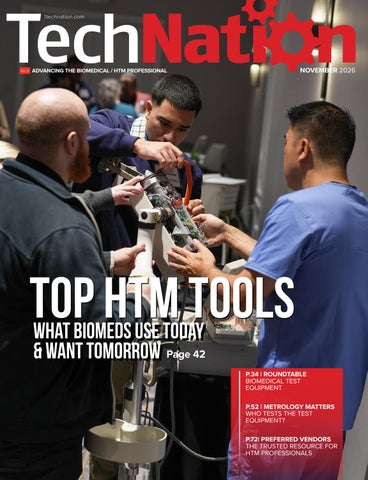
TOP HTM TOOLS What Biomeds Use Today & Want Tomorrow Page 42
P.34 | ROUNDTABLE BIOMEDICAL TEST EQUIPMENT P.52 | METROLOGY MATTERS WHO TESTS THE TEST EQUIPMENT? P.72| PREFERRED VENDORS THE TRUSTED RESOURCE FOR HTM PROFESSIONALS
You asked for an end-to-end imaging equipment solution at a value.
626 DELIVERS IT.
165+ Our number of expert, full-time, engineers on staff ready for service.
We are your multi-modality, multimanufacturer service and support solution.
Remote Diagnostic Solution.
ISO 13485:2016 Certified
CCMC-1 Cyber Certified.
Acquisitions to expand our services to our customers.
The World Moves Fast. We Move Faster.
™
800.516.0990 www.weare626.com
ReadyFix™ Fleet management solution
Remotely maintain and optimize your critical care devices and help minimize disruptions to patient care Enable remote device management Deliver efficiencies across your organization Help boost care team confidence
ReadyFix user interface example
ReadyFix keeps your devices ready to go so care teams can focus on patient care. Talk to a GE HealthCare representative to learn more.
Not all products or features are available in all markets. Full product technical specification is available upon request. Contact a GE HealthCare Representative for more information. Data subject to change. © 2026 GE HealthCare. ReadyFix is a trademark of GE HealthCare. GE is a trademark of General Electric Company used under trademark license. Use of ReadyFix is limited to ReadyFix-enabled devices. JB14581US
Deliver a Clear View with
EndoPro-Cam
®
Inspect and document rigid scope image quality for maintenance and quality assurance activities hmark.com 800.521.6224
Identify Image Quality Issues Document with Confidence Standardize Workflow
Explore EndoPro-Cam
Disclaimer: Intended for inspection and documentation of rigid endoscope image output during maintenance and quality assurance activities. Not intended for patient examination, diagnosis, treatment, or intraoperative use.
Scan to explore how the EndoPro-Cam can support your rigid scope inspection process.
One coil restored
Countless lives touched
Elevate Patient Care Rely on Innovatus Imaging
844-687-5100
innovatusimaging.com
CONTENTS P.12 SPOTLIGHT p.12 Professional of the Month: Tomisha Johnson, CHTM p.14 Department of the Month: The AdventHealth CFD Clinical Engineering Department P.16 INDUSTRY UPDATES p.16 News & Notes p.21 TechNation Pulse p.24 AAMI Update
42 P.27 THE BENCH p.27 Tools of the Trade: FSI p.28 Biomed 101 p.30 Webinar Wednesday FEATURE ARTICLES p.34 Roundtable: Biomedical Test Equipment p.42 Cover Story: Top HTM Tools: What Biomeds Use Today & Want Tomorrow
34
P.52 EXPERT ADVICE p.52 Rigel Medical: Sponsored Content p.56 Cybersecurity p.58 Right to Repair p.60 MedWrench Guru p.62 The Massey Method
TechNation (Vol. 17, Issue #11) November 2026 is published monthly by MD Publishing, 1155 Senoia Road, Ste. 200 Tyrone, GA 30290. TechNation magazine is dedicated to providing medical equipment service professionals with comprehensive, reliable information concerning medical equipment, parts, service and supplies. It is published monthly by MD Publishing, Inc. Subscriptions are available free of charge to qualified individuals within the United States. Publisher reserves the right to determine qualification for free subscriptions. Every precaution is taken to ensure accuracy of content; however, the information, opinions, and statements expressed in the articles and advertisements herein are those of the writer and/or advertiser, and not necessarily those of the publisher. ©2026
November 2026 | TechNation 9
PUBLISHER
John M. Krieg
VICE PRESIDENT
Kristin Leavoy
VICE PRESIDENT BUSINESS DEVELOPMENT
Jayme McKelvey
EDITORIAL
John Wallace
CONTRIBUTORS
K. Richard Douglas Joie Marhefka Steven J. Yelton Garrett Seeley Nathan Proctor Carol Davis-Smith Eric Massey Gay Gordon-Byrne Dave Francoeur Andrew Whyte James Linton Christopher Walters
DIRECTOR OF CLIENT SERVICES
Megan Cabot
ACCOUNT EXECUTIVE
Warren Kaufman
ART DEPARTMENT
Karlee Gower Taylor Hayes Alicia Brown
DIGITAL SERVICES
Cindy Galindo Kennedy Krieg Haley Harris
EVENTS
Kristin Leavoy Sydney Krieg
WEBINARS
Linda Hasluem
HTMJOBS.COM
Sydney Krieg
ACCOUNTING
Diane Costea
CIRCULATION
Stephanie Cote
66 P.65 BREAKROOM p.65 The Social p.66 NCBA Scrapbook p.68 Service Index p.71 Alphabetical Index p.72 Preferred Vendors
Like us on Facebook Follow us on LinkedIn
EDITORIAL BOARD Rob Bundick, Director HTM & Biomedical Engineering, ProHealth Care
Subscribe to TechNation TV
Carol Davis-Smith, CCE, FACCE, AAMIF, Owner/ President of Carol Davis-Smith & Associates, LLC Nadia ElKaissi, CHTM, Biomedical Engineer, HTM, VA Central Office (19HTM) Bryant Hawkins Sr., Site Manager, Children’s Hospital of New Orleans Earl Morris Jr., BMET, Director of Clinical Engineering, Harrison County Hospital Leticia Reynolds, Clinical Engineering Operations Manager at UCHealth Parkview Medical Center
10 TechNation | November 2026
MD Publishing / TechNation Magazine 1155 Senoia Rd, Ste. 200, Tyrone, GA 30290 800.906.3373 • Fax: 770.632.9090 Email: info@mdpublishing.com www.mdpublishing.com
Proud supporters of
a
Learn
M
e
Sc
to
or
n
Build In-House Expertise. Reduce Downtime. LEADERSHIP & PROFESSIONAL SKILLS
DENTAL EQUIPMENT HANDS-ON TRAINING
PRODUCT-SPECIFIC HANDS-ON TRAINING
ONLINE & HANDS-ON PROGRAMS
2 Weeks Online, 1 Week In-Person
Customization Options Available
Communication & Customer Service Course Customized Leadership Training
Infusion Pumps Patient Monitors Telemetry Systems Oxygen Blenders Electrosurgical Units (ESU) Patient Beds & OR Tables Defibrillators/ECG Tabletop Sterilizers Ventilators
Dental Bootcamp (2 Weeks InPerson) Dental Repair Technician 100300 Series (1 Week In-Person)
Biomed to Imaging (B2I) Biomedical Imaging & Information Systems (BIIS) Medical Device Integration (MDI) Medical Equipment Technician 100-300 Series Radiological Safety MRI Safety Biomedical Information Systems Analyzing & Design Linear Accelerators - Beginner through Intermediate
Hands-On, Hybrid, and Customizable HTM Training Programs MORE INFORMATION: 210-233-1102 TRAINING@CBET.EDU CBET.EDU/CBET-B2B-SERVICES/
FLEXIBLE, INTEREST-FREE PAYMENT PLANS AVAILABLE.
SPOTLIGHT
PROFESSIONAL OF THE MONTH Tomisha Johnson, CHTM
T
BY K. RICHARD DOUGLAS wo measures of accomplishment are to build something from scratch and to work your way up the career ladder.
By either measure, Tomisha Johnson, CHTM, has accomplished much. Johnson, an HTM biomed manager at UT Southwestern Medical Center in Dallas, has experienced both life in the field as an entrepreneur and as a manager for an in-house biomed department. “My passion for the field sparked during high school after a college visit to Texas State Technical College in Waco. Seeing the vital intersection between advanced technology, engineering and patient care immediately resonated with me. I knew right away that I wanted a career where my technical problem-solving skills could directly impact and improve lives behind the scenes in healthcare,” she says. Johnson earned an Associate of Applied Science in Biomedical Equipment Technology degree from Texas State Technical College. “That hands-on technical curriculum provided the foundational knowledge required for modern medical device architecture, electronic troubleshooting and patient safety standards, establishing the launching pad for my continuous education and growth in the field,” she says. After college, Johnson began her career as a biomedical intern at Hillcrest Hospital and then advanced through technician roles to a supervisory position at a third-party company. Embracing the entrepreneur role, she founded and served as CEO of her own independent service organization for 15 years, overseeing end-to-end technical service delivery, regulatory compliance and business operations. She then transitioned back into health systems as a biomedical equipment technician (BMET I, II, III), clinical engineer and currently healthcare technology management (HTM) manager at UT Southwestern Medical Center. Johnson holds a Master of Science in Engineering Management degree. 12 TechNation | November 2026
TRANSITIONING FROM BUSINESS OWNER TO BIOMED MANAGER The career challenges have been varied as Johnson has both hung out a shingle as the owner of a biomed ISO and then returned to a leadership role on an HTM team after advancing through several roles. “One of the most defining chapters of my career was building my own business and qualifying as a primary service vendor for the Dallas VA Medical Center to support and repair specialized research equipment and hospital sterilizers,” she says. She says that navigating that venture came with significant operational and financial hurdles. One of those was cash flow and government billing cycles. “Managing payroll for my team of technicians and securing credit lines to maintain critical parts inventory, all while navigating standard 45- to 90-day government disbursement terms,” Johnson says. She also cites supply chain and regulatory rigor that included sourcing specialized components on tight turnarounds to keep missioncritical sterilization and research
equipment fully compliant and operational. Another business challenge involved sustained growth and continuous learning while running a business. “Successfully leading an independent enterprise for 15 years while simultaneously funding my own undergraduate and graduate degrees, pursuing specialized technical certifications and mastering emerging medical device technologies,” Johnson explains. She says that at UT Southwestern, that entrepreneurial resilience translates directly into leading enterprise-level medical device initiatives, systemwide equipment deployments and standardizing operational quality across clinical environments. One of those initiatives was an equipment replacement project. “A prime example of a major project was directing the enterprisewide transition from outdated, high-maintenance plastic suction regulators to standardized, precision Boehringer suction regulators across all 12 inpatient floors at Clements University Hospital (751 beds) and eight floors at Zale Lipshy Hospital (148 beds) and critical care units,” Johnson says. She says that managing a multifacility equipment rollout requires far more than logistics; it demands rigorous risk management, clinical consensus and zero disruption to daily patient care. She says to execute this project she established a centralized operational roadmap. That roadmap included strategic procurement and vendor integration through coordinated direct supply schedules and delivery pipelines to match real-time unit turnover rates, eliminating clinical downtime. She says that another element of the project was standardized clinical workflows. “Partnered directly with nursing leadership, respiratory therapy and clinical educators to deliver targeted, shiftfriendly in-service training, ensuring 100% staff competency prior to go-live,” Johnson says. She adds that standardized maintenance protocols within the CMMS ensured rapid incoming inspection of over 2,300 regulators and consistent regulatory documentation. “Since stepping into my management role, one of my most significant accomplishments was leading the healthcare technology management commissioning for the opening of the new 292-bed Texas Behavioral Health Center. Bringing a specialized facility of this scale online demanded meticulous technical governance, cross-departmental coordination and an uncompromising focus on both patient and technician safety,” Johnson says. She explains that in a behavioral health environment, standard medical device operations require specialized oversight. “I directed the complete onboarding for all clinical assets across the 292-bed campus.”
It was an effort that required CMMS asset integration as well as rigorous safety assurance. “Cataloged, barcoded and built out comprehensive maintenance profiles for every incoming piece of medical technology within our CMMS to establish full audit readiness from day one. Led and oversaw comprehensive electrical safety inspections, performance verifications and manufacturer-baseline calibrations on 100% of the facility’s clinical fleet before clinical go-live,” Johnson adds. She says that she also authored and implemented targeted standard operating procedures tailored to the unique behavioral health environment, establishing clear protocols for tool control, escort procedures and safety practices so technicians can perform routine maintenance and urgent repairs securely and effectively. Beyond the rigors of the workplace, Johnson enjoys family. “Outside of my professional career, my greatest foundation and pride is my family. I have been married for 27 years and am blessed with five daughters and four granddaughters,” she says. No test seems too great for this HTM manager who has experienced the full spectrum of the profession’s challenges.
BIOMETRICS FAVORITE BOOK:
“The 7 Habits of Highly Effective People” by Stephen R. Covey
FAVORITE MOVIE: “Hidden Figures”
FAVORITE FOOD:
Classic Southern soul food
HIDDEN TALENT:
Interior design and DIY home remodeling (especially working with epoxy finishes and modern aesthetic design)
FAVORITE PART OF BEING A BIOMED?
“Knowing that behind every calibration, repair and safety check, our work directly safeguards patients and ensures clinical teams can deliver lifesaving care without hesitation.”
WHY DO YOU READ TECHNATION? “ It keeps me connected to the pulse of the HTM community
— offering valuable insights on emerging medical technology trends, leadership strategies, regulatory shifts and peer perspectives across healthcare systems.”
November 2026 | TechNation 13
SPOTLIGHT
DEPARTMENT OF THE MONTH The clinical engineering team supports nine hospitals in central Florida.
A
The AdventHealth CFD Clinical Engineering Department
BY K. RICHARD DOUGLAS dventHealth is a health system that spans several states. “More than 100,000 skilled and compassionate caregivers in physician practices, hospitals, outpatient clinics, skilled nursing facilities, home health agencies and hospice centers provide individualized, holistic care,” according to the healthcare system’s website.
The healthcare system has a considerable presence in Florida, including its nine-hospital AdventHealth Central Florida Division (CFD), which spans three counties. “Altamonte Hospital is one of nine hospitals within our Central Florida Division that is served by our clinical engineering department. Our team has a staff of 100 including front-line, support and leadership,” says Gary R. Butler, senior manager of clinical engineering. Butler says that the CE team also supports 14 stand-alone EDs (OSEDs) and 35 sports medicine/rehab units. The department manages data for over 100,000 devices across 135 sites. The supported hospital campuses include the 1,400-bed flagship AdventHealth Orlando, which spans four patient towers and covers all specialty services; the 550-bed AdventHealth Celebration; the 14 TechNation | November 2026
225-bed AdventHealth Kissimmee; the 450-bed AdventHealth East Campus; the 450-bed AdventHealth Winter Park; the 200-bed AdventHealth Apopka; and the 150-bed AdventHealth Winter Garden. Leading the CFD CE team are Vice President of Support Services Dave Patchin; Executive Director of Clinical Engineering Dave Petters; Senior Manager of Imaging Services Robert Bagwill; Manager of the Project Management Office Liam Mahon; and Butler. Leadership at the Altamonte Hospital includes Market Manager Joel Burke and Supervisor Pavel Marchenko. CE staff at the hospital also includes nine clinical engineers. “The AdventHealth systemwide mission is ‘Extending the Healing Ministry of Christ’ and guides our every effort. Our vision for CFD Clinical Engineering is ‘We bring safety to care team and patients’ and is designed to complement the mission,” Butler says. He says that most biomed services across CFD are largely handled in-house with very limited outsourced agreements. “We have an asset management team that works with our corporate supply chain team to manage agreements and budgets for any outsourced resources (labor, parts, etcetera),” Butler says. The department has several specialty teams in-house, including imaging, sterilizer and SPD-related equipment, OR lights and tables, dialysis and RO carts, emergency/lab/sports medicine and rehab. “Project management team works closely with our
AdventHealth Office of Design and Construction to bring new sites and renovation of existing areas to go-live. Networking team works closely with our AdventHealth IT and clinical partners to assist in any issue that involves our internally managed infrastructure,” Butler adds. He says that the team also has a high level of collaboration with its IT counterparts across all of CFD. “We crafted our network engineering role (clinical IoT engineer) to have a focused relationship on both IT and our care teams. Anytime there is ITrelated activity — upgrade, replacement of aging devices, planned network outages, etcetera — that could affect medical equipment connection, we are involved to ensure a return to normal operation (patient data flowing to electronic charting),” Butler says. RELATIONSHIPS THROUGH ROUNDING The health system’s growth and expansion have relied on the resources of the CE department. The pace of this development has increased in recent years. “AdventHealth has experienced significant and rapid growth requiring the staffing and training of a wide variety of roles who have served during the opening of new facilities across Central Florida. Two new hospitals and six new off-site stand-alone emergency departments (OSEDs) just in the last three years,” Butler says. At Altamonte Hospital, the CE team has strengthened its connection to clinical departments through a purposeful routine. “This is done through focused rounding efforts that the team does on a scheduled basis. The first is relationship rounding where the team builds that relationship with the department leader and staff to forge a high level of trust that the biomed department can be counted on to meet their equipment needs,” Butler says. He says that the second is compliance rounding where the team sweeps the department for equipment in need of preventive or corrective maintenance. “Joel and the team have developed a schedule and tracker that covers each department down to the room level. This optimizes the condition of our equipment and provides maximum safety for our care teams and patients,” Butler adds. He says that the resources of the department are always available, including capital purchases. “When there is an issue that involves medical equipment, we are the first to be called and the first to respond. We are available to contribute whether it is a hard downtime issue, or a user department making decisions about new equipment selection,” Butler says. One of the contributions that team members make is to do whatever detective work is necessary to solve problems related to devices or networks. “We recently had devices losing network connections. Troubleshooting with our IT partners, we checked the usual suspects, and while everything was in working order, the problem persisted. We engaged the OEM to assist in troubleshooting the issue. The problem continued until we inquired if there were any software updates available that we could try. There were no current updates, but it did mimic the behavior of similar devices at another health system,” Butler says. He says that this resulted in the discovery of a software issue causing intermittent Wi-Fi disconnections. “The network architecture on its own often requires our insights to reveal deeper issues with software interactions with medical imaging or biomedical devices,” Butler adds. Away from work, Butler says that several of the staff are active in the local Central Florida Biomedical Instrumentation Society. “Several of our staff will attend the MD Expo as well as the yearly AAMI conference if it is being held in Florida,” he adds. When the large AdventHealth healthcare system has to keep a large medical device inventory working smoothly, it relies on a big 100-member HTM department for the needed resources.
Top: Jeff Arend works on a ventilator at an AdventHealth hospital in central Florida. Middle: Andrea Lopez works on an EKG machine. Bottom: Mike Lambert is part of an AdventHealth “Road Warrior” travel team that services OSEDs and physical therapy locations. November 2026 | TechNation 15
INDUSTRY UPDATES
NEWS & NOTES Updates from the HTM Industry IN MEMORIAM: PHILIP F. JACOBUS Philip “Phil” F. Jacobus, founder and CEO of DOTmed.com and publisher of HealthCare Business News, as well as president of Owen Kane Holdings Inc., died unexpectedly on Sunday, Aug. 23, at the age of 72. MD Publishing President John Krieg is among thousands of individuals shocked by the news. “Phil has been a real force in our industry since I started 30 years ago. His entrepreneurial spirit and vision set the tone for the field and were groundbreaking in many ways,” Krieg shared. “I always enjoyed our conversations about the industry. He left an indelible mark, was truly one of a kind and will be sorely missed.” Philip was born and raised in Kane, a town in the Allegheny Mountains of Pennsylvania. He graduated from Kane High School in 1972 and earned his bachelor’s degree at the University of Pittsburgh. His ambitions were as large as his hometown was small, and upon graduating, he went to New York City. Even that metropolis was too constricting to contain his ideas, so he went to China with his first foray into medical equipment technology, heading the China Business Development Group (CBDG). Doing business there was complex, and for 1977, still very unorthodox. But people there recognized his sincerity, which came across in any language, and CBDG was a success. It’s hard to picture now, but Phil sold China its first MRI system, according to his official obituary. “That set a pattern, and he would later bring the same earnest goodwill to his business dealings around the world, including Russia, where he similarly helped build the country’s very first proton therapy system in St. Petersburg through his investment company, Owen Kane Holdings,” the obituary adds. “By that time he’d built a new company in a pioneering realm, where business done online and in the real world meshed seamlessly. This was DOTmed.com. It was the turn of the century and the ‘dot com boom’ occupied everyone’s thinking. People were beginning to get used to hearing the term ‘dot-this-or-that,’ and so he and his colleague devised the name DOTmed.com, which could be so easily remembered because it fused the company’s concept with its means of access. But what isn’t known about that name is that Phil’s mother had passed away shortly before the company was born. Her name was Dorothy, but people knew her as Dot. And so, DOTmed was also meant to honor her memory,”
16 TechNation | November 2026
it continues. “Philip was such a warm, loving and special person, and we feel blessed to have known him. We will always cherish the beautiful memories and the love and affection he had for all of us,” Ajay and Usha Goel wrote in an online guestbook accompanying the obituary. “My sympathy is with Barbara and family. Growing up in the same neighborhood in Kane, I will always remember Philip as a very interesting, kind and caring person. A big thanks goes out to what he did in the medical field!” wrote Ann Holmes Chapman. IAMERS President Diana Upton shared that Phil was a founding member of IAMERS. She said he had a wealth of knowledge. “In addition to being a dear friend, Phil was a great supporter of IAMERS. He was a contributing member who came to most of the IAMERS meetings. He had great knowledge of our industry both domestically and internationally,” Upton shared via email. The family asked that expressions of sympathy be made in the form of contributions to a scholarship in Phil’s name. Those wishing to contribute to the Philip F. Jacobus Memorial Fund can visit https://tinyurl.com/3962mbr2
INDUSTRY UPDATES
WAKEMED CLINICAL ENGINEERING THREE-PEATS The WakeMed Health & Hospitals Clinical Engineering team has been recognized by the North Carolina Biomedical Association as the 2026 Shop of the Year. WakeMed Health & Hospitals Director of Clinical Engineering George Reed shared the exciting news on LinkedIn. “I’m incredibly proud to share that the WakeMed Health & Hospitals Clinical Engineering team has been recognized by the North Carolina Biomedical Association as the 2026 Shop of the Year!” he posted. “What makes this recognition even more special is that this is the third time our team has received this honor over the years — a tremendous testament to the consistency, dedication, expertise and
teamwork of the people who make up this organization.” Reed stressed that this is a team award. “This award represents far more than a title. It reflects the work our team does every day behind the scenes to ensure the medical technology supporting our patients and clinicians is safe, reliable and available when it matters most,” he added. “This award belongs to the entire team. I’m honored to lead such an exceptional group of professionals and incredibly proud of what they continue to accomplish for WakeMed and our patients.” “Congratulations to the entire WakeMed Clinical Engineering team! Three-time Shop of the Year — well deserved!” he concluded.
November 2026 | TechNation 17
INDUSTRY UPDATES ELEVATE HTM MARKS FIRST YEAR OF BUILDING PATHWAYS INTO HTM Elevate HTM is celebrating its first year with a milestone that goes beyond introducing young people to healthcare technology management (HTM). The New Orleans-based nonprofit is beginning to turn career awareness into education, internship and employment opportunities. Founded by Bryant Hawkins Sr., Elevate HTM reached more than 4,000 students across Greater New Orleans and the Northshore during the past year. The organization participated in 11 career events, conducted 11 hands-on demonstrations and worked with six schools and partner sites across three communities. The numbers also highlight the need for greater awareness of HTM careers. According to Hawkins, only 10 of the more than 4,000 students reached by Elevate HTM were familiar with HTM before the organization’s presentations. “Young people cannot choose a career they have never heard of,” Hawkins said. “It also reminded us that talent is everywhere, even when access and exposure are not.” Elevate HTM’s goal during the year was to move beyond career-day introductions and establish a structured pathway that provides students with mentorship, education, internship experience and connections with potential employers. A major step toward that goal came in June with the formal launch of the organization’s 4A Pathway. Three students entered the program, and Elevate HTM had one young person secure employment in HTM. An early participant also remains on track to earn an associate degree in biomedical equipment technology. “Reaching more than 4,000 students was significant, but watching exposure begin to produce real career outcomes meant even more,” Hawkins said. Elevate HTM plans to expand its work in New Orleans and surrounding communities by enrolling additional students in the 4A Pathway, helping participants progress from Certified Associate in Biomedical Technology (CABT) preparation to testing and certification, expanding internship opportunities and establishing its first formal apprenticeship. Because the path to an HTM career can include completing a two-year college program, Hawkins said the organization measures progress throughout the process, including awareness, mentorship, education, certification, internships and employment. Elevate HTM is also expanding its reach through HTM Forward, with Senior Consultancy Programs beginning in the Atlanta and Orlando areas. Hawkins emphasized, however, that New Orleans will remain the organization’s home and primary focus. A 501(c)(3) nonprofit, Elevate HTM describes its mission with the promise “from first exposure to first 18 TechNation | November 2026
paycheck.” Its model is designed to support students through career discovery, mentorship, education, scholarships, certification preparation, internships and employment. TechNation readers and members of the HTM community can support the organization by donating, sponsoring a student’s pathway, volunteering as a mentor or speaker, hosting workplace tours, offering internships or apprenticeships, and hiring qualified Elevate HTM participants. Schools and community organizations can also invite Elevate HTM to introduce students to the profession. “We are not creating another one-time career-day experience,” Hawkins said. “We are building a pathway that stays with students through career discovery, mentorship, education, scholarships, certification preparation, internships and employment.” The organization’s long-term goal is to help develop the next generation of HTM professionals while creating new educational and career opportunities for students and their families. Find out more at ElevateHTM.com.
ALTHEA US INC. ANNOUNCES REBRAND TO ALLY TECHNICAL Althea US Inc., a leading provider of solutions, service and training for all major medical technology equipment manufacturers and modalities, has rebranded as Ally Technical and received an investment from FFL Partners, a private equity firm focused on growth investments. Financial terms were not disclosed. “Our rebranding to Ally Technical is an exciting new chapter in our history, reflecting our strategic positioning as a newly independent, industry-leading company that provides a unique integrated services and parts approach to meeting our customers’ healthcare technology management challenges, so they can focus on better patient care,” said Dan Siler, CEO of Ally Technical. “We’re thrilled to partner with FFL, a firm known for its depth of healthcare business-building experience that will enable us to pursue new growth opportunities, both organically and through strategic M&A.” Headquartered in Nashville, Tennessee, Ally Technical combines nationwide field service with extensive in-house technical capabilities, including system and parts testing, board-level repair, depot repair, replacement parts and technical training. Built on a legacy of expertise in contrast injectors, the company is applying that same knowledge and service-driven approach to a broader range of medical devices. “Healthcare providers are increasingly turning to
experienced independent service organizations (ISOs) for mission-critical maintenance, service and parts support to improve cost efficiency. As a preferred servicing partner, Ally Technical is well positioned to capitalize on this trend,” said Karen Winterhof, partner at FFL. “We have identified meaningful growth opportunities where FFL can help Ally Technical scale organically and through acquisitions, expand into new modalities and enter high-growth markets.” Ally Technical’s technicians provide comprehensive, on-site support for a large installed base of contrast injectors and diagnostic imaging equipment, including parts, preventive maintenance, repairs and servicing for all major manufacturers. The company also provides capital equipment sales and installation, PM/service kits, technical training and technical support across a wide range of medical devices. FFL’s investment in Ally Technical is another outcome of the firm’s proprietary Sector Exploration and Expertise Development (SEED) sourcing and value creation strategy.
MEDICAL EQUIPMENT SALES AND SERVICE
BIOMEDS HELPING BIOMEDS
TM
Expert, cost effective on-site test equipment calibration and repair services
CONTACT US TODAY!
(828) 396-6010 | sebiomedical.com November 2026 | TechNation 19
INDUSTRY UPDATES TRANSCAT ACQUIRES SOUTHEASTERN BIOMEDICAL
LENDING A HELPING HAND AT EVERY STEP. Diagnostic Solutions is a customer service based parts provider that specializes in all imaging modalities and manufacturers. Created to offer hospitals and ISO’s a cost effective and time saving solution for ordering imaging replacement parts, equipment moves, ultrasound probe repair and on-site service.
Contact us today, we are confident you will see us as THE Parts Solution!
diagnostic-solutions.com
330.296.9729 20 TechNation | November 2026
Transcat Inc., a provider of accredited calibration services and test and measurement equipment, has acquired privately held Southeastern Biomedical Associates Incorporated. Southeastern, founded in 1996 and based in Granite Falls, North Carolina, provides calibration, repair, preventive maintenance, electrical safety inspection, and documentation and regulatory compliance services to hospital networks and healthcare facilities throughout the southeastern United States and beyond that conform to both ISO/IEC 17025 and ISO 9001 standards. Southeastern also sells biomedical equipment, patient-ready accessories and equipment parts, and assists customers with equipment acquisition and asset liquidation. This acquisition complements Transcat’s existing biomedical business, extending its capabilities and geographic presence in what is expected to be a growing end market for Transcat. The acquisition advances Transcat’s strategy of building scale in regulated, highcost-of-failure end markets, where accredited calibration is mission-critical to patient safety and regulatory compliance. With over 30 calibration labs across North and Central America, Transcat is uniquely positioned to support hospital networks and other regulated customers that depend on consistent, accredited calibration to protect patients and maintain compliance across a broad footprint. “The acquisition of Southeastern Biomedical reinforces Transcat’s strategy of deepening our presence in the life science sector, one of the most regulated and mission-critical end markets we serve,” said Jaime Irick, president and chief executive officer. “Southeastern’s reputation for high quality and a customer-first approach supporting hospital networks throughout the southeastern region of the United States and beyond builds on our established leadership in biomedical calibration and will position us to service a much larger geography with a consistent focus on quality and timely service for our customers in these critical end markets.” “I want to welcome the Southeastern employees to the Transcat team. Under the leadership of the prior owners, Boyd Campbell and Greg Johnson, the Southeastern team has built a high-quality culture and reputation in the industry that aligns well with Transcat’s core values and our commitment to timely, high-quality service for our customers,” Irick added. Greg Johnson, co-owner of Southeastern Biomedical, commented, “With over 30 years of serving customers throughout the southeastern region of the U.S. and beyond, Southeastern has established a high-quality reputation in the industry, a dedicated commitment to customer satisfaction and a strong employee culture. There was never a doubt that Transcat was the right partner to take our company to the next level of growth. Transcat has developed a reputation in this industry for treating acquired employees and customers right, and for focusing on the key attributes and operating principles that have made Southeastern successful over time. Both Boyd and I look forward to joining the Transcat team and being part of the future success of Transcat Biomedical. The future as a combined company is very bright.” Irick concluded, “Greg and Boyd have built a great company with strong leadership, a reputation for quality, a focus on culture and dedicated employees. I am confident that bringing our two companies together will accelerate growth across our combined customer base and create further opportunity to deliver high-quality service with industry-leading turnaround times in the critical end markets we serve. Acquisitions like this one remain central to our go-forward strategy, strengthening our value proposition in regulated verticals and supporting the disciplined growth that underpins our fiscal 2027 outlook, which includes M&A and continued service gross margin expansion.”
The latest news and events from TechNation
VOTE NOW FOR THE 2027 TECH CHOICE AWARDS
Th e 20 27 W re nchi es
The healthcare technology management community has the opportunity to recognize its peers as voting opens for the 2027 Tech Choice Awards, also known as The Wrenchies. Presented by TechNation, the fourth annual Tech Choice Awards celebrate the HTM professionals, departments, organizations and industry partners making an impact throughout the healthcare technology field. The top five finalists in each category were featured in the October issue of TechNation, and voting will remain open through the rest of this year. The deadline to cast your ballots is January 4, 2027! The Wrenchies give biomeds, clinical engineers, HTM leaders and other members of the industry an opportunity to help recognize the people and organizations they believe deserve to be celebrated. This year’s Tech Choice Award categories include Professional of the Year, Young Professional of the Year, Large Department of the Year, Small/Midsize Department of the Year, Military BMET of the Year, Industry Influencer of the Year, Director/Manager of the Year, Women
in Leadership Award, Educator/Trainer of the Year, Humanitarian of the Year, Association of the Year, Vendor of the Year and the ICON Award. The awards are designed to put the voice of the HTM community at the center of the recognition process. In the inaugural Wrenchies, more than 5,000 votes were cast by TechNation readers, biomeds and other members of the HTM community. Winners are determined entirely by votes from the HTM community. Award sponsors do not have a role in selecting the honorees. Whether a finalist is an outstanding biomed, an influential leader, an exceptional HTM department or an organization supporting the profession, every vote is an opportunity to recognize excellence across the industry. Make your voice heard and support your favorite 2027 Tech Choice Awards finalists. Vote in the Tech Choice Awards at 1TechNation.com
HTM NOMINATIONS NOMINATE OUTSTANDING HTM PROFESSIONALS & DEPARTMENTS
Great work deserves recognition, and TechNation wants to hear about the people and teams making a difference in healthcare technology management. Nominations are open for TechNation’s popular Professional of the Month and Department of the Month features. Readers are invited to nominate an outstanding colleague, their department or themselves for an opportunity to be featured in TechNation. Know an HTM professional who goes above and beyond, demonstrates leadership or makes an important contribution to their organization? Nominate them for Professional of the Month. TechNation is also looking for exceptional HTM departments. Department of the Month nominations provide an opportunity to recognize an entire team and share why the department deserves to be highlighted. Don’t be shy about your accomplishments, either. If you or your department has a story worth sharing with the HTM community, submit a nomination. Help TechNation shine a spotlight on the professionals and departments advancing HTM every day. Nominations may be submitted online or by emailing editor@mdpublishing.com. Visit 1TechNation.com/nominations to submit a nomination and learn more. November 2026 | TechNation 21
INDUSTRY UPDATES IMAGING SERVICE PROS INVITED TO CONNECT, LEARN AT ICE 2027 Imaging field service engineers looking to expand their technical knowledge, connect with imaging leaders and discover industry resources can mark their calendars for the 2027 Imaging Conference & Expo (ICE), set for Feb. 26-28 in Fort Worth, Texas. ICE is the only conference dedicated to imaging directors, radiology administrators, radiologic technologists and imaging service engineers. The event brings imaging management and imaging engineers together, creating opportunities for professionals responsible for servicing and supporting imaging technology to interact with decision-makers and other members of the imaging community. For imaging engineers, the conference provides a combination of education, networking and access to industry companies and resources. ICE attendees include imaging service engineers, senior imaging engineers, HTM imaging technicians, biomedical equipment support specialists specializing in imaging, clinical engineering leaders and imaging service supervisors, along with radiology and imaging directors and managers. The 2027 schedule includes educational sessions throughout Saturday and Sunday. While the website has not yet posted the individual 2027 session topics, examples from the 2026 program include two sessions on servicing CT systems, ultrasound probe performance and proactive HTM strategies for imaging equipment performance.
The exhibit hall offers another opportunity for imaging field service engineers to make the most of their time at ICE. Attendees can interact with leading companies and access resources designed to help them better perform their roles and responsibilities. The exhibit hall grand opening is scheduled from 4-6:30 p.m. Saturday, Feb. 27, with additional exhibit hall hours from 11:30 a.m.-2 p.m. on Sunday, Feb. 28. Networking is also a key part of the ICE experience. By bringing imaging engineers together with imaging management professionals, the conference provides opportunities to develop industry contacts, exchange ideas and build relationships with professionals working throughout the imaging field. The event concludes Sunday evening with the Cowboys & Cocktails Finale Party from 5-6:30 p.m., offering attendees another opportunity to connect after the educational sessions and exhibit hall activities. ICE 2027 will be held at the Hilton Fort Worth. The ICE group hotel rate is $229 per night, with a Feb. 5, 2027, deadline, although the group rate may sell out before then. Learn more about the 2027 Imaging Conference & Expo and register at AttendICE.com.
YOUR EQUIPMENT COST MAY BE A BUYING AND SUPPORT PROBLEM
Too many makes, models and service agreements create unnecessary complexity and costs across your health system. RENOVO SOLUTIONS doesn’t sell medical equipment. We help you select the right technology,
PUT YOUR EQUIPMENT STRATEGY TO THE TEST. Discover how smarter planning and support can uncover savings across your equipment fleet.
standardize and support it throughout its lifecycle. Our flexible, multi-vendor service programs combine technical expertise and transparent data to reduce OEM dependence, minimize downtime and lower total cost of ownership.
22 TechNation | November 2026
Renovo1.com 1-844-4-RENOVO
2027 TECH CHOICE AWARDS
VOTING NOW OPEN
VOTING IS OPEN THROUGH JANUARY 4 Scan here for the list of 2027 nominees and to cast your vote.
SCAN TO VOTE
Th e 2027 W re nch ie s
INDUSTRY UPDATES
AAMI UPDATE
HTM Leaders Chart a Five-Year Course for the Field at AAMI’s Fourth Future Forum
T
hirty healthcare technology management (HTM) leaders gathered at AAMI’s Center of Excellence on Aug. 31 and Sept. 1 for the fourth Future Forum, a two-day working session built around a single question: What does HTM need to become over the next five years, and what must AAMI build, scale or launch to get it there?
The forum’s participants represent all corners of HTM, ranging from inspectors and regulators to service providers and your hospitals’ fix-it professionals. And the answer that emerged from this group was less a single fix and more of a shift in posture toward standardization, 24 TechNation | November 2026
clearer data and conveying HTM’s value as a source of go-to experts for modernizing health systems. DAY 1: NAMING THE PROBLEM The forum opened with a word exercise that set the tone for the day. Asked to describe HTM today, attendees repeatedly landed on “rewarding” and “essential,” but also “under-resourced,” and, more than any other term, “complex.” When the group looked ahead, they ranked technological innovation, AI, data utilization, cybersecurity, and the regulatory environment as the forces most likely to reshape the field over the next five years. Much of the day’s discussion returned to AAMI’s 2025 State of HTM survey, which drew roughly 1,000 responses and identified workforce issues as the field’s No. 1 challenge. Participants noted a hopeful signal buried in
“A scary future is, if we’re not making standards important to the right people, they’re just going to be forgotten.” the data: 72% of Gen Z respondents said they entered HTM intentionally, compared with the vast majority of baby boomers who discovered the career path by chance. “This shows our work is having an impact,” noted Danielle McGeary, AAMI vice president of HTM. However, the group also flagged a shrinking pipeline of military veterans entering the field and a continued lack of public awareness about the profession itself. The conversation grew pointed around HTM’s positioning relative to hospital information technology (IT) departments. “The role of IT in a hospital is clearly defined. HTM, meanwhile, is a jack of all trades,” one participant said — a framing others linked directly to the field’s chronic “cost center” perception and its difficulty attracting resources. “We pride ourselves as being that jack of all trades, but that is to our own peril,” another participant added, noting that budgets aren’t built around a department’s ability to efficiently put out fires, no matter how many times HTM pros are celebrated for saving the day. Rather, forum participants called for ways to better highlight the benefits a proficient and well-funded HTM team can offer in addressing and preventing specific challenges faced by modernizing health systems. Of course, HTM leaders need clear data and common baselines to prove that excellence. Several leaders described HTM as “the Wild West,” lacking a shared yardstick for maturity or best practice, while others pointed to rising wages, scope creep and blurred lines with IT as compounding pressures that can get in the way of self-assessment. A recurring line of the day captured the stakes bluntly: “Excellence is not easily scalable.” What is deemed excellent in a health system serving an affluent cityscape may look very different from the kind of excellence sought in a small rural hospital. According to McGeary, these discussions will prove essential as AAMI works to update the field’s HTM Levels Guide and its accompanying online assessment tool. By afternoon, productive ideation sessions converted voiced frustrations into high-concept solutions including: • A certification or recognition program to convey modern aptitudes • Standardized vendor performance and contract templates • An opt-in collective for anonymized HTM benchmarking data
• AI tools to help the field keep pace with technology no longer built on purely mechanical foundations DAY 2: BUILDING THE RESPONSE The second day of the HTM Future Forum opened with a comprehensive synthesis of day one and pushed the group toward concrete recommendations for AAMI. These recommendations were organized around several key themes including: • Modernizing HTM standards • Building a new efficiency guide • Establishing clearer guardrails for data collection On standards, participants called for elevating AAMI’s HTM work internationally through bodies like ISO and IEC — a call to action AAMI is well-practiced in as a source of U.S. technical advisory groups for international standards development. Other ideas included an “implementation guide” series to make standards easier to apply within complex hospital environments and an “AAMI Standards University” for shared learning resources, such as webinars and case studies. It was even floated that an AI agentic tool developed and trained by AAMI could theoretically help the field digest and navigate standards more quickly — even helping HTM leadership digest standards within the framing of their existing SOPs. “A scary future is, if we’re not making standards important to the right people, they’re just going to be forgotten,” one participant warned. Underlying much of the day’s work was a tension one participant described plainly: “The customer is the healthcare provider. The impact is on the patient. The demands are coming from financial and regulatory considerations.” Reconciling those pressures is where guiding principles — not just guidance documents — come in. Workforce planning discussions produced a BMET competency framework and a proposed HTM cybersecurity certification developed alongside established AAMI partners such as ECRI. The forum closed with a call to modernize HTM’s value proposition — through media, standards work and closer alignment between technicians, department leaders, and the C-suite — so the field’s impact is understood by hospital leadership before the next crisis more painfully makes the case for it. AAMI plans to translate the forum’s recommendations into concrete initiatives over the coming months. November 2026 | TechNation 25
OZARK BIOMEDICAL
YOUR SINGLE SOURCE FOR PARTS AND DEPOT REPAIR
StatSpin Express 2, 3, 4
We have a complete line of parts as well as service available.
THE BENCH
TOOLS OF THE TRADE CMMS/EAM FSI
LIVE DEMO:
NOVEMBER 18 at 2 PM ET Registration on WebinarWednesday.live Eligible for 1 CE credit from the ACI.
The only CMMS purpose-built for healthcare maintenance management. Optimize your hospital’s facilities and healthcare technology management (HTM) operations with FSI’s CMMS/EAM platform, now part of Ultimo. Deploy a comprehensive, standardized and scalable cloud-based maintenance management software and empower your users with accurate, usable and useful data. November 2026 | TechNation 27
THE BENCH
BIOMED 101
What HTM Professionals Should Prepare for Next
C BY DON L. SEVEN
onnected clinical technology has expanded what healthcare technology management (HTM) teams are expected to understand, document and help secure. The next challenge is not simply adding cybersecurity tasks to HTM workloads. It is building the inventory, authority, technical fluency and shared accountability needed to act on those tasks responsibly. CHANGING ROLE As connected clinical technology continues to replace legacy clinical systems and healthcare networks become increasingly integrated, HTM professionals will face greater cybersecurity accountability, increased involvement in vulnerability remediation, stronger demands for original equipment manufacturer coordination and a larger role in life cycle and replacement decisions.
28 TechNation | November 2026
That shift is already visible in daily work. A vulnerability can be discovered by a security platform, but the finding quickly raises questions that a scanner in most cases cannot answer for medical equipment: What actual piece of equipment is affected? Which software version is installed? Is the system still supported? Can it be removed from service? Has the manufacturer approved a correction? Who can authorize downtime? Who owns the decision if no supported fix exists? In my experience working across clinical technology and cybersecurity, identifying a vulnerability is often the easy part. The harder problem is determining who has the information, authority and operational ability to move it forward. A finding without an accountable next step is not risk management. It is just discovery and documentation of a problem. INVENTORY CONTROL IS BECOMING SECURITY INFRASTRUCTURE Traditional equipment records were often designed to support maintenance: manufacturer, model, serial number,
“A finding without an accountable next step is not risk management. It is just discovery and documentation of a problem.” location, preventive-maintenance history and service status. Those fields remain essential, but they are no longer enough for connected clinical systems. Organizations increasingly need to associate a device or system with its operating system, application version, IP and MAC addresses, network segment, remote-access method, clinical owner, support status, manufacturer guidance and known cybersecurity findings. If those records are split among HTM, IT, procurement, cybersecurity and the manufacturer, even a legitimate vulnerability can stall before anyone confirms what is actually affected. Full and proper inventory control therefore becomes more than an administrative exercise. It creates the foundation for vulnerability validation, mitigation and remediation planning, segmentation, replacement decisions and credible risk documentation. HTM WILL NEED PRACTICAL IT FLUENCY HTM professionals do not need to become cybersecurity engineers, but basic IT knowledge is becoming difficult to separate from effective clinical-equipment management. Understanding operating systems, basic OS navigation, ports, network paths, authentication, remote support, software versions and common security terminology allows HTM to communicate across departments and recognize when a proposed action may affect clinical operation. At the same time, IT and cybersecurity teams may understand the technical exposure while lacking knowledge of the system’s clinical function, maintenance restrictions, manufacturer relationship and consequences of downtime. Neither side holds the complete picture independently. Training should support informed participation rather than forced career conversion. The goal is not to turn every biomedical equipment technician into a threat hunter and researcher. It is to ensure HTM can identify the right questions, interpret manufacturer guidance, recognize operational constraints and escalate appropriately. PREPARATION MUST BE ORGANIZATIONAL Regulatory and manufacturer expectations are reinforcing this shift. Proposed updates to the HIPAA Security Rule would make activities such as technology asset inventories, network mapping, risk analysis, patch-management
practices, segmentation, compliance audits and compensating-control documentation more explicit. HIPAA does not assign these duties specifically to HTM, but many depend on information HTM maintains or is best positioned to validate. Preparation should also begin before equipment is purchased. Cybersecurity review during acquisition can identify operating-system lifespan, patch availability, remoteaccess requirements, logging capabilities, upgrade costs, support limitations and end-of-life expectations. The cheapest purchase price can become an expensive life-cycle problem if the system cannot be securely maintained. Connected clinical technology has made cybersecurity part of HTM’s environment. HTM brings knowledge that vulnerability scanners and traditional IT teams cannot reproduce from technical data alone: how equipment is maintained, how it supports patient care, what the manufacturer permits, what downtime means and whether a proposed action is operationally realistic. That expertise makes HTM indispensable, but participation should not be confused with isolated responsibility. Successful clinical-systems cybersecurity depends on combining HTM’s clinical-technology knowledge with cybersecurity’s threat expertise, IT’s infrastructure control, clinical leadership’s operational judgment, manufacturer support and leadership accountability. Biomedical and HTM organizations are already beginning to experiment with integrating some of these traditionally separate cybersecurity functions into their service models, signaling an emerging shift in how clinical technology and cybersecurity responsibilities may be structured. Don L. Seven is a senior clinical systems security engineer whose work focuses on connected medical technology, vulnerability governance, manufacturer coordination and collaboration among HTM, IT, cybersecurity and clinical teams. He is also an independent researcher whose work examines the intersection of cybersecurity, IT, healthcare technology and human behavior. November 2026 | TechNation 29
THE BENCH
CLICK. WATCH. EARN.
Watch these webinars on-demand
EXPERTS SHARE AI, CYBERSECURITY, IMAGING INSIGHTS The connection between cybersecurity and clinical operations was at the center of the webinar “A Smarter Investment in Healthcare Cyber Resilience: Why Security Spending Only Matters When It Changes Clinical Outcomes,” sponsored by Claroty. Skip Sorrels, field CTO-CISO at Claroty, explored how healthcare organizations can move beyond traditional cybersecurity tools to develop a more proactive and operational approach to protecting cyber-physical systems, including connected medical devices. A key focus was what Sorrels described as the “Readiness Gap” that can exist between technical cybersecurity alerts generated by IT systems and the operational realities faced by clinical engineering and biomedical equipment teams. The webinar emphasized that technology alone cannot provide cyber resilience. Instead, healthcare organizations need stronger collaboration between IT, cybersecurity and clinical engineering teams so that technical information about vulnerabilities and threats can be translated into actions that protect clinical operations and patient care. Sorrels discussed how a unified approach can help organizations quickly understand the potential clinical impact of a cyber threat. Teams can then prioritize their response accordingly. The session also addressed the importance of clearly defining medical device ownership and developing response playbooks before an incident occurs. Webinar attendees said collaboration and preparation were among their biggest takeaways. “Security must be a joint effort,” said Antonio Cervera, a biomed at Eisenhower Health. Christina Bottomley, a biomed tech manager and BMET II, highlighted “the planning and testing strategies that work to prepare for a cyberattack” as her biggest takeaway from the session.
30 TechNation | November 2026
IMAGING PARTS Understanding the difference between a replacement imaging part that has simply been “tested” and one that has undergone a comprehensive quality process can have important implications for equipment performance, regulatory compliance and patient safety. The webinar “Beyond ‘Tested’: Understanding Diagnostic Imaging Parts Quality, Condition Classification, and FDA Regulatory Expectations” examined how HTM professionals can more effectively evaluate replacement parts and the suppliers that provide them. Richard Gerler, senior vice president of operations at Probo Medical, presented the educational session. Probo Medical sponsored the webinar. Gerler discussed the regulatory environment surrounding diagnostic imaging replacement parts, including how FDA requirements apply to medical devices and service activities. The presentation also explored the distinction between servicing and remanufacturing and the importance of keeping equipment within the specifications associated with the original manufacturer’s FDA clearance. A key focus of the webinar was helping HTM professionals look beyond terminology when purchasing replacement parts. Common descriptions such as “new,” “refurbished,” “tested” and “used” may not, by themselves, provide enough information to determine a part’s quality or the processes it underwent before being offered for sale. Instead, Gerler encouraged attendees to consider the processes behind those classifications and evaluate whether a replacement component meets requirements for form, fit, function and durability. The session also highlighted the importance of traceability, documentation and testing throughout a replacement part’s life cycle.
For HTM professionals, that can mean asking suppliers more detailed questions before making a purchasing decision. Rather than accepting that a component was simply “tested,” buyers can ask what that designation means, what measurements were collected and whether testing occurred on a complete imaging system or using a bench fixture. Documentation can provide another level of assurance. Service organizations and healthcare facilities may benefit from requesting sample test reports that include measured values and from establishing written definitions for the condition classifications they use when purchasing or selling replacement parts. The webinar also addressed FDA requirements associated with diagnostic imaging equipment, including 21 CFR 1020.30, as well as documentation responsibilities associated with the assembly and service of certain diagnostic X-ray systems. Gerler discussed the value of examining a supplier’s quality processes rather than making decisions based solely on price or a part’s stated condition. Traceability systems, testing protocols, quality assurance capabilities, documentation and risk management practices can all provide insight into how a supplier approaches replacement part quality. The discussion provided practical considerations for those responsible for maintaining diagnostic imaging systems. Ultimately, the session reinforced that replacement part quality involves more than whether a component powers on or passes a basic test. Understanding how a part was sourced, classified, inspected, tested and documented can help HTM professionals make more informed decisions while supporting equipment reliability and regulatory compliance. AGENTIC AI Artificial intelligence is creating new opportunities for HTM professionals. Those opportunities were explored during the recent TechNation Webinar Wednesday session, “Better Together: How Agentic AI Is Amplifying the HTM Workforce,” sponsored by Trimedx. Murphy McGraw, senior director of product management at Trimedx, and Lindsay Price, manager of product management at Trimedx, discussed how agentic AI tools designed for clinical engineering can support biomedical technicians and HTM leaders as they manage increasingly complex equipment inventories, growing work order volumes and ongoing pressure to do more with limited resources. The presenters examined how agentic AI differs from more familiar forms of artificial intelligence and how the technology can be incorporated into everyday HTM operations. The session highlighted emerging applications for AI in troubleshooting, knowledge retrieval, maintenance support and other tasks that can consume valuable technician time. A key theme throughout the webinar was using AI to augment the expertise of HTM professionals rather than replace it. By
helping technicians quickly locate relevant information, analyze data and navigate routine administrative tasks, AI tools have the potential to allow biomeds to focus more of their attention on equipment maintenance, problem-solving and supporting patient care. McGraw and Price also addressed considerations organizations should evaluate when adopting AI, including workflow integration and technician trust. For HTM departments, successful adoption involves more than simply introducing new technology. Teams must determine where AI can provide meaningful value and how it can fit naturally into existing clinical engineering processes. Attendee feedback reflected interest in the practical applications of the technology. Andrew Kristofek, BMET III at Baylor Scott & White All Saints, said the webinar provided a “better understanding of various aspects in which AI can enhance biomed from PMs and repairs to data management.” For Michelle Werns Melendez, BMET III at NovaMed Corporation, understanding practical applications was particularly valuable. “Knowing specific, valid uses of AI for equipment management will help determine if I can successfully integrate it into my current system,” Werns Melendez said. CT ADVANCEMENTS Recent advancements in computed tomography technology and their impact on diagnostic imaging were the focus of a recent webinar sponsored by AllParts Medical. The webinar, “CT Advancements: What’s Changed in the Last Five Years,” was presented by James Freeman, multivendor modality manager, CT-PET/CTnuclear at Philips Healthcare and AllParts Medical. The webinar is eligible for one continuing education credit from the ACI. Freeman explored some of the most significant hardware and software developments introduced to CT technology during the past five years. The presentation examined how these innovations are expanding clinical capabilities, providing benefits for clinicians and patients, and creating new considerations for healthcare technology management (HTM) professionals who support, maintain and manage CT systems. Attendee feedback highlighted the value of keeping HTM professionals informed about emerging technologies and changes within the industry. “Topics like this are very useful and informative; keep this trend going,” said Carlos Duran, imaging engineer III with Trimedx. A list of upcoming webinars and previous presentations are available for on-demand viewing at WebinarWednesday.live.
November 2026 | TechNation 31
welcome to the
future of htm jobs. Specialized job placement for HTM, Biomed and Imaging Service Engineers.
HTMjobs
HTMJobs is offering a new and improved website designed to make it easier and more efficient for employers to connect with qualified candidates and fill their positions.
RESUME DATABASE ACCESS: Gain access to our HTM and Imaging Talent Network of 4,000+ job-seeking professionals. AI MATCH SCORING: Quickly identify qualified candidates with AI-powered scoring that analyzes each applicant’s skills, certifications and qualifications against your open roles. AUTOMATIC JOB SYNCING: Connect your career page to HTMjobs.com to automatically keep your most up-to-date job openings active on the site.
SEARCHING FOR A NEW JOB?
350+
open positions across the country
FREE
and confidential registration for job seekers
Visit HTMjobs.com to learn more
ROUNDTABLE
ROUNDTABLE Biomedical Test Equipment
A
s medical devices become increasingly sophisticated, connected and software-driven, the test equipment used to maintain them is evolving just as quickly. Today’s healthcare technology management (HTM) professionals need tools that deliver more than accurate measurements. Automation, connectivity, digital documentation, CMMS integration and streamlined workflows are becoming increasingly important as departments look to improve efficiency, maintain compliance and make the most of limited resources. TechNation invited industry experts to discuss the changing role of biomedical test equipment, strategies for evaluating investments and the technologies shaping the future of medical device testing. Participants in this roundtable article are: • BC Group International Director of Business Development Justin Barbour; • Datrend Systems Inc. Director of Business Development Owen Liu; • Fluke Biomedical Sales Engineer Jamie Spragis, CBET; 34 TechNation | November 2026
• Pronk Technologies Vice President of Marketing Julio Castro; and • Southeastern Biomedical Co-Owner Boyd S. Campbell, CBET, CRES, CHTM. Q: AS MEDICAL DEVICES BECOME MORE SOPHISTICATED AND INCREASINGLY SOFTWAREDRIVEN, HOW HAS THE ROLE OF BIOMEDICAL TEST EQUIPMENT CHANGED OVER THE PAST FIVE YEARS? WHAT CAPABILITIES ARE NOW CONSIDERED ESSENTIAL? BARBOUR: Modern medical equipment has more configuration options, more alarms, greater facility integration and more network-dependent functionality than ever before. As a result, our test equipment needs to be just as flexible, with user-configurable profiles, multiple units of measurement, built-in technician help and pictures showing proper test setups and connections. Medical devices have become more complex, which means our testing procedures have also become longer and more involved, while the number and variety of devices we are responsible for continues to grow. Modern testing needs to help guide the technician through these increasingly complex procedures, while also providing consistency and quality control to ensure the same test is performed correctly every time.
LIU: I think biomedical test equipment has evolved from being primarily a measurement tool to becoming part of the broader digital workflow of the HTM department. As medical devices have become more software-driven and interconnected, I think test equipment needs to do more than simply produce an accurate measurement. It should guide the user through the procedure, automate repetitive tasks, document results and make that information available within the organization’s maintenance management system. When I look at what is becoming increasingly important, I would include automated test sequences, intuitive user interfaces, CMMS connectivity, electronic documentation and the ability to update procedures or software over time. SPRAGIS: Test instruments have always evolved alongside the medical device industry, but over the past five years that evolution has moved in one clear direction: software. Automation is where medical equipment testing is headed. The capability I would now call essential is the ability to run a procedure automatically and send the resulting measurement straight into the CMMS, without a technician documenting anything by hand. That closed loop between the instrument and the service record is what saves real time, and it removes the most common source of documentation error. CASTRO: Today’s medical devices are far more softwaredriven, networked and complex, and the equipment used to service them has had to evolve just as fast. Essential capabilities of biomedical test equipment should also evolve to include wireless connectivity, automated test sequencing and the ability to capture and document results digitally rather than by hand. Our Pronk Mobilize wireless solution reflects this shift directly: it lets a biomed control the Pronk test equipment, such as the Safe-T Sim Electrical Safety Analyzer, from a smart device, run an automated test sequence and have the results populate a CMMS work order in real time. Compliance with manufacturer requirements has become just as essential as the test itself, which is why we built Pronk CheckMate into that same Mobilize platform: it runs the manufacturer-based PM checklist and automatically produces a timestamped, traceable record, so the documentation an auditor asks for already exists rather than having to be compiled after the fact. Test equipment is no longer just a measurement tool; it has become an automated documentation and workflow system that must keep pace with the sophistication of the devices it services and better support incredibly busy biomeds. CAMPBELL: Previously, test devices were stand-alone and required no interface. Now that more capabilities are being developed, networking and computer skills are becoming more relevant. In addition, we now have data that was not previously available, so the question becomes what do we do with this information? How to change processes? And how do we validate the results? The traditional PM doesn’t stop
when the sticker is applied, but now with the information we can capture, we must use that to increase the quality and efficiency of the HTM department. Q: WHEN EVALUATING NEW TEST EQUIPMENT, WHAT FEATURES DELIVER THE GREATEST VALUE FOR HTM DEPARTMENTS? CONSIDER FACTORS SUCH AS AUTOMATION, ACCURACY, PORTABILITY, CONNECTIVITY, CLOUD INTEGRATION, CYBERSECURITY OR EASE OF USE. BARBOUR: Value is subjective because every HTM department has different needs. Is your organization focused on standardization and modernization? Do you have a team of experienced technicians, or are you developing newer technicians who may benefit from more guided testing? Is your team overwhelmed with workload and looking for automation to improve efficiency? That’s why I prefer to discuss both a customer’s current needs and their future plans rather than simply recommend the newest or most feature-packed product. Just because a device is loaded with features and the latest buzzwords doesn’t mean it’s the best solution for everyone. With nearly 40 years of test equipment manufacturing experience and a broad product catalog, BC Group can offer multiple solutions and help customers choose the equipment that best fits how their HTM department actually operates. LIU: I think the greatest value comes from looking beyond the specifications of the instrument itself and considering the overall workflow. Accuracy and traceability will always be fundamentally important, but in my experience, a highly accurate instrument that takes significant time to zero, set up, operate and document can still create inefficiencies. I look at automation, ease of use, portability and connectivity as areas that can have a significant impact on overall productivity. Automated procedures with cloud synchronization can also help standardize testing between technicians within the same organization. Ultimately, I don’t think the best equipment is necessarily the instrument with the longest specification sheet. I look for equipment that helps technicians complete the job accurately, consistently and efficiently while meeting OEM or hospital testing requirements. SPRAGIS: Reliability comes first. An instrument you cannot trust, or that is out of service when you need it, delivers no value no matter what else is on the spec sheet. Once reliability is established, the conversation shifts to efficiency and how the instrument fits the way your team actually works: how quickly a technician becomes productive on it, and how well it connects to the systems you already have in place. Automation belongs in that second group, and I would encourage departments to assume they will be using it. It is far easier to buy into automation deliberately now than to retrofit it later.
“Biomedical test equipment has evolved from being primarily a measurement tool to becoming part of the broader digital workflow of the HTM department.” — Owen Liu, Datrend Systems November 2026 | TechNation 35
ROUNDTABLE
CASTRO: Automation and connectivity deliver the greatest value today, but only when they don’t add complexity, bulk or user complexity. When we design our products, our goal is a compact device with single-button operation and no complex menus to navigate. Portability and durability matter just as much, and that holds true across our whole product line. Every Pronk product is engineered to be the smallest and most portable in its category, built to travel in a bag or a pocket rather than sit on a bench or cart. That’s the standard we hold ourselves to for every product, because a biomed working in the field can’t afford to transport large, fragile equipment. Accuracy must meet or exceed the medical device manufacturer’s specifications for testing. Full stop, no compromises. CAMPBELL: When evaluating new test equipment, all of these factors should be considered. The days of assuming that products from major manufacturers offer the same capabilities and performance are over. HTM departments must assess not only how they operate today, but also where they want to be in the future. Features such as automation, connectivity, cloud integration, cybersecurity, accuracy, portability and ease of use all play a role in determining long-term value. The right solution should align with the department’s workflow, support strategic goals and help improve efficiency. Return on investment is also a critical consideration. This extends beyond the initial purchase price and expected lifespan of the device. Departments should evaluate the impact on labor hours, workflow efficiency, data management and additional capabilities that can help technicians work more effectively and consistently. The greatest value comes from equipment that not only meets current needs but also supports future growth and operational improvement. 36 TechNation | November 2026
Q: MANY HEALTHCARE ORGANIZATIONS FACE BUDGET CONSTRAINTS. WHAT STRATEGIES HELP HTM LEADERS JUSTIFY INVESTMENTS IN NEW TEST EQUIPMENT, AND HOW CAN THEY DEMONSTRATE RETURN ON INVESTMENT? BARBOUR: Clinical engineering needs to develop a test equipment (and staff) resource plan. I recommend an annual inventory before scheduling calibrations, where management physically puts their hands on each piece of test equipment and asks some basic questions: Do we still need it? Is it redundant? Are all the required cables and accessories present? Is it still serviceable and capable of supporting the equipment we maintain? From there, every device should be considered in terms of immediate needs as well as a five-year technology improvement and efficiency plan. An analyzer may be perfectly serviceable today, but if it lacks automation, CMMS integration or the capabilities needed to support a growing medical device inventory, its eventual replacement should already be part of the budget. ROI can then be demonstrated through reduced test time, fewer manual processes, better equipment utilization and increased technician productivity. Clinical engineering leaders need to budget for technology improvement as their departments and medical device inventories grow, rather than waiting until aging test equipment becomes an operational problem. LIU: These constraints are always challenging for HTM leaders. I would start by looking closely at the testing requirements of the organization. Having worked with many healthcare organizations, I’ve found that it is definitely not one size fits all when selecting test equipment or
working with automation. How many devices are managed internally? How frequently are they tested? How is the team structured, and what is their skill level? What is the current completion rate, and which devices are at risk each quarter? Then, I would look at what the investment is expected to improve. How much productivity can I gain through automation? If I integrate the test equipment with my CMMS, how much time could I save per team member? Can I increase my completion rate? I would also consider the instrument’s life expectancy, upgradeability, maintenance costs and calibration turnaround time. All of these factors become part of the overall ROI calculation. SPRAGIS: Budget has always been a real factor in any test equipment purchase, and we design around that. We offer a wide portfolio across a range of price points, and we include OneQA Basic software at no cost with the purchase of an ESA710, ESA715 or IDA-6. That allows a department to build and run automated procedures without additional spend, and to see the value firsthand before deciding whether to upgrade to the full version. When it comes to demonstrating ROI, the argument that resonates with finance is almost always time: hours per PM, hours spent on documentation and the labor cost attached to both. We also work with customers globally to map how their test equipment program should grow over time, so the investment can be staged against real workload instead of made all at once. CASTRO: The clearest ROI argument is time savings. For example, an electrical safety test that used to take several minutes of manually selecting test parameters, handwriting results and entering later can all be automated and wirelessly logged into a work order in a fraction of that time, across an entire fleet of devices and technicians. The labor savings add up quickly and are easy to demonstrate to finance leadership. We’d also encourage HTM leaders to look past the initial cost and look at the total cost of ownership. Ask about the warranty; we back all the products with an industry-leading four-year warranty at no extra cost, which directly lowers total cost of ownership by cutting down on unplanned repair and early-replacement expenses over the life of the equipment. The Pronk CheckMate feature automatically captures a traceable manufacturer-based PM checklist, so a department walks into a Joint Commission or CMS survey with audit-ready documentation already in hand rather than scrambling to compile all the information. CAMPBELL: Successfully justifying an investment in new test equipment requires HTM leaders to move the conversation beyond purchase price and focus on the total value the technology delivers. The most effective strategy is to connect investment to measurable operational, financial and clinical outcomes. Return on investment should be calculated using both direct and indirect benefits. Direct savings may include reduced labor hours, fewer outsourcing expenses, lower training requirements and the elimination of duplicate equipment purchases. Indirect benefits can be even more significant, including increased technician productivity, improved compliance documentation, reduced risk of testing errors, better asset utilization and enhanced readiness for regulatory inspections. Q: ARTIFICIAL INTELLIGENCE, AUTOMATION AND DIGITAL WORKFLOWS ARE BEGINNING TO INFLUENCE MANY AREAS OF HEALTHCARE TECHNOLOGY MANAGEMENT. HOW DO YOU SEE THESE TECHNOLOGIES CHANGING BIOMEDICAL TEST EQUIPMENT OVER THE NEXT THREE TO FIVE YEARS? BARBOUR: I believe documentation will be affected the most by AI. We’re already moving toward automated capture and reporting of test results, but over the next three to five years, I expect AI to play a much larger role in reviewing those records as well. Clinical engineering has historically had a lot of flexibility in how testing and documentation are performed, but AI could make it incredibly easy for compliance teams to identify
Justin Barbour BC Group International
Owen Liu Datrend Systems Inc.
Jamie Spragis Fluke Biomedical
Julio Castro Pronk Technologies
Boyd S. Campbell Southeastern Biomedical
ROUNDTABLE inconsistencies, missing information, skipped steps or differences in testing practices between technicians. The same applies to legal discovery, where years of service records could potentially be analyzed in seconds following a patient-care incident. That puts a much larger magnifying glass on not only whether a device was tested, but exactly how it was tested and how well that work was documented. Automation and AI will ultimately push HTM toward more standardized, repeatable testing with better documentation and greater consistency from technician to technician. LIU: I think automation will continue to expand, particularly around test setup, procedure execution, data collection and documentation. AI could eventually help interpret test results, identify unusual measurements, suggest troubleshooting steps or recognize trends across large amounts of historical service data. More importantly, AI should help reduce administrative and repetitive work while giving technicians better information to make decisions. It could also help identify when a device may require additional attention based on its testing and service history. Eventually, I see test equipment becoming an intelligent participant in the HTM workflow, supporting technicians rather than simply providing measurements. SPRAGIS: Building automation software into the instrument itself has permanently changed biomedical test equipment. Automated test procedures are the visible part, and they matter — you get consistency from technician to technician and less time spent per device. But the bigger shift is in documentation. When a measurement moves directly from the instrument into the CMMS, the record is created as the work is performed rather than reconstructed afterward. Over the next three to five years, I expect that to become the baseline expectation rather than a differentiator, and I expect the data those workflows generate to start informing how departments schedule and prioritize their work. CASTRO: We expect the biggest near-term impact to come less from AI making decisions and more from AI having good data to work with. Our Pronk CheckMate is built from RI (Real Intelligence) from a former biomed with years of frustration from digging through 300-page service manuals to do the right testing and even test equipment manuals to find features needed. Pronk CheckMate procedures are designed to make it easy for a technician of any experience level to meet the requirements of the manufacturer. None of this replaces a technician’s judgment, but it does remove the repetitive, error-prone parts of the job, freeing biomeds 38 TechNation | November 2026
to spend their time on the devices and situations that actually need hands-on expertise. CAMPBELL: With the data that we now have at our fingertips, AI can help HTM departments analyze and manage information. It is not a replacement for the biomedical technician or managers, but more of a tool that is at our disposal. I can also see that these features can assist the technician to more quickly diagnose problems which get the device back in service faster, increasing patient throughput thus helping to control loss of revenue but also increase patient satisfaction. Q: LOOKING AHEAD, WHAT EMERGING TRENDS, TECHNOLOGIES OR REGULATORY CHANGES DO YOU BELIEVE WILL HAVE THE GREATEST IMPACT ON BIOMEDICAL TEST EQUIPMENT AND THE WAY HTM PROFESSIONALS MAINTAIN TODAY’S MEDICAL DEVICES? BARBOUR: I’m hopeful that ISO 13485 certification could eventually provide a pathway toward greater access to OEM service resources as part of Medical Right to Repair. It’s a complicated industry with a strong OEM lobby, but I’m encouraged to see more independent medical equipment repair companies pursuing ISO 13485 certification. Medical equipment repairs and calibrations should be welldocumented processes with strong quality controls to ensure both consistency and patient safety. This is also why we’re seeing more healthcare technology companies move toward standardized testing. A well-documented process shouldn’t just include a checklist of tasks to complete; it should also provide guided instructions for how each test is performed, helping ensure that the process is repeatable and consistent from one technician to the next. LIU: I think one of the biggest impacts will be the increasing complexity of the devices HTM departments are responsible for maintaining. Medical devices are adopting new technologies that can change how they behave and how they need to be tested. For example, there are ESUs operating at 3-4 MHz rather than the traditional 300-500 kHz range, which can require a different approach to testload characterization and calibration. As medical devices continue to evolve, test equipment manufacturers will need to keep adapting testing methods rather than simply adding more features to existing analyzers. I also think HTM departments will increasingly look at risk-based testing, using service history and device performance data to determine where their resources are best spent.
SPRAGIS: The greatest impact will come from being able to capture every measurement and place it into a qualitycontrolled document automatically. Audits and accreditation surveys ultimately come down to whether you can produce defensible evidence of the work you performed. A workflow that generates that evidence as a byproduct of testing is worth far more than one that requires you to assemble it after the fact. Beyond that, the direction of travel is consistent: fewer steps and more efficient workflows. We are always working on both at Fluke Biomedical, and listening to our customers is how we keep pace with where testing is actually going. CASTRO: Cybersecurity requirements are only going to tighten, and that applies to test equipment itself, not just the medical devices being tested, so any truly Wi-Fi-based platform has to be designed with data protection built in rather than added on later. We saw this coming years ago and chose Bluetooth connectivity to avoid potential involvement in IT and cybersecurity issues. We also expect continued pressure toward interoperability: HTM departments don’t want a different app or dashboard for every instrument; they want one platform that can control multiple pieces of test equipment, including multiple brands, and feed a single CMMS. We see both of these as the baseline for where test equipment is headed, not optional extras, and it’s the direction we’ve already built Mobilize products around. CAMPBELL: I think that as more cloud-based applications emerge and CMMS integrations occur as well as remote diagnostic capabilities, the technicians are moving even more to being technology managers instead of repair technicians. There is still most definitely a need for traditional BMETs, but skills must change to be able to adapt to what the future holds. Q: IF YOU COULD RECOMMEND ONE PIECE OF TEST EQUIPMENT THAT EVERY HTM DEPARTMENT SHOULD CONSIDER ADDING OR UPGRADING WITHIN THE NEXT TWO YEARS, WHAT WOULD IT BE AND WHY? BARBOUR: I highly recommend equipping every technician with a ruggedized Android tablet. Access to information has never been easier, especially with resources like iFixit’s FixBot AI assistant. A tablet allows technicians to quickly photograph equipment condition, document damage, identify faulty parts, capture contractor service reports for work order attachments and access service information right at the equipment. Many medical test equipment manufacturers also offer apps that support automated test result reporting and digital workflows. Beyond testing, technicians can answer emails, communicate with medical staff, coordinate with other members of the biomed team and update work orders without having to return to a workstation. A rugged tablet has become one of the most versatile tools you can put in a technician’s hands.
discussed earlier around ROI. Start by looking at the oldest test equipment in the organization. In many cases, these are good candidates for replacement because they may have higher maintenance costs, limited support or lack capabilities available in newer instruments. Then, look at which test equipment is used most frequently. If a department has dozens of technicians using the same manual, outdated analyzers every day, replacing those could have a much greater impact on productivity than replacing an instrument that is only used occasionally. I would look at age, frequency of use, number of units and potential productivity gains. That gives HTM leaders a practical way to prioritize investments based on the impact to their department, rather than simply replacing equipment because the budget is available. SPRAGIS: The ESA700 Series. It is an all-around electrical safety analyzer with software automation onboard, which makes it useful across the widest range of work a department performs — incoming inspections, preventive maintenance and verification after a major repair. Electrical safety testing touches nearly every device in the inventory, so it is the place where automating the test and capturing the documentation pays back the fastest. CASTRO: If a department only adds or upgrades one thing in the next two years, we’d point out the pocket-sized, incredibly accurate pressure meter Pressure MAX with the range needed for any medical device. Recently one of the most popular pressure meters on the market was obsoleted, which can be very frustrating for end users especially when the replacement device is bigger and much more expensive. To add to this complexity, often more than one pressure meter is needed to meet the specs for various medical devices’ requirements. Pressure MAX was designed to eliminate the need to search the biomed shop for the right pressure meter with the right range and accuracy based on the devices due for PM. Combined with a fouryear warranty and a form factor designed to survive daily field use, it’s the kind of investment that keeps paying back well past the initial purchase. CAMPBELL: I suggest any product but instead map of where you future and then based on that direction.
wouldn’t particular develop a road want to be in the determine your needs and start working in that
LIU: Rather than recommending one particular piece of test equipment, I would apply the same approach we November 2026 | TechNation 39
40 TechNation | November 2026
SAVE
theDATE
MIDWEST MAY 20-21, 2027 • KANSAS CITY, MO The HTM Mixer provides healthcare technology management professionals with a unique, intimate and rewarding conference second to none. Earn continuing education credits, explore solutions in an exhibit hall and network with peers.
Learn more at htmmixer.com PROUDLY SUPPORTED BY
COVER STORY
TOP HTM TOOLS What Biomeds Use Today & Want Tomorrow HTM professionals share the hand tools, test equipment and digital resources shaping medical equipment service today — and the technologies changing the toolbox for the future.
COVER STORY
BY JOHN WALLACE, EDITOR The tools healthcare technology management (HTM) professionals rely on are changing as quickly as the medical equipment they maintain. From traditional hand tools and test equipment to remote diagnostics, artificial intelligence and 3D printing, today’s HTM toolbox extends well beyond screwdrivers and electrical safety analyzers. Miles Crissey, CBET, AAS 3, IJM4644, serves as an intermediate biomed tech/clinical engineer at UCHealthAnschutz Campus. Colleagues know him as the “Director of Tool Management” at UCHealth “because he has every tool needed,” according to co-worker Dave Scott. Crissey is among HTM professionals TechNation asked to share insights on the top tools technicians rely on today and what they want in the future. The group represents HTM professionals at different stages of their careers, providing a 360-degree look at the modern biomed toolbox. Also participating are: • Dallas Sutton Jr., a clinical engineering manager at WakeMed Health & Hospitals with more than 30 years of HTM experience. • Allison Woolford, M.S., CBET, the clinical engineering operations manager with Duke Raleigh Hospital with 18 years of HTM experience. • Jauslyn Stewart, a biomed tech 2 with Duke Raleigh Hospital with five years of HTM experience. • Zachary Fowler, a BMET I with Norton Healthcare who started his HTM career earlier this year. ESSENTIAL TOOLS FOR TODAY’S BIOMEDS “The three tools that I consider to be the most useful for a biomed or an HTM technician today are 1) ballend metric and standard Allen wrenches; 2) Wera multi-bit screwdriver set; and 3) pocketknife/scissors/ Leatherman,” Woolford said. “These are my three things because a lot of times, as a biomed, you are being called because something is moving that shouldn’t, something should move that isn’t, or a new device has been purchased that needs to be opened.” Sutton took a broader view when asked to identify the three tools he considers most useful for today’s HTM professionals. The first “tool” on his list is not one a biomed can hold, but a technology that can help technicians diagnose issues and prioritize service needs remotely. “Remote diagnostics — particularly with imaging devices, remote diagnostics allows for more efficiency in prioritization and diagnosis of reported issues,” Sutton said. “Modality leads can provide support to fellow technicians as well as provide for user technical support to quickly resolve minor issues, returning the system to clinical availability without the need for an on-site response. This tool is also useful during on-call events, allowing technicians a higher level of
discernment when making determinations about on-site response.” Sutton’s next two selections are from PartsSource, including one his department helped develop. “Uptime Monitoring — this is a PartsSource product that WakeMed was given the opportunity to assist in the development of as an Alpha Partner,” Sutton said. “This tool uses an API tied directly to our CMMS and allows us to centrally display the status of down and limited critical equipment that we choose to monitor. We have two of these displays, one specific to imaging and the other for critical biomed equipment. The display is interactive, allowing us to drill down on each Kanban Card to specific data about the service event (downtime, assigned technician, parts order status, etc.) as well as information tied to our Glassbeam telemetry data (temperatures, kV waveforms, error codes, etc.) which can aid in remote troubleshooting. All of the Uptime data can be viewed on my phone, allowing me to keep tabs on critical outages from anywhere, as well as have the ability to forward critical updates to clinical end users or executive leadership.” Sutton also identified Punchout, another PartsSource product, as a valuable tool for streamlining parts ordering. “Punchout ties the PartsSource parts catalog to my hospital’s EDI for very quick electronic ordering of parts. The order process, which is very Amazon-like, allows technicians to make a parts selection based on part quality (new, tested, third party, OEM, etc.), delivery timeframe, vendor quality rating, etc., and then to ‘Punchout’ without the need to go through a purchase order process or specific internal approvals,” he explained. TEST EQUIPMENT, INFORMATION & RELATIONSHIPS While Sutton pointed to digital tools that support efficiency and equipment monitoring, Crissey’s selections combine test equipment, access to information and an often-overlooked HTM resource: relationships with clinical customers. “I would say that three of the most useful tools I use would be a Pronk simulator kit, a laptop with access to the internet and a good relationship with my customers,” Crissey said. “The Pronk simulator allows you to go to a patient room or device and pretty easily test a device’s function, accuracy and its accessories (cabling, etc.). Having access to the internet will allow you to reference your CMMS, manual and vendor contact information. Lastly, having a good relationship with your customers will help you in several ways. Someone who is comfortable speaking with you is more willing to keep you updated when there is something upcoming like a project or new piece of equipment. They’re more likely to be understanding when a repair or service is delayed. They’re also helpful with locating
November 2026 | TechNation 43
COVER STORY equipment that you’re having difficulty with finding.” Stewart’s selections return the focus to the physical tools that biomeds carry into the field. Her top three are a Fluke 179, Sim-T SIM and precise toolkit. Fowler, the newest biomed among those interviewed, also included a computerized maintenance management system (CMMS) and laptop among his essential resources. “Electrical safety analyzer — absolutely non-negotiable for ensuring patient and provider protection,” Fowler said. “Computerized maintenance management system (Accruent TMS) — more often than not, all of the necessary information for instrument repair can be found in the device history. Laptop — the world’s information plus CMMS access plus work order details provide the puzzle pieces and my job becomes simplified: put them together.” HOW TECHNOLOGY IS CHANGING THE HTM TOOLBOX Advances in technology continue to reshape the healthcare technology management toolbox, changing how medical devices are tested, maintained, diagnosed and repaired. “Newer technologies are certainly changing the HTM toolbox,” Woolford said. “As technology advances, the way biomeds approach and perform these repairs must advance as well. In the past, technicians often kept inventories of individual electronic components — such as resistors, capacitors, diodes and transistors — along with soldering equipment to perform component-level board repairs. Today, with multilayer PCBs, we are replacing the whole board and not just a component. Access to
44 TechNation | November 2026
technical information has also evolved dramatically. We went from rooms filled with manuals and schematics to using smartphones to video chat with tech support or leverage AI-powered search engines for troubleshooting guidance. Virtual reality devices are further transforming the profession by providing immersive training opportunities for new and prospective biomeds, helping them develop repair skills more efficiently and effectively.” Sutton said the HTM toolbox continues to expand as departments incorporate technologies that can improve troubleshooting and solve practical service challenges. “In conjunction with remote diagnostics, we are using more AI tools to make troubleshooting knowledge base data more accessible, once again increasing our individual technician efficiency and effectiveness,” Sutton said. “We have also incorporated 3D printing into our available resources. We have three in the shop that we use to print solutions to noncritical or low-risk problems such as cable management or mounting needs.” Healthcare technology management continues to evolve as advances in medical devices, test equipment and digital technologies reshape how biomeds approach their work. The HTM professionals featured in this article offer a glimpse into the tools they rely on today and the technologies they expect to become increasingly important in the years ahead. Keep reading to discover tools and solutions companies offer to help HTM professionals keep pace with technological advances, increasingly sophisticated medical devices and the challenges they encounter every day.
AN INTIMATE EVENT FOR HTM PROFESSIONALS
SAVE theDATE
NASHVILLE T
E
N
N
E
S
S
E
E
AUGUST 6-7, 2027 P R O U D LY S U P P O RT E D BY
The HTM Mixer provides healthcare technology management professionals with a unique, intimate and rewarding conference second to none. Earn continuing education credits, explore solutions in an exhibit hall and network with peers.
L E A R N M O R E AT H T M M I X E R . C O M
TOP TOOLS TECHS WANT
EndoPro-Cam® Designed for evaluating the condition of rigid endoscopes, the EndoPro-Cam® is a portable endoscopic video system providing 1080p high resolution HD imaging that assists healthcare workers with inspection of their facilities’ rigid scope to check if their device is damaged. The lightweight ergonomic EndoPro-Cam allows for image capture and recording, and adapts to C-Mount couplers.
Learn More & Request a Demo: www.hmark.com/product/endopro-cam/
HTM Jobs
Learn More at: www.htmjobs.com
46 TechNation | November 2026
HTM Jobs is a specialized career platform connecting healthcare technology management, biomedical and imaging professionals with leading healthcare organizations and industry employers. The platform provides job seekers with access to targeted career opportunities while offering employers advanced tools such as a specialized Talent Network, AI-powered candidate matching and automated job management. Built specifically for the HTM community, HTM Jobs creates a centralized space for professionals to explore new career opportunities and employers to connect with qualified talent.
POWERED BY
™
The Modern Way to Achieve Ultrasound Probe HLD Fast UV-C disinfection. Verified performance. More predictable cost of ownership.
Speed. Traceability. Cost Control. For compatible ultrasound probe High-Level Disinfection
~90-second cycle¹ Supports predictable probe availability
98% uptime since 2019² Field-proven reliability
Five-year all-inclusive warranty package³ Offers predictable service costs
No HLD chemicals to purchase or manage Eliminates need for chemical indicators or test strips
We have had no repair costs, no service requests, no downtime whatsoever with Chronos®.” – Karen Waninger Executive Administrative Director, Clinical Engineering, HTM Franciscan Health
Explore Chronos® germitec.com | (855) 884-5363
The Chronos® is indicated for use in a healthcare environment to achieve High-Level Disinfection (HLD) of the surfaces of external, transvaginal and transrectal ultrasound probes that do not contain lumens and that do not contain indentations or channels that are deeper than their widths. ¹Internal data: average cycle time - 90 seconds. ²Based on Germitec internal field data since 2019. ³Warranty package terms apply; contact Germitec for details. © Germitec 2026. GER0269-US-FLY-V01
TOP TOOLS TECHS WANT BC Biomedical SA-2600 The BC Biomedical SA-2600 is a fully automated, microprocessor-based Electrical Safety Analyzer engineered to streamline biomedical equipment testing. Designed for maximum efficiency, it integrates a full electrical safety analyzer, an internal ECG patient simulator, and patient lead testing for 10 inputs—allowing technicians to execute a wide range of tests using a single unit and set of lead connections. Featuring a 4.3-inch color touchscreen interface with touch controls and no physical knobs, the SA-2600 delivers an intuitive user experience. Built-in Bluetooth and Micro USB connectivity enables full compatibility with the myBC Mobile App for seamless data handling. Custom and fixed auto-sequences allow technicians to run complete test protocols with minimal user intervention, saving significant time during routine maintenance and compliance checks. Key Technical Capabilities: • Auto-Sequences: Selectable Custom & Fixed Auto-Sequences (e.g., AAMI & NFPA-99). • ECG Simulation: Offers four waveforms with constant QRS duration alongside six machine performance testing waveforms. • Core Measurements: Delivers True RMS readings for 200mA earth/ground lead resistance, pointto-point testing, enclosure/chassis leakage current, external resistance, external leakage current, and MAP (isolation) functions. • Design & Build: Operates on 90–264 VAC, features integrated self-test points, and is proudly made in the USA. Compact, modern, and versatile, the SA-2600 combines multi-functionality with automated workflows, making it an indispensable tool for today’s HTM professionals.
Learn More at: bcgroupstore.com
Chronos® Powered by patented Yuvee™technology, Chronos® is the first UV-C High-Level Disinfection system to receive FDA De Novo granting in the United States. It provides automated, chemical-free HLD for compatible external, transvaginal, and transrectal ultrasound probes that do not contain lumens and that do not contain indentations or channels that are deeper than their widths. For healthcare organizations with aging HLD systems approaching end of service life, Chronos® offers a modern, chemicalfree upgrade path with low-maintenance ownership and predictable long-term service costs. Its solid-state design has minimal moving parts, supporting 99.8% uptime since 2019.(1) A five-year all-inclusive warranty package helps provide greater visibility into service costs over the life of the system. Chemical-free disinfection helps protect ultrasound probes and the department’s investments. The Chronos® Yuvee™ technology uses a uniquely designed reflective chamber to guarantee HLD UV-C exposure and eliminate shadowing across compatible probe surfaces. Two internal photodiodes monitor the delivered dose, controlling HLD cycle, and a third photodiode provides an independent UV-C dose reading for validation before cycle approval. The workflow is simple: load, disinfect, trace. A typical cycle takes about 90(2) seconds, with no chemical soaking, rinsing, post-HLD wiping, drying, or test strips, so probes return to service faster. Validated to AOAC and ASTM HLD standards, Chronos® is effective against HPV-16, HPV-18, HIV, bacteria, fungi, mycobacteria, and spores. Germitrac software is included and automatically documents each disinfection cycle, creating consistent, audit-ready records.
Verified performance, predictable ownership, and no chemicals: Chronos® is a modern approach to ultrasound probe HLD. (1) Based on Germitec internal field data since 2019. (2) Internal data: Average cycle time is 90 seconds.
48 TechNation | November 2026
Learn More & Download our brochure: germitec.com/en-us/chronos
Meet the
DPM5 DIGITAL PRESSURE METER
The DPM5 Digital Pressure Meter features an internal pressure pump, eliminating the need for manual pressure generation. Paired with a dual-port system for liquid and gas, an intuitive touch screen interface and built-in apps—you’ll save time, reduce costs, and streamline your workflow with an all-in-one solution.
Built-in Pressure Pump
Dual-Port Design
Integrated Apps
Touch Screen
No need for manual pressure generation
Port 1: Dry gas Port 2: Dry gas or water
Preloaded for common measurement tests
Intuitive interface— easy to master
Measure Smarter. Test Faster. Deliver Better. flukebiomedical.com/dpm5 © 2026 Fluke Biomedical
TOP TOOLS TECHS WANT DPM5 Digital Pressure Meter
Measure Smarter. Test Faster. Deliver Better. The DPM5 Digital Pressure Meter features an advanced internal pressure pump, eliminating the need for manual pressure generation. This integration helps create consistent, repeatable pressure application, minimizing human error and enhancing test reliability. Healthcare professionals can now perform precise pressure tests faster and with greater confidence, optimizing workflow and improving overall testing accuracy in medical device maintenance and verification. Engineered for medical device testing, the DPM5 offers exceptional precision through its dual-port design, capable of measuring both dry gas and liquid pressures across wide ranges. Lightweight and battery-operated, this portable meter is ideal for testing devices such as blood pressure monitors, infusion pumps, dialysis machines, and ventilators. Its versatility helps ensure reliable performance whether in the lab or field, making it indispensable for healthcare professionals who require accuracy on the go. The DPM5 simplifies complex pressure testing with a modern, intuitive touchscreen interface combined with preloaded measurement apps tailored for common tests including occlusion, leakage, valve tests, and atmospheric pressure. This user-friendly setup reduces training time and helps users quickly set testing parameters, monitor real-time data, and review results effortlessly, ultimately accelerating the testing process and enhancing diagnostic confidence.
ReadyFix: Enabling Smarter Device Management For healthcare technology management (HTM) teams, maintaining device readiness across a growing fleet of connected medical devices can be challenging. Limited visibility into device status, manual troubleshooting, and inconsistent configurations often contribute to downtime and workflow disruptions. ReadyFix™, GE HealthCare’s remote fleet management solution for MAC VU360™ resting ECG devices, was designed to help organizations address these challenges through greater fleet visibility and simplified device management. By delivering near real-time device information, ReadyFix helps HTM professionals proactively identify issues, monitor fleet performance, and improve operational awareness across locations. The solution leverages connected-device technology to securely provide insights that can help reduce manual oversight and support more informed maintenance decisions. A key advantage of ReadyFix, for organizations with MAC VU360 V3 software, is View-Only access capabilities, allowing them to begin realizing value before committing to a full fleet management subscription. View-Only access provides visibility into device status and connectivity, device properties, active faults and alerts, performance metrics, and fleet-level insights across compatible devices. This enables clinical engineering teams to better understand device health and performance from a centralized dashboard using existing MyGEHealthCare credentials. For organizations ready to take the next step, a full ReadyFix subscription extends beyond visibility to enable remote configuration management, software deployment, log retrieval, and advanced troubleshooting support. Teams can standardize configurations, remotely deploy software updates, retrieve diagnostic logs, and manage devices more efficiently while minimizing disruptions to clinical users. Whether leveraging View-Only access for fleet insights or adopting the full remote management experience, ReadyFix helps healthcare organizations improve visibility, streamline operations, and keep critical ECG devices optimized and ready for patient care.
Scan here to watch a demo and learn more.
50 TechNation | November 2026
@T ec hN ati on _T V
TV
LIKE, SHARE & SUBSCRIBE
Check out our Youtube channel for more information and exclusive content! youtube.com/@TechNation_TV November 2026 | TechNation 51
EXPERT ADVICE
Metrology Matters:
A
Who Tests the Test Equipment? n electrical safety analyzer displays a result just below the test limit. Its calibration label is current, the test sequence is complete and the medical device appears ready to return to service. Before closing the work order, how much confidence should we place in that result?
That question brings metrology, the science of measurement, directly to the biomed bench. Every decision about a medical device’s measured performance depends partly on the equipment used to assess it. Calibration supports those decisions, but understanding the evidence means looking beyond the next due date. WHAT DID THE CALIBRATION ESTABLISH? Calibration establishes a relationship between an instrument’s indications and reference values, including uncertainties. Adjustment changes the instrument’s response. Verification determines whether specified requirements have been met. These activities may occur together, but they answer different questions.
52 TechNation | November 2026
A tester can be calibrated without requiring adjustment. Equally, an instrument can power up, complete its self-test and still have a measurement function outside specification. A successful functional check does not establish performance across all ranges. I raised this during my recent defibrillator webinar when discussing AEDs. A successful self-test does not necessarily confirm that the device will deliver the correct energy when required. When arranging calibration, agree on the functions, ranges and data required. An electrical safety analyzer may measure resistance, leakage current and voltage. A satisfactory result on one function does not establish the condition of the others. TRACEABLE TO WHAT, AND SUITABLE FOR WHAT? Metrological traceability connects a measurement result to a specified reference through a documented chain of calibrations, each contributing uncertainty. Traceability should therefore be supported by evidence relating to the measurement, rather than treated as a general endorsement of the instrument. NIST makes an important distinction: traceability alone does not guarantee fitness for purpose. The uncertainty
SPONSORED CONTENT
must also be suitable for the intended measurement. A traceable result can still be inadequate for deciding whether a device meets a tight tolerance. Ask calibration providers about the quantities, ranges and uncertainties required. Where accredited calibration is specified, confirm that the accredited scope covers the work, including its location. Accreditation does not automatically cover every service an organization offers. WHY A FEW MICROAMPS CAN MATTER Consider a leakage current reading of 98 microamps against a hypothetical upper limit of 100 microamps. Suppose the expanded uncertainty for the complete measurement is 5 microamps at the stated coverage level. The resulting interval, 93 to 103 microamps, crosses the limit. It is not a guaranteed boundary containing the true value but illustrates why the displayed number alone may not settle the decision. The relevant uncertainty cannot automatically be taken from the analyzer’s calibration certificate. That certificate describes calibration conditions. Subsequent drift, resolution, repeatability, environment and setup may also contribute during use. A decision rule defines how uncertainty is considered when declaring conformity. Guard banding places the acceptance threshold inside the specification limit to reduce false acceptance. A rule requiring the result plus its expanded uncertainty to remain within 100 microamps would accept readings up to 95 microamps, assuming uncertainty remains 5 microamps. This can increase false rejection. Decision rules should be established through the applicable procedure and quality process, not improvised at the bench. MATCH THE CALIBRATION TO THE WORK Calibration should cover the functions and operating points technicians rely upon. For ground resistance measurements, lead and contact resistance can significantly affect results. A damaged lead or poor connection can alter the reading even when the analyzer is within specification. Follow the manufacturer’s lead compensation procedure and inspect the complete connection path. During infusion testing, tubing compliance, trapped air, stabilization and measurement duration can influence results, particularly at low flow. Calibration does not eliminate these setup effects. My experience working with BS 70000 in the United Kingdom has helped me understand this approach. The standard addresses quality, safety and competence in clinical engineering departments. Reliable measurements depend on the equipment, the procedure and the competence of the person performing the work. That principle is equally relevant at a biomed bench in the United States.
READ THE RESULTS BEFORE FILING THE CERTIFICATE “As found” data records the instrument’s condition before adjustment or repair. “As left” data records its condition afterward. In many cases, if a unit is in tolerance, the “as found” will represent the “as left” since there was no adjustment or repair. If an analyzer reads low on a leakage current range, that error could contribute to false passes against an upper limit. Adjustment addresses future measurements, but previous results also need consideration. Identify the affected function, range and work orders. Compare recorded values with their limits and determine whether review or repeat testing is necessary. An out-oftolerance result does not invalidate every earlier test but requires informed assessment. Recording the test instrument’s ID against work orders supports this review. KEEP CONFIDENCE BETWEEN CALIBRATIONS Calibration describes performance at a particular time. Handling, transport, damage and drift can affect subsequent performance. Use manufacturer recommendations and applicable requirements to establish intervals, then review history, usage and risk through the organization’s documented process. Intermediate checks can reveal changes. Define the method, reference, expected result and response to failure. Comparing instruments can flag a difference but cannot alone establish which is correct. BRINGING CALIBRATION CLOSER TO THE BENCH Sending analyzers away can disrupt preventive maintenance schedules. Rigel Medical has introduced on-site calibration in the Northeast, supported from our U.S. head office in Edison, New Jersey, to help customers manage that disruption. On-site work still requires suitable reference standards, controlled methods and appropriate conditions. Transported standards may require stabilization and checks before use. Some work may need a laboratory setting. Before a visit, confirm the asset list, scope, accessories and workspace. Agree how faults, adjustments and further servicing will be handled. When an analyzer returns from calibration, review its results before filing the certificate. Check what was measured, whether anything changed and whether the evidence supports your team’s tests. Those questions connect calibration to confidence in the next “pass.”
rigelmedical.com November 2026 | TechNation 53
vc_TechNation_Clr Ad_7x4.5_26Sept23.pdf
1
9/23/26
1:16 PM
T3 X-ray QA Meter –
With Smart PROFILE Technology Compatible with AG3 QA Software
Accu-Gold Mobile
is now available in both iOS and Android – Bringing True Mobility to Diagnostic X-Ray QA. *Compatible devices T3, Touch, Digitizer with Nugget. Visit us at RSNA Booth #4316 | Nov. 29 - Dec. 2 For further details: Contact us at +1 (626) 357-7921 • Radcal.Sales@iba-group.com or www.radcal.com
Learn more about Accu-Gold Mobile Visit www.radcal.com or scan the QR code
PowerMATE
®
Relocatable. Mountable. Power Distribution.
SPICE UP YOUR INBOX Sign up for the monthly TechNation newsletter and get a first look at magazines, promos, webinars, MD Expos, and more!
Current Monitoring Display on CM Model 15 ft Medical Grade Power Cord Includes a 1-Year Warranty
1technation.com/technation-newsletter-subscription/ 824A
54 TechNation | November 2026
CLICK. WATCH. EARN! All webinars, podcast, and product demos are eligible for 1 CE credit from the ACI.
LIVE WEBINARS
ON - D E M A ND SPONSORED BY
NOVEMBER 4 SPONSORED BY
ARE YOU DOING TOO MUCH PM? A Practical Guide to Alternative Equipment Maintenance Programs
NOVEMBER 11 ROUNDTABLE ON TEST EQUIPMENT
SPONSORED BY
TOOLS OF THE TRADE Skillnet
NOVEMBER 18 TOOLS OF THE TRADE LED BY
SPONSORED BY
QAPI\QMS in HTM
FOR ALL WEBINARS VISIT WEBINARWEDNESDAY.LIVE
EXPERT ADVICE
“The time to build your backup plan is before you need it.”
CYBERSECURITY Why It’s Time to Re-COOP: Building Resilience Before the Crisis Hits
A
BY YAREN USUL
Continuity of Operations Plan (COOP) is a necessity for every organization. Think of it like walking into a store without checking your wallet, crossing your fingers, hoping you brought enough cash. You get to the register and realize you don’t have enough cash on you to purchase your dinner for tonight. Now, if you’d had a COOP in place, you’d have options: a credit card in the same wallet as a backup, a reliable friend down the street you could call to cover the difference, or some emergency cash stashed in your car’s glove box compartment. A COOP gives organizations a guided alternate route when
56 TechNation | November 2026
faced with risks or disasters, to continue following the principles of cybersecurity: confidentiality, integrity and availability (CIA triad). Without one, there’s no credit card in the wallet, no friend down the street, no cash in the glove compartment. Just an unplanned scramble when it matters most. In healthcare, especially, this is crucial. CORE INGREDIENTS FOR A STRONG COOP 1. Clear Roles and Responsibilities: A strong COOP assigns roles and responsibilities to individuals in a cross-disciplinary setting. Having this laid out ahead of time dissipates the finger-pointing that can occur in a time of crisis. It clearly defines each member’s role in the plan and what operations of the plan they are responsible for carrying out. Without this, tasks can go
unnoticed. It can be difficult to identify points of contact and their tasks in the middle of a crisis. To prepare for the worst, you should also have secondary points of contact in case the primary contact is unavailable. 2. Identify What’s Truly Mission-Essential: What IT systems must stay online for the organization to continue serving your customers or patients? Think about these questions when considering if something is mission essential: if this function is unavailable, would this cause patient safety/care issues, would it pose a risk to our staff, would customers lose trust in the organization? Don’t take the “we will find out when it happens” approach — that’s a definite recipe for disaster. 3. Redundant, Reliable Data Backups: In preparation for a potential disaster or attack, it is crucial and a best practice to always have backups of important data and infrastructure. Whether that is on-site backups, off-site backups or cloudbased backups, your data should not be stored in one place and one place only. This can help remediate the risk of losing data indefinitely. It can also help with your recovery time because losing data could be irreversible. These are only a few considerations, but they get the conversation started. Without this, you are also at risk of violating privacy rights, which can lead to monetary fines, public distrust and government sanctions. 4. Defined Recovery Time Objective (RTO): You are not likely to always be prepared to fight against a threat. Sometimes you will have to recover after the fact; in that case, “What is your recovery time objective? How fast do you want to return to your functions?” Having predefined steps on how to recover critical IT systems can help improve your recovery time. It shows a proactive approach to your customers and patients that you value the CIA principles. 5. A Communication Plan That Doesn’t Rely on Business as Usual: The simplest but easiest step to overlook is having a communication plan. In a crisis, you might not have access to your normal means of communication with your internal team or vendors. If your primary communication system is at risk, it might not be feasible to continue with that system. Having another mode of communication can ensure smoother operation and decrease chaos. Including these “ingredients” in your COOP can help ensure a smoother process. Have this plan handy with both a digital and a hard copy. You’ll want to have backup options in place because having a COOP that you can’t access when you need it defeats the entire purpose. Ensure your organization is prepared for different types of risk and disasters. They can come in many forms: cyberattacks, natural disasters, insider threats, etc. Your plan should be flexible and adaptable for any type. Organizations are strongest when they have prepared and diligent offensive and defensive strategies. To continue serving your customers and patients, take the time now to prepare ahead. Yaren Usul is a biomedical engineer with a master’s degree and Security+ certification.
November 2026 | TechNation 57
EXPERT ADVICE
RIGHT TO REPAIR
Court Upholds DMCA Exemption
R
BY NATHAN PROCTOR ight to Repair continues to make progress around the country. Here are some highlights that might be especially relevant in the medical device repair space.
In 2021, the Federal Copyright Office and the Librarian of Congress granted an exemption under copyright law for bypassing digital locks in medical devices for the purposes of repair. Without this exemption, it would be a copyright violation to bypass a login screen or other digital access control mechanisms, even if the purpose of bypassing a lock is to repair your own equipment. After the Copyright Office granted this exemption, trade organizations that represent medical device manufacturers, AdvaMed and MITA, sued to invalidate the exemption. After losing their initial case, the trade groups filed an appeal in the D.C. District Court. In September, the district court upheld the lower court’s ruling, rejecting the suit by AdvaMed and MITA. The exemption process is intended to protect “fair use” of copyrighted materials — in other words, the Librarian determined that bypassing a protection measure to fix a device was a fair use, and not fundamentally a violation of the copyrighted software contained in the device. Manufacturer groups argued that this fair-use doctrine was misapplied, and that the Librarian of Congress did not properly support their exemption. The court disagreed. In its decision, it writes that the “Librarian’s adoption of the medical device repair exemption
58 TechNation | November 2026
was lawful, reasonable, and supported by ‘thorough and well-reasoned explanations from the Eighth and Ninth Triennial Rulemaking procedures.’” The decision comes as the Copyright Office is hearing arguments for and against renewing the exemption. Congress appears poised to extend Right to Repair to the Military Heading into the end of the year, both the House and Senate have passed their versions of the National Defense Authorization Act, or NDAA, and both have a version of Right to Repair contained within the draft text. The two versions need to be reconciled by the end of the calendar year. The approach of this NDAA on Right to Repair is somewhat different from the version that almost passed last year. In federal defense procurement, the government typically grants itself certain rights, including inclusion of operation, maintenance, installation or training data, or OMIT data. This right can be waived in a number of situations, however, and companies routinely claim these exemptions. The new NDAA closes those loopholes in any case where the OMIT data is necessary for “contingency operations” such as forward deployment. We are hopeful that, for example, biomedical engineers who are treating wounded warfighters would be able to access OMIT data needed for repairs they are currently denied. We will keep a close eye on how this plays out in the field. Nathan Proctor is senior director of the U.S. PIRG Campaign for the Right to Repair.
EXPERT ADVICE
When Is It Time to Let Go of Aging Medical Devices?
W BY ANDREW WHYTE
hen is it time to just let go of an aging medical device? When do we finally push the Narkomed into the dumpster, quietly shuffle that Eagle 10 into the scrap metal bin, or pry the CodeMaster XL from the bony hands of the cardiologist who has had it for nearly 30 years? Yes, I know it can still shock, Doc, but it crackles and the lights dim when you press the charge button. I’ll admit it; I have kept many pieces of equipment going far longer than is reasonable. In fact, I take a certain amount of pride in keeping old equipment operational. But eventually, we have to draw the line somewhere … right? So, what could, or perhaps more importantly, what should stop us from continuing to support aging medical devices? Government direction might be a good place to start. A risk assessment certainly has a role to play. The availability of parts, environmental concerns, new technology and features and, of course, the budget. We all know that cash is king, so maybe it really is all about the money. GOVERNMENT DIRECTION Every few months, I take a peek at the FDA’s list of approved AEDs. I know, right? What fun! It is a fairly easy web search
60 TechNation | November 2026
to find if you’ve never taken a look. Models are in fact added and removed from time to time. Plenty of devices have been subject to voluntary recalls, and we have also seen government interventions when equipment goes really bad. Some of us may remember when a certain infusion pump manufacturer accumulated so many recalls that it was eventually banned from selling its products for a period of time. I started with the FDA’s list of AEDs for a reason. When a department has an AED that is so old that even I don’t want to put my name on it, I hand the department a copy of that list. The office manager is usually off ordering a replacement within minutes, and I’m not the bad guy. Now, the FDA does not say to throw out an unapproved AED immediately. In fact, its guidance states: “Continue to keep your AED available for use, even if it is not FDAapproved, until you obtain an FDA-approved AED, given the importance of these devices in emergency situations.” Sometimes all it takes is an authoritative source to move a replacement from the “someday” list to the “we need to order this now” list. ALMIGHTY RISK ASSESSMENT Every hospital system I have visited has its own version of a medical device risk assessment. Ours is an amalgamation of four different assessments, and so far, so good. Most forms have a box asking some variation of “Do we have a backup if this device breaks?” Consider a nursing unit with a fleet of infusion pumps. If one pump breaks, it may not be a big deal.
At least, it’s not a big deal to us until we get paged at 2 a.m. on a Sunday. That situation might receive a relatively low score in the backup category of my risk assessment. Now compare that with a small cardiology office that has a single stress-test system. That is a very different situation. A single point of failure can become a linchpin for a whole collection of headaches. You know how long it takes to get a treadmill tilt motor? I do, and it’s too long. I am far more likely to tell the cardiology office that it is time to replace that 10-yearold stress-test system than I am to tell a hospital that it needs to replace an entire fleet of infusion pumps. Then again, if those pumps are approaching the same age, the hospital should probably at least start looking at replacement options. The point is that the age of the device alone does not determine the risk. How critical the device is, whether a backup exists, how frequently it is used and what happens when it fails all matter. CAN WE STILL GET PARTS? Can you even get parts for that device when it arrives in your shop? Is the only remaining example of the centrifuge you are working on sitting in a museum? Go ahead and buy new brushes for it. You can file them down to fit. What makes me throw in the towel most often is the unavailability of parts. Overlays, hard drives, lenses, glass components that look hand-blown. These are the things that usually bring a repair to an end. Funny enough, though, batteries never seem to be a problem. Anecdotally, some parts have become more available as equipment gets retired. By the magic of buying a second device on your preferred auction website, we suddenly have a supply of parts for equipment that has been discontinued for years. Then there are those newfangled 3D printers. Sometimes, they can produce the little doodad that keeps the whatchamacallit going. Years ago, an electrocardiograph arrived in our shop from a rural health clinic. The unit was already old then, and its end-of-life letter was yellowing in the filing cabinet. The rubber mounts for the print motor were failing. The solution back then was to just stick a piece of wood under the motor, prop it up and call it a day. Nearly a decade and a half later, that same unit showed up in my shop again. A quick model in AutoCAD, about 50 cents’ worth of plastic later and we had a perfectly sized cradle. No more wood! Can we still get paper for the unit? Yup. Batteries? Yup. The button overlay? Oh, Lord no. We’ll likely be saying goodbye to that ECG if it ever comes back for anything other than a battery replacement.
ENVIRONMENT AND GENERAL SAFETY We also have to consider the risk of keeping old and ancient equipment. Hospitals are often described as some of the most dangerous places to work, and older medical equipment can contribute to that risk. Take mercury blood-pressure gauges, for example. Does your hospital have any hanging around? I hope not, but I still see them from time to time. Then there are sterilizers containing asbestos insulation. There are a variety of older devices that present hazards that were either unknown, poorly understood or simply accepted when the equipment was new. MEDWRENCH CAN HELP Can that handsome guru on MedWrench help me keep this device going? Alright, well, yes, most of the time, but even I have had to tell some users the bad news. When the last service manual in existence was scanned at a slant in 1997. When the ultrasound has a monochrome CRT and you need a new hard drive. When the film canister on your X-ray system isn’t turning right. It’s time to let go. I still have the image file for the PageWrite XLI if anyone needs that though. That is, if you still have a floppy drive. So, when do we let go? There probably isn’t a single magic number that tells us when a medical device has reached the end of its useful life. OK, sometimes there is, but 10 years is not automatically too old, just as five years does not automatically mean it’s still supported. The better question is whether the device can still perform its intended function safely and reliably, and whether we can reasonably support it when it fails. Regulatory status, risk, redundancy, parts availability, safety, environmental concerns, technology and cost all play into it. And perhaps the hardest part for those of us who maintain medical equipment is knowing when our ingenuity is extending the useful life of a device and when it is merely postponing an inevitable decision. (I’m getting Old Yeller vibes here.) There is nothing wrong with being proud of keeping an older device alive. But eventually, even the most dependable old equipment deserves a dignified retirement, and sometimes the best repair decision we can make is knowing when not to repair it. MedWrench Guru Andrew Whyte, CBET, is the owner and operator at Maple Tree Biomedical. He began his biomed career in the U.S. military and has more than a decade of HTM experience. November 2026 | TechNation 61
EXPERT ADVICE
The Massey Method From Reactive to Proactive: Building an HTM Program That Runs on Systems
P
BY ERIC MASSEY icture a typical day for a reactive HTM director.
The phone starts before they finish their first cup of coffee. A tech is out. A piece of imaging equipment went down overnight. A customer is already frustrated. By 9 a.m. they are three fires deep with nothing on their actual priority list touched. By 5 p.m. they have worked a full day and cannot point to a single thing that moved the program forward. Sound familiar? This is not a workload problem. It is not a staffing problem. It is a systems problem. And it is the most common leadership pattern I see across HTM today. The good news is that it is entirely fixable. But fixing it requires a shift in how you think about your role as a leader from someone who responds to everything to someone who has built a program that runs with clarity and consistency, whether you are in the room or not. HIDDEN COST OF REACTIVITY Reactive leadership has a price tag, and most of it never 62 TechNation | November 2026
shows up on the work order. When a program runs in constant reaction mode, four things happen consistently: • Overtime spikes. Unplanned hours cost significantly more than scheduled ones. When there is no system, everything becomes an emergency, and emergencies are expensive. • Vendor spend increases. Without a service delivery plan, every downtime event starts with confusion — who services this device, who is the backup, who do we call if we need additional support? That chaos delays response time and almost always ends the same way: a call to the OEM at premium rates because nobody had a better answer ready. • Staff burns out and leaves. Reactive teams lose their best people first. High performers want structure, growth and a program worth being part of. When none of that exists, they go find it somewhere else. • Clinician trust erodes. Inconsistent response times and unpredictable communication undermine the confidence hospital leadership has in HTM. Once that trust is gone, it takes a long time to rebuild. None of these show up as a line item on a work order.
But they compound. And over time, a reactive program becomes significantly more expensive in dollars, in people and in reputation than a proactive one. Overtime is a planning failure, not a staffing problem. That is the mindset shift everything else builds on. LEADERSHIP GAP Here is the hard truth about HTM leadership: we promote great technicians and give them no leadership system to work from. A high-performing technician responds fast, fixes things and moves on to the next problem. Those are exactly the skills that make a great tech. And they are exactly the habits that can limit an HTM director if they are never replaced with new actions. I lived this. Early in my leadership career I thought answering every call immediately and jumping on every issue as it came in made me a good director. Customers liked my responsiveness. I felt productive. But I was not building anything. I was just moving fast on a treadmill. The shift from technician thinking to leadership thinking is not automatic. It has to be intentional. And it starts with building systems that let your program run even when you are not personally touching every issue. THE FOUNDATION: EVERY ASSET HAS A NAME, PLAN & ESCALATION PATH The most important system a proactive HTM leader builds is the service delivery plan. Not a document that sits in a folder. A living framework that tells your team exactly what to do when any asset goes down — before it goes down. Every asset in your program should have: • A primary coverage owner. This is the tech responsible for that asset. • A backup and escalation path — including secondary, tertiary, ISO partner, OEM — defined in advance, not figured out in the moment. • A time-based escalation trigger: if unresolved in two hours, notify the director and senior tech; six hours, contact ISO; 12 hours, contact OEM. • Automated routing built into the asset management system, so the right person gets the right call without anyone making a judgment call under pressure. When this is built correctly, your team knows exactly what to do when a device goes down. They do not call you to ask. They follow the plan. That is what operational independence looks like. And it is built before the crisis, not during it. SHARED VISIBILITY One of the biggest drivers of reactivity in HTM programs is the status call. A device goes down, and suddenly everyone (the customer, the director, hospital leadership) is calling each other trying to figure out what is happening.
Proactive programs eliminate that cycle with shared visibility. Critical device alerts that automatically notify the customer, the director and all relevant leadership in real time. Status updates that go out as events happen, not after someone asks. When everyone is looking at the same timeline, the phone stops ringing. The customer does not need to call because they already know what is happening. The director does not need to chase down the tech because the update is already there. Proactive communication is not just a customer service tool. It is a leadership discipline. It is how you stay informed without being in the middle of every repair. PLAN Reactive programs are not just reactive in how they handle break-fix. They are reactive in how they plan — or fail to plan — preventive maintenance, staffing and capital. A proactive program distributes PM workload intentionally across 12 months. It cross-trains staff so no single tech is the only person who can touch a critical asset. It uses scheduling discipline to eliminate the midnight emergencies that drive overtime because the work was planned, not ignored until it became urgent. The same logic applies to capital planning. When you track end-of-life and end-of-support dates years in advance, you eliminate forced purchases. You eliminate the conversation where an unserviceable device forces an emergency capital request that nobody budgeted for. You replace it with a data-driven plan that aligns HTM, finance and clinical leadership around a shared forecast. Predictable programs are trusted programs. And trust is built through planning, not reaction. FINAL THOUGHT The reactive HTM program is a systems gap. Most directors running reactive programs are working hard. They care about their customers, their teams and their equipment. They are just doing it without a framework that lets the program run at a level that matches their effort. Over the next few months, this series is going to build that framework piece by piece. Service delivery plans. Full life-cycle management. Financial discipline. Executive influence. The skills that turn a reactive program into a high-performing one. Start this month with one question: What is the most reactive part of your program right now? Name it. Write it down. That is where the work begins. Eric Massey is the regional director of operations with Intelas and founder of The Massey Method.
November 2026 | TechNation 63
FAST, RELIABLE BIOMEDICAL REPAIR WHEN EQUIPMENT CAN’T WAIT
ISO 13485:2016
Flat-rate repair, exchange parts, and expert technical support to keep critical medical equipment running. READY-TO-SHIP AVAILABILITY •GE Telemetry Case Kits •Dash and B Series Monitor Bezels •Reconditioned GE Transmitters
REPAIR SUPPORT: •Patient Monitors •Telemetry Systems •Gas Analyzers •Physiological Modules •Central Monitoring •Transmitters
WHY CHOOSE US? •Certified technicians •Fast turnaround •Quality parts, proven service •Telemetry case kits and B-Series front bezels in stock •6-month repair warranty •1-year refurbished warranty
Need repair support now? 64 TechNation | November 2026
844-656-9418
brcsrepair.com
BREAKROOM
1
The Social Happy Retirement
@ RAY LAXTON
Back and Stronger Than Ever
Yesterday at Piedmont, we came together to celebrate the retirement of a truly remarkable man, Dan Harrison. Dan began his career 47 years ago in the U.S. Air Force, and throughout the decades that followed, he served in multiple ISOs and in‑house departments, always bringing excellence, steadiness and heart to every role. The room was full — many people traveled long distances just to honor him. What stood out most was the consistency in every story shared. No matter who spoke, their experiences echoed the same themes. Having known Dan for 46 years, and as someone who is proud to call him a close personal friend, I can attest that every word rang true. Dan is a man of integrity. He leads by example. He is a mentor, a teacher and a steady presence. He’s a leader in every sense of the word. And on top of all that, he has a great sense of humor and is a Beatles superfan. If you ever have a Beatles trivia question, Dan is your guy. So while there is a bit of sadness knowing I won’t see him every day at work, there is also tremendous joy. Joy in knowing that Dan has been unwaveringly consistent throughout his career, and joy in knowing he’s stepping into the next chapter of his life — one where he will undoubtedly continue to make an impact. Dan, it has been one of the greatest pleasures of my life to have you as both a friend and a co-worker all these years. We all wish you nothing but the very best as you begin this new journey.
2
The SPC Biomedical program is back and stronger than ever! We just completed Week 1 of the program and it felt amazing. Our Biomed group is completely maxed out with our three cohorts: morning, afternoon and night! The students got to tour our simulation center and other healthcare programs that we get to support at St. Philip’s College. Thank you to all of the programs who allowed us to show our incoming classes a peek into what they will be doing as BMETs upon graduation. Plus, our new Biomedical certificates are live and ready to begin the expansion of our Biomed program. Overall, we had a great time touring and are looking forward to Week 2. Thank you all who have continued to support us during this time.
3 You Never Know
You never know who you will run into at a random dinner. I had the pleasure to run into Syed Hassan this evening. A wonderful and talented HTM individual. We were putting the names, faces and beards together. Wishing a bright future for this young man.
@ JEFF RUIZ
@ ISAIAH LEDESMA November 2026 | TechNation 65
BREAKROOM
The North Carolina Biomedical Association (NCBA) Symposium recently celebrated its 48th year as a key regional gathering for biomeds, HTM leaders and vendors. The 2026 education program offered a wide range of timely and practical topics. In addition to education sessions, the event included a golf tournament, social activities and an exhibit hall designed to foster collaboration between clinicians, technicians and industry partners. With nearly five decades of history, the NCBA Symposium remains a cornerstone event for the HTM community in the Carolinas and beyond, offering a blend of education, networking and industry engagement. Find out more at ncbiomedassoc.com
1
3
66 TechNation | November 2026
2
4
5
1.
Attendees and vendors check in for the annual NCBA Symposium, a tradition nearly 50 years strong.
6.
Caldwell Community College students attend a training course at the annual NCBA Symposium.
2.
Metropolitan Medical Services Senior Anesthesia Specialist Alex Fox, BMET, provides anesthesia training at the 2026 NCBA Symposium.
7.
Surgical table training was a popular session.
8.
Excitement fills the exhibit hall as attendees discover new products and resources.
3.
TechNation proudly continues its longtime partnership with the North Carolina Biomedical Association.
9.
4.
Justin Thompson presents the presidential gavel to Jeff Hogan.
TechNation and FSI roll out a striking good time at their bowling party with over 175 in attendance!
10.
5.
Boyd Campbell celebrates another successful symposium planned by the NCBA board.
Jeff Hogan and Lee Lewis from Sage Services Group present the Vance McGraw CBET scholarship to Justin Martin.
6
7
8
9
10
November 2026 | TechNation 67
SERVICE INDEX Metropolis International, LLC 73
Soma Tech Intl somatechnology.com • 800-438-7662
Artificial Intelligence 6
GEHealthCare.com •
Southeastern Biomedical, Inc sebiomedical.com/ • 828-396-6010
Asset Management 72
admarneuro.com • 728-900-3969
Fluke Biomedical
P P
FSI Pronk Technologies, Inc. pronktech.com • 800-609-9802
FSI
27
www.fsiservices.com • 412-567-4070
22,40
TruAsset, LLC
P P P
TruAsset, LLC
Diagnostic Solutions diagnostic-solutions.com • 330-296-9729
Maull Biomedical Training
Association
maullbiomedicaltraining.com • 440-724-7511
OHMS Law Foundation
73
ohmslawfoundation.org •
Metropolis International, LLC RSTI
Interlight
72
interlightus.com • 800-743-0005
P
Biomedical
College of Biomedical Equipment Technology
Maull Biomedical Training maullbiomedicaltraining.com • 440-724-7511
Pronk Technologies, Inc. pronktech.com • 800-609-9802
Renovo Solutions renovo1.com • 844-4RENOVO
68 TechNation | November 2026
rsti-training.com • 800-229-7784
11
weare626.com • 800-516-0990
72 73 17
Maull Biomedical Training
P
22,40
maullbiomedicaltraining.com • 440-724-7511
College of Biomedical Equipment Technology
P P
FSI
P P P
Renovo Solutions
P P P
20
P P
17
P P P
4
P P P
5
P P
17
P P P
Cyber Security
P
2,64,74
P P
Contrast Media Injectors 626 Holdings
73,76
40
73
Metropolismedical.com • 718-371-6026
Batteries
www.j2smedical.com • 844-342-5527
Computed Tomography cmpartsplus.com • 877-267-2784
57
truasset.com • 214-276-1280
J2S Medical
57
CM Parts Plus
74
spbs.com • 800-713-2396
interlightus.com • 800-743-0005
P P
2,64,74
truasset.com • 214-276-1280
SPBS
Interlight
19
27
www.fsiservices.com • 412-567-4070
49
flukebiomedical.com •
cbet.edu • 210-233-1102
P P
CMMS
Admar Neuro
BCGroupStore.com • 314-638-3800
73
Cardiology
GE HealthCare
BC Group International, Inc
73
Metropolismedical.com • 718-371-6026
ohmslawfoundation.org •
TRAINING
C-Arm
P P
Apparel OHMS Law Foundation
SERVICE
3
usocmedical.com • 855-888-8762
renovo1.com • 844-4RENOVO
73
somatechnology.com • 800-438-7662
USOC Medical
PARTS
Soma Tech Intl
Anesthesia
Renovo Solutions
Company Info
AD PAGE
TRAINING
SERVICE
PARTS
AD PAGE
Company Info
cbet.edu • 210-233-1102
www.fsiservices.com • 412-567-4070
renovo1.com • 844-4RENOVO
11 27
22,40
P P P
Defibrillator Soma Tech Intl somatechnology.com • 800-438-7662
P
73
P P
diagnostic-solutions.com • 330-296-9729
Innovatus Imaging
40
P P
20
P P
College of Biomedical Equipment Technology cbet.edu • 210-233-1102
Ozark Biomedical ozarkbiomedical.com • 800-457-7576
Maull Biomedical Training
RSTI
17
P P P
22,40
P P P
maullbiomedicaltraining.com • 440-724-7511
Education/Training
RSTI rsti-training.com • 800-229-7784
Webinar Wednesday http://webinarwednesday.live/ •
11
P
17
P
4
P
55
P
Employment/Recruiting HTM Jobs www.htmjobs.com •
32
hmark.com • 800-521-6224
P P
Infection Control Germitec germitec.com •
Healthmark Industries hmark.com • 800-521-6224
47 7
P P
aiv-inc.com • 888-587-6759
BC Group International, Inc BCGroupStore.com • 314-638-3800
J2S Medical www.j2smedical.com • 844-342-5527
PM Biomedical pmbiomedical.com • 800-777-6474
Pronk Technologies, Inc. pronktech.com • 800-609-9802
USOC Medical usocmedical.com • 855-888-8762
4
P P P
49
flukebiomedical.com •
47
germitec.com •
Monitors/CRTs Soma Tech Intl somatechnology.com • 800-438-7662
73
P P
40
P P
20
P P
MRI CM Parts Plus cmpartsplus.com • 877-267-2784
Diagnostic Solutions Innovatus Imaging
8
innovatusimaging.com • 844-687-5100
73
Metropolismedical.com • 718-371-6026
Neurodiagnostics Admar Neuro
Infusion Pumps AIV
Fluke Biomedical
Metropolis International, LLC 7
P P
Manufacturer
diagnostic-solutions.com • 330-296-9729
Endoscopy Healthmark Industries
rsti-training.com • 800-229-7784
Germitec
College of Biomedical Equipment Technology
26
Mammography
8
innovatusimaging.com • 844-687-5100
maullbiomedicaltraining.com • 440-724-7511
TRAINING
Diagnostic Solutions
Maull Biomedical Training
SERVICE
cmpartsplus.com • 877-267-2784
cbet.edu • 210-233-1102
P
PARTS
CM Parts Plus
renovo1.com • 844-4RENOVO
11
Laboratory
Diagnostic Imaging
Renovo Solutions
Company Info
AD PAGE
TRAINING
SERVICE
PARTS
AD PAGE
Company Info
admarneuro.com • 728-900-3969
72
P P
20
P P
Nuclear Medicine Diagnostic Solutions diagnostic-solutions.com • 330-296-9729
Online Resource 54
P P
73,76 73 73,74
P P P P
FSI MedWrench
59
www.MedWrench.com •
Patient Monitors AIV
54
aiv-inc.com • 888-587-6759
BC Group International, Inc
2,64,74
BCGroupStore.com • 314-638-3800
P P
www.brcsrepair.com • 844-656-9418
3
27
www.fsiservices.com • 412-567-4070
P P
73,76
Biomedical Repair & Consulting Services, Inc.
64
P P
November 2026 | TechNation 69
sebiomedical.com/ • 828-396-6010
USOC Medical usocmedical.com • 855-888-8762
2,64,74
P
19
P P
3
P P
Refurbish Admar Neuro admarneuro.com • 728-900-3969
Innovatus Imaging innovatusimaging.com • 844-687-5100
www.j2smedical.com • 844-342-5527
72
P P
8
admarneuro.com • 728-900-3969
AIV aiv-inc.com • 888-587-6759
BC Group International, Inc BCGroupStore.com • 314-638-3800
CM Parts Plus cmpartsplus.com • 877-267-2784
GE HealthCare GEHealthCare.com •
Innovatus Imaging innovatusimaging.com • 844-687-5100
PM Biomedical pmbiomedical.com • 800-777-6474
Soma Tech Intl somatechnology.com • 800-438-7662
SPBS spbs.com • 800-713-2396
73
aiv-inc.com • 888-587-6759
Contrast Injector Solutions injector-solutions.com • 321-524-3050
Diagnostic Solutions diagnostic-solutions.com • 330-296-9729
J2S Medical www.j2smedical.com • 844-342-5527
70 TechNation | November 2026
FSI www.fsiservices.com • 412-567-4070
27
Software TruAsset, LLC truasset.com • 214-276-1280
AIV aiv-inc.com • 888-587-6759
PM Biomedical pmbiomedical.com • 800-777-6474
usocmedical.com • 855-888-8762
57
72 54
P P P P
73,76 40
P P
6 8 73,74
P P
73 74
BCGroupStore.com • 314-638-3800
Healthmark Industries hmark.com • 800-521-6224
IBA Radcal Corporation www.radcal.com • 800-423-7169
Pronk Technologies, Inc. pronktech.com • 800-609-9802
QRS Solutions qrs-solutions.com/ • 877-254-7086
Southeastern Biomedical, Inc sebiomedical.com/ • 828-396-6010
74 20
P P
Interlight interlightus.com • 800-743-0005
P P P
3
P P
73,76
P P
7
P P
54
P P
2,64,74
P P
75
P P
19
P P
72
P
72
P P
Ultrasound Admar Neuro admarneuro.com • 728-900-3969
Innovatus Imaging
8
X-Ray Metropolis International, LLC
P
Metropolismedical.com • 718-371-6026
P P
rsti-training.com • 800-229-7784
73
73,74
P P
Tubes/Bulbs
innovatusimaging.com • 844-687-5100
54
54
Test Equipment BC Group International, Inc
Replacement Parts AIV
3
RTLS
USOC Medical
Repair Admar Neuro
usocmedical.com • 855-888-8762
P P
Telemetry
Rental/Leasing J2S Medical
USOC Medical
73,74
TRAINING
Southeastern Biomedical, Inc
P P P
pmbiomedical.com • 800-777-6474
SERVICE
pronktech.com • 800-609-9802
73,74
PM Biomedical
PARTS
Pronk Technologies, Inc.
6
Company Info
AD PAGE
pmbiomedical.com • 800-777-6474
TRAINING
PM Biomedical
SERVICE
GEHealthCare.com •
PARTS
GE HealthCare
AD PAGE
Company Info
RSTI
73 4
P P P
ALPHABETICAL INDEX 626 Holdings………………………………………………… 5
J2S Medical……………………………………………… 73
Admar Neuro……………………………………………… 72
Maull Biomedical Training………………………………… 17
AIV………………………………………………………… 54
MedWrench……………………………………………… 59
BC Group International, Inc…………………………… 73,76
Metropolis International, LLC……………………………… 73
Biomedical Repair & Consulting Services, Inc.…………… 64
OHMS Law Foundation…………………………………… 73
CM Parts Plus ……………………………………………… 40
Ozark Biomedical………………………………………… 26
College of Biomedical Equipment Technology…………… 11
PM Biomedical………………………………………… 73,74
Contrast Injector Solutions………………………………… 74
Pronk Technologies, Inc. …………………………… 2,64,74
Diagnostic Solutions……………………………………… 20
QRS Solutions……………………………………………… 75
Fluke Biomedical………………………………………… 49
Renovo Solutions……………………………………… 22,40
FSI………………………………………………………… 27
RSTI…………………………………………………………… 4
GE HealthCare……………………………………………… 6
Soma Tech Intl…………………………………………… 73
Germitec…………………………………………………… 47
Southeastern Biomedical, Inc…………………………… 19
Healthmark Industries……………………………………… 7
SPBS……………………………………………………… 74
HTM Jobs………………………………………………… 32
TruAsset, LLC……………………………………………… 57
IBA Radcal Corporation…………………………………… 54
USOC Medical………………………………………………… 3
Innovatus Imaging…………………………………………… 8
Webinar Wednesday……………………………………… 55
Interlight…………………………………………………… 72
We’re on LinkedIn!
FOLLOW US:
linkedin.com/company/iamtechnation
November 2026 | TechNation 71
PREFERRED VENDORS
Admar Neuro admarneuro.com • 728-900-3969 BC Group bcgroupstore.com • 314-638-3800 Contrast Injector Solutions injector-solutions.com • 321-524-3050 Interlight interlightus.com • 800-743-0005 J2S Medical j2smedical.com • 844.DIAL.J2S Metropolis International metropolismedical.com • 718-371-6026 OHMS Law Foundation ohmslawfoundation.org PM Biomedical pmbiomedical.com • 800-777-6474 Pronk Technologies, Inc. pronktech.com • 800-609-9802 Soma Tech, Inc. somatechnology.com • 800-438-7662 SPBS spbs.com • 800-713-2396
BECOME A PREFERRED VENDOR SCAN TO LEARN MORE
72 TechNation | November 2026
Email Jeff Van Etten, Sales Director jeffrey@interlightus.com
PREFERRED VENDORS
SOAR HIGHER
with a Refurbished system from Metropolis
Looking for a company that delivers performance and reliability mile after mile? We will help you soar your business to new levels.
CALL TODAY 718-371-6026 C-Arms•Bone Densitometers CT •Mammography MRI•Nuclear Medicine Radiographic Rooms•R/F Rooms•Ultrasound•X-Ray
POWER THE
FUTURE
OHMS LAW FOUNDATION IS A REGISTERED 501 (C) (3) NONPROFIT ORGANIZATION DEDICATED TO SUPPORTING THE NEXT GENERATION OF BIOMEDICAL EQUIPMENT TECHNICIANS (BMETS)
SCHOLARSHIP FUND
CERTIFICATION SUPPORT
BE THE CURRENT. AMPLIFY POTENTIAL. BUILD THE FUTURE.
NEW, DEMO & REFURBISHED
CAPITAL MEDICAL EQUIPMENT EQUIPMENT | ACCESSORIES | PARTS
MENTORSHIP & OUTREACH
DONATE TODAY! SCAN FOR QUOTE
OHMSLAWFOUNDATION.ORG EMAIL:
chacetorres@ohmslawfoundation.org FOUNDATION PARTNER:
www.somatechnology.com soma@somatechnology.com (800) 438-7662
ohmslawfoundation.org/foundationpartners
November 2026 | TechNation 73
TEAMS NATIONWIDE FIELD SERVICE MAINTENANCE & REPAIR
PREFERRED VENDORS
TV
COMPREHENSIVE IN-HOUSE SERVICES
WE’RE SEEKING SKILLED WE’RE SEEKING SKILLED PROFESSIONALS WE’RE SEEKING TO SKILLED PROFESSIONALS TO JOIN OUR HTM SERVICE TECHNICIAN PROFESSIONALS TO JOIN OUR HTM SERVICE TEAMS NATIONWIDE PERKS JOIN OUR HTM SERVICE SKILLED WE’RE SEEKING TEAMS NATIONWIDE TEAMS NATIONWIDE
WE’RE SEEKING SKILLED PROFESSIONALS TO JOIN OUR HTM SERVICE TEAMS NATIONWIDE PROFESSIONALS TO FIELD SERVICE
FIELD SERVICE & MAINTENANCE JOIN OUR HTM SERVICE PROFESSIONAL FIELD SERVICE
Field Service Maintenance & Repair REPAIR COMPREHENSIVE MAINTENANCE & REPAIR
GROWTH MAINTENANCE & REPAIR TEAMS NATIONWIDE
COMPREHENSIVE FINANCIAL IN-HOUSE COMPREHENSIVE IN-HOUSE SERVICES PROTECTION & IN-HOUSE FIELD SERVICE SERVICES RETIREMENT SERVICES MAINTENANCE & TECHNICIAN PLANNING TECHNICIAN PERKS REPAIR TECHNICIAN PERKS HEALTH AND PERKS
Comprehensive In-House Services
Check out our Youtube channel for more information and exclusive content!
Technician Perks
WELLNESS COMPREHENSIVE PROFESSIONAL PROFESSIONAL BENEFITS GROWTH IN-HOUSE PROFESSIONAL GROWTH GROWTH SERVICES FINANCIAL FINANCIAL PROTECTION & FINANCIAL PROTECTION RETIREMENT & PROTECTION & RETIREMENT PLANNING TECHNICIAN RETIREMENT PLANNING PERKS PLANNING HEALTH AND HEALTH AND WELLNESS HEALTH AND WELLNESS BENEFITS www.spbs.com/careers WELLNESS BENEFITS BENEFITS PROFESSIONAL
Professional Growth
Financial Protection & RetirementQUESTIONS? Planning Health and Wellness Benefits GROWTH
(800) 713-2396
QUESTIONS? QUESTIONS? FINANCIAL QUESTIONS?
www.spbs.com/careers PROTECTION & www.spbs.com/careers RETIREMENT www.spbs.com/careers (800) 713-2396 PLANNING (800) 713-2396 (800) 713-2396
HEALTH AND WELLNESS BENEFITS
End of Life...
doesn’t mean OUT of life Providing Parts For Your Injectors
QUESTIONS? www.spbs.com/careers (800) 713-2396
Injector-Solutions.com
74 TechNation | November 2026
vPad-ESU
CMMS
API
LINE OF TEST E ATED Q U IPM EGR NT E NT EI ON
Procedure s sets As Work Orders &
MediMizer
Phase 3
mp
vPad-IV
C A L I B R AT I O N S
ul
t
s
Co
lete d T es
s t Re
U.S. SALES & SERVICE OF DATREND PRODUCTS DATREND’S VISION-PAD TECHNOLOGY™ Sends work orders to your testers & results back to your CMMS.
DBA QRS SOLUTIONS
NATION-WIDE SALES, TRAINING & CALIBRATIONS ONSITE OR DEPOT PRECISION CALIBRATIONS AND METROLOGY SERVICES (FACTORY AUTHORIZED SERVICES) Quality Management System accredited to ISO/IEC 17025:2017 National Standard ANSI/NCSL Z540-1-1994 (R2002) and Certified to ISO9001:2015.
Sales@QRS-Solutions.com
1 877 254 7086 | QRS-SOLUTIONS.COM ECAT SUPPLIER
SERVICE SIN CE 2007
ROI REALIZATION TH ROUGH TEST EQUIPMENT AUTOM ATI O N