AUGUST 2025 | VOLUME 9 | ISSUE 8
MAGAZINE
THEICECOMMUNITY.COM
ADVANCING
IMAGING PROFESSIONALS
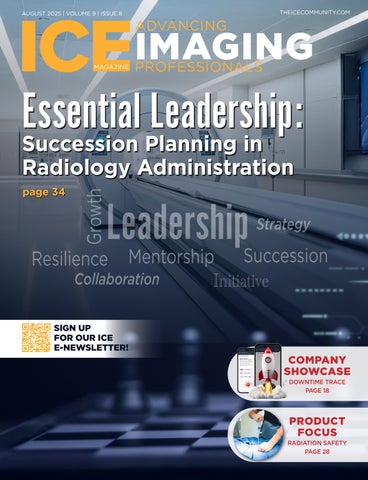
Essential Leadership: Succession Planning in page 34
Growth
Radiology Administration
Leadership
Strategy
Mentorship Succession Collaboration Initiative
Resilience
SIGN UP FOR OUR ICE E-NEWSLETTER!
COMPANY SHOWCASE DOWNTIME TRACE PAGE 18
PRODUCT FOCUS
RADIATION SAFETY PAGE 28
SUPPLYING YOUR
GE AT&AOEC Cables PRICE YOU CAN AFFORD Kenneth Saltrick, President of Engineering Services in Twinsburg, Ohio, knows from his long experience that C-arm machines themselves are absolute workhorses. For customers looking to blend the gap between expensive OEM and unreliable used assemblies, WE have your solution.
1
2
3
Our complete repair contains a new cable assembly, utilizing all OEM cable and components with a harvested plate and connector housing as they are proprietary items. These completely repaired products will have a significant cost savings with build quality above new OEM products and carry a warranty of 180 days, which is untouchable in the market.
Photo 1: 9900, 9800 Interconnect cables, Photo 2: 5435446-01 and 5840677-01 Elite Interconnect cable, Photo 3: 9900, 9800 Receptacle cables
CONTACT US TODAY!
330.425.9279 X.11 | WWW.ENG-SERVICES.COM INFO@ENG-SERVICES.COM
Training The Industry Since 1985
ATTENTION MILITARY
We Offer Career-Ready Training E-TRAINING C I V R E S IMAGING
TRAINING PARTS (ISO CERTIFIED) SUPPORT SERVICES
GI Bill® and DoD Skillbridge approved education center X-Ray Series: Phase 1, Phase 2, Phase 3, and Phase 4. Job placement assistance included.
RSTI won the Tech Choice Award Outstanding Vendor of the Year for 2025
(440) 349-4700 X 1 | registration@rsti-training.com 60 classes offered from Intro to Advanced: rsti-training.com ISO 9001:2015 Certified
(IQC Certificate No. Q-1158)
State of Ohio Reg. No. 93-09-1377T
Outstanding Ve nd or
XperTIS
What is XperTIS? What is Solutions XperTIS? Tri-Imaging introduces a cutting-edge platform that enhances supply chain Tri-Imaging Solutions a cutting-edge that enhancesengineers supply chain management, engineerintroduces performance, and system platform monitoring. It provides with management, engineer performance, and system monitoring. It provides with diagnostic tools and video tutorials, and streamlines parts ordering engineers and tracking. diagnostic tools and video tutorials, minimizes and streamlines parts and tracking. Designed for efficiency, the platform downtime andordering optimizes operations, Designed for standard efficiency, platform minimizes downtime and optimizes operations, setting a new forthe reliability in medical imaging. setting a new standard for reliability in medical imaging.
system
Solutions Solutions XperTIS offers step-by-step repair guidance,
health, engineers in repairs, and XperTISsupports proactively monitors system enhances the supply chain process and by health, supports engineers in repairs,
helping engineers troubleshoot XperTIS offers step-by-step repair efficiently guidance, while ensuring faster, more accurate parts helping engineers troubleshoot efficiently
giving teams access to parts enhances the seamless supply chain process by ordering and order tracking. giving teams seamless access to parts
ordering. This helps uptimeparts and while ensuring faster,maximize more accurate minimize repair costs. maximize uptime and ordering. This helps
ordering and order tracking.
minimize repair costs.
XperTIS
Objectives Objectives proactively monitors
10 Fant Industrial Dr. Madison, Tennessee
www.triimaging.com
10 Fant Industrial Dr. Madison, Tennessee 855.401.4888
www.triimaging.com sales@triimaging.com
855.401.4888
sales@triimaging.com
REVOLUTIONIZING Medical Imaging Equipment Maintenance and Repair Finally, the features you love most about your favorite ride share app, food delivery app, Angi, UpWork, or TaskRabbit are available for medical imaging equipment maintenance and repair. Enter a Trace Ticket with one tap to broadcast your repair needs to a network of qualified technicians. Review Bids to find the best service option for improved repair outcomes with less equipment down time, resulting in a lower overall cost. Track progress, issue payments and rate services all in a single dashboard.
EFFECIENCY MADE EASY for Your Healthcare Teams Speed Instantly blast your service request to every qualified and vetted service provider
Take Control of Tracking
Standardized Communication
Pay Through the App
From response times to uptime, you no longer have to rely on service companies to track their own activities and performance
Like your favorite personal apps, get in-app alerts when a service technician is on their way, arrived, waiting for a part, completed a job, etc.
Competitive bidding among service technicians allows you to get the best price and only pay and track one entity
downtimetrace.com join_the_revolution@downtimetrace.com
FEATURES
42 DIRECTOR’S CUT
34
Growth
As leaders, we need to find the right person for the job, but we also need to find the right job for the person. Sometimes that may take a few tweaks.
Leade
Resilience Mentor Collaboration
COVER STORY
Succession planning is an exercise in human resource management, capital strategy, and institutional memory. It can contribute significantly to the longterm health of an imaging team, department, clinic, or hospital.
10 RISING STAR
Jonathan Subala holds an occupational associate degree in radiography with ARRT certification and post primary certification in MRI.
6
ICEMAGAZINE | AUGUST 2025
ADVANCING THE IMAGING PROFESSIONAL
AUGUST 2025
20 IMAGING NEWS
A look at some of the top news from the imaging world.
ership
Strategy
rship Succession Initiative
28 PRODUCT FOCUS
Imaging safety products for the patient and provider are highlighted in this month’s feature.
48
EMOTIONAL INTELLIGENCE
Don’t let conflict destroy the workplace environment. Use these tips to avoid long-term problems.
THEICECOMMUNITY.COM
ICEMAGAZINE
7
MD Publishing 1155 Senoia Rd, Ste. 200, Tyrone, GA 30290 Phone: 800-906-3373
CONTENTS SPOTLIGHT
10
Rising Star Jonathan Subala
John M. Krieg john@mdpublishing.com
12
In Focus Michelle Brady, BA, CRA, RT (R), (MR)
Vice President
14
Off the Clock Ramin Abrahim, MD
16
ICE Debut Centella
18
Company Showcase Downtime Trace
President
Kristin Leavoy kristin@mdpublishing.com
Vice President of Business Development Jayme McKelvey jayme@mdpublishing.com
Senior Account Manager Megan Cabot megan@mdpublishing.com
Editorial
John Wallace
Editorial Board
Beth Allen David V. Buczkowski Kimberly Love Megan M. Parker Dean Skillicorn Jason Theadore
Senior Sales Executive Emily Hise
Art Department Karlee Gower Taylor Hayes Alicia Brown
NEWS
20
PRODUCTS
24
Director’s Circle Radiology/Imaging Safety Experts
27 28
Market Report Product Focus Radiation Safety
INSIGHTS
38
Leveraging a Business Operations Platform to Boost Revenue Integrity SPONSORED: Health Level
Events
40
DEI Disability Etiquette 101: Every Leader Should Know
Webinars
42
Director’s Cut Passion is Working For Something You Love
45
Cindy Galindo Kennedy Krieg Haley Harris
PACS/IT/AI Automated Radiology
46
Outpatient Imaging in 2025 Ensuring Sustainability While Navigating Declining Reimbursements
Accounting
48
Emotional Intelligence The Dangerous Sound of Silence
50
IAC AND YOU: A QUALITY CONNECTION Coaching for Quality & Patient Safety: A Winning Strategy
52
Medicine for the Soul ‘Veggie Smarts Celebrates Science & Soul of Vegetables
55 56 58
ICE Break
Kristin Leavoy
Linda Hasluem
Digital Department
Diane Costea
ICE Magazine (Vol. 9, Issue #8) August 2025 is published by MD Publishing, 1155 Senoia Rd, Ste. 200, Tyrone, GA 30290. For subscription information visit www. theicecommunity.com. The information and opinions expressed in the articles and advertisements herein are those of the writer and/or advertiser, and not necessarily those of the publisher. Reproduction in whole or in part without written permission is prohibited. © 2025
8
Imaging News A Look at What’s Changing in the Imaging Industry
ICEMAGAZINE | AUGUST 2025
ICEDEX ICE Maker Preferred Vendors ADVANCING THE IMAGING PROFESSIONAL
TIMES CHANGE quality doesn’t Excellence You Can Always Trust
SPOTLIGHT
RISING
STAR
JONATHAN SUBALA, MRI TECHNOLOGIST LEAD
J
onathan Subala holds an occupational associate degree in radiography with ARRT certification and post primary certification in magnetic resonance imaging. His education serves him well as MRI technologist lead with Scripps Clinic John R. Anderson V Medical Pavilion. Q: WHERE DID YOU GROW UP? A: I grew up in a military family. We moved to San Diego, California from Hawaii in 1994 and have been here ever since. Q: WHERE DID YOU RECEIVE YOUR IMAGING TRAINING/ EDUCATION? A: I attended the radiography program at Pima Medical Institute in Chula Vista, California, and earned an associate degree and ARRT certification. I obtained my post primary certification in MRI through an online program from Greenville Technical College, located in South Carolina. Q: HOW DID YOU FIRST DECIDE TO START WORKING IN IMAGING? A: Growing up, I always had a passion for art. My father also worked in radiology as a diagnostic and CT 10
ICEMAGAZINE | AUGUST 2025
ADVANCING THE IMAGING PROFESSIONAL
technologist and I had a visit to the hospital that he worked at when I broke my hand as a teenager. I knew I would pursue radiography when I saw firsthand the art involved in helping others through medical imaging! Q: WHAT IS THE MOST REWARDING ASPECT OF YOUR JOB? A: The most rewarding aspect of my job lies truly in the care of our patients. Providing a calm and soothing environment is essential for obtaining great images as MRI scans can be very difficult for patients, especially for those who are claustrophobic and/or already nervous about what their images might show. Taking the time to explain the procedure in detail, letting patients know what to expect throughout the process, and giving them a chance to ask questions can go a long way. It really is the bright smiles of patients who come out of the scanner calm and relaxed at the end of their exam that is most rewarding. Q: WHAT DO YOU LIKE MOST ABOUT YOUR POSITION? A: I work alongside an exceptional team of MRI technologists and clinicians, and I really enjoy the collaborative effort to find and communicate areas that we can build and improve upon. I like the continuous team building environment most, which ultimately leads to quality patient care. Q: WHAT INTERESTS YOU THE MOST ABOUT THE IMAGING FIELD? A: Coming from an outpatient clinic that specializes in cardiac MRI, I am particularly interested in how developing AI technology can be used to improve cardiac image quality and reduce total scan time. I am also interested in seeing the further development of AI imaging tools to help improve technologist workflow and obtain consistent and accurate imaging planes. Q: WHAT HAS BEEN YOUR GREATEST ACCOMPLISHMENT IN YOUR FIELD THUS FAR? A: I am grateful for the time and effort of those who have passed their knowledge on to me, and I recognize the importance of sharing the wealth of information with others. It has become my personal goal to freely share what I have learned with those who come willing to learn. Becoming a teacher in the field of MRI has been my greatest accomplishment thus far. Throughout my career in MRI, I have successfully trained 17 MRI students. THEICECOMMUNITY.COM
Q: WHAT GOALS DO YOU HAVE FOR YOURSELF IN THE NEXT 5 YEARS? A: I hope to expand on the cardiac program within the Scripps Health system and establish the Anderson Medical Pavilion as the training hub for cardiac MRI. I would also like to build upon our cardiac MRI capabilities with the addition of a cardiac stress MRI program. •
FUN FACTS FAVORITE HOBBY: Playing guitar and ukulele FAVORITE SHOW: “How It’s Made” FAVORITE FOOD: A Filipino dish called Kare Kare FAVORITE VACATION SPOT: Visiting family in Hawaii 1 THING ON YOUR BUCKET LIST: Traveling to Japan with my wife and daughters SOMETHING YOUR CO-WORKERS DON’T KNOW ABOUT YOU: I was in Air Force Junior ROTC for 3 years in high school and presented the California flag in a four-man color guard team.
ICEMAGAZINE
11
SPOTLIGHT
IN FOCUS MICHELLE BRADY, BA, CRA, RT (R), (MR)
A
ssociate Director at Banner Imaging Michelle Brady, BA, CRA, RT (R), (MR), was set to become an accountant until a class assignment opened her eyes to the world of diagnostic imaging. “I originally set out working towards an accounting degree. My English professor assigned us to write a paper on a career that was different than our major of choice. In an effort to just get the paper completed, I reached out to a friend that was an X-ray technologist,” Brady explained. “I interviewed her, researched the job opportunities and was hooked. By the end of the semester, I decided that radiology was far more interesting than accounting.” The decision to enter radiology continues to pay off even today. “I love being a leader,” Brady said when asked why she loves her job.” Having the opportunity to coach and mentor my team is an honor and a privilege. I love sharing knowledge, lessons learned and watching them grow and become successful. It gives 12
ICEMAGAZINE | AUGUST 2025
ADVANCING THE IMAGING PROFESSIONAL
“Strong leaders listen to, understand, support, and set the tone for a culture of trust and continuous growth.” me a sense of fulfillment.” Speaking of leadership, Brady aims to boost those she works with in a variety of ways. “My approach to leadership is rooted in communication, empathy, and accountability. I believe strong leaders listen to understand, support, and set the tone for a culture of trust and continuous growth,” she said. “I aim to lead by example, maintaining high standards for myself, which hopefully empowers others to rise to their potential as well. I value open communication and believe that clear expectations, mutual respect, and honest feedback are essential to building a high performing team.” Her approach is a reflection of how Brady was able to learn and advance her career. “My mentors have helped shaped me by encouraging me to see the bigger picture, not by giving me answers, but by asking powerful questions to challenge my thinking which ultimately leads me to finding solutions and make my own path forward,” Brady said. “I do currently mentor other imaging leaders and find it very challenging and rewarding at the same time.” Brady is also a leader outside of work. “I have been married for 32 years. We have three boys. My husband and my children are my pride and joy,” she explains. “My greatest accomplishment has been raising my three boys alongside my husband and seeing them become happy, thriving adults. I am so proud of them!” •
Q&A 1. What book are you reading currently? I am about to start a book that was referred to me called “Dare to Lead” by Brene’ Brown. 2. Favorite movie? I have several favorites, but “Goodwill Hunting” is definitely one of my top picks. 3. What is something most of your coworkers don’t know about you? Something my coworkers don’t know about it me is I played volleyball, basketball, track, the piano, clarinet, and saxophone and love physical activity; it is fishing that I love the most. It is so peaceful being out on the water, there is nothing like it. 4. Who is your mentor? I have the privilege of working with amazing leaders/mentors daily, but Beth Allen, director of operations for Banner Imaging, has been an incredible mentor. I have great respect for her. She encourages me to seek to understand, gain new perspective, and her experience and vast knowledge in imaging and leadership allows her to guide me through complex situations. 5. What is one thing you do every morning to start your day? I start my day early by having a few moments of meditation and then heading out to the gym at 4:30 a.m. This gets me going for the day and allows me to have done something for myself each day. It is not easy some mornings, but I never regret dragging myself there. Finally, I make my bed every day. This has been a habit since I was a child, and it always makes me feel good by completing at least one task successfully. 6. Best advice you ever received? The best advice I ever received was if you work hard enough you can do anything. There may be others that are more talented than you, but they should never out work you. I played sports throughout high school, and it had a profound effect on my work ethic and personal accountability. 7. Who has had the biggest influence on your life? My biggest influence on my life has been my husband. He has been my biggest supporter. He has encouraged me and cheered me on as I worked hard to reach my goals as a mother and in my career. He has been by my side every step of the way and I am forever grateful for him. 8. What would your superpower be? My superpower would be turning uncertainty into direction. I tend to stay calm under pressure so helping others break things down into small tasks allows them to focus when things get messy. 9. What are your hobbies? I have many hobbies but a few that I enjoy most are decorating, paddleboarding, working out, fishing, hiking, really anything outdoors.
Pictured from left to right are family friend Jordan Folkman, son Tyler Brady, husband Rob Brady, Michelle Brady, son Preston Brady and son Hunter Brady.
THEICECOMMUNITY.COM
10. What is your perfect meal? My idea of a perfect meal isn’t about what’s on the table but who is around it. I love having my family gathered around sharing stories, laughter and just simply being together.
ICEMAGAZINE
13
SPOTLIGHT
Off Clock THE
RAMIN ABRAHIM, MD BY MATT SKOUFALOS
F
or much of his youth, Ramin Abrahim was an only child, and his father encouraged him to occupy those hours making art. From making charcoal drawings in a sketchbook, the boy was given a miniature camera at age 10, which sparked an interest in photography. Abrahim was also a gifted student, skipping a grade in middle school, finishing high school at 17, and completing his undergraduate education at the University of California-Irvine by age 20. At 25, he became the second-youngest in his 150-student graduating class at the Tufts University School of Medicine, and by 32, Abrahim was completing his radiology residency at New York Medical College, a married father to twin boys. Throughout that intensive academic career, his pursuit of painting and photography was burgeoning silently in the background. “While I was in Southern California, my dad bought me a Pentax SLR manual film camera; I played around with that without any training,” Abrahim said. “In my first year of medical school, I met my future wife. She gifted to me a box of oil paint and a bunch of canvases she had used for some class. I was living in a little apartment then, playing with some oil paint, and it just fired up a bunch of emotions and I was really enjoying paint in general.” As Abrahim switched from oil to acrylics, he also expanded his approach to the canvas from realism to abstract interpretation, exploring techniques and styles “at a very low volume, as time allowed,” he said. “During my internship in Sacramento, I was painting, but 14
ICEMAGAZINE | AUGUST 2025
I was working 36-hour shifts every other day; I barely had time to sleep,” he said. “The photography took a back seat, although by 2000-01, when the tiny digital cameras came around, I started picking it up. It was more like snapshots, and I kept on with that for maybe a decade-plus, but the painting kept going.” By the end of 1998, Abrahim had landed work with a private practice, Washington Radiology, in Washington, D.C., with which he would spend the bulk of his career. In his basement home office, an easel was set up next to the PC, and as Abrahim’s personal interest in computing flourished, he realized it could be even more useful in the workplace. By the early 2000s, he had become the physician head of PACS for Washington Radiology, and a leading-edge expert in imaging informatics. All that work intensified the demands of his career by the day, and art remained his personal refuge. “Art for me was the grounding part of life,” Abrahim said. “If I was doing painting or photography, it was a space where mistakes didn’t matter. Nobody was going to sue me. I could be me, and be relaxed, and do what I wanted to, and not be worried.” “It became my sanctuary and remains my sanctuary throughout my career.” The family was struck by tragedy in 2008, when Abrahim’s wife died, unexpectedly, at 43. In his grief, he was plunged into a search for meaning. Abrahim moved from the Washington, D.C. suburbs into the Georgetown neighborhood, his sons went off to college, and he began painting again. Abrahim describes this period of his life as “like a renaissance of sorts.” “I felt a lot of light coming through,” he said. “[My painting] ADVANCING THE IMAGING PROFESSIONAL
became more emotion-based, and it just changed how I practiced. It really impacted how I valued time. I became very focused on capitalizing on my time in the best way possible, whether it’s in relationships, family, friends, travel, or art. I felt compelled to pay more attention to it.” As his work expanded to contain these new insights, Abrahim took his first commission from an art collector. By 2015, he had launched a website for his artwork. His work was featured in exhibitions, and he began selling paintings from California to London. Moreover, Abrahim also began to find greater personal and emotional expression through his art. “Up to 2014, I was painting for myself; I didn’t have any understanding of where it fit,” he said. “I never aspired to be in the business side of things, so whatever happened was coincidental.” “I did a lot of paintings that are emotion-based,” Abrahim said. “Some of them are around enlightenment; some of them are around your feelings. Some of them are around practicing ideas of control and being outside of my comfort zone.” One of these works, “Ascension,” Abrahim describes as his “turning point painting.” At its center is a burning orb, casting flames upwards against a background of narrow, dark spires. He sees it as the depiction of “the first spark to arise from the darkness” on a path to enlightenment. “Pain,” which shows a smoky kanji character set against a crackling red and beige backdrop, was inspired by a back injury sustained during a ski trip. Abrahim said it seeks to understand the power of physical discomfort as a pivotal motivational force. “You come to a fork where you decide, ‘Am I going to change my circumstances or stay in pain?’” he said. Like his painting, Abrahim’s photography shows a similar
Vatical Museum Stairway
THEICECOMMUNITY.COM
patience in its composition, and interest in a variety of subjects, from architecture to the natural world. “I started with landscape [photography] because my father was a mountaineer,” he said. “Since I was traveling, I started mixing in travel photos. Wildlife is what I got into during the [novel coronavirus] pandemic because our practice was shut down to 5-percent capacity.” After shooting monuments, flowers, and reflections of sites around Washington, D.C., Abrahim began seeking “opportunistic shots” in places as far-flung as Havana, Cuba; Pantanal, Brazil; London, England; and Banff, Alberta. He credits an innately strong visual cortex with establishing his appreciation for the beauty of the natural world, and the ability to recognize and recreate patterns of artistry, felt or observed, within it. “Sometimes I pause as I’m reading an MRI, and I zoom in and look at it, and it looks kind of abstract,” Abrahim said. “I have something of a photographic memory, so visual art, imaging, radiology, and photography, it’s all connected.” Moreover, Abrahim said, it’s the interconnectedness of visual metaphor and the underlying discipline of creating and appreciating art that has offered him the catharsis to endure through both personal tragedy and the weight of high-level medical practice. “I think it’s very important for one to put enough priority for things outside of work to make life even more enjoyable and balanced,” he said. “Joy and balancing different degrees of intensity helps for longevity of careers.” “There’s a lot of pressure at work, and it’s good nutrition for the soul to have something that grounds you.” •
Cherry Bossoms at the Basin
The Capitol
ICEMAGAZINE
15
SPOTLIGHT
ICE Debut centellahealthtech.com
I
CE Magazine is excited to introduce Centella in this month’s issue.
Centella is a longtime Siemens Healthineers Advanced Partner, offering sales and service across South Florida. The company recently launched its Health Technology Solutions (HTS) arm – which specializes in multivendor imaging and biomed equipment services and can support all the technology needs of Centella’s healthcare systems customers. HTS is new to the Centella umbrella, but it’s already creating buzz for its responsiveness and hands-on approach. We spoke with Gonzalo Diaz III, CEO of Centella, to learn more about what Centella does, and how it supports radiology teams across the region. Q: WHAT DOES CENTELLA DO, AND WHAT MAKES YOU DIFFERENT? A: We rebranded from Med-Lab to Centella when we realized that healthcare systems in South Florida were struggling to obtain prompt, expert service for their imaging equipment – particularly when they had machines from multiple manufacturers. The direct impact is a delay in diagnosis, which can regularly be life threatening. They were having to work with two, three, or more service vendors, creating a juggling act at the best of times and a fire drill when they experienced unplanned downtimes. HTS is a direct response to that situation. We bring together engineers with experience and certifications across all major imaging equipment manufacturers, meaning we can maintain and service just about anything a hospital or imaging center has on site. And because our engineers are exclusively based in South Florida, we’ve reduced turnaround times to hours, not days. It sounds simple, but that level of speed isn’t the norm in this industry. Q: WHO DO YOU TYPICALLY WORK WITH? A: Mostly hospitals and outpatient imaging centers. A lot 16
ICEMAGAZINE | AUGUST 2025
of the people we work with are directors or managers of imaging departments. We also coordinate with biomedical engineering departments, depending on the healthcare system. Imaging departments are regularly understaffed and have a difficult challenge of maintaining patient throughput with sporadic operational obstacles. If your scanner is down, that’s a backlog of patients and lost revenue, not to mention a clinical disruption. So, it’s not just about fixing equipment. It’s about minimizing downtime and helping teams stay available to meet the needs of our community. Q: WHAT ARE YOUR GOALS FOR THE NEAR FUTURE? A: Right now, it’s mostly about growing without compromising quality. We’ve had more and more facilities reaching out to us for service coverage, so we’re adding more engineers, tightening up logistics, and making sure our identity to the community is not diluted. We’ve also been working on ways to keep customers informed with timely and valuable information. For example, giving customers better visibility into what’s been done on a system or when the next PM is due. That’s the kind of thing that helps build trust and makes service less of a headache. Q: ANYTHING ELSE YOU WANT ICE READERS TO KNOW? A: Just that we want to be valuable members of the healthcare community; their lives aren’t easy, but if they can focus more time on patient interaction (rather than on broken equipment) then everyone involved has a better experience and outcome. We can’t help the patients, but we can manage and resolve your technical problems. We want to be where you need us when you need us and see if we can exceed your expectations. If you’re in South Florida and looking for more than help, but a reliable and responsive service partner, please reach out. • For more information, visit centellahealthtech.com.
ADVANCING THE IMAGING PROFESSIONAL
NEW
!
The manufacturers listed are the holders of their respective names and/or trademarks, and are not to be taken as an endorsement or affiliation with AIV, Inc.
807A 807A 811C
SPOTLIGHT
R
18
iding on the coattails of your favorite ride-share apps, food-delivery apps, home-task apps, and Amazon ... Downtime Trace is a mobile app that instantly connects healthcare providers with all medical equipment maintenance and repair options for the specific make and model of equipment requiring service.
To pay their success forward, the brothers raised investment money and tapped into their unique experience in the niche medical equipment maintenance and repair field to make jobs and lives better for these wonderful “Humans of Healthcare” that poured into them early in their careers.
Q: WHAT’S YOU STORY, WHY DOES DOWNTIME TRACE EXIST? A: Early in their careers, hospital executives and frontline workers poured into two brothers, Jason and Danny Mobley, the founders of Downtime Trace. Jason had the idea many years ago when he was working as a biomed department manager while also delivering pizzas, working as a Lyft driver, and other side-hustle jobs in the evenings to make ends meet. While working his side-hustle jobs, his hospital would call for after-hours service and pay thousands per hour to outside vendors for equipment Jason could fix himself. He thought ... if only the hospital knew people like him (with the proper skill set and experience to work on their equipment) were available and open to work, and if these competent technicians could somehow know that hospitals were in need of service. His idea was to use the Lyft, Uber, Domino’s, Amazon, and DoorDash model to instantly match a hospital’s need for medical equipment maintenance and repairs with all of the vetted and available service options.
Q: WHAT DOES YOUR MOBILE APP DO TO HELP MAKE MEDICAL IMAGING EQUIPMENT MAINTENANCE AND REPAIR BETTER THAN A HEALTHCARE PROVIDER’S CURRENT PRACTICES? A: Downtime Trace uses a web-based and mobile app technology to instantly connect a healthcare provider to all available service options, at once, and facilitates a bid from every service option that has the competency to service the specific make/model, giving the healthcare entity the data to choose which option is best suited for every service event ... all at their fingertips and on their smartphones. The web portal and mobile app showcases all three types of service providers – ISOs (independent service organizations), OEMs (original equipment manufacturers), and introducing “gig technicians” – in a familiar Yelp, LinkedIn, and Facebook-style profile to make it easy for healthcare providers to see; pictures and videos of service technicians, technical competency scoring and experience on specific makes/models, and ratings and reviews. With a single press of a button, our technology BLASTs a healthcare provider’s service request (known as a “Trace
ICEMAGAZINE | AUGUST 2025
ADVANCING THE IMAGING PROFESSIONAL
COMPANY SHOWCASE
Ticket”) to all pre-matched service provider options. Downtime Trace app notifications look just like the notifications/alerts you receive on your favorite mobile apps. Only vetted service options that are pre-matched by make/model receive the BLASTs and return bids (in a standard bid format) that contain the following: • WHAT they estimate the problem/solution likely is, WHEN they can begin service (estimated onsite arrival time), and HOW MUCH they will charge. Providers choose a bid based on the service option’s profile, availability, response time, price, etc.
Finally, like AirBnB receives payment from the buyers/ renters and pays the home owners, and like food-delivery apps receive payments from the customers through their app and distribute payments to their delivery drivers, restaurants, and stores, Downtime Trace technology serves as the trusted, single-point of payment for healthcare providers. We receive approved payments and quickly distribute the payments to the service labor and parts entities (within days, not weeks or months). We track all service expenses in the app to allow providers access to their historic spend on any asset, like seeing past rides on Uber. Q: HOW DOES YOUR COMPANY STAND OUT IN THE IMAGING SPACE? A: Downtime Trace pays the service options really fast and keeps it simple for providers, which should stand out quite-a-bit compared to the 60 to 120 days it takes healthcare institutions to pay. We piggy-back off of mobile app technology that has been around for 10+ years to give healthcare provider’s visibility of and easy access to service options that already exist. We actually have the audacity to try something new that might create more service options for healthcare by making the service options easy to find, easy to get connected to, paying them more, and paying them fast. Our technology stands out most for speedy and easy access to all of the imaging equipment service options and for the savings that naturally come with competition, but I hope we also stand out to the radiology technologists and staff for the fact that we set a single standard that makes their jobs easier THEICECOMMUNITY.COM
and lessens their anxiety when their equipment breaks. Q: HOW CAN A SINGLE STANDARD MAKES THEIR JOBS EASIER? A: When a healthcare provider chooses Downtime Trace over the current and antiquated methods for ordering and tracking service, it signals their desire for a single standard of service that is far less complicated for their staff than learning hundreds of different policies from hundreds of different service vendors. Providers can easily access, see on their phones, and measure the following relevant service data: response time, downtime/uptime, performance against repair estimates, ratings/reviews of service technicians, and financial information. Q: WHAT IS ON THE HORIZON FOR YOUR COMPANY? DO YOU HAVE ANY GOALS YOU WOULD LIKE TO ACHIEVE IN THE NEAR FUTURE? A: Downtime Trace has launched! So that’s pretty big for us, but we are especially excited for the gig service technicians and independent service organizations that are getting opportunities to earn supplemental income and some flexibility (choice of which jobs they want to bid on). A healthy Downtime Trace means we have created more income or freedom for imaging service technicians and companies while saving the healthcare providers more than 30% of their current spend on imaging equipment maintenance and repairs. Q: IS THERE ANYTHING ELSE YOU WOULD LIKE ICE MAGAZINE READERS TO KNOW? A: Consider that the best things often seem to be the simplest, and that this technology is a baby-step towards the AI that is coming. Our team cannot believe that no one else has brought this idea to market yet. It has been percolating for many years and we know how fortunate we are that the stars have aligned in a way that has allowed us to build this helpful tool. We feel extremely accountable to the service technicians and healthcare providers to make sure it gets to market and utilized. It likely won’t be easy, and it will require providers to have a little bit of courage, but it can easily work. Kindly also visit us at DowntimeTrace.com and on YouTube, where we have created commercials and some videos that give an overview of what Downtime Trace is, how you can describe it to others, how service technicians interface with the app, and how healthcare providers interface with the app. ICEMAGAZINE
19
NEWS
Imaging News A LOOK AT WHAT’S CHANGING IN THE IMAGING INDUSTRY
MIRION MEDICAL DEBUTS NEW SOLUTIONS Mirion – a global leader in radiation safety, science, and medicine – showcased its portfolio of solutions designed to enable the radiopharma and theranostic fields at the 2025 Society of Nuclear Medicine and Molecular Imaging (SNMMI) Annual Meeting. New products from Capintec and Dosimetry Services were introduced alongside innovations from the broader Mirion portfolio, including the ec2 Software suite and advances from Mirion Technologies.
Debuting at the 2025 SNMMI Annual Meeting were: • Graves Phantom from Capintec: The Graves Phantom is a groundbreaking, solution for enabling precise dosimetry in radiopharmaceutical therapy (RPT). Designed as a 20cm tissue-equivalent phantom, it supports the calibration of SPECT systems per radioisotope and allows for accurate sensitivity factor measurements under realistic scatter conditions, enabling reliable and reproducible RPT workflows. • InstadoseVUE Beta Dosimeter from Dosimetry Services: The only hybrid wireless dosimeter designed for theranostic applications, the InstadoseVUE Beta device tracks and measures radiation exposure, ensuring the safety of medical staff in environments where beta radiation is present. The InstadoseVUE Beta is the latest model in the InstadoseVUE line of wireless dosimeters for radiation monitoring of personnel. Additional featured solutions included: • ec2 Software Suite: ec2 Software provides software to simplify workflows, support regulatory compliance, and drive operational efficiency for stakeholders across the nuclear medicine, molecular imaging and radiopharmaceutical fields.
20
ICEMAGAZINE | AUGUST 2025
• Apex-Guard Software: From Mirion Technologies, the newest version of Apex-Guard software includes a robust impurity analysis feature and patent-pending algorithm for gamma spectroscopy measurements, which simplifies radioisotope production quality management, boosts confidence in radioisotope safety, and aids in regulatory compliance. The software integrates with BioTrax QMS, improving workflow efficiency and data integrity. • Portable and Mobile Radiation Monitoring: New solutions from Mirion Technologies include the CSPevo Probe and RDS-Med Survey Meter for comprehensive, portable radiation survey monitoring and the IC3 Portable Ion Chamber Survey Meter for measuring gamma, beta and X-ray radiation. In addition, the iCAM Mobile Alpha/Beta Particulate Monitor for reliable monitoring of airborne activity will be on hand. “As the nuclear medicine and molecular imaging landscape evolves, Mirion is committed to leveraging our deep expertise in ionizing radiation to serve our customers and ensure safe, efficient operations at every step,” said Luis Rivera, executive vice president of Mirion Medical. “From research to production to patient care, Mirion Medical and Mirion Technologies alike are developing solutions to drive higher quality. We look forward to demonstrating how these solutions can shape a more connected future.”
ADVANCING THE IMAGING PROFESSIONAL
SIEMENS HEALTHINEERS ANNOUNCES THERANOSTICS RESEARCH COLLABORATION Siemens Healthineers Molecular Imaging has entered into a research collaboration with leading healthcare institution Massachusetts General Hospital (MGH) to support the use of theranostics. The ability to diagnose disease with one radiopharmaceutical and treat it with a similar therapeutic agent, theranostics has been used to treat certain types of cancer, including thyroid cancer, prostate cancer, and neuroendocrine cancer. Typically, molecular imaging is used in theranostics to identify the extent of disease and monitor treatment response. Siemens Healthineers and MGH will establish a Therapy Command Center to support the use of theranostics across MGH and its affiliated centers in Massachusetts, Maine, and New Hampshire. The Therapy Command Center will help MGH collect theranostics-related data, provide realtime monitoring capabilities, and support physicians in determining the most appropriate path forward for each patient. “This research collaboration, which is based on a relationship between Siemens Healthineers and Massachusetts General Hospital that spans more than 20 years, will enable innovations along the patient’s clinical pathway, provide precision diagnoses, and deliver highly effective forms of customized therapy,” said James
Williams, Ph.D., head of Siemens Healthineers Molecular Imaging. “The Therapy Command Center helps provide a framework that will enable the integration of a wide variety of patient imaging and laboratory data, combined with population-based data for enhanced individual patient outcomes,” said Umar Mahmood, MD, Ph.D., chief of nuclear medicine and molecular imaging, Massachusetts General Hospital. “This collaboration will help expand theranostics across the region, advancing personalized medicine through precision diagnoses and tailored therapies. Our focus on examining radiation’s impact on tumors and normal tissues will further improve treatment protocols and outcomes while decreasing toxicity to normal organs.” As part of this collaboration, Siemens Healthineers and MGH researchers will use Biograph Vision Quadra and Biograph Trinion positron emission tomography/computed tomography (PET/CT) scanners to examine the effects of radiation on molecular and biological processes, as well as the toxicity levels in the cancer cells and healthy tissues of patients who receive radiopharmaceutical therapy. Understanding these effects is crucial to advancing the concept of personalized medicine.
Imaging Chain issues with your GE Legacy or Precision-500 R/F systems? Upgrade system with Insight DRF Enhanced - New Windows 10 Platform with Dynamic Digital DR Panel - Eliminates the OEM Saturn Windows 95 Platform - Dose Reduction - HIPAA Compliant, 510k approved. - Fluoroscopy digital recording loops for MBS studies - Upgrade Provided to your Proven R/F System in 4 days. - Complete Refurbished Systems Available
R A D O N M E D I C A L I M AG I N G .CO M BRIAN.CARLOCK@PREMIERIMS.COM
THEICECOMMUNITY.COM
|
800.722.1991
ICEMAGAZINE
21
NEWS BAYER FILES FOR APPROVAL OF GADOQUATRANE Bayer has announced the submission of a New Drug Application (NDA) to the U.S. Food and Drug Administration (FDA) for its investigational contrast agent gadoquatrane for contrast-enhanced magnetic resonance imaging of the CNS and other body regions in adults and pediatric patients including term neonates. The submitted dose is 0.04 mmol gadolinium per kilogram body weight. If approved, gadoquatrane would become the lowest dose macrocyclic GBCA available in the U.S., corresponding to a 60 percent reduction compared to macrocyclic GBCAs dosed at 0.1 mmol Gd/kg body weight. The submission of gadoquatrane to the FDA is based on positive data from the pivotal Phase III QUANTI studies evaluating the efficacy and safety of gadoquatrane in adult and pediatric patients globally. The first results from the Phase III QUANTI CNS study were presented at the European Congress of Radiology (ECR) in February of this year and further results are planned to be presented at upcoming scientific meetings. Nearly 40 million MRI scans are performed each year in the United States. “There is a rising need for medical imaging, among
others driven by the increasing incidence of chronic diseases such as cancer and cardiovascular diseases,” said Dr. Konstanze Diefenbach, head of radiology research and development with Bayer. “As a leader in radiology, we are committed to advancing innovation in this field, including options to reduce the gadolinium dose. Patients can benefit from a dose reduction, especially patients with chronic conditions who require multiple contrast-enhanced MRI examinations during their lifetime. This is in line with guidance from health authorities and guidelines from scientific bodies which recommend using the lowest dose required to obtain the needed clinical information.” Bayer recently announced the submission of gadoquatrane to the Ministry of Health, Labour, and Welfare (MHLW) in Japan, marking the first application for marketing authorization for the investigational contrast agent. Further regulatory applications to health authorities worldwide are planned for the coming months.
Simplifying The Imaging Equipment Ownership Experience Image One Medical is the only Engineer-Owned medical equipment service group that is fully dedicated to Florida’s amazing base of Imaging Centers, Hospitals, and Cancer Treatment Centers. We have a mission: Self perform on every aspect of our business. Specialize on specific modalities: Pet CT, CT & MRI, and Focus in a key geographic region. Fort Myers I Fort Lauderdale I Tampa I Orlando FLORIDA BASED Dealer and servicer of PET CT, CT and nuclear medicine • Equipment service: full coverage plans • Equipment sales: installation, relocation and project management • Mobile coach construction, refurbishment, maintenance and management
877.304.8999 22
ICEMAGAZINE | AUGUST 2025
OUR EXPERTISE • Self performing team of in-house engineers • High level problem solving for Siemens and GE PET CT, CT and nuclear medicine • In-house inventory of 40+ systems and parts for repair • 24 hour service with quick uptime guarantee
www.Image1Group.com ADVANCING THE IMAGING PROFESSIONAL
RICHARDSON HEALTHCARE IS NOW DIRECTMED IMAGING The acquisition is complete, and Richardson Healthcare has officially rebranded as DirectMed Imaging. This marks a major milestone in the diagnostic imaging industry, combining decades of experience, inventory, and innovation under one name – DirectMed Imaging – to serve its customers better than before. In early 2025, DirectMed Imaging acquired Richardson Healthcare, investing deeply in expanding its Canon/ Toshiba capabilities, X-ray tube offerings, and training resources. Now, with the rebrand and integration complete, Richardson’s expertise in CT parts, tube repair, and engineer training is fully integrated into DirectMed’s operations. This acquisition supports DirectMed Imaging’s goal to deliver the most reliable, responsive, and comprehensive
support for the diagnostic imaging community worldwide, according to a news release. The release adds that DirectMed Imaging now offers: • The world’s largest Canon/Toshiba aftermarket parts inventory • Exclusive global distribution of ALTA750D and ALTA750G CT X-ray tubes • Repaired Siemens Straton Z CT tube distribution • Expanded training programs for Canon/Toshiba CT platforms Additionally, the same Toshiba representative will continue to be attached to each customer’s relationship with DirectMed Imaging moving forward. Effective immediately, customers have a team supporting ongoing parts, systems, and training needs. •
GE HEALTHCARE EXPANDS BKPORTFOLIO GE HealthCare recently announced the launch of the bkActiv S series, representing the next era of intraoperative ultrasound. The bkActiv S series is part of the bkPortfolio family of Active Imaging systems, designed to provide interventional guidance during urology, colorectal and pelvic floor procedures. The bkActiv S series empowers clinicians with precise ultrasound guidance, enabling clear visualization of anatomical structures to support confident, real-time decision-making and better patient outcomes. The system also delivers exceptional imaging quality, an intuitive, modern interface, and Prostate Volume Assist (PVA) – an artificial intelligence (AI)-driven feature that automates processes, streamlines workflows and elevates the user experience. “At GE HealthCare, our surgical visualization and guidance team is committed to advancing technologies that make a significant difference in the surgical environment and meet the evolving needs of our customers,” said Matthijs Groot Wassink, general manager, surgical innovations at GE HealthCare. “The bkActiv S system will help support clinicians across a wide range of procedures – including prostate diagnostics, biopsy, and treatment guidance – and reflects our focus on helping navigate increasingly complex surgical procedures with greater precision.” The bkActiv S series includes a modern touch interface with TruSense technology and customizable options, allowing users to personalize their preferred layout for efficiency. In addition, Smart Button transducer technology gives users the option to select from a variety of functionalities to elevate user control and flexibility to
THEICECOMMUNITY.COM
utilize the system with one hand. Clinicians can capture images with remarkable resolution, while smart digital tools help improve contrast and detail resolution with a range of high-performance transducers. The system’s Image Compare mode helps clinicians retrieve a stored image and view alongside a live ultrasound image, facilitating realtime comparisons and measurements. The bkActiv S series also integrates PRISM Technology – which includes the TruFocus algorithm for autooptimization of images for exceptional detail and clarity. Adaptive Noise Suppression reduces noise, enabling deeper visualization without haziness and automatically adjusting gain levels during imaging. In addition, AI-based software PVA can enhance the user experience and save time, automating prostate measurements with one click. Not all products or features are available in all markets. Please visit gehealthcare.com for details.
ICEMAGAZINE
23
PRODUCTS
DIRECTOR’S
CIRCLE
S
afety is an important aspect of healthcare delivery and that includes the safety of the patients, providers and everyone involved. ICE Magazine contacted several radiology/imaging safety experts to participate in this roundtable-type article. Three leaders in radiology and imaging safety agreed to share their expert insights with the ICE Magazine community. Participants include: • RAD-Planning & Gilk Radiology Consultants Principal Tobias Gilk, MRSO, MRSE; • AdventHealth Clinical Director at AdventHealth Imaging Center Cory Whitehouse;and • Scripps Health Director of Medical Physics & Radiation Safety Stephen Steuterman. Q: WHAT ARE THE MOST PRESSING SAFETY CONCERNS CURRENTLY FACING YOUR RADIOLOGY DEPARTMENT OR IMAGING CENTER, AND HOW ARE YOU ADDRESSING THEM? Gilk: For better or worse, I’m not “in the trenches” at a hospital, but instead am trying to wrestle with a number of the “big picture” issues related to safety. Perhaps my biggest concern of this moment is the severe strain that I see in MRI services, everywhere: cost reductions, throughput increases, smaller workforces, and increased patient complexities. In my corner of radiology, MRI, where there are no meaningful minimum safety requirements, this often means that safety efforts get “shortcut,” imperiling patients and staff, alike. Whitehouse: We just changed to virtual supervision of contrast administration. It has been a journey. We are now seeing great success but starting the program was very unsettling for clinical staff. We implemented an
24
ICEMAGAZINE | AUGUST 2025
education process as well. The soft go live really helped elevate concerns while we started the program at sites. Steuterman: A primary focus for us remains on balancing image quality with radiation dose reduction, particularly in CT imaging, where minimizing exposure without compromising diagnostic image quality is critical. To address this, we require the use of procedure protocols and leverage tools such as the ACR Appropriateness Criteria to help ensure imaging is necessary and appropriate. In MRI, safety continues to be a top priority due to the complexity of screening for ferromagnetic implants, pacemakers, neurostimulators, and other devices. We maintain strict screening protocols and ongoing staff education to mitigate these risks. Q: HOW DOES YOUR FACILITY ENSURE COMPLIANCE WITH RADIATION DOSE MONITORING AND DOSE REDUCTION PROTOCOLS FOR PATIENTS AND STAFF? Gilk: I know you didn’t mean it this way, but I actually had to chuckle when you used “compliance” and I was thinking about MRI safety. If you were looking strictly at mandatory compliance (not what we ought to do, but what someone makes us do), then there functionally is no MRI safety compliance … because there are no MRI safety minimums. Whitehouse: We have the dose monitoring program Radametrics. We stay in compliance with radiation monitoring with our radiation physics team. They help us stay compliant in monitoring and advising our staff. We also have a radiation safety monitoring course the staff completes yearly in our online learning.
ADVANCING THE IMAGING PROFESSIONAL
TOBIAS GILK
RAD-PLANNING & GILK RADIOLOGY CONSULTANTS
CORY WHITEHOUSE ADVENTHEALTH
Steuterman: We maintain a robust radiation safety and dosimetry program for our staff, including initial and annual training that emphasizes correct dosimeter usage, timely badge exchange, and adherence to safety protocols. For patients, we utilize advanced dose monitoring software to track radiation exposure, particularly for CT and fluoroscopy. The software includes dose alerts customized by modality and exam type. This allows us to compare data across facilities, assess trends and optimize protocols. Additionally, we hold bimonthly multidisciplinary meetings with imaging administration, radiologists, modality leaders, supervisors, and our medical physicist. These meetings cover equipment updates, regulatory changes, workflow reviews, and protocol evaluations, ensuring a continuous cycle of quality improvement and safety compliance. Q: CAN YOU DESCRIBE YOUR PROCESS FOR CREDENTIALING AND ONGOING TRAINING RELATED TO IMAGING SAFETY, ESPECIALLY WITH MODALITIES LIKE CT, MRI, AND FLUOROSCOPY? Gilk: This is one of the bright spots in MRI safety. We’ve had radiation safety officers (RSOs) for forever, and over the past decade we’re beginning to see facilities adopt MRI safety officers (MRSOs)! At the moment, this role is not explicitly required by state licensure, or accreditation organizations, or CMS Conditions of Participation, but there are now thousands of trained and credentialed MRSOs across the country and around the world! This level of knowledge is well beyond what MRI techs are exposed to in their training programs, and can often improve a provider’s safety and patient access to MRI exams. There are a number of different MRI safety training seminars and courses, but there’s only a single credentialling group, the ABMRS and their certifications for MRSOs, as well as physicians (MRMDs) and medical physicists (MRSEs). Whitehouse: The staff has radiation safety training yearly to those modalities. Our physics team works with the state for credentialing. THEICECOMMUNITY.COM
STEPHEN STEUTERMAN SCRIPPS HEALTH DIRECTOR
Steuterman: All imaging staff are required to hold the appropriate state licenses and certifications upon hire, which are closely monitored for timely renewal. This process is managed collaboratively between human resources and imaging leadership. Staff receive both initial and annual safety training, tailored to their specific modalities. Our radiation safety program includes general safety principles followed by modality-specific sections, including CT, fluoroscopy, mammography and nuclear medicine. This structured training ensures staff are up to date with the latest safety standards and best practices in each area. Q: WHAT STRATEGIES OR TECHNOLOGIES CAN BE IMPLEMENTED TO IMPROVE PATIENT SAFETY AND REDUCE THE RISK OF ADVERSE EVENTS DURING IMAGING PROCEDURES? Gilk: Oh, how I wish I could waive a magic wand and get CMS to accept, adopt, and embrace MRI safety best practices as minimum standards. But if I were king for the day, I’d require all hospitals and imaging centers to have appointed MRSOs, and all radiology practices to have MRMDs. I think having a clearly delineated line of responsibility/authority for MRI safety might be the single best thing that we could do to improve safety conditions. I think without effective governance structures, many of the tools or technologies that I might suggest (and that we really need) would be far less effective. Whitehouse: Creating a culture of education and not being punitive. The staff takes classes in our online training program to speak up when necessary. We also utilize a safety culture survey that helps us identify possible safety issues or cultures that are not conducive to safety. Steuterman: Patient safety begins with proper identification. Staff are trained to verify multiple identifiers, such as full name, date of birth, and medical record number, to prevent misidentification. We also ICEMAGAZINE
25
PRODUCTS
perform daily pre-exam order reviews to ensure the exam matches the clinical history and is appropriate. This gives us time to consult with radiologists or referring providers if clarification is needed. During scheduling, patients complete pre-screening questionnaires relevant to the modality, such as allergies for contrast studies or metal screening for MRI. These are reviewed again at the time of the exam. These multiple checks significantly reduce any risk of adverse events. Q: HOW CAN ONE FOSTER A CULTURE OF SAFETY AND ENCOURAGE INCIDENT REPORTING, FEEDBACK, AND CONTINUOUS IMPROVEMENT WITHIN YOUR IMAGING TEAM? Gilk: Oh, now you’ve touched a nerve! In MRI the existing incident reporting structure is so convoluted and confusing that – further motivated by shame and embarrassment – MRI accidents are concealed and suppressed with alarming frequency. I have a citizen’s petition to the FDA to modestly improve one part of MRI accident reporting (https://www.regulations. gov/document/FDA-2025-P-1100-0001). But to make a big difference, I would encourage everyone to share accidents and near misses with an MRI-specific adverse incident reporting system that I’m a partner in establishing: CAIREreporting.org. Whitehouse: We try to foster a culture where the staff feels comfortable with leadership enough to speak up about their concerns. If they are empowered to seek out leadership, and know it will be a positive experience, they will be more likely to do so. Steuterman: We actively promote a culture of transparency and non-punitive reporting. Staff are encouraged to report any safety concerns using an online portal or call center, both of which can be accessed anonymously. We also run routine quality assurance (QA) reviews where one site evaluates a set number of exams from another location. These audits assess image quality, documentation, positioning and artifacts. Findings are shared with staff and used for continuous improvement. As the medical physicist, I maintain regular informal and formal touchpoints with staff, encouraging them to bring forward safety,
26
ICEMAGAZINE | AUGUST 2025
equipment or workflow concerns confidentially. The goal is to build trust and reinforce that safety is a shared responsibility. Q: LOOKING AHEAD, WHAT INNOVATIONS OR CHANGES IN POLICY DO YOU BELIEVE WILL HAVE THE GREATEST IMPACT ON IMAGING SAFETY OVER THE NEXT 3-5 YEARS? Gilk: I don’t want to sound like Debbie Downer, but I think the greatest impact to MRI safety in the near term will likely be complacency, and it won’t help us. I don’t see any serious or institutional approaches to improving MRI safety on the near horizon. My fear is that we’ll continue a slow slide into greater and greater risk. Absent a changemaker in a national structure, or – God forbid – another high-profile MRI fatality, I think everyone working towards improving MRI safety has signed on to be Sisyphus for a while longer. Whitehouse: I think we must leverage technology in all ways to better protect our patients. There are constantly new ways emerging to keep patients safe from MRI, safer ways we can better screen our patients. To leveraging technology like Volpara in MA to better diagnose cancer via mammograms and utilizing CAD to help us with MRI breast exams, we can keep our patients safe and produce the best outcomes for them. Also, since we went to virtual supervision of contrast, we have noticed that more instant support when we have contrast reactions because the radiologists are much easier to get in touch with. They are just a touch away. This is just a few instances where we have leveraged technology to keep our patients safe and create a culture of safety; and produce the best outcomes for our patients. Steuterman: Technological advances are improving imaging safety. New CT innovations such as photoncounting detectors offer lower doses with enhanced image quality. In MRI, hardware and software improvements are shortening scan times and reducing contrast requirements. Additionally, AI is playing a growing role in supporting radiologist workflows. These innovations collectively can be safer, faster and more efficient imaging in the years ahead. •
ADVANCING THE IMAGING PROFESSIONAL
PRODUCTS
Market Report Safety Market Growth Continues
STAFF REPORT
T
he U.S. diagnostic imaging services market was valued at $122.41 billion in 2022 and is projected to grow to $206.84 billion by 2030, according to Fortune Business Insights. This growth in diagnostic imaging is driving expansion in the radiation and imaging safety sectors. The global medical radiation detection market is projected to increase from $1.26 billion in 2024 to $1.89 billion by 2029, with a compound annual growth rate (CAGR) of 8.5%, according to MarketsandMarkets. “This growth is fueled by increasing awareness of radiation hazards, stringent regulations, and a rising incidence of cancer, which amplifies the demand for effective radiation therapy and safety measures,” the report states. “The market, dominated by personal dosimeters and gas-filled detectors, faces challenges such as a shortage of skilled professionals and high raw material costs, particularly for lead.” Despite these challenges, government initiatives and public health campaigns are spurring investments in advanced detection technologies. Companies such as Mirion Technologies and Thermo Fisher Scientific are creating innovations that improve monitoring accuracy in health care environments. While North America currently dominates the market, the Asia-Pacific region is emerging as a key growth area because of improving health care infrastructure and increased awareness of radiation safety. THEICECOMMUNITY.COM
Personal dosimeters held the largest share of the medical radiation detection and monitoring market in 2023. This dominance is attributed to rising demand among health care workers who are increasingly aware of the risks associated with radiation exposure. New developments, such as digital dosimeters with real-time monitoring capabilities, improved accuracy, and easier data management, are further driving adoption. In the radiation safety products segment, full-body protection gear held the largest market share in 2023, according to MarketsandMarkets. “This growth is driven by increased awareness of radiation exposure risks and heightened concern for protecting health care workers and patients,” the report notes. “Regulatory agencies worldwide are enforcing stricter safety guidelines in medical settings. Meanwhile, innovations in protective materials – such as lightweight, lead-free options – have made full-body protection more comfortable and practical without compromising safety.” ResearchAndMarkets.com reports similar trends. According to its data, the global radiation detection, monitoring, and safety market is expected to grow to $4.4 billion by 2029. “This expansion is fueled by growing defense budgets, a rising global cancer burden, heightened safety awareness, increased use of PET and CT imaging, and the widespread application of nuclear medicine and radiation therapy,” the report states. •
ICEMAGAZINE
27
PRODUCTS
Product Focus RADIATION SAFETY
1
BURLINGTON MEDICAL BAT
BAT reduces the risk of breast cancer and other radiationassociated cancers in health care workers. BAT reduces radiation to the upper outer quadrant of the breast by over 97%, as well as decreasing exposure to the thyroid, chest and spine. BAT is a lightweight garment that can be worn with any radio-protective apron, with no attachments needed. With over two million radiation health care workers worldwide, it addresses the critical gaps in radiation protection often overlooked by conventional aprons. BAT was developed by Dr. Lauren Ramsey, a breast surgical oncologist who lost a friend and colleague to breast cancer and believed her occupational exposure to radiation may have played a role.
*Disclaimer: Products are listed in no particular order.
28
ICEMAGAZINE | AUGUST 2025
ADVANCING THE IMAGING PROFESSIONAL
2
MARSHIELD
Leaded Acrylic and Glass Leaded acrylic and leaded glass are excellent options for many shielding requirements. Acrylic is shatter-resistant and versatile. It contains 30% lead by weight, combining superb light transmission with effective radiation protection. The clear view Lead Safety Glass is thinner than acrylic and is also resistant to complete breakage and comes in multiple size variations up to 54” x 108”. Acrylic and lead safety glass can be used in a variety of applications such as X-ray room widows, mobile testing machines, modular rooms, laboratory testing facilities and modular rolling barriers. MarShield supplies leaded acrylic and lead glass in any size or thickness required.
RAYSAFE X2
The RaySafe X2 is built to make quality assurance of X-ray machines fast, accurate, and remarkably user-friendly. With its built-in display, it functions as a stand-alone system – no PC needed during measurements. Just power on, place the sensor, and start testing – no setup, no waiting. Designed for flexibility, the X2 offers Bluetooth connectivity for wireless use and Ethernet or USB options when a wired connection is preferred. One system covers all your needs with dedicated, highaccuracy sensors for radiography, fluoroscopy, CT, mammography, and dental. It also supports light measurements for display brightness checks and survey applications for measuring scattered radiation – making it a true all-in-one QA solution. Smart accessories simplify positioning and alignment, while the system’s intuitive interface reduces training time and user error. From fast startup to consistent results, the RaySafe X2 brings clarity and control to every QA session – so you can focus on safety, not setup. Explore the details: http://bit.ly/44K80vF
THEICECOMMUNITY.COM
3 ICEMAGAZINE
29
4
PRODUCTS MRIEQUIP
MR Safe and MR Conditional Medical Equipment MRIequip is a trusted provider of MR safe and MR Conditional Medical Equipment. It offers a range of high-quality, non-magnetic products designed for use in MR environments, ensuring patient and staff safety. All products that leave MRIequip’s warehouse are double checked with a magnet or Ferromagnetic Detection System to assure safety in rooms with MR Systems. Product highlights include: • Non-Magnetic Stretcher with Fowler Crank Assembly: This stretcher is designed with non-magnetic materials and offers an adjustable backrest via the Fowler crank for enhanced patient comfort. Its durable design ensures safe use around MRI machines without compromising imaging quality. • Non-Magnetic MRI Wheelchair: This wheelchair is MR conditional, constructed with non-magnetic materials, and equipped with a reliable braking system. Its lightweight design makes it easy to maneuver while ensuring no interference with MR systems. Offered in a variety of sizes. • MRI Stainless Steel Non-Magnetic IV Pole: This IV pole is made of nonmagnetic stainless steel, offering adjustable height and stability for MRI use. It is designed to be safe, sturdy, and adaptable in MRI settings. •
In December 2025, we will announce the eight imaging directors or managers selected by our ICE audience for their outstanding contributions.
New England Mideast Great Lakes Plains
Southeast Southwest Rocky Mountains Far West
Scan the QR code to VOTE NOW!
Voting Opens
AUGUST 1ST
30
ICEMAGAZINE | AUGUST 2025
ADVANCING THE IMAGING PROFESSIONAL
Prove Your Excellence in Medical Imaging Leadership Earn Your Certified Radiology Administrator (CRA) Credential The CRA is the gold standard for imaging leaders. This certification validates the key skills, knowledge, and expertise essential for success in medical imaging administration. By earning your CRA, you not only demonstrate your commitment to quality and value, but you also set yourself apart in an increasingly competitive field.
89%
of CRAs recommend the certification to others — because no one ever regrets earning it.
Take the next step in your career. Learn more and apply!
ICE MAGAZ • A niche job board for the HTM and imaging communities powered by TechNation.
• 3,500+ actively looking biomedical and imaging professionals.
» Completely free and confidential registration and application process.
Breaking News:
THE FUTURE OF HTM JOBS IS HERE.
ICE MAGAZ htmjobs@mdpublishing.com for posting inquiries htmjobs.com to register today
ZINE NEWS • The fastest growing HTM talent network in the country.
• 350+ open opportunities throughout the United States.
» A variety of posting options ranging from single-job postings to 12-month unlimited memberships.
“My HR department advertised on various government sites and our web site but we did not get a single applicant in over 120 days. Fairbanks Alaska is hard to recruit for but I took out an ad on HTM Jobs and got two good applicants in less than 30 days. I am hiring them both. Thanks HTM Jobs.” - D. Anderson, Tanana Chiefs Conference
ZINE NEWS Featured Employers: Agiliti, InterMed, TRIMEDX, Kaiser Permanente, Renovo Solutions, SPBS, Inc., Universal Medical Resources, Inc., and more!
COVER STORY
Essential Leadership: Succession Planning in Radiology Administration Growth
BY MATT SKOUFALOS
Leadership
Strategy
Resilience Mentorship Succession Collaboration Initiative
COVER STORY
T
he work that it takes to land a medical imaging leadership position requires years of professional experience, the achievement of advanced degrees and technical certifications, and the ability to work effectively in a variety of situations with different people. Continued advancement within that career, or retention of a leadership role once earned, is the work of succession planning – the process whereby a healthcare institution seeks to ensure stability in its management structure throughout an extended period of time. Succession planning is an exercise in human resource management, capital strategy, and institutional memory. The logistics involved vary by setting, facility, budget, and institutional priority. But as top-tier talent can be difficult to source, and harder to retain, it’s an exercise that can contribute significantly to the long-term health of an imaging team, department, clinic, or hospital. As radiology director for Hartford Hospital and the Bone & Joint Institute and Workforce Manager for all Hartford HealthCare Radiology, Sandra Phillips plays a pivotal role in shaping the structure and strategy of imaging services across the Hartford HealthCare system in Hartford, Connecticut. From defining job descriptions at every level to overseeing leadership pipelines, Phillips ensures that the radiology departments at Hartford HealthCare are aligned, credentialed, and resilient in the face of persistent change. “For imaging leaders, it’s our job to know the specific credentials each person needs for every modality, the required job descriptions, and the preferred qualifications for their roles,” Phillips explains. “We base our assessments upon conversations with peers, internal benchmarking, and guidelines from accrediting bodies like The Joint Commission.” In the event of a planned leadership transition, Phillips said that she considers “a variety of skills” when identifying the person best suited to assume that role. Beyond technical proficiency and workplace professionalism, she said she pursues leaders who are great communicators, mentors, and advocates for the people they supervise. “It is not just about moving into management,” Phillips said, “it is about having the emotional intelligence and people skills to lead. A lot of people can go into management, but they must have the ability, knowledge, skill, and knowhow to be a people person. Those soft skills are very important.” Aside from being able to manage among different personality types, Phillips said she sees leadership potential in people who are comfortable taking initiative; those who spot a concern, and, beyond simply identifying it, recommend a solution. She also commits herself to elevating the talent in her organization by facilitating their improvement through coaching, mentoring, and identifying their individual strengths and weaknesses. THEICECOMMUNITY.COM
When deciding where her employees are in their career tracks, Phillips uses a nine-block assessment tool: a three-bythree grid that helps evaluate employee performance based on potential for growth. “I map out my management team and ask, ‘Where are they now? Are they ready to move? Are they comfortable in their current role, or should we start preparing them for the next step?’” she said. “If I left tomorrow, I know my team would be fine,” Phillips said. “I always have a backup plan, and a backup to the backup. Our business has to run whether I’m here or not. But it’s not about me being irreplaceable, it’s about building sustainable leadership. My people are invested, and I invest in them.” Phillips said she views succession planning as “an operational reality,” and the driver behind her proactive approach to organizational stability. Despite thorough planning, however, sometimes budgetary or other constraints play a larger part in determining the outcome of a management strategy for which she’s advocated. “Healthcare management isn’t easy,” Phillips said. “We’re all managing rising costs, inflation, and resource limitations. We’re navigating a staffing shortage while leading a new generation of workers who prioritize work-life balance and purpose. “It makes every leadership hire a strategic decision,” she said. “To attract and retain talent, we have to be creative – not just competitive in pay, but intentional in how we support their development and long-term growth. It’s up to me to present the data and build the case.” The landscape for healthcare employees in the wake of the novel coronavirus (COVID-19) pandemic remains one that faces a persistent shortage of talent, no matter how aggressive a recruitment and retention strategy any institution may support. Phillips said she sees challenges and opportunities on the horizon, as clinical education programs expand to support planned growth in developing new technologists “Hospitals are investing more than ever in training and onboarding,” Phillips said. “Imaging schools are at capacity, but they face a bottleneck: there simply aren’t enough clinical sites to accommodate the number of students coming through.” “It’s a tough balance,” she said. “We want more technologists, but we can only support so many at a time. The situation is improving, and by 2027, I believe we’ll be back to selecting the best of the best.” Courtney Eaddy is the senior manager human resources business professional for the Central Florida Division of AdventHealth Medical Group. From her perspective, imaging management leadership roles demand executive presence and strong ability to communicate, build trust, and adapt quickly. “Developing future leaders is an intentional process,” Eaddy said. “At AdventHealth, we identify high-potential internal ICEMAGAZINE
35
COVER STORY
candidates and support their growth through mentorship, leadership development programs, and exposure to strategic initiatives and key meetings. These experiences help prepare them for future leadership roles.” In carrying out management responsibilities, the best leaders also can leverage their relevant expertise, be it specific knowledge of technologies or formalized education. Eaddy also believes in the power of mentors to help them transition into leadership roles, and identify any areas where new managers could benefit from additional coaching. “Interviewing for leadership roles goes beyond technical skill,” Eaddy said. “We are looking for individuals who embody our mission and service standards. Our process often includes a culture fit interview, where candidates are assessed on how well they align with our four Service Standards: Love Me, Own It, Make It Easy and Keep Me Safe.” In her organization, Eaddy said succession planning efforts may be generated internally within a department before a C-suite team signs off. The first phase of that process involves connecting with organizational vice presidents to help identify any internal candidates who may be a good fit for a promotional opportunity. Thereafter, those vice presidents consult with the HR department about their selections, and create talent profiles, which are then presented to C-suite executives. Ultimately, succession planning at AdventHealth reflects the work of a shared partnership between human resources teams and executive leadership, with individual reports made to an executive board that has final approval over the proposals. The length of time it takes to place a new candidate in a leadership role is dependent upon the nature of the position sought, and whether the ideal candidate is an internal hire or must be recruited. “Building a strong leadership pipeline starts with creating a culture that supports growth and recognizes potential,” 36
ICEMAGAZINE | AUGUST 2025
Eaddy said. “We work closely with our talent acquisition team to identify both internal and external candidates when leadership roles become available.” “While many of our leaders grow from within, external recruitment allows us to bring in new perspectives and specialized expertise when needed,” she said. “Retention strategies like mentorship, career-pathing, and professional development play a key role in ensuring we’re cultivating leaders who are engaged, committed and aligned with our mission,” she added. Although she’s been with Hartford Hospital for 21 years in various roles, Maya Mackiewicz recently became the operations manager for its radiology department, a new position at that institution. An ultrasound tech by trade, Mackiewicz started working with her associate’s degree, grew into a lead tech position, and then transitioned into a supervisory role. When Phillips assumed her directorship within the hospital, she sought to fill leadership gaps by transitioning leads like Mackiewicz into supervisors. “When I started here, there were five of us, and now there’s 26 people,” she said. “Now it’s 24/7. As the department grew and our volume increased, there was a leadership need that started taking me off the floor. Sandy transitioned us to managers, so we’re off the floor; when there’s a need, we step in.” Under Phillips’ mentorship, Mackiewicz completed a bachelor’s degree, and then a master’s degree in healthcare administration. She credits her boss with identifying her innate leadership qualities – among which she described an ability to take control of a situation and drive towards a solution – and finding ways to apply them to the needs of the hospital where they work. “Being in healthcare for so long, if you want things to change, you have to be the person that is willing to make ADVANCING THE IMAGING PROFESSIONAL
COVER STORY “Building a strong leadership pipeline starts with creating a culture that supports growth and recognizes potential,” Courtney Eaddy said. the change, because otherwise, nothing is going to change,” Mackiewicz said. “It’s easy to get burnt out in healthcare; however, if we want to see things be different, then why not be part of that solution? That’s what drove me.” Mackiewicz said that when she contemplates the kinds of candidates who will facilitate a succession plan, she considers people who are similarly motivated by achievement and driven to lead in their work environments. Once they’ve been identified, she suggests including those candidates in different meetings, and assigning them responsibilities to see how they manage them. “There have been situations where we start to train people and it’s not for everybody,” Mackiewicz said; “also, managing people is not for everybody.” Ideally, she said, the process will yield a candidate who is capable of serving as the back-up to an existing manager, and from there, managers work to debrief with those back-ups whenever they’re gone from the workplace for an extended period of time. Those kinds of one-on-one meetings help to establish which projects can be handed off to individual modality managers, or to other potential candidates who are willing to grow in their roles. “If I move out of this position a couple of years down the road, there’s people who you definitely can groom to start taking over for you,” Mackiewicz said. “Conversations are important; knowing your goals, your team, and what they want to do. You still want to encourage people to do what they want to do with their lives.” In all, Mackiewicz said the succession planning process is and ought to be “pretty collaborative.” If the institution has a goal in mind, it’s the job of leaders down the chain to align with that goal; however, she stressed that communication flows both ways. “We have a balanced scorecard, so if we know that there’s a direction the hospital’s going in, it’s a matter of fitting into that goal and that trajectory, and leadership is pretty open,” Mackiewicz said. “If there’s things we definitely feel like we
SANDRA PHILLIPS HARTFORD HOSPITAL
THEICECOMMUNITY.COM
need, there’s good communication with our department. We can express our concerns, and if we can back it up, they’re very open to our suggestions.” Another component of succession planning involves establishing the ability to pivot from advanced leadership roles to filling in at the modality level, or even the technologist level, when that is what’s needed in the patient environment. “At one point one of our sister hospitals lost all their ultrasound technologists,” Mackiweicz said. “I was the one recommended to get over there and help them get reestablished as a department. That brings a whole other set of responsibilities.” Despite the variability in settings to which imaging leadership must be responsive, there are commonalities to the experience of managing people. The more complex a working environment, the more difficult it can be to find a leadership style that meets their variety of needs. Healthcare leadership is different from the leadership that governs any other kind of business entity; the same strategies do not always apply. Recruitment and retention of key personnel in a succession plan involves finding people who either have or can develop a good rapport with the staff over which they’ll be given charge; whether they’ll be respected in the role often depends upon how they’ve performed within an organization. Sometimes, Mackiewicz said, the outside hire is a necessary move to give a beleaguered team a fresh start. “Institutional knowledge is very important, especially in a place the size of this organization,” she said. “Coming in already knowing the facility, the layout of the hospital, how everything works in the system – in that case, an internal candidate is the right one. “If you’ve gone down the road of hiring internal, and that person didn’t work out, you may need a fair amount of change,” Mackiewicz said. “It’s sometimes better than promoting from within, although I do think you should always try to promote from within. That’s really important for growth and longevity.” •
MAYA MACKIEWICZ HARTFORD HOSPITAL
COURTNEY EADDY
ADVENTHEALTH MEDICAL GROUP
ICEMAGAZINE
37
INSIGHTS
LEVERAGING A BUSINESS OPERATIONS PLATFORM TO BOOST REVENUE INTEGRITY
E
very year, thousands, if not hundreds of thousands of revenue dollars are lost due to operational inefficiencies that lead to errors or missed revenue capture opportunities. Many practices and centers may not even realize what they’re missing – they’re just too busy keeping their head above water. Even the most financially stable of institutions may experience diminished or sub-optimal financial health: they have trouble acquiring or keeping staff to support growing demand; their devices age, leading to more downtime or delays in upgrading their modalities; and administrative tasks backlog faster than staff can keep up. So, it’s no surprise that when an organization’s operations struggle, so does its revenue integrity. Similarly, when revenue integrity is improved, organizations experience boosts in their operational and financial health. COMPLEXITIES LEAD TO REVENUE LEAKAGE Maintaining a high degree of revenue integrity is a complex matter. Tasks include accurate procedure documentation, timely and precise coding, charge capture for both technical and professional components, reimbursement alignment with payer requirements, and compliance with CMS and other regulatory bodies. Gaps in any of these can impact an administrator’s ability to ensure accurate, efficient, and compliant billing. Furthermore, the risk of revenue leakage increases when these tasks are handled manually. Many RCM teams are challenged with maintaining optimal processes because they either don’t have the staff or the capacity to keep up. TECHNOLOGY DRIVES OPERATIONAL EFFICIENCIES There are several key advantages to using a technology
38
ICEMAGAZINE | AUGUST 2025
platform, such as a business operations platform, to boost operational efficiency and reduce revenue leakage. For example, a business operations platform can quickly process data about charge capture, RVUs and revenue. It personalizes the presentation of it for individual staff roles, and presents it as near real-time, interactive analytics. It’s simply not possible to deliver this information as rapidly when managing data manually; e.g., by the time a person completes a report, it will already be outdated. At the center of any business operations platform is data. More specifically, a core function is its ability to quickly process and prepare data through automation – it converts a sea of varied information and organizes it into meaningful data sets. Sure, a spreadsheet can hold and calculate data, but it can take hours upon hours for a person to do this. A business operations platform can automatically pull from a variety of systems and collate information, freeing up the time of staff to work on other clinical tasks. A business operations platform can also personalize analytics for specific roles. All staff – whether they’re CFOs, practice admins, supervisors, etc. – need information that is relevant to what they do. Table time analytics matter to a practice admin while billed charges analytics matter to a RCM manager. A business operations platform delivers specific information to a specific role, eliminating the need to chase it down or comb through irrelevant data. This valuable process efficiency doesn’t just slightly improve staff productivity – it boosts it! Whether it be a practice, imaging center, or department, organizations are competing in a market that demands increasingly faster output. Appointments, table times, and TATs are just a few examples. So, staff need real-time information to make real-time decisions, and a business
ADVANCING THE IMAGING PROFESSIONAL
SPONSORED CONTENT
Why Our Customers Choose Foundations™ 33% increase in productivity 20% increase in billing 8,000+ users 130+ medical centers
operations platform delivers information in real time; e.g., revenue by location, revenue by procedure, service type, etc. Taking it a step further, an advanced business operations platform can also provide predictive analytics to help administrators plan more effectively and efficiently; for example, forecasting patient demand and the staff needed to support it. By using real-time information, organizations become more efficient, leading to reduced costs and increased revenue. RECOVERING REVENUE When organizations leverage a business operations platform to improve their revenue integrity, they can address known gaps and uncover gaps that were previously unknown. To illustrate, consider gaps in charge capture such as missed or underbilled charges. Many practices lack an adequate reconciliation process to ensure every exam is properly coded and billed; e.g., CTA or MRA head/neck combos. And matching the accession number to what was ordered and what was billed is not sufficient – this doesn’t show which or how many charges were missed. Some practices audit manually, but the volume may be so high, staff may not be able to remediate issues before a claim’s submission deadline. This is where a business operations platform can help. It provides a detailed, step-by-step look into billings with auditing capabilities. Automated verbiage searches into case reports uncover gaps such as CPT codes that were missed by even the most experienced coders. Findings are presented through intuitive dashboards, and practices can fine-tune THEICECOMMUNITY.COM
the automated searches to meet their specific needs. For example, auditing for underbilled charges on procedures that were not comprehensively coded; e.g., a retroperitoneal ultrasound. Using a business operations platform ensures the rapid identification and correction of billing discrepancies across high volumes, so that practices can potentially recover tens of thousands of rightfully earned dollars every month. SUPERCHARGE YOUR REVENUE CAPTURE Radiology businesses – practices, imaging centers, hospital departments – are facing increasing strain which can be alleviated with healthier margins. A business operations platform, like HealthLevel’s Foundations™, supercharges radiology operations to improve efficiency, cut costs, and boost revenue. It provides visibility into revenue activities with powerful auditing capabilities to ensure that gaps are uncovered, addressed, and that revenue capture is maximized. Furthermore, its real-time, personalized, interactive analytics enable radiology administrators and staff alike to boost productivity, ensuring that personnel are working efficiently and effectively through real-time decisions. HealthLevel offers Foundations™, the leading radiology business operations platform, through a risk-free, 60-day trial with no long-term contracts. Visit www.healthlevel.com or scan the QR code to learn more about this powerful radiology platform. • ICEMAGAZINE
39
INSIGHTS
DISABILITY ETIQUETTE 101: EVERY LEADER SHOULD KNOW
G
reat leadership isn’t just about making strategic decisions – it’s about creating a workplace where everyone feels valued, respected, and able to perform at their best.
DEI BY NICOLE DHANRAJ
In radiology departments, where efficiency and teamwork are critical, understanding disability etiquette can help prevent unintentional exclusion and build a more supportive and productive work environment. Many leaders have good intentions but may not always know the best way to communicate with employees or patients with disabilities. Small missteps – like assuming someone needs help without asking or using outdated language – can unintentionally create barriers. The good news? A few simple changes in how we communicate and interact can make a big difference. Here’s what every radiology leader should know about respectful communication, accessibility, and best practices for working with colleagues, employees, and patients with disabilities. 1. ALWAYS ASK BEFORE OFFERING ASSISTANCE It’s natural to want to help when you see someone with a disability – but jumping in without asking can be intrusive. People with disabilities are used to adapting, and they know best when they need assistance. Example: A Radiologic Technologist Who Uses a Cane You see a technologist who uses a cane walking toward the control room door, and your instinct is to hold their arm and guide them. While well-intended, this could be disrespectful and disorienting if they weren’t expecting it.
40
ICEMAGAZINE | AUGUST 2025
What to do instead: Simply ask, “Would you like any help?” and respect their response. If they say “No,” trust that they can navigate independently. If they say “YES,” ask how they’d like assistance rather than assuming. The key takeaway? Offering help is great – assuming someone needs it is not. 2. USE THE RIGHT LANGUAGE: PERSONFIRST VS. IDENTITY-FIRST Language plays a powerful role in shaping how people feel in the workplace. Using respectful language when referring to employees, patients, and colleagues with disabilities ensures they are seen as individuals first, not defined by a condition. Person-First vs. Identity-First Language • Person-first language: “A person with a disability” (emphasizes the individual before the condition). • Identity-first language: “A disabled person” (some prefer this, as it acknowledges disability as part of their identity). Example: A Radiology Resident with a Speech Impediment When introducing someone, their disability should not be mentioned unless they choose to disclose it. Incorrect: “This is Dr. Jones, he has a speech impediment.” Correct: “This is Dr. Jones, one of our residents.” A person’s expertise and role should always take priority over mentioning a disability. If their disability is relevant to a specific discussion (such as workplace accommodations), they should have the choice to disclose it on their own terms. Never assume it’s necessary to mention someone’s disability in an introduction. If in
ADVANCING THE IMAGING PROFESSIONAL
doubt, ask privately how they prefer to be identified. Respect their choice to disclose or not disclose their disability. By focusing on professional identity first and allowing people to self-identify, leaders create an environment where everyone is valued for their contributions, not their perceived limitations. 3. NEVER ASSUME SOMEONE’S CAPABILITIES BASED ON THEIR DISABILITY One of the biggest mistakes leaders make is assuming someone with a disability can’t handle certain tasks. Not all disabilities are visible, and capability isn’t determined by disability – it’s determined by skills and accommodations. Example: A Radiologic Technologist with a Speech Impediment A radiologic technologist who stutters applies for a lead technologist position. Leadership hesitates, wondering: • “Will they struggle to give clear instructions to staff and patients?” • “Wouldn’t it be easier to promote someone with more fluent speech?” This assumption is unfair and ignores the fact that stuttering has no impact on intelligence, technical skills, or leadership ability. If necessary, simple accommodations – like allowing written patient instructions or using digital communication tools – can ensure clear communication. Best practice: Instead of assuming a person can’t do something, ask: “What tools or adjustments would help you perform at your best?” 4. MAKE MEETINGS AND COMMUNICATION MORE ACCESSIBLE Meetings and daily communication are essential to running a radiology department, but if they’re not accessible, employees with disabilities may struggle to fully participate. How to Make Meetings More Inclusive: • Provide agendas in advance – This helps employees who process information differently (e.g., those with dyslexia or cognitive disabilities). • Use captions on video calls – This supports employees with hearing loss and neurodivergent colleagues who process information better with visual reinforcement. • Be mindful of speaking pace – Some people need more time to process or respond. Don’t rush discussions. Example: A Radiology Administrator with Dyslexia A radiology administrator with dyslexia struggles to keep up with dense meeting notes. Instead of assuming they will “just adapt,” leadership provides audio summaries and speech-totext transcriptions for everyone. This small adjustment doesn’t just help one employee – it
THEICECOMMUNITY.COM
improves efficiency for the entire team. 5. ENSURE PHYSICAL ACCESSIBILITY IN THE WORKPLACE Many radiology departments are not designed with accessibility in mind, making it harder for employees and patients with disabilities to move freely and perform tasks efficiently. Example: A Front Desk Coordinator Who Uses a Wheelchair A radiology front desk coordinator who uses a wheelchair finds it difficult to reach the standing reception counter, making interactions with patients awkward. Instead of expecting them to adapt, leadership modifies the desk to include a lower section, creating a functional and dignified workspace. Best practice: Small design choices can make a big difference in making a workplace fully accessible. Key Accessibility Improvements: • Adjustable workstations – Ensure that control panels and work surfaces can be modified for seated employees. • Ergonomic Seating & Equipment – Provide heightadjustable chairs, anti-fatigue mats, and lightweight tools to reduce strain for employees who stand for long periods or have musculoskeletal conditions. • Accessible Technology – Implement voice-activated controls, screen magnification software, and alternative input devices for employees with visual, dexterity, or neurological disabilities. • Flexible Workspace Layouts – Ensure that radiology control rooms, patient intake areas, and break spaces are designed for ease of movement, allowing employees using wheelchairs or mobility aids to work efficiently. • Low-Resistance Doors & Touchless Features – While automatic doors are already in place, consider adding touchless entry buttons and sensor-activated doors in high-traffic areas to improve ease of access. By proactively designing workspaces with accessibility in mind, radiology leaders create an environment where every team member can perform at their best without unnecessary physical barriers. Are you ready to create a more accessible and inclusive workplace? Whether it’s auditing your department’s accessibility, refining workplace policies, or training your team on disability etiquette, small changes can lead to significant improvements in productivity, morale, and patient care. Let’s take the next step in building a workplace where every team member has the tools to succeed – because when accessibility is a priority, everyone benefits. • Editor’s Note: Read a longer version of this column online for more tips and insights.
ICEMAGAZINE
41
INSIGHTS
PASSION IS WORKING FOR SOMETHING YOU LOVE
R DIRECTOR’S CUT BY BETH ALLEN
ecently, our team was tasked with a high-profile project that would occur over the course of 5 days. The project could impact the reputation of our entire company. We planned for it, tried to have prepared solutions for any obstacles that we may encounter, and provided extra resources to be available during the event. Then the day came for us to give it our best shot. Ready or not, here we go! On the last day of the event, I got a call from the facilitator of this project. She had one word to describe her impression of our team, “Flawless.” I was thrilled and deeply proud of our team. It was Friday afternoon and that seems like a perfect way to start the weekend. Better quit while we were ahead! We did strategize our plan, adjusted as we went, and kept our eyes focused on the goal to complete the week successfully and safely. Extra bonus points awarded if we were also able to
42
ICEMAGAZINE | AUGUST 2025
impress the client. Score! I think the most important key to our success was having the right people in place, ready to succeed. From reception to the assistants, technologists, managers and coordinators, this could not have gone better. As leaders, we need to find the right person for the job, but we also need to find the right job for the person. Sometimes that may take a few tweaks. Our directors practice intentional rounding. The goal is to listen to our team members to determine what we can do to help them do their jobs well, but we are also learning about what would make a difference so they can love where they work. We communicate things we want them to know and ask questions to ensure they are understanding quality and safety projects we have underway. We want to demonstrate that we truly care about each of them and the work they do, which is not easy in these challenging times. Leader training go-to Simon Sinek
ADVANCING THE IMAGING PROFESSIONAL
mentioned something in a video that really resonated with me. He said that working hard for something you don’t care about is called stress. Working hard for something you love is called passion. People that have a passion for taking care of our patients in a safe, efficient and empathetic way is who we need to hire. This is true for every single position within our company. This is not always easy to identify. Many people know what to say in an interview to secure a position, only to find out they are not who they said they were. We need to manage those people off our teams. “Promote them to customer,” as a previous CEO used to say. It is a hard thing to do and the worst part of leadership, but it is how we support the rest of our team of people whose performance aligns with our values. If we do hire someone that is a perfect match for our team but not a good fit for the position they hold, it is important that we help them find the spot that they are able to use their talents more naturally. We need to identify their strengths and help them nurture the skills that prepares them for a role that allows them to love their job.
I credit our successful completion of this project to the people that we had on our team, who had common goals, incredible communication, and creative solutions. “The right people” is the secret sauce to making patients feel empathy, but also allowing patients to witness that those providing their care love what they do and where they work. It starts from the top. As a leader it should be our number one priority. The rest will fall in line, if you choose the best people to be on your team. Once chosen, keep them by demonstrating how important they are to our overall success and our understanding of how deeply personal a position in healthcare can be. I am so proud of our amazing team, grateful for the opportunities I have been given and I love where I work. That will continue to be true by being intentional about who we hire. Thanks for all you do. • Beth Allen, RT(R)(CT), CRA, is the director, clinical — operations at Banner Imaging
Contrast Injector
Training
• Over $3000 in free PM kits available with training • Massive Troubleshooting Library
• 100s of Error Codes not found in OEM Lit • Online and Onsite Training Available • Training BMETs since 2008
ON-SITE AVAILABLE
WWW.MAULLBIOMEDICAL.COM | 440-724-7511 | STEVE@MAULLBIOMEDICAL.COM
THEICECOMMUNITY.COM
ICEMAGAZINE
43
44
ICEMAGAZINE | AUGUST 2025
ADVANCING THE IMAGING PROFESSIONAL
INSIGHTS
AUTOMATED RADIOLOGY
A
researcher at a leading pharmaceutical company had spent decades billing clients thousands of dollars per hour for his research judgment. He once believed his most powerful tools were his instincts and a pen. But today, it’s a chat window.
PACS/IT
BY MARK WATTS
THEICECOMMUNITY.COM
When a chemotherapy product raised a nuanced question about regulatory exposure in four jurisdictions, he typed the query into a generative AI platform his firm quietly licensed last year. Forty-five seconds later, it returned a synthesis of precedent, statute, and risk assessment more comprehensive than any junior associate could have produced in a week. He reviewed it, added a comment or two, and forwarded it to the client His young associates, the ones taking on sixfigure debt for the privilege of doing this work, never touched the file. This is not a story about the future. It’s already happening in medicine, in law, in finance, and in engineering. The disruption of intellectual value chain is underway. And like every revolution, it begins quietly. Will and can this happen in radiology and what will it look like? A ”wet read” of stat diagnostic scans have been done by resident radiologists for years with over reads by faculty radiologists. My thesis is that AI will replace the “wet read” step and generate the first pass of a report or triage for review. This could help with true acuity and maximize the productivity of the radiologist. I see that the radiologist profession value is based on exclusive access to codified knowledge or repeatable process, this makes it vulnerable. This perceived moat of time investment and historical relevance will not protect the status quos.
I believe this profession is close to being automated. Once something becomes teachable, it becomes learnable by machines. Once it becomes learnable, it becomes replaceable. Today’s most revered occupations, law, coding, finance and medicine are deeply codified. They have spent decades standardizing best practices, benchmarking performance, reducing errors through systematic frameworks. It is this systemization that makes it at risk. Google Med-Palm 2 is being tested in clinical settings to answer open-ended medical questions with high levels of accuracy. A leader in healthcare has stated that the role of the radiologist is shifting from sole interpreter to a partner with AI that can see the unseen. This organization in its magazine states AI systems can detect subtle, early-stage disease patterns in scans that are often invisible to the human eye. This changes the fundamental approach and enhances and potentially altersthe diagnostic process. I see a future where tasks that justified junior associates are absorbed by machines. This pre-read radiologist can draft memos, mark and summarize findings and research at astonishing speed. The AI can even check the radiologist’s work and flag anomalies and suggest edits in near real time. The future star radiologist will not be the one who memorized the most pathology patterns, it will be the one who can ask the AI the smartest questions. This is the beginning of a new kind of expertise, one rooted not in what you know but who can work best with what the machine knows. • — Mark Watts is an experienced imaging professional who founded an AI company called Zenlike.ai. ICEMAGAZINE
45
INSIGHTS
OUTPATIENT IMAGING IN 2025: ENSURING SUSTAINABILITY WHILE NAVIGATING DECLINING REIMBURSEMENTS
T
he healthcare industry continues its steady transformation toward more cost-effective, patientcentric care models. One of the most prominent examples is the ongoing shift from hospitalbased imaging departments to outpatient imaging centers. BY KIMBERLY LOVE
While these facilities offer cost-effective and patient friendly alternatives to hospital-based imaging, they are grappling with declining reimbursements from both Medicare and commercial payers. This article explores the financial pressures facing outpatient radiology providers and outlines practical strategies for long-term sustainability in a shifting reimbursement environment. THE FINANCIAL SQUEEZE: MEDICARE AND COMMERCIAL PAYER CUTS Medicare Reimbursement Reductions In 2025, the Centers for Medicare & Medicaid Services (CMS) implemented a 2.9% decrease in average Medicare payment rates for physicians, including radiologists. This continues a multi-year trend of decreasing reimbursement for diagnostic services, particularly advanced modalities, such as MRI, CT, and ultrasound. The American Medical Association (AMA) has expressed concerns that such cuts make it harder for practices to acquire new equipment,
46
ICEMAGAZINE | AUGUST 2025
retain staff, and accept new Medicare patients, especially in rural and underserved areas. A long-term view of Medicare trends tells a similar story. Although unadjusted radiologist reimbursement per beneficiary increased slightly from 2005 to 2021, inflation-adjusted compensation actually declined by nearly 25% during that period. Commercial Payer Reimbursement Trends Adding to the challenge, commercial payers are increasingly adopting siteneutral payment strategies – reimbursing outpatient imaging services at the same or lower rates than hospital-based services. This shift aims to reduce overall healthcare costs but places additional financial pressure on outpatient centers that lack the diversified revenue streams of larger hospital systems. Case Study: Impact on Interventional Radiology A study published in the Journal of Vascular and Interventional Radiology analyzed Medicare reimbursement trends for 20 common interventional radiology procedures between 2012 and 2020. The findings revealed a significant decline in reimbursement rates with an inflation-adjusted reimbursement decline of 18.7% over eight years – a sobering indicator of the financial strain.
ADVANCING THE IMAGING PROFESSIONAL
This trend emphasizes the broader challenges faced by radiology practices in maintaining financial viability amidst declining payments. The Value Proposition: Why Outpatient Imaging Remains Essential Despite financial obstacles, outpatient imaging continues to thrive because it addresses core healthcare priorities: • Lower Costs: Outpatient centers avoid the facility fees and administrative overhead common in hospitals. • Patient Convenience: These centers offer easier scheduling, shorter wait times, and more accessible locations. • Payer Incentives: Both government and private payers steer care away from hospitals when medically appropriate. Real-world examples support this momentum. Walmart’s partnership with RadNet to offer mammograms at retail locations reflects the industry’s push toward accessible, consumer-friendly diagnostic care. Meanwhile, providers like Munson Healthcare have improved access to care by expanding centralized scheduling for outpatient services. STRATEGIES FOR SUSTAINABILITY IN A SHIFTING MARKET To remain viable and competitive, outpatient imaging centers must take proactive steps in response to reimbursement changes and shifting payer behaviors. The following five strategies can support long-term sustainability: 1. Operational Efficiency Implementing lean management principles and investing in workflow optimization can reduce operational costs. Additionally, automating administrative tasks and efficient scheduling systems can improve throughput and patient satisfaction. 2. Service Diversification Expanding offerings to include high-demand services like PET/CT, MRI, or interventional procedures can attract a broader patient base, higher reimbursement rates, and even new revenue streams. 3. Value-Based Care Participation Engaging in value-based care models and quality reporting programs can lead to incentive payments and shared savings opportunities. Demonstrating high-quality outcomes and patient satisfaction can also strengthen negotiations with payers. 4. Strategic Partnerships Aligning with healthcare systems, physician groups, or accountable care organizations can enhance referral networks and provide access to shared resources. Such
THEICECOMMUNITY.COM
collaborations can also improve bargaining power with payers. 5. Advocacy and Policy Engagement Actively participating in professional organizations and advocacy efforts are crucial. Engaging with policymakers to highlight the impact of reimbursement cuts on patient access and care quality can influence future payment policies. FROM CHALLENGE TO OPPORTUNITY Imaging center executives face a complex but navigable environment in 2025. The outpatient transition is no longer a trend – it’s a structural evolution in care delivery. Those organizations that strategically respond to financial pressures, evolve their service models, and remain vigilant of payer policies will be best positioned to lead in this new era. The path forward requires awareness, agility, and a commitment to both operational excellence and patientcentered care. In doing so, outpatient imaging centers can not only survive but thrive, in the evolving healthcare landscape. • — Kimberly Love is a vice president with Regents Health Resources. References: 1. Centers for Medicare & Medicaid Services. Calendar Year (CY) 2025 Medicare Physician Fee Schedule Final Rule. Published 2024. Accessed June 1, 2025. https://www. cms.gov/newsroom/fact-sheets/calendar-year-cy-2025medicare-physician-fee-schedule-final-rule 2. Owens C. Docs to see Medicare pay cut nearly 3% next year. Axios. Published November 4, 2024. Accessed June 1, 2025. https://www.axios.com/2024/11/04/doctors-medicare-paycut-3-percent-2025 3. The impact of Medicare payment cuts on radiology and patient care access. Radiology Business. Accessed June 1, 2025. https://radiologybusiness.com/topics/healthcaremanagement/healthcare-policy/impact-medicare-paymentcuts-radiology-and-patient-care-access 4. Medicare Reimbursement Trends for Interventional Radiology Procedures: 2012 to 2020. Journal of Vascular and Interventional Radiology. 2021;32:447-452. Accessed June 1, 2025. https://www.jvirblog.org/2021/05/medicarereimbursement-trends-for.html 5. Walmart to start offering key service for women’s health in new direct competition with CVS & Walgreens. The Sun. Accessed June 1, 2025. https://www.the-sun.com/ health/10950437/walmart-offering-mammograms-womenshealth/ 6. Munson Healthcare expands centralized outpatient scheduling. Manistee News Advocate. Accessed June 1, 2025. https://www.manisteenews.com/news/article/munsonhealthcare-expands-centralized-outpatient-20322766.php
ICEMAGAZINE
47
INSIGHTS
THE DANGEROUS SOUND OF SILENCE W EMOTIONAL INTELLIGENCE BY DANIEL BOBINSKI
orkplaces rarely implode overnight. Like small cracks in a dam that eventually lead to catastrophic failure, two tendencies in a workplace can create devastating fissures in an organization’s culture. The first is avoiding conflict. The second is ignoring feedback. Conflict is natural and feedback is vital, so these should not be ignored. And yet it happens. One can think of these as silent killers. I say that neglecting conflict or feedback can slowly erode a team’s trust, and if that goes on too long, the damage can be extremely difficult to repair. THE FALSE PEACE OF CONFLICT AVOIDANCE Picture two department heads having a passive-aggressive feud for months over resource allocation. Budgets are tight and some supplies are getting hard to come by. The two department heads hold high profile positions in the organization, so people have picked up on the tension. And, human beings being what they are, employees start taking sides. As a result, cooperation between the departments declines and morale starts deteriorating. Yet everyone attends meetings and pretends everything is fine. The impulse to avoid conflict is hardwired into many of us. Why? Because conflict can be uncomfortable and unpredictable. Fear is a powerful emotion. Especially fear of loss. And it just so happens that fear of loss is a
48
ICEMAGAZINE | AUGUST 2025
common obstacle in conflict resolution. In reality, conflict isn’t the enemy. Unresolved conflict is. When people consistently avoid addressing issues, they may think they’re maintaining peace, but in reality, they’re allowing frustration to fester. Eventually, it becomes a painful, untreated infection. Conflict avoidance often stems from a fundamental misunderstanding about what conflict actually represents. I believe Patrick Lencioni addresses this issue best in his book, “The Five Dysfunctions of a Team.” He defines conflict as open, unfiltered, and engaged debate about ideas and issues that matter to members of the team. When conflict emerges and needed debate does not occur, tensions rise. Lencioni tells us that tension is merely unspoken conflict. Lencioni also says healthy conflict isn’t about personal attacks or emotional outbursts, but rather it’s about addressing different perspectives and competing priorities or unmet expectations before they become toxic. When managers or leaders avoid such conversations, they’re essentially choosing temporary comfort over longterm team health. By the way, the cost of avoiding conflict is staggering. Not only does trust dissipate, but when conflict goes unresolved, good employees become disengaged. In fact, they may just decide it’s not worth it and leave. That said, if they decide to stay, innovation often stagnates because fear of introducing additional conflict leads people to stop sharing ideas.
ADVANCING THE IMAGING PROFESSIONAL
GETTING TO RESOLUTION One way to prevent conflict from going unresolved involves implementing what some call the “72-hour rule.” With this rule, when leaders or supervisors become aware of conflict or tension, they should commit to addressing it within 72 hours. This doesn’t mean solving everything immediately, but it requires acknowledging the issue and beginning the conversation. Often, simply naming the elephant in the room reduces its power. Plus, it gets people thinking about solutions. Another technique involves using a “dispute resolution team.” This involves training select employees in dispute resolution, and when a conflict arises, a team member can be brought in as a neutral third party. Again, this puts the issue on the table instead of letting tensions grow. In both scenarios, the first priority is always getting the issue clearly identified. Without an agreed upon definition of the problem, it’s difficult to find solutions.
might reveal their limitations or diminish their authority. Others are simply overwhelmed and treat feedback as another item on an already overflowing plate. Here’s the secret: team members don’t expect leaders to implement every suggestion that’s made. But they do expect to be heard and receive thoughtful responses. Therefore, establishing a “feedback loop protocol” can be valuable. When someone provides input, the protocol dictates the suggestion must be acknowledged within 24 hours, even if it’s just to say it’s being considered. Then, within a week, the person offering the idea should receive a detailed response explaining the decision. In other words, acknowledgement is made whether the suggestion is being implemented or set aside, or whether modifications will be needed for the suggestion to move forward. Bottom line, people offering suggestions need feedback. If none is given, even the best problem-solvers eventually stop trying to help.
THE INNOVATION GRAVEYARD OF IGNORED FEEDBACK The second silent killer operates with similar stealth, and that’s people in management or leadership regularly ignoring employee feedback. Organizations in which suggestion boxes exist can be great – if suggestions get responses. But those boxes can quickly become a running joke if employee input is ignored. The message becomes “your input doesn’t matter.” There doesn’t even need to be suggestion boxes. If any employee input is regularly cast aside, or worse yet, scoffed at, it doesn’t take long for morale to dip, with a similar downturn for motivation and innovation. What many in management and leadership often forget is that employees who are closest to the actual work often have the best ideas for improvement. They see inefficiencies, they identify bottlenecks, and perceive opportunities that leadership or management might miss. I’ve said for decades that when organizations ignore input coming from the front line, they are essentially throwing away free consulting services from their most invested stakeholders. Again, human beings often act like human beings, and that includes protecting one’s ego. Some leaders unconsciously fear that implementing employee suggestions
THE PATH FORWARD Both conflict avoidance and feedback dismissal prioritize leader comfort over team effectiveness. Solutions for each problem require courage, meaning the courage to have difficult conversations and the humility to value input from others. Leadership isn’t about having all the answers or maintaining artificial harmony. It includes creating environments in which problems get addressed and ideas get acknowledged. Conflict should be a tool for improvement and feedback should be a gift from and for the team. In other words, it pays to be proactive. Any organization’s future depends on the paths chosen by its leaders and managers. •
THEICECOMMUNITY.COM
— Daniel Bobinski, who has a doctorate in theology, is a best-selling author and a popular speaker at conferences and retreats. For more than 30 years he’s been working with teams and individuals (1:1 coaching) to help them achieve excellence. He was also teaching Emotional Intelligence since before it was a thing. Reach him by email at DanielBobinski@ protonmail.com or 208-649-6400. ICEMAGAZINE
49
INSIGHTS
IAC AND YOU:
A QUALITY CONNECTION COACHING FOR QUALITY & PATIENT SAFETY: A WINNING STRATEGY
D BY NANCY DAVIS BS, RT(R)(M)(CT)
o you feel like you are struggling to get your team on board with quality and safety initiatives? Like you are the goalie, and the defensive players have food poisoning? Like the balls are whizzing by you, or worse yet, smacking you in the face? Being on a team of one or of many individuals who are disconnected can be exhausting, but with the correct key players and communication strategies, you can lighten the load. I like to say that quality and safety is a team sport, because in today’s health care environment when everyone is tasked with doing more with less, it takes a cohesive unit working together to accomplish. In a perfect world, everyone on your team would be quality and safety superstars, but there will only be certain individuals who fall into this category. These will be your quality and safety champions. Quality champions are the eyes and ears of the facility. They can assist with QI initiatives, bring potential issues or areas for improvement to your attention, assist with process improvement, record keeping and even accreditation. You may be able to think of a couple of people who fit this bill, but let’s look at what qualities you are looking for. Traits that are valuable in these roles are strong organizational skills, detail oriented, interested in compliance, good at record keeping, and confident enough to approach leadership with safety concerns and areas that need
50
ICEMAGAZINE | AUGUST 2025
improvement. If you have employees that seem interested in professional growth, this role is a great way to add skills to their work experience. I encourage you to ask individuals during their annual performance reviews if they are interested in your compliance team. Assigning tasks to this squad can free up your time to work on projects. To bridge the gap between those who are passionate and motivated about quality and safety and those who may have another primary focus, you need a variety of communication tools in your toolbelt. Communication is the cornerstone of a winning team. Remember that not everyone learns and engages in the same way. Ways to present this information in a durable form include written communications. Let’s look at a couple. POLICY AND PROCEDURE BOOK/FILE Every team needs a playbook. Imagine if a football team didn’t have a book that references all their plays? How would the quarterback know when the center was snapping the ball and where the other key players were headed on the field? How would he know where to look for a wide receiver? Likewise, how is your team supposed to know who is calling 911 and who is getting the drug box in a medical emergency at the facility? If it is a medical emergency in the MRI suite, you have more factors to contend with like criteria for quenching the magnet, assuring that emergency personnel do not enter the MRI suite without being cleared, and how to get the patient out of the room as quickly as possible. Throughout my 30-year career as a ADVANCING THE IMAGING PROFESSIONAL
SPONSORED CONTENT
technologist and administrator, coupled with my current role as director of CT accreditation at the IAC, I have reviewed countless facility policies. Writing effective policies can be tricky. Some can lack any detail or direction, some come from legal departments, that may not understand the complexity of radiology, and some are so lengthy that they mimic the look of the great American novel. When it comes to policies and procedures, less is often more. Imagine yourself in an emergent situation. Say you are in a friend’s boat, and it starts to take on water. If the owner is not right there you would need to figure out how to call for help and where the life jackets are, but if there are 25 pages of instructions without summaries of pertinent steps for these two tasks, you could be underwater before any actions are taken. Similarly, if there is a medical emergency in the facility and your medical emergency policy is 20 pages long, things could go horribly wrong. If you need some assistance with developing concise, effective policies, the IAC offers a searchable repository at tinyurl.com/yc2ma434
critical, although excessive criticism can lead to your team checking out during the huddles. ROUNDING Rounding is simply spending time in different environments throughout the office. It is good practice for multiple reasons. First and foremost, it gives you an opportunity to see interactions between staff and patients and observe how staff carry out their assigned tasks within the office. Pitching in to assist staff during busy times and seeing firsthand where challenges exist will help your team feel supported and bring issues to your attention. Additionally, rounding can present opportunities to connect one-on-one to address timely issues.
WRITTEN PROTOCOLS Written protocols ensure that the scans performed at the facility are reflective of the exams that the interpreter is expecting. Think of the protocol as a recipe for one of your family’s Thanksgiving dishes. There are several ways to make sweet potatoes, but whoever is going to make them for Thanksgiving needs the exact recipe that you are expecting. If you want the MRI technologist to perform an MRCP and include all the sequences that the physician is expecting, then they need the details written out in a protocol. These details should include the area to be scanned, sequences, contrast, and contrast delay, and angle of the slices through the anatomy. These written resources are vital to ensure that all team members have the same understanding when it comes to the facility’s operations. This helps to reduce quality and safety mishaps, but written documents are not enough; you must also create opportunities for connection. Let’s look at a few.
QI MEETINGS QI meetings tend to be perfunctory where peer-to-peer results are read, and safety is a line item that can be checked off. But these meetings can create the opportunity to explore concerns the staff may have. I encourage you to provide a means for employees to make known their concerns anonymously. Often members of a team are not comfortable bringing forth issues. They do not want to be labeled as a tattletale or a pot stirrer. This approach may also encourage individuals to reveal a struggle they are having. These issues can often be discussed productively in this environment, especially if the meeting is attended by leadership. QI meetings are for all staff. Therefore, I encourage you to vary the day of the week for QI meetings and make them available afterward as recordings, enabling everyone to benefit from the message, despite their work schedule. By applying these strategies, I predict you’ll see improvements in accountability and continuous learning as you coach your team to a quality and safety win! Most importantly, you’ll cultivate a thriving team that is well equipped to provide the best possible care, resulting in improved patient outcomes. •
HUDDLE UP I am curious, do you have morning huddles? I know, the team doesn’t like them and think they are a waste of time, and, depending on what you are discussing, they may be. That said, huddles can be an effective way to connect and focus on what is important. Make it a point to have both a quality and a safety touchpoint each week in the morning huddle. Maybe it is mentioning an article you read about the consequences of a medical error. Or perhaps you call out a compliment that a referring physician gave about imaging from your office. You could also discuss topics that the leadership in the office noticed. These could be positive or
— Nancy Davis, BS, RT(R)(M)(CT), is the director of CT accreditation at the IAC. As a technologist with over 30 years of experience, including management of a private radiology group which grew exponentially both in staff and locations under her oversight, she understands the challenges that practice administrators face. To connect with Nancy and learn more about IAC’s accreditation services as a CMS-approved quality and safety organization for advanced diagnostic imaging under the Medicare Improvements for Patients and Providers Act (MIPPA), visit intersocietal.org or scan the QR code.
THEICECOMMUNITY.COM
ICEMAGAZINE
51
INSIGHTS
MEDICINE FOR THE SOUL
‘VEGGIE SMARTS CELEBRATES SCIENCE & SOUL OF VEGETABLES
W
hat do onions, beets, tomatoes, and kale have in common? According to “Veggie Smarts: A Doctor and Farmer Grows and Savors Eight Families of Vegetables” (Hardcover, April 22, 2025), they’re all part of an edible botanical puzzle that holds the key to how we eat – and why we should eat better. Written by Dr. Michael T. Compton, a public health physician turned organic farmer, “Veggie Smarts” is a joyful, nerdy, and nourishing exploration of the eight families of vegetables that make up most of our plant-based plates: brassicas, alliums, legumes, chenopods, aster greens, umbellifers, cucurbits, and nightshades. Part nutrition guide, part farm memoir, and part scientific curiosity cabinet, “Veggie Smarts” is already popular on Amazon. Compton pairs his medical expertise with the dirtunder-his-fingernails perspective of a small-scale organic farmer in New York’s scenic Hudson Valley, where he traded in city life for a field full of carrots, tomatoes, and possibility. “Eight on my plate” is Compton’s mantra – an invitation to explore the incredible variety, nutrition, and stories rooted in these eight plant families. From why onions make us cry to how beets can turn your pee pink, he breaks down food facts with humor and heart, while offering a deeper look at the land’s agricultural history and his own journey reclaiming old farmland. “Vegetables are more than side dishes,” says Compton. “They’re science, sustenance, and soul. This book is about learning to love them more – and maybe even growing a few yourself.” With vivid farm life anecdotes, bite-sized botanical facts, and a deeply personal voice, “Veggie Smarts” is a timely and tasty read for gardeners, food lovers, health seekers, and anyone curious about where their vegetables come from – and how to enjoy them more fully.
52
ICEMAGAZINE | AUGUST 2025
“This endearingly quirky book describes Compton’s love affair with eight families of vegetables for their growing habits, diversity, nutritional value, flavor, texture, and deliciousness, and he offers science, experience, charm, and recipes to prove it. His dietary advice? Eat your veggies!” shares Marion Nestle, Ph.D., Professor of Nutrition, Food Studies, and Public Health, Emerita, New York University. Dr. Michael T. Compton is board-certified in psychiatry, preventive medicine, and lifestyle medicine—a Distinguished Fellow of the American Psychiatric Association, a Fellow of the American College of Preventive Medicine, and a Member of the American College of Lifestyle Medicine. As a professor of psychiatry at Columbia University, he has a deep understanding of what makes people feel secure, content, and happy; he also happens to have expertise in healthy lifestyle behaviors and nutrition. Having grown up on a dairy-farmturned-beef-farm in rural southwestern Virginia, embracing a whole-foods, plant-predominant eating pattern might not have been in his genes. But creating a garden with his two green thumbs from Granny definitely was. Attending college at Mary Washington, medical school at the University of Virginia, and specialty training in psychiatry and preventive medicine at Emory University took this proverbial boy off the farm, but as all who know the old saying might suspect, the farm had not been taken out of him. In a mid-life burst of productivity, he built a compact, organic-certified vegetable farm and got smart about growing and savoring vegetables. • To learn more about Dr. Compton visit: http://www.drcompton.health/ or scan the QR code.
ADVANCING THE IMAGING PROFESSIONAL
THEICECOMMUNITY.COM
ICEMAGAZINE
53
Replacement X-ray tubes for Radiography, R/F, Mobiles, C-Arms, And Mammography systems • One-year-old company with 67 years of experience manufacturing and supplying X-ray tubes.
Premium Quality Exceptional Value Impressive Warranty
• High-quality components from IAE SpA, Europe’s premium X-ray tube manufacturer for 75 years.
PROOF SHEET
Made in the USA with US and European components.
For a product list and prices contact us at: Email: info@X-RayAmerica.com Phone: 1.854.999.6888 Global: IAE.it US Headquarters: X-RayAmerica.com
Powered by
LOOKING TO PURCHASE OR SELL AN MRI, PET/CT, CT, OR X-RAY?
LOOKING FOR SYSTEM SALES OR TECHNICAL SUPPORT? LOOK NO FURTH ER. LOOK
NO FUR
TH
ER
.
GE • TOSHIBA • SIEMENS • PHILIPS GE • TOSHIBA 213-276-8209 | (844-PMIM-MRI) SIEMENS • PHILIPS PMIMAGINGMGMT.COM 54
ICEMAGAZINE | AUGUST 2025
Give us a call at 213-276-8209 (844-PMIM-MRI) ADVANCING THE IMAGING PROFESSIONAL or visit www.pmimagingmgmt.com
ICE Break Visit theicecommunity.com for the solution.
Quote of the Month:
“I was taught that the way of progress was neither swift nor easy.” – Marie Curie ACROSS
1 Desirable quality in an image which can be improved by AI
6 Color shade 8 Incident 10 It maintains optimal temperature for the superconducting magnet 12 Biz ___ 13 Stock market debut, abbr. 14 The T in TCOS 16 Not often happening 18 Running, a machine, e.g.
27 Enthusiastic
9 Confidentiality agreement, abbr.
28 Discovers or notices something not obvious
11 Govt. watchdog for the environment, abbr.
29 Alert to potential danger or problem
15 Responsive to medical intervention
DOWN
1 Use of an optical instrument that measures light as a function of color (frequency)
2 It will affect the price in the resale of equipment 3 Kneecap bone
20 Conclusion
4 Keyboard key used to cancel operations, abbr.
22 Referenced as evidence or authority
5 School subject which includes physics and chemistry, abbr.
24 Core component of MRI equipment
6 Cooling gas used in traditional MRI units
25 Release written material for distribution
7 Register or sign up for
THEICECOMMUNITY.COM
16 Standard quantities for measurement 17 Alternatives to complete replacement of equipment 19 Single item 20 Puzzling situation 21 Complete test of a system before delivery to a customer, 2 words 23 Critical computer storage device used as part of imaging machine operation, hard _____ 26 Having a high temperature
ICEMAGAZINE
55
ICEDEX Tri-Imaging Solutions triimaging.com • 855-401-4888
USOC Medical
9
usocmedical.com • 855-888-8762
21
radonmedicalimaging.com • 866-723-6698
Tri-Imaging Solutions triimaging.com • 855-401-4890
3,58
4,58
Metropolis International, LLC
44
Metropolismedical.com • 718-371-6026
54
x-rayamerica.com • 854-999-6888
radonmedicalimaging.com • 866-723-6698
AHRA
HTM Jobs
Engineering Services
ICE Webinars 2
Computed Tomography
maullbiomedical.com • 440-724-7512
44
cmpartsplus.com • 877-267-2784
22
image1group.com • 877-304-9000
Intersocietal Accreditation Commission (IAC)
Metropolismedical.com • 718-371-6026
PM Imaging Managment pmimagingmgmt.com • 213-276-8209
Radon Medical radonmedicalimaging.com • 866-723-6698
Ray-Pac ray-pac.com • 843-767-8090
RSTI rsti-training.com • 800-229-7784
ICEMAGAZINE | AUGUST 2025
RSTI rsti-training.com • 800-229-7784
ImageOne Medical
Metropolis International, LLC
theicecommunity.com/webinars •
Maull Biomedical Training
CM Parts Plus
keimedicalimaging.com • 512-477-1500
53
53
53
htmjobs.com • 615-861-8977
USOC Medical
54
21
keimedicalimaging.com • 512-477-1500
58,60
image1group.com • 877-304-9002
X-ray America, LLC 3,58
31
x-rayamerica.com • 854-999-6888
Intersocietal Accreditation Commission (IAC)
32
44
PM Imaging Managment
54
Radon Medical
21
radonmedicalimaging.com • 866-723-6698
59
Tri-Imaging Solutions triimaging.com • 855-401-4889
43
4,58
Nuclear Medicine ImageOne Medical
3,58
22
image1group.com • 877-304-8999
Intersocietal Accreditation Commission (IAC) intersocietal.org • 800-838-2110
32
53
Online Resource AHRA ahra.org • 978-443-7591
9
53
53
keimedicalimaging.com • 512-477-1500
pmimagingmgmt.com • 213-276-8209
Downtime Trace downtimetrace.com •
31
5,58
PACS 53
Radon Medical radonmedicalimaging.com • 866-723-6698
Mobile Imaging ImageOne Medical
22
Metropolismedical.com • 718-371-6026
Installs/Deinstalls KEI Medical Imaging Services
32
htmjobs.com • 615-861-8977
Metropolis International, LLC
Infusion Pumps usocmedical.com • 855-888-8762
44
HTM Jobs
KEI Medical Imaging Services 21
Employment/Recruiting HTM Jobs
2
intersocietal.org • 800-838-2110
Education/Training
htmjobs.com • 615-861-8977
KEI Medical Imaging Services
43
image1group.com • 877-304-9001
Cables eng-services.com • 330-425-9279
Engineering Services
Intersocietal Accreditation Commission (IAC) intersocietal.org • 800-838-2110
44
cmpartsplus.com • 877-267-2784
ImageOne Medical
ahra.org • 978-443-7591
X-ray America, LLC
CM Parts Plus
Diagnostic Imaging
Radon Medical 2
eng-services.com • 330-425-9279
56
Maull Biomedical Training
Digital Radiography
Engineering Services
MRI
eng-services.com • 330-425-9279
maullbiomedical.com • 440-724-7511
C-Arm
intersocietal.org • 800-838-2110
54
Contrast Imaging
Radon Medical
rsti-training.com • 800-229-7784
X-ray America, LLC x-rayamerica.com • 854-999-6888
Breast Imaging
RSTI
4,58
Company Info
AD PAGE
Anesthesia
Company Info
AD PAGE
AD PAGE
Company Info
21
Parts 22
AIV aiv-inc.com • 888-587-6759
17
54
ADVANCING THE IMAGING PROFESSIONAL
ICEDEX Company Info Service
USOC Medical
9
usocmedical.com • 855-888-8762
Downtime Trace downtimetrace.com •
Radiation Safety
Telemetry
Intersocietal Accreditation Commission (IAC)
USOC Medical
intersocietal.org • 800-838-2110
53
Replacement Parts CM Parts Plus cmpartsplus.com • 877-267-2784
Engineering Services eng-services.com • 330-425-9279
PM Imaging Managment pmimagingmgmt.com • 213-276-8209
Ray-Pac ray-pac.com • 843-767-8090
USOC Medical usocmedical.com • 855-888-8762
usocmedical.com • 855-888-8762
X-Ray 5,58
2
54
58,60
9
Ray-Pac ray-pac.com • 843-767-8090
X-ray America, LLC x-rayamerica.com • 854-999-6888
htmjobs.com • 615-861-8977
RSTI rsti-training.com • 800-229-7784
htmjobs.com • 615-861-8977
Metropolismedical.com • 718-371-6026
9
PM Imaging Managment pmimagingmgmt.com • 213-276-8209
Ray-Pac 58,60
ray-pac.com • 843-767-8090
RSTI 54
rsti-training.com • 800-229-7784
Tri-Imaging Solutions
Ultrasound HTM Jobs
HTM Jobs
Metropolis International, LLC
Tubes/Bulbs 44
Company Info
AD PAGE
Patient Monitors
AD PAGE
AD PAGE
Company Info
triimaging.com • 855-401-4891
32
X-Ray America, LLC x-rayamerica.com • 854-999-6888
32
44
54
58,60
3,58
4,58
54
3,58
ALPHABETICAL INDEX AHRA …………………………… 31
ImageOne Medical ……………… 22
Radon Medical ………………… 21
AIV ……………………………… 17
Intersocietal Accreditation Commission
Ray-Pac …………………… 58,60
CM Parts Plus …………………… 44
(IAC) …………………………… 53
RSTI …………………………… 3,58
Downtime Trace ……………… 5,58
KEI Medical Imaging Services … 53
Tri-Imaging Solutions ………… 4,58
Engineering Services …………… 2
Maull Biomedical Training ……… 43
USOC Medical…………………… 9
HTM Jobs ……………………… 32
Metropolis International, LLC …… 44
X-ray America, LLC ……………… 54
ICE Webinars …………………… 59
PM Imaging Managment ……… 54
THEICECOMMUNITY.COM
ICEMAGAZINE
57
Tri-Imaging Solutions introduces a cut management, engineer performance, an diagnostic tools and video tutorials, Tri-Imaging Solutions introduces a cutting-edge platform thatfor enhances supply chain Designed efficiency, the platform management, engineer performance, and system monitoring. It provides engineers with in m setting a new standard for reliability diagnostic tools and video tutorials, and streamlines parts ordering and tracking. REVOLUTIONIZING Designed for efficiency, the platform minimizes downtime and optimizes operations, setting a new standard for reliability in medical imaging.
ICE MAKER is XperTIS? PREFERREDWhat VENDORS
XperTIS
ICE MAKER Medical Imaging Maintenance PREFERREDWhatEquipment is XperTIS? and Repair VENDORS BECOME A PREFERRED VENDOR • $300 a month
XperTIS
XperTIS
Tri-Imaging Solutions introduces a cutting-edge platform that enhances supply chain management, engineer performance, and system monitoring. It provides engineers with What is XperTIS? introduces and a cutting-edge platform that enhances supply chain diagnostic tools and video tutorials, and streamlines Tri-Imaging parts Solutions ordering tracking. management, engineer and system monitoring. It provides engineers with WHAT ISperformance, XPERTIS? diagnostic tools optimizes and video tutorials,operations, and streamlines parts ordering and tracking. Designed for efficiency, the platform minimizes downtime and Designed for efficiency, the platform minimizes downtime and optimizes operations, XperTIS proactively monitors system Tri-Imaging Solutions introduces a a new standard for reliability in medical imaging. setting a new standard for reliability in medical imaging. setting
Objectives
Objectives
proactively
cutting-edge platform that enhances health, supports engineers in repairs, and supply chain management, engineer enhances the supply chain process by performance, and system monitoring. XperTIS step-by-step repair guidance, givingoffers teams seamless access to parts Objectives Solutions It provides engineers with diagnostic helping engineers troubleshoot efficiently ordering and order tracking. tools and video tutorials, and streamwhile faster, accurate parts linesensuring parts ordering andmore tracking. DesignedThis for efficiency, the platform ordering. helps maximize uptime and Solutions minimizes downtime and optimizes minimize repair costs. XperTIS offers step-by-step repair guidance, operations, setting a new standard for helping engineers troubleshoot efficiently reliability in medical imaging. while ensuring faster, more accurate parts 10 helps Fant Industrial Dr. Madison, Tennesse ordering. This maximize uptime and
Solutions
monitors
system
health, supports engineers in repairs, and • 1/6 page ad included in enhances the supply chain process by the marketplace giving teams seamlessObjectives access to parts • Up to 5 categories in our ordering and order tracking. ICEDEX XperTIS proactively monitors system
XperTIS
XperTIS offers step-by-step repair guidance,
helping engineers troubleshoot efficiently
enhances the supply chain process by
proactively
monitors
while ensuring faster, more accurate parts
giving teams seamless access to parts
ordering. This helps maximize uptime and
ordering and order tracking.
minimize repair costs.
10 Fant Industrial Dr. Madison, Tennessee
www.triimaging.com
855.401.4888
sales@triimaging.com
minimize repair costs.
855.401.4888 www.triimaging.com sales@triimaging.com
www.triimaging.com
sales@triimaging.com
Up to 40% OFF
X-Ray Tube Repairs, Sales and Service
X-Ray Tube Repairs, Sales and Service
Hologic Dunlee/ Picker AND MORE!
Tube Replacements For
GE Shimadzu Philips Fuji
Siemens
Hologic GE Dunlee/ Shimadzu www.ray-pac.com Picker Philips AND MORE! Fuji
www.ray-pac.com
Tube Replacements For
Siemens Canon/ Toshiba Varex
Canon/ 843-767-8090
Varex
843-767-8090 Hologic Dunlee/ Picker AND MORE!
X-Ray Tube Repairs, Sales and Service
GE Shimadzu Philips Fuji
www.ray-pac.com
Toshiba Tube Replacements For
Siemens Canon/ Toshiba Varex
843-767-8090
health, supports engineers in repairs, andlove Finally, the features you • Your company name, aboutchain yourprocess favorite enhances most the supply byride website and phone foodaccess delivery app, Angi, giving share teams app, seamless to parts UpWork, or tracking. TaskRabbit are available included in your ICEDEX ordering and order for medical imaging equipment listings maintenance and repair. 10 Fant Industrial Dr. Madison, Tennessee • Your company name in the alphabetical business 855.401.4888 index 10 Fant Industrial Dr. Madison, Tennessee downtimetrace.com • Appear in the print and 855.401.4888 join_the_revolution@downtimetrace.com digital magazine
system
health, supports engineers in repairs, and
3” & 4” X-RAY TUBES from Varex - IAE - Kailong
YOUR AD IS MISSING! CONTACT US AT
SALES@MDPUBLISHING.COM
58
ICEMAGAZINE | AUGUST 2025
www.Ray-Pac.com Call Today For a Quote: 843-767-8090
Ray-Pac® ADVANCING THE IMAGING PROFESSIONAL
IT ALL STARTS ONLINE ICEWEBINARS.LIVE 1.REGISTER Register to view the webinars each month
2.WATCH
Watch recorded webinars on-demand
3.EARN
ARRT Category A CE credits pending approval
Ray-Pac
®
NEW
INTERAY X-RAY TUBES Ray-Pac proudly reintroduces the INTERAY name to the x-ray tube replacement industry. Our direct replacements for Canon / Toshiba diagnostic tubes are now available from the country’s leading manufacturer of aftermarket x-ray tubes. Trust the best to deliver “When Quality Counts”
INTERAY-52X = E7252X
INTERAY-42X = E7242X INTERAY-84X = E7884X INTERAY-39X = E7239X
www.Ray-Pac.com Call Today For a Quote: 843-767-8090