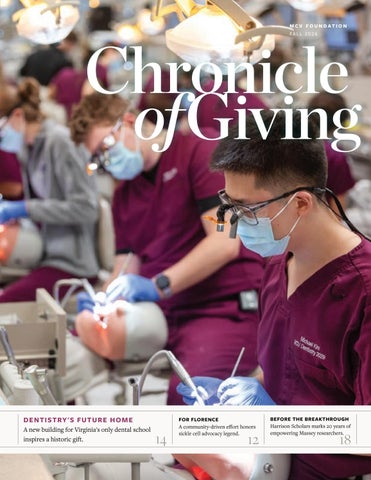
M C V F O U N D AT I O N FALL 2026
DE NTISTRY ' S FUTURE HOM E A new building for Virginia's only dental school inspires a historic gift.
14
FOR FLORENCE A community-driven effort honors sickle cell advocacy legend.
12
BEFORE THE BREAKTHROUGH Harrison Scholars marks 20 years of empowering Massey researchers.
18
LETTER FROM THE BOARD CHAIR AND INTERIM PRESIDENT & CEO
Dear friends,
As we welcome the fall season and a new academic year, we are grateful for the generosity that continues to strengthen VCU Health Sciences and VCU Health. Every gift helps advance education, accelerate research and enhance patient care, creating opportunities and improving lives across our community. In this issue of the Chronicle of Giving, we are pleased to share stories that demonstrate the impact of philanthropy in meaningful ways. You will read about a significant gift supporting the planned new home for the VCU School of Dentistry, helping shape a modern environment for learning, discovery and care. We also celebrate the recipients of the MCV Foundation Awards, which honored four individuals whose service, leadership and support have strengthened the MCV Campus. We invite you to reflect on the extraordinary impact of the Harrison Scholars Program and its enduring contributions to cancer research across two decades. You will also learn about the community-led elevation of an endowed chair for sickle cell disease, an important milestone that reinforces our commitment to advancing treatment, research and hope for patients and families. In addition, this issue includes our annual financial commentary, highlighting the foundation’s stewardship of donor investments and the impact those resources have across our mission. Thank you for all you make possible. Your partnership drives innovation, supports future healthcare leaders and helps deliver exceptional care. Together, we thrive. With gratitude,
Brian S. Thomas Interim President & CEO
Stephen J. Gaidos Board Chair
MCV FOUNDATION B OARD OF T RUST EES Nupa Agarwal Danny T.K. Avula, M.D., M.P.H. Wyatt S. Beazley IV Turner Bredrup J. Abbott Byrd III, M.D. Robert C. Canfield Diana F. Cantor Alex W. Cecil
I. Lee Chapman IV Clay M. Coleman Heidi Schlicher Cook Paul W. Croston D. Oscarlyn Elder Robert L. Findling, M.D. Jennifer F. Flinchum Louis N. Formica, D.D.S.
Stephen J. Gaidos Sheryl L. Garland, M.H.A. John V. Hager Darius A. Johnson Susan G. Kornstein, M.D. Susan Learned, M.D., Pharm.D., Ph.D. Marlon F. Levy, M.D.
H. Frederick T. Moore Ghulam D. Qureshi, M.D. Kee Tilghman Rabb Michael Rao, Ph.D. W. Taylor Reveley III Michele A. Romano, M.D. Arturo P. Saavedra, M.D., Ph.D. Ernesto Sampson
Liza Jarvis Scott Hina B. Shah, M.P.H. Louise Woltz Smith Jennifer Wold Rachel L. Yost
F E AT U R E S
The Chronicle of Giving is published twice a year by the MCV Foundation for alumni and friends of the Medical College of Virginia Campus of Virginia Commonwealth University. © 2026 MCV Foundation VP AND CHIEF COMMUNICATIONS OFFICER |
Eric M. Peters
A Crowning Achievement
Delta Dental Foundation’s $5 million investment in the new VCU School of Dentistry building will help ensure Virginia’s only dental school continues to shape oral healthcare and dental education for decades to come.
EDITOR | C. Paul Brockwell Jr. DESIGNER | Penelope M. Carrington PHOTOGRAPHY | Daniel Sangjib Min, Will Rummel,
Tyler Trumbo CONTRIBUTORS | Jason Chestnutt, Stephen J.
Gaidos, Caitlin Hanbury, Holly Prestidge, Zaynah Qutubuddin, David S. Silver, Brian S. Thomas The MCV Foundation supports and fosters VCU Health and VCU Health Sciences through philanthropy,
MCV Foundation Annual Awards Celebrate the visionary leaders who received the foundation’s top honors during the annual awards dinner.
For Florence A community-driven effort has elevated a professorship named to honor Florence Neal Cooper Smith to an endowed chair at the VCU School of Medicine. D
stewardship, innovation, communications and collaboration. The support empowers the education, research and clinical care mission of the foundation’s MCV Campus partners: VCU College of Health Professions, VCU School of Dentistry, VCU School of Medicine, VCU School of Nursing, VCU School of Pharmacy, VCU School of Public Health, VCU Massey Comprehensive Cancer Center, VCU Health Pauley Heart Center and VCU Medical Center. Through more than 2,000 funds, the MCV Foundation provides scholarships, professorships and funds for research and programs to support the lifesaving work occurring
Before the Breakthrough For 20 years, the Harrison Scholars Program at VCU Massey Comprehensive Cancer Center has empowered emerging cancer researchers to turn possibility into real progress for patients. D E PA R T M E N T S FO UNDATI O N NE WS
New trustees join the board, and our MCV Society event highlights the power of planned giving.
through VCU Health Sciences and VCU Health. O N T H E COV E R | Students at the VCU School of
Dentistry will benefit from a new home and state-ofthe-art learning spaces for Virginia’s only dental school. PHOTO: DANIEL SANGJIB MIN
G O I N G G R E E N | If you prefer to receive a digital
copy, email info@mcvfoundation.org.
14
ANNUA L F I NA NCI A L CO M M E NTA RY
Annual results demonstrate the foundation’s critical support for teaching, research and healing on the MCV Campus. MCV CA M PUS GI VI NG
Philanthropic impact and generosity fuel student scholarships, faculty support and research. PLA NNE D GI VI NG: GI F TS F RO M WI LLS A ND TRUSTS
VCU School of Pharmacy alum Beth Toscano learned how easy it was for her to provide a meaningful gift from her will.
7 12 18 2 24 26 36
FOUN DAT I O N NE WS
TRUSTEE’S CORNER
Giving Back to the Community Jack Hager sees his service on the MCV Foundation Board of Trustees as making a difference in a city and a community that has afforded his family so much. Hager joined the MCV Foundation board in 2025. As vice president of global accounts for AVI-SPL, the largest audiovisual and unified communication integration company in the world, he helps organizations, particularly healthcare and life sciences organizations, use technology to drive global collaboration and innovation. He said it’s been rewarding to see how medicine and healthcare are being revolutionized. When the Hager family moved back to Richmond in 2024, after living in Philadelphia for seven years, they were eager to engage in their community in meaningful ways. Hager found that serving as a trustee of the MCV Foundation was an ideal way to give back, and he hopes to leverage his professional experience to advance the foundation’s priorities and expand its impact. “At its core, the foundation transforms generosity into impact, and I am deeply excited to be part of that effort. The foundation is an essential catalyst for progress for both VCU Health and VCU Health Sciences,” he said. “Our ability to connect donors to meaningful results accelerates innovation, advances discovery and improves outcomes for patients and families across Virginia.” Looking toward the future, he said the foundation is uniquely suited to support the next generation of healthcare leaders. “The foundation plays a critical role in ensuring that VCU Health remains a destination for exceptional students, researchers and faculty,” he said, adding that the board’s most important responsibility is making sure philanthropic investments are directed in ways that create the greatest possible impact – whether that’s scholarships to support students, research that drives cutting-edge medicine, technological or infrastructure needs, or recruitment of the best and brightest from around the world. Hager’s wife, Katharine Hager, also volunteers in service to the MCV Campus as a member of the VCU Massey Comprehensive Cancer Center Advisory Board. “We view our involvement with organizations like these as an opportunity to ensure that future generations continue to benefit from the exceptional healthcare, education and resources that make this region a special place,” he said.
M CV FOU N DATIO N
Photo: Daniel Sangjib Min
FALL 2 0 2 6
3
FOUN DAT I O N NE WS
More than 115 guests gathered May 28 at Highclere for the annual MCV Society Garden Party. The event honors the vision and generosity of planned giving donors who support the MCV Campus. Photos: Daniel Sangjib Min
A Growing Legacy at MCV Society Garden Party Overlooking a commanding view of the James River, more than 115 guests gathered May 28 to celebrate donors and the impact their planned giving support will have on VCU Health and VCU Health Sciences. The annual MCV Society Garden Party was hosted at Highclere, the home of Louise Martin. It is a beautiful space with classic English post and beam construction, complete with leaded glass windows. Louise’s late husband, David, named the house for its sweeping views of the countryside overlooking the James River. The annual event honors donors who are planting seeds for the future
by supporting patient care, teaching and research at VCU. The MCV Society was created in 1994 to recognize and thank those donors who have included any of the MCV Campus schools or units in their philanthropic plans. “MCV Society members are among our most loyal and devoted supporters,” said Brian Thomas, interim president and CEO of the MCV Foundation. “Their generosity will touch every area of the MCV Campus and ensure it will continue to flourish.” During the past year, the MCV Society welcomed 32 new members, bringing total membership to 717 individuals. The impact of planned
giving remains astonishing. This year, new documented planned gifts and realized bequests exceeded $28.6 million. Collectively, MCV Society membership has documented the intention to give more than $119 million in future support across the campus. “Each year, the MCV Society continues to grow,” Thomas said. “We are grateful for the opportunity to celebrate and thank this exceptional group of donors who believe in our mission and in the importance of sustaining the world-class care, education and research happening at VCU Health and VCU Health Sciences.”
If you would like to learn more about how to support the MCV Campus through a planned gift, please contact Jason Chestnutt, CFP®, assistant vice president of planned giving at VCU, at 804-828-1671 or chestnuttjr@vcu.edu.
M CV FOU N DATIO N FALL 2 0 2 6
75
Above: Louise Martin, pictured with Brian Thomas, interim president and CEO of the MCV Foundation, generously opened the grounds at her home, Highclere, to host this year’s garden party. Above right: MCV Society members Mary Brown (left) and Barbara Brown.
BY THE NUMBERS
32
NEW MEMBERS
717
TOTAL MEMBERS
$28.6 million
REALIZED OR DOCUMENTED GIFTS IN FY26
Above: Jason Chestnutt (left), assistant vice president for planned giving at VCU, enjoyed connecting with MCV Society members Cecily Powell, Ken Powell, Mel Fitzgerald and Ellen Byrne, D.D.S., Ph.D., a lifetime honorary trustee of the MCV Foundation. Below: The evening brought together planned giving donors who share a passion for supporting the MCV Campus.
$119
million+ TOTAL EXPECTANCIES FOR THE MCV CAMPUS
FOUN DAT I O N NE WS
MCV Foundation Welcomes New Members, Honors Three New Lifetime Honorary Trustees
New MCV Foundation trustees include (L to R) Turner Bredrup, Heidi Schlicher Cook, Diana F. Cantor and Clay M. Coleman. Not pictured: J. Abbott Byrd III, M.D. Photo: Daniel Sangjib Min
The MCV Foundation in July welcomed five new trustees to its board and named three lifetime honorary trustees. The new board members bring extensive leadership experience spanning healthcare, finance and organizational strategy. Turner Bredrup, a senior advisor in the Healthcare & Life Sciences Group at Harris Williams, brings more than 35 years of investment banking experience to the board. He founded and led the firm’s healthcare practice for more than two decades.
J. Abbott Byrd III, M.D., a retired orthopaedic surgeon and VCU School of Medicine alum, brings more than J. ABBOTT BYRD III three decades of experience to the board from his career with Atlantic Orthopaedic Specialists. He and his wife, Allison Byrd, M.D., also a VCU School of Medicine alum, endowed the Allison D. and J. Abbott Byrd III Chair in Orthopaedic Surgery at VCU.
Diana F. Cantor is an accomplished investment and governance leader who currently serves as the chair of the VCU Health System Authority board. A certified public accountant and member of the state bar in Virginia, Florida and New York, she is a member of the Investment Committee and Board of Managers of Alternative Investment Management LLC, and she sits on several public and nonprofit boards. Clay M. Coleman, chief operating officer of Harris, Hardy & Johnstone P.C., is a
seasoned operations and technology executive who joins the board with more than three decades of leadership across healthcare, insurance and consulting organizations. The foundation also welcomed Heidi Schlicher Cook as the VCU Board of Visitors representative. A 2006 graduate of VCU, she currently serves as senior vice president at Old Dominion Public Affairs, where she represents a diverse portfolio of Fortune-ranked companies, Virginia-based businesses and nonprofit organizations. In addition to welcoming new trustees, the foundation named three new lifetime honorary trustees: B. Ellen Byrne, D.D.S., Ph.D.; Tracy Kemp Stallings; and Richard P. “Dick” Wenzel, M.D., M.Sc. This distinction is reserved for individuals whose longstanding leadership, service and advocacy have made a transformative impact on the MCV Campus. “Our board is strengthened by leaders who bring wisdom, integrity and a deep commitment to the mission of VCU Health and VCU Health Sciences,” said Steve Gaidos, chair of the MCV Foundation Board of Trustees. “We are grateful to our new trustees for joining us in this work and to our lifetime honorary trustees for their remarkable service and lasting impact on our community.”
M CV FOU N DATIO N FALL 2 0 2 6
MCV AWARDS MCV Foundation Awards 2026 By Caitlin Hanbury and Holly Prestidge Photos by Daniel Sangjib Min
O
n June 15, the MCV Foundation honored four individuals whose service and support strengthen the MCV Campus across VCU Health and VCU Health Sciences. “Each of this year’s honorees represents the very best of our community – leaders whose service, generosity and vision strengthen every corner of the MCV Campus,” said Brian Thomas, interim president and CEO of the MCV Foundation. “We are proud to celebrate their extraordinary impact and the legacy they continue to build.” The foundation recognized a devoted volunteer leader, a visionary administrator, a distinguished healthcare executive and a trusted philanthropic steward for decades of contributions that have advanced patient care, academic excellence and institutional progress. “Our continued excellence is possible because of dedicated individuals like these, whose service and philanthropy move our mission forward every day,” said Steve Gaidos, chair of the MCV Foundation Board of Trustees.
7
11
2026 STRAUSS AWARD
SHIRLEY GIBSON, D.N.P. Vice President of Real Estate, VCU Health System
For more than five decades, Shirley Gibson, D.N.P.,
has devoted her career to strengthening healthcare – and for the past 21 years, she has applied that experience to shaping what VCU Health is today and what it is preparing to become. Her perspective spans the full arc of the profession: bedside nurse, clinical leader and senior executive strategist. That breadth of service makes her selection as the recipient of the 2026 Strauss Award particularly fitting. Colleagues say her influence is visible across the institution – in major projects, in the teams she mentors and in the culture she helps to define. They describe a leader whose optimism and drive set a clear tone. “Boundless energy, incredible curiosity, enormous enthusiasm describe her,” said Marlon Levy, M.D., CEO of VCU Health. “She is eternally optimistic about the projects that we're trying to do and the reasons that we're trying to do them.”
For Ralph “Ron” Clark, M.D., associate professor at the VCU School of Medicine, Dr. Gibson’s consistency stands out most. “It’s always with the patient, the family first,” he said. “She's had so many positive influences on us. Probably the most important is always keeping us centered on what's important, and that's the quality of the service that we're providing to our patients.” “She is truly a role model for current and future healthcare professionals,” said Sheryl Garland, M.H.A., chief of health impact for VCU Health and a trustee of the MCV Foundation. “She has created this set of standards around excellence, and that has followed her throughout her entire career,” Garland added. “She’s a steely administrator. She’s wonderful.” At VCU Health, Dr. Gibson’s leadership has helped shape a foundation the organization continues to build upon – and a blueprint still guiding its future.
Established in honor of Jerome “Jerry” Strauss, M.D., Ph.D., former dean of the VCU School of Medicine, this award is presented to a VCU administrator, faculty or staff member who has demonstrated extraordinary service and stewardship to MCV Campus alumni, donors or other members of the community.
2026 DOWDY AWARD
MIKE GRACIK
Past Chair, VCU Massey Comprehensive Cancer Center Advisory Board
M
ost people who talk about Mike Gracik eventually say it feels like he’s been part of the VCU Massey Comprehensive Cancer Center volunteer corps longer than anyone else. What they’re describing isn’t just the span of years he’s been involved – it’s the depth of his contributions. “It’s almost 30 years of commitment, of incredible service and of someone giving back of themselves and bringing others to give back,” said Becky Massey, past chair of the Massey Advisory Board. His decades of volunteer leadership have shaped Massey in ways colleagues say are impossible to overstate. “It’s hard to actually estimate how much impact he’s had,” said Gordon Ginder, M.D., former director of Massey. “He’s had tremendous impact over a very long period of time.” That long arc of service is why Gracik was honored with the 2026 MCV Foundation Michael B. Dowdy Award. Gracik’s tenure began in the late 1990s through Jeanette Lipman, a beloved benefactor who saw in him someone who shared her sense of purpose. As he tells it, Lipman, who died in 2017, didn’t simply invite him to get involved – she essentially pulled the chair out for him, as if to say, “Here’s your board seat. This is where you’re needed.” From then on, he poured himself into the work she believed he could help advance. “Mike was an incredible friend, I would say almost like an adopted son, of Jeanette Lipman,” Massey said. Colleagues describe him as both larger-thanlife and quietly indispensable. “He’s the person people call when something needs to happen fast,” said MCV Foundation board member Jen Flinchum. She recalls him helping a colleague secure care after a diagnosis: “Within 48 hours, Mike had her into Massey and being seen.” For nearly 30 years, Gracik has been steady, generous and visionary. The Dowdy Award simply acknowledges what everyone already knows: “Mike brings it when he is committed. When he comes to a meeting, when he engages, he always brings it,” Massey said. Established in honor of Michael “Mickey” Dowdy, who served as president of the MCV Foundation from 1993 to 2006, this award recognizes a volunteer who has played a lead role in fundraising for the MCV Campus at VCU Health.
M CV FOU N DATIO N FALL 2 0 2 6
9
2026 IRBY AWARD
PATRICIA SIME, M.D.
Chair, Department of Internal Medicine, VCU School of Medicine
Patricia Sime, M.D., arrived on the MCV Campus amid
Richmond’s summer heat in 2019. She had barely settled in when COVID-19 hit a mere six months later. The newest addition to the School of Medicine’s largest department quickly endeared herself to new colleagues by trusting and leaning into the expertise around her – a move that helped VCU Health, within a matter of days, to be among the first health systems on the East Coast to treat COVID-19 patients. Dr. Sime, who holds the William Branch Porter Endowed Professorship, is the 2026 recipient of the Irby Award, namely because she was instrumental in facilitating the largest publicly shared gift in VCU history: a $104 million donation in 2022 that established the VCU Stravitz-Sanyal Institute for Liver Disease and Metabolic Health. “She can visualize the impact of philanthropy and how it works for both the institution and the donor, and that’s the special and secret recipe that makes her so successful,” said
Stephen Kates, M.D., interim dean of the VCU School of Medicine and interim executive vice president for medical affairs at VCU Health. “She builds great teams because she knows how to spot the talents in people and use those talents to help everyone be successful.” Her spirit of collaboration is embraced by others within the department, which today encompasses 11 divisions and nearly 1,300 faculty and nonfaculty team members. “Trish began to establish a research infrastructure that I don’t think we ever had,” said Alpha “Berry” Fowler III, M.D., the W. Taliaferro Thompson Jr. Endowed Chair in Pulmonary Medicine and the former chair of the Division of Pulmonary Disease and Critical Care Medicine. “All along, her message was team science, that we can do fabulous research if we team together and form multidisciplinary groups,” Dr. Fowler said. “Through her vision and her emphasis on interdisciplinary research, she’s going to continue to elevate VCU to national and international levels.”
Established in memory of Robert Irby, M.D., an MCV rheumatologist who was devoted to securing financial support for the MCV Campus, this award is presented to a faculty member who has assisted with major fundraising efforts.
2026 TRANI AWARD
JAMES H. STARKEY III
Lifetime Honorary Trustee, MCV Foundation
There’s more to philanthropic investments than
seeing numbers grow. Donor intent is paramount, and no one knows that more than James H. Starkey III, who joined the MCV Foundation as a board member in 2005 and served in several key roles, including finance and audit committee chair, board vice chair and investment committee chair for a decade. “He is committed to doing what’s right for the institutions we support, but more importantly, he keeps his eye on the ball to make sure we honor the intent of our donors and deliver what they wanted their money to do,” said Harry Thalhimer, former MCV Foundation board chair and lifetime honorary trustee. Starkey is the 2026 recipient of the MCV Foundation’s esteemed Trani Award. He is known to fellow board members as someone who tackles challenges head-on.
“You knew Jim was going to be prepared, he was going to show up and he was going to be knowledgeable about what was going on across campus,” said Keith Middleton, a member of the foundation’s leadership council. Lee Krumbein, MCV Foundation lifetime honorary trustee, said Starkey could build consensus even among a diverse group. “Jim had the ability to distill complicated issues and information into simple terms that allowed the committee to understand the decisions it was making,” Krumbein said. “The ability to do that is one of the hallmarks of great leadership, and he had it in spades,” Krumbein added. “He was one of the best investment committee chairs I’ve ever had the pleasure to work with.”
Established in honor of Eugene P. Trani, Ph.D., who served as president of VCU from 1990 to 2009, this award recognizes exceptional dedication and support of the MCV Campus.
M CV FOU N DATIO N FALL 2 0 2 6
13 13
For Florence Working with the MCV Foundation, community groups have successfully raised funds to elevate an endowed professorship honoring Florence Neal Cooper Smith to an endowed chair, recognizing her lifelong advocacy for sickle cell disease research. By Paul Brockwell Jr. | Photo By Tyler Trumbo
A
t 95, Florence Neal Cooper Smith is royalty among the 130 people who attended her birthday party in August. In addition to her birthday, the group was celebrating the culmination of years of work to elevate an endowed professorship named in her honor to an endowed chair. For more than a decade, dedicated volunteers and community groups have built – brick by brick – a grassroots effort to fund the endowed chair, the highest academic honor a university can award its outstanding faculty. Many of the attendees at her celebration know her as the “Mother of Sickle Cell Disease” in Virginia, and she’s inspired most of them to join her efforts over the years. She has worked since the 1960s with the community to raise awareness about sickle cell disease, to support research for better cures and to ensure access to treatment. Sickle cell disease affects around 100,000 people in the U.S., and more than 90% of them are Black. Without proper access to care, most sickle cell patients experience severe complications and/or early death. Smith works to change that reality. In 1969, she organized Richmond’s first citywide survey to determine awareness about sickle cell disease. After passage of the 1972 National Sickle Cell Anemia Control Act, she co-founded the Virginia Sickle Cell Anemia Awareness Program, and later helped pave the way for mandatory statewide testing for sickle cell trait in newborns throughout Virginia in 1989. After retiring in 1995, she continued to advocate for greater understanding of the disease and funding to support research into treatments, all while recruiting fellow advocates at the local, state and national levels. In 2014, the Florence Neal Cooper Smith Professorship, one of the few endowed professorships named for an African-American woman in the U.S., was established at VCU to support research aimed at finding a cure. From annual motorcycle rides and 5K walks to the efforts of several social clubs and organizations, the
collective actions by individual donors and community groups is evidence that Florence’s voice for progress continues to resonate through the people she has educated and inspired. Today, those people have invested in her hope for a future in which suffering from sickle cell disease can end thanks to treatments that have been fueled by research. A particularly impactful group has been Finding a Cure Together 4 Sickle Cell (F.A.C.T.S.). In addition to raising funds for the endowed chair, F.A.C.T.S. and other groups have advocated successfully for historic investments in care and research from the state. The recent Virginia state budget included nearly $20 million in new funding that will bolster adult and pediatric patient care, expand education and awareness programs, fund gene therapy through Medicaid and establish VCU Health’s leadership in coordinating access to care statewide. Another important ally has been Del. Delores McQuinn. The Richmond delegate was instrumental in securing support and the final funding to elevate the professorship to an endowed chair. The endowed chair named in Florence’s honor is held by Wally R. Smith, M.D., a nationally recognized sickle cell expert and director of the VCU Health Sickle Cell Program. Dr. Smith has been instrumental in advancing critical research, care and innovation on the MCV Campus. Elevating this professorship to an endowed chair will strengthen the long-term impact of the endowment on sickle cell research and care. “This milestone honors Florence’s extraordinary legacy while creating new opportunities for discovery, innovation and improved care for patients affected by sickle cell disease,” said Brian Thomas, interim president and CEO of the MCV Foundation. “All of us who serve the MCV Campus are grateful for the tremendous support from the community for this important initiative.”
If you would like to support sickle cell disease research and care on the MCV Campus, please contact Brian Thomas, interim president and CEO of the MCV Foundation, at 804-828-0067 or bthomas@mcvfoundation.org.
A CROWNING ACHIEVEMENT
The VCU School of Dentistry is moving forward on a once-in-a-generation project to build a new facility that will expand access to care, strengthen the dental workforce and redefine oral health across Virginia.
By Caitlin Hanbury
The VCU School of Dentistry is taking a historic step –
one that promises to shape oral healthcare and dental education across the commonwealth for decades to come. The school – Virginia’s only school of dentistry – is building a state-of-the-art home on the MCV Campus. The five-story, 314,000-square-foot building is slated to break ground in 2027 and open its doors in late 2029. This next chapter represents a once-in-a-generation opportunity to expand access to care, strengthen the dental workforce and advance VCU’s role as the commonwealth’s leader in oral health. The Delta Dental of Virginia Foundation has made a $5 million commitment to the project, reinforcing its longstanding partnership with the school and its investment in the future of oral healthcare in the commonwealth. As a leading dental benefits provider, Delta Dental remains committed to advancing access to care for the communities it serves. “Every Virginian deserves access to quality oral healthcare, and that begins with investing in the people who provide it,” said Frank Lucia, president and CEO of Delta Dental of Virginia. “This historic investment will create meaningful pathways to careers in dentistry, strengthening the workforce and expanding access to quality oral healthcare for Virginians in every community.”
The vision behind the project is rooted in both ambition and necessity. “One of the vital roles the School of Dentistry plays in Virginia is, as its only school of dentistry, we educate the majority of the workforce for all oral health practice across the commonwealth, not just in Richmond,” said Jeffrey A. Johnson, D.M.D., M.P.H., Ed.D., interim dean of the School of Dentistry. That workforce is the backbone of oral healthcare in every corner of Virginia – from urban clinics to rural communities where provider shortages continue to limit access. The urgency is unmistakable. “Oral healthcare is the least-accessible form of healthcare,” Dr. Johnson explained.
CVFOU FOUNNDATION DATIO N MMCV FALL 2 0 2 6 FALL 2 0 2 6
“If we’re unable to train the workforce, if we’re unable to drive innovation and discovery in our laboratory spaces, we can’t meet the needs for Virginians.” The new facility will rise on the current Larrick Student Center site, placing it near existing and future VCU Health and VCU Health Sciences facilities, ensuring convenient access for patients and community members. The new building will bring all of the school’s clinics and programs into one shared space, creating a more unified setting for learning, teaching and patient care.
17 15 15
Placing predoctoral, dental hygiene and graduate specialty clinics side by side strengthens VCU’s hallmark breadth – from general dentistry to advanced specialties – and opens the door to more connections across education, patient services and research. The result is an environment that enhances how students learn, how patients receive care and how faculty and trainees pursue new discoveries. For Dr. Johnson, the design reflects a simple belief: When learners come first, better care follows. “This new building is really transformative for the Commonwealth of Virginia, for VCU and for our patients, because it puts the learner first,” he said. “Everything is meant to improve the quality of education, to improve the quality of experiences that our learners have. And in that, we improve patient care.” Commitment to patient care is central to the school’s mission. VCU Dental Care, the clinical arm of the School of Dentistry, delivers more than 100,000 patient appointments each year and serves as the state’s leading dental safety‑net clinic, providing the reliable, comprehensive care many Medicaid‑insured and underserved Virginians cannot find elsewhere. (Continued on next page)
As Virginia's only dental school, VCU educates the majority of the commonwealth's oral health workforce and drives innovation through research and clinical training that support more than 100,000 patient visits each year. Rendering courtesy VCU School of Dentistry
Jeffrey A. Johnson, D.M.D., M.P.H., Ed.D., interim dean of the VCU School of Dentistry, previews the renderings of the new home for Virginia’s only dental school. Photos: Daniel Sangjib Min
Jeffrey A. Johnson, D.M.D., M.P.H., Ed.D. (left), interim dean of the VCU School of Dentistry; Sen. Todd Pillion; VCU President Michael Rao, Ph.D.; Polly Raible, executive director of the Delta Dental of Virginia Foundation; and Frank Lucia, president and CEO of Delta Dental of Virginia and chair of the foundation, are pictured Aug. 21 at the celebration of the Delta Dental of Virginia Foundation’s $5 million donation to the School of Dentistry.
EXPLORE MORE OF THE STORY
Scan to watch the video feature. [2:28] mcvfoundation.org/NewDentalSchool
VCU alums and longtime supporters Don and Michele Romano created a fund that will expand oculoplastic The new in facility will bring allof predoctoral, dental hygiene and graduate specialty clinics together under one roof, creating a seamless expertise the Department Ophthalmology. environment for learning, collaboration and comprehensive patient care. Renderings courtesy VCU School of Dentistry
M CV FOU N DATIO N FALL 2 0 2 6
“We don’t turn anybody away,” explained Sarah Heise, D.D.S., a 2025 dentistry alum now continuing her training as a resident. “Every morning, there is a line outside the door of patients experiencing urgent or emergent needs. We have clinics equipped to triage, collect imaging, come up with a diagnosis and treat – all in the same day.” The new building will dramatically expand the school’s capacity to meet that responsibility. The Dr. Roger Wood Special Care Clinic will double in size, expanding care for individuals with significant medical, cognitive or behavioral needs, and giving students essential experience in treating patients with complex conditions. The urgent care clinic will nearly double in size, expanding same‑day access for patients in pain and preventing minor issues from becoming serious. Clinical spaces throughout the building will be designed to remove barriers to care, ensuring patients can receive the services they need and that the workforce of tomorrow is prepared to meet diverse needs. For Dr. Heise, the impact is clear. “Being in a clinical setting where patients feel comfortable and well cared for – and having the tools that we need to fix whatever problem they’re having – is really, really important,” she said. The School of Dentistry’s current facilities, while home to extraordinary work, are stretched to their limits. Clinics are spread across multiple floors, creating logistical challenges and limiting collaboration. Years of additions and renovations have left patient spaces fragmented and difficult to navigate. The buildings’ ages and deferred maintenance needs mean they no longer fully align with modern educational or patient‑care expectations, and limited space can constrain the number of emergency patients the school is able to accommodate, affecting both access to care and learning opportunities. “We are always at maximum capacity,” Dr. Heise said. “There’s never a shortage of patients, never a shortage of
17 19
students who want to be here learning. I think we are outgrowing this building – and it’s all because of wonderful things.” Dentistry alum and former MCV Foundation board chair John Doswell II, D.D.S., sees the new building as an essential tool in maintaining the school’s leadership in the field. He stresses that both clinical care and education rely on modern infrastructure, not just meeting today’s standards, but anticipating tomorrow’s. “You need to have a state-of-the-art clinical facility, and from an educational standpoint, you need to be able to be current with everything, if not even more than current, and looking forward with it,” he said. The school’s new building is designed with that future in mind. “This building will be agile and adaptable as we grow into it,” Dr. Johnson emphasized. “We’re not just building a school for 2030, when we’re fully operational. We’re building a school for 2040, for 2050, with the ability to pivot classroom spaces, educational laboratory spaces and clinical spaces to reflect what’s new in dentistry and the needs of our patients.” The state is funding construction of the new building, but additional partnership and investment like that from Delta Dental will shape what the facility can ultimately deliver. Philanthropic support will help ensure the space is equipped to meet the needs of students, patients and communities across Virginia. For alumni, friends and partners, it is a meaningful chance to influence the future of oral healthcare in the commonwealth. “If we’re doing such great things in a facility like we’re in now, there really is no limit to what we can do in a new facility – a facility that embraces innovation, collaboration and focuses on the people inside it,” Dr. Johnson said.
If you would like to support the VCU School of Dentistry, contact Gloria Callihan, the school’s associate dean for development and alumni relations, at 804-828-8101 or gfcallihan@vcu.edu.
BEFORE
Backed by the Harrison Scholars Program, Can Senkal, Ph.D. (right), is partnering with colleagues like Dickson Donu, Ph.D., to convert bold, early-stage ideas into the foundational breakthroughs that propel cancer research at VCU Massey Comprehensive Cancer Center.
BREAK
M CV FOU N DATIO N FALL 2 0 2 6
19
THE THE HARRISON SCHOLARS PROGRAM AT VCU MASSEY COMPREHENSIVE CANCER CENTER EMPOWERS EMERGING CANCER RESEARCHERS TO TURN POSSIBILITY INTO REAL PROGRESS FOR PATIENTS.
THROUGH STORY BY CAITLIN HANBURY | PHOTOS BY DANIEL SANGJIB MIN
What if the next major cancer breakthrough is already scribbled in the margins of a notebook in a lab somewhere, penciled in by an early career researcher who hasn’t yet had the chance to test a bold idea? For scientists, a successful leap from promising concept to impactful research often depends on seed funding, which acts as an incubator and an accelerator. These early-stage funds don’t just fuel the work – they promote possibilities. That’s where the Harrison Scholars Program at VCU Massey Comprehensive Cancer Center enters the picture. The program was established in 2004 through a generous gift from members of the Harrison family. Their goal was simple: to help Massey attract and retain emerging cancer researchers by funding their early-stage work. Through the program, three years of seed funding is supplied to promising researchers as a flexible infusion of support to test bold ideas, gather the first crucial data and build the foundation needed for major grant applications at organizations such as the National Cancer Institute. It gives them their head start – setting up a lab, running early-stage experiments or assembling the team required to carry their work forward. Over its 20-year history, the Harrison Scholars Program has had a hand in fueling the careers of 14 Massey scientists, 13 of whom still work at Massey today, a remarkable testament to the program’s impact for keeping the most promising young investigators in Richmond and at Massey. Across two decades, the early research undertaken by Harrison Scholars has also generated a strong pipeline of follow-on grants, proving that early investment does more than spark possibility, it kick-starts it.
THE SWITCH THAT TURNS CANCER OFF Cancer becomes hardest to treat when tumors learn to override the signals that should tell a cell when to survive or self‑destruct. This is the molecular level tipping point that Can Senkal, Ph.D., a member of the Cancer Biology research program at Massey, is determined to understand.
An assistant professor of cellular, molecular and genetic medicine in the VCU School of Medicine, he serves as interim director of the Lipidomics and Metabolomics Shared Resource. Dr. Senkal studies sphingolipids – a special type of fat molecule that can act like the cell’s internal control switch – to understand why some cancers respond to the initial course of treatment but then suddenly stop. When tumors disrupt the signals that these lipids normally send, therapies lose their effect. Restoring the signal may help cancer cells regain the ability to shut themselves down in response to treatment. “Imagine a cancer patient who goes through therapy. Initially, they respond to the therapy, and after some time, they get this devastating news that they do not respond anymore,” Dr. Senkal said. “This happened to my father.” That experience shapes his commitment to finding new therapeutic targets for patients who run out of treatment options. Dr. Senkal’s lab studies how these lipids behave across multiple cancer types – including lung, breast, ovarian, colon and pancreatic cancers – mapping the molecular events behind where the signaling breaks down and where it might be restored. Understanding those failure points may reveal new ways to prevent or reverse treatment resistance and, ultimately, how to stop it. “We want to discover what is happening in the cells,” he said. “We want to know what is unknown.” Dr. Senkal received Harrison Scholars Program funding in 2020. It arrived at a pivotal moment, giving him room to pursue his ideas, something traditional external grants do not typically support. That early freedom to chase a promising lead helped accelerate his discovery. He was able to hire a key postdoctoral fellow and to generate early data that ultimately helped secure his first National Institutes of Health R01 grant – a highly competitive award earned by only one in five applicants.
M CV FOU N DATIO N FALL 2 0 2 6
“Seed funding gives us the flexibility to explore something new, something a little bit different,” Dr. Senkal said. “The data we generated using the Harrison Scholars funding was the key.”
FORECASTING BETTER CANCER CARE Being able to predict how a treatment will work before a patient ever receives it could change the way cancer care is delivered. Harrison Scholar recipient Kevin Byrd, D.D.S., Ph.D., an associate research member at Massey and assistant professor of oral and craniofacial molecular biology in the VCU School of Dentistry, is working to make that possible. His lab combines artificial intelligence, spatial biology and single-cell genomics to build detailed digital models of human tissues and tumors, creating virtual testing grounds where researchers can evaluate therapies and understand disease long before decisions reach a patient. He describes it as creating a Google Maps-style view of the body, where
KEVIN BYRD, D.D.S., PH.D.
21
scientists can zoom from an entire organ down to individual cells, visualize how those cells interact and predict how disease may evolve over time. Dr. Byrd’s commitment to this work is personal. “When my dad got cancer for the first time, I was both a son and a scientist training to be a clinician,” he said. “So that thing I’ve gone back to is: What are we missing in those diagnoses that gives us an opportunity to think of a better medicine earlier?” That question pushed him to consider how existing technologies could ultimately help match patients with the therapies most likely to work for them. Today, his team works across cancer as well as inflammatory and infectious diseases, generating large-scale cellular maps that help researchers identify therapeutic targets, understand treatment response and build predictive models of disease. His lab now builds models that help researchers anticipate how tumors might grow or respond to therapy, a shift he compares to forecasting.
“Probably the best metaphor is that we're getting much better at almost being like a meteorologist,” he said. “But, in our case, we’re thinking about disease, and we are thinking about ways to control some of those weather events.” In 2025, Harrison Scholars support gave Dr. Byrd resources to build his ambitious program, which soon began attracting additional talent. “When I came to VCU, our initial group was four people total, including me and three team members who moved with the program from my prior institution,” Dr. Byrd said. “By the end of the year, that had grown to about 16.” That kind of growth, born from a single philanthropic investment, created a widening circle of expertise, collaboration and discovery, helping stabilize the original team while giving the lab enough momentum to recruit new trainees, staff and collaborators.
TAKING SHARPER AIM AT CANCER Medical oncologist Andrew Poklepovic, M.D., focuses on developing treatments that act with greater precision – therapies that focus their full force directly on the cancer and cut down the collateral damage that can make treatment feel as hard as the disease itself. An associate professor of internal medicine at the VCU School of Medicine, he leads clinical trials in immunotherapy, cellular therapies and targeted
treatments. He and his team are advancing new tools for early detection, including blood-based screening and minimally invasive monitoring that can show when patients are being over- or under-treated. These approaches help clinicians match treatment to each patient – who needs which treatment, and in what dose. Dr. Poklepovic’s commitment to this research grew directly from his years at the bedside as a clinician. “I always knew I wanted to do oncology because of that unique bond you develop with a patient who is dealing with cancer,” he said. Seeing the real-world impact of treatment – the victories, the setbacks, the toll it can take – shaped the questions he wanted to pursue in the lab. He entered the field at a pivotal moment when cancer care was being reimagined in the early 2000s. “We were coming up with new therapies, new ways to deliver older therapies, new strategies for surveillance, and impacting the way patients survive cancer,” Dr. Poklepovic said. “Participating in that wave of transformation is what I decided I wanted to do with my career.” More than a decade ago, funding from the Harrison Scholars Program early in his career gave him the time to turn those clinical insights into a research program grounded in real patient experiences and needs. That kind of early support can shape an entire career, and for him, it validated the direction he would take.
“
When my dad got cancer for the first time, I was both a son and a scientist training to be a clinician. So that thing I’ve gone back to is: What are we missing in those diagnoses that gives us an opportunity to think of a better medicine earlier?
”
KEVIN BYRD, D.D.S., PH.D.
ASSISTANT PROFESSOR, VCU SCHOOL OF DENTISTRY AND ASSOCIATE RESEARCH MEMBER, VCU MASSEY COMPREHENSIVE CANCER CENTER
M CV FOU N DATIO N FALL 2 0 2 6
23
“
This funding is so powerful because it recognizes this is someone who needs to be able to protect their time – to split it between asking the questions that move the needle and taking care of the patients who are coming through the door. It’s a statement of confidence – that you’ve been identified as someone with good ideas and a strong work ethic to really advance a new approach..
”
“If you get very busy clinically, it consumes all hours of the day, and there is no time to actually pursue the research. This funding is so powerful because it recognizes this is someone who needs to be able to protect their time – to split it between asking the questions that move the needle and taking care of the patients who are coming through the door,” he said. “It’s a statement of confidence – that you’ve been identified as someone with good ideas and a strong work ethic to really advance a new approach.”
DISCOVERY TAKING ROOT Now part of Massey’s leadership as the associate director for clinical research, Dr. Poklepovic sees the Harrison Scholars Program as a model for cultivating the next generation of clinical investigators and keeping that talent at Massey. The early part of a research career is a defining period when investigators are forming the ideas that will profoundly influence their work. But it is also the most crowded and competitive phase of a research career – the moment when early funding can propel ideas into contention for major grants.
ANDREW POKLEPOVIC, M.D.
ASSOCIATE DIRECTOR FOR CLINICAL RESEARCH VCU MASSEY COMPREHENSIVE CANCER CENTER
Seed funding through philanthropic investment, Dr. Poklepovic said, is often what keeps promising ideas moving forward in a landscape where competition for limited federal grant dollars sidelines even compelling proposals. “Your grant will be stronger if you have preliminary data,” he explained. “You can collect what’s needed on $20,000 worth of philanthropic investment: to get the biospecimen, show that this exists in patients and have some persuasive early data,” he said. “Now, all of a sudden, you’re better positioned.” And for Dr. Poklepovic, supporting these early-stage ideas means supporting the people behind them. “I see fresh ideas, enthusiasm. I see a desire to make a difference in the world and to help people,” he said. “And, you know, it is truly altruism on display. And that's great to see. It's heartening.” That spirit is especially visible at Massey, where every effort is focused on a single, urgent purpose. “It’s very easy in oncology because there’s only one bad guy, and it’s the disease,” he said.
If you would like to support the VCU Massey Comprehensive Cancer Center, contact Amy Brackett, director of development with the Office of Medical Philanthropy and Alumni Relations, at 804-833-4913 or bracketta@vcu.edu.
Financial Strength
$998 ENDOWMENT
million TOTAL FUNDS
2,142
For the fiscal year that ended June 30, 2026, contributions across the MCV Campus totaled $84 million. New planned gift expectancies and realized planned gifts totaled $28.6 million in support during the fiscal year. The MCV Foundation endowment portfolio returned 11.1% in fiscal year 2026. Over the past 10 years, the portfolio has returned 10.9% versus 10.4% for the policy benchmark. The foundation’s endowment performance continues to rank highly compared to peer universes of other endowments and foundations.
Through the MCV Foundation, donors have established more than 2,100 funds in support of health sciences students, faculty, patients and programs at VCU Health Sciences and VCU Health. Now more than ever, the foundation is honored to partner with you in supporting the leading care, transformational research and formative education that saves lives around the world today and in the future.
TOTAL ENDOWED FUNDS
1,292
Statement of Financial Position For the year ended June 30, 2026 | Amounts in thousands
Assets NEW ENDOWED FUNDS IN FY2026
33
Current Assets Cash and cash equivalents
$ 21,900
Short-term investments 122,609 Pledges receivable, current Other assets
13,181 332
Total current assets 158,022 Long-term Assets Endowment investments
$997,677
Pledges receivable, non-current
6,769
Other assets
11,133
Total long-term assets
1,015,579
Total assets
$1,173,601
M CV FOU N DATIO N FALL 2 0 2 6
27 25
S C H O L A R S H I P, R E S E A R C H , PAT I E N T P R O G R A M S A N D O T H E R F U N D S
As of June 30, donors had provided 569
endowed scholarships. Through these
endowed scholarships, the five schools and one college on the MCV Campus received
$4.14 million in funding and support that ranges from full tuition to modest support to
help with expenses. In addition, 53 current
fund scholarships provided more than $5.65 million in financial assistance to
students on the MCV Campus last academic year.
$84 million
TOTAL RAISED IN FY 26 ON THE MCV CAMPUS
Financial Highlights For the year ended June 30, 2026 | Amounts in thousands
Disbursements totaling $88.6 million by program T 39.4% T 35.4% T 24.6% T 0.6%
Faculty salaries and support
$ 34,943
Scholarships and awards 31,380 Education, research and general 21,773 Other programs and patient care
518
This is a condensed version of the MCV Foundation’s Fiscal Year 2026 audited financial statement. Our independent auditor issued an unmodified opinion on the complete financial statements, which can be obtained by writing or calling the MCV Foundation office or by visiting the foundation’s website.
M C V C A M P U S G IV ING
Jane Kaplan and her late husband, Jim, said they were treated like family when receiving care at VCU Health. That experience inspired their generosity to support a number of important causes, including student scholarships at the VCU School of Medicine. Photo: Daniel Sangjib Min
M CV FOU N DATIO N FALL 2 0 2 6
27
Inspired by Great Care Jane Kaplan and her late husband, Jim Kaplan, were no strangers to the MCV Campus. After retiring in Williamsburg in the early 1990s, Jim was treated for cancer at VCU Massey Comprehensive Cancer Center, while VCU Health Pauley Heart Center kept Jane’s heart healthy. Jane described her husband as someone who enjoyed being generous with his money, whether that meant large gifts to institutions and causes that were meaningful in their lives, or slipping a handyman a few extra $20s for fixing a leaky pipe. After Jim’s passing in 2022, Jane chose to honor her husband with several gifts that will continue to make a significant impact on the MCV Campus. Earlier this year, Jane created the James R. and Jane T. Kaplan Scholarship to support students within the VCU School of Medicine, specifically graduates of William & Mary, as well as students who wish to pursue cardiology as their field of study and others of exceptional academic merit. Jane previously endowed the VCU Health Pauley Heart Center’s Summer Undergraduate Research Fellowship, and last year, she established the James R. Kaplan Memorial Professorship for Cancer Research Fund. “Jim always felt good about giving back,” she said, adding that VCU Health treated them like family. She joked that doctors would see her in the elevators when she visited her husband during any of his cancer treatments, and they knew her, even if she didn’t know them.
“Once we got involved, we just found out what a wonderful place it is,” Jane said. “It was the best place for us for treatment, and we developed relationships with many of the doctors there.” The Kaplans’ generosity extended to their time. Both have been longtime supporters of the MCV Foundation’s Discovery Series, which offers programming in Richmond and Williamsburg that highlights the cutting-edge research, care and education happening at VCU Health and VCU Health Sciences. Jane continues to serve on the host committee for the Williamsburg series. She believes in the program because she’s seen how it brings the Williamsburg community together in the spirit of better health. She’s also seen how it leads to important fundraising opportunities that advance healthcare across Virginia and beyond. “That’s been such a great experience, especially for people who moved to Williamsburg from other places and had no idea what was right up the road,” she said. Ultimately, Jane said, she hopes the scholarships help future cardiologists, in particular, who may not otherwise get the chance to attend medical school. “We had such good care,” she said, “and I really want to make sure there are others out there who can reach their dreams of working in the field of cardiology and continue that tradition of excellence.”
If you would like to support student scholarships at the VCU School of Medicine, please contact Nathan Bick, executive director of development, at 804-827-0387 or ngbick@vcu.edu.
M C V C A M P U S G IV ING
Rooted in Relationships
Establishing a pair of scholarships is how Henry and Susan Ivey have put their values into action, investing in future healthcare leaders across the MCV Campus. Henry Ivey, M.D., values relationships – the ties between physician and patient, the bonds between a practice and the families it serves, and the connections that anchor a community and influence its future. Those relationships shaped his four decades of practice in Southwest Virginia, sustained his involvement with VCU and now fuel the philanthropy he and his wife, Susan, are investing in the students who will carry those values forward. His roots at the MCV Campus go back to the 1970s when he earned his medical degree and completed his residency. He then opened Parkway Physicians in Vinton with classmate Daniel Jones, M.D. Over 44 years, the practice grew from two doctors to 600 providers, eventually becoming Carilion Clinic Family Medicine, serving thousands of families with dependable, patient-centered care. Mid-career, as technology and insurance demands reshaped medicine, Dr. Ivey returned to VCU for a master’s degree in health administration in 1994. He applied those skills immediately, helping his practice navigate rapid growth and complexity. Over 30 years later, he is back in the same program – this time, as a volunteer. He works with students in the practicum process, interviewing them, reviewing their projects and offering guidance drawn from decades of experience. Seeing their talent and commitment up close has cemented his understanding of how essential well-prepared leaders are to the future of healthcare. That is what motivates the Iveys’ giving. In 2019, they established the Ivey Family Scholarship in the School of Medicine. This year, they expanded their philanthropy, creating the Ivey Family Health Administration Scholarship in the VCU College of Health Professions, honoring both the clinical and administrative paths that shaped Dr. Ivey’s career. Their commitment is also personal: All three of their daughters have built careers in healthcare. Sara Sarraf, M.D., and Jessica Sheehy earned degrees on the MCV Campus and now care for patients in Richmond and Atlanta, respectively, as a physician and a genetic counselor. Their third daughter, Rebecca Ivey, works as a healthcare attorney. For the Iveys, giving is simply an extension of what matters most to them: supporting leaders who, like Dr. Ivey, will leave VCU ready to serve their communities with skill, compassion and purpose. If you would like to support the VCU College of Health Professions, contact T. Greg Prince, Ed.D., senior director of development, at 804-828-3269 or tgprince@vcu.edu.
M CV FOU N DATIO N FALL 2 0 2 6
29
Henry Ivey, M.D., and his wife, Susan, have created a scholarship in the Department of Health Administration at the VCU College of Health Professions. Photo: Daniel Sangjib Min
M C V C A M P U S G IV ING
Top Inset, Next Page: Katie Walker and Lyna Nguyen were lifelong friends until Nguyen passed away from leukemia. Photo courtesy Katie Walker Below Inset, Next Page: The longtime friendship of Barbara Brown, Ph.D. (left), and Barbara Dunn, Ph.D., started when they were students at the VCU School of Nursing, and it inspired Dr. Brown to create a scholarship to honor her friend. Photo: Daniel Sangjib Min
M CV FOU N DATIO N FALL 2 0 2 6
31
Friendship and Scholarship The loss of a childhood friend led Katie Walker to a new career in nursing. A scholarship inspired by another deep friendship helped make her education possible. For Katie Walker, a 2025 graduate of the VCU School of Nursing, the life and loss of her childhood friend, Lyna Nguyen, inspired her to change the trajectory of her profession from a decade-long career in accounting to healthcare. “I was the quiet one, and Lyna was the spunky and outgoing one,” said Walker, who received the Dr. Barbara H. Dunn Nursing Scholarship as a student. “She was sick for such a long time, but she just wanted to live life to the fullest.” Nguyen was diagnosed with leukemia in high school, and her disease relapsed when she was 20. With treatment options exhausted, she shifted her focus to fulfilling her bucket list, so just a month before passing, Nguyen went skydiving. “She was the type to say, ‘I’m going to do this,’ and actually do it,” Walker said. It was this ambitious spirit that Walker channeled when she decided to chase her goal and become an oncology nurse. “I took that leap of faith the way she always did,” Walker said. Already a wife and mother of two young boys, adding student to the list of roles meant Walker had to be meticulous with expenses. When she received the Dunn Scholarship – not once, but twice – she felt liberated from financial strain. The scholarship supports students who are pursuing nursing as their second career. “I don’t think it’s a coincidence that I received this specific scholarship that was inspired by friendship,” said Walker, since it was friendship that inspired Barbara Brown, Ph.D., to create the Dunn Scholarship in honor of her fellow 1970 School of Nursing classmate and lifelong friend, Barbara Dunn, Ph.D. After graduation, Walker accepted a position with the Cellular Immunotherapies and Transplant Program at VCU Massey Comprehensive Cancer Center, which is housed in the former location of the bone marrow transplant unit – the same floor where Nguyen received a bone marrow transplant. “The scholarship, me working on the same floor where Lyna got her transplant. It’s such a full-circle moment,” Walker said. “Sixteen years later, Lyna continues to inspire me.” If you are interested in supporting the VCU School of Nursing, please contact Jessica Sorenson, the school’s senior director of development, at 804- 615-5877 or jlsorensen@vcu.edu.
M C V C A M P U S G IV ING
For more than three decades, Adrienne Maxwell built a movement around Massey by doing what she does best: bringing people in. Photos: Daniel Sangjib Min
Adrienne Maxwell Makes Connection Her Cause With trademark moxie and a volunteer’s heart, Massey Club founding member Adrienne Maxwell has helped VCU Massey Comprehensive Cancer Center reach more people by pulling the community closer to its mission. Adrienne Maxwell came to Richmond from New York with boardroom instincts honed in an era when women weren’t expected to have them. Starting her finance career in the 1960s – when women executives were still an anomaly and ambition in a woman was met with surprise – she learned to read rooms, build trust and turn complex conversations into action. Those instincts found new purpose through her advocacy for VCU Massey Comprehensive Cancer Center, where she applied the same clarity and drive to building community around cancer care, education, access and research – and to strengthening the fundraising and awareness efforts that supported it.
After she and her husband, Jack, arrived in Richmond, Maxwell wasn’t searching for a committee to join. She was looking for a mission. That mindset quickly drew her into a circle of volunteer peers – people like Rhoda Thalhimer and Morgan Massey – who were philanthropic drivers in Richmond who often steered one another toward causes that needed steady hands and clear vision. Maxwell met with David Goldman, M.D., then director of the Massey Cancer Center. As she walked into the meeting, longtime Massey benefactor Jeanette Lipman was walking out. Dr. Goldman mentioned that Lipman had just provided funding for the Rural Cancer Outreach Program to help Massey oncologists like Chris Desch, M.D., and Tom Smith,
M CV FOU N DATIO N FALL 2 0 2 6
33
M.D., travel to remote parts of Virginia. The program – the 35 YEARS OF THE MASSEY CLUB first of its kind in the nation – earned a reputation for Those early efforts became the groundwork for what would delivering expert care to rural cancer patients. grow into Massey Club, a circle of supporters each giving That detail struck Maxwell. $1,000 or more annually to Massey’s unrestricted fund. Now Massey wasn’t just treating cancer; it was taking in its 35th year, Massey Club raises more than $5 million responsibility for ensuring care reached everyone who annually to support the cancer center’s most urgent needs. needed it. That was the moment, in 1989, when Maxwell Once, Maxwell recalled, a friend misread one of her decided she would volunteer with Massey. handwritten solicitations – a hazard of her penmanship For Maxwell, it stirred a fond memory of a college during long note-writing sessions – and assumed she was roommate who had worked with the Kentucky Frontier asking for a smaller gift than intended. When the donor Nursing Service, riding into remote found out, he teased that he would hollows on horseback to deliver care have given more if only he could where it had rarely reached before. have read her writing. Maxwell Massey Club and Women Maxwell understood that access to and Wellness isn’t about how loves that story because it captures care wasn’t simply a matter of logissomething she already knew at the much we bring in. It really tics, but it was also making sure no time: People often want to do more exists to connect more one was out of reach. And it became – they just need to be asked. clear to her that the most meaningful “I changed some of my initial people to Massey’s care. way for her to help take on that thoughts about Massey Club to be ADRIENNE MAXWELL challenge was through Massey, where bigger,” said Maxwell, who received MASSEY CLUB FOUNDING MEMBER there was a commitment to reaching all the MCV Foundation's 2020 Michael communities and to conducting research B. Dowdy Award in honor of her that could change outcomes. volunteer leadership helping to raise Shortly after Maxwell’s meeting with Dr. Goldman, funds to support the MCV Campus. Morgan Massey – a volunteer leader and fundraising force Bigger meant expanding the vision and the approach: She behind the cancer center’s growth – invited her to join asked for more, drew in people who had never been involved the Massey Advisory Board and chair the development and built something new that gave Massey a stronger committee. He was working to formalize the board’s foundation. And growth wasn’t just about money – it was structure and strengthen its philanthropic focus, and he about expanding the community around Massey. made it clear to those around him that Maxwell was the “It’s one thing to have an idea and another thing to person who could bring people together. execute it,” Maxwell said, “and it was a team effort.” Maxwell recently laughed about those early days. “It felt That vision helped spark the Women and Wellness strange to write my own rules,” she said. And in many ways, Luncheon, a companion effort to Massey Club that extends she did – finding whatever space where the group could meet, the center’s mission by engaging even more women in pulling together a volunteer corps to handle what a staff Massey’s work. didn’t yet exist to do, poring through her own and others’ “Massey Club and Women and Wellness isn’t about how address books, and penning notes to ask friends and friends much we bring in,” she insisted. “It really exists to connect of friends for support. more people to Massey’s care.” (Continued on next page)
“
”
M C V C A M P U S G IV ING
Adrienne Maxwell and Becky Massey at a spring MCV Foundation event, two leaders whose collaboration has guided the growth of Massey Club and Women and Wellness.
For Becky Massey, longtime friend and fellow Massey supporter, Maxwell’s influence has shaped the cancer center in ways that are unmistakable and lasting. “Adrienne Maxwell is an extraordinarily intellectual and giving individual and has had a profound impact on Massey the past three decades,” she said. “A greater level of awareness and support of our region’s comprehensive cancer care and research has resulted from Adrienne’s passion and commitment.” What makes Maxwell’s story remarkable is not just that she helped build something lasting – it’s how she built it, and how she built it with others. She brought the full force of her professional life into her volunteer one. The strategic mind that once guided major business decisions now guided community building. She didn’t soften her skills to fit volunteer work; she sharpened volunteer work with her skills. Alongside her were early founders, champions, volunteers and leaders who followed, all of whom helped build the philanthropic culture that continues to sustain Massey today and drive its success. Thirty-five years later, Massey Club reflects not only how they started, but how they kept at it. And Maxwell still does. When weather pushed this year’s Women and Wellness Luncheon to a new date, she was right back at it – dutifully posted next to her phone, calling friends, because persistence is simply how she leads. Her commitment has always been rooted in the same belief – the one that first inspired her to get involved. “I’m patriotic and believe in being a good, productive citizen,” she said. “To be a good citizen, you need to have good health and education.” It’s a conviction at the heart of her service, and one that has guided every chapter of her work with Massey. If you would like to support the VCU Massey Comprehensive Cancer Center, contact Jasmine J. Davis, executive director of development with the Office of Medical Philanthropy and Alumni Relations, at 804-830-4578 or jjdavis3@vcu.edu.
IN M EM O R I A M
M CV FOU N DATIO N FALL 2 0 2 6
G LO R IA “DO LLY” S A F BOM H I NTZ 1 9 3 4-2 02 6 Born Aug. 26, 1934, in Chicago, Gloria “Dolly” Safbom Hintz, who lived a life of compassionate service and principled devotion, died May 15. She was 91. In the early 1980s, she was volunteering at the VCU Medical Center on the MCV Campus when she noticed that the families of patients needed support – many of them sleeping on makeshift beds or washing up in the restrooms. Inspired to help, Hintz was one of five volunteers from the MCV Hospital Auxiliary who set out to open a hospitality house that could provide the families of patients with supportive housing. Thanks largely to her early vision, the MCV-VCU Hospital Hospitality House (now called The Doorways) grew over the years. Along the way, she advocated tirelessly for the support and wellbeing of the families of hospitalized patients, whom she called “the forgotten members of the healthcare team.” The Doorways celebrated its 40th anniversary in 2024 and has served more than 225,000 guests with 1.3 million nights of lodging. Hintz served as president of The Doorways board until 1994 and was recognized for her service by The Valentine Museum as a Richmond History Maker in 2019. She also served as a trustee of the MCV Foundation, which awarded her its 2025 Michael B. Dowdy Award in recognition of her many years of volunteer leadership. She was a dedicated member and supporter of River Road Church, Baptist. A skilled artist and always creative, Hintz was delighted by travel, the arts and the company of her grandchildren.
35 37
J O HN DUVAL 195 2-2 02 6 John Duval, who led VCU Health through more than a decade of significant growth as CEO of VCU Hospitals and Clinics and vice president for clinical affairs, died June 9 in Tucson, Ariz. He was 73. Duval retired in 2016 after 13 years in the role, and colleagues throughout VCU recall his dynamic leadership, strategic vision and extraordinary care for patients and staff. He oversaw the health system’s growth, including the additions of Children’s Hospital of Richmond and Community Memorial Hospital. At VCU Health, Duval’s focus on patient safety and quality of care led to numerous accolades for VCU Medical Center. Among them, the American Hospital Association’s top honor for leadership and innovation in safety and quality improvement, as well as recognition as one of the best hospitals in the country and the No. 1 ranking in Virginia by U.S. News & World Report. His legacy of championing and delivering quality care and safety at VCU Health will live on forever. In 2016, the John F. Duval Fund for Quality and Safety was established to improve care at VCU Health. The fund perpetuates, enhances and supports efforts related to patient safety and quality in healthcare throughout the health system. The support promotes the education of caregivers, team members, contractors, business partners and trainees about quality and safety, quality and safety pilot projects, evidence-based research related to quality and safety in healthcare, and opportunities to leverage and implement new and novel performance improvement measures within the hospital and clinics.
P L A N N ED G I V I NG S POTLIG HT
Making a Gift Through Your Will or Trust VCU School of Pharmacy alum Beth Thomas Toscano learned when updating her will how easy it was for her to provide a meaningful gift to support student scholarships. When Beth Thomas Toscano reminisces about her years at the VCU School of Pharmacy, she recalls how close her class was and how they’d often eat their packed lunches on the steps of the Virginia State Capitol with legendary faculty like Eugene V. White, who revolutionized how community pharmacy was practiced and won the profession’s highest honor – the Remington Honor Medal. Toscano said high-ranking faculty like White were down to earth and more akin to family. “He was like everybody’s dad,” she said. “You knew he was super-intelligent, but he didn’t need to impress upon you that he was more trained than everybody else. He was just on your level, very approachable. If you ever needed anybody to talk to, he was there.” That sense of belonging was key to the person and the pharmacist Toscano became. After graduating in 1983, she began a fulfilling career in community pharmacies, where she relished knowing all of the customers and the names of their pets. She retired in March 2021 after almost 40 years. When her father passed away in 2025, Toscano served as executor of his estate and saw firsthand how a will or trust can be used to direct assets to causes that matter most as a way to have a significant impact. It was something she had not considered previously. She knew she had always wanted to support the School of Pharmacy, but also wanted to ensure she had the means to live and support her family. Learning from that process inspired her to update her own estate plans and to include a gift to the School of Pharmacy that will provide support for the Class of 1977 Reinders Scholarship fund, which supports students with demonstrated financial need. She also plans to support research efforts with future gifts. “I’ve always felt that the students who want to do something, and can’t because they don’t have the financial means, are the ones who will get the most out of the program if they’re helped,” Toscano said. For Toscano, making a gift through her trust solved the problem many donors face: how to give meaningful support to causes they care about without giving up the financial security they need later in life.
“It's a good way to give a significant amount of money and not have to worry about whether I'm going to run out of money,” she said. The process, she said, was far simpler than she expected. “I wasn’t even aware that you could do this until my father passed away,” Toscano said. “I'm sure there are other people out there who are unaware that you can put these sorts of assets into a trust or a will. And it’s easy – you just set it up once, and it’s done.” Her advice to fellow alumni considering a similar gift is direct: “Do it. It’s easy. When you are updating your will, it’s a really good time to do it.” Toscano hopes her gift will do what her own pharmacy education did for her: open a door for someone who might not otherwise be able to walk through it.
ENDURING IMPACT
Making an estate gift is an act of generosity that can improve the lives of others and benefit the community. It does not cost you anything now, and it can be modified if your circumstances change. NEXT STEPS 1. BEGIN BY REFLECTING ON WHAT MATTERS TO YOU. Many of our supporters establish future gifts to ensure resources will be available for cutting-edge medical research or to increase the accessibility of medical education. Maybe you wish to honor a loved one or a mentor, or create a permanent source of support through a named endowment.
2. EXPLORE WAYS OF GIVING AND THEIR BENEFITS. Some gift structures are more beneficial than others. Planned giving, legal and financial professionals can help ensure your gift is structured to optimize tax or other benefits while ensuring your wishes are met.
3. COMPLETE THE APPROPRIATE PAPERWORK.
Update your will or trust, beneficiary designation form or other planning tool, depending on how you structure your gift.
4. NOTIFY BENEFICIARIES OF YOUR FUTURE GIFT.
This crucial step ensures your beneficiaries can plan for your gift and understand how you want it to be used. It also allows them to express their gratitude to you. To include a gift for the VCU College of Health Professions, VCU School of Dentistry, VCU School of Medicine, VCU School of Nursing, VCU School of Pharmacy, VCU School of Public Health, VCU Massey Comprehensive Cancer Center, VCU Health Pauley Heart Center or VCU Health in your estate, use the following information: Legal Name: MCV Foundation Tax ID: 54-6053660 Address: 1021 E. Cary Street, Suite 1100, Richmond, Virginia 23219 If you have already included a gift in your estate and not previously told us or would like to explore your options with a planned giving professional, contact Jason Chestnutt, CFP®, assistant vice president of planned giving, at 804-828-1671 or chestnuttjr@vcu.edu.
1021 E. Cary St., Suite 1100 | Richmond, VA 23219
Health in Harmony VCU Health is one of a few academic medical centers in the country to have its own symphony orchestra and wind ensemble. Both groups extend VCU Health’s inherently collaborative approach to care beyond the clinical space. The ensemble includes a growing group of more than 100 faculty, staff, students, alumni and volunteers who show up to make music together for the community. That’s music to our ears. Learn more at: MCVFoundation.org/orchestra
Non-profit Org. U.S. Postage PAID Lynchburg, Va Permit No 215