“We Do Journalism”
the Quadrangle
Visit Our Website mcquad.org
THE STUDENT NEWSPAPER OF MANHATTAN UNIVERSITY | SINCE 1924
FREE
NEW YORK, OCTOBER 6, 2026
Volume CXIV, ISSUE 6
Manhattan University Launches Interdisciplinary Sustainability Studies Minor Kiersten Chan Contributor
MU Hosts First Open House of the Year
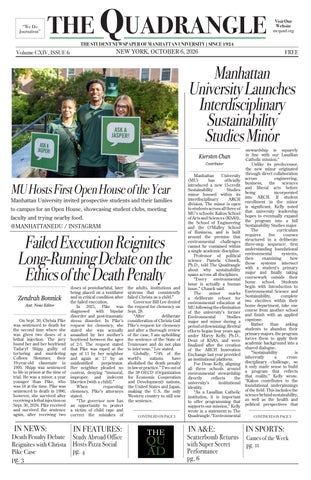
Manhattan University invited prospective students and their families to campus for an Open House, showcasing student clubs, meeting faculty and trying nearby food. @MANHATTANEDU / INSTAGRAM
Failed Execution Reignites Long-Running Debate on the Ethics of the Death Penalty On Sept. 30, Christa Pike was sentenced to death for the second time where she was given two doses of a lethal injection. The jury found her and her boyfriend Tadaryl Shipp guilty of torturing and murdering Colleen Slemmer, their 19-year-old classmate in 1995. Shipp was sentenced to life in prison at the time of trial. He was a minor, a year younger than Pike, who was 18 at the time. Pike was sentenced to death in 1996; however, she survived after receiving a lethal injection on Sept. 30, 2026. Pike received and survived the sentence again, after receiving two
doses of pentobarbital, later being placed on a ventilator and in critical condition after the failed execution. In 2021, Pike was diagnosed with bipolar disorder and post-traumatic stress disorder. In Pike’s request for clemency, she stated she was sexually assaulted by her mother’s boyfriend between the ages of 2-5. The request stated that Pike was raped at the age of 11 by her neighbor and again at 17 by an unidentified perpetrator. Her neighbor pleaded no contest, denying “immoral, improper, and indecent liberties [with a child].” When requesting clemency, Pike’s attorneys stated. “The governor now has an opportunity to protect a victim of child rape and correct the mistakes of
IN NEWS:
IN FEATURES:
Zendrah Bonnick Asst. News Editor
Death Penalty Debate Study Abroad Office Reignites with Christa Hosts Pizza Social pg. 4 Pike Case pg. 3
the adults, institutions and systems that consistently failed Christa as a child.” Governor Bill Lee denied the request for clemency on Sept. 28. “After deliberate consideration of Christa Gail Pike’s request for clemency and after a thorough review of the case, I am upholding the sentence of the State of Tennessee and do not plan to intervene,” Lee stated. Globally, “74% of the world’s nations have abolished the death penalty in law or practice.” Two out of the 38 OECD (Organization for Economic Cooperation and Development) nations, the United States and Japan, making the U.S. the only Western country to still use the sentence. __________________________ CONTINUED ON PAGE 3
Manhattan University (MU) has officially introduced a new 15-credit Sustainability Studies minor housed within its interdisciplinary ARCH division. The minor is open to students across all three of MU’s schools: Kakos School of Arts and Sciences (KSAS), the School of Engineering and the O’Malley School of Business, and is built around the premise that environmental challenges cannot be contained within a single academic discipline. Professor of political science Pamela Chasek, Ph.D., told The Quadrangle about why sustainability spans across all disciplines. “Every environmental issue is actually a human issue,” Chasek said. The minor marks a deliberate reboot for environmental education at MU following the elimination of the university’s former Environmental Studies major and minor during a period of downsizing. Revival efforts began four years ago under Marcy Kelly, Ph.D., Dean of KSAS, and were finalized after the creation of the ARCH Innovation Exchange last year provided an institutional platform. For Dean Kelly, aligning all three schools around environmental stewardship directly reflects the university’s institutional identity. “As a Lasallian Catholic institution, it is important to offer programming that supports our mission,” Kelly wrote in a statement to The Quadrangle. “Environmental
IN A&E:
Scatterbomb Returns with Super Secret Performance pg, 6
stewardship is squarely in line with our Lasallian Catholic mission.” Unlike its predecessor, the new minor originated through direct collaboration across engineering, business, the sciences and liberal arts before being incorporated into ARCH. If student enrollment in the minor is significant, Kelly noted that university leadership hopes to eventually expand the program into a full Sustainability Studies major. The curriculum requires five courses structured in a deliberate three-step sequence: first understanding foundational environmental systems, then examining how those systems intersect with a student’s primary major and finally taking coursework outside their home school. Students begin with Introduction to Environmental Science and Sustainability, complete two electives within their home department, take one course from another school and finish with an applied capstone. Rather than asking students to abandon their primary majors, the program forces them to apply their academic background into a shared dialogue. “Sustainability is inherently a crossdisciplinary challenge, so it only made sense to build a program that reflects that reality,” Kelly wrote. “Kakos contributes to the foundational underpinnings of the field. This includes the science behind sustainability, as well as the health and political perspectives that __________________________ CONTINUED ON PAGE 3
IN SPORTS: Games of the Week
pg. 11
News
OCTOBER 6, 2026
Volume CXIV, Issue 6 October 6, 2026
The Editorial Board
Barbara Vasquez Editor-in-Chief Maddie Rosado Managing Editor
Maddie Rosado News Editor
Leyla Mercado Features Editor
Zendrah Bonnick Asst. News Editor
Sarah Rolka Asst. Features Editor
Maria Castaño Arts & Entertainment Editor
Zeke Jazwinski Sports Editor
Joshua Reichard Asst. Arts & Entertainment Editor
Emmamuel Sofillas Asst. Sports Editor
Misha Jabal-Abadi Production Editor
Lois Boateng Social Media Editor Leyla Mercado Joshua Reichard Dylan Chon
Jayden Gonzalez Nicky Lombardo Photo & Video
Asst. Social Media Editors
Aureliano Morales Web Editor
Nishat Parvez Faculty Advisor
About The Quadrangle A tradition since 1924, The Quadrangle is a news or ganization run by the students of Manhattan University. We strive to cover news around campus and the greater community, publishing weekly in print and daily online. Our goal is always accuracy, relevancy and professionalism. The opinions expressed in The Quadrangle are those of the individual writer and do not necessarily reflect the views of the Editorial Board, the University or the student body.
Join The Quadrangle The Quadrangle’s staff holds weekly open meetings on Tuesdays at 2 p.m. in Kelly Commons. All are welcome to come and join the club. If interested, please email thequad@manhattan.edu!
Connect with The Quadrangle mcquad.org @mu_quad @mu_quad mcquad
2
LETTER from the EDITOR Hello everybody and welcome back to issue 6! Midterms are starting up which means we are officially reaching the halfway point of the semester. I feel like I say this every week, but I truly cannot believe how fast this year is flying by. The haunting reality of senior year and what comes after (a job) is rapidly approaching me and I have never been so grateful to be on campus. I look outside, see a busy quad from my Chrysostom Hall window, and smile. As for campus, the university seems active as ever. MU hosted its first Open House of the year this past Saturday, and seeing all of the different student clubs presenting brought a tear to my eye -- or maybe it was just the free food trucks. Club fundraisers, students lounging around and occasionally Santo, our beloved CMSA mascot, are typical features of a random day on the quad. Of course, though, the workload is as real as ever as well. In our issue, you can read about a few of the campus happenings of the last week. In news, MU recently announced an all-new Sustainability Studies minor, following the release of their recent Artificial Intelligence minor. While the use of AI on campus has been quickly developed with the ARCH program that started last year, there is still a lot of student and faculty backlash to the integration. Read more about how the two minors, and seemingly conflicting subject matters, intersect in our news section! In features, students can read about a recent Pizza Social, hosted by the Study Abroad Office, and learn more about the process and experiences of studying internationally. In A&E, we cover the return of Scatterbomb in their first show of the semester! With a secret-agent themed performance, members snuck onto the stage in the dark wearing spy outfits in a surprisingly intimidating fashion (yes, I was there. And yes, I may have yelped a bit when someone ran behind me). Give it a read, and be sure to follow Scatterbomb’s social media for updates on their upcoming shows -take it as a personal recommendation. Finally, in sports, you can read a run down of some of the club and intramural teams we have at MU, including rowing, basketball, running and more. In our Games of the Week, we had a disappointing turn of events for most teams, but women’s soccer celebrated a very impressive game against Quinnipiac on Sept. 28, recording Molly Brunk’s record-breaking 25th career win. Congrats to women’s soccer! That’s all for this issue -- give it a read, and see you next time! Sincerely,
Editor-in-Chief
News
3
THE QUADRANGLE
Manhattan University Launches Interdisciplinary Sustainability Studies Minor
__________________________ CONTINUED FROM PAGE 1
shape how sustainability challenges actually play out in the real world. Engineering complements that foundation by equipping students with the technical skills to respond directly to sustainability problems. And O’Malley [Business School] will provide courses to examine the financial dimensions of sustainability.” According to Kelly, the program structure marks a deliberate shift from traditional environmental programs. “ T r a d i t i o n a l environmental studies programs tend to focus primarily on understanding environmental systems,” Kelly wrote. “Those programs study the science of how ecosystems work, how they’re affected by human activity, and what the consequences of that impact look like. That theoretical foundation is essential, and it’s still part of what students in this minor will learn. But Sustainability Studies goes a step further by asking a more applied question: given what we know about these systems, how do we actually act on that knowledge in a way that’s workable?” That applied
framework builds on coursework previously developed by Chasek. In past environmental politics classes, students researched campus operations and produced cost-benefit analyses for university administrators. Several student proposals were later implemented on campus, including setting library default printing to double-sided and replacing single-use bottled water at catered events with hydration stations. Chasek documented this problem-based learning approach in a 2024 article in International Studies Perspectives, examining classroom projects built around the United Nations’ 17 Sustainable Development Goals. The model asks students to navigate institutional cost, human behavior and logistics alongside environmental data. The new minor capstone expands this approach through external client partnerships. Currently being developed in collaboration with J. Patrick Abuelencia, Ph.D., associate professor of engineering at MU, the Urban Sustainability Consulting Capstone will place student teams into consulting roles.
“We envision that [the] course will bring together students from all three schools, who will serve as a consulting firm to help a non-profit organization address a sustainability concern,” Kelly wrote to The Quadrangle. The program also sits alongside MU’s new Artificial Intelligence minor, set to launch in fall 2026. While developed independently, the coexistence of both programs allows students to examine the resource demands behind emerging technologies. According to a 2024 Lawrence Berkeley National Laboratory report, U.S. data centers could consume up to 12 percent of the nation’s total electricity by 2028. “Absolutely. I think there’s a lot of potential in that area. Certainly, more to come....,” Kelley wrote, about the connection between the two fields. The minor aims to encourage students to evaluate those tradeoffs early in their careers, whether an engineering student evaluating energy infrastructure, a business student managing corporate supply chains or a computer science student tracking resource consumption. Some of the biggest problems AI creates for the
environment were stated in 2024, by the United Nations Environment Programme(UNEP), to occur during various stages of AI related processes: manufacturing electronics, generating responses and consuming resources to produce. “Most large-scale AI deployments are housed in data [centers]... the electronics they house rely on a staggering amount of grist: making a 2 kg computer requires 800 kg of raw materials, as well, the microchips that power AI need rare earth elements, which are often mined in environmentally destructive ways,” UNEP wrote. “The second problem is that data [centers] produce electronic waste, which often contains hazardous substances, like mercury and lead. Third, data [centers] use water during construction and, once operational, to cool electrical components. Globally, AIrelated infrastructure may soon consume six times more water than Denmark, a country of 6 million,” UNEP added. As the program launches, administrative details including specific course offerings continue to develop. Chasek also noted that a common
hurdle is student visibility, as undergraduates often assume a minor requires taking extra credits beyond their degree plan when room for electives already exists. University leadership hopes the program’s practical design will attract a broad range of students across campus. “We invite any student who is interested in the minor to take advantage of it,” Kelly said. “We did not design the minor with a particular group of students in mind.” Later, Kelly added that she hopes the minor gives students “the opportunity to think more holistically about sustainability across our disciplines,” while delivering “a positive experience in the proposed capstone course that benefits our local community.”
Failed Execution Reignites Long-Running Debate on the Ethics of the Death Penalty
__________________________ CONTINUED FROM PAGE 1
Lethal injection, contrary to popular belief, is one of the most painful forms of the death penalty. “Today, there is compelling evidence that many people executed using lethal injection suffer severe physical distress and feelings of suffocation before their death. It is reported that pulmonary edema, a condition that causes a sensation of drowning, has been found present in 84% of autopsies conducted after lethal injection executions. Additionally, approximately 7.2% of all executions by lethal injection have been considered “botched,” making it the most errorprone execution method ever used in the United States,” The Death Penalty Information Center states. While in the U.S. the practice is legal in 27 states, doctors typically do not administer lethal injections.
One of the oldest documents in the profession’s history, the Hippocratic oath states, “I will neither give a deadly drug to anybody who asked for it, nor will I make a suggestion to this effect.” In accordance with this, the American Medical Association’s code of ethics states, “...as a member of a profession dedicated to preserving life when there is hope of doing so, a physician must not participate in a legally authorized execution.” In a recent publication by NPR on Tennessee’s failed executions, which was published Sept. 28, prior to the failed execution of Pike, Dr. John Greer stated, “We [doctors] do not want to participate and should not participate in legally authorized executions.” During the interview with NPR, interviewer and WPLN station member Catherine Sweeney gave context to Tennessee’s execution practices, “Under
Tennessee’s protocol, other health workers, like nurses or paramedics, place IVs into the prisoner’s arms. If they can’t find a vein, a doctor must step in to insert a plastic tube, or central line, in a deeper vein,” Sweeney stated. Sweeney referenced another execution that failed from May of this year, in which a physician incorrectly inserted a central line into Tony Carruthers. Sweeney later stated, “Tennessee is slated to execute a woman named Christa Pike on September 30. Her attorneys say she has a blood disorder that makes it likely she will need a central line,” Sweeney said. The death penalty in America has been a large topic of debate among Americans, with the law banned in 23 U.S. states. It has a long history of also being given to members of marginalized communities, often used in cases where
black people are exonerated used for the death penalty, posthumously after being deterrence and justice. “68% also see the death wrongfully convicted – meaning that their name is penalty as morally justified those committing cleared of their conviction for after they were already murder, while just 28% see it as morally wrong... executed. “Black people are about But a 59% majority say the 7½ times more likely to death penalty is not a crime be wrongfully convicted of deterrent; far fewer (39%) murder in the U.S. than are say that it is,” the center whites, and about 80% more added. Contrary to this, in 2009, likely to be innocent than others convicted of murder, the Journal of Criminal Law according to a new report and Criminology, 88.2% of by the National Registry of scientists reported that the death penalty does not have Exonerations.” In August of this year Pew a deterrent effect. “88.2% of respondents Research Center shared a report on polling results on do not think that the death public opinion of the death penalty deters murder—a level of consensus penalty, to the “About two-thirds of comparable Americans (66%) now favor agreement among scientists the death penalty for people regarding global climate.” The justice rationale convicted of murder, while nearly a third (32%) oppose is harder to research due to it being subjective it,” the center wrote. The report went further depending on how people in depth, describing specifics define justice: punitive or of people’s surveyed retributive, or restorative perspective on common and rehabilitative. justifications historically
Features
OCTOBER 6, 2026
4
Study Abroad at MU Welcomes Prospective Students with Pizza Social Nicholas Melendez Staff Writer
Over the years, the study abroad opportunities at Manhattan University (MU) have become a way for students to travel parts of the world that they might not have had the chance to before. Students are able to experience different cultures, languages, food and especially, a new cadence of living. On Sept. 30, the study abroad office put together a pizza social for prospective
students looking to join the program. To bring extra sources of information and advice, international students and those who have already been abroad were also invited to the pizza social. The meeting began with Emmett Ryan, Ph.D., executive director of the global engagement and study abroad programs, who presented news of the new Rome campus in Italy, based at the Lasallian Generalate, and that the school will be hosting students for a semester to earn 15 credits within their major. He
additionally noted that this program is filling up fast, so if students are interested they should get in contact with the study abroad offices soon. Ryan then went over the winter opportunities at MU before prompting attendees to mingle amongst themselves, in hopes to ask questions and meet possible new classmates. Ryan spoke to The Quadrangle to share insight on these upcoming opportunities during the winter intersession and future semesters. “We have a great lineup of faculty-led winter
A flyer for the Study Abroad Pizza Social held on Sept. 30. @STUDYABROADMU / INSTAGRAM
intersession programs in India, Panama, Mexico City, Barcelona, Paris and Rome,” Ryan said. “For students who want to spend a full semester abroad, we have exchange partners all over the world. Not only is a student abroad getting to travel while collecting credits for their course, but they are also being immersed in a new culture, trying new foods, meeting new friends. It is an experience that many students have discussed enjoying thoroughly.” Ryan believes that one of the biggest takeaways from studying abroad is growth, not just as a student, but more as a person. “[Being in an unfamiliar country will] push students outside their familiar zones and help them become more adaptable,” Ryan said. “[They] learn how to navigate unfamiliar situations, communicate with people from different backgrounds, see the world and [themselves] from a new vantage point.” Growth occurs when one steps out of their comfort zone, and thus flying to a whole new location in pursuit of furthering one’s academia is a great growth opportunity for many Jaspers. At the end of every trip abroad, the students will be asked for feedback so that the professors and directors of the program can better it for up-and-coming students. Ryan’s favorite feedback was from a student studying in Paris, who remarked that studying there helped them break their screen and digital device habits. “In a place like Paris, café culture encourages you to put away your phone, sit with friends, have a long conversation, and be present,” Ryan said. The Quadrangle spoke with some study abroad students who studied in Japan this past summer to see how this trip altered their time here at MU. Erin
Stroehlein, a sophomore electrical engineering major, recounted her time in Japan and shared she wouldn’t change anything about her experience. “[I] would definitely tell students to do it if they get the opportunity,” Stroehlein said. “I was nervous at first and worried about making friends, but I ended up loving every second of it. It might seem intimidating, but once you are there you adjust quickly.” Liv Wagoner, psychology major and history minor, another student who went to Japan, recounted how she loved the experience so much – she went twice! “Study abroad has shown [me] a new way of education,” Wagoner said. “The physical immersion in what [the other students and I] were studying has been [my] favorite way to learn.” To be able to subdue oneself into different cultures, present outside of students’ native country, is an opportunity for a new way of living. Wagoner also commented that not only is it a new way of improving one’s education, it also has given her beautiful connections with other people. She encourages other students to take the chance. “It’s crazy how close you can get with people in such a short time abroad.” Wagoner said. “It will be the best experience of [their] life. Get on that plane!”
Features
5
THE QUADRANGLE
ASA Shares Asian Culture Through Dumpling-Making Event Reyna Orlova Contributor
On Wednesday, Sept. 30 Manhattan University’s (MU) Asian Student Association (ASA) hosted a dumpling making event in Jasper Hall. The members of ASA demonstrated how to make dumplings from scratch and offered chicken, pork and vegetable fillings. The event was designed to give students an introduction to the ASA, as well as give them something hands-on to appreciate Chinese culture. ASA members encouraged all students to join even if they were not a part of the club. Vincent Vocal, ASA’s social media manager and junior computer science major, shared ASA’s mission to be inclusive to all students on MU’s campus. “[ASA’s] purpose is to create a welcoming community.” Vocal said. “Not just for Asian students, but for everybody interested in the culture and wanting to celebrate it.” Christina Cheng Wu, ASA’s shadow board member and sophomore
political science major, emphasized this point and mentioned that ASA strives to create community outside of campus through donations and charity. “We are trying to communicate with local communities and either help them [by] volunteering or [donating] money.” Cheng Wu said. “We are looking for more charity programs to donate [to].” ASA has already successfully worked with one charity organization, the United Nations Children’s Fund (UNICEF), which is devoted to helping impoverished children gain access to things like food, shelter and education. Vocal also mentioned that the ASA has specific plans in Chinatown with food pantries and volunteer work planned. Gabriella Dimalanta, ASA’s event coordinator and senior biology major, shared future events and a possible collaboration with MU’s Black Student Union (BSU) with the Quadrangle. “We always have a potluck during the fall semester, which is just [where] we share a bunch of our culture, like cultural
Two students with their dumplings from the ASA event. REYNA ORLOVA / THE QUADRANGLE foods, and just hangout with all [members].” Dimalanta said. “We’ve also been trying to do a movie night with [BSU].” Collaborations with other MU affinity groups are being planned, but nothing has been made official yet. ASA also shared that students looking to get involved with the club should reach out at @asa_manhattan on Instagram or email them at asa@manhattan.edu. Cheng Wu also emphasized to the Quadrangle that ASA’s community is not just for students with Asian
backgrounds. “[ASA] is for all Asians and anyone who’s interested in Asian culture in general.” Cheng Wu said. “So you don’t have to be Asian [to join].” Students at the dumpling event shared their sentiments about ASA’s message. Thandi Hammonds, sophomore criminology major at MU, shared what the ASA community meant to her. “When I hear ASA, I think about the Asian communities–and not even [just] Asians–but people coming together and
celebrating their cultures and making new friends.” Hammonds said. ASA encourages all students on MU’s campus to join them for upcoming events, support their fundraisers or just stop by to meet the community. The members emphasized that all students regardless of background are welcome to celebrate Asian heritage, all the same, through a variety of activities, fundraisers and more for the remainder of the fall semester and throughout the spring.
OCTOBER 6, 2026
Arts and Entertainment
6
Top Secret Comedy: Scatterbomb Returns with First Show of the Year! Zendrah Bonnick Asst. News Editor
On Friday, Oct. 2, Scatterbomb, returned with their first show of the year, following a theme of spies and secret agents. The Quadrangle newspaper conducted interviews on the night of the performance with the troupe’s members and audience. Declan Boyle, club secretary and a senior political science major, shared his perspective on how the group and club
setting helps to offset some of the concerns people have about performing. “Honestly, there is always that itch at the back of the brain of worrying that maybe you’re not the funniest, or maybe you won’t shine the brightest,” Boyle said. “But honestly, for this group, because of how much of a team game it is, I honestly really admire everybody else in the group.” Nicholas Tomczyk, a junior civil engineering major, who is responsible for managing the group’s public relations and social
Performers “snuck” into Hayden 100 as part of their secret entrance. ZENDRAH BONNICK / THE QUADRANGLE
media, expressed a similar sentiment. “At first I was definitely a little nervous for the show,” Tomczyk said. “I’ve never really performed for a crowd before, other than being one of hundreds in middle and elementary school shows. This is a smaller group, with more space for me. But my nerves have gotten less and less as time goes on, and playing these games [lets us be more] comfortable with the group and with the community.” The games mentioned by Tomczyk help the improv group during rehearsals to improvise jokes on the spot. “Practice twice a week is an hour and a half,” Tomczyk said. “First, we do a little circle warm-up, some quick games... Once we get that warmed up, we have fun... we run 20 to 30-minute practice scenes, and we run a half of a show or a full show during our practices.” Sophia Whitmore, a sophomore adolescent education major, shared her perspective as an audience member and fan of Scatterbomb with The Quadrangle. “I think improv is a really important form of comedy because it’s a way to take your mind off of [things and] just be funny,”
A moment from the performance. ZENDRAH BONNICK / THE QUADRANGLE Whitmore said. “To have fun with your friends and be in a space where you can just make believe and have fun [is important].” Whitmore shared her insights, as a member of MU’s other performing arts programs, on the significance they hold to the broader MU community. “I’m in a lot of performing arts,” Whitmore said. “I’m in Players [and] I’m in Singers. And I think Scatterbomb is kind of on the outside of performing arts, [but] they should be [seen] as more in it, because I think they’re
really funny and they’re really an integral part of the community... I just love everyone in [the troupe].” Later, Boyle stated during his interview that the talents of the group make the process of performing more enjoyable, expressing admiration for his fellow troupe members and how their skill makes him feel fortunate. “I think that they are the funniest people alive,” Boyle said. “No joke, some of them are generationally talented. And [it’s] very uplifting just being part of that team.”
Group photo of all performers in Scatterbomb. ZENDRAH BONNICK / THE QUADRANGLE
Arts and Entertainment
7
THE QUADRANGLE
Tune into WRCM! Sophia Fortunato Staff Writer
Tucked away in room 509 of Thomas Hall, Manhattan University’s (MU) studentrun radio station, We are College Music (WRCM), continues broadcasting this fall, carrying on a legacy that began more than five decades ago. Founded in 1970, WRCM has gone on and off the air several times over the years, most recently returning in 2018 after a hiatus. Today, the station is run by senior communication and English major Sadie Fox, who serves as general manager, continuing a tradition that has outlasted changes in music, technology and generations of Jaspers. Michael O’Regan, a freshman psychology major, described the process of applying for his radio show “Rasta Radio,” which airs
Inside the WRCM radio show. TRAVIS VEGA / COURTESY
Wednesday from 7-8 P.M.. “In order to apply, you fill out a Google form with your show name, logo and time slot request,” O’Regan said. “It was pretty important [that] you got the form in on time. You then had to attend tech training, which was when I formally met some of the board members, and I was trained on how to use the equipment.” O’Regan went on to share the different genres of music he enjoys playing on “Rasta Radio,” as well as genres he plans to cover in future segments. “I cover reggae music mostly on my show, dancehall, ska, but I tend to close out the show with some other genres that I enjoy like hip hop, punk and alternative rock,” O’Regan said. Nora Durcan, a freshman double major in marketing and political science, hosts her radio show, “Sister Talk,” on Wednesdays at 9
P.M.. “I just talk about kind of funny things that have happened to me and my sister,” Durcan said. Durcan went on to tell The Quadrangle about how the show’s scheduling works and how easily it fit into her own routine. “It’s really chill, [just] one hour a week,” Durcan said. “You don’t even have to do the full hour. You can end [your show] when you want to end it… It’s very flexible around your schedule.” Aine Kolpa, a junior biology major, hosts “Jump Aine Radio,” which airs Tuesdays from 1-2 P.M.. Beyond covering what’s happening around campus, the show features multiple recurring themes. “I do random updates to help you understand what’s going on with school and get insight into college life,” Kolpa said. “[On] my radio show, I do like [to do] a different theme each week... the music is based on what that theme is... In October I’ll do a Halloween segment and I’ll play ‘Monster Mash.’” WRCM also hosts campuswide events, including its annual Halloween Bash. When asked about the event, Kolpa explained that the station has broadened its reach this year by partnering with other campus clubs. “They have local bands, mainly students from MU, and they’ll go and play music,” Kolpa said. “This year their goals include a lot of different clubs, so they reached out to different clubs to help them do events for Bash. They’re going to have a costume contest and
Promotion for (MU) Halloween Bash posted on Instagram. @WRCM.ROCKS/INSTAGRAM they’re going to do crafts.” The event is being cohosted by WRCM and MU’s fashion magazine, LOTUS, on Friday, Oct. 23. There are several ways, O’Regan explained, that the station connects with students beyond the airwaves themselves. O’Regan went on to outline the main ways listeners can actually tune in to the shows. “People can listen to the WRCM Radio at the wrcm.rocks website, and some [individual radio shows even] have [their own] YouTube channels,”
O’Regan said. When asked if they would ever do a radio show like WRCM outside of MU, Kolpa showed interest in it. “I don’t think I would see myself doing it as a career,” Kolpa said. “But I do think it’d be fun to find something similar outside of MU. I don’t know how I would do that, but it’s really fun that there’s a radio show on campus, and it can be low-key if you want it to be” Students can follow WRCM’s Instagram page, @ wrcm.rocks for updates on upcoming events.
OCTOBER 6, 2026
Arts and Entertainment
8
Book Nook: “The Silent Patient,” by Alex Michaelides Erioluwa Akin-Salami Contributor
I started “The Silent Patient” by Alex Michaelides twice. The first time, I read a few chapters and dropped it. A couple of months later, I gave the book another chance. Now, I can confidently say giving this book a second chance was one of the best decisions I have ever made. What hooked me was that every time I brought the book outside, someone would ask, ‘Have you gotten to the plot twist?’ I began to wonder, for a book that starts slow, what could change so much that it leaves every reader baffled and advocating for it? I simply had to find out. Anyone who loves trying to guess the plot twist in a book would thoroughly enjoy this murder mystery. “The Silent Patient” begins like a blurred picture, and the more you read, the clearer your vision becomes. And yes, the plot twist had my jaw on the floor. There was a concept I learned in psychology that explains that when the brain does not have the answer to something, it fills it in with prior knowledge to make complete sense of what it is looking at, reading, or trying to understand. Michaelides, the main protagonist, uses this to his advantage. If you are an avid book reader, there are so many things that you presume to be true. Maybe commonly you expect a certain setting,
a particular time, or an exact scenery. You might not think filling in the blanks this way is detrimental (or even relevant), but Michaelides shows it has such a big impact. By the end of the book, you are left skimming the beginning pages all over again, wondering how you could make such a silly presumption. I have always been in love with the “unreliable narrator” plot line, in which a narrator appears to be lying to the reader. And this plot line compels the reader to handpick the truth out of the narrator’s hay pile of lies. In a line of unreliable narrator books, “The Silent Patient” takes the cake because, even though you do not trust the narrator, you want to. He shares his trauma with you, discusses how he wants to become a better person and by the middle of the book you are hoping he is not lying (despite the fact that he heavily suggests he is). He is going through so much while claiming all he wants to do is help the character, Alicia. With how convincing he is, you root for him and hope he turns out to be the hero and not the villain. The number of morally grey characters in the book is the perfect amount for me, and there were a lot. In fact, almost every character was “good” but had some terrible secret, or they did something wrong for a reason that seemed almost noble. The whole book, you wonder why Alicia kills her
Photo of a copy of The Silent Patient. ERIOLUWA AKIN-SALAMI / THE QUADRANGLE husband and even wonder if she actually did. However, all of a sudden the plot twist hits, and the picture becomes clear. Then, you catch yourself thinking, ‘Is she all that bad?’ In all, “The Silent Patient” is a beautifully complex murder mystery that not only tricks the reader but also compels them to face difficult topics such as childhood trauma, abuse,
addiction and so much more. What I got out of this book, and what I hope everyone else who reads it gains as well, is that no matter who you are, no matter what has happened to you, negatively projecting your trauma onto others can end terribly. Instead of letting yourself hurt others, in words taken directly from the book, get help and “Break free from
your past. Free yourself from endlessly repeating it.”
Arts and Entertainment
9
THE QUADRANGLE
9
Book Nook: Homegoing by Yaa Gyasi Lois Boateng
Social Media Editor
I had always heard about this book called “Homegoing,” by the Ghanaian-American author Yaa Gyasi, but I never actually got the chance to read it. I was eventually gifted the book by my aunt, who is a book fanatic and is always recommending different ones to me. I recently gained a strong interest in reading African literature. So, I was excited to finally pick up a book written by an African author and explore a story connected to African history. “Homegoing” follows the descendants of two half-sisters, Effia and Esi, who are born in eighteenthcentury Ghana. Both sisters grew up in completely different circumstances. They both share the same mother, Maame, but the two sisters never knew each other. Effia is married off to a British slave trader and lives in Cape Coast Castle, while Esi is captured and imprisoned in the dungeons to be sent off to be a slave in America. Reading this story stood out to me, especially as a Ghanaian; I have family who are also British, which made some parts of the story feel even more personal and complicated for me. I found myself thinking about how two different parts of my background are connected to a history that is not always easy to talk about. In school, we learned about colonization and its effects, but reading a book
like “Homegoing” allowed me to see the fictional history. Instead of only learning about facts and historical events, I was able to see how these experiences affected people’s lives, families and identities. What I found most interesting while reading was how the book made history feel personal to me. I have actually visited the Cape Coast Castle in Accra before, so reading about Esi being held in the dungeons made me think of my own experience. In the castle, the dungeons had a very strong, distinct smell that was insufferable. Even in the reading, it says, “the smell was unbearable” when describing the conditions inside the dungeon. Reading that line shook mem because I know that smell. This line made me think of my own family and what happened during colonization, when families were innocently taken and shipped to America and different places for slavery. This book thus draws a lot of connections to identity. While reading, I started thinking more about my own identity as a Ghanaian and what it means to know where I come from. I think sometimes I take my background for granted, because being Ghanaian is just a part of who I am. Overall, I enjoyed reading “Homegoing.” I will say this book keeps you in a loop; it’s like a thriller. You meet so many different characters throughout it, and by the end you realize that everyone is connected in some way or somehow related.
Cover of HomeGoing by Yaa Gyasi. AMAZON.COM/WEBSITE The story follows different generations and shows how their lives connect back to the original
family. I liked how the connections between the characters slowly became clear. I would recommend
this book to anyone who enjoys historical fiction and stories about family, identity and history.
Sports
OCTOBER 6, 2026
10
Meet Manhattan University’s Sports Clubs! María Castaño
Arts and Entertainment Editor
Manhattan University (MU) offers students the opportunity to engage in different sports at the national and local level through intramural sports teams and student-led clubs. Currently, MU recognizes cheerleading, tennis, esports, dance, men’s rowing and ultimate frisbee as clubs with distinct seasons and divisions, according to its official site. All of these clubs have been active in recent years except for the tennis club, who’s last Instagram post was on Oct. 21, 2024. The Student Engagement office also sponsors oncampus intramural sports. The only active teams currently are the basketball, volleyball, flag football and soccer clubs. To join any of these teams, it is necessary to sign up on IMLeagues. com or look for specific interest forms on the teams’ Instagram pages. The club basketball team recently announced open tryouts for the semester. Their 2025-2026 season ended roughly with a streak of 11 losses and only one home game won, according to the NCBBA website. Both men’s and women’s soccer clubs were introduced last year and have been active ever since. The women’s team recently posted its executive board for the 2026-27 year, featuring Ashley Zegler, a senior mechanical engineering student, as the captain and founder of the club. They compete in the US College Club Soccer East Conference as members of the NYC Division / NIRSA NY Metro region. In support of breast cancer awareness, they played a doubleheader this past Saturday against NYU and Cornell in a round-
Photo spread of some of the club sports at Manhattan Univeristy. GOJASPERS.COM/COURTESY robin tournament hosted at MU, after which they played against Columbia on campus. Their season began on Sept. 12 in an away game against Hofstra. This was closely followed by the men’s team, as they won their season-opening game against Farmingdale 4-0, held on Sept. 19. The third game of their season was held this past Sunday against Stony Brook at Gaelic Park. The club flag football team also opened tryouts last month and has been fundraising for future activities and equipment. Last year, they opened the National Intramural and Recreational Sports Association tournament successfully with a 32-6 win against the Rochester Institute of Technology team on Nov. 13. While no official games have occurred this semester, they have had a friendly match against SDT
and an open practice so far. The newest addition to student-led sports clubs in MU is the running club, founded by Shane Dilley, a sophomore communication major who also serves as the club’s social media manager. So far, they have held two events to gauge interest and introduce themselves to the campus community. The ultimate frisbee club was held down after the core and founding members graduated years ago, and only recently did they kick off the fall ‘26 semester with a revamped marketing strategy that caught the eye of many on campus with a poster captioned “You Can Be a Good Boy Too!” The club represents MU at the USAU Metro New York Regional Tournament, for which they fundraised last year. Hopefully, we will see them there in the near future. Manhattan University
also has a D1 co-ed esports team that offers students four games to play: League of Legends, Overwatch, Rocket League and Super Smash Bros Ultimate. They compete in weekly matches that can be seen on their Twitch channel against other MAAC schools, having their own dedicated room on the 1st floor of Kelly Commons. Some of their most recent accolades include winning the 2024 MAAC Esports Valorant Championship and placing 2nd in the 2023 MAAC Tournament for League of Legends. Their season runs from September to March and the easiest way to contact them is through their Instagram page or by email at esports@ manhattan.edu. One of the longestrunning clubs at MU belongs to the Men’s Rowing team, which was instituted in 1932. They compete from
September to May with the help of their coach, Michael Ward. The team’s practices are usually held in New Rochelle, with transportation to and from campus, or at Draddy Gymnasium for land practices. The club is open to all, with no experience required for the nonvarsity level. They are recognized as one of the founding members of the Dad Vail Regatta events, in which they participate as much as their funding allows. To raise funds for their 2026 Spring season, they organized their first-ever Ergathon, a 12-hour rowing endurance challenge, alongside a GoFundMe so they could cover the cost of competing in the regattas. To join, email the coach for more information.
Sports
11
THE QUADRANGLE
Games of the Week Barbara Vasquez Editor-in-Chief
Women’s Soccer In an impressive game on Sept. 28, the Manhattan University (MU) women’s soccer team took down the Quinnipiac Bobcats with a final score of 2-0. The match began with a shot on target by the Bobcats within the first minute, causing the Jaspers offense to push forward on the team, to no avail. Freshman forward Baileigh Johnson ended the charge with a high shot towards the Quinnipiac goalkeeper, met by a save. In the 32nd minute of play, senior midfielder Arancha Antunes attempted a shot on the left side of the goal, with teammate Olivia McMaster, senior midfielder, performing a head shot to complete the point. This marked McMaster’s third goal of the season, tying her for second most goals with sophomore forward Scarlett Smith. The first half ended with no more on target shots for either team. The Bobcats attempted a goal within 15 minutes of the second half, leading to
The Jaspers made strong attempts in the first set, tying with Iona through the first nine points on each team. The Gaels pulled through, gradually increasing the deficit to 22-15. Senior Katie Powers responded shortly after with two consecutive kills, shortening the lead. Iona rallied quickly for the last three points and took the set in their favor. MU took the lead early in the second set and earned a 6-5 advantage after a service ace from Powers. The Gaels responded harshly, going on a 9-1 stretch against the Jaspers and eventually securing the set with a final score of 25-19. The third set began in a toss up between the Jaspers and Gaels, with both teams tying the score throughout the first 12 points. Sophomore outside hitter Emma Francesconi landed her second service ace of the game, bringing the Jaspers to their largest lead of the match at 15-12. Both teams responded to each other, hit after hit, but the Iona Gaels secured the game with a final score of Women’s Volleyball 26-24. The team then traveled to Women’s volleyball fell to the Iona Gaels this past Loudonville, NY to continue Tuesday, Sept. 29 with a Metro play against Siena University this past Friday, final score of 3-0. Oct. 2, losing in a match of senior goalkeeper Molly Brunk’s first save of the day. Jaspers Lauren Ahearn, Mary Trudeau and Antunes all tried shots against the Quinnipiac goalkeeper, with none getting past. McMaster attempted one more shot within the last ten minutes of gametime, kicking the ball high in the air, followed by senior forward Ahearn finishing the goal. This point marked her fifth goal of the season, extending her lead on the team. The game ended with a final score of 2-0 and a conference win for the Jaspers. Brunk recorded her 23rd shutout and 25th game win of her collegiate career, and this marked head coach Brendan Lawler’s 100th win while at the university. Women’s soccer continue conference play against the Merrimack Warriors on Oct. 3. *Editor’s note: The Saturday game resulted in a draw between MU and Merrimack.
Women’s volleyball drops to the Iona Gaels in a match of 3-0 VINCENT DUSOVIC / COURTESY 3-1. The Jaspers lost the first two sets of the game in scores of 25-19 and 25-15 in favor of the Siena Saints. However, in the third set the Jaspers reignited with two aces by Francesconi and freshman outside hitter Karsyn Harris, bringing MU’s lead to three. The Saints and Jaspers tossed the advantage back and forth until freshman outside hitter landed two final kills, securing the Jaspers their first set win of the game in a score of 25-20. The fourth and final set ended with a similar backand-forth play between the two teams. Sophomore middle blocker Helenn Montilla held against the Saints’ attempts, but the Jaspers’ efforts were not enough as Siena logged their final kill, ending the set with a score of 25-22 in favor of the Saints. The Jaspers head to Poughkeepsie, NY on Oct. 3 for a conference match against the Marist Red Foxes. *Editor’s note: The Jaspers fell to Marist with a final score of 3-1. Men’s Soccer
Senior Olivia McMaster scores her third goal of the season in a win against Quinnipiac VINCENT DUSOVIC / COURTESY
MU’s men’s soccer team competed against Quinnipiac University this past Wednesday, Sept. 30, falling in a game of 3-1 for
the Bobcats. The game started with an immediate shot by graduate forward Cristiano Marsilii, followed minutes later by a miscue by the Jaspers, leading to a successful penalty kick by the Bobcats and the first point of the game. In the 27th minute, junior defender Nicolo Donadio secured a set piece from teammate Tycho van Haaren and logged his fourth goal as a Jasper. The second half opened with three consecutive shots by the MU team with none on target. Shortly after in the 53rd minute, Quinnipiac’s William Holum secured the Bobcats’ second goal of the game. The Jaspers continued fighting until a third goal from the Bobcats came 65 minutes into the match, extending their lead 3-1. More attempts came from the Jaspers, but the team’s efforts were futile as the Bobcats were not backing down, eventually ending the game with the final score in favor of Quinnipiac. The Jaspers are scheduled for their next match against Fairfield University on Oct. 3. *Editor’s note: Men’s soccer lost 3-0 to the Fairfield Stags.