Anglepoise Final.qxp_Layout 1 22/05/2026 12:43 Page 1
CITY HISTORY
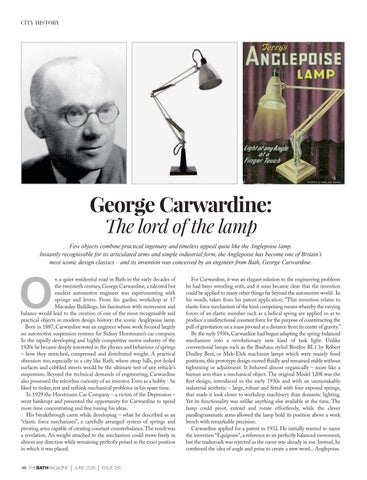
George Carwardine: The lord of the lamp Few objects combine practical ingenuity and timeless appeal quite like the Anglepoise lamp. Instantly recognisable for its articulated arms and simple industrial form, the Anglepoise has become one of Britain’s most iconic design classics – and its invention was conceived by an engineer from Bath, George Carwardine.
O
n a quiet residential road in Bath in the early decades of the twentieth century, George Carwardine, a talented but modest automotive engineer was experimenting with springs and levers. From his garden workshop at 17 Macaulay Buildings, his fascination with movement and balance would lead to the creation of one of the most recognisable and practical objects in modern design history: the iconic Anglepoise lamp. Born in 1887, Carwardine was an engineer whose work focused largely on automotive suspension systems for Sidney Horstmann’s car company. In the rapidly developing and highly competitive motor industry of the 1920s he became deeply interested in the physics and behaviour of springs – how they stretched, compressed and distributed weight. A practical obsession too, especially in a city like Bath, where steep hills, pot-holed surfaces and cobbled streets would be the ultimate test of any vehicle’s suspension. Beyond the technical demands of engineering, Carwardine also possessed the relentless curiosity of an inventor. Even as a hobby - he liked to tinker, test and rethink mechanical problems in his spare time. In 1929 the Horstmann Car Company – a victim of the Depression – went bankrupt and presented the opportunity for Carwardine to spend more time concentrating and fine tuning his ideas. His breakthrough came while developing – what he described as an “elastic force mechanism”, a carefully arranged system of springs and pivoting arms capable of creating constant counterbalance. The result was a revelation. An weight attached to the mechanism could move freely in almost any direction while remaining perfectly poised in the exact position in which it was placed. 46 THEBATHMAGAZINE | JUNE 2026 | ISSUE 280
For Carwardine, it was an elegant solution to the engineering problems he had been wrestling with, and it soon became clear that the invention could be applied to many other things far beyond the automotive world. In his words, taken from his patent application, “This invention relates to elastic force mechanism of the kind comprising means whereby the varying forces of an elastic member such as a helical spring are applied so as to produce a unidirectional constant force for the purpose of counteracting the pull of gravitation on a mass pivoted at a distance from its centre of gravity.” By the early 1930s, Carwardine had begun adapting the spring-balanced mechanism into a revolutionary new kind of task light. Unlike conventional lamps such as the Bauhaus styled Bestlite BL1 by Robert Dudley Best, or Mek-Elek machinist lamps which were mainly fixed positions, this prototype design moved fluidly and remained stable without tightening or adjustment. It behaved almost organically – more like a human arm than a mechanical object. The original Model 1208 was the first design, introduced in the early 1930s and with an unmistakably industrial aesthetic – large, robust and fitted with four exposed springs, that made it look closer to workshop machinery than domestic lighting. Yet its functionality was unlike anything else available at the time. The lamp could pivot, extend and rotate effortlessly, while the clever parallogrammatic arms allowed the lamp hold its position above a work bench with remarkable precision. Carwardine applied for a patent in 1932. He initially wanted to name the invention “Equipoise”, a reference to its perfectly balanced movement, but the trademark was rejected as the name was already in use. Instead, he combined the idea of angle and poise to create a new word... Anglepoise.