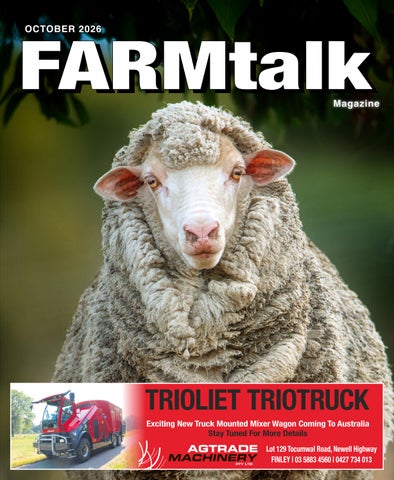
OCTOBER 2026
Magazine
TRIOLIET TRIOTRUCK
Exciting New Truck Mounted Mixer Wagon Coming To Australia Stay Tuned For More Details Lot 129 Tocumwal Road, Newell Highway FINLEY | 03 5883 4560 | 0427 734 013
NORTH DENI STEEL OCTOBER SPECIALS
PTY LTD
GAL END ASSEMBLIES
GATES
Complete Set (as below) ����������������� $200�00
10ft ‘N’ Stay Gate .....................................$163.00 Each
80nb Medium Gal Backing Post - 2.400 M .$52.00 Each
14ft ‘N’ Stay Gate .....................................$200.00 Each
16mm Round Galvanised 1 x 3.000 M .......$30.00 Each
BARB WIRE
100nb Medium Gal Strainer - 2.400 M .......$76.00 Each
12ft ‘N’ Stay Gate .....................................$177.00 Each
50nb Medium Gal Stay - 3.250 M ...............$42.00 Each
16ft ‘N’ Stay Gate .....................................$235.00 Each
CATTLE RAIL 115 x 42 x 2.0 Galv Cattle Rail 6.100 M Lengths ........... ....................................................................$73.00 Each
1.57mm High Tensile (500 M Roll) ...... $105.00 Per Roll
1.80mm High Tensile (500 M Roll) ...... $130.00 Per Roll
2.5mm Iowa (400 M Roll) .................... $150.00 Per Roll
GAL PURLIN C10015 (6.100 M Length).........................$48.00 Each
C15015 (6.100 M Length).........................$65.00 Each C20015 (8.000 M Length).......................$103.00 Each
FENCING Stiff Stay 7/90/30 (200 M Roll) (2.8mm Top & Bottom Wires) .................................................. $360.00 Per Roll
345-351 Augustus St, Deniliquin (Off Conargo Rd) Phone 5881 6688 Email - admin@northdenisteel.com.au
OCTOBER 2026
FARMtalk • 3
Top of $15,000 at Willandra sale
The Willandra Ram Sale reflected the positive sentiment in the Merino industry this spring, fuelled by good wool returns on top of extreme lamb, mutton and surplus sheep prices.
T
he sale started with strong competition that continued through to the end. The purchaser of the top priced, $15,000 Poll Merino ram (Lot 3) was the Ron Mackay Family of Lone Pine Stud, Coonamble. They have been using Willandra genetics for the past 15 years. The second top price of $14,500 was Lot 10, another Poll Merino, purchased by the Turnbull family of Narada Grazing Co. in Tambo, Queensland. Another Poll Ram (Lot 1) was purchased by Walkindyer Poll Merino Stud of North Hampton, Western Australia. After purchasing semen for 10 years and being the losing bidder on the top ram last year, family members had travelled to Jerilderie to be at the sale. Merino (horn) rams topped at $7,500 twice. Hayden Croake purchased Lot 31 for his recently purchased Allendale stud. Local Tom Sleigh, of Sleigh Pastoral Co, purchased Lot 35, the equal top priced ram for $7,500. The ram was a full brother to a ram recently sold to Argentina for $30,000. The Sleigh family purchased a total of 12 rams. Other volume buyers included Willoway Farming Pty Ltd, which purchased four rams to a top of $8,000, averaging $6,625. Willoway Farming breed rams to supply the Brinkworth family properties, with 500 rams each year to service their 80,000 breeding ewes.
Angus Heath of Willandra, holding Lot 1 purchased by Walkindyer Stud, with Callum Teakle, Josh Trafford, Sophie Seabrook and Nathan Teakle.
HARVEST SAVINGS ON LUBRICANTS BRAND NEW PRODUCT Purtill Group Diesel Engine Oil 20L
12750
$
Purtill Group Hydraulic Oil 20L
Purtill Group Unitrans Fluid 20L
8210
Purtill Group AdBlue 20L
$
10480
$
$
40
Harvest special pricing vaild until 31/1/27 or while stocks last.
1300 PURTIL (1300 787 845) www.purtillgroup.com.au
Special only available on above products, 200L also available. AdBlue also available in 10L.
OCTOBER 2026
4 • FARMtalk
Heidy Heath and Ross Wells from Willandra at the 2019 Elders Rivrina Sheep Expo in Deniliquin.
OUR PRODUCERS:
Wells Brothers
Jerilderie’s Wells brothers, Ross and Graham, have been recognised for their contribution to the NSW stud Merino industry over a 60-year period as breeders and industry advocates of the highest level.
B
oth have been inducted into the NSW Stud Merino Breeders’ Association Hall of Fame for their joint achievements and those of their own families. After forming his own family business, separate from his brother, in 1974, Ross purchased Willandra. He rebuilt the renowned bloodline into a leading national stud through innovative breeding, early adoption of artificial insemination and embryo transfer technologies, and a strong focus on genetic improvement. He achieved major success in the show ring, ram sales and international genetics markets while helping advance Poll Merino breeding. Beyond the stud, Ross was a tireless advocate for wool growers, leading campaigns on wool stockpile reform and Ovine Johne’s Disease policy. He was awarded an Order of Australia Medal (OAM) for his industry efforts in 1998.
Graham is also renowned for his industry leadership and developed innovative breeding programs at One Oak Poll that combined multiple bloodlines and created sheep suited to different regions and production systems. He was an early adopter of artificial insemination, embryo transfer, DNA technology and performance recording, helping drive genetic improvement across the industry. Beyond breeding, he played key leadership roles with the NSW Stud Merino Breeders Association, Riverina Field Days and major sire evaluation projects, including helping establish the Merino Lifetime Productivity Project. The following article, written for the NSW Stud Merino Breeders’ Association’s 2026-2027 Top Sire Magazine by Drew Chapman, charts the early beginnings of the Wells brothers in building a family legacy in the Southern Riverina and beyond. •••
The journey for the Wells brothers began at a young age, Ross at 16 and Graham at 14, with the support of their father Alby, who helped them purchase a draft of Glendonald stud ewes from Paddy McDonald, Nhill, Victoria. Impressed by the boys’ enthusiasm, Paddy graciously gifted them two blade-shorn show ewes. The two ewes were show-prepared and entered at the Melbourne Sheep Show in 1956. Graham recalls Les Faulkiner was the judge and sent one back to the pen without inspecting her. The other won her class, which was the first award for the fledgling One Oak stud. These ewes would prove pivotal for the new stud and go on to produce incredible results. Also in 1956, they purchased a Buttabone Stud Park sire and joined these ewes to it in an out-of-season joining. Lambs dropped in January onto lucerne pastures and an outstanding ram lamb was born.
JERILDERIE, NSW
Ross Wells getting hands on at Willandra Merino Stud.
Named Donald Mac, this ram would go on to achieve significant accolades. Donald Mac was first exhibited at the Australian Sheep Breeders’ Association (ASBA) Sheep Show in Melbourne in 1960, winning the medium wool championship. In the same year, he also won Grand Champion Ram at Hamilton, becoming the first medium wool sire to beat a fine wool champion at this event. Donald Mac continued to impress, cutting 40lb of wool at the end of the show season, and repeated his Melbourne Show success in 1961, again claiming the Medium Championship Ram award. The growth of the One Oak business saw the Wells brothers leave school in their early teens. Both brothers had incredible work ethics, along with their father Alby, who was constantly seeking to acquire land and sheep to grow the business for the family. Graham went shearing, from which he attributed his knowledge of skin types through the experience of different bloodlines and how they performed. Ross acknowledged his father Alby’s influence on them and remarked, “I think both Graham and I inherited our keenness, ability and competitiveness from our father. He was a quiet man, but he really liked to win, and at times, if he didn’t win, he was sure the judge was wrong!” The late 1960s and 1970s were transformative years for the Wells brothers, who took enormous strides, and plenty of risks, in growing their business. In an era before mobile phones and other technologies, their relationship with agents Denny Lasselces Ltd, who financed their growth, was critical. They purchased Ardgour Park at Jerilderie, now the home base of Ross and Irene Wells and the Willandra Merino Stud, followed by
OCTOBER 2026
FARMtalk • 5
Graham Wells with his Australian Supreme Merino Ram at the Rabobank National Merino Sheep Show and Ram Sale in 2013.
“We inherited our keenness, ability and competitiveness from our father.” — ROSS WELLS the purchase of Tongala, also at Jerilderie, which would become the home of Graham and Mary Wells and the One Oak Merino Stud. During the 1970s, the Wells brothers focused on trading sheep, with significant numbers on stock routes, as well as expanding operations by leasing more land. Wawhoon at Hay was leased from Andrew Mills, son of celebrated stud breeder Neilson Mills. Graham Wells remarked, “We thought Jerilderie country was good, until we leased Wawhoon.” Sheep numbers at this time in the operation were nearing 30,000, plus cattle, with over 800 bales of wool being produced each year. However, adversity struck the Wells family on December 10, 1965, when a particularly nasty Riverina day saw a devastating storm destroy Ross and Irene’s home and start a fire which ravaged part of Wawhoon. The Wells brothers were faced with several setbacks in business and family, alongside a change of government, which challenged the family’s resolve.
Andrew Mills wished to allow the Wawhoon property to recover and asked the Wells family to finish their lease. Seeking to find a new home for their sheep, Alby secured lease country in and around Lake Bolac. Ross, Irene and family relocated back to Victoria, running 13,000 wethers, while Graham stayed in NSW to look after the Jerilderie interests. The Whitlam Government had also come to power and changed tax laws, dropping many agricultural concessions. This left the Wells family with a tax bill of $1.30 on the dollar of their earnings when provisional tax was applied. Undeterred by life’s challenges, the Wells family continued to acquire country in the Jerilderie area. They purchased 8000 acres for $22 per acre as part of The Yanko and then secured 16,000 acres of Bundure, known as ‘New Camp’, which is now the home of One Oak Poll. A defining moment arrived in 1976 when Don Ewan, who was the manager of Goolgumbla, approached Alby to see if he would be interested in purchasing the Willandra stud. The sale consisted of 4000 mixed-age ewes and lambs, as well as 1800 young ewes and rams. This acquisition facilitated a partnership split, with Ross taking ownership of the Willandra Stud and Graham stepping into the role of studmaster of One Oak. With their split, Ross and Graham were now both well positioned to make their mark on the stud Merino industry. • To read more on Ross and Graham’s careers following the partnership split, go to the ‘Publications & News’ section of merinonsw.com.au.
Calling all Southern Riverina and Mid Murray primary producers! FARMtalk magazine is looking for local producers to feature in an ongoing ‘Our Producers’ article series, sharing the stories behind the people, properties and enterprises that make our region’s agricultural industry so diverse and resilient. Whether you’re growing, breeding, innovating or taking your farm in a new direction, we’d love to hear your story. The feature will highlight your journey, your operation, the challenges and successes along the way, and what makes your business unique. If you’d like to be part of a future edition, get in touch with the FARMtalk team. See page 19 for contact details.
GIVE YOUR PADDOCKS
A BOOST!
E R U N A M FEEDLOT Full Detailing from
✓ Finely Screened – $35/t ✓ Unscreened – $12/t ✓ Delivery Available ✓ Nutrient Analysis Available
$100
• Towing • Spray Painting • Panel Beating • All Insurance Companies
03 5881 1010
Naturally improve soil structure and fertility.
Improve water retention, soil structure and organic matter.
A practical way to enrich your soil and support stronger growth.
Build stronger, more productive soils from the ground up.
Add valuable nutrients and organic matter back into your soil.
Improve soil structure, fertility and organic matter naturally.
3 Stewart Street • Deniliquin
Ray White Real Estate Rural
✆ CALL TODAY 0409 500 455
Hamish Thomson 0419 532 259
Perfect Season Perfect Time To Sell
Ray White Deniliquin I 173 Cressy Street I (03) 5881 1000
raywhitedeniliquin.com
OCTOBER 2026
FARMtalk • 7
Harnessing AI against drought Southern Riverina dairy farmer Kristen Clark has been named one of 14 recipients of a prestigious 2027 Nuffield Australia Scholarship, with her research set to explore how artificial intelligence could help strengthen drought resilience across the Australian dairy industry.
A
warded in Darwin, the scholarship includes a $40,000 bursary to undertake international research and investigate emerging technologies that could transform how farmers make critical business decisions in increasingly challenging conditions. Ms Clark, who operates ‘Glenbank Farm’ alongside her mother and sister, will focus on a project titled ‘AI as a decision support: Building drought resilience in the Australian dairy industry’. The research aims to examine how artificial intelligence can bring together the vast amounts of data already collected on farms and convert it into practical insights. Her family runs a 1300-cow Holstein and Jersey dairy enterprise supported by 15 staff in a mixed housed and grazing system. Like many dairy businesses across southern Australia, ‘Glenbank Farm’ must constantly adapt to volatile irrigation allocations, variable rainfall, fluctuating fodder costs and seasonal uncertainty. Ms Clark believes better use of farm data could help producers respond more effectively to these challenges. Awarded in Darwin, the scholarship includes a $40,000 bursary to undertake international research and investigate emerging technologies that could transform how farmers make critical business decisions in increasingly challenging conditions. Ms Clark, who operates ‘Glenbank Farm’ alongside her mother and sister, will focus on a project titled ‘AI as a decision support: Building drought resilience in the Australian dairy industry’. The research aims to examine how artificial intelligence can bring together the vast amounts of data already collected on farms and convert it into practical insights. Her family runs a 1300-cow Holstein and Jersey dairy enterprise supported by 15 staff in a mixed housed and grazing system. Like many dairy businesses across southern Australia, ‘Glenbank Farm’ must constantly adapt to volatile irrigation allocations, variable rainfall, fluctuating fodder costs and seasonal uncertainty. Ms Clark believes better use of farm data could help producers respond more effectively to these challenges.
Kristen Clark will use her scholarship from Nuffield Australia to travel the world and research innovative technologies for dairy farms.
Nuffield chair Jane Bennett, 2027 scholar Kristen Clark and Future Drought Fund sponsor Petra Hewett. Photo by Toby Zerna Media.
D T L Y T P S E R A AGSP
Call now and book your harvest check up
ABN 48 002 492 702
BARHAM ROAD DENILIQUIN NSW 2710 I PHONE 03 5881 1255
Need Christmas present ideas? How about a Gift Voucher?
Large range of agriculture tyres available. Mobile service, we come to you! With on farm service and 24/7 call out.
Available in-store now! YOUR LOCAL "ONE STOP" SHOP FOR FARM & INDUSTRIAL SUPPLIES
Call Les on (03) 5881 2261 or 0428 796 607 249-257 Barham Road, Deniliquin.
For all your FOR HIRE Windscreens needs Call Wes 0421 216 806 147 Napier St, Deniliquin TORO MINI LOADER
+ attachments
•
Windscreen Repair and Replacement • Windscreen Replacement • Windscreen Chip Repair* • Cal-Tech ADAS Recalibration*
• Side Window Replacement • Rear Window Replacement • Truck and Bus Glass*
ALL TERRAIN SCISSOR LIFTS
• Windscreen Wipers
1.7 & 2.7 EXCAVATORS
152 Napier St, Deniliquin - Ph 5881 5521
Servicing Deniliquin anD surrounDs
+ attachments
TRAILER MOUNTED BOOM LIFT
OCTOBER 2026
FARMtalk • 9
Rangelands at Booroorban in September 2026.
Monitoring, managing in the rangelands Do you consider groundcover or vegetation cover in your management decisions?
D
o you have a minimum target level in mind and understand the protection groundcover provides for your soil? Different land-types have varying ‘ideal’ minimum levels of groundcover with a target of 50 per cent minimum set for rangelands areas, and 70 per cent considered minimum ideal level for those in high production areas with more dense pasture types. Management practices, livestock, seasonal conditions and other factors can all impact the groundcover available. It is up to managers to monitor what is happening in paddocks and what strategies can be implemented to manage groundcover, and take steps to maintain a level that protects the soils. Maintaining groundcover will not only protect your soils but also support increased water infiltration rather than run-off, and therefore assist plants in response to rainfall. Spring is an ideal time to take stock and assess current groundcover and the seasonal conditions. Different soil types are more susceptible to degradation than others and will respond faster to seasonal conditions and stocking practices (rotational grazing, managing stock numbers, destocking where required). Many people will do a visual assessment as you go around your paddocks, a broad general assessment of how much is there, bare ground, feed available and more. There are plenty of more technical ways of assessing groundcover with quadrats, measurements, transects across paddocks and more, and while it is critical to get out and look at a spectrum of the paddock and not just focus
on the really good or really bad areas, there are also tools available to assess satellite imagery. Murray Local Land Services is currently participating in a rangelands project, ‘Smart Grazing, Stronger Lands’, assessing the utilisation of different tools to support management decisions in rangelands around grazing management and subsequent land impact. With satellite assessments of vegetation cover being used in many formats already (think, NDVI maps, CIBO Labs, vegetation maps and more), the project is trialling use of a ‘Vegetation Cover Trigger Tool’ (VCoTT). It runs off historical data to determine the best month for setting a ‘decision trigger’ relative to current groundcover (green and dead material) and historical information to give an indication of likely impact on groundcover relative to management decisions; ie. groundcover is X, management action required to reduce likelihood of cover going very low or ground cover is Y, proceed as normal. The tool is being trialled for genuine usability, relevance to management decisions and application in field settings. The project involves user testing with landholders in rangeland areas, 1:1 discussions and workshops. If you are interested in knowing more, keep an eye out for an upcoming workshop (November 4) or contact Rebecca Stacey, agriculture production at Murray LLS by email rebecca.stacey@lls.nsw.gov.au. The Smart Grazing, Stronger Lands project is supported by the Australian Government through funding from the Climate-Smart Agriculture Program under the Natural Heritage Trust.
The project is led by Adelaide University through the SA Drought Hub, in partnership the Southern NSW Innovation Hub, Grower Group Alliance through the South-West WA Drought Hub, South Australian Arid Lands Landscape Board, DustWatch, CSIRO, NSW Local Land Services, Rangelands NRM, Gascoyne Catchments Group, Southern Rangelands Pastoral Alliance, and the Goldfields Nullarbor Rangelands Biosecurity Association.
Contributed by Rebecca Stacey (pictured), senior local lands officer - mixed farming with Murray Local Land Services.
OCTOBER 2026
10 • FARMtalk
The latest cohort at Tocumwal Public School, which has educated local children for nearly 150 years.
MURRAY IRRIGATION’S COMMUNITY IN FOCUS SERIES: TOCUMWAL PUBLIC SCHOOL
Working together for good
For nearly 150 years, Tocumwal Public School has catered for the educational needs of young people in this Murray River town and the surrounding region.
I
n the 21st century it continues to grow, with a committed staff, active P&C Association and a supportive local community. The school motto, ‘Working Together For Good’, is not just an abstract phrase … it’s a vision that is encouraged and embraced. Over the years, Tocumwal Public School has also retained a commitment to ensuring its students have access to the best facilities and technology to support their learning. A 2026 project has been acquiring decodable readers to assist in developing literature skills. Decodable readers are designed to help children in younger years practice and develop their phonic skills, which is considered essential for literacy development and the foundations of learning. The readers will be used daily by Kinder and Year 1 students. Their purchase has been made possible through efforts of the school’s Parents & Citizens Association, supported
by $5,000 from Murray Irrigation Ltd’s 2026 Education Sponsorship Program. The set comprises 60 books x 6 copies in the Year 1 Reader series, with another 60 books x 6 copies in the Year 1 Wattle series. “This collection will help children in younger years practice and develop their phonic skills,” explained P&C spokesperson Eloise Harris, who submitted the funding application to Murray Irrigation.
“With the purchase of these readers, our younger students will be able to keep their books for a little longer to familiarise themselves with the sounds. “These literacy techniques are the foundations of further learning and will aid in the development of many students in coming years,” Ms Harris explained.This latest stage of RMW is on track for completion as required by 31 December 2026.
“These literacy techniques are the foundations of further learning and will aid in the development of many students in coming years.” ELOISE HARRIS, P&C SPOKESPERSON
TOCUMWAL, NSW
OCTOBER 2026
FARMtalk • 11
“We work together to create a supportive and inclusive school where every child is set up for success.” — DARREN WHITE, PRINCIPAL
The SDLAM program is part of the Murray-Darling Basin Plan and is designed to achieve improved environmental outcomes for rivers, wetlands and wildlife using less water. In the growing Tocumwal community there will be a large Year 1 cohort in 2027 and the readers were considered necessary so students could have access to books for both in class and ‘at home’ learning. “Purchase of the books will help our school provide essential learning material to more students, more regularly, and for many years,” Ms Harris said. While decodable readers are not a new phenomenon, or based on the latest technological advancements, they are considered a valuable resource for student learning. Phonics-based reading has been recognised for its educational techniques for more than a century, with a resurgence in recent years. Many schools use decodable readers as a key part of systematic phonics instruction, because it allows students to practice sound-spelling patterns they have already learned. The readers have carefully written texts that align with a structured phonics program, featuring words that children can decode based on the phonics skills they have been explicitly taught. Children use segmenting (breaking words into sounds) and blending (combining sounds to form words) to read each word, reinforcing their phonics knowledge. Decodable readers are recognised as providing a safe and motivating environment for children to practice reading, which can increase confidence and therefore encourage individual reading. Specifically, the InitiaLit program purchased by Tocumwal Public School provides structured reading and writing instruction for young learners. Since 2002 Tocumwal Public School’s Principal has been Darren White, who says the school team is committed to every student’s learning, wellbeing and sense of belonging. “We work together to create a supportive and inclusive school where every child is set up for success,” he says. Mr White describes it as a “community-enriched and well-resourced school which has a commitment to providing a caring, sharing, and effective learning environment for all students”. “Our students are encouraged to have high expectations and to reach their full potential with a sense of responsibility, self-motivation and interdependence. It is a school that encourages and values positive interactions between students, staff and parents to achieve educational outcomes of a high standard,” Mr White said. Playing a key role in the link between the school and parents is an active P&C Association, which raises vital funds to help support activities, resources and opportunities for students.
Tocumwal Public School students love their reading, which is being enhanced by a new set of decodable readers.
In 2026 a key goal of the P&C was raising funds for a whole new set of personal computers for students. While acknowledging this would be a significant cost, no stone has been left unturned to generate the required revenue. Volunteer members are active in the community selling raffle tickets, with a major fundraiser this year being a ‘Cost of Living’ raffle where prizes included fuel, meat and groceries. The P&C also receives significant community support for its annual Easter Egg Raffle, with donated prizes including a range of Easter-themed goodies. “We are an active P&C … it is important to have family involvement to help provide the activities and learning supports that our students deserve,” spokesperson Eloise Harris said. “We’re proud of our school and the contribution it makes to the Tocumwal community. The young people we support today are our leaders of tomorrow.”
“We’re proud of our school and the contribution it makes to the Tocumwal community. The young people we support today are our leaders of tomorrow.” — ELOISE HARRIS, P&C SPOKESPERSON
Brian McCleary & Co ACCOUNTANTS FRIENDLY, ACCESSIBLE, CONFIDENTIAL SERVICE • Income Tax Returns • GST & BAS • Business start up • Audits • Cloud accounting software • Establish a SMSF • Single Touch Payroll ready solutions
Registered Tax Agents Registered Company Auditors SMSF Administration
Offices located in Deniliquin, Barham, Hay, Echuca, and Rochester.
126 End Street, Deniliquin
Phone 5881 7999
admin@brianmccleary.com.au
Want to promote your business or sale? M
BE
R
25
TO BE R 20 25
SEP TEM BE R2 025
PA
G
de
un
yo
u
se
e th
is
PAG ES 2-3 w
ne
sy
ste
m
PRE-SEASON DEAL S ON THE ENTIRE NEW RANGE OF KUHN HAY EQUIPMENT
5
d, wire and , bed Toilets r 4 plum te Fully owers, Hot wa . 12 sh basins, y to go ad nd 4 ha ice. Re serv
til
in e
ra
gaz
pg
Ma
tu
e
e
no
in
zin
o
go
4-
az
5T $2 + GS
•D
ag
ga
k toc In s now
ES
Mixed dairy outlo amid cost pressurok es nit
RS
G
WE MO
. 3. 60 01 45 734 83 58 427 03 E 0 ley IFF Fin AUL Mc
SY pe S ry T ea r p EM er u
o
M
Ma
n
13 W, 27 60 Finley, NS 83 45 y, 03 58 well Hw Ne 129
A Bu me ilt ric . a
AN
gs
Fl
fi we in nds r far Co roo m na ts PA r
t
in
k 03 5881 2322
n for flock n catioiry 12M X 3M/ r u ER wds Cro o’s retu n ed in daG ES 4 -5 TSOHILOEWT BLOCK PA expES 4 - 5 A K
Maga zine
Tu ff
Lo
TR 129 Toc IO umwa 03 in g lR 58 ve L d, rtic IE Ne 8 al we 3 m T ll H 4 ixin g SH ighw 56 on its I ay, FIN0 he FT LE ad •$ R 35 O Y -$ 75 N k fu I el C s
Tu rn
av
Contact us today!
OC
20
DECE MBER 2025
SE
W
VE
From 50 $7,2 GST +
n a ec
! p l he
NO
Lot 129 Tocumwal Rd, Newell Hwy, Finley Ph: 03 5883 4560 Mob: 0427 734 013, Fax: 03 5883 4570 Email: agtrade@b igpond.com
Seed your visibility in the Riverina
TOCUMWAL, NSW
OCTOBER 2026
FARMtalk • 13
Connecting women in water Women working across the irrigation and agricultural sectors are being encouraged to come together this month for a special networking and professional development event at Tocumwal.
T
he Women in Water Luncheon, hosted by Murray Irrigation and Southern Growers, will be held at The Bend in Toc on Thursday, October 15, bringing together women involved in all areas of irrigated agriculture from across the region. Running from 10am to 2pm, the event will offer attendees the chance to hear from industry speakers, share experiences and build valuable connections with other women working in the sector. And best of all, it doubles as a fundraiser for Can Assist. The program will feature three information sessions covering topics designed to help women strengthen their businesses, enterprises and careers.
A practical session on artificial intelligence will demonstrate simple ways AI can be incorporated into everyday business administration, helping save time and improve efficiency across routine tasks. Attendees will also learn more about the services and support available through Murray Irrigation, including ways water users can maximise the value of their water, infrastructure and farming operations. The day will conclude with a panel discussion exploring the opportunities available to women in irrigated agriculture, as well as the support networks, leadership pathways and industry changes shaping the future of the sector.
Following the presentations, guests will enjoy a twocourse lunch and networking opportunity, providing plenty of time for conversation and connection. Tickets are $22.50 per person and include lunch and a drink on arrival. Proceeds from ticket sales, excluding the $2.50 administration fee, will be donated to local Can Assist branches, supporting the vital work they undertake for regional families. Places are limited and bookings are now open via eventbrite. https://www.eventbrite.com.au/e/women-inwater-luncheon-tickets-1999961487647
DENILIQUIN TREE SERVICE - TREE REMOVAL - TREE MAINTENANCE & TRIMMING - STUMP REMOVAL & GRINDING - MULCHING - AERIAL RIGGING / LIMITED ACCESS
- TREE HEALTH & HAZARD ASSESSMENT - PEST & DISEASE IDENTIFICATION & MANAGEMENT - REMOTE AREA / TRAVEL SPECIALIST - 24 HOUR EMERGENCY TREE SERVICE
FREE QUOTES / FULLY INSURED 0418 572 787 admin@deniliquintreeservice.com
OCTOBER 2026
14 • FARMtalk
Nutrien livestock team members Geoff McCallum and Peter Fisk.
Record breaking Hay sale
New price records were set at the Hay annual September Sheep Sale, in front of the largest crowd of agents, buyers, vendor and spectators in recent memory.
T
he national record for Merino year-and-a-half ewes and Hay sale record were set by Greg and Fred
Turner, of Abbotsford, Ivanhoe. Abbotsford took out the top price record when their lead pen of 407 April/May 2025-drop, Collinsville-blood, August-shorn ewes made $515 a head. This toppled the previous Hay top price of $512, set in September 2021. The rest of the Abbotsford draft, offered from a total consignment of around 2000 head, sold on to $405 and $362. Two other vendors joined the $500-plus bracket: Nick McKindlay’s Mooloomoon (Moulamein) line at $502, and the Morphett family Alma operation (Booligal) also at $502, with Alma’s second and third cuts making $450 and $354. The average price paid was $375 per head
Alma’s Peter Morphett said Hay often attracted a large crowd - especially when the weather was good - because of its reputation as a premium sale. Nutrien agent Geoff McDougall refuted reports by some media outlets that the sale was “subdued”. “The sale was competitive, and I think everyone would be happy,” Mr McDougall said, adding that the quality, atmosphere and prices were on par with the successful 2021 sale at Hay. “The quality was there, and the buyers were keen to bid. “The top price was made early, in the first lane. “The second lane made around $400 but into the third lane the bids were still very good.” Beyond the results over $500, bidding was spirited, with auctioneers working hard to entice the crowd; one encouraging buyers to “buy the best and breed them better”.
Generally, better-grown ewes sold in the $420-$480 range, while plainer, smaller ewes sold at $350-$400. Buying agents from Forbes, Euroa, Narrandera, Wagga Wagga and Swan Hill travelled to attend the sale. Other results from the day included Yamba (Booligal) to $496; Daisy Plains (Booligal) to $488; Moolpa (Moulamein) to $498 and Benilkie (Balranald) to $444. Top results of the 2025-drop Merino ewes were as follows: Abbotsford (Ivanhoe), $515/$405/$362; Alma (Booligal), $502/$450/$354; Yamba (Booligal), $496/$408/$382/$344; Gunbar Station (Hay), $304/$290; Moolpa (Moulamein), $498/$400/$372; Budgewah (Hay), $360/$354; Budgewah (Hay), $472/$430/$368; Humewood (Booligal), $354/$350/$328; Daisy Plains (Booligal), $488/$384; Coulpataro (Booligal), $358/$300; Tiarra (Hay), $278/$250.
OCTOBER 2026
JERILDERIE, NSW
FARMtalk • 15
Andrew Low of Elders in action during the sale.
Smaller lines (310-600 head each) from Burtundy Station, Tchelery, Moolamoon, Albemarle, Minarto (Oxley), Nullagong, Kitcho, Benilkie, Formosa, Tarwong, Walgrove, Groongal and Mayfield ranged from $360 up. oungest of the 2024 and older Merino ewes bracket, Albemarle (2024 drop, Hay), topped at $354 while Bronte (Mossgiel) sold two lines - 300 head of 2023-drop at $350, and 800 head of 2022-drop at $340/$280. Older drops (2021–22) traded lower: Yamba’s 1360 head 2021-drop line made $312/$274/$282, Gunbar Farm’s 2022-drop line made $300/$245 and Daisy Plains’ 2021-drop line made $298. Crutched (rather than shorn) 2021-drop Minarto line made $334, slightly ahead of comparable-age uncrutched lines Just one line of ewe lambs was offered - 450 head of unshorn 2026-drop Minarto lambs - and made $238/$172.
“The sale was competitive, and I think everyone would be happy.” — GEOFF MCDOUGALL, NUTRIEN Daisy Plains’ Bec, Peter and Matt Bunyan were amongst the vendors.
A great 2026 harvest starts with the right storage Invest In On Farm Storage
Harvest at peak efficiency | Reduce wait times and freight bottlenecks | Increase marketing flexibility Maintain grain quality | Store grain when and where you need it!
Flexible Finance Available
Elders can help make your storage investment more achievable with tailored finance solutions designed to support your business and cash flow
Local Advice, Local Support - Contact your Elders representative today!
elders.com.au
FINLEY - 214-216 Murray St, Finley P: 03 5890 6000 | E: finley@elders.com.au
JERILDERIE - Oaklands St, Jerilderie P: 03 5886 2001 | E: jerilderie@elders.com.au
JIM MUIRHEAD EARTHMOVING TREE REMOVAL AND CHAINSAW WORK
Buyers of all metal products Including: Steel & Cars, Copper, Brass, Aluminium, Ally Cans, Batteries, Lead
All channel cleaning, dam cleaning, laying all concrete and black brute structures for farmer’s farm plans. Small slashing jobs.
BEST prices paid call to find your price!
Servicing the Southern Riverina and Northern Victoria.
Owner operator Jim Muirhead 0429 576 599
25-35 Hammersley Rd, Corowa - Ph 02 6033 5372
FOR ALL YOUR EARTHMOVING NEEDS GREAT & SMALL
JERILDERIE G.D. & J.A. WILLIAMS PTY LIMITED
EARTHMOVING
Huge fleet with endless applications available for hire. JER
ILDE
RIE
EAR
THM
OVIN
G
Most families that fall out used to get along. It doesn’t have to be that way. We work with families to keep relationships strong through succession and transition.
JE
RI
JE
RI
JE
RI
LD
ER
IE
LD
JE ER
RI
IE
LD
EA
R
Gary Williams Mobile 0428 845 780 Phone (03) 5886 1765 EA
R
ER
IE
LD
EA
ER
RT
IE
HM
EA
OV
RT
IN
HM
G
OV
IN
G
Call Rob Brown - 03 5877 7011 peppinfamilyconsulting.com.au
OCTOBER 2026
ID and manage fleece conditions
FARMtalk • 17
The days are starting to warm up, and you probably have seen a few blowflies flying around.
T
he current seasonal conditions have also been a good start to the fly breeding season which will likely increase in the risk of flystrike to your flock this season. Periods of wet weather can also increase the risk of other fleece conditions such as fleece rot and lumpy wool (dermo). Flystrike, lumpy wool and fleece rot are different conditions, so it is important to understand what to look for and how to manage each condition. The information below may help. If you would like further information on identifying and managing fleece rot, lumpy wool or flystrike, you can head to flyboss.com.au or contact your local district vet by calling 1300 795 299 or drop into a nearby Local Land Services office.
Fleece Rot What is it caused by? Skin infection, most commonly caused by bacteria Pseudomonas aeruginosa. Develops following prolonged wetting of the fleece and skin (usually 5-7 days) What does it look like? The wool near the skin becomes crusted, matted, and often results in green staining of the wool How is it spread? It doesn’t spread from sheep to sheep. Some sheep are susceptible to infection when conditions are right. What sheep are most susceptible? Sheep that have poor conformation along their backline such as having a dip between or behind the shoulder blades where the fleece cannot dry out. Sheep with a fleece type that lets the water in and dries out slowly. What is the effect of the condition? Reduction in wool quality, stained wool that is unscourable and increased risk of flystrike. How do you treat it? There is no effective treatment available for fleece rot. Usually resolves spontaneously once the wool and skin dry out. Once resolved at the skin level, as the wool grows it moves away from the skin but the fleece will remain stained until removed at shearing. How do you prevent it? • Breed sheep for fleece rot resistance • Timing of shearing: – Wait until lambs are 12-15 months of age to shear. – Avoid shearing lambs less than five months old. – Shear immediately before the start of the rainy season to ensure that the short fleece can dry quickly. – In older sheep, ensure they have at least three months wool before the rain so the fleece can form a barrier to the rain.
Lumpy wool (dermo) What is it caused by? Scab causing skin infection caused by bacteria Dermatophilus congolensis.
What does it look like? Forms columns of hard lumps along the wool staple. In non-wool areas such as the face and ears, the scabs are generally less than 1cm in diameter. Scabs are more significant on wooled areas, and advanced cases have hard lumps or plates of scabs across their back. The scabs lift from the skin with the fleece as it grows, causing the characteristic lumpy wool appearance. How is it spread? Can spread between sheep when infected sheep become wet and have physical contact with non-infected sheep. What sheep are most susceptible? Weaners or hoggets, especially those with a fleece type that wets easily. Young lambs less than six weeks of age are susceptible to lumpy wool due to the low protective wax content of their wool. What is the effect of the condition? Loss of condition and deaths in affected mobs, reduced skin and wool value, increased risk of flystrike and can lead to fleece rot. How do you treat it? Most sheep will develop immunity to lumpy wool infection, and in most instances the active skin infection heals within four to six weeks. In severe cases, sheep can be treated with antibiotics. Cull chronically infected sheep due to their ongoing susceptibility to flystrike. How do you prevent it? • Limit physical contact between wet sheep and don’t yard wet sheep. • Shear and dip young sheep first, before the area becomes contaminated from older sheep which may be carriers of the disease. • Shear or dip infected sheep last. • Use of commercially available dip additives (such as 0.5% zinc sulphate solution) may act as a preventative.
Flystrike What is it caused by? The Australian sheep blowfly (Lucilia cuprina) causes more than 90 per cent of all flystrike in Australian flocks. Warm and moist conditions favour activity of blowflies and flystrike occurring. What does it look like? Pulled or discoloured wool, with maggots are visible. There are various types of flystrike including: Breech strike that takes place around the crutch area of the sheep; body strike; wound strike; pizzle strike and poll strike. How is it spread? Individual sheep are infected when blowflies lay egg in moist wool. Once hatched, maggots then feed off damaged skin. What sheep are most susceptible? All breeds of sheep are vulnerable to flystrike during wet seasons. Fleece rot and lumpy wool are predisposing factors for flystrike. Urine or faecal stained wool, skin
wounds, tissue damage such as footrot, weeping eyes, and sweat around the base of the horns in rams can all cause increased moisture, making sheep susceptible to flystrike. What is the effect of the condition? Loss of production and death. How do you treat it? Treatment is essential. If struck sheep are left untreated death can occur. The struck area should be clipped with wide margins, allowing the skin to dry out and expose maggot trails. The wool and maggots should be placed in a black plastic bag and left in the sun to die. The struck area should be dressed thoroughly with an appropriate, registered flystrike treatment. How do you prevent it? Integrated flystrike prevention methods should be used to prevent flystrike. This may include: • Chemical insecticides - rotation of chemicals is important in reducing resistance. • Worm control - can minimise scouring and dags, and reducing the risk of breech strike. • Shearing and crutching - can provide up to six weeks protection for strike. • Breech modification techniques. If you have ongoing issues with flystrike, consider culling for strike, high wrinkle and/or fleece rot scores as part of a wider genetic selection strategy for long term prevention.
Contributed by Katelyn Braine (pictured), district veterinarian with Murray Local Land Services.
Contact us! ADVERTISING: DENILIQUIN OFFICE:
The Southern Riverina’s wool growers are part of an industry with a truly global reach.
Sam Wake or Amber King, Advertising Consultants P: 03 5881 2322
According to WoolProducers Australia, more than 95 per cent of Australian wool exports are sent to just four countries - China, India, Italy and the Czech Republic. That means wool grown on local farms around Deniliquin, Finley, Jerilderie and surrounding districts can ultimately be transformed into premium textiles and garments sold around the world.
E: farmtalk@denipt.com.au SOUTHERN RIVERINA OFFICE: Sarah Bain, Advertising Consultant P: 03 5883 1033 E: sarah.bain@ southernriverinanews.com.au EDITORIAL: Zoe McMaugh, Content Manager P: 03 5881 2322 E: zoe.mcmaugh@denipt.com.au
Advertising and Editorial Deadlines Advertising bookings and editorial requests for each edition of FARMtalk close on the third Friday of the month preceding publication.
Nigel Lutton
GENERAL MANAGER
Zoe McMaugh
CONTENT MANAGER
FARMtalk welcomes community contributions from farmers, experts and professionals who make their living and life on the land. If you would like to contribute, there are several ways to do so.
STORY TIP OR IDEA?
•
Get in touch and give us a tip of a great story idea.
•
Contribute an article: If you are an expert in your field then contributing once off, or regularly, is a great way to get started in our FARMtalk magazine. Contact Zoe McMaugh at farmtalk@denipt.com.au or 03 5881 2322.
•
Become an author: FARMtalk is open to occasional contributors who are experts in their field or authorities on a subject or area. Once you have contributed an article, and the editorial team have approved you, we can set you up with a regular column to contribute. We would love to hear from you. Contact Zoe McMaugh at farmtalk@denipt.com.au or 03 5881 2322.
•
Have a fascinating farm in mind for us to showcase? Tell us! We would love to hear from you. Contact Zoe McMaugh at farmtalk@denipt.com.au or 03 5881 2322.
Sam Wake
Amber King
ADVERTISING
ADVERTISING
Rowan Frazer
Eamon Kurta
CADET JOURNALIST
CADET JOURNALIST
Sarah Bain ADVERTISING
Krista Schade
RIVERINE GRAZIER JOURNALIST
Information contained in this magazine is presented only after being carefully researched. However, there are differences in state and regional regulations and conditions. Farmers are asked to check with their own advisors. FARMtalk can assume no responsibility for the contents.
What Is Your Crop Telling You? Why Spring a good time to Plan for 2027 With crops across the region continuing to motor along, it's easy to focus solely on getting through to harvest. However, spring a valuable time of the year to gather information that can help improve paddock performance next season. While crops are still growing, differences between varieties, soil types and management zones are often easier to identify than they are after harvest. Taking the time to walk paddocks now can reveal a wealth of information, from areas affected by nutrient deficiencies and waterlogging to sections consistently outperforming the rest of the paddock. Modern tools such as NDVI imagery, satellite mapping and crop monitoring platforms can help pinpoint areas worth investigating. Combining these technologies with on-ground observations can assit growers to better understand what's driving variability and where opportunities may exist for improvement. Spring is also an ideal time to assess variety performance. Which varieties have handled seasonal conditions best? Are there differences in biomass, disease pressure, maturity or yield potential? Recording these observations now can support variety selection decisions well before seed orders are placed.
Taking notes, marking locations and capturing photos now can provide valuable insights when planning soil testing, variable-rate applications or paddock rotations for 2027. By spending a little time observing, recording and analysing what's happening in the paddock today, growers can support long-term productivity gains. After all, the time to plan for next season is while this season is still growing.
Nutrien Deniliquin | (03) 5881 1777 Nutrien Finley | (03) 5883 1733 Nutrien Corowa | (02) 6033 3833