SOUTHERN RIVERINA & MID MURRAY MONTHLY RURAL MAGAZINE
SEPTEMBER 2019
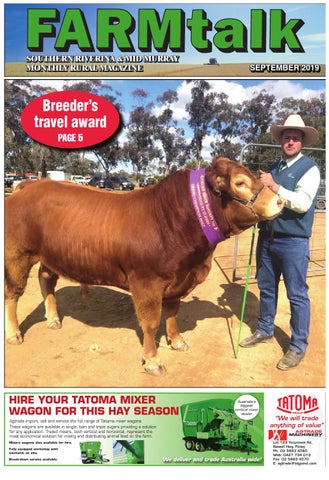
Breeder’s travel award PAGE 5
HIRE YOUR TATOMA MIXER WAGON FOR THIS HAY SEASON
Australia’s biggest vertical mixer dealer
Agtrade import, sell and service the full range of Tatoma mixer wagons. These wagons are available in single, twin and triple augers providing a solution for any application. Trailed mixers, both vertical and horizontal, represent the most economical solution for mixing and distributing animal feed on the farm.
AGTRADE MACHINERY PTY LTD
Mixers wagons also available for hire. Fully equipped workshop with mechanic on site. Break-down service available.
“We will trade anything of value”
We deliver and trade Australia wide!
Lot 129 Tocumwal Rd, Newell Hwy, Finley Ph: 03 5883 4560 Mob: 0427 734 013 Fax: 03 5883 4570 E: agtrade@bigpond.com
Scholarships for women in the rice industry now open
PUBLISHED BY DENILIQUIN PASTORAL TIMES 230 Cressy Street, Deniliquin NSW 2710 Phone (03) 5881 2322
Advertising Amy Gretgrix Sarah Bain
Production Ged Munro
Editorial Zoe McMaugh Daniel Hughes Olivia Duffey
Front Cover Finley’s Tom Isedale has won the Limousin Youth International Travel Award, which will see him travel to America to study the breed further in 2020. Full story on page 5.
September issue To be published September 2, 2019. Advertising booking deadline August 21, 2019. Contact your local advertising representative: Deniliquin Amy Gretgrix (03) 5881 2322 amy.gretgrix@denipt.com.au Finley Sarah Bain (03) 5883 1033 sarah.bain@ southernriverinanews.com.au
Information contained in this magazine is presented only after being carefully researched. However, there are differences in state and regional regulations and conditions. Farmers are asked to check their own advisors. FARMtalk can assume no responsibility for the contents.
Applications for the 2020 Jan Cathcart Scholarship are now open for women involved in the Australian rice industry, offering financial assistance valued at $10,000 a year for up to three years of tertiary study. The scholarship, which honours the memory of longterm SunRice employee Jan Cathcart and her 43 years with the rice industry, provides numerous opportunities for recipients, from financial support, to work experience and employment placements with SunRice, and professional and personal growth. ‘‘The recipients of the Jan Cathcart Scholarship have all shown a desire to contribute to the rice industry, as well as agriculture as a whole, and we’re looking to support the professional development of women in these industries,’’ SunRice chairman Laurie Arthur said. ‘‘This scholarship pays tribute to Jan’s enormous commitment to the rice in-
dustry by helping recipients in their studies and with employment options.’’ Women connected to the rice industry, shareholders and employees of SunRice and their extended families are urged to consider applying for the scholarship. Applications close on October 12, 2019, with the winner to be announced in early 2020. Moulamein’s Millie Mertz, who received the scholship in 2016, said the scholarship can open doors for young women in the industry. ‘‘The work opportunities that have arisen due to the scholarship have enabled me to explore numerous areas within the business and ultimately expose me to roles that I may never have considered without such guidance,’’ she said. ‘‘I studied a Bachelor of Business degree with a major in accounting and I am now employed as a full time IT analyst. ‘‘Without the scholarship I
wouldn’t have looked outside finance. ‘‘In these difficult drought conditions and with the water situation, the scholarship helps to shine a light not only on the premium rice that is grown in the Riverina but also the talent that can be found there.’’ Other past recipeints include: ● 2019 – Emily Fasham, from a rice farm near Wakool. ● 2018 – Annabel Arnold, from a rice farm in Berrigan (read more on page 3). ● 2017 – Sarah Cudmore, from a mixed farming property at Benerembah. ● 2016 – Millie Mertz and Elise Wilson, from a rice farm in Coleambally. ● 2015 – Samantha Glenn, from a rice farm in Moulamein; Zoe Reynoldson, from a rice farm in Berrigan. For more information and to apply for the scholarship, go to https://careers.sunrice.com.au/scholarships/.
Joint campaign for better access to fever vaccine Six prominent agricultural and rural organisations have joined forces to raise awareness of Q fever and its impacts on communities and workers. Q fever is a bacterial infection that can cause a severe flu-like illness. For some people, Q fever can affect their health and ability to work for many years. The bacteria are spread from animals — particularly cattle, sheep and goats — and even people who do not have contact with animals may be infected. The NSW Farmers’ Association, Australian Meat Industry Council, Country Women’s Association of NSW, National Farmers’ Federation, Australian Livestock and Rural Transporters Association, the Australian Meat Processor Corporation and Q fever researchers are combining efforts on a National Q Fever Taskforce to
Page 2 — ’Farm Talk’, September 2019
advocate for better access to Q fever vaccination. The taskforce will ask state and federal governments to sign up to a National Partnership Agreement on Q fever, which will clearly define state and federal responsibilities for managing the disease, and provide a framework for government investment. NSW Farmers president James Jackson is a vocal advocate for Q fever awareness following his own battle with the disease. ‘‘Q fever is a deadly disease, and it’s the last thing a farmer needs to be dealing with during an ongoing period of drought,’’ he said. ‘‘We want to see governments of all levels coming together to address this crucial public health issue. New South Wales has led the way on funding awareness and new vaccine research – other states and the Federal Gov-
ernment need to step up to match this investment.’’ Patrick Hutchison, CEO of the Australian Meat Industry Council, noted that it needs to be clearly understood that Q fever is not an occupational disease and is not restricted to any individual industry. ‘‘Q fever is a community health issue that can affect every person, young or old. The Q fever Taskforce has been established to highlight the scale of the disease and the need to raise its awareness across Australia to businesses, governments at all levels, the medical fraternity and, of course, the general community.’’ The Taskforce also aims to have all tests and vaccination details contained on the National Immunisation Register, to ask the Federal Government reintroduce funding for the National Q fever Management Program, and to secure funding for research for a new and improved vaccine.
Scholarship gives Annabel the chance to grow Since receiving the Jan Cathcart Scholarship courtesy of SunRice in 2018, Berrigan’s Annabel Arnold’s life is about continuing to be a positive influence for the rice industry. The scholarship offered Miss Arnold financial assistance — $10,000 a year for up to three years — to complete tertiary education. Miss Arnold grew up on a mixed farming property near Berrigan in the Riverina, which she said inspired her desire to work in the industry. ‘‘My family planted their first rice crop in the early 1970s and my dad has continued to do so in seasons when water is available for irrigation,’’ she said. ‘‘I have many fond memories of helping dad with watering the crop and driving a chaser bin during harvest. ‘‘We both share a love of birds and loved that growing rice brought hundreds of them to our property, not to mention being able to listen to a chorus of frogs each night.’’ Since receiving the scholarship, Miss Arnold has explored her career at SunRice and the rice industry, receiving valuable work experience whilst studying full time at university. With the support of SunRice, she has been able to complete work in a range of related fields, furthering to her education and understanding of the industry. ‘‘Winning the scholarship has given me the confidence to explore career options, build networks, grow pro-
■ Annabel Arnold (centre) with fellow Jan Cathcart scholar and now SunRice employee Samantha Glenn (left) and SunRice senior marketing manager Shannon Cumberlidge at the 2019 Rice Industry Field Day in Jerilderie. fessionally and meet a wide range of inspiring people in the rice industry,’’ she said. ‘‘It has enabled me to do work experience at SunRice whilst still studying full time at university, giving me the opportunity to work in a range of fields, from grower services, to Rice Research Australia Pty Ltd, and within the consumer markets team. ‘‘This has helped me to determine where I want to begin a career and the type of work I enjoy. ‘‘It has also broadened my knowledge about how businesses work and the type of roles that are out there in the workplace, which is something that isn’t taught at university.’’
The scholarship is open to all women who have a passion for perusing into the rice industry. ‘‘This scholarship enables young women from rural areas to broaden their horizons and step outside their comfort zones,’’ Miss Arnold said. ‘‘However, the knowledge and skills that the recipients bring from on farm experience is also a huge benefit to the broader industry and SunRice. ‘‘In the past many women were overlooked for their contribution to agriculture and it is great that the rice industry is taking the lead in supporting the smart and
clever women we have in our communities. ‘‘This scholarship has opened my eyes to the possibility of a career in agriculture, and I hope to really make a difference to my wider community in one way or another. ‘‘The opportunities SunRice faces on the world stage are exciting, however, I hope that I will be able to continue to support our local growers and those that rely on the rice industry here in Australia.’’ Applications for the 2020 Jan Cathcart Scholarship are now open, and Miss Arnold said previous applicants should keep trying. ‘‘I missed out the first time I applied for this scholarship, and I was determined that I would apply again because I could see all the potential opportunities in receiving it,’’ she said. ‘‘It doesn’t matter if you don’t have a clear direction of where you want to go with a career. ‘‘Opportunities arise for people that go out there and seek them. ‘‘This scholarship is a wonderful opening for women with a connection to the rice industry with a clear interest in agriculture and who want to make a difference to their local community. ‘‘I can’t possibly describe how much this scholarship has opened my eyes in terms of future job prospects and I would seriously encourage young women with a passion for rural Australia and agriculture to apply.’’
SWANN Outbackcam
POWERTECH
Portable HD Video 12 megapixel photo camera and recorder
Fully portable Folding panels 600W 10amp
Solar Panels
George Street, Deniliquin NSW 2710
CEL-FI GO Smart Signal Repeater boost your mobile service
03 5881 3555
GME
UHF Radio
wired@wired-entertainment.com.au Wired-Entertainment
7KM range 17 hours operating USB multi-charge
’Farm Talk’, September 2019 — Page 3
Simple steps to restrict farm invaders By LINDA SEARLE How do you make sure you are fully protected against on farm trespassers? Starting on August 1, 2019 was a change to the Biosecurity Act in NSW which makes it an offence to create a biosecurity risk by illegally trespassing on a farm. This is punishable by an immediate on-the-spot fine of $1,000 and further fines of up to $220,000 per person and $440,000 for corporations. So how do you prove that illegal trespassers create a biosecurity risk? 1. Have a biosecurity management plan in place. This could be the biosecurity plan that you
■ An example of the new biosecurity signs.
filled in for your Livestock Production Assurance (LPA) accreditation to get your National Vendor Declarations (NVDs) or a plan filled out on the FarmBiosecurity App. Your biosecurity plan must state what visitors to your farm need to do, and these steps need to be reasonable.
Whether you trade once a week, or once a year, every client is our most important client. Water. It's what we do.
02 6931 8522 | 0428 694 608 Page 4 — ’Farm Talk’, September 2019
You need to have proof that you are actively following your biosecurity plan. You can make your biosecurity management plan for your entire property or you may choose to only restrict the access to visitors to a certain part of your farm such as the paddocks, but not around the house. Alternatively you could choose a specific area such as a shed or a feed lot to be the location covered by the biosecurity management plan. An example of this using the LPA On-Farm Biosecurity Plan Template would be to add some written statements to section 2: People, Vehicles and Equipment. This could include steps like: ● Visitors should phone (insert phone number) before entering property. ● Visitors must disinfect shoes before entering sheds. ● Visitors will restrict the movement of their vehicles to the main driveway unless prior approval is obtained. ● Visitors must sign in and out of the property on a visitor’s log. Frequent visitors who have prior approval from the management are exempt from this requirement. Base your steps around your main risks and the best
ways of reducing those risks. Keep records, such as a visitor log, to prove that you are following your biosecurity management plan. 2. Have a sign at each entrance to the biosecurity management plan area. These signs must state: ● a biosecurity management plan is in place. ● it may be an offence under the Biosecurity Act 2015 to fail to comply to the biosecurity management plan. ● how visitors can contact you (or the property manager) to find out what they need to do to follow the directions of your biosecurity management plan. How do you get a sign? Free signs are available from your Local Lands Services office until the end of this year. If you already have an existing farm biosecurity sign you can get a sticker with the new wording to attach to your old sign. If you wish you can even make your own sign. If you have any more questions you can visit www.dpi.nsw.gov.au/ biosecurityact or contact your nearest Local Land Services office. ■ Linda Searle (pictured) is district veterinarian with Murray Local Land Services.
Mulesing pain relief campaign The NSW Farmers Association has supported industry taking the lead on mandating the use of pain relief during mulesing. President James Jackson said the Association’s mulesing policy is focused on protecting the practice, to ensure access to effective flystrike management techniques and the highest welfare outcomes.
‘‘Our members are concerned by movements in the market to demand nonmulesed wool. This step to support industry driving the mandating of pain relief highlights the need to actively defending the practice. ‘‘Industry must drive this initiative and explain to the market the positive welfare outcomes that mulesing with pain relief delivers.’’
Breeder’s travel award Finley Limousin producer Tom Isedale will travel to North America late next year after winning the Limousin Youth International Travel Award. The award has given him $5000 to travel anywhere overseas, to create international relationships and learn about the industry in other countries while promoting the Australian industry. ‘‘I am very humbled and would like to thank the Limousin Youth Association for providing such a prestigious award,’’ Mr Isedale said. ‘‘I would also like to thank the judges for selecting me and believing that I will be a good representative for the Limousin breed overseas. ‘‘It is then highest award you can win in the scholarships so I am proud of that achievement. ‘‘I am looking forward to creating new connections in North America that will further my knowledge and understanding of the Limousin breed overseas. ‘‘And by winning this award I hope I can help the next generation like others have helped me.’’ Mr Isedale plans to specifically look at cattle studs while exploring other parts of the industry in North America which, he says, is where the best bulls come from. ‘‘Most of the time, artificial insemination is from the bulls in North America, so I will be able to look at the bulls in the
■ Tom Isedale has won the Limousin Youth International Travel Award, which will see him travel to America to study the breed further. flesh and then pass on that knowledge,’’ he said. ‘‘I am also interested in seeing a large dairy and beef operation, because dairy is a big part of the industry here (in the Southern Riverina). ‘‘I want to see if that might be an option for here and to see how they operate.’’ Mr Isedale has been breeding Limousin cattle for more than ten years, and now wants to help others. He said the guidance he received from the older generation was an immense help to him. ‘‘While we primarily grow lucerne hay on the property, Limousin are my passion and I want to pass on the knowledge I have from working with them,’’ he said.
Watch for, report dieback Graziers have been advised by the NSW Department of Primary Industries (DPI) to be on the lookout for pasture dieback. DPI research scientist, Suzanne Boschma, said NSW producers should be aware of the spread and impact of pasture dieback which has affected large areas of sown and native summer-growing grasses in Queensland. ‘‘Pasture dieback kills grass pastures, reducing productivity,’’ Dr Boschma said. ‘‘The first suspected case in New South Wales was reported this autumn and we are monitoring the site. ‘‘Grasses only are affected,
with symptoms including yellowing, reddening and purpling of leaves before the plants eventually die. ‘‘The best time to look for symptoms in summer grasses is following significant rainfall, when the plants are actively growing. Dieback symptoms are similar to those of stressed plants and it is important to first rule out other causes, including moisture stress, fertility and herbicide damage.’’ Suspected symptoms of pasture dieback in NSW should be reported to the Exotic Plant Pest hotline 1800 084 881.
‘‘I have always liked the breed. My dad grew up with them and would put the bulls on commercial cows. They have always been top of the line in Finley, so they were an obvious choice for me.
Rob Brown
Paul Marshall
Jodie ^ĞŌ ŽŶ
‘‘Now I feel that I am at a stage where I should give back to the younger generation in the industry and continue to learn and see what could become an opportunity for Finley.’’
Ben Chartres
Naldo-Rei Casanova
Marie Muldoon
zŽƵƌ ůŽĐĂů Į ŶĂŶĐŝĂů ƉůĂŶŶŝŶŐ ĂŶĚ ĂĚǀŝĐĞ ƐƉĞĐŝĂůŝƐƚƐ ŵĂŬŝŶŐ ƚŚĞ ĐŽŵƉůĞdž ƐŝŵƉůĞ ͻ ^ƵĐĐĞƐƐŝŽŶ ͻ ^ƵƉĞƌĂŶŶƵĂƟ ŽŶ ͻ ZĞƟ ƌĞŵĞŶƚ WůĂŶŶŝŶŐ ͻ WĞƌƐŽŶĂů /ŶƐƵƌĂŶĐĞ ͻ /ŶǀĞƐƚŵĞŶƚ ͻ ƐƚĂƚĞ WůĂŶŶŝŶŐ ͻ ĞŶƚƌĞůŝŶŬ ͻ &ĂŵŝůLJ tĞĂůƚŚ Θ ƵƐŝŶĞƐƐ WůĂŶŶŝŶŐ
ĞůŝǀĞƌŝŶŐ ĂĚǀŝĐĞ ĂŶĚ ƐŽůƵƟ ŽŶƐ to our region since 1958 Contact the team at Peppin on 03 5881 1866 or ĞŵĂŝů ƐŽůƵƟ ŽŶƐΛƉĞƉƉŝŶ͘ĐŽŵ͘ĂƵ
Since 1958
CONSULTING
’Farm Talk’, September 2019 — Page 5
Don’t let your hay go up in smoke By ADRIAN SMITH Producing hay can be a risky proposition at the best of times! And with hay so costly at the moment, and so hard to come by, the last thing you want (or can afford) to happen is for it to (literally) go up in smoke! Many producers may be contemplating salvaging failing winter crops for grazing, hay or silage. It is timely to consider some of the issues around making hay at this (earlier than normal) time of the year. There are two causes of hay shed fires – straight out accidents or spontaneous combustion, where moist hay produces enough heat to burn. Spontaneous combustion can occur where there are high moisture levels in hay. Natural processes such as the production of moulds and other chemical reactions lead to the production of heat. If enough oxygen is present in conjunction with enough heat, the hay can get hot enough to ignite. As a general rule, hay with more than 16 to 18 per cent moisture content is at risk of going mouldy and producing heat. More than 20 per cent moisture and the risk increases, and at moisture contents above 25 per cent, there is a significant chance of spontaneous combustion. Impacts of heating on feed quality? If hay becomes too hot, feed quality (particularly protein levels) will be affected, with energy levels and digestibility also being negatively impacted.
The production of moulds can also have toxic impacts on livestock, cause respiratory problems for both humans and livestock and certainly reduce the palatability of the feed. What to be wary of? ● Making hay early in the season often means days are still relatively short, and as a consequence, curing times can be significantly longer. This also increases the risk of lower quality hay, or weather damage. Balancing the curing and quality constraints is vital. ● Drought impacted crops often have higher levels of water soluble sugars, which can support greater levels of microbial growth if moisture levels are high. ● Drought impacted crops are often more variable in their growth – perhaps meaning some areas of the crop are either too dry (impacts on quality) or too moist. ● Drought impacted crops can often have less bulk – sometimes meaning crops are ‘cut’ using headers or windrowers to reduce costs and increase the speed of operations - rather than mower conditioners. Mower conditions split and crush the plant stems allowing crops to dry quicker and more evenly. What can you do to minimise the likelihood of spontaneous combustion? ● Bale at the correct moisture content. Check by either visual examination of plants in the windrow (will the stems ‘snap’ easily, is there moisture still in the plant stems/nodes?) or using electronic moisture meters or probes. Experienced operators can provide a very accurate assessment. If using moisture probes, make sure they are calibrated to ensure
accuracy and reliability in measurements. ● Use hay additives to reduce or prevent mould growth, and therefore reducing the risk of heating. These additives are typically propionic acid, which acts to reduce microbial development, or anti-oxidants, which eliminate oxygen. ● Inoculants are for silage, as there is no fermentation in baled hay. ● If you think you may have a problem, check your hay stacks regularly by looking for signs of heating. Heating can occur anytime from the time of baling up to 2-3 months after. However, any moisture, such as from a leaking shed, which infiltrates the stack can lead to heating and fire at any time. ● If you suspect your hay is heating up, be very careful. Walking on a stack can cause it to collapse, especially if the centre is hot and has burnt out a cavity. ● If moving ‘hot’ bales from the stack, be very careful, as exposure to oxygen can quickly cause ignition. ● Adequate ventilation is essential – around stacked bales and through the entire stockpile. What other things should I consider?
● Adequate insurance – both of your hay sheds and the fodder itself. Do not assume because your hay shed is insured, that the contents are as well. Check with your insurer. ● Be aware of your insurance status - some insurers may not cover any loss of machinery that was stored in hay sheds that burn. Either don’t store machinery in with your hay, or ensure your policy will adequately cover any such machinery damaged in a hay fire. ● Be aware of any chemical residue/stock withholding periods as the result of chemicals that may have been applied to crops, which are now to be consumed by livestock. Ask for a commodity vendor declaration. ● Nitrate poisoning – crops under stress (in particular canola) can have elevated nitrate levels which can poison and kill livestock , and the baling process will not reduce these levels (ensiling can reduce nitrate levels). Testing of nitrate levels in failed crops may be beneficial. ● Be aware of the potential to import weed seeds if buying in hay from elsewhere. Bottom line Ensure as much as possible that your hay is cured correctly before baling. The earlier in the season, generally the more difficult (and longer) this is. Check the moisture content of your windrows. Monitor any stacks you think may be heating up – and take action before it all goes up in smoke. ■ Adrian Smith (pictured) is senior lands services officer – mixed farming with Murray Local Land Services.
DENILIQUIN TREE SERVICE - TREE REMOVAL - TREE MAINTENANCE & TRIMMING - STUMP REMOVAL & GRINDING - MULCHING - AERIAL RIGGING / LIMITED ACCESS
- TREE HEALTH & HAZARD ASSESSMENT - PEST & DISEASE IDENTIFICATION & MANAGEMENT - REMOTE AREA / TRAVEL SPECIALIST - 24 HOUR EMERGENCY TREE SERVICE
FREE QUOTES / FULLY INSURED 0418 572 787 admin@deniliquintreeservice.com
Page 6 — ’Farm Talk’, September 2019
Litigation funder for Class Action secured Progress is being made with a class action over water, being led by irrigators in the NSW Murray region. Lead claimant Chris Brooks said it had taken many months to compile the relevant evidence and data required for the class action to be successful. And after many weeks of intense due diligence, negotiations with the firm funding the legal case have been finalised. ‘‘This work is complete and they are satisfied we have a very good case,’’ Mr Brooks said. ‘‘We have since negotiated an arrangement for them to provide all farmers with a ‘no win – no fee’ deal. They have appointed a global law firm, Squires Patton & Boggs, to
■ Chris Brooks. manage the case presently before the Supreme Court in Sydney.’’ The Class Action is seeking $750 million in damages from the Murray Darling Basin Authority for impacts on what they allege was mis-
management of the MurrayDarling system. Mr Brooks said the new legal team would amend the pleadings to include all the claimants (irrigators) who have recently signed up with Aqua Law and the funding agreement would be registered on the same day, being September 18, 2019. Mr Brooks reminded irrigators that in the event of a win, damages can only be claimed for the water owned by the irrigators who have registered as part of the class action. ‘‘The settlement from this case will be distributed only to those irrigators who have signed up by September 18, and who hold Murray General Security water entitlements.
‘‘I encourage those not registered to do so immediately, as they have nothing to lose and everything to gain, including making the MDBA manage the water rights of the Murray into the future so we can again have a reliable water supply and become profitable again.’’ Mr Brooks said he wanted to clarify that the class action was not a Southern Riverina Irrigators initiative and has no involvement with SRI. He said there was some confusion over this issue when an SRI logo was inadvertently attached to previous communication from Aqua Law. Anyone requiring more information is asked to phone Mr Brooks on 0419 505 404, or your Landholder Association chair.
MILCAST PRECAST CONCRETE PRODUCTS Phone (03) 5888 3051 - Murray Hut Drive, Finley NSW Milcast@murrayirrigation.com.au - www.milcast.com.au
PROFESSIONAL CUSTOMER SERVICE
UNPARALLELED QUALITY
MILCast has a wealth of experience in precast irrigation and is passionate about creating structures that provide the perfect solutions.
MILCast believes its customers need products they can trust – and they don’t mess around when it comes to quality. Their ongoing research and development means you can be sure that you’re getting the latest and their best.
Rice Flumes
Pits and risers
Bay outlets
CUSTOM MADE ,I \RX QHHG D VSHFL¿ F shape or your project has challenging dimensions, take your problem to MILCast. Using the latest in tech-design, enables in-house engineers to create products tailored to exact VSHFL¿ FDWLRQV
Pipes
’Farm Talk’, September 2019 — Page 7
On-farm servicing now available Selling or fixing your computers, printers, copiers is now easier thanks to the Deniliquin Newsagency’s new ‘on farm’ service. Owner Mark Ritchie said when expanding into IT and maintenance, he realised there was a need for the service. ‘‘It is about offering good customer service, even in a rural area,’’ he said. ‘‘Boxing up and dragging your computer into town is a huge pain. ‘‘So, we are offering the convenience of coming to you.’’ The service, while just two months old, is already a huge success for the business. ‘‘We have already been able to help many customers by offering this service,’’ Mr Ritchie said. ‘‘We know how inconvenient it is, especially living out of town, so we are here to help. ‘‘Give us a call and we will let you know what we can do to help you.’’ Call Deniliquin Newsagency on (03) 5881 2080 to find out more.
Fire danger advice With the Bush Fire Danger Period (BFDP) starting early in some parts of NSW, and other areas to follow suit on October 1, Local Land Services is helping landholders with advice on native vegetation management and bushfires. ‘‘With bushfires a potential threat in some of the drier parts of the state, it is good idea for landholders to look at their options for managing native vegetation on farm,’’ said LLS sustainable land management officer Andrew Davidson. ‘‘As a volunteer firefighter, I have experienced the impact of bushfires first-hand and know how important it is for landholders to have the right information and advice.’’ Local Land Services has a set of fact sheets on managing native vegetation to prepare for bushfires, during a bushfire emergency and after an emergency has passed. Landholders wanting to prepare for bushfires have a range of options available to them, including clearing vegetation to protect rural infrastructure which does not require approval from Local Land Services because it is listed in the ‘allowable activities’ provisions.
If a bushfire is underway that threatens people, animals or property, landholders can remove native vegetation if directed by the NSW Rural Fire Service for emergency firefighting or emergency hazard reduction. When a bushfire has passed and the clean-up is underway, landholders have options such as removing fallen timber that is on the ground and lopping parts of fire-damaged trees, whilst maintaining the integrity of the live tree. At any time landholders can also consider their options for managing native vegetation for safety, productivity and the environment under the Land Management Framework. ‘‘Depending on the circumstances, different rules apply so talk to us at Local Land Services and we can provide individual advice,.’’ For more information about bushfire danger zones, go to www.rfs.nsw.gov.au. For more information about the Mid Murray Rural Fire Service stop harvest guidelines, turn to the double page spread on page 12.
On Farm IT Support. Call Us Today 03 58 812080 2I¿FH &KRLFH 'HQLOLTXLQ now offer an “On The Farm” IT Support Team available to give you “one on one” IT support online or at your farm. We can give you advise on all your IT Needs.
Sales & Service • Computers • Networking • Printers
Page 8 — ’Farm Talk’, September 2019
• Laptops • Displays • Accessories
Rotarians on a mission to help district farmers Cobram Rotarians Jill and Malcolm Kerr’s mission to help drought-stricken farmers has raised more than $76,000 through the Rural Aid’s Buy a Bale campaign. During the past year the couple visited 63 Rotary clubs from Deniliquin and Holbrook in NSW to Mt Beauty, Shepparton and Melbourne to encourage members to donate to the Rural Aid campaign. Mr Kerr is a former governor of Rotary District 9790 which includes Shepparton. Mrs Kerr said after a year of travelling, their final fundraising tally was $38,083 which was matched by Qantas. At the start of their travels last year Mrs Kerr said she was inspired to support the campaign because of her own rural background.
‘‘It’s close to my heart as I grew up on a family property near Hay,’’ she said. She said they recently met Rural Aid general manager Wayne Thomson who thanked them for their support. ‘‘He told us about Visa cards which were distributed during the hay drops so that farmers can spend them locally which is so important as local stores need to be supported too,’’ Mrs Kerr said. ‘‘We heard so many stories of grateful farmers — one farmer was able to take his daughter to buy some new shoes after school. Up until then he’d been taping her old shoes on to her feet. ‘‘Other families had turned their fridges off, as there was nothing to put in them, others were able to pay accounts such as mechanics, which in
New app to track water in the Basin Farmers and growers will get improved access to vital water market information through a new web and mobile app, Waterflow. Senator Perin Davey joined Water Resources Minister David Littleproud in Echuca on September 2 to announce the release of the Waterflow platform, funded through the Coalition’s Business Research and Innovation Initiative (BRII). The app was developed by natural resource economics firm Marsden Jacob Associates and will give irrigators greater confidence in the water market, enabling them to use the market to better manage their risks. ‘‘The Waterflow app is a one-stop shop and provides irrigators real-time information so they can make the best possible business decisions,’’ Senator Davey said. ‘‘It puts the power in farmers’ hands to get the best of out of the water market in changing conditions. It will serve as a powerful tool for increasing market accessibil-
ity and help level the playing field, further enhancing the positive economic benefits of innovative technology. ‘‘The app is a terrific example of how technology can make a big difference in one of our most established and important industries to help solve complex issues faced by our farmers and irrigators. ‘‘Importantly, the app has been designed to work where the mobile signal is weak, enabling more farmers to access the real-time data. ‘‘Having this information at their fingertips evens the playing field so farmers have the same information as other water market participants.’’ The web-based version of Waterflow is available now at www.waterflow.io, with the mobile app version to be made available within weeks of the launch. Further information on the program is available from the Department of Industry, Innovation and Science website at www.business.gov.au/ BRII.
■ Rural Aid general manager Wayne Thomson, with Cobram’s Jill and Malcolm Kerr in Nagambie holding one of the Rural Aid Visa cards which were donated to struggling farmers during their Buy a Bale campaign. turn helped the mechanic — ‘‘Just hearing these stories there were so many similar made it all worthwhile. These are the stories that farmers stories. don’t often tell.’’
Brian McCleary & Co Accountants Chartered Accountants
Are you looking for experience and expertise with a helpful attitude? Registered Tax Agents Registered Company Auditors
126 End Street, Deniliquin Phone 5881 7999 Barham 03 5453 2237 Hay 02 6993 1304 Echuca 03 5482 4410 ’Farm Talk’, September 2019 — Page 9
North Deniliquin Steel Supplies Specials NEW GAL & BLACK PIPE
NEW PURLINS
Up to 30% off 100nb Medium Gal Pipe (6.5mtr) ..................................... $140 per Length 100nb Medium Black Pipe (6.5mtr) ..................................... $130 per Length 25nb Medium Black Pipe (6.5mtr) ....................................... $26 per Length
WELDMESH SHEETS
50 x 50 x 3.15 (2.400 x 1.200) .......................................... $35 50 x 50 x 3.15 (2.400 x 3.000) .......................................... $63 75 x 50 x 4.00 (2.000 x 1.200) .......................................... $26 75 x 50 x 4.00 (2.400 x 3.000) .......................................... $77
per Sheet per Sheet per Sheet per Sheet
C15015 Gal (6.1mtr)
C20015 Gal (8mtr)
$45 LENGTH
$73 LENGTH
SHEEPYARD MESH 900mm High 1100mm High x 6mtr x 6mtr
$34 EA
$38 EA
Pictures for illustration purposes only
Ph: (03) 5881 6688 Fax: (03) 5881 3838 Augustus Street, Deniliquin Page 10 — ’Farm Talk’, September 2019
Dairy learning plan a big winner St Michael’s School in Deniliquin has won the Best Learning Journal Award as a result of its Dairy Australia Picasso Cow program entry. The school’s project coordinator Fiona Waters created the winning slideshow over 10 weeks last term, reporting on what and how the students were learning through the program. It received a score of 39 out of 40 from judges, who were scoring the design and decoration of their life-size fibreglass cow statue ‘HarMOOny’ and their school learning journal. The award comes with a $1000 prize. ‘‘I am so excited. To win is a really uplifting moment for the school and local farmers as well,’’ Mrs Waters said. ‘‘I first saw the program on a Facebook post by Dairy Australia and being a dairy farmer myself, I thought we needed some positive things about the industry because it is really suffering with the drought and everything at the moment. ‘‘So, I rang up and they allowed us to be a late entry
■ Fiona Waters, George Marshall, Daniel Burn, Aleaha Leetham and Sophie Pearn. which was fantastic. Then all of the teachers were just so keen and happy to get on board which was great.’’ The school conducted a variety of lessons with a theme of paddock to plate in term two. ‘‘Usually just one class does the program, but our whole school got involved and we explored a wide range of different curricular areas and different ways of learning. ‘‘We painted, did science,
saw slideshows on some of our local dairy farms, we even had some calves brought into the school and we had milk companies come and give us products, so it really showed that whole process from paddock to plate. ‘‘Our statue ‘HarMOOny’ was also designed and decorated by all of the students which now has a permanent fixture in our playground.’’ Comments from the judges
highlighted the whole-school approach had greatly benefited the students. ‘‘HarMOOny and the Learning Journal entered by the school demonstrate quality approaches to teaching and learning. It is also pleasing to see how the project engaged the whole school, the school staff, community members, local dairy farmers and local milk companies,’’ their comments read. Mrs Waters said she was proud of the students for their efforts in learning, and the teachers who made running the program possible. ‘‘It really opened up the opportunity for our students to learn about all of the processes within the dairy industry,’’ she said. ‘‘While most of our students come from farming backgrounds, everyone still learnt something new and had fun while doing it. ‘‘I think the whole experience has been incredible and I really recommend other schools getting involved and taking part in it.’’
’Farm Talk’, September 2019 — Page 11
Using the grain harvesting guide - an example S Step 1
GRAIN HARVESTING GUIDE
+1 3%(( *!! 0+ )! /1.! 0$! 1..!*0 0!),!. 01.!Č $1)% %05 * 3%* /,!! +* 5+1. ,.+,!.05ċ +. 3%* /,!! /Č 5+1 /$+1( 2!. #! 0$%/ .! %*# +10 +2!. āĀ )%*10!/ċ +. $1)% %05Č .+1* 0$! *1) !. +3*ċ S Step 2 $!*Č 1/%*# 0$! )! /1.!)!*0/ 5+1Ě2! &1/0 0 '!*Č ü* 0$! ) 4%)1) .! +))!* ! 3%* /,!! %* 0$! 0 (!ċ
PRODUCED IN PARTNERSHIP BY THE NSW RURAL FIRE SERVICE, NSW FARMERS AND AUSTRALIAN CUSTOM HARVESTERS
+. !4 ),(!Č 0!),!. 01.! +" ąĀŋƫ * āĆŌ .!( 0%2! $1)% %05 !-1 (/ Ăć ',$ċ S Step 3 ƫ+), .! 0$%/ .!/1(0 3%0$ 0$! 3%* /,!! 5+1 .! +. ! ċ
This voluntary guide applies to all grain harvesting operations that occur “in the paddock” including the operation of grain harvesters, vehicles involved in the transporting of grain, grain dryers and grain augers. Your responsibilities Under the Rural Fires Act 1997, any public authorities and owners and occupiers of land have a duty to ,.!2!*0 ü.!/ /0 .0%*# +. /,.! %*# ".+) ,.+,!.05ċ
* +3*!./ * + 1,%!./ )1/0 *+0 1/! *5 ) $%*!.5 3$!.! $! 0! , .0/ +" 0$! ) $%*! +)!/ %*0+ +*0 0 3%0$ +) 1/0% (! ) 0!.% (ċ
Ƶ '* ,/ ' /,. 5 ,1), 3%0$ 0 (! /0 āć (%0.!/ +" water; or
Rate of Spread (kph)
%þ 1(05 +" /1,,.!//%+*
Āġāā
ĀċăġĀċć
āĂġĂą
āċă
ĂĆġąĊ
Ăċć
ĆĀġĊĊ
ĆċĂ
āĀĀġāąĊ
āĆĀŐ
* 0$%/ !4 ),(!Č %" 0$! 3%* /,!! +* 5+1. ,.+,!.05 %/ Ăć ',$ +. )+.!Č 5+1 /$+1( *+0 $ .2!/0ċ
Current Relative Humidity
Ƶ ü.! !40%*#1%/$!. Ĩ(%-1% 05,!ĩ +" 0 (! /0 *%*! (%0.!/ capacity; or Ƶ .5 ,+3 !. !40%*#1%/$!. +" 0 (! /0 ĀċĊ'# , %05ċ
When to cease harvesting 0 %/ .! +))!* ! 0$ 0 5+1 ! /! $ .2!/0%*# +,!. 0%+*/ 3$!* 0$! . // %.! *#!. * !4 Ĩ ĩ %/ ăĆ +. )+.!ċ + ) '! %0 ! /%!.Č 3!Ě2! ,.!, .! 0$! #. %* $ .2!/0%*# #1% ! +* 0$! *!40 , #!ċ $%/ #1% ! %/ ( 1( 0+. 0$ 0 !-1 0!/ 0+ +" ăĆċ
Grassland Fire Danger Index (GFDI) - Fire Behaviour Relationships Grassland Fire Danger Index (GFDI)
" 0$! 3%* /,!! 5+1Ě2! .! +. ! %/ !-1 ( 0+ +. #.! 0!. 0$ * 0$! *1) !. %* 0$! 0 (!Č %0 %/ .! +))!* ! 5+1 + *+0 $ .2!/0ċ ! //!// 3! 0$!. +* %0%+*/ ( 0!.ċ
5%
10%
15%
20%
25%
30%
40%
50%
60%
65%
15°C
31
35
38
ąĀ
43
45
49
53
Ćć
58
20°C
29
33
ăć
38
ąĀ
43
ąć
ĆĀ
53
55
25°C
27
ăĀ
33
ăć
38
ąĀ
44
47
ĆĀ
52
30°C
25
28
31
33
35
37
41
44
47
49
35°C
23
Ăć
28
31
33
35
38
41
44
ąć
40°C
21
24
26
28
ăĀ
32
35
39
41
43
45°C
19
22
24
Ăć
28
ăĀ
33
ăć
39
ąĀ
Maximum Area At Various Times From Start (Hectares)
1/2 HR
1 HR
2 HR
4 HR
Low Moderate ! ü.! /0+,,! 5 .+ * 0. '/
ăġć
ĂĀġąĀ
ĉĀġāćĀ
ăĂĀġćąĀ
High ! 00 ' #!*!. ((5 /1 !//"1( 3%0$ 3 0!.
15
ĊĀ
ăćĀ
āąąĀ
35
ĂāĀ
ĉąĀ
ăăćĀ
Severe ! 00 ' ) 5 " %( !4 !,0 %* " 2+1. (! %. 1)/0 * !/
ĉĀ
ąĉĀ
ĂĀĀĀ
ĉĀĀĀ
ćċąġāĂċĉ
Extreme %.! 0 00 ' 3%(( #!*!. ((5 " %(ċ
āĀĆġăĀĀ
ćăĀġāĉĀĀ
ĂĆĀĀġĈĀĀĀ
āĀĀĀĀġĂĉĀĀĀ
āĂċĉŐ
Catastrophic
ăĀĀŐ
āĉĀĀŐ
ĈĀĀĀŐ
ĂĉĀĀĀŐ
Very High ! 00 ' 3%(( #!*!. ((5 /1 !!
Average wind speed (kph) 0$ 0 !-1 0!/ to 35 GFDI
It is your responsibility to limit the ignition and ,.!2!*0 0$! /,.! +" ü.!/ ".+) 5+1. ,.+,!.05ċ
" 5+1 .! 1/%*# ) $%*!.5Č +. 5+1 .! 3!( %*#Č 1/%*# !4,(+/%2!/ +. * *#(! #.%* !.Č 5+1 /$+1( (3 5/ ..5 ü.! / "!05 !-1%,)!*0 /1 $ /č
Current Temperature
Fires which start during harvesting operations can destroy homes, crops and livelihoods. However many are preventable.
Is the wind speed you recorded equal to or greater than the wind speed shown above? " 5!/Č %0 %/ .! +))!* ! 5+1 + *+0 $ .2!/0ċ ƫ$! ' 3! 0$!. +* %0%+*/ ( 0!.ċ
Permits to burn required in the Mid Murray Zone from October 1, 2019 W acknowledge the South Australian Country Fire Service and South Australian Farmers Federation We for their work in developing this guide.
www.rfs.nsw.gov.au Page 12 — ’Farm Talk’, September, 2019
’Farm Talk’, September, 2019 — Page 13
Local dairy farmer selected to help guide the industry Blighty dairy farmer Malcolm Holm has been named as a member of the eight person dairy industry taskforce, which will advise on options for reform of industry organisational structures. Partner organisations of the Australian Dairy Plan announced the members on September 3. Other members are: Shirley Harlock (Victoria), Bruce Donnison (Victoria/ Tasmania), Adam Jenkins (Victoria), Lauren Finger (Victoria), Wes Judd (Queensland), Michele Lawrence (Tasmania) and Greg McNamara (NSW). Mr Holm said the need for reform was highlighted as a priority issue at regional workshops held across Australia, including at Finley, and at a national workshop held on July 30 and 31. The Joint Transition Team will recommend options for transformational change, which will form part of the plan’s report to be published by the end of the year. It will report to the Australian Dairy Plan Committee, comprising the chairs of the
four partner organisations and independent chair John Brumby. ‘‘The dairy industry has shrunk, and so the organisational structure within the industry we have had for the last 20 years might not necessarily be needed now,’’ Mr Holm said. ‘‘We’ll look at the organisations that work within the industry, and what they do. ‘‘We will be looking at an industry structure that will see us in to the future, because the dairy industry is floundering at the moment. ‘‘We will look at how we can streamline the industry to better serve the 5500 Australian dairy farmers that remain in the smaller industry. ‘‘Our recommendations will also aim to give farmers a more direct line of sight to what’s happening in the industry.’’ Mr Holm said the taskforce’s aim will not be an easy task, but said each member has been chosen for the skills they can offer to the process. ‘‘I have been involved in organisations that have been
■ Malcolm Holm. through a transitional change, whether that be during the transition or if it continued after I was there,’’ he said. ‘‘I also come from a region that has gone through a significant transitional change.’’ Mr Brumby said reform of current industry structure and advocacy arrangements was the ‘‘number one issue during Dairy Plan consultation meetings’’. He said the taskforce was created in response. ‘‘We opened up the application process for membership of this taskforce, to ensure that anyone with rel-
evant experience had the opportunity to be considered. ‘‘We received more than thirty applications, all of an extremely high standard. From these applications, we’ve appointed a strong team which can bring an enormous amount to this process along with an independent view. ‘‘Ensuring that dairy has the most effective, agile and well resourced structure is an absolutely crucial element for us to get right. We can learn from other industries which have successfully reformed their organisational structures. ‘‘We all agree on the potential for dairy to speak more clearly with a strong and unified voice, to direct combined resources to industry priorities, to be more nimble in addressing challenges, to be more streamlined and remove duplication.’’ A summary of key outcomes from the national workshop of the Australian Dairy Plan can be found at www.dairyplan.com.au/ consultation-summary.
Dairy Plan built on industry feedback The dairy industry has come together and voiced its views about what is needed to shape the future of Australian dairy and deliver real and positive change for the next five years and beyond. More than 1000 farmers, service providers, processors, retailers, investors and other key stakeholders associated with the dairy industry contributed at more than 20 consultation workshops across dairying regions, through one-on-one interviews, and via OurSay the Australian Dairy Plan online forum, to the end of July. Australian Dairy Plan chairman John Brumby AO, along with Australian Dairy Plan partners — Dairy Australia, Australian Dairy
Farmers, Australian Dairy Products Federation and the Gardiner Dairy Foundation — have been actively listening to contributors across the nation. A number of consistent and clear themes have been voiced on what is needed to get the industry to a better place. Mr Brumby said overwhelmingly, contributors to the plan identified that there is a need for industry bodies to do things differently — with a clear aim to have a stronger, more united voice and a need to consider structures that make advocacy more effective. It was also highlighted that more emphasis and industry investment is needed in pro-
Page 14 — ’Farm Talk’, September 2019
moting the inherent benefits of dairy. With a lot of misinformation about the health benefits of dairy and the way it is produced, there needs to be greater focus on reinforcing the value of dairy to consumers. Many contributors also reinforced the importance of addressing social licence and environmental issues in best positioning the industry in a world of increased consumer scrutiny, choice and competition. Challenges around ‘attraction’ to the industry was also voiced, noting that there is a need to do a better job of presenting what a successful career in dairy looks like, the many career pathways, and the opportunity to build skills
essential to dairy farming and manufacturing. The workshops also recognised the increasing complexity in running dairy businesses, with greater risk and volatility. New tools and innovations that enhance profitability are needed. Dairy Australia chairman Jeff Odgers said the input was key in informing where the industry needs to head. ‘‘The contribution of farmers, processors and all of industry will inform the creation of the roadmap towards a dairy industry that is more profitable across the supply chain, more confident about competing at a local and global level, and more united,’’ he said.
In the top of milk quality After years on the cusp of the dairy industry’s top prize for milk quality, Northern Victorian dairy farmer Chris Hibberson has been announced as a 2019 winner of Dairy Australia’s Milk Quality Awards. Despite facing challenging seasonal conditions, Chris has entered the top 100 producers for milk quality nationwide by maintaining his focus on mastitis management and milk quality, resulting in better outcomes for his heard health and his bottom line. Chris and his wife Nicole purchased their 224 acre flood irrigated dairy farm at Yarroweyah after previously share farming on the property. A 50:50 split calving pattern is used for their 220 cow mixed herd. The feedbase is made up of lucerne and grazed pasture, as well as some hay, which is fed out in rings on a temporary feed pad established in a sacrifice paddock to get through the dry season. For Chris, producing high quality milk comes down to three factors – maintaining excellent teat condition, early detection and treatment of mastitis, and herd testing. ‘‘I’m finding really good teat condition is the best way to control mastitis,’’ Chris said. Chris is often in the dairy and keeps a close eye on the herd and milkers. Keeping the cows calm is important, as calm cows kick the cups off less often, have better milk let-down and move through the dairy more easily. Machinery and rubberwear is also serviced regularly to harvest milk efficiently and maintain healthy teats. Chris says he has seen improvements in his Bulk Milk Cell Count (BMCC) of 20,000-30,000 cells/mL in changing his rubberwear from round to triangular liners. Teat condition is not just managed in the dairy. Chris is a firm believer in providing enough shade to cows in the hotter months to reduce the
risk of health problems including mastitis, especially for his autumn calvers. When cows experience heat stress in late pregnancy, it suppresses their immune system for several weeks, leading to a higher risk of mastitis. Chris routinely uses a chlorhexidine teat spray in the dairy. Teats are kept clean and inspected for any abnormalities at every milking. ‘‘Identifying and treating cows when they first come in is one of my secrets to keeping a low cell count throughout the whole year,’’ he said. When a case of mastitis is identified, Chris uses an intermuscular antibiotic to treat all four quarters, rather than treating quarters individually. Cows are clearly marked after treatment for ongoing monitoring and management. A major challenge for the business is addressing spikes in cell counts immediately after calving. As a preventative measure, all cows receive dry cow treatment, which treats existing infections that were not cured during lactation and reduces the number of new infections during the dry period. For one to two months following calving, all cows are stripped weekly, and more often if heifers are prone to mastitis. Not only does this help to detect clinicals, it also helps to accustom cows to the milking process and provides an effective signal for milk letdown. In early lactation, Chris checks to see that all cows have been milked out properly. Dairy Australia’s Countdown program considers a Bulk Milk Cell Count (BMCC) below 150,000 cells/ mL to be excellent. Most processors will pay a premium for a cell count below 200,000, but Chris aims for a yearly average around 60,000 cells/mL. This number spikes after calving, but Chris believes that addressing any issues
■ Chris Hibberson at his Yarroweyah dairy farm. early puts his cows in a better position for the remainder of the lactation. ‘‘I may treat more when they first calve, but I see the benefits later on,’’ Chris said. ‘‘From around three months, the cell count drops right back, even as low as 40,000 (cells/mL), and I have very few mastitis issues, so it saves on the vet bills.’’ Herd testing is conducted once a month on the Hibberson farm to allow
Chris and Nicole to make informed decisions about their herd during a tight season. Herd testing assists them to see which cows are more prone to mastitis and how they respond to treatments. Chris does not believe there is any special secret to maintaining milk quality, but instead believes in making incremental gains across the business.
249 – 257 Barham Rd, Deniliquin Contact Les Booth on 5881 2261 or 0428 796 607
Servicing your tyre needs for all truck, tractor, earthmoving, 4WD and cars. Wheel alignments and balances Large range of tyre brands available Mobile service, we come to you! With on farm service and 24/7 call out. ’Farm Talk’, September 2019 — Page 15
SUNRICE AGM 2019
SunRice gains two new directors Jeremy Morton’s election as a SunRice grower director has triggered the need for an internal election for the Ricegrowers’ Association of Australia. Mr Morton stepped down as president of the RGA and from its central executive, effective of the central executive meeting on September 3. SunRice chair Laurie Arthur and Leigh Vial were both returned to the SunRice board, and will be joined by new directors in Mr Morton and Julian Zanatta, from Benerembah. Mark Robertson and Glen Andreazza chose not to restand for election at the end of their terms, making way for two vacancies to be filled. Unsuccessful candidates were Finley’s Warren Lang, Finley’s Angela Urquhart and Rob Massina who farms between Finley and Jerilderie.
Mr Morton said it had been ‘‘both an honour and privilege’’ to serve the RGA and its members, and was now looking forward to his new role in the industry. ‘‘Thank you for the opportunity to lead the RGA, which has an incredible legacy and bright future that will come with new leadership,’’ Mr Morton said. RGA execuitve director Graeme Kruger said Mr Morton had brought dedication and a passion for the rice industry in his role as president, overseeing a constitutional review and structural review of the RGA during his tenure. He has also been a strong advocate for water and for improving the lot of rice growers, he said. ‘‘It has been a privilege serving Jeremy in his role as president and chairman of the board. His inclusive lead-
ership style and commitment to the role was sincerely appreciated by fellow Delegates and all the staff at the RGA, he will be missed.� SunRice grower directors are elected for a four year term, which started after the 2019 AGM in Jerilderie on August 22. Mr Arthur commended the other six growers who stood for election, and said the new directors come on board at a busy time for the company. ‘‘It’s an exciting time for SunRice, following our listing on the Australian Securities Exchange in April 2019, and mid-way through execution of our 2022 Growth Strategy. ‘‘I’m delighted growers have seen fit to give me the opportunity to continue leading the company through the next phase. ‘‘The field of candidates was of an extremely high
standard, and I want to take this opportunity to thank Warren, Angela and Rob for putting themselves forward — I’m appreciative of them taking the time to nominate and engage in this process. ‘‘I also acknowledge Mark Robertson and Glen Andreazza, who determined to not re-nominate for the board at this election. ‘‘I also take this opportunity to welcome Leigh Vial back to the board. Since joining the board in 2015, Leigh has been involved across numerous aspects of the business. ‘‘Our two new grower directors, Jeremy Morton and Julian Zanatta, will bring fresh perspectives as we deliver upon the dual objectives of our 2022 Growth Strategy of increasing returns to both growers and investors.’’
Simple Soil Health Solutions Deniliquin Golf Club ,Golf Club Road Deniliquin NSW 26th September 2019, 9:00am Registration Key Note Speaker: Dr Christine Jones
359 TRANSPORT 45 FT Drop Deck with B/Tail and Bi-Fold ramps/ container pins 45 FT Tautliner, Bissaloy Chassis Tipper CARTAGE OF: • Machinery • General freight • Hay • Poly/ PVC pipe • Wool • Bulk bag fertiliser • Concrete pipes & • Bulk firewood products • Sand & Gravel For all freight requirements contact Steve “Budgieâ€? Malcom 0427 315 249 budgieboy1968@hotmail.com Berrigan
Page 16 — ’Farm Talk’, September 2019
Over the past decade Christine has gained international UHFRJQLWLRQ DV D VSHDNHU SUHVHQWLQJ RQ œ7KH )XQGDPHQWDOV RI 6RLO¡ DW ZRUN VKRSV ÀHOG GD\V VHPLQDUV DQG FRQIHUHQFHV WKURXJKRXW $XVWUDOLD 1HZ =HDODQG South Africa, Western Europe, Central America, USA and Canada. )RU PRUH LQIRUPDWLRQ YLVLW ZZZ DPD]LQJFDUERQ FRP
Speakers Keiran Knight B.Bus (Ag Comm) Agronomist - Best Australia
Rachelle Armstrong Owner/Director NutriSoil
Eager to support the connection of food A 5th generation production and human farmer, helping farmers health, Rachelle helped UHMXYHQDWH VRLOV ORZHU EXLOG WKH 1XWUL6RLO IDPLO\ input costs & improve EXVLQHVV WKH RYHUDOO TXDOLW\ RI FURSV SDVWXUHV “Lets build organic carbon, improve water holding capacity, raise soil fertility, build farm resilience, stimulate farming communities and economies�
BBQ lunch provided on the day Z^sW ÍŹ ŜƋƾĹ?ĆŒĹ?ÄžĆ? Luke Harrington 0427 138 100 luke@re-genfarming.com.au
SUNRICE AGM 2019
Stalwarts of the rice industry
■ Marj Evans, SunRice chairman Laurie Arthur and Ron and Judy Hemley. ‘‘Farming, as with nature, is cyclical. We have seen good and challenging times but sticking to what you know and a system that works has done well for us.’’ Marj and Ivor Evans made their first delivery in 1952 and have also not missed a year since. Mrs Evans, who sharefarms with Dick Thompson, was surprised and equally delighted her family’s support of the industry has been acknowledged in this way, reminiscing about life in the early days of growing rice post World War II. ‘‘I have wonderful memories of the close-knit community around the area,’’ she said. ‘‘Many rice growers were returned soldiers and all had a pioneering spirit and just got on with what needed to be done. Rice has always been a wonderful industry to be involved in and those who
established it should be proud of the legacy they have left. ‘‘The value adding that the rice industry does and what that means to the community is marvellous — what other agricultural industry achieves that? ‘‘Our research and devel-
opment is second to none and the new varieties we have are great. ‘‘I would love for the wider community to know just how good we are, particularly with water efficiency. We have such a great story to tell and we need to be louder in telling it.’’
5503571
SunRice Chairman Laurie Arthur made a very special presentation to two rice growing families, both from near Griffith, at the company’s 2019 Annual General Meeting to recognise their extraordinary dedication to the Australian rice industry. ‘‘While several growers have grown rice for many years, what sets these two families apart is that they have not missed a year for 72 and 68 years respectively, even when drought threatened to decimate the industry in crop year 2008 and just 19,000 tonnes of rice was produced,’’ Mr Arthur said. ‘‘This is a feat that is unlikely to be repeated.’’ Mr Arthur presented service awards to Ron and Judy Hemley for their 72 years of continual growing and delivery of rice and to Marj Evans, and in memory of her late husband Ivor, for their 68 years of continual growing and delivery of rice. The Hemleys grew their first crop in 1947 and they have not missed a delivery since. They share-farm with Serg Panazzolo and their legacy is in good hands with their grandson Brett Turner recently winning the highest yield award at the Rice Industry Awards. ‘‘Farming has been our life and we have enjoyed every minute of it,’’ Mrs Hemley said. ‘‘The rice industry has always been good to us and we have tried to support the industry when times have been tough.
2019
DENILIQUIN YAMAHA 167-169 Napier Street, Deniliquin. Phone 03 5881 1461. Mobile 0455 593 963.
• Servicing all brands of ATV’s and Motorcycles • ATV Tyres • Stessl and Horizon Boats • Stihl Power products ’Farm Talk’, September 2019 — Page 17
ELDERS RIVERINA SHEEP EXPO 2019
Seven in a row for AFA
■ Australian Food & Agriculture Company general manager Justin Campbell, sponsor Annie Romanin, judge Ken Noakes, Elders Rural general manager southern zone Malcolm Hunt, Elders Deniliquin branch manager Clyde McKenzie and Poll Boonoke stud manager Shannon Mitchell with the 2019 Riverina Merino Ram of the Year.
The Australian Food & Agriculture Company won its seventh consecutive Ram of the Year at the Elders Riverina Sheep Expo in Deniliquin on August 16. The 11th annual expo had a change of scenery, moving from the Peppin Heritage Centre to the Waring Gardens. Boonoke stud manager Shannon Mitchell said he was ‘‘a bit shocked’’ by the win with Poll Boonoke 180874. ‘‘I knew we were up there, but I didn’t think we were quite that good. But I guess it shows we are,’’ he said. ‘‘He (the winning ram) is not the biggest runner on the floor, but he was the best. ‘‘I think this is probably one of the better rams we’ve bred. He’s doing goods things for us. ‘‘This ram was a Grand Champion All Purpose Ram and Reserve Champion Ram at Bendigo (Australian Sheep and Wool Show). ‘‘He’s a very long, deep, medium wool ram. His wool is very luscious, soft and bright and he’s a sirey pure muzzle.’’ The winning ram is a 2018 drop, shredded March blade shorn ram. He has a fibre diameter of 19.0 microns, standard devi-
ation of 2.8, co-efficient variation of 14.7 and comfort value of 99.8 per cent. Judge Ken Noakes, from Karowara Plains Midstate Merinos in Forbes, said Poll Boonoke 180874 first caught his eye because of his ‘‘strong presence’’. ‘‘He has a good head and neck extension and great width across the shoulders, carrying right down through to the rump,’’ he said. ‘‘It stands very square and wide with good depth in the flank and a good spring of rib. ‘‘It has a tremendous quantity and quality of wool production, fine medium type. Good in staple length density and brightness, and he’s just a complete animal. ‘‘If I could describe this ram in a few words, I’d describe him as having an essence of uniqueness about him.’’ Since the first expo in 2009, AFA has now won eight Ram of the Year titles with entries from both its Boonoke and Wanganella studs. As well as the seven year streak from 2013 to 2019, it also claimed the title in 2011. Sims Uardry Stud took out the inaugural top prize in 2009, and One Oak is the only other winner, claiming it in 2010 and 2012.
A popular location A new, temporary venue set the perfect stage for all the best sheep studs showcasing their flocks at the 2019 Annual Elders Riverina Sheep Expo. The 11th annual event was just as successful in the Deniliquin Waring Gardens as it has been in its usual home at the Deniliquin Peppin Heritage Centre. ‘‘Council is planning some renovations at the centre and we weren’t allowed in there, so we had to pick another site, which was here,’’ Elders Rural livestock production advisor Errol Horneman said. A successful day started with a shearing demonstration with Deniliquin South Public School students
Page 18 — ’Farm Talk’, September 2019
watching on, learning the tricks of the trade. The region’s best shearers came together with some young up and coming talent to go blade by blade in the shearing competition. Before the day got stuck into the big award winners, the crowd was treated to a fashion show which featured local high school students among the models. The day also included the presentation of the Northern Clip of the Year, Elders Riverina Merino Ewe of the Year, Elders Riverina Performance Ram and Ewe of the Year, and the coveted Elders Merino Ram of the Year won by Australian Food & Agriculture for the seventh consecutive year.
ELDERS RIVERINA SHEEP EXPO 2019
Willandra’s third expo title Willandra has again claimed the Riverina Ewe of the Year title at the Elders Riverina Sheep Expo. The Jerilderie stud has dominated the category, winning three of the last four years. This year’s winning ewe caught the eye of judge Ken Noakes early, who said it was a ‘‘lovely shaped ewe’’. ‘‘She has good length in her body, she’s well rounded, has a good spring of rib and was conformationally very sound,’’ Mr Noakes said. ■ Willandra’s Heidy Heath, judge Ken Noakes, Willandra’s ‘‘Great density wool and Angus Heath and Elders Rural Services Deniliquin branch staple length, well crimped manager and district wool manager Clyde McKenzie with and showing very good the Riverina Ewe of the Year. colour.’’
The ewe’s wool was 18.3 microns with a standard deviation of 2.7 and comfort factor of 99.8 per cent. Heidy Heath of Willandra said the ewe, which had only just cut her teeth, was sired by Willandra 422, and the dam was a Desmond daughter. The same ewe was named champion strong wool ewe and junior champion ewe at the Australian Sheep and Wool Show in Bendigo in July. ‘‘She also won the Marchshorn pair with another ram in Bendigo. She was a 2018 drop so she only just cut her two teeth,’’ she said.
Clip trophy finds home in Conargo Michael and Claire Bull from Conargo won the Elders 2018-2019 Northern Clip of the Year. Classed by Sara Park of Caroonboon, the Bulls’ clip was first named the best January clip due to its great style, yield and length and strength results, before being named the overall winner. Mr Bull said the results have been improving since they switched to short shearing intervals of about eight months.
The winning clip averaged 18.2 microns and measured 69mm with a staple strength of 43 Newtons per kilotex. Monthly winners for the Northern Clip of the Year were as follows: ● August (2018) – AL Dickins & Co, classed by Jayde Cluff. ● September – Australian Food & Agriculture Co, classed by Barry Doidge. ● October – RM & JE
Did you know that you can now claim subsidies for the transport of seed, chemical, fertiliser and fodder in addition to livestock?
Molesworth, classed by Ashley Lindner. ● November – PM Reynolds Family Trust, classed by Malcolm Webb. ● December – Fowles Farm , classed by Kelly Chapman. ● January (2019) – MS & CE Bull, classed by Sara Park. ● February – RA, JE & AP Ross, classed by Allan Thomas. ● March – Willandra Merino Stud, classed by Christine Hall. ● April – IE Camer-
■ Elders Rural Services Deniliquin branch manager and district wool manager Clyde McKenzie, Michael Bull and Elders branch network general manager Richard Norton. on & Co, classed by Plains Pastoral Co, David Curtin. classed by Robert Doh● May – Spring erty.
1800 319 458 Call Airlie (Coleambally) Darren (Hay) or Linda (Hilston) in your local office to talk about the changes to the RAA Drought Transport Subsidy and how you can apply quickly and easily.
Airlie Hoskins | Coleambally | 0429 396 729 Tony Flett | Deniliquin | 0428 815 766 Darren Macartney | Hay | 0410 622 599 • Government Financial drought support information • Developing strategies and financial solutions for your agribusiness • Cash flow management and budgeting • Debt restructuring and accessing additional finance • Help with financial institution and creditor negotiations • Preparation for succession planning • Assistance developing a business plan • Drought preparedness planning
Servicing the NSW Southern Region Free Confidential Professional Service
www.rfcsnsw.com.au
RFCS
Rural Financial Counselling Service
NSW Southern Region
’Farm Talk’, September 2019 — Page 19
ELDERS RIVERINA SHEEP EXPO 2019 ■ LEFT: Performance Ram of the Year judge Joe Scott, sponsor Hayley Marciniak (Rivalea), Wattle Park’s Phillip Murrowood, sponsor Annie Romanin (Apiam), Elders Rural livestock production advisor Errol Horneman, Wattle Park’s John Jamieson and sponsor Andy Whitsed (Rivalea).
Performance double for Wattle Park Finley’s Wattle Park stud was a double winner at the Elders Riverina Sheep Expo, claiming both the Performance Ewe and Performance Ram of the Year titles. The result comes a year after Finley based Closeup stud achieved the same feat. Wattle Park stud owner John Jamieson was surprised
to win a double, particularly with his ewe. ‘‘She’s straight out of the paddock, it’s her first show,’’ he said. ‘‘I think the judge chose her because she still has her lamb’s teeth. She was a bit younger than the other ewes in the line-up and has a pretty handy scan there at 93.5kg
MONDAY 16TH SEPTEMBER The Jerilderie Apex club invites you to an evening with Topher Field and Anthony Violi. Topher will discuss all things MDBP, the governance of our mighty river systems and the effect its having in our local communities, both mentally and financially, along with a range of other topics. Anthony from AV weather will discuss climate change, the current weather patterns and the drivers behind them.
Anthony Violi
Private weather forecaster
Both speakers will conduct a Q&A session following their presentation.
and 42 eye-muscle lined with fat. ‘‘They haven’t seen a lot of feed these ewes. To be in that sort of condition and to have a scan like that, just shows she’s a really good type of young stud Merino. ‘‘She’s a real light southern type, she’s clean over the head, real good on her feet, and handles well through the lining of her muscle and still has plenty of length.’’ The winning Wattle Park 337 ram weighed 127.5 kilograms and had a fat depth of 11 millimetres and eye muscle depth of 49mm. Judging both performance categories was Joe Scott from Valley Vista Poll Dorset in Coolac, who was impressed with both of Wattle Park’s winners. ‘‘The ewe had a very good carcase, and stands up on her feet extremely well,’’ he said. ‘‘She was very white across the line which helped put her on top.
‘‘It was difficult with the ram class with a Merino ram in the class. I had to re-think the way I was judging the class. ‘‘The ram I had on top, I first picked him on his structure without looking at his figures. ‘‘I did the same with the ewes. I didn’t look at the numbers straight away, I just judged the sheep in my head first on structure, their muscle and their depth from what I could see. ‘‘Once I stood back and had a look I read the cards. The ram I picked first then had the numbers that he'd been scanned that morning that matched and justified his performance to being the top ram. ‘‘I was very happy with his depth; the way he stands he looks so correct on his feet. He’s going to last his five or six years as a sire and will definitely do his part in the market place.’’
x Start Time: 6.45pm x Location: Jerilderie Civic Hall, 33 Jerilderie Street Jerilderie 2716
■ LEFT: John Jamieson, judge Joe Scott and Errol Horneman with the Performance Ewe of the Year.
x Finger food will be provided between presentations. x Drinks will be available at bar prices. All enquiries Call: Brendan Lawton 0401 641 386 Please respond to facebook event
Topher Field
Optimist, Libitarian & Film maker
https://www.facebook.com/events/2443313422594720/?ti=icl
Page 20 — ’Farm Talk’, September 2019
ELDERS RIVERINA SHEEP EXPO 2019
Shannon’s shearing superiority Shearing veteran Shannon Mitchell took out the blade shearing competition in Deniliquin’s Waring Gardens on August 16, as part of the 11th Annual Elders Riverina Sheep Expo. The contest was hard fought and back breaking for the six contestants as they
clung to their sheep on the footpath of Edwardes St. Elders Rural livestock production advisor Errol Horneman said Mr Mitchell’s win was due to his selection of sheep, and his speed. The judges were looking for simple winning factors and saw Mr Mitchell — who is based at Boonoke with
Australian Food and Agriculture — as the clear favourite. ‘‘The judges looked at mainly time, that they don’t cut the sheep and the evenness of the shearing — they are the main things,’’ Mr Horneman said. ‘‘Second to finish was Bruce Rollinson who took on a tough sheep but cut well
and clean enough through the closer wool. ‘‘Tom Lilburne came in third in what was a great job for a young bloke.’’ Mr Horneman said the event also saw some young up-and-coming talent. ‘‘The last one in was young Lachie Barrett, who’s only 12 months into his career but did a great job.’’
■ Blade shearing competition winner Shannon Mitchell (middle) with second placed Bruce Rollinson (left) and ■ The blade shearers in action as they race to be crowned third placed Tom Lilburne. the quickest in the region.
Around the grounds:
MERRENGREEN RAM SALE: 60 Poll Dorsets
■ Shane Foster from Pooginook Merino Stud.
On Farm - Thursday, September 26 at 1.00pm At “Merrengreen” Caseys Road, Finley (12km east of Finley – turn left at signs)
Light lunch provided. Gudair Vaccinated. Footrot Free. OJD Vaccinated. Second Generation. Free delivery available.
■ David Curtin and Andrew Gillett.
Duncan Carmichael (03) 5885 2561 mob. 0497 231 858 Agents: Bill O’Brien – 0417 229 553 Jim Jewell - 0488 539 363 Marc Braybon - 0419 625 815 ’Farm Talk’, September 2019 — Page 21
Winter works complete Murray Irrigation recently completed its most comprehensive winter works maintenance and construction program. Executive general manager – infrastructure Lachie Knight has thanked his team for their tireless efforts delivering the work under budget and on schedule. ‘‘This was a massive piece of work that entailed 55,000 labour hours to complete,’’ he said. ‘‘We engaged 40 primarily local contractors and together completed more than 5000 work orders and 450 bridge engineering assessments. ‘‘These assessments helped us prioritise the work and resulted in life-extending works on 217 bridges, and emergency bridge repairs/ major structural works on another 33 bridges. ‘‘Some bridges needed to be closed to allow us to safely undertake remediation works and I’d like to extend my thanks to local shareholders and road users for their understanding and
■ Work on the Southdown Road Bridge during the winter works program.
patience while this was com- frastructure is maintained for generations to come. pleted.’’ ‘‘Concrete exposed to the Mr Knight said the works will extend the life of assets atmosphere degrades over time and this is expensive to and defer their replacement; reverse, leading to the asset allowing the organisation to requiring replacement. The better manage costs over the life-extending works signifilong-term while ensuring in- cantly slow down this degradation. ‘‘These works were the start of a larger asset man105 years of breeding agement strategy that focuses on three key areas; saving water by only draining onethird of the channel network each year; working with local contractors to complete the bulk of our work during the winter period when work can be completed most efficiently; and deferring asset re-
WOMBOOTA BORDER LEICESTERS
placement by investing in works that slow down asset degradation. ‘‘Most importantly, the work was completed with zero lost time injuries.’’ Winter Works in numbers: ● Zero Lost Time Injuries ● 55,000 labour hours ● 40 primarily local contractors ● 5,000 + work orders ● 450 bridge engineering assessments ● 217 bridge life-extending works ● 33 bridge emergency repairs / major structural works ● 1,450 regulators services ● 400km channels desilted and de-weeded
Weather expert to present at Jerilderie ON PROPERTY
SALE Thursday 26th of September at 1pm Malcolm Starritt: 0429 893 200 Ian Starritt: 03 5489 3250
E: malcolm@wombootapastoral.com
70 RAMS AND 6 SPECIAL STUD EWES FOR SALE Page 22 — ’Farm Talk’, September 2019
The Jerilderie Apex Club will host an evening with Anthony Violi and Topher Field on Monday, September 16. Mr Violi is a private weather forecaster and will discuss climate change, the current weather patterns and the drivers behind them. Mr Field is a libertarian and filmmaker, who has been campaigning for change in the Murray Darling Basin Plan. He will discuss all things Basin Plan, the governance of our mighty river systems and the effect its having in
our local communities, both mentally and financially. Following their presentations, both speakers will conduct a Q&A session. Finger food will be provided on the night, and drinks will be available at bar prices. The event will be held at the Jerilderie Civic Hall from 6.45pm, with tickets available at the door for $20. Those wishing to attend are asked to RSVP via the Facebook event page, at https://www.facebook.com/ events/2443313422594720. For more information, contact Brendan Lawton on 0401 641 386.
2019
SQUARE BALE CR RADLE FEEDER • Fully Galvanised • Heavy duty construction • Australian made • Suits big square bales
2 TONNE LICK FEEDER • Made on Site • Proudly Australian Made $
1,550
575
each
$
eac e ach
ADJUSTABLE SHEEP LOADIN NG RAMP
SHEEP GATE IN FRAME
• Fully Galvanised • 3.15m long x 600mm wide (Internal) • Walkway & handrail • Fully sheeted sides $
1,750
each
$
200
each
Heavy 2m sheep gate in frame
HEAVY DUTY SHEEP PANEL
DOWNGRADE 150 x 50 x 2.3mm NOPC 6.8M 150 x 50 x 2.3mm NOPC 7.4M 100 x 50 x 4mm PTD 8M 75 x 75 x 3mm PTD 8M 65 x 65 x 6mm PTD 8M 89.9 5.5mm Black CHS 6M 89 x 89 x 5mm PTD 9M 40 x 40 x 2mm GAL 8M
$69.25 $75.33 $99.50 $78.42 $119.40 $99.32 $164.71 $28.58
WOULD BE GREAT FOR SHEEP YARDS $
93
• 1100 X 2900 • 60 X 30 Rail • 6 Rail • With Pins
65 x 35 x 4mm GAL 8m 65 x 65 x 3mm GAL 6.55m
$65.91 $57.20
each
Call us for a Distributor in your area
Ph: (03) 5881 5541 Mobile: 0427 203 334 Fax: (03) 5881 6146 Cnr Wakool Road and Kelly Street, Deniliquin
’Farm Talk’, September 2019 — Page 23
Spreading or Spraying we have you covered Pilots are Spraysafe and AAAA accredited ensuring all services are carried out using industry standard practices and procedures.
Servicing the Southern Riverina & Northern Victoria Phone Jason Neutze 0429 337 341 Operations 02- 6954 6777 0499 220 981
Email operations@masagwork.net.au
www.masagwork.net.au Page 24 — ’Farm Talk’, September 2019