Yolo
MAGAZINE
Mile High Edition Spring/Summer 2022
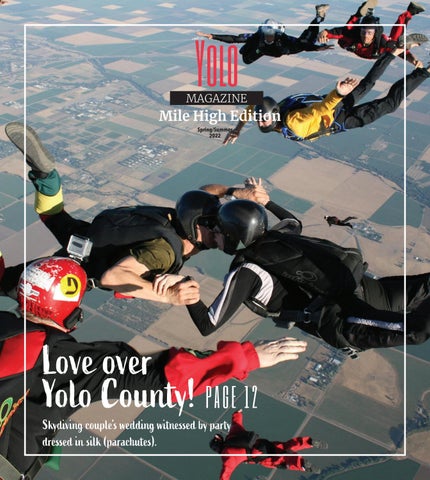
Love over Yolo County! PAGE 1 2 Skydiving couple’s wedding witnessed by party dressed in silk (parachutes). 1
1
Yolo Magazine | Spring/Summer 2022
Yolo Magazine | Spring/Summer 2022
2
3
Yolo Magazine | Spring/Summer 2022
Index Yolo Magazine Spring/Summer
18
STOR IE S
MONTICELLO MEMORIE S Winters Museum opens floodgates of memories of former sister city.
24
SIERRA ORCHARDS
To send us ideas to feature in the Yolo Magazine Fall/Winter edition, write to info@yolo.guide.
ADVE RTIS ING To inquire about advertising or sponsorships, get in touch at advertising@yolo.guide.
STAF F FRED GLADDIS, EDITOR TAYLOR BULEY, PUBLISHER
ON T HE CO V E R A skydiving couple exchange vows over Yolo County. — Page 12
Farm wins Climate Smart Farmer of the Year using ancient farming method.
26
WHAT’S ALL THE BUZ Z ABOUT BUCKE YE ? Yolo Magazine | Spring/Summer 2022
4
5
Yolo Magazine | Spring/Summer 2022
In Depth Yolo Magazine Spring/Summer
SUDWERK: A COMMUNIT Y BRE WERY By Caleb Hampton When Sudwerk opened in 1989, it was the only business on the industrial strip of Second Street that stretches eastward from L Street to the edge of town. Off the beaten track, it was a fitting spot for a brewery that is both a pioneer of California’s craft beer movement and an outpost of a German working-class beer culture. The brewery was founded by two Davisites of German descent, Dean Unger and Ron Broward, who traveled to Bavaria and entrenched themselves in the region’s famous brewing scene. After returning to Davis, Unger, an architect, drew up plans for a German-style beer hall—a more community-oriented venue than a bar or tavern—and Broward, a contractor, built it.
Trent Yackzan and Ryan Fry, both 36, were childhood friends in Davis and roommates at Cal Poly San Luis Obispo. They have owned Sudwerk since 2013. Caleb Hampton photo
While it specializes in German-style lagers, Sudwerk’s tap room recently featured an Irish stout, an oatmeal coffee stout, an India pale lager (IPL) and a milkshake India pale ale (IPA) alongside the brewery’s awardwinning pilsner and amber lager. Caleb Hampton photo
Yolo Magazine | Spring/Summer 2022
6
7
Yolo Magazine | Spring/Summer 2022
“They wanted to create that German beer experience—not only in the style and quality of the beer but also the community and family environment,” said Ryan Fry, who now owns Sudwerk alongside Unger’s grandson, Trent Yackzan. In their quest to brew true Bavarian beer, Unger and Broward shipped over a pair of 15-barrel copper and stainlesssteel brew kettles from Germany. The state-of-the-art brew system was joined by a fifthgeneration German brewer, Karl Eden, who moved from Stuttgart to Davis to work as Sudwerk’s first master brewer. While his reign as brewmeister was brought to an unceremonious end by U.S. immigration authorities in the mid ‘90s, Eden’s trove of family recipes— along with a collection of yeast strains brought from Germany— continues to form the basis of some of Sudwerk’s most popular beers. With his help, Unger and Broward’s passion project took off. Within a few years, Sudwerk maxed out its 3,000-barrelper-year brewing system while selling all of its beer on site. At that point, churning out Bavarian lagers in the shadow of the Pole Line overpass, it sold more beer over the counter than any brewpub in North America. In 1995, Sudwerk expanded into an adjacent warehouse-style building, which it used to brew beer on a commercial scale. From the start, the brewery used traditional brewing methods to make high-quality lagers, a style of beer known for its light body and nuanced flavors. Those characteristics are earned through a timeconsuming process which, at Sudwerk, involves boiling the brew in kettles, fermenting it for weeks in open tanks and then transferring it to a cellar kept at near-freezing temperatures. “It’s a challenging style to Yolo Magazine | Spring/Summer 2022
make,” Fry said. As time passed, Sudwerk struggled to keep pace with its reputation. For years, the brewery marketed its beer under a separate name, Hübsch Bräu, German for “pretty beer,” which gave it an authentic flourish but left Sudwerk fans searching when they sought out the brewery’s name at their local grocery store. Without much focus on sales or marketing, most of Sudwerk’s distribution channels beyond Davis dried up. The 2008 financial crisis didn’t help. “They had fallen on hard times and were thinking about selling the brewery,” Yackzan said. He and Fry, both 36, were
Over the past decade, Sudwerk scaled up its production from 1,000 barrels per year to 10,000. The brewery’s distribution now covers most of California, Nevada and Missouri. Caleb Hampton photo
Sudwerk’s hyperlocal branding embraces its Davis roots, as shown in its Small Town Hustle label featuring the arboretum, water tower, farmers market, bicycle and other local imagery. Courtesy image
8
childhood friends in Davis and roommates at Cal Poly San Luis Obispo. They had grown up around Sudwerk and in 2009, after returning to Davis, they started working there. Within the next few years, the beer label changed from Hübsch to Sudwerk and the brewery installed a bar at its warehouse entrance, rolled up the metal door and began serving beer out of The Dock, as they named it, after the old loading dock it was built on. In 2013, with money raised from local investors, Yackzan and Fry bought the brewery and rebranded it, highlighting Sudwerk’s Davis roots with a new logo—a California Grizzly riding a bicycle—and a slate of colorful beer labels crammed with local imagery. “It’s a community thing and a family legacy for me,” Yackzan said. A frequent venue for community events, Sudwerk has helped raise hundreds of thousands of dollars for various
9
Yolo Magazine | Spring/Summer 2022
causes. Over the past decade, it has also increased its production tenfold and expanded its distribution network far beyond Davis. Today, Sudwerk beer is available at restaurants around town and on shelves all over California, Nevada and Missouri. Quality hasn’t been sacrificed for quantity. At last year’s Great American Beer Festival, Sudwerk won two gold medals—for its People’s Pilsner and Backyard Hero lagers—and was named Brewery & Brewer of the Year. The precision of Sudwerk’s brewing process has benefited from a close relationship with UC Davis’ world-renowned brewing program, which offers classes taught at the brewery. Sudwerk’s team of master brewers are all products of the intensive program, the prerequisites for which are comparable to those required for medical school. In Sudwerk’s laboratory, brewers measure the dissolved oxygen in each beer and use a microscope to conduct cell counts on yeast cultures. “Beer looks simple when you see it in a glass,” Fry said. “When you start peeling back the layers, there’s an endless amount of story.” With the pandemic, that story took a twist. The tap room and orders from local restaurants—
about half of Sudwerk’s business—vanished overnight. Openings and closings, mandated by public health authorities, wrought havoc on the weekslong process required to produce a batch of beer. (“You need to know where you’re going to sell it in advance,” Fry said.) Sudwerk improvised and adapted, setting up a drivethru service and an online store. “What didn’t kill us made us stronger,” Fry said. “It definitely took a mental toll,” Yackzan added. “At the same time, we look forward and we have a purpose and vision about where we’re headed.” One aspect of that vision is expected to come to fruition later this year. Sudwerk’s restaurant—closed since 2016— is slated for a major remodel this spring and summer before reopening in the fall as a restaurant and beer garden. The new setup will feature shaded outdoor seating, fire pits, a water fountain, a stage for live music, open space for kids to play and an indoor-outdoor bar. Patrons will also get a peek at the brewing process, with the bubbling fermentation tanks visible through glass windows, each of which will have a scoreboard displaying the type of
During the pandemic, Sudwerk began serving food at The Dock and added a drive-through to-go option. Later this year, the brewery plans to open a remodeled restaurant and beer garden. Caleb Hampton photo
In 2011, Sudwerk installed a bar at its back entrance, rolled up the metal door and began serving beer on tap. They named the makeshift bar The Dock after the old loading dock it was built on. Caleb Hampton photo
In the early 1990s, Sudwerk served more beer on site than any brewpub in North America. Courtesy photo
Yolo Magazine | Spring/Summer 2022
10
beer, fermentation temperature and other details. The adjacent wood-paneled beer hall will stay mostly unchanged, Yackzan said, serving as a place to preserve Sudwerk’s history. The brewery’s purpose will also remain the same. “Sudwerk,” pronounced with a long “u” and a “v” sound, translates literally as “Southern factory” and is German slang for brewhouse, a reference to the primacy of brewing in Southern Germany. But Yackzan and Fry said they’ve pushed the slang a step further. For them, Sudwerk means community brewery. “It’s a place for people to come together,” Fry said.
11
Yolo Magazine | Spring/Summer 2022
In Focus Yolo Magazine Spring/Summer
LOVE IS IN THE AIR By Rebecca Wasik Some couples search for the perfect wedding venue. Kurt and Grey Issel only needed to look up. The couple wed on June 27, 2011, while skydiving over Yolo County — and are now celebrating over a decade together after free-falling in love. Grey, born in California, and Kurt, born on the East Coast, met in 2009 while both were working as skydiving instructors at Skydance Skydiving in Davis. Kurt began skydiving in 1990, while Grey took to the skies in 2006. Their first date took place at a sushi spot in Roseville while Kurt was working at a skydiving drop zone in Lincoln. In addition to being an instructor, Kurt works as a photographer as well. Before his own exchanging of vows, he shot video of other couples who wed in the clouds. When the pair decided to get married, a “sky wedding” seemed perfect. As a self-described “introverted and chill” couple, Kurt and Grey knew that a wedding in the sky was the natural choice for them. “The sky is even more beautiful than the most beautiful cathedral,” said Kurt. The sky wedding was planned to coincide with a “boogie,” which is a skydiving term for a party where everyone gets together to skydive. That June, Kurt, Grey and 30 of their closest friends from their trusted “sky family” took two separate airplanes out above Yolo Yolo Magazine | Spring/Summer 2022
Kurt and Grey Issel kiss as husband and wife after being given the nod by the officiant, at left, during the brief ceremony over Yolo County. Everyone in the party wore silk (parachutes). Jeffrey Einsohn photo
County for the “sky wedding.” “Friends are the family you get to choose,” said Grey. “It was chaotic and fast but also felt like a lifetime.” The ceremony was rather brief. The officiant, a “sky teammate” of Kurt’s, pointed at both Kurt and Grey. Once they each said “I do,” the officiant brought his hands together as a sign for the bride and groom to kiss. The Issel’s then flew down the “aisle” together back to solid ground. Unlike a traditional wedding, photos of the Issel’s wedding were captured by the GoPro cameras on the helmets of their free-falling wedding guests. Since members of their 12
immediate family were not able to attend their “sky wedding,” Kurt and Grey decided to have a “ground wedding” the following day. The ceremony took place at the UC Davis Arboretum. Rather than a fancy reception, the Issels opted for a gathering at Davis’ Village Pizza & Grill. The pair and their guests enjoyed wedding cake from the restaurant’s bakery. When asked if they took a honeymoon, Grey replied, “No, our life is a honeymoon.” The couple feel that both weddings were special for different reasons. The dual ceremonies allowed them to share their testament of love with
13
Yolo Magazine | Spring/Summer 2022
Grey and Kurt Issel celebrate their wedding after all in their party landed safely from the aerial venue. Jeffrey Einsohn photo
everyone in their lives. “It’s wonderful to share love that you get out of the skydiving community back with the skydiving community,” said Grey. “There are a lot of people in unhappy relationships all over the world, but when you can have fun and trust each other and know that everything is going to be alright, you can do beautiful things and see a beautiful world.” Of all the drop zones in Northern California, Kurt believes that Davis is the nicest one to live in due to its rural landscape. Grey appreciates that skydiving in Davis allows for an experience that is simultaneously both beautiful and terrifying. Between the altitude, seeing water sheds from above, viewing soils and comprehending their level of pollution, surveying the Sacramento-San Joaquin River delta, and overall landscape, she believes that skydiving over Yolo County is a profound experience. As the Issels approach their eleventh wedding anniversary, they spend their free time together watching Star Trek, playing video games, riding their bikes and taking their dogs to the dog park. Yolo Magazine | Spring/Summer 2022
I guess you could say that the couple that skydives together, stays together. Kurt still works as a skydiving instructor and photographer with more than 15,000 total skydives under his belt. Grey is no longer a
14
“Skydiving in general is less of a competitive sport and more of a cooperative venture,” said Kurt Issel. “We’re trying to build formations together. It is very supportive and very positive.” Jeffrey Einsohn photo
skydiving instructor — however, she still skydives recreationally. Her interests nowadays include a lot of “earth-based activities.” She loves to crochet and study, especially plants. When Kurt began his skydiving journey in Washington state, and Grey in Lompoc, Calif., neither could have imagined one day marrying the love of their life with their heads literally in the clouds. When it comes down to it though, marriage can be likened to skydiving. “Skydiving in general is less of a competitive sport and more of a cooperative venture,” said Kurt. “We’re trying to build formations together. It is very supportive and very positive.” For the Issels, their cooperative ventures in love, life, and in the sky continue to build formations that will last a lifetime.
15
Yolo Magazine | Spring/Summer 2022
Guinda
YOLO 16 COUNTY 4
1
Zamora 3
Brooks Capay 5
2
Esparto
Knights Landing
5
16
Woodland 5
505
113 24 Davis 23
Winters 26 Capay Valley & Dunnigan Hills Wineries 1.
Capay Valley Vineyards
13757 State Highway 16, Brooks (530) 796-4110 www.capayvalleyvineyards.com Check website for latest information on visits. Open Sat.-Sun. 12-5 p.m. No appointment needed but please phone to confirm we are open that day. Produces Tempranillo, Viognier, Cabernet Sauvignon, Petit Verdot and a unique, lively Sparkling Viognier and Sparkling Tempranillo.
5. Taber Ranch Vineyard & Event Center 16628 County Road 81, Capay (530) 665-3691 www.taberranch.com Tasting room open Fri., Sat., Sun 11 a.m.–5 p.m. Serving wine, local beer & cider and food in a beautiful outdoor socially distanced setting. Please see our website for our schedule of events & live music.
Clarksburg Wineries at the Old Sugar Mill
35265 Willow Ave., Clarksburg 916-744-1615 www.oldsugarmill.com
2. Grindstone Wines 12700 County Road 89, Esparto 3. Matchbook Wine Company 12300 County Rd. 92B, Zamora 4. Séka Hills Olive Mill and Tasting Room 19326 County Road 78, Brooks (530) 796-2810 www.sekahills.com
27
80 25
Locations are approximate. Map by shawn.collins@mcnaughton.media
Other Clarksburg Wineries
20. Bogle Family Vineyards Home Ranch 37783 County Rd. 144, Clarksburg www.boglewinery.com Come visit us at the Home Ranch, where you can take in the expansive Delta and vineyard views while you enjoy a guided tasting of Bogle traditional favorites or Limited Release wines – or – bring your own lunch and gather with family and friends for a special picnic setting nestled among our sustainable Chardonnay vineyard. Bogle Home Ranch is open Thursday through Sunday 10am-5pm by reservation.
6-19 22 21
Clarksburg 20
Winters Wineries
26. Berryessa Gap Vineyards www.berryessagap.com Book a tasting with us or stop by for a glass of award-winning wine. Please see our website for latest information on hours and events.
21. Julietta Winery 51221 Clarksburg Rd., Clarksburg 6.
Bonitata Boutique Wine
7.
Bump City Wine
8.
Carvahlo Family Winery
9.
Clarksburg Wine Company
22. Miner’s Leap Winery 54250 S. River Rd., Clarksburg
Davis Wineries
23. Nashoba Wines Cork It Again 820 4th Street, Davis
10. Draconis Wines 11. Due Vigne Winery 12. Elevation Ten
24. Great Bear Vineyards 24800 County Road 101A, Davis
13. Kirchhoff Family Wines Book an event with us, private tastings and private tours. Estate Wines: Sauvignon Blanc, Syrah, Viognier, Tuluk’a, Tannat, Grenache and Dessert Wine. Our tasting room also features Premium Estate Olive Oil, deli and retail shopping. Tasting room open Wed.–Sun. 11–5 p.m.
128
West Sacramento
14. Rendez-vous Winery
25. Senders Wines 26891 Caddy Court, El Macero
15. Scott Harvey Wines 16. Séka Hills Winery 17. Three Wine Company 18. Todd Taylor Wines 19. Vino de Oro Vineyard & Winery 16
Downtown Tasting Room 15 Main Street, Winters Winery & Tasting Room 27260 Highway 128, Winters 27. Turkovich Family Wines 304 Railroad Avenue, Winters (530) 795-3842
Discover our list of Yolo wineries, breweries & other activities.
Adventure awaits just beyond your backyard!
.directory
17
Yolo Magazine | Spring/Summer 2022
In Retrospect Yolo Magazine Spring/Summer
MEMORIE S OF MONTICELLO RE-EMERGE 75 years ago, a young rider shows off her skills in front of the huge crowd in Monticello at the 1956 Annual Rodeo and Barbecue. Thousands would gather on the first Sunday of May to see the riders on parade, watch bronco riders compete, and observe roping and cow milking. The Barbecue was the best beef, bar none! This was the last year of the event. Courtesy photo
By Woody Fridae There was a thriving agricultural town on the western side of the Sacramento Valley … that is until 1957. In the Berryessa Valley, snuggled into Sacramento Valley’s foothills just west of Yolo County, lived the town of Monticello. This town was vibrant with life. Farmers cultivated fields, men rode horses in an annual rodeo, youngsters rode bikes throughout town, locals played music at the tavern, Yolo Magazine | Spring/Summer 2022
kids went to school, families met at the restaurants, and everyone swam in the Putah Creek swimming hole. In 1956, it was razed and burned by the Bureau of Reclamation to flood the valley and build Lake Berryessa. While there are few folks alive who remember those times, they are still grieving their lost Valhalla. Their memories of a town, now 75 years old, are still very much alive. This month, its sister city of 18
Winters is resurrecting those memories. The Historical Society of Winters has chosen to gather photos, artifacts and speakers to commemorate the lost town of Monticello because they share common history. The high school students from Monticello attended Winters High School. Many of the Winters Youth Day Sweethearts were from Monticello. Locals remember going up to the famous Monticello Rodeo on the first Sunday every May. And a
Lake Blvd.
Davis .
Covell Blvd
Covell Blvd.
Arthur St.
Calaveras Ave.
Russell Blvd.
Davis Bike Loop Spanning 12 miles in length, the loop comprises a series of bike paths, trails and bike-friendly roadways that pass through most Davis neighborhoods and their lush parks.
Oxford Circle Park
Oak Ave.
Anderson Rd.
113
14th St.
Russell Blvd.
Davis Bike Loop
Dave Pelz Bridge
F St.
lvd. ton B Arling
Portage Bay
HWY
Sycamore Ln.
Humboldt
Redwood Park
J St.
Villanova Dr.
Shasta Dr. Arroyo Park
Village Homes
t. FS
Community Park
W. 8th St.
d.
ll Blv
Russe
80
UC Davis
Cowell Blvd.
Lillard Dr.
Arboretum
19
Putah Creek Underpass
Yolo Magazine | Spring/Summer 2022
Life magazine article that never ran about the destruction of the little town — photographed by Dorothea Lange and Pirkle Jones — will finally get the light of day. The town lives on in the memories of many who scattered and resettled in Winters and other Yolo, Napa and Solano County towns. Those memories are celebrated in the exhibit “Remembering Monticello” at the Winters Museum, located at 13 Russell St., in Winters. It is open Thursday through Sunday from 1 to 5 p.m. Call 530-204-8563 for more information. Photos from the Dorothea Lange/Pirkle Jones collection, found in the UC Santa Cruz special collection, are up in the Winters Museum’s “Remembering Monticello” exhibit. The project, sponsored by Life magazine, never ran. Some of these photos may be the first time ever presented in public. Courtesy photo
Living carefree in Berryessa Valley—these youngsters wheel through the streets of Monticello and not comprehending that their world is about to end. Only a few years later, this valley would be 125 feet below water. Courtesy photo
Yolo Magazine | Spring/Summer 2022
20
21
Yolo Magazine | Spring/Summer 2022
In Writing Yolo Magazine Spring/Summer
GERTRUDE V S . THE MACHINE IN THE GARDEN Yolo magazine spoke with David Wilkinson, author of Gertrude’s Oaks: The History and Legacy of Woodland’s Urban Forest. Publisher: Your book, “Gertrude’s Oaks,” is the story of the nexus between nature’s beauty and the industrious people who first planted a flag here in Yolo – or Yolo City, I suppose. It’s an interesting narrative where you’re using both trees and people to essentially tell the same story, the story of Woodland’s industrialization. Where did the idea for all of this come from?
Wilkenson: The idea germinated with my being involved, for 21 years now, with the Woodland Tree Foundation. Looking back, I believe I did just a bare-bones explainer of Woodland’s urban forest history, posted for a few years on our website, woodlandtree.org. It just grew from there, organically. I’ve always loved Woodland’s history. I came across a couple of articles and letters that Gertrude Freeman had written which conveyed her deep love for Woodland and its oak trees, too. She came there as a teenager, a school teacher, and was living right there in the midst of a virgin oak grove. Over the course
of her long life, she watched a lot of it being removed. In one of her quotes in that first, titular chapter, she said that most of the oaks had been removed, “due to the avarice of man.” I think that’s an old word, “avarice,” but we all know what it means. Yolo City died out, Woodland took off — which is tangential to trees, but ties back to our tree history. As a historian, it enabled me to write in different layers, but keeping the running theme. It’s really, in essence, a deep historical context statement, if you will, about how I feel our valley oak should be restored to its magnificence and grandeur in our landscape by preserving what we have and planting new oaks where we can. That’s really the main reason I wrote it. I always write my books with a policy goal. I’m glad that Gertrude didn’t live to see her tree getting cut down in Freeman Park. The tree that was planted for her there in 1928 was a cypress. She was so touched that the town had named the park Freeman Park in honor of her and her husband. That tree must have survived into the ’80s, because some of my colleagues who worked in the parks remember it. We came along, my generation, and planted a new tree in her honor in the ’90s and, somehow, it disappeared. I think maybe someday we’ll go back and plant another tree for Gertrude in the park.
Gertrude’s Oaks, The Story & Legacy of Woodland’s Urban Forest by David L. Wilkinson is available for sale at in Woodland at Nugget Markets, Local Inspirations, Haven and Antique Emporium, the Hattie Weber Museum in Davis, the Winters Museum, as well as on Amazon. Courtesy image
Yolo Magazine | Spring/Summer 2022
22
What do you think is the lesson of Gertrude Freeman? Do we have anything that we can learn from this 1900 era teacher? What Gertrude was facing was the whole theme of the machine and the garden. She arrived in 1857, when it was just really a virgin outgrowth. Most of the
trees in downtown Woodland disappeared, and almost all the trees surrounding Woodland, oak trees, disappeared. But she did see a much-diversified urban forest grow up during the time she lived in Woodland. She lived until around the early 1930s. She saw a lot of the native oaks be destroyed, or dying, but she also witnessed a much more diversified forest, urban forest, which I think is another important story I’m trying to convey. Yes, we should all be disappointed we’ve lost, we’re down to 900 oaks, we probably had 10,000, but we have 20,000 other varieties of trees and we can regenerate a lot of the oaks in newly developing areas. When she taught there, she could step outside of that little small school house there at 6th and Main St. and be surrounded by oaks and birds. I’m sure she probably conveyed that to her students, the importance of them and her love for the environment. This development was plot by plot being subdivided — small amounts of developments — where trees are making way for
an industrious Main Street. It seemed a little bit like today where, like “Boiling Frog syndrome,” you don’t realize something is gone until it’s a little bit too late. However, I was inspired by how far back our local tree-hugging history went. For example, the ordinance that was put in place, so early on,
placing a moratorium on tree height limitations. It did seem like even before the ’30s, they were contemplating the very same issues that we’re grappling with today.
removed. The women were advocating for that in the 1920s, 100 years ago, they were advocating to stop the butchering of trees when they conflicted with overhead wires. That’s still going on in the core part of Woodland today because the wires never got undergrounded by PG&E and I don’t think they ever will be undergrounded now. We’ve been kicking the can down the road politically for about 100 years. How far are we going to go to protect our heritage? I think it becomes even more critical in the era we live in. In the sweep of history, I’d written about 150 years or more. You see these things repeating themselves up into the present day.
Gertrude Freeman wears her Eastern Star medallion. Courtesy photo
It inspired me to come across people that, if I would want to know them today, I would like to spend time with them today. These are people that wanted Woodland to be exceptional, not average, exceptional. A lot of the women I wrote about, and the Shakespeare Club women, the women’s improvement club, and then Ed Leake, of course, and Paul Leake with the Daily Democrat, Serelda Thomas and her husband, Charles. These were people that were developing their minds. They were meeting, discussing literature, poetry. They were the intelligentsia of their era. The women in the Shakespeare Club, almost exactly a century ago, petitioned City Hall to stop cutting down trees over 40 feet. They also wanted restrictions on people removing oaks on private property. Fast forward to 2022, we’re still debating whether oaks on private property should require a permit to be removed. The women were advocating for that in the 1920s, 100 years 23
Yolo Magazine | Spring/Summer 2022
In Fieldwork Yolo Magazine Spring/Summer
SMART FARMING AT SIERRA ORCHARDS Sierra Orchards wins Climate Smart Farmer of the Year Award
Woolly sheep graze on knee-high grasses between rows of walnut trees at Sierra Orchards. Courtesy photo
By Emma Johnson The McNamaras sit down to talk about family farms and the future At Sierra Orchards, between the rows of walnut trees, chickens strut and take dirt baths while, nearby, woolly sheep graze on knee-high grasses and wildflowers in the dappled light. If that sounds bucolic, it looks even more so. But these farming practices aren’t quaint. These are ancient, indigenous farming methods that predate colonizations, and ones that the McNamaras hope will be a part of a sustainable future. Craig McNamara started Sierra Orchards with his wife, Julie McNamara, more than 40 years ago. This year, California FarmLink, a community development financial institution that supports organic and sustainable farms, named Sierra Orchards “Climate Smart Farmer of the Year” for their commitment to sustainability and their success. Craig said that it was a huge honor to have the farm, along with the team that runs it, recognized with this award. That team includes Ramon Del Toro, the farm foreman; Ari Hoover, the solutions specialist; Luis Yolo Magazine | Spring/Summer 2022
Craig McNamara, center, and two of his children, Emily McNamara and Sean McNamara are all Sierra Orchards farmers. Courtesy photo
Sandoval and Reynaldo Sandoval, both farmers, and Fred Blum, the chicken manager. Sean McNamara and Emily McNamara, two of Craig’s children, are also farmers at Sierra Orchards. Sean, Emily and Craig all sat down for an interview about the family business and what they imagine the future of sustainable
24
agriculture might look like. “When we were younger, Dad always asked, ‘Who’s coming back to the farm?’” Emily recalls with a smile. Craig doesn’t remember this, but Emily insists it happened, and that the siblings were not enthusiastic about the idea. Whatever was said, Craig is now very happy that Sean and Emily are back, working on the farm where they grew up. “Having Emily and Sean come back to the farm is the best gift of our careers,” he says. The siblings say that it was partially their father’s organic farming practices, which he began when they were children, that brought them back. When Sierra Orchards went fully organic in 1993, it was a huge financial risk. It brought in new complexities to every level of their business. At the time
they even lost a substantial loan because of it. But Craig remained dedicated. That year he and Julie founded the Farming, Agriculture, and Resource Management for Sustainability (FARMS) Leadership Program. In 2001 they founded the Center for Land Based Learning, a nonprofit dedicated to teaching and supporting the next generation of farmers. During the pandemic the Center for Land Based Learning moved their headquarters from their first location on Putah Creek Road to Maples Farm in Woodland. Now that next generation includes their own children. Twice a week, the family gets together to talk about the business of the farm, and when they do, Emily says that the climate is 100-percent on their minds. She understands that climate change may seem like a political issue to some, but says that no matter how you put it, farmers know something is wrong. “At the end of the day, the farmer knows what’s going on. They know there are not enough chill hours,” she says. January and February were particularly frightening, Emily says, as they watched the days go by with rising temperatures and no rain. After over four decades of farming, Craig is familiar with the uncertainties a farmer faces. But he also sees that things are changing. He looks towards an uncertain future, and sees the stress and anxiety in his children’s eyes. “Decisions we’re making today have a half-a-century footprint,’’ Craig says. He’s talking about the walnut trees that surround the sunlit office where we’re chatting. They were planted in the ’60s, and they’re coming to the end of their lives. What happens next? “We’re making the best decisions available to us,” Craig says, “but the future is very
Emily McNamara holds a baby chick from her egg business. Chicken manure is left through the walnut orchard — leading to better soil health. Courtesy photo
unknown.” Sean sees a future where the farm grows not in acres, but in complexity, by adding layers onto their current production. “The vision is not just to survive, but to thrive,” he explains. When Sean started working at Sierra Orchards he implemented a closed-loop composting system, with compost made from the byproducts of their walnut harvest. He then combined that with a diverse cover crop, designed to rejuvenate and aerate the soil. Next, they brought in sheep to graze the cover crop, which decreased their use of mechanical mowers. Emily came back just before 2020 and began an egg business. Her chickens added another level to Sierra Orchards, as the
A rainbow forms over the 60-year-old Sierra Orchards walnut orchard. Courtesy photo
25
three chicken tractors are moved through the walnut orchard, leaving manure in their wake. This farming method is called silvopasture. It’s the practice of integrating grazing practices with orchard farming, and it’s one of the oldest farming methods in human history. For the orchard it can lead to better soil health with fewer mechanical interventions, while the animals have less heat stress in the shade. At Sierra Orchards they combine this ancient practice with modern technology. They do soil and tissue sampling of the trees to track their health. On their farm they advocate for using the top technology and paying the highest wages, all while they have to compete with the cheapest products. That’s a difficult line for any business to walk. “To be sustainable, you also have to be financially sustainable,” Emily points out. Emily will tell you: farming is hard, expensive, and full of uncertainties. She says that what agriculture needs now is not just more farmers, but also farmers from different demographics. She wants to see more small, sustainable farms taking off, because those are the farms that generate the healthiest food, for the people and the planet. While there are government grants available to farmers, Emily says the process to access them is so intricate that it would be nearly impossible for someone on their own to do it. It’s also difficult for the small farmer to get into the right market. “There has to be more support, or the small farms will be bought up,” Emily said. At Sierra Orchards, they don’t know everything the future will bring. But they know that the best thing they can do now is generate resilience. To learn more about Sierra Orchards, visit sierraorchards.com, or follow @sierra_orchards on Instagram. Yolo Magazine | Spring/Summer 2022
In Bloom Yolo Magazine Spring/Summer
W H AT’S A LL T HE BU Z Z A BOU T BUCK E Y E P OIS ONING ? By Kathy Keatley Garvey Girls, stay away from the California buckeye blossoms! You’ll get buckeyed. Beekeepers cringe when “their girls” head over to California buckeye trees, Aesculus californica, to forage on the fragrant, pinkish-white spiked blossoms. The tree, native to California and commonly known as “California horse chestnut,” is toxic to the non-native European honey bees. The result: crumbled wings, dwarfism, paralysis and death. It’s the pollen that poisons honey bees, but scientists think that the nectar is toxic as well. One thing is for sure: the nonnative honey bee (European colonists brought it to America in 1622) has not adapted to the California buckeye. “Do not plant (California) buckeyes near apiaries as the flowers are poisonous to honey bees,” warns the Natural Resources Conservation Service of the U.S. Department of Agriculture. “No wildlife can eat buckeye seeds except squirrels, such as the California ground squirrel (Citellus beecheyi).” UC Davis entomologist George Haymaker Vansell (1892-1954) wrote about the toxic effects of California buckeye blossoms nearly a century ago. “Many of the young worker larvae are killed outright and are devoured by the adults or thrown out of the hive,” he wrote in a December 1925 article in the American Bee Journal. “Others develop into adults of very abnormal appearance, being Yolo Magazine | Spring/Summer 2022
A honey bee forages on buckeye in Pleasants Valley, near Winters. Kathy Keatley Garvey photo
wholly unable to fly on account of the crumpled conditions of the wings. The legs are often abnormally small and the whole body may be dwarfed. Queen and drone brood are affected similarly.” “Many of the adult field bees feeding upon buckeye become very much swollen, as in a dysenteric condition,” Vansell noted. “Their intestines are gorged with a very sour, malodorous yellow substance to such an extent that a slight presence will cause them to burst with a snap. Many of the affected bees become shaky and are picked almost free of hairs by other workers so that they appear shiny, as in the case of paralysis. Apparently, none of the poisoned mature bees or 26
immature young are able to fly and they crawl out of the hives by the hundreds and die. I have seen dead bees in front of single colonies to the depth of three or four inches.” Extension apiculturist Elina Lastro Niño, based in the UC Davis Department of Entomology and Nematology, said she gets “phone calls about it (buckeye poisoning) every so often. It seems to be an issue of dilution. If that is the only food source, that could be harmful to honey bees.” John Foster of the Espartobased BZ-Bee Pollination, who maintains a total of 28,000 hives in the seven-county area of Yolo, Solano, Sacramento, Lake, Sonoma, El Dorado and Marin, calls the toxicity problem
“terrible, and especially so with the drought.” Just before the buckeyes start blooming, around May, he gives his bee colonies a protein-like supplement and “I make sure they have plenty of sugar syrup.” Bee breeder-geneticist Susan Cobey, former manager of the UC Davis Harry H. Laidlaw Jr. Honey Bee Research Facility, kept her Carniolan colonies in Solano and Yolo counties before joining the Washington State University (WSU) Department of Entomology in 2010. “When the buckeye was not the main forage, the impact was minimum,” she said. “But some years when the buckeye was the prominent forage, yes, severe. I remember one season we had problems rearing viable queens during the bloom. The cells emerged — virgins with deformities. The pollen is red — so if you see this in colonies, that’s a warning to feed and get the bees to a new location.” The deciduous tree is in the horse-chestnut family, Hippocastanaceae, but toxicity seems to vary by species of the genus, Aesculus. Cobey, formerly of Ohio, noted that the Ohio buckeye, Aesculus glabra, the state tree, seems to “provides good forage” for honey bees and is apparently not toxic to them. Tim Lawrence, a WSU associate professor of entomology and Extension director for Island
A honey bee forages on a buckeye blossom on the UC Davis campus. The buckeye blooms in May. Kathy Keatley Garvey photo
A buckeye tree on the UC Davis campus in bloom in May. Kathy Keatley Garvey photo
County (and husband of Cobey), recalled working on a project for a UC Davis pollination ecology class with professors Robbin Thorp and Grady Webster “and we had several (bee) yards that we needed to abandon in May to avoid buckeye.” “The problem varies from year to year,” Lawrence said. “We always noticed some effect, but some years were worse than others. The problem was that little else is blossoming when buckeye comes in. Spring flowers have all but dried up, and it’s too early for things like starthistle to come in. As I recall, the problem was with the pollen, and emerging bees would show signs of deformation. We had one yard near Brentwood where we would be hit very hard if we did not get the bees out soon enough — eventually we just abandoned the yard.” Caroline Yelle of Pope Canyon Queens LLC said buckeye toxicity affects her hives every season, sometimes more, sometimes less. “Sometimes it can kill them,” she said. “The past three years have been the worst, as 27
the buckeye is drought-resistant and the other flowers are already dried up by then. So, when it blooms, bees hit the pollen and nectar hard. They eat it and it poisons them. The other problem is that they store the buckeye pollen and will have a second wave of intoxication weeks later when they go for the reserve.” The first wave weakens them, but when the second wave hits, “they mostly cannot survive.” During the buckeye bloom, “the bees are on it looking super happy,” Yelle commented. “But the resources they bring back to the colony totally disorganizes them. A strong healthy hive can survive that disorganization but if there is already something missing (population, pollen, food, etc.) in the colony, they won’t make it through the buckeye bloom.” “They might seem happy with the feast provided as they finally found something to forage on, but they aren’t aware that it will hit them later.... but hey, if I were starving and you would serve me something like buckeye, I might go for it, out of Yolo Magazine | Spring/Summer 2022
desperation.” Every year just before buckeyes bloom, Yelle moves her hives away from her farm (which has buckeyes) and from other locations where the tree grows. “For me it is a normal procedure to have (bee) yards without buckeyes, so when it blooms, I can move them to a safe area. My queen production can be shut down early if the cell builders get intoxicated by the buckeyes; they just stop raising cells. It happened before, and now I plan every year to avoid it.” Clay Ford of Clay’s Bees, based in Pleasants Valley, said he’s encountered various results in different yards; “some more severe in some years.” Said Ford: “It’s disheartening to see lakes of dead bees in front of the hive” and to open a hive and see that “the bees can’t fly.” The California buckeye, discovered in the early 1800s in California, was described by French botanist Édouard Spach in 1834, according to Frank Callahan of Central Point, Ore., writing for the Native Plant Society of Oregon. “All parts of California buckeye are toxic to humans and livestock. Poisoning is from glycosidal compounds that are present in all plant parts…The flowers are toxic to European honeybees (Apis mellifera); however, native pollinators relish the collection of nectar without side effects. The adult pale swallowtail butterfly (Papilio eurymedon) appears particularly fond of this plant.” Native pollinator specialist Robbin Thorp (1933-2019), UC Davis emeritus professor of entomology, shared this back in 2014: “We know California buckeye nectar and/or pollen is toxic to honey bees from years of experience with managed hives. Toxicity to native bees and other flower visitors is not so easily determined and to my knowledge has not been investigated.” Yolo Magazine | Spring/Summer 2022
Bees foraging on buckeye bring home red pollen, a tell-tale sign in a buckeyed hive. Kathy Keatley Garvey photo
Neither have feral bees been investigated. “It would be interesting to compare the reactions of commercial bees from areas free of buckeye to feral bees in buckeye areas that are totally isolated from commercial or beekeeping activities,” said Norm Gary, UC Davis emeritus professor of entomology. Buckeye honey, however, is not toxic. Amina Harris, director of the UC Davis Pollination Center (and whose family members rear bees) sells buckeye honey at her family business, The Hive, in Woodland. She purchased the honey from a Sacramento area beekeeper after “10 to 15 of his colonies died from buckeye poisoning. It was a very, very sad story.” Harris describes the honey as “dark amber color, fruit scent, 28
with hints of molasses, licorice and dried frig. “it’s fruity — makes you salivate — and silky and astringent. The flavor doesn’t linger long, although there is a slight bitterness that endures.” Buckeye poisoning also leaves an enduring bitterness in bee breeders and beekeepers struggling to keep “their girls” out of the blossoms. Claire Tauzer, director of brands and process improvement of Sola Bee Farms commented: “I have seen issues with our bees (disorientation, death of foragers, disorganized colonies that can lead to collapse) when they are near blooming buckeye. It can cause a variety of issues. We try not to place our hives in areas where there is buckeye. If there are enough other forage sources to dilute the exposure, then it can be OK.”
In Events Yolo Magazine Spring/Summer Woodland Care Car (Meals on Wheels), local food banks, Toys-for-Tots, and many other charities.
Annual
Celebrate Davis! • June 3, Starting at 4:30 p.m. and ending at dark with a fireworks display; Community Park (14th and F streets) • davischamber.com Festival and business expo: family fun, music and fireworks. Live music with local youth bands. Food, beer and wine garden. Raffles and prizes. Attendance is free.
Picnic Day, UC DAVIS • April 23; UC Davis campus & Downtown Davis • picnicday.ucdavis.edu This family-friendly event — back after a two-year hiatus — is free for all to come and experience the richness of diversity and achievement at UC Davis and the surrounding community. Picnic Day is produced by students and is believed to be the largest student-run event in the country.
Cache Creek Lavender Festival, Rumsey
California Conference for the Advancement of Ceramic Art, Davis • April 29-30; Various venues, Davis • natsoulas.com/ccaca-2022 After 35 years of tradition, the John Natsoulas Center for the Arts is proud to continue the largest sculptural ceramics conference in the world. Conceived by the need for dialogue and direct interaction between artists and students, CCACA 2022 brings the ultimate ceramic sculpture event to Davis. In an intimate setting, you can interact with top artists in a way not possible at other venues. UC Davis, home to the late sculptor Robert Arneson, was instrumental in defining a new direction for ceramic art. Enjoy delightful downtown Davis and be inspired by nationally recognized ceramic art talents.
Youth Day, Winters • April 30; Downtown Winters • wintersyouthday.com Winters Youth Day was founded in 1933 to teach the aspects of city government to a group of high school students. Each year, the high school elects mock city officials who “take over” the city offices in Winters for a hands-on experience and participation in a council meeting. After a week of training, everyone is honored with the annual Youth Day Parade and a daylong celebration. After the parade the city park fills with booths, crafts, music, food and entertainment. Pre-celebration events, such as the Duck Derby on Putah Creek, start on Friday evening.
Pence Gallery Garden Tour, Davis • May 1 • pencegallery.org; 530-758-3370 For more than 25 years, the Pence’s Garden Tour has provided the public with the opportunity to view up to 10 beautiful local gardens. Visitors have enjoyed Japanese gardens, art-filled yards and xeriscapes filled with native grasses. This self-guided tour is a ticketed event. Tickets are sold at the Pence, Redwood Barn and Newsbeat, and include access to the gardens.
Wayne Tilcock Primo Santana, left, and Darius Weiss get their intergenerational groove on.
Whole Earth Festival, UC Davis • May 6-8; UC Davis Quad • wef.ucdavis.edu. With morning tai chi and nighttime fire twirling, the annual Whole Earth Festival will samba and sway onto the UC Davis Quad Mother’s Day weekend. Whole Earth began in 1969 when an art class taught by José Argüelles organized an “art happening” at UCD. The students used art to involve visitors in the ultimate goal of learning about activism, wellness and the environment. The Whole Earth Festival aims to ignite passion, propel creativity and leave visitors with inspiration. Circling the Quad are food vendors and crafts booths selling jewelry, art glass, clothing, toys and more. Bands, yoga classes, spoken word and dance are abundant at the threeday WEF.
Woodland Winefest • May 21, 1 to 5:30 p.m. • www.soroptimistofwoodland.org/winefest The annual Woodland Winefest returns to historic downtown Woodland’s Heritage Plaza. Along with a variety of great wines, attendees will be able to taste local honey, olive oil, balsamic vinegar and locally brewed beer. Food will be available for purchase.
• June 11-12; Cache Creek Lavender Farm, 3430 Madrone St., Rumsey • www.cachecreeklavender.com An annual celebration in June of all things lavender. During the festival you’ll find live music, wine tasting with local vineyards, food, lavender products and u-pick lavender, field tours and talks, craft demonstrations and more!
Davis Music Festival • June 17-19; Various venues • davismusicfest.com Davis Music Festival (DMF) is a three day multi-venue multi-genre live music event showcasing local, regional and touring artists – all to benefit local arts nonprofits. It’s like our own version of SXSW in a single weekend.
4th of July Criterium, Davis • July 4; Downtown Davis • dbcraceteam.org Bikes race through downtown Davis, starting as early as 7:45 a.m. The Fourth of July Criterium is a local classic: a Northern California institution started in 1976. The event features all-day racing in downtown Davis, including most categories and a fun kid’s race. Spectators enjoy the thrill of the races as well as the many food and vendor offerings downtown.
Albariño Wine Stroll, Winters • August 4-7; Downtown Winters • www.discoverwinters.com In a celebration of the International Albariño Grape Day, Walk through the streets of charming Winters to experience wine and food pairings, specials at local retail stores and enjoy live music.
Woodland Street Cruisers Back to the Street Car Show Yolo County Fair, Woodland and Cruise • May 28, 10 a.m. to 3 p.m., Main Street, Woodland • woodlandstreetcruisers.com Hot rod, classic car, custom car, rat rod, Bonneville racers and classic motorcycle owners and enthusiasts show their cars in downtown Woodland. Proceeds are donated back into the local community, supporting groups such as the
29
• August 17-21; Yolo County Fairgrounds, • 1250 East Gum Ave., Woodland • yolocountyfair.net One of the last remaining free-admission fairs in California. Every August this five-day fair features music, a rodeo, destruction derby, rides, food and livestock.
Yolo Magazine | Spring/Summer 2022
Stroll Through History, Woodland • September 8; Various locations downtown Woodland • strollthroughhistory.com Take a step back in time to experience the history of Woodland. Enjoy a street fair, tour of historical homes and buildings, exhibits, vintage vehicles, entertainment, and people dressed in period costumes.
Winters Festival de la Comunidad & Carnitas Festival
Davis Jazz and Beat Festival • October; John Natsoulas Gallery, 521 First St., Davis • natsoulas.com/davis-jazz-and-beat-festival Celebrating the spirit of collaboration and creativity that flourished in California during the 1950s and early 1960s. Every October, musicians, filmmakers, scholars, historians, painters and poets converge on Davis for this premier creative-arts event. Experience an intimate festival filled with poetry readings and painting improvisation set to the rhythm of live jazz. This is a unique opportunity for attendees to experience exclusive performances by well-known jazz musicians, jazz painters and poets.
Tractor Parade, Winters • December 3; Downtown Winters • discoverwinters.com The Holiday Tractor Parade features dozens of farm tractors and heavy equipment decorated in twinkle lights and holiday decor representing local businesses and community organizations. Visitors can watch this year’s Tractor Parade from anywhere along Main Street.
Woodland Holiday Parade Tractors & Brews, Woodland
• Sept. 24, 5-10 p.m. A community celebration of cultures featuring a carnitas cook-off, live music, Native American dance performances, and family-friendly activities, all for a good cause, bringing ethnic traditions together.
member of the board of directors. This traditional watering hole features music, food tasting and a variety of brews and wines.
• October 28; California Ag Museum, 1962 Hays Lane, Woodland • californiaagmuseum.org “Guests will delight in seeing tractors unveiled, engines started, and see a trio of smoke rise to the ceiling accompanied by old time showmanship,” said Doug Veerkamp, a
• Dec. 10; Woodland Main Street • woodlandchamber.org Sit along Main Street in historic downtown Woodland and enjoy one of the largest parades in Northern California featuring holiday cheer. More than 150 entries entertained parade watchers in 2016. Santa Claus riding on an antique fire engine is counted on as one of the highlights; the Ben Ali Shrine is a crowd favorite. As a California State Horsemen’s Association judged parade, many fine horse entries participate from throughout California and surrounding states.
Ongoing Davis Davis Craft & Vintage Fair • Select Sundays, 10 a.m. to 4 p.m. • Central Park, 301 C St., Davis • www.daviscraftandvintage.org Established in 2012, Davis Craft and Vintage Fair was once called Square Tomatoes Craft Fair. This event was started by teachers from the UC Davis Craft Center in order to have a monthly craft fair for local artisans. The event is home to local artists and makers from the Davis and greater Sacramento area. Expect to see vendors with local baked goods/ foods, jewelry, homemade crafts, vintage, and more. In addition, live music fills the open space for a lively atmosphere.
Davis Cruise-In • Third Saturday of month, April through October, from 5 to 7 p.m. • University Park Inn at 1111 Richards Blvd. in Davis. • www.daviscruisein.com Between 50 and 80 classic cars, trucks, motorcycles and bikes are on display. Exhibitors are invited to bring their prized-possession vehicles, whether they’re fully restored or not. Entry is free.
Davis Farmers Market • Saturdays: 8 a.m. to 1 p.m.; Wednesdays: 3 to 6 p.m. October through March, open till 7 p.m. April through September • davisfarmersmarket.org This popular event brings farmers and consumers together rain or shine. Find locally grown fruits, vegetables, nuts, organic produce, live entertainment, food vendors and much more!
Yolo Magazine | Spring/Summer 2022
Sutter Davis Hospital Farmers Market • • • •
Thursdays, 10 a.m. to 1 p.m. May through October 2000 Sutter Place, Davis davisfarmersmarket.org/our-partners An extension of the Davis Farmers Market.
UC Davis Farmers Market • Wednesdays, 11 a.m. to 1:30 p.m., fall and spring quarters; UC Davis quad • Seasonal on-campus extension of the Davis Farmers Market. • healthy.ucdavis.edu/eating-well/farmers-market
Woodland Farmers Market • Saturdays, 9 a.m. to noon, 201 First St.; • Tuesdays, 4:30 to 7 p.m. (June-August) at Woodland Healthcare, 1325 Cottonwood St., Woodland • thewoodlandfarmersmarket.org
2nd Friday ArtAbout, Davis • Second Friday of each month, 5 to 9 p.m. • Various locations downtown • davisdowntown.com/artabout Davis’ Second Friday ArtAbout is a monthly evening of art viewing and artists’ receptions at galleries and businesses in downtown Davis and beyond. Coordinated by Davis Downtown, all events are free and open to the public. Many include complimentary refreshments and opportunities to converse with featured artists.
30
Woodland Food Truck Mania, Woodland • First Sunday of each month, (Second Sunday in July & Sept.) 4 to 8 p.m. • 428 First Street, Woodland • www.mojoskitchen428.com Join in on an afternoon of delicious fun with food trucks, music and many activities and local businesses to discover. Event entry is free.
First Friday Art Walk, Woodland • First Friday of each month through December • Various locations downtown • visitwoodland.com Galleries, restaurants and businesses in downtown Woodland feature exhibitions, performances and viewing. Receptions and live music!
Mojo’s Hot Summer Nights Car Show, Woodland • May 19, June 16, July 21, August 25, Sept. 15 and Oct. 20; 4 to 8 p.m. • Mojo’s Lounge/Kitchen 428, 428 First Street, Woodland • mojoskitchen428.com Mark your calendars and get your cars ready for Mojo’s Hot Summer Nights car shows this summer. Cruise in your hot rods, cool cars and low riders anytime between 5 to 8 p.m. Car show starts at 5:30 p.m.
31
Yolo Magazine | Spring/Summer 2022
Yolo Magazine | Spring/Summer 2022
32