Yolo
MAGAZINE
Harvest Edition Fall/Winter 2021
Olive Yolo County! PAGE 1 2 Meet the couple helping to put California olive oil and the UC Davis Olive Oil Center on the Ag map. 1
Index Yolo Magazine Spring/Summer
28
CHANGING LIVE S ONE TROT AT A TIME
STOR IE S To send us ideas to feature in the Yolo Magazine Spring/Summer edition, write to info@yolo.guide
ADVE RTIS ING To inquire about advertising or sponsorships, get in touch at advertising@yolo.guide
The Therapeutic Riding and Off-Track Rehabilitation (TROTR) ranch welcomes all comers and is changing the lives of its riders and volunteers.
18
MARKE T VALUE
The best Farmer’s Market in California runs twice weekly in Yolo County.
STAF F FRED GLADDIS, EDITOR TAYLOR BULEY, PUBLISHER
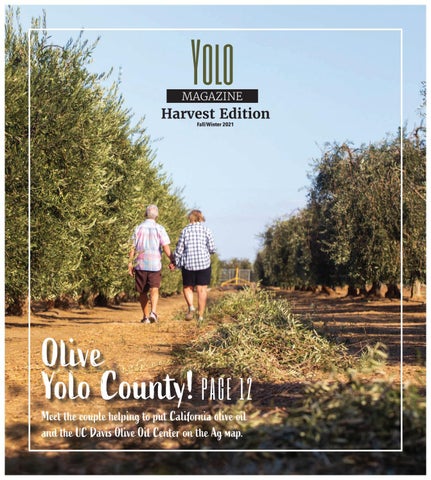
ON T HE CO V E R Karen and Malcolm Bond walk their olive ranch, which has put Yolo and Solano County olive oil on the map. — Page 12
26
A RENAIS S ANCE IN WOODLAND 2
Neighborhood care at two Davis locations Proud to offer our newest clinic: 684 Hutchison Drive As the region’s only academic medical center, we’re proud to provide the community a unique combination of personalized primary care and extraordinary expertise at our two Davis medical offices located at 2660 W. Covell Boulevard and 684 Hutchison Drive (on the UC Davis campus). Both of our clinics offer dedicated doctors, patient-centered primary care for adults and children, and plenty of parking for all of our patients. To start your care with UC Davis Health, or transfer your care to our new location, please call our Consumer Resource Center at 800-2-UCDAVIS (800-282-3284).
health.ucdavis.edu/aggies 18 clinics in 10 communities | 150 specialties | Routine check-ups to breakthrough surgery
3
In Depth Yolo Magazine Fall/Winter
A VIE W FROM ABOVE By Mike Bush The Yolo Ballooning Adventures has been going up, up and away since 2013. During that time, general manager Michael Veliz and his employees have developed a unique experience that showcases Yolo County near the sky. Yolo Balloons Adventure is based out of Dixon. “What makes Yolo County special for hot air ballooning is the diverse and ever-changing landscape throughout the year,” Veliz said. People who like to, or for the first timers, launch nearly four miles from the Putah Creek State Wildlife Area. The passengers get to enjoy the scenic view of the
Vaca Mountain Range, foliage along Putah Creek and a diverse variety of farmland, Veliz noted On clear days, flying in the wide-open valley floor provides a peek at the Sutter Buttes, north that is in Sutter County, to Mount Diablo to the south that is in Contra Costa County. “Being tucked up against the Western mountain range also provides perfect weather for year-round hot air ballooning,” Veliz said. Veliz feels another perk for the hot air ballooning business is many people from California and out-of-state seem to interest in seeing the region from afar. “Hot air ballooning helps businesses in Yolo County by drawing in passengers from
A sunrise launch in Winters. Michael Veliz photo
The inside of our balloon during inflation in rural Yolo County. Michael Veliz photo
4
around California and out of state,” explained Veliz. “Many of our guests have never visited Yolo County before, and we are eager to share our knowledge of local activities and places to visit after their flight.” Connecting with local and a variety of businesses is what is important to Veliz and his staff, such as wineries and restaurants. “By networking with local businesses, we not only provide a more personalized service to our passengers, but we help them discover their next adventure in Yolo County,” Veliz said. On their Website, www. balloonyolo.com, it’s stated that “our staff is invested in making every flight safe and memorable for all of our passenger. For more information or make reservations, contact Yolo Balloon Adventures at (530) 6628867.
• INDIAN CUISINE •
· Full Bar · Happy Hour 3pm-6pm, Monday-Friday
· Belly Dancing 7pm-8pm, Saturday
DINNER SPECIAL Buy one dinner entree & get one
· Home Food Delivery All Over Davis
· Order On Line & Table Reservations
Check out our delicious products online at:
Same day reservations only accepted by phone
$5.00 OFF of equal or lesser value · ONE COUPON PER TABLE
With coupon. Not good with other offers. Expires 11/30/21.
234 G Street • Davis • 530.756.3507
Welcome to... Located in Yolo County, just 25 miles from the Sacramento International Airport and at the start of the beautifully manicured Hwy 128, Winters, CA serves as the eastern gateway to Napa wine country. Nestled in the heart of downtown Winters, Hotel Winters is surrounded by celebrated restaurants, renowned wine-tasting rooms, and unique shops. For the adventure seekers, Lake Berryessa and The Blue Ridge mountains just 15 miles away offer water sports, hiking, biking, and bird watching. Wine enthusiast will enjoy 7 Westeren Yolo County wineries all within 25 miles and everyone will appreciate the many seasons of the Winters countryside providing unparalleled beauty at every angle.
Amenities: Room Service • 24 Hour Front Desk • Fitness Center • Restaurant • Hot Tub or Spa • Internet Access - Free Public Access • Parking - Valet • Business Center • Catering • Event Space
For booking or more information, visit www.hotelwinters.com. Follow Hotel Winters on Facebook and Instagram.
12 Abbey Street, Winters, CA • 530-505-9123 • guestservices@hotelwinters.com 5
Napa Valley Aloft For people who want a longer trek into riding a hot air balloon, the Napa Valley Aloft in Yountville is another option. According to its Website, www. nvaloft.com, the Kimball Family ballooning history dating to the 1970s when Napa Valley was beginning to develop as a destination for wonderful wine and great restaurants. “Tourism was on the rise and so were the first hot air balloon Napa company,” the Website stated. Jay Kimball was one of the first pioneers of commercial ballooning in Napa Valley. He has taken ballooning to new heights, as he’s opened new flight corridors in Lake Tahoe, Del Mar and San Miguel de Allende, Mexico. Jay’s children in Gretchen, Jayson and Jared have jumped aboard the balloons, and have developed a deeper understanding of the skills needed to find wind currents and landings spots. Jayson has been flying commercially since his 18th birthday in 1995. Gretchen began her commercial piloting in 1999 and Jared is flying in his spare time, while handling the marketing and special events for the company. The Kimball family loves Napa Valley and enjoys sharing their stories and limitless knowledge of this spectacular valley with their guests aboard the balloons. For more information or schedule an adventure of a lifetime, call Napa Valley Aloft at (707) 944-4400 or (855) 9444408.
According to its Website, balloonrides.com, he has established the company that has grown the company into one of the most prominent hot air balloon aviation companies in America. Barbarick’s vision was to evolve into a high-level guest serviceoriented company providing an experience that would become a major attraction in the worldrenowned Napa Valley. This has been accomplished: hot air balloons have become a major presence and an icon in the region. “We take pride in procuring and maintaining the highest quality aircraft and selecting the most experienced pilots,” Balloons Above The Valley stated on its Website. “We hold in highest regard that we provide an experience that our
Balloons Above The Valley Bob Barbarick, who oversees Balloons Above The Valley in Napa, started his adventures in 1975 as a pioneering hot air balloon aviator in the Napa Valley when there were very few vineyards.
6
Balloonists prepare to launch in rural farmland outside Davis. Michael Veliz photo
Balloonists see their reflection from Putah Creek in Winters. Michael Veliz photo
passengers remember for a lifetime.” For more information or make reservations, call Balloons Above The Valley at (800) 464-6824. Napa Valley Balloons If one wants to take the trip to Napa, the Napa Valley Balloons offers rides of a lifetime. On its Website, www. napavalleyballoons.com, Don Surplus, who is a pilot and cofounder, purchased a hot air balloon with four friends. That is when they called it the Yountville Aerostat Society, which would later become Napa Valley Balloons. “There were approximately 400 balloons in America at that time, making hot air ballooning a very unique and curious sight in the Napa Valley,” the Website stated. In 1980, after incorporating the business, a team of pilots began offering commercial flights to wine country travelers looking to explore Napa Valley from above. Now, Napa Valley Balloons, Inc. is armed with a team of dedicated staff to show the sights of Napa Valley. For more information or reservations, call Napa Valley Balloons at (707) 944-0228 or (800) 253-2224.
STABLER’S A-1 APPLIANCE
Serving Yolo County for over 60 years Voted Best Major Appliance Store Year After Year! Stop by our showroom for an amazing selection of appliances. Knowledgeable sales & service staff available to assist.
Pat Calvert with Duggan and Chris Calvert with Lucy
AWARD-WINNING EXTRA VIRGIN OLIVE OILS
Look for our products at the Turkovich Family Wines Tasting Room, 304 Railroad Avenue; Steady Eddy’s Coffee Roasting Room, 106-C Main Street and the Woodland Farmer’s Market. And available by mail order at https://ciarlofruitnut.com/
Ask us about the current promotion East St.
548 Kentucky Ave., Woodland
530.662.3996
3946 Ciarlo Lane • Vacaville
Open Mon-Fri 8am-5:30pm · Closed Sat & Sun
Delivery & Installation Available
530.304.2605 • patcalvert@ciarlofruitnut.com
College
www.stablerappliance.com
5
113 Kentucky Ave. Main St.
Holiday Open House November 12, 13 and 14 10 am to 4 pm
Dana Hawkins
Savor lavender treats and create custom gift boxes.
Top Producing REALTOR for Over 20 Years in Yolo & Sacramento Counties. Davis Resident Since 1974. Global Luxury Specialist, Realtor® | CalDRE #01318897
Dana.Hawkins@cbnorcal.com • www.danahawkinsrealestate.com
530.219.5076
Coldwell Banker Realty
For more information: CapayValleyLavender.com 7
In Depth Yolo Magazine Fall/Winter
OLD SUGAR MILL KEEP S GOOD TIME S ROLLING By Emma Johnson The formidable brick walls of the Old Sugar Mill stand tall in the rich clay and loam soils of southern Yolo County. The buildings have the distinct charm of a bygone industrial era, and, in many ways, it tells the story of the rich timeline of Yolo County’s agricultural history. First built as a sugar beet refinery, the Old Sugar Mill is now nestled in the heart of the Clarksburg American Viticultural Area’s many acres of vineyards. At the time the mill was built in the 1930s, Yolo County was the top nationwide producer of sugar beets. Agriculture shifted in the ensuing decades, and sugar beet production in Yolo County dropped drastically by the end of the twentieth century. Today, the Old Sugar Mill has been reinvented as the home to fourteen Northern California wineries. John Beckman, President of the Clarksburg Winery and
Visitors can come to the Old Sugar Mill to taste and buy wines made from grapes sourced from all over Northern California.
John Beckman hopes to see not only more wineries but also breweries, coffee and distilled spirits added to the Old Sugar Mill.
Fred Gladdis photo
Fred Gladdis photo Trumpet vines bloom outside in the rear courtyard. Fred Gladdis photo
General Manager of the Old Sugar Mill, spoke about the way the Old Sugar Mill has become a destination for Californian wine lovers. He also shared some insight on how the Old Sugar Mill has spent the past year and a half adapting through
8
the shutdowns and changing guidelines Once the shutdown started and tasting rooms closed, many of the fourteen wineries contacted their customers and shipped wine directly to their homes. This worked for a while, but
Shop safe. Shop local. Saturdays: 8-1
Central Park Downtown Davis
Wednesdays: 3-6
DavisFarmersMarket.org
9
First built as a sugarbeet refinery, the Old Sugar Mill is now nestled in the heart of the Clarksburg American Viticultural Area’s many acres of vineyards. Fred Gladdis photo
Beckman says things really started improving when outdoor tasting was allowed. The tenants moved their tasting out onto their picturesque 100 acres, and Beckman says that they found people were more comfortable outside. He says they still are. “We will continue to utilize both inside and outside spaces,” Beckman says. “We’re really lucky to have the outdoor space to accommodate people.” This large outdoor space is why the Old Sugar Mill can spend the weekends hosting weddings and other events without closing their public tasting room options. Those tasting room options have more than doubled since Beckman came to the Old Sugar Mill in 2009. At that time, he says, they had only six wineries. They selected new wineries based on their high caliber, but also on the great personalities at the wineries they work with every day. “We never advertised that we had space available,” Beckman says, but they instead grew by word of mouth. He says it’s not unusual to get at least one call a week asking if there is space for a new winery to join. Currently, they are full, but
Clarksburg Wine Company is one of 14 wineries with tasting rooms at the Old Sugar Mill. Fred Gladdis photo
there are plans to expand the Old Sugar sometime in the near future. Beckman hopes to see not only more wineries at Old Sugar Mill, but also potentially breweries, coffee and distilled spirits added to the Old Sugar Mill. For now, visitors can come to the Old Sugar Mill to taste and buy wines made from grapes sourced from all over Northern California. Along with the grapes from the Clarksburg AVA, there are wines sourced from the foothills, Contra Costa County,
A vineyard worker walks past the Clarksburg Wine Company’s brewing vats and barrels at the Old Sugar Mill. Fred Gladdis photo
10
and Napa. “Any given day there are probably 100 wines you can come out and taste,” Beckman says. Visitors to the Old Sugar Mill are required to make a reservation, but that reservation can be made in person. Beckman said that parties will often make an online reservation at several tasting rooms, and then make an in-person reservation at another. Those interested in visiting the Old Sugar can visit oldsugarmill. com or call (916) 744-1615 to make a reservation.
CELEBRATING OUR 40TH ANNIVERSARY! Helping local gardeners since August 1981
We always have lots of great houseplants!
Come discover the many benefits of private golf membership!
• Vegetable and herb plants for winter and spring harvest • Fruit trees • Flowers for butterflies, hummingbirds, and pollinators
• 18-Hole Championship Golf Course • Family Programs and Activities • Indoor & Outdoor Venue for Weddings, Parties, Business Meetings
Come be part of our family...
17980 County Road 94B, Woodland 530.662.0281 • www.yolofliers.com Quality Furniture & Affordable Pricing Everyday!
Great selection of succulents and cactus! • Low-water landscape plants • Shade trees • Garden supplies • Beautiful pottery and gifts • And much more! REDWOOD BARN NURSERY
395-A E. Monte Vista Avenue, Vacaville
Helping You Grow Since 1981 1607 Fifth St., Davis • 530.758.2276 www.redwoodbarn.com
707.449.6385 LaineysFurnitureForLiving.com
11
In Depth Yolo Magazine Spring/Summer
BONDOLIO DELIVERS SICILIAN FLAVOR
When arranging their orchard, Karen Bond and Malcolm Bond looked to Southern Italy for inspiration, where the olive trees can be hundreds of years old and the farming methods even older.
By Emma Johnson
Olive trees were first cultivated for agriculture somewhere between 6,000 and 8,000 years ago. Farming has since changed in many ways over those many millennia, but the founders of Bondolio Olive Oil looked to the past to find a path toward a more sustainable future. Now they are harvesting the results with national and international recognition for their California extra virgin olive oil — and plugging their experience back into the next generation, with a budding relationship with UC Davis. Karen Bond and Malcolm Bond, Ph.D, are the married couple behind Bondolio Olive Oil. Karen is the owner, and it was with her unique palate that the trees in their olive orchard were selected. Malcolm is the company’s master miller and horticulturalist. Together they have brought a Sicilian olive orchard to the heart of the Sacramento Valley. Karen and Malcolm chose their trees deliberately, after time spent tasting olive oils in Italy.
Taylor Buley photo Karen Bond and Malcolm Bond, Ph.D, are the married couple behind Bondolio Olive Oil. Together they have brought a Sicilian olive orchard to the heart of the Sacramento Valley. Taylor Buley photo
“I wanted a more fruity oil,” Karen said, and a variety of Sicilian olive trees gave her that flavor profile. Taylor Buley photo
In California, most olive oil producers use Spanish, Tuscan or French olive varietals. Karen describes these as having a more bitter flavor profile. She wanted something different. After two years of Karen blind taste testing olive oil, Malcolm and Karen found that she kept coming back to the same varietals. “I wanted a more fruity oil,” Karen said, and a variety of Sicilian olive trees gave her that flavor profile. Now that they knew what they wanted, their next challenge was transporting the trees to California. After meticulous planning — and two and a half years spent quarantined in a California greenhouse — their olive trees were ready to be planted. When arranging their orchard,
12
they once again looked to Southern Italy for inspiration, where the olive trees can be hundreds of years old and the farming methods even older.
13
Modern olive orchards are designed with trees planted closely together, so close that they can only be harvested by machines. While this industrial mindset might lead to a faster harvest, it creates a host of problems in the orchard. Closely knit trees are more vulnerable to moisture, rot and insect infestation. Not only does that increase the use of pesticides, Karen says, the insect damage will also affect the flavor profile of the oil. To avoid these issues, the Bonds designed their orchards based on the time-proven Italian farming methods. At Bondolio, the trees and rows are spaced 20 feet apart and pruned in such a way that the inside of the tree’s canopy is open like a giant vase. This allows sunlight to fill the tree, keeping the branches and the olives dry and healthy. Because of this, the pests that have plagued olive orchards across the state are not a concern at Bondolio, and they rarely have to use pesticides on their allorganic orchards. This attention to the quality of the trees, the fruit and the oil has netted Bondolio 28 honors to date. Along with dozens of county-wide awards, they have twice won the Best in Show at the California State Fair, took the coveted Good Food Award three years in a row and secured gold medals at both the New York and Los Angeles International Olive Oil Competition. The Bonds have also shared their knowledge in collaboration with UC Davis and Cal Poly. They
Malcolm Bond points to the Bondolio motto, a Pliny the Elder quote that translates as, “Except for the vine, there is no plant that produces a fruit as important as the olive tree.” Taylor Buley photo
Bondolio Extra Virgin Olive Oil is available at the Davis Food Co-op. It is not a cooking oil, but rather, a finishing oil. Taylor Buley photo
Attention to the quality of the trees, the fruit and the oil has netted Bondolio 28 honors to date, including two Best in Show awards at the California State Fair. Taylor Buley photo
did some research with the two schools on how to take the meat of the olive, which is usually discarded during milling, and turn that into a food product. They have also worked with UC Davis on looking into ways for olives to thrive in California with the continuing drought and climate change. The Bonds’ dedication to UC Davis and its UC Davis Olive Center continues to grow. The couple lends space on their mill — an overpriced “juice machine,” Malcolm jokes — so the facility can sell its own olive oil.(The university harvests their olives from Wolfskill Ranch, where olives have been grown since 1842, just down the road from the Bonds on Putah Creek Road.) Not only does the couple donate to the UC Davis Olive Center, but they also host
14
potential donors for tours. They plan to continue working with UC Davis. Students and professors travel out to Bondolio farms — located right at the border of Solano County — to study their methods. They work in other regions, too, such as Oregon, showcasing how they turned an unprofitable almond orchard into an award-winning olive ranch. Those looking to buy a bottle of Bondolio Extra Virgin Olive Oil in Yolo County can visit the Davis Food Co-op. Karen suggests that it is not a cooking oil, and rather, a finishing oil, and her website provides multiple recipes, from pasta to pound cake. For more information or to schedule a tour to visit the Bondolio olive orchard, go to bondolio.com or call (916) 7159007.
Lake Blvd.
Davis
lvd. ton B Arling
Cowell Blvd.
Davis Bike Loop
UC Davis
Lillard Dr.
Spanning 12 miles in length, the loop comprises a series of bike paths, trails and bike-friendly roadways that pass through most Davis neighborhoods and their lush parks.
Map by shawn.collins@mcnaughton.media
Cycling Starts Here... “We’re Serious About Your Fun!” Here at Ken’s, we love the outdoor life: riding bikes, snowboarding, skiing and more. And we take pride in our work, helping you get ready for your next adventure. Demand for healthy outdoor fun is higher than ever, and we’re expanding rapidly to meet the need. Click, call, email or stop in today to see what’s new and how we can help you (and our community and our planet) get healthy and stay healthy whatever comes!
• Open Monday-Saturday 10-7, Sunday 12-5 • Wide Selection - Shop Online or In Person • Easy Parking at Store, Local Delivery Available • Friendly, Expert, Award-Winning Service
BEST BIKE SHOP
15 years in a row! As voted by readers of The Davis Enterprise
650 G Street • Davis • 530-758-3223 • kensbikeski.com 15
Guinda
Take a flight through
YOLO 16 COUNTY Capay
1 Dunloe Brewing 1606 Olive Drive Davis 2 Sudwerk Brewing Co. 2001 2nd Street Davis 3 Super Owl Brewing 1260 Lake Boulevard, Suite 121 Davis 4 Three Mile Brewing 231 G Street, Suite 3 Davis
West Sacramento Breweries 5 Bike Dog Brewing Co. 2534 Industrial Blvd. #110 West Sacramento 6 Jackrabbit Brewing Co. 1323 Terminal Street West Sacramento 7 Yolo Brewing Co. 1520 Terminal Street West Sacramento
Winters Breweries 8 Berryessa Brewing Co. 27260 Highway 128 Winters 9 Green River Taproom 4513 Putah Creek Road Winters 10 Hooby’s Brewing
9 E. Main Street, Suite J Winters
Esparto 505
12
5
West Sacramento
3
Davis
11
9 10
16
Woodland 113
Winters 128 8
Knights Landing
5
Brooks
Yolo Breweries & Distillery Davis Breweries
Zamora
2 1
80
7 6 5
4
Locations are approximate. Map by shawn.collins@mcnaughton.media
Clarksburg
Winters Distillery 11 Patio 29 Spirits Co. 723 Railroad Ave. Winters, CA (530) 794-6174 Patio29 Spirits Co. is a family-owned and operated distillery in the small and picturesque town of Winters. We create super-premium whiskies, gin, vodka, rum, brandies and other spirit products. We source local-grown grains and fruits to honor the region and insure the freshest ingredients. As a true and authentic small-batch artisan craft distillery, we make everything by hand from farm to glass. Please visit us for a tour and a tasting.
Woodland Brewery 12 Blue Note Brewing Co. 750 Dead Cat Alley Woodland
16
The Davis Enterprise October 2021 || Winters Express November 2021
Guinda
YOLO 16 COUNTY 4
1
Zamora 3
Brooks Capay
2
5
Esparto
Knights Landing
5
16
Woodland 5
505
113 24 Davis 23
Winters 26 Capay Valley & Dunnigan Hills Wineries 1.
Capay Valley Vineyards
3. Matchbook Wine Company 12300 County Rd. 92B, Zamora 4. Séka Hills Olive Mill and Tasting Room
128
27
2. Grindstone Wines
19326 County Road 78, Brooks (530) 796-2810 www.sekahills.com Book an event with us, private tastings and private tours. Estate Wines: Sauvignon Blanc, Rosé, Viognier, Tuluk’a, Tannat, Grenache and Dessert Wine. Our tasting room also features Premium Estate Olive Oil, deli and retail shopping. Tasting room open Wed.–Sun. 11–5 p.m. 5. Taber Ranch Vineyard & Event Center
Clarksburg Wineries at the Old Sugar Mill
35265 Willow Ave., Clarksburg
6.
Batia Vineyards
7.
Bonitata Boutique Wine
8.
Bump City Wines
9.
Carvahlo Family Winery
10. Clarksburg Wine Company 11. Draconis Wines 12. Du Vigne Winery 13. Elevation Ten 14. Kirchhoff Family Wines 15. Rendez-vous Winery 16. Scott Harvey Wines 17. Séka Hills Winery 18. Three Wine Company 19. Todd Taylor Wines
Other Clarksburg Wineries 20. Bogle Vineyards 37783 County Rd. 144, Clarksburg 12700 County Road 89, Esparto (530) 393-2162 www.grindstonewines.com Tasting room open every Friday, Saturday and Sunday 11 a.m.–4 p.m. We have a patio that overlooks the coast range and a park that is perfect for private parties.
16628 County Road 81, Capay (530) 665-3691 www.taberranch.com Tasting room open Fri., Sat., Sun 11 a.m.–5 p.m. Serving wine, local beer & cider and food in a beautiful outdoor socially distanced setting. Please see our website for our schedule of events & live music. 17
80 25
Locations are approximate. Map by shawn.collins@mcnaughton.media
916-744-1615 www.oldsugarmill.com
13757 State Highway 16, Brooks (530) 796-4110 www.capayvalleyvineyards.com Check website for latest information on visits. Open Sat.-Sun. 12-5 p.m. No appointment needed but please phone to confirm we are open that day. Produces Tempranillo, Viognier, Cabernet Sauvignon, Petit Verdot and a unique, lively Sparkling Viognier and Sparkling Tempranillo.
West Sacramento
21. Julietta Winery 51221 Clarksburg Rd., Clarksburg 22. Miner’s Leap Winery 54250 S. River Rd., Clarksburg
6-19 22 21
Clarksburg 20
Davis Wineries
23. Cork It Again 820 4th Street, Davis 24. Great Bear Vineyards 24800 County Road 101A, Davis 25. Senders Wines 26891 Caddy Court, El Macero
Winters Wineries
26. Berryessa Gap Vineyards Downtown Tasting Room 15 Main Street, Winters Winery & Tasting Room 27260 Highway 128, Winters 27. Turkovich Family Wines 304 Railroad Avenue, Winters (530) 795-3842
In Focus Yolo Magazine Fall/Winter
DAVIS FARMERS MARKE T BRINGS FE S TIVIT Y By Wendy Weitzel The Davis Farmers Market is a premier destination in Yolo County year-round. But in fall and winter, patrons are in for special treats, from pumpkins to pies, and gift baskets to garlands. The market, at 301 C St. in downtown Davis, is open from 8 a.m. to 1 p.m. on Saturdays, and 3 to 6 p.m. on Wednesdays. Its signature Saturday market features seasonal, farm-fresh produce, eggs, meat, almond milk, baked goods, nursery plants, succulents, honey, flowers, nuts and crafts. There’s also coffee, pastries, smoothies and hot food like Asian dumplings, Indian curries, tri-tip sandwiches and hot dogs. The Wednesday market has the above hot food and a selection of produce. The covered structure allows the market to stay open year-round. Pre-Thanksgiving Market: The market extends its hours for its annual Pre-Thanksgiving Market on Wednesday, Nov. 24. It opens early, with hours from noon to 6 p.m., with “everything but the turkey.” There’s a bounty of ripe seasonal produce, table décor, flowers, meats, cheeses, olive oil, honey and wine. Fresh-baked items include pumpkin, apple and berry pies and pumpkin cheesecake, breads, stuffing mix and cookies. Holiday gifts: The market features a wide array of farm products and handmade items
A Capay Organic staffer sets up a booth at a Saturday market before the pandemic. Fred Gladdis photo
that are perfect for gifts or “shop-local” gift baskets. Besides the abundant produce, market sellers offer preserved
PURE Honey, which comes in a variety of flavors, is a favorite filler of local gift baskets. Wendy Weitzel photo
18
jams and sauces, lemon curd, honey, balsamic vinegars, olive oils, dried herbs, nuts and nut butters. There are sweets like dried fruit or chocolate-covered almonds, pistachio brittle, toffee and local wines. Other items include handmade soaps and lotions, candles, wreaths, flowers, poinsettias, hats and scarves, jewelry, totes, wood crafts and crystal spinners. At the market shed, find “The Davis Farmers Market Cookbook, Revised Edition,” which features seasonal recipes for market produce. There are also handmade baskets, and marketlogo aprons, hats, tote bags, mugs and T-shirts. Choose from a grab-and-go gift packages or create ones with your purchases. Holiday hours: The Davis Farmers Market will be closed
Family Owned & Operated Since 1995
Shoppers can find a selection of pre-wrapped gift bags, or assemble one on their own.
TAKE OUT, PICKUP & DOORDASH • Sandwiches • Salads • Pastas • Desserts • Catering • Much More!
Wendy Weitzel photo
on Christmas and New Year’s days, but open for special morning hours on the Fridays before. On Fridays, Dec. 24 and 31, the market will open from 8 a.m. to noon. It will have regular hours (3 to 6 p.m.)
on Wed., Dec. 29. For more information, visit https//davisfarmers market.org or check it out on Facebook or Instagram, where it lists vendors and products the day before each market.
Two Locations to Serve You! DAVIS 530-750-7870 616 3rd Street, Davis
Mon-Sat 10am-3pm • Sun 11am-3pm
SACRAMENTO 916-441-DELI (3354) 1401 O Street, Sacramento Mon-Sat 10am-3pm
www.ziasdeli.com
EXPERIENCE THE TASTE OF WINTERS
Prepared in our exhibition kitchen, Carboni’s Ristorante, Bar, and Market offers an Italian-forward menu complete with homemade pizza and pasta straight from Winter’s regional bounty. Enjoy craft beers, artisanal cocktails, or a glass of vino at our wraparound bar, outdoor patio, rooftop bar or dining area. Carboni’s was carefully crafted to deliver lasting culinary memories that will inspire you to return time and time again. We have a table waiting for you! We’re located inside the charming four-star boutique Hotel Winters nestled in the heart of downtown, surrounded by celebrated renowned wine-tasting rooms, and unique shops.
HOURS OF OPERATION: Barista 6am-10am Monday-Thursday for Coffee/Pastries etc. Dinner 5pm-9pm Daily • Brunch 8am-2pm Friday-Sunday Abbey Roof-Top Bar & Lounge 6pm-10:30pm Thursday-Saturday
316 Railroad Avenue, Winters • 530.505.9125 • carboniswinters.com 19
In Depth Yolo Magazine Fall/Winter
BORDERLINE WILDERNE S S AT CACHE CREEK By Rebecca Wasik The Cache Creek Wilderness consists of 27,245 acres of exquisite nature views. Bounding Yolo and located just beyond Rumsey in Lake County, this area is lightly trafficked, open yearround, and offers an array of activities. Over 11,000 years ago, this area was inhabited by the Patwin tribe. It is now managed by the Bureau of Land Management and part of the National Wilderness Preservation System. The Cache Creek Wilderness was established back in October of 2006. In July of 2015, the area became part of the Berryessa Snow Mountain National Monument. Common activities include nature photography, whitewater rafting, hiking, fishing, backpacking, and bird watching. There are also many wildlife species in the area. Some include tule elks, wild turkeys, black bears, raccoons, mountain lions, quail, black-tailed deer,
Kayaker Mark Holcomb paddles on Cache Creek while practicing for the 2016 Cache Creek Slalom and Downriver Races at Cache Creek Regional Park near Rumsey. Fred Gladdis photo
Cache Creek flows under a bridge near Guinda in the Capay Valley. Fred Gladdis photo
rabbits, gray squirrels, pigeons and doves. There are several different hiking trails in the area, with difficulties ranging from easy to hard. Redbud Trail to Baton Flat is a moderate hike. It consists of 5.3 miles of trail and is moderately trafficked. Dogs are allowed, as long as they are on a leash. This trail has a 4 star rating by users on alltrails.com. Cache Creek Ridge’s Judge David Trailhead is a moderate hike as well. It consists of 10 miles of trail and is lightly trafficked. Dogs are allowed on this trail as well. It has a 4.2 star rating by users on alltrails.com. Perkins Creek Ridge Trail is a moderate hike. It consists of 4.4 miles of trail and is lightly trafficked. Dogs are allowed,
20
as long as they are on a leash. Perkins Creek Ridge has a rating of 3.8 stars on alltrails.com. Lynch Canyon Trail is an easy hike. If you are looking to take your kids out to enjoy a walk in nature, Lynch Canyon is perfect. It is a great trail for all skill levels. It is lightly trafficked and consists of 3.1 miles of trail. It is dog-friendly and you may even see a few horses along the way. It has a rating of 3.7 stars on alltrails.com. If you’re looking for a challenging hike, you may consider the Cache Creek Ford Trail. It is 12.2 miles long and lightly trafficked. This trail is at its best from November through May. This area is full of wildlife and both dog and horse friendly. It has a 4.4 star rating on alltrails.com.
Cache Creek Wilderness, in yellow, is seen on a map provided by the National Wilderness Preservation System. Courtesy graphic
The Cache Creek Wilderness Trail is a moderate, lightly trafficked hike. It is a 9.8 mile hike that features beautiful wildflowers. It is accessible year-round but mountain biking is not permitted until April of each year. Dogs are allowed on the Cache Creek Wilderness Trail. It has a 3.9 star rating on alltrails.com. 3 Ponds, Thompson Canyon, Brophy Canyon and Cache Creek Ridge is a 15.9 mile loop trail. The difficulty of this hike is moderate and moderately-trafficked. It features a river and is horsefriendly. This trail has a 4.0 star rating on alltrails.com. Cowboy Camp to Judge Davis Trailhead is one of the hardest trails in this area if you are truly looking to test your abilities. It is lightly-trafficked and consists of 11.6 miles of trail. This trail offers a chance to see wildlife and is dog and horse friendly. This trail is best used from November through May. Bear Creek can be difficult to cross and there is heavy clay in the area. It is advised that you let soil dry for 10 days before venturing out onto the trail. Cowboy Camp has a 4.3
star rating on alltrails.com. If you are looking for an easy, family hike, try Lynch Canyon Trail. If you want to step it up a bit from an easy walk, give the Cache Creek Wilderness Trail or Perkins Creek Ridge trail a
Swallows collect mud from a Cache Creek bank to build their nests under a nearby bridge. Fred Gladdis photo
21
go. But, if you are looking to challenge yourself, you will love Cowboy Camp to Judge Davis Trailhead and the Cache Creek Ford Trail. This stunning area is full of unique wildlife species and plants that all nature-lovers will enjoy. You may even see a bald eagle since they inhabit the area year-round. The Cache Creek Wilderness Area is a magnificent gem, practically in our backyard. Whether you want to hike, fish, take photos, go rafting, or camp, this area is an impeccable place. It doesn’t matter if you have never hiked a day in your life, or have seen some of the hardest trails the U.S. has to offer, the Cache Creek Wilderness Area has something for everyone. Now that the cooler months are coming and Autumn is here, it is the perfect time to get outside, breathe in the fresh air, and experience the allure of the Cache Creek Wilderness Area.
In Depth Yolo Magazine Fall/Winter
THE NATURE OF FIRE S By Timothee Mendez Reneau The past decade has plummeted the western United States with wildfires. Communities have been left in ashes and millions of acres have been burned to the ground. There is no doubt about it, these historic wildfires have carried with them bad news. Yet these fires, tragic as they are, don’t paint a full picture of the role fire plays in natural ecosystems. It only shows one side of a multifaceted issue. Most people only ever hear about the side that portrays fire as a devastating antagonist. The truth is, fire isn’t always a bad thing. Certain ecosystems are heavily resistant to fire or even thrive with its presence. Frequent and low-intensity fires help reduce the risk of large catastrophic wildfires. Fires promote the growth of native species while reducing populations of invasive A Davis firefighter cools off a species. fire intentionally set Wildfire can and has been to control an invasive dangerous and destructive in species at the UC Davis Yolo County. But a villainous Putah Creek Riparian portrayal of fire has had harmful Reserve during wildimpacts, too. This mindset is land fire suppression what has prevented “good fire” training that involved from doing its work against fires. Woodland, West Sacramento, Yocha Indigenous tribes who have Dehe and Davis fire lived within the boundaries of departments in 2012. what is now California have known this for millennia. Despite Fred Gladdis photo all the challenges they have faced for it, indigenous communities in parts of California continue managing fire and leading the efforts for its use.
Wildfires in Yolo County Although the impacts of wildfires across the state break records every year, fire is nothing new to the California landscape. Fire has been a signature component of this territory for thousands of years. It has shaped the ecological composition of these lands, well before the word “California” was ever uttered on the continent. And while some local residents may not love the idea, Yolo County is not immune to wildfires. Especially in recent years. Since 2016, Yolo County
22
has experienced 5 of the largest wildfires in its history, including the 2020 LNU Lighting Fire Complex that became the 4th largest wildfire in California history. The 2020 LNU Lightning Complex Fire burned more of Yolo County than all wildfires in the past 20 years combined. This fire burned through the familiar landscapes of blue oak woodlands, chaparral and grasslands that compose a section of the Putah Creek Watershed in Yolo County. From that burn, neighbors are moving forward but life springs anew for
Recent Wildfires Name Rumsey Fire Cold Fire Winters Fire County Fire San Fire LNU Lighting Complex
Date October 2004 August 2016 July 2017 July 2018 June 2019 August 2020
their natural neighbors, too.
Good fire and bad fire The difference between a good and a bad fire is not blackand-white. It depends on the ecosystem, the fire, and, lastly, the human perspective. This human element is not to be understated. In the end, it’s us humans who decide what’s good and bad about the burn. In the past decade, coniferous forests, like those
Acres 39,138 5,371 2,269 90,288 2,512 363,220 The hills northwest of Winters are darkened by the Yolo County fires of 2018. Fred Gladdis photo
in mountainous regions of California, have lost millions of acres of forests due to wildfire. It is these fires that have largely captured the attention of the news and media. Many today argue that catastrophic fires like these have occurred, at least in
part, due to bad forestry practices and a fire suppression policy that sought to eliminated fire for the landscape rather than use controlled-burn techniques such as so-called “back burning.” Good fires are something we hear about less. In forested
Whisk your closest friends and family away to a luxurious and relaxing stay as they take part in the best day of your lives. Nestled in the beautiful hills of Winters, Field and Pond offers an unimaginable experience that will be remembered for years. A wedding at Field and Pond features stunning backdrops of lush gardens, historical grounds, a beautiful wood barn, and antique silos. Field and Pond offers a variety of customized options to meet the wishes of each couple. Working with our team of super star vendors, we can host the wedding of your dreams. You will have access to over 10 acres of event space with various lawns, gardens, and meadows available for ceremonies, rehearsal and wedding photo backdrops. Use of the Main Craftsman Lodge from Friday to Sunday morning, you will have access to the Bridal Suite, Groom's Suite, and 4 full bathrooms, available to the wedding party the day of the ceremony. *Maximum Over-Night Occupancy 10 Guests
Fieldandpond.com | facebook.com/fieldandpond instagram.com/fieldandpond | info@fieldandpond.com
26055 County Rd. 29, Winters, CA | 916-730-8436 23
Looking for a luxury weekend getaway and a private bed and breakfast experience? Through Airbnb and VRBO, we offer private chef services, massage therapy, vineyard day trips, farm tours, and animal handling. Field and Pond is the perfect place for you and your friends to relax and unplug in our 4 bedroom, 4 bathroom lodge. Let us curate a weekend you won’t forget!
A lonely Blue Oak (Quercus douglasii) Sharif Photography photo
ecosystems, these are fires that burn through the understory but don’t significantly impact the biggest trees. Ecologically they improve diversity, increase resilience, and improve the ecological structure. They prevent catastrophic fires by burning woody debris and vegetation that act as fuel before it accumulates in large quantities. They don’t destroy homes and other structures. The recent LNU Lightning Complex Fire, undoubtedly a bad fire, largely affected two types of non-human ecosystems in Yolo County. These are the blue oak woodlands and the chaparral landscape. Each has its unique fire ecology that is distinct from other ecosystems such as the coniferous forests in California. Both of these ecosystems have adaptations that make them resilient to wildfires. Non-native species often do not. Thankfully, because of this, we are already seeing a smooth recovery after the LNU Complex Fire, and the Camp Fire before it.
The hills west of Winters are darkened by the Yolo County fires of 2018. Fred Gladdis photo
usually sparsely vegetated with medium-sized deciduous oaks (Quercus douglasii) evenly spaced across a landscape. These are the classic oak woodlands you see on many of the slopes around Lake Berryessa. They rarely form a closed canopy which allows an understory of plants to thrive. Historically, these may have been dominated by deep-rooted perennial bunchgrasses and other native wildflowers/forbs. Today is dominated by nonnative annual grasses. When fires pass through these woodlands they often burn much of the understory without causing catastrophic damage to
Blue oak woodlands Blue oak woodlands are
24
the trees. The most vulnerable trees here are those with any sort of ladder fuel, such as Poison Oak, that catches fire and brings it into the canopy. Still, Blue Oaks are resilient. Even if the entire aboveground portion of a blue oak burns in a wildfire it still has a good potential of surviving. Blue oaks are notorious for sprouting from their root crown after low to moderate severity fires. If the weather permits they may sprout their first leaves just a couple of months following the fire. Fire also helps control one of the biggest pests affecting oak trees. The acorn weevil. These miniature insects burrow into the growing acorns and consume them before they’re ready. This can greatly reduce the number of viable acorns produced by the Oaks. Since the acorn weevil spends part of its life cycle below ground, fires can help control its prevalence. The young larvae are “cooked” as the fire burns below the oaks.
Chaparral If you’ve spent some time in Yolo you’ve encountered Chaparral ecosystems. They are the short bushy ecosystems that occur on the dry southfacing slopes. They have bushy aromatic plants like Black Sage, Sage Brush, Chamise, and the beautiful Manzanitas. Adventures hikers who find themselves amongst dense stands of Chaparral are familiar with bushwhacking through this impenetrable wall of vegetation. The word “Chaparral” actually originates from the Spanish word “Chaparro” which means short, referring to the short stature of these ecosystems. Chaparral thrives with fire. It doesn’t just resist it like other ecosystems, but it does best with occasional high-intensity fires that burn it to the ground. They intentionally grow
themselves into rich fuels that violently burn with high intensity. Volatile oils and other secondary compounds within their tissues further contribute to high temperatures. They aim to create a biological system that burns hot, quick and leaves nothing behind. They essentially “dig their own graves” while planting their own seeds and ensuring nothing else will compete. Most Chaparral species, like the common Manzanita and Buck Brush, have seeds that are extremely resilient to fire. Manzanita seeds, for example, have a tough coating that protects the seeds. So much so that their seeds germinate better after being exposed to temperatures higher than 240F! Many other species like Black Sage, Yerba Santa, and Chamise aggressively sprout from their roots after wildfires. They have specially adapted root systems that handle these high temperatures.
Non-native species Invasive species have come to dominate much of the landscapes in Yolo county. Even the all familiar annual grasses that change the panorama from green to golden every summer are introduced species.
Wild manzanita tree growing with vibrant red bark. Mike Fusaro photo
While some invasive species do thrive after fires, fires can also help control the populations of invasive species. In turn, fire can stimulate the germination of many native species that have been sitting dormant in the soil seed bank. Unlike native plants, most non-native plants don’t have the same adaptations to fire. Their root systems get fried and their seeds, burnt. These soils now become a good habitat for native species that are better adapted to fire disturbance. This makes fire an effective means of promoting the diversity of native plants.
Clean, Efficient Heat
Let us enhance the style and comfort of your home!
ZONE HEAT, SAVE MONEY! NO POWER, NO PROBLEM!
Free In Home Estimate!
AUTHORIZED DEALER FOR
385 MERCHANT STREET • VACAVILLE 707-446-9008 • www.galleryoffireplaces.com MON-FRI 10-6 • SAT 10-4 • CLOSED SUN
25
In Depth Yolo Magazine Spring/Summer
WOODLAND PROVIDE S A HOME FOR IT S HIS TORY By Lauren Keene WOODLAND — In Woodland, they’re partying like it’s 1871. That’s when the city officially got its start, founded by landowner and businessman Frank Freeman. A century and a half later, Woodland is commemorating its 150th anniversary as a self-governing city, the first in Yolo County. This year also marked the return of the Stroll Through History, an annual celebration of Woodland’s past and architecture that, due to the pandemic, paused for the first time last year since its 1989 beginnings. The event focuses on Woodland’s early years, following California’s 1850 admission to statehood amid the Gold Rush era. One of its earliest residents, Henry Wyckoff, built a general store on the land where Freeman Park sits now and declared the area “Yolo City.” Freeman, a native Missourian who farmed along Cache Creek, bought the store from Wyckoff in 1857 and, with a 160-acre homestead, set about developing what became a prosperous farming town. The rest, as they say, is history, celebrated each fall with the Stroll. “It was always an educational mission,” said David Wilkinson, a local historian and Stroll docent who has written multiple books about Woodland’s history, including its architectural treasures. “If people learn about what we have here, they’ll appreciate it and want to preserve it.” Deborah Rains, a former Davis resident who moved to Woodland two years ago, spotted signs advertising the Stroll while driving one day and “I jumped on that right away.” She invited her friend, Davis resident
Ann Reioux, to join her for the day’s events. “I love history, I love old buildings and old homes, so I think this is really great,” Reioux said. “Woodland’s just a treasure, and it’s in Davis’ backyard,” added Rains. “This makes me proud to live here.”
Sharing history Woodland’s first Stroll Through History “was kind of a spontaneous event,” said longtime docent Mary Aulman. Created to promote a new walking-tour publication published in 1989, it featured a 4-1/2 mile walk from downtown’s Heritage Plaza to neighborhoods to the north and south, “and there were a lot of people out in front of their houses, talking about
26
them.” Historians David Wilkinson and Mary Today’s Stroll Aulman stand visitors can choose before a Victorian from 10 free home, built in 1874 docent-led walking at 546 First St., and and biking tours, restored by Bob and featuring more than Carole Scibienski. 400 homes and Fred Gladdis photo buildings of diverse architectural styles. This year’s event also offered tours of the city cemetery, historic barns and alleys, as well as viewings of five historic homes. “A big story about Woodland is how much variety we have in a concentrated area,” said Wilkinson, whose family bought and restored a First Street Victorian in 1985. “Woodland was
wealthy, and people sought beauty.” First Street from Lincoln Avenue to Pendegast Street, for example, treats the visitor to classic Victorians as well as Colonial Revival, Spanish Revival, Craftsman Bungalow, Tudor, Cape Cod, Prairie and adobe brick styles in just a four-block stretch. The stately Gable Mansion, a now-California historical landmark that ranching brothers Amos and Harvey Gable built for their families in 1885, stands among the highlights. The mansion became one of many historic homes that fell into disrepair during the 1960s. There was a time, Aulman said, when overgrowth of the Gable gardens shielded views of the three-story house from the street. “The 50s and 60s were a real low point,” Aulman recalled. “Some of Woodland’s best houses were torn down and condemned,” with builders erecting apartment complexes in their place. That changed in the late 1960s, however. New arrivals in town who recognized the neighborhood’s uniqueness began buying the properties, painstakingly restoring them to showcase their original beauty — some with a modern twist. “It’s interesting to see how people maintain the Victorian look, but they still have to make it work for a culture where we don’t like a lot of tiny, enclosed rooms,” Aulman said. “I think of them as brought back from the dead.”
Victorian love Everet Erickson and Mary Solecki weren’t looking for an historic home. The Santa Cruz transplants had their sights set on a move to Sacramento when an “accident” sealed their fate. By chance, their realtor widened their search radius “and this house came up,” Erickson said on the porch of the couple’s Queen Anne Victorian on First Street, purchased three years ago. “We didn’t even know where Woodland was, but when we came here, we loved it and put in an offer right away.” Built in 1907, the house had good bones but felt dated — old wallpaper,
worn carpeting and some rooms lacking electricity. There were some oddities, too, like the toilet sitting out in the open in the master bedroom. However, “we saw potential where others saw a headache,” Erickson said. “The rooms were enormous, and we appreciated the craftsmanship.” They completed their remodel in three phases over 2-1/2 years with the goal of re-using as many of the existing materials as they could. When they couldn’t, they sourced antique and period-appropriate pieces, such as light fixtures and stained-glass windows, to complement the home’s vintage style. Their project also revealed some surprises, including a five-foot-wide pocket door sealed inside the wall between the entryway and front parlor. Inside an upstairs wall, they found an old glass bottle containing a war bond. Visitors saw the fruits of their labor when the couple opened their home for this year’s Stroll Through History. The decision “was an easy yes,” Erickson said. “We want this tradition to keep going,” he said. People expressed their appreciation of the couple’s work, and they met several who had either lived the house or had friends who did. “It’s just a really fun experience.”
Stepping back A new tour this year — “Stepping Back to 1871: What Was Woodland Like?” — took strollers back to downtown Woodland’s earliest days, starting with the location of the general store Frank Freeman purchased along South Street, later renamed Main Street. Freeman met and married his wife Gertrude Swain, a local teacher, and the couple settled into their first home next to the town’s rice mill. The house, which still stands today on the east end of Court Street, is believed to be one of Woodland’s oldest, said docent David Wilkinson. It was Gertrude Freeman who later coined the name “Woodland,” paying homage to the community’s abundance of oak trees. Even before its incorporation,
27
Woodland played a significant role within the county as Freeman established the town’s first post office in 1861. A county courthouse followed suit, as did shops, hotels, saloons, a three-story Bank of Woodland and the Hesperian College campus, also constructed in 1861. Heading west, Main Street’s historic buildings show the evolution of architectural preferences, from wood to brick to the Spanish and Mission styles inspired by the “California Building” displayed during the 1893 World’s Fair in Chicago. “Woodland became infatuated with its Spanish roots,” Wilkinson noted. At Main and Second streets, an electric train depot connected rail travelers to Sacramento and the world beyond. Across the street, the brick Woodland Opera House, built in 1896 (the original, erected in 1885, was destroyed in an 1892 fire that wiped out the block) still hosts live performances. Today, much has changed in downtown Woodland. Like the historical homes district, Main Street also experienced a period of neglect, until community members sparked an architectural and commercial revival in recent decades. “Downtown Woodland has evolved, but a lot is still here. We’ve managed to The Gable Mansion, built in maintain our 1885, was one of many historic homes that was restored character,” after falling into disrepair Wilkinson said. in the 1960s. “We’re in a Fred Gladdis photo renaissance.”
In Depth Yolo Magazine Fall/Winter
HORSE THERAP Y By Mia Croff Located down County Road 102 between Davis and Woodland, the Therapeutic Riding and Off Track Rehabilitation (TROTR) ranch welcomes all members of the community, regardless of experience or physical ability, with open arms. TROTR is a nonprofit organization that offers a plethora of services ranging from one-of-a-kind volunteer opportunities to saddle training rehabilitated racehorses, to providing a variety of lessons for anyone interested, including adaptive riding for individuals with special needs and so-called hippotherapy services. The organization has now been serving Yolo County and its surrounding communities for over 16 years, holding a special place in the hearts of many, including ranch owner Shannon Personeni. “TROTR was a childhood dream for me,” Personeni said. “When I was in high school, my mom gave me a book on therapeutic riding, and I knew that’s what I wanted to do.” And for over two decades, Personeni has put in the relentless hard work to make her dream a reality. She obtained her master’s degree in business, bought the property and established TROTR in 2005. “We started out with off-track rehabilitation, focusing on rescuing as many horses as possible and then we moved into therapeutic riding. And we’ve continued expanding since
then,” Personeni said. Despite obstacles along the way, such as the current COVID-19 pandemic, TROTR has adapted and prevailed and continues to serve, touching those who set foot on the ranch. Alicia Cary moved up the ranks of TROTR, starting as a “Stall Warrior,” and is now an adaptive riding instructor. “I’ve been coming every Saturday since,” Cary said. She shares lessons with other instructors and works with anywhere from five to eight students each week. “The students that I see all have some sort of special needs, varying in diagnosis. They come and we use the horses as a form of therapy,” Cary said. “(They) learn how to care for the horses, doing tasks like grooming
28
Christopher Miranda and tacking. It’s showing off his important for winning smile while building confidence. leading 18-year-old Then riding the horse chestnut Belgian builds core strength, Draft horse, Horace. balance and cognitive Debbie Shoup photo skills. We play games and work on range of motion and listening skills.” Cary also has the important responsibility of working with Personeni to find the right match between instructors, adaptive riding families and horses. “Together, we have to decide (what instructor) would be the best fit for this child and this horse together,” Cary said. “It’s an important process.” Her weekend job at TROTR allows Cary the opportunity to combine her
passions. “I grew up riding horses, and then, once I didn’t have my own anymore, I started volunteering,” Cary said. “Now I work as a pediatric therapist in a school, and I love how (TROTR) just wraps everything up in a bow — my love for horses, my love for kids, my love for adaptive riding.” Christopher Miranda first discovered TROTR when looking for a volunteering opportunity as part of his Student Services plan for career exploration. “Chris loves animals,” Anna Miranda, Chris’s mother said. “He’s always had a special connection with them. He just has a gentle, kind spirit, as do the horses.” After some time as a volunteer, Chris and his family made the decision to start lessons. “During that first lesson, Chris was excited yet apprehensive. He slowly mounted, then dismounted. He was given the time to manage his anxiety, a debilitating feature of Fragile X Syndrome,” said the mother. “Everyone was very supportive. He has an excellent instructor, Michaela, who allows him to learn at his own comfort level.” Now, Chris is much more confident on horseback and is now partnered with 19-year-old gray Percheron, Galan, working on his posting skills. Chris has reaped great benefits from his experiences at TROTR. He has gained confidence through riding, independence and responsibility through learning to care for his equine companions, and physical benefits as well. Christopher has issues with low muscle tone and coordination. You can tell the riding lessons are really benefiting him physically,” Anna said. “He’s working on his core strength, posture and coordination by correlating his movements with those of the horse.” “(TROTR) was exactly what I was looking for – a supportive place where Chris could learn (and grow),” Anna said. “It truly opened more doors for him and allowed him to be a bigger part of the community. And allows for more activities we could do as a family,” Anna said. Because of the hard work and
dedication Christopher has put in at TROTR, he will be going on a family trail riding this month, an activity that was previously extremely challenging for him. The Miranda family is very grateful for TROTR and gives their thanks to the organization and volunteers. Joey McDill is a veteran student of TROTR’s adaptive riding who has been a part of the programs since late 2019. Joey originally started his lessons on the back of Goldie, a 28-year-old Appaloosa mare. However, upon her retirement, Joey had to find a new equine partner. “Finding a replacement (for Goldie) was hard, but Joe was the perfect one,” Joey said. “And I love Joe. I think he might be starting to become my favorite horse.”
Volunteer Alena Watson giving Horace a warm embrace. Debbie Shoup photo
According to Cari, TROTR took the time to really consider all the potential pairings with Joey and choose the horse they believed to best fit Joey’s personality, skill level and needs. “Watching the relationship form between my son and his horse and how that connection has grown is special,” Cari said. “There’s definitely something special about horses and kids who can’t communicate well or connect well and watching those connections form.” Joey has experienced great growth in his confidence due to his riding experiences. “I’ve seen a huge growth in his riding skills and confidence because being able to do something well translates (his confidence) to the rest of his life,” Joey’s mother, Cari McDill, said. Along with the growth in confidence
29
Joey has experienced, he has also formed new friendships on the ranch. “With my son, it’s not just riding the horses, it is forming a connection with an animal, forming a connection with the people involved, besides all the other therapeutic physical (benefits) that go along with the therapy,” Cari said. Joey doesn’t plan to stop riding anytime soon and wishes that others can reap the benefits of TROTR as he has. Alena Watson, a veterinary sciences major at the University of Nevada, found TROTR this summer when looking for places to volunteer with horses. “I needed to find a place fast to get veterinary experience from school,” Watson said. “And I wanted to work with horses because I want to pursue a career as a large animal veterinarian. Then when I saw it was a nonprofit, I was decided because (nonprofits) can use all the help they can get.” So, Watson turned in the required paperwork in late May 2020 and began volunteering. Little did she know TROTR would become her second home for the duration of her summer. “I immediately fell in love,” Watson said. “It was just the perfect atmosphere, and everyone is so welcoming there. I loved seeing everyone smiling. And that’s all you see when you’re walking around there.” Watson dedicated herself to the ranch over the summer: waking up at 5 a.m. to arrive at 6 a.m. and work the day away, nearly everyday. She earned her stripes as a Stall Warrior by completing ranch chores and mucking countless stalls, trained to lead and be a side walker for adaptive riding lessons, learned the hay routine and how to feed the horses their individual grains and even took lessons herself. By the end of the summer, Watson proudly completed 108 volunteer hours. Watson has maintained two passions throughout her life – horses and volleyball. Volunteering at TROTR allowed Watson to find relief in one of her passions after the loss of the other. “Animals were my initial passion from the start, (…) but volleyball was the priority (… and) being able to get
Volunteer Nicole Beard shares a tender moment with horse, Cisco. Debbie Shoup photo
back on a horse and be around a horse, just being in their presence, … now that I’m no longer playing volleyball, … I was able to gain happiness again,” Watson said. “It was my get away from the real world.”
Importance of your assistance “The way that they welcome everyone of every culture, every background and every disability (is special),” Watson said. TROTR indeed is a special organization with the goal to serve as many people as possible in the community and enrich lives through equine and ranch experience. “TROTR as an organization is important because there is a growing need for programs that are like this,” Cary said. “They are welcoming and can be adaptive to everyone’s needs, regardless of what their abilities are.” “I think the beauty of TROTR is that it’s a nonprofit,” said volunteer Aly
Lodigiani. “It means that we don’t charge as much (for our services). A lot of our lessons offered are pretty incredible but effective, compared to the surrounding area. We’re about to reach a lot more community members who wouldn’t normally be able to afford and or access horseback riding because of cost.” As a nonprofit, help to defray the costs of services is needed and appreciated. There are several ways to contribute to the organization, including financial donations, in-kind contributions of horse and therapy supplies, investment of time through volunteering and spreading awareness of the organization. “Fiscal donations are always going to be useful,” Lodigiani said. “A lot of horses at TROTR tend to be older, so vet bills are high and specific dietary needs are costly. Horses are expensive creatures and surprisingly fragile. (We) directly use those funds (from
30
donations) and distribute them how the ranch needs.” Interested donors can give through the TROTR website, trotr.org. There are various options for monetary donations. One can either make a general donation or become a sponsor for a rider or horse. Sponsors pay a fixed monthly fee that either pays the price of one lesson of a rider or the cost to feed one horse for a month. There you can also find a wish list of desired horse supplies and therapy equipment the ranch could always use more of, including everyday household items like stickers, small toys and plywood. However, money is a limited resource and physically getting out on the ranch and contributing your spare time through volunteering is just as valuable of a donation. “Being there, being present, being available, being there with an open mind, and being ready to work, is such a huge help,” Lodigiani said. If interested in becoming a TROTR volunteer, you can find all the required information on their website, including all the required forms and the date and time of the next volunteer orientation, so you can get started as soon as possible. “Regardless of people coming out on Saturdays, horses need care 7 days a week, 52 weeks out of the year. If you’re unable to provide fiscal or physical support, spreading the word helps more than you know,” volunteer Joe Morrison said. “Even helping indirectly has an impact for us.” “(TROTR) provides opportunities for individuals who might not have these opportunities and I believe everyone deserves to have opportunities,” Anna said. “I think everyone deserves to have opportunities in their areas of interest because of the broad range of benefits that are provided through adaptive and therapeutic riding, from social, emotional, and physical.” “Strong communities support each other,” Anna said. “Nonprofits like TROTR are a wonderful way to do that. And seeing that those of us who you would typically view as needing help are capable of providing help is powerful as well.”
Fall in Love with Local We’re more than just a financial institution. We’re your partner, your helping hand, and your trusted advisor for all your financial needs.
Discover the Local Difference Scan the QR code to schedule an appointment.
Or visit YoloFCU.org/Schedule.
YoloFCU.org | Federally Insured by NCUA | Equal Housing Lender | NMLS #401954
31
PRESENTS
Holiday Weekends
2021
SACRAMENTO’S BACKYARD
NOVEMBER 26-28 | DECEMBER 4-5 · 11-12 · 18-19 10:00am-5:00pm · Extended Hours · Free Wine Glass with Registration Only 15 Minutes South of Downtown Sacramento • OldSugarMill.com