TRAVIS TAILWIND

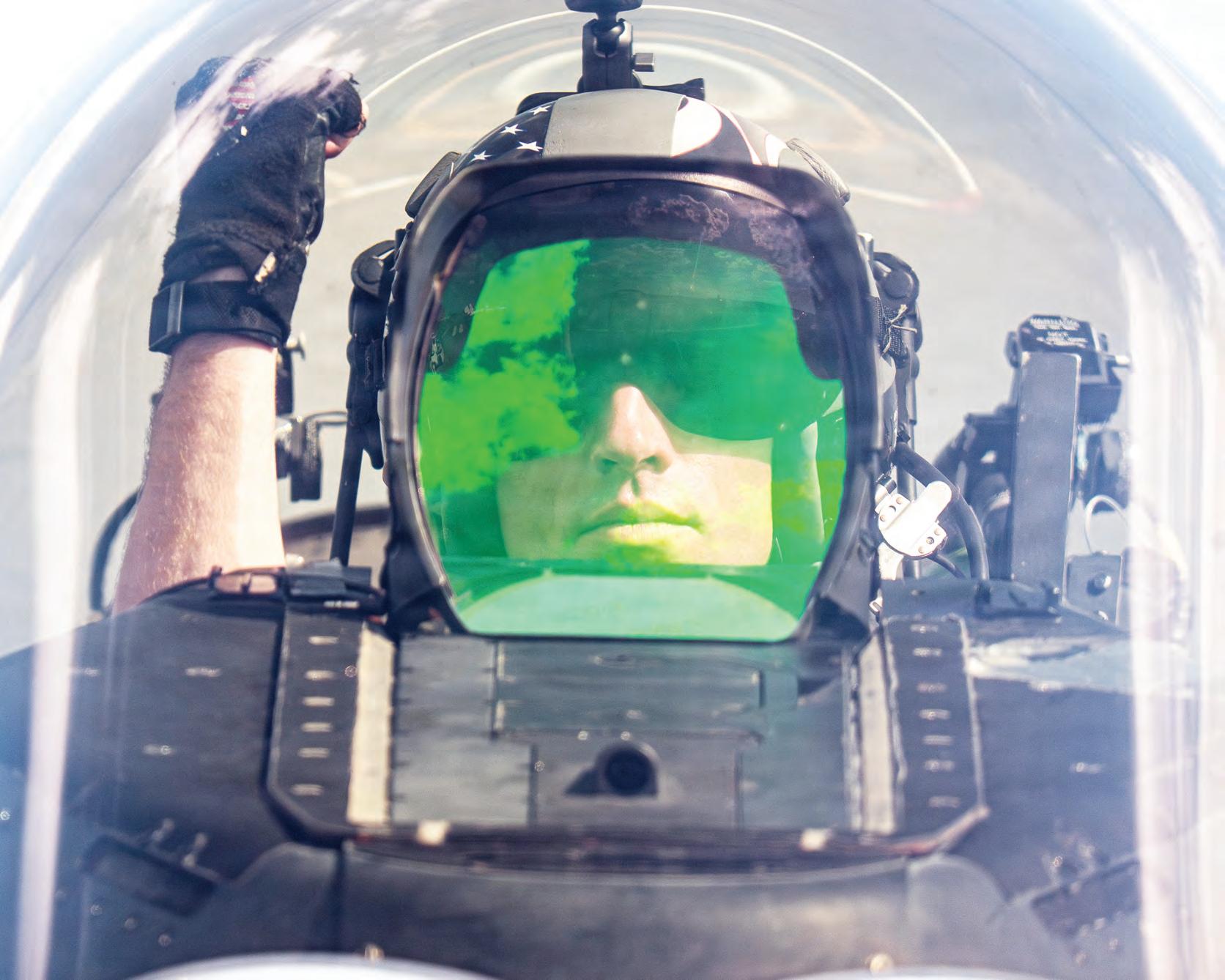
SUN ‘N FUN
86th
Secretary of the a ir force Public a ffairS
ARLINGTON, Va. — The Air Force’s Experimental Operations Unit, under Air Combat Command, concluded a critical exercise with Collaborative Combat Aircraft recently at Edwards Air Force Base, putting principles of the new Warfighting Acquisition System into practice. The exercise employed the YFQ-44A aircraft and represents a shift toward the new concept of earlier, operator-driven experimentation to inform tactics and procedures that will accelerate the delivery of this transformative capability to the warfighter. EOU airmen, working side-by-side with Air Force Materiel Command’s 412th Test Wing, executed a series of sorties that refined core operational and logistical procedures for deploying and sustaining CCA in a contested environment. This hands-on testing is a cornerstone of the Air Forces’ strategy to field combat-ready, uncrewed airpower at speed and scale by breaking down the barriers between the requirements, acquisition and operational
conduct a MASCAL joint exercise at Ramstein Air Base Experimental Operations Unit accelerates CCA program
Staff Sgt. Mary Bowers/U.S. Air Force file
Capt.
“Laz”
Airman Paden Henry/U.S. Air Force file photos
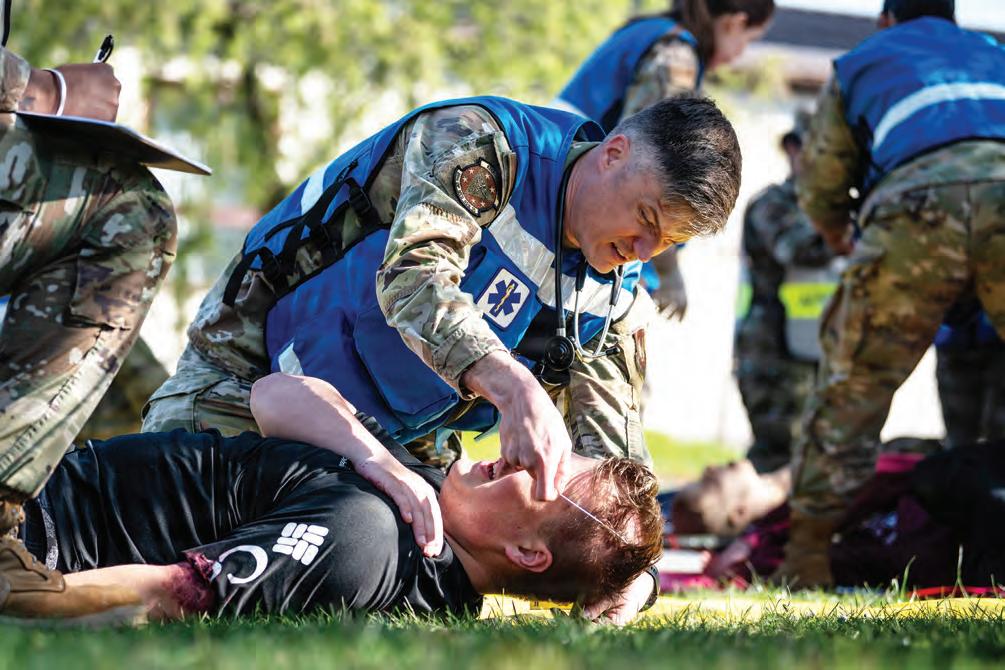
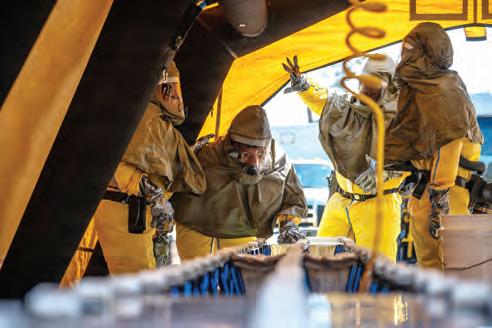
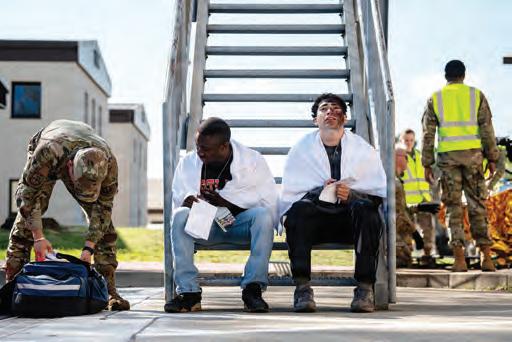
Capt. John Harris, 86th Operational Medical Readiness Squadron flight surgeon, performs triage on a simulated patient during a mass casualty exercise at Ramstein Air
Base, Germany, April 15. The MASCAL exercise divided personnel into medical response teams to test their ability in providing life-saving care in austere environments.
374th MG’s Ground Surgical Team showcases capabilities
yASuo oSAk A
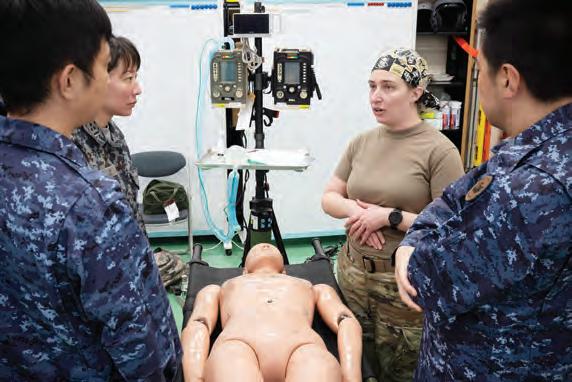
IRUMA AIR BASE, Japan — Airmen from the 374th Medical Group demonstrated the capabilities of their Ground Surgical Team to medical personnel from the Japan Air Self-Defense Force during a medical knowledge exchange at Iruma Air Base, Japan, Mar. 13.
The event provided an opportunity for U.S. and Japanese military medical professionals to exchange knowledge and observe expeditionary surgical capabilities designed for austere and forward environments.
The Ground Surgical Team, or GST, is a sixmember mobile medical unit that delivers damage control surgery and stabilizes critically injured patients before evacuation to higher levels of care.
“During the demonstration we improvised a ‘man-down’ scenario, which is something we would do in a real situation if a team member were unable to perform their role,” said Maj. Heather
Barber, 374th Surgical Operations Squadron medical director of surgical services.
“In austere environments, every team member has to be flexible,” Barber said. “We train to adapt quickly so we can continue providing life-saving care even when conditions are challenging.”
The GST typically consists of a surgeon, anesthesia provider, emergency physician, surgical technician, intensive care nurse and administrative specialist. Team members are cross-trained to operate effectively in resource-constrained environments.
During the engagement, airmen briefed participants on the team’s mission and equipment before conducting a short setup and simulated casualty care demonstration.
More than 100 participants attended the event, including JSDF medical personnel and representatives from partner organizations. The exchange also supported the Japan Air Self-Defense
See 374th, Page 7
Travis AFB BX hosts free Nerf fest event
A rmy & A
TRAVIS AIR FORCE
BASE — Military kids can join the Nerf action at the Travis BX from 12-3 p.m. on May 16.
Military families can drop by the Travis Exchange for hands-on battle featuring popular Nerf toys including the Zombie Strikeout Dart Blaster, Elite 2.0 Commander RD-6 Dart
Blaster and more.
“We’re excited to bring a little extra fun to the Travis BX,” said Exchange General Manager Cathie Byrns. “We love creating moments that bring families together and make the Exchange a place kids look forward to visiting.”
Preregistration is not required. For more information, contact the Travis Exchange or visit the Travis Exchange’s social media pages.
Mobility Vanguard strengthens readiness across 515th AMOW
StAFF Sgt. Shelby r APert 515TH AIR MOBILITY OPERATIONS WING PUBLIC AFFAIRS
JOINT BASE PEARL HARBOR-HICKAM, Hawaii — The 515th Air Mobility Operations Wing hosted its inaugural Mobility Vanguard at Joint Base Pearl Harbor-Hickam, Hawaii, March 12–13, bringing together 86 airmen from 13 units across the Total Force to test technical expertise, teamwork and mission readiness.
Across the flightline and maintenance areas, airmen worked against the clock to complete technical challenges designed to simulate real-world mobility operations. The events mirrored the operational demands airmen face when supporting global air mobility missions and sustaining rapid throughput across the Indo-Pacific.
warrior mindset through a hands-on competition.
This year, the event was rebranded to better represent the wing’s commitment to rapid global mobility, theater integration and continued advancement across the air transportation and maintenance career fields.
competitor. “We’ve all put blood, sweat and tears into this mission and it means a lot to me that we are all working together to serve our country.”
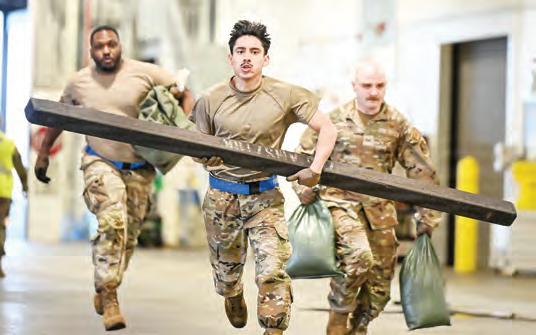
On the final day, all teams participated in a rigorous combat fitness competition, testing their endurance, strength and teamwork.
tion to everything that we do,” Lyndrup remarked. “When we consistently continue to train and work together across the AMOW, we strengthen our common playbook. Common playbooks build that trust.”
TRAVIS TAILWIND

Serving Travis Air Force Base and the surrounding community 1250 Texas St., Fairfield, Calif. 94533 707-425-4646 | Fax 707-425-5924
Publishers: Foy S. McNaughton and T. Burt McNaughton
Advertising Manager: T. Burt McNaughton
Editor: Todd R. Hansen
Layout : Aaron Rosenblatt
Mobility Vanguard 2026 built upon the foundation of last year’s Air Mobility Team Rodeo, expanding the scope of the competition to highlight the wing’s focus on readiness, integration and operational excellence across the mobility enterprise.
“This competition is about sharpening the skills our airmen rely on every day to keep global mobility moving,” said Col. Jens D. Lyndrup, 515th AMOW commander. “Events like Mobility Vanguard allow our teams to practice under pressure, build confidence in their craft and strengthen the readiness we need to support joint operations anywhere in the world.”
In 2025, the 515 AMOW hosted the Air Mobility Team Rodeo for Air Mobility Teams across six squadrons, reinforcing Air Force Specialty Code core task competency, physical fitness and the
The two-day event featured aerial port and maintenance challenges designed to test airmen’s technical skills under high-stress conditions and tight time constraints while promoting friendly competition across the wing.
Aerial port competitors were evaluated on aircraft load reconfigurations, joint vehicle inspections, pallet build-ups, 10K forklift operations, cargo off-loads, Air Transportability Test Loading Activity certification and AFSC-specific knowledge tests.
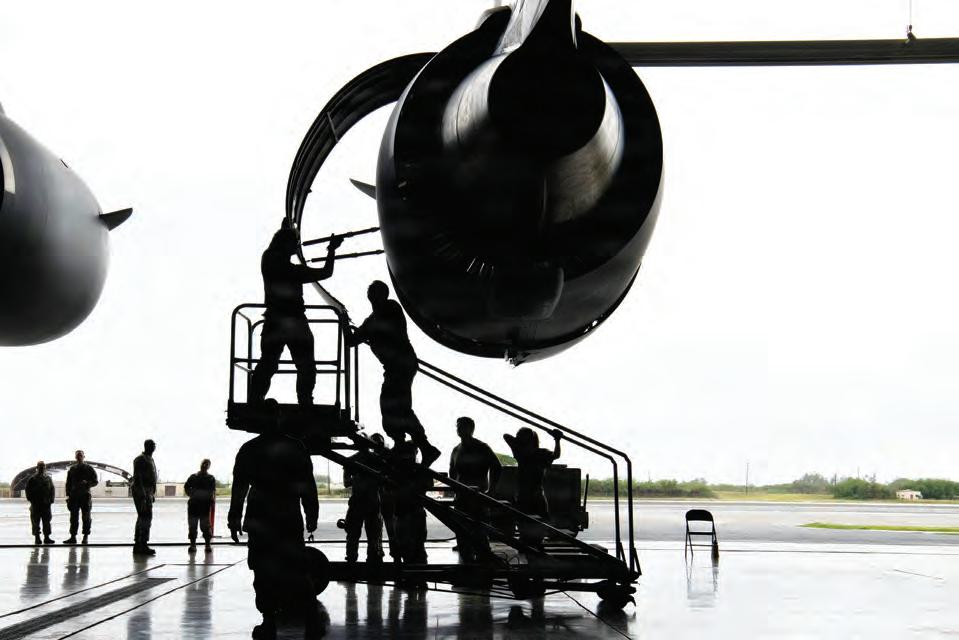
At the same time, maintenance airmen competed in events including maintenance knowledge tests, pre- and post-landing inspections, safety wire boards, seat installation and removal, C-17 nose tire changes and engine installations.
“This event brought the best of us forward,” said Charles Medford, 735th Air Mobility Squadron aerial port technician and MVR


Mobility Vanguard also provided an opportunity for airmen from across the Total Force to collaborate, share best practices and strengthen partnerships throughout the IndoPacific region and beyond
“Trust is the founda-
The 732nd Air Mobility Squadron won the overall aerial port operations team award, the 730th AMS and 734th AMXS team won the overall maintenance event, Team PACAF; Comprised of the 647th Logistics Readiness Squadron, 36th LRS and 773rd LRS won first place in the Combat Fitness course and the 732 AMS aerial port team earned the overall winner of the 2026 515 AMOW Mobility Vanguard Rodeo. “Our airmen are the decisive advantage behind every mission we support,” Lyndrup said. “Mobility Vanguard highlights the professionalism, technical expertise and warrior mindset that allow this wing to project mobility power across the Indo-Pacific and keep the mission moving.”













Courtesy photos/U.S. Air Force
Airmen from the 515th Air Mobility Operations Wing
perform repairs to an engine during the 2026 Mobility Vanguard Rodeo on Joint Base Pearl Harbor-Hickam,
Hawaii, March 12. Aerial Port and Maintenance Career Fields competed in various scenarios designed to increase readiness and improve interoperability.
Senior Airman Alexis Contreras, center, carries a log during a combat fitness course as part of the 2026 Mobility Vanguard Rodeo at Joint Base Pearl Harbor-Hickam, Hawaii, March 13.
Airmen launch remotely operated weapon station course in Turkey
Senior a irM an ViCtoria nuzzi
39TH AIR BASE WING
INCIRLIK AIR BASE, Turkey — The 39th Security Forces Squadron certified airmen on the Common Remotely Operated Weapon Station for the first time at Incirlik Air Base, Turkey, in March, supporting the 39th Air Base Wing’s goal for airmen to be trained, equipped and ready.
While the CROWS system allows airmen to control a mounted weapon from inside an
armored vehicle, it is also essential for members of the 39th SFS to continually adapt and become proficient in its operation. The wing remains focused on providing diverse training opportunities that better equip its personnel for a variety of operations.
This was the first class conducted in-house at Incirlik since the squadron received instructor training at the U.S. Air Forces in Europe CROWS instructor course at
See Turkey, Page 6
AF combat search and rescue is an unwavering commitment
M aj. Claire Fitle 355TH WING PUBLIC AFFAIRS
DAVIS-MONTHAN
to semi- and unprepared surfaces.
From Page 1
communities. “This experimental operations event was executed by EOU members from start to finish. Every sortie generated and flown was done with a warfighter, not an engineer or test pilot, kicking the tires and controlling the prototypes,” said Lt. Col. Matthew Jensen, EOU commander. “We are learning by doing, at a speed and risk tolerance accepted by the USAF’s most senior leaders, to ensure CCA is ready to operate and win in the most demanding combat environments.”
As the Air Force’s designated unit for developing CCA employment concepts, the EOU’s core mission is to put operators at the center of the process. By embedding the warfighter’s voice as the driving force from the beginning, the unit forges the initial tactics, techniques and procedures needed to ensure CCA is integrated, and tactically viable for future conflict.
By uniting the distinct test authorities of AFMC and the operational authorities of ACC, officials were able to fast-track the event, enabling groundbreaking, hands-on experimentation by operators at a uniquely early stage of development.
The CCA program is a pathfinder for the Warfighting Acquisition System, deliberately structured to move from concept to combat-credible capability in record time. The Air Force achieves this through empowering a close partnership between operators, developers and testers, relentlessly focused on delivering capability at the speed of relevance.
“The collaboration we saw in this exercise is the cornerstone of our acquisition transformation. By embedding the operators from the EOU with our acquisition professionals, we create a tight feedback loop that lets us trade operational risk with acquisition risk in real-time,” said Col. Timothy Helfrich, portfolio acquisition executive for fighters and advanced aircraft. “This isn’t just a test; it’s a demonstration of how we are adopting a more agile process. An 85% solution in the hands of a warfighter today is infinitely better than a 100% solution that never arrives.”
The conclusion of this exercise marks a vital step toward delivering a combat-effective force multiplier that extends the reach and enhances the survivability of crewed aircraft; it carries the Air Force closer to delivering a fully operational CCA capability to the Joint Force.
AIR FORCE BASE, Ariz. — In the U.S. Air Force, no phrase carries more weight than “That Others May Live.” It is not merely a motto; it is a commitment that underpins the existence of the Combat Search and Rescue (CSAR) mission.
This solemn promise to leave no one behind, whether a downed pilot in enemy territory or a civilian stranded by natural disaster, is forged in the demanding, complex training environment of Davis-Monthan Air Force Base, the heart of the Air Force’s rescue enterprise.
A successful CSAR mission is a highly synchronized operation requiring seamless integration of specialized aircraft and personnel. It relies on a force package of three distinct platforms, with every airman trained to execute their role with precision under the most strenuous conditions.
Every rescue mission begins with a plan, and for CSAR, that plan is orchestrated from the sky by the HC-130J Combat King II and its aircrew.
The HC-130J Combat King II is a day and night, all weather capable special mission platform designed to conduct personnel recovery using CSAR tactics. The aviators who employ the HC-130J are specifically trained to perform night-one contested rescue missions through CSAR coordination, aerial refueling, airdrop of personnel and equipment, low-level flight, and austere landings
Critically, the HC-130J extends the range of rescue operations by providing leading relay of command and control, support to recovery vehicles such as the HH-60W, coordination of supporting forces, and operational reach-back to command elements.
“The HC-130J Combat King II, and the highly trained aircrew who fly it, are a critical component to the Joint Force for successful CSAR mission execution,” said Lt. Col. Cory Pilinko, 79th Rescue Squadron director of operations. “They dynamically orchestrate strike, Intelligence, Surveillance and Reconnaissance (ISR), escort, Suppression of Enemy Air Defenses (SEAD), and command assets to enable the recovery vehicle, such as the HH-60W, to recover an isolated person as quickly as possible.”
Without the Combat King II’s ability to pass fuel mid-air, the reach of
a rescue mission would be drastically shortened, potentially putting a survivor beyond reach.
“The HC-130J significantly extends the capabilities of rescue assets by in-flight refueling recovery vehicles and airdropping combatmedics, such as Guardian Angel teams, and their equipment,” said Pilinko. ”Operating under the Crown callsign, HC-130J crews train and execute everyday with the sole focus of making sure that an isolated person’s worst day is not their last.”
As the rotary wing recovery vehicle, the HH-60W Jolly Green II and its aircrew infiltrate hostile or contested environments to retrieve isolated personnel. The crew, consisting of pilots, special mission aviators, and pararescuemen are trained to fly in a variety of conditions, including nighttime lowlevel formation terrain flight, maritime operations, threat penetration, weapons employment,
and adverse weather operations. Equipped with two machine guns, the HH-60W can defend the isolated personnel, while providing a platform for pararescue teams to conduct medical intervention on any injured personnel. The operational readiness of these helicopters is a direct result of the meticulous work performed by maintenance crews.
“These helicopters have to be ready to go at a moment’s notice,” said Master Sgt. Nikolas Russell, 55th Rescue Generation Squadron Lead Production Superintendent. “When we send an HH-60 out, we know it’s flying into a dangerous situation to bring someone home. Every bolt we tighten, every inspection we perform, is a promise to that crew and to the person they’re rescuing that this aircraft will not fail them. We take that promise personally.”




















Senior Airman Jasmyne Bridgers-Matos/U.S. Air Force file (2025)
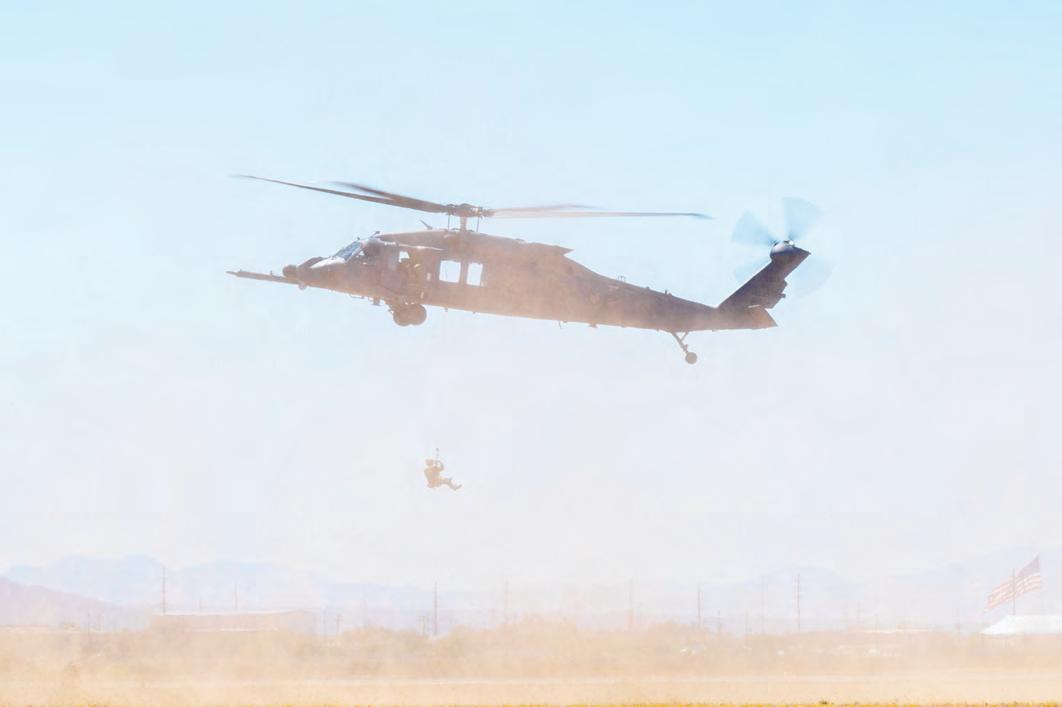
An Air Force pararescueman descends from an HH-60W
Jolly Green II aircraft during the Thunder and Lightning Over Arizona Air Show at Davis-Monthan Air Force Base, Ariz.,
March 21, 2025. Members of the 563rd Rescue Group performed a combat search and rescue demonstration to showcase their mission.
Staff Sgt. Thomas Sjoberg/U.S. Air Force file
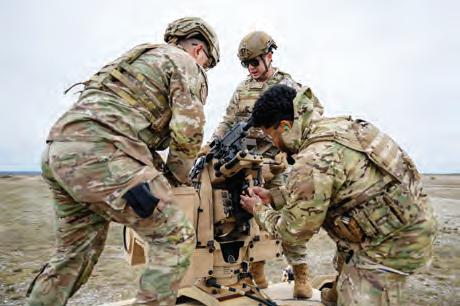
From left, Senior Airman Ethan Monroy, Staff Sgt. Matthew Hoyt and Senior Airman Donovan Benford attach a M240B machine gun to a CROWS during certification training at Cellina Meduna Range, Italy, March 26.

Guyanese, US Air Force dental expand care, enhance readiness
A ndreA Jenkins AIR
DEMERARA, Guyana —
U.S. Air Force dental teams are delivering care in fast-paced clinics across Guyana, treating high volumes of patients alongside host-nation providers during Lesser Antilles Medical Assistance Team 2026. The mission combines patient care with operational readiness by placing Airmen in real-world, resource-constrained environments. Working in shared treatment spaces with Guyana Ministry of Health providers, U.S. and partner-nation teams exchange knowledge, adapt to constraints and build the relationships required for future operations.
Across clinical sites, dental teams are addressing high demand for care, with many patients presenting with advanced dental decay and infection. Efforts are focused on procedures that reduce pain, control disease and restore function while maximizing the number of patients treated.
“We have three dental teams here focusing on high-impact, essential procedures such as fillings, extractions, prophylactic cleanings and rapid triage for patients presenting with acute pain and infection,” said Lt. Col. Puneet Pande, 349th Medical Squadron dentist. “In this resource-limited setting, access to advanced and preventive dental care is limited, so we prioritize relieving pain, controlling disease and restoring basic function for as many patients as possible.”
Operating in a partner-nation clinical environment requires teams to adjust to limited equipment and supplies, reinforcing skills associated with contingency operations.
“Working in a partnernation clinic enhances our medical readiness by requiring us to adapt quickly,” Pande said. “Resources are limited, so we have to improvise and still deliver effective care under austere conditions. It strengthens our clinical decision-making, flexibility and teamwork, skills that directly translate to deployed or contingency
environments.”
Care is delivered through integrated teams, with U.S. and Guyanese providers coordinating patient flow, sharing treatment spaces and collaborating throughout procedures.
“We’re working side-by-side with Guyanese providers,” said Pande. We’re coordinating patient triage, sharing treatment spaces and exchanging techniques in real time. It’s a true two-way exchange. We gain experience working in a resource-constrained environment, while they benefit from additional capacity and exposure to our clinical practices. Together, we’re strengthening skills, improving patient care and building lasting partnerships.”
For hostnation providers, collaboration reinforces shared approaches to care and professional exchange.
“There’s not a right or wrong way, just different ways of doing the same thing,” said Dr. Rushaim Taylor, a Guyanese dental surgeon. “I got to show him my way, and he explained his. We were talking through the different steps and learning from each other. All in all, it was a good experience, I’m glad you guys came and I look forward to seeing you again.”
The exchange extends to dental assistants and technicians, supporting clinic operations and efficiency.
“It’s been really nice,” said Kimberly Moore, a dental assistant. I’ve had a lot of fun. Everybody’s been nice, very helpful. We were able to
share how we improvise with what we have, especially with sterilization and managing equipment between patients,”
Sustaining operations in a resource-constrained environment requires continuous adjustment to processes and equipment limitations.
“The biggest challenges are limited supplies and equipment,” said Pande. “We don’t always have the materials we’re used to, so we have to adapt and develop alternative techniques. For example, we don’t have high-suction evacuation systems, so patients have to rinse and spit between steps. It slows us down, but we adjust and continue providing care.”
In addition to treatment, teams incorporate preventive care and patient education to support longer-term outcomes and reduce future demand.
“We focus heavily on patient education – explaining the causes of cavities and encouraging patients to return for preventive care. Many patients are unaware of available services beyond emergency treatment. During procedures, we also try to provide additional care, like sealants and fluoride treatments, to protect other teeth and reduce future issues.”
LAMAT provides a platform for interoperability and strengthens professional relationships between U.S. and partnernation providers.
“Missions like LAMAT 2026 are important not only for immediate care, but for building trust, strengthening partnerships and improving interoperability with host-nation providers,” said Pande. “They enhance long-term readiness and prepare teams to operate effectively in diverse, resource-constrained environments while fostering lasting professional relationships.
“This mission is very meaningful to me,” added Pande. “I have a personal connection to the region, as many people in Guyana share
From Page 3
The pilots of the A-10 Thunderbolt II, flying under the famous “Sandy” callsign, serve as the Mission Commander during CSAR operations. The A-10 pilot’s job is to authenticate and locate the survivor, mitigate threats and protect the rescue task force. The A-10 neutralizes any ground threats to the vulnerable recovery aircraft with its iconic GAU-8 Avenger 30mm cannon and an array of other munitions. By creating a secure terminal area, the A-10s allow the HH-60 crews and Pararescuemen to focus on the extraction.
“When a rescue is underway, A-10s work to find the downed aircrew member, sanitize the area and ensure the rest of the team can do their job without being threatened from the ground,” said Lt. Col. Ryan Rutter, 357th Fighter Squadron commander. “The trust between the A-10 and the rest of the rescue community is absolute; they know we will do whatever it takes to protect them while they work to bring our teammates home.”
at-risk personnel, preparing them for the “Support” phase, where they must survive and evade capture until the recovery force can arrive. The SERE Specialists have been part of that downed aircrew member’s career-long training to prepare airmen for this exact moment, teaching them to survive and evade capture while giving them the tools to support their own recovery. The SERE Specialist also has a unique role to debrief and help reintegrate airmen back into normal life in the days and weeks after the isolating event.
“The type of airmen that we raise in the Rescue and Attack community forms this very unique team that executes a unique mission that only we are capable of doing at that level,” said Col. Jose Cabrera, 355th Wing commander.
The proficiency of these teams is forged through intentionally demanding training at Davis-Monthan. The training is designed to be as realistic as possible, because in a real-world rescue, there are no second chances.
interactions even more special. Seeing the impact we have - helping people out of pain and improving their quality of life - is incredibly rewarding. It’s been an incredible experience. I’m grateful to be part of this mission and hope to continue participating in future LAMAT missions. The relationships built here – both with host-nation providers and fellow team members –are something that stays with you long after the mission ends.”
At the heart of the recovery mission, and throughout the five phases of Personnel Recovery – Report, Locate, Support, Recover, and Reintegrate – are the special warfare Airmen. Pararescuemen, or PJs, deploy from the HH-60 to provide immediate, lifesaving medical care on the ground. As elite combat medics, they are trained to treat and stabilize survivors in the most austere and hostile environments before preparing them for the “Recover” phase.
Alongside PJs, Tactical Air Control Party (TACP) airmen serve as experts in fires control, directing airpower to neutralize threats and protect the isolated personnel and recovery teams. Their ability to manage a complex array of air-to-ground munitions is critical to mission success.
Furthermore, Survival, Evasion, Resistance, and Escape (SERE) specialists provide critical skills to


A wide array of complex scenarios are simulated to ensure teams are ready for anything. DM regularly hosts mass casualty exercises and simulated combat strikes so airmen are prepared for high-stress events. Teams conduct high-angle rescues in complex mountain environments, where they employ expert climbing and rope skills to reach and recover personnel from otherwise inaccessible locations.
This integrated team of airmen and aircraft stands ready for worldwide deployment. The training pipeline at Davis-Monthan ensures every airman in the CSAR mission is prepared to execute their specific function as part of a cohesive team.
“It goes back to our motto as rescue airmen,” said Cabrera. “’These things we do, that others may live.’ That’s really the mindset; that’s the baseline that every one of our Rescue and Attack airmen has. No matter what the circumstances are, we’re never going to leave an American behind.”




















a similar cultural background to mine. That connection makes patient
Staff Sgt. Dakota Carter/U.S. Air Force file photos
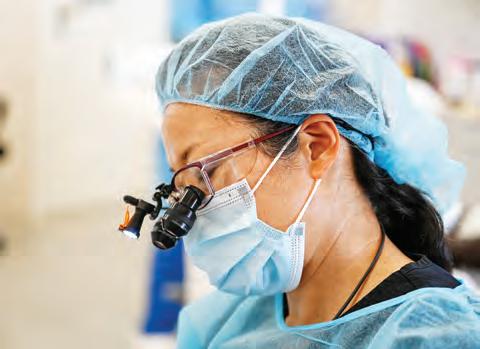
Air Force Reserve Lt. Col. Puneet Pande, 349th Medical Squadron dentist, performs a dental filling on a Guyanese patient at Cheddi Jagan Dental School in Georgetown,
Guyana, March 18. During the LAMAT 2026 mission, AF dentists used restorative treatments like fillings to help preserve natural teeth to maintain long-term oral health.
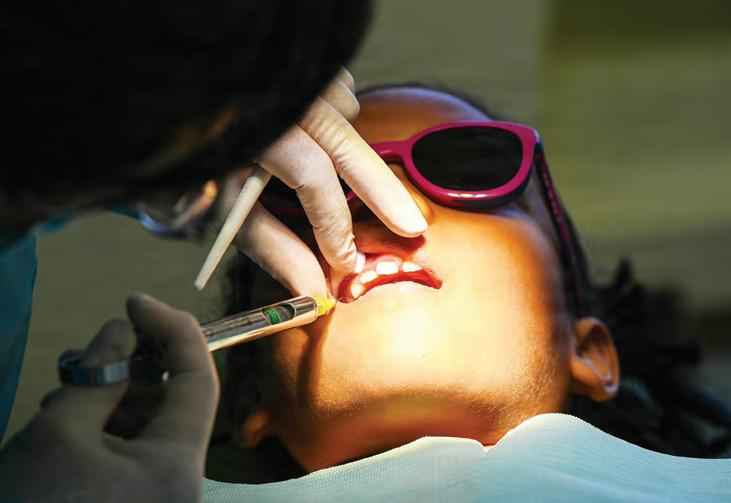
An Air Force Reserve dentist prepares a pediatric patient for a tooth extraction at Cheddi Jagan Dental School in Georgetown, Guyana, March 18. During the LAMAT 2026 mission, preventive dental care and early treatment played a key role in maintaining oral health and reducing the progression of dental disease in children.
Lt. Col. Eirleen Hyun, 349th Medical Squadron dentist, performs a dental procedure at De Kinderen Regional Hospital in West Coast Demerara, Guyana, March 17.
Regenerated B-1B Lancer dedicated as ‘Apocalypse II’ to honor WWII heroes
M aster sgt. Dana J. Cable 7TH BOMB WING PUBLIC
DYESS AIR FORCE
alized on the Walls of the Missing in the Philippines.
The event served as the latest chapter in an ongoing tribute to the fallen crew, building upon the 2025 dedication of “Apocalypse Hall” by the 436th Training Squadron. Six of Tedone’s relatives were in attendance to witness the nose art reveal. Among them was his nephew, Frank Tedone, whose own service as a former Dyess C-130 maintainer brought his family’s military legacy full circle.
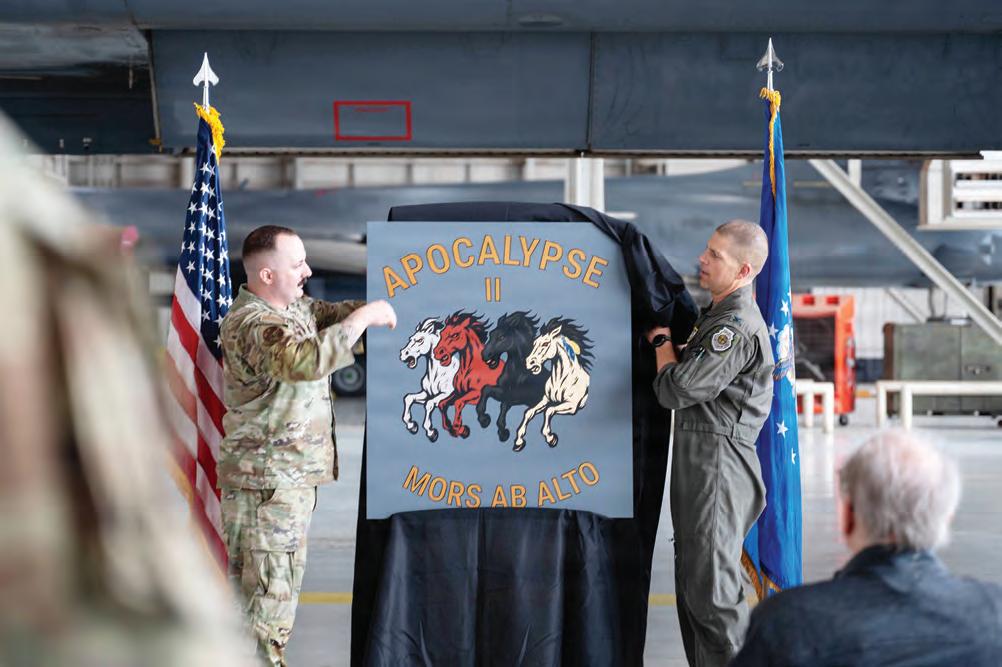
Col. Seth Spanier, 7th Bomb Wing and installation commander, and Staff Sgt. William Sawyer, 28th Bomber Generation Squadron dedicated crew chief, unveil the “Apocalypse II” nose art design during a dedication
BASE, Texas — The 7th Bomb Wing unveiled new nose art for a recently regenerated B-1B Lancer, linking the legacy of World War II airmen with the future of American airpower during a dedication ceremony April 22. The aircraft, tail number 86-0115, will serve as the new flagship of the 7th BW. It was christened “Apocalypse II” in honor of the original B-24J Liberator “Apocalypse” and its crew from the 436th Bombardment Squadron, who were lost when their aircraft was shot down over Burma on Dec. 1, 1942. The original crew included pilot, 2nd Lt. John E. McLauchlen Jr., radio operator Tech. Sgt. Harold L. Seifreid and gunner Staff Sgt. Frank J. Tedone. During a bombing mission targeting the Insein Railroad Yard north of Rangoon, their aircraft was struck by anti-aircraft fire and entered a steep dive. For decades, the men were listed as missing in action. Through recent DNA analysis, McLauchlen was
ceremony at Dyess AFB, Texas, April 22. The unveiling marked the formal transfer of the newly regenerated B-1B Lancer to Sawyer, who will be responsible for maintaining the readiness of the wing’s new flagship aircraft.
accounted for and interred in July 2024, and Tedone’s remains were identified for
burial at Arlington National Cemetery in spring 2025. Seifreid remains memori-
“Today, we celebrate the legacy of the historic 436th Bombardment Squadron and the 7th Bombardment Group, whose guidons have stood the test of time through acts of courage, sacrifice and dedication,” said U.S. Air Force Maj. Joseph Spada, 28th Bomber Generation Squadron commander. “Their example ignites a fire within every airman; a call to uphold
See WWII, Page 6
We invite you to join us for Sunday service at 10:30 a.m.
2207 Union Avenue, Fairfield, CA www.1ag .com




Website: www.northhillsvv.org
Service Times: Sunday morning 10 a.m., Wednesday evening 6:30 p.m. Phone: 707-449-8977



of Christ 401 Fir St., Vacaville, CA 95688 (707) 448-5085
Minister: Elliott Williams
Sunday Morning Bible Study 9:30 AM
Sunday Morning Worship 10:30 AM Sunday Evening Worship 5:00 PM
Wednesday Evening Bible Study 6:00 PM vacavillecoc.com 401






Airman 1st Class William Neal/U.S. Air Force file
Medevac team transports wounded to world-class care
Md. — When injured active-duty service members need to get from the battlefield to critical medical care back home in the U.S., the medical evacuation department for Walter Reed National Military Medical Center, Maryland, plays a vital role.
“Walter Reed’s medevac team is responsible for supporting patient movement across the globe while ensuring patients receive presidential care during transport throughout the aeromedical evacuation system,” said Navy Lt. Abena Nimako, officer in charge of the medevac team. “In addition to inbound and outbound military personnel from all branches requiring transport, the medevac team also supports the movement of reservists, veterans, beneficiaries and dependents for care.”
The medevac team supports the Defense Health Network National Capital Region’s patient movement requirements as directed by the War Department. The team coordinates and synchronizes various movement plans with the U.S. Transportation Command’s Global Patient Movement Requirements Center, the U.S. European Command’s Theater Patient Movement Requirements Center, the
Deployed Warrior Medical Management Center at Landstuhl, Germany, and Air Force aeromedical staging facilities to ensure a seamless transition of patients transferring to and from the national capital region.
The medevac team is composed of dedicated officers and enlisted personnel from the Navy, Army and Air Force, including registered nurses, paramedics, medics and hospital corpsmen. The primary team consists of 14 active-duty personnel, which includes one nurse who serves as the mission nurse and the officer in charge of the department, currently filled by Nimako; one patient care coordinator; one noncommissioned officer in charge and 11 hospital corpsmen.
There is also a rota-
tional team comprised of nine active-duty enlisted personnel and two registered nurses that operate on a two-month period to provide relief for the primary team.
The service members use a variety of vehicles to transport patients and team members to and from the pickup/drop-off locations, including ambulances, patient evacuation vehicles that function as intensive care units on wheels, an ambulance bus, a separate luggage truck and a nine-seater van.
The team is equipped with critical lifesaving equipment, including defibrillator units, IV kits, a blood infusion system, oxygen tanks, wound vacuums and other vital patient care supplies. In addition to the medical staff, the team also
includes three professional drivers who operate the large vehicles required to carry the medical staff and sizable pieces of equipment necessary to safely transport patients.
A typical mission begins far from the hospital, with the initial stabilization and transport of wounded or critically ill service members from a combat zone conducted by air medevac units.
“Once stabilized at an overseas hub, the patient is then flown back to the United States to various destination airfields in the national capital region,” Nimako said.
Walter Reed serves as a critical receiving and continuing care facility for service members – and sometimes their families or allies – who have already
From Page 3
Aviano Air Base, Italy, last year. “The CROWS course enhances the combat readiness and depth of our defenders,” said Air Force Staff Sgt. Quinton Burts, the squadron’s course chief and program manager. “A CROWS-qualified team can respond to threats faster and more accurately while remaining protected.”
The training certified the airmen on the M240B and M249 light machine guns, using a CROWS system attached to a Joint Light Tactical Vehicle.
After completing four days of internal classroom instruction – covering system fundamentals, operational procedures, maintenance and troubleshooting – the airmen transitioned to live-fire training. The 31st Security Forces Squadron Combat Arms Training and Maintenance hosted this final portion, providing the range, equipment, weapons and safety oversight needed for the certification.
“This training is now a core part of our unit’s training plan,” Burts said. “As new defenders arrive, they will be scheduled for this course to ensure our forces are 100% qualified and combat-ready on this critical weapons system.”
lence and to project airpower with precision and honor.” The dedication also marked the return of the aircraft to operational service. Previously nicknamed “Rage,” tail 86-0115 was one of 17 B-1Bs retired in 2021 and placed in Type 2000 storage at the 309th Aerospace Maintenance and Regeneration Group at Davis- Monthan AFB, Arizona. The Air Force later returned the bomber to service to replace another aircraft undergoing extensive structural repairs, a decision made to preserve the congressionally mandated fleet of 45 B-1Bs. After departing the AMARG, the aircraft underwent depotlevel maintenance and upgrades at Tinker AFB, Oklahoma, before returning to operational status.
U.S. Air Force Col. Seth Spanier, 7th BW and installation commander, who previously flew tail 115 during an assignment at Ellsworth Air Force Base, South Dakota, reflected on the significance of the aircraft’s return.
“This bomber has its own story of resilience,” Spanier said. “Just a few years ago, it sat silent in the boneyard. But when
the call came, it was brought back – regenerated to serve again. Its return is a testament to the ingenuity and dedication of our airmen.”
During the ceremony, Spanier also highlighted the role of enlisted maintainers in sustaining the aircraft’s legacy and recognized the dedicated crew chief assigned to the aircraft, emphasizing the responsibility that comes with maintaining a flagship bomber.
“I want to take a moment to recognize Staff Sgt. Sawyer,” Spanier said. “Pilots like me may fly these aircraft, but they belong to their crew chiefs. Staff Sgt. Sawyer, when tail 115 arrives, it becomes your aircraft. Its readiness will be your responsibility. Its legacy will be yours to carry forward.” The “Apocalypse II” nose art serves as a lasting reminder of the sacrifices of those who came before and the responsibility carried by today’s airmen.
“This aircraft is now more than a tail number. It carries the weight of history. It embodies the spirit of warriors,” Spanier said. “This aircraft, and the name it now carries, sends a clear message to any adversary: We honor our past. We are masters of our present. And we will always be ready for the future.”





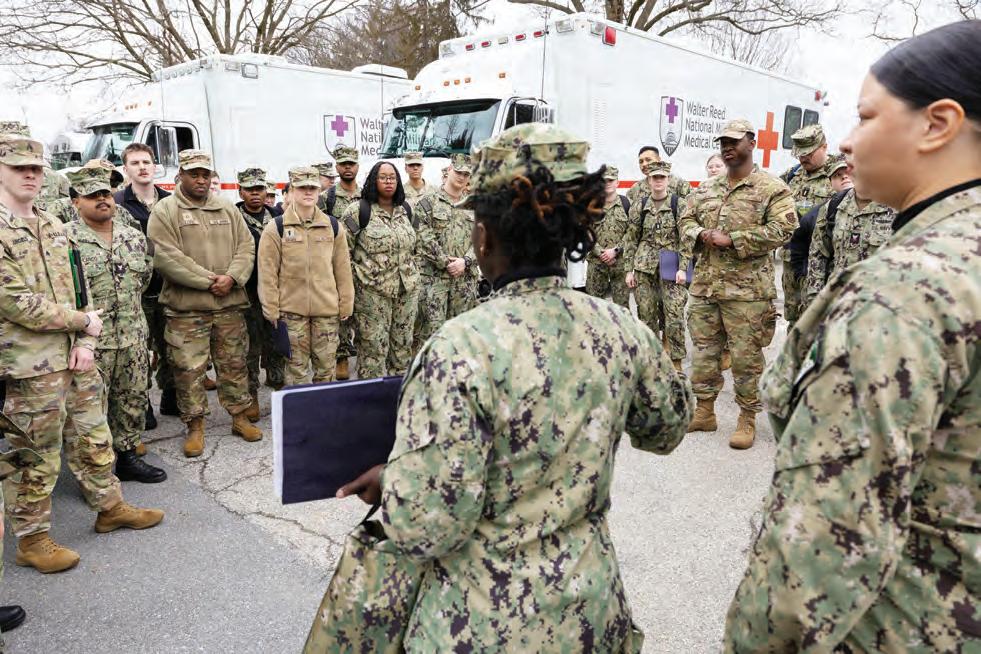
Ricardo Reyes-Guevara/Department of War photos
Members of the Walter Reed National Military Medical Center medevac team listen as U.S. Navy Lt. Abena Nimako, medevac Officer in Charge, briefs the team beside specialized patient evacuation vehicles prior to a mission at Walter Reed National Military Medical Center in
Bethesda, Md. Walter Reed’s medevac team is composed of officers and enlisted personnel from the Navy, Army and Air Force, including registered nurses, paramedics, corpsmen and medics, representing the inter-service approach to military medical evacuation.
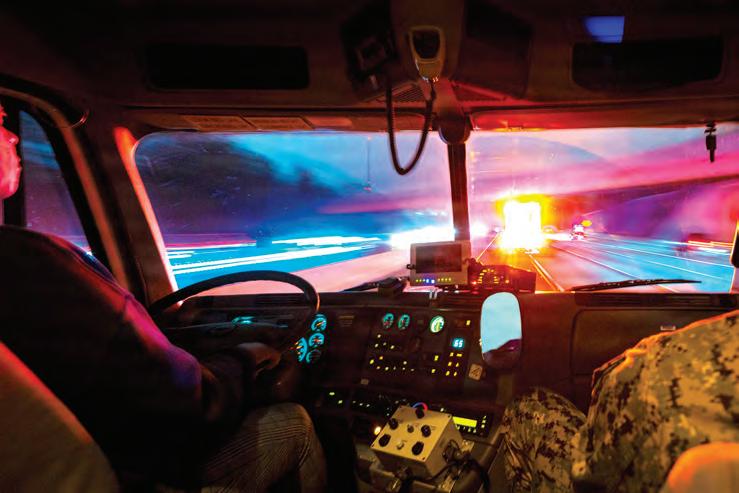
A convoy of patient evacuation vehicles travel during a medevac mission to Walter Reed National Military Medical Center in Bethesda, Md.
See Medevac, Page 7
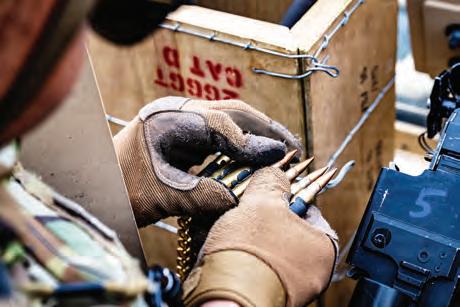
Staff Sgt. Thomas Sjoberg/U.S. Air Force file
Senior Airman Ahmaad Fallon prepares ammunition for firing during a Common Remotely Operated Weapon Station certification training at Cellina Meduna Range, Italy, March 26.
374th
From Page 2
Force’s ongoing efforts to develop and establish its own Ground Surgical Team capability in the future.
“This demonstration is just the beginning,” Barber said. “As our partners continue developing their own surgical capabilities, we hope to continue sharing lessons learned and working together to improve medical readiness.”
Medevac
From Page 6
been medically evacuated from an operational theater.
The medevac team meets the incoming patients at their destination airfield, transitioning them into patient care vehicles to ensure uninterrupted quality of care. An average mission involves transporting between eight to 10 patients, but the team has the capability to carry as many as 26 patients on litters or upward of 42 ambulatory patients.
Once the patients are secured in the vehicles, the team continuously monitors their condition, administering any needed care during the trip to Walter Reed. At each stage of the process, the team remains in contact with operations for Walter Reed, base
security forces, servicespecific liaisons and hospital staff, depending on the nature of the patient’s medical situation. Hospital staff will also inform patients’ families of their imminent arrival so they can be present to support their loved ones.
At Walter Reed, patients are transferred into the care of the specialized unit depending on their needs – intensive care, orthopedic, gastrointestinal or other treatment type. Each handover involves a detailed report of the patient’s condition.
“’Thank you’ is not what I am looking for,” Nimako said. “The real validation is when the mission is secured and the patient is at Walter Reed. I tell myself that I made a difference that day. I did something good.”
US, Chilean Air Force crews complete historic refueling
2nd Lt. Grace Brandt AIR FORCES SOUTHERN PUBLIC AFFAIRS
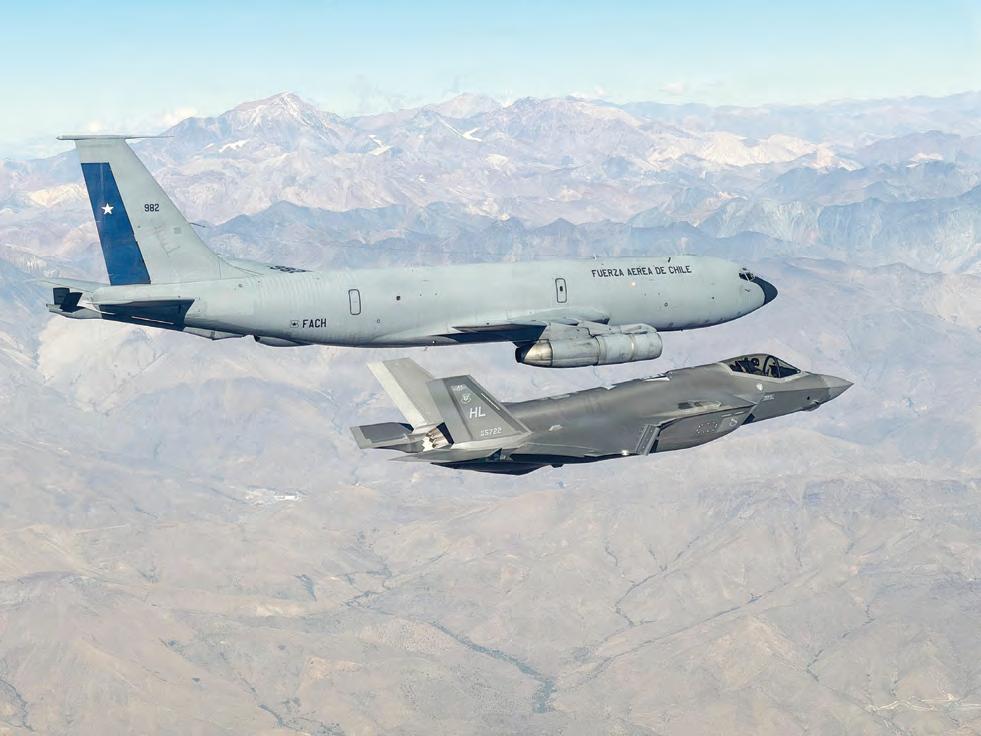
SANTIAGO, Chile — U.S. and Chilean Air Force (FACh) crews demonstrated advanced interoperability, April 4, executingthefirst-everChilean KC-135 Stratotanker airto-air refueling of two U.S. F-35A Lightning II aircraft – marking a significant step forward in bilateral airpower integration.
The mission, conducted en route to Feria Internacional del Aire y del Espacio 2026, showcased real-world coordination between trusted partners while reinforcing the ability to operate seamlessly across the hemisphere.
As part of the U.S. Air Force’s F-35A Demonstra-
tion Team, the aircraft and their crews were on their way to Chile to participate in FIDAE, the largest trade show in Latin America. The jets departed Eglin Air Force Base, Florida, on April 4, flying approximately ten hours to arrive in Chile. A KC-135R Stratotanker from MacDill Air Force Base supported the first leg, refueling each aircraft four times. Near the Peru-Ecuador border, a Chilean KC-135 assumed the mission, refueling each F-35 four times and supplying approximately 41,000 pounds of fuel while escorting them into Chile.
According to Capt. Austin McDaniel, F-35A Demonstration Team safety observer and one of the two F-35A pilots, this collaboration was a “target of opportunity” to inte-
grate with a trusted U.S. military partner.
“They were excellent” McDaniel said. “Their pilots and boom operators were top-notch. I think there were a little bit of nerves on both sides for that first refuel, but it went off just as smoothly as I’ve ever seen it.”
The mission, conducted en route to Feria Internacional del Aire y del Espacio 2026, showcased real-world coordination between trusted partners while reinforcing the ability to operate seamlessly across the hemisphere.
The F-35A Demonstration Team remained in Chile to conduct aerial demonstrations through the conclusion of FIDAE on April 12.
McDaniel said the
success of the mission reinforces the strength of U.S.-Chile interoperability.
“To be able to see it actually work, as we expected it to, just gave us the confidence that, yes, it’s something we can do,” he said. “We can work as nations to make something happen that matters to both of us.”
FIDAE, hosted by the Chilean Air Force, is a biennial international aerospace and defense exhibition that brings together global partners to showcase capability, strengthen relationships and advance innovation across the region. Chile remains a key U.S. partner in the Southern Cone, with continued U.S. Air Force participation underscoring a shared commitment to security and stability.


Courtesy photo/U.S. Air Force
A Chilean KC-135E Stratotanker and an F-35A Lightning
II fly in Chilean airspace April 5. The aircraft completed
the first-ever in-flight refueling with a Chilean tanker while enroute to Feria Internacional del Aire y del Espacio 2026.
Yasuo Osakabe/U.S. Air Force file
Maj. Heather Barber, 374th Surgical Operations Squadron medical director of surgical services, explains the role of the Ground Surgical Team to Japan SelfDefense Force medical personnel after a demonstration at Iruma Air Base, Japan, March 13.