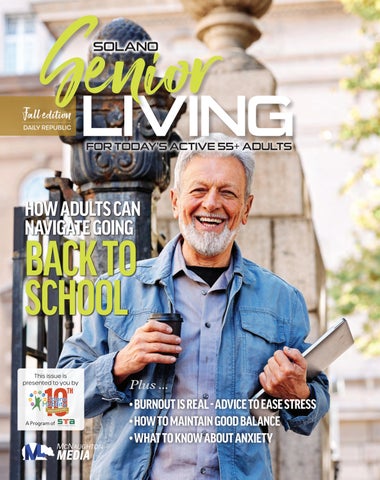
Senior LIVING SOLANO
Fall edition DAILY REPUBLIC
FOR TODAY’S ACTIVE 55+ ADULTS
HOW ADULTS CAN NAVIGATE GOING
BACK TO SCHOOL
This issue is presented to you by
A Program of
MCNAUGHTON
MEDIA
Plus ...
• BURNOUT IS REAL - ADVICE TO EASE STRESS • HOW TO MAINTAIN GOOD BALANCE • WHAT TO KNOW ABOUT ANXIETY
How adults can navigate going back to school METRO
A
n ever-changing employment landscape is compelling many adults to go back to school. According to a February 2026 report from the American College of Education, roughly one in three adults who chose to return to school within the previous two years did so out of concerns related to automation and artificial intelligence. Education is an undeniable asset when confronting an uncertain job market. Data from the U.S. Census Bureau indicates that workers with a bachelor’s degree have an employment rate that is roughly 7 percentage points higher than the rate for workers who have some college education but did not earn a bachelor’s degree. In an era when so many adults fear automation and AI, that 7 percentage point disparity seems even more significant. Adults planning to return to school may find such a return exciting but also a little bit intimidating. But adults need not be intimidated, and some might even find they enjoy school more as adults than they did when navigating academia years earlier. As adults prepare to return to the classroom, keeping a few things in mind can ease their concerns and lay a foundation for success. • You’re not alone. As the ACE report indicates, many adults are going back to school. Knowing there will be others your age and with similar life experiences should calm
A SUPPLEMENT TO THE DAILY REPUBLIC
academia has changed. But change should be embraced and not seen as a hurdle or deterrent. Many schools now use e-books instead of traditional print books, which may require some adjustment for adult students. And applications that might not have been around the last time adults were in a classroom may be the standard now. Using e-books and new applications may require a learning curve, but educators, many of whom also had to adapt to the growing emphasis on tech over the last couple of decades, recognize ADOBE STOCK adult students will need time to adjust, and many are more than concerns and make the classroom less willing to afford that time and offer intimidating. In fact, data from the advice on how to adjust. National Center for Education • Prepare to enjoy education Statistics indicates that 74% of more this time around. Many students have at least one nontradiadults who return to school report tional characteristic, a notable statistic enjoying academia more the second that should eliminate adult students’ time around. Some who have tried fears that they don’t belong. college before might have lacked • Recognize you’re bringing a unique and insightful perspective. direction the first time around, and that undoubtedly affected their When returning to school, many adults bring a unique perspective that motivation and enthusiasm. When adults return to school, they do so their younger classmates cannot knowing exactly what they want and provide. Having navigated professional and personal challenges, which why they’re back in school, which makes the experience more enjoyable may include raising a family, adult and engaging. students challenge the status quo, Adults have much to gain from which can contribute to more engaggoing back to school. And as millions ing and more nuanced classroom who have returned to school as adults discussions. When viewed through that lens, it’s hard to dispute that adult can attest, those gains greatly outweigh the fears adults may have as students are assets. they begin this exciting chapter in • Prepare for change. It’s vital that adult students recognize their lives.
SeniorLIVING SOLANO
Publishers: Foy S. McNaughton, T. Burt McNaughton Editor: Todd R. Hansen Project Manager: Nancy Meadows
DAILY REPUBLIC — Sunday, September 13, 2026 | Senior Living Fall 2026 | 3
ADOBE STOCK
Burnout is real
Experts say you should follow this advice to ease stress MICHELLE MARCHANTE MIAMI HERALD
A
re you happy? Happiness – laughing with loved ones, a purpose in life, something to look forward to – is a factor in whether a person will live a healthy and long life, experts say. Eating healthy, sleeping well and staying active – critical lifestyle changes that can promote healthy
aging – are easier to track. But happiness can be difficult to measure, and at times, difficult to feel. “How do you feel happy if you’re dealing with dementia? How do you feel happy if you’re a caregiver? How do you feel happy if you’re unhoused and dealing with multiple chronic conditions? It’s a real challenge,” said Joy Siegel, a professor at Nova Southeastern University. Siegel is also a board member of the private not-for-profit Alliance for
4 | Senior Living Fall 2026 | Sunday, September 13, 2026 — DAILY REPUBLIC
Aging. The organization provides resources and services to seniors, their families and caregivers in Miami-Dade and Monroe counties. “Those aren’t necessarily happy things, but the reality is that when we look at the present moment, we can feel happy for right now,” from the simple things in life, such as listening to music and helping someone, Siegel said. Even so, people are feeling the squeeze. Groceries, housing and the
cost of living is up. A historic number of older Americans are living alone. And seniors who live alone are at higher risk for social isolation, depression, falls and other accidents, hospitalization and death. For those who take on the role of a loved one’s caregiver, research also indicates that the stress can worsen physical and mental health. “It’s very important to understand that the stress that you see every day, you encounter every day, it’s hard to be happy when you have such stress,” said Tami Muller, a certified happiness trainer and positive psychology coach in Miami. And long-term stress can increase the risk of many health problems, including heart disease, sleep, digestive, depression and issues with memory and focus, according to the Mayo Clinic. While you can’t avoid stress, you need to give yourself time to recover from stress, Muller said. “You need to allow yourself to take some recovery during the day – if it’s going for a
couple of minutes of deep breathing or going for a short walk, good sleep at night, one day a week that you don’t answer your phones.” Finding opportunities to relieve stress, laugh and connect with others is becoming even more important in an aging country that is also in a growing mental health crisis. That crisis has particularly hit South Florida kids, teens and older adults hard, according to several experts who spoke during the New Face of Aging: Aging and the Art of Happiness Conference, hosted in May by Alliance for Aging at the Hilton hotel on Biscayne Boulevard in Miami. Former U.S. Surgeon General Vivek Murthy has described the U.S. mental health crisis, which is affecting people of all ages, as being largely fueled by loneliness. “It’s those moments of happiness that may serve as that bridge between a good day and a not good day,” said Siegel, co-chair of the conference and served as the conference’s moderator.
The caregiver effect People need to take care of themselves before caring for others, similar to how you would secure your own oxygen mask before helping others in a flight emergency, said Dr. James Galvin, director of the Comprehensive Center for Brain Health at the University of Miami Miller School of Medicine. Galvin’s team developed a tool a few years ago that can provide a snapshot of how healthy a patient’s brain is and how much risk the patient has of developing Alzheimer’s and related disorders. “Caregiving is a biomedical challenge. The actual practice of care giving raises inflammatory markers, increases headaches, increases GI complaints, decreases response to vaccines,” Galvin said. But it also has positive effects. “Caregiving gives people a sense of accomplishment,” he said. “They can feel the joy they’re providing, the love, the care to their loved one, giving back. It makes many people feel good,
Conveniently Located Near Nut Tree and Alamo Drive... Close to Raley’s Shopping Center • Quiet, Gated Community • Spacious, 936 sq.ft., 2 Bedroom Apartments • Washer & Dyer Hookups • Patios / Balconies • Kitchen Appliances Included • Picturesque Landscaped & Maintained Grounds • Gorgeous Clubhouse Open Daily • Social Activities Including Exercise, Coffee Klatches, Bingo, Dominoes, Etc. • Pets Welcome
2 months free* *Call us for a tour or more details. ie Fairv
w Dr
ive
Dem e Driv arest
Nut Tree Road
200 Demarest Drive • Vacaville • California (707) 448-7462 • poppygarden@comcast.net
Move-In Special
Alamo Drive
DAILY REPUBLIC — Sunday, September 13, 2026 | Senior Living Fall 2026 | 5
has high life satisfaction.”
‘Laughter yoga’ and other tips to reduce burnout, stress Here are some tips Galvin, Muller, wellness advocate Lauren “L2” Howard, Dr. Thomas Felke, director of the Shady Rest Institute for Positive Aging at Florida Gulf Coast University, and Arnold Rodriguez, a certified ‘laughter yoga’ instructor in Miami, gave to help reduce stress and encourage socialization to promote healthier aging: • Laugh, even if nothing funny has happened. Laughter has both positive and long-term effects, including reducing stress and tension, improving your mood, and can even help reduce pain, bolster your immune system, and make it easier to cope with difficult situations, according to the Mayo Clinic. But the funny thing about laughter is that “the body does not know the difference between forced laughter and actual laughter,” said Rodriguez, the “laughter yoga” instructor. Laughter Yoga was invented in 1995 by Dr. Madan Kataria in Mumbai, India, and relies on a mix of breathing and laughing techniques meant to help improve mood and reduce stress. Some studies suggest that laughing yoga, or simulated laughter, “may be as effective as aerobic exercise at reducing selfreported stress,” although some experts say there’s not enough large-scale research yet to determine how beneficial laughing is, according to Healthline. Here’s how it works: Breathe deeply through the nose, “engage our entire torso, and then we’re gonna let it out with a smile and a ‘ha’ sound,” Rodriguez told people at the Miami aging conference. After you do this breathing exercise a few times, breathe in again and when you’re ready to exhale, do so with a “good hearty laugh.” • Find activities you enjoy and
ADOBE STOCK
engage the brain. Take a class, join a book club, volunteer with a school or nonprofit, join an exercise group, find activities that interest you and give an opportunity to socialize with others. Keeping your body and brain active is also known to help reduce the risk of Alzheimer’s and other dementia. Walking, for example, can help improve your physical and mental health. “There’s no magic formula so for each person – the things that make them happy is going to be different,” said Galvin, the UM doctor. “And so you really need to think about what makes you happy and what makes you sad and try to choose those things that make you happy.” Online communities can be a form of support, too, according to Howard, who is also founder and CEO of mental health company LBee Health. “Everybody has a different set of circumstances and abilities and desires to go out and engage and so when you start treating any place where you can get fulfillment and friendship and camaraderie as community, it opens up a whole lot of opportunities for you to find different pockets that make you feel happy, that you feel welcome, that make you feel included,” Howard said. • Learn new things. “Once you find that thing you like to do, do something different because the brain likes novel things,” Galvin said. “So if you exercise and you walk on a treadmill, great. Now, do something
6 | Senior Living Fall 2026 | Sunday, September 13, 2026 — DAILY REPUBLIC
different. Swim. Use a resistance band. Take a yoga class, a Tai Chi class. If you read a book, join a book club. If you listen to music, go to a concert. The idea is to challenge yourself each day and so the high activity is the one that’s going to give you the most satisfaction and open new doors for you,” he said, noting that Florida residents 60 and older can take college courses for free at Florida public universities, and don’t have to worry about homework. • Use tangible rewards as incentives to kickoff healthy lifestyle changes. Howard, the wellness advocate, said she loses interest in things quickly so she’s had to find creative ways to get engaged. She switched out her desk for a standing desk to help motivate her to move. She suggests finding ways to “gamify” your own activity as a completion incentive. Some fitness trackers, for example, give digital metals when you hit certain walking or other fitness goals. • Find people who have the same goals as you. “Be around people that want to do what you want to do,” to encourage and keep you accountable, Muller said. • Train yourself to think positive, even when things get tough. “Positive psychology doesn’t suggest that there are no challenges, doesn’t suggest that there are no difficulties,” Muller said. “It suggests that we can choose to focus on what works on the bigger picture.”
How to maintain good balance METRO
F
ostering good balance is crucial for maintaining independence, staying active and preventing falls. According to West Hartford Health & Rehabilitation, falls are a leading cause of injury among older adults. By building better balance, seniors can ensure that a minor trip or stumble will not turn into a serious fall. Balance training involves building strength in the lower back, core and legs. Should a fall occur, having stronger muscles and more nimble reflexes can help protect bones and joints. The following exercises courtesy of the Mayo Clinic are some activities that can improve balance and reduce falls. • Single-leg stance: While standing near a counter, lift one foot two to three inches off the ground and hold
• Shift weight: Stand with feet shoulder-width apart and slowly shift all weight to one foot, lifting the heel of the opposite foot. Hold this for 10 seconds and then switch sides. • Tree pose: Many yoga poses strengthen balance. Poses like the “tree pose” can train the center of gravity and improve flexibility. • Water exercises and swimMETRO ming: Swimming and pool exercises are great ways to build for 10 to 30 seconds. Then switch legs core and leg strength without and repeat. This can be done while straining the joints. brushing teeth to build it into a • Pilates and tai chi: These daily routine. structured activities are good for • Sobriety test: Much like a police building strength and improving officer will conduct a sobriety test on flexibility, which can facilia suspected offender, place your right tate balance. heel directly in front of your left toe so Older adults can engage in balthey touch. Walk forward for 10 to ance-building activities each day to 20 steps, focusing on a fixed promote greater health and reduce point ahead. the risk of injury.
ʸ˟˘˩˔˧˘˗ ʼˡ˗˘ˣ˘ˡ˗˘ˡ˧ ʿ˜˩˜ˡ˚ ʙ ʴ˦˦˜˦˧˘˗ ˆ˘ˡ˜ˢ˥ ʿ˜˩˜ˡ˚
ʶˢ˚˜˥ˢ˙ˉ˔˖˔˩˜˟˟˘ʡ˖ˢˠ ʛʪʣʪʜ ʦʨʦʠʦʥʧʦ ʿʼʶ ʖʧʫʩʫʣʦʫʣʬ
ʸ˟˘˩˔˧˘˗ ʼˡ˗˘ˣ˘ˡ˗˘ˡ˧ ʿ˜˩˜ˡ˚ ʙ ʴ˦˦˜˦˧˘˗ ˆ˘ˡ˜ˢ˥ ʿ˜˩˜ˡ˚
ʿʼʹʸ ˂ˁ
<RXU ˇʸ˅ˀˆ
ʶˢ˚˜˥ˢ˙ˉ˔˟˟˘˝ˢʻ˜˟˟˦ʡ˖ˢˠ ʛʪʣʪʜ ʦʤʧʠʦʦʦʪ ʿʼʶ ʖʧʫʩʫʣʦʫʣʫ
ʶʴʿʿ ʹ˂˅ ˂ˈ˅ ˀ˂ˉʸʠʼˁ ˂ʹʹʸ˅ˆʔ DAILY REPUBLIC — Sunday, September 13, 2026 | Senior Living Fall 2026 | 7
The quiet impact hearing loss has on independence BPT
F
or many older adults, independent aging isn’t about doing more - it’s about continuing to do the things that matter. Talking with family, managing a schedule, calling a doctor with a question instead of waiting. Yet for millions of Americans, untreated hearing loss quietly makes those everyday moments harder, often leading to frustration, isolation and reliance on others. Hearing loss is one of the most common conditions associated with aging, affecting nearly one in three adults over 65. Still, it often goes unaddressed. Cost concerns, stigma and the belief that “it’s not that bad yet” can delay action for years. In the meantime, missed words can turn into missed connections, which can gradually erode confidence and independence. “We hear from older adults every day who don’t realize how much hearing loss is shaping their independence until they start avoiding conversations altogether,” said Mike Strecker, Chief Regulatory and Compliance Officer of ClearCaptions. “When communication becomes difficult, people often withdraw - not because they want to, but because it feels exhausting or embarrassing. Addressing hearing loss is really about preserving connection, dignity and autonomy.”
Communication is foundational to aging well Research consistently shows that staying socially and cognitively engaged is a key pillar of healthy aging. Phone conversations, in particular, play an outsized role.
BPT
They’re how many seniors schedule transportation, refill prescriptions, connect with care teams and stay emotionally connected to loved ones. But standard phones aren’t designed with hearing loss in mind. Background noise, unclear audio and fast-paced conversations can make even short calls exhausting - or impossible. Captioned phones offer a different reality. By displaying near real-time captions of what the caller says, they allow people with hearing loss to read along while listening, reducing strain and helping ensure nothing important is missed.
Why “free” raises eyebrows When people first hear about phones with captioning services that are available at no cost, skepticism is natural. In a world of robocalls and too-good-to-be-true offers, older adults and their families are rightly cautious. So how can a specialized phone be free? According to Strecker, a federally
8 | Senior Living Fall 2026 | Sunday, September 13, 2026 — DAILY REPUBLIC
certified Internet Protocol Captioned Telephone Service provider, the answer lies in federal accessibility policy, not marketing gimmicks or predatory schemes. Captioned telephone service is funded through the Federal Communications Commission via the Telecommunications Relay Service Fund. This federal fund was created to allow persons who are deaf, hard of hearing, deafblind, or have speech disabilities to communicate by telephone in a manner that is functionally equivalent to telephone services used by persons without such disabilities. For individuals whose hearing loss prevents them from using their telephone and who certify under penalty of perjury, the phone, captioning service and user support are at no-cost to the customer thanks to the FCC’s TRS Fund. There’s no requirement to provide a credit card, no subscription fee and no obligation to purchase additional products. Advocates note that skepticism is understandable given how many scams target older adults - but this captioning service is free because it is
part of a government-backed service that is funded in order to increase accessibility under Title IV of the Americans with Disabilities Act, similar in spirit to closed captions on television.
What to look for to avoid scams Still, not all offers are created equal. Advocates recommend examining a few key details to confirm legitimacy: • Check FCC registration: Legitimate captioned phone providers are registered with the FCC and can be found at fcc.gov. • No pressure tactics: Reputable services don’t rush decisions or use scare tactics. • Clear eligibility explanation: You should be told why you qualify and what certification is required. • No payment requests: There should be no upfront or hidden fees for eligible users for the service. Trusted providers also offer transparent user support and clear
privacy policies, helping users feel confident that their information - and conversations - are protected.
A small change with outsized impact For many older adults, using a captioned phone isn’t about adopting new technology so much as it’s about removing a barrier. “[Using a captioned phone] was the first time I called my sister who lives 2,000 miles away, and I didn’t miss anything she said. I was so happy I cried,” said Lynn T., a user who embraced this technology. Captioned phone users often describe feeling more confident making calls on their own, less dependent on family members to “translate,” and eager to be socially engaged. That sense of autonomy matters. Studies link untreated hearing loss to higher risks of social isolation, depression and cognitive decline. Tools that support clearer communication can help interrupt that cycle, reinforcing
independence rather than diminishing it.
Reframing help as empowerment As the population ages, conversations about independence in aging are evolving. The focus is shifting away from “getting by” toward proactively supporting quality of life. Meaningfully addressing hearing loss is part of that shift. Captioned phones won’t solve every challenge associated with aging, but they can make everyday communication easier and more dignified. When they’re made free and accessible through a legitimate, federally funded program, there’s no catch, just a public resource. For older adults who value staying connected on their own terms, clearer conversations may be one of the simplest ways to support independence. To learn more about captioning services, visit https://clearcaptions. com/lp-mat.
Your Realtor for any stage in life.
Sandy Stewart REALTOR®
Cal BRE Lic #01038978 SRES® Seniors Real Estate Specialist
Let us turn your interior design dreams into reality. Floors, walls, windows... we have you covered! A family business since 1934!
Voted as one of the Top 20 Realtors in Solano County.
Cell: 707-696-7063
sandy.stewart@kappelgateway.com www.sandyst.com
Visit our Design Showroom
Visit Our Website for Money Saving Coupons! GillespiesAbbeyCarpet.com 2026
(707) 427-3773 360 Chadbourne Road • Fairfield (707) 451-6660 900 Merchant Street • Vacaville (near Auto Mall)
/LFHQVH
750 Mason St., Ste. #101, Vacaville, CA 95688
DAILY REPUBLIC — Sunday, September 13, 2026 | Senior Living Fall 2026 | 9
METRO
What seniors should know about anxiety METRO
D
iscussions surrounding older adults and health often focus on seniors’ physical health. That’s understandable, as age-related issues affecting the body can add up over time, making it vital that seniors emphasize a physically active lifestyle that can reduce their risk for an assortment of medical conditions. But mental health also is an important consideration for older adults, many of whom may be struggling. Anxiety is one mental health issue that affects a significant percentage of older adults. A 2024 study published in the Journal of
General and Family Medicine noted that the global prevalence of anxiety symptoms among older adults is 28%. That means nearly one in three older adults is experiencing symptoms of anxiety. With so many seniors potentially confronting anxiety, it can be helpful to older adults and their loved ones to learn about the condition, its causes and its signs and symptoms.
Defining anxiety The National Council on Aging notes that anxiety is a natural response to many life stressors. But when anxious feelings overwhelm an individual and make daily life more
10 | Senior Living Fall 2026 | Sunday, September 13, 2026 — DAILY REPUBLIC
difficult, a person may be experiencing an anxiety disorder. According to the American Association for Geriatric Psychiatry (AAGP), anxiety disorders cause feelings of fear, worry, apprehension, or dread.
What distinguishes anxiety from an anxiety disorder? The American Psychiatric Association notes occasional anxiety is a normal part of life. But occasional anxiety comes and goes rather quickly, whereas an anxiety disorder is marked by a more persistent level of anxiety that’s harder to control. In addition, an anxiety disorder can
GūƑ qūƑĚ TŠIJūƑŞîƥĿūŠɇ
ĘđĘńĕēĖńđėĔę þĔ
ŞĚîŕƙūŠDžĺĚĚŕƙƙūŕîŠūɍūƑijɓDŽūŕƭŠƥĚĚƑ
affect how people interact with others, how they work, and even their overall well-being.
Are there different types of anxiety? Yes. The AAGP notes that anxiety may be a specific phobia in which a person harbors an intense and irrational fear of a place, thing or event. Social anxiety is another type of disorder that occurs when an individual feels overwhelmingly anxious and self-conscious in the typical social situations people encounter each day. Generalized anxiety disorder is marked by constant worry even when there is little or nothing to cause concern. These are just some of the various types of anxiety.
What causes an anxiety disorder? The AAGP notes a number of factors can contribute to an anxiety disorder, including:
• Extreme stress or trauma • Bereavement and complicated or chronic grief, which may be of particular concern for older adults dealing with the death of a spouse or a longtime friend • Consumption of alcohol, caffeine or drugs, including prescription or over-the-counter medication • A separate medical condition or illness • Neurodegenerative disorders, such as dementia
How do I know if I or a loved one is experiencing an anxiety disorder? Seniors are urged to speak to a health care professional if they feel they are overwhelmed by anxiety. Family members also can learn to look for signs of anxiety disorder, which the AAGP notes include: • Excessive worry or fear • Refusing to engage in routine activities or being overly preoccupied
with routine • Avoiding social situations • Excessive concern about safety • Physical symptoms such as a racing heart, shallow breathing, trembling, nausea, and/or sweating • Difficulty sleeping or poor sleep • Muscle tension, feeling weak and shaky • Hoarding, which the Cleveland Clinic notes is a distinct mental health condition but also a sign of an underlying anxiety disorder • Depression • Self-medication with alcohol or other central nervous system depressants, including benzodiazepines and barbiturates There are many ways to treat anxiety disorders in older adults, so seniors should not hesitate to open a dialogue with a health care professional if they feel they are dealing with excessive anxiety. More information can be found at aagponline.org.
COUNTRY G ARDEN SENIOR APARTMENTS ,ON\YYW] +Z^] -Y^^KQO] y 6K_XN\c 0KMSVS^SO] y =ZKMSY_] -V_LRY_]O
Burton Dr .
WALMART
SAM’S CLUB
. Dr
12 | Senior Living Fall 2026 | Sunday, September 13, 2026 — DAILY REPUBLIC
r we Po
%XUWRQ 'ULYH 9DFDYLOOH &$
FQWU\JUGQVUDSWV#FRPFDVW QHW &RXQWU\*DUGHQ6HQLRU$SDUWPHQWV UHQWDOV
0
I-8
len He
$PVOUSZ (BSEFO JT BO JOEFQFOEFOU TFOJPS MJWJOH DPNNVOJUZ OFTUMFE JO UIF IFBSU PG 7BDBWJMMF 0VS SFTJEFOUT FOKPZ B TFDVSF USBORVJM FOWJSPONFOU DMPTF UP B WBSJFUZ PG TIPQQJOH PVUMFUT BOE QVCMJD USBOTQPSUBUJPO 3FTJEFOUT NVTU CF ZFBST PWFS
COUNTRY GARDEN SENIOR APTS
?
Nutritional needs change as a person goes through different stages in life. For example, older adults typically do not need to eat as much as a younger person. According to Dr. Sarah Booth, director and senior scientist at the Jean Mayer USDA Nutrition Research Center on Aging at Tufts University in Boston, when people age, they need fewer calories to maintain the same weight. Also, multiple changes occur with age, and those shifts affect how a body digests and uses the food a person eats. According to federal dietary guidelines, women 60 and older require between 1,600 and 2,200 calories per day. Men in this age group require 2,000 to 2,600 calories per day. Calories should come primarily from nutrientdense foods, with an emphasis on vegetables, fruits, whole grains, lean meats, and low-fat dairy. Older adults need to make every calorie count, and they may need to work with a nutritionist to get the foods they need to stay healthy.
Did you know
DAILY REPUBLIC — Sunday, September 13, 2026 | Senior Living Fall 2026 | 13
ADOBE STOCK
How volunteering benefits seniors’ mental health METRO
S
eniors are vulnerable to mental health issues. The World Health Organization says around one in five older adults experience psychiatric disorders like depression, anxiety, and dementia-related mood changes. While various therapies can help, seniors may discover volunteerism can be a surprising antidote to mental health concerns. Volunteering offers seniors many benefits, including a renewed sense of purpose. Volunteering also helps combat social isolation, which can lower rates of depression and anxiety. According to Voices for National Service, older adults who volunteer have reduced risk of mortality, more optimism and feel less depressed and lonely. People who were once working full time and are now in retirement
may find they have hours to spare. Those hours can be directed toward volunteer efforts, which can boost seniors’ mental health in myriad ways. • Lowers depression and anxiety: The National Institutes of Health says research indicates consistent volunteering can help to reduce risk of depressive symptoms. Staying engaged and active combats feelings of hopelessness. • Decreased social isolation: Points of Light says regular time spent with peers and the people being helped can mitigate loneliness. Having a strong support network can make stress more tolerable and increase feelings of belonging. • Restores sense of purpose: When work ends, many seniors lose the structure that governed their working life. Volunteering gives the opportunity to wake up, follow a
14 | Senior Living Fall 2026 | Sunday, September 13, 2026 — DAILY REPUBLIC
schedule and achieve goals. It can be rewarding to play a valuable role in the community again, according to Voices for National Service. • Mental stimulation: Volunteering may lead to learning new skills and interacting with others, and that can keep the mind sharp. • Physical activity: Older adults may lead sedentary lifestyles if they have nothing to keep them busy. Volunteering helps a person engage in some sort of physical activity. A 2025 study published in the journal Social Science & Medicine found volunteering is associated with lower levels of hypertension and chronic inflammation. Staying active can lower blood pressure, risk of heart disease and eight types of cancer. Volunteering is a tool older adults can use to stay healthy both physically and mentally.
Travel can facilitate healthy aging METRO
T
he adage, “an apple a day keeps the doctor away,” may be true, but for seniors, enjoying that apple at a hotel or on a cruise may be even more healthy than having it at home. Travel can be an important component of healthy aging. Travel provides many benefits across multiple areas of life. According to The Senior List, around 70% of seniors (adults age 50 and up) travel regularly. Seniors are a target demographic for the travel industry, accounting for roughly one-third of all travelers. Seniors spend almost one month each year traveling. Here are a few of the many healthrelated rewards seniors can reap from travel. • Morale boost: Booking a trip, making it to a destination and
checking out new sights creates a strong sense of purpose that can elevate self-confidence. • Meet new people: Travel offers lots of opportunities to meet fellow travelers and engage with locals at various destinations. • Get physical activity: Exploring sights and landmarks engages the body. According to Clarendale Clayton Senior Residences, studies show that older adults who regularly vacation experience lower rates of
high blood pressure, stroke and heart disease. • Reduces stress: Getting away from the daily grind and household routines or responsibilities can lower feelings of stress. • Improves cognitive health: According to research by the Global Coalition on Aging, regular cultural travel can reduce Alzheimer’s risk by up to 47%. • Foster cultural understanding: Travel takes people outside of their typical circles and can expose individuals to new cultures. Learning about these cultures and interacting with local populations can foster a greater sense of cultural understanding. Travel can be a key component of healthy living for seniors that boosts their physical and mental well-being.
SOLANO COUNTY REAL ESTATE CONSULTING & SALES
3DP :DWVRQ CRS, GRI, SRES®
Associate Broker, DRE Lic#00078546
Decades of Experience and Local Expertise working for You!
Ŝ 6HQLRUV 5HDO (VWDWH 6SHFLDOLVW p Ŝ
REALTORS® who carry the Seniors Real Estate Specialist® (SRES®) designation are specially qualified to address the real estate needs of those age 50+. Referrals for: Probate, Trusts, Title, Organize to Sell, Long Term Care, Out of Area Relocation
707-290-3235 www.pamwatson.com pam@pamwatson.com DAILY REPUBLIC — Sunday, September 13, 2026 | Senior Living Fall 2026 | 15
What to know about seniors and vaccines METRO
P
arents know that vaccination is a big part of caring for young children. The American Academy of Pediatrics advises parents to vaccinate children against a host of diseases and conditions in the first 12 to 18 months of a child’s life. The AAP notes that early immunization helps children build immunity at the best time before they’re exposed to germs that can make them very sick. The effectiveness of vaccines in relation to protecting young children is well documented, but what about seniors and vaccines? Are immunizations still a vital part of a wellness routine when adults reach their golden years? The National Institute on Aging advises older adults to speak with their doctors or pharmacists about the vaccines they need, which may help to prevent or reduce the severity of various diseases.
Covid-19 The NIA notes that age is a risk factor for serious illness from Covid19. Due to the relative infancy of Covid-19, researchers are still learning about the effectiveness of vaccines against new variants of the virus. But older adults are more likely to get seriously ill from Covid-19 than younger people, so it’s imperative seniors discuss immunization against the virus with their physicians.
Influenza The World Health Organization notes that the flu kills as many as
shot. Seniors are urged to speak with their physicians about which flu shot is right for them.
Respiratory syncytial virus (RSV) The NIA indicates that RSV is a common virus that often produces mild, cold-like symptoms. But older adults should know that they are at higher risk of developing severe symptoms if they are infected with RSV. The NIA notes RSV can be particularly dangerous for older adults with chronic diseases or weakened immune systems. Hospitalization or even death can occur after severe RSV symptoms develop. RSV vaccines can prevent serious health problems, and the CDC ADOBE STOCK urges seniors to speak with their physicians regarding immuni650,000 people across the globe each zation. Doing so prior to peak RSV year. A 2009 study published in the infection season, which is fall and journal Influenza and Other Respira- winter, is ideal. tory Viruses indicated that most Pneumococcal disease deaths associated with influenza in industrialized countries occur among The CDC advises that all adults seniors age 65 and older. The flu is age 50 and older get pneumococcal easily transmitted from one person to vaccination. Pneumococcal disease is another and the NIA advises everya serious infection that the NIA notes one age six months and older to get often causes pneumonia in the lungs. an annual flu vaccine. While the The risk of getting very sick and even protection from a flu vaccine can dying from pneumococcal disease is lessen over time, particularly in older higher among older adults than adults, a flu shot still reduces the younger people. There are different likelihood of serious illness and/or forms of the pneumococcal vaccine, hospitalization. The Centers for and seniors can speak to their physiDisease Control and Prevention cians about which one is recommends that seniors age 65 and best for them. older receive a higher-dose flu vaccine Immunization schedules begin or an adjuvanted flu vaccine, the latter shortly after birth, and seniors still of which helps to create a stronger have much to gain from being immune response than a normal flu vaccinated.
16 | Senior Living Fall 2026 | Sunday, September 13, 2026 — DAILY REPUBLIC
Bloom Where You Are Planted You don’t have to do it alone. Let us help you get connected!
(877) 266-6390
»ǺȬȕ ǯƲDZȥƌǦ ǎƲƌǦȥǎ ȜȥƌȕȥȜ ǎƲȕƲˎ
SolanoConnex.org CLICK HERE
One FREE app,
100 local resources
Is moving the right move after retirement? METRO
R
etirement is a milestone moment in life. Each person has their own vision of an ideal retirement. Some may want to travel the world. Others may look for a second career or a chance to volunteer in support of a cause near and dear to their hearts. Retirement also may lead some to ponder if it’s the right time to sell their homes. Retirement is often associated with downsizing a home, but data indicates that even seniors who sell are not necessarily moving into smaller homes. A spring 2026 report from the National Association of Realtors found that seniors between the ages of 61 and 70 who sold a 2,000-square-foot home between June 2024 and June 2025 typically moved into a similarly sized property. Downsizing may not be compelling seniors to move after retirement, but that doesn’t mean newly minted retirees should not give the idea of moving ample consideration. In fact, there are many reasons to move after retiring, and considering those factors can help seniors determine if moving is right for them.
Real estate market Real estate markets fluctuate, and retirees can monitor home prices where they currently live and where they might want to move to see if the time is right to relocate. If prices are high in your current market and low in areas where you may want to spend your retirement, then a relocation might enable you to pocket a sizable amount of money, which can then be redirected toward retirement expenses like travel, entertainment and health care.
METRO
Taxes Working with an experienced tax attorney can help retirees determine if moving is in their long-term financial interest. Capital gains taxes, income taxes, and property taxes are just some of the financial variables affected by location. Retirees could save substantial amounts of money by moving to locations with lower tax obligations. Those savings can help to ensure seniors do not outlive their money. Even if you’re attached to your current home, the tax savings associated with relocating to a more retiree-friendly locale may be too great to pass up.
Maintenance While financial considerations may be foremost on the minds of retirees pondering a move, it’s equally important to ask if you can keep up with the maintenance associated with your current home. There’s also the question of desire in relation to home maintenance. If you’re physically
18 | Senior Living Fall 2026 | Sunday, September 13, 2026 — DAILY REPUBLIC
incapable of routine maintenance tasks or simply want someone else to handle chores like maintaining the landscape, then a move to a 55+ community where maintenance is paid for by monthly homeowners’ association fees might be the best decision.
Family Modern families tend to spread out. According to the Pew Research Center, 32% of adults with a postgraduate degree do not live near any extended family members. But 42% of such adults live within an hour’s drive of some extended family members. Retirees who aspire to reconnect with grown children and build strong relationships with grandchildren who may live an hour or more away might consider relocating to be closer to the people they love most. Seniors considering a relocation in retirement can ponder a number of variables to determine if a move is in their best interest.
McCune
GARDEN CHAPEL FD - 0388
Voted Among the Best for Solano County
Y
our o u family needs are important to us. W We at McCune Garden Chapel, since 1938, have dedicated ourselves to providing help, understanding and support in your time of need.
FAMILY OWNED AND OPERATED. NO MEMBERSHIP FEES. SERVING ALL FAITHS, MEMORIAL SERVICES, SIMPLE LOW-COST CREMATION, MONUMENTS.
212 MAIN STREET • VACAVILLE
448-6546 • Fax: 448-6559 • www.mccunechapel.com
Rose Garden S E N I O R
A PA RT M E N T S
Enjoy active senior living in the beauty of a serene garden setting. • Gated Community • Close to Shopping • Spacious Clubhouse • Social Activities • Pet Friendly • Covered Parking • 1 & 2 Bedroom Units • Affordable Rates
Visit our website at rosegardenseniorapartments.rentals
1717 California Drive, Vacaville, CA 95687
Call (707) 448-7036 or email rosegardensrapts@comcast.net
DAILY REPUBLIC — Sunday, September 13, 2026 | Senior Living Fall 2026 | 19
ADVERTORIAL
Connecting Solano County Veterans, Older Adults to Essential Healthcare SOLANO TRANSPORTATION AUTHORITY
N
avigating transportation to medical appointments should never be a barrier to maintaining health and independence. For Solano County veterans and older adults aged 60 and older, the Medical Trip Concierge Services Program offers a reliable, low-cost solution tailored specifically to mobility needs. The program provides up to 30 reduced-cost trips per month to medical and essential appointments throughout Solano County. Rides are dispatched through GoGo Grandparent, a specialized concierge service designed for older adults and individuals with disabilities. Riders can access standard rideshare options like Uber and Lyft – without needing a smartphone – as well as specialized non-emergency medical transport and wheelchair-accessible vehicles through Green Med Trans Inc. and B811 Medical Transportation.
Rooted in Community Needs The program originated from community feedback collected by the Solano Transportation Authority
(STA) during countywide transportation summits conducted in 20172018. Designed to address the critical need for accessible medical transportation outlined in the Solano County Mobility Plan, the service officially launched in April 2019.
Expanded Coverage and Eligibility Over the years, the program has evolved to serve a broader segment of the community: • COVID-19 Response: Coverage expanded to include ambulatory, ADA-certified individuals facing local taxi shortages for essential travel. • Veteran Support: In April 2022, eligibility opened to all Solano County veterans, providing direct access to medical appointments at the Martinez Veterans Affairs Clinic, designated sites in Contra Costa County, and Travis Air Force Base.
20 | Senior Living Fall 2026 | Sunday, September 13, 2026 — DAILY REPUBLIC
• No Age Limits for Specific Groups: While non-veteran adults must be 60 or older, there are no age restrictions for military veterans or ADA-certified participants. • Enhanced Accessibility: The inclusion of B811 Medical Transportation and Green Med Trans Inc. ensure dedicated service for passengers requiring wheelchair-accessible vehicles or equipment storage for walkers. To date, the Medical Trip Concierge Services Program has delivered more than 107,000 trips across Solano County.
Learn More or Register For more information about the GoGo Grandparent Medical Trip Concierge Service or other Solano Mobility programs, please visit www.solanomobility.org or call 800-535-6883, Monday-Friday, between 8 a.m.-5 p.m. ❙
-JFW 'JYYJW ў 7NLMY &\F^ &Y 0JS\TTI -JFWNSL (JSYJWX \J ZSIJWXYFSI MT\ NRUTWYFSY NY NX YT MJFW ^TZW GJXY J[JW^ IF^ \MNHM NX \M^ \J TKKJW +FNWKNJQIѣX GJXY MJFWNSL HFWJ \NYM YNRJQ^ FSI JKKNHNJSY FUUTNSYRJSYX
ADVERTORIAL
Kenwood Hearing Centers focuses on what best suits people’s individual needs
K
enwood Hearing Centers in Fairfield has been helping people in the North Bay improve their lives through better hearing for more than 60 years. The company has six conveniently located offices with professionally trained audiologists and hearing Deb Davis specialists to provide customers with the very best Kenwood care. Kenwood is family owned and operated and treats Hearing Centers • In Fairfield: each patient as if they were 1261 Travis family, too. Blvd., Suite 140 Kenwood Hearing Centers • To schedule an offers a complete suite of appointment, call hearing care services, includ707-766-0782. ing hearing testing, hearing aids, repair, custom earplugs and more. If you need a hearing aid, how can you know which one is right for you? With Kenwood’s Hearing Aid Test Drive, you are able to try out different hearing aids at home, work, or wherever you go to make sure it’s the right fit before you commit. Visitors to the Fairfield office will see the smiling faces of Hearing Aid Dispenser Deb Davis and Patient Care Coordinator Tanya Drummond. Davis has lived in Solano County for almost her entire life and loves the people and places of Northern California. She has a keen eye for design, a genuine love of people and a deep technical knowledge of the hearing aid fitting process. With attention to detail and a desire to make a difference, people can be assured that they will feel comfortable with her expert advice. ❙
8JW[NHJX NSHQZIJ Ѭ -JFWNSL 9JXY Ѭ -JFWNSL &NI +NYYNSL Ѭ -JFWNSL &NI 7JUFNW Ѭ -JFWNSL &NI (QJFSNSL Ѭ 9MJ -JFWNSL &NI 9JXY )WN[J
(FQQ TW [NXNY \\\ LTTIMJFWNSL HTR KTW FQQ ^TZW MJFWNSL SJJIX 2026
'JXY -JFWNSL (JSYJW 'JXY -JFWNSL &NI (JSYJW
9WF[NX 'TZQJ[FWI 8ZNYJ +FNWKNJQI (&
9WF[NX 'TZQJ[FWI FSI 5JSSX^Q[FSNF &[JSZJ
\\\ LTTIMJFWNSL HTR
DAILY REPUBLIC — Sunday, September 13, 2026 | Senior Living Fall 2026 | 21
ADVERTORIAL
GIVE A LITTLE TIME, CHANGE A LOT
Volunteer with Meals on Wheels Solano County MEALS ON WHEELS
W
hen we think about helping others, grand gestures often come to mind. Yet sometimes, the most meaningful difference is made in just one heartfelt knock at someone’s front door. At Meals on Wheels Solano County, our volunteers are doing just that – delivering nourishment, dignity, and a friendly face to homebound seniors across our community.
Why Your Time Matters Beyond nutrition: More than just meals, your presence conveys compassion and human connection. Many clients eagerly await their delivery not just for the food, but for the chance to see someone caring about them. Flexible roles: Whether you prefer active work or behind-thescenes support, there’s a volunteer role that fits your strengths and schedule. Options include the warmth of meal delivery, the precision of meal packing, the support of office assistance, and the energy of fundraising and event help. mealsonwheelssolano.org Meaningful impact: Every hour you invest nurtures independence, combats isolation, and strengthens our local safety net.
DAILY REPUBLIC FILE
A volunteer prepares meals, which are to be frozen and distributed to seniors, at the Meals on Wheels office.
day. Meanwhile, in the kitchen, another volunteer is organizing bags for the next day, ensuring every client gets the regular, nourishing food they deserve. Behind the scenes, in the office, volunteers help with administrative tasks, data entry, or calls that keep the program running efficiently. Others bring their energy to fundraising events, spreading awareness and support for this vital service.
Volunteers in Action
How You Can Help
Imagine: you sign up for a weekly delivery route. You step into a quiet neighborhood, knock on a client’s door, hand them a nutritious meal, and share a brief greeting. That brief exchange may brighten their entire
It doesn’t take long to make a difference. Volunteers of all backgrounds and ages are welcome. mealsonwheelssolano.org/volunteer You choose what role suits you best and how much time you can give.
22 | Senior Living Fall 2026 | Sunday, September 13, 2026 — DAILY REPUBLIC
• Deliver Meals: Bring nutritious meals and compassion to seniors’ doorsteps • Pack Meals & Produce: Help prepare shelf-stable and fresh produce bags • Office Assistance: Support administrative and operational work • Events & Fundraising: Assist with community outreach, events, and campaign efforts Ready to step in? Apply today and join a community of caring volunteers who show up – sometimes with a meal, always with heart. Your dedication can change lives and uplift the spirits of those who need it most. Visit mealsonwheelssolano.org/ volunteer to learn more and sign up. ❙
ADVERTORIAL
What does California’s ‘Great Wealth Transfer’ mean for your family? TRAVIS CREDIT UNION
I
t has been reported that 2030, more than $10 trillion is expected to change hands between generations across the United States. Experts call it the “Great Wealth Transfer,” and while that may bring to mind wealthy families and large inheritances, here in Northern California it can affect anyone that has savings, investments or owns a home that has benefited from decades of rising property values. For many families, the biggest concern is not how much will be inherited, but whether they are prepared to manage the process. A home may need to be sold to share among beneficiaries. Bank accounts, investments, and other assets may need to be located and distributed. Without clear instructions, families can face delays, unexpected costs, and difficult decisions during an already stressful time. At Travis Credit Union, we have been following these reports and asking ourselves a practical question: How can we help members prepare their families for the transfer of assets they have worked so hard to build? A will is a good place to start. It can identify who should
receive your property and name someone to manage your estate. But a will is only one piece of the puzzle. An estate plan may also include powers of attorney, health care directives, trusts and beneficiary designations. The way an asset is owned or designated can affect how it is handled after your death or if you become unable to manage it yourself. Estate planning should also consider how savings and investments will support your family’s long-term goals. Through Travis Wealth Management, members can meet with a financial professional to discuss investment strategies, retirement planning and other financial considerations that may be part of transferring wealth between generations. For some, establishing a trust and choosing the right financial
institution to help manage the assets can be an important consideration. Travis Credit Union offers fiduciary accounts for individuals legally appointed to manage finances on someone else’s behalf; this includes trustees managing trust assets. A properly structured trust can also help certain assets, including a family home, pass to intended beneficiaries without going through probate, depending on how the trust is structured and how assets are titled. An estate planning attorney can help determine whether a trust is appropriate for your family, while TCU can help with the financial accounts needed to put that plan into action. Many of our branches have a fiduciary account specialist who can explain available account options, assist with the required paperwork, and provide ongoing support as trustees manage the account. The “Great Wealth Transfer” is about more than money. It is about protecting what you have built, preparing the people you trust to manage it, and making the transition easier for the people you care about. Travis Credit Union is here to help families navigate the financial side of that transition. ❙
DAILY REPUBLIC — Sunday, September 13, 2026 | Senior Living Fall 2026 | 23
GoGo Grandparent