Friday, October 16, 2026 l Vol. 51, Number 42
SERVING TRAVIS AIR FORCE BASE AND THE MILITARY COMMUNITY OF SOLANO COUNTY
70 YEARS OF KC-135 Page 2
EXERCISE BIG TROUBLE Page 4
COMBAT HAMMER Page 6
TAILWIND
TRAVIS
A product of Daily Republic
HIGH-G
THRUST
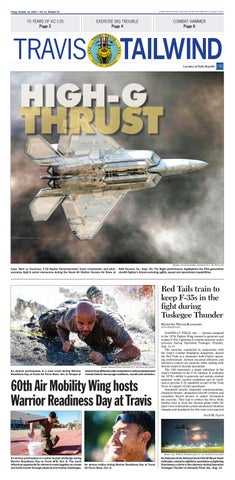
Airman 1st Class Kaden Ciminnisi/U.S. Air Force file
Capt. Nick Le Tourneau, F-22 Raptor Demonstration Team commander and pilot, executes high-G aerial maneuvers during the Naval Air Station Oceana Air Show at
NAS Oceana, Va., Sept. 20. The flight performance highlighted the fifth-generation stealth fighter’s thrust-vectoring agility, speed and operational capabilities.
Red Tails train to keep F-35s in the fight during Tuskegee Thunder Master Sgt. William Blankenship 187TH FIGHTER WING
Senior Airman Robert Nichols/U.S. Air Force file photos
An airman participates in a mud crawl during Warrior Readiness Day at Travis Air Force Base, Oct. 8. Groups of
airmen from different units competed in various physical and mental trials to encourage readiness, morale and cohesion.
60th Air Mobility Wing hosts Warrior Readiness Day at Travis
DANNELLY FIELD, Ala. — Airmen assigned to the 187th Fighter Wing trained to generate and sustain F-35A Lightning II combat airpower under pressure during Operation Tuskegee Thunder, Aug. 12-14. The exercise, conducted in conjunction with the wing’s Combat Readiness Inspection, placed the Red Tails in a simulated Indo-Pacific operating environment. Airmen executed offensive and defensive counter-air missions while dealing with threats meant to disrupt operations. The CRI represents a major milestone in the wing’s transition to the F-35 mission. It evaluates the 187th’s ability to generate and sustain combat airpower under combat conditions and its readiness to provide F-35 capability as part of the Total Force in support of joint operations. Simulated attacks, degraded communications, chemical threats, unmanned aircraft systems and casualties forced airmen to adjust throughout the exercise. They had to protect the force while finding ways to keep the mission going while the giant voice notification system announced situation changes and simulated live-fire tests were injected See F-35, Page 6
Master Sgt. William Blankenship/U.S. Air National Guard file
An airman participates in a water bucket challenge during Warrior Readiness Day at Travis AFB, Oct. 8. The event offered an opportunity for airmen to come together as a team and build morale through physical and mental challenges.
An airman smiles during Warrior Readiness Day at Travis Air Force Base, Oct. 8.
An Alabama Army National Guard UH-60 Black Hawk helicopter conducts nighttime operations as lightning illuminates a storm in the distance during Operation Tuskegee Thunder at Dannelly Field, Ala., Aug. 13.
AIR FORCE
2 Friday, October 16, 2026 — TRAVIS TAILWIND
African air forces chart path toward 2034 during AAAF planning conference Tech. Sgt. Alexandra M. Longfellow
U.S. AIR FORCES IN EUROPE – AIR FORCES AFRICA PUBLIC AFFAIRS
RAMSTEIN AIR BASE, Germany — U.S. Air Forces in Europe – Air Forces Africa hosted a weeklong Association of African Air Forces planning conference Aug. 31-Sept. 4, bringing together multinational military planners to advance the organization’s strategic vision and strengthen African-led airpower cooperation. Representatives from Nigeria, the current AAAF chairing nation, along with delegates from Tunisia and Kenya and U.S. military advisers, worked to develop a three-year roadmap, integrate new organizational roles and align future multinational training and exercise initiatives. “The AAAF planning conference this week was a huge success,” said U.S. Air Force Lt. Col. Ed Salazar, AAAF Permanent Secretariat director. “We were able to bring Permanent Secretariat members from Tunisia, Kenya and Nigeria together with the shared goal of codifying a strategic vision for the organization and applying it to our first-ever
African-led live-fly exercise in January 2027.” The conference built upon guidance established during the May 2026 African Air Chiefs Symposium, translating senior-leader priorities into actionable objectives for the organization. Planners also incorporated best practices from the System of Cooperation Among the American Air Forces as they refined AAAF processes and longterm planning. A key focus throughout the week was strengthening cooperation among African air forces to address humanitarian emergencies and disasters across the continent. “The conference was particularly important because it provided an opportunity for African air forces to strengthen a shared understanding of the humanitarian and disaster response challenges confronting our continent, while reaffirming the importance of working together as one African airpower community,” said Squadron Leader O. Lawal, AAAF Permanent Secretariat public affairs officer. Conference participants also engaged with U.S. and partner air leaders, including
Senior Airman Monique Stober/U.S. Air Force file
A KC-135 Stratotanker assigned to the 6th Air Refueling Wing taxis the flightline at MacDill Air Force Base, Fla., July 3. The aircraft, carrying airmen assigned to the
Celebrating 70 years of KC-135: Enduring lessons in acquisition Robert Marcell
AIR FORCE LIFE CYCLE MANAGEMENT CENTER HISTORY OFFICE
DAYTON, Ohio — At AFLCMC’s tenth annual Life Cycle Industry Days gathering in July, Air Force Under Secretary Matt Lohmeier indicated that an “85% solution in the hands of our armed forces today is infinitely better than an unachievable 100% solution endlessly undergoing testing.” But what can 85% actually give the warfighter? In some cases, it gives them 70 years of legendary service… and counting.
See AAAF, Page 3
LeMay’s problem: The call for a jetpowered tanker In late 1953, Air Force General Curtis LeMay, the hard-charging, cigarchomping leader of Strategic Air Command (SAC), had a problem. It was SAC’s job – it was his job – to ensure that the Air Force had the capability to strike back at the Soviet Union with waves of American bombers carrying nuclear weapons should the Soviets (who’d started making nukes of their own in 1949) ever attack the United States. Unfortunately, the new-fangled fleet of jet-engined bombers the Air Force was developing for SAC, consisting of B-52 Stratofortresses and B-58 Hustlers, would not be able reach all of their targets in the U.S.S.R. – an enormous country that spanned the gap between the Baltic Sea and the Black Sea in the west, and the Pacific Ocean in the east. The only way they could possibly do so was with the aid of en route aerial refueling. The Air Force’s predecessor organizations in the Army had been experimenting with aerial refueling for decades by the start of the Second
Tech. Sgt. Alexandra M. Longfellow/U.S. Air Force file
Members of the Association of African Air Forces from Kenya, Nigeria and Tunisia prepare for a discussion during the AAAF planning conference at Ramstein Air Base, Germany, Sept. 3.
TRAVIS
50th and 91st Air Refueling Squadrons, returned from a scheduled deployment while providing critical aerial refueling capabilities to joint and coalition forces.
TAILWIND
Serving Travis Air Force Base and the surrounding community 1250 Texas St., Fairfield, Calif. 94533 707-425-4646 | Fax 707-425-5924 Publishers: Foy S. McNaughton and T. Burt McNaughton Advertising Manager: T. Burt McNaughton Editor: Todd R. Hansen Layout: Aaron Rosenblatt Travis Tailwind is a publication produced by the Daily Republic. All rights reserved. Reproduction in any form, in whole or in part, without written permission, is prohibited. Content published in Travis Tailwind is not necessarily the official view of, nor is it endorsed by, the U.S. government, the Department of Defense or the Department of the Air Force. The appearance of advertising in the publication, including inserts or supplements, does not constitute an endorsement by the Department of Defense, the Department of the Air Force or the Daily Republic of the products or services advertised. Those off base who wish to receive home delivery of Travis Tailwind can call 707-427-6975. For information on paid advertising, call 707-425-4646. Send correspondence to: Travis Tailwind/Daily Republic, 1250 Texas St., Fairfield, CA 94533.
COUNTRY GARDEN
Courtesy file photo (1956)
The first KC-135 Stratotanker emerges from the factory in Renton, Wash., next to the KC-97 Stratofreighter, in 1956. This pairing symbolized the new age of jet tankers, which eventually replaced the rotary wing aircraft to keep up with faster fighter aircraft. World War, but it was only after the war, and the establishment of an independent Air Force, that the Air Force acquired the Boeing KC-97 Stratofreighter. It was the first aircraft specifically procured as a tanker. By 1953, there were a couple hundred KC-97s in the Air Force, with hundreds more on the way, but there was an issue with this plane: Namely, the KC-97 was a pistonengined propeller-driven plane, while LeMay’s new bombers were all jets. The KC-97 was simply too slow to keep up with the planes it was supposed to be refueling. In experimenting with refueling the jet-engined B-47 and F-84, KC-97 pilots discovered that they could get around the speed differences with a maneuver known as “tobogganing.” During this maneuver, the jets would come down from altitude to hook up to the KC-97 at its highest altitudes, and then both planes would enter a controlled dive (like sleds or toboggans going downhill)
to increase the speed of the Stratofreighter. This was pretty inefficient though, with the jets wasting away a portion of the precious fuel they’d just taken on simply climbing back up to altitude after the process was done. Tobogganing also left the receiving jets vulnerable in potentially contested skies by forcing them low and slow. To General LeMay, the “tobogganing” maneuver was a band-aid, not a solution. It wasn’t good enough. At SAC’s November 1953 annual requirements conference, LeMay called for 200 jet-powered tankers to be procured with fiscal year 1954 funds. If he wanted to refuel jet bombers, he’d do so with jet tankers: That’s all there was to it. Headquarters Air Force concurred and announced on May 5, 1954, that a turbo-jet tanker was required by the Air Force.
Selection of the KC-135: The 85% solution
made to buy a jet tanker, the Air Force published its requirements for the plane and called for proposals from industry. The aviation giants of the day, including Lockheed, Boeing, Douglas, and others, drew up their designs and submitted their bids. Two years earlier, however, in 1952, the Boeing Airplane Company had made a massive gamble. With $16 million of their own money (or approximately $200 million in today’s money), they had designed and built a prototype jet transport with no guarantee of ever actually selling it. This was the Boeing 367-80 (or “Dash 80”). From the start, the Dash 80 was intended for use as both a military tanker and a commercial airliner, so while the other companies were drafting their plans for a jet tanker in the summer of 1954, Boeing was already flying a real, physical demonstrator – with the Dash-80’s first flight occurring on July 15, 1954, right in the middle of the selection process. Desperate for jetengined tankers, the Air Force ordered 29 of Boeing’s airplane before the contest was even over, intending to use them as “interim” tankers to bridge the gap between present requirements and the eventual construction of whichever tanker won the bid. That fall, in October and November of 1954,
After the decision was
See KC-135, Page 4
'5 -())5(< %522.6
9$5,&26( 9(,16" /(* 8/&(56" /(* 3$,1" /(* 6:(//,1*"
0)+ '6%147# 0)+ ,)%:-2)77# &962-2+ 7)27%8-32# 7/-2 '3036 ',%2+)7# 6)780)77 0)+7#
SENIOR APARTMENTS
,ON\YYW] +Z^] -Y^^KQO] y 6K_XN\c 0KMSVS^SO] y =ZKMSY_] -V_LRY_]O
Burton Dr .
WALMART
1ENSV -RWYVERGI 1IHM'EP 1IHMGEVI 'SZIVIH '% 'EVI 'VIHMX %GGITXIH
SAM’S CLUB
7I ,EFPE )WTEySP
. Dr
&RXQWU\*DUGHQ6HQLRU$SDUWPHQWV UHQWDOV
r we Po
%XUWRQ 'ULYH 9DFDYLOOH &$ FQWU\JUGQVUDSWV#FRPFDVW QHW
0
I-8
len He
$PVOUSZ (BSEFO JT BO JOEFQFOEFOU TFOJPS MJWJOH DPNNVOJUZ OFTUMFE JO UIF IFBSU PG 7BDBWJMMF 0VS SFTJEFOUT FOKPZ B TFDVSF USBORVJM FOWJSPONFOU DMPTF UP B WBSJFUZ PG TIPQQJOH PVUMFUT BOE QVCMJD USBOTQPSUBUJPO 3FTJEFOUT NVTU CF ZFBST PWFS
&$// 72'$<
COUNTRY GARDEN SENIOR APTS
396 3**-')7
8VERGEW 7XVIIX 7YMXI ' 2ETE '% 8VEZMW &PZH 7YMXI *EMVJMIPH '%
[[[ 8VIEX=SYV0IKW GSQ
TRAVIS/AIR FORCE
AAAF From Page 2 USAFE-AFAFRICA Plans and Programs leadership, as well as medical and contingency response experts, to identify opportunities for greater cooperation and interoperability. Another milestone was the continued integration of newly established Permanent Secretariat positions, including the public affairs officer and continuity manager roles assigned to officers from Nigeria and Tunisia. The positions are designed to strengthen organizational continuity, communication and coordination as AAAF expands its activities. “For the AAAF, our strength lies in our unity, the exchange of experiences and lessons, and our ability to develop African-led solutions that harness the unique capabilities of our air forces in support of communities affected by crises and disasters,” Lawal said. Planning for future multinational exercises remained a central focus throughout the conference, particularly AAAFEX27, scheduled to take place in Kenya in January 2027. Kenyan planners worked alongside the U.S. Air Force’s 435th Contingency Response Group to evalu-
ate support requirements, airspace control frameworks and distinguished visitor demonstration events while also beginning discussions for AAAFEX29. AAAFEX27 will provide an opportunity to translate years of partnership and planning into practical cooperation, with humanitarian and disaster response serving as a key focus. “As we intensify preparations for AAAFEX, our objective is to build on this spirit of collaboration by bringing together African air forces, partners and relevant stakeholders to strengthen interoperability, share best practices and enhance collective humanitarian and disaster response capabilities,” Lawal said. The conference concluded with the development of an executive summary for membernation air chiefs outlining the AAAF Strategic Plan 2027–2034, updated standard operating procedures and a three-year calendar of engagements designed to sustain cooperation among African air forces. “The desired outcome is not simply a successful exercise, but a more cohesive and capable African air forces community that can respond more effectively, collectively and rapidly to humanitarian and disaster situations across the continent,” Lawal said.
TRAVIS TAILWIND — Friday, October 16, 2026 3
Staff Sgt. Stacey Thornburg/U.S. Air Force file
Tech. Sgt. Vincent Boyd, a loadmaster assigned to the 53rd Weather Reconnaissance Squadron, conducts preflight checks before a routine training flight at Keesler
Air Force Base, Miss., Aug. 6. Loadmasters assigned to the 53rd WRS are responsible for the aircraft’s cargo and equipment while operating the dropsonde system.
The hurricane vs. the hunter Staff Sgt. Stacey Thornburg 403RD WING
KEESLER AIR FORCE BASE, Miss. — Powerful. Ferocious. Intense. These words are commonly used to describe a major hurricane bound to make landfall on U.S. soil. The amount of catastrophic destruction these monstrous storms can cause makes it an important mission to keep the American people informed, prepared, and involved. To embark on and succeed in this specialized mission, agencies such as the National Oceanic and Atmospheric Administration, the National Hurricane Center, and the National Weather Service utilize the U.S. Air Force Reserve’s 53rd Weather Reconnaissance Squadron to fly through the storms to take detailed observations and gather important data to send back to the agencies. The partnerships ultimately help improve the forecasts of tropical cyclones threatening the U.S. coast. While most aviators do their best to steer clear of storms, these crew members actually hunt them. Alongside
their NOAA counterparts, these individuals are commonly known as the Hurricane Hunters. “The mission of the Hurricane Hunters really impacts the American people by giving us better weather data, which improves the accuracy of forecasts,” said 1st Lt. Rileigh Sevigny, 53rd WRS navigator. “It actually can improve the infamous cone (of uncertainty) that you see by about 30%.” The information gathered in flight, including wind speed, wind direction, temperature, pressure, and humidity, is distributed directly to the NHC, triggering a ripple effect among various agencies and media outlets as a result of improved forecasts. “It gives the people who are making decisions for evacuation versus nonevacuation a bigger lead time and more of a headsup of where the hurricane is actually going to make landfall and how it will affect the everyday lives of American people,” said Sevigny. Aboard the WC-130J, a military aircraft that includes specialized weather instrumentation,
the basic crew consists of the aircraft commander, a co-pilot, a navigator, an aerial reconnaissance weather officer, and a loadmaster. Each plays a crucial role in supporting the hurricane mission. Pursuing the chaotic storms, which are formed by powerful heat engines and driven by the strict laws of physics, warm ocean water, and Earth’s rotation, the crew thereby strengthens readiness back on the home front. “As pilots, we have to ensure that we have all the proper clearances to get into the airspace, and that we’re clear of terrain, clear of traffic, and that we’re operationally legal to be where we’re at,” said Capt. Ashley Kosturock, 53rd WRS pilot. Planning and executing the mission are everyone’s responsibility, but the pilots’ sharp skills are crucial to the crew’s safety. “Sometimes turbulence can be so severe that the autopilot disconnects, and one pilot may have to handfly the airplane while the other manages the throttles,” Kosturock said. “At that point, the two pilots must work together to make sure they don’t over-
speed or stall the airplane. Most hurricane training is on the job because you can’t truly replicate those conditions, even in a simulator.” Helping pilots maneuver their way through the storm are the navigators. They are also seated in the flight deck directly behind the pilots. “As navigators in the storm environment, we’re kind of the go-between for the back of the plane and the pilots,” said Sevigny. “The aerial reconnaissance weather officer is telling us where they want to go in the eye of the storm to collect the data they need, and we are checking our radar, making sure it’s a safe direction, and passing on a heading to the pilots.” Just like the green imagery radars seen in movies, navigators use low-powered weather radars to help find a safe direction in flight. “There will be little things that kind of pop out on the edges of the storm that create a lot of turbulence and could cause us to lose altitude quickly,” said Sevigny. “We want to avoid See Hunter, Page 6
“We Go The Extra SMILE” • Orthodontics for Children & Adults • Cosmetic (Clear) Braces • Invisalign • Early Intervention Treatment • Financing Options Available • Military Discounts
Bryan C. Scott, D.M.D. Specialist in Orthodontics
=V[LK )LZ[ 6Y[OVKVU[PZ[
www.scott-ortho.com
1360 Burton Drive, Ste 100, Vacaville, (707) 451-2292
Rose Garden S E N I O R
A PA RT M E N T S
Enjoy active senior living in the beauty of a serene garden setting. • Gated Community • Close to Shopping • Spacious Clubhouse • Social Activities • Pet Friendly • Covered Parking • 1 & 2 Bedroom Units • Affordable Rates Visit our website at rosegardenseniorapartments.rentals
50% OFF TWELFTH Up toClearance ANNIVERSARY
SALE NOW THRU OCT 31
Merchandise
20% OFF
Custom Orders Visit our 25,000 sq. ft. showroom!
1717 California Drive, Vacaville, CA 95687
Call (707) 448-7036 or email rosegardensrapts@comcast.net
! ! # "
( 0RQWH 9LVWD $YH s 9DFDYLOOH /DLQH\V)XUQLWXUHIRU/LYLQJ FRP
AIR FORCE
4 Friday, October 16, 2026 — TRAVIS TAILWIND
Flight: KC-135 First Aug. 31, 1956 From Page 2
Tech. Sgt. Aaron Thomasson/U.S. Air Force file
Senior Airman Mitchell Massa, front, an explosive ordnance disposal technician assigned to the 366th Civil Engineer Squadron, and Airman 1st Class Levi Womack, an explosive ordnance disposal technician assigned to the 341st Civil Engineer Squadron, approach a simulated
chemical explosive device during Exercise Big Trouble at Limestone Hills Training Area, Mont., Aug. 18. Working in chemical protective gear adds heat, restricted mobility and limited visibility. Technicians must train in these conditions to stay effective against contaminated threats.
EOD airmen train on full spectrum of explosive threats Tech. Sgt. A aron Thomasson 341ST MISSILE WING
LIMESTONE HILLS TRAINING AREA, Mont. — The call comes in from headquarters. “[Explosive ordnance disposal], this is Godfather. Be advised hostiles approaching your location. How copy?” Inside the gas mask, every breath feels like drinking air through a straw. Airman 1st Class Levi Womack keys the radio and responds. “Godfather, this is EOD. Good copy.” Further up the ridgeline, Senior Airman Mitchell Massa hears the radio chatter and knows time is running out. He is working against the clock to disarm and decontaminate a chemical explosive device found in the woods near a forward operating base. With the seconds slipping by, his entire world narrows down to the problem in front of him, visible only through the fogged lenses of his gas mask. Then the call comes in from headquarters to leave the area. Massa works his way down the ridge, moving slowly in his chemical protective gear and drops the device in a decontamination tub. “End of scenario,” yells the instructor during Exercise Big Trouble, a weeklong field training exercise at Limestone Hills Training Area near Townsend, Montana. It’s only the morning of the first day and Massa and Womack are already drenched in sweat as they
peel off their protective gear, hot and thirsty under the August sun. Massa, assigned to the 366th Civil Engineer Squadron at Mountain Home Air Force Base, Idaho, and Womack, assigned to the 341st Civil Engineer Squadron at Malmstrom Air Force Base, Montana, are there to hone their craft on simulated chemicals and explosive devices. They gather around the instructor for a debrief after finishing their second problem of the day. He tells them this scenario is meant to teach junior explosive ordnance disposal technicians what to do when external constraints make it too dangerous to continue disposal operations. Knowing when to break off a mission rather than push past the point of safety was exactly the lesson Staff Sgt. Lucky Widjaja, the exercise’s main organizer and a 341st Civil Engineer Squadron EOD technician, wanted every technician to carry off the range. “The end goal is for them to realize their limitations and capabilities – the miles they’re able to travel and how they function under less-than-ideal conditions,” Widjaja said. “So that if that were to ever happen in a deployed environment, they have that experience to fall back on.” Now in its fourth iteration and second year bringing in EOD airmen from around the country, this year’s exercise featured six EOD teams training in a simulated deployed environment. Over the week, techni-
cians worked though scenarios that spanned a range of threats they could see downrange, such as improvised explosive devices, unexploded ordnance, weapons caches, route denial and chemical agents, like what Massa and Womack confronted that first morning. The training plan was built for airmen early in their careers, many of them working through these high-pressure, decision-making processes for the first time. The aim was to develop technicians who understood what team leadership demanded and could transfer their skills to real-world deployed environments. If judgment, leadership and technical skill were the lessons, communication between EOD shops was the method. Planners paired technicians with counterparts from other shops to trade tactics, techniques and procedures, allowing airmen to sharpen not just their own units but the shops they trained alongside. “My favorite part is getting EOD members from different shops out here to train,” Widjaja said. “It allows us to communicate and exchange learning points so that we are, as a whole EOD enterprise, more ready and capable to face our next emerging threat.” Throughout the week, teams gained experience with the career field’s full toolkit. Massa traded his chemical protective gear for the controls of an unmanned ground vehicle, sending the robot to examine a suspected device while the oper-
ator stayed outside the blast radius. In another case, careful planning made success possible. Staff Sgt. Hartvig Homberg, a 341st Civil Engineer Squadron EOD technician, and Airman 1st Class Jacob Miller-Lujan, a 28th Civil Engineer Squadron EOD technician from Ellsworth Air Force Base, South Dakota, mapped out a plan before tackling a problem with multiple devices, deciding who did what and in what order. After each scenario, teams gathered to debrief, learning new lessons before moving to the next problem. The training tempo left technicians with limited recovery time. Teams woke up early to prep their gear and were on the range by 8 a.m. Once there, they rotated through problems, trading team leader and team member roles and switching between mounted and dismounted work. After a short rest at the end of the afternoon, they started a night mission brief around 9 p.m. and conducted training while using night-vision devices until at least midnight. For the airmen learning during Big Trouble, the purposeful grind of the exercise teaches not just explosives, but teamwork and endurance. “The hardest part is being tired, and keeping a good attitude and staying motivated throughout,” Widjaja said. “But by the end of it, we see teams and players coming together, learning from other shops and exchanging knowledge.”
the Air Force determined in its evaluation of the submitted bids that Lockheed’s tanker best met its technical specifications. Lockheed’s proposal existed only on paper, however, which left the Air Force considering its options: Could the nation afford to wait years for Lockheed’s superior design to enter production while the Soviet Union seemed only to be growing in power? Or should the Air Force pick the “ready-to-go” 85% solution that was already roaring to life on Washington runways? It is worth noting that this decision was being made years before the U.S. had its first operational Intercontinental Ballistic Missiles (ICBMs), and before the first nuclear missile-carrying submarines: The only way to deliver nukes to targets in the U.S.S.R. was bombers… and those bombers could only reach their targets with aerial refueling. Given all of the above, the Air Research and Development Command (or ARDC, which, alongside the more logistics-minded Air Materiel Command, was a historical predecessor to today’s AFMC) recommended that the Air Force not buy Lockheed’s tanker. Yes, it was the best design, but the Air Force needed the best design that was ready right now. For that reason, ARDC argued that the Air Force should instead go with the more production-ready Boeing tanker, converting the 29 planes already ordered from Boeing to the final design configuration of the KC-135, and producing all future planes in that configuration from plane #30 on up. SAC was on board with this recommendation, too. In fact, SAC argued for it: In LeMay’s view, having two tanker fleets would unnecessarily complicate things. It would make the logistics of supporting both fleets much more complex, and it would be more expensive. Moreover, crew interchangeability requirements meant that all of SAC’s tanker pilots would have to train on both aircraft if the Air Force fielded two tanker fleets. In the end, the Air Force went with ARDC’s recommendation: Boeing’s gamble had paid off, and the KC-135 was selected for production. Boeing’s Dash-80 prototype would go on to enable Boeing’s 707 commercial airliner, as well.
After the tanker contest was over and the decision was made, Boeing went to work on the world’s first jetpowered tanker, the KC-135 Stratotanker. On Aug. 31, 1956, 70 years ago this year, the KC-135 made its maiden flight out of Boeing’s plant in Renton, Washington (near Seattle). It was early on a Friday afternoon, temps were in the 70s, and it was mostly sunny and dry. The aircraft, which was named the City of Renton, was flown by Richards L. “Dix” Loesch, Boeing’s senior experimental test pilot, and Alvin M. “Tex” Johnston, Boeing’s chief of flight test. Johnston and Loesch also flew Boeing’s original “Dash 80” prototype in 1954, and Johnston flew the 707 airliner’s maiden flight in 1957. An hour and 19 minutes after takeoff, the City of Renton landed at Seattle’s Boeing Field.
Conclusions In the decades since this first flight, the KC-135, and the rest of the versatile C-135 family (which originally consisted of 820 aircraft, with 732 of them being KC-135s), has proven highly adaptable to the needs of the nation. After numerous larger – and smaller-scale modification and modernization efforts, today’s KC-135Rs and KC-135Ts are highly capable and sophisticated weapon systems. Other C-135 systems have had jobs ranging from command and control (the EC-135) to reconnaissance (the RC-135) to atmospheric testing (the “nuke sniffing” WC-135). NASA even used a KC-135 as a “Vomit Comet” for simulating weightlessness with parabolic flights until it was replaced by a 737. And while the KC-135, fortunately, never had to enable a doomsday scenario like the one LeMay was preparing for, the platform remains a critical enabler of the U.S. Air Force’s ability to be anywhere in the world on short notice today. When the last KC-135 was delivered to the Air Force in 1965, the KC-135 fleet was the largest tanker fleet in the world. Decades later the Air Force’s KC-135 fleet is still the world’s largest tanker fleet. The KC-135 is not expected to fully retire until at least the 2040s, which means that it will continue to enable the global reach of American airpower for many years yet to come. Not bad for an “85% solution.”
HOME • BUSINESS • SERVICES
HAULING
LANDSCAPING
When You Want It Gone...
... call John
JOHN’S HAULING (707) 422-4285 FREE Estimate • Same Day Svc Insured License #04000359 Credit Cards Accepted www.422haul.com
HOUSE CLEANING
A & A Professional Cleaning Services Carpet & Upholstery, Kitchen & Baths, Windows, Etc. Lic’d & Insured
707-386-3004
LOCKSMITH
SSGARDENINGSERVICE
D I R E C T O RY
FAIRFIELD SAFE & LOCK CO. Serving Fairfield, Suisun, Travis & Vacaville Since 1963 BONDED LOCKSMITH
Octavio Silva
EYS • LLOCKS OCKS • SSAFES AFES KKEYS
Best Prices in Town!
Changed, opened, repaired & installed.
Mowing, Edging, Fertilizing, Trimming Bushes, Weeding, Sod, Sprinkler Systems, Relandscaping, Cleanup, Fences, Hauling Octavio • 707-720-8394 Jaime • 707-720-5649 Instagram: sgardeningservice
Free Estimates!
Looking to Advertise? Call today 707-427-6973
ROOFING
Deadbolt & foreign car specialist 24 Hr. Emergency Service 811 Missouri St. • 426-3000
PAINTING
BELLA
PAINTING
Superior Quality & Craftsmanship
(707) 631-6601
“Locals Serving Locals” For Over 34 Years
FREE ESTIMATES
(707) 447-3132
CalRoofingSystems.com CA LIC #560708
LIC.# 678919
For Service Source Information, Call Classifeds at (707) 427-6973
TRUCKING
NORTH BAY TRUCK CENTER 1245 Illinois St, Fairfield, CA 94533 (707) 427-1386 www.northbaytruckcenter.com
Home Improvement Time?
Let Service Source help you find the perfect professional!
AIR FORCE
TRAVIS TAILWIND — Friday, October 16, 2026 5
919th SOW passes new readiness inspection test Senior Airman Emily Bloodworth
919TH SPECIAL OPERATIONS WING
DUKE FIELD, Fla. — Air Commandos from the 919th Special Operations Wing validated their warfighting capabilities during a Combat Readiness Inspection (CRI), Aug. 6-9, at Duke Field and Hurlburt Field, Fla. The inspection was formally spearheaded by the Air Force Reserve Command Inspector General to evaluate the wing’s ability to generate combat power under realistic, high-pressure situations in a simulated forward operating location. “The ability of our wing to take a complex operational concept and within a month execute a synchronized event across multiple platforms is a profound testament to the work our wing does every day,” said Lt. Col. Brandon Wood, lead exercise planner, 919th SOW Inspector General’s office. The August inspection marked the operational climax of a ground-breaking, four-month long distributed campaign that spanned across the INDOPACOM and SOUTHCOM theaters of operations since April. Representing a revolutionary shift from traditional, localized
Senior Airman Emily Bloodworth/U.S. Air Force file
An airman from the 919th Special Operations Wing participates in the Combat Readiness Inspection by passing through a simulated Personnel Deployment Function line and receiving mobility gear at Duke Field, Fla., Aug. 6. The Combat Readiness Inspection was spearheaded by the Air Force Reserve Command Inspector General to evaluate members from the 919th SOW’s ability to generate combat power under realistic, high pressure situations in a simulated forward operating location. events, the 919th SOW produced the model blueprint for all future AFRC CRIs. The 919th SOW validated its distributed mission command and agile combat support alongside simulated partner nation forces proving the readiness and capability in a new high-tempo, campaign construct.
The assessment evaluated the wing across three phases: generation, employment and sustainment. Simulated deploying personnel processed through formal deployment lines to verify readiness, receive mission-essential equipment, and marshal cargo to evaluate mobilization capabilities.
Operating from a simulated forward operating location, Air Commandos demonstrated their ability to project power, assist host-nation partners in disrupting transnational threat networks, and counter near-peer adversarial influence within the region. Concurrently, tactical aviation and maintenance oper-
ations generated sorties and maintained a strict readiness posture from their respective simulated home stations. “Our members were incredibly motivated to demonstrate their capabilities during this exercise, and their professional drive was a huge factor in our success,” said Wood. Executing such a vast operation alongside AFRC required extensive preparation. Wood noted that designing the exercise and aligning the evaluating organizations came with its own set of internal hurdles. “One of the greatest challenges during the exercise development was the communication and integration of dissimilar mission sets across the wing to ultimately operate together in harmony.” said Wood. Setting up a framework then allowing the units to express their own mission sets was critical to success, Wood further credited the wing’s local inspection team for the massive undertaking in capturing the 919th SOW’s performance across many unique mission sets throughout the campaign. Col. Scott Hurrelbrink, 919th SOW commander, praised the wing’s performance See 919th, Page 6
For advertising information about this directory, call Classifieds at 707-427-6973 or email: cgibbs@dailyrepublic.net ASSEMBLY OF GOD
NAZARENE
BAPTIST
NON-DENOMINATIONAL
NON-DENOMINATIONAL
PRESBYTERIAN
-PYZ[ (ZZLTIS` 6M .VK VM -HPYÄLSK
We believe Church is WAY better when you are here! First Assembly is a place where all are welcome to Discover, Develop, and Demonstrate a relationship with God. We invite you to join us for Sunday service at 10:30 a.m.
2207 Union Avenue, Fairfield, CA www.1agff.com
Bible-Based Expository Preaching Sunday Worship Services 9:00 & 10:45 a.m. Pastor Jon Kile 192 Bella Vista Road, Vacaville 707-451-2026 Sunday school for all ages is provided during both services. Visit our website for information on other ministries offered at
www.vacavillefaith.org
Christ Exalted, Lives Transformed 3777 Vaca Valley Pkwy Ste.F, Vacaville, 95688 Email: office@northhillsvv.org Website: www.northhillsvv.org Service Times: Sunday morning 10 a.m., Wednesday evening 6:30 p.m. Phone: 707-449-8977
BAPTIST NON-DENOMINATIONAL
:RUVKLS :LWK 8V 6W 3DXO %DSWLVW &KXUFK
“To know Him, and to make Him known” Live stream at: itsallaboutfamilies.org 301 N. Orchard Ave., Vacaville 707.448.5848 .HQWXFN\ 6WUHHW )DLU¿HOG &$ 5HY 'U 7HUU\ /RQJ 3DVWRU 6XQGD\ 6XQGD\ 6FKRRO D P 0RUQLQJ :RUVKLS 6HUYLFH D P &KLOGUHQ¶V &KXUFK D P 7XHVGD\ 3UD\HU 0HHWLQJ S P %LEOH 6WXG\ S P VWSDXOIDLU¿HOG RUJ VWSDXOEFIDLU¿HOG#FRPFDVW QHW
SUNDAY Classes for all ages ............10:00 am Worship..................................11:00 am CORE Bible Studies... 12:30 & 5:00 pm (2nd & 4th Sunday)
WEDNESDAY Adult Studies...........................2:00 pm AWANA for Kids .....................6:15 pm Adult & Youth Studies............6:30 pm
CHURCH OF CHRIST
The Father’s House
490 Brown Street Vacaville, CA 95688
4800 Horse Creek Drive Vacaville, CA 95688
707-446-8684
(707) 455-7790 tfh.org
Sunday School (9:45 am)
Service Times Sunday: 8:15am, 10am & 11:45am Live Stream at tfhvacaville tfhvacaville
Sundays: Worship Service (11:00 am) Fellowship Lunch (12:30 pm)
Thursdays: Prayer Meeting (7:00 pm) Bible studies throughout the week. Pastor Ben Smith
www.vacavillebiblechurch.com office@vacavillebiblechurch.com
Vacaville Church of Christ
401 Fir St., Vacaville, CA 95688 (707) 448-5085 Minister: Elliott Williams Sunday Morning Bible Study 9:30 AM
ĨéijƀǛēŋČŽƀēƇąƷƐēƀijéœĆįƖƀĆįɒŝƀĩ
UNITED METHODIST “The People of The United Methodist Church™”
&20081,7< 81,7(' 0(7+2',67 &+85&+ )DLU¿HOG $YHQXH )DLU¿HOG
LQIR#FXPFIDLU¿HOGFD RUJ FXPFIDLU¿HOGFD RUJ <RX7XEH &80& )DLU¿HOG
Sunday Morning Worship 10:30 AM
)DFHERRN #FXPFIDLU¿HOGFD
Sunday Evening Worship 5:00 PM
,Q 3HUVRQ 2QOLQH :RUVKLS # D P
Wednesday Evening Bible Study 6:00 PM
vacavillecoc.com 401 Fir St., Vacaville, CA 95688 (707) 448-5085
3DVWRU 'DYLG 3HWWHQJLOO
&RPPXQLRQ VW 6XQGD\V $GXOW DQG %HOO &KRLUV 6PDOO *URXSV 8QLWHG 0HWKRGLVW :RPHQ 8QLWHG 0HWKRGLVW 0HQ &KLOGUHQ¶V 6XQGD\ 6FKRRO
tfhvacaville
&+85&+ RI &+5,67 0HHWV DW 5RFNYLOOH &HPHWHU\ 6WRQH &KDSHO
6XLVXQ 9DOOH\ 5G )DLUÀHOG 6XQGD\ $0 %LEOH &ODVVHV DP 6XQGD\ $0 :RUVKLS DP 6XQGD\ 30 :RUVKLS SP :HGQHVGD\ 30 %LEOH &ODVVHV SP :H ZHOFRPH DQG HQFRXUDJH \RX WR FRPH DQG KHDU WKH JRRG QHZV RI WKH JRVSHO RI &KULVW DQG WR OHDUQ DERXW HWHUQDO VDOYDWLRQ IRU DOO PDQNLQG WKDW LV RIIHUHG WKURXJK -HVXV ´$QG WKHUH LV VDOYDWLRQ LQ QR RQH HOVH IRU WKHUH LV QR RWKHU QDPH XQGHU KHDYHQ WKDW KDV EHHQ JLYHQ DPRQJ PHQ E\ ZKLFK ZH PXVW EH VDYHG µ $FWV %ULQJ D KHDUW DQG PLQG ZLOOLQJ WR KHDU *RG·V :RUG DQG WR GR +LV JUHDW ZLOO )RU PRUH LQIRUPDWLRQ RU GLUHFWLRQV SOHDVH YLVLW RXU ZHEVLWH DW URFNYLOOHFRIF FRP
7R %H 2Q 2XU :RUVKLS 'LUHFWRU\
&RQWDFW &RQQLH *LEEV 6WLQVRQ FRQQLH JLEEV#PFQDXJKWRQ PHGLD
6 Friday, October 16, 2026 — TRAVIS TAILWIND
AIR FORCE
Tyndall sharpens air-to-ground skills during Combat Hammer Senior Airman Amanda Alvarez 325TH FIGHTER WING
HILL AIR FORCE BASE, Utah — The 325th Fighter Wing joined the 86th Fighter Weapons Squadron at Hill Air Force Base, Utah, for an air-toground exercise Aug. 4-14. Weapon System Evaluation Program-Combat Hammer 26.07 was designed to test the combat capability of air-to-ground precision-guided munitions and weapon systems of the F-35A Lightning II, while providing hands-on experience with live ordnance. The training directly supports Air Combat Command’s emphasis on readiness, lethality and Agile Combat Employment by requiring airmen to generate combat power away from their normal operating environment while building the proficiency and repetition needed for high-end conflict. “Combat Hammer allowed us to have handson exposure, specifically to air-to-ground weapons that the F-35 can carry,” said Capt. Simon Little, 95th Fighter Squadron pilot. “We’re able to have those weapons on the aircraft, for the first time for some pilots.” Unlike Tyndall’s primarily overwater training environment, the Utah Test and Training Range provides a different set of conditions for the F-35 and its pilots. “At Tyndall, we don’t get a ton of exposure to our airto-ground mission set, just because we primarily train in the Gulf of America,” Little said. “So being here allows us exposure on different terrain – we get experience flying low level around the mountains and using terrain masking, different techniques and to target specific things on the ground.” Additionally, working with live ordnance creates another layer of responsibility while providing a
Hunter From Page 3 those to the best of our ability. So, if we see something like that on the radar, we will choose maybe a slightly different heading than what’s directed by the ARWO in the back.” The ARWO and loadmaster sit in the cargo area of the aircraft on specialized pallets, where they collect critical weather data throughout the mission. “While we’re on board the aircraft, first we’re working with the crew to ensure that we fly where we need to go to collect the data,” said Maj. Garrett Black, 53rd WRS ARWO. “And then, with the help of our loadmasters, we release and utilize specialized weather instruments to ultimately collect and compile data onto our computers. From there, we can assess the data quality and then send it directly to the NHC.” As the aircraft traces its alpha pattern through the storm, loadmasters complement the ARWO by deploying the physi-
919th From Page 5 under pressure. “The wing demonstrated outstanding tactical lethality, particularly in aircraft maintenance and base defense operations,”
Senior Airman Amanda Alvarez/U.S. Air Force file
Staff Sgt. Daniel Rivera, 325th Aircraft Maintenance Squadron weapons team chief, and Airman 1st Class Lance Toland, 325th AMXS weapons load crew member, place an adaptor onto a munition during Weapons System Evaluation Program-Combat Hammer 26.07 at Hill Air Force Base, Utah, Aug. 12. level of realism that can’t be fully reproduced during routine training. “Anytime you have a live munition on the aircraft, the stress level is naturally a little higher,” Little said. “We train for this every day, but there is a distinct realism that comes with the ability to employ catastrophic ordnance … it’s a sobering reminder of what we do in the F-35. We are in the business of protecting America and our values, and I think the first time you get exposure to that, it’s a little bit of a sobering reminder of what we do and how we do it.” The training extended beyond the cockpit as the 325th Maintenance and Munitions Squadrons worked hand-in-hand with Hill’s WSEP team to support the 95th FS. The 325th MUNS arrived a week before the exercise to execute a dedicated “bomb week,” assembling all the necessary ordnance from the ground up, and shifting to a rapid 24-hour cycle once the live-fly phase began. “We are evaluated on the ability to properly build up ammunition with all the components on hand and ensuring that we start the serviceability of assets from start to finish,” said Staff Sgt. John Neer, 325th Munitions Squadron
weapons system evaluation program precision-guided munitions inspector. “We get 24 hours’ notice of what [munitions] are expected for the next day, what needs to be getting greened up, finished and out to the line, so it’s very quick.” For Neer, the faster pace and smaller team structure added another layer to the exercise, forcing the team to operate with fewer personnel and resources than they normally use at home station. This shift reinforced the vital role of individual expertise and trust in a contested environment. “Here, we’re doing it as a 14-man team, as opposed to a 50-man team,” Neer said. “We brought individuals who can accomplish all the [different components] into a smaller team. So we really count on the individuals’ expertise, and we have to trust that they’re doing things correctly.” The exercise also gave newer munitions airmen experience handling live components and working at a tempo they don’t regularly encounter at Tyndall. Neer said three members of his team had not previously built live munitions, making the exercise an opportunity to expand their experience and responsibilities. “It’s great getting to
spread the wealth and let other people learn,” said Neer. “We’re letting members take on leadership roles, even if they might be small, so they can grow in areas they’ve never experienced before. It’s going to be incredibly rewarding to have our newer guys experience the feeling of success that comes with doing our job correctly.” The value of the exercise extended across the entire spectrum of the mission, from the airmen assembling the bombs to the crews loading them and the pilots employing them. “It takes an entire team to execute the fundamentals of ‘fly, fight, and win’ and achieve our objectives,” Little said. “Being here allows us to see how every single role contributes directly to the team’s success or failure. We need everybody on the team to buy in, and we need everyone to carry their weight.” By integrating pilots, maintainers, and munitions airmen into a single team, Combat Hammer bridged the gap between home-station training and real-world execution. Operating with live ordnance in a dynamic environment ultimately strengthens Tyndall’s ability to generate combat airpower and project decisive mission readiness.
cal sensors at strategic points within the eyewall and eye to capture that critical data. “We drop sensors, called dropsondes, from the aircraft to the surface that measure wind speed, wind direction, temperature, dew point, and pressure,” said Tech. Sgt. Vincent Boyd, 53rd WRS loadmaster and dropsonde operator. “It’ll fall at about 2,500 feet per minute, and as it drops to the [water’s] surface, it’s picking up the data, and once it hits the water, it terminates.” The purpose of this task is to fix the storm so we can track exactly where it’s going, explained Boyd. “We look for an area where the winds drop to almost zero, then fly our alpha pattern around the storm and return to that same spot,” he said. “That essentially tells us how far and in what direction the storm has moved.” For the people back at home watching the forecast and the hurricane cone, the mission helps narrow the storm’s projected path, allowing for better-informed decisions and a more effective response. “By going out and col-
lecting this atmospheric data over very sparse regions of the oceans, we can really hone in on those weather models and enhance the weather forecasts to allow people to have more advanced warnings,” said Black. Across the 53rd, some Hunters are passionate about the overall mission simply because of a personal connection to severe weather. “I grew up in Kansas, so tornadoes really got me into weather,” said Black. “As I continued to go through my meteorology program in college, I heard about this unit way back then. I thought this was a very exciting way to help people, but also to actually be out exploring the weather, and feeling its impacts, while helping others be more prepared for those impacts.” For others, a single direct hurricane in their own lives was all it took to be drawn to the mission. “Growing up in South Mississippi, I was directly affected by Hurricane Katrina in 2005,” said Kosturock. “I remember seeing the effects of the powerful water that swept away the homes, leaving
nothing but concrete and oak trees.” The mission is personal for many in the squadron. Seeing the impact of hurricanes on communities motivates them to continue their efforts. “It has had a lasting, resounding impact on my family and on the coastline as well. I have personal photos that inspire me to keep doing what I do,” said Kosturock. “I usually keep them in my helmet bag.” While the hurricane intensifies at sea, these Air Force reservists don’t just await its arrival, they set out to face it head-on. Much like a battle against the forces of nature, they use their skills and specialized weather instruments to keep the lives of the American people in its path as safe as possible. “You’re helping people save lives and stay out of harm’s way,” said Boyd. “And that’s worth it.” Powerful, ferocious, and intense may describe the hurricane, but… Resilient. Determined. Dedicated. These are words that can define the Hunters – the Hurricane Hunters.
said Hurrelbrink. “We prepared for these assessments by focusing on the wing’s priorities: achieving a maximum state of readiness and promoting innovation across all daily operations.” By integrating compliance checks directly into ongoing training cycles, the wing treated routine prep-
aration as the foundation of its combat capability. This ensures Citizen Air Commandos are ready now for immediate taskings while fostering the innovation needed to transform for future operations. “We welcomed this external evaluation as an opportunity to find our blind spots and improve
our warfighting posture,” said Hurrelbrink. “I am incredibly proud of this wing’s hard work and outstanding performance. We will use these findings to refine our training, streamline our resources, and ensure the 919th SOW remains the premier special operations wing in the Air Force Reserve.”
F-35 From Page 1 throughout. For Col. John D. Caldwell, 187th Fighter Wing commander, Tuskegee Thunder was about more than what the F-35 could do. It tested whether the wing could keep producing combat power when conditions got harder. “The F-35 is the most capable fighter aircraft in the world, but readiness is ultimately measured by our airmen’s ability to fight and sustain operations in the most challenging conditions,” Caldwell said. “Operation Tuskegee Thunder provided our airmen the opportunity to hone their skills, refine tactics, techniques and procedures and develop the confidence to operate anywhere at any time.” Pilots and operations personnel planned and executed F-35 missions while maintainers generated aircraft and kept them ready to fly. Across the installation, airmen worked to protect people, equipment and the systems needed to keep aircraft in the air. Responding to an attack was only part of the problem. The mission still had to happen. This included pilots crewing jets and other extreme measures as the wing pushed through obstacles to achieve mission success. Airmen changed protective postures, responded to simulated threats and casualties and adjusted as communications degraded. When primary communication methods became unavailable, units shifted to alternate, contingency and emergency methods to maintain command and control while operations continued. Red Tails confronted gate runners, responded to mass casualties and ground attacks, preparing for whatever they may be called upon to face. “Operating a fifthgeneration fighter in a contested environment requires the entire wing to be part of the fight,” said Lt. Col. Martin “Lefty” Smith, 187th Fighter Wing F-35 pilot and plans and programs lead. “The challenge isn’t simply launching aircraft. It’s maintaining command and control, protecting and sustaining the force, adapting when the environment changes and continuing to generate combat airpower. Tuskegee Thunder gives our airmen the opportunity to work through those problems here so we’re prepared to execute when it matters.” The exercise was the latest in several years of training tied to the Red Tails’ transition to the F-35, and arguably the most important milestone to date. This tested the combat readiness of the wing. The 187th received its first F-35As at Dannelly Field in December 2023, beginning the
wing’s transition from the F-16 Fighting Falcon to the F-35A Lightning II. Getting the jets was one piece of that transition. The wing also had to train its people and develop the processes needed to employ and sustain them. Since then, Red Tails have flown in largeforce exercises, trained at night and practiced operating across distributed locations. In 2025, the wing supported Resolute Force Pacific, moving personnel and equipment in support of distributed operations across the Indo-Pacific. The wing built on that experience during Sentry South 26-2, when F-35s continued operating from Dannelly Field while a small maintenance team worked from a forward location. For Smith, those exercises and Tuskegee Thunder give airmen a chance to work through problems before they’re asked to do it for real. “We know a real fight isn’t going to go exactly the way we planned it,” Smith said. “People get tired, communications don’t always work and the situation changes. We have to be able to adjust, make good decisions and keep getting airplanes airborne. That’s what training like this is for.” Tuskegee Thunder brought much of that training together at the wing level. Maintainers generated aircraft. Security forces airmen protected the installation. Logisticians moved people and equipment. Communications airmen kept information moving. Medical personnel responded to simulated casualties. Army partners teamed up for medical evacuations. Red Tails operated from various operating sites. Different jobs supported the same F-35 mission. The fighter on the flightline is the most visible part of that mission, but keeping it ready to fly depends on airmen well beyond the cockpit. Caldwell said that connection across the wing is what turns the F-35 from an advanced aircraft into combat capability the nation can use. “The 187th Fighter Wing maintains a high level of readiness, so we are prepared to respond when our nation calls,” Caldwell said. “This inspection demonstrated that our wing is ready to face any challenge that we may encounter during real-world operations.” As an Alabama Air National Guard F-35 unit, the 187th trains to provide combat-ready airmen and aircraft as part of the Total Force. Tuskegee Thunder put those airmen together under conditions meant to reflect some of the problems they could face during combat operations. For the Red Tails, the exercise was another opportunity to train the entire wing to do what the Air Force asks of it: generate combat airpower and keep it going when conditions get harder.
New Name... Same Trusted Service DOCUMENT PREPARATION SERVICE Divorce ................$399-$699 Living Trusts ....... $599/$699 7DPP\ 5HQH %RMRUTXH] Incorporation / LLC ...... $399
LDA #12009 - Solano Count y
Helping You... Help Yourself
%73 'RFXPHQW 6HUYLFHV Formerly By The People
BTP Document Services is independently owned and operated. They are not lawyers, cannot represent customers, select legal forms, or give advice on rights or laws. Services are provided at customers’ request and are not a substitute for advice of a lawyer. Prices do not include court costs.
(707) 428-9871 • 1361 Oliver Rd, Fairfield
AIR FORCE
TRAVIS TAILWIND — Friday, October 16, 2026 7
Air Force assembles inert Sentinel missile Secretary of the Air Force Public Affairs NATIONAL HARBOR, Md. — The LGM-35A Sentinel intercontinental ballistic missile program reached a critical milestone by completing the vertical stacking of the inert missile at Vandenberg Space Force Base. The vertical integration event demonstrated the maturity of the missile’s design and verified that all critical subsystems are on track for initial flight testing in 2027. “This is more than a milestone, this integration demonstrates our commitment to moving forward with the pace necessary to modernize the ground-based leg of our nuclear triad and deliver critical capability to the warfighter,” said Gen. Dale White, director, Critical Major Weapon Systems for the Department of War. The stacking event concluded a rigorous four-month test campaign that proved the viability of all missile stages, propulsion elements, shroud and subcomponents to be assembled into a
Courtesy photo/Northrop Grumman
An inert LGM-35A Sentinel intercontinental ballistic missile is erected on a test-ped at Vandenberg Space Force Base. The vertical integration test event, called Pathfinder, demonstrated the maturity of the missile’s design and verified that all critical subsystems are on track for initial flight testing in 2027. single configuration on the test pad. The operation also verified key segments of the weapon system’s operational lifecycle, confirming that all handling processes and personnel are fully capable of executing complex field assembly.
“Executing this test campaign proved that our logistics pipeline and test operations work in complete lockstep,” said Maj. Gen. William S. Rogers, Air Force Portfolio Acquisition Executive for Intercontinental Ballistic Missiles. “From cross-country
OPEN HOU
transport and specialized crane lifts to precision interface checks on the pad, bringing all of these elements together validated our technical baselines and proved Sentinel is ready to support the next phase of development.” In parallel with on-pad inte-
SE
Open House: Saturday 12-2PM 2257 Ross Place, Fairfield Move-in ready single-story 3BR/2BA, 1,438 sq ft on an expansive 6,100 sq ft lot. New interior paint, dual pane windows, updated HVAC, newer roof, clear pest. Mature trees, storage shed, inside laundry. Near greenbelt, paths, schools, shopping, Travis AFB. $495,000.
OPEN HOU
gration, the Air Force Test Center’s 719th Test Squadron completed the first flight test Design Review, confirming that the missile’s design maturity and hardware testing satisfy stringent requirements for performance, safety and mission assurance ahead of flight testing scheduled in 2027. Together, these achievements mark a decisive transition from digital modeling into a fully integrated system. “Sentinel is no longer conceptual or designs for what the nation’s next-generation ICBM looks like; it’s a physical, fully integrated system that is one major step closer to being ready for flight testing,” said White. “While this is a significant achievement, we will keep driving, firmly focused on delivering a modernized, credible strategic deterrent that will safeguard the nation and its allies well into the future.” Sentinel remains on track to field initial capability in the early 2030s, ensuring a safe, secure and credible ground-based deterrent for decades to come.
SE
Open House: Saturday 12-4PM 3422 Breton Avenue, Davis A beautifully refreshed home in Davis’ desirable Stonegate neighborhood. The home is thoughtfully updated inside and out and offers the comfort of modern improvements while maintaining the appeal of an established neighborhood. All improvements have been completed with permits. A move-in-ready opportunity, the home is a must see! $950,000
ON THE MARKET THIS WEEKEND ~ October 17th & 18th ~
OPEN HOU
Open House: Sunday 11AM-3:30PM 215 Manatee Street, Suisun City 2 years old with lots of upgrades, 3 beds, 2.5 baths, bonus room and laundry area on
Leslie Blevins
REALTOR® DRE#01337516
(707) 389-9331
(530) 304.6867
OPEN HOU
SE
second floor, open layout. $599,000
Bobbie Schultze
REALTOR® DRE#02059665
SE
Open House: Sunday 12-2PM 3278 Inwood Place, Fairfield Gated 62+ retreat in Tuscany Hills at Rancho Solano! Single-story 2BD/2BA, 1,409 sq ft duet home with hardwood floors, custom shutters, gas fireplace, granite kitchen, and walk-in shower. Two patios back to open space, no rear neighbors. Near clubhouse and resort-style amenities. $550,000
OPEN HOU
SE
Open House: Sunday 1-3PM 2050 Ramsay Court, Fairfield West Fairfield Charmer. 3BD/2BA plus enclosed patio. Corner lot. NEW roof. Living & Family rooms. Fireplace. Remodeled baths & kitchen. $540,000
REALTOR® DRE#01021448
Bobbie Schultze
REALTOR® DRE#02059665
Sandra Glauz & Pam Watson
(510) 418-1210
(707) 389-9331
(916) 752-8765, (707) 290-3235
Joyce Rodriguez
FIRST OPEN HO
REALTORS® DRE#01496919, 00748546
U SE
Mary Reyff
REALTOR® DRE#01921697
(707) 249-5515
First Open House: Saturday 1-3PM 2440 Skyview Circle, Fairfield Wow! Prepare to be Impressed! Very Desirable Rolling Hills Neighborhood! Over $134,000 in Documented Improvements! Move In Ready! 5 Bedrooms, 3 Full Bathrooms. Full Bedroom & Bathroom Downstairs. 2648 SF. 24 Years of Original Owner’s Love & TLC. The Heart of the Home Is A Fully Remodeled Chef’s Kitchen w/ Custom Cabinetry, Soft Close & Pull Out Features, Granite Countertops, Solid Walnut Butcher Block Island Top, Apron Front Sink, Stainless Appliances w/5 Burner Gas Range & Convection Oven, Zephyr Range Hood Custom Enclosure, Counter Depth Refrigerator. Upgrades Throughout the Home: Gorgeous Laminate Flooring, Custom Window Coverings, Ceiling Fans Throughout, Organized Primary Closet System, Water Softener, Alarm System. Indoor-Outdoor Living: Spacious Covered Patio & Large Storage Shed. This is More Than Simply An Updated Home. It Has Been Loved, Carefully Maintained and Continually Improved. Must See to Appreciate What a Rare Opportunity It Would Be To Own This Truly Special Home. Offered For $779,000.
8 Friday, October 16, 2026 — TRAVIS TAILWIND
! " # $ !
% & ' ()* ' + '
! ! " # $ % & ' # ( $ % ) * + , , - + . / 01 2 % - 3 - 4 ! 5 % 66 7 )(
B C; % 3 < :% / 3 &; 7 % ! <
' ' / ';% 2 % $ . .* 5 ( A 7 0 4 ; G 7 0 )
A + ,. , + & & % &?8= 9 % + $ . % )A6 ' + ! $- ! * 36 3( )
< 4 - ; 0 4 - 9 3 4 0 0 - & . ? ! 1 H !
!I7I <% % 2 + - 0 ! L ; (( ) + ' I %
;
A ?>& 4H ;
' 38
A
A A ( 1
;
G<H ; :
- < & 0 ) % ' %% - 0 = )6( % ;
( $ % ! %
B "" ( % & : 4
, - % 4 - 9 < 4 ) ! $ ! * 36 3 **6
3 2
. .*
. ? 4 ? )6 # 3 /* J 1 - 1 ; < ! ) < & . ! 4 $4 ! * 3 * A3#(#(
- + % ! > , EE 0 ;
*A ;
!
: M % % ; < %
" ' % % '
* + ' 0 4 0 3 : % * + ' ) 1 . 4
* - 4 ! . 4M , - F 2 4 , 1 N 4! - + - 0 ! ) ! $ !
! 7 3 ; % A % ;
* 7 9 6 ; ? + 7
= . 0 4 G 0 . 0 4 G 0 ) 7 . ! " # $ !
! ( : J !2 : 3 G :H ! ( J ! ( K
N O < ' :% $ '3 ? ( ; % " ; 5% & 1
3 4$ < ' % B : 3 8 % ' % $
' D4$ = . )#) 7 ;
! " # $ !
B %% !
A & , )) = % . 0
? : / < < #*# , ;
2 & - 8 ( ;
/ < - 8 ( ;
% ; % : ;&
; & 8 ';% ! %" )
= . )#) 7 ;
* +
: % G % ; < %H
' ) 1
. 4
. < < + 6 - < ;
' '
4 /
+ - % - 6 ( ,
: % % ; < % * + ' 0 4 0
A + = ? . ( # 0 ;
3 3 $ : % %
+ 7 ! ; ! < % / 0
/ < % ; ( ) : " ; !; );% % $ '
3
?
3 E ' ? % 5 ; "; / ? 3 E ' ? % ; "; / ? 4 M %% ' C; ;&1
- & ! - #($ ! * 3 6(3 ))
= + % (# % ;
+ 8 ( ;
! !; % D 0
A ( )
* . 4 > 4 - F - ' 4 ) * ? F 4 P - 1 5 F Q - 4 ;&77 4 3 ! 5 2 % " ! % + 3 . ( $ % );& & : % )A6 ' + ! $- 1& 1'7 " ; ! * 36 3( ) ' 4! ; - 4 80 1 ! / : > & ; . .* 3 ! - ? ( # 333 ) / 3 1;7 0 8 1 /* ! % 4 '! 0 ' 4 *) 7 )( ! $ % ; % : 4 !
+ - ;
A + 0 ( 7 4 ;
: < - & - ) ; ;
;&
7 ' 3
A ?>& 4H ;
- D ' ) 1 . 4
) (
G<H ; :
! 2 % / < < . .* D ,. D ; - 0 - = ! % 4 ?4 ) ** ; ! $ - ! () 3 3 ) 6
! 5 $ /OO 4
3 $
+ . 1 ' (B ) 5> )) & S*)) % : - - ) ' 2744 & ' E ';% $ 5 /3 44 /4'4( !
-
4
? A )) ;
: % G % ; % % < %H
, + 4 4 1 1 - 9 < 4 ) ! $ ! * 36 3**6
! % 2 $ ? "; @ ! ! :
#)(
3$ $ % 2
-> 6 ,
. ,D 5, D , - A(K 9 % G 43 9 ) 5 & ! $ 4!
! 4
; 7 !; :% 7 % 0 G $ H6 ;% (B ! 6 ?; 6 ( 2 3 3 %
A + ;
43 4 - - F 4 ! ( # ; 4 0 & ( # ; 4 0 & 0 ! $- ! * 3 #3# A
' : 3$
- < #*# , ;
. ( % ;
B <
- ,. - 0 4 ! % + 3 . % )A6 ' + ! $- ! * 36 3( ) ? : / <
A 7 ** 5 ( $ 7 % ';% ( $ 5 F > % > ; % 7 % ! ! B; : 2P 5 ! * * + & + + - 0 4 ! % 2 < A * B 4 ; ;% ? I ! & 8=2 1 ; Q ; / .. 5 00 ; < ? $ ; " ( $ % . % % ( 3 % A ,. & ; A & : G ==.H - , 4 ;F - / < ! ; . A ) % ; 0 * ,+ 6 ) O 88 0 ! ( : 6 6( - & ! 8 8 0 ? ' C ! J 7 J 0 6 6( F 4 A ! ( K
A < < ;
A +
!
8 7 % ; ) % %
!
A ,DDI==5,*DI== = = & . H " & % ; 9 01' 7R ? )# 7: + ! $ !
< #*# , ;
;
; F /
+ ' 257 2 ! /* C % #/* ! 257 & D ) ) 1 . ! $E 4 ! * 3## 3 ##
A + . ++B A + ; % 3? & * A )) ; ; + . .* 7; 5 ? : / < ! 6 3 -
A + = ? . ( # 0 ;
$ / >4
%
(B ) 5>
* + ,D 5, * + , % 4 < ((* + - 4 - A(K 9 % ; G 43 ! : ' $ G. H 9 < J 7'7<&1 ' 2 A 6 1 ; 0 ! $ 4! ; % A %
( : : 7 % ) % % B % $ : > : 7 7 % & 1
= + 0 0 &
= 2 # ;
. 2 , 2 : - > ? 4 4 0 = > ! 1 - ! ; ! . @ & ) )A6 . B ! $ !
, .+ 5 . + + ! 7 4 ; - ; % > D ; 2 & 2 FF - % , 4 1 : 1 0 9 1 0 A + 4 )A)A ; ! 0 0 * + - ! J H F # $ ! - 4 4 H ; % P-O ! 5 ) ) " / $ , 4 1 : Q % 2 8 )%: 2 % . .* ()A ?>; ; D - ! $F 4 : ! ) * < < 1 % A ?> () 3* 3# A* ; ;
. 1 0 - 4 < 1 % 7 ; . 5 % 66 /;"": 7 )( ! = $ ! % ) ) # ; 3 % < ' : / < % . % %
! " ; :%% :% " / %
A ,+ .. 5 . + 0 , EE 0 ( 7 4 ; ! $ !
* +
% : ;
A + ,+ 5, ) % < ! ;? A : - < 1 % . .* /0')1 2 2 % $ ; 3 4 ! : 23 !43! 5 ! < 0 )) 0 ' ! ;% : !; :% < 2 % 6 3 5 7 8 ; ! $ A * + ,. % $ L B "" ! < ! () 36(A3#* 8% 9 0 = " : + * ( )) ; ) )* D B; ? % < 4 ' ! 4 4 - : < 1 % - ! & : %% % " ; *))6 )# % % ?: % % ; ! $ 4 ! - %% % + . 0 4 G . : 3 ! 2 % $ - 4 4 0 . 0 4 G . 4 0 ) 7 + 4 1 ; 0 1 0 1 . ! " # $ ? ! )6 80 ;H % + 4 0 )A)A ; ! ! 0 / = 0 F # $ ! H ' ; 0 7 : ;& " ( $ % - ) I 3 7: ' $ 0 < : ; E ) 1 1 9 D B . 5 % ; ! $ 4 - ! A ! 4 ! 0 8 - = = 4 0 ( ) ! ! 4 $ ! ) " / $ A % ; 2; < 1 % A ?> %% % ( $ % 3 % ;
"9 / 2 % $ ) 5) : " ; ( ; / % < ) %
) (
=1 ' *6 ))
2 !! % $ $ ; $ %; 8
A + ,+ 5,D . ? . ' )* % . ! - A$ ! A 36 3(*
7 ; 7 & #7 0 ( # < 7 / % 6 7 ' 6 E B ;
2 : !< % 5 3 $ < 7 $ $ 48
A ,D * 5 - + 0 , EE 0 ( 7 4 ; ! $ !
"
!
- 0 0 & ' '
0 4 E ! 1 F ! 4 !