H July 1, 2026
FAIRFIELD CELEBRATES ITS 170 - YEAR HISTORY

H July 1, 2026
FAIRFIELD CELEBRATES ITS 170 - YEAR HISTORY
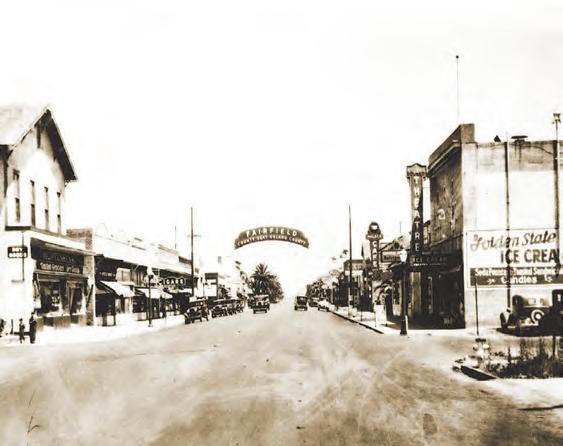
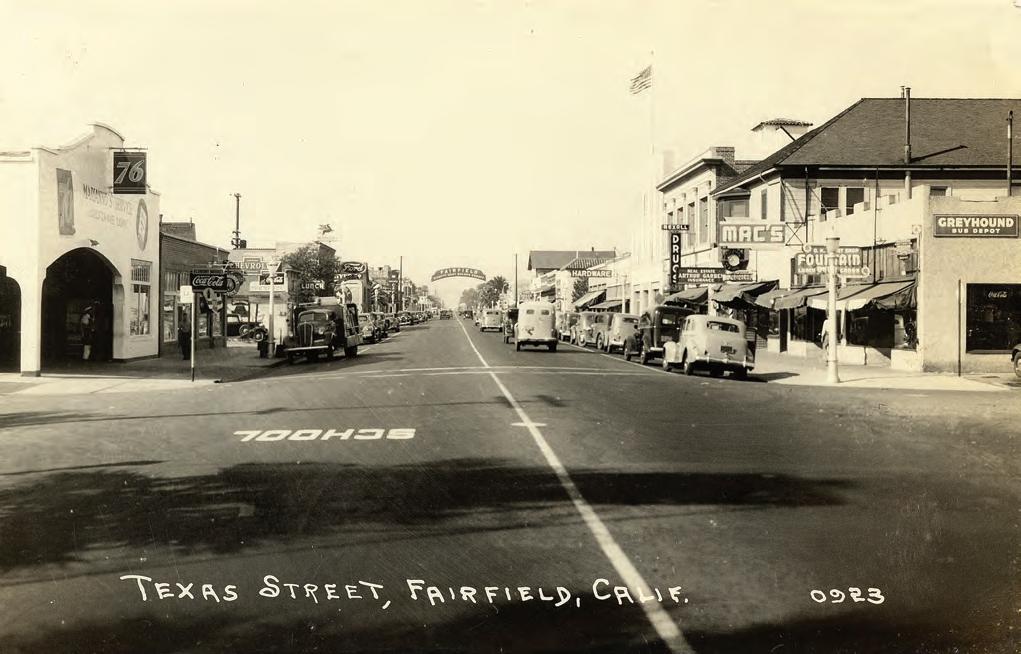
Long before the golden arches, there was the Fairfield arch.
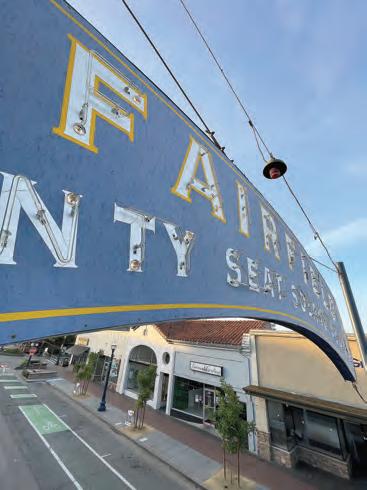
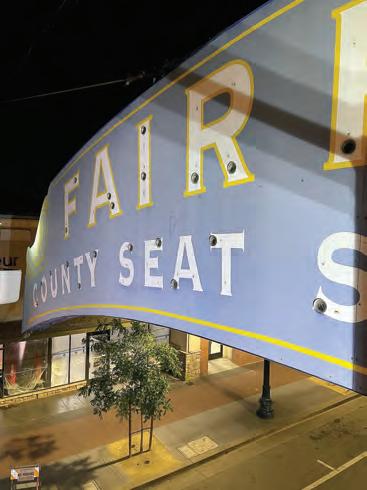
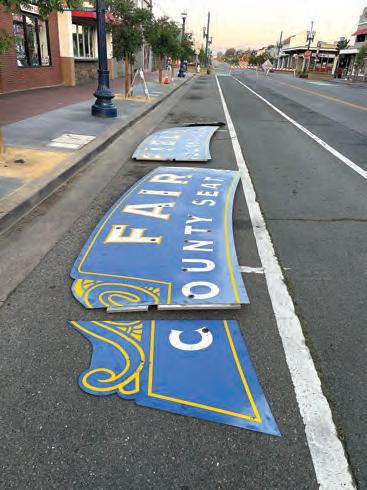
Originally constructed in 1925, the downtown landmark has survived, but was beginning to show its age up close.
A few weeks ago, it was removed from the landscape and carefully transported to YESCO signs in Sacramento for a revamp.
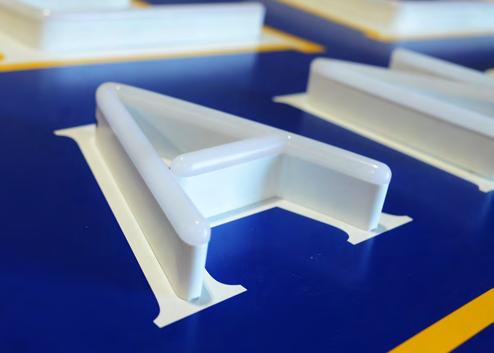
A closer examination revealed wear and tear, and damage, to the panels. New ones have been fabricated.
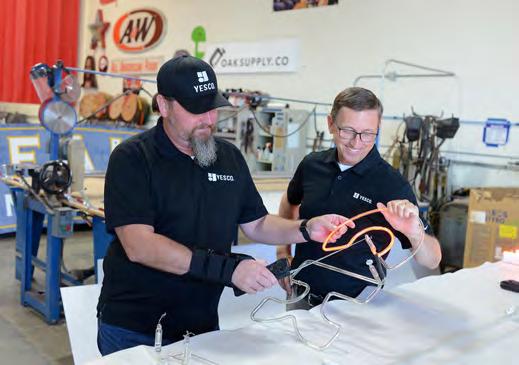
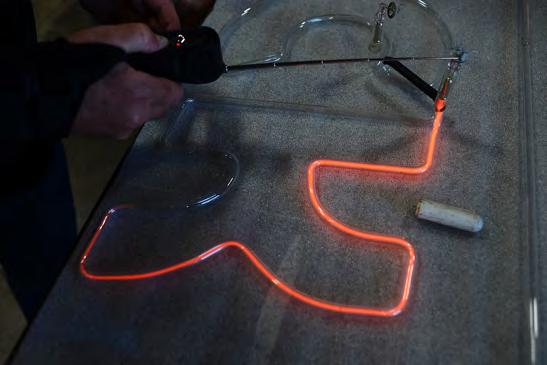
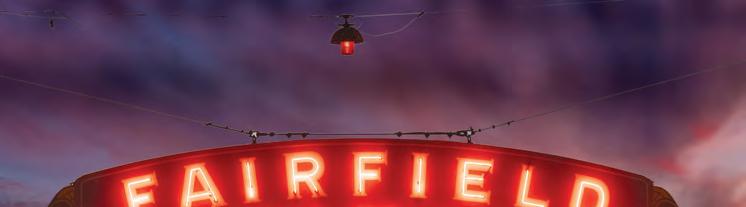
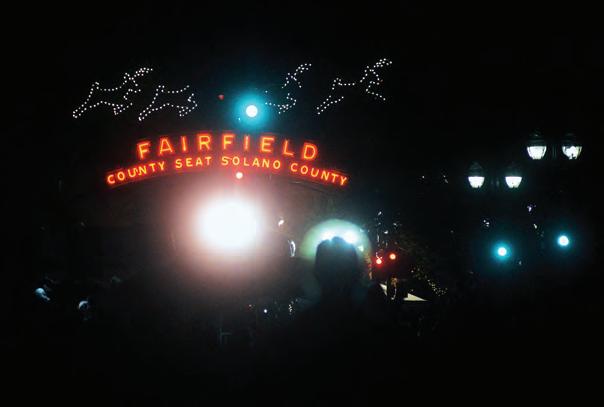
The neon lights are gone and
replaced by LED.
“Neon is amazing but its got its got its drawbacks,” said Jeffrey Young, executive vice president and chief revenue officer of YESCO, during a recent visit to the Sacramento shop where the the reconstruction is happening.
“The design is more true to the original,” he said. “We try to be as true as we can.”
In the shop area, there are large work tables with the different panels in different stages. A first glance reveals a much brighter blue on the panels and more
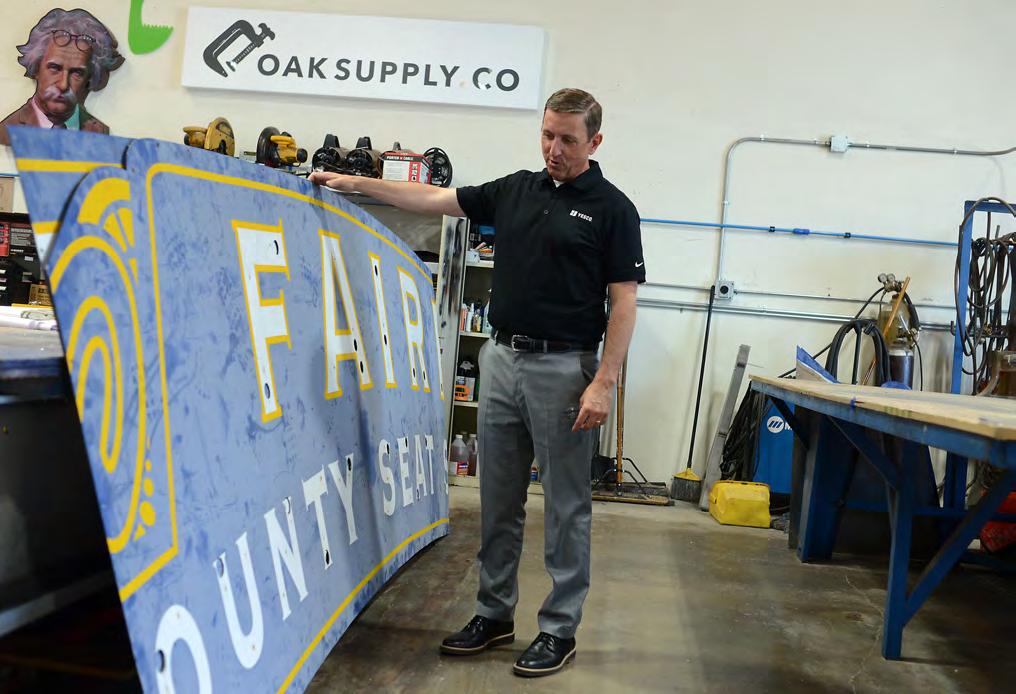
Jeffrey Young, executive vice president and chief revenue officer of YESCO, looks at the original Fairfield arch at YESCO in Sacramento.
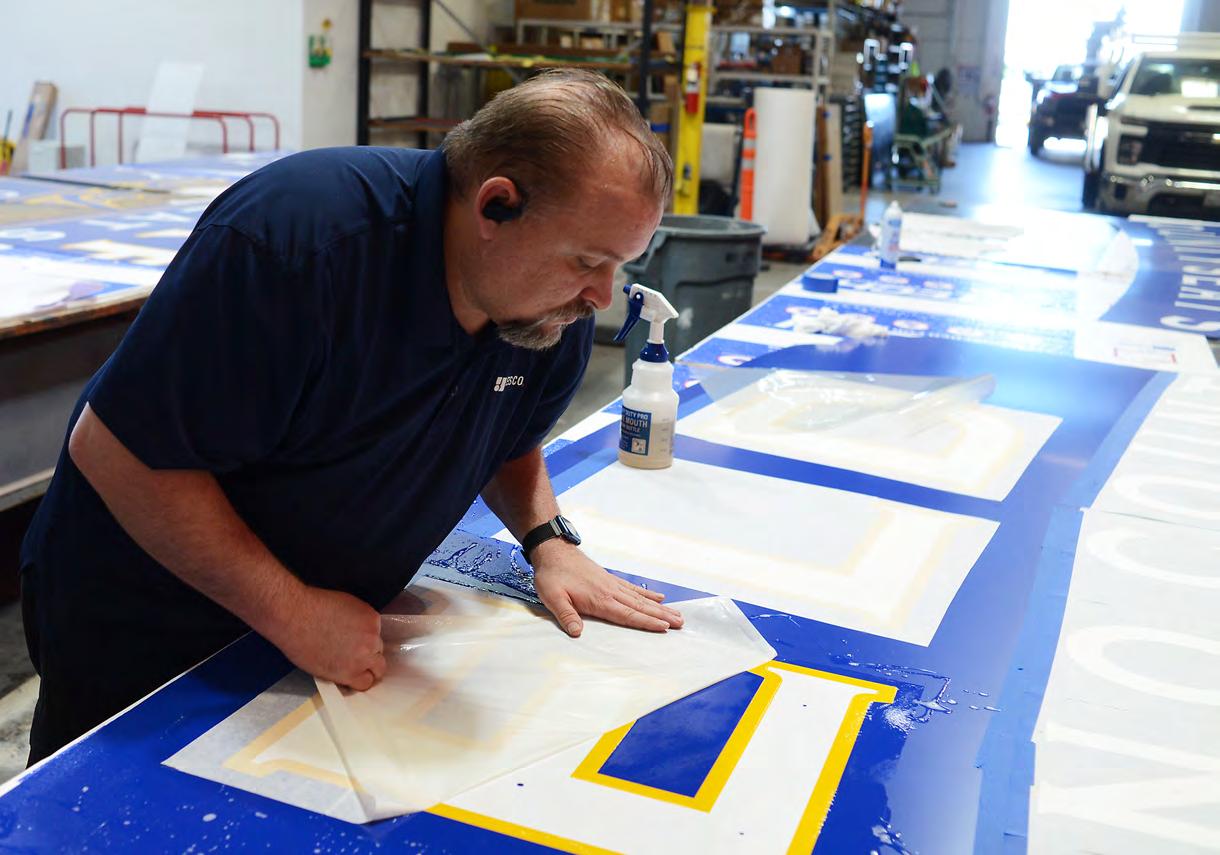
distinctive letters.
The old panels sit on the floor and have shoe prints on them as well as a chalky look.
Young noted that YESCO did not build the original sign but was in business at the time. The company marked its 100th anniversary in 2020. It’s operated by the third generation of the family.
Young believes this is the oldest arch his company has worked on. He considers it an honor and is impressed that the project is funded by community donations.
“We love this archway,” Young said. “It means so much to the community.”
Not only as part of history, but the fact illuminated signs are looked at twice as often than those not lit, he said.
There are other YESCO projects in Fairfield. The most recent is the signage on Valley Strong Credit Union on Nelson Road, which faces Interstate 80.
The restored arch will be lit up at 10 a.m. as the annual parade begins its march. There are plans in place to avoid a Clark Griswold moment as in “Christmas Vacation,” where the flip is switched and nothing lights up. Extra
power supplies will be on hand. A test run is planned a few days prior.
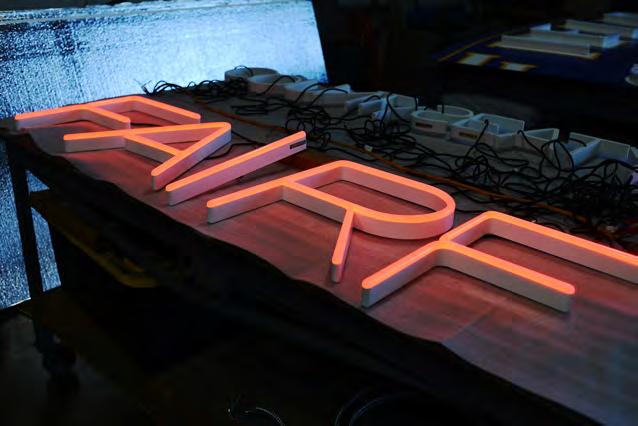
Young emphasized the red letters will not look a true very cherry red, because LED mimics neon.
“It’s going to look so pretty,” Young said.
“It’s obviously a better-looking product compared to what came in here,” said Jim Miller, production lead for the new Fairfield arch. It’s the first arch he has worked on.
The Lions Club gathered the $1,000 funds needed for the original construction. Again, they stepped forward to lead efforts to preserve and restore it.
At the June 16 City Council meeting the club presented a check to the city for $100,000 for the project.
The Fairfield Lions Club worked in partnership with the city of Fairfield, local businesses, community organizations and residents to secure the funding for the structure’s restoration.
“The Fairfield Lions Club has been woven into the fabric of this
community for more than a century,” Councilman Scott Tonnesen said. “From organizing community events like Easter egg hunts and supporting local youth to restoring the Fairfield Arch, their dedication to service and civic pride is unmatched. Their contributions demonstrate what can be accomplished when neighbors come together to invest in their community.”
Fairfield Lions Club representative Nancy Meadows presented the ceremonial check.
“When the Lions Club first raised $1,000 to install the Fairfield Arch in 1925, they planted a seed of
community pride that continues to grow today,” Meadows said. “We are proud to help restore this important community landmark and preserve its legacy for future generations. This achievement would not have been possible without the incredible generosity of our corporate partners and community supporters. Any funds raised beyond our goal will continue supporting local youth and senior programs.”
Premier sponsors recognized on the commemorative donor plaque include Ferrara Jelly Belly, Visit Fairfield, Joe and Sonny Basra –ARCO AM/PM, Medic Ambulance, Herman G. Rowland Sr., the Paul and Harjit Hayer Family - Bevbox, and the Hindu Sikh Community.
Fairfield is one of the cities across the country participating in America 250 that celebrates people, places and stories that define America’s past, present and future.
The restoration of the arch is the city’s commitment to the nation’s milestone. H
DAILY REPUBLIC STAFF
Community pride, preservation and a landmark approaching its second century
For nearly a century, it has stood as one of Fairfield’s most recognizable symbols.
Long before Fairfield became a city of more than 120,000 residents, before freeways crossed Solano County and before Travis Air Force Base became known around the world as the Gateway to the Pacific, a glowing sign stretched across Texas Street welcoming visitors into the heart of town.
The Fairfield Arch has never simply marked an entrance. It has announced a community. And for nearly 100 years, generations of residents have worked to
ensure that welcome remains.
The story begins in 1925.
Fairfield was a small but growing agricultural community, and Fairfield Lion leaders wanted a visible symbol that reflected local pride and optimism. The Fairfield Lions Club embraced the idea.
What followed was a nine-month fundraising campaign driven not by large donors, but by community effort. One of the earliest fundraisers involved a raffle for a donated washing machine. Residents contributed what they could, determined to create something lasting for their town.
The project soon became more
complicated than expected. Original support poles proved inadequate. Heavier iron poles had to be ordered from the East, increasing costs and creating new challenges for organizers.
Still, the community pressed forward.
By the time construction was complete, the sign had cost approximately $1,000 — a remarkable sum in 1925 and close to a full year’s wages for many workers.
The investment reflected how strongly Fairfield believed in the project. This was more than a sign. It was a statement about the future.
On Oct. 23, 1925, hundreds gathered downtown for the official


















1925 — The Fairfield Lions Club launches a nine-month fundraising campaign to build a civic gateway for downtown Fairfield.
Oct. 23, 1925 — Hundreds gather for the first lighting ceremony featuring speeches, local history readings and music from Tony Lawrence’s Twin Cities Band.
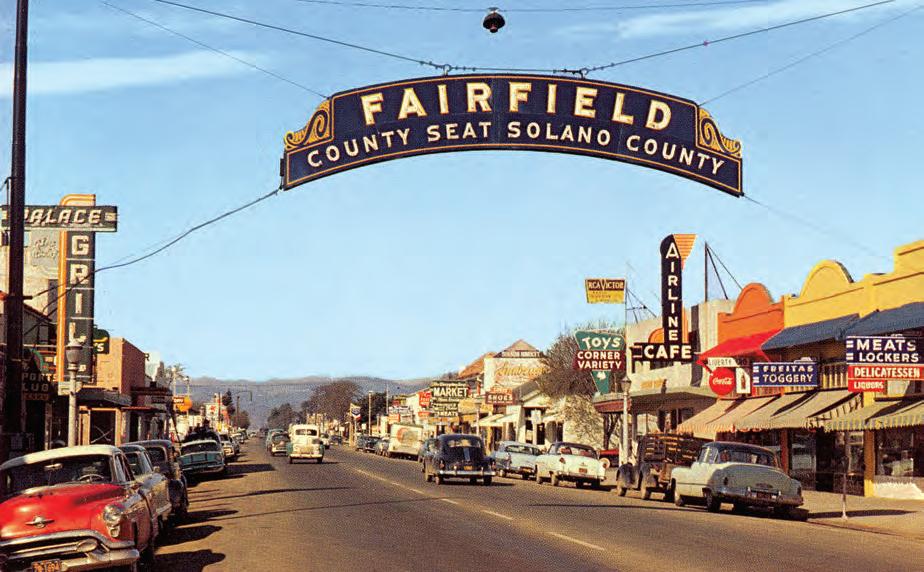
1925 — Construction costs reach approximately $1,000, close to a full year’s wages for many workers at the time.
1961 — A proposal to remove the arch sparks public opposition and is quickly abandoned.
1980s — The arch undergoes major refurbishment and repainting after years of exposure and deterioration.
1985 — The city of Fairfield purchases the landmark, ensuring its long-term preservation.
Late 1980s — Public support helps preserve the arch during downtown renovation discussions.
2025–2026 — A nearly $100,000 restoration project introduces modern LED lighting, structural improvements and a new generation of preservation.
2026 — As America celebrates its 250th anniversary, Fairfield’s arch approaches its own 100th birthday.
lighting ceremony.
The evening featured speeches, a reading of Fairfield’s history and music performed by Tony Lawrence’s Twin Cities Band. Residents from Fairfield and neighboring Suisun joined together beneath the newly illuminated arch as the lights came alive for the first time.
The ceremony marked more than the unveiling of a civic landmark. It celebrated a community coming together to create something larger than itself.
Few in attendance could have imagined that the structure would still stand nearly a century later.
As Fairfield evolved through the decades, the arch remained a constant.
Automobiles replaced horsedrawn vehicles. New neighborhoods appeared. Businesses opened and closed. Generations came and went. Yet photographs from every era show the arch standing watch over downtown. It appeared in postcards, family photographs and community celebrations. Residents used it as a landmark and visitors recognized it
as a symbol of arrival.
The sign became woven into Fairfield’s identity. For many longtime residents, it represented home.
Like many historic landmarks, the arch faced moments when its future seemed uncertain.
In 1961, a proposal surfaced that would have removed the structure entirely. Public reaction was swift. Residents objected strongly and the idea was quickly abandoned.
The community had spoken. The arch mattered.
Years later, the sign again showed signs of age and deterioration. During the 1980s, it underwent significant refurbishment, including repainting and restoration work intended to preserve the structure for future generations.
In 1985, the City of Fairfield purchased the arch for less than the Lions Club had paid to construct it sixty years earlier. The acquisition provided long-term protection for one of the city’s most recognizable landmarks and ensured that stewardship would continue into
the future.
Another preservation effort in the late 1980s emerged during downtown improvement discussions. Once again, public support helped ensure the arch remained part of Fairfield’s landscape. Time after time, residents chose preservation over removal.
Today, the arch stands on the threshold of its second century.
Yet nearly 100 years of exposure to weather, changing technology and everyday wear have taken their toll.
Current restoration efforts are estimated at approximately $100,000 and include crane work to remove and reinstall the double-sided sign, disposal of aging neon materials, cleaning and repainting by a local professional contractor, installation of new LED lighting systems, modern power supplies, specialized electrical components,
prevailing-wage labor and sales tax. Lane closure costs will be covered separately by the city of Fairfield.
The work reflects far more than routine maintenance. It represents a commitment to preserving a visible connection between Fairfield’s past and future.
While the original builders relied on neon technology and early twentieth-century construction methods, today’s restoration
incorporates modern lighting, contemporary safety standards and specialized craftsmanship designed to ensure the arch remains a community landmark for decades to come.
The Fairfield Arch has survived because generations of residents chose not to let it disappear. They raised money. They defended it. They restored it. They passed its story forward.
As America celebrates its 250th anniversary, the arch offers a powerful reminder that history is not preserved by accident. Communities decide what is worth saving.
For nearly a century, Fairfield has repeatedly made that choice.
The result stands above Texas Street today. A welcome. A landmark. A symbol. And a reminder that Fairfield’s story is still being written. H
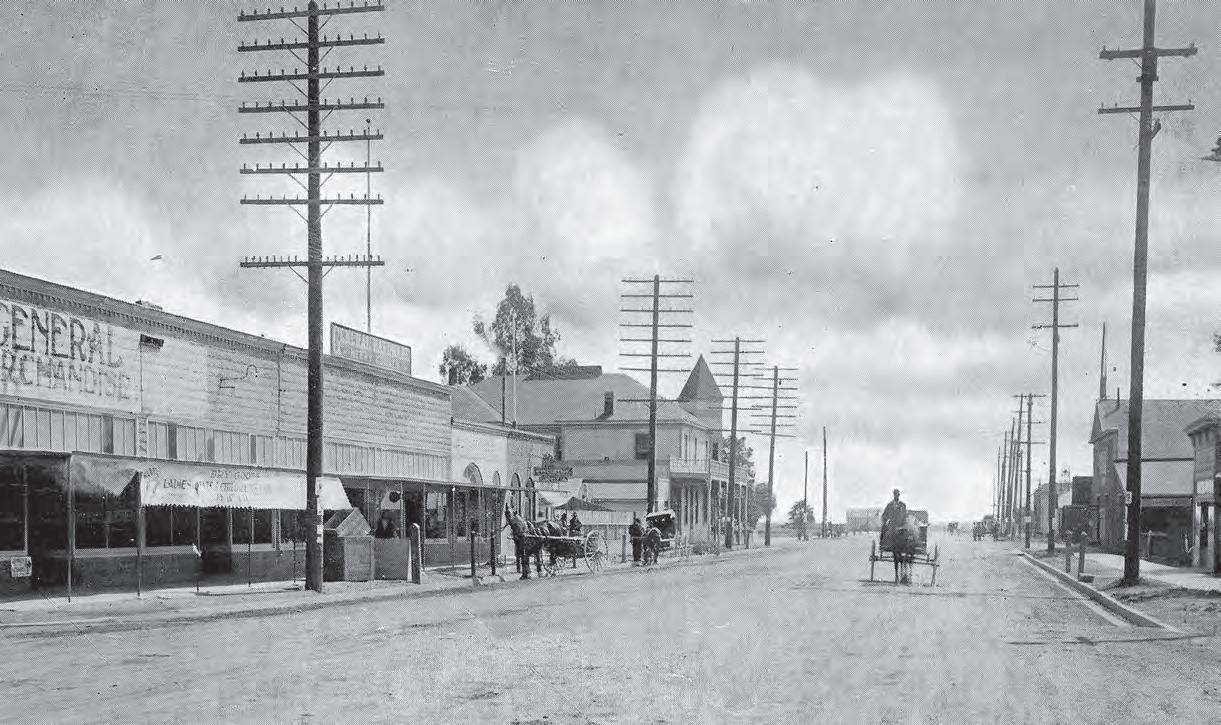
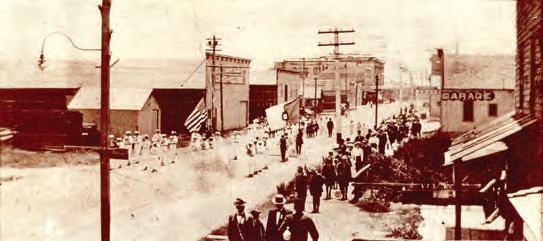
This photo was captured in 1911, shortly after the town raised enough funds to grade the street and install sidewalks. In the fading era of horse and buggy transportation, hitching posts were an essential feature. CITY OF FAIRFIELD
Every city has a beginning. Some begin around water. Some begin with industry. Some grow where roads meet, where rail lines stop or where opportunity gathers enough people to form a town.
Fairfield began with a vision. In the middle of the 19th century, California was still defining itself. The Gold Rush had transformed the state. New communities were appearing across the map. Ranchlands, farms, ports and transportation corridors were reshaping the region. In Solano County, a sea captain named Robert H. Waterman looked at the rolling land between the Bay Area and Sacramento and saw the possibility of a city.
Waterman had spent much of his life moving across oceans. He understood routes, trade, timing and the importance of location. In 1856, he established a new community and gave it a name from his own past: Fairfield, after his home-
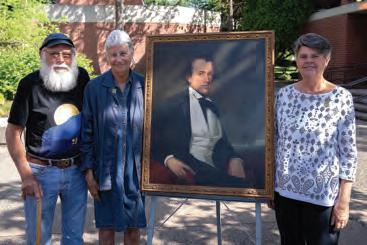
town in Connecticut.
The name carried memory. The location carried promise.
Long before Fairfield appeared on any map, the region was home to Native peoples whose lives were deeply connected to the land, water and seasonal rhythms of what is now Solano County.



• Clipper ship captain and early California settler.
• Founded Fairfield in 1856.
• Named the town after Fairfield, Connecticut.
• Helped position the community as the county seat through a land donation.
The landscape they knew was open and dynamic. Grasslands, oak woodlands, creeks, marshes and hills shaped the movement of people and animals. Food, shelter and culture were tied to local ecosystems and long-established knowledge of place.
Any story of Fairfield begins there, before streets and county buildings, before ranches and


railroads, before the city took its name. The later transformation of the region into a town, county seat and modern city took place on land with a much deeper human history.
Robert Waterman’s role in Fairfield’s founding gives the city one of its most distinctive origin stories.
He was not simply a land speculator looking for a place to divide parcels. He was a clipper ship captain who had seen the world and understood how geography could shape destiny. The city he founded sat in a position that would prove increasingly valuable: near agricultural land, within reach of transportation routes and close enough to larger regional centers to benefit from their growth.
Fairfield’s early promise was strengthened by Waterman’s decision to donate land for public purposes, helping position the young town as the county seat.
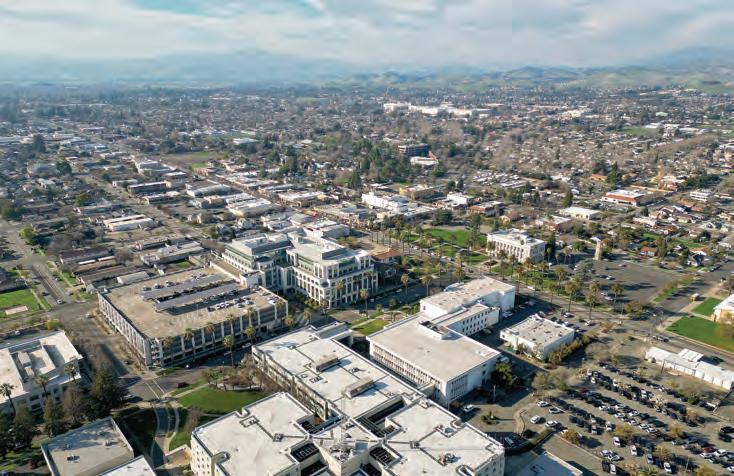
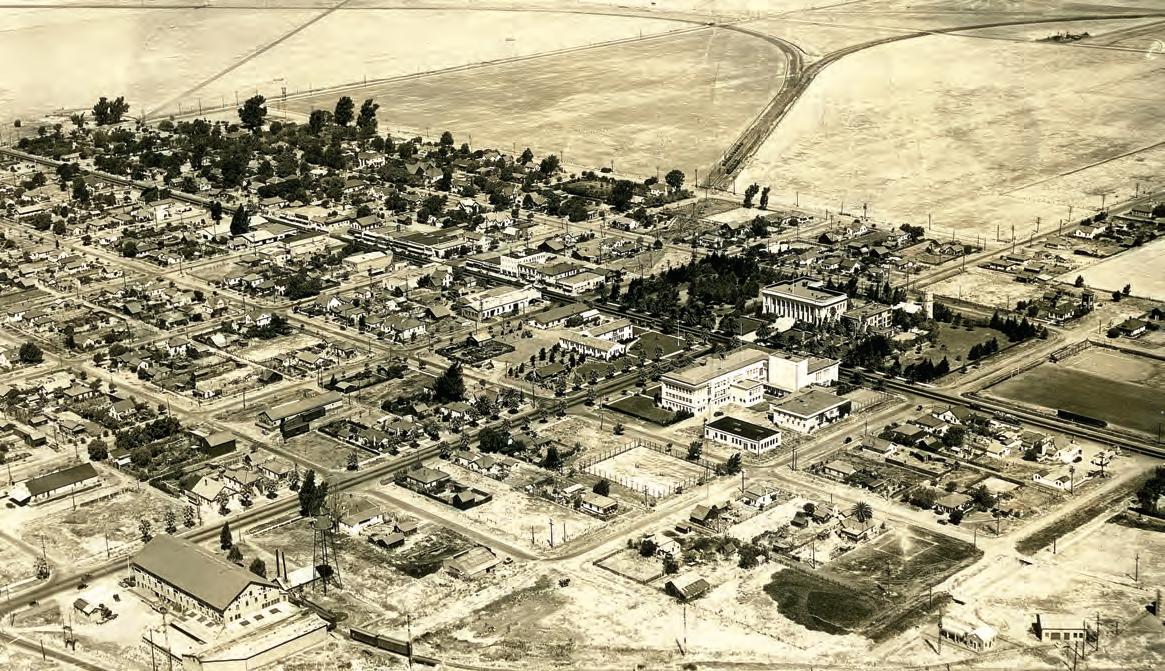
A low flight in 1938, top, depicts the early infrastructure and layout of the downtown and now. Fairfield now has a population nearing 121,000.
That act was both civic and strategic. It gave Fairfield an institutional role that helped anchor its future.
A town can grow because people live there. A county seat grows because people throughout a region need to come there.
Fairfield’s early development was rooted in the land. Farms, ranches, orchards and vineyards shaped the region’s
economy and identity. The fertile soils and favorable climate supported a variety of agricultural uses, while nearby communities such as Cordelia, Green Valley and Suisun Valley added their own layers to the region’s rural character.
Agriculture did more than produce crops. It created patterns of work, settlement and community life. Families built homes near fields and ranches. Roads connected farms to markets. Seasonal rhythms influenced business, school and civic life.
The surrounding landscape helped give Fairfield a practical, grounded identity. Even as the city grew, its agricultural surroundings remained part of how residents understood the place they lived.
Fairfield’s growth also depended on movement.
No community develops in isolation, and Fairfield benefited from its position between major Northern California destinations. Roads, rail lines and later highways connected the city to Sacramento, San Francisco, the Bay Area and the broader region.
Transportation brought goods, visitors, workers, soldiers, families and ideas. It helped transform Fairfield from a small settlement into a center of commerce and public life.
Nearby Cordelia played an important role in this transportation story. Before modern freeways and suburban growth, it served
travelers moving through the region, offering services, rest and connection. The history of Cordelia reminds us that Fairfield’s development was never only about one town center. It was shaped by a network of places, roads and communities.
Becoming the county seat gave Fairfield a civic role that continues to define it.
Government offices, courts, public services and regional institutions brought people into the city and reinforced its importance beyond its own boundaries. Fairfield became a place where decisions were made, records kept and civic life organized.
That role helped shape downtown and gave the city a sense of purpose. Fairfield was not only a place to live; it was a place that served the broader county.
That civic identity remains part of the city today.
The 20th century brought another defining force: military service.
What became Travis Air Force Base changed Fairfield profoundly. Originally tied to World War II military needs, the installation grew into one of the nation’s most important air mobility bases. Its presence brought military families from across the country and around the world, adding new dimensions to the city’s culture, economy and identity.
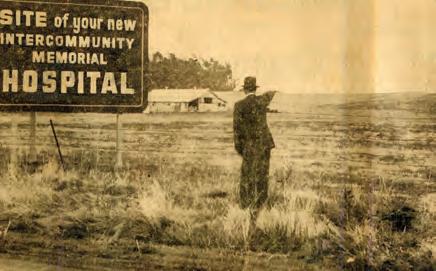
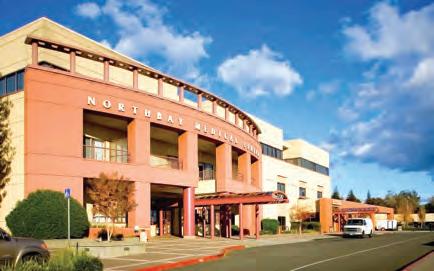
A community-driven effort was made in 1955 to establish a new hospital in Fairfield to accommodate a growing population. Intercommunity Memorial Hospital opened in 1960. It became NorthBay Medical Center in 1986.
The base connected Fairfield to national and global events in a way few communities experience so directly. Humanitarian missions, military operations and global logistics became part of the city’s everyday soundscape. Aircraft overhead were not background noise alone; they were reminders of Fairfield’s role in a larger mission.
Modern Fairfield is the result of all these layers.
It is a city shaped by Native history, maritime ambition, agriculture, transportation, government, military service, population growth and community pride. It has changed dramatically since Waterman’s time. New neighborhoods have spread across former open land. Businesses have expanded. Schools, parks and civic institutions serve a far larger and more diverse population. Yet the city’s story remains connected to its beginnings.
Fairfield’s history reflects themes that also define the American experience: opportunity, migration, service, adaptation, work, growth and the ongoing challenge of building community across generations.
That is why Fairfield’s story belongs in a publication marking America’s 250th anniversary.
The national story is not only told in Philadelphia, Washington or on battlefields. It is told in communities that grew, changed and endured.
Fairfield is one of those communities. H
Every city has official history. It appears in founding dates, civic records, museum displays and public markers.
But cities also have hidden histories: stories that survive in local memory, old photographs, unusual landmarks, neighborhood legends and the names of places people pass every day without knowing what came before.
Fairfield is full of those stories. They reveal a city more surprising than many residents realize. A clipper ship captain. A town that changed its name for love. A wild railroad settlement. A quarry that helped build another city. A vanished company town. Vineyards that predate Napa’s fame. A schoolhouse beneath an old oak. A water tower children imagined as a castle.
Together, these stories help explain why Fairfield’s past is richer than a simple timeline can show.
Robert Waterman gives Fairfield a founder with a story worthy of a novel.
Before he established the city in 1856, Waterman was known as a clipper ship captain. His life at sea connected him to a world of trade, travel and risk. He understood
movement and opportunity, two forces that would also shape the community he founded.
When Waterman named Fairfield after his Connecticut hometown, he gave the new community both a personal connection and a civic identity. His decision to help secure land for public use strengthened Fairfield’s future as the county seat.
The city’s origin, then, is not only a story of land development. It is a story of memory, ambition and place.
Before Fairfield became the dominant name in the area, Waterman had tried to develop another settlement: Bridgeport.
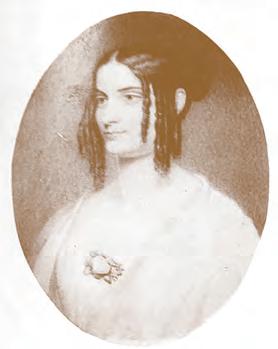
When postal officials required a more distinctive name, Waterman renamed it Cordelia in honor of his wife. The name remains one of the most personal details in the region’s early history.
gave Cordelia a character distinct from Fairfield’s civic role.
Today, Cordelia’s history reminds us that the Fairfield area was shaped by more than one center of life. It was a network of settlements, travelers, workers, ranchers and businesses tied together by roads, rail and geography.
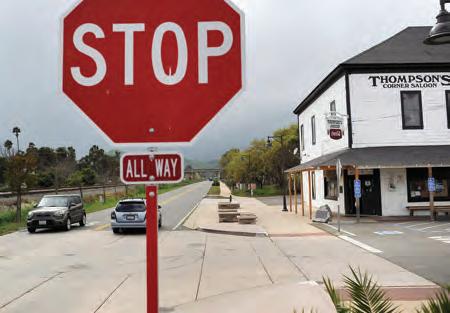
Some landmarks survive because they continue to be used. Thompson’s Corner Saloon, built in 1902 by Henry Studer, stands as one of the oldest operating bars in Solano County. Its two-story building, wraparound porch and history as a gathering place link it to an earlier era of travel, work and entertainment on the edge of the Suisun Marsh.
Cordelia later developed a reputation as a lively railroad town. Stories describe cowboys from Cody Hill riding into town and firing into the night air, while the community supported its own newspaper, the X-ray. That energy
Places like Thompson’s Corner matter because they make history tangible. They are not reconstructed memories. They are physical spaces where generations have gathered, talked, celebrated and passed through.
Fairfield’s hills once helped build
a much larger city.
In and around Cordelia, workers cut paving stones from local rock and shipped them by barge to San Francisco. Those stones became part of the early urban infrastructure of one of America’s most famous cities.
It is a striking connection: material taken from the Fairfield area helping shape streets across the bay.
The story reveals how rural landscapes and industrial labor supported California’s urban growth. Fairfield was not isolated from the rise of the Bay Area. Its resources, workers and geography were part of that larger transformation.
Northern California wine history is often told through Napa Valley, but the Fairfield area has its own deep roots in winemaking.
Cordelia and Suisun Valley became important agricultural areas where cherries and grapevines thrived. Local winemakers were shipping barrels to San Francisco in the 1860s, long before Napa became the dominant name in California wine tourism.
Today, Suisun Valley’s wineries are gaining renewed attention, but the region’s wine story is not new. It is a continuation of agricultural knowledge, immigrant traditions, favorable climate and local persistence.
The vineyards around Fairfield are not just scenic. They are historical.
The land that became Green Valley Country Club carries connections to one of California’s most dramatic chapters.
The site was once associated with the Swift family and a large 1850s stone estate. Granville Swift, connected to the Bear Flag Revolt,
is part of the region’s lore and links Fairfield-area history to California’s transition into American control.
Stories like this remind readers that Fairfield’s local history intersects with state history in unexpected ways. The landscape around the city holds traces of ranching, politics, settlement and identity formation that shaped California itself.
Constructed in 1883, the Green Valley Schoolhouse is among the region’s most important educational landmarks.
The building served country children for more than four decades, closing as a schoolhouse in 1926. Its one-room setting reflects a very different educational world, where multiple ages learned together and schools often doubled as community gathering places.
The schoolhouse also represents the importance rural families placed on education. Even in scattered agricultural communities, schooling helped bind families to a shared future.
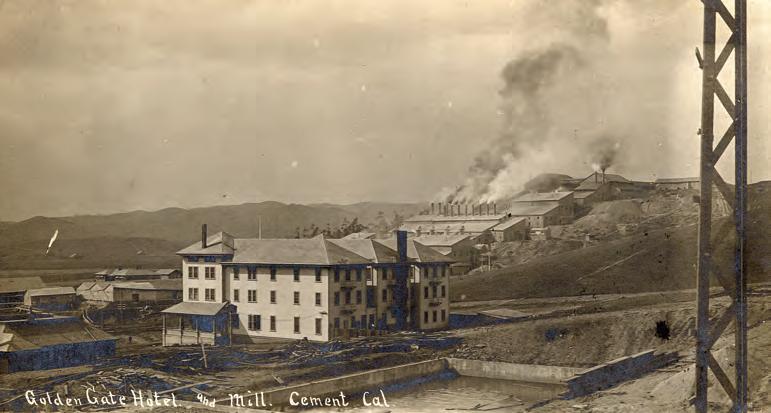
Cement, California, sounds almost invented, but it was once a busy company town.
Built in 1902 around cement production, the town included homes, a hotel, a theater, a meat market and modern lights. Work at the mill was difficult and dusty. White powder coated buildings, trees, grass and people.
When the local rock supply ran out in the 1920s, the company closed the plant. Houses were moved away, and the once-active settlement faded into ghost town memory.
Today, the old ruins remain part of Fairfield’s hidden landscape. The story of Cement is a reminder that not every community lasts, even when it once seemed permanent.
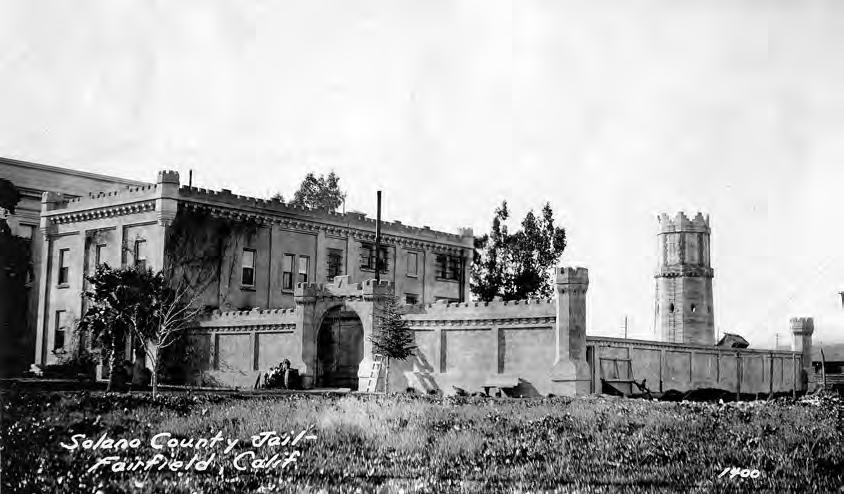
Near Armijo High School stands a stone water tower built in 1919. For generations of local children, it looked less like infrastructure and more like something from a storybook. Its stone walls and distinctive shape earned it a nickname: the Castle.
The Castle shows how landmarks gain meaning beyond their original function. Built to serve a practical purpose, it became part of neighborhood imagination. Children gave it mystery. Families used it as a reference point. Residents folded it into the city’s visual identity.
That is how local history often works. A structure becomes a story because people decide it is one.
Fairfield’s modern identity also includes one of the country’s most recognizable candy names.
bringing visitors from across the region and beyond. The company’s connection to President Ronald Reagan and its playful factory tours made it one of Fairfield’s most widely known attractions.
The candy company may seem very different from clipper ships,
Fairfield’s evolution. It shows how the city continued to attract industries, visitors and new associations across generations.
Hidden histories change how people see familiar places.
A road becomes a former transportation corridor. A hill becomes a quarry landscape. A water tower becomes a castle. A valley becomes early wine country. A neighborhood edge becomes the memory of a vanished town.
These stories make Fairfield feel larger, older and more layered. They also remind us that communities are never only what they appear to be in the present. Beneath every modern city is another city made of memory, labor, ambition and change.
Fairfield’s hidden histories invite residents to look again. H

DAILY REPUBLIC STAFF
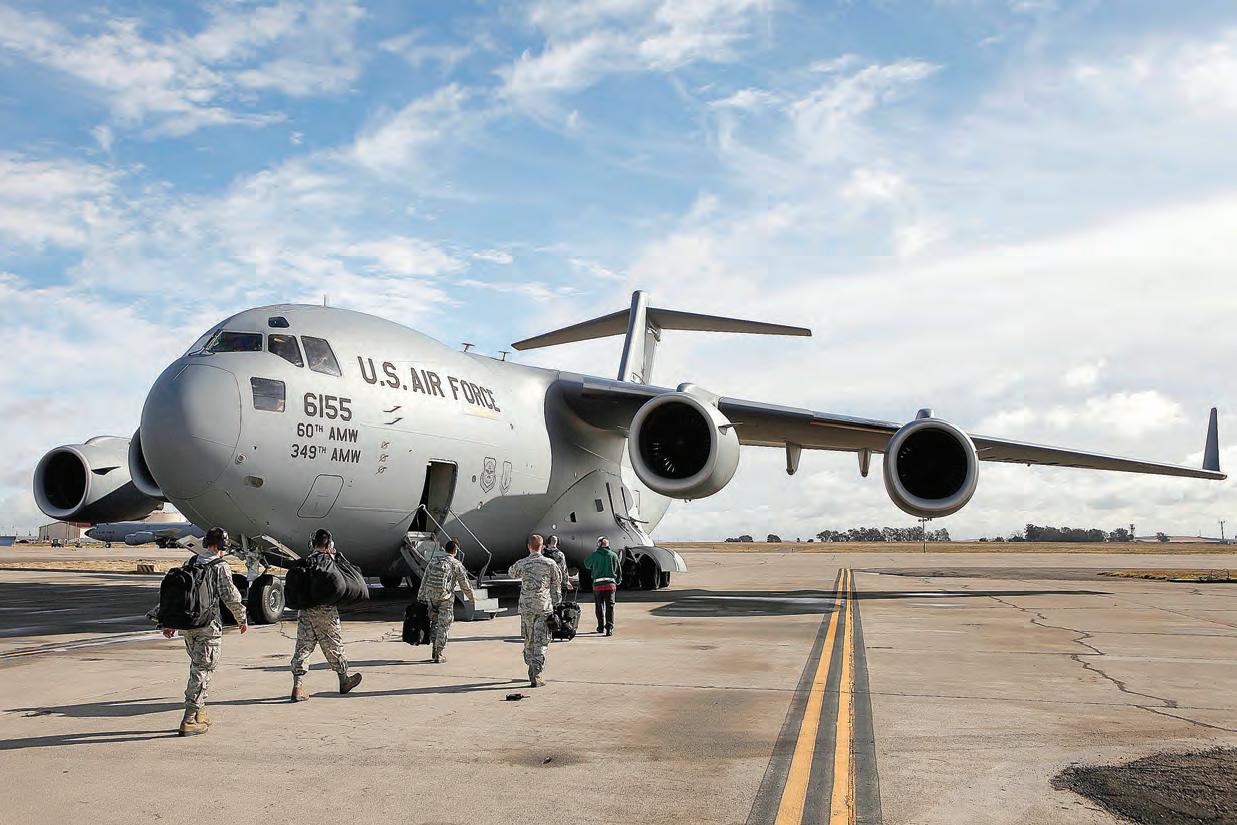
On any given day in Fairfield, the sound of aircraft can rise over neighborhoods, schools, shopping centers and open land. For visitors, it may be startling. For residents, it is familiar.
The aircraft are part of the city’s daily rhythm and part of its identity. They connect Fairfield to missions that reach across the
Pacific and around the world. They also connect the city to generations of military families who have lived, worked, served and built community here.
Few American cities are shaped as directly by military air mobility as Fairfield. Travis Air Force Base is not simply nearby. It is woven into the city’s economy, culture, history and sense of service.
The base traces its origins to World War II, when military planners needed installations capable of supporting the Pacific Theater. The Fairfield-Suisun location offered space, access and strategic value. What began as a wartime necessity grew into a permanent
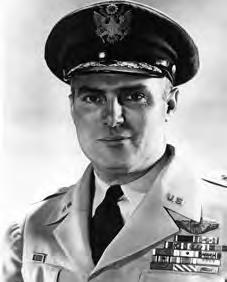
was the Commander, 5th Strategic Reconnaissance and 9th Bombardment Wings, FairfieldSuisun Air Force Base, California. As commander, he was responsible for the operations of both wings stationed at Fairfield-Suisun Air Force Base. On Aug. 5, 1950, Travis was killed in the crash of a B-29, 15 minutes after take off. Fairfield-Suisun Air Force Base was officially renamed Travis Air Force Base on Oct. 20, 1950, in honor of the base’s fallen commander.
and nationally significant installation. In the decades that followed, military aviation changed rapidly, and the need to move people, supplies and equipment across long distances became central to America’s global role.
Travis became one of the places where that mission took shape.
Travis Air Force Base is known as the Gateway to the Pacific, a title that reflects its global reach.
Aircraft connected to the base have supported military operations, humanitarian missions, disaster response and medical evacuation. When crises occur far from Fairfield, the response can begin here.
That connection gives the city an unusual place in the American story. Fairfield residents may live ordinary local lives, but their community is tied to extraordi-
nary global movement.
The mission at Travis represents service on a scale that can be difficult to comprehend until one sees the aircraft, meets the families or understands how many lives are touched by the base’s work.
The base’s greatest impact may be human.
For decades, military families from across the United States and around the world have called Fairfield home. Some stayed only for an assignment. Others retired here, raised children here or returned later because the community had become part of their lives.
They brought new cultures, traditions and experiences. They enrolled children in local schools, joined churches and service organizations, opened businesses, coached teams and





















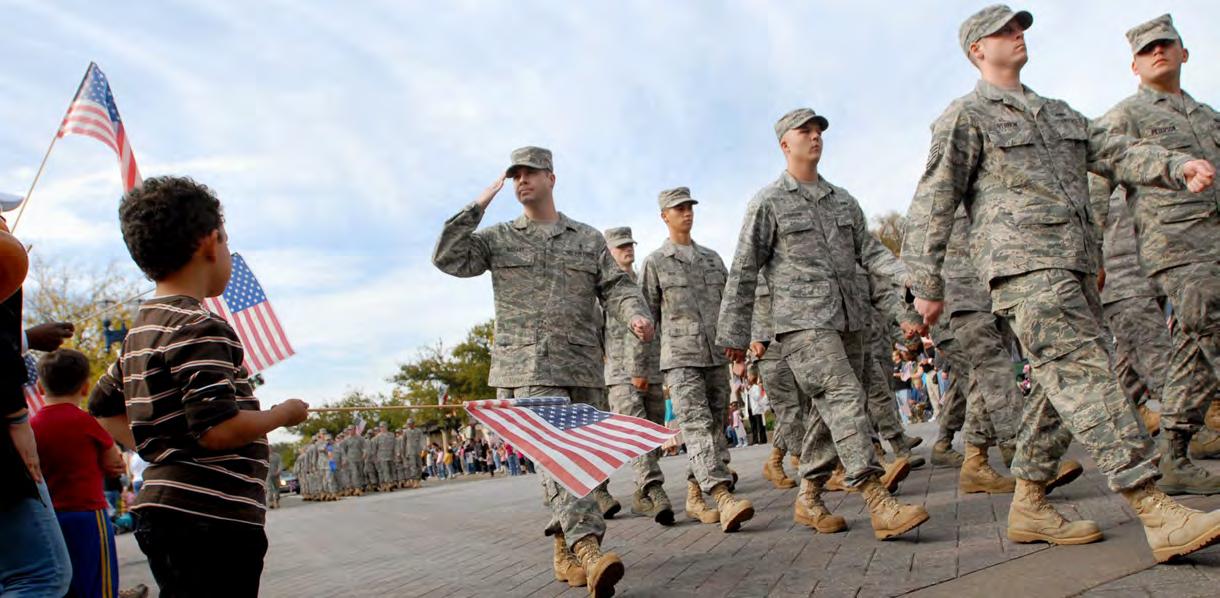
volunteered at events.
The relationship between Fairfield and Travis has always moved in both directions. The base supports the community, and the community supports the base.
Military service gives Fairfield a civic character distinct from many other cities.
Residents may have personal ties to active-duty service members, veterans, civilian employees, contractors or military families. For many, national service is not an abstraction. It is part of everyday life.
That presence shapes local ceremonies, school communities, business networks and neighborhood relationships. It also reinforces a culture of service that extends beyond the base itself. Volunteerism, civic pride and mutual support are strengthened when a community includes so many people accustomed to serving a mission larger than themselves.
One of the most powerful aspects of Travis Air Force Base is its role in humanitarian response. Military airlift is often associated with defense, but it also moves relief supplies, medical support and emergency resources during disasters. Earthquakes, storms, international crises and humanitarian emergencies can all require rapid movement across great distances.
For Fairfield, that means aircraft lifting off nearby may be carrying help to people the city will never meet.
That is a profound connection. It links a local community to global acts of assistance and underscores the idea that service can travel far beyond city limits.
The base also plays an enormous role in Fairfield’s economy. It supports jobs, housing demand, services, transportation needs and business activity. Its
presence influences planning, schools, infrastructure and longterm regional development.
But the relationship is not only economic. Travis gives Fairfield a national role and a shared identity. The phrase Gateway to the Pacific is not merely a military nickname. It is part of how Fairfield understands its place in the world.
As America commemorates 250 years, Fairfield’s connection to Travis highlights one of the city’s clearest links to the national story.
The base represents service, sacrifice, mobility, humanitarian response and global responsibility. It has helped shape Fairfield’s population, economy and civic culture.
Most American communities contribute to the nation in local ways. Fairfield does that, too. But through Travis Air Force Base, Fairfield also contributes to missions that reach around the world.
The aircraft may depart from a runway, but the story begins in a community. H
The people, places and traditions that define a community
A city is more than its founding date.
It is more than its boundaries, population counts or offi cial landmarks.
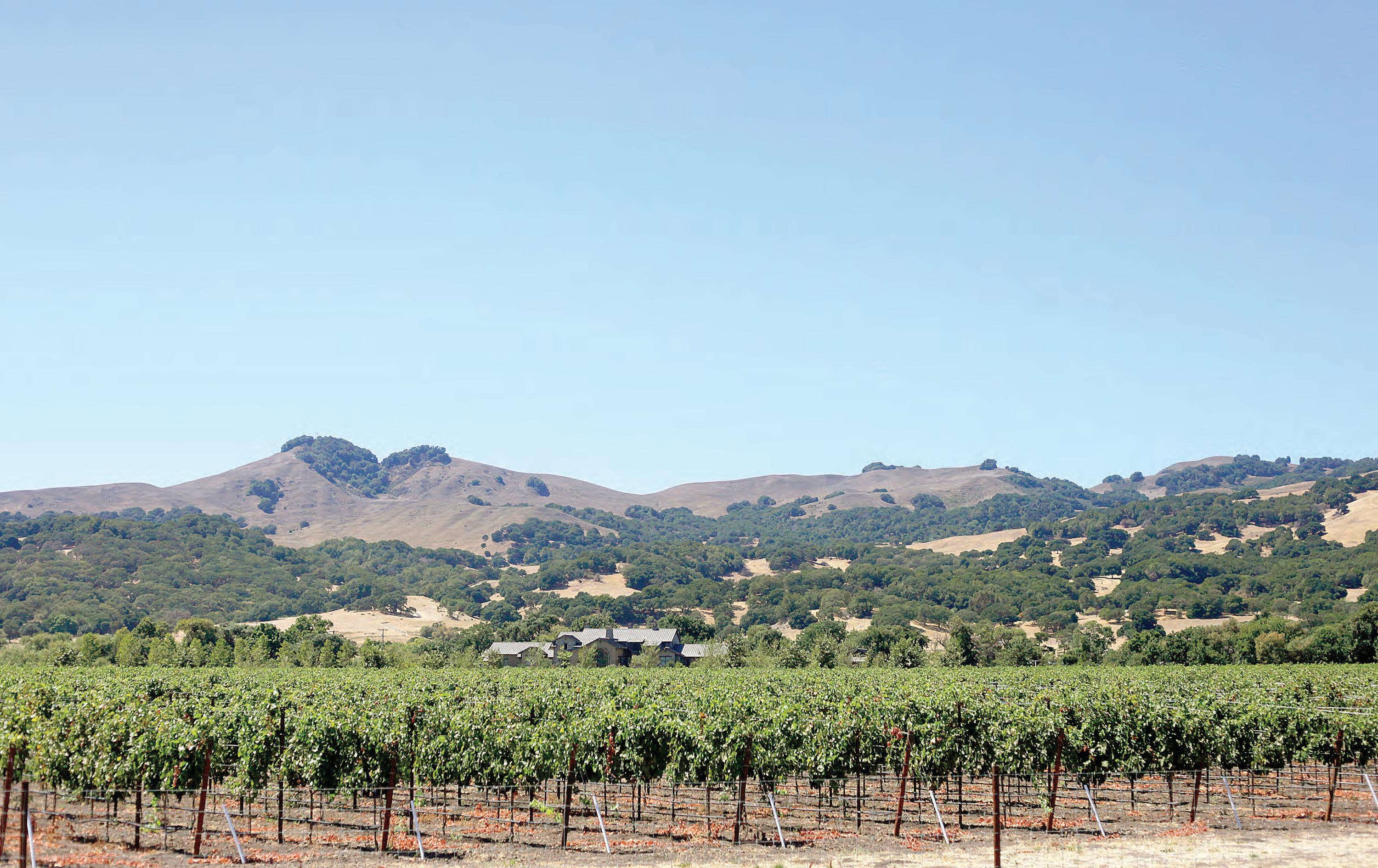
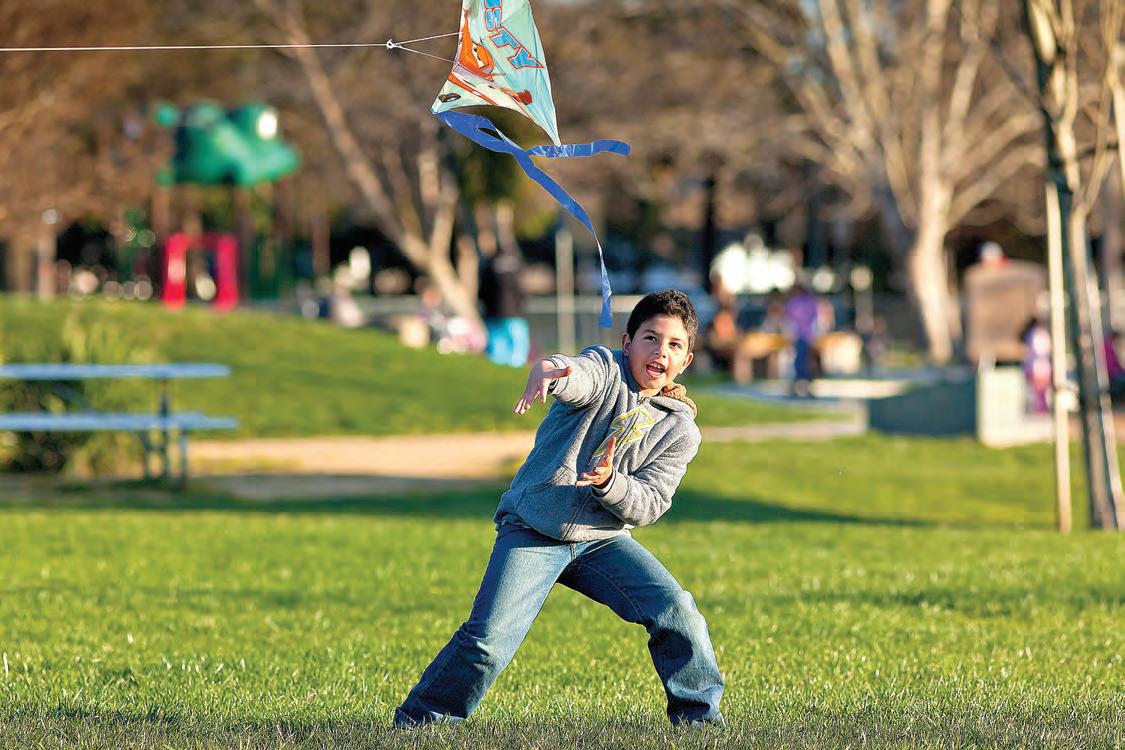
A city becomes home through small attachments: the park where children learned to ride bikes, the restaurant where families gather, the hill that glows at sunset, the parade route people return to each year, the school gym where genera tions cheered, the familiar sound of aircraft overhead.
That is why a list of reasons to love Fairfield should not read like a directory. It should read like a portrait.
The goal is not simply to name 100 places. The goal is to invite residents to recognize themselves in the city’s story.
• Friendly neighborhoods
• Local volunteers
• Service clubs
• Youth sports
• Generations of families
• Cultural diversity
• Military families
• Teachers and coaches
• Small business owners
• Residents who show up when the community needs them
Parks and outdoors
• Rockville Hills
• Linear Park Trail
• Allan Witt Park
• Green Valley open space
• Suisun Marsh access
• Neighborhood playgrounds
• Walking paths
• Cycling routes
• Scenic hillsides
• Big Solano County skies
• Suisun Valley wineries
• Family farms
• Farm stands
• Local restaurants
• Fresh produce
• Agricultural heritage
• Seasonal harvests
• Wine country views
• Weekend tastings
• The connection between city and surrounding countryside
• The Fairfield Arch
• Historic downtown
• Cordelia
• Green Valley Schoolhouse
• The Castle water tower
• The town of Cement
• Old transportation corridors
• County seat history
• Historic schools
• Stories hidden in familiar places
• Fourth of July festivities
• Downtown gatherings
• Parades
• Community fundraisers
• School events
• Veterans ceremonies
• Holiday traditions
• Local performances
• Family celebrations
• The rituals that make a city feel familiar
The most important reasons to love Fairfield may not appear on any official list.
They may be personal: a first home, a favorite teacher, a family business, a childhood street, a view from a hill, a team, a neighbor, a memory.
That is why this section should invite readers to contribute their own reasons. A community’s story is strongest when it includes many voices. H
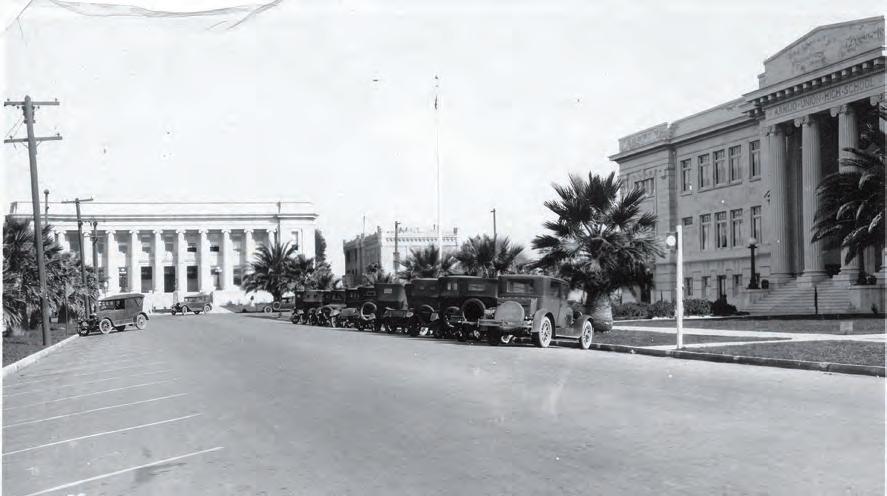
This photo captured the new County Government campus featuring the Solano County Courthouse as it appeared in the 1920s. The courthouse was dedicated on July 4, 1914, and the rest of the campus was dedicated the following year. CITY OF FAIRFIELD
DAILY REPUBLIC STAFF
Fairfield’s history is best understood not as a straight line, but as a series of layers.
Each generation added something: a townsite, a courthouse, a road, a school, a base, a neighborhood, a business, a tradition, a landmark restored for the next generation.
Robert H. Waterman establishes Fairfield in 1856 and names it after Fairfield, Connecticut. His land donation helps position the young town as the county seat, giving it a civic role that shapes its future.
Farms, ranches, vineyards, quarries and transportation routes define the region. Cordelia becomes a lively settlement, and surrounding valleys support agriculture and travel.
Downtown Fairfield grows. The arch becomes a civic symbol. Thompson’s Corner, the Green Valley Schoolhouse, the water tower and other landmarks become part of local memory.
World War II brings military activity that eventually leads to the growth of Travis Air Force Base, reshaping Fairfield’s identity and connecting the city to national and global missions.
New neighborhoods, schools, businesses and infrastructure reflect Fairfield’s rapid postwar expansion. Military families and civilian residents contribute to a more diverse and dynamic city.
Fairfield continues to grow as a regional center. Business development, tourism attractions, wine country recognition and civic investment expand the city’s profile.
Downtown revitalization, historic preservation and community projects reflect renewed interest in Fairfield’s identity. The
restoration of the Fairfield Arch becomes a visible symbol of that effort.
As the nation marks 250 years since the Declaration of Independence, Fairfield reflects on its own story within that larger American journey. The city enters a new chapter while honoring the people and places that shaped it. H












DAILY REPUBLIC STAFF
Anniversaries naturally turn our attention backward.
They ask us to remember. To preserve. To honor the people who built the communities we inherit.
But the best anniversaries also ask us to look forward.
Fairfield’s next chapter will not look exactly like its past. No city’s future ever does. The challenges will be different. The economy will change. Technology will reshape work and communication. New families will arrive. Young people will imagine possibilities older generations could not have predicted.
Yet the values that helped build Fairfield will remain important: service, resilience, opportunity, connection and care for place.
Fairfield is not finished.
That may be its greatest strength.
A city with room to evolve can welcome new ideas without abandoning its identity. Downtown investment, business development, parks, education, transportation and community partnerships will all shape what Fairfield becomes in the decades ahead.
The question is not whether Fairfield will change. It will.
The question is how the city will carry its history into that change.
The children growing up in Fairfield today will inherit a city shaped by choices made long before they were born. They will also make choices that future residents will one day inherit.
That is the quiet responsibility of community life.
Every restored landmark, every school, every park, every neighborhood tradition and every act of civic service becomes part of what the next generation receives.
The story of Fairfield’s future will be written by people who may not yet know they are writing it.
Preserving history does not mean freezing a city in time.
It means giving people the context they need to understand change. It means recognizing that progress is stronger when it grows from memory rather than erasing it.
The restored Fairfield Arch offers one example. It does not tell the whole story of the city, but it gives residents a visible reminder that the past can be renewed rather than discarded.
The same principle applies to Fairfield itself.
The city’s next chapter will be strongest if it remains connected to the people, landscapes and landmarks that made it what it is. H
















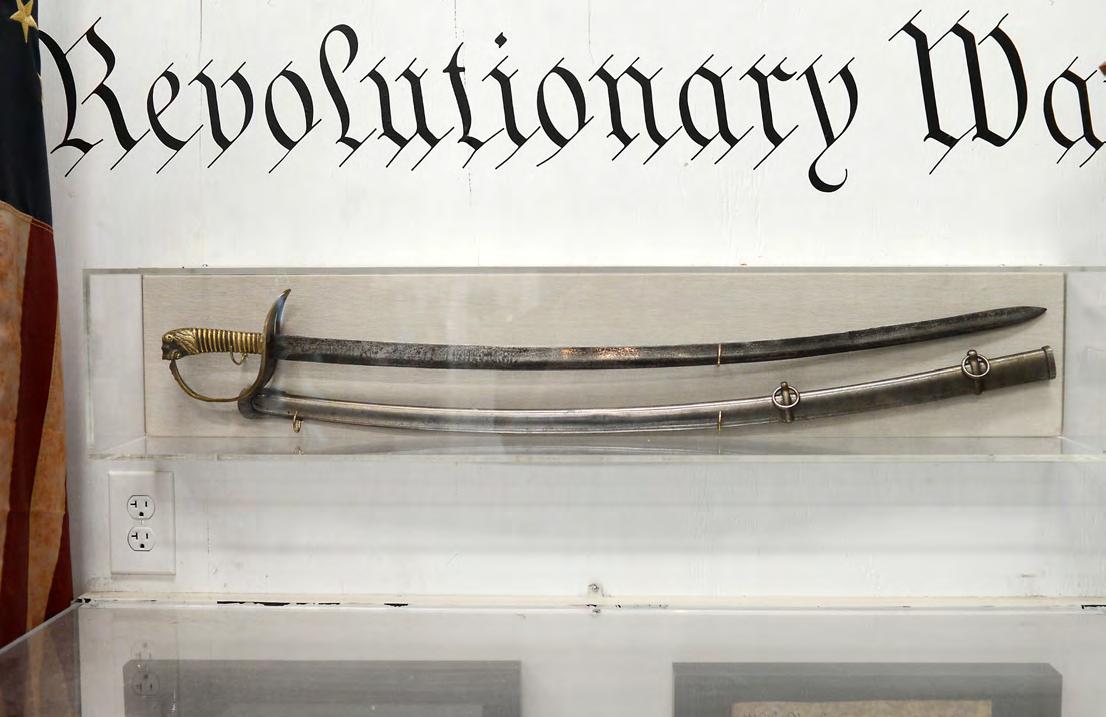
A Revolutionary War-era sword is on display at the Rowland Freedom Center in Vacaville. AARON
TODD
The United States is celebrating its 250th birthday on July 4 – a milestone marked by the then radical proclamation of a new nation declaring its independence. Thomas Jefferson wrote that nation would be built on “life,
liberty and the pursuit of happiness.”
A piece of that historic cradle of the country can be found at the Rowland Freedom Center, located at the Nut Tree Airport, where a post-Revolution-era American Light Horse sword is on display
with an assortment of other artifacts, including a Continental Army pay slip, and a George III 1775 halfpenny.
But it is the sword, with its lion-head pommel at the end of the hilt, that is the centerpiece of the display.
Of course, the concept of the United States would have truly been foreign to the inhabitants of what is now Solano County. In 1776, the area was mostly a natural landscape – home to the Patwin and Suisun Native American tribes.
While Spaniard Juan Rodríguez Cabrillo led the first European expedition up the Pacific coast in 1542, the focus then was primarily Baja California. It was Gaspar de Portolá, in the fall of 1769, who is credited as the first European to discover San Francisco Bay.
It would not be until 1844 that U.S. Army explorer John C. Frémont led a mapping expedition into the region.
So a celebration of American –that is, U.S. – history in the Solano County region is a celebration of artifacts and written histories and stories, mostly around the military presence.
One such story, tied directly back to the birth of the nation, is the burial of Anna Arnold Key Turner in the historic Mare Island Naval
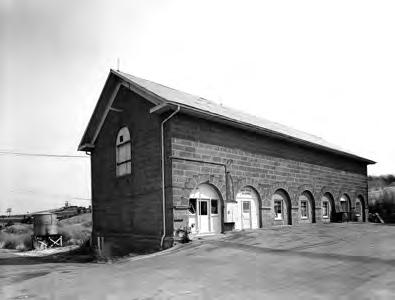
The Benicia Arsenal, Storehouses and Engine House, also known as Camel Barns Building Nos. 7, 8, 9.
LIBRARY OF CONGRESS
Cemetery. She was the daughter of Francis Scott Key, who wrote the American national anthem. She died in 1884, and is buried next to her husband, Daniel Turner, a naval officer who fought in the War of 1812.
• The oldest American military installation in Solano County, the Benicia Barracks and Arsenal, was the region’s major Army presence from the Gold Rush to the 1960s.
• Two months after California joined the Union on Sept. 9, 1850, Navy Commodore John Sloat urged President Millard Fillmore that the

new state badly needed a shipyard. In January 1853, the Navy bought Mare Island for $83,491, and the Mare Island Naval Shipyard became a key part of the U.S. Navy history on the West Coast.
• It was the fear, in the spring of 1861, that pro-Confederate secessionists had designs on taking over, or at least disrupting, the Union’s shipyard at Mare Island, which brought the Marine Corps there.
• What is now Travis Air Force Base was activated in 1943 as the Fairfield-Suisun Army Air Base, serving as a World War II transport base for the Pacific Theater. It was renamed in 1950 for Brig. Gen. Robert F. Travis after he died on Aug. 5, 1950 in a B-29 Superfortress crash at the base. Today, it is home to the 60th Air Mobility Wing and is the largest air mobility base in the U.S. Air Force.
More than a smattering of that ever-present, regional military history is on display at the Rowland Freedom Center, including a piece of the USS Arizona.




“You can go to Hawaii and see the Arizona, or you can come here and touch a piece of the Arizona,” said Paul Mirich, general manager of the Aviation and Military Museum.
A Medal of Honor bestowed on Army Lt. Orson Bennett – a white officer with the 102 U.S. Colored Troops during the American Civil War – is among the items on display. He accepted it on behalf of his unit. There are 96 Black members of the U.S. military who have received the Medal of Honor.
It was during a Militaria, G.I. Joe and Sci-Fi Toy Show that Mirich spotted a collection of swords being sold by a vendor.
When a friend of Mirich later saw the swords, he remarked, “I bet that cost you a pretty penny,” Mirich recalled, only to be surprised by the purchase price of $100 for three swords.
One turned out to be a Civil War Union sword; another is a 1906 Russian officer’s sword. But the prize piece is the early American sword.
“So it was in that (Revolution) era, so I put it on display,” Mirich said.
The Freedom Center is located at 300 County Airport Road, just inside the entrance to the county airport.
Former Daily Republic reporter Ian Thompson contributed to this report. H





















DAILY REPUBLIC STAFF
Solano County cities have a bevy of events planned to celebrate the nation’s 250th birthday.
The fun begins July 3 with the annual Torchlight Parade on First Street. It steps off at 6:30 p.m.
It’s followed by live music on The First Street Green at 8 p.m. East Bay Mudd will perform.
The day ends with a drone light show at 9:30 p.m.
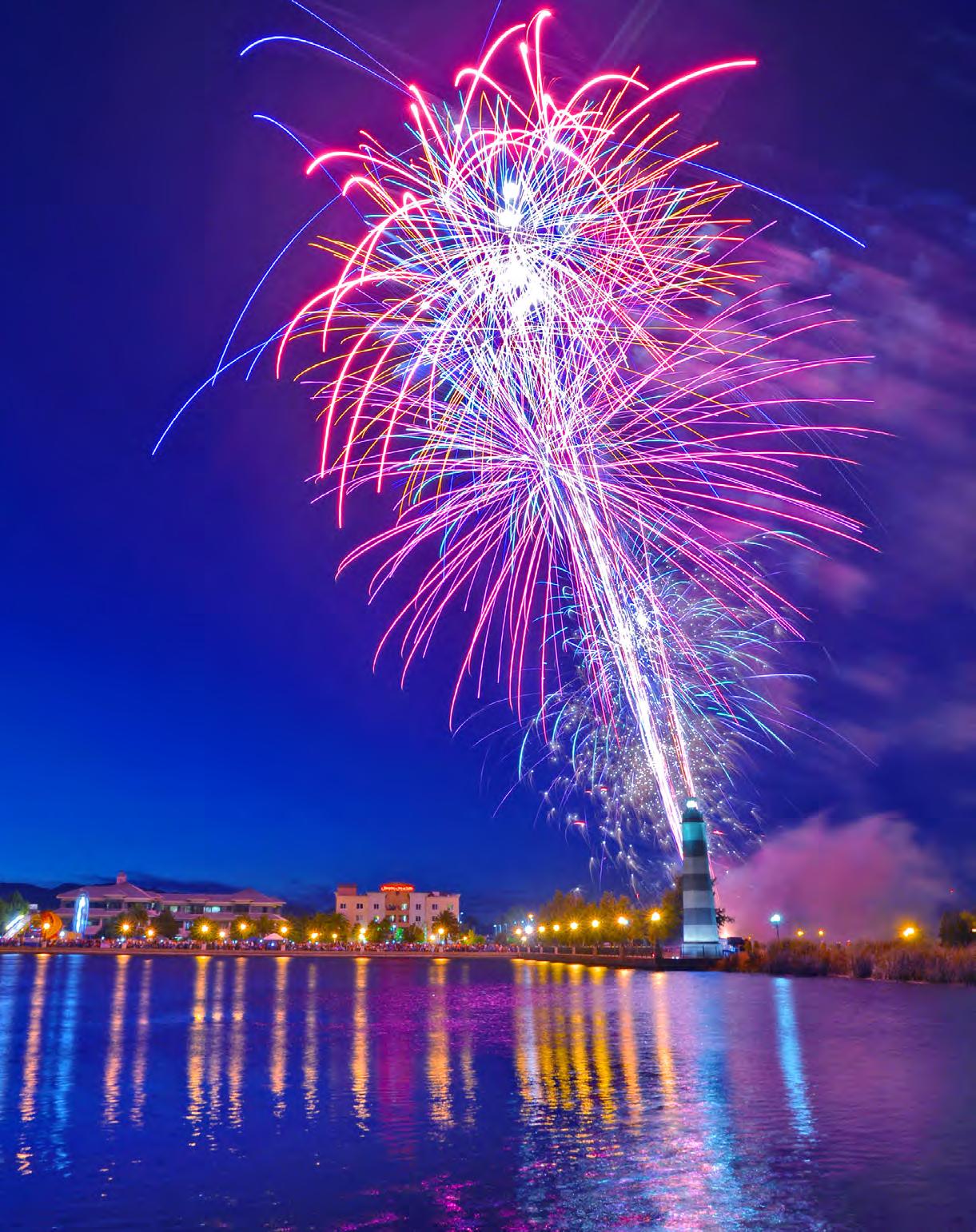
Independence Day will be celebrated from 3 to 10 p.m. at The First Street Green. There will be live performances, food vendors and more. The fireworks get under way at 9:30 p.m.
For more information, visit www.visitbenicia.org/events.
The celebration gets underway at 6 p.m. at Hall Park. Events include pickleball, swimming and a concert from Smokehouse Reunion. The fireworks begin at 9:15 p.m.
For more information, visit www.facebook.com/cityofdixonca.
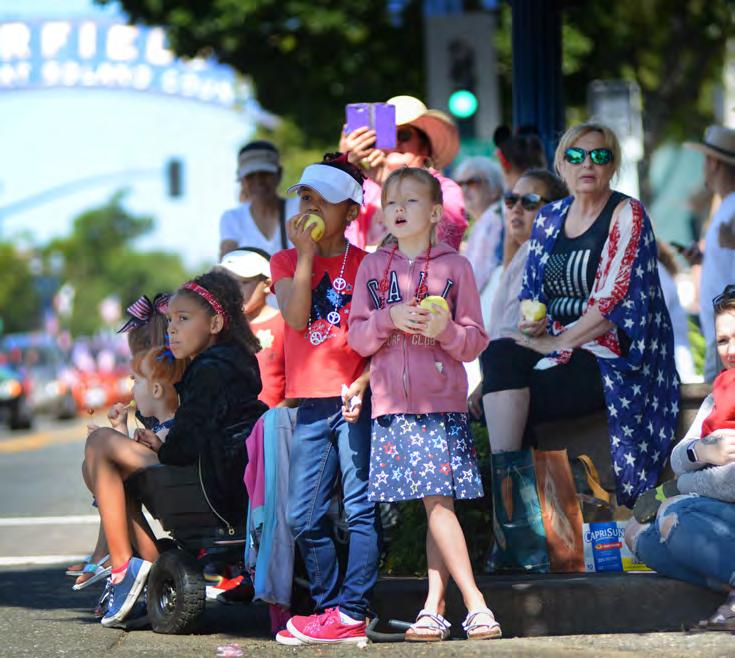

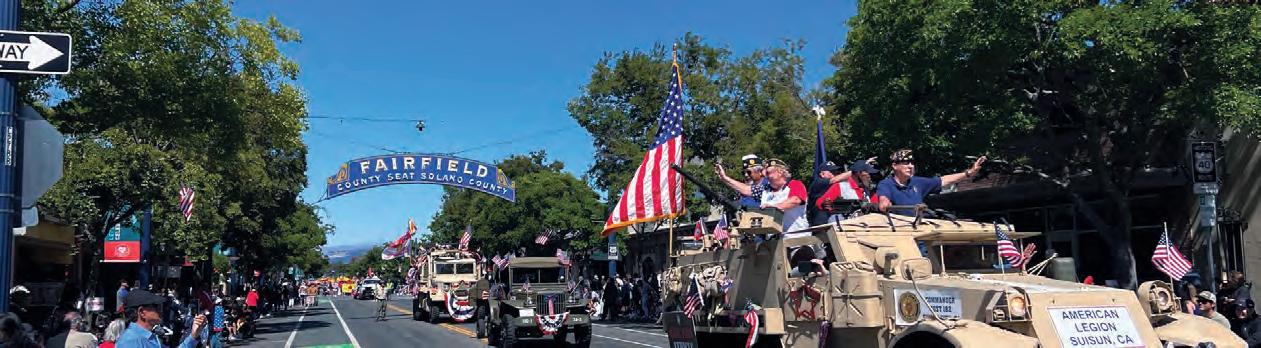
The city will unveil it’s renovated arch over Texas Street at 10 a.m.
The annual parade follows, kicking off at Webster and Kentucky streets, then marches down Kentucky to Great Jones, turns up Texas Street, and wraps up at Washington Street.
The review stand is at Texas and Jackson streets.
To learn more, visit www.fairfield.ca.gov/july4.
The fun begins at 11 a.m. and offers a day of carnival rides, vendors and live music from Pop Rocks, West Coast Strut, Vixen Strut and community acts.
Carnival rides and vendors open from 11 a.m. to 9 p.m. Community acts will perform from 11 a.m. to 2 p.m.
Fireworks will light up the sky
from 9:15 to 9:30 p.m.
For more details visit, www.suisun.com/events-directory/ 4th-of-july-celebration-2026.
The city hosts its annual Fourth of July Free Concert and Fireworks at 6:30 p.m. in Andrews Park.
Enjoy live classic rock from the Fog City Swampers followed by a spectacular fireworks show.
Food, drinks, beer and wine are available for purchase from food trucks and food stands.
For more details, visit www. facebook.com/events/andrewspark-vacaville/city-of-vacaville-4thof-july-free-concert-and-fireworks/ 2660727927655150/?ref=110.
The city celebrates the Fourth with a Mad Hatter theme.
The 171st Vallejo Fourth of July Parade begins at 10 a.m. at

Tennessee and Broadway streets, taking the traditional route west to Sonoma Boulevard, then south on Sonoma and west again on Georgia Street, ending at Georgia and Santa Clara streets.
The party then moves to the Barbara Kondylis Waterfront Park, featuring peddlers, merchants, food trucks, wellness activities and more.
Guests can see historic maritime ships docked at the Mare Island ship building faculties.
The evening Night Market then lights up with live entertainment until the sky begins to sparkle.
Throughout the day there will be the popular Annual Maritime Dog Parade, interactive exhibits with the Wholly Wackers (sheep), rescued reptiles, a Kids Zone, Giant Kites and classic cars.
For more information, visit www.facebook.com/ madhatterholidayvallejo. H