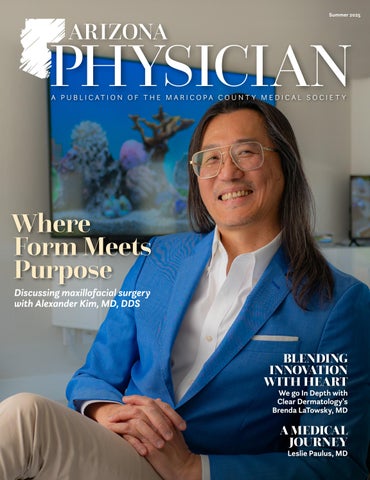
Summer 2025
A P U B L I C AT I O N O F T H E M A R I C O PA C O U N T Y M E D I C A L S O C I E T Y
Where Form Meets Purpose Discussing maxillofacial surgery with Alexander Kim, MD, DDS
BLENDING INNOVATION WITH HEART
We go In Depth with Clear Dermatology's Brenda LaTowsky, MD
A MEDICAL JOURNEY Leslie Paulus, MD
(602) 808-5540 www.AZWealthLaw.com
IS YOUR CASTLE PROTECTED? What the Owners of Every Arizona Luxury Home Need to Know About Asset Protection We have two decades of experience devoted to protecting billions of dollars in personal wealth for some of the most successful people in America, including their luxury homes. Ike Devji - Founder and Managing Attorney
Arizona Luxury Home Values Are at An All Time High. We have entire neighborhoods, if not zip codes, of multi-million-dollar homes in Scottsdale, Phoenix, and Paradise Valley, with new record prices being set every week.
But Arizona Law Protects Only $400K of Your Home Equity Arizona law has not kept up with this appreciation, any your home now makes a up a bigger percentage of your net worth than ever before. Only $400,000 of the equity is your primary residence is protected, and none of the equity in your vacation homes is protected, whether you hold it in your own name, or through a revocable trust.
The Problem with Using Basic Estate Planning Tools They often don’t protect any of your equity, during your life. Many require making permanent gifts of your home equity to others. Most don’t work well if you have a mortgage. They can cost you important tax benefits.
We Have a Better Solution for Luxury Homeowners It helps protect all your homes, up to their FULL equity value. It will not trigger a due on sale clause with your mortgage. It works with your existing estate plan. You get to keep mortgage interest deductions and capital gains benefits. It adds a massive layer of protection to many of your other assets.
We make this process simple and cost effective. All you need to do is call or email us to get started. Our consult process includes written plans and specific fee quotes, so you can make an educated business decision about protecting your life’s work.
CONTENTS IN EVERY ISSUE VOLUME 7 • ISSUE 2
EDITOR-IN-CHIEF
Desire’e Hardge, MBA MANAGING EDITOR
Edward Araujo ASSOCIATE EDITORS
Dominique Perkins Ella Ditzenberger CREATIVE DESIGN
Randi Karabin, KarabinCreative.com
4 | From the MCMS Board President 6
| From the Editor-in-Chief
8
| Briefs
38 | Legal Corner 42 | Community Health 44 | Practice Management 46 | MCMS Member Practices Directory
COVER & FEATURED ARTICLES PHOTOGRAPHY
Perkins sits down with Clear Dermatology’s Founder,
ADVERTISING
Brenda LaTowsky, MD, to
ads@arizonaphysician.com
discuss her practice and what makes it thrive.
MARICOPA COUNTY MEDICAL SOCIETY BOARD MEMBERS
32
PRESIDENT
Jane Lyons, MD
Smart Enough to Save Yourself
PRESIDENT-ELECT
Adnan Saithna, MD, FAANA TREASURER
MCMS member and pediatric
Rahul Rishi, DO, FAAAAI, FACAAI
surgeon, Erin Garvey, MD,
SECRETARY
discusses the importance
Gregory Aran, DO Zaid Fadul, MD, FS, FAAFP DIRECTORS
Mona Amini, MD, MBA Kishlay Anand, MD, MS Jay Arora, MD, MBA Ajay Bhatnagar, MD, MBA Shana Johnson, MD Linda Eller, DO Karyne Vinales, MD
Blending Innovation with Heart
Associate Editor Dominique
Jeff Noble, jeffnoblepictures.com
IMMEDIATE PAST PRESIDENT
12
18 C O V E R S T O R Y Maxillofacial surgeon, Alexander Kim, MD, DDS, shares his medical journey in which he helps patients of traumatic injuries and long-standing conditions reshape their appearances and self images.
of physician finance. She shares how you can become financially literate.
RESIDENT & FELLOW DIRECTOR
Regan Hill, DO, MA MEDICAL STUDENT DIRECTOR
Kyle Nguyen, MS-1 DIGITAL & SOCIAL MEDIA
26 A M E D I C A L J O U R N E Y
arizonaphysician.com
A Life of Purpose: The Unyielding Journey of Leslie Paulus, MD
ArizonaPhysician @AZPhysician @AZ_Physician
ARIZONAPHYSICIAN.COM
3
FROM THE MCMS BOARD PRESIDENT
Stronger Together:
The Power of Physician Unity and Collaboration
A
s physicians, we spend years mastering the science of the human body, studying physiology, pharmacology, and the art of diagnosis and treatment. Yet, the practice of medicine today involves much more than clinical expertise. We navigate a growing web of insurance constraints, administrative burdens, and policy decisions, most of which are made outside the clinic, often by individuals with no medical training. As a pediatrician, I see this disconnect every day. Whether I’m re-prescribing an antibiotic because a preferred medication was removed from a formulary, justifying a wheelchair for a child with a broken femur, or ensuring my documentation aligns with current regulations, it’s clear that today’s regulatory environment often undermines sound clinical judgment and delays essential care. This is precisely why the collective voice of physicians has never been more important. Recently, MCMS hosted Congressman Greg Stanton to discuss the future of healthcare in America. Our conversation was frank and timely. There was deep concern about the One Big Beautiful Bill Act and the devastating impact it could have not only in stripping coverage from millions of Americans, but also in weakening our healthcare infrastructure, particularly in rural communities, public health programs, and medical education. But what gave me hope was the strength of our profession. To see so many physicians engaged, asking questions, and standing united in their advocacy was a powerful reminder of what we can accomplish together. MCMS exists to harness that power. We are the collective voice of Maricopa County’s medical community: amplifying physician concerns, informing policy with clinical expertise, and fighting for a system that allows us to provide the care our patients deserve. Advocacy is not “optional,” it’s integral to protect our profession and preserve the future of medicine. Now more than ever, we need to stand together. A strong, unified voice is essential to challenge harmful legislation, promote evidencebased reforms, and preserve the integrity of patient care. MCMS has remained committed to being that voice and to supporting the physicians who power it, along with healthcare allies and associations.
Dr. Jane Lyons is a Pediatrician, who provides care for patients in both the inpatient and outpatient setting. She works locally in Phoenix as well as providing rural locum hospital based care. Dr. Lyons completed her medical training in San Diego, CA, has two young children, and enjoys the outdoors, cooking, and spending time with family and friends.
Jane Lyons, MD MCMS Board President
4
n ARIZONA PHYSICIAN MAGAZINE
Get involved with MCMS. Visit our website, mcmsonline.com.
AZPHYSICIAN.COM
5
FROM THE EDITOR-IN-CHIEF
Celebrating Purpose Stories from Physicians Across Medicine
I
n this issue of Arizona Physician, we spotlight the incredible depth and diversity of medicine in our state from surgical innovation and financial insight to legal clarity and human stories that remind us why we choose this path. We begin by featuring MCMS member, Dr. Alexander Kim who’s specialty is Maxillofacial and Oral-Facial Surgery, which marries surgical precision with aesthetics, trauma care, and function restoration. Next, Associate Editor, Dominique Perkins dives into physician finance with Dr. Erin Garvey. From student loan strategies to investment diversification and retirement planning, Dr. Garvey delivers real-world insights for physicians at all career stages. Financial wellness is physician wellness and it’s time we treat it as such. We go In Depth with MCMS member practice, Clear Dermatology and its founder, Dr. Brenda LaTowsky, who offers a candid look at building a modern, patient-centered dermatology practice. From cosmetic procedures to chronic condition management, their integrative approach exemplifies the evolving role of dermatologists in whole-person care. In our “Medical Journey” series, we sit down with retired physician Dr. Leslie Paulus, whose decades of service reveal wisdom not just in medicine, but in legacy, mentorship, and purpose beyond the clinic. Her story is a reminder of the enduring impact one physician can have on generations of patients and peers. Further in this issue, MICA Attorney Kristin Penunuri addresses the increasing overlap between healthcare delivery and immigration enforcement. As Immigration and Customs Enforcement (ICE) protocols become more visible in healthcare spaces, she offers guidance on how physicians and practice teams can navigate these situations Also, MICA attorney Jeanne Varner-Powell shares with our physician readers about advanced directives for patients. Finally, Flinn Foundation’s Brian Powell shares exciting growth at Arizona Biosciences. At MCMS and Arizona Physician, we remain committed to bringing you the issues that matter most from the frontlines of practice to the broader systems that shape medicine in Arizona. As always, thank you for reading, for serving, and for trusting us to share your stories for more than 60 years. We are grateful for your continued support and for making Arizona Physician your go-to magazine for staying informed on all things’ healthcare in Arizona.
Desire’e Hardge, MBA, serves as the CEO & Executive Director of MCMS and the Editor-in-Chief for the Arizona Physician magazine. Desire’e brings over 19 years of experience across both for-profit and non-profit sectors. She has successfully led organizations through business development, community relations, and strategic growth.
With Gratitude,
Desire’e Hardge, MBA Arizona Physician Editor-in-Chief MCMS CEO & Executive Director 6
n ARIZONA PHYSICIAN MAGAZINE
Become an MCMS member in 2025 by calling us at (602) 209-9867 or email us at mcms@mcmsonline.com.
Advocacy Pushing policies that matter
Patient Referrals Online directory and referral line
Professional Referrals Legal, financial, staffing, real estate, etc.
Scan to learn more about the benefits of being an MCMS member
CME In person and virtual
Physician Stories Print and digital magazine, podcast
Networking Happy hours and fun events
Focused on Physicians Like You! Become a Member Today.
BRIEFS
NEWS AND NOTES FROM THE FIELD
STAY COOL IN ARIZONA:
8 Strategies for Your Patients to Beat the Heat
PRACTICAL TIPS A N D C R E AT I V E IDEAS TO SHARE WITH YOUR PAT I E N T S T O KEEP THEM C O M F O R TA B L E DURING THE HOT ARIZONA SUMMER
8
n ARIZONA PHYSICIAN MAGAZINE
As the sun blazes and temperatures soar, staying cool in the summer becomes more than a matter of comfort—it’s a key to health and well-being. Whether your patients are navigating city streets, relaxing at home, or heading outdoors for summer adventures, here are strategies you can share that will make all the difference. Here’s a concise guide to help your patients beat the heat and savor the joys of summer without overheating.
K E E P YO U R E N V I R O N M E N T C O O L Close Blinds and Curtains | Block out sunlight during the hottest part of the day to keep indoor spaces cooler.
S TAY H Y D R AT E D Drink Plenty of Water | Your body loses more fluids through sweat in the heat, so drink water regularly throughout the day— even if you don’t feel thirsty.
P L A N O U T D O O R AC T I V I T I E S W I S E LY Schedule Activities for Cooler Hours | Try to run errands, exercise, or enjoy outdoor activities early in the morning or later in the evening when temperatures are lower.
Eat Water-Rich Foods | Incorporate fruits and vegetables with high water content into your meals—think watermelon, cucumber, oranges, and lettuce.
Take Frequent Breaks | If you’re active outside, pause regularly to rest, hydrate, and cool down in the shade.
Use Fans and Air Conditioning | Ceiling fans, portable fans, and air conditioners can circulate air and lower indoor temperatures. If you don’t have AC, try placing a bowl of ice in front of a fan for a quick cooling hack.
U S E WAT E R T O YO U R A DVA N TAG E Apply Damp Cloths or Ice Packs | Placing a damp towel on your neck, wrists, or forehead can provide fast relief from the heat.
C R E AT I V E WAYS T O S TAY C O O L DIY Cooling Sprays | Mix water with a few drops of peppermint essential oil and spritz your skin for an extra cooling effect.
Swim When You Can | Whether it’s a public pool, lake, or even a sprinkler in the yard, taking a dip is a classic, effective way to stay cool.
Cool Your Pulse Points | Applying ice packs or cold water to your wrists, neck, elbows, and the backs of your knees can quickly reduce your body temperature.
E AT L I G H T E R M E A L S Choose Fresh Light Dishes | Heavy meals can raise body temperature. Opt for salads, cold soups, and grilled vegetables instead of fried or rich foods.
E M B R AC E T H E S H A D E A N D TA K E I T E A S Y Rest When You Need To | Don’t push yourself during heatwaves. Taking time to relax in a cool environment is not only pleasant, but also necessary for your health.
Skip the Oven | Cooking with the oven heats up your kitchen. Use a microwave, stovetop, or outdoor grill instead.
Create Your Own Oasis | If you have access to a garden or balcony, set up a shady spot with a fan or a mister for a peaceful, refreshing retreat.
B E M I N D F U L O F H E AT- R E L AT E D I L L N E S S Know the Signs | Fatigue, headache, dizziness, nausea, and rapid heartbeat can be signs of heat exhaustion. Act immediately if you or someone near you experiences these symptoms.
Don’t forget that summer is a time of vitality, adventure, and relaxation, but the heat can catch you off guard. With these strategies, your patients can enjoy all the season has to offer while staying safe, comfortable, and cool.
Check on Vulnerable People | Small children, older adults, and those with health conditions are more susceptible to heat. Ensure they have access to cool spaces and plenty of fluids.
ADVOCATES FOR THE PRIVATE PRACTICE OF MEDICINE Health Care Compliance Estate Planning Health Care Audits, Investigation and Litigation Business Transactions State and Federal Licensing Reimbursement Patient Privacy Fraud and Abuse Corporate Law Intellectual Property Employment Law Counseling and Litigation
MilliganLawless.com
602.792.3500 5050 North 40th Street, Suite 200 Phoenix, Arizona 85018
ARIZONAPHYSICIAN.COM
9
4 Ways Parents Can Keep their Children’s Eyes Healthy
Early detection of conditions like lazy eye (amblyopia), crossed eyes (strabismus), or refractive errors allows for prompt treatment, which is often more effective during early development.
C E L E B R AT I N G CHILDREN’S E Y E H E A LT H AND SAFETY AWA RENES S MONTH
August marks Children’s Eye Health and Safety Awareness Month—a timely reminder for parents, caregivers, and physicians to pay special attention to the well-being of young eyes. Vision is crucial for a child’s development, learning, and daily activities. By fostering healthy habits and awareness from a young age, parents can set children on a path toward a lifetime of clear vision and healthy eyes. Here are four essential strategies you can share with your patients in which they can help protect and nurture their children’s eyesight. SCHEDULING REGULAR EYE EXAMS Routine eye examinations are the cornerstone of maintaining eye health in children. Many vision problems, such as nearsightedness, farsightedness, and astigmatism, can go unnoticed, especially in early childhood. Because children may not always recognize or communicate vision difficulties, professional screenings are vital. Early Detection | The American Academy of Ophthalmology recommends the first comprehensive eye exam at 6 months of age, another at 3 years, and again before first grade.
10
n ARIZONA PHYSICIAN MAGAZINE
Monitor for Changes | As children grow, their eyes change too. Annual or biennial checkups ensure that any new issues are caught quickly and addressed before they impact learning or quality of life. ENCOURAGE PROPER SCREEN USE AND LIMIT DIGITAL EYE STRAIN In the digital age, children are exposed to screens more than ever—through tablets, smartphones, computers, and televisions. Prolonged or improper use of these devices can lead to eye discomfort and even vision problems. Follow the 20-20-20 Rule | Encourage your child to take a 20-second break to look at something 20 feet away every 20 minutes of screen time. This simple practice helps relax the focusing muscles on the eyes and reduces fatigue. Set Screen Time Limits | The American Academy of Pediatrics suggests no more than one hour of screen time per day for children aged 2 to 5, and consistent limits for older children. These boundaries help lower the risk of digital eye strain, dry eyes, and headaches. Monitor Symptoms | Watch for signs like frequent eye rubbing, headaches, or complaints about blurred vision—these may indicate digital eye strain or other vision issues.
PROTECTING EYES FROM INJURY AND THE SUN Active children are prone to accidents, and eye injuries can have lifelong consequences. Similarly, ultraviolet (UV) radiation from the sun can damage young eyes and increase the risk of eye diseases later in life.
PROMOTE A BALANCED DIET RICH IN EYE-FRIENDLY NUTRIENTS Nutrition plays a pivotal role in eye health. Certain vitamins and minerals can help reduce the risk of vision problems and support overall ocular development. Essential Nutrients | Include foods rich in vitamin A (such as carrots, sweet potatoes, and leafy greens), vitamin C (like oranges and strawberries), vitamin E (nuts and seeds), and zinc (lean meats and beans). These nutrients contribute to the maintenance and repair of eye tissues. Hydration | Encourage children to drink plenty of water throughout the day. Proper hydration keeps eyes moist and helps flush out irritants.
Use Protective Eyewear | Make sure children wear safety glasses or goggles during sports, science experiments, or any activities where there’s a risk of flying objects or chemical splashes. Protective eyewear is especially important for sports like baseball, hockey, and racquet sports. Sun Protection | Children’s eyes are more sensitive to UV rays than adults’. Provide wide-brimmed hats and sunglasses that block 100% of UVA and UVB rays whenever kids are outdoors, even on cloudy days. Sunglasses labeled as UV400 offer the best protection. As we observe Children’s Eye Health and Safety Awareness Month this August, let’s make a commitment to helping parents become proactive with their children’s eye care.
Designing Innovative Healthcare Spaces in the Heart of Arizona BANNER ESTRELLA MEDICAL CENTER - PHOENIX ARIZONA
ARIZONAPHYSICIAN.COM
11
BLENDING INNOVATION WITH HEART I N S I D E C L E A R D E R M AT O L O GY W I T H D R . B R E N D A L AT O W S K Y
A
t Clear Dermatology and Aesthetic Center in North Scottsdale and Paradise Valley, science and compassion meet under one roof. Whether treating skin cancer, revising scars, or researching groundbreaking therapies for rare dermatologic conditions, Dr. Brenda LaTowsky has built a practice that reflects not only her clinical expertise but her dedication to kindness, innovation, and patient-centered care. “I really wanted to do clinical research, and I really wanted to provide an extremely high level of care and customer service to patients in the Valley,” Dr. LaTowsky said. “That led to the foundation of Clear Dermatology and Aesthetics Center.”
M ED I C I N E AN D R ES E ARC H Dr. LaTowsky has been a dermatologist since 2005, finishing her residency in 2008 and completing a laser and cosmetic surgery fellowship in Boston in 2009. She moved to the Phoenix area shortly thereafter and began laying the groundwork for what would become not just one, but two thriving institutions.
12
n ARIZONA PHYSICIAN MAGAZINE
ARIZONAPHYSICIAN.COM
13
“I love innovation and I love making people feel more confident in their skin—those two things together have led me to a career in dermatology and specifically cosmetic dermatology and dermatologic research,” she explained. Today, Clear Dermatology is home to a growing team of top-tier physicians and physician assistants. About 10 years ago, Dr. LaTowsky also launched Investigate MD, a clinical research company co-located at Clear Dermatology’s Bell Road facility. “It is possible to do both,” she said of juggling two ventures. “I’m very lucky because I work with incredible people. And so when you have great leadership, it is possible to do all these things.” Investigate MD focuses on clinical trials in both common and 14
n ARIZONA PHYSICIAN MAGAZINE
“
I think the research component contributes to our patient care.
”
rare dermatologic conditions, from eczema and psoriasis to hidradenitis suppurativa and alopecia areata. “Due to the research that we participated in, we’ve contributed to of FDA approval of many medications that have been really impactful on so many patients all over the world,” she said. “So I’m really, really proud of that.”
B U I LT O N PRI N C I PLES Clear Dermatology has expanded steadily since its founding. Most recently, two previous locations were combined into a new, spacious headquarters in North Scottsdale. “We’re really proud of our new facility,” Dr. LaTowsky said. “It’s modern and has a lot of natural light, which is really nice for dermatology because it helps us
with our exams. It also contributes to its peaceful ambiance, which goes with our high regard for customer service. It’s really beautiful.” At the core of the practice are three foundational values: kindness, quality, and expertise. These principles show up in everything from how patients are greeted to how new technologies are vetted. The research and clinical care sides of the practice aren’t siloed—they complement each other. “It’s a different type of education that we get by doing these research trials,” she said. “It teaches us to think more critically. When there’s a new medication that’s been FDA approved, many times we’ve done the trials. So we feel very comfortable with the medication and know a lot of background about it as well.”
FU LL-S PECTRU M CAR E Clear Dermatology offers comprehensive care to patients of all ages. “That’s something that I take great pride in,” Dr. LaTowsky said. “It’s really rewarding because a lot of us start by seeing a single person in a family, and we end up seeing the entire multi-generational family.” Medical dermatology cases range from acne and eczema to hives and psoriasis, but Arizona’s high incidence of skin cancer means screenings are a major focus. “We feel very, very fortunate to have all of our providers be experts in screening for,
M ENTO RS H I P AN D C U LT U R E Dr. LaTowsky’s passion for mentorship and education permeates the entire organization, spanning everything from leadership coaching to preprofessional work experiences. While not a formal program, it thrives on word-of-mouth and the team’s intrinsic interest in education and collaboration. “We’re always trying to create a really strong team with a really strong culture,” she said. “There’s a unique culture of positivity and education,” she noted, “and I think the doctors and the physician assistants really find it rewarding to do the mentoring.” Her attitude toward education extends to her patient base as well. The practice maintains a presence on Instagram, Facebook, and TikTok, and sends out monthly educational newsletters to its patient base. “The opportunity for education is better than it used to be,” she said. “I really appreciate that, because sometimes it lets us have a more educated discussion.”
“ I ’m s o p r o u d o f a l l t h e p h y s i c i a n s a n d t h e p h y s i c i a n assistants that we have in the of fice. I think they are all top -notch, and we have continued to provide high quality of care throughout the years, even as we have g r o w n . T h a t r e a l l y h a s b e e n m y f o c u s t h i s e n t i r e t i m e .”
ARIZONAPHYSICIAN.COM
15
catching, and treating skin cancers,” she said. Her own clinical emphasis is on cosmetic dermatology: “I am doing a lot of laser work, a lot of scar revisions, treating acne scars, injectables, and preventative aging, including regenerative medicine.” Increasingly, the field is leaning into regenerative medecine—an area where Dr. LaTowsky’s research involvement proves invaluable. “A lot of the newer technologies coming out—we have participated in the research. So we have a sort of baseline knowledge about them even before they become commercially available in the U.S.”
16
n ARIZONA PHYSICIAN MAGAZINE
“
There are conditions that we are very easily able to treat now, thanks to advancements in medications.
”
DATA- D RIVEN I N N OVATI O N With her dedication to innovation and direct involvement in research, adapting new techniques and technologies allows her to keep pace with a rapidly-expanding field. New treatments are rigorously evaluated before being adopted. “It usually starts with the data review— quality studies, making sure that we believe in the data,” she said. Then the practice trials the treatment internally. “I have a rule that we never bring anything on that I haven’t tried myself.” Her decision-making process prioritizes safety, efficacy, consistency, and affordability. “Will it work for
every patient or is it only going to be one in 10 patients?” she asked. “So those are really the decision makers.” An example of a preventative treatment is a standout laser treatment called the Fraxel laser that is both anti-aging and FDA-approved for precancer treatment. “By doing one treatment of this laser, someone is really making themselves look younger, slowing down the aging process, and actually preventing the formation of precancers and nonmelanoma skin cancers—all with one treatment,” she said.
A CAR EER WITH J OY AN D M E AN I N G For other physicians, especially those navigating today’s difficult healthcare landscape, Dr. LaTowsky offers this advice: “Surround yourself with people that you enjoy working with, and positive people. Medicine is hard. Life can be hard. And so when you have a supportive team that you enjoy working with, it can help get you through the good times as well as the bad. And find something to laugh at every day!” She adds, “If medicine is something that you’ve committed to, and a calling for you as it is for me, then finding a way to make it fun, challenging, and rewarding is really key for a long and fulfilling career.” Above all, she credits her support system at home. “The support that I receive from my incredible husband and my three amazing kids has really helped me along the way,” she said. “And I’m always grateful for their support.” ■
Clear Dermatology & Aesthetics Center BY THE NUMBERS
Founded in 2013 7 Physicians 6 Physician Assistants 3 Aestheticians 1 Nurse Injector 4 Research Investigators 85 Total Employees Services Offered Mohs, CellFX, Neuromodulators, Fillers, Biostimulators, Pro-Nox, Lamprobe, Microneedling, MiraDry, Peels, Vbeam laser (vascular laser), RF (radiofrequency) Microneedling, IPL (Fotofacial), PRP (Platelet-Rich Plasma), Fraxel laser (resurfacing laser), Photodynamic therapy (PDT), Coolsculpting, Cooltone
Conditions Treated Melanoma, Squamous cell skin cancer, Basal cell skin cancer, skin cancer screenings, Atopic Dermatitis, Pediatric Psoriasis, Hidradenitis Suppurativa, Prurigo Nodularis, Chronic Spontaneous Urticaria, Atrophic Acne Scarring, Scar revision, Actinic keratoses, Hyperhidrosis, Rosacea, Moles, Warts, Port Wine Stains, Acne, Eczema, Anti-aging, Resurfacing, Treatments after weight loss.
2 Locations North Scottsdale, Paradise Valley
By Dominique Perkins Associate Editor Arizona Physician azphysician@mcmsonline.com
Connect with Clear Dermatology cleardermatology.net | 480-398-1550
ARIZONAPHYSICIAN.COM
17
18
n ARIZONA PHYSICIAN MAGAZINE
Where Form Meets Purpose THE WORK OF DR. ALEXANDER KIM
I
n medicine, there are few disciplines where the connection between form and function is as visible—or as emotionally profound—as maxillofacial surgery. For Alexander Kim, MD, DDS, that connection is the beating heart of his practice. Whether treating traumatic injuries, complex skeletal deformities, or long-standing conditions that have reshaped a patient’s appearance and selfimage, Dr. Kim brings more than surgical precision to the operating room. He brings a quiet humility, a sharp intellect, and a deep sense of purpose.
TH E P OWER O F A D UAL LEN S Dr. Kim knew from the outset of his training that he wanted his education to explore the full scope of understanding the human body, so he made the choice to train in both dentistry and medicine. He received his D.D.S. from Columbia University, then his M.D. from the Keck School of Medicine at the University of Southern California. “I saw what the oral and maxillofacial surgeons were doing, and to me it was just the purest essence of changing someone’s life,” he said. “Once I saw that, I was hooked. Everything I did from that point forward was to achieve that goal.”
ARIZONAPHYSICIAN.COM
19
After completing his training, Dr. Kim began his work in oral and maxillofacial surgery in San Diego, California, before coming to Phoenix. He currently practices at Phoenix Oral and Facial Surgery. “I feel blessed, I have a true full-scope practice,” he said. “I get the opportunity to really employ the full scope of training that I’ve acquired in my career.” The practice encompasses a wide range of conditions and treatments, from routine to complex, often intertwining both functional and aesthetic aspects: Surgical removal of third molars, reconstruction of a bite or missing part of the jaw with bone grafts or implants, treating a step joint with TMJ arthrocentesis, skeletal deformities, stigmata from trauma, obstructive sleep apnea, degenerative joint disease. The practice carries the slogan, Changing Faces, Changing Lives, a mission statement Dr. Kim holds with deep sincerity. “These are life-changing injuries that patients have,” he said. “I think there’s nothing really that affects the human spirit so much as things that involve your face.” Multidisciplinary patient care strategies reflect his ethos that all good medicine is collaborative, and Dr. Kim relies on both a strong team and an education-forward approach to working with his colleagues in medicine. “I am a big believer in structuring a systemsbased approach to create accountability, empower individual staff, and maintain good communication with our patients and peers,” he said. Dr. Kim cited a few examples of cases that depend on strong coordination between disciplines to set treatment plans up for success: A referral for a corrective skeletal facial deformity, most often an acquired deformity with malocclusions and a poor bite, as well as aesthetic concerns. A TMJ open-joint surgery, using an arthroplasty to remove or repair parts of the damaged joint all the way to a total joint replacement operation using a custom-designed prosthetic. The surgical management of osteonecrosis of the jaws due to long term bisphosphonate use. “I think as a group we tend to be overachievers,” Dr. Kim says of his team members in
20
n ARIZONA PHYSICIAN MAGAZINE
these cases, adding that many have completed fellowships or advanced subspecialty training in cosmetic surgery or head and neck oncology. “We just constantly say, oh there is a mountain, let’s climb it! What else can we do?”
PR EC I S I O N I N 3 D Alongside collaboration, technology plays a pivotal role in elevating patient outcomes. The most significant new technology Dr. Kim has seen in over 20 years of practice is the widespread accessibility of and use of cone beam CT scanners, which produce threedimensional imaging of the teeth, jaw, and other surrounding structures of the face. These
images can be manipulated to examine from every angle in fine detail. “Cone beam CT scanners are much more economical, the radiation output is much smaller, and the footprint is way more compact,” he said. “And it really allows us to have some amazing imagery.” Though a little hard to imagine in our current era of point-click-zoom, not so long ago film x-rays were the only imaging technologies in use. “I still remember when I was a resident, we had this x-ray developing room, and we would have to take the x-rays and I would go and develop the film, dip them in the developer and fixer solutions.” “It just seems crazy now!” he said. “It’s mind boggling how great that technology is.”
“
Being a good physician means you have to kind of bridge and meet people on their own terms. Your core mission is still the same: you need to educate, help, and treat patients as best you can. But having great communication is part of your job.
”
ARIZONAPHYSICIAN.COM
21
That sense of amazement hasn’t faded—even now, with cutting-edge tools at his fingertips, the speed and clarity still impress him. “We take a scan, and literally 20 seconds later the data is there, and we are showing the patient. We can trace out where nerves are, we can see how much bony support there is, all within the span of just a minute.”
C O NTE X T, C O N FI D EN C E , AN D C O N N ECTI O N Speed and accessibility allow Dr. Kim to maximize his time with patients, since consultations have grown increasingly brief. “I like to spend the majority of the time really talking to a patient, leading them through the complexities of diagnosis and treatment, so that they have a good grasp and understanding of what the issue is.” “I spend a lot of time with my patients, I usually get into trouble because I’m always behind and it’s because I just talk too much,” he said. Dr. Kim holds his patients in high regard, describing them as intelligent and educated. The mass of information available today means that most patients will have done some level of their own research to try and understand what is happening to them. “I view my job as a physician at the consultation stage as being someone who helps educate and provide context for an issue, so the patient can decide what is relevant and important to them,” he said. “What the internet doesn’t provide is context, a framework to understand.” He says that once this context is fully understood, everything else usually falls into place, “because you’ve created a bridge so that they understand.”
22
n ARIZONA PHYSICIAN MAGAZINE
“
Patients who are affected by skeletal or facial deformities often have never truly been able to eat a normal meal or even smile without feeling incredibly self-conscious. To see the transformative power of surgery free these patients to be the best versions of themselves is truly remarkable.
”
Learn more about XXXXXXX and her medical journey by visiting arizonaphysician.com/xxxxxxx
Given the extent of the procedures he is involved in, he often spends quite a bit of time with his patients, from diagnosis to recovery, often including follow-up visits to ensure that everything is healing correctly. Because of his specialty, many of his patient stories are intense and transformative. Dr. Kim describes the intense satisfaction he feels in making that level of impact in someone’s life. “Over the years I’ve been really lucky to be a part of a lot of these patients’ lives and their journeys,” he says. “It never gets old!” He shared a story of a recent patient who came in for an extensive corrective jaw surgery. The patient was a woman in her early 20s with a severe skeletal dentofacial deformity: misalignment of the teeth and jaw caused significant pain and discomfort, and the overall asymmetry presented a significant aesthetic challenge. As they planned and prepared for the procedure over several months, Dr. Kim remembers
her being very closed off and difficult to draw into conversation. He performed extensive facial reconstructive surgery, and she healed very well. She recently came in for her 6-week follow-up appointment, and the change was far more than just her face. “The person that walked in the door was not the person who showed up three months ago,” Dr. Kim said. Everything about her was different, not just the facial surgery. Posture, hair, style, attitude, demeanor, conversation—she was entirely transformed. “She exuded a confidence, she was just so happy!” Dr. Kim said. “It’s gratifying when you see it, because it is such an incredible change. To be a part of that is incredibly humbling.”
TH E Q U I E T WO R K O F STAYI N G WH O LE Despite the wonder and fulfillment Dr. Kim finds in his work, he is not immune to feeling overwhelmed or discouraged. As regulations and systems continue to evolve, the healthcare landscape has grown increasingly murky for physicians of all specialties. “For me, I have found burnout tends to be the result of feeling kind of isolated or alone,” Dr. Kim said. He described burnout as a constraint on physician’s natural exuberance. To combat this in his own life, Dr. Kim takes a more active role in connecting with his peers and supporting others in the field. In addition to being a member of the Maricopa County Medical Society, Dr. Kim is the president of the Arizona Society of Oral and Maxillofacial Surgeons. “I think we’ve got a very generous and collegial membership,” he said. “When I have a problem, and I think, who can I call, I feel so blessed. I can call so many people!” Having a network of peers who are willing to share their experiences, challenges, and insights has been invaluable. For Dr. Kim, cultivating those relationships is a clear priority. “I think it just makes everyone better,” he said. “And I think that is really the antidote to burnout.” In addition to leaning into his professional support system, Dr. Kim also finds considerable joy in spending time with his family, and in several flourishing hobbies. A self-confessed “gearhead”, he said that in another life he would be out building racing cars all day, every day.
ARIZONAPHYSICIAN.COM
23
“
I’ve found many smart and practical solutions for my problems by leveraging the experience of my friends and colleagues.
”
24
n ARIZONA PHYSICIAN MAGAZINE
“I’ve always loved cars,” he said. “I would build cars when I was younger, work on my old mustang.” He also loves music, and has a broad taste in genres, with a penchant for the “classic rock” era of the late sixties to early eighties. “Music is like a direct pipeline to your past,” he said. “It can just transport you back to a time in your life instantly. It’s the greatest thing.” He has built a significant analog collection which he thoroughly enjoys, as well as playing the guitar himself. Although, he insists, he does this rather poorly. “I tell patients I play guitar badly,” he laughs. “I’ve been playing for more than 20 years and somehow I’m still a beginner!” But hobbies don’t exist for us to become masters of the craft. After all, the core meaning of the term “amateur” is one who engages in the activity for the love of it, motivated by genuine interest,
passion, and enjoyment, rather than for financial gain or professional reasons. Trust Dr. Kim to be good at something by “not” being good at something. “I do it for fun, I do it for myself. I do it for the kid in me who dreamt of being a rock star,” he said. “In my dream, I still am.”
WHAT MAT TERS I N TH E EN D After decades of training, innovation, and hands-on healing, Dr. Kim circles back to something simple: intention. “I really don’t think there is anything special about me,” he confessed. “There are thousands of private practice doctors just like me, and we are just doing our best: trying to do things the right way as we see it. And maybe that’s all we can do.” But for the patients whose lives he helps transform, it’s more than enough. ■
By Dominique Perkins Associate Editor Arizona Physician azphysician@mcmsonline.com ARIZONAPHYSICIAN.COM
25
A MEDICAL JOURNEY
A LIFE OF PURPOSE THE UNYIELDING JOURNEY OF LESLIE PAULUS, MD
S
ome physicians follow a straight line from ambition to achievement. Others, like Dr. Leslie Paulus, shape a life and legacy through relentless resilience, detours of necessity,
and the conviction to serve others no matter the odds.
A retired internist and former medical director, Dr. Paulus is a long-time member of the Maricopa County Medical Society. Her journey—both personal and professional— offers younger physicians a rare blueprint for how to persevere, adapt, and lead with heart.
ARIZONAPHYSICIAN.COM
27
A MEDICAL JOURNEY
FI N D I N G A WAY The idea of becoming a physician first sparked at a family dinner table in the early 1970s. Then a high school student in a parochial school, Dr. Paulus told her parents she enjoyed science and wanted to help people—but hadn’t considered becoming a doctor. “My dad said, ‘Well, why don’t you be a doctor?’” she recalls. “It hadn’t even occurred to me. At that age, for girls, it was nurse, teacher, or homemaker.” Despite early discouragement— including from a family physician who bluntly told her medicine was a “wasted spot” for women—Dr. Paulus never let go of the idea. She married young, had two sons by the age of 21, and divorced within five years. But instead of stepping back, she pressed forward. She returned to school as a single parent, worked through undergraduate premed, and faced her first major institutional hurdle: a rejected medical school application, not for lack of academic strength (she held a 3.72 GPA), but because she was a single mother. Other applicants weren’t asked what they’d do with their kids, she remembers. But she was. Undeterred, Dr. Paulus earned a PhD in microbiology and immunology in just three years—two years faster than expected—while raising her sons in North Carolina. That determination paid off. She was accepted into the University of North Carolina School of Medicine, and later returned to Arizona to complete a combined internal medicine and pediatrics residency at St. Joseph’s Hospital in Phoenix. 28
n ARIZONA PHYSICIAN MAGAZINE
“I have been a long term member of The Maricopa County Medical Society, as well as American College of Physicians. These organizations provided not only support but community involvement and of course education. I think the organizations even more so are providing support for changes that are occurring in the community where physicians are frequently employed and if they have private practices really struggle.”
MAK I N G C HAN G ES From the outset, Dr. Paulus gravitated toward work that integrated care across disciplines. She joined Children’s Rehabilitative Services and saw firsthand how fragmented the system was for patients with special needs. “Services were split between AHCCCS, CRS, and DDD,” she said. “In addition, at age 21, CRS no longer covered those particular conditions. Which is silly if you think about it because the conditions did not go away at age 21.” Her frustration with bureaucratic obstacles became a powerful motivator. “I was never one to just accept things for what they were,” she said. And so she started asking questions. Others warned her she would never be able to change anything, that these were statutes, just accepted realities. “Never tell me it can’t be done,” she laughed. “Eventually, they did combine all those programs, and I was in the right place to deal with all that.” Over a career spanning decades, Dr. Paulus took on increasingly complex administrative and medical leadership roles, including serving as Director of the Department of Medicine at the Arizona State Hospital and later for UnitedHealthcare, where she oversaw care for patients in Medicare, AHCCCS, and the Division of Developmental Disabilities (DDD). “Managed care has gone through many stages and finally has realized not only do they need to meet public health metrics but they also have to
be accountable to the concern and wishes of patients and members,” Dr. Paulus said. Dr. Paulus remained close to the people she served—especially vulnerable populations with overlapping physical and behavioral health needs. She worked on integrated care models long before they were standard, often acting as an intermediary between specialists, psychiatrists, and social workers to ensure patients were treated as whole persons in private practice and later as a medical director for United Healthcare. Her persistence often paid off. She helped write and pass legislation to extend care for adults with spina bifida, led reforms to unify care streams for medically complex children, and remained a steady advocate for humane, comprehensive healthcare. “That’s why I liked administration,” she said. “I could actually change things.”
RO OTED I N FAM I LY, G RO U N D ED I N C O M PAS S I O N For Dr. Paulus, professional purpose has always been intertwined with personal experience. Her mother died of breast cancer before she entered medical school. Her youngest son developed schizoaffective disorder in early adulthood. When he asked her, “Mom, how am I going to die?” she faced a truth few parents are equipped to answer. She adopted his daughter, her granddaughter, April, who has autism, and cared for her son through hospice during the height of the COVID-19 pandemic—while supporting April in finishing ARIZONAPHYSICIAN.COM
29
A MEDICAL JOURNEY
college. April has now graduated and works at her first job at a hotel as a front desk staff in Phoenix. “I found purpose in the work,” she reflects. “It helped me focus. It helped me survive.” With regards to her role as Medical Director for Special Needs at UnitedHealthcare Community Plan she states, “it’s like full circle, all this experience, and it was just perfect for the role. So the state combined their mental health services with the medical. Who else could do that but me, right? So it just all worked out really well, and I felt like I actually was contributing and helping people.” Even now, her lens remains holistic. “I have always understood that people are whole and not just medical or having behavioral health components,” Dr. Paulus said.
R E TI R EM ENT I N NAM E O N LY While Dr. Paulus officially retired, she is far from inactive. She maintains her medical license, stays current on medical literature, and consults occasionally. More prominently, she serves in leadership with the Valley Interfaith Project (VIP), where she advocates on issues like Medicaid access, affordable housing, and behavioral health reform. “You teach people to be leaders, you teach them to talk to elected officials, you isolate what you want to change out of all the issues that come up,” she said. “Give them ways to change things,” Dr. Paulus said. “Give them verbiage, how to talk to people in an email or a phone message.” She draws on her medical knowledge in these policy conversations, helping bridge the gap between bureaucratic decision-makers and the lived realities of patients. Practical, detailed advice and training helps combat the hopelessness that can periodically overwhelm those trying to affect change, both in and out of healthcare. 30
n ARIZONA PHYSICIAN MAGAZINE
Her granddaughter played the harp until she was 16, and now focuses on her art—a pastime and passion Dr. Paulus also shares: “I like to sketch, I do paint by numbers and then embellish the pictures, I do watercolor and acrylics.”
“You have to make time for that, and that’s the hard part,” Dr. Paulus said. “You feel that grind, day in and day out, and feeling like I can’t even keep my head, I can’t do that and balance with family and work. But if you don’t do some of the [advocacy] stuff, nothing will change.”
C U LTIVATI N G A WH O LE LI FE In addition to passionate, dedicated advocacy, Dr. Paulus is also a gardener, painter, hiker, and poet. She grows squash, peppers, herbs, peaches, mulberries, citrus, and other produce in her Phoenix yard and escapes to their cabin in the Bradshaw Mountains with her husband, Mark, and their dog, Hope. She also enjoys spending time with her son, TJ, her six grandchildren, and her great-grandson. A recent remodel of their home, inspired by caregiving needs during hospice, has made aging-in-place a more tangible reality in their home of 35 years. Recently, on a trip up to the Bradshaw Mountains cabin, Dr. Paulus experienced a sudden wave of double vision and imbalance—classic warning signs of a stroke. She turned to her husband and said plainly, “I’m having a stroke.” In true physician fashion, she conducted a self-exam, documented her symptoms with photos, and even did her own research—covering one eye to see clearly enough to read. Her conclusion? A mild stroke, likely stress-induced. She emailed her doctor a full report, promising to go to the hospital if things worsened.
Thankfully, she’s recovering well. “When you’re a doctor, you watch the signs, you can feel it,” she said. “So I’m doing everything I can.”
LES SO N S FO R A N E W G EN ER ATI O N Dr. Paulus offers this advice to young physicians: “There are many choices for what one is able to do in medicine. The important thing is to maintain hope and continue to advocate for yourself,” she said. “You must ask for help when you need it. Family and organizational supports are incredibly helpful. Stay in touch with friends and family.” Her journey—spanning single motherhood, professional hurdles, family loss, systemic change, and enduring service—reminds us that medicine is not a straight line. It is a calling lived through detours, compassion, and the courage to lead. Dr. Paulus’ story is both a guide and a challenge: don’t be afraid to take on what seems impossible. With conviction, community, and heart—it just might be exactly what you were meant to do. ■
By Dominique Perkins Associate Editor Arizona Physician azphysician@mcmsonline.com ARIZONAPHYSICIAN.COM
31
Smart Enough to Save Yourself
Erin Garvey, MD, on Physician Finance
F
or pediatric surgeon Erin Garvey, MD, financial literacy isn’t about luxury or greed—it’s a simple matter of both survival and self-care. “I think being financially literate and having financial stability, which I recognize is a privilege, undoubtedly makes for better physicians,” she says. “Because when your health is in order, you’re better able to care for others, and your financial health—that creates peace of mind.” Dr. Garvey completed her general surgery training at Mayo Clinic Arizona and became the first pediatric surgery fellow at Phoenix Children’s, where she now practices. Alongside her surgical work, she has become an unexpected advocate for financial education among physicians—an effort born not from side interest but from lived experience, systemic frustration, and a desire to help others avoid common pitfalls.
ARIZONAPHYSICIAN.COM
33
Her entry into finance was serendipitous. During the last year of her fellowship, she was out to dinner with a couple of her closest friends from medical school when the topic turned to finances, and one of them asked her if she had heard about The White Coat Investor—a physician-led company whose tagline, ‘helping physicians get a fair shake on Wall Street,’ caught her attention. Dr. Garvey began listening to the podcast, diving into personal finance books, and realized quickly that she had entered a world that most of her peers knew very little about. Partly due to lack of opportunity, and partly due to stigmas surrounding the topic in general. “In an altruistic career, such as a physician, sometimes it’s kind of taboo to talk about money,” she says. Physicians may be trained to sacrifice, but that doesn’t mean they should sacrifice their financial wellbeing—or their futures. “I don’t think I know a single physician… who went into the business for the money,” Dr. Garvey says. “But that doesn’t mean it’s not important to learn about money and understand your money. Both of these things can be true.” Perhaps most importantly, she believes that the silence around money can—and should—be broken. “I think it starts by setting an example,” she says. “We have so many eyes on us in medical training… from first-year medical students to surgery fellows.” It’s a legacy of open conversation, practical advice, and purpose-driven choices that she hopes will ripple outward.
BR E A K I NG T H E S I L E NC E Dr. Garvey has since spoken at local medical schools, residency programs, national conferences, and to pediatric surgery fellows across the country. Her goal isn’t to overwhelm—it’s to empower. “Medical students… they memorize the Krebs cycle. Physicians understand the molecular intricacies of the human body and how it works. So there’s no reason they can’t learn the basics of personal finance.” As she has shared what she has learned, she has noticed three trends regarding physicians and their personal finances. Firstly, “physicians are financially illiterate,” she says. “We really need to do a better job educating medical students and trainees on personal finance.” “The truth of the matter is the learners are really hungry for this information,” she said. “And the earlier they can understand it, the greater impact it’s going to have on their careers, and therefore their patients, too.”
34
n ARIZONA PHYSICIAN MAGAZINE
“In my 1st year I obser ved a coronar y ar ter y bypass graf t s u r g e r y, a n d I w a s just completely h o o k e d ,” D r. G a r v e y said. “I saw the dif ference in how the hear t muscle beat visibly stronger after the graft was sewn into place. I looked at the cardiac surgeon, a n d I t o l d h i m , ‘ T h a t ’s the most beautiful t h i n g I ’ v e e v e r s e e n .’ ”
The second issue she highlights: a dangerous sense of invincibility. “Physicians tend to think they’re invincible, and they don’t get disability insurance—the right type, the right amount, and at the right time— when they should.” The Center for Disease Control and Prevention predicts 1 out of 4 adults will experience a disability before they retire. And, according to a 2021 study published in the National Library of Medicine, the prevalence of physicians in the United States who reported experiencing a disability is about 3.1%. The propensity of physicians to underreport in this area could mean the true rate is considerably higher. Dr. Garvey stresses the importance of protecting income, especially for those planning families. “Getting a disability insurance policy in place before becoming pregnant can help assure that any pregnancy-related complications or health issues will not be excluded from coverage.”
She doesn’t just advocate for coverage. She teaches how to find it. She explains the concept of “own occupation, specialty-specific” insurance—one of the few types of policies that truly covers physicians in their actual roles—and lists the only five companies in the U.S. offering such plans: Ameritas Guardian Mass Mutual Principal The Standard The third recurring issue is the easy pitfall of unplanned and unfettered spending when the new salary finally rolls in after years of delayed gratification. “Physicians are really great at delayed gratification—until they’re not,” she says. “It’s a really long road to become a physician,” Dr. Garvey explains. “But I’ve seen all too frequently… by the time that first attending paycheck rolls around, it’s already been spent. It’s on the new doctor car, the
ARIZONAPHYSICIAN.COM
35
new doctor house, the new doctor wardrobe, the new doctor lavish vacation.” Without a plan, she says, “you can find yourself somehow living paycheck to paycheck again, despite making upwards of three times what you were during residency.”
C A PA BL E , A N D A L L OW E D Dr. Garvey’s message to new physicians is clear: “You are smart enough to understand and optimize your finances. Period, end of story.” But she also offers grace. “It’s okay if you don’t want to. But you need to find a true fiduciary financial advisor who will manage your money for you at a fair price—the objective is to not let someone take advantage of you.” The goal isn’t perfection—it’s awareness. Budgeting doesn’t have to be restrictive; it can be a path to freedom. “My feeling is, if you don’t monitor your spending, it’s impossible to optimize it,” she says. “You can have everything, but you can’t have everything all at once.” For those just beginning their careers, she suggests a mindset of intentionality. “Know and live by your own values, and then pay yourself first,” she says. “Fund your 401k, fund a Roth IRA, put the money away—and then you can freely spend what’s left, however your heart desires.” Dr. Garvey knows firsthand how a sustainable financial foundation can create the breathing room needed to recover when life pushes back. “I finished fellowship, and I hit the ground sprinting,” she says. “I worked hard, numerous long hours, published research, sat on national committees… and then that all completely changed when my own health was compromised.” Trying to push through a health crisis while raising an infant during a pandemic without local family support led to a breaking point. “I had to physically step off the fast-track train of academic medicine,” she says. “And… working less at a sustainable pace for many years is far more helpful for our ultimate financial goals than the scenario of working oneself into the ground and burning out of medicine entirely.” She compares it to an aviation principle: “You have to put on your own oxygen mask first.” And having the financial means to do so—to take time off, pay
36
n ARIZONA PHYSICIAN MAGAZINE
“Not ever ybody faces burnout or health conditions the same in medical t r a i n i n g . We a r e trained to be ver y tough and to do ver y hard things, and when you feel like you are deviating from that, that can be soul crushing because it's not what you were trained to do and what you were t r a i n e d t o b e .”
Prescribed Listening and Reading Budgeting App for therapy, housecleaning, childcare—can be the difference between sustainability and collapse. The task of repairing a system that increasingly leads to physicians struggling with the physical and emotional exhaustion of occupational burnout and moral injury is not one that individual physicians can bear alone. “But it is our job to survive in it,” she says of the current medical system. “There is some part of the individual physician that has to stand up or make a change, or we will lose them.” For Dr. Garvey, financial literacy isn’t a side project— it’s a survival skill, a leadership tool, and a quiet act of rebellion in a system that often forgets its healers are human. Her message to fellow physicians is simple: You are smart enough to save yourself—and you’re allowed to start now. ■
YNAB – You Need A Budget Financial ynab.com
Financial Podcasts ChooseFI choosefi.com/listen
The White Coat Investor Podcast whitecoatinvestor.com
Financial Books
The Simple Path to Wealth, by JL Collins The Bogleheads’ Guide to Investing, by Mel Lindauer, Michael LeBoeuf, and Taylor Larimore The White Coat Investor, by James M. Dahle, MD Die With Zero, by Bill Perkins
Net Worth Tracker By Dominique Perkins Associate Editor Arizona Physician azphysician@mcmsonline.com
Empower empower.com/empower-personal -wealth-transition
ARIZONAPHYSICIAN.COM
37
LEGAL CORNER
What to do if an ICE Agent Enters Your Medical Practice 38
n ARIZONA PHYSICIAN MAGAZINE
M
edical practices should understand their responsibilities before and during an ICE enforcement action while also maintaining their patients’ privacy. Developing a written policy now will help your practice prepare and meet its legal obligations if an ICE agent conducts an enforcement action at your medical office. This article informs practices of their responsibilities before and during an ICE enforcement action, and it provides considerations for practices who develop a policy for interacting with law enforcement.
“Practices’ responsibilities during an enforcement action will depend upon the type of warrant or subpoena presented by the agent. If the agent has a judicial warrant or subpoena,
IC E AG E N T S C A N NO W C ON DUC T E N F OR C E M E N T AC T IONS AT M E DIC A L P R AC T IC E S The United States Department of Homeland Security (DHS) issued policies in 2011 and 2021 generally prohibiting Immigration and Customs Enforcement (ICE) agents from conducting enforcement actions at health care facilities, including at medical offices and practices. However, on January 21, 2025, DHS issued a directive rescinding these policies. As a result, medical practices might now wonder how to prepare for an ICE enforcement action and how to manage any tension between protecting patient privacy and complying with law enforcement requests.
R E S P ONS I BI L I T I E S BE F OR E A N IC E E N F OR C E M E N T AC T ION ICE agents might arrive at a medical practice unannounced to conduct an enforcement action. To prepare, medical practices should know their responsibilities pertaining to patients’ immigration status. Patients’ immigration status can be considered protected health information (PHI). In most states, physicians and other health care providers are not required to document patients’ immigration status. Physicians and other health care providers generally are not required to report immigration violations to law enforcement. HIPAA permits covered entities to disclose PHI to law enforcement if the entity believes the PHI is evidence of criminal conduct that occurred on its premises. 1 Such disclosure is discretionary and not mandatory, 2 and not all immigration violations are criminal.
the practice must produce the documents l i s t e d i n t h e w a r r a n t o r s u b p o e n a .”
R E S P ONS I BI L I T I E S DU R I NG A N IC E E N F OR C E M E N T AC T ION Medical practices should also understand their responsibilities during an enforcement action. Practices should know the two types of warrants and subpoenas an agent might present. A judicial warrant or subpoena is signed by a state or federal judge or magistrate, and it should include the name of the practice, the time for executing the warrant, and the scope of the search. Meanwhile, an administrative warrant is signed by a government agency (like ICE or U.S. Customs and Border Protection) or by an immigration judge. An administrative warrant might appear on Form I-200 or Form I-205. Practices’ responsibilities during an enforcement action will depend upon the type of warrant or subpoena presented by the agent. If the agent has a judicial warrant or subpoena, the practice must produce the documents listed in the warrant or subpoena. Agents with a judicial warrant or subpoena can also enter private areas of the medical practice, if those areas are listed in the warrant or subpoena. Meanwhile, if the agent has an administrative warrant or subpoena, the practice is not required to produce the documents listed in the warrant or subpoena. Similarly, agents with an administrative warrant or subpoena cannot enter private areas of the practice without the practice’s consent. However, agents with an administrative warrant are allowed in public spaces without consent, including the practice’s parking lot and waiting areas. Last, ICE agents might ask questions during an enforcement action. Patients and staff have the right to remain silent if questioned by agents. Patients and staff who wish to remain silent can say, “I’m exercising my right to remain silent.”
AZPHYSICIAN.COM
39
LEGAL CORNER
P OL IC Y C ONS I DE R AT IONS Practices should develop a policy ahead of time that not only governs staff interactions with ICE agents, but also with law enforcement agents in general. Practices can consider the following when developing their policy. Practices can physically designate private areas of their building. This might include locking doors and hanging signs to mark areas as private. Practices can appoint an internal representative who is responsible for speaking with any law enforcement agents who arrive at the practice. This person should be familiar with the practice’s policy for interacting with law enforcement. This person should also be able to review any warrant or subpoena to determine whether it is judicial or administrative, and whether all required elements are present.
Checklist for Practices to Include in their Law Enforcement Policy
Practices can also consider appointing an external representative who can provide additional support if agents arrive. The external representative might be legal counsel. As soon as agents arrive at the practice, the internal and external representatives can be notified. The practice staff can direct agents to a room, office, or an area away from patients. One or both representatives should accompany the agents around the practice. The representatives should document the name of anyone interviewed by the agents and anything seized by the agents. Practices should train staff members to protect patients’ PHI as required by HIPAA, even during an ICE enforcement action. HIPAA protections apply even if the request for disclosure of PHI comes from law enforcement agents. Practices should caution staff to avoid leaving patient PHI
FRONT DESK S TA F F. . .
AG E N T S ARRIVE AT THE PRACTICE,
The following is a checklist of steps that practices can consider incorporating into their policy for interacting with law enforcement agents
40
n ARIZONA PHYSICIAN MAGAZINE
possibly unannounced.
l NOTIFIES the internal representative (and external representative, if one exists) of the agents’ arrival. l ESCORT the agents into a room away from patients while waiting for the representatives to assist the agents.
visible from public areas—like the public side of the reception desk—because PHI in plain view can be observed by law enforcement without a warrant. Staff should also refrain from discussing confidential information within the earshot of anyone not authorized to receive that information. Practices seeking more information on how to prepare for an ICE enforcement action can visit the National Immigration Law Center at nilc.org ■
By Kristin Penunuri, JD Legal Risk Consultant Mutual Insurance Company of Arizona (MICA) kpenunuri@mica-insurance.com
THE INTERNAL AND EXTERNAL R E P R E S E N TAT I V E S ARRIVE IN THE ROOM where the agents are waiting.
Judicial warrant or subpoena = signed by a state or federal judge or magistrate, describes the name of the practice, the time for executing the warrant, and the scope of the search.
Administrative warrant or subpoena = signed by a government agency or by an immigration judge.
I F T H E AG E N T S H AV E A J U D I C I A L WA R R A N T O R SUBPOENA lT he practice must provide the documents requested (unless advised otherwise by legal counsel). l If the agents search the practice, the internal and external representatives should escort the agents.
I F T H E AG E N T S H AV E A N A D M I N I S T R AT I V E WA R R A N T OR SUBPOENA l The agents cannot enter private areas of the practice without the practice’s consent. l The practice is not required to produce the documents requested.
R E P R E S E N TAT I V E S SHOULD DOCUMENT T H E F O L L OW I N G I N F O R M AT I O N l The agents’ names and badge numbers l What information the agents requested l The name of anyone the agents spoke with l A description of the agents’ behavior l How long the agents were at the practice l What areas of the practice were searched l A list of anything the agents seized.
AZPHYSICIAN.COM
41
C O M M U N I T Y H E A LT H
Arizona Biosciences Generate Sustained Growth, Record Highs in Research Funding
A
rizona’s bioscience industry, which ranges from hospital and university research to innovative medical startups, is outpacing the nation in several key metrics that impact the region’s economy and health outcomes. Those are top-line findings in the latest data analysis commissioned by the Flinn Foundation to track the state’s bioscience sector—a practice that started with the launch of Arizona’s Bioscience Roadmap in 2002. Highlights of the report released earlier this year include record highs in hospital and non-hospital bio jobs, federal National Institutes of Health funding, and bioscience-related R&D spending at the state universities. Challenges remain in the areas of commercialization and venture capital deal activity. The Flinn Foundation is a Phoenix-based privately endowed, philanthropic grantmaking organization established in 1965 by Dr. Robert S. and Irene P. Flinn. The foundation’s focus on health care and medical research stems from the career of Robert Flinn, a cardiologist who practiced in Phoenix and provided leadership across Arizona’s medical community. Dr. Eric Reiman, CEO of Banner Alzheimer’s Institutes and director of the Arizona Alzheimer’s Consortium, serves as chair of the Flinn Foundation’s board of directors. Arizona’s Bioscience Roadmap is the longest-running statewide bioscience strategic plan in the nation and serves as the blueprint for a significant economic driver. A new iteration to guide Arizona through 2030 will be launched this fall.
42 n A R I ZO N A P H Y S I C I A N M A G A Z I N E
A M O N G T H E F I N D I N G S R E V E A L E D BY T H I R D - PA R T Y C O N S U LTA N T T E C O N O M Y PA R T N E R S : Arizona’s most recent bioscience job growth rate from 2020-2023 (8.1%) was higher than the nation’s (6.7%). Non-hospital jobs—about 40,000 of the state’s total 144,000 bio jobs—grew far faster, up 19% over the same period. In 2023, bio workers’ average annual wages were $20,000 above Arizona’s private-sector average. The average wage was $87,000 compared to $67,000. Bio wage growth of 15% generally matched the national rate. Arizona received $368 million in grants from NIH in 2024, a new annual record for the key metric of biomedical research funding. Arizona’s growth rate was about four times faster than the U.S. from 2020-24. Arizona’s share of national funding inched up slightly to a record .99%, just shy of the 1% target. Arizona’s research universities spun out
14 bioscience firms in 2024, two more than the year before. Still, the number was short of 2021’s high of 27. Venture capital funding for bioscience companies in the state totaled $289 million in 2024, the highest number since 2021’s $291 million. The 50 deals, however, continued a downward trend from 2021’s high of 71, mirroring national trends. In 2023, bioscience-related R&D spending at state universities exceeded $800 million for the first time. At 30%, the R&D growth rate at Arizona universities outpaced that for the nation (25%) from 2020-2023.
T H E C O M PA N I E S W I T H T H E H I G H E S T V E N T U R E C A P I TA L F U N D I N G B E T W E E N 2020 A N D 202 4 W E R E : Nectero Medical of Tempe, which is developing treatment for aneurysmal disease. MedAvail of Phoenix, a telehealth-enabled
pharmacy tech company. GT Medical Technologies of Tempe, which is developing a therapeutic device for the treatment of brain tumors. eVisit, a Mesa-based virtual care platform. OncoMyx Therapeutics of Phoenix, which is developing oncolytic immunotherapies.
Flinn Foundation President and CEO Tammy McLeod, Ph.D., said the Arizona bioscience ecosystem is on a roll and gaining ground nationally. “With world-class talent across research, entrepreneurship, education, and health care, we are confident that Arizona will have improved health outcomes and quality of life for years to come,” McLeod said. ■
By Brian Powell Flinn Foundation Communications Manager BPowell@flinn.org
A R I ZO N A P H Y S I C I A N . C O M
43
PRACTICE MANAGEMENT
Making Sense of Advanced Directives
M
ICA’s Risk Team consults frequently with physicians about managing communications with patients’ family members who want to make care decisions or access/discuss protected health information (PHI) for patients who may or may not have advanced directives. Making sense of the various types of health care directives under Arizona law can be a challenge. This article explains the basics.
To be valid: The designated agent cannot be a person directly involved with providing health care to the patient at the time the POA/MPOA is executed. POA/MPOAs must contain the signature of the
patient and a notary or at least one witness.
HE ALTH CARE POWER OF AT TORNE Y (POA )
There are two Arizona state statutes that list spe-
Patients execute POAs to designate an adult “agent” to make future health care decisions on their behalf. Agents are only permitted to make decisions when the patient is unable, and the scope of their authority is limited only by the POA’s language or court order. Agents designated in POAs/MPOAs can access/discuss patients’ PHI as if they were the patient.
cific requirements as to who can serve as a witness. They are statutes 36-3221 and 36-3282.
MENTAL HE ALTH CARE DIREC TIVES Patients may use POAs or execute separate MPOAs to designate an adult agent to make future mental health care decisions. Agents cannot make mental health treatment decisions unless a licensed neurologist, psychiatrist, or psychologist determines the patient cannot provide informed consent. Agents’ authority is broad and limited only by the language in the document or a court order except that agents may consent to inpatient psychiatric facility admission only if the MPOA/POA expressly allows.
44
POA/MPOA E XECUTION REQUIREMENTS
n ARIZONA PHYSICIAN MAGAZINE
E XPIR ATION? POAs/MPOAs are effective until revoked by the patient or court order. Patients who can make their own decisions may revoke agents’ authority: in writing, by executing a new POA/MPOA, or orally by notifying the physician.
LIVING WILL S Living wills specify patients’ wishes about future treatment decisions but do not appoint decisionmakers. Some patients execute a living will, but not a POA or MPOA. Patients may attach living wills to POAs/MPOAs to control or limit future decisions made by their agent.
In Arizona, physicians must comply with surrogate decisions unless the physician knows that those decisions are inconsistent with the patient’s advanced directives. Physicians also have a duty to provide information about the patient’s health status and care to surrogates, just as the physician would provide the information to the patient.
WHEN FAMILY DISPUTES POA /MPOA VALIDIT Y Physicians may encounter family members who assert the POA/MPOA document in the patient’s medical record is invalid for various reasons including that the patient was not competent at the time of execution, it is outdated and superseded by another document, or it was executed in another state. Consider the following in these situations: In good faith, physicians may rely and act on
out-of-state directives because Arizona law considers them valid if they were valid where executed and if they do not conflict with any Arizona criminal laws. Patients may also use living wills to say they do not want a particular family member to make decisions on their behalf, such as an estranged brother or parent.
LEG AL DUTIES Arizona physicians have legal duties when caring for adult patients who are incapable of making and communicating health care decisions. Physicians must make “reasonable efforts” to: Determine if a patient has a health care
directive and review and follow that directive; Consult with a patient’s surrogate. A surrogate
may be an agent listed in a POA/MPOA or a guardian appointed by court order. In the absence of either type of surrogate, a physician must make “reasonable efforts” to locate one of the following potential surrogates in order of priority: Spouse
Physicians may rely on an apparently genuine
directive unless they receive written or oral revocation. Physicians should regularly check in with patients/family to ensure patients’ current advanced directives are in the medical record. Physicians are immune from criminal or civil
liability and not subject to professional discipline for good faith decisions based on surrogates’ directions or “apparently genuine” living wills and POAs/MPOAs. “Good faith” includes decisions, actions, and lack of action based on a reasonable belief of a patient’s desires or best interest, or surrogate directives, if not contrary to the patient’s express written directions in a valid health care directive. Physician practices should consider implementing office policies that include processes for: Educating staff about advanced directives Obtaining current directives from patients Checking for patients’ directives in the state’s
registry. ■
Adult child Parent Domestic partner if patient is not married Sibling Close friend (as defined by statute)
By Jeanne E. Varner Powell Mutual Insurance Company of Arizona Senior Legal Risk Consultant JVarnerPowell@mica-insurance.com
AZPHYSICIAN.COM
45
MC MS MEMBER PR AC T ICES
TOP SPECIALT Y
| SURGERY
OVERVIEW | Arizona Advanced Surgery (AAS) provides patients with the highest quality surgical care and the latest surgical techniques. Surgeons at AAS deliver expert surgical care while minimizing disruption to patients’ lives. They routinely perform minimally invasive procedures that dramatically reduce risks and recovery time. SERVICES AND CONDITIONS TREATED | Bariatric surgery, colon & rectal surgery, general surgery, laparoscopic surgery procedures, plastic surgery, robotic surgery, surgical oncology, trauma surgery, and vascular surgery.
TOP SPECIALT Y
| UROGYNECOLOGY
OVERVIEW | As the foremost urogynecology practice in Phoenix, Arizona, Valley Urogynecology Associates offers exemplary care to patients with urinary and gynecologic issues. Valley Urogynecology Associates emphasizes a strong quality of life for every patient. The team offers a variety of treatment options, from conservative nonsurgical care, like lifestyle changes and medication, to advanced treatments, including minimally invasive vaginal surgery and robotic surgery.
LOCATIONS | 14 offices in Chandler, Gilbert, Glendale, Goodyear, Mesa, Peoria, Phoenix, Scottsdale, and Surprise
SERVICES AND CONDITIONS TREATED | Hysterectomies, urinary incontinence, thermiVA, overactive bladders, fecal incontinence, pelvic organ prolapse, sacral nerve stimulation, bladder Botox, Vesicovaginal fistula, vaginal suspension, rectovaginal fistula, robotic surgery, laparoscopic surgery, and urethral bulking.
MAIN OFFICE | 2945 S Dobson Rd, Mesa, AZ 85202
NUMBER OF PHYSICIANS | 4
NUMBER OF PHYSICIANS | 45
480-969-4138
LOCATIONS | 1 office in Phoenix
WEBSITE | arizonaadvancedsurgery.com
MAIN OFFICE | 1616 E Maryland Ave, Phoenix, AZ 85016
602-788-1521
WEBSITE | valleyurogynecology.com
TOP SPECIALT Y
| PEDIATRICS
OVERVIEW | Pediatrix physicians and staff focus on the overall well-being of children. They believe each child is a special individual; thus, they consider the specific needs of the child at each visit. Likewise, Pediatrix address parents’ concerns to help families meet the needs of their children. In cases of children with special needs, Pediatrix coordinates referral care from specialists to ensure the process of care moves smoothly for parents. Children not only experience special attention at Pediatrix; they also receive the finest medical care.
TOP SPECIALT Y
| INTERVENTIONAL RADIOLOGY
OVERVIEW | The doctors at Vascular & Interventional Partners are renowned in the Phoenix area for their knowledge and specialized procedural skills. Our expertise comes from decades of combined experience treating some of the most complex medical conditions in Arizona. Our team’s commitment to improving the health and wellness of our patients has helped us become one of the most respected interventional radiology (IR) divisions in the state.
SERVICES AND CONDITIONS TREATED | Care of premature infants, care for children with special needs, adolescent care, ADHD management, pediatric nutrition & obesity prevention.
SERVICES AND CONDITIONS TREATED | Oncology, venous disease, neurovascular, men & women’s health, spine care, dialysis access, Gi interventions, arterial disease treatment, join pain treatment.
NUMBER OF PHYSICIANS | 8
NUMBER OF PHYSICIANS | 7
LOCATIONS | 2 offices in Phoenix (Black Canyon & Happy Valley)
LOCATIONS | 2 offices in Scottsdale and Glendale
MAIN OFFICE | 15650 N Black Canyon Hwy, STE 100,
MAIN OFFICE | 22455 N Miller Rd #B100,
WEBSITE | pediatrixmd.com
WEBSITE | vipinterventional.com
Phoenix, AZ 85053 | 602-866-0550
46 n A R I ZO N A P H Y S I C I A N M A G A Z I N E
Scottsdale, AZ 85255 | 480-613-3445
TOP SPECIALT Y
| OTOLARYNGOLOGY
OVERVIEW | Valley ENT is a multi-practice physician group that specializes in otolaryngology, allergy, audiology, and facial plastics. No matter the ear, nose, and throat problem, the physicians and providers at Valley ENT can take care of the problem with expertise and care.
TOP SPECIALT Y
| ORTHOPEDIC SPINE SURGERY
OVERVIEW | DISC is an orthopedic spine center of excellence practice serving spine patients in the greater Phoenix, Arizona area. DISC surgeons treat a wide array of spine conditions such as herniated disc, sciatica, spinal stenosis, and degenerative disc disease. DISC provides compassionate and customized patient care to those suffering in pain.
SERVICES AND CONDITIONS TREATED | Adult ENT services, allergies & asthma, facial/cosmetic surgery, snoring & sleep apnea, dizziness & balance, head & neck cancer, swallowing & speech issues, hearing loss & hearing aids, sinus conditions & nasal surgery, thyroid, parathyroid & salivary issues.
SERVICES AND CONDITIONS TREATED | Artificial disc replacement, endoscopic spine surgery, selective endoscopic discectomy, endoscopic visualized dorsal rhizotomy, and endoscopic foraminoplasty.
NUMBER OF PHYSICIANS | 39
NUMBER OF PHYSICIANS | 5
LOCATIONS | 18 offices in Phoenix, Glendale, Chandler, Mesa, Scottsdale, Flagstaff, Green Valley, Sierra Vista, and Tucson
LOCATIONS | 6 offices in Phoenix, Gilbert, Glendale, and Scottsdale
MAIN OFFICE | 9097 E Desert Cove, STE 250,
MAIN OFFICE | 1635 E Myrtle Ave, STE 400,
WEBSITE | azvent.com
WEBSITE | sciatica.com
Scottsdale, AZ 85260 | 480-614-0499
TOP SPECIALT Y
| NEPHROLOGY
OVERVIEW | DKA physicians are tireless advocates for Arizona patients vulnerable or already suffering from CKD and those experiencing end-stage renal disease (ESRD). Their mission is to meet the varied needs of each patient, provide value and excellence in their care, and work to improve every patient’s quality of life. SERVICES AND CONDITIONS TREATED | Chronic kidney disease treatment, kidney transplant management, kidney stone management, kidney transplants, dialysis, diabetic neuropathy, hypertension treatment, hematuria. NUMBER OF PHYSICIANS | 14 LOCATIONS | 16 offices in Phoenix, Avondale, Chandler, Mesa, Casa Grande, Florence, Gilbert, Globe, Lake Havasu, Maricopa, Prescott, San Tan Valley, Show Low, and Sun Lakes. MAIN OFFICE | 612 W Baseline Rd, Mesa, AZ 85210
480-834-9039
WEBSITE | desertkidney.com
Phoenix, AZ 85020 | 602-944-2900
TOP SPECIALT Y
| OTOLARYNGOLOGY
OVERVIEW | AOC provides multiple levels of comprehensive primary ENT care including the diagnosis and management of all diseases of the ears, nose, throat, and sinuses. SERVICES AND CONDITIONS TREATED | Management of pediatric airway, cancer, skill base surgery, neuro-otology, advanced head & neck surgery, craniofacial surgery, ENT diseases, pediatric otolaryngology, laryngology, endoscopic sinus surgery, audiology & hearing aids, voice & swallowing disorders, thyroid & parathyroid. NUMBER OF PHYSICIANS | 8 LOCATIONS | 3 offices in Phoenix, Glendale, and Mesa MAIN OFFICE | 4530 E Shea Blvd, STE 180, AZ 85028
602-264-4834
WEBSITE | aocphysicians.com A R I ZO N A P H Y S I C I A N . C O M
47
MC MS MEMBER PR AC T ICES
TOP SPECIALT Y
| OPHTHALMOLOGY
OVERVIEW | Associated Retinal Consultants has an experienced team of Arizona eye specialists that diagnose and treat vision problems. Their focus is on the retina and macula (the back of the eye) and the vitreous humor (gel like tissue) in the eye. SERVICES AND CONDITIONS TREATED | Retinal diseases, ocular oncology, inherited retinal disease, retina surgery, and clinical trials. NUMBER OF PHYSICIANS | 10 LOCATIONS | 13 offices in Phoenix, Gilbert, Goodyear, Mesa, Scottsdale, Peoria, Prescott Valley, Prescott, Casa Grande, Cottonwood, Flagstaff, Payson, and Sedona. MAIN OFFICE | 1750 E Glendale Ave, Phoenix, AZ 85020
TOP SPECIALT Y
| KIDNEY, LIVER, & PANCREAS SURGERY
OVERVIEW | Arizona Transplant Associates has continued to wage war on cancer for decades. SERVICES AND CONDITIONS TREATED | Whipple procedures, liver resections, liver transplants, kidney transplants, kidneypancreas transplants, pancreas transplants, and other pancreas & bile duct resections. NUMBER OF PHYSICIANS | 6 LOCATIONS | 1 office in Phoenix MAIN OFFICE | 2218 N 3rd Street, Phoenix, AZ 85004
602-252-2543
WEBSITE | aztransplant.com
602-242-4928
WEBSITE | associatedretinalconsultants.com
TOP SPECIALT Y
| RADIATION ONCOLOGY
OVERVIEW | Radiation Oncologists of Central Arizona, LLP (ROCA) has been offering compassionate, cutting-edge cancer treatment to Valley residents for over 20 years at the premier hospital-based cancer centers in metro Phoenix. ROCA physicians are internationally recognized leaders in advanced radiotherapy technology and have introduced state-of-the-art therapies to the Valley. ROCA physicians have also provided Arizona’s cancer patients access to clinical trials through collaborative research organizations. SERVICES AND CONDITIONS TREATED | Lung cancer, breast cancer, prostate cancer, brain cancer, trigeminal neuralgia, abdominal cancer, acoustic neuroma, and arteriovenous malformations (AVM). NUMBER OF PHYSICIANS | 4 LOCATIONS | 1 office in Phoenix MAIN OFFICE | 4611 E Shea Blvd, STE 120, Phoenix, AZ 85028
602-441-3845
WEBSITE | phoenixcyberknifecenter.com 48 n A R I ZO N A P H Y S I C I A N M A G A Z I N E
TOP SPECIALT Y
| OPHTHALMOLOGY
OVERVIEW | At Retinal Consultants of Arizona, they diagnose and find new innovative treatments for retinal conditions. Their goal is to provide patients the best possible outcomes for their unique retinal needs. SERVICES AND CONDITIONS TREATED | Diabetic macular edema, diabetic retinopathy, flashes, floaters, macular degeneration, macular holes, macular pucker, posterior vitreous separation, retinal artery occlusions, retinal detachment, retinal tears, retinal vein occlusions, and uveitis NUMBER OF PHYSICIANS | 7 LOCATIONS | 15 offices in Phoenix, Gilbert, Mesa, Peoria, Scottsdale, Bullhead City, Flagstaff, Kingman, Payson, Prescott, Yuma, and Yuma Foothills MAIN OFFICE | 1101 E Missouri Ave, Phoenix, AZ 85014
602-222-2221
WEBSITE | retinalconsultantsaz.com
TOP SPECIALT Y
| GENERAL SURGERY
OVERVIEW | At Arizona Preferred Surgeons, their surgeons are skilled in complex decision making and diagnosis, as well as treatment and management. SERVICES AND CONDITIONS TREATED | From anal fistula & fissures, appendectomies, breast surgery, colon cancer surgery, colonoscopies & upper endoscopies, Crohn’s & Ulcerative colitis, diverticulitis, fecal incontinence, gallbladder surgery, gastric resection, hernia surgery, hemorrhoids, and Nissen Fundoplication. NUMBER OF PHYSICIANS | 3 LOCATIONS | 1 office in Glendale MAIN OFFICE | 18699 N 67th Ave, Glendale, AZ 85308
602-995-0822
WEBSITE | azpreferredsurgeons.com
TOP SPECIALT Y
| DERMATOLOGY
OVERVIEW | Arizona Dermatology is proud to be a leader in the skin care industry and they strive to provide the highestquality medical dermatology, skin cancer treatments, cosmetic procedures, and med spa aesthetic services in Arizona. They use advanced techniques, expertise, and state of the art technology that allow them to provide unparalleled skin care results. SERVICES AND CONDITIONS TREATED | Medical Dermatology (wart removal, acne treatments, psoriasis treatments, rosacea treatments, vitiligo treatments, melasma treatments), skin cancer (skin cancer screening, Mohs therapy skin cancer treatment), Botox, facial fillers, and Medspa services (intense pulse light therapy (IPL), micro-needling, chemical peels, vascular laser, dermaplaning, and microdermabrasion). NUMBER OF PHYSICIANS | 6 LOCATIONS | 5 offices in Phoenix, Paradise Valley, Apache Junction, Mesa, and Show Low MAIN OFFICE | 4835 E Cactus Rd, STE 155, Scottsdale, AZ 85254 | 602-996-3050 WEBSITE | arizonaderm.com
TOP SPECIALT Y
| PAIN MANAGEMENT
OVERVIEW | Mountain View Headache and Spine Institute provides one-on-one chronic pain management services. In addition to medication management, they offer a variety of pain-relieving therapies. SERVICES AND CONDITIONS TREATED | Bone Marrow Concentrate, injections, infusions, nutraceuticals, and manual therapy. NUMBER OF PHYSICIANS | 3 LOCATIONS | 2 offices in Phoenix and 1 in Peoria MAIN OFFICE | 2222 E Highland Ave, STE 110, Phoenix, AZ
85016 | 602-767-0007
WEBSITE | mountainviewheadacheandspine.com
TOP SPECIALT Y
| PEDIATRICS
OVERVIEW | Pleasant Pediatrics was founded in 2008 by a devoted husband-wife team with a vision of providing compassionate, family-centered care. The Pleasant Pediatrics logo of three joyful children (inspired by the founders’ triplets) represents their inspirations and commitment to nurturing every child’s wellbeing. SERVICES AND CONDITIONS TREATED | Routine well child exams, sports physicals for school, immunizations, TB skin testing, hemoglobin, urinalysis, rapid strep treatment, flu testing, pregnancy testing, antibiotic injections, circumcision, ear lavage, frenectomy (tongue tie), umbilical granuloma, and nebulizer treatments. NUMBER OF PHYSICIANS | 16 LOCATIONS | 8 offices in Peoria, Glendale, Ahwatukee, and Phoenix MAIN OFFICE | 9059 W Lake Pleasant Pkwy, STE E540,
Peoria, AZ 85382 | 623-322-3380
WEBSITE | pleasantpediatrics.com ARIZONAPHYSICIAN.COM
49
MC MS MEMBER PR AC T ICES
TOP SPECIALT Y
| NEUROLOGY
OVERVIEW | Neurology Associates Neuroscience Center is a multi-disciplinary practice that takes a comprehensive approach to physical and mental health and well-being. In addition to neurology they offer other related specialties. SERVICES AND CONDITIONS TREATED | Neurology conditions treated include epileptology, movement disorders, multiple Sclerosis, and stroke. Related medical services include MRIs, neuropsychological evaluations, physical therapy, and psychiatry. Holistic services include cognitive rehabilitation, counseling, and naturopathic medicine. NUMBER OF PHYSICIANS | 5 LOCATIONS | Chandler, Mesa MAIN OFFICE | 2201 W Fairview St, STE 1,
Chandler, AZ 85224 | 480-800-4890
WEBSITE | neurologyassociates.com
TOP SPECIALT Y
| FAMILY MEDICINE
TOP SPECIALT Y
| PSYCHIATRY
OVERVIEW | Choulet Performance Psychiatry is revolutionizing mental health care for today’s professionals and their families. They have a deep understanding of achieving mental excellence. They guide patients to optimize performance in all facets of life and help them enhance overall life satisfaction. SERVICES AND CONDITIONS TREATED | Concierge psychiatry, executive mind health assessments, psychology, sleep medicine, and concierge care. NUMBER OF PHYSICIANS | 5 LOCATIONS | Phoenix, Paradise Valley, Scottsdale, AZ, Beverly Hills, San Diego, CA, Dallas, TX, and Bellevue, WA MAIN OFFICE | 7373 N Scottsdale Rd, STE C190,
Scottsdale, AZ 85253 | 480-448-6571
WEBSITE | chouletperformance.com
TOP SPECIALT Y
| VASCULAR SURGERY
OVERVIEW | Ark Family Health prioritizes patients by providing affordable, direct primary care. Direct primary care allows patients unlimited and direct access to their physician by paying a flat monthly membership fee.
OVERVIEW | Veincare of Arizona understands the importance of vein health in the overall well-being of their patients. They offer innovative, effective, and comprehensive care for varicose veins and other venous diseases.
SERVICES AND CONDITIONS TREATED | General primary care, same or next day appointments, 24/7 urgent care, in-house procedures, diagnostics, labs & imaging, low-cost medications, gynecology, and behavioral health.
SERVICES AND CONDITIONS TREATED | Varicose vein treatments include laser vein ablation, radiofrequency vein ablation, clarivein, transcatheter embolization, venaseal, and sclerotherapy.
NUMBER OF PHYSICIANS | 3
NUMBER OF PHYSICIANS | 1
LOCATIONS | Peoria, Gilbert
LOCATION | Sun City West
MAIN OFFICE | 8514 W Deer Valley Rd, STE 100,
MAIN OFFICE | 13626 W Camino Del Sol #100,
WEBSITE | arkfamilyhealth.com
WEBSITE | veincarearizona.com
Peoria, AZ 85382
50 n A R I ZO N A P H Y S I C I A N M A G A Z I N E
Sun City West, AZ 85375 | 623-584-7874
Arizona Physician Magazine 326 E Coronado Rd, Suite 101 Phoenix, AZ 85004 (602) 417-2303 information@arizonaphysician.com
THE SOLID FOUNDATION FOR A STRONGER FUTURE At MICA, independence isn’t just a principle—it’s our promise. As a physician-directed mutual company, we’re dedicated to supporting the unique needs of independent practices. With a deep understanding of your challenges, we’re here to help you strengthen and protect your medical practice—today and for the future.
Discover the MICA difference, call 800-681-1840 or visit info.mica-insurance.com/mcms