Volume 10 • 2027
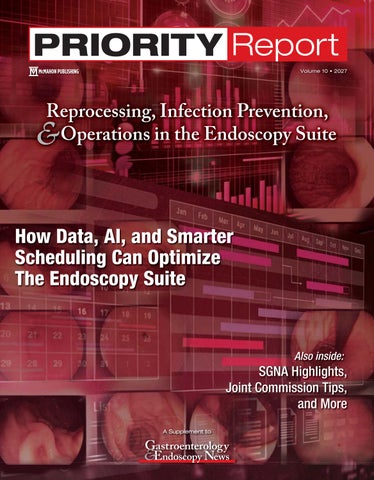
Reprocessing, Infection Prevention, Operations in the Endoscopy Suite
How Data, AI, and Smarter Scheduling Can Optimize The Endoscopy Suite
Also inside:
SGNA Highlights, Joint Commission Tips, and More A Supplement to
ʵ˘˧˧˘˥ ˘˥˚ˢˡˢˠ˜˖˦ʡ ʵ˘˧˧˘˥ ˖ˢˡ˧˥ˢ˟ʡ ʵ˘˧˧˘˥ ˣ˥ˢ˖˘˗˨˥˘˦ʡ
6XSSRUWHG E\ WKH 8 6 1DWLRQDO 6FLHQFH )RXQGDWLRQ
ʶˢ˟ˢˊ˥˔ˣ̀ ˜˦ ˧˛˘ ˙˜˥˦˧ ˖˟˜ˡ˜˖˔˟ ˦ˢ˟˨˧˜ˢˡ ˧ˢ ˠ˜˧˜˚˔˧˘ ˧˛˘ ˡ˘˘˗ ˙ˢ˥ ˠ˔ˡ˨˔˟ ˔˕˗ˢˠ˜ˡ˔˟ ˖ˢ˨ˡ˧˘˥ˣ˥˘˦˦˨˥˘ ˗˨˥˜ˡ˚ ˘ˡ˗ˢ˦˖ˢˣ˜˖ ˣ˥ˢ˖˘˗˨˥˘˦ ˕ˬ ˨ˣ ˧ˢ ʬʣʘʡ ʶˢ˟ˢˊ˥˔ˣ ˜˦ ˣ˔˥˧˜˖˨˟˔˥˟ˬ ˘˙˙˘˖˧˜˩˘ ˙ˢ˥ ˣ˔˧˜˘ˡ˧˦ ˔˧ ˥˜˦˞ ˙ˢ˥ ˗˜˙˙˜˖˨˟˧ ˖ˢ˟ˢˡˢ˦˖ˢˣˬʭ ˟ˢ˪ ˔˕˗ˢˠ˜ˡ˔˟ ˧ˢˡ˘ʟ ˟ˢ˪ ʵˀʼ ˢ˕˘˦˜˧ˬʢ˖˘ˡ˧˥˔˟ ˔˗˜ˣˢ˦˜˧ˬʟ ˛˜˚˛ ʵˀʼ ˦˨˥˚˜˖˔˟ ˛˜˦˧ˢ˥ˬ
˧ˢ˥˧˨ˢ˨˦ʟ ˥˘˗˨ˡ˗˔ˡ˧ ˔ˡ˔˧ˢˠˬ ˛˜˦˧ˢ˥ˬ ˢ˙ ˜ˡ˖ˢˠˣ˟˘˧˘ ˖ˢ˟ˢˡˢ˦˖ˢˣˬ ˔˕˗ˢˠ˜ˡ˔˟ ˛˘˥ˡ˜˔
ʿ˘˔˥ˡ ˠˢ˥˘ ˔ˡ˗ ˦˖˛˘˗˨˟˘ ˔ ˗˘ˠˢʭ
˪˪˪ʡʶˢ˟ˢˊ˥˔ˣʡ˖ˢˠʢ˃˅ʠʥʣʥʩ ʤʡ ʶ˥ˢ˖˞˘˧˧ ˆʷʟ ʶ˜˥˥˜ ʻ˂ʟ ʾ˘˟˔ˣ˨˥˘ ˅ʟ ʺ˔˟˔ˡ˞ˢ ʽʴʟ ˀ˔˥˧˜ˡ ʶʹʟ ʷ˘˟˟ˢˡ ʸˆʡ ˈ˦˘ ˢ˙ ˔ˡ ʴ˕˗ˢˠ˜ˡ˔˟ ʶˢˠˣ˥˘˦˦˜ˢˡ ʷ˘˩˜˖˘ ˜ˡ ʶˢ˟ˢˡˢ˦˖ˢˣˬʭ ˔ ˅˔ˡ˗ˢˠ˜˭˘˗ʟ ˆ˛˔ˠʠʶˢˡ˧˥ˢ˟˟˘˗ ˇ˥˜˔˟ʡ ʶ˟˜ˡ ʺ˔˦˧˥ˢ˘ˡ˧˘˥ˢ˟ ʻ˘ˣ˔˧ˢ˟ʡ ʽ˔ˡ ʥʣʤʩʮ˗ˢ˜ʭʤʣʡʤʣʤʩʢ˝ʡ˖˚˛ʡʥʣʤʨʡʤʥʡʣʦʬ ʥʡ ʸ˟˨˜˥˜ ˆʟ ˅˨ˡ˚˘ ˇʟ ʶ˜˥˥˜ ʻʟ ˘˧ ˔˟ʡ ʶˢ˟ˢˊ˥˔ˣ ʼˠˣ˥ˢ˩˘˦ ʴ˗˘ˡˢˠ˔ ʷ˘˧˘˖˧˜ˢˡ ˅˔˧˘ ˜ˡ ˊˢˠ˘ˡʟ ˂˟˗˘˥ ˃˔˧˜˘ˡ˧˦ʟ ˔ˡ˗ ˂˕˘˦˘ ˃˔˧˜˘ˡ˧˦ʭ ˅˘˦˨˟˧˦ ˙˥ˢˠ ˔ ˅˔ˡ˗ˢˠ˜˭˘˗ ʶˢˡ˧˥ˢ˟˟˘˗ ˇ˥˜˔˟ʡ ˃ˢ˦˧˘˥ ˣ˥˘˦˘ˡ˧˘˗ ˔˧ʭ ʴˠ˘˥˜˖˔ˡ ʶˢ˟˟˘˚˘ ˢ˙ ʺ˔˦˧˥ˢ˘ˡ˧˘˥ˢ˟ˢ˚ˬ ʴˡˡ˨˔˟ ʶˢˡ˙˘˥˘ˡ˖˘ʮ ˂˖˧ ʤʩʠʥʤʟ ʥʣʤʨʮ ʻˢˡˢ˟˨˟˨ʟ ʻʼʡ ʥʣʤʨʮ ʦʡ ʶ˥ˢ˖˞˘˧˧ ˆʟ ˔˟ʡ ˘ʡ ˈ˦˘ ˢ˙ ʶˢ˟ˢˊ˥˔ˣ ˅˘˗˨˖˘˦ ʶ˘˖˔˟ ʼˡ˧˨˕˔˧˜ˢˡ ˇ˜ˠ˘ ʷ˨˥˜ˡ˚ ʶˢ˟ˢˡˢ˦˖ˢˣˬʡ ʺ˔˦˧˥ˢ˜ˡ˧˘˦˧˜ˡ˔˟ ʸˡ˗ˢ˦˖ˢˣˬʡ ʥʣʤʦʮʪʪʛʨʜʭʴʵʨʣʤʡ ˗˫ʡ˗ˢ˜ʡˢ˥˚ʢʤʣʡʤʣʤʩʢ˝ʡ˚˜˘ʡʥʣʤʦʡʣʦʡʫʣʬ ʧʡ ˆˣ˔ˡ˔˥˞˘˟ ˀʟ ˀʷʟ ʷ˨˕˜ˡ˦˞˜ ˀʴʟ ˀʷʟ ʻ˔˧˛ˢ˥ˡ ʽ˃ʡ ʶˢ˟ˢˊ˥˔ˣ ʵ˜ˡ˗˘˥ ˅˘˗˨˖˘˦ ʼˡ˦˘˥˧˜ˢˡ ˇ˜ˠ˘ʟ ˈ˦˘ ˢ˙ ʴˡ˖˜˟˟˔˥ˬ ˀ˔ˡ˘˨˩˘˥˦ʟ ˔ˡ˗ ʹ˥˘ˤ˨˘ˡ˖ˬ ˢ˙ ˃˥ˢ˟ˢˡ˚˘˗ ʼˡ˦˘˥˧˜ˢˡ ʷ˨˥˜ˡ˚ ʶˢ˟ˢˡˢ˦˖ˢˣˬʡ ʴ˖˖˘ˣ˧˘˗ ˙ˢ˥ ˣ˥˘˦˘ˡ˧˔˧˜ˢˡ ˔˧ ˆˢ˖˜˘˧ˬ ˙ˢ˥ ʴˠ˘˥˜˖˔ˡ ʺ˔˦˧˥ˢ˜ˡ˧˘˦˧˜ˡ˔˟ ˔ˡ˗ ʸˡ˗ˢ˦˖ˢˣ˜˖ ˆ˨˥˚˘ˢˡ˦ ʛˆʴʺʸˆʜ ʴˡˡ˨˔˟ ʶˢˡ˙˘˥˘ˡ˖˘ʡ ʴˣ˥˜˟ ʥʠʨʟ ʥʣʤʧʡ ˆ˔˟˧ ʿ˔˞˘ ʶ˜˧ˬʟ ˈˇ ʥʣʤʧʡ ʨʡ ʶ˥ˢ˖˞˘˧˧ ˆʟ ʷ˘˟˟ˢˡ ʸˆʟ ʵ˜˚˚˘˥˦ ʿʟ ʸ˥ˡ˦˧ ʷʴʡ ˈ˦˘ ˢ˙ ˃˔˧˜˘ˡ˧ ʴ˕˗ˢˠ˜ˡ˔˟ ʶˢˠˣ˥˘˦˦˜ˢˡ ʷ˘˩˜˖˘ ˅˘˗˨˖˘˦ ˆ˧˔˙˙ ˀ˨˦˖˨˟ˢ˦˞˘˟˘˧˔˟ ˃˔˜ˡ ʴ˦˦ˢ˖˜˔˧˘˗ ˊ˜˧˛ ˆ˨ˣˣˢ˥˧˜ˡ˚ ʶˢ˟ˢˡˢ˦˖ˢˣˬʭ ˅˘˦˨˟˧˦ ʹ˥ˢˠ ˔ ˅˔ˡ˗ˢˠ˜˭˘˗ ʶˢˡ˧˥ˢ˟˟˘˗ ˇ˥˜˔˟ʡ ʺ˔˦˧˥ˢ˘ˡ˧˘˥ˢ˟ˬ ˁ˨˥˦ʡ ʥʣʥʤ ˀ˔˥ʠʴˣ˥ ʣʤ ʥʣʥʤʮʧʧʛʥʜʭʤʦʩʠʤʧʨʡ ˗ˢ˜ʭʤʣʡʤʣʬʪʢˆʺʴʡʣʣʣʣʣʣʣʣʣʣʣʣʣʨʨʣ
2027
Reprocessing, Infection Prevention, Operations in the Endoscopy Suite Volume 10 • 2027
EDITORIAL STAFF
ART AND PRODUCTION
SARAH TILYOU Managing Editor smtilyou@mcmahonmed.com
JEANETTE MOONEY Senior Art Director
KATIE PRINCE Senior Editor kprince@mcmahonmed.com
JAMES O’NEILL Senior Systems Manager RON REDFERN Production Manager
POSTMASTER: Send address changes to: Gastroenterology & Endoscopy News 545 West 45th Street, 8th Floor New York, NY 10036
MCMAHON PUBLISHING
Commentaries and opinions do not necessarily reflect the views of the publication.
DAVID BRONSTEIN Vice President, Editorial KRISTIN JANNACONE Copy Chief
VAN VELLE President, Partner
MADISON FIEDLER Copy Editor
MATTHEW MCMAHON General Manager, Partner
SALES STAFF MATTHEW SPOTO Group Franchise Director mspoto@mcmahonmed.com DONALD V. POPOWSKI Account Manager dpopowski@mcmahonmed.com CRAIG WILSON Classified Advertising Manager cwilson@mcmahonmed.com
MCMAHON PUBLISHING Sales, Production and Editorial Offices: 545 West 45th Street, 8th Floor New York, NY 10036 Telephone: (212) 957-5300
LAUREN SMITH MICHAEL P. MCMAHON MICHELE MCMAHON VELLE Partners RAY & ROSANNE MCMAHON Co-founders
Disclosure Statement: We endeavor to obtain relevant financial disclosures from all interviewees and rely on our sources to accurately provide this information, which we believe can be important in evaluating the research discussed in this publication. Copyright © 2027 McMahon Publishing Group, 545 West 45th Street, 8th Floor, New York, NY 10036. Printed in the USA. All rights reserved, including the right of reproduction, in whole or in part, in any form.
JOSEPH MALICHIO Vice President, Medical Education jmalichio@mcmahonmed.com
Founded in 1972, McMahon Publishing is a family-owned medical publisher of clinical newspapers and specialty periodicals that creates continuing medical education programs and custom publications.
Reprocessing, Infection Prevention, & Operations in the Endoscopy Suite
3
2027
Reprocessing, Infection Prevention, Operations in the Endoscopy Suite Volume 10 • 2027
6
Tracking System and Staff Training Cut Endoscope Repair Burden in QI Project
7
Tech Training Program Aims To Stem a Staffing Shortage
8
Automated Endoscope Drying May Reduce Residual Moisture And Microbial Contamination Highlights of SGNA 2026:
10
4
Water-Soluble Simethicone, a GLP-1–Related Nausea Remedy, a Perforation Protocol, and More
14
7 Pearls to Consider Before Your Next Joint Commission Survey
18
How Data, AI, and Smarter Scheduling Can Optimize the Endoscopy Suite
Reprocessing, Infection Prevention, & Operations in the Endoscopy Suite
BUILDING BLOCKS FOR STRONGER
E N D O Better tools build better outcomes. mes. Let’s strengthen endo together. r. Endoscope processing is built on a series of critical steps, and each one calls for tools that support clarity and compliance. Our endo-focused solutions and educational support are designed to help your team build a strong foundation for success.
Manual Cleaning Labeling Protective Equipment
Let’s build a stronger endo foundation for your team. Scan to get started.
Inspection Tools Transport & Storage Educational Resources
2027
Tracking System and Staff Training Cut Endoscope Repair Burden in QI Project ATLANTA—An initiative that involved tracking of endoscope repairs, physician and staff education, and standardized handling protocols reduced the cost of endoscope repairs by 84% over a six-month period during a quality improvement initiative at one center.
saijid stock_AdobeStock
“As both a practicing gastroenterologist and physician executive, I would emphasize that preventing endoscope damage should become part of a broader culture of equipment stewardship and quality improvement, rather than simply teaching people to be more careful,” commented Harish Gagneja, MD, the vice chair of the American College of Gastroenterology Board of Governors and chief medical officer at Austin Gastroenterology, in Texas, who was not involved in the study. “I would say, treat the scope as if it is your own dog or a baby.” Between February and August 2025, Melanie Harris, RN, the endoscopy education coordinator at CHI St. Luke’s Health, in Houston, and her co-investigators conducted the project to minimize endoscope failures and the need for repairs in their unit.
Phase 1: Tracking System The first phase of the initiative involved designing and implementing a tracking system to monitor endoscopes throughout The tracking system also their life cycle and identify allowed our team to schedule common causes of device cases more efficiently because failure. Subsequent phases focused on developing tarwe knew the exact inventory geted strategies to reduce of scope types available. the need for repairs and —Melanie Harris, RN evaluating and monitorCHI St. Luke’s Health, Houston ing the outcomes of the program.
‘
’
see Scope Repair, page 22
6
Reprocessing, Infection Prevention, & Operations in the Endoscopy Suite
2027
Tech Training Program Aims To Stem a Staffing Shortage
A
sharp increase in the demand for endoscopic services portends a looming staffing shortage, but a national standardized training
program for endoscopy technicians aims to address this impending problem, according to Gottumukkala S. Raju, MD, the John Stroehlein Distinguished Professor of Medicine at The University of Texas MD Anderson Cancer Center, in Houston. “Endoscopy services have exploded,” Dr. Raju told GEN Priority Report. “The team is at risk of implosion if we don’t make some changes.” The impending staffing shortage is driven by a shift in colorectal cancer screening guidelines to 45 years of age, which Dr. Raju noted has added 20 million potential patients to an already overloaded system. In a presentation at DDW 2026 (abstract Sp1260), Dr. Raju outlined how an endoscopy technician program that he and his colleagues from Texas Medical Center developed at Houston City College in 2021 can and should be scaled up to schools and hospital networks across the country to meet growing clinical demand.
Since the 2021 launch of the program, Dr. Raju’s model has grown exponentially, with 263 technicians from 35 centers nationally now holding the American Society for Gastrointestinal Endoscopy GI Technician Certificate of Completion. To support this effort, Dr. Raju has made 175 narrated instructional videos publicly available on YouTube to provide a standardized open-source curriculum for any facility in the country. Research has validated the academic rigor of the program. In a comparative study of ASGE GI Technician Assessment Exam scores, graduates from the 2022-2023 class consistently scored as well as or better than experienced
Courtesy Gottumukkala S. Raju
Dual Studio_AdobeStock
see Tech Training, page 21
‘ Over 50 students graduated, and all
of them signed up for jobs before they graduated. The hospitals that hired them were very pleased with their training because they were able to see not only technical skills but cognitive skills.
’
—Gottumukkala S. Raju, MD The University of Texas MD Anderson Cancer Center, Houston
Reprocessing, Infection Prevention, & Operations in the Endoscopy Suite
7
2027
Automated Endoscope Drying May Reduce Residual Moisture And Microbial Contamination utomated drying systems and drying/storage cabinets may
A
reduce residual moisture and microbial contamination in
gastrointestinal endoscopes more effectively than conventional drying methods, according to a recent systematic review. In several of the included studies, automated drying reduced residual moisture from rates as high as 90% with conventional drying to no detectable moisture, while also substantially lowering
A-TiMe_AdobeStock
microbial contamination rates.
8
Retained moisture is an infection prevention concern, explained James Collins, RN, the accreditation program manager of clinical and operational improvement in enterprise quality and safety at Cleveland Clinic, in Ohio. “The presence of residual moisture may provide an excellent environment that can support microbial growth and biofilm development,” he said. “A facility does not want to wait for a safety event before they augment reprocessing practices.” “Endoscope reprocessing is a key area of quality emphasis in modern endoscopy units,” agreed Vivek Kaul, MD, a professor of medicine at the Center for Advanced Therapeutic Endoscopy at the University of Rochester Medical Center, in New York. “Residual moisture in endoscope channels, even after optimal reprocessing, is a well-recognized issue. Endoscopy units should make every effort to ensure this is addressed per current guidelines.” Neither Dr. Kaul nor Mr. Collins was involved in the review. To better understand the effectiveness of available drying methods, Chengyi Han, MD, a medical researcher and clinician in the Department of Infection Prevention and Control at The First Affiliated Hospital of Henan University of Chinese Medicine, in Zhengzhou, China, and co-investigators reviewed studies published through November 2025 evaluating endoscope drying techniques and their effects on residual fluid and microbial contamination (Endosc Int Open 2026;14:a28717878).
Reprocessing, Infection Prevention, & Operations in the Endoscopy Suite
2027
The investigators identified 16 eligible studies from the United States, Canada, Europe, and North Africa. Because of considerable variation in drying methods and outcome measures, they performed a descriptive review rather than a formal meta-analysis. Across the studies included in the analysis, residual moisture frequently remained after standard drying protocols. In one study, all 42 endoscopes remained wet after standard automated endoscope reprocessor (AER) alcohol flush and air purge cycles, whereas no residual fluid was detected after use of a dedicated forced-air drying system. Another study found residual moisture in 90% of endoscopes processed with a conventional washer-disinfector, compared with none processed incorporating the PlasmaTYPHOON drying system (Pentax). Several studies also evaluated drying efficiency and processing times. In one investigation, endoscopes stored in conventional cabinets still contained residual internal moisture 24 hours after reprocessing, whereas automated drying and storage cabinets achieved complete dryness within one hour. Another study found that a dedicated forced-air drying system eliminated residual fluid after a 10-minute drying cycle, compared with persistent moisture following standard AER alcohol flush and air purge cycles. In addition, the review authors noted that in one investigation of 140 samples collected, bacterial contamination declined from 86.4% immediately after decontamination (95% CI, 81%-92%) to 33.6% after automated drying (95% CI, 26%-41%).
The Role of Drying Cabinets Storage methods also appeared to play an important role. In one study, contamination levels exceeding target thresholds were detected in 45% of samples from endoscopes stored in conventional cabinets, compared with 13% of those from endoscopes stored in a semi-automated drying cabinet. Another study reported no recoverable microorganisms from endoscopes after 31 days of storage in automated drying cabinets. Some investigations found contamination continued to decline during storage in drying cabinets but remained stable or increased during conventional storage.
Although automated drying cabinets and drying systems appear promising, adoption may not be straightforward because of the perception that retained moisture is not a meaningful concern, Mr. Collins noted. “Either moisture is not visualized on the exterior surface of the endoscope or there are not puddles on the floor of the endoscope storage cabinet, so there must not be an issue with retained fluid in the endoscope,” he said, describing the first of two common misconceptions.
‘ A facility does not want to wait for a safety event before they augment reprocessing practices.’ —James Collins, RN Cleveland Clinic, Ohio
Mr. Collins said another common misconception involves endoscope turnaround times, which rest on the presumption that endoscopes go straight back into service after the AER cycle. In this context, many believe retained fluid poses no problem and that hanging them in the cabinet after the day’s last reprocessing dries the channels overnight, Mr. Collins said. Both Mr. Collins and Dr. Kaul agreed that education and awareness are key to adopting new practices. “There is overt concern that the introduction of enhancements to the reprocessing of endoscopes will be burdensome to the reprocessing clinicians. Education of clinicians is crucial,” Mr. Collins emphasized, noting that endoscopy units also should assess procedure volume, turnaround expectations, staffing, available space, and maintenance requirements. Weighing the potential benefits against the costs and logistical challenges, Dr. Kaul said that “the cost proposition should always be looked at through the prism of what is currently considered best practice, what is in the best interest of the patient, and where capital investments are supported by data.” —Celina Carter, PhD, MN, RN The review authors and Dr. Kaul reported no relevant financial disclosures. Mr. Collins reported a financial relationship with Steris.
Reprocessing, Infection Prevention, & Operations in the Endoscopy Suite
9
2027
Highlights of SGNA 2026 Courtesy Cynthia M. Friis
Water-soluble simethicone, a GLP-1–related nausea remedy, a perforation protocol, and more Cindy Friis, MEd, BSN, RN, with Natasha Albaneze, MPH
Cynthia M M. Friis Friis, MEd, BSN, RN, NPD-BC
n this installment of Expert Picks from the Society of Gastroenterology Nurses and Associates 2026 Annual Course, Cynthia M. Friis, MEd, BSN, RN, NPD-BC, the associate executive director of clinical affairs at SGNA, discusses five of her favorite abstracts from the meeting.
I
EXPERT PICKS GI Nurse Certification developed a framework for encouraging more nurses to pursue certification that ... can serve as a template for other facilities interested in promoting specialty nursing certification.’
Perforation Management ‘This GI perforation protocol helps to guide nurses and technicians in supporting physicians during perforation assessment and intervention.’
10
Halfpoint_AdobeStock
‘The investigators
Residual matters: evaluating endoscopy cleanliness after simethicone vs. water-soluble alternative (Rabelo et al) Investigators assessed the residue retention of a novel water-soluble simethicone alternative (WSSA) compared with traditional water-insoluble simethicone. The water-soluble version was hypothesized to maintain the benefit of simethicone of enhancing visualization during endoscopy without resulting in persistent residue after high-level disinfection. Investigators evaluated endoscopes from seven days of procedures using either WSSA or traditional simethicone. The scopes were confirmed to be residuefree pre-procedure; post-procedure they
underwent high-level disinfection, were dried, and inspected via borescope to evaluate for the presence of residue. A total of 18 WSSA and 48 traditional simethicone endoscopes were included in the analyses. After high-level disinfection, residue was detected in no WSSA scopes and in 14.6% of traditional simethicone scopes (P=0.09). In addition, the investigators reported that no positive protein indicators were present in the WWSA and traditional simethicone scopes. The investigators noted that these see SGNA Expert Picks, page 12
Reprocessing, Infection Prevention, & Operations in the Endoscopy Suite
®
HANG IT RIGHT. DRY IT RIGHT. Independent research on cabinet storage design found that combining full vertical suspension with active channel drying dramatically reduced residual moisture and bacterial growth compared to partial-hang or coiled storage
4 Back
• Full-length vertical hang — keeps channels open and draining, not coiled or comopressed. • HEPA-filtered active drying — validated 10-minute cycle through every internal channel. • At-a-glance LED status — know which scopes are drying, dry, or need attention without opening the door. • Built for compliance workflows — hang-time alerts, FIFO rotation, maintenance tracking.
Dry it. Store it. Know its status. Supports alignment with AAMI ST91, AORN, ASGE, and SGNA drying and storage recommendations.
See TRACKER in action at www.driscope.com Manufactured in an FDA-registered, ISO 13485-certified U.S. facility
2027
SGNA Expert Picks continued from page 10 “findings can inform evidence-based decisions, enhance safety, and empower nurses to lead quality improvement in endoscope reprocessing.” Ms. Friis: As simethicone often is used during gastrointestinal endoscopy procedures to enhance visualization, the issue of residual simethicone continues to be an important point of discussion.
There are challenges in ensuring that simethicone is completely removed from the endoscope post-procedure via highlevel disinfection. Further investigation is needed, but this study addresses this need through a comparison of simethicone with a water-soluble alternative and pushes the envelope in seeking solutions to this issue.
Improving GI lab nurse certification across multiple university hospital sites through a structured coaching program (Lardizabal et al) Investigators conducted a survey of gastroenterology nurses to gauge motivators and deterrents to seeking Certified Gastroenterology Registered Nurse (CGRN) certification and then implemented a coaching program to facilitate the certification process. For the study, recruited gastroenterology nurses were surveyed about their certification status, preparation for certification, and their thoughts about the benefits of and barriers to certification. Survey participants were most commonly female and mid-career. A sample of the participants were selected for in-depth interviews. Based on the survey and interview findings, the investigators used the Plan-Do-Study-Act framework to implement a structured coaching program that included self-study, coaching and mentoring sessions, test-taking strategies, practice exams, reimbursement for fees, and post-exam debriefs. The investigators found that motivations for undergoing certification were “professional growth, financial rewards, and recognition.” On the other hand, barriers to certification were “limited
time, financial constraints, and insufficient institutional support.” After implementation of the coaching program, the proportion of GI nurses who were certified increased to 53% from 41%. The investigators concluded that “a formal institutional structure effectively reduced barriers, enhanced professional development, strengthened clinical competence, and promoted a culture of excellence in gastroenterology nursing.” Ms. Friis: Specialty nursing certification plays a key role in a nurse’s career. Earning certification enriches professional credibility, provides opportunities for career advancement, and can consequently improve patient care due to the high level of expertise of the certified nurse. CGRN certification is highly valued in gastroenterology practice. Recognizing this, the investigators developed a framework for encouraging more nurses to pursue certification that goes beyond simply having a conversation. This framework can serve as a template for other facilities interested in promoting specialty nursing certification.
Investigation of ginger vs. placebo to decrease nausea associated with glucagon-like peptide-1 therapy (Balaban et al) With the high prevalence of nausea (15%-50%) in patients who take GLP-1 receptor agonists, which can lead to discontinuation, investigators assessed whether a ginger chew supplement could reduce this side effect. Participants, all of whom were taking GLP-1s, were randomized to nausea management with ginger chews or a caramel candy placebo. The participants rated the nausea on a 10-point Likert scale, with 0 indicating no nausea, 1 to 3 indicating mild nausea, 4 to 6 indicating moderate nausea, 7 to 9 indicating severe nausea, and 10 indicating vomiting. The patients reported nausea severity before and after treatment in a diary. The investigators assessed the changes in the severity of nausea per dose, per participant, and per nausea event.
12
In the modified intent-to-treat population, there were 38 patients in the ginger group and 36 in the placebo group. For each dose of treatment, nausea severity decreased by 3.46 points in the ginger group, compared with 2.95 points in the placebo group (P=0.380). Across nausea events, 92.3% treated with ginger saw a reduction of 1 to 6 points on the Likert scale, compared with 81.6% treated with placebo (P<0.001), while a reduction of 7 to 10 points was achieved in 3.8% of ginger-treated events and 6.2% of placebo-treated events. No change or an increase in nausea severity was seen in 3.8% of ginger chew–treated events and 12.1% of placebo-treated events. These findings illustrate that “both ginger and placebo
Reprocessing, Infection Prevention, & Operations in the Endoscopy Suite
2027
numerically reduced nausea severity in GLP-1-treated participants. However, ginger was statistically superior to placebo in achieving mild/moderate reduction and in achieving any nausea reduction,” according to the investigators. Ms. Friis: GLP-1 therapy has taken a prominent seat in gastroenterology, as many people struggle with weight and the
comorbidities that accompany sustained obesity. While it has proven to be effective for weight loss, glycemic control, and metabolic health, patients experience several side effects, with nausea being a consistent one. This study is impactful, as it investigates a simple treatment, ginger chew consumption, to reduce nausea. By minimizing GLP-1 therapy side effects, more people in need of this treatment may take it comfortably.
Reducing day-of-surgery cancellations in the endoscopy unit (von Stoosten et al) Investigators implemented a quality improvement initiative to reduce the day-of-surgery (DOS) cancellation rate from 14% to less than the U.S. national average of 12%. The initiative comprised a chart review and call to patients by nurses the day before the endoscopy procedure. In reviewing charts, nurses aimed to identify patients who were at high risk for noncompliance, those who were missing pre-procedure assessments, those who had critical lab results, or those who were taking high-risk medications. In addition, the calls to patients, which were scripted, were used to confirm appointments, including verifying that patients had transportation to the procedure, reminding patients of pre-procedure instructions and to withhold certain medications, and answering any patient questions. The program resulted in a 2% decrease in DOS cancellations, from 14% in 2023 to 12% in 2025.
The investigators concluded these results illustrated that “integrating the day prior to procedure nurse-led chart reviews and patient calls has shown success in reducing DOS cancellations.” Moving forward, they added that “embedding these nurse-driven interventions into standard workflow, supported by dedicated staff, education and audits [would foster] sustainability and drive long-term improvements in endoscopy units.” Ms. Friis: GI procedures that are canceled on the day of the procedure are disruptive to the anticipated schedule. Disruptions can affect the financial bottom line, cause staff frustration, and may result in patient dissatisfaction. This study addressed cancellations and shares a process that has shown to improve cancellation rates by adding a chart review and nurse-led communication to the pre-procedure process.
GI perforation protocol (Pelayo et al) Investigators developed a protocol for effectively managing bowel perforations during endoscopic procedures. The protocol, which has three components, emphasizes an “efficient, evidencebased, and team-oriented” approach. Ultimately, the investigators noted, “these strategies promote a structured and coordinated response [to bowel perforation], enhancing patient safety and improving clinical outcomes.” The first component is use of evidence-based interventions for bowel perforation management, particularly those recommended by American Society for Gastrointestinal Endoscopy and European Society for Gastrointestinal Endoscopy guidelines. The investigators stressed the use of evidence-based interventions but highlighted the need to adapt these guidelinerecommended approaches “to the specific needs and resources of the [endoscopy] unit.” The second component is “comprehensive training for nurses and technicians.” This, the investigators emphasized, bolsters the confidence and competence of the management team, and can
help “ensure … cohesive teamwork during a perforation event.” The third component, creating a perforation box, is designed to “reduce response time and prevent unnecessary delays” in the management of the perforation event. Ms. Friis: GI procedures are often uncomplicated, relatively quick diagnostic tests, but depending on the severity of the patient’s condition, they can turn into more involved and complex procedures. Perforations are uncommon, but the team needs to be prepared to intervene when they occur. This study explores current guidelines and establishes a comprehensive training program and the creation of a protocol. This GI perforation protocol helps to guide nurses and technicians in supporting physicians during perforation assessment and intervention, which drives a knowledgeable, consistent approach to a low-incidence, potentially high-risk event. —Natasha Albaneze, MPH Ms. Friis reported no relevant financial disclosures.
Reprocessing, Infection Prevention, & Operations in the Endoscopy Suite
13
2027
7 Pearls to Consider Before Your Next Joint Commission Survey efore taking a position with Joint Commission as an ambulatory surveyor in 2021,
B
Beth Hogan, MSN, RN, had been a nurse for more than four decades, with myriad
roles, including clinical director of nursing at a GI endoscopy center. She spent much of her career developing protocols and policies and educating nurses and other health
Wiktoria Matynia_stock.adobe.com
care professionals, a long history she said she brings to every survey.
“I’m very passionate in terms of my ‘why,’” she said, explaining that her drive to be a healthcare educator and surveyor is more personal than abstract. Many years ago, her father was in the hospital and required surgery. He received a contaminated steroid dose that sent him into sepsis and dialysis, and he passed away three weeks later. “My why is making sure we aren’t missing opportunities for safe patient care,” she emphasized. “I don’t want any family to ever have to go to through that.” In a recent interview with GEN Priority Report, Ms. Hogan shared an insider’s perspective and offered practical tips for successful Joint Commission surveys.
1 1
Relax, This Is an Open-Book Test
A lot of people get anxious by the term “accreditation,” but it should be viewed as a collaboration between you and your
14
accrediting agency and an opportunity for education about things you might not be aware of. We all wake up with the best intentions every morning, and, unfortunately, we don’t know what we didn’t know until we find out we didn’t know it. When we know better, we can do better. I like to remind organizations: You’ve opted for this accreditation process. This is as much about what you need as what we need. You have things that you’ve been trying to identify and fix. A survey is an open-book test. There should not be any surprises as far as what we’re looking at, what we’re looking for, or what our approach is going to be. Joint Commission uses a tracer methodology. We’re going to follow your patient, your instruments, that scope. CMS has a worksheet, there are checklists available from your professional organizations, and your accrediting agency has lists for you.
Reprocessing, Infection Prevention, & Operations in the Endoscopy Suite
see JC Survey, page 16
DESIGN YOUR OWN
ENDOSCOPY SINK
We know one size doesn’t fit all. That’s why TBJ will work with you to customize a sink to fit your specific space and equip it with the options and features you need to process scopes safely and efficiently.
Notable optional features include: - Integrated Scope Buddy™ Plus Flushing Aid - Automatic push-button sink filling - Water temperature monitoring - Overhead lighting and task lighting/inspection options - Numerous faucet and fixture options - Push-button height adjustment - Storage and shelving options - Single, double and triple bowl configurations
More Choices · More Features Visit www.tbjinc.com or call 717-261-9700
2027
JC Survey continued from page 14 2 2
The Devil Is in the Details
Organizations often focus on the big-picture goals of infection prevention, but success frequently is determined by the small operational choices that shape day-to-day practice. The most effective programs aren’t necessarily the most complex. As an example, I can almost predict when I go into an organization how hand hygiene is going to look based on where their hand sanitizers are. If the bay is on the back wall, your provider and your anesthesia provider are not going to crawl over the patient to get to it. If it’s outside the bay or if it’s on a table front and center, they’re much more likely to be compliant. The other thing that I see in successful hand hygiene audits is a code word. For example, we don’t want to say in front of a patient, “Doctor, you forgot your hand hygiene.” But if we say, “Doctor, have you seen ‘Gene’ yet?”—as in hand hygiene—then he’s reminded to do his hand hygiene right there in the moment without embarrassing him in front of the patient. Another example is the one-hour window to begin the manual reprocessing of scopes, which can be challenging, but we can tell you best practices we’ve seen across the country. There’s a misconception about when that hour starts. It starts when the scope comes out of the patient, and if it’s over an hour, with most scopes, the reprocessing protocol becomes more involved. However, if you don’t have a process for evaluating that, how do you know you’re getting everything done in an hour? If you have one room and you’ve got a tech in there all the time, it’s probably not an issue. But what about the day that person calls out sick? What about the situation where you’ve got three or four rooms and scopes are coming out at the same time; how do we know which one should be done first? Sometimes organizations don’t have a process for that. It doesn’t have to be complicated. There are places that have made a login book for scope tracking, but you can take a Sharpie and write on the bag what time the scope came out of the patient so your reprocessing tech will know which one to clean first. And if there are so many
16
scopes that it’s not realistic to process them all in a timely manner, then we need to look at our distribution of labor. I also think about leak testing with scopes, too. Very often, people aren’t depressing the pin before they connect it to the scope. If you don’t do that and you’ve got a bend in your pin, you’ve got a false sense of security about whether you’ve got a hole in your scope or not.
3 3
Good Onboarding and Continuing Education Are Essential
Any time you’re onboarding a new licensed practitioner, whether it’s a physician, anesthesia provider, CRNA, RN, or tech, you should do an orientation checklist: how to use the phone system, what your role is in a fire, and where to find emergency equipment. This is our expectation for hand hygiene, scope processing, and safe injection practices, too. What’s more, when we bring on a new employee, we should not only be aware of the competencies that they need for that role but ensure they are getting all those competencies along with routine reassessment. It’s not a “one and done.” I can’t tell you how many times I’ve gone into someplace where the person who has been doing it for 30 or 40 years is missing steps. Again, no one is doing that intentionally. Perhaps the person who instructed them neglected a step that day by accident or, over time, may have dropped a step entirely without realizing it. It’s critical to validate that the competencies we bring people in with are as detailed as they should be and that we’re reassessing those periodically.
4 4
Know Your Instructions for Use
I strongly encourage people to read their manufacturer’s instructions for use (IFUs). Often, that’s where we find organizations falling outside the standard. IFUs have a lot of information, but it’s not complicated if you read it step by step. We don’t always have the time to do that, but we need to make the time.
Reprocessing, Infection Prevention, & Operations in the Endoscopy Suite
2027
That said, the people who write IFUs are human, and sometimes there are typos. If you read something and your gut says something doesn’t seem right, talk to someone and make sure of what you should be doing. I knew a tech who, every six months, would request the device educator to come to her facility because she learned something every time they came in. The educator would spend the day with the techs, and they would take turns washing scopes so he could watch the process.
5 5
Craft Thoughtful Policy
I surveyed an organization that, in their hand hygiene policy, said that anytime someone touches an inanimate object, they must do hand hygiene. Is that realistic? I don’t think so. We see policies that say every nurse in the organization is going to be credentialed by year two. That’s a great goal, but how many of your nurses are actually certified at that point? Make sure to review policies annually—not just a quick look but thoroughly, and ask if they still accurately reflect what you’re doing and expect of your staff. We’re going to hold a facility to the highest measure of policy they profess to uphold—it may be a standard from Joint Commission, it may be federal, state, or local guidelines, or standards the organization reports to be following per their policies. On the other hand, sometimes a policy is unclear. When a new employee reads it, will they understand what they should be doing? I’ve seen organizations struggle to master their own highalert policies for medications. These become a bit of an “if that, then this” policy, which just feels overly complicated. If I’m a nurse who’s been out of school for just six months, is this going to be clear to me? When we’re writing policies, we have to consider that it shouldn’t be written with the experience of somebody who’s been in healthcare for 30 years. Write policy for all the people who are expected to read and understand it.
6 6
Live Survey Ready
We encourage organizations to work as if a surveyor could come in at any time. We can tell when organizations are doing things just because
we’re there for the day. For example, I visited an organization where a surgeon came up to the administrator while I was talking to her and naively said, “I know they’re here today. Remind me: What’s that timeout thing I’m supposed to be doing?” Even if I hadn’t heard that comment, it was very clear when he did his timeout that he wasn’t doing it on a regular basis.
7 7
Own Your Mistakes
I really appreciate when an organization is up front about challenges they’ve been experiencing, because we may be able to talk it through and help them. It’s a much more collaborative and beneficial experience for everybody if we’re all transparent about what we’re seeing, what our concerns are, and what our risks are. One survey stands out in my mind because their sterilization high-level disinfection area was spectacular in terms of how it was maintained, what they were doing, and documentation. There was one step that they were missing— a filter cleaning that was supposed to be done daily. And when we read the IFUs, the tech very quickly said, “I did not know that, and I am not doing that.” I said, “The integrity with which you just said that is more impressive to me than anything I’m going to see on survey.” There were six of her superiors standing behind her, and to say that she was not taking that step as clearly and articulately as she did and truly “own it” was huge. That person is not going to hesitate if they feel something’s not right in the future with their other processes. Isn’t that what we all want? We need to build a culture where the team feels comfortable speaking up. Of course, sometimes I see the leaders beating themselves up, but my thinking is: “You called us in to help you identify risks. We’ve identified one. That’s the long-term goal, and now you know it and you’re going to do better. We’re not going to beat ourselves up over this, but we’re going to change what our practice is moving forward.” Our goal is to provide the highest quality care to every patient every day, and this is what the survey process is all about. Be open to the experience and take advantage of the expertise and resources your surveyor can provide. —Katie Prince This transcript has been edited for clarity and brevity.
Reprocessing, Infection Prevention, & Operations in the Endoscopy Suite
17
2027
How Data, AI, and Smarter Scheduling Can Optimize the Endoscopy Suite ata-informed scheduling and digital tools could help
D
endoscopy units make better use of limited resources,
reduce reporting and documentation burdens, and increase access to care, according to experts who spoke at DDW 2026.
Voice-recognition reporting systems can shorten procedure, reporting, and report preparation times. … For a physician performing 10 to 12 procedures per day, this can add up to half an hour of reclaimed time.
Courtesy Mohammad Bilal
—Mohammad Bilal, MD University of Colorado Anschutz Medical Campus, Aurora
Encouraging gastroenterology practices to embrace technological advances to make endoscopy units more operationally efficient and cost-effective, the speakers highlighted research showing that predictive overbooking can increase service utilization by nearly 15%, voicerecognition reporting can save minutes per case, and artificial intelligence–assisted capsule review can reduce reading time nearly in half.
Redesigning the Endoscopy Suite Schedule Conflicts, no-shows, and equipment issues can make scheduling a complex problem in the endoscopy suite. Lukejohn Day, MD, MBA, a see Optimize Endo Suite, page 20
18
Reprocessing, Infection Prevention, & Operations in the Endoscopy Suite
Are You Receiving This Publication For Endoscopy Professionals? ims gram A ing Pro Shortage in ra T h g Tec a Staffin To Stem
Highli
ghts o
2027
thia M. y Cyn Courtes
A
EXP
graduated
ala S. Raju Courtesy
Gottumukk
’
MD And
erson Can
cer Cen
tock
10
io_AdobeS Dual Stud
Reproces
sing, Inf
ection Pre
vention,
&
y Suite Endoscop
6
I
t_Adobe
Stock
t of Ex tro tasha pert Cours enterolo Albane Pick gy N e, Cyn ze, M asso PH thia M urses an s from th cia e Socie d Asso . Friis , discus te execut ty of ive di MEd, BSN ciates 20 ses fiv 26 An re , RN, N ctor e of he nual of clini PD-B r favo ca C rite ab , the l affa irs stract s from at SGNA, the m eetin g.
Resid ual m atte clea rs: ev alua water nliness ting afte -s
ent ‘This GI pe protoc rfora tion ol nurses helps to guide and te in su chnic ppor ians ting ph durin ysician g pe s rfora asse ssmen tion t and interve ntion. ’
7
ns in the Operatio
inves deve tigator lope s for en d a framew cour ork aging nurses more to pu certific rsue ation that serve ... ca as a n templ othe r facil ate fo r in prom ities inter ested ot nursing ing spec ialty certific ation. ’
Perf orat ion Man agem
Reprocessing, Infection Prevention, Operations in the Endoscopy Suite
, and all ore they
of pitals ning . The hos graduated ased with their trai only not y ple were ver able to see they were skills. because cognitive , MD skills but kala S. Raju ston cal muk hni tec —Gottu ter, Hou of Texas
KS
A 202
Halfpoin
Volume 10 • 2027
r 50 jobs bef ‘ Ove d them ned up for that hire them sig
ersity The Univ
Cynthia MEd, M. Friis, BSN, NPD- RN, BC
P IC
GI N urse Certif icatio ‘The n
if cen told for Ga tificate Dr. Raju risk of implosion impending 35 erican Society cian Cer at s.” The a shift in Am GI Techni port this effort, team is oscopy e change d by to End mpletion. To sup 175 narrate make som rtage is driven de Co le guidelines sho staffing cancer screening u noted has of Raju has ma publicly availab ed al colorect age, which Dr. Raj ients to an Dr. ructional videos e a standardiz vid pat of inst rs ial pro facility 45 yea potent Tube to for any million 6 on Youource curriculum added 20 rloaded system. 202 DDW open-s ntr y. the aca already ove sentation at lined ed out cou dat u In a pre 260), Dr. Raj program in the earch has vali In a com Sp1 Res program. hnician technician r of the (abstract Tec Texas endoscopy eagues from demic rigo dy of ASGE GI duates from how an coll uston stu res, gra and his ed at Ho be parative Exam sco sistently scored that he develop uld ent ter sho essm con Cen and Ass class erienced Medical 2021 can hospital net2022-2023 ter than exp llege in 21 City Co to schools and , page wing the well as or bet Training meet gro as see Tech scaled up ss the country to works acro and. clinical dem
students
ERT
202
f SGN
Wate a GLP r-soluble -1 a perf –related simethico ne oratio n Cindy n pro ausea rem , Friis, tocol, e MEd, n this BSN, and m dy, install RN, wi ore men Gas th Na
Friis
s portend rvices opic se ining endosc ized tra nd for ndard dema nal sta nding tio pe in the na im a se s but s thi increa ortage, addres oehlein sharp ffing sh aims to John Str ng sta icians MD, the a loomi s MD y techn S. Raju, of Texa doscop mukkala for en iversity to Gottu The Un program ine at the pro cording dic ac , nch of or of Me 2021 lau wn expoproblem Profess Since the u’s model has gro s from uston. ished Raj r, in Ho loded,” hnician Distingu have exp “The gram, Dr. with 263 tec holding the er Cente y services ort. now n Canc tially, stinal “Endoscop GEN Priority Rep we don’t nen ters nationally Anderso strointe
olub en r sim Invest le al ethico doscop tern tion of igators assess y ne vs ative a ed the . alternati novel water (Rab residu e -solub elo et le simeth reten- un tional ve (WSSA) al) de co wa water-so ter-insolub mpared with icone dri rwent high-l ed le evel dis to maint luble versio simethicone tradi- eva , and inspe infection lua n cte . ain wa te Th d , were for s hy the e via bo enhanc A total the presen resco ing vis benefit of sim pothesized ualizati witho ethico simeth of 18 WSS ce of residu pe to ut on e. icone after hig resulting in during endo ne of the endosco A and 48 tra analy sco h-l dit pe Invest evel disinfect rsistent res py residu ses. After higpes were inc ional iga lud e idu ion wa h-l tor ed e an from . d in 14 s detected in evel disinfect in seven s evaluated .6% of ion no WSS days of either en scopes W tradit A sco , proced doscopes (P The sco SSA or tra ures gators =0.09). In ional simeth pes dit ad report free pre pes were confi ional simeth using ind ed tha dition, the icone icator ico -proced rm t investiure ; po ed to be res ne. and tra s were pre no positive iduest-pro protei sent in dition Reproc cedure n al the simeth The inv essing, they estigator icone sco WWSA Infectio s noted pes. n Prev see SGN ention, that the A Exp &O se ert peration
Picks,
s in th
e Endo
scopy
page
12
Suite
How Data, AI, and Smarter Scheduling Can Optimize The Endoscopy Suite 2027
7 Pea Next rls to Cons Joint Commider Befor eY B ission Surve our y
A-TiMe_Ad
obeStock
sin Reproces
g, Infect
ion Pre
vention,
& Opera
the tions in
Endosco
py Suite
A Supplement to
e.com ck.adob
ope sen ctio is an infe er of clinical and Ohio. “The pre port microbial moisture , in sup nag to Retained ion program ma nd Clinic ment that can does not want iron itat at Clevela lity the accred lity and safety e an excellent env” he said. “A faci essing practices.” in roc prise qua re may provid development, emphasis ment rep moistu biofilm nt before they aug area of quality , a profesand eve l, MD growth is a key a safety rocessing agreed Vivek Kau ced Therapeutic rep wait for e ” van ter, “Endoscop oscopy units, ter for Ad ster Medical Cen ls, end Cen n the moder Roche channe dicine at iversity of re in endoscope ed sor of me at the Un istu l-recogniz Endoscopy k. “Residual mo essing, is a wel ry effort to Yor l reproc uld make eve in New r optima ines.” even afte oscopy units sho current guidel involved issue. End is addressed per . Collins was Mr this l nor ensure of Dr. Kau Neither ctiveness , the effe iew. in the rev ter understand Cheng yi Han, MD thods, To bet n in the drying me er and clinicia tion and available al research n Preven spital of a medic nt of Infectio Ho iliated ine, Departme The First Aff se Me dic ors at of Chine Control estigat University ina, and co-inv Henan through zhou, Ch lished dryin Zheng studies pub endoscope reviewed 2025 evaluating cts on residual effe ber their Novem (Endosc niques and contamination ing tech microbial 78). fluid and 6;14:a287178 202 Int Open
SGNA Highlights, Joint Commission Tips, and More
ynia_sto
Also inside:
A
efore taking a po Beth sition Hog roles, with an, M Joint includ SN, R Com ing cl N, ha of he missi inical d be r care on as en a direct er de care an am nurs or of velopi e for profes bula nurs ng pr more tory ing at sional ot surv than ocol a GI s, a lo eyor s an four endo ng hi in 20 d deca polic scop story 21, des, ies an y ce she with nter. d said educ myria She she ating d spen brings nurs t muc to ev es an h ery su d othe rvey r heal . th
a Mat
may binets rage ca n in ying/sto and dr minatio l l conta stems crobia entiona ying sy ted dr and mi n conv tha ure ist utoma ely tiv In l mo re effec residua review. es mo matic reduce doscop nt syste duced re tinal en a rece g to tes dryin cording gastroin tional tomated ds, ac conven dies, au metho % with ering ed stu drying h as 90 tially low includ as hig of the substan m rates several ile also ure fro ure, wh l moist le moist residua tab tec , es. llins, RN to no de rat g Co n es yin dr minatio lained Jam ent in enterem cern, exp l conta tion con rational improv ce of residual microbia n preven
Wiktori
Drying oscope oisture ted End M Automa uce Residual ination d May Re robial Contam And Mic
“I’m ing th very passion at her more drive ate in terms pe to the ho rsonal than be a healt of my ‘why ,’ sp steroid ital and req abstract. M hcare educ ” she said, ato ex an away th dose that sen uired surge y years ag r and surv plain- ac cre o, ry. ey ree t we opportu eks lat him into sep He receiv her father or is thing diting ag en was in ed a co cy an sis an s yo any fam nities for saf er. “My wh y is ma d dialysis, ntaminated intentio u might no d an oppo e pa ily and he king su rtunity In a rec to ever have tient care, what ns every mo t be aware re pa ” sh for we we sse ent int of to shared erview go to thro e emphasized aren’t missi d we know didn’t know rning , and, . We all wa education an ins ug ke up ng wi . “I do cessfu You’ve better, we until we fin unfortuna with th about n’t wa l Joint ider’s persp th GEN Pr h that.” tel op ca nt ective Comm ior ted ity Re what yo for th n do bette d out we did y, we don’t e best an ission is r. sur veys. d offered pr port, Ms. trying u need as wh accreditatio I like to rem n’t know it. know 1 Relax Hoga actica to ide W n pr at ind or n l tips , This ganizati hen for su A surv ntify and we need. Yo ocess. Th Is an cis ey is Open u have on fix. is A lot prises -Boo thing s as much ab s: as far an open-bo k Test it shou of people th as at what ou ok tes you’ve out ge what ld be t. been viewe t anxious by method r approach we’re lookin There sh d as a ou is collabo the term ments, ology. We’r going to be g at, what ld not be “accre ration an we e . th y Joi ’re loo going at betwee ditation, king for surto fol nt Comm ” but available fro scope. CM 14 n you iss low , ion S or m iti yo and yo has uses ng agen yo ur ur cy has ur profession a workshee patient, yo a tracer Reproc lists for ur t, al orga essing, you. nizati there are ch instruons, an Infect ec d your klists ion Pr accred eventio n, see
1
& Ope
rations
JC Sur
in the
8
To receive your free copy of this 2027 issue go to
GastroEndoNews.com/ PriorityReport/subscribe
Endo
vey, pa
ge 16
scopy
Suite
202
7
7
2027
Courtesy Lukejohn Day
Optimize Endo Suite continued from page 18
Uniform fixed-slot scheduling is a ‘failure of design’ and a primary ‘driver of chaos’ in the endoscopy suite. ‘How do we move to a more nimble and data-driven approach?’
Courtesy Joshua L. Hudson
—Lukejohn Day, MD, MBA UCSF Health, San Francisco
‘Any lost opportunity for a procedure impacts all of those patients that are waiting in the queue.’ —Joshua L. Hudson, MD, MSc University of North Carolina at Chapel Hill School of Medicine
20
professor of medicine and the system chief medical officer at UCSF Health, in San Francisco, presented a standardized framework for solving scheduling conflicts and making better use of patient and physician time (abstract Sp1259). “Traditional scheduling approaches are not sustainable,” Dr. Day told Gastroenterology & Endoscopy News. “How do we move to a more nimble and data-driven approach?” Dr. Day’s recommendations to optimize scheduling focus on three practical areas: using historical data to better inform scheduling, mitigating the effects of no-shows, and ensuring equipment capacity matches the planned case volume. Uniform fixed-slot scheduling, according to Dr. Day, is a “failure of design” and a primary “driver of chaos” in the endoscopy suite. He argued that this traditional approach, which involves assigning “blanket time slots,” is not sustainable due to growing procedural demand and the increase in complex cases. Instead, he recommended building scheduling templates based on 12 months of historical unit data and setting appointment lengths at the 80th to 90th percentile of comparable procedure times. This approach, he said, allows most cases to finish on time without over-padding. No-shows and late cancellations create a separate problem. In a 2026 study of 4,658 patients at a single safety-net hospital, 32.1% missed their appointments (BMC Gastroenterol 2026;26:371). Missed appointments can contribute to unused capacity, financial losses, and delays in diagnosis and treatment. To mitigate this problem, Dr. Day suggested predictive overbooking using tools such as the Epic Risk of Patient No-Show Model to identify high-risk patients and ensure that rooms are used even when no-shows occur. One study cited by Dr. Day found that predictive overbooking increased service utilization from 86.4% to 99.5% and enabled 111 additional endoscopies (Am J Gastroenterol 2016;111[9]:1267-1273). Dr. Day recommended limiting double-booking to no more than 3% and retaining one or two 10to 15-minute buffers per half day. “By accurately identifying patients at highest risk of missing appointments, we can
strategically optimize double-booking practices to maximize endoscopy capacity and patient access,” he said. But Dr. Day added that scheduling improvements can still be problematic if there aren’t enough clean scopes available for every procedure. Therefore, he also recommended a ratio of 2.5 scopes per room for standard schedules and 3.0 scopes per room for high-turnover or advanced procedure suites to prevent delays caused by insufficient equipment availability. Unused procedure slots can affect the broader waitlist, commented Joshua L. Hudson, MD, MSc, an assistant professor of medicine and the director of clinical operations in the Division of Gastroenterology and Hepatology at the University of North Carolina at Chapel Hill School of Medicine. “Any lost opportunity for a procedure impacts all of those patients that are waiting in the queue. This can lead to further delays in diagnosis, which can have a cascade of effects for those patients,” he said in an interview with GEN Priority Report.
How AI and Digital Integration Can Help Reclaim Time Another approach to help gastroenterologists and staff make better use of their time employs digital tools to support reporting, quality metrics, and diagnostic review. Mohammad Bilal, MD, an associate professor of medicine and the director of endoscopy at the University of Colorado Anschutz Medical Campus, in Aurora, described a “highly digitally integrated unit” that makes use of the latest automation and digital tools (abstract Sp1262). Dr. Bilal cited a study showing that a voicerecognition reporting system shortened total procedure and reporting time by 156 seconds and report preparation time by 118 seconds (J Gastroenterol 2022;57[1]:1-9). For a physician performing 10 to 12 procedures per day, this can add up to half an hour of reclaimed time. “A lot of times, the first time we meet patients is in the endoscopy lab,” he told GEN Priority Report. That extra time could allow a gastroenterologist to spend a couple of minutes “to develop a rapport with patients.”
Reprocessing, Infection Prevention, & Operations in the Endoscopy Suite
2027
Dr. Bilal also highlighted research that showed a substantial reduction in capsule endoscopy review time. In a Chinese study, the SmartScan AI system used in the OMOM capsule endoscopy system (manufactured by Jinshan; not available in the United States) reduced average reading time by 89%, from 51 to 5.4 minutes per video (JAMA Network Open 2022;5[7]:e2221992). Another AI-assisted system used for small-bowel bleeding reduced review time by 84%, from 54 to 8.7 minutes (Cureus 2025;17[11]:e96037). “The small bowel alone is greater than 20 feet long, so looking at every bit of film is time-consuming,” Dr. Bilal said, adding that automated systems could help flag abnormal images for closer review. Dr. Bilal also outlined how AI could be used as a tool to help reduce costs. Under a “resect-and-discard” strategy, selective diminutive polyps are removed and characterized with AI assistance, rather than routinely being submitted for pathology. Research highlighted in the presentation suggested that the approach could reduce pathology costs by 72% to 75%. Dr. Bilal also cited research on a similar strategy called “diagnose-and-leave” that could reduce overall colonoscopy costs by 7% to 19%.
Dr. Bilal cautioned that clinicians would need to be highly confident in the accuracy of such systems, which would require clinical validation and regulatory review before broad adoption. In addition to saving time and money, Dr. Bilal highlighted the Open-Source Automatic Bowel Preparation Scale as a way to standardize quality measurements. The tool uses a neural network to estimate the amount of visible mucosa and fecal matter and calculate a fecal-to-mucosa ratio. This, Dr. Bilal said, can help to reduce variation in bowel preparation scores among clinicians. Although some of the more ambitious AI tools require clinical trials and FDA approval before widespread adoption, Dr. Bilal said endoscopy units can use automation in other ways, such as for scheduling, appointment reminders, and digital bowel prep guidance. Ultimately, both Drs. Day and Bilal emphasized, the primary goal of integrating AI and digital tools is to develop a more resilient workflow that better supports patients and providers.
Tech Training continued from page 7
A Career-Focused Solution
technicians across several domains, including surgical anatomy and infection control (iGIE 2024;3:153-162). “Over 50 students graduated, and all of them signed up for jobs before they graduated,” Dr. Raju said. “The hospitals that hired them were very pleased with their training because they were able to see not only technical skills but cognitive skills.”
Roadblocks to Widespread Adoption Despite these successes, Dr. Raju identified “professional ennui” as a significant hurdle to widespread adoption. “[Gastroenterologists] should take the initiative,” he emphasized. “They all want to do this, but the question becomes how much time do we want to [spend].” Another roadblock he noted is that the placement bottleneck of securing hospital contracts for clinical training remains difficult, often limiting program capacity. Emma Townsend Rogers, a registered medical assistant and an advanced endoscopy technician at Duke University Medical Center, in Durham, North Carolina, and an associate director on the national board of the Society of Gastroenterology Nurses and Associates, said administrative buy-in is frequently hampered by financial constraints. “It’s a huge investment, and a lot of facilities feel that it is a huge cost,” she told GEN Priority Report. “If you have a high turnover, [then facilities ask], if we invest in these folks, are they going to leave?”
—Amy Kraft Dr. Bilal reported financial relationships with Boston Scientific, Cook Medical, Steris, OVESCO, and Microtech. Drs. Day and Hudson reported no relevant financial diclosures.
In 2025, the program evolved into the first Department of Labor Registered Apprenticeship Program for endoscopy technicians, which uses federal funding through the Workforce Innovation and Opportunity Act (WIOA) to financially support both the students’ wages and hospital training costs. Dr. Raju referred to this as an “earn-while-you-learn” model whereby students work as full-time paid employees, typically earning about $20 per hour. Hospitals that employ the program also receive a $9,600 WIOA reimbursement for the endoscopy unit to cover mentor stipends and program support. Dr. Raju also said the original one-year certificate now serves as an “on-ramp” to structured academic progression, providing technicians with an opportunity to earn higher degrees, such as an associate degree or a Bachelor of Science in healthcare administration. The goal is to provide a formal program so students can “build a career” rather than just have a job, he emphasized. Ms. Rogers agreed that this approach was necessary as the technician’s role evolves into the “doctor’s right-hand man” for complex therapeutic procedures. She also explained that these conversations have been happening for a long time, and like Dr. Raju, noted that the infrastructure is now fully established for local GI leaders to forge the partnerships necessary to stabilize their workforce and facilitate long-term patient safety. —Amy Kraft Dr. Raju and Ms. Rogers reported no relevant financial disclosures.
Reprocessing, Infection Prevention, & Operations in the Endoscopy Suite
21
2027
Ms. Harris, who discussed the results during a presentation at the Society of Gastroenterology Nurses and Associates 2026 Annual Course, said the tracking system allowed her team to review repair trends and identify exact causes of failure, which typically included leak test failures, broken component parts, and connection failures. “The most frequent reason for repair was distal impact damage,” she said. The tracking system “also allowed our team to schedule cases more efficiently because we knew the exact inventory of scope types available,” Ms. Harris said. To address the failure points that they identified in the first phase of the initiative, Ms. Harris and her co-investigators introduced a series of targeted interventions. These included education for staff delivered through in-service training, monthly education slots, or as a component of the institution’s annual skills fair. Education emphasized correct selection of tip protector sizes for different scope types and the importance of scope protection before, during, and after procedures, including during transport and point-of-use cleaning. A physician education component sought to improve procedural techniques and reduce the likelihood of scope damage. One technique the team emphasized was maintaining a neutral position when advancing biopsy needles, as it reduces stress on the device and prevents leaks, Ms. Harris noted. The team also implemented standardized post-procedure care protocols and a competency assessment form to reduce variability in cleaning and handling practices.
Substantial Decrease in Repairs Data show that even basic training in endoscope handling and care can significantly reduce repair needs (Endosc Int Open 2022;10[1]:E56-E61), but the multicomponent initiative by Ms. Harris and her co-investigators resulted in dramatic savings. Prior to implementing the initiative, the unit was sending out an average of 35 scopes per month for repairs, at a cost of about $32,000. Following
22
the initiative, repairs decreased to an average of nine scopes per month, with costs reduced to $5,000, a savings of $27,000 per month. Of all the interventions implemented, Ms. Harris said, “staff education had the greatest impact. … It provided a safe space for staff to share concerns and empowered them to take active steps in avoiding preventable damage.” She added that the changes have been sustained one year after completion of the project. “We have incorporated this education into our annual competencies and during the hiring process,” Ms. Harris said.
Courtesy Harish Gagneja
Scope Repair continued from page 6
‘ Preventing endoscope damage should become part of a broader
culture of equipment stewardship and quality improvement, rather than simply teaching people to be more careful.
’
—Harish Gagneja, MD Austin Gastroenterology, Texas
This initiative provides the type of dramatic results needed to motivate staff to alter existing workflows and behaviors, Dr. Gagneja suggested. “From the perspective of a practicing endoscopist, the biggest barriers to adopting initiatives like this are usually not the technology itself; they are behavior change, workflow integration, and demonstrating measurable value. If a tracking and education program requires extra work without obvious benefits, adoption will be limited,” he said. Although the study was conducted at a single center over a relatively short time frame, the investigators said they believe their project is scalable. “The endoscope tracking log is a tool that many facilities could easily implement and use,” Ms. Harris said. “The initial setup required significant time from team members to pull scope types and serial numbers. We created a hybrid tracking system using a digital document where we manually input data for scope repairs. Now that it is established, the system is maintained by unit coordinators and charge nurses who input the data.” Ms. Harris added that findings from this project underscore the importance of preventive maintenance strategies and staff engagement in preserving medical equipment. —Celina Carter, PhD, MN, RN Dr. Gagneja and Ms. Harris reported no relevant financial disclosures.
Reprocessing, Infection Prevention, & Operations in the Endoscopy Suite
AI Search now available on
Ask our new AI-powered GEN Assistant anything about studies, techniques, findings, or related coverage in Gastroenterology & Endoscopy News.
ONE FAMILY. THE RIGHT SOLUTION FOR EVERY WORKFLOW
• Full vertical drying and storage • At-a-glance LED scope-status indicators • Hang-time, FIFO, and maintenance tracking
• Validated 10-minute drying • HEPA-filtered high-flow air • Dry two scopes at once • Counertop, wall mount or pole mount
• Add drying g to an existing cabinet inet • Keep the cabinet that fits • Active internal channel airflow flow
We don’t sell one drying method. We build the one your workflow needs Supports alignment with AAMI ST91, AORN, ASGE, and SGNA recommendations
Automatic Borescope
Inspection System
Manual Borescope
• Earlier detection. Smaller repairs. $5,397 $3,709 per colonoscope repair.1 • One dashboard. Every inspection saved. • Three purpose-built systems — automatic, manual, portable — so the right tool fits your department.
Learn more about the family at www.driscope.com 1
Ofstead CL, Smart AG, Lamb LA, Daniels FE. Impact of Borescope Inspections on Endoscope Repair Frequency and Costs. Biomedical Instrumentation & Technology. 2024;58(4):88–98. Results reported by one academic medical center; results at other facilities may vary.