WE REMEMBER 9 /11 • BRETWOOD GOLF : FROM FARMLAND TO FAIRWAYS • RUN NH!
Live Free.
MAGAZINE
Red Tide Rolls In September 2026 $6.99 nhmagazine.com
All-women's sailing team proves their salt.
Nonprofi Nonprofi t since t since 1907 1907
435 435 Union Union Ave. Ave. Laconia, Laconia, NHNH
8383 Rolling Rolling Wood Wood Dr.Dr. Wolfeboro, Wolfeboro, NHNH
21 Upper 21 Upper Mile Mile Point Point Dr.Dr. Meredith, Meredith, NHNH
Discover Discover New NewHampshire’s Hampshire’s Premier PremierRetirement Retirement Community. Community. Laconia Laconia| Wolfeboro | Wolfeboro| Meredith | Meredith
(603) (603) 366-1400 366-1400 • TaylorCommunity.org • TaylorCommunity.org
Your best business upgrade starts with your building systems. If your business operates in an older building, outdated systems like HVAC, lighting, and building controls could be driving up costs. Eversource can help you close that gap with an energy assessment that identifies high-impact upgrades, connects you with incentives, and reduces energy use without disruption. Improve efficiency, lower operating costs, and reach your sustainability goals with expert support.
Visit eversource-nh.com/ci to learn more.
Butterfly Agate earrings with boulder opal, golden sapphire, orange sapphire and pearl, in 22k and 18k gold and fine silver
the Kalled Gallery Wolfeboro, NH & Santa Fe, NM • 603.569.3994 • kalledjewelrystudio.com
SEPTEMBER 2026 • Volume 40, Number 7 | ISSN 1532-0219
IN THIS ISSUE
62
74
46
FEATURES
NAVIGATE
INFORM
CONNECT
46 9/11 : We Remember
16 Big Picture
32 Science & Discovery
82 Living
38 WDYK
92 Out and About
September 11, 2001, was a beautiful day in the Northeast. And then the unthinkable happened. By Crystal Ward Kent
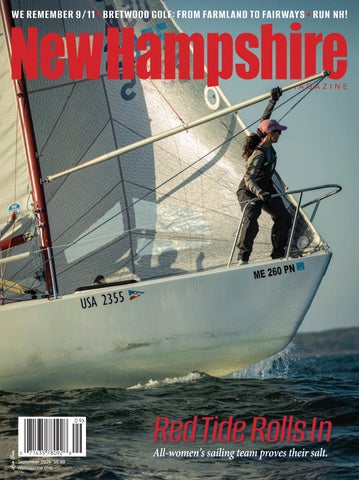
52 Red Tide Rolls In
Meet the sailors aboard Red Tide, an allwomen’s J-24 sailing crew racing where the Piscataqua meets the Atlantic. By Elisa Gonzales Verdi
62 Born from Fire, Built to Play
Bretwood Golf Course in Keene, a familyowned business spread across nearly 300 acres, is the state’s only 36-hole facility. By Paul Miller
74 Run NH
Read about local running clubs, and the Derry duo that each faced cancer and completed their 25th Boston Marathon within the same year.
FIRST THINGS
8 Editor’s Note 8 Contributors 10 NH Notebook
Three women create a mix of studio and retail spaces in downtown Exeter. By Rick Fabrizio 4 New Hampshire Magazine | September 2026
Blazing with Silent Fire Photo by Bridgette Pontbriand
18 Community
Creative spaces for kids, community for parents can be found at area Play Spaces. By Megan Rogers
20 Our Town
Bristol is a lake town that keeps calling people back. By John Koziol
26 Savor
Three new restaurants are ushering in a new era for Dover’s food scene. By Sarah Cahalan
26
Thousands of eels appear in New Hampshire waterways every year for their trek upstream. By Jill Armstrong Piloting the Albacore is a young boy’s dream and an old man’s nightmare. By Marshall Hudson
42 On the Job
‘North Woods Law’ stars find new fan base on Game Warden Channel. By Emily Reily
From local farms to James Beard-winning chefs, sustainability, like canning, is in the heart of the kitchen. By Morgan Rizzo Calendar of events Compiled by Elisa Gonzales Verdi
94 Healthwise
Taking care of yourself is more than just going to the gym. It’s about living well. By Krysten Godfrey Maddocks
96 Live Free
Last-Minute Mountaineers By Kayla Hollatz Mitchell
SPECIAL AD SECTION
86 Ask the Experts
Wills and Estate Planning ON THE COVER Elizabeth Kane, part of the allwomen crew on the J-24 sailboat Red Tide, positions herself at the foredeck during a recent race. From the shore, the boats look like they’re dancing. From the boat, it’s organized chaos.
Photo by Joe Klementovich
Lighting thatDreams are made of
ABOUT US Based in Bedford, NH, we design custom wedding lighting displays across New England, working closely with you to bring your vision to life. From romantic bistro lights and elegant tented installations to fully custom builds, we create lighting that elevates your celebration from beautiful to extraordinary.
OUR SERVICES Tent, Bistro, Barn & more Custom Lighting Options Elegant Drapery & Décor Expert Design Team Seamless Venue Collaboration Tailored to Your Vision Stress-Free Setup & Support
“Elevate Life’s Special Moments with Exceptional Lighting”
Contact us today for a FREE Quote & Site Visit to help bring your vision to life! info@premierlightingofne.com
www.premierlightingofne.com
(603) 836-4432
276 State Route 101, Unit B, Bedford, NH 03110
nhmagazine.com | September 2026 5
NHMAGAZINE.COM
President/Publisher Ernesto Burden 603-624-1442 x5117 ernestob@yankeepub.com Editor Mike Cote 603-624-1442 x5141 mikecote@yankeepub.com Managing Editor Emily Heidt 603-624-1442 x5115 eheidt@nhmagazine.com Managing Editor, Sarah Pearson 603-624-1442 x5128 Custom Publications sarahekp@yankeepub.com Assistant Editor Elisa Gonzales Verdi 603-624-1442 x5010 egonzalesverdi@nhmagazine.com Assistant Editor Emily Reily 603-624-1442 x5119 emilyr@yankeepub.com Art Director John R. Goodwin 603-624-1442 x5131 johng@yankeepub.com Associate Publisher/ Jodie Hall 603-624-1442 x5122 Creative Services Director jodieh@yankeepub.com Graphic Designer Christian Seyster 603-624-1442 x5116 christians@yankeepub.com Senior Graphic Nicole Huot 603-624-1442 x5116 Production Artist nicoleh@yankeepub.com Director of Business Jenna Pelech 603-624-1442 x5154 Development jennap@yankeepub.com Sales Executives Josh Auger 603-624-1442 x5144 jauger@nhmagazine.com Jessica Schooley 603-624-1442 x5143 jessicas@yankeepub.com Connie McCullion 603-624-1442 x5000 conniemc@yankeepub.com Director of Sales, Ren Chase 603-624-1442 x5114 Operations & Events renc@yankeepub.com Sales & Events Coordinator Paul Milone 603-624-1442 x5121 paulm@yankeepub.com Information Manager Gail Bleakley 603-563-8111 x113 gailb@yankeepub.com Assistant Controller Nancy Pfuntner 603-563-8111 x138 nancyp@yankeepub.com VP/Consumer Marketing Brook Holmberg brookh@yankeepub.com VP/Retail Sales Sherin Pierce sherinp@yankeepub.com
NEW
HAMPSHIRE
GROUP
100% Employee-Owned
250 Commercial Street, Suite 4014 Manchester, NH 03101 603-624-1442, fax 603-624-1310 E-mail: mikecote@yankeepub.com Advertising: sales@nhmagazine.com Subscription information: Subscribe online at: nhmagazine.com or email customerservice@nhmagazine.com To order by phone call: 877-494-2036 © 2026 Yankee Publishing, Inc.
Providing New Hampshire with premium health and wellness solutions for over 30 years 455 Amherst Street, Nashua 603-595-7727 | hotspas.com 6 New Hampshire Magazine | September 2026
New Hampshire Magazine® is published by Yankee Publishing, Inc., 250 Commercial Street, Suite 4014, Manchester, NH 03101, 603-624-1442. All rights reserved. Reproduction in whole or in part without the written permission of the publisher is prohibited. The publisher assumes no responsibility for any mistakes in advertisements or editorial. Statements/ opinions expressed herein do not necessarily reflect or represent those of this publication or its officers. While every effort has been made to ensure the accuracy of the information contained in this publication, Yankee Publishing, Inc.: New Hampshire Magazine disclaims all responsibility for omissions and errors. New Hampshire Magazine is published monthly, with the exception of February and April. USPS permit number 022-604. Periodical postage paid at Manchester 03103-9651. Postmaster send address changes to: New Hampshire Magazine, P.O. Box 37900, Boone, IA 50037-0900 PRINTED IN NEW HAMPSHIRE
EDITOR’S NOTE
Shining a Light on the Heroes MY DEEPEST MEMORIES OF SEPT. 11, 2001, come from when I first learned about the terrorist attacks — I thought the guy ranting at the Burger King drive-thru as he handed me my breakfast sandwich was crazy — and from its aftermath a couple of months later, when I drove my mother-in-law to the airport in New York and could see from the distance the space in the horizon where the Twin Towers used to stand. Like everyone else, I watched the endlessly repeated footage of American Airlines Flight 11, co-piloted by Navy veteran and Portsmouth resident Tom McGuiness, crashing into the North Tower of the World Trade Center after it was hijacked by al-Qaeda terrorists. McGuinness and 42 passengers with New Hampshire connections, three of them also veterans, were among the 2,977 who died in the attacks. As the nation commemorates the 25th anniversary of 9/11 this month, Renee Plummer wants people in New Hampshire to embrace a new memory — one that will illuminate the summit of the highest peak in New England to honor veterans, firefighters and first responders. “The Honor Summit” installation from Sept. 9 to Sept. 12 will feature two huge LED light beams that will reach 3 miles into the sky from the top of Mount Washington from 8 p.m. to 3 a.m. each day and will be visible within a radius of 135 miles around the summit. (For details, visit honorsummitnh.org.) The Granite Springs Foundation, which is organizing The Honor Summit, was founded by Plummer — a Portsmouth businesswoman and long-time supporter of veterans. The Summit was inspired by a similar installation that was hosted by the National 9/11 Memorial Museum in New York. “As we approach the 25th anniversary of 9/11, I find myself reflecting on how differently this day is experienced,” Plummer said in a statement announcing the tribute. “For many of us, the memory is immediate and deeply personal. For others, especially kids, it is something learned — not lived. The Honor Summit was created to bridge that distance. To ensure that this moment in our history is not only remembered but felt — together.” Brig. Gen. Al Aldenberg of the New Hampshire National Guard appeared with Plummer in a video posted to Facebook to promote the tribute. “Here we are 250 years as a nation, and now we’re at the 25th anniversary of 9/11. As a society, as a country, we have become very fractured,” Aldenberg said. “This is an opportunity to kind of recalibrate, refocus and remember what happened to this country.” It’s also a time to remember the first responders who perished trying to save the lives of others, Plummer said. “This is the time to stop everything and to think back about what they did for us.” Longtime contributor Crystal Ward Kent revisits September 11, 2001, in a story told through the voices of the survivors of New Hampshire residents who died in the attacks (page 44.) Even after all these years, it’s not an easy story to read. While the chaos that ensues as the attacks happen leaves you with a chill, it’s the profound sense of loss expressed by the families that resonates the most. “The world will never know what these individuals might have accomplished, but it can long remember who they were and how they lived,” Kent writes. “This is the legacy of September 11, 2001, that matters most — the lives that shone bright for too short a time.”
contributors
Morgan Rizzo is a New England-based freelance writer covering travel, food and beverage, culture and lifestyle. Her work has been featured in National Geographic, Travel + Leisure and more. She wrote this month’s Living story about canning.
Sarah Cahalan is a writer, researcher and a former editor at New Hampshire Magazine. She is a regular contributor to Travel + Leisure and the New York Times, and wrote this month’s Savor story about three new restaurants in Dover.
Joe Klementovich is a North Conway-based freelance photographer who specializes in environmental photography. He photographed this month’s sailing story, including the cover image.
Frequent contributor Jill Armstrong wrote this month’s feature story about eels and their role in New Hampshire’s ecosystem. 8 New Hampshire Magazine | September 2026
S H O P. D I N E . E X P L O R E . Unique Marketplace Shops Five Distinctive Restaurants Al Fresco Dining • Coffee House Ice Cream • Independent Bookshop Pet Boutique • Lake Logo Clothing Women’s Apparel & Accessories Vintage & New Home Décor • Hair Salon Award Winning Sculpture Walk Live Music – Fridays, July & August Holiday Open House – December 6th
Lakes Region’s Premier Shopping Destination
Shops Open Daily 10 AM • millfalls.com/the-marketplace • Routes 3 & 25 Meredith, NH
You will still find our hilltop hideaway at the end of the winding dirt road. Lighten your spirit as you step out of your world and into ours. Welcome to Pickity Place. Have a Pickity Day!
CALL US FOR DINING RESERVATIONS. nhmagazine.com | September 2026 9
NH NOTEBOOK
Jennie Bishop, owner of White Wave Photography, poses in her studio and store on Water Street in downtown Exeter.
Where the Business of Art is the Art of Business
Three women create a mix of studio and retail spaces in downtown Exeter S T O RY & P H O T O G R A P H Y BY R I C K FA B R I Z I O
A
building in downtown Exeter is home to three artists working in different mediums, but together represent a movement in the business of art. The three women are passionately devoted to maintaining a physical space in an increasingly digital world by maintaining a combination of studios, storefronts and online commerce. 10 New Hampshire Magazine | September 2026
Their camaraderie and synergy help them thrive beyond being artists as each is a mom with children ranging from toddler to teen to adult. They rely on each other’s professional and personal experiences to support one another and overcome myriad challenges of running studios and businesses. White Wave Photography at 154 Water St., specializes in maternity, newborn, children,
high school senior portraits and professional branding photography. Owner and artist Jennie Bishop, who grew up in Exeter, emphasizes she is an artist, not just a photographer. She recently participated in an art walk with the nearby Seacoast Art Association. “People said ‘I thought you were an artist,’ ” she said. “Well, I am.” Striking photos adorn her studio, and, as
Bishop working on a newborn photo shoot. White Wave Photography specializes in maternity, newborn, children, high school senior portraits and professional branding photography.
photographers say, memorable photos are made, not taken. Bishop can stroll through the building to visit Lauren Avery Hutton, owner of Avery Art, a studio dedicated to creating fine art that is intentional in thought, elevated in form, and designed to belong in beautifully curated interiors.
Her space at 2 Center St., in the Water Street building, features custom artwork shaped by 18 years living in England and a lifelong love of travel. Hutton blends an artist’s eye and designer’s sensibility, partnering with interior designers, art consultants and curators to create custom work that enhances physical spaces.
“Art is more important than ever, and both consciously and unconsciously affects our well being,” Hutton said. “Where art historically served as education, recording historical events, proselytizing and the provenance of the wealthy elite, art is now generally more participatory and egalitarian with a very broad means of concept delivery.” Around the corner, Art by Alyssa offers an eclectic mix of illustrated gifts to brighten one’s life. Owner and artist Alyssa Watters makes many of the products in her shop. After graduating with a degree in illustration from Montserrat College of Art in 2007, Watters managed a stationery gift shop in Hamilton, Mass., where the owner encouraged her to hang her paintings for sale. It was, she said, unknowingly the catalyst of her company. “I’ve always made art,” Watters said. “I truly can’t imagine my life without it.” Her grandfather was an oil painter and window dresser in the 1940s, and her mom makes jewelry and sews. Her dad is a retired welder who crafts clever metal pieces. Her
Alyssa Watters, owner of Art by Alyssa, stands in front of a sample of the eclectic mix of illustrated gifts offered in her studio and storefront in downtown Exeter. nhmagazine.com | September 2026 11
sister is a florist, and her husband is a self-employed artist. “Most of my closest friends are working artists, too,” she added. “I’m almost completely immersed in the arts at all times. It’s not a conscious choice; it’s simply the rhythm and nature of my life.” The three artists cite Exeter’s independently owned downtown stores and supportive and growing art community for choosing the town for their studios and businesses. “There’s an energy and sense of community that feels increasingly rare, and I’m very grateful I’ve found a home here,” Watters said. Bishop adds that her artist’s eye led her to choose her studio location. “The studio faces north, which is the perfect light for a natural light photographer, so when I saw this space being renovated, I knew it was perfect,” she said.
Hutton notes that while moving to Exeter was a decision made without hesitation, it was only after signing the lease that she discovered two of the other tenants were artists. “What are the odds that three women artists would end up renting commercial spaces in the same building on a downtown main street,” she said. “It was this happy accident that we all ended up here.” Running a small business is challenging, especially mixing a studio, brick-andmortar store and online commerce. And there’s that delicate balance of producing art while marketing it, which Watters lists as one of her greatest challenges. Having a physical retail location requires significant commitment, including the cost of rent and maintaining consistent retail hours. “Honestly,” Watters said, “I could run my business from home with far less stress and
PHOTO COURTESY OF ART BY ALYSSA
NH NOTEBOOK
Alyssa Watters’ studio and retail space is one of three artist studios and storefronts in the building at 154 Water St., in downtown Exeter.
a fraction of the expenses, but it wouldn’t be nearly as fulfilling.” Hutton adds that balancing artist and businesswoman is a constant juggling act, as performing these left- and right-brained jobs are both full-time endeavors.
Artist Lauren Avery Hutton shares her inspiration for her paintings that are displayed at her studio and storefront in downtown Exeter. 12 New Hampshire Magazine | September 2026
While Bishop said she loves being an artist and businesswoman, she admits it can be hard to switch from creative to business. “So, I make it a point to batch my work so that I am doing creative tasks on different days then I am doing things like finance and client follow up,” she said. Blending studio and storefront is another thing. Hutton said it took a while to get used to the “goldfish bowl” effect as her previous studios were only open to the public for art tours or specific occasions. Despite all challenges the women are driven foremost by their love of art. “I like to hope that art can slow us down in the fast-paced world we live in,” Watters said. “We consume so much information constantly, and art offers a moment of reflection, connection and emotion for both the artist and the viewer.” They share a goal to create lasting pieces. Bishop said access to art digitally is taken for granted today where photos live on social media and phones but are too often lost due to technological failures. “A photograph hanging on the wall or in an album will be cherished for a lifetime,” she said. Avery adds that painting makes her “very happy,” and she is fascinated to see what resonates with the viewer. “The artist should create for themselves, and challenge themselves,” she said, “but if the work resonates with other viewers, that is a gift all around.” NH
We took the wrong train
PHOTO BY COREY McKEAN
Corey McKean’s scenic autumn photo on page 56 in our August issue, which received an honorable mention in our Reader Photo Contest, captured a ride by the Mountaineer from the Conway Scenic Railroad. The caption misidentified the locomotive as the Cog Railway, careful readers informed us. Find him on instagram @coreyjmckean
Soup’s on at Fidelity for NH Food Bank In June, employees at Fidelity Investments teamed up to make minestrone soup — enough to feed 50,000 families served by the New Hampshire Food Bank. For the volunteer event, 480 employees at the company’s campus in Merrimack donned aprons, hairnets, facemasks and latex gloves and arranged themselves in assembly lines to fill packets with ingredients for a dry soup mix, which they then weighed and sealed. Small teams working in shifts each packed the equivalent of 1,050 meals. This was the fourth year Fidelity partnered with the Food Bank for the meal packing program, said Amy Branson, director of the regional leadership office for Fidelity. “We’ve been able to scale it and have it take place simultaneously in both of our buildings,” said Branson, who just celebrated her 30th year with Fidelity. Elsy Cipriani, executive director of the Food Bank, said she appreciates that Fidelity has been a long-time partner. “This is great because these are meals that are going to people facing food insecurity,” she said. The New Hampshire Food Bank distributed 20 million pounds of food in 2025, its highest ever, Cipriani said. — Mike Cote nhmagazine.com | September 2026 13
NH NOTEBOOK
Come Sail Away NEW HAMPSHIRE MAGAZINE
MUSICIANS IN TUNE WITH KIDS • SETH MEYERS: FUN FOR A CAUSE • TOP DENTISTS
MAGAZINE
A U G U S T 2025
Smith Cove in Gilford, by Ann Marie Shepley
• R E A D E R P H O T O CO N T E S T W I N N E R S H A M P T O N B E A C H S E A F O O D F E S T I VA L
• TOP DENTISTS Live Free.
August 2026 $6.99 nhmagazine.com
250+ Entries Capture the Scenic Granite State Landscape
ANN MARIE SHPELEY'S serene image of Smith Cove in Gilford — an editor's pick in our Reader Photo Contest — graced the cover of our August issue. Shpeley is an award-winning portrait and landscape photographer based in the Lakes Region. Check out her fine photography at annmarieshpeleyphotography.com. (We're sorry we stumbled over the spelling of Shpeley's name in the original photo credit. We wanted to blame a newt, but we had trouble finding one. See below.)
Spot FOUR newts, like the one here, hidden on ads in this issue. Tell us where you found them, and you might win a gift certificate for $50 to use at The Common Man Restaurants. To enter, visit spotthenewt.com and fill out the online form. Or send answers plus your name, email address and mailing address to: Spot the Newt c/o New Hampshire Magazine 250 Commercial St., Suite 4014 Manchester, NH 03101 You can also email them to newt@nhmagazine.com. Last month’s “Spot the Newt” winner is Mary Ganz of Hampton Falls. August issue newts were on pages 7, 21, 31 and 101. They were hard to find, but they were there! (We tried to make it a little easier this month.) 14 New Hampshire Magazine | September 2026
PHOTO BY ANN MARIE SHPELEY
•
READER PHOTO
CONTEST WINNERS
nhmagazine.com | September 2026 15
NAVIGATE | big picture
September 2026 2026 16 New Hampshire Magazine | September
Blazing with Silent Fire “I took this photograph in Gilford near Ellacoya State Beach. I find mornings to be the most peaceful and relaxing part of the day, so I am always inspired to see what Mother Nature has to offer at sunrise. She was pretty dramatic with colors on this summer morning! We live in such a fast-paced world and need to take more time to appreciate these simple, yet beautiful moments.” P H O T O BY B R I D G E T T E P O N T B R I A N D
Sensory Seekers is an inclusive sensory play gym designed specifically for children with sensory needs.
Creative Spaces for Kids There’s an activity for everyone at indoor play spaces across the state BY MEGAN ROGERS
M
essy play. Climbing structures. A quiet space with books and puzzles. When kids arrive at Sensory Seekers, they can get creative with sand, PlayDoh and paint. They can work their energy out on swings, climbing structures and crash pits. Or, they can ease in with a moment in the play center’s calm down room, checking out books, puzzles, blocks and Legos. As for parents? They get to take a moment to themselves, knowing that their kids are having fun and NOT making a mess at home. It’s a common scene at indoor play spaces across the state. “I see parents and grandparents meeting up at the cafe and allowing the children to play, and the grandparents are there to be able to make those memories, and then the parents are there, and you know that now nobody has to worry about their house being clean,” says Kristie Ranahan, owner of Village 18 New Hampshire Magazine | September 2026
Play Cafe in Manchester. In recent years, several indoor children’s play spaces have opened in New Hampshire, giving kids ages 6 and younger a place to stretch their imaginations that also offers third spaces to parents. “It’s just nice to talk to other people that are in the same situation as you,” says Christina Shibilia, a Sensory Seekers owner. “(Your kid’s) running around playing, you know it’s a safe space, you can see them, but you can also sit and have a moment to be a mom.” Sensory Seekers is an inclusive play space with locations in Hudson and Concord. It was designed to support children with sensory needs and welcomes children of all abilities for its play space and special events. Marc and Christina Shibilia purchased the business in 2025, a few years after the original Concord location opened. In addition to serving as a place to play and connect,
Sensory Seekers is also an approved site for supervised visits and a space where many therapists work with clients. When Ranahan, owner of Village Play Cafe in Manchester, moved to New Hampshire from Florida, she was surprised to learn there weren’t more play spaces for young kids. She especially saw a need for creative spaces for kids who are neurodivergent. “We definitely need to have sensory rooms. We definitely need to have quiet spaces where kids can kind of not only just let out their energy but also quiet their mind,” she says. Village Play Cafe includes two sensory rooms. Through Village Play Foundation, Ranahan offers free play for children on the spectrum every other week. These indoor play spaces host music and dance classes, disco afternoons, princess tea parties, and other creative events in addition to the everyday offerings of jungle gyms, art stations, and giant stuffed animals. “We have a ball pit that’s a 5-by-5-by-3foot-high ball pit that’s apparently a big deal to little toddlers,” says Megan Greene-Costa, owner of Little Hearts Playroom in Amherst. “They love that. We have a tiny one for the babies too on the other side that they love.” Little Hearts opened in 2023 and expanded its footprint a year later. In addition to a popular ball pit, they have slides, books, space for art play, building blocks, monkey bars, Legos
PHOTO COURTESY SENSORY SEEKERS
NAVIGATE | community
and more. It’s enough to keep kids — and their parents, grandparents and nannies — happy and entertained. Jessie Perry opened The Playspace in Goffstown, when her son was just a year old. It offers music and movement groups, sensory groups, bubble dance parties and crafts for all ages. Creating a community for kids and caregivers was a big reason she decided to open. “We (opened) for the community,” she says. “Being a place where people can come and feel not so lonely, even if it’s just me there, having people to talk to and relate to, and find friends for their kids, or whatever that may be, just being part of the community and being able to help other parents.” NH
Play Spaces Across the State Little Hearts Playroom Amherst • littleheartsplayroom.com Sensory Seekers Concord and Hudson • sensoryseekers.org The Playhouse Goffstown • theplayhousegoffstown.com Village Play Cafe Manchester • villageplaycafenh.com The Playroom Gilford • theplayroom603.com The Village Playroom Salem • villageplayroom.com Happy Place Windham • happyplaceplay.com Imagine Art & Play Hampton Falls • imaginenh.com The Play Loft Pelham • theplayloftpelham.com The Creative Duckling Pembroke • thecreativeduckling.com
PHOTO COURTESY VILLAGE PLAY
Jump & Jive Keene • jumpandjive4all.com
Top and above: Village Play is the ultimate spot for parents and their little ones. Drop by for a safe play environment or to connect with other families through shared experiences. nhmagazine.com | September 2026 19
NAVIGATE | our town
A Place Called ‘Home, Home’ Bristol is a lake town that keeps calling people back STORY & PHOTOS BY JOHN KOZIOL / ILLUSTRATION BY PETER & ISLA NOONAN
F
or Joe Denning, Bristol is “home home,” the Lakes Region town he loved as a youth and where he returned years later after his wife died. The town is blessed to be at the foot of Newfound Lake, one of the most pristine lakes anywhere, says Denning, a self-described “street kid from South Boston” who first moved to Bristol when he was 12. The former Bristol selectman — a once and current Bristol resident — was a longtime special education teacher and author. His autobiography tells how Bristol accepted the newcomer and made sure he prospered there. “Anything that’s been good that has happened to me has come from Bristol,” said Denning, 84. First on that list, he placed his late wife, Paula Westfall Denning, who died from brain cancer on May 11, 2024. At the time of her death, she and Joe had been married for 62 years. They raised three children and had six grandchildren. 20 New Hampshire Magazine | September 2026
Paula taught Joe how to play tennis well, he recalled. When she died, they had been living in Charlotte, N.C. Recently, Denning moved back to Bristol and now lives with his daughter, Debbie. They reside on North Main Street, across from Kelley Park, the green heart of the downtown and a short walk from the TapplyThompson Community Center. Known as the TTCC, the center was significant in Denning’s upbringing and continues to be important in the lives of children and adults not only in Bristol, but throughout the larger Newfound region. Bristol can thank the late Wink Tapply for one of the town’s longtime Christmas traditions. Tapply — one of the first municipal recreation directors in New Hampshire — borrowed an idea he heard about in the Midwest where every child gets a free Christmas gift and brought it to Bristol, where it is known as Santa’s Village. In turn, his son
carried that tradition to Laconia, where Christmas Village has been a popular seasonal event since 1975. A while back, Bristol lost its only pharmacy, but it still has a moderately-sized Hannaford grocery store that’s open yearround, as well as Shackett’s supermarket, which has operated seasonally near the lake since 1945. There have been some changes on the dining scene in Bristol, but Gilly’s on Lake Street continues to serve up breakfast and lunch, and The Big Catch on Shore Drive, across from the lake, still reels them in for its seafood offerings. Gina’s Place, the Bristol Diner and the Purple Pit Coffee Lounge bring folks into the downtown, while The Homestead on Route 104 remains the place for steaks and cocktails. More recently, Cielito
The Tapply-Thompson Community Center at 30 N. Main St. is the heart of the community in Bristol.
Mexican Restaurant has brought an international flavor to Bristol. It has been joined by Odysea Coffee Roasters, which features coffee made from beans grown in Honduras. And as Denning points out, “We have Newfound Lake and rivers, and places to hike, such as Little Round Top, aka Inspiration Point, from which you can see a long way.” When asked why he returned to Bristol, Denning said the decision was easy and obvious: “My family’s here.” It didn’t hurt, however, that Bristol was and is a very good place to be, not least because of its proximity to Alexandria, the town immediately northwest of Bristol. Once a week, Denning plays pool with a half-dozen former elementary school chums at Melvin Defosses’ home on Karl Gordon Road. Defosses, his brother Roger and Denning used to lift weights at the TTCC, where Denning got his taste for tennis. As 11-year-olds, Denning remembers that he and Melvin were part of the “bucket brigade” at the TTCC, where, in lieu of heavy excavation equipment — which was eventually used — anyone who could fill and remove a bucket of sand from the basement was recruited to do so.
Private docks along Shore Drive in Bristol on Newfound Lake. Just to the east, to the right, is the municipal Avery-Crouse Town Beach. nhmagazine.com | September 2026 21
NAVIGATE | our town When asked whether Bristol has changed in the seven cumulative decades he has lived there, Denning replied, “yes and no.” “The core is still the Central Square. There aren’t many in New Hampshire, but we have one,” he said, noting how the square was redone from the infrastructure up, in a move to make it more appealing to locals and visitors. “Bristol looks great,” said Denning, whose enthusiasm for the place might merit him a job with the Chamber of Commerce. “It’s quaint,” he added. “Home is home,” said Denning. “It isn’t that I didn’t enjoy being where I was,” he said in a reference to Charlotte, “but Bristol is home. Home-home.” “It’s a good place to live and a good place to grow up in,” said Denning, which he recounted in “The Town That Raised a Child,” his 2010 book about how he learned that many people in Bristol had been committed to his success. “I was — capital letters — fortunate — to come to Bristol, New Hampshire,” he summed up, and says it has always been “home” even when he didn’t live there. Like Denning, Pete Daniels is a reverse snowbird, although he spent considerably more time down south than Denning.
Longtime Bristol resident and former selectman Joe Denning wrote a book about growing up there.
Peter Daniels, among the newer residents of Bristol, was born and raised in New Hampton, which is east of Bristol, But he went to school and participated in many activities in Bristol, and considers it to be home. 22 New Hampshire Magazine | September 2026
Born in his grandmother’s house on Old Bristol Road in New Hampton, a town directly northeast of Bristol and separated from it by the Pemigewasset River, Daniels, 78, is a graduate of the Newfound Regional High School, Class of 1966. NRHS is in Bristol and serves students from several Newfound communities. Bristol was the stomping ground for kids like himself, Daniels recalled, and, for the athletically-minded, it also had the TTCC. After attending then-Plymouth State College for a year, when he played soccer and tennis, Daniels got married, got disenchanted, got divorced and “decided to go where the grass was greener.” Specifically, he settled on Hilton Head Island and was hired there as a teaching tennis pro. More than a quarter-century later, after having watched Hilton Head’s population soar from 3,000 to 35,000, he retired and told friends he was going back to New Hampshire. “That surprised everybody,” said Daniels, who, before his second, current retirement, served for several years as Bristol’s landuse officer.
LOON’S ONLY SLOPESIDE RESORT FOR ALL SEASONS
Your next White Mountain retreat starts here. The Mountain Club on Loon is the perfect spot to meet, stay and play any time of year. With a full complement of first-class services and amenities, it’s everything you want your Corporate or Special Event to be, in a setting you’ll love. 90 Loon Mountain Rd, Lincoln, NH | 800-229-7829 | mtnclub.com
Where the wilderness blends with city sophistication to bring you unique, quality merchandise Spruce Hurricane has been the Mt. Washington Valley’s premier specialty boutique since 1992. Family owned and operated, our goal is to provide the best in personal service and fabulous merchandise in our distinct mountain chic style. Our inventory includes world renowned designers, one of a kind items, as well as your favorite manufacturers of clothing and accessories. We welcome you to join us for a shopping experience that delights the senses with color, texture and artistry.
2655 White Mountain Hwy, No. Conway, NH Open 10-5, closed Mondays
603-356-3854 nhmagazine.com | September 2026 23
He lives on NH Route 3A, just north of downtown, and gets to watch car shows at the restaurant across the street. “I grew up here. I know a lot of the kids here,” who Daniels said also went to NRHS and were regulars at the TTCC. He said Bristol is attractive to him in part because it is small. “I guess I’m just a smalltown guy,” he said. Among Bristol’s newer residents are Benjamin Archibald and Alesha Borges, artists and principles behind Bliss NH LLC, which has decorated three buildings in the downtown with huge, colorful murals. Archibald is a Sanbornton native, while Borges is a transplant from Somerville, Mass., who owns a laundromat in Bristol. Together, “we create fine art, murals, teach youth art classes and facilitate collaborative community art projects that bring people together through creativity and participation,” the couple said in a joint e-mail. Like Denning and Daniels, they say the attraction of Bristol is simple. “Bristol is home — where our children are growing up, and where we can show them the impact one can have in their community. Creating and sharing positive experiences inspires others to do the same,” they said. What makes Bristol special is the people, they said.
PHOTO COURTESY BLISS STUDIOS
NAVIGATE | our town
Alesha Borges poses with a mural that she and her partner, Benjamin Archibald, of BLISS- NH, painted on a building on Main Street in Bristol.
“It has the character of a small town where relationships matter, where neighbors know one another, and where individuals genuinely invest in the success of their community, working together to get through the seasonal changes, which seem to come faster every year,” they said. The natural beauty of Newfound Lake
The Central Square Historic District in Bristol is a popular gathering spot for locals and tourists alike. 24 New Hampshire Magazine | September 2026
and the surrounding landscape inspires their art, but the town’s sense of connection and shared pride makes it a place where they want to create. “We believe art can strengthen community identity, spark conversations, and help people see value in both their own stories and the stories of those around them,” they said. NH
A boutique cabin and treehouse village in the Mount Washington Valley. On-site winery, heated pool, and sauna. Weddings for up to 125 guests, immersed in nature with resort-style amenities.
1255 US-Route 302, Bartlett, NH • 603-374-5154 • alpinegardenglamping.com Facebook & Instagram • @alpinegardenglamping
uniq
o m r e a b m l e d e n v e a n t g s ! n i t i c x e ue, Our team will help you create your perfect event! Corporate • Social • Weddings • Rentals thateventco.com | 917-686-7438
nhmagazine.com | September 2026 25
INFORM | savor
Fresh on the Menu Three new restaurants are ushering in a new era for Dover’s food scene BY S A R A H C A H A L A N
Aubrey Blanchette from Aubrey’s on Central is here to make sure the Seacoast is full of baked goods with plenty of heart and soul. 26 New Hampshire Magazine | September 2026
PHOTO COURTYESY NEW HAMPSHIRE FILM FESTIVAL
Dover,” says Christopher Parker, the deputy city manager. “And customers are eager to support new concepts.” That has certainly been the case for Aubrey’s. In June — long before the shop even had an opening date — Blanchette launched a GoFundMe to help with café-opening expenses like a new walk-in freezer and oven. The fundraiser notched more than $3,500 in donations in just its first month, a testament to Blanchette’s deep community support. “Even my landlords are tremendously supportive. That was partly why I was like, ‘I need to jump on this opportunity,’ ” says Blanchette, a native of nearby South Berwick, Maine. “I just love the community feel in Dover.” Aubrey’s will mark a return to brick-andmortar business for Blanchette, who owned Aubrey’s Coffee House + Bakery in South Berwick before pivoting to home baking.
PHOTO BY AUBREY BLANCHETTE
I
t’s a good time to be a foodie in downtown Dover. Native son Evan Hennessey brought home the Best Chef: Northeast title from the James Beard Awards in June — New Hampshire’s first Beard outside the America’s Classics division — and it seems a new restaurant pops up in town every month. Three of those openings are worthy of particular note. Charro’s Mexican Cuisine had its grand opening in July, bringing south-of-the-border delights to the Cocheco Mills complex. Nearby, TikTok-famous chef Taryn Merrill slings her signature cheeky café fare at Bad Batch, welcoming customers since early this year. And, in the space that housed Harvey’s Bakery & Coffee Shop for more than 90 years, baker Aubrey Blanchette will soon open Aubrey’s on Central, an eatery poised to open its doors next month. “Entrepreneurs see real opportunity in
nhmagazine.com | September 2026 27
INFORM | savor In addition to a full coffee bar and savory items like bagels and sandwiches, Aubrey’s will feature Blanchette’s large roster of homemade baked goods — many of which are gluten- free. (Her top recommendation for new customers? The Kosmic Brownie, a gluten-free riff on the beloved mass-market kids’ treat.) At just 28, Blanchette will breathe a decidedly youthful new life into her Central Street space. Its former resident, Harvey’s, opened in 1932, only closing in 2025 when its family
“ It is especially exciting to see a new generation of business owners breathing fresh life into spaces with deep roots.” — C H R I S T O P H E R PA R K E R
28 New Hampshire Magazine | September 2026
Menu items like this parrilla monterrey from Charro’s Mexican Cuisine are full of bold Mexican flavor.
Bad Batch in Dover offers plenty of tasty sips with a side of sass (and a few sweet treats, too).
COURTESY PHOTOS
owners decided to retire. “I have so many memories of going to Harvey’s with my grandfather and my parents as a kid,” Blanchette says, and she also knew one of the Harvey’s owners well through a mutual friend. “So that’s really cool that I’m kind of taking over.” A few blocks away, Merrill and her team have also transformed a storied coffee shop for a new generation. Bad Batch occupies the Hale Street space that once housed the beloved boho café Adelle’s. The bohemian streak remains at Bad Batch — think dark moody interiors and intimidatingly cool baristas — but with a new-school twist. Those cool baristas, for instance? They call themselves “the baddiez” and have their own team Instagram. A café steeped in Internet culture is a natural outgrowth for Merrill. She first rose to prominence last year, when drinks from her other business, Plaistow’s Fresh AF Bakeshop, went viral on TikTok. Called “baddie buckets” at Bad Batch, these lemonades and coffees feature flavored syrups, boba pearls, and “jelly confetti” punched into shapes like hearts and stars, and oh yeah: They’re served in plastic mega-cups so big they come with top handles. Bad Batch also has regular-sized drinks, of course — its inventive and often seasonal
concoctions have included “Kiss Me, I’m Chai-rish” tea on St. Patrick’s Day and “Purple Haze” lavender matcha for 4/20 — and, like at Aubrey’s, house made pastries are a specialty, too. Bad Batch is part of a downtown stretch that calls itself “Little Brooklyn,” and curling up with a latte here will quickly show you how the neighborhood earned that name. By comparison, Charro’s Mexican Cuisine might be the most familiar-feeling of these three new eateries. The restaurant offers the kind of items you know, love and expect from a Mexican restaurant, from queso fundido and fajitas to kid’s-menu quesadillas perfect for the niños. But the classics are classic for a reason — and they’re especially appealing when paired with a drink menu that includes eight Mexican-imported beers and a whopping 10 different margaritas. The restaurant’s Washington Street home has had a high rate of turnover in recent years: Smuttlabs, Aviation Brewing and Fire and Spice have all opened and closed there since 2019. But sit at the long, sleek bar with a michelada and a plate of birria tacos, and you’ll see why locals hope Charro’s will be the concept that sticks. “It is especially exciting to see a new generation of business owners breathing fresh life into spaces with deep roots,” says Parker, who oversees development and strategic initiatives for the city. “These businesses are making these spaces their own and offering a glimpse of where Dover is heading.” Aubrey’s, Bad Batch and Charro’s are hardly the only new developments in Dover. Chef Hennessey’s Topolino opened this spring down the street from the now Beard-winning Stages at One Washington, and a few blocks north, the year-old Garrison City Provisions offers gourmet grocery that would fit right into a city 10 times Dover’s size. Taken together, though, they all represent the same thing: a dynamic and delicious new chapter for this little city on the Cocheco. NH Aubrey’s on Central 376 Central Ave. aubreyscoffeehouse.com Bad Batch Café 3 Hale St. Instagram and Facebook (Keep an eye out for their website!) Charro’s Mexican Cuisine 47 Washington St. charrosrestaurant.com
Florals & Plants for Personal & Professional Occasions
www.jacquesflowers.com 1-800-622-5155 • 603-625-6153 712 Mast Road, Manchester, NH 03102 nhmagazine.com | September 2026 29
September Sippers
Black Manhattan Ingredients:
Roku Ginza Collins
Paper Plane
Ingredients:
Ingredients:
2 parts Jim Beam Black
2 p arts Roku Gin
¾ parts Maker's Mark Bourbon
½ part sweet vermouth
½ part elderflower liqueur
¾ parts aperol
½ part amaro
½ part fresh squeezed lemon juice
¾ parts amaro
2 dashes Angostura Bitters Garnish:
½ part simple syrup
¾ parts fresh squeezed lemon juice Garnish:
Amarena cherry Combine all ingredients in a mixing glass with ice. Stir. Serve in a large coupe glass with a cherry garnish.
3–5 mint leaves 2–3 cucumber slices Soda water, to top Garnish: Mint sprig and cucumber wheel In a collins glass, gently muddle the mint, cucumber, and simple syrup. Add the gin, elderflower, lemon juice, and a small bit of ice and gently stir to combine. Fill the glass with ice and then top with soda, giving another gentle stir to combine. Garnish with a mint sprig and cucumber wheel.
30 New Hampshire Magazine | September 2026
Lemon peel Shake all ingredients and double strain into coupe glass. Garnish with lemon peel.
COCKTAIL RECIPES
ADVERTISEMENT
Pumpkin Old Fashioned Ingredients:
Burgundy
Autumn Whiskey Sour
Ingredients:
Ingredients:
2 parts Knob Creek Bourbon Whiskey
1½ parts Hornitos Plata Tequila
½ part pumpkin syrup*
½ part honey syrup
2 parts Basil Hayden Kentucky Straight Bourbon Whiskey
2 dashes orange bitters
¼ part mezcal
1 orange wedge Garnish: Cinnamon stick Muddle the pumpkin syrup, orange bitters and orange wedge in a mixing glass. Pour into an Old Fashioned over a large ice cube. Add the Knob Creek; stir with the cinnamon stick to combine. *Pumpkin syrup: Add 1 cup water and ¾ cup brown sugar to a saucepan and simmer until the sugar dissolves. Turn the heat to low and whisk in 3 teaspoons of pumpkin pie spice and 1/3 cup pumpkin puree. Simmer on low for 8 minutes, remove from heat, and allow to cool. Strain, then add 1 teaspoon vanilla extract.
¾ part vermouth, sweet Garnish: Orange twist Add ingredients to a mixing glass, stir and strain over fresh ice into a whiskey tumbler glass (large cubes preferred). Garnish with orange twist.
1 part fresh lemon ¾ parts honey 2 dashes apple cider vinegar 1 dash Angostura Bitters Garnish: Sprig of charred rosemary* Add all ingredients to a cocktail shaker with ice. Shake vigorously and strain into a rocks glass. Serve neat or on the rocks. Garnish with a sprig of charred rosemary. *To char the rosemary sprig, plcae it over an open flame (either on a grill or stovetop) and rotate for 5-10 seconds until herb begins to smoke and brown slightly.
nhmagazine.com | September 2026 31
INFORM | science & discovery
Eels on the Move
Thousands of eels appear in NH waterways every year for their trek upstream
T
he American eel — that long, slender fish that inhabits freshwater and estuarine environments from Greenland to Venezuela and west to the Mississippi Valley — is as extraordinary as it is mysterious, providing us with one of nature’s greatest migration stories. In late spring, when temperatures briefly tease the hot summer days to come, thousands of small, translucent eels begin to appear in New Hampshire’s freshwater ecosystems as they continue their migration upstream.
Their story goes like this: American eel eggs hatch into larvae in the Sargasso Sea, a 2-million-square-mile area in the North Atlantic defined by four major ocean currents midway between the Bahamas and the Azores. They’ll float along the Gulf Stream and other currents to the Eastern seaboard of the Americas. Once they reach coastal waters and estuaries, the larvae transform into 2-inch to 3-inch transparent “glass eels.” As they migrate upstream, the juvenile eels develop into “elvers,” ascending obstacles, advancing through
Top right: Juvenile eels like these travel thousands of miles from the Sargasso Sea through New Hampshire’s freshwater systems — one of nature’s greatest migration stories. Above: Suzannah Buzzell, a graduate research fellow at New Hampshire Sea Grant, inspects a juvenile American eel at the Mill Pond Dam monitoring site on the Oyster River in Durham. 32 New Hampshire Magazine | September 2026
PHOTO COURTYESY NEW HAMPSHIRE FILM FESTIVAL
BY J I L L A R M S T R O N G / P H O T O G R A P H Y BY B R I A N Y U R A S I T S
nhmagazine.com | September 2026 33
INFORM | science & discovery
New Hampshire Fish and Game Department fisheries biologist Matt Lee instructs volunteers monitoring eels at the Oyster River site last spring.
cracks in dams and climbing vertical surfaces with only a mere trickle of water. Eventually they develop into “yellow eels,” taking on that familiar dusky olive and yellow coloration. Yellow eels can live for about 20 years or more in lakes, ponds and rivers before reaching sexual maturity. In the final stage of their life cycle, the eels undergo a 34 New Hampshire Magazine | September 2026
process called “silvering” where they grow pectoral fins and larger eyes and store fat in preparation for their months-long journey back to their place of birth, the Sargasso Sea, where they spawn and, climactically, die. Scientists are still uncertain about what triggers this final migration (although there are many theories) and have yet to witness
American eels spawn in the wild, raising questions about what, exactly, is happening out there in the open ocean. “It’s quite a life history,” said fisheries biologist Matt Lee of the New Hampshire Fish and Game Marine Division in an interview earlier this year. “They have this innate ability to identify where they’re supposed to be
Fish and Game’s Mat Lee and Wells Costello, the Citizen Science program manager for the New Hampshire Sea Grant Coastal Research Volunteers program, review eel-monitoring protocols with the day’s volunteers.
going. They’ll kind of make their way up to whatever latitude on the Eastern seaboard that the parents that spawned them originally came from, and then head back into those systems.” For example, if parents of juvenile eels emigrated from Florida, their spawn would ride ocean currents back to that specific
Between the two sites, more than 200,000 juvenile eels were counted during last spring’s monitoring period. nhmagazine.com | September 2026 35
INFORM | science & discovery latitude before entering those same freshwater systems. This would also be true for eels traveling from the Sargasso Sea to New Hampshire’s waters. While American eels are commonly found in New Hampshire, a noted decline in population along the Atlantic coast a few decades ago prompted the Atlantic States Marine Fisheries Commission (ASMFC) to act. In 2000, the ASMFC prepared standard protocol for surveying eels during this migration period, mandating that every Eastern coastal state monitor two rivers. With a lack of long-term data on the American eel, the purpose of the survey was to determine natural variation in annual recruitment — the process by which young, surviving fish transition into older life stages — and facilitate an understanding of possible long-term trends in eel numbers along the Eastern seaboard. The next year, New Hampshire Fish and Game began monitoring eel migration on the Lamprey River in Newmarket, and in 2013, with the assistance and efforts of the New Hampshire Sea Grant, they began surveying a second location on the Oyster River in Durham. “We’re obtaining results that can be comparable to previous years and other locations to identify general trends that go into coastwide quotas for adult eels and in states that allow harvest for glass eels,” Lee said. (As a side note, and a topic worthy of its own feature, the harvesting of glass eels is banned in every state save for South Carolina and Maine where the industry is highly regulated but also highly lucrative due to a high demand for glass eels in foreign markets.) Lee, who’s been with New Hampshire Fish and Game for seven years and in this role specifically for 3½, spends most of the spring monitoring migratory fish, including rainbow smelt, river herring, and, of course, American eels. Eels start appearing when the water temperature reaches 50°F. Although there’s never really a set date to begin monitoring at the two sites — the Macallen Dam in Newmarket and the Mill Pond Dam in Durham, both manmade obstructions that make it difficult for eels to continue onward — a brief spike in summer-like temps signals prime conditions, triggering an influx of eels. At this point in the year, Lee’s team will install a box trap system on the dam, essen36 New Hampshire Magazine | September 2026
tially a long PVC pipe with a material similar to a brillo pad on the inside that assists the eels as they ascend — an EEL-avator, as some refer to it. Excellent climbers, the eels make their way up the trap and drop into a bucket on the other side, where they’re counted Tuesday through Friday (Monday following the weekend is a dump day) by biologists and volunteers alike. For many years, the protocol included anesthetizing the eels with clove oil, measuring them, and recording variations in pigmentation. But as of this year, the ASMFC decided it no longer needed to collect that information, noting that the data had been so
consistent in the past. This season, biologists and volunteers simply counted the eels, separating them between sleek, translucent glass eels and the longer, opaquer elvers. “They’re identifying different age classes and separating them according to whether they’re true youngof-the-year,” Lee said. (“Young-of-the-year” refers to eels that hatched during the current calendar year.) “Or what we would call age 1+ eels that have remained in the tidal portion of the river for an additional year or more, and then ascend.” The data sheet includes the time of the sample, the water temperature and the
NH Sea Grant Graduate Research Fellow Suzannah Buzzell inspects eel numbers in the box trap at the Mill Pond Dam. Once counted, volunteers release the eels farther upstream past the obstruction.
number of eels accumulated since the last counting. The survey also includes information about the strength of the river’s flow and the lunar phase on any given day. “There is an associated component of the number of eels observed during a full or new moon. That generally has to do with stronger tides, carrying them in and out toward the head of tide, where they’re ultimately ending up either at a dam or at an impassable obstruction,” Lee said. Once their numbers are counted and recorded, they’re released further upstream to continue on with their migration. The eels continue to migrate throughout the summer,
but Lee and his team typically end monitoring efforts in early July. At the time of writing, nearly 3,500 eels had been counted at the Oyster River dam, a site where monitoring efforts will discontinue after this year due to the deconstruction of the dam, ultimately altering the conditions of the survey. While those numbers might seem high, more than 205,000 eels were observed on the Lamprey River by mid-June with plenty of the migration period still left to document. Lee typically monitors the Lamprey in conjunction with operating the fish ladder for other species of migrating fish, and com-
munity volunteers with New Hampsire Sea Grant’s Coastal Research Volunteer program monitor the Oyster River site. Leading the charge is Wells Costello, the citizen science program manager for the CRV program, which hosts a variety of participatory science projects where volunteers and researchers work together. “When you have these partnerships that are grounded in research or community, everyone can share knowledge to support these decisions about the health of New Hampshire,” Costello said. Once volunteers are trained on the data collection protocol, they’re free to sign up for shifts lasting from one to 2½ hours. While veteran volunteers often return, Costello reported that 20 new recruits assisted with monitoring efforts this past season. “I can’t stress enough that volunteers are the backbone of the projects that I coordinate,” Costello said, “and without them, some of this research wouldn’t even exist or the amount of data that is collected would be far less.” One young volunteer, a UNH student, became interested in eels a few years ago while scuba diving near his home on Lake Champlain in Vermont, Costello said. Conditions were clear, and as he approached the base of a grassy riverbed, he spotted a huge American eel, just sitting, staring, breathing. “It didn’t spook him. It didn’t do anything,” Costello added. “He was mesmerized. And that’s why he came to the training, to learn more about these eels.” Volunteers don’t need former experience with eels to participate, and all gear — box traps, buckets, nets — is provided when they arrive. Costello recommends wearing a sturdy pair of shoes and bringing a buddy along to help count the slippery, sinuous fish before carrying them upstream and sending them on their way. “I think involving the community just brings a little bit more awareness to our coastal ecosystems and the issues that surround them,” Costello said. “They can advocate for the issues, which can lead to action.” NH
For more information and to volunteer, visit seagrant.unh.edu/volunteer/coastal-researchvolunteers/current-projects/eel-monitoring. nhmagazine.com | September 2026 37
INFORM | what do you know
Marshall Hudson’s grandson assumes command of the USS Albacore and pilots her through imaginable peril.
Piloting the Albacore
A young boy’s dream and an old man’s nightmare S T O RY A N D P H OT O S BY M A R S H A L L H U D S O N
T
he submarine’s commanding officer gave the order to “Dive, Dive, Dive!” so I pushed the yoke forward and began working levers, flipping switches and turning knobs. The captain, now peering through the periscope, yelled excitedly, “Watch out for the whale!” I turned the rudder hard, missing the giant creature by inches. “That was close,” the captain said. “We almost had whale guts splattered all over our windshield.” I’m at Albacore Park, a National Historic Landmark in Portsmouth featuring the historic research submarine USS Albacore, which is now a public museum. My 4-year-old grandson and I are exploring the submarine on a self-guided tour; he quickly assumed the role of commander and began barking out orders. His imagination is in overdrive, and 38 New Hampshire Magazine | September 2026
he is thrilled to be hands-on in an actual submarine, albeit a decommissioned and stationary one. The submarine doesn’t have a windshield and is permanently mounted on dry ground, a long way from any meandering whales, so the near-miss windshield splatter occurred only in my grandson’s imagination. I’m delighted he is enjoying himself, but keeping up with him in these cramped quarters isn’t easy for this not-as-flexible grandfather. “Quick! Get to the engine room, we need more power!” he yelled and took off running down the narrow passage toward the back of the sub. The passageway weaves over and around complicated-looking stainless-steel machines, and through gray hatch doors with low overheads and high thresholds.
Little kids and skinny sailors might be able to clear these obstacles on the run, but I had to fold up like an accordion to bend through the hatch … and I still banged my head and scraped my shin. This submarine, christened USS Albacore (AGSS 569), was built at the Portsmouth Naval Shipyard, launched in 1953, and served as a research vessel. It was used for testing control and propulsion systems, sonar equipment, dive brakes, escape mechanisms and other innovative equipment. When outfitted with high-capacity silver-zinc batteries, Albacore could outrun a contemporary nuclear submarine. In 1966, the Albacore set the record as the world’s fastest submarine by attaining an underwater speed of nearly 40 miles per hour. In 1972, the USS Albacore was decommissioned and placed in reserve at the Naval Inactive Ship Maintenance Facility in Philadelphia. Ten years later, an effort began to return the Albacore to her New Hampshire birthplace for permanent display. In 1984, the sub was towed from Philadelphia back to the Portsmouth Naval Shipyard.
PHOTO COURTESY NATIONAL ARCHIVES
The USS Albacore launches in August 1953 at the Portsmouth Naval Shipyard.
To get the Albacore from the Piscataqua River to its new home on dry ground, it was necessary to remove a railroad trestle, cut through a fourlane highway and dredge a channel to the end of a constructed marine railway. Gaining permission to do all this required over 20 permits and approvals, including a sign-off by then-President Ronald Reagan.
The challenge of getting the Albacore to its new home, a quarter-mile from the river and some 27 feet above sea level, was solved by constructing a marine railway. The Albacore would be floated onto a specially designed railcar that would then be moved on rollers over twin tracks. A heavy-duty winch would pull the submarine out of the water and up
a ramp. Complicating this move was the fact it needed to be done at the highest tide of the month. In May, 1985, the Albacore began maneuvering through the dismantled railroad bridge and four-lane highway cut. By October, 1985, she was settled onto a concrete cradle in a dry basin at what is now Albacore Park. Visitors can go inside this historical submarine, look through the periscope, explore the control room, engineering spaces, bunkrooms and more. Recordings by former crew members play over speakers throughout the sub. Voices share personal stories of their time aboard the submarine. With pretend screwdrivers and makebelieve wrenches, my grandson and I fixed the malfunctioning “master-blaster” in Albacore’s engine room. With the “super-power speed” now restored to the stationary ship, we headed back to the control room. Along the way we stopped at the galley and mess hall. These terms are too generous for the tiny kitchenette with three small tables squeezed into an area the size of a minivan. I noticed the tables had chessboards permanently painted on them, indicating that when not serving meals, this area was
The narrow passageway from the control room to the engine room is packed with operating equipment making it a bit of an obstacle course. nhmagazine.com | September 2026 39
INFORM | what do you know also the ship’s recreation room. I find that hard to imagine. If there were more than three or four others in here with me, I’d feel claustrophobic; yet a narrative tells me the Albacore carried a crew of 40 to 50 sailors and fed four meals a day right here. Old black and white photos depict sailors packed shoulder to shoulder around these tables eating or holding mission briefings. Whereas the galley was uncomfortably claustrophobic, the bunkroom was a nightmare for me. Bunks were racked three-high in an area the size of an office cubicle, with a less than 6-foot ceiling. There is zero privacy here and little personal space. A recording reveals this area is nicknamed the “goat locker” and was a stateroom for mid-rank officers. Too tiny for me, its space is luxurious when compared with enlisted men’s quarters. Enlisted sailors slept 10 to a room in narrow bunks packed so closely together that when walking sideways down the center aisle, you’d still bump into beds on both sides. My grandson easily scampered into one of the middle berths and pretended to happily fall asleep. I struggled to crawl into a lower rack and once in, felt like I was inside a coffin
Marshall Hudson tries out a bunk in the cramped quarters of the Goat Locker.
with the lid closed. Sleeping would have been impossible for me. Visiting the Albacore taught me I would not have done well as a submariner, but I also got to enjoy seeing it through the excitement of a 4-year-old who loved every minute of it.
Using the periscope to check for whales is a difficult duty assumed by this young submarine captain. 40 New Hampshire Magazine | September 2026
If you know any youngsters with high-speed imaginations or a mechanical aptitude for fixing invisible “master-blasters,” take them to see the USS Albacore. And if they give the order to dive the submarine … watch out for meandering whales. NH
Agility and flexibility are necessary to pass through this narrow hatch with a low overhead and high threshold.
BEAR SHOWS
TRAIN RIDES
WOLFMAN
& MUCH MORE!
CL ARKSBEARS.COM
110 U.S. Route 3, Lincoln, NH 03251
603-745-8913
JOY Wonder Science al
YEARS
nter Ce
Natu r
Connection
Squam Lakes ȟ˿ɫW HPMM
Scan or visit nhnature.org for tickets & events!
Guided Squam Lake Cruises Mid-May - Mid-October
Live Animal Trail open daily May 1 - November 1
Raptor Migration Celebration 9/19 Grandparents Day 10/3 Howl O Ween 10/24 Fall New Hampshire Day 11/1 NHWildlife
&
NHNature
nhmagazine.com | September 2026 41
INFORM | on the job
NH Fish and Game conservation officer Eva Golden stands outside her patrol truck near Peirce Island Bridge in Portsmouth. Golden, the department’s second fulltime female officer, has appeared on the Game Warden Channel’s YouTube show “On Patrol New Hampshire,” which is documenting the state’s conservation officers.
Answering the Call ‘North Woods Law’ stars find new fan base on Game Warden Channel BY E M I LY R E I LY / P H O T O G R A P H Y BY M A R K B O LT O N
E
very day, in all weather conditions, New Hampshire Fish and Game Department conservation officers patrol the state’s waterways, forests, valleys and trails. Along the way, they encounter wild animals on private property, help with dangerous mountain rescues and educate the public about conservation. Officer Eva Golden, of Raymond, slowed down long enough to pick up a New Hampshire Magazine writer and a local photojournalist during a sluggish mud season morning for a fisheye look into her daily routine. 42 New Hampshire Magazine | September 2026
MONDAY, 9 A.M. It’s a bracing, windy morning at the Fish and Game Region 3 office in Durham, where officers patrolling District 6 — Seacoast communities like Somersworth, Rollinsford, Dover, Madbury, Lee and Durham — start their day. The first order of business for Golden, who’s identified as call number 62, is following up on weekend calls. After greeting colleagues, Golden was briefed about a homeowner’s call about a possibly sick raccoon in Durham. Since the neighborhood contained horses
and other barnyard animals, the homeowner thought it may have been accidentally poisoned. As an animal rescue was on the docket, Golden headed to the garage, where they store equipment, supplies and evidence from ongoing court cases, to pick out a carrier for an average-sized raccoon. She was also told by Fish and Game waterfowl biologist Jessica Carloni about a deceased female peregrine falcon that was brought into the office that had gone missing several months before. Tracking down its owner would be the next mystery to solve. Before heading out to Durham, Golden and Carloni carefully examined the peregrine, which had been fitted with a telemetry device, signaling the bird may have been trained. Carloni continued the detective work to locate its owner. Meanwhile, Golden loaded up her truck, stocked with equipment, a scanner, supplies, any necessary weapons,
Wildlife biologist and waterfowl project leader Jessica Carloni, left, and Golden carefully examine a peregrine falcon that was brought into the Fish and Game Department’s Region 3 office in Durham.
a “panic button,” which can be activated in an emergency, and snacks.
CRITTER PATROL Golden says every day on the job is different, and duties change with the seasons. In spring, for example, she’s reviewing laws regarding turkey hunting and spring gobbler season; in October, she’s preparing for turkey, moose,
deer and pheasant season. Winter is checking snowmobile licenses and patrolling icy roads as hunters seek out squirrel, foxes, skunks, snowshoe hare, muskrat, mink and other small game. We first stopped at a Durham home to investigate the raccoon. Golden grabbed her gear and carefully walked over to it. The raccoon, quietly resting near a tall tree in the
front yard, wasn’t bothered by the oncoming human, a sign that it might not be well, Golden says. Still, it put up a valiant fight before Golden could safely wrangle it into the carrier. Her experience with handling wild raccoons told her this one likely couldn’t be rehabilitated. The most humane course of action was to euthanize it, Golden said, so she loaded it onto her truck for later “dispatch” at a secret location in another Seacoast city that officers designated for the task. Next, Golden’s plan was to check commercial and recreational fishing boats, but the coast was apparently a ghost town. Along the way, Golden messaged fellow conservation officer Justin Whipple to alert him that she was heading toward the Yankee Fishermen’s Co-Op “to see if there’s anything exciting happening.” Whipple’s Siri-coated reply: “lol, I just left; there are zero people out,” prompted Golden to use a word that’s mildly unsuitable for publication. As an alternative, Whipple invited us to board Fish and Game’s patrol boat at the U.S. Coast Guard station in Portsmouth Harbor for an aquatic tour of their
Golden slowly approaches a sick raccoon in Durham so that she can safely place it in a carrier for examination. nhmagazine.com | September 2026 43
INFORM | on the job jurisdiction, and our next stage was set. “We will have two additional souls on board,” Golden told Whipple.
WILDLIFE WARRIORS, 2.0 In March, 2012, The Animal Planet Channel launched the reality-documentary series “North Woods Law,” to follow Maine game wardens. In 2017, it shifted its attention to New Hampshire, garnering a new community of local fans clocking every adventure and noting every back road they recognize. Production ceased in 2021 after 16 seasons, but interest hasn’t waned — the “North Woods Law” Facebook page still boasts about 274,000 followers. In response, YouTube’s Game Warden Channel, created through Engel Entertainment and producers of “North Woods Law,” began airing new segments and longer “episodes” featuring New Hampshire officers called “On Patrol New Hampshire.” “North Woods Law” fans may already recognize Golden, who has been featured on the “On Patrol New Hampshire” show several times. In one popular clip, she helped rescue a gosling in Portsmouth’s Prescott Park; the young goose had fishing line stuck on its feet and had swallowed some as well. While driving to the Seacoast, Golden says half-jokingly in the video, “Hopefully I don’t get mauled by a goose today.” As another officer held the gosling, and as the gosling’s family looked on close by, Golden cut the fishing line that was wrapped around its foot and from its mouth. Golden says while the popularity of NH’s conservation officers remains high, it’s not rock-star level, which is what she had heard. “The stories of those guys not being able to even go out for breakfast on a day off without being apprehended by a fan — it’s not quite at that level,” says Golden, but acknowledged fans making extra efforts to watch the latest episode proves the format has staying power. “It was a good opportunity to get the hype of the show back, because we had been missing that since COVID,” Golden says. Golden says as long as the Game Warden Channel can sustain itself, new episodes of “On Patrol New Hampshire” will continue. “As long as they’re finding that it’s a profitable avenue for them … this is an experiment that we’re doing right now. That’s why they’re releasing a show every month. It’s still developing,” Golden says. 44 New Hampshire Magazine | September 2026
Marine patrol officer Meredith Brinton, left, and Golden chat about their observations during a lull in action on the Piscataqua River in Portsmouth.
BAD BUNNY AND GOOD BOOKS
FALCON UPDATE
Driving toward the Coast Guard facility, Golden, one of two female conservation officers in New Hampshire, talked about her other interests, and why this is her ideal job. Naturally, Golden’s down time involves even more outdoor activities. “My main love is mountain biking. I used to be a climber, but I just love to go for a run, or walk for hours in the woods.” She’s also an audiophile, devouring audiobooks on long drives. “I will listen to anything. I consume audio; seriously, I’ll listen to any sort of nonfiction. I’m listening to this right now: ‘The House We Grew Up In,’ by Lisa Jewell; it’s pretty good. So, I just always have a book, really.” Fittingly, Golden is also drawn to detective mysteries. “Karen Slaughter … yeah, I know, great name. … Karen Slaughter is one of my new favorite authors. Think of like, ‘Law and Order: SVU’ kind of thing. It’s super interesting; usually a who-done-it kind of murder mystery. But oftentimes she writes from the perspective of an attorney.” If an audiobook isn’t playing, then you’ll likely catch her listening to the latest Bad Bunny creation, which did blare from the radio occasionally. Sharing musical tastes is one way Golden keeps a close relationship with her mother. “You know, having ties to Puerto Rico, we are obsessed with Bad Bunny; love Bad Bunny. That’s how we bond,” Golden says.
Heading toward the Piscataqua River, Carloni called Golden with an update on how the recovered peregrine falcon got lost. Carloni tracked down the owner, who said the falcon was not a fan of red-tailed hawks and was prone to chasing them. “And then they lost sight of her, and they kept going back, trying to find her, throwing pigeons up, and searching all over for her. So, he was devastated,” Carloni said of the owners. She said arrangements were being made to bring the peregrine back to its owners.
ALL QUIET ON THE WATERFRONT At the Coast Guard station, we met Whipple to board the boat. After getting life jackets, a rundown of safety rules, and impromptu lessons on keeping both feet on the deck, our life jackets on board and food in our stomachs, we shoved off along the Piscataqua River. Whipple slowed the boat to a crawl while passing landmarks like Portsmouth Naval Prison, Badger’s Island and the Sarah Mildred Long Bridge, but then took the vessel into high gear, which halted all conversation as the engine roared over ripples and waves. Only random chatter from the radio scanner was communicated over the din. Apart from a local company hauling gear, and brief interactions with a marine patrol officer and a commercial fisherman, commercial fishing activity on the Piscataqua was nearly nonexistent. But patrolling the water is a vital part of
the job. “We still have the legal authority to enforce any of the laws,” Golden says. Fish and Game sometimes coordinates with other marine authorities during search and rescue missions, but focusing on the fisheries and protecting marine life are big priorities. “(Other authorities are) out here doing vessel inspections, (whether) you have the proper safety equipment, you have your registration, and everything is in place. Obviously, we do care about safety, but we’re focusing on like: ‘Is that person fishing?’ ” Golden explained. Despite the small coastline, keeping an eye on fishermen’s activities is no less important. “Once stripers (striped bass) come in, we’ll be looking at: Are they going to release it? Are they measuring it? Are they keeping it and are they catching more; making sure that everyone’s complying. The laws are there for reasons, (so that) everything’s fair,” Golden says. “We’re making sure that the fishery is protected. We’re kind of like the referees out there,” she adds.
SCANNER CHATTER Talk on the boat turned to conservation officers’ interactions with the public, one component of the show. While navigating, Whipple says overall, interacting with the public is positive.
“We have the best job in law enforcement, by far,” Whipple says. “We’re the only agency, probably (for) a majority of the time, (where) people thank you for giving them the ticket in the end, because they understand,” they’re simply doing their job, he says. Though many interactions are benign, they’re not all walks in the park. “You remember the ones that stick out,” Golden said, who recalled checking licenses for one outdoorsman. The conversation began friendly enough, she says, but quickly turned disrespectful. “He was just overtly being very inappropriate — (saying) ‘oh, you can check me anytime,’ ” recalls Golden. Regardless of how people respond, conservation officers say they do their job — no two days are the same. “The difficult part about us is, we do wear so many different hats. And I think people don’t really always understand (all that we do),” Golden says. Conservation officers also take part in community events like fishing derbies, and talk about their job with school-age children. “We do so much community engagement. We’ll go out and do fairs; we’ll go to Kittery Trading Post and spend the day with our community outreach trailer. We’re doing that on top of our normal job, which pulls us in a thousand different directions all the time.
(But) it’s nice to get that recognition (through outreach).” Golden is only the second full-time female conservation officer in the department’s history. Newer hire, officer Rachael Stocker, is the third. Golden credits now-retired conservation officer Sgt. Heidi Murphy with helping pave the way. “Sgt. Heidi Murphy made (it possible) for us, and she’s awesome to work with. I really wish she was here. I got hired as the second female ever. And then Rachael (Stocker) got hired just after me,” Golden says, which granted her some seniority. “And you have three months (seniority) over me,” Whipple said to Golden, to which she joked, “and don’t you forget it.”
SMASHING BARRIERS Golden says women have as many rights as men to join this profession and hopes others consider a similar career. “Don’t let that stop you. Don’t let the thought that it is a male-dominated field (be discouraging). I’m here, Rachael’s here, Heidi was here. We got here. We deserve to be here,” Golden says. Golden pointed to Murphy’s lengthy career as a positive indication that being a conservation officer is an achievable goal for anyone. “I think just the fact that Heidi was here and (was) so successful for so many years … we’re willing to step in and get this job.” She adds that the physical test for Fish and Game officers is identical; gender “doesn’t matter,” she says. But one of the biggest parts of working in outdoor conservation is to be outdoorsy to begin with. “If women are excited about it or want a better chance of getting the job, it’s really (about) going out and doing things, going out hunting and fishing, and getting handson knowledge. “A lot of it’s like being here and (being) ready to respond. Anything (can) happen,” Golden adds. Golden says she loves her job and hopes to be with the department long-term. “This is my career — in it to win it,” she says. NH
GAME WARDEN CHANNEL ON YOUTUBE: Golden, left, surveys the scene on the Piscataqua while on patrol with Fish and Game conservation officer Justin Whipple.
www.youtube.com/@TheGameWardenChannel thegamewardenchannel.com nhmagazine.com | September 2026 45
September 2026 2026 46 New Hampshire Magazine | September
WE REMEMBER
B Y C R Y S TA L WA R D K E N T P H OTO S B Y A DA M PA R E N T
September 11, 2001, was a beautiful day in the Northeast. “Bluebird” skies stretched over New York City, and the city sparkled in the early autumn sunlight. The morning commute was in full swing, and guests filled the popular “Windows on the World” restaurant on the 106/107th floors of the World Trade Center North Tower. It was the kind of day one felt good to be alive. But before the morning was out, nearly 3,000
people would perish in a series of horrific terrorist attacks that spanned from New York City to Washington, D.C., to the rural countryside of Pennsylvania. In South Portland, Maine, Winifred Trumbull of Wilmot Flat had spent the night at the Comfort Inn, unknowingly sharing the location with Al Qaeda terrorists Mohammad Atta and Abdulaziz al-Omari. Trumbull was en route to California with her sisterin-law. Her daughter, Meg Cowan, headed home as her mother flew to Boston. As she drove south on I-95, Cowan heard a newscaster
say that a plane had hit the North Tower of the World Trade Center. It was 8:46 a.m. No further information was available, so she kept driving — surprised but not alarmed. She stopped for coffee, and the shop’s TV broadcast was interrupted by news of a second plane hitting the South Tower at 9:03 a.m.; shortly after, another hit the Pentagon at 10:15. A fourth plane was missing in Pennsylvania. The United States was under attack. Air space would be shut down. Cowan remembers saying aloud, “What the heck is going on?” and then thinking, “Where is my mother?”
American Airlines Flight 11 First Officer Tom McGuinness had recently moved with his family to Stratham from California. A former Navy fighter pilot and Top Gun instructor, he loved flying, his wife, Cheryl, and his children Jennifer and Tommy. He was also a man of deep faith and active in his
48 New Hampshire Magazine | September 2026
church. McGuinness had been with American Airlines for about 18 months and was happy to be closer to his Eastern roots, having grown up in Burlington, Mass., and attending Boston University. He would be among the first casualties of Sept. 11. He was 42. Shortly after take-off, Atta and al-Omari used
concealed weapons to kill several flight attendants, breach the cockpit and kill the pilots. Taking over the plane, they changed course for New York City. Flight attendant Betty Ong is credited for alerting authorities as to what transpired, using an AirFone to relay information on the hijacking. Her last words noted they were “flying very low” among the city’s tall buildings, ending with “Pray for us. Pray
for us.”
Seated in Row 34 back in Economy Class on Flight 11 was Anna Allison of Stoneham, Mass. Allison had a computer consulting business and was flying to California to meet with clients. She was supposed to fly out on Monday, but changed her flight to give her another day to prepare, since she had been on vacation. Her husband, Blake (now of Lyme), dropped her off at Logan and headed to work. As he was driving, his car phone rang. It was Anna. “She knew I had a stressful day ahead, and told me to ‘keep her in my pocket’ — something we often said to each other,” he recalls. “It was so strange that she called, as we had already said good-bye, but I’m glad she did. Those were the
last words I would ever hear from her.”
At about 9 a.m., a colleague told Blake Allison that a plane had hit the World Trade Center. They initially thought it was Boston’s World Trade Center in the Seaport district, so he was not concerned for Anna. As he was listening to a WBZ radio newscaster talk about the North Tower, the second plane hit the South Tower. The on-site reporter said,
“That was no accident.”
“When I realized the first plane was from Logan, I knew it was Anna’s flight and that she was dead,” Blake says. “She had an empty row
and wanted to sleep so I pray she never woke up. She was far back in the plane, so may have never known what happened.” Anna was 48. Robert “Bob” LeBlanc, a professor emeritus of Cultural Geography at the University of New Hampshire, was on United Airlines Flight 175 heading to California for a conference. His wife, Andrea, was at their home in Lee, as a builder worked on their deck. Suddenly, he said, “Turn on the TV;
the radio says a plane just hit the World Trade Center.” Andrea turned it on just in time to see the second plane, Robert’s plane, hit the South Tower, although she did not yet know it was his. Initially, she heard his plane landed in Ohio. It will be hours
before the fate of his flight is confirmed. By nightfall, she knows the truth.
Robert was 70.
T R AG E D Y S T R I K E S As firefighters arrive at the Twin Towers, the up-
per floors are engulfed in flames.
There is the repeated thunk of bodies hitting the ground after plummeting from the highest levels of the towers as workers choose to jump rather than burn. No one above the plane in the North Tower will survive; miraculously, 18 make it down from the South Tower thanks to one open stairwell. Inside the North Tower, Port Authority worker Frank De Martini is on the 73rd floor. He notices that the heat from the 2,000-degree inferno above is causing the floor trusses to sag and the building’s steel frame to warp. The building will fall. He alerts authorities. At 9:50 a.m. the South
Tower collapses with a roar, sending a violent cloud of ash and debris through the area. At
Meanwhile, Cowan finally learns that her mother’s plane touched down in Detroit, forced to abort its trip due to the closing of American air space. It is days before her mother can get home due to repeated flight cancellations, but she is ultimately bussed back to Manchester. Sadly, another
woman from Wilmot Flat, Thelma Cuccinello, 71, is not so lucky. En
route to California to visit her sister, she is on Flight 11, which crashed into the North Tower.
On Flight 93, the passengers learn the fate of the other planes and vow that theirs will not be weaponized. They will storm the cockpit. On board is Linda Gronlund, whose sister lives in Amherst. An attorney for BMW, she is on her way to California. Fifteen minutes before passengers act, she leaves a voicemail for her sister, calling to say good-bye. The passengers thwart the attack, but at 10:03 a.m. the hijackers crash the plane into a remote field near Shanksville, Pennsylvania. All are killed. Gronlund was 46. In the hours that follow, America shuts down. No planes streak the skies. Highway traffic is limited. Schools close. Offices close. The rubble in New York and D.C. smolders. In the coming
days vigils are held as the enormity of the losses sinks in.
Only 20 survivors are pulled from the wreckage of the towers. America has lost her innocence.
L E G AC Y O F T H E L O S T
Today, 25 years after the tragedy of 9/11, the families still grieve those lost that day and strive to understand what happened. “Who wanted to murder my wife?” Blake Allison says. “I will never make sense
of it.”
10:28, the North Tower followed. (Martini would not survive the attack.) nhmagazine.com | September 2026 49
What sustains them is keeping alive the memories of their loved ones — ensuring they are remembered for who they were and what they achieved and not as statistics from an unthinkable tragedy.
The McGuinness family lost a father who was fun, fearless and strong in his faith. His family took courage from that. Cheryl wrote a book, “Beauty
Anna Allison was “vivacious, fun, and outgoing,” her husband, Blake, says. “We met when she was a student in my wine course. We had a lot in common — a love of cooking, travel, gardening. She worked in the emerging tech industry in quality assurance — basically trying to break software programs that engineers dreamed up. She loved the challenge. Anna
became a caring voice for other widows seeking a
was joyful, hopeful and she lived life to its fullest. I remember her looking
path forward. In later years, their son, Tom, would
out at our gardens and saying, ‘Sweetie, isn’t this so
become a pilot for American Airlines like his dad.
beautiful?’ She saw beauty everywhere.”
Jennifer married a pilot for American Airlines. She The LeBlanc family made a conscious decision to
Linda Gronlund loved sailing, swimming, snorkeling — anything involving water. She was accom-
talk about Bob, making him real for the grandkids he
plished in karate and playing the guitar, but her real
Beyond Ashes: Choosing Hope After Crisis” and
is a mother of two and an esthetician.
never knew, and not letting 9/11 define
his life.
“They talk about him as if they knew him,” Andrea says. “They’ll say ‘Grampa would have loved this’ and they are as curious and intrepid as he was in
passion was working on foreign cars. It was this that led to her job at BMW. Gronlund is memorialized by the Linda Gronlund Nature Preserve in Peconic Bay in New York State, an area she loved as a teen.
He first studied geology, then history, then ultimately
And in tiny Wilmot Flat, there is a memorial to Thelma Cuccinello.
geography. How the Earth formed, its peoples and
A devoted grandmother, avid quilter and hobbyist,
their cultures intrigued him.”
she had recently taken up golf and was eager to
seeing the world. Bob was fascinated by everything.
Bob LeBlanc was fascinated about the impact people have on where they live and how it changes them, she says. “He was constantly inspiring his students to travel, to go to unusual places where people spoke a
play with her sister. She had been married to her husband, Albert, for more than 40 years. For the families, there is the never-ending sadness of holidays and family celebrations that those they lost can never attend.
different language and their perceptions would be
Of milestones never observed. Of years that should
challenged. He was an obsessive traveler and never
have been shared but were cut short. But beyond
worried about not speaking the language. On trips, you might find him off in a field somewhere trying to communicate with a farmer or engaging a
shopkeeper. He loved that — making
connections with real people.”
these personal tragedies, there is the ultimate tragedy of such collective potential destroyed when thousands of dynamic lives were snuffed out.
After LeBlanc’s death, the family set up a scholarship
“Every year in Boston they have a tribute to 9/11 victims,” Blake Allison says. “They show
for UNH students seeking funds to study abroad.
a montage of their photos and it gets to me, as you
As a result, students have explored countries around
see pictures of everyone so happy and full of life.
the globe, learning about the world he was so
Many of the victims were relatively young with
passionate about.
much ahead of them.”
50 New Hampshire Magazine | September 2026
The National September 11 Memorial & Museum is a memorial and museum that is part of the World Trade Center complex in New York City. It was created to remember the September 11, 2001 terrorist attacks which killed 2,977 people, as well as the February 26, 1993 World Trade Center bombing, which killed six.
N O M O R E D E AT H Andrea LeBlanc, Blake Allison and a number of other 9/11 families did not want revenge for the terrorist attacks that killed their loved ones. “It’s not what Bob would have wanted, and it wouldn’t bring him back,” LeBlanc says. “He would have been horrified to have any particular group of people targeted because of what a few terrorists did. He would not have supported hatred or war. He was always pushing for solutions to global problems, for better understanding among different peoples.” Allison has a similar outlook. “I believe in punishment for the terrorists, but not more killing. Imprisonment, but not more death. There has been enough death.” Their viewpoints have not always been understood or popular, but both take comfort in the fact that they are not alone. They, and many others, belong to a group called “September 11th Families for Peaceful Tomorrows,” an organization found-
AUTHOR’S NOTE: At least 40 others with connections to New Hampshire died on the planes that day or perished in the towers. The Twin Towers cast a long shadow over the years that followed. September 11 would lead America into decades of war, more death, more trauma and racial tension, with each leaving its mark. But no wound would run deeper than that left by the nearly 3,000 souls who perished. What might they have done? What of the medical
ed by the victims’ families that works to support global peace through education, advocacy and activism. “I have found great community there,” LeBlanc says, adding, “although we are all in a club we never wanted to join.” Allison and LeBlanc have spoken out about their personal experiences, even when reliving 9/11 still brings pain, in order to help others. “I knew Anna would want me to go on,” Allison says. “I thought if I spoke out perhaps it would help others get on with their lives as well.” Both are mindful of the passing years, and Allison fears that the impact of 9/11 will be forgotten as those who experienced it age. He notes that there are still terrorists imprisoned at Guantanamo Bay awaiting trial. “We are getting older,” he says. “I wonder if we will live to see this resolved.” For now, they continue to tell their stories and hope for peaceful tomorrows.
breakthroughs and science research never achieved? The art and music never created? The social and global problems never solved? The babies never born because of what happened on a beautiful September day 25 years ago? The world will never know what these individuals might have accomplished, but it can long remember who they were and how they lived. This is the legacy of September 11, 2001 that matters most — the lives that shone bright for too short a time. NH
nhmagazine.com | September 2026 51
Red Tide Rolls In
52 New Hampshire Magazine | September 2026
The crew of Red Tide turning through the choppy waters off the coast of Portsmouth.
Meet the sailors aboard Red Tide, an all-women J-24 sailing crew racing where the Piscataqua River meets the Atlantic BY ELISA GONZALES VERDI PHOTOGRAPHY BY JOE KLEMENTOVICH
Elizabeth Kane and Autumn Becker deal with sails during an evening race.
Hampshire Magazine Magazine ||September September2026 2026 54 New Hampshire
overing around the starting line, the 15 J-24 sailboats racing tonight at the mouth of the Piscataqua River tack and maneuver around each other to avoid a false start. It’s race day — the best day of the week. Crossing the imaginary line drawn by the Piscataqua Sailing Association’s race committee would mean time added to a race where every second counts. From shore, the boats look like they’re dancing — a well-choreographed routine preformed on Thursday nights. From the boat, it’s organized chaos. Strategies are planned and plotted, playful banter is shouted from one boat to the next, all while the sailors anticipate the “go” signal for the dogfight to begin. It’s Red Tide’s third season in the mix. Without fear of failure, and a can-do “have fun" attitude, the league’s only all-women’s boat has risen in the standings as the crew has learned and grown together. What started as a conversation over a few beers at the State Street Saloon in Portsmouth has become a tight-knit team that’s changing the culture of sailing. “(This team) came together with a lot of serendipity,” says Elizabeth Kane, Red Tide’s co-owner. Four years ago, Kane was newer to racing on larger boats and wanted to learn more about sailing as well as build hands-on knowledge. But she wasn’t really getting that while working the same deck position on a large boat week after week. Her friend Kali Moran, a well-weathered sailor who grew up building wooden boats with her dad and has sailed worldwide, was newer to helming and looking for a challenge. “We were chatting one night at a social gathering after a race; we were like, ‘Oh my gosh, it’d be so fun to sail a smaller boat.’ And, ‘Oh my gosh, it would be fun to have an all-women’s team,’ ” Kane says. At the time, they were just spitballing, but soon the conversation shifted from “what if?” to “how do we do this?”
“It was a spur of the moment thing, but Kali and I are very much doers,” Kane says. Within two days, the duo was sending each other Craigslist listings for J-24s, and within a month, they were hitching their new boat to a trailer to bring home to Pepperrell Cove in Kittery Point, ME. Before they could build a team, their boat needed a suitable name. Most boats, sailboats especially, are named using cheeky wordplay, and the intended all-women’s boat was no exception. Besides that, they love a bad boat pun. “Some potential names were Pussea Cat, She/Her, Shegulls,” says Moran, laughing. “A
red tide is a harmful algal bloom that affects clams of all shapes and sizes. The name brings awareness to the dinoflagellates … plus, it’s dangerous.” Boat? Check. Clever name? Check. Now all that’s left was to find a crew. “We wanted to do sailing on our own terms,” Moran says. “We wanted Red Tide to be an environment where you can learn and improve, and be a safe space to mess up, in a supportive community.” Every season, crews are built on a firstcome-first-serve basis, with limited open spots. Because it’s a competition, some teams are hesitant to take a chance on a sailor who
Counterclockwise from bottom: Autumn Becker, Kali Moran, Annie Teegarden, Elizabeth Kane and Sarah Linscott
Onboard Red Tide Sarah
Sail Trimmer (Both foresails – Genoa and Spinnaker)
Kali
Autumn
Mast and Foredeck
Annie
The Pit (Supports/assists Spinnaker and the Twings. Reads the wind and makes adjustments)
Helm/Skipper (Main Sail and steers the boat)
Cam
Calls strategy, and will back people up and fix a line
56 New Hampshire Magazine | September 2026
Elizabeth
Foredeck (Pole set and Jibes)
nhmagazine.com | September 2026 57
Team members wear custom T-shirts onboard Red Tide moored in Pepperrell Cove.
With racing done, it's just a leisurely sail back to the mooring at sunset.
58 New Hampshire Magazine | September 2026
Annie Teegarden, Sarah Linscott and Autumn Becker approaching the rounding mark.
Sarah Linscott coils lines in the cabin as the crew waits out a storm aboard Red Tide.
is learning how to race, or doesn’t have a resume of experience. Pulling a wrong line or turning at the wrong time could cost your team the race. Mess up, and you could lose your spot altogether. It’s a high-stakes environment, which can be intimidating for sailors new to crewing — especially women — because you’re proving your worth and belonging onboard while actively learning a new skill set in a sport that’s historically been a boys’ club. “We knew these other women through sailing who had an interest in learning more, and wanted a bigger set of responsibilities and (to) not just be a passenger,” Kane says. While building a crew primed for competition, Kane and Moran first and foremost wanted Red Tide to be fun. They both agreed that they didn’t want racing to feel intimidating, and wanted genuine camaraderie — a place where women can make friends and sail. Onboard Red Tide, it’s clear they did just that. The six women crewing — Annie Teegarden, Sarah Linscott, Autumn Becker, Camden Myles, Moran and Kane — have been on Red Tide since its first season with no turnover. For the past three years, they’ve had such a good time together that no one has left their position. The list of alternates grows every year with no sign of an opening anytime soon. “Seeing everyone every week is a fun girl’s day,” Teegarden says. “Women do things differently, and (there’s no) culture of yelling or blame. It’s not about the winning, and we’re having a lot of fun.” “We want to be here, and we’ve already won just by doing it,” Kane says. “It feels OK to be bad.” “We’re learning every race,” Moran says. “The ranking doesn’t matter (for us). We’re up against people who have been racing for 20-plus years, and that knowledge builds over time. It’s intimidating in that way, but everyone shares the knowledge.” As the team talks, it’s almost impossible for them not to laugh. Inside jokes are thrown around, one-liners are created at lightning speed and previous races’ highs and lows are shared with raucous laughter and boundless support for both mistakes made and obstacles overcome. “We joke that the first two years were like, ‘just don’t die,’ ” says Kane, laughing. “Now nhmagazine.com | September 2026 59
Perched on the bow at the turn marker, Elizabeth Kane prepares to set the spinnaker. 60 New Hampshire Magazine | September 2026
The crew of Red Tide (sail no. 2355) turning through the choppy waters off the coast of Portsmouth.
we have the capacity to start thinking about strategy, rather than ‘Oh my God, how do we not crash?’ ” While it’s a competitive league, Kane says there’s a camaraderie amongst the competition. On and off season, there’s a lot to do to keep Red Tide in racing shape, and the J-24 community has had their backs. In previous years, “boat dads” have lent a helping hand in repairing Red Tide’s (frequently) flooded engine and rigging the boat, and are always willing to pass on their wealth of knowledge to help fix a problem. This past season, Kane and Moran have been rigging Red Tide independently, a major accomplishment for a newer team. “We would have had a much harder time if we weren't leaning on the institutional knowledge of the people around us,” Kane says. “We took the knowledge and experience from the first two years of help, and empowered ourselves to do it this year. For a competitive league, there has been so much support, and people are really cheering any new boat.”
Over the past three seasons, Red Tide has made a name among the racing community. Week after week, they’ve steadily climbed up the ranks, but they’re best known for their indomitable spirit, high energy and snacks. The whole crew agrees that the snacks are vitally important, and every crew member brings a bag of chips, cheese, hummus and crackers galore for their post-race hang out tradition. “One of our little traditions is everyone brings a snack and some drinks, and the minute we cross the finish line, the snacks and the drinks come out,” Kane says. “It sounds like such a trivial thing, but I think it's representative of the social aspect of it for us. I think if you asked any of the girls, (they) would say it’s their favorite thing, because it's so hard for people to find time to get together and be social. We all look forward to this every single week.” After the race, with the pressure released, it’s time for the crew to relax and
debrief. That time together is at the heart of racing on Red Tide. “It’s like … wow, we did it and we did it well,” Kane says. “We have this collective feeling of accomplishing something that’s not easy.” “Thursday night is where I want to be,” says Teegarden, who also says that sailing on Red Tide is a major confidence-booster. “We’re always learning,” Kane says, “which is why we got our own boat. It gives you the weekly ability to pull in all these little pieces of knowledge that aggregate (to) make you a better sailor.” This past season, there were four new co-ed boats in the league, mostly crewed by younger people who bought a J-24 and wanted to get out there and race. Kane is seriously excited by that, because if her experience on Red Tide has proven one thing, it’s that the community is excited by new sailors, and is there for support. As Red Tide prepares for a fourth season, they’ll be there to lean on, too. Just with more snacks. NH nhmagazine.com | September 2026 61
Born from Fire, Built to Play
Bretwood Golf Course in Keene, a family-owned business spread across nearly 300 acres, is the state’s only 36-hole facility BY PAUL MILLER / PHOTOGRAPHY BY JODIE ANDRUSKEVICH
It was 5:05 a.m.
Matt Barrett, then 16, was awakened by a loud cry of “Fire!” The ceiling above his bed glowed orange. Barrett sprang, grabbed a pair of dungarees from a wall hook in his room on the second floor of a large two-story, two-family brick colonial. Shirtless and shoeless, Barrett dashed through one of his sister’s bedrooms, past the room where his parents slept, down a staircase and outside. 62 New Hampshire Magazine | September 2026
The home was not burning, but the family dairy farm just yards away on the other side of East Surry Road was intensely ablaze. The loud cry came from Matt’s father, Ellis Barrett. “I remember peeling out of the house, my brother Billy and I running together,” Matt says. “Fire was shooting from the front of the barn’s main entrance. We jumped off a stone wall and ran into the barnyard where we normally let the cows out.” Matt is the lone surviving member of four Barrett family members who went into the fire that Monday morning, June 22, 1967. It was,
Golfers play the third hole on the North Course, a downhill par three, and part of the only double green on the course.
otherwise, a routine summer day in Keene, the Elm City; the weather was cool with a gentle southerly breeze. In a brief but tense, adrenaline-fueled burst, Matt and Bill Barrett, their uncle, Tobey Barrett, and their father saved all of the farm’s more than 90 heads of cattle — milking cows, young stock and a handful of steers — marshaling them to safety in a pasture across the street beside the large family home. Matt’s reflections are evocative, still vivid, sometimes emotional, down to each lost tree, maybe a butternut or a meaningful maple; to
the community that came to the aid of the Barrett families that fateful day; to just “how hot” his bare feet got, which he didn’t realize in the midst of the frenetic rescue. Yes, this is a story about a farm fire 59 years ago, a fire that gave rise to a showcase public golf course that bears the same name as the farm, Bretwood, that is run by members of the same two Barrett families. The course features 36 pristine holes, or two championship-caliber layouts; hosts roughly 50,000 rounds each year; and touts more than 400 members. nhmagazine.com | September 2026 63
Bretwood the golf course has hosted the prestigious NH Open 19 times, eight more than any other course, and the State Amateur twice. This is also a story about rural traditions, remarkable patriarchs and matriarchs, passionate families, land and community stewardship and Yankee ideals that still ripple across this idyllic and historic 299acre property. It was later determined that spontaneous combustion in a hay mound in the main barn caused the Bretwood fire. Setting the cows free was anything but routine. Matt raced to the north side of the main barn, where embers from burning hay, grain and sawdust were falling. Bill raced to the opposite end, a newer section of the barn. The cows were secured by stanchions, spring-loaded headgates that secure the animals for milking. The stanchions didn’t always unlock easily, but the “energy was running,” Matt says, “and we went down the row as fast as we could and didn’t miss a beat. Everyone, first try … boom, boom, boom.” Used to being let out for feeding, most of the milking cows, once freed, moved quickly to escape, Matt says. More frightened ones pulled against him, he says. “They knew the place was in trouble.” Matt says he and his brother would often race to see who could open their stanchions
faster. “There was always a sticky one or two,” he says, “but not this time.” Smaller calves were hand-carried from the barn, Matt recalls. After the first 25 stanchions were unlocked, and with fire now falling more heavily, “My dad yelled, ‘Matty, get out of there!’ ” Matt says. Instead, Matt ran to the next section and let out 25 or so more heifers. By the time fire crews arrived — two from Keene and one from Surry — most of the damage had already been done. A sugar house and a bunkhouse, where one of Matt’s uncles lived, were spared. Ellis’ Piper Cub aircraft, anchored as usual in a pasture near the barn, sustained damage to its tail section. The heat from the flames was tremendous, Matt says. “Our house was fully covered in ivy then. It was all scarred, cooked and eventually died. Windows were broken, too.” Matt’s sister, Kathryn Barrett Blair, recalls firefighters hosing down the house to cool it. The fire drew an immediate and overwhelming community response, as area farmers, neighbors and citizens flocked to the scene to provide help, bearing hammers, saws and other tools. Without electricity right away, wood was hand-cut. Materials were brought in and RN Johnson, a contracting firm, delivered a bulk tank for milk storage. A local homebuilder and family friend, Jim Mugford,
Above: Golfers practice at the driving range. Right: The par four fourth hole on the North is short but features water and bunker hazards. 64 New Hampshire Magazine | September 2026
nhmagazine.com | September 2026 65
coordinated an effort to erect a temporary structure, complete with trusses and plywood, so cows could be milked. “By 3 o’clock that day, we were milking cows again,” Matt says, still sounding amazed. Lemonade, ham sandwiches and coffee arrived from nowhere, Joye Barrett, Ellis’ wife, told the Keene Sentinel the day after the fire. “This is all pretty amazing to me,” she said. “I had no idea people would turn out like this.” Bonnie Barrett Shortsleeve, one of Tobey and Janis Barrett’s five children, recalls the commotion that morning and looking out from the basement window, where she
“ There is no doubt about it, the basic satisfaction in farming is manure, which always suggests that life can be cyclical and chemically perfect and aromatic and continuous.” — E . B . W H I T E , One Man’s Meat, a collection of essays shared a room with a younger sister, Caren, and seeing flames. Just 10 years old, she retreated to two maple trees adjacent to the home, where the children were taught to gather in the event of a fire. “It saddens me a little still that neither of those trees are still standing,” she recalls. “I remember so many people bringing food to feed all of those folks that were helping us. You could also hear the sawing of lumber and the pounding of nails as the temporary structure to milk the cows went up. I especially remember the cows mooing at the gate in the field across the street in the early evening, as if to say, ‘Could you tell Toby and Ellis that it is time for us to be milked?’ ” Bretwood Farm did business for a short while after the ruinous fire, which claimed structures, including a large silo and equipment. But it was only a few weeks before the decision was made to repurpose the land as a golf course. 66 New Hampshire Magazine | September 2026
From farms to fairways Who knew that the rhythms of rural dairy farming and tending to livestock, and the rhythms of golf-course management and tending to fairways and greens were absolutely compatible? But history shows that farmland can make excellent golf land: The topography is often favorable, the pastures largely undisturbed and the soil rich in nutrients. In New Hampshire, Baker Hill in Newbury, Campbell’s Scottish Highlands in Salem, Blackmount Country Club in North Haverhill and Hooper Golf Course in Walpole are other examples of courses developed on farmland. In the case of Blackmount, the hilltop pasture of the Blackmount Dairy
Farm became its golf footprint; in the case of Hooper, it was created on Meeting House Farm and then the highly rated nine-hole track was gifted to the town. Bretwood’s history is distinguished by the blaze. “The fire was devastating; it changed our lives,” Shortsleeve says, “but how we evolved is a great family story of dedication and perseverance.” She credits her father and uncle for instilling in all the children and extended family a strong farming ethos built on Yankee values, especially hard work and humility. Patriarchal figures, Ellis and Tobey were frugal men with distinct talents. They were also shaped by their idiosyncrasies: different
The South Course’s par-3 16th hole, played from elevated tees over water, is considered one of the most scenic holes on the grounds.
from one another, but complementary. They built bridges and baseball fields, served in the military, flew and assembled planes, were competitive outdoorsmen, held elected offices and volunteered in their communities. They were not throw-prudence-to-thewind types; rather, family members say, they were pragmatic and nonsense. Jack of all trades, they could build just about anything. A strong, creative spouse supported each. Janis’s parents owned and operated Darling Farm before selling it to Tobey and Ellis in 1950. It then became Bretwood Farm. Tobey and Janis were married for 67 years; Ellis and Joye for 65. Ultimately, the four family guardians and
providers found in golf the same connection they found in farming. At the same time, it was new and peculiarly familiar. The Barretts’ attachment to golf were small strands. As a young teen, Tobie caddied at Winding Brook Lodge Golf Course. After caddying, he was allowed to play or use the lighted driving range. He and Ellis also had a mutual friend, Towar (Tige) Arnold, who lived nearby and who had recently developed and opened a golf course of his own, Edgewood Country Club in Southwick, Mass. Arnold would come over to the Barretts’ home and often talk to Ellis and Tobey about how ideal the farm property was for a golf course, Matt says. At the time, the property was farm build-
ings and pasture — cow fields, alfalfa fields and Timothy fields, which provided foraging for livestock. “There was virtually not a tree out there,” Matt says. “I remember the family meeting around the table when it was decided that we’d stop farming and try golf,” Blair says. All of the animals, named and graded as they were, and some equipment were sold at an auction that September. “The barn having been completely destroyed by fire, the herd must be dispersed before cold weather,” read the first line of the Dispersal Catalog. The course opened a week shy of one year after the fire, on June 17, 1968, as nine holes. It was “a kinda rainy day,” Matt says, as if he could picture it. nhmagazine.com | September 2026 67
“The parking lot was grass and it had five or six cars, and one was Mom’s,” Kathryn chuckles. A Harley Davidson three-wheeler with tiller steering was the golf cart of choice then; Bretwood had a starting fleet of six. The course featured 18 holes, named the North Course, when the facility opened for play in 1969. Bretwood expanded to include a second 18-hole layout, the South Course, in 1991. Over time, the Barretts strategically acquired abutting properties, including another one-time dairy farm, to make the expansion possible. The original 18 holes were designed by prominent golf architect Geoffrey Cornish, whose stamp is on hundreds of New England layouts. Where Cornish stopped, Hugh Barrett took over, making the entire complex a co-creation and vision of the two. Barrett is the son of Aubrey and a prolific player in his prime. He captured the N.H. Amateur title in 1980 and was the event runner-up the following year. He also touts a state high school individual championship. Hugh, who still helps maintain the course, is regarded as a natural at the creative and technical demands of golf course design. While contours can be shaped, he said, Bret-
wood’s landscape already offers abundant natural beauty and features to work with. “It’s a unique place; just look at that,” he says, gazing out over the 18th and 17th holes of the North Course from the clubhouse deck. “These views are what I enjoy the most about Bretwood.” Lucas Barrett, Matt’s son, says the beauty of Bretwood, as a course and a business, is consistency of approach. “When Bretwood was a farm, it was just that, a dairy farm,” he says. “They fed cows, bred cows, milked cows. Then they sold the milk on the wholesale market. It was about providing milk for the community and providing stability for the family. “When it became a golf course, it was just that, too: Support the community, provide recreation at reasonable prices and draw people from outside to patronize local shops and restaurants and hotels. Very old-fashioned. “When the farm burned down, and the community rallied around the family, I almost feel like Bretwood has been paying that back forever, continuing an unwritten relationship of supporting people and a place that supports them.” Spread across 299 acres, the two golf courses, depending on setup, serve up perils
and pleasures. The Ashuelot River makes its presence felt on 18 of the 36 holes; water hazards, including ponds and brooks, are in play on 27 holes. Three par-3s have carries over water, including the signature island hole on the South Course, No. 13. A par-4 on the same track, No. 15, is short but menacing. It requires two impeccable shots, including an approach over water that is all carry to a long, but shallow green. “The land itself has so much going for it as a template for a course layout,” says Jonas Maynard, course superintendent. “There are some reasonable elevation changes and movement to the terrain while still maintaining a connection to the river on nearly the whole of both courses.” Eight prominent, red-roofed covered bridges, longstanding stonewalls and a variety of trees — oaks, maples, ash, walnuts, hickories, basswood and a small scattering of sycamores, the last trees on the course to grow leaves in the springtime — are other distinguishing characteristics of the lush acreage. The tree list is actually too long to mention in full, Maynard says, noting that apple and cherry trees steal the show in spring blossom.
Family owners of the Bretwood Golf Course in Keene include, from left, Hugh Barrett, Caren Barrett, Bonnie Shortsleeve, Julie Barrett, Kathy Blair, Becky Barrett and Matt Barrett. In the background, where the buildings are, was the original location of the dairy barn. 68 New Hampshire Magazine | September 2026
PHOTO BY PAUL MILLER
Day lilies are in bloom behind the fourth tee and near the only covered bridge on Bretwood's North Course.
Wildlife is abundant, including foxes, great blue herons, egrets, hawks, minks, turtles, geese and owls. Silty sand deposits are prevalent and drain well, Maynard says, making them ideal for firm golf conditions. He and his “small but mighty” grounds team tend to approximately 9 acres of greens and collars, 9 acres of tee boxes and 65 acres of fairways. What truly sets Bretwood apart is its immutable focus on being what it is, a golf course and a golf course only, head professional John Pawlak says. “We have no homes, condominiums, or town homes on the property. We have tees, fairways, greens, bunkers and trees! Pure golf. “So many people and groups return each year and the common reaction is, ‘We love this place!’ Consistent faces in the snack bar and pro shop over the years adds up to a homey atmosphere.” Mike Foresteire is part of a large group of friends from Massachusetts, New Hampshire and Connecticut that has made a four-day trip to Bretwood for each of the past 20 years.
“I think everyone in our group would agree that Bretwood offers 36 of the best golf holes in New England.” The group rents several cottages on nearby Spofford Lake, and everyone contributes food. Says Foresteire, “Evenings have become just as important as the golf: campfires, card games, plenty of laughs and enough food to feed an army.” There are 97 golf facilities in the state, 75 of which are public. When Green Meadow closed in 2023, Bretwood was the state’s only remaining 36-hole facility. “Bretwood is invaluable to us,” says Matthew Schmidt, executive director for NH Golf. “When we host an event there, you can feel what it means to them, and just to think of all the great golfers that have won championships there. It’s a special place.” The course layouts have endured as challenging competition venues for professionals and amateurs, Schmidt says. Keegan Bradley (eight PGA Tour wins, Ryder Cup captain) and Dana Quigley (11 PGA Senior Tour victories) are notable golfers who have competed at Bretwood.
“We love coming there … it’s like a time capsule,” Schmidt explains. “It is still very much like golf was in the ’70s. Some of the golf carts are a little older, range balls are picked from the ponds and creeks and partly painted, and the porch and deck are perfect to relax on and watch players come in. Then, you can end your day with a milkshake … a great milkshake.” Where uncomplicated trumps sophisticated as an aspiration, perhaps the milkshake — simple and satisfying — symbolizes all that is unique and quaint about this history-filled and beautifully-manicured golfing playground. Over its nearly six-decade history, after all, Bretwood has shunned familiar upscale trappings of many of today’s modern golf venues — lavish dinning, pools, mahogany-trimmed locker rooms and gaudy initiation fees — and stayed resolutely true to its simple charge: to provide a memorable golf experience for all players. At its core, it is a farming mentality, one might say. There can be no doubt that here, it is a family thing. NH nhmagazine.com | September 2026 69
FOR EVERY
Swing At New Hampshire Golf, we believe
OWL’S NEST VINEYARD COURSE is an 18-hole championship golf course that was formerly known as White Mountain Country Club. It sits along the scenic Pemigewassett River offering a traditional layout with wide fairways, strategic bunkering, and bent grass surfaces. The course plays to a par of 71 over approximately 6,400–6,500 yards from the longest tees, with a slope and rating that make it both engaging and enjoyable for casual players and more experienced golfers alike. ASHLAND | (603) 536–2227 | OWLSNESTRESORT.COM
the game is for everyone. Whether
OWL'S NEST RESORT offers one of New Hampshire's premier fall golf experiences, where championship golf meets breathtaking White Mountains scenery and spectacular autumn foliage. Home to a Nicklaus Design course recognized for its exceptional value, Owl's Nest combines unforgettable mountain vistas with luxury resort amenities. Even more is on the horizon, with exciting expansions, including a new par-3 course, walking trails, and enhanced resort experiences, making Owl's Nest a must-play destination this fall and beyond! THORNTON | (603) 726-3076 | OWLSNESTRESORT.COM
you're picking up a club for the first time, competing in a state championship, or simply enjoying a round with friends, NHG is here to support your golf journey. Our mission is to grow the game by creating an inclusive, welcoming community where every golfer has the opportunity to play, learn, and connect. Through championship competitions, beginner clinics, junior golf programs, women's initiatives, social events, and affordable membership opportunities, we're
NIPPO LAKE GOLF CLUB is a par-70, 18-hole public course overlooking the Blue Hills Range in Barrington. Our course’s unrivaled scenery, meticulous landscaping and abundant wildlife provide the perfect backdrop to your round of golf, lesson or practice time on the driving range. The design of each hole takes advantage of its natural surroundings, providing a serene yet challenging golf experience, for those just taking up the game to the most experienced golfer. BARRINGTON | (603) 664-7616 | NIPPOLAKE.COM
making golf more accessible across the Granite State. ROCHESTER COUNTRY CLUB Is an 18-hole championship golf facility offering daily play and a variety of membership opportunities on a scenic 150-acre property along the banks of the Cocheco River. With beautiful views of the pastoral countryside and four distinct teeing options — from 6,687 yards at the championship tees to 5,187 yards at the forward tees — this par-72 layout delivers a memorable golfing experience for players of all skill levels. RCC is also known for hosting elite NHGA and PGA events. ROCHESTER | (603) 332-9892 | ROCHESTERCC.COM
No matter your age, skill level, or reason for playing, there's a place for you at NHG. Because every golfer's journey is different, and every swing matters.
LOCHMERE GOLF CLUB pairs championship golf with the natural beauty of New Hampshire's Lakes Region. Its thoughtfully designed layout features rolling elevation changes, meandering streams, scenic mountain views, and a rewarding challenge for golfers of every skill level. Beyond the course, Lochmere has expanded its offerings with the new Pub Room hosting live entertainment, and newly renovated Legacy Function Room, creating an inviting destination for dining, tournaments, micro weddings and events, all in a warm, sophisticated setting. TILTON | (603) 528-7888 | LOCHMEREGOLF.COM
70 New Hampshire Magazine | September 2026
GREAT GOLF TODAY. TOMORROW’S EVEN BETTER.
Experience everything Owl’s Nest Resort has to offer today — from championship golf, luxury accommodations and exceptional dining to breathtaking White Mountain views.
And stay tuned... An exciting new golf experience is taking shape: The Hoot 9-Hole Golf Course! As our newest addition takes shape, get details and real-time updates at owlsnestresort.com/expansions/.
Play today. Come back for what’s next.
THORNTON, NEW HAMPSHIRE
OWLSNESTRESORT.COM
ROCHESTER COUNTRY CLUB
18 H o l e s O P EN TO T H E PU B LIC
• NEW Golf Membership Options • Discounted Prepaid Greens Account • PGA Golf Instruction • Indoor Golf Simulators • Full Restaurant • Function & Outing Dates Available • Best Golf Value in NH
Pro Shop 603-332-9892 Restaurant 603-332-1395 Email: info@rochestercc.com RochesterCC.com 94 Church Street, Rochester, NH 03839
72 New Hampshire Magazine | September 2026
NIPPO LAKE GOLF CLUB 1 8 Holes OP EN TO THE P UBLIC
• NEW Golf Membership Choices • Discounted Prepaid Greens Account • PGA Golf Instruction • Amazing Views • Full Restaurant Function & Outing Dates Available
• Live Entertainment
Pro Shop 603-664-7616 Restaurant 603-664-2030 Email: nlgc@nippolake.com NippoLake.com 88 Stagecoach Road, Barrington, NH 03825
ALL-NEW SEASON!
Now Airing on Public Television Stations Nationwide
F U N D E D B Y:
B R O U G H T TO YO U B Y T H E G O O D P E O P L E AT: G B H | YA N K E E | C R E AT E T V AMERICAN PUBLIC TELEVISION
nhmagazine.com | September 2026 73
PHOTO BY JOE VIGER
Runners at the NH Marathon enter The Ledges section of the course, breaking the 20-mile mark and turning the corner with views of Newfound Lake.
Girls on the Run NH at 25
A
t the end of every Girls on the Run They aren’t running that whole time. Each session New Hampshire season, there’s a 5K includes an introduction to the day’s curriculum celebration. They don’t call it a topic, stretching and simple strengthening exercises, race. There’s no official clock, a warm-up activity, and running or movement though girls who want to wear a connected to the lesson. watch and chase a time are welcome to do so. There’s Jen returns throughout our conversation to what music pumping, tutus and wild socks, and girls from the girls learn about themselves: across New Hampshire toe the line with invited run“Being a part of Girls on the Run is such an ning buddies, often a parent. important time for young girls to really look at themJen Hubbell, Girls on the Run New Hampshire’s selves and know that who they are right now, and who executive director, says, “One of my favorite images is they’re becoming, is important and valuable.” watching a dad and daughter cross the finish line, and I’ve often cited one of the virtues of running as the dad’s three steps behind, or they’re hand in hand.” being a sport you can do alone. Just throw on a pair It’s his daughter’s day. Dad isn’t going to cross the line first. Each girl passes beneath an inflatable arch bearing the words “The finish line is just the beginning.” “It really is,” Jen says. “They finished this. What’s next?” Listening to Jen describe the program, I can see why she’s so passionate about it, and why Girls on the Run New Hampshire is celebrating its 25th anniversary this year. I hear echoed in her stories all the things that have made running with a club Girls on the Run teaches life lessons, including the importance of such an important part of my adult life: teamwork and community responsibility. the support, camaraderie and inspiration; the comfort and conversation; the friendships and of sneakers and head out the door. And as much as accountability. Above all, the vital knowledge that that’s true, there’s a flip side to that coin: running in even when things feel hard — especially when things community is empowering. As the old proverb says, feel hard — you can keep going. “If you want to go fast, go alone. If you want to go far, Understanding the impact a great club, a comgo together.” munity of people moving and enduring together, If you’re looking for your own New Hampshire can have on an adult runner’s life, it seems hard to running community, we’ve highlighted just a few of overstate how powerful such a community can be the many clubs in the state on the coming pages. for the girls in this program. Girls on the Run New Hampshire The running matters, but it is also a vessel for The eight-week program costs $165, with a sliding other lessons. Over eight weeks, the girls learn about peer pressure, bullying, self-knowledge, pacing, team- scale based on family income. Fall registration is now open at girlsontherunnh.org. The website also lists work and community responsibility. They learn to volunteer and support opportunities. move at their own pace and trust that they can cover The Sneaker Soiree will be held Thursday, a distance that once seemed unimaginable. October 1, from 5:30–8:30 p.m. at The Factory in A girl crosses that finish line thinking, as Jen Manchester, featuring dinner, a silent auction and puts it, “If I can do this, whoa, what else can I do?” a mission moment. Tickets and sponsorships are During the eight-week season, girls meet with available online. volunteer coaches twice a week for 90 minutes. BY E R N E ST O B U R D E N
nhmagazine.com | September 2026 75
RUN NH | spotlight on runners' clubs
SIX03 Endurance
SIX03 is a team of fun, healthy and athletic people who share a passion for the outdoors and the social community. Their members range from people looking to run their first 5K to National Ironman finishers. They focus on wanting a team for every sport and promoting camaraderie, encouraging fitness, enhancing training and increasing knowledge through group runs, meet-ups and special events. Their races range from the Sunapee Scramble to the Loon Mountain Race and Great Pumpkin Trail Relay in Lee. Weekly pub runs are a great opportunity to run either their 3- or 5-mile loops at your own pace and finish with drinks and appetizers at a local brewery. Running and socializing? Count us in! six03endurance.com
Formed in 1978, this track club is a nonprofit charitable organization that promotes running and supporting their local community. Over the years, they’ve grown to become a fun run club hosting several annual races, an in-person Couch to 5K program, kids summer fun runs, track workouts and more. When you can’t find them hitting the pavement or trails, you can find them giving back to their community through volunteering, charitable giving and wherever their help is needed. No matter what your running experience is, you’re “part of the club.” Still need convincing? Check out their blog for club stories told by their members like Bob and Maureen Knepp, whose legacy spans 54 marathons, brewery runs and hiking 1,500 miles of the Appalachian Trail. gdtc.org 76 New Hampshire Magazine | September 2026
COURTESY PHOTOS
Greater Derry Track Club
White Mountain Milers
Founded in 1985, the White Mountain Milers is a nonprofit running club that brings together runners and walkers of all ages and abilities throughout the Mount Washington Valley. With a focus on fitness, community and a little bit of fun with every step, the club hosts group runs, races, trail events, and volunteer opportunities while supporting local causes through scholarships and community service. Keep an eye on their website for updated events coming up this fall! whitemountainmillers.org
Millennium Running
You can’t talk about running in New Hampshire without mentioning Millennium Running. Part events, part store, part club, they are fueled by the passion of promoting healthy, enjoyable lifestyles. They offer over 30 signature road races and triathlons to over 50,000 participants every year, including timing services to over 75,000 runners across the region. Club members are inspired by professional coaches to work toward personal records and learn more about various workouts and their purpose, increase fitness levels and meet friends with similar goals. No excuses to not lace up your shoes here, as there’s something for everyone, everywhere! millenniumrunning.com
More Running Clubs to Check Out Exeter Run Club
A nonprofit organization dedicated to developing physical fitness, running abilities and giving back to Exeter and the surrounding communities. exeterrunclub.com Gate City Striders
The Gate City Striders are southern New Hampshire's largest running club. Founded in 1979 and based in Nashua, the nonprofit offers coaching, group runs, and youth programs for all abilities. gatecity.org
Keene Runners Club
The Keene Running Club is just a group of happy folks of all abilities and ages who share the love of running, jogging, and walking. Facebook She Runs This Town, NH
SRTT NH is a free running group open to all women in NH to motivate and encourage them in their fitness journey. All skill levels welcome. Facebook Monadnock Regional Milers
A place where we share activities with runners in the region. monadnockmilers.com
Scores Running Club
This socially based club with a competitive aspect is a nonprofit organization serving youth running and health and fitness related causes in the community. scoresrunningclub.com Upper Valley Running Club
The Upper Valley Running Club is a diverse community of runners that promotes and encourages running as a healthy activity and competitive sport. Serving the western NH and eastern VT area, for all levels of runners. uppervalleyrunningclub.org
nhmagazine.com | September 2026 77
RUN NH | courage & perseverance
Running Down a Dream
Nadine Palmer, left, and Lisa Zappala celebrate completing the Boston Marathon in 2019.
E
ven more impressive than running the Boston Marathon, the world’s oldest annual marathon and one of the most notoriously challenging 26.2-mile courses in the country, are the stories that bring these athletes to the starting line and carry them through to the end. This past April, two Granite Staters, Lisa Zappala, 65, and Nadine Palmer, 58, of Derry, each ran their 25th consecutive Boston Marathon — ushering them into the exclusive and honorary Quarter Century Club, a small list with an even smaller percentage of female athletes. And they both did it within the same year of receiving lung cancer diagnoses. Roommates, running partners and teammates on the competitive Whirlaway Racing BY J I L L A R M ST R O N G 78 New Hampshire Magazine | September 2026
Team of Methuen, Mass., Zappala and Palmer have long since established themselves in the New England running scene. Not only have they both qualified for the race time and time again, but they have also been key players on championship teams that won Master’s titles, a division for athletes 40 and up. “We’ve done it through thick and thin,” Palmer said. “I’ve been injured. I’ve been sick. But looking back 25 years, I’ve done the work.” Palmer’s journey started in 2025. She’d been very ill since January of that year, but still ran her 24th Boston Marathon in the spring. When her condition wasn’t improving, she finally went in for a chest X-ray. After a few more tests, it was confirmed: lung cancer. Never a smoker or one who worked in a
carcinogenic environment, both women were stunned about the outcome. And so, Zappala took to the internet for answers. What she learned was high levels of radon, a naturally occurring radioactive gas, is the number one cause of lung cancer among non-smokers in the U.S., and that potential exposure to radon in New Hampshire is greater than the national average, as it emanates from granite bedrock and seeps into homes through cracks in old foundations. With a workout room in the basement, where both women spent a substantial amount of time training, Zappala decided she had to test for radon. The results showed levels four times higher than the acceptable limit. “My first reaction was that my house made her have cancer,” Zappala said. “I felt awful.” Shortly after, Palmer had her first surgery, and when Zappala went in for a physical later that year, sharing of her friend’s diagnosis and her discoveries of radon levels in her home of 28 years, her doctor ordered a chest X-ray right away. “If Nadine hadn’t been diagnosed, I would have never known because I had no symptoms at all,” Zappala said. After the diagnosis, Zappala installed a mitigation system (radon levels in her home now measure below the average limit) and informed others in her cul-de-sac neighborhood of this knowledge. Many reported similarly high levels, and most were totally unaware of the threat of radon poisoning. “I just hope that if anything comes out of this, I really would like the state of New Hampshire to do a better job getting the message out about radon,” Zappala said. “There should be a public service announcement or social media posting every now and then. Because with a mitigation system, it is manageable.” Within that year, Zappala and Palmer both had surgery (Palmer, her second), requiring the partial removal of a lung. Before, however, both women asked if they
COURTESY PHOTOS
Derry duo each face cancer and complete their 25th Boston Marathon within the same year
could postpone their surgeries until after the marathon. As one might expect, the doctors looked at them like they were crazy. Absolutely not, they said. But they were determined. Knowing that there wouldn’t be much time between her surgery and race day, Palmer started training early, completing her long runs months before in hopes she’d be able to recover within five weeks to reach the starting line for the 130th Boston Marathon. “We were able to run; that was the good news,” Palmer said. “We were both able to run.” Palmer continued her training during her stay at Dartmouth Hitchcock Medical Center. As soon as she could start walking again, she asked the staff how many laps around the nurses’ station would equal one mile – about 60. And so, through a fever, chest pain, withdrawal symptoms from pain medication, and other complications, Palmer kept up her training, completing 34 laps at the hospital every single day of her stay. Five weeks after her release, she ran the
Boston Marathon. In a qualifying time for her age, too, crossing the finish line in under four hours. One of the perks of the Quarter Century Club is that, once a member, those runners no longer have to qualify for the race, and rightly so. With that in mind, Zappala knew she wanted to simply enjoy the experience. Instead of a heads-down type of race, she slapped hands with young kids on the sideline, stopped to say hello to bystanders who had come to support her, and read the humorous and inspirational signs as she passed by Wellesley College, known as the legendary “Scream Tunnel.” “It was a very special one for me this year because I truly took it all in with all those people out there for me,” Zappala said. Although she fears her competitive racing days may be behind her, Zappala’s grateful she can still get out there. “I love pushing my body. I love competing with myself to see how I can improve. I love the camaraderie of being part of a team,” she said. “And what I feel too about running is that anybody can run. I truly believe that.”
Zappala started running at the age of 33 after her father died. What started as a therapeutic walk/jog combination turned into an addictive passion for racing. A college athlete, Palmer needed a cheap way to stay in shape once she graduated, so she bought a pair of sneakers and hit the pavement. It wasn’t long before they recognized one another on the road, became friends, and left their mark on the scene in extraordinary ways. Palmer and Zappala, however, were quick to note that their stories aren’t unique. Tens of thousands of runners line up each year with their own trials and tribulations, motivating them to cross that finish line. In fact, they added, two of their Whirlaway teammates, Christin Doneski and Cindy Scully, were also diagnosed with cancer that same year. All four of them ran the Boston Marathon. Regardless, their tenacity, their resilience, their hope, is no less inspiring. In the end, it was running, they said, that helped them through. “We’ve run all these marathons. We can certainly get through this cancer diagnosis,” Zappala said, crediting Doneski. “And beat it, too.”
Left and far right: Nadine Palmer and Lisa Zappala each ran their 25th consecutive Boston Marathon in April. Center: Zappala and Palmer celebrate joining the coveted Quarter-Century Club. nhmagazine.com | September 2026 79
RUN NH | featured race events SEPTEMBER 25 Clarence DeMar Marathon
O C TO B E R 3
The New Hampshire Marathon New Hampshire’s best-kept secret for over 30 years is the New Hampshire Marathon! Come experience the natural beauty of NH’s Northeast. This small, friendly and community-oriented event offers activities for every age, ability and goal. There's a full marathon, half marathon, 10k and a kids’ marathon that ends with its final 1 mile on race day. 9 a.m., Newfound Lake; nhmarathon.com
COURTESY CLARENCE DEMAR MARATHON
PHOTO BY JOE VIGER
The Clarence DeMar Marathon is a tremendously well-organized, welcoming race held during early New England foliage season. The 26.2-mile course is USATF-certified and a Boston qualifier. At the DeMar, runners receive a world-class experience and are celebrated as they cross the finish line. The Full Marathon begins in Gilsum and the Half Marathon begins at Surry Mountain Beach. The Super Seniors and DeMar Kids Marathon begin 1.2 miles from the finish line. The Full Marathon begins in Gilsum at 7 a.m. From the start line, follow the route to Surry Mountain Dam, where you get extraordinary views and a chance to high-five your fellow marathoners. There are port-a-potties available every six miles on the course and at the finish. Staffed water stations are available approximately every 1.5 miles. 7 a.m.; clarencedemar.com
O C TO B E R 2 5
The scenic course winds through the historic coastal communities of Portsmouth, Rye and New Castle, offering stunning views of New Hampshire’s rugged Seacoast. The course features striking views of woodlands, salt marsh, working and recreational waterways, historic homes and Portsmouth Harbor. There are mile markers all along the course, and split clocks at 1 mile, 5 miles and 10 miles. There are five liquids stations with water and Gatorade on the course approximately every 2 miles, and port-a-potties just before mile 2 and mile 8. Traffic control and course marshals are at all major intersections to guide you through the course. In a race calendar crowded with corporate, for-profit events, the Seacoast Half is the only purely local, purely charitable race of its kind — and has raised nearly $2 million for worthy area nonprofits. Portsmouth; seacoasthalfmarathon.com NOVEMBER 8 SEPTEMBER 26
NH-VT Covered Bridge Half Marathon Run this scenic half-marathon and relay! Enjoy breathtaking views of the Columbia Covered Bridge and fall foliage along a 13.1-mile course in northern New Hampshire and Vermont. 9 a.m., Colebrook; nhvtcoveredbridgehalfmarathon.com 80 New Hampshire Magazine | September 2026
Manchester City Marathon
This Boston Qualifier will give you a tour of NH’s largest city, just 45 minutes north of Boston. Starting in downtown Manchester, the course runs through the historic Millyard and the North End, and crosses over the Merrimack River to the Goffstown Rail Trail before returning downtown to finish. 8:50 a.m., Veterans Park, Manchester; millenniumrunning.com
COURTESY NH-VT COVERED BRIDGE HALF MARATHON
Seacoast Half Marathon
PHOTO BY DEE DESIGN
CONNECT | living
82 New Hampshire Magazine | September 2026
Preserving the Season’s Abundance
From local farms to James Beard-winning chefs, sustainability is in the heart of the kitchen BY M O R G A N R I Z Z O
O
inch of land to plant crops and raise dairy cows, chickens, pigs and other animals for her family. In this homestead lifestyle, everything raised in her yard is grown and butchered for the family’s use. As vegetables, fruits and meat are produced year-round, Hoxie turns to canning — both water-bath canning and pressure canning — to preserve the fresh produce for years on end. According to the National Center for Home Food Preservation, canning places food in jars and heats it to a specific temperature to destroy microorganisms that cause spoilage. During heating and cooling, air is pushed from the jar, forming a vacuum seal that keeps microorganisms from getting inside. Water-bath canning is good for highacid foods including fruits, jams, salsas and pickles, whereas pressure canning uses steam to reach a higher temperature. It’s only compatible with low-acid foods including vegetables and meats.
PHOTO COURTESY ANGIE HOXIE
n a 5-acre farm nestled in the rural fields of Deerfield, Angie Hoxie is in the kitchen pulling a glass jar of her favorite vegetable soup out of the pantry for a quick and easy dinner. While some might have shelves full of Campbell’s soup and store-brand vegetables, Hoxie’s pantry is full of pickled vegetables, sauces and jams, all made from scratch. “I haven’t bought a condiment in years,” says Hoxie with a laugh as she explains that she cans pizza sauce, ketchup and salsas from tomatoes grown in her garden. As a little girl, Hoxie grew up watching her grandparents can food, as food security was important. “It was fascinating to me that my grandparents always had food in their cabinets,” Hoxie says. “When we got a small piece of land, I got my first garden, and right away, I was determined to preserve my own food.” Living a simple life, she bought the farm she has always dreamed of, started gardening and expanded it from there, using every
Above: Angie Hoxie teaches guests how to pressure can on her farm in Deerfield. Left: Summer’s harvest, such as tomatoes and corn, is great for canning for the winter ahead. nhmagazine.com September 2026 83
An Introduction to Canning • • • •
Make sure to carefully select and wash fresh fruit. Some fruits and vegetables may need acid added (lemon juice or vinegar). Jars should be processed in a boiling-water or pressure for the correct timing. Follow the USDA Complete Guide to Home Canning for safe practices.
INGREDIENTS FOR CANNING TOMATOES
Use your ripened tomatoes from this summer’s garden for use during the cold winters. 2½ to 3½ pounds ripe tomatoes (about 8 to 11 medium) per quart Water ¼ to ½ teaspoon citric acid or bottled lemon juice Salt, optional View the full step-by-step instructions at ballmasonjars.com. 84 New Hampshire Magazine | September 2026
“One of the things I’ve learned is to can what you eat,” Hoxie says. “It’s easy to see awesome recipes that look great and then sit on your shelves for years, so it’s important to base them on your family’s needs and wants.” Hoxie cans a lot of beets, carrots and beans, and makes chilis and chicken and vegetable soup by pressure canning. She also cans summertime vegetables like corn, tomatoes and cucumbers for the winter months. Hoxie recommends first deciding which recipe to make, and then following it exactly; it’s similar to baking, as improvisations will cause a faulty product. Water bath canning is a good option for beginners and doesn’t require specialized equipment. As long as there’s a pot that allows a few inches of water above the jars, anyone can can. Starting with a simpler recipe like jam, the jam should first be brought to a boil alongside a pot of jars simmering in a pan. Following the temperature rules provided is essential, as thermal shock can happen if ingredients are added to a cold jar. Using a plastic fork, Hoxie removes the bubbles before placing the lid on, creating the tight seal. With many years of canning under her belt, this process comes naturally for Hoxie. “I started talking to people who wanted to be able to, as I do, but were scared, so I started teaching people,” Hoxie says. “There’s such a need for it, especially with homesteading becoming more popular after the pandemic — so many people want to learn how to do it, with videos and Pinterest recipes floating around.” 2026 James Beard Best Chef Northeast winner Evan Hennessey also strives to emphasize preservation in his kitchen. “People view it as a new idea, but this is one of the oldest food methods in the world, and now more people are just discovering it,” Hennessey says. “The way we’re able to serve a variety of ingredients and food year-round, even when we get into the dark months of winter, is amazing.” Although Hennessey doesn’t preserve his ingredients in cans, he turns to alternate techniques, including fermenting and oil packing, suitable for his restaurants, Stages at One Washington, The Living Room and Topolino in Dover. The processes are similar, but instead of heat, they rely on pressure. When an ingredient is in abundance for the season, such as green tomatoes that might not be marketable to the farm, they can be used in restaurants and preserved. Hennessey
PHOTO BY KASSCO / ADOBE
CONNECT | living
PHOTO BY KATHERINE KEENAN PHOTOGRAPHY
Chef Evan Hennessey doesn’t preserve his ingredients in cans. He turns to alternate techniques, including fermenting and oil packing.
pulls the early green tomatoes to blanch and oil-pack with olive oil and sweet fern, a cross of bay leaf and cinnamon, before vacuum sealing them until needed. When the tomatoes are pulled out later in the season, the tomato leaves help preserve the flavor of a fresh tomato. In addition to oil packing, Hennessey pickles ingredients such as turnips, radishes and snap peas, and he even reuses pickling liquids to combine flavor combinations. With carrots, Hennessey peels the carrots for a sauce while keeping the peels. He then pickles the peels, dehydrates them after they’re out of the brine and grinds them into a powder for a new seasoning agent, while wasting zero parts of the carrot. “The roots and origins of the canning and pickling methods are based on seasonal survival and lack of refrigeration,” Hennessey says. “We now have the tools and techniques to not only safeguard these processes but use them to our advantage.” NH Visit sweetriverfarm.net to view Angie Hoxie’s upcoming water-bath canning and pressure-canning workshops, and learn more about Evan Hennessey’s work at stages-dining.com.
Get Ready for
with PBS KIDS
Find educational videos games and more at
pbskids.org
PBS KIDS and the PBS KIDS Logo are trademarks owned by Public Broadcasting Service. Used with permission.
nhmagazine.com September 2026 85
SPECIAL ADVERTISING SECTION
ASK THE EXPERTS : WILLS AND ESTATE PLANNING
ASK THE Y
Experts
ou have spent most of your adult life creating wealth and assets for you and your family. If you are like most people, you probably believe that your final wishes will be carried out without much difficulty. Those who fail to manage their estates and create rock solid wills are leaving themselves wide
open to a plethora of troubles that will make it very difficult for your loved ones and others to receive what you intended. We reached out to two of New Hampshire’s most prestigious law firms to learn more about wills and estate planning and why they are critical to protecting your assets.
MEET THE EXPERTS:
Emily LeClerc RUSSMAN & PHINNEY
Laura Purslow RUSSMAN & PHINNEY
Sarah S. Ambrogi, Esq. DEVINE MILLIMET
Kayla P. Ryan DEVINE MILLIMET
Bryan Townsend II, Esq. SHAHEEN & GORDON, P.A., CONCORD
Jocelyn P. Frawley, Esq. SHAHEEN & GORDON, P.A., MANCHESTER
Mark Bartram SHEEHAN PHINNEY
Stephanie J. Thomson UPTON & HATFIELD
86 New Hampshire Magazine | September 2026
SPECIAL ADVERTISING SECTION
ASK THE EXPERTS : WILLS AND ESTATE PLANNING
Russman & Phinney RUSSMANLAW.COM
Q
documents, your loved ones will have to petition their local probate court, and possibly incur legal costs through filing fees and attorney’s costs, to be appointed as your personal guardian to make such choices. The court may appoint anyone that they believe to be fit enough, within the parameters of New Hampshire law, which may be different from who you would’ve elected had you prepared such documents.
What are the key documents every adult should have in place to protect themselves and their family?
A
At minimum every adult should have a last will and testament, a durable power of attorney and a healthcare directive in the state of New Hampshire. The last will and testament directs your loved ones, and the court how you would like your property to be distributed after you pass away. In this document, you have complete control over who is allocated your belongings and what belongings they are entitled to. Should you pass without a will, state law will determine how your assets will be distributed, through the probate process. The durable power of attorney and healthcare directive is only ever used when you become incapacitated or incompetent and cannot speak for yourself. The durable power of attorney gives an agent, selected by you, the authority to act on your behalf for financial affairs, such as paying your bills while you are unable to act on your own behalf. These documents are often enacted when someone experiences a healthcare scare or develops a progressive illness that affects their ability to make competent choices pertinent to their well-being. The healthcare directive gives your agent the authority to make healthcare decisions on your behalf when you are unable to speak for yourself. Should you become incapacitated or incompetent without these two
— Emily LeClerc, attorney, Russman & Phinney
Q
What are the most common mistakes people make when creating (or avoiding) an estate plan, and how can they be prevented?
A
The most common mistake people make with estate planning is simply the delay in actually doing it. Often, people push off estate planning as “something they will get to eventually.” Many of our clients contact us after they have had a loved one recently pass without an estate plan. At that point, they see how difficult it can be to manage an estate without clear direction while also grieving. This added confusion, cost and stress can be avoided by having a proper estate plan in place, and informing your appointed executor of where to find it and what it contains when the time comes. In sum, it is critical to be proactive and plan ahead – before you need the effective documentation. — Laura Purslow, attorney, Russman & Phinney
The knowledgeable team at Russman & Phinney Law is committed to helping their clients achieve the best possible outcomes every day. nhmagazine.com | September 2026 87
ASK THE EXPERTS : WILLS AND ESTATE PLANNING
SPECIAL ADVERTISING SECTION
Sheehan Phinney SHEEHAN.COM
Q
What are some effective ways to integrate charitable giving into your estate plan?
A
Charitable giving can be as simple as leaving a specific amount in your will or trust, naming a charity as an account beneficiary, or using a donor-advised fund or charitable trust. The most effective approach often depends on which assets you use to fund the gift. Traditional IRAs and other tax-deferred retirement accounts can be particularly well suited for charitable gifts. Most adult children and other non-spouse beneficiaries must withdraw an inherited IRA within 10 years. Those distributions are generally taxed as ordinary income, potentially reducing the amount the beneficiary ultimately retains. A tax-exempt charity, by contrast, generally pays no income tax when it receives IRA funds. Naming a charity as the beneficiary can therefore allow the full value of the account to support the charitable purpose you selected. For example, a $100,000 IRA left to an individual may be worth substantially less after income taxes, while a charity can generally put the full $100,000 to work.
Upton & Hatfield UPTONHATFIELD.COM
Q
What is the purpose of a will and what happens if you die without one?
A
A will is a legal document that allows you to direct the probate process after you pass away. This document can allow you to do the following: chose how your funeral/burial expenses and debts will be paid, direct how assets in your name at death will be distributed, elect an executor or personal representative to manage the process, and, if you have minor children, nominate a guardian for those minor children, if no other parent is still living. When someone dies with a will, we say that person died “testate.” The person’s will is then filed with the probate court, and any assets held solely in the deceased person’s name will go through the probate process, in accordance with the provisions of the will. When someone dies without a will, we say that person died “intestate.” If a person dies without a will, then all assets that go through probate, are directed by the NH Intestacy Statute (NH RSA 561:1). This statute directs how probate
88 New Hampshire Magazine | September 2026
If you intend to benefit both family members and charities, consider leaving IRA assets to charity and other assets to individuals. Inherited investments and real estate often receive an adjustment in income-tax basis at death, potentially reducing or eliminating capital-gains tax on appreciation occurring during your lifetime. Those assets may therefore be more valuable in the hands of individual beneficiaries. Beneficiary designations should be coordinated with your will or trust and reviewed periodically. Thoughtful asset selection can accomplish the same charitable and family goals while increasing what each beneficiary ultimately receives. — Mark B. Bartram, attorney and co-chair of the Estate Planning Group, Sheehan Phinney Bass & Green PA
assets will be distributed based on several factors, including: if there is a surviving spouse, if there are surviving children and whether those children are shared with the surviving spouse, or if there are surviving parents. Most people do not wish for their estate to be governed under New Hampshire’s intestacy statute, as it may not follow the distributions that they would have preferred. It is important to note that just creating a will is not enough to avoid the intestacy statute. The will must conform to the legal requirements set forth by the New Hampshire Legislature (NH RSA 551:2). If a will is deemed to be lacking the requirements, then a person’s estate could be treated as if the will was never made at all. To avoid such issues, it is recommended that you consult an estate planning attorney to help you create your Will and ensure it complies with all legal requirements. Finally, it is important to note that only assets held solely in the person’s name at death will require probate, and therefore be governed by a will. Some people choose to avoid the time and expense of probate by titling their assets in joint ownership with another person or in a trust, or they may designate a pay on death beneficiary (for those assets that allow this), which would also avoid probate. As always, it is important to discuss these options with your estate planning attorney to determine which plan is best for you. — Stephanie J. Thomson, Attorney, Upton & Hatfield
603.207.3550
fidtrustco.com/nh-mag E X P E R T S F O C U S E D O N Y O U R B E S T I N T E R E S T S TM
Wealth with Purpose. Planning with Discipline. We begin with a simple act too often overlooked: we listen. For the story behind the assets. For the hopes beyond the numbers. For the future you are building for yourself and for those who follow. From that understanding, we shape a comprehensive plan around your goals, aspirations, and resources. A portfolio guided by trusted advisors and dedicated investment, planning, legal, tax, trusts and estate teams. Advice aligned with your best interests. Let’s begin with a conversation about what comes next. Wealth Planning | Investment Management Contact Mike.Costa@fiduciary-trust.com today.
Learn more:
Trusts & Estates | Philanthropy | Tax FTNewEngland.com
Wealth Planning | Investment Management
| Donor-Advised Trust & EstateContact: ServicesMichael Fund Program Costa at 603-695-4321 or costa@fiduciary-trust.com
fidtrustco.com/nh-mag nhmagazine.com | September 2026 89
SPECIAL ADVERTISING SECTION
ASK THE EXPERTS : WILLS AND ESTATE PLANNING
Shaheen & Gordon SHAHEENGORDON.COM
Q
What happens if you die or become incapacitated without an estate plan?
A
Most people think estate planning is about what happens after they die. However, this assumption fails to consider the importance of planning for life events prior to death. If you become incapacitated, for instance, without a durable power of attorney or advance directive, your family or close friends cannot simply step in and make financial or medical decisions for you. They may instead have to petition the court to appoint a guardian — a public process that can be expensive, time-consuming, and emotionally draining at precisely the wrong time. Worse yet, the person appointed may not be the individual you would have chosen to act on your behalf. If you are unable to speak for yourself, a durable power of attorney allows you to name someone you trust to handle financial and legal matters, and an advance directive allows you to appoint a healthcare agent to make medical decisions and communicate your wishes to your doctors. These relatively simple documents often prevent the need for a guardianship altogether. Planning for death is equally important. Without a will or trust, New Hampshire’s intestacy laws — not you — determine who receives your assets. While those laws provide a default distribution scheme, they rarely account for the countless unique family dynamics that exist today. Your loved ones may also face additional court proceedings, delays, and unnecessary legal fees before assets can be distributed. The bottom line? Estate planning isn’t about expecting the worst — it’s about making life easier for the people you love when they need it most.
90 New Hampshire Magazine | September 2026
Q
How do I know whether I need a will, a trust, or both—and what factors should guide that decision?
A
Nearly every adult should have a will, and many benefit from having both a will and a trust. A will details who should receive your property, who should administer your estate, and, importantly for parents of minor children, who should serve as a guardian. Without one, the state has already written a plan for your assets through New Hampshire’s default intestacy laws — and it may not reflect what you would have wanted. A trust is different. Rather than taking effect after death, a trust operates during your lifetime and can continue seamlessly if you become incapacitated. Assets titled in the trust generally avoid probate, which can reduce court involvement, maintain privacy and simplify administration of your estate. Trusts can also be especially helpful for blended families, business owners, real estate holdings, beneficiaries with special needs or anyone seeking additional flexibility and control over how assets are managed and distributed. The best estate plan isn’t necessarily the most complicated one — it’s the one that’s tailored to your goals, family and assets. For some, that’s a well-drafted will and living documents. For others, adding a trust provides additional benefits. An experienced estate planning attorney can help determine which approach makes the most sense for you.
— Bryan Townsend II, Esq., Shaheen & Gordon, P.A., Concord, and Jocelyn P. Frawley, Esq.,Shaheen & Gordon, P.A., Manchester
ASK THE EXPERTS : WILLS AND ESTATE PLANNING
SPECIAL ADVERTISING SECTION
Devine Millimet DEVINEMILLIMET.COM
Q
How do I know whether I need a will, trust, or both—and what factors should guide that decision?
A
A will is foundational to any estate plan. Every estate plan should include a will to designate guardians for minor children, name an executor, and direct asset distribution. However, a will alone requires probate, meaning your estate passes through the public court system. The probate process involves court supervision, potential delays and public disclosure of your assets and beneficiaries. On the other hand, assets properly titled in the name of a revocable trust generally avoid probate, allowing for a more efficient and private transfer of property. Unlike a will, a trust is not filed with the court and remains private, while providing seamless incapacity planning. You can serve as the trustee during your lifetime and designate successor trustees to manage assets if you become unable to do so, avoiding the need for a court appointed guardian or conservator.
For many individuals, executing both a will and trust is often recommended. You can establish a revocable trust during your lifetime and execute a “pour-over” will that directs any assets not already in trust to be transferred to the trust at death. New Hampshire law expressly authorizes pour-over wills. This combination ensures all assets ultimately pass through your trust while capturing any property inadvertently left outside it. Key factors to consider include the size and complexity of your estate, your desire for privacy, whether you own real estate in multiple states, and your need for ongoing asset management during incapacity. The right choice, whether a will, a revocable trust, or both, depends on your goals for probate avoidance, privacy and incapacity planning. Consulting with a New Hampshire estate planning attorney can help you determine the approach that best fits your estate planning needs. — Kayla P. Ryan, Attorney, and Sarah Ambrogi, Of Counsel, Devine Millimet
Make a life-changing difference for a child. Start your journey to becoming a CASA advocate. Join an info session to learn more. casanh.org/infosessions nhmagazine.com | September 2026 91
CONNECT | out & about
Events Around the State Lancaster Fair Looking for the largest fun-filled family event in the Great North Woods of NH? The undisputed event of the summer is the Lancaster Fair, which has been open for 154 years in succession. The Labor Day week extravaganza spotlights agriculture activities, a large midway, 4-H exhibits, diverse musical entertainment and motorized competitions (pulling events and the ever-popular Demolition Derby). The grounds also boast wide, clean midways and free parking. From one end of the 65-acre compound straddling Route 3 to the other, the fair sprawls out for six days of camping, relaxation, and honky-tonk atmosphere, capping another North Country summer. Ticket prices and times vary. 516 Main St., Lancaster; lanasterfair.com
PHOTO BY DANITA DELIMONT
Exeter UFO Festival Celebrate all things extraterrestrial at this weekend long festival featuring keynote speakers, food, games and parades. As always, the Exeter UFO Festival coincides with Labor Day weekend and the anniversary of the famous “Incident at Exeter.” On Sept. 3, 1965, 18-year-old Norman Muscarello reported to Exeter police his sighting of an unidentified flying object behind a barn in Kensington. As Exeter police investigated the site, they too witnessed the object hovering where Muscarello had seen it. Headlines across the nation covered the story, and the rest became history as police and investigators nationwide sought to determine what young Muscarello observed that night. Weekend-long; exeterufofestival.com
SEPTEMBER 3- 7
ILLUSTRRATION BY AISHA KUDOROVA
SEPTEMBER 3- 7
SEPTEMBER 11-13
Hampton Beach Seafood Festival Send summer off with a bang at the 37th annual Hampton Beach Seafood Festival. With more than 50 local food vendors up and down the boulevard, make sure to bring your appetite. Get ready to “Rock ‘n’ (Lobster) Roll” with a weekend-long lineup of music and live entertainment at two music stages, a 5K race and a Lobster Roll Eating Contest. Prices vary. Ocean Boulevard, Hampton. seafoodfestivalnh.com 92 New Hampshire Magazine | September 2026
SEPTEMBER 18- 20
New Hampshire Highland Games Heading north for this beloved fest, you could almost convince yourself that the mountains on the horizon are the rolling hills of the Scottish Highlands — and once you hear the bagpipes and spot the sea of tartan on the festival grounds, you’ll really start believing it. Now in its 51st year, this three-day celebration will include heavy athletics, dancing, music and art, food and more! Prices vary. 8 a.m. to 5 p.m. daily, Loon Mountain Ski Resort, 60 Loon Mountain Road, Lincoln. (603) 229-1975; nhscot.org
PHOTO COURTESY VISITNH.COM
SEPTEMBER 9 AND 18
Fox Cottage Farm Dahlia Events This season, when the dahlias are at their most extravagant, head to Bird Dog Cider in Greenland for two events unlike any other. On September 9, The Bloom Effect will bring together five people who have built their lives around flowers, farming and beauty to talk about the sustaining power of the natural world. On September 18, grab some friends and pull up a chair at The Dahlia Table for a multi-course meal made to match the setting, with a cider pairing thoughtfully chosen to match every course. Keep an eye on Fox Cottage Farm’s website for other events and workshops throughout the season! Prices and times vary. foxcottagefarm.com. NH Magazine is a proud sponsor of these events. SEPTEMBER 5-6
SEPTEMBER 12
Labor Day Weekend Craft Fair Come and celebrate at the Labor Day Weekend Craft Fair! There will be over 100 awesome artists and crafters displaying a variety of media. Some of the arts & crafts will include amazing laser wood crafts, awesome chain saw wood creations with live demos by Elise, gourmet oils & vinegars, delicious scones & whoopie pies, beautiful jewelry designs, awesome wildlife photography, handsome inlaid mirrors & other marquetry, ceramics, fiber arts, quilts, gourmet food items, handcrafted wooden spoons, beautiful hand-painted wood / slate/glass, kettle corn, handsome dog collars & leashes, hand-poured soaps & essential oils, American wooden flags & lots more! 10 a.m.5 p.m., Free, Gunstock, 719 Cherry Valley Road, Route 11A, Gilford; joycescraftshows.com
Auburn Old Home and Duck Day Thousands gather each September, in the lovely town of Auburn, for a fun-filled family event hosted by the Auburn Historical Association. The Duck Race is the main attraction with prizes for the 10 fastest ducks, including a top prize of $1,000! There will be food trucks, vendors, local artisans and authors, a small petting farm, an Apple Pie Contest, Cookie Contest, music by Ray Zerkle, traditional craft demonstrations, a parade and much more! Free. 10 a.m. to 3 p.m., Auburn Village, Hooksett Road, Auburn. auburnhistorical.org
SEPTEMBER 11-13
68th Hillsborough County Agricultural Fair Enjoy one of New Hampshire’s oldest agricultural fairs. With dazzling exhibitions, exhilarating midway games and fair classics (like pony rides and tractor pulling), this is a fall favorite. $4-$25, Friday, noon to 6 p.m., Saturday, 9 a.m. to 9 p.m., Sunday, 9 a.m. to 6 p.m. hcafair.org
SEPTEMBER 12
Blues Brothers Next Generation The Blues Brothers the Next Generation brings their high-energy 11-piece band to the Rockingham Ballroom for a night of classic soul, R&B, blues, and dance-floor favorites. Capturing the music, humor, and larger-than-life spirit of Jake, Elwood, and Brother Zee, this crowd-pleasing tribute is as much fun to dance to as it is to watch. Audience participation is encouraged, so grab your shades, hit the dance floor, and get ready to shake your tail feather all night long. 8-10:30 p.m. Tickets are $25 in advance and $30 day of the show. Rockingham Ballroom, 22 Ash Swamp Road, Newmarket; rockinballroom.club
SEPTEMBER 19
Manchester Brewfest Enjoy more than 25 breweries serving up samples of delicious beer, mead and seltzer all along the Merrimack River at Arms Park in downtown Manchester, while supporting a good cause. This year’s event will benefit The Moore Center. $20-$60, Arms Park, Manchester; manchesterbrewfest.com SEPTEMBER 19
Claremont Brewfest Celebrate 12 years of beers at the combo brewfest and 5K race held by the Kiwanis Club of Claremont, where attendees can sample beers from more than 30 New England breweries and vote for your favorite. $10-$50. The VIP hour is from 12 to 1 p.m., with general admission from 1 to 4 p.m. Visitor’s Center Green, 14 North St., Claremont. claremontbrewfest.com SEPTEMBER 19- 20
Hampton Falls Craft Festival For the 18th year, the Hampton Falls Town Common will come alive with music, food and fun as more than 75 juried artisans from all over New England will display and sell their American-made works. Free. Saturday, 10 a.m. to 5 p.m., Sunday, 10 a.m. to 4 p.m. Town Common (4 Lincoln Ave.), Hampton Falls. castleberryfairs.com SEPTEMBER 19-20
Granite State Comic Con New Hampshire’s premier comic and pop culture festival returns for its 23rd year. Drop on by the DoubleTree by Hilton Downtown in Manchester to unite over your most ecstatic fandom. Join in for guest speakers like actors Lou Diamond Phillips, Felicia Day and Khary Payton or gaming creator Sarah Dahlinger, or check out the vendors and exhibitors set up in the hotel’s Expo and Armory areas. Prices vary. Friday, 4-8 p.m., Saturday, 10 a.m. to 5 p.m., Sunday, 10 a.m. to 4 p.m. DoubleTree Hilton, Manchester. granitecon.com nhmagazine.com | September 2026 93
CONNECT | healthwise
Wellness Gives You the Opportunity to Begin Again Taking care of yourself is more than just going to the gym BY K RY S T E N G O D F R E Y M A D D O C K S / I L L U S T R AT I O N BY J O H N R G O O D W I N
A
fter Anchit Arora began his doctoral studies in nuclear physics, he quickly discovered that his greatest challenge was giving himself permission to recharge. Arora, who is 33 and originally from India, has spent the last nine years in the United States earning degrees — first in Virginia, now at the University of New Hampshire. Like many high achievers, he worked long hours and pushed himself, often at the expense of sleep, diet and exercise. Eventually, he reached a breaking point. The switch from mechanical engineering to nuclear physics was tough, and adjusting to a new culture added to the challenge. To cope with stress, Arora started exercising again, but he still felt something was missing. “I started working out again and realized that it made a huge difference in my wellbeing,” he says. “That made me think, like, could there be a mental equivalent of that?” That question eventually led him to Living Well Services at the University of New Hampshire, where he met Dawn Zitney, a board-certified wellness coach. Zitney also owns Begin Again Wellness, where she offers personalized wellness coaching, retreats and employee wellness workshops. Living Well Services’ wellness coaching is different from traditional therapy. Wellness coaches do not diagnose or treat mental illnesses such as anxiety or depression. Instead, they help students build healthy habits for studying, sleep and exercise. Students also learn ways to manage chronic illness and improve their relationships. Arora’s conversations with Zitney led him to explore hiking, spending time in nature, medication, journaling and finding a like-minded community. These activities directly affected his professional and personal life. He noticed he no longer shook before presentations, and he began to feel less guilty about putting his own needs first. 94 New Hampshire Magazine | September 2026
“It took me a while to really absorb it because it felt like, ‘this is not what I’m getting paid for,’ right?’ But it is actually, it helps a lot. You’re a better employee. You can work with others better. There’s less conflict, and there’s less anxiety before presentations. So, in all those ways, I feel like putting in time and well-being has definitely been worth it,” he says.
What is wellness?
Zitney says Arora’s story shows how people often misunderstand what wellness is. Even as more organizations offer workplace well-
ness programs, many narrow their focus to diet and exercise, which are just part of the bigger picture. “Wellness is an active process through which people become aware of, and make choices toward, a more successful existence,” according to the National Wellness Institute. The Wellness Wheel was designed in 1976 by Dr. Bill Hettler, co-founder of the National Wellness Institute, to overall well-being. Today, the Wellness Wheel has been adapted to show the integration of eight important dimensions of wellness: emotional, financial, environmental, intellectual, occupational,
physical, social and spiritual. Using a Wellness Wheel can help people identify their core health values and goals and see the areas in which they might want to make changes, Zitney says. “What I like about the Wellness Wheel is that it gives people a visual that helps them see that at the center of their well-being is them, and all around them are all these ways to be well,” she says. “We are a culture that focuses on our challenges or our deficits. The Wellness Wheel doesn’t ignore those things … but it helps us see both our challenges and our strengths.” Wellness coaching doesn’t diagnose mental health conditions. Instead, it helps people move forward by helping them change their habits, set goals and reflect upon their values. More than looking good, Zitney says there isn’t one simple answer for dealing with stress, sleeplessness or problems at home or work. Still, social media influencers often push products like supplements, beauty items, gadgets or workout plans that claim to improve well-being. “In our culture, wellness has really become about consumerism. Like all these things you could buy to look good,” she says. “My definition of wellness that I really work from is that we are whole people. It’s not just about going to the gym — because our culture really narrows wellness down to food and body movement. It’s so much more.” Zitney points out that social belonging, a key part of the Wellness Wheel, continues to erode as technology and social media become more common. People are more apt to talk over Zoom or connect on social media instead of at a class or local coffee shop. At the same time, social media shows people a steady stream of polished lives and wellness tips, along with a lot of misinformation. “It’s really hard even for someone who’s in the field and knows all the misinformation,” she says. “We need to start teaching our young people more — and us too — critical thinking.” Even if you try to keep your life balanced, you can’t expect things to be perfect. People lose jobs, go through divorces, or have a hard time adjusting to an empty nest or retirement. Some work for years toward a goal, only to find something is still missing. Wellness isn’t about acting like everything is OK. Zitney says it’s about reconnecting with what matters to you.
“The cultural value is the American dream,” she says. “Like we’ve made it if we have a car, we’re married and we have the nuclear family. But we could have all those things and maybe they aren’t connected with our value system.” Instead, finding your own path to wellness means thinking about questions that help you figure out your core values. For example, you might ask yourself, “What gives your life meaning?” Zitney says your answers will be personal and can change over time.
GET YOUR
GEAR
“ It’s about noticing progress, being kind to yourself and starting fresh when needed.” — D AW N Z I T N E Y “If you are living your best life, and you are thriving in all areas of your wellness, what would your life look like?” she says. “What would you be doing more of? What would you be doing less of?”
Reflecting on the reset For Arora, academics and wellness activities used to compete with each other. He worried that if he made too much time for self-care, others might think he wasn’t serious enough about pursuing his academic goals. As he began experimenting with activities that supported his wellness, he found himself surrounded by people who quietly practiced many of the same habits. “As I started getting into that space, I started meeting more and more people who were in that space, and this world sort of opened up,” he says. “My advisor, in fact, said, ‘I pretty much try to work out at least three times a week so that my brain’s in a good state.’ ” Guiding students toward wellness doesn’t mean they should aspire to find balance every day or fulfill every part of the Wellness Wheel. It’s about noticing progress, being kind to yourself and starting fresh when needed. “It’s about beginning again,” Zitney says. “We’re always going to be imperfect, but how do we recognize how we’ve gotten off track with compassion and give ourselves permission to begin again?” NH
TEES, TANKS
AND MORE!
nhmagazine.com/shop nhmagazine.com | September 2026 95
CONNECT | live free
Last-Minute Mountaineers S T O RY & P H O T O S BY K AY L A H O L L AT Z M I T C H E L L
Evan lead the way up our climb to the summit.
T
he worst time to adjust your travel itinerary is when you’re already 30,000 feet in the air. Flying over the Granite State, I thought I had every detail ironed out — until my husband, Evan, looked out the cabin window and said the first thing he wanted to do was to hike a mountain. I shouldn’t have been surprised. Being from the Midwest, Evan had never seen mountains up close, much less hiked one. Given his adventurous spirit, a late summer / early fall mountain hike made sense, but I hadn’t factored it into the plan. We spent our first few days in New Hampshire exploring the Seacoast with our friend Emily (and your fellow managing editor, an apt tour guide) and visiting her family. As “classic New Hampshire” as the Route 1A drives and the cobblestone streets of Portsmouth were, Evan couldn’t stop talking about the mountains. When it was time to pack up the car for our own adventure, we traveled north before settling into our charming suite in Jackson at the Christmas Farm Inn. 96 New Hampshire Magazine | September 2026
The next morning, between bites of breakfast, Evan researched nearby mountain hikes. We came across Mount Webster — a moderate hiking trail with stunning summit views. Despite my reluctance, we put on your “Live Free and Die” mentality hat, threw caution to the wind and headed north. A light dusting of snow appeared on the streets as we parked and found the trailhead. Undeterred by the conditions, we set out on the uneven path. For the first hour, we didn’t see a soul. Then we passed two hikers with trekking poles and microspikes. We must have looked like tourists in our tennis shoes and jeans, but we owned it, and I gave them a sheepish smile while scrambling over rocks. We must have been so lost in the wintry scenery that we missed our turn. Unbeknown to us, the Webster trail continued in another direction, and we soon found ourselves climbing Mount Jackson — one of New Hampshire’s 4,000-footers. After slipping on one too many slick rocks, I was ready to give up, but Evan encouraged me to keep climbing. A few hours in, we noticed a Canada jay perched on a branch, cocking its head as if to ask why we were up there. To our surprise, the bird joined us, gliding from tree to tree between photo breaks. At first, it seemed peculiar, but then its presence became a comA Canada jay fort and supported us kept watch over through the last stretch. our progress. After we climbed the steepest incline on our hands and knees, we reached the summit with reverence, taking in the hard-fought view as the mountain took the remainder of our breath away. Moments later, we realized we’d hiked the wrong mountain, thanks to a trail sign. We laughed and began our descent. My mood lifted with every step, but Evan worried about getting back before sunset. It was my turn to encourage him as we found our footing and finally reached the car hours later. As we drove back, Evan pointed and said, “Do you see that mountain peak? We climbed that today.” We felt euphoric. Thankfully, we resumed my itinerary the next morning, but before heading to Maine, we stopped at The Christmas Loft in hopes of finding an ornament to commemorate the trek. Serendipitously, we found one bearing a striking resemblance to our Canada jay friend. Now the ornament hangs on our Christmas tree every year — a reminder of our adventures through the Granite State and that hope has a way of finding us in the most unlikely places. NH
The first robotic heart bypass in New England? Possible. Right here, we have a healthy disregard for the impossible. Our cardiac surgery team was the first in New England to use pioneering robotic technology to perform minimally invasive heart bypass surgery. Every day, we’re redefining what’s possible.. World-class innovation and leading-edge heart care from Dartmouth Health is available across New Hampshire and Vermont, including Concord, Manchester, and Nashua.
For more information, visit go.d-h.org/heart
A Healthy Disregard for the Impossible™
More than 40 locations across the region. One world-class health system. In partnership with Dartmouth and the Geisel School of Medicine.