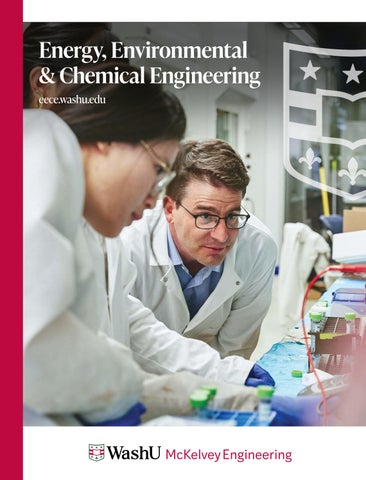
Energy, Environmental & Chemical Engineering eece.washu.edu
From the EECE Chair Solutions to the challenges shaping our future do not fit neatly within a single discipline. Sustainable energy, clean air and water, carbon management, advanced materials and biomanufacturing require new ways of connecting science and engineering. That is the strength of the Department of Energy, Environmental & Chemical Engineering (EECE) at WashU McKelvey School of Engineering. By bringing three connected fields together, EECE approaches complex problems from multiple perspectives, boosting our ability to translate fundamental discoveries into solutions with real-world impact.
Joshua Yuan Department Chair and the Lucy & Stanley Lopata Professor joshua.yuan@wustl.edu
With 28 full-time faculty, $26.7 million total research awards and $19.3 million in research expenditures in FY26, EECE researchers are developing faster ways to detect airborne pathogens, recovering valuable resources from wastewater, advancing technologies for sustainable energy and biofuels, turning industrial waste into highperformance materials and developing new approaches to carbon conversion. The average h-index for tenure-track faculty is 50, reflecting the reach and influence of our faculty’s scholarship. These measures speak to a department that is advancing knowledge while pursuing applications that can help address large-scale needs. Our research centers and partnerships extend this expertise across disciplines and create opportunities to turn ideas into action. Students are an essential part of this work. Through research, design projects, international experiences, industry partnerships and other hands-on opportunities, they engage with meaningful problems and develop the skills to contribute beyond the classroom. Their work has earned recognition in national competitions, connected them with industry and research partners, and prepared them for careers and continued study across engineering and related fields. Our faculty, students, alumni and partners are part of a community driven by discovery, collaboration and impact. I invite you to explore EECE, connect with us and discover how we are advancing engineering solutions for a changing world.
No. 22
No. 30
No. 16
Best Environmental Engineering Program
Best Chemical Engineering Program
National Universities (WashU)
U.S. NEWS & WORLD REPORT
U.S. NEWS & WORLD REPORT
U.S. NEWS & WORLD REPORT
2 McKelvey School of Engineering
About EECE Founded in 2006, WashU’s Department of Energy, Environmental & Chemical Engineering (EECE) was the first of its kind in the nation and remains the only department to unite these three disciplines. This distinctive approach brings together internationally recognized faculty whose pioneering research addresses some of the world’s most pressing challenges. From developing sustainable energy technologies and advancing clean air and water solutions to transforming carbon emissions into valuable products and engineering next-generation materials, EECE researchers are making discoveries with far-reaching impact. Home to a National Science Foundation Engineering Research Center, nationally ranked academic programs and world-class research facilities, EECE combines scientific excellence, interdisciplinary collaboration and innovation to improve human health, protect the environment and shape a more sustainable future. + One department. Three connected fields. Energy, environmental and chemical engineering come together to address challenges that don’t fit neatly within one discipline.
Degree programs
Energy
Bachelor’s
+ Energy Conversion & Storage
+ Sustainable Energy Systems
+ BS in Chemical Engineering
+ Research with a path to impact. From clean air and water to sustainable energy, carbon management and advanced materials, EECE turns fundamental engineering into solutions for realworld problems. + Students at the forefront. Undergraduate and graduate students work alongside faculty on research that tackles complex challenges in energy, environment and chemical engineering.
Research areas
+ BS in Environmental Engineering Master’s + MEng in Energy, Environmental & Chemical Engineering
+ Interface of Energy with Environmental & Chemical Engineering Environmental Engineering + Air Quality & Climate
+ MS in Energy, Environmental & Chemical Engineering
+ Environmental Chemistry & Microbiology
+ MEng/MBA joint degree program
+ Water Quality & Resource Recovery
Doctoral + PhD in Energy, Environmental & Chemical Engineering
Chemical Engineering + Advanced Materials & Nanotechnology + Novel Chemical Processes & Technologies + Synthetic Biology & Bioproduct Engineering
150
Undergraduate students
138
Graduate students
26.7M
$
Total research awards (FY26)
19.3M
$
Total research expenditures (FY26)
Department of Energy, Environmental & Chemical Engineering 3
Faculty awards & honors EECE faculty are recognized by leading professional organizations and institutions for contributions to energy, environmental and chemical engineering, as well as for research, education and service.
50
Average h-index for EECE faculty
Randall Martin
Young-Shin Jun
Zhen (Jason) He
Raymond R. Tucker Distinguished Professor
Anna McKelvey Professor
Laura and William Jens Professor
+ 2026 ACS Midwest Award
+ 2026 Camp Applied Research Award, Water Environment Federation
+ Research.com top 35 environmental scientist (worldwide), top 15 (U.S.) Martin studies atmospheric composition to better understand air quality, climate change and environmental health. His research combines satellite remote sensing and global modeling to examine issues including population exposure and emissions. He has been named a Highly Cited Researcher by Web of Science annually since 2019.
Faculty fellows EECE faculty are named as fellows of leading professional and scientific organizations, reflecting their contributions to research and the engineering profession.
Jun’s research in environmental nanochemistry addresses challenges spanning carbon dioxide conversion, criticalelement recovery, clean water and soil. Her work connects chemistry, materials and environmental engineering to challenges in energy and environmental sustainability.
He develops technologies that use microbiology, engineering and electrochemistry to improve wastewater treatment and recover valuable resources. His work spans bioenergy, sustainable desalination, bioremediation and resource recovery. He directs WashU’s Center for Water Innovation and is editor-in-chief of two major environmental engineering journals.
+ American Association for the Advancement of Science (AAAS) Young-Shin Jun and Joshua Yuan
+ International Water Association (IWA) Zhen (Jason) He
+ American Chemical Society (ACS) Feng Jiao and Young-Shin Jun
+ The Royal Society of Chemistry (RSC) Feng Jiao, Young-Shin Jun and Joshua Yuan
+ Association of Environmental Engineering & Science Professors (AEESP) Daniel Giammar + The Electrochemical Society (ECS) Vijay Ramani and Gang Wu
4 McKelvey School of Engineering
+ 2026 Ralph and Joe Bales Graber Science Award, American Academy of Environmental Engineers and Scientists
+ The Water Environment Federation (WEF) Zhen (Jason) He
Faculty honors
Research centers Through the cross-disciplinary research of chemical, environmental and biological processes in engineered systems, EECE can achieve cleaner air and water while meeting global demand for energy and goods.
Marcus Foston Professor of energy, environmental & chemical engineering
Center for Aerosol Science & Engineering
+ Named one of eight recipients of the 22nd annual Gerry & Bob Virgil Ethic of Service Award from the Gephardt Institute for Civic and Community Engagement
The Center for Aerosol Science & Engineering (CASE) advances aerosol science and technology to address challenges in energy, the environment, materials and health. Researchers study how airborne particles form, evolve, move and interact with their surroundings through measurement, modeling and experimentation. Their work explores air quality, climate and human health while developing technologies for energy, environmental and biomedical applications.
aerosols.washu.edu
Feng Jiao The Lauren and Lee Fixel Distinguished Professor + Received Saint Louis Section American Chemical Society Award for outstanding contributions to chemistry
Carbon Utilization Redesign for Biomanufacturing Engineering Research Center The Carbon Utilization Redesign for Biomanufacturing (CURB) Engineering Research Center, funded by the U.S. National Science Foundation, will advance, deploy and scale innovative hybrid electro-biomanufacturing engineered systems to empower a new circular carbon economy in which carbon dioxide will serve as valuable feedstock for manufacturing a broad range of products much more efficiently than current state-of-the-art and natural systems. WashU leads a consortium of eight universities and 12 industry partners.
curb.washu.edu
Joshua Yuan Chair and the Lucy & Stanley Lopata Professor of Energy, Environmental & Chemical Engineering + Elected a Fellow of the American Association for the Advancement of Science (AAAS), one of the most distinct honors in the scientific community
Center for Carbon Management By harnessing abundant renewable electricity, the Center for Carbon Management aims to develop innovative hybrid electrochemical and biological approaches to transform captured carbon dioxide into valuable platform molecules. Strategic collaborations with agricultural and industrial partners will ensure these molecules serve as vital feedstocks for food production and biopharmaceutical advancements. The center strives to drive the transition to a sustainable and circular carbon economy.
Research centers Consortium for Clean Coal Utilization Established in 2008, the Consortium for Clean Coal Utilization (CCCU) advances research in coal utilization and carbon capture technologies. The consortium supports faculty-led research, advanced research facilities and outreach focused on using coal as an affordable energy source and chemical feedstock while minimizing environmental impacts. Operating under WashU’s International Center for Energy, Environment and Sustainability, CCCU brings together university researchers and international partners to advance clean energy technologies and sustainable solutions. Its founding sponsors are Arch Coal, Peabody and Ameren.
cccu-wustl.com
Synthetic biology Manufacturing of Advanced materials Research Center The Synthetic biology Manufacturing of Advanced materials Research Center (SMARC) harnesses manufacturing technology and the potential of synthetic biology to unlock the next generation of advanced materials with unprecedented functional properties. It aims to combat plastic waste by creating a circular bioplastic economy that eliminates non-biodegradable plastics from polluting land and sea. To accomplish this, SMARC researchers are designing synthetic biological materials or bio-derived polymeric materials with highly tunable properties produced by microorganisms.
syntheticbiology.washu.edu
Center for Water Innovation The Center for Water Innovation (CWI) supports both fundamental and applied research to develop advanced technologies and strategies for improving the efficiency of water and wastewater treatment and for recovering valuable resources from wastewater. The research activities aim to address water-related social and economic challenges and create business opportunities for the water economic ecosystem.
watercenter.washu.edu
Shared research facilities
GEOS-Chem
Specialized facilities and advanced instrumentation give EECE researchers access to the resources needed to conduct cuttingedge research, test new ideas and develop innovative solutions.
GEOS-Chem is an open-source atmospheric chemistry model used worldwide to study air quality, climate and atmospheric composition. It helps scientists simulate atmospheric processes and understand how human activities and natural systems influence the environment. The model is managed by the GEOS-Chem support team, based at Harvard University and WashU.
+ Center for Aerosol Science & Engineering (CASE) Shared Facility + Chemical and Environmental Analysis Facility (CEAF) 6 McKelvey School of Engineering
Research in action EECE researchers tackle complex challenges in energy, environmental and chemical engineering, translating fundamental discoveries into technologies and solutions with real-world impact.
WashU to lead bioaerosol sensor development on up to $40 million federal contract to revolutionize clean indoor air When a public building catches fire, its built-in systems automatically respond: Smoke alarms blare, sprinklers come on and occupants quickly evacuate. But what if a similar smart-building system could detect invisible airborne contaminants before they make occupants sick? Researchers from WashU, led by Rajan Chakrabarty, professor of energy, environmental & chemical engineering, are leading one of three technical areas on a contract for up to $40 million from the Advanced Research Projects Agency for Health (ARPA-H). The research project, called Bioaerosol Risk Assessment interVention Engineering (BRAVE), aims to reduce respiratory illnesses, like cold, flu and asthma symptoms, by 25% with its own innovative clean-air version of a fire suppression system. Implemented in classrooms, supermarkets, hospitals and airports, BRAVE could help reduce illness, absenteeism and improve productivity.
WashU’s Trusted Tap will empower households to monitor water quality Water utilities regularly monitor drinking water supplies. But once water enters household plumbing, there are no checks on what’s coming out of the tap. Researchers at WashU want to change that with Trusted Tap, a project that empowers people to monitor their own tap water. Households purchase commercially available water filters, use them until replacement and mail the used filters to WashU for analysis. In exchange, they receive a snapshot of what’s in their water. WashU researchers can offer guidance if contaminants of concern are detected. Dan Giammar, the Walter E. Browne Professor of Environmental Engineering and director of WashU’s Center for the Environment, is the principal investigator. The interdisciplinary team includes partners from WashU, the University of Illinois Urbana-Champaign and community organizations, with a focus on developing a long-term water monitoring system.
Up to $5.2 million in DARPA funds will enable WashU to develop new biomanufacturing capabilities McKelvey Engineering researchers are working to give biomanufacturers a competitive edge by solving the challenge of continuous fermentation. Fuzhong Zhang, the Francis F. Ahmann Professor in the Department of Energy, Environmental & Chemical Engineering, will lead an interdisciplinary team developing a genetic “switch” to keep microbes working efficiently over extended periods during bioproduction. Biomanufacturing works much like beer brewing, the oldest form of biomanufacturing. Industries use microbes such as microalgae, fungi and bacteria in bioreactors to produce chemicals in batches. But continuous fermentation can lead to mutations or an inexplicable “worker strike,” when microbes stop producing the desired chemical despite unchanged conditions. Zhang’s team will develop a switchable system to keep microbes on task.
Department of Energy, Environmental & Chemical Engineering 7
Student experience EECE students apply their engineering education, work on meaningful problems, build professional connections and pursue experiences beyond the classroom.
WashU students earn top honors in water design competitions Students in the Department of Energy, Environmental & Chemical Engineering in the McKelvey School of Engineering earned top honors at two student design competitions in 2025. Two WashU teams won first place in their categories at the Midwest Student Design Competition in Madison, Wisconsin, then won second and third place at the Water Environment Federation Technical Exhibition and Conference (WEFTEC) in Chicago. Both teams were led by Grace Duong, a doctoral student and OlinChancellor’s Fellow, and advised by Zhen (Jason) He, the Laura and William Jens Professor. In each competition, students identified a real-world environmental problem, developed an engineering solution and presented their proposal to a panel of industry professionals.
EECE student joins national laboratory for internship opportunity Jamie Kamp, a senior majoring in chemical engineering at the McKelvey School of Engineering at Washington University in St. Louis, joined Brookhaven National Laboratory’s Energy Conversion Group in the Energy Systems Division during the summer of 2025 through the U.S. Department of Energy (DOE) Science Undergraduate Laboratory Internship (SULI) program. The group develops next-generation energy technologies that improve efficiency, emissions performance and fuel adaptability across diverse applications. Kamp’s research focused on reducing particulate emissions from wood heaters. SULI provides undergraduate interns with the opportunity to work alongside scientific and engineering staff on projects aligned with the DOE mission. Seventeen national laboratories participate in the program, which is managed by the DOE’s Office of Science. Through hands-on research, SULI interns contribute to projects addressing energy, environmental and nuclear challenges through transformative science and technology solutions.
↑ Student team at the 2025 Midwest Student Design Competition. (From left) Lindsey Feeley, Grace Duong, Naomika Raveendran, Soyoung Park, Paloma Santiago, Sally Carrington, Kate Martin (Credit: Grace Duong)
Joshin Kumar Postdoctoral researcher, Energy, Environmental & Chemical Engineering
8 McKelvey School of Engineering
Science can span vastly different scales. For Joshin Kumar, that has meant studying airborne particles that affect climate and air quality and, more recently, developing technology to detect airborne pathogens. As a doctoral student at McKelvey School of Engineering, Kumar studied particulate matter and its role in climate change and air pollution. His research took a new direction when his adviser, Rajan Chakrabarty, professor of energy, environmental & chemical engineering, introduced him to the challenge of detecting airborne pathogens. That work led to the development of a first-of-its-kind biosensor that can detect airborne particles of avian influenza. The technology could potentially be adapted to detect other airborne pathogens and microbes. Now a postdoctoral researcher, Kumar is continuing to work in Chakrabarty’s lab, focusing on scaling the sensor technology and advancing it toward broader use by industry and others seeking a rapid way to monitor airborne pathogens and microbes.
Environmental Engineering students win three awards at WERC competition
International Experience 2026: England
Students in the Environmental Engineering Capstone course at the McKelvey School of Engineering at WashU earned three awards at the WERC Environmental Design Contest at New Mexico State University April 12–15, 2026. Olivia Richards, Bailey Vogt, Henry Fine and Thomas Bambrick, who earned bachelor’s degrees from McKelvey Engineering in 2026, designed a bench-scale system to manage brine concentrate produced through reverse osmosis treatment. The team’s design focused on reducing waste by recovering brine byproducts as resources that could be sold to local businesses, addressing challenges associated with reverse osmosis in water-scarce regions. The team received the Pollution Prevention Award for its approach to reducing waste and creating value from byproducts. It also earned the Peer Award, selected by fellow competitors. Richards received the Terry McManus Outstanding Student Award for her leadership and commitment to environmental conservation. WashU EECE Capstone students have earned 12 WERC awards since 2023.
Ten McKelvey School of Engineering students traveled to the University of Warwick in Coventry, England, as part of the International Experience program coordinated by the Department of Energy, Environmental & Chemical Engineering. Each summer, a group of McKelvey undergraduate students studying engineering and environmental science participates in a two-week visit to an international university that partners with the McDonnell International Scholars Academy. The purpose of the International Experience program is to gain an understanding of global issues that engineers will face. The experience included research lab tours, academic lectures and visits to biotechnology, petrochemical and environmental engineering companies. Students also met WashU alumni in London and participated in cultural activities. The program gave students opportunities to explore engineering beyond the classroom, including advanced manufacturing, autonomous vehicles, robotics, artificial intelligence, battery technologies, medical imaging and energy systems. Hands-on activities and industry visits provided insight into real-world applications while highlighting the value of interdisciplinary collaboration, international perspectives and professional connections.
← (From left) Kristen Wyckoff, Olivia Richards, Bailey Vogt, Thomas Bambrick, Henry Fine and Ben Kumfer at the 2026 WERC Environmental Design Contest.
Claire Throckmorton Doctoral candidate, Energy, Environmental & Chemical Engineering
Claire Throckmorton, a graduate student in the Department of Energy, Environmental & Chemical Engineering, was among four McKelvey Engineering graduate students selected as Olin-Chancellor’s Fellows. As a doctoral student in the lab of Young-Shin Jun, the Anna McKelvey Professor of energy, environmental & chemical engineering, Throckmorton’s research focuses on addressing energy and environmental challenges by examining the fundamental interfacial interactions that occur during resource recovery of critical minerals from unconventional sources. Her work examines the nucleation of critical minerals from subsurface brines and clays, as well as how interfacial reactions may affect subsurface environments to advance our understanding of the role that these can play in securing domestic sources of these materials. She employs a unique combination of advanced surface-sensitive techniques and state-of-the-art synchrotron-based X-ray techniques at Argonne National Laboratory in her research to enhance nanoscale understanding. Department of Energy, Environmental & Chemical Engineering 9
$84,372
Data from alumni reporting within six months of graduation
Average starting salary across all degree levels
$81,000
EECE Bachelor’s
EECE Master’s
EECE PhD
TOP EMPLOYERS:
TOP EMPLOYERS:
TOP EMPLOYERS:
+ Boston Scientific
+ Jacobs
+ University of California
+ Bristol Myers Squibb
+ Kiewit Corporation
+ Bloom Energy
+ Jacobs
+ Pfizer Inc.
+ Harvard University
+ PricewaterhouseCoopers
+ SpaceX
+ Intel Corporation
+ Thermo Fisher Scientific
+ UL Solutions
+ MilliporeSigma
TOP INDUSTRIES:
TOP INDUSTRIES:
TOP INDUSTRIES:
Health Care
Consulting
Education
Architecture, Design & Construction Pharmaceuticals / Biotech
Architecture, Design & Construction Pharmaceuticals / Biotech
Information Systems / Technology
Aerospace & Defense
Government
Engineering
Aerospace & Defense
Other industries
Engineering
Class of 2025 outcomes
100% go on to full-time employment (57.6%), continuing education (39.4%) or fellowships (3%) 10 McKelvey School of Engineering
100% go on to full-time employment (64.3%) or continuing education (35.7%)
Median starting salary across all degree levels
Non-Profit Industrial Products / Manufacturing Pharmaceuticals / Biotech
Graduate student fellowships + Charles A. and Marlene S. Buescher Graduate Fellowship + Cecil & Bertha Winingham Lue-Hing Environmental Engineering Graduate Fellowship + Henry G. Schwartz, Jr. Graduate Fellowship + Otis, Dorothy and Bryce Sproul Family Graduate Fellowship + John L. & Julianne J. Stein Graduate Fellowship + Sverdrup Corp. Graduate Fellowship
Connecting people, ideas and impact EECE creates opportunities for students, faculty, alumni and industry partners to exchange ideas, build relationships and connect engineering education and research with real-world needs. + Seminars and research exchange. Researchers and experts from academia and industry share emerging ideas and perspectives throughout the academic year. + Industry and alumni connections. Career events, industry partnerships and alumni engagement help students build relationships and understand the many paths an EECE education can open.
EECE Day Students, faculty, alumni and industry partners come together for research talks, career conversations, poster presentations, tours and networking. The annual event creates opportunities to share ideas, build connections and celebrate the people who make up EECE.
Department of Energy, Environmental & Chemical Engineering 11
Alumni shaping the future
2,696 EECE alumni
2026 McKelvey Engineering Awards EECE ALUMNI
McKelvey EECE alumnus makes historic $200 million commitment to public health Andrew M. Bursky, a WashU alumnus and former chair and Distinguished Trustee of the university’s Board of Trustees, and his wife, Jane M. Bursky, have made a $200 million commitment to fortify WashU’s newly established Andrew M. and Jane M. Bursky School of Public Health. The landmark investment is the largest in WashU history. Andrew Bursky earned a bachelor’s degree in economics from WashU Arts & Sciences, and bachelor’s and master’s degrees in chemical engineering from WashU’s engineering school. The Burskys’ gift will drive immediate growth, including faculty hiring, scholarships and new research initiatives, while advancing efforts to rethink how public health is taught, studied and applied. The Bursky School of Public Health already draws on expertise from across WashU, including five McKelvey School of Engineering faculty who hold secondary appointments in the school: Alvitta Ottley, Chenyang Lu, Feng Jiao, Daniel Giammar and Kimberly Parker. Their work spans areas including artificial intelligence, environmental engineering, energy and sustainable technologies, creating direct connections between engineering research and public health challenges. The school is designed to build on these interdisciplinary connections, bringing together expertise from engineering, medicine, business, the built environment and other fields to address complex public health challenges. The goal is to move beyond traditional disciplinary boundaries and translate research into real-world impact. ↑ Andrew and Jane Bursky
12 McKelvey School of Engineering
Michael Lefenfeld, BS ’02
Polly J. Shrewsbury, BS ’95 EMERGING LEADER AWARD
Rebecca Vincent, BS ’08
Luo receives 2025 EECE Distinguished Alumni Award For his leadership in developing and deploying innovative technologies and his contributions to industrial research and development, Huping Luo received the 2025 EECE Distinguished Alumni Award. Luo is a senior manager at Chevron, where he oversees an R&D group focused on developing and deploying technology solutions from the laboratory to the field. His group supports Chevron’s low-carbon strategy and other business areas while helping guide the company’s research and innovation portfolio. The group also has built partnerships with universities and national laboratories, including WashU EECE. Luo is an inventor who co-led the development and commercialization of Chevron’s proprietary ISOALKY technology and was the main contributor to the design and scale-up of its reactor system. The technology filled a long-standing gap in U.S. industrial alkylate production, generated billions of dollars in revenue for Chevron and earned several awards, including the 2017 Platts Breakthrough of the Year Award and the 2020 HP Best Refining Technology Award. Luo earned a doctorate in chemical engineering from WashU.
Terlaje receives EECE Rising Star Award For her leadership at the intersection of technology, policy and national security, Melissa Holtmeyer Terlaje received the EECE Rising Star Award. Terlaje is chief government relations officer and secretary to the board of managers of the Johns Hopkins Applied Physics Laboratory, where she works with government leaders and stakeholders on national priorities. Previously, she led strategy development and strategic engagement in APL’s Air and Missile Defense Sector, developing initiatives and connecting technology with senior military and government leaders. Terlaje previously served as special assistant to APL Assistant Director for Policy and Analysis Christine Fox, where she led analytic efforts examining the intersection of technology and policy and coordinated the APL Senior Fellows program. She also served as strategic studies lead to then-Chief of Naval Operations Adm. John Richardson. Terlaje was an American Association for the Advancement of Science & Technology Policy fellow in the U.S. Senate and the Office of the Secretary of Defense. Terlaje earned bachelor’s and master’s degrees in mechanical engineering and a doctorate in energy, environmental & chemical engineering, all from WashU.
WashU alumnus earns honors for energy research Zhongyang Wang, who earned his doctorate in energy, environmental & chemical engineering from WashU in 2019, continues to make an impact in energy and electrochemical engineering. Now an assistant professor at the University of Alabama, Wang received a National Science Foundation CAREER Award in 2026, the 2024-25 Electrochemical Society Toyota Young Investigator Award and a 2024 U.S. Department of Energy IGNIITE Award. He also is a Hewson Engineering Faculty Fellow and a 2026 American Chemical Society Petroleum Research Fund Doctoral New Investigator. Wang’s research group aims to advance high-performance electrochemical systems and sustainable technologies by addressing fundamental challenges at the intersection of polymer science and electrochemical engineering. Its work focuses on ion and electron transport in nanostructured materials, improved interfaces for water and carbon dioxide electrolysis, and structured liquid crystals for water treatment and energy storage.
13
Energy, Environmental & Chemical Engineering Faculty
Joshua Yuan Department Chair and Lucy & Stanley Lopata Professor joshua.yuan@wustl.edu Research interests: Mechanism-based engineering design to address the challenges in energy, the environment and health
Richard Axelbaum The Stifel & Quinette Jens Professor of Environmental Engineering Science axelbaum@wustl.edu Research interests: Challenges in clean energy and advanced materials, with emphasis on combustion
Peng Bai Associate Professor pbai@wustl.edu Research interests: Analytical tools to investigate the fundamental science in advanced electrochemical energy systems
Christopher Cooper Assistant Professor cbcooper@wustl.edu
Jenna Ditto Assistant Professor dittoj@wustl.edu
Marcus Foston Professor mfoston@wustl.edu
Research interests: Responsive, soft materials for applications in energy storage, environmental sustainability and health
Research interests: The chemistry and impacts of urban indoor air pollution
Research interests: Utilizing biomass and plastic waste resources for production of value-added products
Feng Jiao Lauren and Lee Fixel Distinguished Professor jiaof@wustl.edu
Young-Shin Jun Anna McKelvey Professor ysjun@wustl.edu
Benjamin Kumfer Professor of Practice kumferb@wustl.edu
Research interests: Advances in nanoscale interfacial chemistry and solid nucleation
Research interests: Innovative power generation and combustion technologies
Research interests: Electrocatalysis and carbon dioxide utilization; electrochemical devices to address energy storage and sustainability challenges
14 McKelvey School of Engineering
Janie Brennan Teaching Professor and Associate Chair of Undergraduate Studies jbrennan@wustl.edu Evidence-based teaching methods in engineering education
Daniel Giammar Walter E. Browne Professor of Environmental Engineering and Assistant Vice Provost for Environmental Research giammar@wustl.edu Research interests: Sustainable solutions to produce safe drinking water
Chi Li Research Assistant Professor chili@wustl.edu Research interests: Air pollution trends, sources and their health impacts
Rajan Chakrabarty Harold D. Jolley Professor of Engineering chakrabarty@wustl.edu Research interests: Grand challenges in aerosol-climatehealth nexus using interdisciplinary science
Zhen (Jason) He Laura and William Jens Professor of Energy zhenhe@wustl.edu Research interests: Advanced technologies to recover valuable resources from wastewater
Xinhua Liang Professor xinhua.liang@wustl.edu Research interests: Novel nanostructured materials using gas-phase synthesis to address energy and environmental challenges
Fangqiong Ling Associate Professor fangqiong@wustl.edu Research interests: Microbial ecosystems with potential to improve water supply safety and public health
Trent Silbaugh Senior Lecturer and Director of Master’s Studies tsilbaugh@wustl.edu Undergraduate lecture and laboratory courses in chemical engineering
Randall Martin Raymond R. Tucker Distinguished Professor rvmartin@wustl.edu Research interests: Advancing the understanding of atmospheric composition
Kimberly Parker Associate Professor kmparker@wustl.edu Research interests: The fate of chemical and biological pollutants in soil, air and water
Vijay Ramani Roma B. & Raymond H. Wittcoff Distinguished University Professor and Senior Vice Provost for Graduate Education and International Affairs ramani@wustl.edu Research interests: Electrochemical energy conversion & storage
Yinjie Tang Professor yinjie.tang@wustl.edu
Elijah Thimsen Associate Professor elijah.thimsen@wustl.edu
Research interests: Metabolic modeling and analysis; fermentation engineering; and algal bioprocesses
Research interests: Thermodynamic aspects of chemical and material transformations
Jay Turner James McKelvey Professor of Engineering Education & Vice Dean for Education jrturner@wustl.edu Research interests: Air pollution sources and human exposures to drive interventions
Kurt Russell Lecturer kurtr@wustl.edu Research interests: Catalysts in various applications, including X-ray absorption spectroscopy and X-ray diffraction
Jian Wang Professor jian@wustl.edu Research interests: The impact of aerosols on climate and air quality
1.12M
$ Gang Wu Elvera and William R. Stuckenberg Professor gangw@wustl.edu Research interests: Earth-abundant materials and catalysts for electrochemical engineering and technologies to achieve energy and environmental sustainability
Lu Xu Assistant Professor xu1@wustl.edu Research interests: Air quality and climate change
Fuzhong Zhang Francis F. Ahmann Professor fzhang29@wustl.edu Research interests: Engineering microbes to produce better biofuels, chemicals and highperformance materials
Research awards per tenure-track faculty
840K
$
Research expenditures per tenure-track faculty
Department of Energy, Environmental & Chemical Engineering 15
Washington University in St. Louis McKelvey Engineering MSC 1180-0206-01 One Brookings Drive St. Louis, MO 63130-4899
About WashU
About McKelvey McKelvey School of Engineering at WashU promotes independent inquiry in engineering research and education with an emphasis on scientific excellence, innovation and collaboration without boundaries. WashU engineers produce new knowledge that advances human health, improves the environment and enriches scientific understanding, while faculty educate students in creating a world we cannot yet imagine. Through research and education, McKelvey is making a positive impact on the local community, the country and the world.
Department of Energy, Environmental & Chemical Engineering eece.washu.edu • @washuengineers
26-0603
Washington University in St. Louis (WashU) is among the world’s leaders in teaching, research, patient care and service to society. WashU is distinctive in its purpose-driven scholarship across a range of academic disciplines, supportive residential undergraduate experience and world-class research enterprise. WashU draws students and faculty to St. Louis from all 50 states and more than 100 countries. The university offers more than 100 programs leading to bachelor’s, master’s and doctoral degrees.