M:

2026
Rural Australia
Resilience under pressure: The future of Australian farming.
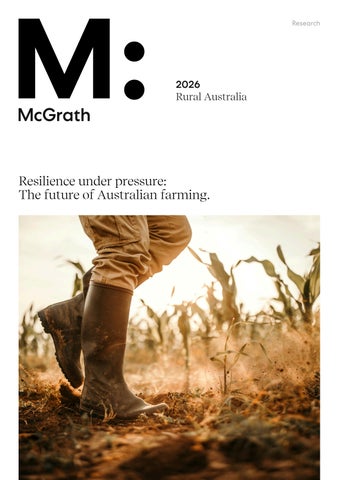
Resilience under pressure: The future of Australian farming.
Australia’s agricultural sector is expected to face a tougher operating environment over the coming year, with seasonal conditions and persistently high input costs continuing to shape farm production decisions
According to the Department of Agriculture, Fisheries and Forestry (ABARES), the gross value of agricultural production is forecast to fall 5% to $98.3 billion in 2026-27, while export
earnings are projected to decline 9% to $74.8 billion as livestock and crop export values ease
While conflict in the Middle East is expected to weigh on global economic growth, demand for agricultural commodities and food products remains comparatively resilient.
Despite this, broadacre farm profitability is forecast to deteriorate significantly, with average business profits projected to decline by 70% as lower incomes are compounded by elevated operating costs.
What are the immediate concerns for Australian farmers? Over the next season
Global grain and oilseed production is forecast to reach a record high in 2025–26, supporting strong international supply levels
Within Australia, however, variable summer and autumn rainfall has weakened crop and pasture prospects across parts of the eastern states, contributing to lower summer crop production than previously anticipated
Australian farmers are facing a challenging operating environment, with rising input costs and extreme weather events emerging as their most immediate concerns in the Farms in Focus 2026 survey conducted by CommSec
Nearly half of farmers surveyed identified input costs as their primary concern, reflecting ongoing pressure from expenses such as fuel, fertiliser, labour and farm inputs. At the same time, increasingly frequent and severe weather events continue to create uncertainty around production, yields and business planning
Beyond these challenges, farmers are also concerned about product prices, finance costs and the growing burden associated with sustainability standards.
Together, these issues are creating a more complex and costly business environment, prompting many producers to focus on improving efficiency, strengthening resilience and exploring new practices that can help reduce costs and maintain profitability
Farmers are adopting new practices to improve productivity, resilience and business performance
Australian livestock farmers are increasingly adopting innovative management practices to improve productivity, profitability and resilience.
From rotational grazing and multispecies pastures to low-emissions livestock management, producers are embracing approaches that enhance animal performance, strengthen environmental outcomes and support long-term business sustainability
Reducing steroids and antibiotics
Australian farmers are reducing the routine use of antibiotics and growth treatments by improving animal nutrition, genetics and herd management This supports animal welfare and responds to growing consumer demand for sustainably produced food.
Rotational grazing
Rotational grazing involves moving livestock between paddocks to allow pastures to recover
The practice improves pasture quality, soil health, water retention and livestock productivity while reducing land degradation
Integrating livestock and cropping
Many Australian farmers combine livestock and cropping to improve soil health and diversify income Livestock help recycle nutrients, manage weeds and graze crop residues, creating more resilient farming systems
Agroforestry
Agroforestry integrates trees with farming operations to provide livestock shelter, improve biodiversity and capture carbon It can also generate additional income through timber production and carbon credits
Low-emissions livestock management
Farmers are adopting methanereducing feed additives, improved pasture management and selective breeding to lower livestock emissions These practices help improve sustainability while maintaining productivity and profitability
How many farms have adopted or started to adopt?
Based on livestock
Australia’s livestock sector is expected to face softer conditions in 2026–27, with the gross value of production forecast to fall 2% to $47 billion and export earnings declining 7% to $38 billion according to ABARES While beef, sheep, pig and poultry meat production is expected to remain high, dairy production is forecast to ease
Domestic cattle and lamb prices are expected to soften, whilst milk and wool prices are projected to improve. Slower global economic growth and persistent inflation are also likely to weigh on international demand for livestock products.
Innovative farming techniques continues to grow across Australia's cropping sector
How many farms have adopted or started to adopt?
Based on cropping
Cropping farmers are continuing to adopt practices that improve efficiency, reduce risk and build resilience to changing seasonal conditions.
Low or no-till
Low and no-till farming reduces soil disturbance by limiting or eliminating cultivation before planting
Australian growers are adopting this practice to improve soil structure, retain moisture, reduce erosion and lower fuel and labour costs, while supporting long-term soil health.
Retain stubble
Stubble retention involves leaving crop residues on paddocks after harvest rather than removing or burning them The practice helps protect soils from erosion, conserve moisture, improve organic matter and support better crop performance in dry conditions.
Integrating livestock and cropping
Combining livestock and cropping
Australia’s cropping sector is expected to ease in 2026–27, with production value forecast to fall 8% to $509 billion and export earnings declining 10% to $37.0 billion as lower production volumes outweigh stronger prices
Drier seasonal conditions are expected to support higher domestic grain prices while also shaping grower decisions more than rising fuel and fertiliser costs, highlighting the growing influence of seasonal conditions on crop production and profitability
enterprises to improve farm resilience and productivity are being ramped up by farmers across Australia Livestock can utilise crop residues, recycle nutrients and help manage weeds, creating more diversified and efficient farming systems
crops
Cover crops are planted primarily to protect and improve the soil between production cycles. They help reduce erosion, suppress weeds, improve soil fertility and increase moisture retention.
rotations
Crop rotation involves growing different crops in sequence on the same paddock to improve soil health and break pest and disease cycles.
Variable rate spraying and fertiliser
Variable rate technology allows farmers to apply fertilisers and crop protection products at different rates across a paddock based on soil and crop conditions This precision approach can improve input efficiency, reduce costs and support stronger production.
Top 5 results for path to strengthen innovation, crops
Farmers are investing in land, water and energy initiatives to strengthen resilience and support sustainable farming
How many farms have adopted or started to adopt?
Based on energy and water
Taking a more proactive approach to land management, Australian farmers seek to improve the productivity, resilience and sustainability of their farming operations
Increasingly, producers are recognising that investing in the health of their land can deliver long-term benefits, from better soil condition and water security to improved biodiversity and reduced erosion. As climate variability and environmental expectations continue to shape the sector, land stewardship is becoming an integral part of farm business planning
The Farms in Focus 2026 survey highlights growing participation in a range of land management practices Around 15% of farmers have adopted initiatives to rehabilitate degraded land and control erosion, while 20% are actively conserving nature on their properties In addition, 17% have planted trees to support environmental outcomes and 12% have fenced dams to improve water quality and livestock management
Australian farmers are increasingly adopting energy and water management practices that improve efficiency, lower operating costs and support long-term sustainability With input costs and seasonal variability continuing to shape farm decisions, many producers are investing in solutions that improve resource use and strengthen business resilience
According to the survey, 16% of farmers have adopted on-farm renewable energy, while 14% have invested in equipment powered by renewables Meanwhile, 6% have implemented
water-saving technologies and 15% have introduced measures to protect waterways from runoff and erosion.
The survey also highlights strong momentum for future adoption Around 25% of farmers have started adopting renewable energy systems, 23% are transitioning to renewable-powered equipment, 23% have begun implementing water-saving technologies, and 27% are taking steps to protect waterways from runoff
These findings suggest farmers are increasingly embracing practical solutions which improve resource efficiency, strengthen resilience and support more sustainable farming operations over the longer term
Encouragingly, there is a strong pipeline of future adoption across these areas
The survey found that 28% of farmers have started rehabilitating degraded land, 25% have begun planting trees, 34% have started fencing dams, 29% are implementing erosion control measures, and 18% are undertaking nature conservation activities These figures indicate that many producers are actively transitioning towards more sustainable land management approaches.
Overall, Australian farmers are increasingly embracing land stewardship practices which protect natural resources, strengthen farm resilience and contribute to the long-term sustainability of the agricultural landscape
How many farms have adopted or started to adopt?
Based on land management
Implementation is highest among smaller farms and owner-operated businesses investing in long-term change
How many farms have adopted or started to adopt? Based on farm size
How many farms have adopted or started to adopt?
Based on ownership status
The results from the Farms in Focus 2026 survey suggests that farm size and land ownership play an important role in the adoption of new farming practices across the country
Smaller farms are often leading the way, recording higher adoption rates across a range of innovations, while landowners are significantly more likely than leaseholders to invest in long-term practice changes
This highlights the importance of flexibility, confidence in future returns and security of tenure when implementing new approaches
The findings show that smaller farms have particularly strong adoption rates for practices such as rotational grazing, reducing antibiotics and steroids, stubble retention, tree planting and renewable energy
In contrast, larger farms are more likely to be in the process of adopting practices such as variable-rate inputs and stubble retention, suggesting innovation continues to gain momentum across farms of all sizes
Ownership status is also a significant driver of adoption Farmers who own their land consistently report higher adoption rates for practices including rotational grazing, reducing antibiotic use, variable-rate fertiliser application, stubble retention, tree planting and renewable energy
Leaseholders, while less likely to have already adopted these initiatives, often report higher rates of beginning implementation, indicating strong future potential where longer-term investment horizons can be supported
Responding to rising pressures whilst investing in future performance
Australian agriculture faces a period of heightened uncertainty as farmers navigate seasonal variability, rising costs and changing market conditions. Despite these challenges, producers remain focused on the future.
The outlook for farm profitability is mixed, with cost pressures and climate volatility expected to remain significant challenges While some producers anticipate lower returns, many expect profitability to remain broadly stable over the next five years as they focus on improving operational efficiency and managing risk
Encouragingly, farmers adopting new technologies and management practices generally report stronger profit expectations. Investments in areas such as precision agriculture, rotational grazing and renewable energy are expected to support productivity gains and cost savings over time.
Farmers identify rising input costs and extreme weather as their greatest long-term concerns, alongside policy complexity and increasing sustainability requirements Accessing finance and determining which innovations deliver the best return also remain ongoing challenges.
Producers are optimistic about growing demand for Australian agricultural products over the coming years, supportive policy settings and greater assistance to implement new practices Clearer information on returns, simpler adoption pathways and improved access to finance could help accelerate innovation and strengthen profitability across the sector
What are the longer term concerns for Australian farmers? Over the next five years
Top 5 results for path to improve profitability over the next five years
Rural Australia
Rural Australia refers to the areas outside of the ‘Greater Capital Cities’ or considered to be the ‘Rest of State’ as defined by the Australian Bureau of Statistics, which covers properties most suitable for agricultural purposes
ABARES
The Australian Bureau of Agricultural and Resource Economics and Sciences (ABARES), is the science and economics research division of the Department of Agriculture, Fisheries and Forestry
Gross Value of Production
Gross value of production (GVP) refers to the total value of products produced on farms, measured at farmgate prices That is, the prices received by producers before any processing, transport, or retail markups
Hectares
All land area measurements in this report are expressed in hectares (ha) unless otherwise stated. One hectare equals 10,000 square metres, or approximately 2 47 acres
Currency
All monetary values in this report are expressed in Australian dollars (AUD) unless otherwise stated.
Farms in Focus 2026
The Farms in Focus Report 2026 captures the voice of Australian farmers
About the survey
Harvard University partnered with Commonwealth Bank of Australia (CBA) to survey Australian farmers, in collaboration with the National Farmers’ Federation and the Australian Farm Institute
More than 500 farmers engaged in the survey, with 348 providing complete responses used in the analysis The survey was conducted between 16 November 2025 and 16 March 2026, and included farmers engaged in all types of farming, across all Australian states and territories The study sample included farmers managing large and small farms and those farming on land they own as well as those leasing land or managing farms for owners.
Respondents were asked questions about their major immediate concerns today and when looking ahead 5 years, and their views on positive changes that could improve profitability. They were also asked for their overall predictions for profits in the current year and over the next 5 years as well as recent experience with extreme weather events
Detailed questions were asked about their adoption (or plans for adoption) of a range of newer/innovative management practices for production across different commodities, as well as other aspects of business and land management such as energy and water use and conservation
Farmers were asked about specific motivations for adopting new approaches and expectations for their return on investment, as well as the main barriers generally to adopting newer approaches
Michelle Ciesielski National Head of Research, McGrath Research
www.mcgrath.com.au/research

Find an agent