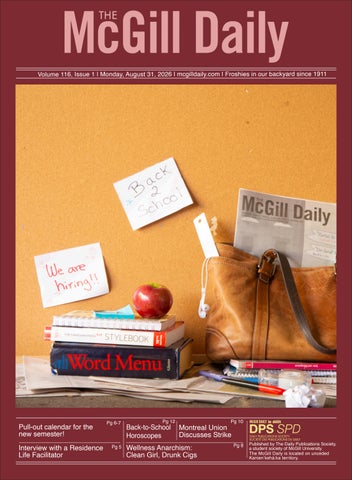
Volume 116, Issue 1 | Monday, August 31, 2026 | mcgilldaily.com | Froshies in our backyard since 1911
Pull-out calendar for the new semester! Interview with a Residence Life Facilitator
Pg 6-7
Pg 5
Pg 12
Back-to-School Horoscopes
Pg 10
Montreal Union Discusses Strike
Wellness Anarchism: Clean Girl, Drunk Cigs
Pg 8
Published by The Daily Publications Society, a student society of McGill University. The McGill Daily is located on unceded Kanien’kehá:ka territory.
Annual General Meeting All members of the Daily Publications Society (DPS), publisher of The McGill Daily and Le Délit, are cordially invited to its Annual General Meeting:
Wednesday, September 30th @ 6:00 pm McGill University Centre, 3480 Rue McTavish, Room 107
DPS Directors meet at least once a month to discuss the management of both Le Délit and The McGill Daily and get to vote on important decisions related to the DPS’s activities. The annual financial statements and the report of the public accountant are available at the office of the DPS and any member may, on request, obtain a copy free of charge. Questions? Send email to: chair@dailypublications.org
DEPUIS 1967
Volume 116
EDITORIAL
Issue 1
August 31, 2026 | The McGill Daily | mcgilldaily.com
3
editorial board 3480 McTavish St, Room 107 Montreal, QC, H3A 0E7 phone 514.398.6790 fax 514.398.8318 mcgilldaily.com
Keep the Planet in Mind During Move-in
The McGill Daily is located on unceded Kanien’kehá:ka territory.
coordinating editor
Ingara Maidou managing editor
Adair Nelson news editors
Justin Friedberg Mara Gibea Sonia Berman commentary + compendium! editor
Vacant culture editor
Isabelle Lim features editor
Elaine Yang visuals editors
Eva Marriott-Fabre Nikhila Shanker copy editor
Charley Tamagno design + production editor
Parker Russell multimedia editor
Golnar Saegh social media editor
Vacant cover design
Ingara Maidou Adair Nelson Golnar Saegh Charley Tamagno staff contributors
Enid Kohler contributors
Benjamin Taylor-Sauvé, Anneke Goodwin, Amelia H. Clark, Sarah Toman, Leïla Van Glabeke
Published by the Daily Publications Society, a student society of McGill University. The views and opinions expressed in the Daily are those of the authors and do not reflect the official policy or position of McGill University. The McGill Daily is independent from McGill University.
3480 McTavish St, Room 107 Montreal, QC H3A 0E7 phone 514.398.690 fax 514.398.8318 advertising & general manager
Letty Matteo ad layout & design
As July turns to August, and August to September, slowly but surely the streets between University and Parc come out of a summer hibernation. Each year, over seven thousand undergraduate students begin their studies at McGill, with 52 per cent of the incoming class arriving from out of province. Over 2,800 first-year students live in one of the 14 residences minutes from campus, while for many upper-year students, the return to campus means moving into an apartment. When leases start in May and September, U-hauls and cardboard boxes litter the streets. As exciting as it is to step foot in your first-year dorm room for the first time, or to finally finish unloading all of your things into your apartment, move-in comes with an environmental cost. The move-in and move-out periods generate a significant amount of waste in the Milton Parc neighbourhood. The dumpsters outside of residence halls overflow with cardboard boxes and single-use packaging. Piles of black trash bags line the sidewalks from Lorne to Hutchison. Even just the packaging that comes with furnishing a dorm room or an apartment results in a massive amount of trash when multiplied by thousands of students. The truth is that stopping the move-out mass littering begins at move-in. The reality for many McGill students is that we are temporary residents in Montreal, and many of us will leave the city after graduation. As much as departure seems far away upon arrival, we must remember that many of our possessions will not come with us when we leave. As university students, how often are we thinking about the afterlife of our belongings when contemplating a purchase? It’s easy to imagine the missing piece for a shared living room or a shoebox dorm room when shopping after move-in. Much less often are we thinking of a piece of plastic that will take thousands of years to break down. The expectation should not be to buy something that will serve its purpose for a few years before being tossed away. Rather, moving into one's apartment should come with the understanding that we have a responsibility to be sustainable for the sake of our neighborhood, environment, and wallet. Instead of buying mass-produced items, turn to second-hand when it comes to filling up your space. In addition to being better for the environment, buying second-hand will likely save you money in the process. Montreal has a vibrant Facebook Marketplace community, where you can find all sorts of furniture and unique decor for low prices, or even free of charge. And once you’re ready to move out of your university apartment, you can easily re-list items online or simply donate them to a local thrift
Read us online! website Facebook Instagram
Mathieu Menard All contents © 2026 Daily Publications Society. All rights reserved. All submissions by any contributor for publication in any of the print or online newspapers, websites, blogs, vlogs, letters to the editor, or other publications of the Daily Publications Society (“DPS”), including photographs, artwork, multimedia content, and any other submitted materials, are the exclusive copyright of the DPS. By submitting such materials, every editor, reporter, contributor, and letter writer automatically transfers to the DPS all intellectual property rights therein. The content of this newspaper is the responsibility of The McGill Daily and does not necessarily represent the views of McGill University. Products or companies advertised in this newspaper are not necessarily endorsed by Daily staff. Printed by Imprimerie Transcontinental Transmag. Anjou, Quebec. ISSN 1192-4608.
store. McGill runs its own on-campus thrift store out of University Hall. Launched in 2024 by Student Housing Services with the support of the Office of Sustainability, ThriftMcGill has since received over 10,000 donations including clothing, home decor, books, kitchenware, and board games. All items are free of charge for McGill students, making furnishing an apartment readily accessible. When moving out, think of non-profit organization Sollicite’s Trash2Treasure initiative: a circular, volunteer-based program which redistributes used furniture and household items to charitable organizations across the island. Since 2017, the organization has dedicated itself to cleaning up the neighbourhood for a good cause. During the late-April move-out season, the team collaborates with the Students Society of McGill University (SSMU) to run multiple days of free home collection services in Milton Parc. Volunteers pick up discarded items, including electronics, furniture, and small appliances, that can be recycled for those in need. In 2025 alone, they collected over 18 tonnes of material and gave new life to 96 per cent of it. Frosh soon follows the excitement of residence move-in and OAP brings thousands of students to the lower field in the first week of classes. Both events have dedicated coordinators who work with McGill’s Office of Sustainability. In September 2025 OAP earned a gold sustainability certification, while the Management, Engineering, and Music Froshes earned platinum. In order for these events to happen, we have to be respectful and responsible participants and clean up our waste. The beginning of the fall semester brings a lot of excitement to McGill’s undergraduate community, but we must remember the neighbourhood’s permanent residents while having fun. When attending back-to-school parties or other events in Milton Parc and beyond, dispose of cans, cups, and other plastic waste responsibly. Not only will cleaning up after partying help you avoid fines from your landlord, but it’s the right thing to do for our neighbours and our planet. Moving into a dorm or returning to an apartment is, for many students leaving home to study, one of the most exciting parts of the university experience. But ultimately, Canada produces nearly five million tonnes of plastic waste each year, less than seven per cent of which is successfully recycled into new products. Bottom line, it is our responsibility to be mindful of the ways we can keep Milton Parc and Montreal clean throughout our time as residents on the island all year round.
www.mcgilldaily.com www.facebook.com/themcgilldaily @themcgilldaily @mcgilldaily
CONTACT US Coordinating NEWS COMMENTARY CULTURE FEATURES SCI+TECH
coordinating@mcgilldaily.com news@mcgilldaily.com commentary@mcgilldaily.com culture@mcgilldaily.com features@mcgilldaily.com scitech@mcgilldaily.com
Managing
managing@mcgilldaily.com
PHOTOs
visuals@mcgilldaily.com
ILLUSTRATIONS radio
visuals@mcgilldaily.com
COPY
radio@dailypublications.org copy@mcgilldaily.com
video + Social Media
socialmedia@mcgilldaily.com
4 August 31, 2026 | The McGill Daily | mcgilldaily.com
NEWS
Premier Christinne Fréchette on Language
Quebec’s new Premier, Christinne Fréchette, has decided to embrace only a few of the policies from her predecessor, François Legault. His approach to Language and higher education are among them.
Benjamin-Taylor Sauvé News Contributor t has been 4 years since the incumbent Coalition Avenir Quebec (CAQ) won a landslide electoral victory. Since then, the party has seen a fall in support comparable to Prime Minister Trudeau’s Federal Liberal Party near the end of his term. To further the comparison, the Federal Liberal Party and CAQ pursued similar plans to restore their popularity: replace their leader. On January 14 of this year, Premier François Legault announced his resignation upon the CAQ’s election of a new leader, Christinne Fréchette. Fréchette, who had served various positions in Legault’s cabinet, including Minister of Immigration, Francisation, and Integration, won the election to replace Legault in mid-April, stating in her victory speech that the government largely shouldn’t change its priorities: “Les Québecois ne veulent pas reculer.” She succeeded in reviving her party’s polling popularity. However, they are currently not expected to win the highest number of seats in the National Assembly of Quebec come the general election on October 5th. As Premier, Fréchette had the opportunity to act in one legislative session before the upcoming election, likely the last session with a CAQ majority until the following election. During this time, CAQ administration attempted to pass 27 bills. The Fréchette government’s first bill was particularly symbolic: an early renewal of the notwithstanding clause protecting the controversial Bill 96/Law 14, which consolidated the role of the French language in
I
public, professional, and academic life by strengthening Bill 101. The Fréchette administration further expanded Bill 101 for vocational and adult education as well as changes to the application process for lowcost housing, with specific provisions regarding students. With limited time, these were abandoned.Still, a ban on selling energy drinks to youth under 16, the regulation of ticket resales and subscriptions, the Gabie Renaud law (granting individuals the ability to inquire about a potential partner’s domestic abuse history), and nine others were passed. While Fréchette initially championed bills concerning language, they seem to have lost steam in the national assembly as they neared the session deadline. Due to the need for the opposition's consent to further major legal projects, the CAQ government instead focused on achieving “results without drama.” This meant focusing on bills that wouldn’t get stuck in debate or in committee before the session ended. This also created distance between Fréchette and the famously confrontational Legault. She further distanced herself by criticizing Legault’s “economic interventionism,” referring to the auditor general’s report published on June 10. Despite the deliberate change in “tone,” Fréchette still sees Legault’s policies on the French Language and Quebec Culture as successful and intends to continue in that direction. On the abandoned Bill 101 expansion, she stated, “I understand that if we bring back this bill and we will, should we be reelected, we can modify the process to consult the English community.” In the same interview on June 15, the only formal English
Education minister Martine Biron announced a deal with McGill, Concordia, and Bishop’s offering $20 million a year as long as 60 per cent of out-of-province students reach level 4 proficiency in oral French ... [with] fines if they fail to reach the quota. This does not change the tuition hike, which remains in effect despite the Quebec Superior Court deeming that the near doubling of fees for out-of-province students is “unreasonable.”
Eva Marriott-Fabre | Visuals Editor language interview with Fréchette since becoming Premier, she praised McGill and Concordia as “important, worldclass institutions.” A day later, on June 16, Fréchette’s higher education minister, Martine Biron, announced a deal with McGill, Concordia, and Bishop’s offering $20 million a year as long as 60 per cent of out-ofprovince students reach level 4 proficiency in oral French. In addition, these schools will have to pay fines if they fail to reach the quota. This does not change the tuition hike, which remains in effect despite the Quebec Superior Court deeming that the near doubling of fees for out-ofprovince students is “unreasonable.” As the former Minister of Immigration, Francization and Integration, this does not only represent a continuation of her predecessor’s policies, but of her own. Recent polling by Leger shows that language is not among the highest priorities for most anglophone and francophone voters in Quebec, with the cost of living and quality of health services ranking as higher priority issues. That said, 12 per cent of voters still view Quebec’s language and culture as one of their highest priorities, while 24 per cent of anglophones who intend to move out in the next two years cite language in some form as the main reason. Anglophones also clearly diverge
For students at McGill, these debates are about more than abstract questions of language policy or provincial politics. They shape who can study in Quebec, how accessible young people see a future for themselves here. in their voting intentions as well, with 55 per cent support for the Quebec Liberal Party (PLQ) and 20 per cent for the Conservative Party of Quebec (PCQ). By contrast, the general Quebec population sees 24 per cent and 13 per cent respectively, with the separatist Parti Québécois (PQ) leading at 30 per cent support and the CAQ competing for second with 20 per cent. There is no scheduled English language debate between the party leaders as the CAQ and the PQ declined their invitations, and the PLQ will not participate in debates without the other four parties. The last Englishlanguage debate in Quebec’s provincial history occurred in 2018, with the only other one occurring back in 1985. The “Dialogue jeunesse des chef·fes” planned by the Institute du Nouveau Monde (INM).This event was scheduled for August 25th meant to allow youth to
directly ask questions to party leaders, yet itwas also cancelled. This raises questions about whether young anglophone Quebecers are being adequately included in conversations about the province’s future. For Quebecers, and particularly for students at McGill, these debates are about more than abstract questions of language policy or provincial politics. They shape who can study in Quebec, how accessible its universities are, and whether young people see a future for themselves here. For McGill students, the effects are especially tangible. The provincial government can directly affect their education and their decision to remain in Quebec after graduation. Regardless of how one feels about the CAQ’s approach, these policies matter because they will help determine who feels they have a place in Quebec’s future.
CULTURE
August 31, 2026 | The McGill Daily | mcgilldaily.com
5
What's it Like to Run Move-In Weekend? Behind the scenes with two of McGill's Residence Life Facilitators others, especially big ones where actually make a connection with present their most successful and friends or it's exam season and you go out of the residence or on the community? least successful events of the year, they don't want to go to things. We trips. You feel more connected to s the school year is set in the community. OM: It depends on the person. motion, first years, Yes, because there are specific returning undergrads, and MD: What kinds of questions are residents or groups of residents that graduate students alike flood people asking? don’t interact with us at all, and McGill’s residences on move-in day. that's fine. But there are definitely Behind the scenes are current OM: Mostly about logistics, either people who I've found, after a few McGill students known as Residence the rules of residence or the events years of doing this, who will come to Life Facilitators (RLFs) who themselves. as many events as they can because facilitate move-in and residence life. they just like having free events that The Daily interviewed two RLFs KBV: Sometimes they can ask us they can attend. Olivia Morawetz RLF who currently work at New questions unrelated to residence life, Residence Hall (NRH) to discuss just [because] we're upper year MD: How do you pitch events to managing the stress of moving in. students at McGill. first years, and is it important for and provide feedback on how those had a bar where we had a menu of them to attend those events? went. Then we could take events mocktails that we made [and] we This interview has been edited for OM: I wish more students knew from other RLFs. ordered 50 pounds of sushi. It was clarity and conciseness. that RLFs are a resource of upper OM: I feel like something we've insane. I was like a waiter running year students who can answer been trying to do more recently is MD: How do you get inspiration around with sushi. We had a dance Charley Tamagno for the McGill questions about registering for asking first years what things they for different events? floor. We hired a DJ who was a Daily (MD): What's the day-to-day classes or homework or certain want to see. I think asking students student in Upper. Some guy of an RLF like? subjects. Last year in Upper what events they want to see is KBV: A lot of the time, it's just showed up with a saxophone at Residence we did study hall events important, and a lot of them don't things we want to do. We all have one point and was playing that on Ksenia Boyer Voutova (KBV): that were specifically for studying. realize that they can message us and different hobbies, so Olivia wants to the dance floor. People were Right now it's a lot more intense We would post “I'm going to be at the be like, "Hey, I want to do a do something and then I want to do attending it because of the event. because we're doing Welcome study hall today, and I'm studying masquerade ball,” and we'll be like, something and then we end up Obviously, with that many moving Week. Being an RLF feels more like biology,” so that students who study “Okay, we'll try and do that.” having two different events. parts, things are bound to go an extracurricular than a job. biology can come and ask that Feedback is a really important part wrong. But the things that went Because it’s part-time, I still have a OM: Or in previous years we've right outweighed the things that busy academic and social life. When had really good cultural diversity [on went wrong by a million times, and I’m working, there’s a lot of different the RLF team]. We had specific it was a really, really successful tasks – we either have events or cultural events because we had event. office hours. For the events, we plan people on the team that were part of them and have to attend them. The those communities and were able to KBV: I loved going to the PWHL office hours can happen from 9 to 5 let us know that these things were [Professional Women’s Hockey every weekday. During office hours, happening. League] game. It was really fun you work on project planning and because it was just different. For a advertisements – whether that be MD: Do you have a favorite lot of students, it was their first time making a poster on Canva, making a memory or a favorite event? seeing a hockey game. That was my Olivia Morawetz RLF reel, [or] replying to student first time seeing a hockey game. questions on Instagram. We have a OM: Well, we did a formal last What's good about these events is lot of meetings, whether that be with person for help. of the job. Even when they designed year, which was our biggest event, that students are able to try out new our manager or with our teams. the project planning template, and it had a really good turnout in things. There we discuss feedback and MD: What was your experience feedback was built into it. You have November, which is really rare for brainstorm our next events. with Floor Fellows in place of RLFs? to write down feedback after every our late events. Usually by the end MD: Is there anything else you Do you think there really is a single event. They started doing the of the first semester, attendance would like to add? MD: How do the first two weeks tangible difference between the two? symposium last year, which is a starts to dwindle a little bit because differ from the rest of the year? place where all the RLFs go to people have made their own OM: I love my job. I love my team. Note: Before the 2023-2024 school Olivia Morawetz (OM): You year, Floor Fellows were upper-year work pretty much full time. Usually, students who lived with residents throughout the rest of the year, you year-round in residences, working work six to 10 hours, and then in the more hours than RLFs in addition to first few weeks you're working 40 being a 24/7 support system. McGill hours. So it's a full-time gig. terminated the Floor Fellow program ahead of the 2024-2025 school year. MD: Do you feel like these first two weeks are more rewarding than OM: It’s not just not living in the rest of the year because you're residence — the job changed a really meeting the students? Can you considerable amount. There were see yourself having an impact? some union restrictions the first year [after the switch] that made it so that OM: The first few weeks are we weren't allowed to do any job definitely the best in terms of that the Floor Fellows did. We visibility. We do hall meetings, weren't allowed to put door where we talk to every single decorations up because that was student in the building, and that's something the Floor Fellows did. really motivating in terms of making [Now] it feels a lot more interactive. sure that they know who we are and We have a number of required know that we exist. During the rest monthly events. My Floor Fellow of the year, attendance really goes didn't do any events, so I never saw down, and it makes you feel like him after the initial meeting at the nobody wants to attend events beginning of the semester. It was anymore. At the beginning of the very hands-off. The only people that year, people are really, really were running consistent events were motivated to go to events and meet the council, which I was on. RLFs people and see us and find out who are definitely more connected and we are. interacting with the resident community than the Floor Fellows KBV: I would say there's still were. The New Residence RLF team handing out blue shirts during move-in weekend. some events in the middle of the year Courtesy of Ksenia Boyer Voutova that feel more rewarding than MD: Do you feel like it's hard to
Charley Tamagno Copy Editor
“
Asking students what events they want to see is important, and a lot of them don't realize that they can message us ... [and we'll] try and do that.” ,
“
I wish more students knew that RLFs are a resource of upper year students who can answer questions about registering for classes or homework... ,
“
A
“
8 August 31, 2026 | The McGill Daily | mcgilldaily.com
CULTURE
The Death of Futurity
What your drunk cigs, overpriced lattes, and situationships have in common Anneke Goodwin Culture Contributor hile I was out for drinks with friends, our debrief was rudely interrupted by the table of adults behind us, exclaiming how teens these days are so boring compared to how they were in their youth. After listening to them go on about how no one parties anymore, we had had enough. My friends and I proceeded to loudly swap stories of messy drunken nights from our second year of university, even ordering another round of drinks to calm the next table over's condescending qualms concerning our generation. Nonetheless, I went home livid. We, Gen Z, are the generation who are constantly told by Millennials and Gen X that we have killed the dance floor, that we drink less and date less than any generation before, that AI will be taking over our pointless degrees, and that climate change will kill us before we can have children or own a home. When we do go clubbing to seize the supposedly fleeting days we have left, we open social media the next morning only to be asphyxiated by hundreds of reels with people advising us to go to the gym, hit our protein goals, stay home, and make zero-calorie-lowfat-oat-milk-chia-seed slop for a sweet treat (as you're watching these reels, you’ve done none of these things). The irony and the pressure are discouraging. Wellness Anarchism is a term coined by British award winning brand strategist and entrepreneur Tom Garland in 2025. Garland is an expert with over twelve years of experience in consumer research and trend forecasting, and founder of the brand consultancy edition+partners. Garland’s Wellness Anarchist is someone who strives to lead a balanced yet uninhibited lifestyle, ultimately rejecting the overbearing health and life optimization peddled by the mainstream wellness industry. For example, the Wellness Anarchist could be found at their run club, but always finishing it off with celebratory drinks. A term that began as a consumer archetype has evolved into less of an identity and more a wide range of daily habits. These habits are particularly enacted by Gen Z for a sense of control over the futurity that has been taken from us. Wellness culture, with its traditionally strict, all-or-nothing framework, has thus been met with Wellness Anarchist resistance. The practices Gen Z appear to be using to combat it include, but are not limited to a notable surge in: smoking; shortterm and noncommittal relationships; and making frequent, smaller purchases rather than large savings and investments. Of course, there is something to be said about seeking instant gratification and rebellion, and their historical connection to youth. Disobeying parents' wishes, sneaking out, or impulsively changing one’s appearance, to name a few examples,
W
have long been staples of youth culture and the tendency to prioritize our immediate desires over future consequences. Wellness Anarchism, even before the term was coined, has always been a means for young adults to manage the stresses and anxieties of being in such a transitional stage of life. But in the year of 2026, we all have much more on our plates than we ever bargained for — and online discourse of Gen Z’s doom, combined with wellness culture being pushed down our throats, certainly isn't lightening the load. Two years ago, Substacker Sarah Noack published her article, "Dump your matcha and have a cigarette, bitch,” that now has over 22.5K likes and 4.5K reposts. Despite the conviction in her title, Noack highlights how the Ikarians, inhabitants of one of the world’s Blue Zones (regions with high population longevity), have never engaged in what we know to be wellness practices. Rather, they simply walk or swim instead of going for spin class, they also nap, eat locally produced food, and most importantly, enjoy substances like alcohol and tobacco for pleasure rather than as vices. A portion of Gen Z is arguably no longer just following in the footsteps of our predecessors' reckless youth but also using these habits as what Noack describes as a "necessary escape." The latest Canadian Tobacco and Nicotine Survey from 2022 shows young adult smokers (20-24) decreased from 10 per cent in 2021 to 8 per cent in 2022, and smoking reached generational lows worldwide. However, we do not yet have data from the past year, when smoking cigarettes made a dramatic resurgence online. Whether it's Kylie Jenner lighting one on the cover of Vanity Fair or countless images of Connor Storrie and Hudson Williams with cigarettes in hand, we've all watched the revival of the cigarette as a symbol of rebellion, an aesthetic, and, for some, an escape from everyday pressures. Earlier this year, the CBC released an article titled "Smoking is making a pop culture comeback (even if the risks haven't changed)," which fully explains how smoking has made a large return to mainstream media. In the article, Jared Oviatt, who runs the popular Instagram account @cigfluencers, said he saw the pop culture resurgence of smoking as separate from other mundane daily habits. However, through his social media presence, Oviatt has expended time, effort, and energy towards the aestheticization of the cigarette. It works directly in his favour to argue that the pop culture spotlight on smoking has no real effects, hence avoiding culpability for perpetuating smoking as an aesthetic, while maintaining his own habit guilt-free. Oviatt’s prediction of the ultimate demise of the trend ignores the fact that cigarettes are an addictive chemical substance, not something as innocent as a polka dot top from Brandy Melville. While we do not yet have the data to assess the real-world
Eva Marriott-Fabre | Visuals Editor impacts of the cigarette's cultural renaissance, celebrities can influence what we find cool, what we purchase, and where we go. Hence, it would be naive to say their actions are totally distinct from our own and have no impact on our individual choices. Where I can agree with Oviatt is his theory on why young people smoke. Oviatt acknowledges that broader economic and social pressures are at play: "The anxiety over climate change, general burnout … it's all part of it." There has always been a traditional appeal to doing something taboo, recreationally sharing substances to foster a sense of community, and emulating your idols. Still, smoking has been on the decline for decades now. What's different today is the pressure our generation faces, and a resulting inability to conceptualize our futures. What's more, Gen Z is notably dating less than previous generations, notoriously choosing more low-commitment, nonexclusive romantic relationships. The Atlantic declared that we are in a “Great Romance Slump”, with declining marriage rates and exclusive relationships, with 42 per cent of single adults under 40 in 2019 having never been in a committed relationship. Moreover, Gen Z has been spending more on everyday, smaller purchases to make their dayto-day lives easier, rather than saving for large future purchases. I would argue that the loss of our capacities to imagine a successful and secure future, and our consequent sense of general despair, contribute to a lack of commitment present both in romantic relationships and in the fruits of our spending power. Of course, low-commitment, nonexclusive romantic relationships have always existed. Gen Z has only legitimized this dynamic by giving it a name: the “situationship.” Even
then, it appears to be more present than ever before. Alongside a discernible revival of the cigarette, a decline in committed exclusive romantic relationships and an increase in short-term spending, it seems paradoxical that sobriety is on the rise. A World Finance Report found that Gen Z averages around 20 per cent less alcohol consumption than millennials. There are many possible reasons for this: a better understanding of the dangers of drinking, inflated prices, wellness culture, to name a few. If all of this data is factual, then why do we throw caution to the wind with our wallets, lungs, and love lives, but not alcohol? No matter how one looks at the data, Gen Z appears to take the hit. We are smoking more, meaning we suck; dating less, meaning we suck; and drinking less. Though supposedly healthier, the narrative remains that we are less fun, and thus suck. In contention, I would argue that it is not Gen Z who is responsible for the death of the dance floor, but our predecessors. With their wellness culture and talk of doom and despair, they have made us the generation of Wellness Anarchism: the same generation that has brought back smoking and rejects commitment more than ever, who will always buy the overpriced latte. I don't speak from a place of judgement, but of deep understanding. I am proud to be a Gen Z, so it is hard to be unbiased. But I believe our actions, individual and collective, are valid responses to the state of global affairs, to the overbearing influencers on our phones, and to the way we have been treated by older generations, which has altered our perception of what the future holds and its meaning. However, as much as these small patterns can bring great relief, we
are far from as anarchistic as we may believe. Even if we are using these habits as fleeting escapes from the precarity we face, they are still merely attempts to cope; not, as we saw with Noack's article, a sign of genuine, carefree living. There is power in Wellness Anarchism, but we are engaging in it out of necessity, not real interest. The $10 matchas are not just simple pleasures, but pinpricks of light amidst a seemingly dreary present and future. Documentary photographer and poet Sophia Borzilleri articulated it best in an Instagram post, where she described her smoking habit as a means of reminding herself that life doesn't always have to be taken so seriously, that she can do things that are objectively bad and be at peace with it. This frame of thought counters the dominant narrative in all our lives, that everything is that serious and that everything be okay. won't However, Borzilleri adds nuance to this perspective when she says "For me, when I smoke a cigarette, it's a moment for me to step outside and breathe and realize nothing is that serious. But I want to be able to do that without the cigarette. I want to be able to realize that I don't always have to be curated, [planned, perfectly healthy] and whatever in order to be okay. I can live in a balance." As we begin a new school year, it's important to be conscious of our habits, not in pursuit of condemning them as either good or bad, but rather to recognize why we engage in certain patterns. Acts such as smoking or spending provide us with a moment of control in a time when we are told we have so little. However, our generation is entitled to living in the present, not because the future does not exist, but because it is something worth looking forward to.
CULTURE
August 31st, 2026 | The McGill Daily | mcgilldaily.com
9
Into the Editing Room
Book review: Emma Brodie’s 2026 Into the Blue Sarah Toman Culture Contributor nto the Blue by Emma Brodie is a romance novel released earlier this year and has since gained much praise. Contrary to its positive reviews, this book did not live up to my expectations. The novel follows protagonists AJ and Noah as they meet, fall apart, and reconnect numerous times over the course of thirteen years. From impromptu improv classes to an unscripted television series, they work together multiple times and cannot seem to escape one another. Unfortunately, rather than rooting for these characters and their decade-long romance, I found myself hoping that they would part for good. The book has an interesting concept, as it addresses the harsh reality of living with a terminal illness. Noah is diagnosed with Huntington’s disease as a young adult, and his diagnosis catalyzes much of the conflict in the novel as it causes him to push AJ away. While I appreciated the author’s attempt at portraying life with a terminal illness, I felt as though it was only employed superficially as a roadblock to the protagonists’ romance instead of as something essential to Noah’s character. Rather than portray the difficulties of navigating a relationship while dealing with a terminal illness, the book uses Noah’s diagnosis to pit the
I
protagonists against each other as they disagree about what his medical course of action should be. Noah’s uncertain future is a point of contention between him and AJ for almost the entire novel. While that conflict is understandable and realistic, it never truly gets resolved until the end of the story. The book details their on-again, off-again romance fueled by their opposing beliefs on Noah’s future. However, the story would have been much more compelling had the two protagonists navigated the conflict together, rather than let it tear them apart for thirteen years. After a while, their arguments became repetitive, causing me to lose interest in their relationship. It also felt as though neither of them grew emotionally over the course of the story, and instead remained trapped in the same mindsets they had when they first met. This lack of character and relational development left so much unfulfilled potential for mutual growth and understanding of one another. Hence, the story as a whole fell flat for me. Moreover, despite AJ and Noah’s bond surviving thirteen years of uncertainty, their situation is not one that should be romanticized. They meet when AJ is in high school, do some improv together, and kiss once before Noah leaves town. AJ is then hung up on him for the rest of the novel—even when she is engaged to another man, and would rather watch
Noah, who has become a famous actor, attend the Oscars on television than plan her wedding with her fiancé. Second chance romances are nothing new, present in beloved romance films such as The Notebook and used to show an unbreakable love between two characters. However, this novel presents AJ and Noah’s bond as something that AJ cannot seem to escape from, even after a decade. While some may find that romantic, I certainly didn’t, and I spent most of the book hoping that AJ would finally get over Noah and move on with her life. Their relationship seemed to hold AJ hostage emotionally, never truly benefiting either character until the end of the novel. While the romance in itself is undesirable, the book’s main problem is its writing. The first section of the novel follows AJ in the third person during the summer before her last year of high school. The writing, while meant to reflect the mind of a teenager, is at times downright cringeworthy. When AJ first encounters Noah at her job at a video rental store, she describes him as being “so big, he made the DVD cases look like baseball cards” (page 12) — an unrealistic and frankly ridiculous line, which is a perfect way to summarize the writing in this novel. Noah can be stripped down to a tall, brooding type while AJ is the quirky loner who pines after him. These
Eva Marriott-Fabre | Visuals Editor tropes have been overdone for decades, so to see them in such a new work — especially one that has received numerous good reviews — is strange and worrisome. Not only did the juvenile, shallow writing provide an unpleasant reading experience, but it demonstrated the amount of effort that the author put into the development of the protagonists’ bond. On page 33, AJ describes Noah’s eyes as “not ugly” when they change colour in the sun. The lack of effort put into this line irritated me so much that I had to close the book and take a deep breath. Though cliché, this line could have depicted the intimate act of a character observing the small details about a loved one
that most people might not notice. However, in this case, the author does not even bother to choose a single compelling adjective to end the sentence with, instead providing us with a useless statement that lacks substance and meaning. There was potential for Brodie to create a powerful story about navigating romantic relationships in the face of terminal illnesses and the hardships that come along with them. As much as I wanted to love this book, I was disappointed multiple times: first by the poor writing style and then by the weak narrative. Rather than depicting how love can conquer all, this novel showed how no story can conquer a mediocre composition.
Please Stop Listening to My Favourite Band The 'Niche Connoisseur''s fight for continued pretentiousness Amelia H. Clark Culture Contributor he 'Niche Connoisseur': someone who knows more about a mainstream topic than anyone reasonably should, or someone who seeks to know everything about something you’ve never heard of. In either case, both 'Niche Connoisseurs' look for every opportunity to prove to everyone else that they are more informed and more dedicated to their interest of choice than the “basic” population: the "sheep" who dress in the black tank/ blue jeans uniform and listen to music from Spotify’s AI playlists rather than vinyl records. Gen Z social media culture has blurred the distinction between basic and niche interests by creating a sort of niche-flation. As certain topics grow in popularity online, and more fans of lesser known topics find each other, the standard of what truly counts as a niche interest keeps rising. Geese, yesterday’s alternative band, can become tomorrow’s mainstream trend overnight. As a result, the niche connoisseurs within this fandom must turn on each other to fight for the spot of the “Number One Fan”, or risk joining the rest of the flock of basic, trend-hopping followers. Although the 'Niche Connoisseur' could covet any band, book, or object,
T
they are easy to spot: whether their subject of choice is the highest grossing band of all time, or has 200 monthly Spotify monthly listeners, they will make sure you know they have a deeper connection to said subject than anyone else. They have two ways of achieving this. In the first case, when the subject is already popular, the 'Niche Connoisseur' turns a widely shared opinion about their interests into a unique statement about their own individuality, one that screams “I like this because I am special.” To do so, they delve into the nooks and crannies of the fandom lore. While this involves more mental gymnastics, it can also be more rewarding because it provides the 'Niche Connoisseur' with many, many opportunities to show that while others jumped on the bandwagon, they were the ones who drove it. For example, I once met a 'Niche Connoisseur' who insisted I wasn’t a “real fan” of The Beatles because I didn’t truly know The Beatles discography. Apparently listening to only one album, or a few songs, wasn’t a strong enough expression of my dedication to the band. They argued that if someone really liked The Beatles, they would listen to all of their tracks and see that “Number Nine” is the most sonically impressive Beatles song. Further, they continued, the backstory to each song is incredibly important to actually understanding
the music, so a real fan would listen to the tapes of the band recording the songs, then read the footnotes cited on each member’s Wikipedia page. So, those 36 million people who listen to the Beatles each year may think they like the band, but they don’t truly understand the music because they don’t get the band. After all, can you really appreciate a song like “I Wanna Hold Your Hand” if you don’t know why Paul McCartney isn’t wearing shoes on the Abbey Road album cover? In the second case of the 'Niche Connoisseur', where the subject of enjoyment is more obscure, conflict is (paradoxically) much more likely to arise, especially in online spaces. An alternative band may be known to very few, leading each fan to believe that they are the band’s only true follower. The only one who knew them before they got big — that is, until they find other fans online, and now must prove they were the original fan that posers only seek to imitate. Let’s imagine an indie band called Hard-Kick that has one popular song that blew up on TikTok. Hundreds of thousands can sing the chorus, but only two people have listened to and enjoyed the full album from which it is from. Both criticize their friends for praising Hard-Kick without meeting the 'Niche Connoisseur's standards for enjoying the song. Online, they comment under videos of strangers
dancing or lip-syncing to the trending chorus, saying that they’re too “basic” to understand the deeper meaning behind the song, and don’t understand the culture behind it. One day, Fan #1 sees Fan #2’s comment reading, “Real ones know Hard-Kick from the song ‘I Kick Real Hard’ rather than the catchy single ‘Kick Quick’.” Instead of
happens everyday online, with no peace in sight so long as the standards of what counts as niche is gatekept by a wall of over-possessive fans, who would, to protect their egos, rather see their chosen artist poor and unknown than mainstream and, God forbid, basic. Similarly, for the same reasons, they would rather listen to music
The 'Niche Connoisseur' is annoying to meet in person [and] discouraging to meet online. agreeing with Fan #2 that more people should enjoy “I Kick Real Hard”, Fan #1 retorts that, actually, real fans would understand that Hard-Kick’s best song (which is somehow also their least known) is “Kick, Hit, Kick.” A thread then emerges of both fans trying to out-niche the other over their shared love of Hard-Kick, instead of geeking out about it together. They can’t appreciate their mutual interest, because if others like Hard-Kick just as much as they do, then they are just like everyone else. People who could have been friends are turned to enemies by their own insecurity of being seen as basic. As seen in Marvel comic book and movie fans, who respectively claim that a real fan would read all the comics or watch all the movies. This niche-on-niche violence
alone than play it aloud to an equally enraptured friend. The 'Niche Connoisseur' is annoying to meet in person, discouraging to meet online, and above all else harmful to their artist of choice. In the first case, a person puts down the interest of others in order to further their own ego. The second, they turn what could be an engaging online forum to celebrate an artist into a battleground of “If you liked Y, you would know X.” Both create a negative connotation between the subject and a possible fan. Until the terms “basic” and “niche” are deemed neutral, rather than inferior and superior, 'Niche Connoisseurs' will continue to deter people not only from getting to know them personally, but from getting to know their obsession of choice.
10 August 31st, 2026 | The McGill Daily | mcgilldaily.com
COMMENTARY
This City is Ours In solidarity with Montreal's workers Ingara Maidou Coordinating Editor n July 16, the 230-member blue collar workers’ union at Parc Jean-Drapeau voted unanimously in favor of increasing pressure tactics, such as a general strike, following unsuccessful negotiations with the City of Montreal over a new collective agreement. The union voted on this decision a little over two weeks before Osheaga: one of Canada’s largest music festivals, held annually at Parc JeanDrapeau and one of the busiest weekends of the year for the parc’s workers. “The first thing that comes to mind when thinking about peak season at JeanDrapeau is the huge number of people that attend the many events held on the island.” says Meera Pande, U3 cultural studies and political science student at McGill. Every summer, Jean-Drapeau receives hundreds of thousands of visitors for major events, with music festivals such as Piknic Électronik, Palomosa, and Osheaga being especially popular. “Osheaga has always been an all-ages event, but definitely has a specific draw to students looking to make the most of summertime in Montreal.” Ahead of these festivals, you’ll most likely see students reselling last-minute tickets on social media or student clubs and organizations
O
offering discounted tickets for specific events. Students' lives are vibrant in anticipation of the rush that comes from seeing their favourite artists with their closest friends. The pre-festival frenzy, however, looks a little different through the lens of the Parc Jean Drapeau workers. The Parc Jean-Drapeau union has been working without a contract since December 2023, when their collective agreement expired. Correspondingly, the union has been in negotiations with the City of Montreal over a new collective agreement. The union is represented by the Canadian Union of Protected Employees (CUPE), Canada’s largest worker’s union. A statement released by the CUPE stated that the 230 workers at the park have not received a pay raise despite increased inflation. In an interview with the Daily, PierreGuy Sylvestre, an economist, CUPE negotiator, and staff member, mentioned that the negotiation table includes a mix of grassroots organizers, union representatives and lawyers. He describes how the union has been mainly focused on reaching a new contract with a wage increase that adjusts for inflation as well as back pay for the past two-and-a-half years workers have operated since the previous contract expired. “Sometimes,
there are tough negotiations where even after two years or so, there's no back time pay [included in the agreement]. This is especially in the private sector. But here with the local section, 301 Blue Collars, the back time's always going to be respected.” When asked about what exactly increased pressure tactics can look like, Sylvestre stated that, “Preparing for a strike is very hard, so there are other pressure tactics [unions can apply]. Let's say we’re working with office staff. Just wearing a t-shirt can really offend bosses. …. The best agenda [would be to] go to meetings and meet your members. Some unions don't go see those members because they have this rank and file, but it's too much order. A union is a human relations group, you know? You have to go see the members, you have to talk with them. For me, this is one of the best weapons of any social movement, especially for unions.” The potential strike may not make waves among incoming and returning McGill students as most of the major Parc Jean-Drapeau events of the summer have come to an end, and students’ focuses are most likely directed to preparing for the upcoming fall semester. Many major Montreal strikes typically seem to go under the radar for university students unless work stoppages directly impact their day-to-
day lives, such as the Fall 2025 STM strikes, the 2024 McGill law professor strikes, or the 2025 AirCanada flight attendant strikes. Despite many McGill students only living in the city temporarily, student life is not isolated from Montreal's labour economy. A report by the Chamber of Commerce of Metropolitan Montreal found that in 2019–2020, over 173,000 students lived in Greater Montreal. The presence of students in the city was not only economically advantageous as a result of their spending, but also by promoting job creation. Hence, Montreal businesses have molded themselves to be as desirable to students as possible. In addition to the neverending list of major events throughout Montreal, basic needs and extracurriculars often come at a lower price for students: museums and
cinemas, transit fares, and even groceries are cheaper for students. There are hundreds of thousands of blue collar and service workers working day in and day out who make this city what it is. While apathy for labour grievances is only disturbed once a strike shakes our routines, we students tend to forget that worker compliance is what allows us to enjoy what the city has to offer. As of late, the union told CTV Montreal there is no strike plan. However, if and when one is announced, I urge McGill students to support the movement and stay informed in any way possible. “We’re everywhere that's going to [include] a social fight: equity for women and men, or any kind of discrimination against a group," stressed Sylvestre. "Unions like CUPE and our allies, we ally together and we fight.”
While apathy for labour grievences is only disturbed once a strike shakes our routines, we students tend to forget that worker compliance is what allows us to enjoy what the city has to offer.
The Environmental Cost of AI When it comes to AI in the classroom, educators pay too much attention to ethics and not enough to the environment Enid Kohler Staff Writer his syllabus week, it’s time for the environmental implications of artificial intelligence to take center stage. It happens in every course. My history professor will gaze wearily at the class and heave a hefty sigh rife with apprehension before instructing us to turn to the last page of our syllabus. We scroll through the PDF on our laptops until we find the subheading “AI Policy,” the complexity of these eight letters concealed behind a sleek 12point Times New Roman font underlined in black. About four years ago, on November 30, 2022, OpenAI released an early demo of its generative artificial intelligence (AI) chatbot, ChatGPT. Five days later, co-founder of OpenAI, Greg Brockman, claimed over one million people had used the technology. In 2026, ChatGPT and AI usage feel ubiquitous. Journalists grapple with the implications of AI in op-eds, business owners eagerly implement the newest generative AI technology to maximize their profits, and tourists’ iPhones gleam with itineraries generated from a chatbot, restaurant and museum recommendations spilling out faster than they can say “ciao.” In universities, educators confront a challenge different from anything they
T
have seen before. AI is now a major focus when it comes to syllabus week, earning its own paragraph or even a full page. Professors never cease to pause — sometimes for dramatic effect, sometimes out of apprehension, often begrudgingly — before raising the question of artificial intelligence use in their course. The class discussion that follows is predictable. One student will wax lyrical about artificial intelligence short-circuiting the creative process; another will raise concerns over the misinformation that often spews from chatbots; a third will say that AI can never replicate the unique tone of a scholar who spent six months digging through archives instead of six minutes on ChatGPT.
human academic writing are all fine and well. In fact, they are very important. I, too, am deeply concerned about the implications of AI in academia, especially in creative disciplines that rely heavily on writing, like the humanities. I don’t think we should stop having these kinds of discussions — about the moral implications of AI on creativity, originality, and academic rigour. But I am worried that AI’s impact on the environment is being entirely left out of classroom conversations. In 2025, the MIT Technology Review published a comprehensive assessment of AI’s energy footprint, bluntly laying out the real environmental implications of the technology. The authors spoke to dozens of experts who measured
reveal exactly how generative AI systems work. For one, before a user can prompt ChatGPT to write a research paper or draft an email, AI models are trained in data centres. These centers are incredibly energy intensive, often requiring millions of gallons of water every day for cooling technology to prevent overheating. In 2023, data centres worldwide consumed 175 billion litres of water and training OpenAI’s GPT-4 model alone consumed about 50 gigawatt-hours of energy — the same amount needed to power San Francisco for three days. By 2030, global data centres powering AI are projected to consume about 945 terawatt-hours of electricity, according to a United Nations University Institute for Water, Environment, and Health report published in June. That’s nearly three times the annual electricity use of Pakistan, Bangladesh, and Nigeria combined. While data centers guzzle enormous amounts of water and energy, about 90 per cent of AI’s power use comes from online everyday user requests, according to Miriam Aczel, co-author of the UN study and environmental policy researcher. AI operational requests (like prompting a chatbot to write a LinkedIn post) require Conversations about AI’s energy and water usage and substantial amounts of energy, misinformation and well-researched, then analyzed their findings to estimated to take up to 10 times more
Have we all gotten so swept up in the ethics of using artificial intelligence in the world of academic that we have forgotten about the natural world right in front of us?
energy than a Google search. While the exact amount of energy used varies based on the prompt, it is clear that the average chatbot query is not as harmless as one might think. Artificial intelligence is anything but artificial in its very real, measurable environmental costs. Scientific researchers, journalists, and think tanks are spelling this out like flashing stoplights that are impossible to miss. So why are we not talking about it in the classroom? Why have we stopped thinking about our natural habitat when it comes to AI? Have we all gotten so swept up in the ethics of using artificial intelligence in the world of academia that we have forgotten about the natural world right in front of us? It’s time to steer the discussion about AI away from the abstract and toward the concrete. This week, when your professor will inevitably ask your thoughts on artificial intelligence, consider raising your hand to join the discussion. Your professor may be surprised. They may respond in earnest, or even use your comment as a launchpad for a larger conversation, asking the rest of the class what they think. Yes, creativity, critical thinking and authenticity in academia matter. But so does the environment. It’s time to start acting like it.
COMMENTARY
August 31, 2026 | The McGill Daily | mcgilldaily.com
11
My Midsummer’s Nightmare How “Eurosummer” cities are slowly turning into open-air museums Leïla Van Glabeke Commentary Contributor walked around Paris’ “beaux quartiers” this summer, at the request of a visiting friend who wanted to see the sights. Yet, the longer I walked, the more uncanny the urban landscape appeared. The grass was immaculate, and the streets looked remarkably clean. Everybody we saw seemed dressed for a 5-star dinner, and the monuments were lit as if they were art pieces in a museum. “This is just like Emily in Paris!” my friend exclaimed, and I burst out laughing, mainly because it was true. My own city struck me as beautiful, but too picturesque. It was as if we were on the set of a movie made for a foreign audience. Among the party boats, overpriced restaurants, scenic views, and historic monuments, there were no grocery stores or bakeries in sight. The question arises: who actually lives here? The answer is almost no one. The neighbourhoods in the center of the city have slowly lost their residents and are now plagued by Airbnbs, empty office buildings, and beautiful apartments only millionaires can afford. Paris is the world’s most popular travel destination and welcomes around 48 million people every year. The economic benefits of tourism clash against the city’s efforts to conserve what they deem to be historical landmarks — including residential buildings — breeding tension among the city's inhabitants. Along with other socalled “Eurosummer” destinations, Paris is slowly turning itself into an open air museum for the sake of its visitors — at the expense of its residents’ livelihood. Like many other European cities,
I
Paris is dealing with a housing crisis and has faced a steady population decline since 2012. Parisians are struggling to find decent affordable housing, which is in large part linked to the rise of short term home rental services like AirBnB. Landlords would much rather rent to tourists for short term stays than to residents all year round for less money. Unlike other destinations like Barcelona and Berlin, where home-sharing of single rooms is a common practice, 87 per cent of Paris’s short-term rentals are entire apartments, which otherwise could have been all-year-round rentals. Parisian architectural design poses an additional challenge for its residents, as the emblematic 19thcentury Haussmannian buildings can be a pain to live in. As of 2024, zinc roofers' craftsmanship on Parisian Haussmannian buildings has been added to the UNESCO cultural heritage list. Though very beautiful on the outside, those iconic zinc roofs do a deplorable job at regulating temperatures inside the home. This issue has been especially pressing in the past few years during the repeated heatwaves in Western Europe, with temperatures reaching 40°C this summer. Renters living on top floors of Haussmannian buildings have described “going crazy” in the heat with temperatures reaching 35°C inside, which can cause dehydration, heat exhaustion, or even heatstroke. Students are particularly an affected demographic as they often choose these lower-rent apartments. However, switching out the zinc roofs for a more sustainable alternative is out of the question, especially now that these designs have been listed by UNESCO. The increase in short term rentals
and the conservation of old landmarks feeds into the housing crisis which itself is a factor in the decline of population in the city. While this decline is partly due to the aging population, many Parisians end up moving out of the city to find affordable housing with more space. In terms of preserving residents’ quality of life, other touristic destinations such as Barcelona have elected their mayor on a promise to fight the housing crisis by revoking short-term rentals licenses, for instance. Paris has yet to take actions to protect residents against shortterm rentals. Furthermore, tourism often comes along with mass consumption, which can damage the social web of the city and accelerate gentrification. While high rates of tourism might stimulate economic growth and employment, it can create friction with the residents of these areas. In 2025, the city of Paris profited €24 billion from tourism, and 1 out of 10 jobs in Paris are now dependent on the tourism industry. The tourist’s appetite for sightseeing takes shape as a “tourist gaze” that shifts urban planners' focus away from residents and towards the marketability of the city. For instance, the city’s current focus is shifting towards a “luxury” clientele with higher purchasing power to maximize profits. As tourists come to a certain city, retail businesses shifts around them. Neighbourhood services such as grocery stores, local markets, or even laundromats are being replaced by boutiques, highend restaurants, and American-style coffee shops. “Authentic French restaurants” tend to pop up in neighbourhoods such as Montmartre, le Marais, or le Quartier Latin with English-only menus
providing “typical French food” any tourist would expect to eat in France at an inflated price. Social media leads mass tourism to operate in a snowball effect, a viral video is enough to replace a shop's local clientele with an interminable line of transients. In fact, the small local bakery my brother used to frequent has been deemed “the best bakery in Paris” on Tiktok and now has a permanent waiting line. As the city is slowly changing in order to appeal to its many visitors, how can it live up to the expectations of people travelling for an “authentic” experience? The issues Paris faces are observed in any given city with an increasing reliance on tourism to drive their economy. Tourism grew exponentially from 25 million international
tourists in 1950, to 1.3 billion in 2017, and that number is expected to go up to 1.8 billion in 2030. In many places like Paris, tourism is one of the main embodiments of unchecked capitalism. Tourist attractions today are consumed quickly, a moment captured in a photograph or a video, which is then posted on social media to join thousands of almost identical posts. People’s real, everyday lives becomes a piece of entertainment, a bullet point on someone’s bucket list, an “exotic” highlight on someone’s Instagram profile. Entire neighbourhoods’ livelihoods wither away, while the architecture of the city slowly but surely freezes itself in time.
Nikhila Shanker | Visuals Editor
12
COMPENDIUM!
August 31st, 2026 | The McGill Daily | mcgilldaily.com
BACK TO SCHOOL HOROSCOPES Aries
Taurus
Gemini
(Mar 21 Apr 19)
(Apr 20 May 20)
(May 21 Jun 20)
don’t skip your classes to go to oap!
prioritize groceries over alcohol for the present.
talk to the person next to you in your new classes!
Cancer
Leo
Virgo
(Jun 21 Jul 22)
(Jul 23 Aug 22)
(Aug 23 Sept 22)
add a new club to your linkedin roster this semester!
suck up to a new prof at off i ce hours!
listen without judgement to your friends’f i rst-week bender confessions.
Libra
Scorpio
Sagittarius
(Sept 23 Oct 22)
(Oct 23 Nov 21)
(Nov 22 Dec 21)
do an at-home spa day after a stressful f i rst week back!
accept the invite to new bars & clubs beyond saintlaurent!
host a party at your new dorm room or apartment!
Capricorn
Aquarius
Pisces
(Dec 22 Jan 19)
(Jan 20 Feb 18)
(Feb 19 Mar 20)
create a work-hard, playhard schedule for the semester!
slow down and enjoy the last days of summer this f i rst week !
don’t get lost in the sauce...unless you want to ;)