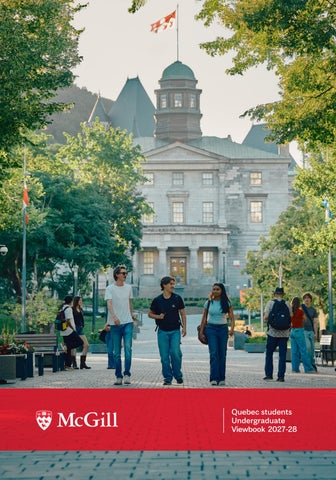
Quebec students Undergraduate Viewbook 2027-28
be ambitious here McGill University is a place to explore who you are and discover who you want to become.
You’ll be challenged to take risks and seek out opportunities. To test your limits, and set new ones. Surrounded by students with the drive, passion and talent to make the world a better place. Working with professors who want to mentor and exchange ideas, all while driving progress in their fields.
149
#1
#30
Rhodes Scholarships have been awarded to McGill students
in Canada among research universities for 20+ years1
globally in the QS World University Rankings2
1
2
Our community has made us one of the world’s top-ranked universities for more than 200 years. With 325,000 alumni in 180+ countries and a research network that spans the globe, McGill will expand your world and help you create a path that’s true to you.
Maclean’s University Ranking, 2026 2 QS World University Rankings, 2027
city and campuses
career and purpose
community and support
faculties and programs
the essentials
Milan (Quebec) Cultural Studies & Music Entrepreneurship ’27
mcgill.ca/undergraduate-admissions
3
Credit © @jfsavaria Tourisme Montréal
your story, shaped here Montréal is a city fuelled by creativity, diversity and unforgettable experiences. Around 200,000 students choose Montréal each year for its open, welcoming community and its limitless potential for opportunity and adventure.
#1
5000+
100+
student city in Canada 1
restaurants to discover
festivals to explore each year
1
4
QS Best Student Cities, 2027
city and campuses
career and purpose
community and support
faculties and programs
the essentials
Credit © Stéphan Poulin Tourisme Montréal
Experience the world here
Choose your own adventure
Montréal is a vibrant, creative city that attracts people from across Quebec and around the world. It’s a place where familiar Quebecois staples like casse-croûtes and dépanneurs meet global influences, from international cuisines to cultural festivals. Living here, you can experience the world without leaving Quebec. French is the everyday language in Montréal, but many residents speak two or more languages. It’s the perfect place to strengthen your language skills in a welcoming, multicultural setting.
100+ festivals, energetic nightlife and a lively arts and culture scene make our city truly unique. Montréal is filled with colourful neighbourhoods, vibrant murals, and hundreds of cafes, restaurants and museums to explore. Being such a creative city, Montréal is also a hub for innovation. We attract startups, multinational corporations and respected research centres working in AI, technology and creative industries, among others. There are endless opportunities for growth and adventure, and something new around every corner.
Land acknowledgment McGill University is on land which has long served as a site of meeting and exchange amongst Indigenous peoples, including the Haudenosaunee and Anishinabeg nations. We acknowledge and thank the diverse Indigenous peoples whose presence marks this territory on which peoples of the world now gather.
mcgill.ca/undergraduate-admissions
5
our campuses McGill is home to two campuses in Montréal and one in Gatineau. Across our campuses, you’ll find vibrant student communities, cutting-edge research facilities and exceptional biodiversity.
6
1,600+
1,200
5
hectares of land across campuses
species observed on campus
research stations in Quebec and internationally
city and campuses
career and purpose
community and support
faculties and programs
the essentials
Downtown Campus
Macdonald Campus
McGill’s Downtown Campus is in the heart of Montréal, steps away from the city’s best cafes, restaurants, festivals and nightlife. Our walkways, lined with towering trees and lush gardens, connect McGill’s 100+ historic buildings — each with a unique architectural style. Inside, you’ll find modern facilities and quiet study spots to explore, including McGill’s 13 libraries. The stunning Mount Royal Park sits at the top of campus, with miles of forested trails to hike, bike and even cross-country ski in winter.
Macdonald Campus is the largest green space on the Island of Montréal, and home to McGill’s Faculty of Agricultural & Environmental Sciences. Hi-tech labs, greenhouses and more than 650 hectares of field, forest and riverfront make “Mac” the perfect campus for hands-on learning in environmental studies, agriculture, food sciences and bioresource engineering. Students love the sense of community and access to nature that Mac offers. A free shuttle bus runs between McGill’s two Montréal campuses, located about 40 minutes apart.
Campus Outaouais Students interested in becoming physicians can complete their four-year undergraduate medical education in French at McGill’s Campus Outaouais in Gatineau. The campus sits within a network of affiliated medical facilities and offers a tight-knit community with a small cohort of students.
Explore our campuses
mcgill.ca/undergraduate-admissions/visit
7
a degree that can take you anywhere With 325,000 alumni living and working in 180+ countries, McGill University offers degrees that are recognized and valued worldwide.
Be inspired to aim high
Blaze your own trail
McGill has some of the highest entering averages in Canada, which makes our campuses full of remarkably smart and driven students. Many go on to teach and conduct research at prestigious universities, launch business ventures or take on leadership roles in commercial, non-profit or governmental organizations around the world. Part of this success stems from the internship, research and entrepreneurial experiences they take advantage of here.
We can provide the support and mentorship you need to take great ideas from the lab or classroom into the real world. Our undergraduates have a strong track record of producing successful startup companies. Many benefitted from the award-winning business incubators on campus. This is a place to take risks and build confidence. Every opportunity you seize is a learning experience and a step towards becoming a leader.
92%
#31
#1
of alumni working or studying 6 months after graduation1
worldwide for graduate employability2
university in Canada for producing CEOs3
1
8
McGill Destination Survey, 2025, 2 Times Higher Education, 2026, 3 Immerse Education, 2026
city and campuses
career and purpose
community and support
faculties and programs
the essentials
When you’re around people at McGill, you feel like you want to do better for yourself. I had the chance to launch a women's health startup through McGill's tech accelerator program and work directly with angel investors. Now, as president of McGill's BioDesign team, I'm working with 200 students to build real-world health solutions. These different parts of McGill — clubs, accelerators and networks — shaped my journey and taught me to go after what I’m interested in.
Tanjin (Montréal) Bioengineering ’27
mcgill.ca/undergraduate-admissions/why-mcgill
9
find the work that drives you forward
10
Get involved with research
Explore real-world learning
Your professors at McGill are world experts, shaping the fields you study every day. They can also be your mentors. There are thousands of research projects happening across McGill and many undergraduates work in labs, even in the first year of their degree. Ask to join a professor’s research project. You might co-author a paper in a prominent publication, or discover an area of research that you'll want to pursue beyond your undergraduate degree. It’s an exciting way to build skills and gain paid work experience.
Many McGill students pursue paid internship and fieldwork experiences off campus. Your Faculty advisors can help you explore options and secure awards if you find an opportunity that is unpaid or requires travel. Some students do internships in Montréal or their hometown over the summer, while others join McGill's fieldwork courses in Panama, Barbados or East Africa. You can also take a French Immersion program to explore Quebec’s language and culture outside of Montréal.
11
1,677
10,000+
Nobel Prizes have been awarded to McGillians
tenure & tenure-stream faculty
research papers published each year
city and campuses
career and purpose
community and support
faculties and programs
the essentials
I reached out to professors, looking for research opportunities, and got a lab position doing tech work on a parasite. It’s something I would definitely recommend. It’s great talking to Master’s and PhD students about their research and getting honest feedback. Being familiar with a scientific environment makes you feel comfortable working in different labs — I know I’ll use the knowledge and skills I gained in a different context.
Au-Co (France) Life Sciences ’26
mcgill.ca/undergraduate-admissions
11
there’s a place for you here McGill’s community of 40,500 students is incredibly diverse. Around 50% are from Quebec, and 30% are international students coming from 150 countries. Support from day one
Live and share your culture
McGill offers support to help you navigate each step of your university journey. From choosing the right courses based on your career goals and interests, to finding peer mentors, accessibility and language support throughout your degree — our community will be here to guide you.
McGill has spaces where you can connect with others who share your culture, experiences and traditions. First Peoples’ House provides support and a welcoming space for Indigenous students. You can also get involved with organizations like the Black Students’ Network, Queer McGill or one of McGill’s 45+ cultural and religious clubs.
Submit work in English or French All McGill students have the option to complete assignments and exams in English or French. If you’d like to improve your language skills, McGill offers tutorial services, courses and workshops for French and English language learners. You can also participate in a peer mentorship program to build your network on campus and get guidance from upper-year students.
12
city and campuses
career and purpose
community and support
faculties and programs
the essentials
You’ll be in spaces where people want your opinion because you’re a minority and they want to understand your experiences. There’s a genuine effort on campus to make us feel like we’re making a difference, and that there are dedicated spaces for us.
Orlane (Montréal) VP Finance - Black Students’ Network International Development Studies ’26
mcgill.ca/eln/find/opportunities
13
14
Clubs, associations and something for everyone
Experience the “best place in the world”
McGill students are known for “hustling 24/7” and that extends to social life and extracurriculars. Faculty societies and clubs help students gather around common interests and put on special events for the broader community. From nature hikes and excursions, to theatre productions, fashion shows, cultural events and even language classes — you'll get to meet people with all kinds of interests, share your own passions and discover new ones.
OAP is a campus tradition you won’t find anywhere else. This multiday music festival happens twice a year on McGill’s lower campus. Started in 1987 by McGill’s Engineering Undergraduate Society and known as the “best place in the world,” OAP features a BBQ and live performances by McGill students. This is just one example of the incredibly creative initiatives our students bring to life on campus.
250+
30+
20
student-run clubs, services and groups
pick-up sports, intramurals and student-led sports clubs
cafes and dining halls on campus
city and campuses
career and purpose
community and support
faculties and programs
the essentials
The McGill experience is really driven by students. We put on social events like OAP and frosh and there are niche events and clubs that you won’t find at other universities, since you have people coming from such different backgrounds. Your time at McGill is really what you make of it, there's so much to do.
Pearce-Tai (Pennsylvania, US) Cognitive Science & Psychology ’27
mcgill.ca/engage
15
building your degree At McGill, you can build a degree that prepares you for a specialized career, or allows you to explore interests and find your path. All bachelor’s degrees include a main area of study with core courses and may include a secondary area of study. Main area of study Major, Honours, Concentration or Specialization
CEGEP credits*
30
credits
up to
122
up to
credits
36
credits Secondary area of study Minor and/or electives
*Most CEGEP students will begin their program with advanced standing credits and can complete their degree in 3 years.
16
city and campuses
career and purpose
Learn more about building your McGill degree
community and support
faculties and programs
the essentials
This guide will help you understand the academic terminology used at McGill.
Bachelor’s degree: An undergraduate degree that normally takes 3 to 4 full-time years of study to complete, depending on the student’s previous education system. Once a student obtains their Bachelor’s degree, they are then eligible to apply to graduate-level programs (such as a Master’s degree). Competitive Admissions Process: Admission to McGill University is competitive and students who present the minimum requirements are not guaranteed acceptance. Admission is always subject to the availability of places in a particular program. Credits: Each course taken is assessed on the basis of a certain number of credits. Most halfyear courses are worth 3 credits and full-year courses are worth 6 credits. A full course load for the September to December and January to April terms is usually 5 courses each term. At 3 credits each, this amounts to 30 credits in total. To be considered full-time, students must take a minimum of 12 credits per term. Faculty: Students at McGill are part of a Faculty, such as the Faculty of Arts or the Faculty of Engineering. There are 11 faculties at McGill, each headed by a Dean. Faculties are divided into departments and schools: • Departments are devoted to a particular area of study, such as the Department of Philosophy or the Department of Chemistry.
Major: A Major is a student’s primary area of study. For example, a student could be pursuing a Bachelor of Science degree with a Major in Biology. Minor: As opposed to a Major, an area of secondary Concentration is called a Minor. Some Faculties also offer a Concentration or Specialization within a Bachelor degree program: For example, a Concentration in International Business within the Bachelor of Commerce (B.Com.) degree. Term: A McGill academic year is made up of three terms: fall (September to December), winter (January to April) and summer (May to August). Most programs do not require students to register for the summer term. U1 Level–University Year 1: Most CEGEP students will enter this level after completing a CEGEP 2-year DEC in Québec. Students entering McGill with 24 or more advancedstanding credits may also begin their studies as a U1 student. All other students will enter the U1 year following completion of their program’s U0 (freshman) year requirements. Undergraduate: An undergraduate student is working towards the completion of a Bachelor’s degree or a program that leads to a Bachelor’s degree.
• Schools, like the School of Architecture or the School of Nursing, are part of a Faculty, but offer more intense, specialized programs usually leading to a professional career.
Search for your program
mcgill.ca/undergraduate-admissions/programs
17
FACULTY OF
agricultural & environmental sciences McGill’s Macdonald Campus — home to the Faculty of Agricultural & Environmental Sciences — is the ideal place for hands-on learning in sustainability, science and innovation. Gain the skills and knowledge to address challenges like food security, climate change and global health.
Bachelor of Science in Agricultural and Environmental Sciences B.Sc.(Ag.Env.Sc.)
Sustainable Agricultural Systems
Agricultural Economics
• Livestock
• Agribusiness • Environmental Economics • Professional Agrology
Environmental Biology • Applied Ecology • Plant Biology • Wildlife Biology
Life Sciences (Biological & Agricultural) • Animal Biology and Health • Life Sciences
(Multidisciplinary) • Microbiology and Molecular
Bachelor of Science in Food Science (B.Sc.(F.Sc.))
• Field Crops and
Horticulture
• Food Science (options in
• Global Food Security
Food Science, Food Chemistry)
Bachelor of Science in Nutritional Sciences (B.Sc.(Nutr.Sc.))
Environment • Biodiversity and
Conservation • Ecological Determinants
• Dietetics
of Health • Environmetrics • Food Production & Environment • Land Surface Processes and Environmental Change • Renewable Resource Management • Water Environments and Ecosystems
• Nutrition (concentrations
in Food Function & Safety, Global Nutrition, Metabolism, Health and Disease, Sports Nutrition)
Biotechnology • Plant Biology
18
city and campuses
career and purpose
community and support
faculties and programs
the essentials
1,200+
13
$250K+
undergraduate students
research units
scholarships & awards
Concurrent Bachelor of Science in Food Science (B.Sc.(F.Sc.)) and Bachelor of Science in Nutritional Sciences (B.Sc.(Nutr.Sc.)) • Food Science & Nutritional
Sciences
Streams: • Bio-Environmental Engineering • Bio-Process Engineering • Bio-Production Engineering
Programs available as minors only: • Agricultural Engineering • Ecological Engineering
Bachelor of Engineering in Bioresource Engineering (B.Eng.(Bioresource)) • Bioresource Engineering
• Environmental Engineering
Hands-on learning opportunities: • Field courses and field
study semesters overseas (Africa, Barbados, Panama) • Industry internships with top employers around the world • Research opportunities with renowned faculty
• Food Process Engineering • International Agriculture • One Health
• Bioresource Engineering
— Professional Agrology
These symbols next to a major mean it is offered in more than one degree. Arts
B.A. & Sc.
Engineering
Management
Science
mcgill.ca/macdonald
19
FACULTY OF
arts
As the hub of McGill’s social sciences and humanities programs, the Faculty of Arts is where you’ll learn to engage in thoughtful debate, craft innovative solutions and express your ideas with clarity and impact.
Programs denoted with a Red + are offered to B.A. students by other faculties (eg. Faculty of Education, Faculty of Management, Faculty of Science). To earn a B.A., one of the academic disciplines you choose must be offered by the Faculty of Arts. To complete a Bachelor of Arts degree at McGill, you must generally complete at least two academic program components in different academic disciplines, or a Faculty Program. At least one of the academic program components must be a program offered by the Faculty of Arts.
Bachelor of Arts (B.A.) Accounting
• African Studies • Anthropology • Art History • Canadian Studies • Classics Computer Science
• East Asian Studies • Economics • English: Cultural Studies
20
city and campuses
• English: Drama & Theatre
• Religious Studies
• English: Literature Environment Finance
• Gender, Sexuality, Feminist
& Social Justice Studies Geography Geography: Urban Studies
• German Studies
Programs available as minors only:
• Hispanic Studies • History
• Arabic Language
• International Development
Behavioural Science
Studies
Cognitive Science
• Italian Studies
• Communication Studies
• Jewish Studies • Langue et littérature françaises
– Études et pratiques littéraires • Langue et littérature françaises – Traduction • Latin American & Caribbean Studies • Liberal Arts • Linguistics Mathematics • Philosophy • Political Science Psychology
career and purpose
community and support
(see also Bachelor of Theology) • Russian • Sociology Software Engineering Statistics • World Islamic & Middle East Studies
Computer Science,
Supplementary • East Asian Cultural Studies • East Asian Language
& Literature • East Asian Language,
Supplementary Education for Arts Students Educational Psychology Entrepreneurship for
non-Management students • European Literature & Culture
faculties and programs
the essentials
8,000+
300+
150+
undergraduate students
faculty members
in-course scholarships & awards
Field Studies
Bachelor of Social Work (B.S.W.)
Hands-on learning opportunities:
• German Language GIS & Remote Sensing Health Geography
• History & Philosophy of
Science • Indigenous Studies • Langue et littérature
françaises – Langue française Management Mathematics, Supplementary
• Medieval Studies • Persian Language • Quebec Studies and
Community-Engaged Learning • Russian Culture
Applicants from high school are not eligible to apply directly to the B.S.W. but must select the Freshman/Foundation Year program on their application form. Following their Freshman/ Foundation year, they are eligible to apply to transfer to Social Work.
• Research Assistantships • Summer research internships
• Theology
• South Asian Studies
• New: Bachelor of Arts (B.A.) -
• Turkish Language
(Africa, Barbados, Panama) • Internships
Bachelor of Theology (B.Th.) School of Population and Global Health
Statistics, Supplementary
• Field study semesters abroad
• Social Work
• Social Studies of Medicine
Science for Arts students
• Field courses
Faculty Program in Population and Global Health
• Urdu Language • World Cinemas
These symbols next to a major mean it is offered in more than one degree. Agricultural & Environmental Sciences
B.A. & Sc.
Engineering
Management
Science
mcgill.ca/arts
21
SCHOOL OF
computer science Computer science helps us understand and shape the digital world we live in—from AI and climate modeling to healthcare and game design. Studying it will teach you how to solve complex problems and develop technology that can change lives.
PROGRAMS OFFERED IN:
• Statistics & Computer Science • Computer Science & Biology
Faculty of Arts: • Computer Science • Software Engineering
• Physics & Computer Science • Minor Concentration in
Science • Supplementary Minor
Concentration in Computer Science
Faculty of Science: • Computer Science • Computer Science
- Artificial Intelligence • Computer Science
– Computer Games • Software Engineering • Mathematics & Computer
Science
22
city and campuses
• Independent Studies in
Computer Science
Computer Science
• Minor Concentration Computer
Hands-on learning opportunities: • Industrial Practicum (IP) • Internships
Bachelor of Arts and Science (B.A. & Sc.):
• Internship Year in Science (IYS)
(B.Sc. only)
• Computer Science
• Research Assistantships
• Software Engineering
• Summer research project
• Minor Concentration in
Computer Science The Faculty of Engineering’s Department of Electrical and Computer Engineering offers a Bachelor of Engineering (B.Eng.) in Computer Engineering and Bachelor of Engineering (B.Eng.) in Software Engineering (Co-op).
career and purpose
community and support
faculties and programs
the essentials
50+
3
11
years of visionary thinking
paths to study computer science (B.A., B.Sc. or B.A. & Sc.)
research areas
cs.mcgill.ca
23
FACULTY OF
education Curious about the power of education to shape lives and communities? At the Faculty of Education, you’ll explore how learning transforms people and society, while gaining the skills needed to make a real impact in the classroom and beyond.
Bachelor of Arts • B.A.(Education); Education in
Global Contexts
Bachelor of Education (B.Ed.) • Kindergarten & Elementary
Education • Kindergarten & Elementary
Education - First Nations & Inuit Studies • Kindergarten & Elementary Education - Jewish Studies • Kindergarten & Elementary Education - Pédagogie de l’immersion française • Physical & Health Education • Secondary Education: English
24
city and campuses
• Secondary Education:
Mathematics • Secondary Education: Science & Technology • Secondary Education: Social Sciences • Teaching English as a Second Language (TESL) • Teaching English as a Second Language (TESL) – Greek Language & Culture
Hands-on learning opportunities: • Field experiences/
Student teaching • Internships
(B.A.(Education))
Bachelor of Science in Kinesiology (B.Sc. (Kinesiology)) • Kinesiology
Students in Kinesiology can take a Minor in Entrepreneurship for non-Management students.
career and purpose
community and support
faculties and programs
the essentials
1,600+
3
13
undergraduate students
degrees offered (B.A., B.Ed., B.Sc.)
teacher certification programs
mcgill.ca/education
25
FACULTY OF
engineering Whether you’re passionate about building sustainable cities, designing cutting-edge tech or creating solutions to today’s biggest challenges, the Faculty of Engineering gives you the tools, mentorship and hands-on experience to achieve your professional goals.
Bachelor of Engineering (B.Eng.)
Bachelor of Science in Architecture (B.Sc.(Arch.))
• Bioengineering
• Architecture (Pre-professional)
• Chemical Engineering • Civil Engineering • Computer Engineering • Electrical Engineering • Materials Engineering (Co-op) • Mechanical Engineering • Mining Engineering (Co-op) • Software Engineering (Co-op)
Interested in Bioresource Engineering? See Faculty of Agricultural & Environmental Sciences.
Programs available as minors: • Aerospace Engineering • Applied Artificial Intelligence • Arts • Biomedical Engineering • Biotechnology • Chemistry
Hands-on learning opportunities: • Co-op programs in Mining,
Materials and Software Engineering • Engineering Internship Program (EIP) • Field courses • Summer Undergraduate Research in Engineering program (SURE)
• Computer Science • Construction Engineering
& Management • Economics • Environment
Bachelor of Global Engineering (B.G.E.) • Global Engineering
• Environmental Engineering • Management • Materials Engineering • Mathematics • Mining Engineering • Nanotechnology • Physics • Software Engineering • Technological
Entrepreneurship
26
city and campuses
career and purpose
community and support
faculties and programs
the essentials
3,600+
300+
173+
undergraduate students
placements through the Engineering Internship Program
in-course scholarships & awards
mcgill.ca/engineering
27
BIELER SCHOOL OF
environment The Bieler School of Environment is a joint initiative of the Faculties of Arts, Science and Agricultural and Environmental Sciences. You’ll explore both the social and natural sciences, building a strong foundation to help you understand and solve the environmental challenges we face today.
Faculty of Agricultural and Environmental Sciences (B.Sc.(Ag.Env.Sc.))
Faculty of Science (B.Sc.)
Major in Environment Concentrations:
• Atmospheric Environment
• Biodiversity & Conservation
• Biodiversity & Conservation
• Ecological Determinants
of Health • Environmetrics • Food Production & Environment • Land Surface Processes
& Environmental Change • Renewable Resource
Management • Water Environments & Ecosystems
Faculty of Arts (B.A.) Faculty Program in Environment Concentrations: • Ecological Determinants
of Health in Society • Economics & the Earth's Environment • Environment & Development
28
city and campuses
Major in Environment Concentrations:
For students majoring in an area other than Environment.
& Air Quality • Earth Sciences & Economics • Ecological Determinants
of Health in Society • Environmetrics • Food Production & Environment • Land Surface Processes & Environmental Change • Renewable Resource Management • Water Environments & Ecosystems
Minor (or Minor Concentration) in Environment
Hands-on learning opportunities: • 401 research projects • Bieler Undergraduate Research
Award projects (BURA) • Field courses • Field study semesters abroad
(Africa, Barbados, Panama) • Internships • Research Assistantships
Bachelor of Arts & Science (B.A. & Sc.): • Interfaculty Program ‒
Environment
• Interfaculty Program ‒
career and purpose
Sustainability, Science & Society
community and support
faculties and programs
the essentials
2
53
$150K+
campuses
faculty and associate members
in undergraduate student awards
mcgill.ca/environment
29
DESAUTELS FACULTY OF
management Gain the real-world experience and problem-solving skills you’ll need in the Desautels Faculty of Management — one of the world’s leading international business schools. You’ll be encouraged to think creatively, work collaboratively and grow as an individual.
Bachelor of Commerce (B.Com.) • Accounting • Business Analytics • Economics • Finance • General Management
(with concentrations in Accounting, Business Analytics, Entrepreneurship, Ethics, Finance, Information Technology Management, Human Resources Management, International Business, Leadership and People Management, Managing for Sustainability, Marketing, Operations Management, Retail Management, Strategic Management – Global Strategy, Strategic Management – Social Business & Enterprise)
Hands-on learning opportunities:
• Information Technology
Management • International Management • Managing for Sustainability • Marketing • Mathematics and Statistics for Management • Organizational Behaviour and Human Resources Management • Retail Management • Strategic Management
• Directed Experiential Learning
Practicum • Experiential learning courses • Integrated Management
Student Fellowship (IMSF) • Internships • Study Trips • Summer Internship in
Management
Programs available as Honours only: • Investment Management
The minor programs offered in the Faculties of Arts & Science may be taken in conjunction with any B.Com. program, unless otherwise indicated.
These symbols next to a major mean it is offered in more than one degree. Agricultural & Environmental Sciences
30
city and campuses
career and purpose
Arts
B.A & Sc.
community and support
Engineering
Science
faculties and programs
the essentials
6
Top 20
32,000
research centres
universities worldwide for producing female founders1
successful alumni around the globe
Immerse Education, 2026
1
mcgill.ca/desautels
31
SCHULICH SCHOOL OF
music
With 200+ professors, numerous ensembles and performance opportunities, and state-of-the-art facilities, you’ll experience the highest international standards of excellence in musical training.
Bachelor of Music (B.Mus.) • Composition • Music History/Musicology • Music Studies • Music Theory • Early Music (Instruments) • Early Music (Voice) • Jazz (Instruments and Voice) • Orchestral Instruments (Brass,
• Conducting • Music Applied Performance
Sciences • Music Entrepreneurship • Music Pedagogy • Music Science and Technology • Musical Applications of Technology
• Organ/Guitar
Minors available to students in other faculties:
• Piano
• Conducting
• Voice
• Music Composition
Percussion, Strings, Woodwinds)
Licentiate in Music: • Early Music • Jazz (Instruments and Voice) • Orchestral Instruments (Brass,
Percussion, Strings, Woodwinds) • Organ/Guitar • Piano • Voice
32
Hands-on learning opportunities:
Programs available as minors only:
city and campuses
• Ensembles • Internships • Research Assistantships
• Music Entrepreneurship • Music History • Music Pedagogy • Musical Science & Technology • Music Theory
For information on applying to Bachelor of Music programs, see mcgill.ca/music/admissions/ undergraduate.
career and purpose
community and support
faculties and programs
the essentials
450+
200+
700+
undergraduate students
faculty members
concerts and events annually
mcgill.ca/music
33
INGRAM SCHOOL OF
nursing
Our innovative courses will help you develop fundamental nursing expertise, opening the door to a variety of exciting career opportunities.
Bachelor of Science (Nursing) (B.Sc.(N)) • Nursing
Hands-on learning opportunities: • Clinical studies/learning
Bachelor of Nursing (Integrated) (BNI)
activities • Satoko Shibata Clinical Nursing
Learning Laboratories
SCHOOL OF
physical & occupational therapy Gain a solid health sciences foundation with undergraduate level courses that prepare you for a professional program in the field of rehabilitation sciences.
Bachelor of Science (Rehabilitation Science) (B.Sc.(RehabSc)) Applicants from high school are not eligible to apply directly. • Occupational Therapy • Physical Therapy
Hands-on learning opportunities: • HELP program • Innovative course activities:
Simulation Centre • Occupational Therapy
Mentoring Program • Fieldwork/Clinical placement
(M1, M2 years)
34
city and campuses
career and purpose
community and support
faculties and programs
the essentials
800+
100+
undergraduate students
years of nursing education
200+
75+
undergraduate students
years of innovation and leadership
mcgill.ca/nursing | mcgill.ca/spot
35
FACULTY OF
science You can benefit from flexible degree structures, fieldstudy semesters, internships and early access to research experiences in the Faculty of Science. Our programs prioritize interdisciplinary, hands-on learning that prepares you for today’s interconnected scientific world.
Bachelor of Science (B.Sc.) Biological, Biomedical & Life Sciences group: • Anatomy & Cell Biology • Biochemistry • Biology • Microbiology & Immunology • Pharmacology • Physiology • Psychology
Bio-Physical-Computational Sciences group: • Biology & Mathematics • Computer Science & Biology • Physiology & Mathematics • Physiology & Physics
(Inter-departmental) • Environment • Geography • Geology • Mathematics • Mathematics & Computer Science • Planetary Sciences • Physics • Physics & Geophysics • Software Engineering • Statistics • Statistics & Computer Science Neuroscience group: Applicants from high school are not eligible to apply directly.
Programs available as Honours only:
• Atmospheric & Oceanic Sciences
• Applied Mathematics
• Atmospheric Science
& Physics • Chemistry • Computer Science • Earth & Planetary Sciences
city and campuses
• Cognitive Science • Data Science • Field Studies • General Science (note: only
available to B.Sc. Liberal students) • Geochemistry • GIS & Remote Sensing • Interdisciplinary Life Sciences • Natural History
Minors in other faculties open to B.Sc. students: • Chemical Engineering
(for Chemistry majors only)
(for Physics majors only) • Entrepreneurship for Science
Students • Kinesiology for Science
• Mathematics & Physics
(apply for either Mathematics or Physics) • Physics & Chemistry (apply for either Physics or Chemistry) • Planetary Sciences • Probability & Statistics
community and support
• Biotechnology
• Electrical Engineering
• Immunology
career and purpose
Science programs available as minors only:
• Education
• Neuroscience
Physical, Earth, Math & Computer Science group: • Atmospheric Science
36
• Earth System Science
Students • Management
faculties and programs
the essentials
5,000+
45+
125+
undergraduate students
programs of study
in-course scholarships & awards
Bachelor of Arts & Science (B.A. & Sc.)
• Mathematics
• Italian Studies
• Physics
• Jewish Studies
• Psychology
• Langue et littérature françaises :
One degree jointly offered by the Faculty of Arts and the Faculty of Science. In this interdisciplinary degree you’ll have a unique opportunity to achieve a diverse knowledge base, to gain competence in different methodologies, to hone your intellectual flexibility, and to integrate material across disciplines. Students in this degree complete an Interfaculty program or the multi-track option. Interfaculty programs • Cognitive Science • Environment • Sustainability, Science
& Society
Études et pratiques littéraires
• Software Engineering • Statistics
• Langue et littérature
Multi-track option Arts areas of study
• Latin American & Caribbean
Most (but not all) areas of study listed under the Faculty of Arts may be primary areas of study for the Arts component.
• Linguistics
françaises : Traduction
• African Studies
Studies • Philosophy • Political Science • Religious Studies • Russian
• Anthropology
• Sociology
• Art History
• World Islamic & Middle East
• Classics
Studies
• East Asian Studies • Economics
Hands-on learning opportunities:
• English • Gender, Sexuality, Feminist
& Social Justice Studies
Multi-track option Science areas of study
• Geography
• Biology
• Geography (Urban Studies)
• Chemistry
• German Studies
• Industrial Practicum (IP)
• Computer Science
• Hispanic Studies
• Internships/Internship Year
• Geography: Physical Geography
• History
Option
• Field courses • Field study semesters abroad
(Africa, Barbados, Panama)
in Science (IYS)
• International Development Studies
• Research Assistantships
These symbols next to a major mean it is offered in more than one degree. Agricultural & Environmental Sciences
Arts
B.A. & Sc.
Engineering
Management
Science
mcgill.ca/science
37
what will it cost? Reviewing the breakdown of your budget will help you better plan your finances while at McGill.
Understanding your costs
How does our tuition compare?
The chart below can help you estimate your cost
McGill offers Quebec residents a world-class
of attendance based on past years. Tuition fees
education at a tuition rate comparable to
for the entering class of 2027 will be published
other Quebec universities.
on McGill’s Student Accounts website.
Approximate annual cost of attendance (entering class of 2026): QUEBEC RESIDENT* CANADIAN
INTERNATIONAL
Tuition and Fees
$5,294.91 – $9,627.07
$15,153.17 – $19,101.21
$38,733.77 – $75,321.21
Course materials and supplies (estimate)
$1,000
$1,000
$1,000
On-campus Housing (Optional)
$5,239 – $15,210
$5,239 – $15,210
$5,239 – $15,210
Meal plan
$6,650
$6,650
$6,650
Health Insurance + Dental Plan (M) = Mandatory
$345
$345
$1,155 (M)
Prices in Canadian dollars *Consult mcgill.ca/legaldocuments/quebec
General tuition & fees information
38
city and campuses
career and purpose
community and support
faculties and programs
the essentials
Scholarships and financial aid
Special funding options
Students of all citizenships can be
McGill offers awards for equity-deserving
considered for merit- and need-based
groups, including students who are
financial aid. Newly accepted first-year,
Indigenous, living with disabilities, children
first-degree students may be eligible
of war veterans or have been youth in care,
for the support below.
among others.
MERIT-BASED SCHOLARSHIPS This program, for high school and CEGEP students, is based on academic excellence. One year scholarship
Major scholarship
Awarded solely on the basis of academic achievement.
Awarded on the basis of academic achievement and outstanding leadership.
$3,000, non-renewable.
$3,000, $5,000, $10,000 or $12,000, renewable.
Applicants are automatically considered, no separate application is required.
A separate application is required soon after you submit an application for admission. Explore the deadlines on McGill’s Scholarships and Student Aid website.
NEED-BASED AID Entrance bursaries: Our need-based Entrance Bursary Program supports students from low-tomodest income families who may not otherwise be able to accept their offer of admission. Entrance bursaries range in value and award amounts are determined by: z The level of need demonstrated by the student and their family, relative to other applicants; z The tuition fee rate charged based on the program of study and student residency (Quebec, rest of Canada, US, International); z Other information provided in our confidential application. The Entrance Bursary application is available once you have an offer of admission. It’s recommended you apply within 30 days as decisions are made on a rolling basis. McGill financial aid: Our program of in-course bursaries and loans is designed to help current full-time degree students facing financial challenges. The program supplements existing financial resources (including government aid and/or Indigenous Band Support Funding, part-time work, parental support and/or other sources of funding).
Scholarships and Student Aid information
mcgill.ca/undergraduate-admissions
39
can I do an internship? Our internships and co-op programs help you apply what you’ve learned in the classroom to a professional setting. Build on-the-job skills, make connections with employers and get paid for your work. Some internships even count for course credit!
What’s the difference?
What are the benefits?
Internships and co-ops are both short-term, hands-on, supervised work experiences at a professional organization. Review the table below to discover the subtle differences between them.
Enhances academic and professional development: skill development (hard and soft skills), earnings, mentorship, resume building, networking opportunities, increased employability
Is participation mandatory?
40
INTERNSHIP
CO-OP
No
Yes
Impact on program Usually shorter in duration, commonly duration taking place over the summer, or during one academic term. Students may complete more than one internship
Typically involves alternating periods of full-time work and fulltime study. May extend the time it takes to graduate by up to one year. May affect ability to participate fully in athletics or extracurriculars
Paid or unpaid
Usually paid or remunerated via internship awards
Typically paid
Structure
Flexible and varied in structure. Offers Structured as part of a formal co-op the chance to explore different career program, offering an integrated paths in a short amount of time work-study experience and in-depth exposure to a given industry
Support
Support via faculty internship offices Support via co-op advisors and university’s career planning services
city and campuses
career and purpose
community and support
faculties and programs
the essentials
where can I go on exchange? McGill partners with more than 150 universities in 40+ countries around the world. We offer non-repayable awards and bursaries to offset the cost of studying abroad and make international learning experiences accessible for all students.
STUDY ABROAD PARTNER LOCATIONS Americas:
• Argentina
• Canada
• Chile
• Mexico
• Brazil
• Caribbean
• Colombia
• USA
• China
• Japan
• Malaysia
• Taiwan
• Hong Kong SAR
• Korea
• Singapore
• Thailand
Middle East:
• Israel
• Lebanon
• Türkiye
Oceania:
• Australia
• New Zealand
Europe:
• Austria
• France
• Italy
• Russia
• Belgium
• Germany
• Netherlands
• Spain
• Czech Republic
• Hungary
• Norway
• Sweden
• Denmark
• Iceland
• Poland
• Switzerland
• Finland
• Ireland
• Portugal
• United Kingdom
Asia:
Hands-on learning
mcgill.ca/undergraduate-admissions
41
choosing where to live Montréal offers safe and affordable housing options, whether you plan to live on or off campus.
Living in residence
Housing options
All first-year students are guaranteed a place in residence if they apply for it. McGill’s residences offer a respectful and supportive living community where you can flourish personally, socially and academically. Many students from Quebec choose to live in residence for their first year to ease into university life and make friends, just steps away from classes.
Our residence options include dormitorystyle (single rooms with shared bathrooms), modern dorm-style (double rooms with private bathrooms), quiet residences and budget-friendly dorms on Macdonald Campus. Montréal is one of the world's most affordable major cities with many studentfriendly neighbourhoods just a quick walk, bike or metro ride from campus.
Residence options
42
city and campuses
career and purpose
community and support
faculties and programs
the essentials
apply in 5 easy steps You can complete your application and keep track of its status online through McGill's admissions portal.
1. Decide what to study Use the program finder tool to explore over 300 undergraduate programs and find your best match.
2. Make sure you’re eligible Admission to most programs is based on your academic record only: • How your academic record is reviewed • The grades that gained entrance to
your program in previous years • The prerequisites for your program
3. Submit your application As of October 1, you can apply. Application fee: $140.16 CAD
4. Apply for an entrance scholarship or bursary Look into entrance scholarships early! The deadline is usually a week after your application deadline. The Scholarships and Student Aid website provides information about entrance scholarships, bursaries and other funding opportunities.
5. Submit documents and keep in touch You will be able to upload your documents for most programs and check the status of your application and documentation on your applicant portal. • Learn about self-reporting your grades
if you attended high school in Canada (outside of Quebec) or the U.S.A. • Verify if you are required to provide proof
of English proficiency. • Applicants to Dietetics, Nursing, Occupational
Therapy or Physical Therapy: verify proof of French proficiency requirements.
Start your application
mcgill.ca/undergraduate-admissions
43
Thanks for taking the time to learn about our university. You can connect with McGill students, hear their experiences and meet our recruiters by joining our mailing list and following us on Instagram (@mcgilladmissions).
Sign up for updates
Information updated as of July 2026