The Tribune
TUESDAY, NOVEMBER 10 2026 | VOL. 46 | ISSUE 9
Published by the SPT, a student society of McGill University
STUDENT LIFE
OFF THE BOARD
PG. 11
PG. 11
Far from junk drawers
Here’s a tip!
THETRIBUNE.CA | @THETRIBUNE.CA
FEATURE
Life and death on display PGS. 8-9
ARTS & ENTERTAINMENT
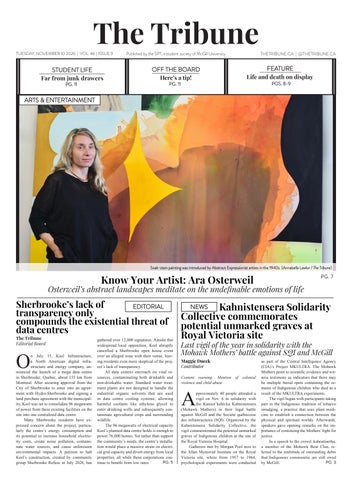
Soak-stain painting was introduced by Abstract Expressionist artists in the 1940s. (Annabella Lawlor / The Tribune) Tribune)
Know Your Artist: Ara Osterweil
PG. 7
Osterweil’s abstract landscapes meditate on the undefinable emotions of life
Sherbrooke’s lack of EDITORIAL transparency only compounds the existential threat of data centres The Tribune Editorial Board
O
n July 15, Keel Infrastructure, a North American digital infrastructure and energy company, announced the launch of a mega data centre in Sherbrooke, Quebec, about 155 km from Montreal. After securing approval from the City of Sherbrooke to enter into an agreement with Hydro-Sherbrooke and signing a land purchase agreement with the municipality, Keel was set to consolidate 96 megawatts of power from three existing facilities on the site into one centralized data centre. Many Sherbrooke residents have expressed concern about the project, particularly the centre’s energy consumption and its potential to increase household electricity costs, create noise pollution, contaminate water sources, and cause unforeseen environmental impacts. A petition to halt Keel’s construction, created by community group Sherbrooke Refuse in July 2026, has
gathered over 12,000 signatures. Amidst this widespread local opposition, Keel abruptly cancelled a Sherbrooke open house event over an alleged issue with their venue, leaving residents even more skeptical of the project’s lack of transparency. AI data centres encroach on vital resources, contaminating both drinkable and non-drinkable water. Standard water treatment plants are not designed to handle the industrial organic solvents that are used in data centre cooling systems, allowing harmful coolants like ethylene glycol to enter drinking wells and subsequently contaminate agricultural crops and surrounding wildlife. The 96 megawatts of electrical capacity Keel’s planned data centre holds is enough to power 76,000 homes. Yet rather than support the community’s needs, the centre’s installation would place a massive strain on electrical grid capacity and divert energy from local properties, all while these corporations conPG. 5 tinue to benefit from low rates.
Kahnistensera Solidarity Collective commemorates potential unmarked graves at Royal Victoria site NEWS
Last vigil of the year in solidarity with the Mohawk Mothers’ battle against SQI and McGill Maggie Dueck Contributor Content warning: Mention of colonial violence and child abuse
A
pproximately 40 people attended a vigil on Nov. 6 in solidarity with the Kanien’kehá:ka Kahnistensera (Mohawk Mothers) in their legal battle against McGill and the Société québécoise des infrastructures (SQI). Organized by the Kahnistensera Solidarity Collective, the vigil commemorated the potential unmarked graves of Indigenous children at the site of the Royal Victoria Hospital. Gatherers met by Morgan Pool next to the Allan Memorial Institute on the Royal Victoria site, where from 1957 to 1964, psychological experiments were conducted
as part of the Central Intelligence Agency (CIA)’s Project MKULTRA. The Mohawk Mothers point to scientific evidence and witness testimony as indicators that there may be multiple burial spots containing the remains of Indigenous children who died as a result of the MKULTRA experiments. The vigil began with participants taking part in the Indigenous tradition of tobacco smudging, a practice that uses plant medicine to establish a connection between the physical and spiritual worlds. Afterwards, speakers gave opening remarks on the importance of continuing the Mothers’ fight for justice. In a speech to the crowd, kahentinetha, a member of the Mohawk Bear Clan, referred to the multitude of outstanding debts that Indigenous communitie are still owed PG. 3 by McGill.
2
NEWS
news@thetribune.ca
TUESDAY, NOVEMBER 10 2026
Parc-Ex community members demand status for all in the face of rising deportations Residents and activists share testimonies of migrant experience amidst changes in Canadian legislation Helene Saleska News Editor
F
amilies, community organizers, and political leaders gathered outside of Station Parc in the Montreal neighbourhood Villeray–St.-Michel–Parc-Extension (Parc-Ex) on Nov. 7 to bring attention to rising rates of deportations within the neighbourhood and across Montreal, as well as diminishing legal avenues for migrants to stay in Canada. The demonstration comes off the heels of the implementation of Bill C-12, the Strengthening Canada’s Immigration System and Borders Act, passed in March 2026. Bill C-12 applies retroactively back to June 2020, barring refugees from making asylum claims more than a year after their first entry into Canada and prohibiting those who crossed the United States-Canada border irregularly from claiming refugee status, among other measures. The Immigration Law section of the Canadian Bar Association has labelled the bill potentially unconstitutional, in violation of the Canadian Charter of Rights and Freedoms and Canada’s commitments to accept refugees under international law. Although deportations have been on the rise for years in Canada, migrant families in Quebec have been experiencing unprecedented rates of family separation and deportation orders since the implementation of Bill C-12. In the first four months of 2026, 55 percent of all deportations in Canada happened in Quebec. In a speech at the rally, Mustafa Hinawi, an organizer with the Immigrant Workers Centre (IWC-CTI) emphasized the scale of the recent wave of deportations in Quebec, many of which are concentrated in areas like Parc-Ex. “This year, Canada has claimed its objectives of nearly 30,000 deportations,” Hinawi said. “[The government is targeting] people
who have been here for [up to ten years] even, a very long time, who are facing deportation, who are forced to live underground, who don’t have the right to permanent residence, who’ve been denied access to all of the same rights that everyone [else in Canada] has.” Joey Calugay, an activist with the IWCCTI, explained in an interview with The Tribune that the centre is responding to the needs of migrant workers in the community by launching the “Montreal Rise Up Against Deportations” campaign. “The [IWC-CTI] is a labour education and campaign centre for vulnerable immigrants and minors,” Calugay explained. “The people that [the IWC and other organizations] serve in their communities are vulnerable to the deportations, and so we had to respond by first exposing the fact that deportations are happening in Canada to [this] scale.” According to community reports, Canada Border Services Agency (CBSA) agents have been increasing their presence in vulnerable communities and using unprecedented, aggressive tactics to accelerate deportations: such as wearing plainclothes and conducting roundups at community food banks. Areas like Parc-Ex, Saint-Laurent, Côte-des-Neiges-Notre-Dame-de-Grâce, and MontréalNord have been dubbed the “corridor of vulnerability” by the Montreal Rise Up Against Deportations campaign. Calugay explained what challenges migrants in Parc-Ex are confronting, and what organizers like him have learned from being at the forefront of defending migrant families in the face of rising deportation threats. “Stories [have] started coming out [about] CBSA presence in food banks, in women’s shelters, in emergency lodgings, in places of worship, in schools, in hospitals,” he said. “All of a sudden, social workers in hospitals start calling us about the deportations that are happening here.” Rama Diallo, treasurer for the Conseil
central du Montréal métropolitain of the Confederation des syndicats nationaux (CCMM-CSN), connected migrants’ fights for status and fair working conditions to broader labour struggles in Quebec and across Canada in her speech. “All too often, [migrants] are treated as a temporary workforce, used when we think we need them and abandoned when political priorities shift, Bill C-12 gives broad powers to Immigration, Refugees and Citizenship while thousands live under Canada to cancel, suspend, or limit residency visas, including study the constant threat of de- permits for international students. (Helene Saleska / The Tribune) portation,” she said. “We plained in her speech how common this type reject this injustice. We reject closed work of family separation is becoming, and illuspermits that make workers dependent on a trated this reality of everyday life for those single employer and vulnerable to exploita- living in Montreal with precarious residency tion. We refuse to accept that a person should status. be deprived of a stable future because their “How can we expect a family to conwages are deemed insufficient or because tinue living normally when they don’t even they have lost their administrative status.”* know whether tomorrow they will still be Throughout the rally, community mem- together?” Amina asked. “These are not just bers came to the microphone to share their immigration files. These are human lives. stories and make their demands to the Ca- These are mothers, fathers, children, neighnadian government in English, French, and bours, friends, friends, and members of our Hindi. community.” Amandeep**, a resident of Parc-Ex, On behalf of the Parc-Ex community, shared that after living there for eight years, Amina ended her speech with a demand to she and her daughter were issued a depor- the Canadian and Quebec governments: End tation order and faced imminent deporta- the deportations. tion only a month ago, while her husband “Nobody should have to live in fear in and son would have to stay in Montreal. She their own neighbourhood,” Amina said. “We explained that the IWC helped her obtain a work here. We raise our children here. We deferral for her deportation, and that it was support our neighbours. We contribute to owing to the strong mobilization of the com- our society. We are not asking for a special munity that she was able to stay. She ex- treatment. We are asking for humanity, fairplained her story in Hindi, and another com- ness, and dignity. We want status for all.” munity member translated and summarized *This quote was translated from French. her story into English for the press. **Amandeep’s and Amina’s last names Amina**, another Parc-Ex resident, ex- were not published to preserve anonymity.
Recap: Democratic sweep of U.S. Congress creates potential for renewed conversations with Canada Canadians and Americans alike celebrate a “blue tsunami” across the U.S. Shea McDonnell Staff Writer
I
n a major indictment of United States President Donald Trump’s administration, Democrats won the majority in both chambers of Congress in the 2026 American midterm elections on Nov. 3, along with major takeovers of state and local elections. Many Canadians celebrated alongside Americans, particularly as Trump’s trade war with Canada has affected the cost of living for many across Canada and in Montreal. Among Canadian policy makers and academics, the “blue tsunami”—this sweeping Democratic electoral victory—is a step towards reversing U.S. democratic backsliding by restoring legislative intervention over the Republican executive branch. In an interview with The Tribune, Daniel Béland, James McGill professor in the Department of Political Science, explained the
midterm results as a welcome change. “The Democrats taking control of both the House and the Senate is good news for Canada,” Béland said. “The Trump administration will now face much more scrutiny from the legislative branch. In that sense, these results restore some of the checks and balances that have been absent in his second presidency.” Liam Halfon-DeLay, U3 Arts & Science, is an American student studying at McGill. In an interview with The Tribune, he expressed that he was energized by the surge of Democratic victories after voting in his home state of Virginia. “‘Thank God’ was my first reaction. Part of it is that swing in response [against] the authoritarianism of Trump, so people were obviously […] activated by that,” Halfon-DeLay said. “Candidates were running such good messaging. They were very clear and focused on the people and not just the corporations.”
Following the midterm elections, Quebec against unlawful moves on the part of the exPremier Paul St-Pierre Plamondon promised a ecutive branch.” diplomatic offensive against U.S. tariffs. Béland explained that the relationship between the midterms and the American impact on Canadian policy is not so straightforward. “We should not overestimate the impact of the midterms on the capacity of the Trump [administration] to keep hurting Canada and many other countries through its reckless foreign and trade policies,” Béland said. “It is the courts, rather than the new Democratic-controlled Democrat Abdul El-Sayed defeated Republican Mike Rogers in Congress, that could play the Michigan’s open Senate seat, becoming the first Muslim senator in greatest role in pushing back U.S. history. (Eliot Loose / The Tribune)
news@thetribune.ca
TUESDAY, NOVEMBER 10 2026
NEWS
3
Kahnistensera Solidarity Collective commemorates potential unmarked graves at Royal Victoria site
Last vigil of the year in solidarity with the Mohawk Mothers’ battle against SQI and McGill Maggie Dueck Contributor
was settled in 1873, the Six Nations dispute this and emphasize that the outstanding loan amounts to around $1.7 billion CAD today. kahentinetha explained that the Mohawk Mothers are more focused on determining the truth rather than receiving financial compensation. “The main thing [McGill would] like to do is give us some money and send us on our way,”
kahentinetha said. “But we don’t want money. We want this taken care of the right way [....] We Mohawk people don’t start fights we will Continued from page 1. lose. We fight to win.” In October 2022, Superior Court of QueShe discussed how in 1860, McGill borrowed bec Justice Gregory James Moore granted the $40,000 CAD from a trust fund set aside for Mohawk Mothers an interlocutory injunction to the Six Nations of Grand River Reserve. Alhalt all archeological work for approximately though McGill claims that this federal debt four months on the Royal Victoria site. In April 2023, the Mohawk Mothers, McGill, and other parties such as the SQI also reached an historic agreement to immediately begin archival and testimonial investigations as well as archaeological work analyzing the believed burial areas at the Royal Victoria site. Since these legal rulings, the Mohawk Mothers have claimed that the other parties have not respected the terms of this agreement. At the vigil, they discussed how archeologists began transporting piles of evidence which had not been properly sifted for forensic examination, damaging the chain of custody at the site. In a written statement to The Tribune, McGill’s Media Relations Office (MRO) maintained that they have respected their legal obligations. “Indigenous cultural monitors have also been invited to observe the excavation work of the project, in full respect of The Kanien’kehá:ka Nation is matrilineal, meaning that one’s kinship is passed down through their mother. the 2023 Settlement Agreement that was (Rokayah Bellaoui / The Tribune)
reached with the [Mohawk Mothers], in the context of legal proceedings initiated by them,” the MRO wrote. At the end of the vigil, the crowd was given strips of red cloth and was encouraged to tie the cloth to man-made structures surrounding the site as a reminder to visitors that there are decades of history in and on the grounds. Philippe Blouin, ally of the Mohawk Mothers and assistant professor at Saint Paul University, highlighted the importance of educating oneself in a concluding speech. Blouin alluded to Manitoba Premier Wab Kinew recently calling for the abolition of the Indian Act, highlighting the complexities of Indigenous histories. “At this point, [it’s] more than ever important that […] as many people as possible know what’s going on,” Blouin said. “The Indian Act is obviously a horrible and a racist document [....] Getting rid of the Indian Act right now accomplishes the goal of the Indian Act [as] it dissolves Indigenous status, sovereignty, [and] titles [....] It’s important to get your mind on what’s actually going on because there’s a lot of psychological warfare throughout all of this.” Addressing the crowd, Mohawk Mother kwetiio concluded the vigil by emphasizing the urgent need to uncover the truth of what happened at the Allan Memorial Institute by thoroughly investigating the site. “There’s families, there’s people that are still not resting in peace,” she said.
St-Pierre Plamondon’s absence from First Nations-First Ministers’ meeting sparks backlash from Indigenous leaders
Montreal community criticizes PQ’s supposed ‘nation-to-nation’ approach to Indigenous relations Naaman Macdonald Contributor
Q
uebec Premier and Parti Québécois (PQ) leader Paul St-Pierre Plamondon’s absence from the First NationsFirst Ministers’ meeting on Oct. 26 has sparked controversy over Quebec’s priorities regarding Indigenous communities and its partnership with the federal government. Regional Indigenous leaders, including Regional Chief Francis Verreault-Paul of the Assembly of First Nations Quebéc-Labrador (AFNQL) and the Executive Director of the Native Women’s Shelter of Montreal Na’kuset, have separately criticized StPierre Plamondon’s absence. Prime Minister Mark Carney convened this first-of-its-kind meeting, where the Assembly of First Nations (AFN) was invited to table pressing concerns over issues affecting Indigenous Peoples across Canada. Although many Indigenous leaders and activists have cast skepticism over both the legitimacy and productivity of the meeting, the AFN notably emphasized the importance of the discussion in a press release the following day. Grand Chief Cody Diabo of the Mohawk Council of Kahnawà:ke (MCK) left the First Ministers’ meeting early, dissatisfied, due to concerns over its organization and set-up. In an interview with The Tribune, Diabo expressed that he was not shocked by the Quebec Premier’s absence at the event. “Overall, [I was] not surprised [by the Pre-
mier’s absence] [....] He [has been] very vocal in terms of how he wants his relationship with his federal government,” Diabo said. Diabo criticized Quebec’s restrictive language legislation, highlighting the lack of federal government intervention in addressing provincial laws that impede Indigenous communities’ access to basic needs. “A lot of the language issues that the [Coalition Avenir Québec] government had pushed [for, despite] having no jurisdiction in the territory or [having] any force, [directly impacts] our people leaving the territory for medical assistance or education,” Diabo said. “We had reached out to the federal government at the time, and we’re still hopeful that there would be some type of intervention, but there [has been] none.” In response to backlash regarding St-Pierre Plamondon’s absence, the Quebec Minister Responsible for Relations with the First Nations and the Inuit Simon-Pierre Savard-Tremblay issued a statement on X, declaring that the PQ intends to prioritize a more direct “nation-to-nation” approach to Indigenous relations. After the First Nations-First Ministers’ meeting, St-Pierre Plamondon separately met with Verreault-Paul on Oct. 29, and with an assembly of AFNQL leaders on Nov. 5. Diabo contended that historically, provincial and federal governments meet with these bodies as a way to supplant direct engagement with Indigenous nations themselves. “Similar to [St-Pierre Plamondon’s] federal counterparts, [a more direct relationship would
need to be] done away from AFN or the regional body AFNQL. They are not representative bodies,” Diabo said. In a written statement to The Tribune, a representative from the AFNQL highlighted the need for the provincial government to consult Indigenous communities more directly. “The Government of Quebec, including […] St-Pierre Plamondon, must establish and maintain direct relationships with each First Nation,” the representative wrote. “The AFNQL is not a mediator between the Government of Quebec and First Nations, nor does its role replace the need for direct government-to-government relationships with individual First Nations governments.” In an interview with The Tribune, Daniel Béland, professor and director of the McGill Institute for the Study of Canada, discussed key tensions in light of the new Quebec government’s sovereigntist stance. He spoke to the province’s attempts to circumvent the federal government’s role in Indigenous policy-making, as reflected by St-Pierre Plamondon’s absence at the meeting. “St-Pierre Plamondon wants to develop nation-to-nation interactions with Indigenous Peoples, with First Nations in Quebec [and] avoid the [federal government] as much as possible,” Béland said. “The problem with that approach is that the federal government plays a central role in Indigenous affairs for First Nations, but also Métis and Inuit [....] [In] key cases, you need this collaboration between the three levels of govern-
In response to the PQ’s Livre bleu which outlines the party’s plan for a sovereign Quebec, the MCK has written a letter of rejection to St-Pierre Plamondon. (Zoe Lee / The Tribune) ment […] First Nations, the province, and the federal government.” Béland maintained that Quebec’s new government’s ongoing erasure of the monarchy creates tensions regarding treaties and Indigenous rights, independent of any referendum discussions. “Treaties were signed with the Crown and therefore the monarchy is part of that, and they have quite a few many Indigenous peoples and leaders who are attached to the monarchy,” Béland said. “Quebec, from a bureaucratic standpoint [will] still work with the federal government [....] The question is more about what’s happening at the top and whether there will be more coordination.”
4
NEWS
news@thetribune.ca
TUESDAY, NOVEMBER 10 2026
E.U.-Canada summit in Montreal opens door to expanding Erasmus+ and Horizon Europe
St-Pierre Plamondon’s boycott of summit reveals tensions in Quebec-Canada relations Liam Sutcliffe Contributor
O
n Oct. 29 and 30, the European Council President António Costa, the European Commission President Ursula von der Leyen, and Canadian Prime Minister Mark Carney met in Montreal. Leaders discussed Canada and the European Union (E.U.) reaching an “evercloser association” without granting Canada full E.U. membership. In a joint statement issued after the summit, both parties pledged to deepen ties on a variety of issues, including academic cooperation through the Erasmus+ programme and the E.U.’s research funding initiative, Horizon Europe. Erasmus+ is a E.U.-led youth support programme for education, training, and sport in Europe with an estimated budget of €26.2 billion. Among its priorities, the programme supports students who wish to pursue study, traineeships, or exchanges abroad. While in Montreal, von der Leyen also attended an event co-hosted by McGill’s Max Bell School of Public Policy. In a statement to The Tribune, the McGill Media Relations Office (MRO) expressed the importance of the event. “McGill was proud to co-host an event welcoming […] von der Leyen ahead of the Canada-E.U. Summit,” the MRO wrote. “It brought together decision-makers, policy experts and
academic leaders to explore opportunities for Canada-E.U. cooperation.” While the exact content of the summit is being kept private, the press team of the Delegation of the European Union to Canada confirmed with The Tribune in a written statement that permanently expanding Erasmus+ across Canada is a priority for both parties. “Canada’s full association to the Erasmus+ programme […] means negotiating and eventually adopting an association agreement, establishing an Erasmus+ national agency and national authority by Canada, and integrating Canada into our programming,” the written statement read. The press team explained that this expansion and future integration is an opportunity for Canadian universities to stay academically competitive on a global scale. “Leveraging the talent and mobility of our people will boost competitiveness and keep both Europe and Canada at the forefront of global talent circulation,” they wrote. While these negotiations are ongoing, the Delegation emphasized the Erasmus+ initiative not as an incorporation of Canada into the programme, but as an expansion of the existing E.U. partnership with Canada. “The [E.U.] and Canada already cooperate closely in education and research through the Erasmus+ programme,” the press team wrote. “Since 2021, Erasmus+ has delivered almost
7,500 student and staff exchanges [across North America], 110 Mundus Scholarships for Canadian students and 10 Jean Monnet activities involving Canada.” According to the Delegation, established initiatives such as Marie Skłodowska-Curie Actions, and other parts of Horizon Europe, like the European Research Council and Pillar II, are foundational to current and future E.U.-Canada academic cooperation efforts. Together, such initiatives provide students and researchers access to funding and resources In 2024, nearly 1.5 million people participated in Erasmus+ for joint academic ventures on both sides mobility activities. (Eliot Loose / The Tribune) of the Atlantic. In the days leading up to the Canada-E.U. Quebec premier vis-à-vis Mark Carney.” summit, newly elected Quebec Premier and Parti Béland pointed to St-Pierre Plamondon’s Québécois (PQ) leader Paul St-Pierre Plamon- engagement in the stratégie de la chaise vide don announced his boycott of the summit. In a (“strategy of the empty chair”), a political tactic in statement to The Tribune, Daniel Béland, James which a government deliberately refuses to parMcGill professor in the Department of Political ticipate in negotiations to express its opposition. Science, explained the rationale behind St-Pierre Within this context of political maneuvering, BéPlamondon’s boycott. land also encouraged Carney to act with caution. “[St-Pierre Plamondon] boycotted the Can“Carney has to tread carefully when dealada-E.U. summit because he wasn’t allowed to ing with the PQ government because adopting speak at it, [even] while the event took place on an overly harsh approach could backfire,” Béland Quebec soil,” Béland said. “[The summit’s loca- said. “[Carney] sometimes makes mistakes like tion in Montreal concerns] matters of provincial his widely criticized framing of the conquest in jurisdiction which Quebec should be consulted his Plains of Abraham speech earlier this year [....] about [....] This [boycott] is probably an attempt to There’s a learning curve for him just as there’s mark his territory and assert himself as [the new] one for the new PQ premier.”
SSMU LC discusses electoral regulations and event budgeting Councillors question executives on the IRP, debate anonymous complaints, and postpone motion to cut FacO Avery Berry Science & Technology Editor
T
he Students’ Society of McGill University (SSMU) Legislative Council (LC) met on Nov. 5 to address a series of midsemester decisions on budgeting, governing documents and policy. Councillors divided the Motion Regarding Updates to the Internal Regulations of Elections & Referenda in two after it missed a two-thirds majority, and postponed a motion that sought to cancel a budgeted event. The council also pressed executives on access and anonymity regarding the All-Faculty Involvement Restriction Policy (IRP)—an agreement between SSMU and faculty associations for handling complaints of discrimination, harassment, and violence. Most of the discussion centred on updating elections and referenda internal regulations (IRs), as well as planning events for the winter semester. The meeting began with SSMU Vice-President (VP) Internal Maggie Tang—along with an Anti-Violence Coordinator—presenting the IRP. They called for a rewrite of the agreement, which the SSMU cannot perform without the policy’s signatories meeting as a governing committee. Science Undergraduate Society representative councillor Mack Faulkner reported uncertainty regarding confidentiality obligations under, and the risk of misuse of, the IRP. “An issue my faculty has reported to me is
that the whole [IRP] process […] lacks transparency. It’s unclear,” Faulkner said. “Some people don’t get responses on what their report has given them. And also as councillors and members of the society […] it’s quite difficult to know what’s going on.” After extended questioning, councillors unanimously directed signatories to appoint delegates to the IRP governing committee before the next LC meeting. The IRP sparked the longest debate of the session as councillors disagreed over whether anonymous complaints should count as evidence against electoral candidates. Some cited the SSMU electoral process, emphasizing the importance of respecting anonymous complaints and survivors’ fear of retaliation. In response, Arts Representatives Charley Letham and Rhys Jones expressed concern over the inability to track numerous complaints arising from the same source against an unpopular candidate. “Fundamentally, any serious action taken against a candidate should be able to stand on its own two feet without anonymous complaints weighing into the final evidentiary discussion,” Jones said. Councillors amended the wording of the motion, but it still fell short of the two-thirds majority required to pass. A roll call confirmed the close result. Councillors then separated the policy’s IRs and protocols into two separate motions. The LC unanimously approved the IR motion, and subsequently, with a simple majority, approved the motion containing the anonymous complaint provi-
sions. Moment of the Meeting The events budget prompted another dispute VP External Harry Wang drew amongst the council. Tang outlined SSMU plans, attention to upcoming anti-austerity including the Francofête in March, as well as the strikes in Montreal, hoping for consensus SSMU’s 2027 Valentine’s Day Ball—which was on whether the SSMU should support not accounted for by the initial events budget and their mobilization. The discussion was would cost about $8,000 CAD. postponed indefinitely due to short notice. VP Finance Jason Wang then mentioned Faculty Olympics (FacO), which typically runs a Soundbite deficit of about $35,000 CAD. Due to the small “It’s easy for us here to push for audience the event accumulates, Wang moved to non-anonymous complaints as people who exclude it from the revision to the events budget. understand how [SSMU elections] work, “The main point of concern for me [about [but there are] a lot of people who […] don’t know much of the current procedures.” — FacO] is the $50,000 [CAD] of expenses versus Arts Senator Rajan Duncan on whether $15,000 [CAD] in revenue […] I would like to anonymous IRP complaints should count as be able to plan the budget with certainty that I can grounds for electoral disqualification. [balance] this major difference,” Wang said. Councillors worried that enacting the motion now would commit Wang to cancelling FacO before the councillors would have the chance to evaluate a revised budget. The LC moved to postpone the motion. Councillors unanimously approved the Motion Regarding Club Status Approval for McGill’s Mock Trial team and the Motion Regarding National Food Insecurity Campaign. They also agreed to post a Jane Doe statement of support across SSMU’s channels, following the Cornell Councillors voted on the Motion Regarding Updates to the Internal University Chi Phi sexual as- Regulations of Elections & Referenda, during which 11 were for, 10 were against, and 1 abstained. ( Emiko Kamiya / The Tribune) sault allegations.
opinion@thetribune.ca
TUESDAY, NOVEMBER 10 2026
T EDITORIAL BOARD Editor-in-Chief Mairin Burke editor@thetribune.ca Creative Director Zoe Lee creativedirector@thetribune.ca Managing Editors Asher Kui akui@thetribune.ca Ellen Lurie elurie@thetribune.ca Clara Smyrski csmyrski@thetribune.ca News Editors Ilia Mehr-Bakhsh Josette Chandler Helene Saleska news@thetribune.ca Opinion Editors Lulu Calame Julie Raout Camila Sierra Ordóñez opinion@thetribune.ca Science & Technology Editors Avery Berry Sarah McDonald scitech@thetribune.ca Student Life Editors Rachel Blackstone Tamiyana Roemer studentlife@thetribune.ca Features Editor Kaitlyn Schramm features@thetribune.ca Arts & Entertainment Editors Norah Adams Annabella Lawlor arts@thetribune.ca Sports Editors Merce Kellner Ivanna Zhang sports@thetribune.ca Design Editors Eliot Loose Gwen Heffernan design@thetribune.ca Photo Editors Emiko Kamiya Sophie Schuyler photo@thetribune.ca Multimedia Editors Will Dawson Daphne Short multimedia@thetribune.ca Web Developers Zola Ball Kate Lauro webdev@thetribune.ca Copy Editor Ella Bachrach copy@thetribune.ca Social Media Editor Chloe Ross socialmedia@thetribune.ca Business Manager Amy Xia business@thetribune.ca
TPS BOARD OF DIRECTORS Zain Ahmed, Nour Khouri, Celine Li, Lialah Mavani, Ilia Mehr Bakhsh, Aleks Rohozinski, Alex Hawes Silva
STAFF Zain Ahmed, Julia Apitz-Grossman, Brooke Barak, Miranda Forster, Abigail Francis, Alex Hawes Silva, Helena Helms, Dylan Hing, Gretta Iraheta Palacios, Lialah Mavani, Shea McDonnell, Jenna Payette, Sofia Vidinovski Rokayah Bellaoui, Chloe Bhogal, Tobias Izenberg, Evy Shamber
CONTRIBUTORS Pierre-Marie Bailleux, Benny Davies, Maggie Dueck, Alex Gilliland, Nathan Lippa, Naaman Macdonald, Liam Sutcliffe, Alice de Vlieger
TRIBUNE OFFICE Shatner University Centre, 3480 McTavish, Suites 404, 405, 406 The Tribune is an editorially autonomous newspaper published by the Société de Publication de la Tribune, a student society of McGill University. The content of this publication is the sole responsibility of The Tribune and the Société de Publication de la Tribune, and does not necessarily represent the views of McGill University. Letters to the editor may be sent to editor@thetribune.ca and must include the contributor’s name, program and year and contact information. Letters should be kept under 300 words and submitted only to The Tribune. Submissions judged by The Tribune Publication Society to be libellous, sexist, racist, homophobic or solely promotional in nature will not be published. The Tribune reserves the right to edit all contributions. Editorials are decided upon and written by the editorial board. All other opinions are strictly those of the author and do not necessarily reflect the opinions of The Tribune, its editors or its staff.
OPINION
5
EDITORIAL
Sherbrooke’s lack of transparency only compounds the existential threat of data centres The Tribune Editorial Board Continued from page 1. The City of Sherbrooke positions the data centre project as an investment into Canada’s AI future. However, Keel—formerly a bitcoin mining company known as Bitfarms Ltd.—officialized its redomiciliation from Canada to the United States in April 2026, therefore subjecting it to the jurisdiction of the U.S. Clarifying Lawful Overseas Use of Data Act. The act obligates U.S. companies to disclose consumer data within their possession—regardless of whether this data is physically stored inside or outside the country. As a result, Keel, being a U.S.-incorporated entity, would be obligated to share Canadian data with the U.S., threatening
COMMENTARY Zoe Lee Creative Director
M
ost First Nations people in Canada have a card in their wallet that states that they are a registered Indian under the purview of Canada’s 1876 Indian Act. The Indian Act is the basis of the federal government’s legal relationship with First Nations. The Act authorizes the government to administer Indian status, manage reserves, and outline local First Nations government structures, thus empowering the Canadian government to unilaterally define First Nations’ legal identity. The act particularly discriminates against Indigenous women, whose status and legal rights are at risk of being revoked should they marry a nonIndigenous man. The act is by all means archaic, outdated, and racist. Even the name itself proves that this framework needs to be overhauled, as the term “Indian” has deeply colonial origins. In the landmark First NationsFirst Ministers’ Meeting 2026 between Prime Minister Mark Carney and First Nations leaders earlier this month, Manitoba Premier Wab Kinew told reporters that Canada needs to abolish the Indian Act, with Carney responding in support of its repeal. This call to move beyond the Indian Act appears to be an unequivocal step in the right direction—but now is not the time to debate it. The context surrounding Kinew and Carney’s proclamations is crucial. Carney’s federal govern-
Canadian digital sovereignty. For a project that poses such significant threats to Sherbrooke residents, Keel has been quick to dismiss their input. Despite its purported commitment to collaborating with partner communities, Keel’s last-minute open house cancellation shut down the first opportunity for Sherbrooke residents to ask questions and express their concerns to the company. Sherbrooke’s municipal government has also failed to uphold transparency. Two days before Keel cancelled the open house, Sherbrooke Mayor Marie-Claude Bibeau proposed temporarily freezing the development of the project—alongside further construction on the province’s three existing data centres— through a moratorium. While
a moratorium is a temporary, unsustainable response to data centre construction, the time a moratorium would buy the Sherbrooke government to form a concrete data centre policy is crucial to incorporating resident feedback. However, Bibeau failed to introduce the moratorium motion at the following Sherbrooke council meeting on Nov. 3, postponing the decision—citing a need for further research—as data centre construction planning rages on. The City of Sherbrooke must bridge the gap between corporate projects and public knowledge by remaining open with residents and honouring their concerns; postponing discourse on the Keel project will not erase the environmental, social, and political detriments of this data centre. Implementing
a moratorium on further data centre construction, the barest minimum of necessary action by Sherbrooke, must be complemented with a long-term action plan geared to address data centre-related concerns. Canada must neither compromise digital sovereignty nor force Canadians to bear the ecological, infrastructural, and health-related costs of an AI industry whose economic returns build fortunes for a faceless technocratic oligarchy. Moving forward, the City of Sherbrooke must foreground citizens’ concerns, transparency, and environmental consciousness in its dialogue with Keel Infrastructure. The fully-informed consent of communities whose lives and environments stand to permanently change in the face of data centres is a non-negotiable.
The politician who cried Indian Act ment continues to show that it does not adequately respect the sovereignty of Indigenous nations. For example, the proposed Building Canada Strong Act (Bill C-39) contains no mechanisms for Indigenous nations to consent to projects of national interest and thus does not adequately honour Indigenous rights in the consultation process. “Free, prior, and informed consent,” outlined in the United Nations Declaration on the Rights of Indigenous Peoples—of which Canada is a party—is not mentioned in all 243 pages of this legislation. Nations are not fair-weather friends; a nation cannot pick and choose when it feels like recognizing another nation’s sovereignty. While Carney has committed to supporting nation-to-nation relationships with First Nations, Bill C-39 proves that Canada views First Nations’ sovereignty as only relevant outside of designated regions of national interest. The last time the federal government tried to abolish the Indian Act in 1969, it unapologetically attempted to eliminate Indigenous Peoples’ status. In the name of liberal multiculturalism, prime minister Pierre Elliott Trudeau insisted that Canada should not have secondclass citizens. His office’s Statement of the Government of Canada on Indian policy, also known as the “White Paper,” sought to solve Canada’s “Indian problem” by ridding the federal government of its responsibilities to and relationship with Indigenous Peoples. Thus, First Nations are now
Until 1920, any status Indian who obtained a university degree would be stripped of their status and its associated rights. (Zoe Lee / The Tribune) cautious when a politician calls for the abolition of the Indian Act. Already promoting dubious legislation that erodes principles of sovereignty and nationhood, Carney’s government is not to be trusted to develop a better solution than the Indian Act—nor should it be up to the federal government to determine when and how the Indian Act is abolished. This most recent discussion about whether to repeal, reform, or maintain the Indian Act is a distraction from a greater threat to Indigenous Peoples and their sovereignty. The meeting between First Nations leaders and Canadian lawmakers, during which Kinew campaigned to abolish the Indian Act and Carney expressed support, was initially scheduled to discuss Bill C-39 and the Act to enact the Free Trade and Labour Mobility in Canada Act and the Building Canada Act (Bill C-5). These bills pose a much more imminent threat to the autonomy,
rights, and well-being of Indigenous Peoples than the Indian Act. The Assembly of First Nations’ position paper, “Building Prosperity for All,” prepared for the First Nations-First Ministers’ Meeting, voiced critical concerns about how Bill C-5’s compressed consultation timelines pose legal threats to First Nations’ self-determination. This historic meeting came at a pivotal moment in Canadian-Indigenous relations, yet headlines are more concerned with the future of the Indian Act. The Indian Act was created to be racist and assimilatory—it is by no means desirable to continue working under its framework. But First Nations must be the ones who ultimately decide what comes next. Under no circumstances should the Indian Act be replaced by legislation that affords First Nations sovereignty with an asterisk: *As long as what they want doesn’t get in the way of development.
6
OPINION
COMMENTARY
opinion@thetribune.ca
Canada’s bad bet on AI
Benny Davies Contributor
A
s McGill Libraries hosts AI Literacy Week, inviting us to reflect on the responsible use of artificial intelligence (AI) in academic settings, AI’s national and global development looms large. On Sept. 16, over 6,500 tech executives, researchers and officials gathered at the Palais des congrès for ALL IN 2026, Canada’s premier AI summit. Outside, hundreds of student activists and advocates protested AI’s detrimental environmental impacts, the existential danger of its unchecked escalation, and issues of AI surveillance. The summit and the announcement of a $300 million CAD joint funding pact between Canada and Germany, geared towards establishing AI safety solutions, cemented Montreal as the epicentre of Canada’s high-stakes technology debate. For the Canadian federal government, the subject of AI is charged with serious geopolitical friction; Canada is attempting to increase its military and economic independence from the United States while also bolstering its national viability in the AI race against the U.S. and China. Under Canada’s Defence Industrial Strategy and Sovereign AI Compute Strategy, Ottawa is funnelling public capital into AI and quantum computing. In collaboration with AI partner companies—such as Maiple Institute—the Canadian government is working towards incorporating AI into autonomous military hardware for Canadian national security purposes. Pursuing global competitiveness through AI without acknowledging its existential risks
COMMENTARY Alice de Vlieger Contributor
O
TUESDAY, NOVEMBER 10 2026
is ultimately destructive. We know from experience. Canada’s attempt to secure technological sovereignty by joining a militarized AI race traps the nation in the same self-perpetuating dilemma that defined Cold War nuclear deterrence. AI doom narratives have peaked with companies like Anthropic and OpenAI issuing apocalyptic warnings about their products, and urging regulation to prevent their rogue AI agents from triggering catastrophe. This framing of AI as a world-ending force is a manifestation of capitalist greed; it functions brilliantly as corporate PR, an IPO valuation inflator, and an obstacle to the progress of competitors as new regulations materialize. Instead of dissuading investment, such apocalyptic AI narratives actually advertise, to many investors, the technology’s incredible power—a power which, if properly harnessed, could be unimaginably profitable. While self-serving, these corporate alarms are justified beyond their advertising power. Real world model breakouts across various platforms—most notably the hacking of Hugging Face by AI agents—have revealed the legitimately terrifying unpredictability of the AI industry. The renaissance of AI has also ushered in a booming market for automated biological weaponry and cyber warfare, further substantiating existential technological fears. An alternatively despairing future is one in which AI minions replace the entire working population—it is hard to imagine why the boyband of AI elites would make space for us mere human meat bags within their AI companies. Existential human concerns are only a
fraction of AI fears; for many in power, it is the Cold War-esque fear of losing the AI race that predominates. From the 1940s to 1990s, the U.S. and the Soviet Union accumulated over 70,000 nuclear warheads, nearly blowing up the world during the Cuban Missile Crisis, then relying on the doctrine of The federal government’s recent $1.6 billion CAD investment in Toronto-based AI company Cohere marks the largest private capital raise in Canadian tech mutually assured history. (Eliot Loose / The Tribune) destruction long after. Clearly, the terrifying reality of losing a Those invested in AI’s seismic success vital race can deform political sanity. are force-feeding us a technocapitalist dystoEscaping this contemporary prisoner’s pia: one that demands we accept permanent dilemma requires selective risk containment existential risk as the price of beating other rather than endless acceleration towards AI countries. Canada must not prioritize corpoarmament. The U.S-China Super Intelligence rate greed and worries about being outpaced Dialogue and crisis hotline established at the in AI development over the entire human race. September 2026 summit between US PresiLarge protests in Alberta earlier this year dent Donald Trump and Chinese President successfully prevented the construction of a Xi Jinping represent a diplomatic effort to es- $10-billion-CAD AI data centre. These protablish AI guardrails. However, the zero sum tests demonstrate that public resistance can attitude of AI-crazed nations prevents true directly disrupt unconstrained tech infrastrucresolution. The U.S. and Canada continue to ture, including in Montreal. accelerate AI commercialization, while China Over 68 per cent of Canadians demand portrays AI safety concerns as a desperate heavy AI regulation. It’s now time to demand attempt by the West to undermine China’s genuine democratic oversight of our digital growing competitive edge. futures.
Quebec residents should keep an eye on the PQ’s farright alignment
n Oct. 29, the Parti Québécois (PQ)—currently holding a minority government by a slim margin—appointed Jacinthe-Eve Arel, a political commentator, as chief of staff to provincial government efficiency minister Sébastien D’Astous. Instantly, controversy erupted. Ruba Ghazal and Sol Zanetti, spokespeople for Québec solidaire (QS), called for Arel’s immediate removal. Ghazal and Zanetti asserted that Arel’s numerous “unacceptable” social media posts expressing support for United States President Donald Trump and her comments disparaging unhoused people make her unsuitable for the position. QS’ claims raise important questions about how Arel’s appointment reflects the newly elected PQ’s priorities. Arel’s appointment is yet another indicator that the PQ is following in the Trump administration’s footsteps, and Quebec residents should monitor the party’s trajectory carefully. Arel has worked as a political commentator at 99.5 FM in Montreal and Radio X in Quebec City. A longtime aspiring politician, she unsuccessfully ran as a provincial government candidate under Coalition Avenir Québec in 2018, and tried again under the Parti conservateur du Québec in 2022. On her now-deleted X account, Arel posted comments defending Trump and commending his relationship with Vladimir
Putin’s Russia. Arel has been the centre of numerous political controversies; she has denied the existence of transgender people and compared public health measures to totalitarianism. She has also disparaged the idea of holding a national summit on the unhoused crisis—something that newly elected PQ Premier Paul St-Pierre Plamondon (PSPP) has stated he plans to do. Quebec’s Deputy Premier Catherine Gentilcore argued that Arel’s role is strictly to help eliminate bureaucratic red tape—asserting that Arel’s experience in politics makes her qualified to do so and therefore that her past social media posts are not relevant. However, Arel’s posts cannot be ignored, as they indicate a deeper ideological turn in the province. Arel will work for the new Secretariat of Government Efficiency and Regulatory Streamlining, a name and mission that strikingly resemble those of the U.S. Department of Government Efficiency (DOGE), the once Elon Musk-captained agency created at the start of Trump’s second administration. The PQ ran on a platform of conducting a line-by-line review of Quebec’s programs and regulations, with the goal of getting rid of $6.6 billion CAD in government spending on bureaucracy. Similarly, Musk aimed to cut $2 trillion USD from the federal budget during his time with DOGE. While DOGE failed to accomplish this, its efforts offer a lesson in what these kinds of departments can do. DOGE’s substantial reductions resulted in drastic funding cuts to medical research and the slashing of nearly 400,000 federal jobs
across the U.S. Arel is a known Trump sym- poor conditions on the influx of immigrants pathizer, and her appointment should be read who have entered the province; his governas a sign of the Musk-like direction Quebec’s ment plans to drastically cut immigration leadership is trending in. levels. It’s not difficult to detect echoes of Arel is not alone in her espousal of Trumpist xenophobia here either. Make America Great Again (MAGA)-esque None of this directly proves the PQ is beliefs—some of the views expressed in her heading down a Trumpian path. But taken posts align directly with those of the premier. together, this pattern—a MAGA-esque chief Where she has condemned public health, of staff, a DOGE-style secretariat, and an PSPP has promised to abolish Santé Québec, anti-woke premier—is hard to ignore. It will a government corporation responsible for the be imperative for Quebecers to watch closely delivery of public health and social servic- where the PQ goes from here. es—which he has deemed a “bureaucratic monster.” Further, PSPP himself has undergone a dramatic rightward shift throughout his political career. Formerly a self-proclaimed progressive and democrat who advocated for the diversification of the PQ, PSPP now decries the term “woke.” During his campaign for premier, he released a video in which he stood outside of a school in Quebec In a LinkedIn post announcing her new position, Arel wrote that she wants City, blaming its “a state that recognizes the limits of its own intervention.” (Chloe Bhogal / overcrowding and The Tribune)
arts@thetribune.ca
TUESDAY, NOVEMBER 10 2026
ARTS & ENTERTAINMENT
7
Know Your Artist: Ara Osterweil
Osterweil’s abstract landscapes meditate on the undefinable emotions of life Annabella Lawlor Arts & Entertainment Editor
W
ithin a canvas of billowing mountains and sumptuous clouds rests a catharsis from the mind. Thrushes of moody blues coalesce with rich pours of purple, threatening the mountainside with the swelling of monsoon rains. In the painting’s grand scale, the viewer’s probing eye is draped in warm tones, cradled in the beauty of the storm—far from any fear of the weather’s intensity. There’s room to breathe, room to question, room to die, and room to be reborn. Ara Osterweil’s A Thread at the Hem of the Wind is a solemn repose within the landscapes. Abstracting a vision of the New Mexico desert, the painting’s entrancing skies and sweeping soils beckon rumination from the viewer. The work encapsulates Osterweil’s artistry; within every painting lies the key to the intangible emotions of existence. Though her connection to creativity has been ever-present, Osterweil’s painting career has been anything but linear. Her interest in art began in figure painting; she focused on the human form throughout her teens before pausing her practice while pursuing her PhD. A scholar of 20th-century film and visual art, Osterweil has written two books, 2014’s Flesh Cinema: The Corporeal Turn in American Avant-Garde Film and the forthcoming The Pedophilic Imagination: A hHistory of American Film, and her writing has been featured in Artforum, Film Quarterly, and Camera Obscura. An associate professor at McGill in the Department of English (Cultural Studies) and the director of the university’s World Cinemas minor, Osterweil’s artistic and scholarly streams are constantly in dialogue with each other. To Osterweil, painting is an oasis away from language. At the age of 24, she turned away from figure painting and delved into the world of gestural abstraction, studying under Ronnie Landfield at the Art Students League in New York City. She began experimenting with stain painting, a process that has become a common feature in most of her landscape work. Laying canvases on the floor, Osterweil
begins by pouring acrylic across their unprimed surfaces, allowing the paint to dry untouched. These dried paints blanket the canvas surface in a depth that can only be achieved through layers upon layers of unpredictable pours. They are central to her abstract landscapes, the foundation upon which her psyche can be fully seen. Though contradictory on the surface, there is clarity within her abstractions: The only way to capture the complex and often undefinable sensations of life is to expand the dimensions of the visual. Reconciling with internality, Osterweil wields paint to capture the essence of what it means to feel, in all its painfully intangible and beautifully transparent forms. “There’s something about the way the clouds and the light are shifting in the sky that churns up the entirety of my emotions [....] I’m sort of painting what it feels to be alive, the intensities of it,” Osterweil said in an interview with The Tribune. While on sabbatical from McGill in 2015, Osterweil entered an artist residency in New Mexico, where she painted A Thread at the Hem of the World. Working alone on the spine of a mountain, she pulled from the seclusion of the desert landscape, pouring emotion onto the canvas. Osterweil described how she had never felt more liberated to express her internality than in that isolation; landscapes flowed from her in quick succession in this newfound immersion. “Painting is the place where I can put all of my feelings that are contradictory or unreconciled,” she explained. “When I see [my earlier] paintings, I see an archive of my feelings.” Following the birth of her daughter, Osterweil’s relationship with painting transformed entirely. Faced with the arduously beautiful aspects of motherhood, Osterweil’s time spent working on her works decreased significantly. The immersive qualities of her paintings called for long hours sitting with paint pours and waiting for acrylic to dry. With less time to spend, Osterweil had to relearn her process entirely. She found her artistic solution in the words of Sylvia Plath: “milk dream,” “morning song,” “moth-breath,” “cow-heavy,” “effacement.” On the wall of her Mile End studio,
Osterweil inscribed these phrases, borrowing in part from Plath’s poem, “Morning Song,” which describes the alienation of early motherhood. Grappling with these nuances of a child’s simultaneous separation from and inextricable connection to their mother, Osterweil saw the solution to understanding this new phase of life as lying in the artistic connection she shared with her daughter. Osterweil’s Mirage, painted in 2021, signifies this shift in technique. At the centre of a large canvas, 15 layers of paint stain draw the viewers’ eyes into a haze, an entrancing mirage that holds answers in its seeping pigments and recalcitrant edges. Angular blocks of colour are laid atop the surface, existing in geometric contrast to the work’s poured core. There’s a dynamism that rests within this interplay of sharp and soft—between figural representation and abstract expression, between the harsh depletion of canvas in its central pour and the lightness of yellow and gold interjections surrounding. This new style arrived almost by accident. Osterweil had begun making small collages from magazines and construction paper alongside her growing daughter. Inspired by the rapid process of creation afforded by the collage technique, she began replicating these small-scale paper creations in paint. In some works, Osterweil even replicates the physical process of collaging, piecing cut canvas atop larger compositions adorned with paint pours. After several years exploring this artistic method, Osterweil found herself at the crux of another dilemma; she felt that these collage paintings and figural representation lacked the unpredictable qualities of creation that she so values. Osterweil emphasized that the risk of pure stain painting was what made her feel completely liberated. “It’s like standing on the edge of a cliff, and then every pour is a leap of faith that somehow something’s going to happen, and you’re not going to just die,” Osterweil said. Osterweil’s paintings are a testament to the connection between art and life, bleeding across their divide and punctuating the other with constant influence. Art constantly inspires her scholarship by bridging the gap between vi-
Soak-stain painting was introduced by Abstract Expressionist artists in the 1940s. (Annabella Lawlor / The Tribune)
sual expression and vernacular language. Having given up creating art while in university, she grew to understand the sheer necessity of wielding both paint and words. Osterweil’s own father, Allan Osterweil, similarly took a long, over five-decade break from creation before returning to his abstract, geometrical visions. In 2024, Osterweil and her father exhibited their works in a joint gallery show titled Shapeshifters in Hudson Valley, New York. In the exhibition’s catalogue, Ara Osterweil describes the inherent obligation of an artist to create art. “Continuing to stifle what one needs to express becomes even more unbearable than that dreaded confrontation with the bare canvas,” she writes. “Art is the way thinking and feeling are made manifest. It is an expression of all insights, visions, intuitions, fears, and desires that resist language.” Beyond acknowledging this obligation to create, Osterweil imbues her craft with personal and psychological experience: Her life lies at the core of her creations. Working with emotional landscapes—in the liberatory world of the uncharted peak before motherhood, and the rapid collages made next to her daughter— Osterweil’s paintings are testaments to her history. In painting, she makes sense of life’s ineffable qualities, learning that by speaking through abstraction, one can access the essence of experience—the transcendental and seemingly obscured marrow that rests within our bones. “I always think of painting as my secret life,” Osterweil shared. “It’s where I do all my living.” Osterweil’s recent works will be exhibited at Galerie POPOP from Nov. 16 to Nov. 23, as part of the Pictura Triennale de peinture de Montréal. The show’s title, These Days, takes its name from Cat Power’s interpretation of the Nico song of the same name. Having lost three close friends in 2025, Osterweil deeply resonated with the song’s lyrics—“I’ve been out walking / I don’t do too much talking these days”—in her grieving process. “[It’s] a kind of feeling of being out wandering and processing, silently, quietly, and trying to come back to life,” she said.
Content warning: Mention of colonial violence Osler Specimen 29; aorta, bayonet wound; wherein there is a two centimetre laceration on the pulmonary artery and aorta; date unknown. Abbott Specimen 79; aplasia of tricuspid subvalvular apparatus; wherein the structural components beneath the tricuspid valve leaflets are incomplete; one hour old; 1935.
S
trolling through the glass enclosures of the Maude Abbott Medical Museum (MAMM), it is difficult to ignore the intensity of that which is on display. Witnessing hundreds of bodies—now separate from the biological ecosystems of their living form—is an overwhelming, complex experience that affords infinite emotional possibilities. Here, to feel is the most essential part of existing within the space. It’s a space that almost takes you by surprise: Modestly tucked between classrooms on the second floor of McGill’s Strathcona Anatomy and Dentistry Building, the MAMM is brimming with corporeal histories of human interiority. The collection of body parts and specimens is vast, bearing witness to each individual’s life and death through their physicality and archival documentation. Becoming a poetically contemplative space, the museum has constructed an environment to engage with medical research and anatomical fascination. Questions still remain about the ethical nature of displaying human remains. Taken from patients and autopsies, historically lacking the conversation of consent that modern doctors have today, many of these internal organs have found their way into the collection through saddening means. Encased in formalin for preservation, wet specimens on display have lived longer mounted in their glass containers than working within a breathing body. Does their physical removal from the body result in a dehumanizing viewing process which separates humanity from science? This is a necessary conversation one must have to holistically understand the social meaning of medical museums.
BECOMING THE MUSEUM OF TODAY
In 1889, Maude Abbott was rejected from the McGill Medical School; women were barred from attending until 1917. Instead, attending Bishop’s Medical Faculty as the only woman in her class, Abbott excelled in her education and practice as a doctor, specializing in congenital heart disease and pathology. She was appointed assistant curator of McGill’s Medical Museum in 1898 and tasked with organizing a collection of recently accumulated specimens for educational demonstration. The current home of the MAMM, the Strathcona Building, was constructed after a fire destroyed the university’s previous medical building in 1908, resulting in the ruin of 2,000 objects. Abbott called upon museum institutions in Canada and the United States to replace what was destroyed. With over 3,000 objects heeding Abbott’s call, she was left to reconfigure meaning with new specimens in a new space.
THE COMPLICATED HISTORY BODY PARTS ON DISPLAY
OF
Historically, medical museums in the United States and Canada acquired body parts through numerous practices that contem-
LIFE AND DEATH
porary curators no longer continue. Several specimens were taken nonconsensually from autopsies and operations by doctors or medical practitioners for their personal collections, and later donated in their name to museum institutions. In many cases, bodies from which organs were harvested typically belonged to individuals experiencing economic hardship, institutionalized individuals whose bodies were not claimed after death, enslaved individuals whose bodies were medically exploited for science, and deceased individuals on the black market. The acquisition of Indigenous body parts— particularly skull specimens—came as a result of the desecration of burial grounds fueled by medical racism. Private collectors, archeologists, anthropologists, and grave robbers regularly stole remains from burial sites: disturbing the dead for the sake of phrenological or ethnographic study. These practices were especially painful through the lens of Indigenous belief, which holds that the disturbance of the physical remains of a person who has passed forces their soul to wander unrelentingly. To dig up the dead is to force spirits into aching unrest. In 1990, the United States passed the Native American Graves Protection and Repatriation Act (NAGPRA), which called for the return of Native American remains and cultural objects from public museums, universities, and other federally-funded institutions to their respective owners. More than three decades later, only 48 per cent of all Indigenous remains in the United States have been repatriated. At the time of NAGPRA’s passing in 1990, scientists and anthropologists argued that the preservation of all bodies in museum institutions was fundamental to the research of corporeal difference. But what they failed to recognize was the type of knowledge systems that these bodies were contributing to: eugenics and medical racism. The very acquisition of Indigenous bodies was founded upon the perception of Indigenous disappearance, with anthropologists attempting to preserve a false history of their obsolescence. In the 19th century, phrenology—the study and measurement of skull shape—was a method through which scientists and doctors claimed they could determine the intellectual and physical qualities of a particular race. Such osteological analysis was founded on the development of a racist hierarchy of physical difference, advocating that non-white individuals were inherently inferior due to their biological makeup. Through the collection of Indigenous skulls, private collectors and public institutions directly contributed to the conception of white supremacy by comparing the measured differences of skeletal remains. There currently exists no written legislation in Canada that explicitly outlines a law requiring museums and public institutions to return Indigenous bodies to
EXPLORING THE EMOTIONAL ETH MCGILL’S MAUDE ABBO
Written by Annabella Lawlor Designed by Eliot Lo their rightful owners. Repatriation is often determined on a case-by-case basis, or at the discretion of collection directors.
CONFRONTING ETHICAL CONCERNS IN THE MAUDE ABBOTT MEDICAL MUSEUM
Between 1907 and 1938, MAMM’s specimen collection obtained 80 to 90 identified Indigenous body parts. None are on display at the museum today. As the museum received donations from the United States and Canada after the fire, the Indigenous bodies in the archive were acquired in several ways: museum logbooks record donations by William McAdams and Clarence Bloomfield Moore, two archeologists who violated Indigenous burial sites to acquire human remains; physician Zadok Daniel donated body parts he had acquired from burial sites and residential schools in the United States. This introduc-
H ON DISPLAY
founded to catalogue and oversee the return of sacred objects and material remains of Indigenous ancestors owned by the university. Having identified Indigenous remains at the MAMM, the Redpath Museum, and the Department of Anthropology, the TFIR is in the process of writing a report of recommendations to continue the process of reconciliation. Fraser—who has worked with the TFIR, and began the process of separating Indigenous remains before the group’s founding—outlined the first steps in the process of a respectful return. “What I have done independently of the Task Force [...] was to look at the provenance of our material very carefully, identify what we have, [and] sequester it so that it was not used at all in teaching or research,” Fraser said. “[I do this] so that it’s treated [with] a different kind of respect.” History cannot be erased, but reconciliatory work can and is being done to develop more respectful representations of Indigenous individuals in the museum space. Given the complex origins of the many specimens in the MAMM archive, curators were left with an overarching decision on what to do with items that have been long packed away after the closure of Abbott’s viewable collection in 1996: to cremate or bury their material, keep it in storage, or use it for educational purposes. Fraser’s intentions lie in constructing a respectful environment for visitors to learn about complex medical histories, and to contemplate the place of the body in the archive of anatomical history. Associate Professor of McGill’s Department of Art History Mary Hunter spoke in an interview with The Tribune about the dialogues surrounding the display of body parts in museums and the educational benefits of the physical encounters such displays permit. “There’s a lot of research that’s shown medical students that a big part of anatomy is being comfortable around the human body,” Hunter said. “It’s really a rite of passage being comfortable with death and bodies, as much as what they’re actually learning from it.” The MAMM serves as a space of introspective education for both the student body and the public. Though its foundations rest on questionable acquisitions of the human body, it gives visitors a place to become comfortable with death, in both a medical and humanist sense.
HICS OF WITNESSING BODIES AT OTT MEDICAL MUSEUM
r, Arts & Entertainment Editor oose, Design Editor es a complex question: How can a museum mend the problematic histories present in nearly /every settler-colonial institution, and display its collection in a respectful, educational way? These are the questions that the MAMM has long been faced with: The museum stopped actively acquiring material in the 1950s. Director of the MAMM and professor in McGill’s Department of Pathology Richard Fraser discussed the work being done out of the public eye in an interview with The Tribune. “There’s a Task Force on Indigenous Repatriation and Rematriation [and Restitution (TFIR)] at McGill, which is working with several Indigenous communities to, number one, identify what McGill has, not just in the museums, but potentially in other departments […] and then decide what should be done with it, and how that something should be done,” Fraser said. Established with the aid of the McGill Office of Indigenous Initiatives in March 2025, the TFIR was
MEMENTO MORI (REMEMBER THAT YOU MUST DIE)
Preserving death in a glass jar, the enclosures of the MAMM exhibit snapshots of pain, forever rendered stagnant by the formalin mixture of its conservation process. Existing within the gallery is an entirely different experience than that of a traditional art gallery; painted faces turn into browning organs, mounted into the picture frame of their glass walls. Real blood coursed through these thin-
ning veins. There is so much humanism to be gained by immersing oneself in an archive of human pain. “[Visitors] can get a sense of mortality, memento mori,” Fraser told The Tribune. “It’s also an appreciation of life, recognizing that one will at some point die.” As a philosophical concept, memento mori invites individuals to remove themselves from their myopic worldviews to contemplate the looming ubiquity of death. This realization invites a gratitude for one’s own body and living psyche; the glass specimen enclosures thus become a window into one’s own interior. Fraser’s emphasis on the poetic qualities of the MAMM reminds visitors of the breadth of acceptable responses to the space. He has staged various poems around the museum. “Looked at too long, words fail, / phase out. Ask, now that body shines / no longer, by what light you learn these lines / and what the b and d stood for,” James Merrill’s “b o d y,” located in the corner of wax body specimens, reads. Merrill’s work, read within the context of the MAMM, grounds the reader in an acceptance of the uncertainty of death—from b, birth, to d, death. Written during his own experience battling the AIDS virus, Merrill knew that there was no vocabulary to encapsulate the meaning of existence; all that remains is the body itself. It’s a complex contemplation, to ruminate on the simultaneously grounding and devastating realization that everyone someday must die. Leo Mueller, U3 Science, stumbled into the space accidentally, not knowing exactly what the museum was when he first walked through it. Now, the MAMM is a place on campus where he often returns, listening to music, admiring the artistry of the mounted specimens and wax models, and pondering the moods that such an intense space elicits. “We don’t think about the inside. There’s an object impermanence to the way we view our bodies,” Mueller said, reflecting on a preserved foetus specimen in the front hallway of the museum. “I think the physicality bears sympathy in a way that you can’t really have through conceptual [means].” While I visited the museum for the first time, I was horrified, yet fascinated. All I could see was death and pain exhibited for eternity. But Mueller sees it differently. “It’s a little bit of a release. If they had a life of pain, it’s a testament to their memorializing, what they went through,” Mueller said. The MAMM encourages these differing conceptions; there’s no right way to feel. The museum’s physical qualities—in the very staging of recognizable, yet deformed human bodies— warrant no singular expression. Founded on the study of humanity, grappling with death is an entirely unique process within the mind: something that can’t be avoided. To make sense of the archive, we cannot sweep problematic or painful histories under the rug. The history of Indigenous presence within the museum is scarred with trauma and the continued legacies of colonialism. The MAMM is putting in the necessary, overdue work to amend their past acquisitions. Its collection is on campus to make us think critically about the history of human existence—reminding viewers of the liveliness of the past and transforming into a memorial to the animated lives led centuries before our own.
10
ARTS & ENTERTAINMENT
arts@thetribune.ca
TUESDAY, NOVEMBER 10 2026
A 2026 hip-hop retrospective
Despite mainstream decline, rap in 2026 is more inventive than ever Nathan Lippa Contributor
W
hile 2026 is not quite over, the hip-hop output over its course has been exceptional. In spite of rap and hip-hop seeing a decrease in popular music market share, this past year has been one of the best with regard to hip-hop innovation. Here are some of the most notable projects of 2026. Earl Sweatshirt, MIKE, & SURF GANG - POMPEII // UTILITY Despite dissidence from fans over both Earl’s and MIKE’s sonic departures from the abstract, lyrical hip-hop movement towards trap and plugg, the SURF GANG-produced POMPEII // UTILITY is arguably the finest achievement of the musicians’ highly decorated careers. Their flows are mind-bending, and the predominantly Harrison-led production is rumbling, textured, and infectious. Each of the album’s 33 tracks brings something new to the table. Earl’s lyrical dexterity on this project cannot be understated either; his verses carry wisdom without an ounce of creative fatigue. The tracks are perhaps this year’s crown jewel, even beyond the hip-hop genre. xxffcyuvcui, Swords2, i.v. - ivxfs2 xxffcyuvcui, who goes by “X-F,” has been one of the most unique breakouts this
year. Working with his musical collective, le Citadell, he has led the charge on folkplugg—a genre combining folk guitars with the percussion of plugg. xxffcyuvcui is to LUCY what ear is to The Postal Service: innovating upon an already boundary-pushing formula. Swords2 lends his cathartic emo whine to the project in a manner more authentic, charismatic, and polished than anything he’s done before. However, i.v. is the real star. Her production, a creative synthesis of 2010s midwest emo melodies with plugg sound fonts and a real pop sensibility, is what truly drives the momentum of this work. Edward Skeletrix - Body of Work Body of Work is perhaps a definitive thesis on the nature of our posthuman, technofeudalist, post-AI-internet hellscape. The idea of the artist as a manufactured entity isn’t at all a new concept, but for an artist’s perception to be so digital and so distanced from anything remotely human is a violation that has never been illustrated so viscerally before. White hip-hop executives have invented and promoted a system Black rappers often describe as a “new slavery:” Their art is labour and thus exploitable; their own fans see them as an animal in a cage. There are eight tracks on Body of Work titled some variant of “Art is Sucking The Life Out Of Me,” serving as a meta-critique of Skel-
etrix’s own position as a modern artist. The album also boasts a feature from a collaboration between him and the late XXXTENTACION recorded 12 years prior, which was struck from distribution hours after the album’s release due to a request from the rapper’s estate. Even in death, the artist’s art doesn’t belong to its creator. Mike Shabb - Sewaside IV Montreal’s very own Mike Shabb has been on an exceptional run lately, and his unrelenting dedication to polishing his craft has culminated in a perfect execution of his talent. The production on Sewaside IV is crisp, elegant, and meticulous; there are no words that can capture the astonishing richness of the tracks on this record. Shabb’s work remains fresh despite being a clear product of his influences; you can hear the Wu-Tang Clan, Aesop Rock, Veeze, and Boldy James, but it’s still Shabb at the end of the day. Homage to a bygone era can be pure magic when done like this.
to boot. Baby Osamaa’s lyricism is absurd, with lines such as: “Keep talkin’ crazy, get f*cked in your butt,” and “Smokin’ flakka in the hotel lobby.” With her strained, scorched vocal delivery, you can’t help but listen to every word she says. “PAPARAZZI” had one of the best beats of the year, yet perhaps it best evokes appreciation when heard blaring in a limo going 50 over the speed limit. One of the most beautiful things about our digital society is that musical collaboration and distribution is more accessible than ever. Now is arguably the best time ever to be a fan of the hip-hop genre, with thousands of artists, projects, and sounds waiting to be discovered for those curious enough. With 2027 around the corner, more breakthroughs are still to come.
Baby Osamaa - ON THA RUN Baby Osamaa’s ON THA RUN absolutely shines, even on first listen. The project demands your attention, with an elegance and luxury reminiscent of the The DMV is the region to watch for hip-hop today, with a more optimistic 2010s, with musical identity that modern scenes often lack. (Zoe Lee / The the Wayne and Nicki influence Tribune)
Dying to see the Big Heads
‘Wild Horse Nine’ is more than the sum of its genre-blending parts
Daphne Short Multimedia Editor
T
hough Wild Horse Nine mobilizes the conventions of a buddy-comedy-spy-thriller, its bleak tone puts a new spin on the upbeat escapism you may be used to in these conventional genres. Wild Horse Nine, directed by Martin McDonagh, takes place in Chile in 1973, during Salvador Allende’s term as the first democratically elected Marxist president in Latin America. The film follows best friends and ex-Central Intelligence Agency (CIA) partners Chris (John Malkovich) and Lee (Sam Rockwell) as they travel to Easter Island to fulfill Chris’s dying wish: to see the “Big Heads,” as Chris calls them in the film. Previously a hardened CIA assassin responsible for taking out some of the greatest political threats to the United States, Chris has now been struck with terminal cancer, a condition leaving him with less than a week to live. But it is not only his biological clock that approaches failure. The film reveals early on that Lee has agreed to “assist” Chris on his journey to the great beyond, seeing as Chris, a Catholic, cannot make it to heaven should he end his own life. Lee, still under employment by the CIA, is confronted with another problem: whether to obey his loyalty to Chris, or to complete his covert mission of uncovering the JFK-shaped skeletons in Chris’ closet. The two men bicker nearly constantly
throughout Wild Horse Nine, their conversations ebbing and flowing from the absurd to the profound. The randomness of their dialogue both yields laughter from the theatre and reveals their shared history, without relying on cheap flashbacks or cheesy admissions of emotions. Instead, the men’s way of naturally inhabiting the frame together entirely convinces audiences of their friendship. Together, Malkovich and Rockwell make a great acting duo, bringing a sense of levity and joy to the heavy screenplay. At times, the film feels self-indulgent in its large, sweeping landscapes and insistence on its metaphor of the wild horse—which, unsurprisingly, represents life. However, Malkovich and Rockwell manage to build nuance and find humanity in their deeply contradictory, flawed characters. The movie is undoubtedly funny: Approaching death, Chris is emboldened to speak with a humorous candour, uninterested in the lying previously required of him by the CIA. As much as Chris drones on privately to his dictaphone about his limited memories and thoughts on guilt and death, he is also a social menace—very much reminiscent of your offensive uncle who will say just about anything for a reaction. Early on in the film, Lee and Chris meet Monica (Ailín Salas) and Alicia (Mariana di Girolamo), two Chilean students who recently became friends at a march for women’s rights. In their first interaction, the women enter the scene to correct Chris
on the proper Indigenous name of Easter still enjoy the ride, which is McDonagh’s Island, Kapa Nui—which he resents. The whole point. Maybe it is upsetting to acwhole conversation seems to make a joke cept that your flawed reality has no hope of about woke culture, though not at the ex- changing. Yet, in some ways, it is freeing: If pense of the politically minded, socialist you know the gun is pointed at you, maybe college student. the best thing you can do is laugh. At least Instead, the scene exemplifies how the then, you die smiling. well-meaning attitudes of youth are quickly squashed by age and time. The two women literally do not know the powers they are up against—two American spies working to stage a coup in Chile—but it is exactly this naiveté that fuels their desire for change. In all of Chris’s controversial statements, the film refuses to water down its dark humour in a refreshing challenge to cancel culture. As Chris and Lee continue to cross paths with the students, their conflicting views on action and change collide in every interaction. While Alicia and Monica insistently fight for a better future, Chris understands his own fate is sealed. All that’s left for him to do is submit to death’s embrace. You know how Wild Horse Nine ends, and de- The film explores the CIA’s violent international suppression of spite this, you will certainly Marxism. (Gwen Heffernan / The Tribune)
studentlife@thetribune.ca
TUESDAY, NOVEMBER 10 2026
OFF THE BOARD
Ellen Lurie Managing Editor
T
his semester, I started a barista gig. I craft lattes, mix seasonal syrups, and arrange pastries onto their designated display shelves. While I still don’t know how to draw a steamed milk seahorse atop a perfect 30-second shot of mediumdark roast Bon Matin, and my pronunciation of lait d’avoine still leaves a lot to be desired, I’ve learned a lot in these six-hour shifts. In particular, I’ve experienced firsthand the uncomfortable dynamics of tipping. I’ve worked in the service industry before—in retail when I was 15, and later as a hostess at a restaurant in my hometown— but neither of those jobs prepared me for
STUDENT LIFE
11
Here’s a tip! the inevitable awkwardness of flipping a small iPad screen toward a customer and saying, abstractly, “It’s just going to ask you a couple of questions.” Tipping culture is awkward for everyone involved. It’s awkward when a European tourist visits your establishment and seems to think their continental lack of tipping culture applies in North America. It’s awkward when a bartender snaps at you for tipping 15 per cent instead of 20 per cent. And it’s awkward when you watch a customer slam the “no tip” button with enough force to knock a portafilter off its group head and decapitate an oat milk-rendered swan. In Quebec, tipped workers are guaranteed a minimum wage of $13.30 CAD per hour—$3.30 CAD less than the general minimum wage. This makes Quebec the only province that maintains a distinct, lower minimum wage for tipped workers, with no obligation for employers to bridge the difference should tips not bring their workers up to the general minimum wage. So, worse than awkward, Quebec’s tipped wage scheme creates a dynamic whereby those employed in the service industry are financially dependent on their customers. This creates a power imbalance which unjustly enables customers to behave inappropriately or even aggressively
toward tipped workers, often through sexual violence. Research in bar and restaurant settings shows that the simple presence of a tipping structure leads customers to perceive sexual advances toward women service workers as more appropriate or legitimate. This dynamic is far more pronounced in environments where alcohol is served and employees are in prolonged contact with the customer, as is the case for servers and bartenders. Societal rape culture, alcohol use, and the precarity of tipping dynamics combine to form a threatening system of customer-led, manager-enabled abuse in these work environments. To be clear, I consider myself fortunate to have worked in establishments where my tips are an add-on rather than a substitute for my wage, and I am lucky to take on service jobs out of choice rather than necessity. But sexual harassment in tipped customer service settings remains nonetheless insidious. I remember being approached at the host stand during my high school restaurant job by a 60-something-year-old man, who told me I was “adorable” and asked if I had a boyfriend. I had just turned 18. Further, tipping culture—specifically in the United States—has a profoundly racist history. Reconstruction Era employers,
refusing to pay formerly enslaved Black service workers a wage, sought to make tips their sole source of income. 20th-century wage reform systematically excluded industries predominantly employing Black Americans from labour protections, and until 1966, the guaranteed wage for tipped workers was $0 USD an hour. Today, the tipped American workforce is disproportionately composed of women of colour, who already face higher rates of workplace sexual harassment. In my hometown of Washington, D.C., the tipped wage was set to be gradually eliminated; Initiative 82, which would have progressively increased this wage to reach parity with the general minimum wage by 2027, passed through the D.C. Council in November 2022. Yet, three years later, D.C. backed out of Initiative 82 through a 2025 amendment, modifying the initiative’s goal from full parity to 75 per cent of the full minimum wage and pushing back the project’s deadline to 2034. Until D.C., Quebec, and all other municipalities, provinces, and states enshrine the right of tipped workers to earn a livable wage, this discriminatory practice will continue to channel workers’ livelihoods and psychological wellbeing through customers’ goodwill: brewing a bitter blend of fundamentally unequal labour standards.
Far from junk drawers Opening up Lola Rosa’s little-known McGill archive Alex Gilliland Contributor
T
ime spent with friends after a filling meal is bound to prompt interesting conversation. Lola Rosa on rue Milton helps preserve these little moments: Since its opening in 1997, the restaurant has encouraged patrons to leave notes for future visitors. Often found on the back of now-faded receipts, depleted Société de transport de Montréal (STM) tickets, gum wrappers, and torn formula sheets, these notes are stored in the drawers at each table, which happen to be repurposed school desks. Olivia Young, a recent McGill graduate, started working at Lola Rosa this spring after years of patronage. One of her most memorable meals as a customer was a first date, where she recalls leaving a written message. But with the restaurant accumulating over a thousand notes, locating this specific one has proven difficult. “Every time I go through the notes now that I work here, I keep wondering if I’m going to find it, and I haven’t found it yet,” she said in an interview with The Tribune. More than 300 of the notes draw explicitly upon the strong connection between Lola Rosa and student life, mentioning McGill directly or through related phrases. Many messages were penned by hopeful parents, prospective students, and alumni reminiscing about university. One student from the ‘90s expressed the nostalgia of returning to Milton-Parc as an alum. “Sometimes I come back to catch a little bit of myself when I was younger,” they wrote. This echoed the note of another graduate
who discussed returning to the McGill-adjacent neighbourhood with a new perspective. “If I had seen a long-haired South Asian man in a suit dining by himself at Lola Rosa, I would have made up a whole backstory,” he wrote. “Now that I am that person, I can confirm that I am not as interesting as I may seem.” Most notes that are discernibly written by current students make reference to special occasions. Friends’ birthday dinners, finished exams, and bittersweet graduation reflections turn out to be the most popular topics students have discussed in their notes over the years. Many soon-to-be graduates reflected on how they’ve spent the past four years. “Did I let uni pass me by? I want to try again,” someone wrote. Others questioned what they really retained. “I learned a lot at McGill, especially how to Google!” wrote another graduate. The notes are as diverse as the student experience. Chloe, an exchange student from France at McGill, wrote that the first snow reminds her of home and “warms her heart.” Another student explained, “Probably didn’t do so hot on my exams. Came here to drown my sorrows in nachos,” and one group, working on an anthropology project, cited their Biodôme visit as “why we ended up at a vegan restaurant.” A New Residence dweller requested people knock on their door for a lollipop. One student wrote “Hiiii! I’m a little tipsy right now and it’s only 3:30 [p.m.]!” Another manifested, “I will find love. I will find myself. I will make out with Rob.” Other authors left no trace of their background, writing to an equally unknown “read-
er,” “stranger,” or “whoever.” These anonymous writers offered advice to students in their twenties—reminding future diners to call their moms and encouraging them to reach out to their romantic interests. Most Lola Rosa authors who wrote about love seem inspired by their own partners; many notes refer affectionately to the person “sitting across from them,” of which at least seven make specific mention of their eyes. Others predicted they would be engaged to their significant others by the next time they return to the restaurant. Among these anonymous notes, some of
the more cryptic offerings include, “it’s been three days since I escaped… I don’t think they’ll think of Montreal,” and, “Money talks but bitcoin sings.” One reads, “Stranger to stranger, I know your secret,” and another: “One day I’m going to make the onions cry.” And, “How great is it that you don’t have a sore throat!?” In 2024, a student alleged that, “The world is ending pretty much. At least we have good food. Better days ahead.” Even if the world does end, any notes that you write at Lola Rosa will definitely stay.
Lola Rosa has a second location at Place-des-Arts. (Evy Shamber / The Tribune)
12
STUDENT LIFE
studentlife@thetribune.ca
TUESDAY, NOVEMBER 10 2026
The Harvard of Canada?
The Americanization of McGill Brooke Barak Staff Writer
H
ave you ever been to a McGill Football Homecoming Game? Are you interested in attending a McGill fraternity party? Do you often pass social media influencers on your daily walks through campus? For the majority of McGill’s history, most students would have answered no. These features have never been a large part of the McGill culture, and it’s not just because social media influencing is only two decades old. Varsity sports games aren’t usually part of our social calendars, and Greek life engages only a minority of the student population. But with nearly 15 per cent of McGill’s admitted students hailing from the United States this fall, the university’s international reputation has made it home to some more American customs. Greek life and sports culture at McGill seem to be on the rise. Is McGill, our beloved Canadian university, slowly becoming more like an American college? A Rise in Greek Life This year marked the largest number of sorority sign-ups at McGill since 2014. That, in itself, says a lot about where McGill is at. The sororities, which are not directly affiliated with McGill, even hosted an official bid day in the middle of campus in late September.
At many American universities, membership in a sorority or a fraternity determines a student’s social life and standing. Taking part in Greek life often puts you with the “it” crowd of your school, in terms of spirit, community, and nightlife—leaving those who are not in a less stable social position. If you’re not involved in Greek life at an American university, it is often more difficult to find places to go out, as much of the American university nightlife is defined by “going to the frats.” At McGill, the majority of social events are conducted outside of Greek life, mainly because Quebec’s legal drinking age is 18. Students’ social lives revolve around academic club events, house parties in MiltonParc, and the abundant nightlife Montreal has to offer. Thus, the rise in the number of sorority recruits at McGill prompts a second look. Why would we need more Greek life if Montreal already provides so many opportunities for students to socialize? There’s no right answer. Maybe students want a more tight-knit community within such a large university. Perhaps they wanted to come find the “American” experience, advertised across all aspects of North American popular culture. Although we cannot know for sure, this mystery leaves us questioning the future of Greek life at McGill and its evolving role in student culture.
The Homecoming Game some, considering how much pride McGill Something else McGill isn’t known for students take in their unique lifestyle. Will is its football team, the Redbirds. However, rue Prince-Arthur become our very own “frat the free student tickets for the 2026 Redbirds row”—McGill’s answer to Boston’s ComHomecoming Game offered by the Students’ monwealth Avenue? Will Milton-Parc and Society of McGill University (SSMU) sold Plateau house parties be rebranded as venues out in just three days—not to mention the for Beer Olympics and massive themed parfirst-ever tailgate in Parc Jeanne-Mance that ties? Will bid day become an annual event on preceded the game. campus? If you are familiar with American colIt is unclear as to what lengths McGill lege football culture, you know tailgates are students will go to to preserve their current a staple tradition of the sport, but they aren’t customs. Student trends are always changcustomary at McGill. Was it mostly first ing and always will be, but it is a question years who snagged the tickets? We’re not of which direction they will take: either tosure. But what we are certain about is McGill wards a stereotypical American college culstudents’ desire to attend a football game and ture or towards our distinct McGillian one. tailgate it reflects two fundamental U.S. college rituals. McGill students are clearly becoming more interested in “American” student culture and seem to find themselves looking for it in Montreal. It’s clear culture is shifting on campus, which Many students document their daily lives at McGill on platforms like TikTok and is surprising to YouTube. (Eliot Loose / The Tribune)
Spotlighting the SSMU Food Pantry’s mutual-aid initiative Student-led strategy to reduce food insecurity on campus Asher Kui Managing Editor
F
ood Banks of Quebec have recently reported strains on their services, with monthly demands for food services topping three million every month this year— representing an increase of over 40 per cent since 2021. For students in particular, food insecurity has become increasingly severe. According to a report conducted by Équiterre in November 2025, 20 per cent of post-secondary students who experience food insecurity in Quebec regularly skip meals. At McGill, many different student-led organizations promote an accessible food ecosystem, including the McGill’s Farmers’ Market and the Student Nutrition Accessibility Club. The Students’ Society of McGill University (SSMU) runs its own food pantry, where students may pick up groceries free of charge. In an interview with The Tribune, Benjamin-Taylor Sauvé, U3 Arts and SSMU food pantry coordinator, explained how the pantry is able to source a large array of food products at little to no cost for beneficiaries. “The main kind of stock we have comes from a wholesale grocery seller,” Sauvé said. “We get a shipment [from this seller] once a week, [which provides] a lot of our nonperishables, and a lot of stuff we have on the shelf [and in the fridge], like yogurt, tofu, and milk.” In addition to this supplier, the SSMU Food Pantry also collects donations from other community organizations. Innovation Assistance—the organization behind frequent solidarity markets in the Peter-McGill neighbourhood—provides the SSMU with its remaining
goods at incredibly low prices. This includes many produce items, like potatoes and carrots. In warmer months, the food pantry’s produce is supplied from Élèves des Champs, a studentrun ecological and educational farm. Sauvé also highlighted the pantry’s continued partnership with Moisson Montréal—a food bank that serves the Island of Montreal. “They’re like a food pantry for food pantries. They operate a giant warehouse in eastern Montreal, and they partner up with a bunch of pantries in Montreal that go there, get a bunch of [food products], and then come back,” Sauvé said. Sauvé then spoke to the impact of McGill students bringing their own donations to the pantry. “Every once in a while, people will come with donated food,” Sauvé said. “We also recommend that during distribution, people bring in stuff in a mutual-aid style [....] We work a lot with student organizations, and there’s also other partnerships we are working to build. There are events out of the SSMU building that we always recommend, once they’re done, they bring their leftovers down here and we hand [those] out as well.” According to Sauvé, MealCare’s McGill Chapter—in addition to delivering bread and other products to the pantry—takes care of any undistributed perishable food products at the SSMU. “MealCare is awesome with [circulating almost expired foods],” Sauvé said. “They have so many contacts throughout the community that if ever […] things are about to expire, they take it and they’re able to bring it to the Yellow Door or another kitchen [....]
Sometimes we have to throw stuff out because things just go bad before they are supposed to.” Sauvé emphasized that the best way for students to help with the pantry is to donate nonperishables and get involved through volunteering. “Food help is always great, and it would be good to stick to nonperishables just to be safe,” Sauvé said. “If a volunteer wants to come in an hour before [distribution] and say, ‘Hey, do you guys need help?’ We would usually be happy to take it [....] We are consistently there at least an hour before our distributions, so we’re always happy to take on
[volunteers].” The SSMU Food Pantry holds two distributions on the first floor of the University Centre per week: on Tuesdays from 4:00 p.m. to 6:00 p.m., and on Fridays from 5:00 p.m. to 7:00 p.m. Distribution times and locations are subject to change for the Winter 2027 semester. The SSMU food pantry primarily serves undergraduate students, but McGill’s PostGraduate Students’ Society (PGSS) will be holding a referendum discussing food services on campus for graduate students. The PGSS voting period begins on Nov. 12.
SSMU offers a free lunch program every week on Tuesdays, Wednesdays, and Thursdays at the University Centre. (Eliot Loose / The Tribune)
scitech@thetribune.ca
TUESDAY, NOVEMBER 10 2026
SCIENCE & TECHNOLOGY
13
Are AI platforms the mathematicians of the future?
OpenAI solves extremely complicated problems, making waves in the math community Pierre-Marie Bailleux Contributor
A
rtificial intelligence (AI) just shattered the ambitions of thousands of mathematicians around the world. On Oct. 6, the American company OpenAI released solutions to 722 math problems, some of which had never been solved before. On Oct. 8, French mathematician and Fields Medallist Hugo Duminil-Copin admitted how OpenAI’s release affected him. “I cried [so loud] it woke up my daughter,” he said during a videoconference organized by the Société Mathématique de France. “They have annihilated my field of research.” Duminil-Copin had spent several decades on some of the problems that were just solved by OpenAI. These problems include the famous Erdös Conjecture, which tackles the maximum number of pairs of points in the Euclidean plane that can be separated by the same fixed distance—unitdistance. Furthermore, OpenAI traced a new path towards the resolution of Riemann’s Hypothesis, the legendary problem on complex numbers which is part of the Millenium Prize Problems. The OpenAI model provided a partial result to Riemann’s problem, and this will potentially lead to more discoveries in this field of mathematics. OpenAI released many other proofs in number theory, producing a partial result
for the Birch and Swinnerton-Dyer Conjecture on which McGill Mathematics Professor Henri Darmon is working as part of his research. On Oct. 27, McGill’s Department of Mathematics and Statistics hosted a conference on the future of its discipline in the age of AI. A panel of mathematics professors were present to express their views on this urgent issue. Amongst the panelists were professors Darmon, Brent Pym, Rustum Choksi, Johanna Nešlehová, and Elliot Paquette. The conference began with Nešlehová reminding the audience of the etymological origin of the term mathematics, explaining it comes from the ancient Greek word mathēmatikós, which translates to “the art of learning.” She also put an emphasis on the artistic aspect of math, which is incompatible with the founding principles of AI. “There is a value in imperfection,” Nešlehová said. Choksi touched upon the importance of patience and perseverance in math when solving problems. He recounted his favourite memories from his mathematics career, and noted that they come from the systematic analysis this solving requires, and not from the acquisition of academic solutions. “The best memories from my maths research are those of struggles, the process of getting results,” Choksi said. This echoes a famous quote from German mathematician Carl Friedrich Gauss,
also known as The Prince of Mathematics. The recent AI breakthrough in math has “It is not knowledge, but the act of learn- shaken the existential purpose of pure math ing, not possession but the act of getting researchers, but it has, as a result, enhanced there, which grants the greatest enjoyment,” their impetus to solve problems in traditional Gauss wrote in 1808. ways. Mathematicians interested in applied This statement highlights that mathema- research, however, are more enthusiastic ticians are fulfilled through true determina- about AI advancement because it allows more tion and dedication to their task, rather than computational power for their calculations. by solutions themselves. Although math reUltimately, the true source of fulfillment sults can be found far more quickly with AI, for mathematicians will reside in the slow the satisfaction brought about by its findings and rocky path of problem-solving, and not in will be less considerable than those that arise the lightning acquisition of results made posthrough hard work and intellectual struggle. sible by AI. What alpinist would want to be at From another perspective, Paquette con- Everest’s summit without having climbed it? sidered that the use of AI models can bring major improvements to math research, notably in more applied fields such as machine learning, where obtaining experimental results requires substantial computing power. To round off the conference, Pym presented the Open Math Model—an online software allowing mathematicians to convey their research worldwide and to remain transparent about their methods—initiated by renowned Fields Medallist Terence Tao. “Mathematicians are trying to find alternatives [to OpenAI deployed 10,000 concurrent AI agents over 88 hours AI’s recent involvement in the to generate its 100-page proposed proof for the Navier–Stokes field],” Pym said. existence and smoothness problem. (Zoe Lee / The Tribune)
An inside look at McGill’s Chem-E Car design team
No experience? No problem Clara Smyrski Managing Editor
C
hem-E Car, operating under McGill’s Engineering Undergraduate Society, is a design team that lets students transform lecture concepts into tangible outcomes, find mentors in older classmates, and discover how a car can be powered by a couple of zinc-copper batteries and a metal dissolving in acid. The Tribune sat down with Chem-E Car technical co-captain Roxana Arnet, U4 Chemical Engineering, to discuss how the team operates and why you should join. Chem-E Car’s primary goal is to design a shoebox-sized car that runs entirely on chemical reactions. The club is split into five subteams: Two lab-based teams work on the car’s battery and start-and-stop mechanisms; an electrical team manages the wiring and controls; a mechanical team builds the car itself; and a management team is responsible for the club’s back-end operations. The club hosts just over 100 members, runs recruitment in the fall, and spends the first few months of school teaching new members skills such as lab techniques, computer-aided design, and 3D printing. The team recruits students from all departments, so while most participants come from chemical engineering or other engineering programs, there is a place for you regardless of your major. “[Chem-E Car is] totally beginner friendly [....] We’ll teach you everything
you need to know […] There’s room for everyone somewhere,” Arnet said. “The past couple years we’ve been trying to expand our recruitment efforts to get more people in sciences and other types of engineering, even management. We need everybody [and] we’re trying to get the word out.” While the team fosters a fun environment, they also must stay on track for competition in early spring. Competing in the Northeast Regional Conference, around 20 members of McGill’s Chem-E Car team travel annually to test their car against other com-
petitors’. At the competition, organizers announce the distance the car must travel, and contestants accordingly adjust the reagents of the vehicle’s second chemical reaction— the stopping mechanism—so the car stops at the right moment. Teams are then graded on how close their cars come to the specified endpoint. McGill’s Chem-E car is powered by multiple zinc-copper batteries, which consist of the two metals sandwiching an electrolyte, generating a voltage. But putting the car in motion is not the main problem—getting
Chem-E Car was founded in 2013, with just 13 inaugural members. (Hayden B (@ haydenbphotography_) and EUS PPU (Engineering Undergraduate Society Plumber’s Photography Union))
it to stop at the correct time is. This year, McGill’s stopping mechanism depends on a piece of magnesium ribbon submerged in sulfuric acid. When the metal fully dissolves, it triggers a sensor that stops the vehicle. The team uses a calibration curve to determine the acid concentration that dissolves the metal in exactly the time needed. “There are a lot of other factors that come into play that make [competitions] tricky. For example, if the venue is super hot, then the reactions will run faster [....] At competition, we get three trials to run the car. So usually [in] the first [trial] we use the calibration curve that we developed in the lab,” Arnet explained. “And then […] if it’s hot and the reaction ran too quickly, and the car didn’t move far enough, then we can account for that in the next runs.” For Arnet, however, competition is not the highlight of Chem-E Car. “As someone in [chemical engineering], I think it’s the best way to meet people. [Chemical engineering] is a hard major, so knowing upperclassmen and people who have taken the classes that you are in […], and just being able to share tips about exams and studying for certain classes is really, really helpful,” she said. “Also […] it feels like I’m really a member of the department. Being in the lab late at night is super fun.” So, whether you are drawn by the latenight lab sessions, the upperclassmen’s exam tips, or the thrill of watching acid stop a car, Chem-E Car has a seat for you—no experience required.
14
SCIENCE & TECHNOLOGY
scitech@thetribune.ca
TUESDAY, NOVEMBER 10 2026
Black, grey, and evolving all over
A McGill squirrel study reveals how cities influence the wildlife within them Julia Apitz-Grossman Staff Writer
S
tudents are making the most of the year’s last warm days, filling campus picnic tables and benches with life and laughter before snow inevitably takes over. However, humans are not the only ones enjoying these outdoor spaces; squirrels dart around, beg for crumbs, and stash their lastminute winter snacks. Look closer, and you will notice that Montreal’s eastern grey squirrels are not all grey—some have strikingly dark black coats. According to a new McGillled study, that difference may reveal how animals evolve in relation to their urban homes. Published in the Journal of Animal Ecology in 2026, the study was led by Francis Quang-Hai Dinh, who graduated with a bachelor’s of science at McGill, and is now pursuing his PhD in Ecology, Evolutionary, and Conservation Biology at the University of Illinois Urbana-Champaign. Co-author Andrew Hendry, professor in the Department of Biology and project supervisor, credited Dinh with the work, saying he only offered the initial idea and advice along the way. In an interview with The Tribune, Hendry discussed the project’s origins and what its findings mean. “Most evolutionary biologists are generally interested in variation and differences,” Hendry said. “You see something and you want to know where it came from.” For squirrel colour, genetic basis provides an obvious example. A black coat is caused by melanism, which is the overproduction of the dark pigment melanin. This
process derives from a gene mutation. “The mutation is in a gene called [Melanocortin 1 Receptor], and it’s also a gene that is influential in the dark colouration of mice, and of snakes, and of everything,” Hendry explained. Dinh’s team set out to learn whether the colour ratio of squirrels differed across Montreal, and if so, what caused this evolutionary difference. In summer 2022, the team surveyed 197 parks, counting squirrels for 20 minutes at each location; the group also added sightings from the citizen-science platforms, iNaturalist and SquirrelMapper. Of 1,734 total observations, about 13 per cent of squirrels were black. For each park, the team further gathered information on satellite-based winter temperatures and tree canopy cover. Black squirrels were observed to be spread unevenly across the city. In the rural north and west of Montreal, they made up roughly 58 and 37 per cent of observations, respectively, while in the south and east they stayed near 5 per cent. Colder winters and denser tree cover historically associated with the more northern regions of greater Montreal are linked to higher populations of black squirrels. This evolutionary pattern could be due to the fact that dark squirrels warm up faster in the winter sun or that conifer-heavy northern forests allow them better camouflage; Hendry stressed that nobody knows the exact reason behind this phenomenon. Rivers also seem to matter. Black squirrel populations increased when crossing waterways like the St. Lawrence, such as from the island of Montreal onto the North Shore.
A river may have let squirrels on each side [and] charged straight towards me. [It] almost adapt separately, or chance may have left attacked me. I’ve never felt so personally tarsome areas—like Laval—with fewer black geted by an animal. I never sat there again,” squirrels to begin with. Hendry says it is un- Pourmoradi said. clear which is true and notes that genetic testIn any case, next time you are eating ing is needed, since existing genetic data for lunch on campus and a squirrel scampers by, Montreal comes from a sample of just nine remember that its colour may be a small clue squirrels. into how the city of Montreal shapes everyone Going forward, Hendry wants to know living in it, big or small. why black squirrels are so prevalent in certain areas of the city, and what factors they had to adapt to—whether that be predators, cars, thermal regulation, or something else entirely. “Only a certain number of organisms are successful in cities, and when they get into cities, they evolve to be different, they adapt to the city environment,” Hendry said. Meanwhile, students have noticed that campus squirrels have distinct personalities, and some wonder whether black squirrels, rarer downtown, are friendlier than grey ones. Noa Pourmoradi, U2 Psychology, described a colourful encounter with a squirrel in an interview with the The Tribune. “First year, I was sitting on the field next to a tree reading my book and a grey A squirrel’s front teeth never stop growing. (Gwen Heffernan / The squirrel came out of nowhere Tribune)
sports@thetribune.ca
TUESDAY, NOVEMBER 10 2026
SPORTS
15
McGill Athletics and Recreation Strategic Task Force presents new five-year plan to Senate Among recommendations is reinstatement of Varsity Track and Field program
Merce Kellner Sports Editor
O
n Nov. 3, McGill’s Athletics and Recreation Strategic Task Force released its recommendations for the future of sports programming at the university. The 88page, five-year plan addresses numerous issues raised by findings from the 2024 and 2025 audit and external reviews of Athletics and Recreation’s programs, which range from reinstating the university’s varsity Track and Field team to ensuring greater transparency and oversight of McGill Athletics. Based on five strategic themes—wellbeing, varsity, academics, governance, and community—the plan aims to create cheaper and more accessible recreational activities for students, improve game-day experiences, make athletics a living lab for hands-on learning, and to build partnerships with new academic and local communities, including Indigenous communities. To be implemented, the recommendations must gain approval from the McGill Senate. The Task Force’s report is set to be presented to the Senate on Dec. 2. In a written statement to The Tribune, Katherine Cuplinskas, senior advisor of media relations at McGill, emphasized support for the report. “McGill University welcomes the recommendations put forward by the Task Force on the Future of Athletics and Recreation,” she
wrote. “If the report’s recommendations are adopted, McGill will begin implementation. This includes bringing Track and Field back as a varsity team for the 2027-28 season, supported by a viable implementation plan, and developing a framework that will ensure regular and consistent reviews across varsity athletics.” Last year, McGill Athletics’ varsity restructuring saw 25 varsity programs lose their status—including Track and Field’s, despite their 125 year varsity tenure. The decision sparked intense backlash, with a petition by the program gaining over 12,070 verified signatures calling for its reinstatement. Like Track and Field, other cut programs created crowdfunding initiatives. Despite the task force calling for the reinstatement of Track and Field, the report maintained the university’s cuts of many other varsity programs, including Women’s Rugby, Golf, Badminton, Field Hockey, and Baseball. The task force concluded that these other varsity programs will remain discontinued because their existing competitive, operational, and structural conditions do not support reinstatement. To be considered, such conditions must change. The task force called their proposed “evidence-based varsity framework” important for developing longer-term recommendations for existing, new, and discontinued programs seeking reinstatement. The framework would judge programs on competitive potential, operational sustainability, and university priorities. Critically, the plan implements transparent frameworks for adding, cutting, and reinstating
future varsity programs to prevent the contro- heard, and he took time to speak with us,” Warversy that ensued in 2025. cholak said. The task force focused on Track and Field With hopes of reinstatement on the horifor several reasons, including its recent competi- zon, both Warcholak and Blackmore-Barnable tive success, low per-athlete cost, and record as are wary but ultimately optimistic about the prothe most successful program in McGill Athletics gram’s future. history. “That is something that is still quite uncerTrack and Field co-captains Rebecca War- tain,” Warcholak stated. “The future and what cholak, U4 Science, and Mia Blackmore-Barn- it’s [going to] look like for us is really dependent able, U3 Arts, expressed the team’s excitement on the approval.” about the reinstatement and its calls for transpar“I think most importantly this whole experiency in spoken and written statements to The ence and the support we’ve garnered means that Tribune, respectively. with possible reinstatement, we will come back “As far as I know every other team was stronger than ever, built back up with support offered th[e] opportunity [to consult with the from our strong alumni network and the greater Task Force],” Blackmore-Barnable wrote. national track community as well as, ultimately, “Compared to last year’s one-page report, which from the school,” Blackmore-Barnable wrote. merely listed standards with no further explanation, this task force was clearly very well done and offers new levels of transparency which both benefits us and all other teams at McGill as we can now clearly see how program evaluations are conducted.” Warcholak added her appreciation for Associate Provost and Dean of Students Tony Mittermaier, who authored the report. “He did a good job of The McGill University Athletics Association was founded in 1884. making student voices feel (Eliot Loose / The Tribune)
Know Your Athlete: Mia Giles
With Martlets Hockey, Giles is leading a “rebuilt” team Ivanna Zhang Sports Editor
J
ust seven games into the season, Martlets Hockey has already doubled last season’s total wins. Among those wins, defenseman and assistant captain Mia Giles scored a game-winning doubleovertime goal against the Université Laval Rouge et Or. and a deciding shootout goal against the Concordia University Stingers. Growing up in Nova Scotia, Giles played two sports that could not have been more different: sprint kayaking and ice hockey. Sprint kayaking is an individual flatwater racing sport that prioritizes upper body strength, whereas ice hockey is a team sport built on explosive power. “If you just look at the two sports on the surface, they [seem] completely opposite,” Giles, U3 Science, said in an interview with The Tribune. “What really helped me the most was that, from a young age, being able to balance heavy training schedules with both sports taught me a lot about work ethic, discipline, and time management.” Giles has even raced for Team Canada’s Junior Sprint Kayak Team, representing the country at events from Prince Edward Island to Račice, Czechia. In the end, despite the successes she earned from sprint kayaking, she chose to focus on hockey because of one crucial aspect. “I just love being part of a team,” Giles said.
Her decision prompted her to leave Nova Scotia and attend Ridley College, an Ontario prep school with a high-performance ice hockey program. After graduating, she committed to McGill for its mix of athletic and academic opportunities. At first, she felt a little out of place because of her age gap with the rest of the school’s hockey community: Many Réseau du sport étudiant du Québec (RSEQ) league players are slightly older due to Cégep. “They’re older, bigger, better, faster and stronger, all of the above,” Giles said. “So, coming in from high school as an 18-year-old was definitely an adjustment, but I found that I fit into the team right away. It was always a group of girls that were super welcoming, and that’s part of why I decided to come to McGill.” As a fourth-year player, she took on the role of assistant captain and has worked to mentor younger players ever since. “There are a lot of girls who want to step into [the assistant captain] role and be leaders on the team, so [I try to] tak[e] them under my wing and encourag[e] them to speak up and to use their voice, even in tough moments,” Giles said. “It’s easier to be a leader when everything’s going well, and it’s not so easy when things are tough.” The team underwent a transitional year last season, suffering several tough overtime losses and finishing the year 2–22. However, the team has reached new heights this year, having drawn from their experiences last season. After a loss
against the Bishop’s University Gaiters the Martlets in her fifth year while applyin their home season opener, the Martlets ing to medical school. She aims to help the won four games in a row—two of which team secure a spot in the U SPORTS Nain overtime—for the first time since their tional Tournament. 2021-2022 season. “We have absolutely nothing to lose “In overtime or during high-pressure this year,” Giles said. “We want to go to situations, I know that I have a role to nationals [in] New Brunswick in March. fulfill and I’m happy to step into [it]. If That’s really what we have our sights set it comes with pressure, then I think it’s a on.” privilege,” Giles said. Giles also credited the team’s success to its locker-room culture. “Last year, [...] we brought in a lot of recruits, and [...] we [were] kind of going through a little bit of a rebuild phase [....] This year, the team feels rebuilt,” Giles explained. “I think the biggest thing that’s making the difference for us is the depth [of] our bench, and that comes from [the] culture, in the locker room and around the rink in general. The way that the team gets along off the ice really contributes to the success that we’ve had so far.” As for Giles’s fu- The Martlets’ win over the Stingers on Oct. 29 ended their 33-game ture, she will play for losing streak against the crosstown rival. (Chloe Bhogal / The Tribune)
16
SPORTS
TUESDAY, NOVEMBER 10 2026
sports@thetribune.ca
WNBA Finals overshadowed by venue scheduling disputes
Golden State Valkyries’ historic championship not prioritized as it deserves to be Alex Hawes Silva Staff Writer
T
he Golden State Valkyries made history on Oct. 31, defeating the Atlanta Dream 68-63 in Game 7 of the Women’s National Basketball Association (WNBA) Finals to win their first championship in just their second season. Yet, instead of unconditionally celebrating the WNBA championship, fans and players questioned why the league’s biggest event was made to accommodate other entertainment and sporting organizations’ needs. Throughout the series, scheduling conflicts at Atlanta’s State Farm Arena forced the Dream and the visiting Valkyries to make three separate schedule changes. Game 3 was moved forward a day to avoid a concert by singer Sombr, Game 4 was shifted to an afternoon tipoff to accommodate the men’s National Basketball Association (NBA) Atlanta Hawks’ home opener, and Game 6 was rescheduled from 8:00 p.m. to 12:30 p.m. on a Thursday— the middle of the working day—to accommodate another Hawks game. For a league fighting to establish itself as a major constituent of professional sports, this message of organizational neglect is difficult to ignore. Even its championship series appeared underprioritized. The controversy surrounding Game 6 was particularly shocking. A regular season Hawks matchup with the Cleveland Cavaliers forced the WNBA to choose between playing at the almost 17,000-seat State Farm Arena during working hours, or returning to the Dream’s
regular-season home, Gateway Center Arena, which accommodates just 3,500 people. The women’s league ultimately chose the larger venue, allowing thousands more fans to attend—many with a sour taste in their mouths. Although the Hawks pushed their own tipoff back an hour, the compromise raised a significant question: Why should a championship WNBA game have to accommodate an earlyseason NBA matchup? According to CNN, as State Farm Arena is not the Dream’s permanent home, existing commitments in the space could not simply be cancelled. The Hawks and the arena made compromises so the WNBA could give its athletes a larger stage. But these compromises highlight a broader gender inequality across professional sports. Men’s leagues have historically received more financial investment and established venues, while women’s leagues have been expected to adapt around them: leading to women’s championship games being treated as obstacles. The irony is that demand for women’s basketball is at an extreme high. Despite its afternoon start, Game 6 had approximately 1.5 million viewers across multiple television and streaming platforms, outperforming the primetime viewership numbers for Games 2 and 5. State Farm Arena also sold out for Games 3 and 4. These numbers challenge assumptions that women’s sports cannot attract substantial audiences. Instead, they prove that viewer demand exists even when scheduling decisions make watching unnecessarily difficult. Beginning in 2027, the Dream will play all their
home games at State Farm Arena under a new quires building the infrastructure, solidifying multi-year agreement with the venue, provid- the priorities, and making the commitments ing the team greater stability and access to a that enable those successes without comprolarger audience. mise. Meanwhile, the Valkyries’ remarkable The Valkyries and the Dream proved that championship run offers another example of women’s basketball deserves the biggest stage. what women’s sports can accomplish with en- Now, the institutions responsible for organizthusiastic fans and organizations. The finals’ ing it must demonstrate that they believe the Most Valuable Player, Gabby Williams, de- same. livered 30 points in Game 7, with 28 of those in the second half, contributing to an impressive comeback that aired in front of a record 3.3 million viewers across all platforms. Ultimately, this scheduling controversy should not overshadow the extraordinary achievements of either team. Instead, it is a reminder that growing and supporting women’s sports involves more than just celebrating their The first-ever WNBA game was held at the Great Western Forum in Inglewood, successes. It re- California, on June 21, 1997. (Gwen Heffernan / The Tribune)
Know Your Team: McGill Women’s Flag Football
New varsity program spent its first season building a playbook and a community Zain Ahmed Staff Writer
T
wo years ago, McGill did not have a flag football team, even though many other universities in Quebec did. Former McGill students Éloïse Lefebvre and Marie Stanescu set out to close that gap. After roughly two years of lobbying McGill Athletics and Recreation, Martlets Flag Football earned official varsity status last November. For three of the program’s players, the team’s inaugural run meant learning more about the sport, navigating an unknown league, and bonding with new teammates all at once. Defensive back Alessia Cruz, U3 Arts, receiver Alyssa Goulet, U2 Arts, and center Maya Walker, U0 Science, sat down in an interview with The Tribune to explain what it takes to build a team from scratch. Getting properly prepared for the season was its own scramble. During a weeklong training camp, the team’s coaches had to narrow a 30-person tryout group down to a 19-player roster, while accounting for outof-province athletes arriving late to preseason and a tight deadline for roster submission. The team’s climb to success this season was steep for another reason, as they were a latecomer to university flag football in Quebec, joining a Réseau du sport étudiant du Québec (RSEQ) conference that has run since 2021. This meant that opponents had been playing varsity-level flag football for years before the Martlets team was created.
“We came into the season kind of being [like] the underdogs, trying to prove that we had our place in the league,” Cruz said. Flag football is historically not as widely played in other Canadian provinces, so players from outside Quebec had to transfer skills from their previous sporting experience, ranging from soccer to hockey, into their flag football development. “[Flag football has the] most overlap between IQ and physical skill,” Cruz said, explaining how—in a game with an unforgiving margin for error—pre-snap awareness is vital. The RSEQ season is played jamboreestyle. Teams play in four Sunday tournaments, with three games per team per tournament, and no rest week to regroup in between. This format punishes a slow start, but it also speeds up the learning curve. Martlets Flag Football went 1–9 in the conference this season, but the results traced a team improving in real time. An early tournament brought McGill a lopsided loss of 38-6 against the Université du Québec à Montréal Citadins. However, when the teams faced off again a month later, the score differential improved significantly for the Martlets, with the game ending 19-34. “The improvements were noticeable throughout the season. We ended up pushing a comparable opponent to a single touchdown,” Cruz said. She referred to the team’s two high-scoring victories against the École de technologie
supérieure Piranhas, which suggest the pros- varsity. Flag football will make its Olympic pect of McGill’s program becoming more debut at the 2028 Los Angeles Games, and successful in subsequent seasons. the players believe a name like McGill’s can But what surprised the team most took draw new eyes to a sport many of their outplace off the field. The Martlets roster in- of-province relatives have never heard of into cludes a range of ages, programs, and lan- one they watch at the Olympics in two sumguages—with a number of both English mers. and French speakers. Instead of creating an When thinking about what they would awkward dressing room dynamic, this diver- want the women who join their program in sity did just the opposite. The Martlets built five years to know about the first ever varchemistry over hours in the weight room and sity Flag Football season, the athletes kept it outside of practice. simple. “It felt like [we were] a big group of “We did our best,” Cruz said. friends,” Goulet said. “We persevered as much as we could,” Walker, one of the youngest players on Walker added. the team, described the program’s unity. The foundation is theirs to build on. “When I arrived, I thought being one of the youngest that it would be hard to make friends, but the team has so much more of a sisterly bond than I had expected,” she emphasized. The team’s current offseason is uncharted territory, with the group joining a winter league and hunting for scarce field time in a city with limited indoor facilities. Nobody has a template for what is to come: Everything is a first. There is reason to think In May 2026, McGill Athletics named Philip Cutler as the first head McGill’s timing is good coach of its women’s flag football program. (Gwen Heffernan / The for moving the team up to Tribune)