The Tribune
TUESDAY, NOVEMBER 3 2026 | VOL. 46 | ISSUE 8
OFF THE BOARD
Critical thinking at McGill is no cakewalk PG. 11
Published by the SPT, a student society of McGill University
THETRIBUNE.CA | @THETRIBUNE.CA
FEATURE
SSMU Fall 2026 Referendum endorsements
The thirst for more PGS. 8-9
PG. 2
SCIENCE & TECHNOLOGY
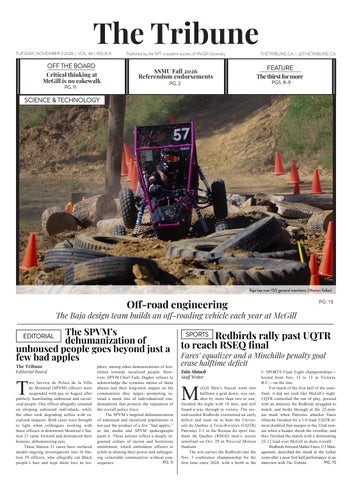
Baja has over 150 general members. (Manon Keller)
Off-road engineering
PG. 13
The Baja design team builds an off-roading vehicle each year at McGill
The SPVM’s dehumanization of unhoused people goes beyond just a few bad apples EDITORIAL
The Tribune Editorial Board
T
wo Service de Police de la Ville de Montréal (SPVM) officers were suspended with pay in August after publicly humiliating unhoused and racialized people. One officer allegedly urinated on sleeping unhoused individuals, while the other took degrading selfies with racialized suspects. Both cases were brought to light when colleagues working with these officers in downtown Montreal’s Station 21 came forward and denounced their heinous, dehumanizing acts. These Station 21 cases have surfaced amidst ongoing investigations into 16 Station 39 officers, who allegedly cut Black people’s hair and kept these locs as tro-
phies, among other demonstrations of hostilities towards racialized people. However, SPVM Chief Fady Dagher refuses to acknowledge the systemic nature of these abuses and their long-term impact on the communities they target—promoting instead a meek line of individualized condemnations that protects the reputation of the overall police force. The SPVM’s targeted dehumanization of unhoused and racialized populations is not just the product of a few “bad apples,” as the media and SPVM spokespeople paint it. These actions reflect a deeply ingrained culture of racism and boisterous entitlement, which emboldens officers to relish in abusing their power and subjugating vulnerable communities without conPG. 5 sequence.
Redbirds rally past UQTR to reach RSEQ final SPORTS
Fares’ equalizer and a Minchillo penalty goal erase halftime deficit Zain Ahmed Staff Writer
M
cGill Men’s Soccer went into halftime a goal down, was outshot by more than two to one, finished the night with 10 men, and still found a way through to victory. The second-seeded Redbirds overturned an early deficit and went on to beat the Université du Québec à Trois-Rivières (UQTR) Patriotes 2-1 in the Reseau du sport étudiant du Quebec (RSEQ) men’s soccer semifinal on Oct. 29 at Percival Molson Stadium. The win carries the Redbirds into the Nov. 5 conference championship for the first time since 2024, with a berth in the
U SPORTS Final Eight championships— hosted from Nov. 12 to 15 in Victoria, B.C.—on the line. For much of the first half of the semifinal, it did not look like McGill’s night. UQTR controlled the run of play, pressed with an intensity the Redbirds struggled to match, and broke through at the 22-minute mark when Patriotes attacker Yanis Abaiche finished for a 1-0 lead. UQTR almost doubled that margin in the 32nd minute when a header shook the crossbar, and they finished the match with a dominating 25-12 lead over McGill in shots overall. Redbirds forward Maher Fares, U3 Management, described the mood in the locker room after a poor first half performance in an PG. 15 interview with The Tribune.
2
REFERENDUM ENDORSEMENTS
TUESDAY, NOVEMBER 3 2026
Fall 2026 Referendum Endorsements
The Tribune’s Editorial Board presents its endorsements for the Students’ Society of McGill University (SSMU) Fall 2026 Referendum items. The endorsements reflect a majority vote of the paper’s editorial board; editors with conflicts of interest abstain from voting on pertinent motions.
Motion Regarding Constitutional Amendment for Athletic Teams: Yes
Last November, McGill Athletics cut 25 varsity and club teams: shifting 11 to interim club status and thus failing to provide teams access to the club funds or administrative support they need to compete. This motion proposes creating a new Athletic Teams category under SSMU, and adding an Athletic Teams representative to the SSMU Legislative Council. If passed, this item would allow athletic teams to retain club status under an administrative category catered to the specific needs of athletic teams; if a majority “No” vote passes, these programs’ futures will be uncertain. This motion would potentially instate an opt-outable undergraduate student fee—between 30¢ CAD and $3 CAD—to contribute towards SSMU athletic team activities. As robust university sports clubs create essential opportunities for students to pursue their passions, The Tribune recommends a “Yes” vote for this motion.
Motion Regarding Plate Club Fee Increase: Yes This motion aims to increase the Plate Club’s opt-outable fee from 14¢ CAD to 35¢ CAD per semester. The Plate Club promotes sustainability by providing free rentals of reusable dishware to McGill and Montreal community members. Some of the gatherings it has served include SSMU club, faculty group, varsity team, Milton-Parc organization, and religious and holiday events. The club is requesting a fee increase due to rising demand for its services; after resuming its programming following COVID-19, its completed orders increased from 10 in 2022-2023 to 119 in 2025-2026. The fee increase will allow the Plate Club to process a greater number of requests, manage its growing team of volunteers, and create a Plate Club Sustainability/Impact Report to address organizational inefficiencies. Without the fee increase, the club will be forced to scale back its operations by 50 per cent, as executives will be forced to reduce their working hours. To ensure environmental progress on campus, The Tribune endorses a “Yes” vote for this motion.
CKUT Existence Referendum: Yes For the last four decades, the CKUT 90.3 FM radio station has served as an independent voice bridging the McGill and greater Montreal communities, providing its 300 volunteer members with training and experience in radio, podcasting, and journalism. Through this motion, CKUT is seeking to establish its continued existence as a student-fee-supported Independent Student Group (ISG). The opt-outable fee ranges from $5.50 CAD to $8 CAD per semester, depending on students’ programs and enrollment statuses. A majority “Yes” vote in this referendum would allow CKUT to continue operating its 24-hour broadcasting, extensive musical library and archive, and student internship opportunities: crucial projects at a university lacking a formal journalism program. A majority “No” vote would terminate undergraduate student fee collection for CKUT, threatening the station’s ability to maintain its services and facilities. In support of the free and alternative press, The Tribune endorses a “Yes” vote for this motion. The Tribune has an ongoing collaboration with CKUT.
Motion Regarding QPIRG-McGill Existence Referendum: Yes
The Quebec Public Interest Research Group (QPIRG)-McGill offers a variety of anti-oppressive services to McGill students and opportunities to get meaningfully involved in environmental- and social justice-projects across the wider Montreal community. QPIRG-McGill hosts multiple free annual event series, offers an Alternative Library with a free textbook loan program, and provides funding to various community-based working groups. A majority “Yes” vote for this motion would affirm the organization’s existence, while a “No” vote would remove QPIRG-McGill’s access to its opt-outable fee of $6.75 CAD per student per semester. This fee is imperative for QPIRG-McGill to pay its staff and offer programs such as its Community University Research Exchange program, which gives students the opportunity to participate in action-oriented scholarship and receive academic credit for their work. To ensure this important advocate can continue to serve McGill students, The Tribune endorses a “Yes” vote for this motion.
TUESDAY, NOVEMBER 3 2026
news@thetribune.ca
NEWS
3
McGill students push back against the federal government’s Canada Strong policy Push Back at McGill brings awareness to the consequences of Bill C-39 Miranda Forster Staff Writer
O
n Sept. 1, the Liberal Party of Canada proposed the omnibus Bill C-39, known as the Building Canada Strong Act. This bill underwent a second reading and was referred to a legislative committee on Oct. 27. If passed, Bill C-39 will shorten the federal approval process for development and extraction projects, imposing one-year project timelines, relaxing federal impact assessments and regulatory processes,
Four major First Nations assemblies across the country are calling on Canada to withdraw the bill. (Gwen Heffernan / The Tribune)
and designating entire regions for deregulated and accelerated development—referred to by C-39 critics as environmental “sacrifice zones.” First Nations leaders and environmental advocates have criticized the bill as a massive rollback of environmental and Indigenous consultation protocols. At McGill, students have initiated Push Back: a movement protesting Bill C-39—as well as Bill C-5, the One Canadian Economy Act, which received royal assent in June. The Building Canada Act, introduced as part of Bill C-5, was passed by Prime Minister Mark Carney’s government as a temporary response to the imminent threat of United States President Donald Trump’s trade war. The act allows the federal government to exempt developmental projects from existing regulations if they are deemed matters of national interest. Bill C-39 would permanently establish the loosened regulatory framework of the Building Canada Act. Christopher Reid is a PhD candidate in Educational Studies at McGill and member of the Nisg̱a’a Nation that spans northern British Columbia. Reid emphasizes Indigenous schooling in Canada, highlighting Indigenous political thought and movements in his teaching. In an interview with The Tribune, Reid explained that Bill C-39’s sweeping deregulation of economic development projects would come at the expense of Indigenous rights. “[Bill C-39] seems quite reckless eco-
logically, considering climate change, environmental impacts […] as well as bulldozing Indigenous rights [and] Indigenous consent,” Reid said.“Fast-tracked, downstream consultations come to stand in for consent […] There are [First] Nations [that] will say no, and we’ll see lots of it. But there’s a lot of coercive pressure to shove [projects] through.” The bill claims to expedite projects that are in the national interest, but Reid emphasized in a written statement to The Tribune that slapdash development benefits no one. “This framing of ‘the national interest’ actually works against the interests of the Canadian majority,” Reid wrote. “Canadians in general would benefit from respecting Indigenous rights and jurisdiction, ending economic inequality, and protecting and caring for the Earth. These bills will work against any progress on these issues that Indigenous peoples and Canadians could build in common.” In Montreal, Bill C-39’s implementation has led to the establishment of Push Back, which is McGill’s chapter of a wider campaign against the bill led by La Repousse, a coalition of campus groups dedicated to environmental activism across Quebec. Shirley Barnea is a climate activist and student at Université de Montréal, and also a member of La Repousse. While Barnea maintained that constructive opposition towards Bills C-5 and C-39 remains insufficient, she is still hopeful about the role of student movements in driving change.
“Students are very often [at] the forefront of social change,” Barnea said in an interview with The Tribune. “[Universities are] a naturally good place to start a movement. So I’m hopeful that we’ll be able to at the very least get the word [out] about this and show our government that […] the population is not happy with creating sacrifice zones.” Ève Claveau, U2 Science, and Anne Césaré, U3 Environment, are both members of La Repousse and organizers of Push Back at McGill. Claveau sees Push Back as a crucial opportunity to voice dissent about Bill C-39. “It’s really important that people show opposition [to the bill] so that people on the inside can see proof that there’s people against it,” Claveau said in an interview with The Tribune. Césaré similarly expressed hope about the role of community dialogue and action in fostering resistance to Bill C-39. “[The bill] has not been adopted yet. Therefore, there is still time to mobilize and voice our concerns, but also get our members of parliament to vote against Bill C-39,” Césaré said in an interview with The Tribune. Césaré encouraged students to get involved with Push Back, no matter their background or expertise. “We’ll provide [students] with the information that [they] need to act on these issues,” Césaré emphasized. “It’s overwhelming, but we can do something about it. And that’s what’s important.”
SPVM Station 21 under investigation for alleged abuses of power, prompting protests in Montreal
Oct. 24 protests denounce SPVM for its recent behaviour Helene Saleska & Sofia Vidinovski News Editor Staff Writer
T
he Service de Police de la Ville de Montréal (SPVM) has suspended two officers from Station 21 amidst an internal investigation into alleged abuses of power by its staff. One of the suspended officers reportedly filmed himself urinating on unhoused people while on duty, and the other allegedly took mocking selfies with racialized individuals during arrests. These acts have led the Montreal city council to approve a motion calling for SPVM Chief Fady Dagher to appear before council for questioning. Ericka Alneus, leader of Projet Montréal—the official opposition—filed this emergency motion. However, the Martinez Ferrada mayoral administration attempted to deny Alneus’ request, wanting to amend the motion so that Dagher would appear at council only after the conclusion of internal SPVM investigations. In a written statement to The Tribune, official opposition press officer Ève ObertBeaulieu explained that Projet Montréal voted against Ferrada’s amendments because they downplayed the urgent need for the public to obtain information about Station 21. “We offered the mayor a concrete opportunity to demonstrate that the safety of the most vulnerable [members of the Montreal community] is a priority, and she denied it,” Obert-Beaulieu wrote. “[Nonetheless, the mo-
tion provides] a formal list of issues [Dagher] will have to address in council, including supervision, corrective measures, and organizational issues.” Obert-Beaulieu also questioned whether treating these incidents as isolated events is productive in examining the SPVM’s broader practices. “We want [...] to address organizational culture, including how officers interact with people experiencing homelessness,” ObertBeaulieu wrote. “We need concrete measures, clear responsibilities and a way to track progress.” In response to the allegations against the SPVM, around 200 protesters gathered outside Station 21 on Oct. 24, denouncing police violence and the SPVM’s lack of accountability. The demonstration began outside the station with speeches from the community. Then, protesters moved northeast on rue Ontario carrying a banner that read, “The police kill in prison and in the streets.”* Riot vans trailed the protesters while riot police—equipped with rubber bullet guns, tear gas canisters, batons, and shields—flanked the group on each side. The protest cut through Parc CharlesS.-Campbell, where Gabriel**, a protester equipped with medical gear, reported in an interview with The Tribune that police got more aggressive with demonstrators. “At that point, the police had pinched off the crowd and separated it into two groups [....] [That’s where] they arrested one person,”
he recounted. “Police were getting a bit ag- discrimination and misconduct against its ofgressive, a bit violent, starting from the square ficers. These acts were purportedly commitnear the police station [....] They [used] a tech- ted against Black and Arab individuals during nique that has been accredited to cause vio- police stops, leading to another investigation lence and unrest at the hands of the police. It’s initiated by Dagher. where the police take two sides of the protest In an interview with The Tribune, Madani and they slowly converge on people. That was Amza, a protester at the Station 21 demonstra[attempted] many times when we were being tion, outlined how crucial it is to shed light on forced onto the sidewalk.” police misconduct. Mounted police, police vans, and police “This is unacceptable,” Amza expressed. cars continued to tail the protest from a dis- “We must break the ‘code of silence,’ omertà, tance until its conclusion. The protesters even- that exists within the police force so that real tually retraced their steps and stopped at metro change can occur.” station Berri-UQAM. *These quotes were translated from Ted Rutland, professor in the Department French. of Geography, Planning and Environment at **All sources’ identities have been anoConcordia University, spoke in an interview nymized to protect their privacy. with The Tribune about protestors’ goals with respect to changing the political reality around policing. “Right now, [politicians] certainly know what the problems are, they certainly know what the solutions are, but they just don’t want to change because they serve the interests of the relatively wealthy people,” Rutland said. “Unhoused people have no political power, no voice. They’re barely treated as citizens, and so ignoring what’s happening to them is baked into the system.” This past June, SPVM’s Sta- SPVM Station 21 covers the eastern part of downtown tion 39 suspended an entire patrol Montreal, Centre-Sud, Old Montreal, Île Notre-Dame, unit due to allegations of racial and Île Sainte-Hélène. (Sophie Schuyler / The Tribune)
4
NEWS
TUESDAY, NOVEMBER 3 2026
news@thetribune.ca
Incarcerated workers in Canada’s federal prisons push for liveable wages and right to unionize
Incarcerated workers perform institutional maintenance and vocational training within Correctional Service Canada Talia Moskowitz Staff Writer
In June 2021, the Canadian Senate’s Standing Committee on Human Rights published a report on the human rights of ince 1981, the wage provided to in- federally sentenced persons. It found that carcerated individuals working inside although $6.90 CAD is the maximum they Canada’s federal prisons has not in- could earn, most incarcerated workers make creased. Despite calls from the Canadian between $4 CAD and $5 CAD per day. Prisoners’ Labor Confederation (CPLC) The report also explained that 30 per for the rights of federal prison workers to cent of prisoners’ earnings are deducted to unionize and bargain for increased pay, the pay for their room and board. An additional maximum wage for incarcerated workers 8 per cent of their wages go to telephone remains $6.90 CAD per day: less than half fees—with some paying supplementary of Quebec’s hourly minimum wage. fees for television cable services. Canadian labour boards have repeatedly ruled that federal prisoners are not statutory “employees” because their work is viewed as rehabilitative rather than contractual employment. In 2024, the CPLC and labour law firm Cavalluzzo LLP launched a challenge before the Federal Public Sector Labour Relations and Employment Board, arguing that denying incarcerated persons unionization violates their rights under the Canadian Charter of Rights and Freedoms and federal labour Only 4.6 per cent of Canadian prisoners earn the maximum standards. Jean Claude Bernheim is possible wage. (Zoe Lee / The Tribune)
S
the president of The John Howard Society of Quebec, an organization that participates in prevention and intervention services, and provides emergency accommodation for people coming out of incarceration living in Quebec City or Montreal. In a written statement to The Tribune, Bernheim underscored that incarcerated workers’ rights to unionize and exercise bargaining power are protected by their status as Canadian citizens. “[Incarcerated worker’s rights are] important because [they] are citizens and [must be] treated on the same basis,” he wrote. “Labour unions are important for two major things: one, to have a good wage, and have the possibility to be a citizen, and secondly, if [incarcerated peoples] are in a union, they have the possibility to work for the collective and participate in the making of decisions.” Jordan House, assistant professor in the Department of Labour Studies at Brock University and co-author of Solidarity Behind Bars: Unionizing Prison Labour, similarly emphasized incarcerated workers must have the freedom to collectively bargain in a written statement to The Tribune. “Collective bargaining is understood to be a basic right of Canadians by the Supreme Court. Incarcerated workers are vul-
nerable—they cannot simply leave a bad job—but they are still workers and deserve basic protections,” House wrote. House also emphasized that prisoners’ right to form labour associations is crucial when considering their daily work. “Collective bargaining rights would necessarily come with other basic employment and health and safety rights,” House wrote. “Take workplace injuries as one example: without a voice at work, there’s little recourse when conditions are unsafe— and injuries don’t promote reintegration.” As of 2019, the two-year post-release reoffending rate for federal offenders is 23.4 per cent, according to data from Correctional Service Canada. In a written statement to The Tribune, Ivory Tong, the finance and administration coordinator at the Quebec Public Interest Research Group (QPIRG) at McGill, argued that low wages for incarcerated workers contribute to this degree of recidivism. “People get out of prison and immediately have no money to pay rent. They are pushed back into these precarious situations where they are criminalized,” Tong wrote. “It’s a vicious cycle of economic marginalization. If you get out and you have money, that’s gonna be a completely different story in terms of recidivism.”
Montreal demonstration links French student protests to social concerns in Quebec Protesters gather outside the French Consulate in Montreal in solidarity with students Mila Fedoriska Contributor
A
round 100 people gathered outside the Consulate General of France in Montreal on Oct. 24, in support of lycéens, high school students demonstrating in France against recent educational policies, while also denouncing police violence and structural racism in Montreal and abroad. Organized by Montréal Insoumise, Les Verts Populaires, and La vérité pour Adama, the demonstration linked demands for better French education to broader concerns about fundamental rights and state violence not only in France, but also in Quebec. The gathering paid tribute to Pengo Bossio Wangi, a 26-year-old man killed on Oct. 23 when a gunman opened fire in Trappes, an area west of Paris. Several other people were seriously injured, including an 11-year-old girl. French President Emmanuel Macron described the shooting as a racist terrorist attack; the gunman admitted to deliberately targeting Muslim people and people of African or North African descent. Taking place just one day after the shooting, the Montreal demonstration connected Wangi’s murder to enduring issues of racism and violence in France. Sarah Patier, founder of the Montreal branch of the Adama Committee, spoke in an interview with The Tribune about how the demonstration acted as an opportunity to denounce what she described as governments’ worldwide failure to listen to students. “[Student] requests have not been heard, but have been repressed with great violence,”
she said. “High school students demand a dignified education with the same opportunities for everyone.” Adama Committee’s demands include increasing public funding for education, creating better learning conditions, and repealing Parcoursup, France’s postsecondary admissions platform. Patier’s concerns extended beyond education, as she also called for the restoration of the rule of law in France. She explained that violence often experienced in disadvantaged French neighbourhoods is increasingly spreading to city centres, and she criticized the normalization of racist speech targeting Black, Arab, and Muslim communities. “We are here to denounce the attack [on Wangi] and the continuum of violence that made it possible, as well as those directly and indirectly responsible [.…] This is a major social and economic crisis,” Patier said. These concerns in France also resonated with demonstrators from Montreal. Jeanne*, a Quebecer attending the gathering, expressed concern about French students’ situation in an interview with The Tribune. She drew parallels between the French and Quebec education systems, pointing to underfunded schools in Montreal and insufficient respect for teachers across the city. Jeanne emphasized that governments should respond to student mobilization through political solutions, rather than policing and restricting public protest. “[If I were a student], I would be very worried about my future [....] There needs to be a different political response than sending in the police and banning demonstrations,”
she said. Montreal resident and protester Ibrahim Alsahary also viewed the issues in France to extend beyond its borders, referring to a general decline of working and studying conditions in Quebec. “Everywhere they attack working-class people, even here in Quebec,” he said in an interview with The Tribune. Maelys* and Colette*, two international students from France who attended the protest, viewed marching on the streets of Montreal as a way to remain involved in the political struggles taking place in their home
country. They stressed that international and domestic struggles should not be treated separately. “Going out to demonstrate is our only power to act,” Colette said in an interview with The Tribune. “All international causes are connected to our national causes and must be carried forward [....] It is important for us not to disconnect from what is happening in France and to keep persevering in these struggles.” All quotes were translated from French. *All sources’ identities have been anonymized to protect their privacy.
56 per cent of Quebecers believe that the quality of the province’s education system has declined over the last 15 years. (Emiko Kamiya / The Tribune)
T EDITORIAL BOARD Editor-in-Chief Mairin Burke editor@thetribune.ca
Creative Director Zoe Lee creativedirector@thetribune.ca Managing Editors Asher Kui akui@thetribune.ca Ellen Lurie elurie@thetribune.ca Clara Smyrski csmyrski@thetribune.ca News Editors Ilia Mehr-Bakhsh Josette Chandler Helene Saleska news@thetribune.ca Opinion Editors Lulu Calame Julie Raout Camila Sierra Ordóñez opinion@thetribune.ca Science & Technology Editors Avery Berry Sarah McDonald scitech@thetribune.ca Student Life Editors Rachel Blackstone Tamiyana Roemer studentlife@thetribune.ca Features Editor Kaitlyn Schramm features@thetribune.ca Arts & Entertainment Editors Norah Adams Annabella Lawlor arts@thetribune.ca Sports Editors Merce Kellner Ivanna Zhang sports@thetribune.ca Design Editors Eliot Loose Gwen Heffernan design@thetribune.ca Photo Editors Emiko Kamiya Sophie Schuyler photo@thetribune.ca Multimedia Editors Will Dawson Daphne Short multimedia@thetribune.ca Web Developers Zola Ball Kate Lauro webdev@thetribune.ca Copy Editor Ella Bachrach copy@thetribune.ca Social Media Editor Chloe Ross socialmedia@thetribune.ca Business Manager Amy Xia business@thetribune.ca
TPS BOARD OF DIRECTORS Zain Ahmed, Nour Khouri, Celine Li, Lialah Mavani, Ilia Mehr Bakhsh, Aleks Rohozinski, Alex Hawes Silva
STAFF Zain Ahmed, Julia Apitz-Grossman, Brooke Barak, Miranda Forster, Abigail Francis, Alex Hawes Silva, Helena Helms, Dylan Hing, Gretta Iraheta Palacios, Niamh Maguire, Lialah Mavani, Shea McDonnell, Jenna Payette, Sofia Vidinovski Rokayah Bellaoui, Chloe Bhogal, Tobias Izenberg, Evy Shamber
CONTRIBUTORS Benny Davies, Amihan del Rosario-Tapan, Mac Devereux, Mila Fedoriska, Éloi Versieux, Sophia Angela Zhang
TRIBUNE OFFICE Shatner University Centre, 3480 McTavish, Suites 404, 405, 406 The Tribune is an editorially autonomous newspaper published by the Société de Publication de la Tribune, a student society of McGill University. The content of this publication is the sole responsibility of The Tribune and the Société de Publication de la Tribune, and does not necessarily represent the views of McGill University. Letters to the editor may be sent to editor@thetribune.ca and must include the contributor’s name, program and year and contact information. Letters should be kept under 300 words and submitted only to The Tribune. Submissions judged by The Tribune Publication Society to be libellous, sexist, racist, homophobic or solely promotional in nature will not be published. The Tribune reserves the right to edit all contributions. Editorials are decided upon and written by the editorial board. All other opinions are strictly those of the author and do not necessarily reflect the opinions of The Tribune, its editors or its staff.
OPINION
opinion@thetribune.ca
TUESDAY, NOVEMBER 3 2026
The SPVM’s dehumanization of unhoused people goes beyond just a few bad apples The Tribune Editorial Board Continued from page 1. Montreal’s police force has long abused the city’s unhoused community without facing tangible repercussions. The same officer accused of urinating on an unhoused man had been filming himself publicly degrading unhoused people for 18 months, before his subsequent suspension. The Bureau des enquêtes indépendantes (BEI), Quebec’s police watchdog, states an investigation into this officer is underway. However, the BEI’s track record demonstrates systematic inaction—specifically in cases of police misconduct against Indigenous and racialized people. Out of 450 BEI investigations in the last nine years, only 2 have led to officers facing charges. The organization’s independence is also severely compromised, as a majority of BEI investigators are
COMMENTARY Benny Davies Contributor
B
ismillah c’est les ténèbres (“In the name of Allah, it is the darkness”). This nonsensical line was the very best attempt an alleged undercover French police officer could muster to infiltrate a student protest group chat. This desperate act of espionage— employed under the alias “Mamadou”—fatally exposed the racist French police apparatus, so out of touch with Gen Z that it attempted to reach French youth through cartoonish prejudice. This botched attempt to infiltrate the lycéen protest movement has since become an international viral slogan, with French students using the phrase to emphasize the state’s complete loss of democratic legibility. But satire is just one feature of Gen Z’s newly established protest strategy. From Paris to Delhi, students have brought their unique generational culture to the streets, ridiculing an out-oftouch political class that sacrifices students’ futures and perpetuates racialized and class-based inequalities. Quebec is no exception: The same breaking point is fast approaching home. In France, striking teachers and trade unions have joined 250,000 student demonstrators, organizing nationwide blockades to condemn the government’s severe underinvestment in public infrastructure. For months, students en-
former police officers. Various advocacy groups have exposed other incidents of the SPVM unfairly targeting the unhoused community. One man asserts the police took his belongings and medication while he was temporarily away from his encampment. The SPVM also allegedly drew guns on an unhoused Inuk soapstone carver and pushed him to the ground, splashing dirty puddle water onto his face. Racialized and Indigenous people are disproportionately affected by the unhoused crisis, and a 2026 study found that 66 per cent of unhoused individuals in Montreal reported rarely or never being treated like other members of the public. The SPVM is a central mechanism that routinely perpetuates this degradation of populations already invisibilized, discriminated against, and structurally excluded from participation in society.
Montreal has been and continues to be callously unwelcoming to the unhoused community. By refusing to enact durable measures to alleviate the unhoused crisis in the long run, the City of Montreal consistently fails those who need support. In October, newly elected Quebec Premier Paul St-Pierre Plamondon announced the deployment of $28 million CAD in emergency funding to fight the unhoused crisis; a minimum of $18 million CAD of the total allocation will go to the City of Montreal. Considering the severity and persistence of the crisis, the short-term emergency measures this funding will allow for are systematically inefficient. Yet, the Quebec and Montreal governments continue to use makeshift solutions instead of tackling the roots of the crisis—which requires a fundamental restructuring of the SPVM and BEI. The SPVM must first and
5
EDITORIAL
foremost recognize that its institutional design has enabled the dehumanization of unhoused and racialized people. The government must invest in the deconstruction of this abusive police system by implementing training for officers that foregrounds care, humanity, and a commitment to rebuilding relationships between the police and unhoused people. Accountability for the harms the SPVM has inflicted also starts with restoring the BEI’s independence. Put simply, BEI investigations should, under no circumstances, depend upon cooperation from the very police forces responsible for the misconduct in question. More broadly, the Quebec government must take actionable steps to combat rampant systemic racism against unhoused people and implement long-term policies that not only alleviate but prevent homelessness, and enshrine the right to housing into its Charter of Human Rights and Freedom.
The revolution, televised dured classrooms without air conditioning during fatal heatwaves and faced teacher shortages: especially in lower-income suburbs. All the while, public funds were funnelled into private schools, national debt servicing, and sustaining the very police force silencing protestors. The global right wing has launched a coordinated campaign to undermine this student resistance. Israeli Prime Minister Benjamin Netanyahu claimed that Hamas was on the streets of Paris. United States Vice President JD Vance and U.S. President Donald Trump blamed protest escalations on immigration to France, describing France as “burning down.” These world leaders unashamedly worship racist rhetoric over the facts. The Albanian student-led Flamingo Revolution, which similarly protests the ruling class’s misdirection of public funds away from education and toward their own selfenrichment, has now raged on for months. Albania—a country with a very low immigrant population—is burning down too; protesters recently set its Supreme Court on fire. Yet, Trump was notably silent about these protests, having lost the basis of his anti-immigration stance. From Albania to Serbia, Nepal to Kenya, Gen Z is coming of age and standing up together to create major progress. In the case of Serbia, the nation’s student-led movement mobilized record voter turnout in last month’s election, resulting in a historic, nonviolent vic-
In an attempt to avoid property damage to tourist sites and government buildings, Paris police rerouted protesters toward the edge of the city. (Chloe Bhogal / The Tribune) tory that ousted long-standing ruler against itself as its name, while Aleksandar Vučić. As digital trans- Serbian students celebrated their parency in the era of social media election victory by hosting raves in collides with collapsing Gen Z trust the streets. in governmental institutions, youth Canada’s protest movements are mutinying. have not quite reached the level of Fueled by rampant state ne- France’s revolutionary flashpoint, glect displayed in real time via but the same material conditions Instagram algorithms, Gen Z has that have evolved into public untransformed its skepticism of po- rest elsewhere exist here. This litical elites from the typical bot- month, Quebec’s Cégep de Sainttomless cocktail of cynicism and Laurent was forced to close a third hopelessness into informed class of its buildings due to structural consciousness and resistance. neglect. Hundreds of Montrealers This resistance is practiced gathered to show solidarity with uniquely. Despite legacy media’s French students, connecting Parifocus on fires and masked destruc- sian school blockades to Quebec’s tion during French student pro- own educational decay. tests, demonstrators in France are Canada is not immune to the combining superhero costumes global Gen Z student contingent. and “aura battles” with speech- It’s only a matter of time till Cégep es—sharing videos of these rallies students also redirect their gaze across social media to boost the away from horizontal infighting, movement’s morale. In a similar and look upward at the ruling elite vein, Delhi’s student Cockroach and billionaire corporate vultures Janta Party reclaimed an insult who profit from these crises.
6
OPINION
COMMENTARY
opinion@thetribune.ca
ICE healthcare scare tactics kill yet another civilian
Niamh Maguire Staff Writer
P
aige Adamson was a 61-year-old Canadian and U.S. permanent resident living in Point Roberts, Washington—an isolated United States exclave where nearly all necessities require regular U.S.-Canada border crossings. On Sept. 15, Adamson crossed the border on her way home from a birthday dinner in British Columbia, where she was stopped and questioned for six hours by U.S. Immigration and Customs Enforcement (ICE) officials under the false pretense that she had illegally registered to vote in Whatcom County, Washington. Adamson stated that border control treated her like a criminal throughout her detainment; she was released with a deportation court hearing set for Nov. 4. That threat of deportation evoked such a grave sense of fear in Adamson that a month later, she avoided seeking life-saving medical care to address a right femur fracture, resulting in her death from fatal blood loss. Adamson’s tragic passing is blood on ICE’s hands. Her death highlights how Trump’s fearmongering immigration policies have created a rising public health crisis. Since his second term began, U.S. President Donald Trump has institutionally expanded ICE’s manpower by more than 50 per cent, with over 22,000 agents now employed by the agency. With Trump’s escalation of ICE’s
COMMENTARY
bureaucracy, ICE has unjustly and wrongfully detained hundreds of U.S. citizens and countless immigrants with lawful status: particularly members of Latino communities. The administrative design of ICE’s institutional complex creates a kafkaesque system of bureaucratic and legal barriers, making it virtually impossible to escape detention if not through death or deportation. The Trump administration has intensified community ICE raids since January 2025, leading to fear over violent and often fatal interactions with ICE—experienced by both immigrants and citizens. This risk prevents people from engaging in core activities such as going grocery shopping, showing up to work, and—as in Adamson’s case—seeking medical care. In a 2025 study, 26 per cent of American clinicians reported that immigration enforcement had directly affected patient care. In emergency rooms across Minnesota’s children’s hospitals, practitioners have noted seeing far fewer patients since ICE’s prevalence increased across the United States—and when patients do arrive, they show up sicker. Furthermore, admission rates, or the percentage of ER visits that result in a patient being admitted to the hospital, had climbed nearly five percentage points in these settings. Parents are also sending neighbours or friends as chaperones for their children if they themselves fear being targeted and deported. ICE increasingly infiltrates healthcare clinics, with seven per cent of hospitals reporting the presence of ICE
agents in waiting rooms. and harassment will continue to cost vulThirty-one people have died in ICE nerable people their lives. custody since the start of 2026. However, this number fails to account for the many deaths that ICE has caused outside of detention centres. Countless individuals like Adamson lack access to vital medical care as a result, putting their lives at risk. The Trump administration’s anti-immigration agenda has proven and will continue to prove deadly. Tragic cases such as Adamson’s shed light on how ICE’s inhumane treatment has culminated in an American public health crisis. Healthcare is a human right, regardless of immigration status. No organization, especially one whose stated mission is to protect, should weaponize medical centres. So long as ICE is permitted to infiltrate Previous U.S. policies forbade ICE enforcement action in hospitals and and abuse such spaces, other “sensitive locations”—including schools and places of worship. fears of deportation (Eliot Loose / The Tribune)
Don’t leave Lucy in the dust
Mac Devereux Contributor
I
TUESDAY, NOVEMBER 3 2026
f asked who you are, what would you say? Your name? Your nationality? Maybe your job? You are forgetting something very important: You are human, and thus a species of great ape. You come from a long line of humans, and before that, numerous other species of apes and primates. But how often do you think about this lineage? Whatever your answer may be, it’s not frequently enough. Lucy—the Australopithecus afarensis, one of the oldest known ancestors of humans—is a useful example. Lucy’s remains, which live at the National Museum of Ethiopia, may seem like just a pile of rocks. Which they are, of course, if not propped upright under an aggressively lit museum display. But this pile of rocks represents the very beginning of humankind. So why isn’t Lucy considered among humanity’s so-called greatest accomplishments, alongside the moon landing, the printing press, peanut butter, and the movie Cars? Lucy is more than humanity’s achievement; humanity is Lucy’s achievement. If she wasn’t there millions of years ago, humans wouldn’t exist today to dream big—or, I suppose, fail MATH 141: Calculus 2. Considering the crucial role apes played in humanity’s genesis, the absence of apes in McGill’s curriculum is deeply
perplexing. Designated primatology courses, such as ANTH 203: Human Evolution and ANTH 311: Primate Behaviour and Ecology, have not been offered at McGill since the 2016-2017 academic year. Why has McGill allowed this discipline to descend into obsoletion? The lack of awareness of humans’ connection to apes, resulting from an absence of ape studies in our classrooms at McGill, perpetuates some humanity-altering misconceptions. For example, the idea that humans evolved from apes, but that at some point, magically stopped being primates and emerged as the semi-hairless, upright-walking monstrosities that we are presently, is not true. Nor is it true that we materialized out of thin air looking and acting exactly as we do today, with no predecessors to speak of. What kind of foundation does this network of falsehoods provide humanity? An unstable one. To quote science-fiction author Stanisław Lem’s book Solaris, “Man has gone out to explore other worlds and other civilizations without having explored his own labyrinth of dark passages and secret chambers.” In our apehood, we have accomplished great things, but rarely stopped to consider what evolutionary legacy they represent. As humanity progresses, provided that we don’t blow ourselves up, we must think of Lucy, all those millions of years ago. We must not forget where we came
from. Being human isn’t just about the here and now: It’s about every step we have taken to arrive here today. To move forward—technologically, intellectually, spiritually, and so on—with no knowledge or consideration of our past wouldn’t be moving forward at all. To know our trajectory, we have to know where we began, not just where we are or aspire to be. Recognizing our apeness helps us; it makes our story all the more impressive. McGill must not ignore Lucy and the rich history of apehood—she didn’t bust her ass 3.2 million years ago only When she was alive, Lucy stood at approximately 3.5 feet tall and weighed to be forgotten. As roughly 60 pounds. (Gwen Heffernan / The Tribune) for you, dear reader: Before you take your Beatles song “Lucy In The Sky With Dianext step forward and capitalize on your monds.” When we are hopefully in the sky upright bipedal morphology, look back. with diamonds one day, we better not have Remember that Lucy was named after The left Lucy in the dust.
arts@thetribune.ca
TUESDAY, NOVEMBER 3 2026
ARTS & ENTERTAINMENT
7
Rafael Manuel’s ‘Filipinaña’ exposes the surreal inequities of paradise
The film offers a satirical and resonant look at the Philippines’ socioeconomic disparities Amihan del Rosario-Tapan Contributor
T
he citizens of Manila line up for water amid a drought. They fan themselves on the street. They pray to God. This is the opening sequence of Filipinaña. However, this is not the film’s main setting. Shifting quickly from the crowded streets of Manila to our protagonist Isabel (Jorrybell Agoto) lying beneath sprinklers, the rest of the film takes place on a welltrimmed golf course in the Philippines over the course of one scorching day. For the rich, the golf course is a place for leisure: The green is home to karaoke, extravagant meals, and long peaceful hours. But for those working on the golf course, it is a site of hunger, heat, and exhaustion. Isabel is a newly employed “tee girl” whose sole responsibility is to place golf balls on their tees at the driving range. It is a ridiculous and repetitive job, punctuated by the piercing sound of golf clubs smacking the balls. Driven by the task of returning a golf club to the resort’s president, Isabel takes us through the green. Caddies trudge through ponds to find balls and resell them, performers stand as static as statues until guests walk by, and food at the golf club is abundant yet uneaten. Meanwhile, Isabel and the rest of
the tee girls nap, packed tightly beneath a fan for a flirt with cool air. Isabel’s perspective elevates the mundane into the surreal, highlighting the raw and fundamentally absurd disparity between rich and poor in the Philippines. Through gorgeous visual language, director Rafael Manuel’s satire-comedy constructs a chilling portrait of the country as a place of immense beauty simply built in service for others. It’s not just that there is a massive wealth gap in the nation; it’s that the nation’s entire identity and aesthetic splendour have been commercialized to cater to the comfort of everyone else, leaving its people to labour in the shadows of their own paradise. Take the film’s other character, Clara (Carmen Castellanos): a wealthy Filipina visiting from the United States, her uncle attempting to convince her to return to the Philippines and work for his golf equipment business. Clara’s uncle’s interest in her return to Manila stems in part from the country’s problem of brain drain—wherein all their best and brightest leave to work or study overseas. Over her time on the course, Ina (Isabel Sicat), Clara’s caddie, constantly questions Clara about her life in America, smiling at the thought of novice golfers holding their own bags in the U.S. Both Clara and Isabel see the resort as foreign, but they experience this alien-
ation very differently. While Clara is able Centuries of Spanish colonialism, deto return to the U.S. and turn away from the cades under American rule, and years under inequalities that prevail in the Philippines, Japanese occupation stripped Filipinos of Isabel remains condemned to serve others their sovereignty, leaving enduring social under the oppressive Manila heat. and economic scars. Current labour policies On Oct. 22, Filipinos of Montreal host- and overseas migration in the Philippines ed a screening of Filipinaña. In an interview are born from this history of exploitation; with The Tribune, Ruddy Navson, an audi- these realities enduringly mark Filipinos. ence member, explained why the film hits Violence evades the camera’s lens, home. dancing around its edges but proving de“What really stood out to me was just structive nonetheless. Rich in every frame, how dystopian [the movie] is, and how it re- surreal, and sometimes tender, Filipinaña flects […] the [socioeconomic] state in the is a vibrantly layered account of a country Philippines,” he said. where beauty is a mask for an insidious and As a Filipina, I was struck by the eerie sinister exploitation. sense of violence that creeps around the film without ever being directly shown. Beauty is demystified in Filipinaña’s sharp contrast between the experiences of guests and workers: reminiscent of my own experiences walking through neighbourhoods in Manila where ten people live in one house, while penthouses loom Filipinaña won the World Cinema Dramatic Special Jury Award for Creative across the street. Vision at the 2026 Sundance Film Festival. (Zoe Lee / The Tribune)
70 years of ‘Giovanni’s Room’
Publisher rejection could not exclude Baldwin’s landmark novel from the canon Ellen Lurie Managing Editor
W
hen James Baldwin wrote Giovanni’s Room in 1956, his publisher, Alfred A. Knopf, pushed back on the novel’s release, calling the book “repugnant.” By the time Baldwin began writing Giovanni’s Room, he was already solidified as a critical figure in literature: a child of the Harlem Renaissance and a central pillar in the American civil rights movement. His prior works, Go Tell it on the Mountain and Notes of a Native Son, shook the foundations of the American literary world, receiving praise for their brilliance and lyricism. It was widely understood that Baldwin—through his preacherly, jazz-like cadence, emotional complexity, and critique of the protest novel—was a force to be reckoned with. Why, then, would an author—whose works were seen as destined to be modern classics—be shunned by his own publisher? At this point in his career, Baldwin had disentangled the complexities of American race relations with his writing. This was not the problem with Giovanni’s Room for Knopf. Rather, it was Baldwin’s abandonment of his prior protagonist—a Black man living in Harlem—in favour of a white American living abroad in Paris. In the novel, Baldwin embodies David, a man wrought by internal conflict, most principally between his closeted bisexuality and his staunch adherence to misogynistic, heteronormative standards. The author brings David to Paris both to question America’s rigid, traditionalist ideal of masculinity against France’s
more open sexopolitical landscape, and— through David’s affair with another man—to point out the ultimately destructive consequences of repressing one’s sexuality. On his trip to Paris, away from his American fiancée, David meets Giovanni, an Italian immigrant working as a bartender. The two descend into a passionate, yet ultimately doomed, relationship. Living together in Giovanni’s private room for several months, David struggles with the cramped and frequently messy space, and constantly tries to tidy and decorate it. David’s attempts to clean the room only worsen his internalized misogynistic hatred; he feels deep
self-loathing for displaying such “housewife” tendencies. Over time, the room suffocates David and, by extension, his identity. The space gradually transforms from a place where he can engage privately in his affair with Giovanni into a confining, claustrophobic prison. Ultimately, David’s fiancée arrives in Paris, and David abandons Giovanni. Giovanni is thus left vulnerable to exploitation by his employer, Guillaume, who forces him to trade sexual favours to maintain his bartender job. In a fit of desperate rage, Giovanni murders Guillaume and is executed by the French state for his crimes.
Giovanni painted the windows of his room with white cleaning polish to block out sunlight, plunging the space into perpetual darkness. (Evy Shamber / The Tribune)
David’s refusal to accept his love for Giovanni ultimately destroys both characters. David’s fiancée, learning of the affair, abandons him, and Giovanni’s death is a direct result of David’s denial. The book is gorgeously written, and a crucial glimpse into the troubling landscape of American sexuality during the mid20th century. Yet, Knopf’s response reflects an attempt to confine Baldwin to a Giovanni’s room of publisher expectations. Baldwin understood that sexuality and race have always been intertwined, stating, “If Americans can mature on the level of racism, then they have to mature on the level of sexuality.” As a Black American writer who moved to France in 1948 to escape racial and homophobic discrimination at home, Baldwin found new perspectives on the United States Jim Crow system from abroad. Giovanni’s Room is as much a work about Baldwin’s own life and experience as it is a work about a white man navigating internalized homophobia. The irony of publishers’ reactions to Baldwin’s manuscript of Giovanni’s Room is that his prior novels were praised by critics for subverting literary conventions to expose the idiosyncrasies of America’s systemic racism. Baldwin’s innovation was the source of his renown and fame, yet it became an obstacle when he attempted to write about a white character and sexual diversity. Giovanni’s Room was eventually published by Dial Press in 1956. 70 years later, it remains a timeless modern classic and a landmark novel in queer literature, and Baldwin’s writing continues to inspire creative innovation—through documentaries and television adaptations of his foundational works.
R
eusable water bottles are hard to ignore on McGill’s campus. Whether in a lecture hall, library, or common space, students carry a variety of brands, designs, and sizes of water bottles every day. Sometimes, these bottles are even accessorized and personalized. But with so many types to choose from, water bottles have become more than just a way to stay hydrated. They are no longer just practical items: They are a way for people to express their personal style and keep up with trends. In 2025, the global reusable water bottle market was valued at an estimated $10.1 billion USD, with its value projected to reach $10.5 billion USD in 2026. In 2021, 9 in 10 Canadian households reported having at least one person that used their own water bottle, a solution to purchasing single-use water bottles. With brands such as Stanley, Hydro Flask, Owala, Nalgene, and S’well competing for market space, reusable water bottles have become increasingly varied in their designs and styles. In a survey of 50 McGill students conducted by The Tribune, 74 per cent of respondents reported owning two or more reusable water bottles, while 6 per cent reported owning none. Additionally, 72 per cent reported having purchased new water bottles despite already owning a functional one. While the survey only offers a snapshot into the purchasing habits of respondents rather than a representative picture of McGill’s entire student population, it shows a clear trend of students purchasing more reusable water bottles than they actually need. More than just a water bottle Water bottle fads have made headlines for years. In January 2024, customers lined up outside Target stores in the United States overnight to acquire limited-edition Stanley tumblers. Stanley’s popularity translated into significant sales growth, with TIME Magazine reporting that the company’s annual sales reached approximately $750 million USD in 2023, doubling over the prior three consecutive years. In an interview with The Tribune, Siddhanth Mookerjee, an assistant professor of Marketing in McGill’s Faculty of Management, explained how everyday objects such as water bottles can become associated with identity. “There’s a social signal in having that product, or [it’s] a product that allows for identity expression,” Mookerjee said. “A func-
tional product can be advertised as a product that offers something beyond just its functional benefits, [portrayed as having] some sort of social value or self-signaling value, in which case consumers are inclined to purchase those kinds of products.” This connection between water bottles and personal style is also reflected in where they are sold. Urban Outfitters—a popular clothing store—sells water bottles from more than 10 brands, including retailer-exclusive Owala designs. Simons also sells a range of reusable water bottles alongside clothing and accessories, framing them as lifestyle products: and making water bottles seem more like fashion accessories than practical items to consumers. Stickers, charms, and different colour options also allow purchasers to personalize their water bottles, distinguishing their bottle from others as a form of self-expression. “Customization is a form of identity expression,” Mookerjee explained. “People can, for example, [...] add things to their cases or to their laptops, little trinkets here and there to express who they are. If a product allows people to customize [it] in any way, then [consumers] can express their identity through those means.” The survey conducted by The Tribune reflects this importance of personal expression when choosing a water bottle. 56 per cent of respondents reported that their water bottle reflects their identity. Additionally, though functionality was respondents’ most frequently cited factor when choosing a water bottle—88 per cent—this consideration was followed closely by colour or appearance—82 per cent. Keeping up with the trends A report from the Advertising Specialty Institute found that in 2025, searches for Owala in its promotional-products database increased by 60 per cent, whereas searches for Stanley declined by approximately 50 per cent. These figures show how quickly interest can shift between brands. To stay ahead of these trends, water bottle companies have begun launching limited-edition designs. Owala’s Colour Drop program releases special designs on scheduled dates. Research has shown that such limited-edition scarcity can make products seem more valuable—and therefore desirable—to customers. By releasing these special, once-in-a-lifetime designs, brands try to encourage customers to purchase new water bottles even if they already own one. However, urging consumers to keep up with the newest designs contradicts the fundamental purpose of reusable wa-
ter bottles: to be sustainable. Owala’s popularity is also reflected by The Tribune’s survey. Owala was the most frequently-used brand among respondents, with 42 per cent preferring an Owala, followed by Hydro Flask at 20 per cent, Stanley at 12 per cent, and Nalgene at 8 per cent. But personal taste is not the only thing that influences what people buy. “Social influence plays a big role in consumption decisions. We are influenced by the people
The thirst
How personal influence, and shape reusable culture at
Written by Ch Social Medi & Designed by Heffernan, Des
around us,” Mookerjee explained. “If everyone’s buying this product, […] this is a product that is valued by many people. And so, if I buy this product, I too will be valued by other people.” On campuses like McGill, where students carry water bottles from class to class, simply seeing what someone else is using can spark interest in a new brand. This is reflected in the 42 per cent of survey respondents that reported considering a new brand purchase after seeing another student with that reusable water bottle. Unlike traditional advertisements, seeing other students carrying water bottles is part of everyday campus life, allowing students to be exposed to new brands without actively looking for them. As certain water bottles become more visible on campus, their popularity may generate further interest among students. Beyond campus, social media is another way for water bottles to be presented to consumers. Mookerjee discussed how brands can gain pop-
ularity by establishing a presence across multiple platforms, therefore exposing consumers to products in different contexts. Of the survey respondents, 64 per cent reported that social media trends had influenced their interest in or decision to purchase a water bottle. What students see online and around campus evidently has a large influence on which water bottle brands they want to buy. The cost of keeping up Reusable water bottles are intended to reduce reliance on
for more
identity, social sustainability e water bottle t McGill
hloe Ross, ia Editor Gwendolyn sign Editor
single-use plastics. Canada generates around four million tonnes of plastic waste annually, only nine per cent of which is recycled. The City of Montreal has been pushing back on this destructive excess in recent years; in 2018, it banned the distribution of single-use plastic bottles in municipal buildings. The city has since introduced additional restrictions on single-use plastics, including a ban on many plastic cups and straws. McGill joined this initiative in the same year, announcing plans to phase out the sale of single-use plastic water bottles on campus. But as water bottle trends evolve, consumers show a tendency to buy more reusable water bottles, despite the one they already own still being functional: constituting a new environmental challenge. In an interview with The Tribune, Jamie Silverman, a master’s student in McGill’s Department of Geography, discussed the environmental implications of reusable products. Silverman is the general
coordinator of Plate Club, a McGill student-run service that provides free reusable dishware for events to reduce disposable waste, and that gives first-hand insight into how reusable systems operate. “Reusable eco-friendly items becoming trendy is awesome until you get rebound effects,” Silverman said. “Reusable water bottles start with a massive carbon debt.” Silverman explained that this carbon debt refers to the carbon footprint associated with the production of reusable water bottles, which can contribute to greenhouse gas emissions that drive global warming. While the popularity of reusable products can encourage people to use fewer disposable alternatives, purchasing multiple reusable products can thus also create additional environmental impacts. Grant Borucki, a McGill Environmental Biology student and facilitator at the ECOLE Project—a student-run sustainability organization—also acknowledged the possible negative environmental implications of purchasing multiple water bottles in an interview with The Tribune. “If you are buying a lot of [reusable water bottles] and not using them, that definitely does diminish the environmental benefits of them, [as] they’re just going into your Stanley collection or whatever [brand] that you [only] use once or twice,” Borucki said. That said, a 2026 study published in Environmental Research found that although manufacturing reusable water bottles has a greater initial environmental impact than the production of single-use plastic bottles, their relative environmental impact decreases with repeated use. Similarly, Borucki noted that seeing other students with reusable water bottles on campus can help normalize sustainable habits at McGill. He encouraged students to consider donating or passing along water bottles that they no longer use. “If you’re replacing your water bottle because you want the new one and you know you’re not going to use the old one, absolutely contribut[e] to that secondhand economy,” Borucki said. “Just [ask your community], ‘Hey, do you want my old one?’” Participation in the secondhand economy does not directly address why students are buying extra water bottles in the first place. As more brands emerge and designs are released, water bottles can start to be seen as outdated, despite them still serving their original purpose. This reflects a deliberate planned obsolescence in the reusable water bottle industry, whereby companies encourage customers
to replace functional products by making their existing water bottles appear inadequate in the face of newly released options. The problem of overconsumption is therefore not solely the result of individual purchasing decisions. Brands also curate these decisions by introducing new designs and marketing water bottles as lifestyle items, encouraging customers to constantly replace perfectly good products. Companies benefit financially from these purchases, though the environmental benefits of reusable water bottles depend on their continued use and are diminished by this overconsumption. Therefore, these brands hypocritically contribute to the same environmental problems that their products ostensibly combat. In The Tribune’s survey, only 8 per cent of respondents said environmental sustainability was extremely important when choosing a reusable water bottle, 26 per cent said it was very important, 44 per cent moderately important, 18 per cent slightly important, and 4 per cent not important. While 78 per cent of respondents considered sustainability at least moderately important when choosing a reusable water bottle, 72 per cent still reported purchasing new water bottles while already owning a functional one. This suggests that while respondents recognized the importance of sustainability, their inaction in actually practicing such sustainability reveals the greater issues growing with increasing purchases of reusable water bottles. Beyond the water bottle At McGill, reusable water bottles have become more than just everyday items. From the brands students carry, to the colours and accessories they choose, water bottles can reflect individuals’ personal style and identity. But what students choose is also influenced by those around them, social media, and purposeful marketing. The environmental benefits of reusable water bottles depend not just on purchasing them, but on how long they are actually used. When products designed to reduce waste become another item that consumers feel inclined to collect, the planet suffers. Seeing other students with certain water bottles can encourage people to buy new ones. That same influence could also encourage students to continue using the bottles they already own. Ultimately, while reusable water bottles have become fashion accessories, the trends surrounding them do not necessarily have to encourage more consumption. Before choosing to purchase their next limited-edition Owala, students should consider whether the appeal of its new design outweighs the environmental benefits of continuing to use the three they already own.
10
ARTS & ENTERTAINMENT
arts@thetribune.ca
TUESDAY, NOVEMBER 3 2026
Three albums and four seasons of lovesick girlhood
Olivia Rodrigo’s Unraveled Tour delivers a masterful reflection on love and rage Sophia Angela Zhang Contributor
fines of Centre Bell, turning the arena into a vivid spectacle in which the passage of time and conceptual cyclicality took center stage. n Oct. 21 and 22, Olivia Rodrigo Each season of the show came with its own took over Centre Bell, inviting a colour palette, wardrobe, visuals, and cupacked house into a two-hour, in- rated setlist. timate, high-octane exploration of lovesick She began in spring, slowly emerging girlhood. Touring her third studio album, from a field of green, white, and light pink you seem pretty sad for a girl so in love, Ro- flowers in a white Dilara Findikoglu babydrigo’s set, organized around the theme of doll dress to sing “drop dead.” Her chiffon seasons, interwove her newest tracks with attire was reminiscent of her iconic outfit hits from albums SOUR and GUTS. from the song’s music video, where she galRodrigo transcended the material con- lops playfully through the halls of the Palace of Versailles. Transitioning into summer with a white tank top and purple shorts, Rodrigo kicked off the next segment with “my way” before diving into angsty rock anthems like “bad idea right?” Her outfit change reflected a departure from the soft pastels of the prior season. Throughout every song, it was clear that Rodrigo’s team had thoughtfully planned how to utilize the arena screens to enhance each performance. During “serena joy,”—a song named after the main character in dysRodrigo has a total of 86 Unraveled shows scheduled across Europe topian novel The Handand North America. (Zoe Lee / The Tribune)
O
maid’s Tale—Rodrigo jumped from side to side and shook her head, her movements rendered on screen with a laggy blur effect to match the song’s pop-punk sound. Rodrigo’s decision to translate the book, a critique of societal complacency about attacks on gender equality and women’s bodily autonomy, into song was an acknowledgment of the current backsliding of women’s rights in the United States and across the world. The singer suggested that, much like Serena Joy, some women today reinforce oppressive patriarchal systems in defence of the greater good, becoming complicit in systems that actively harm them. Rodrigo’s lyrics reinforce this theme of complicity, as she sings, “Go ahead, go ahead / Don’t think about it / What you get, what you get, what you get / Everything is just fine.” Swirling orange lights, harsh strobes, and Rodrigo’s blurred movements amplified the weight of every lyric. After summer came summer twilight, with performances of “vampire” and “purple” occurring in darker lighting. Synchronized LED wristbands given to fans at the stadium’s entrance transformed the entire room into a starry, firefly-lit night. Rodrigo incorporated many moments of audience interaction into the show, allowing the crowd to enter and participate in a live, collective experience. During most songs, lyrics would appear at the bottom of the screen, inciting the audience to sing along. This was most memorable in Rodri-
go’s performance of “maggots for brains,” when the audience united to chant the bridge as her music slowly faded out. During autumn, the artist donned a black-and-purple leather mini dress with a choker. She opened this new act with “stupid song,” walking through the crowd on her way to the main stage. This phase of the performance was marked by a moodier, bittersweet tone—mimicking the feeling of change that punctuates fall. The final winter act started with Rodrigo, dressed in white, performing a collection of songs on the piano: including “honeybee,” a beautifully skeptical love ballad that builds in intensity. Her performance of the track ultimately ended with a flurry of white confetti falling around her to emulate snow. The emotional climax of the season came during the bridge of “the cure,” as torrential rain poured down on Rodrigo, “unravelling” her white dress to reveal a striking red outfit beneath. The day following Montreal’s second show, the artist revealed on Stationhead that she had been feeling under the weather, which meant the city missed out on extra setlist additions. Regardless, Rodrigo’s underlying message remained intact amid her set’s theatrical downpours, pop-punk anthems, and shared crowd chants. The Unraveled Tour delivered a masterclass in modern pop storytelling, with a cathartic, cinematic capture of the beauty and turmoil of evolving youth.
Ripping off the mask of queerphobic reporting on viral Massachusetts lesbian bar The insidious implications of The Boston Globe’s ostensibly humorous article
Norah Adams Arts & Entertainment Editor
I
n the wake of the announced closing of Last Ditch, a lesbian bar in Greenfield, Massachusetts, the passionate keyboard warriors have laid down their pitchforks. Now, the manner in which the bar was reported on—wrought with sensationalism and homophobic rhetoric—warrants addressing. The epic began several weeks ago when, on Sept. 22, The Boston Globe published a story titled, “A Western Mass. lesbian bar required KN-95 masks. When it changed the rules, all hell broke loose.” The article describes how the usually mask-mandatory Last Ditch’s decision to host a weekly maskoptional night led to community uproar. Deputy editor Annalisa Quinn’s piece takes a mocking tone when detailing the establishment’s financial struggles and patrons’ reception of the bar’s last-ditch efforts to stay afloat. Throughout her reporting, she sprinkles in gratuitous commentary that enforces harmful stereotypes and pokes fun at 2SLGBTQIA+ people. Quinn selectively mentions the pronouns of those she interviewed depending on whether they were non-normative enough to support her patronizing descriptions of Greenfield’s queer community. In one paragraph, Quinn includes a perspective from one of Last Ditch’s prior owners in an offhand sentence—solely to emphasize that the owner uses it/its pronouns. Despite The Boston Globe’s article
bringing the story into the spotlight, news of the bar’s controversy was broken on Sept. 17 by more sinister voices. In an episode of their podcast Blocked and Reported, Jesse Singal, known for his transphobic opinion pieces in The New York Times, and Katie Herzog, author of the controversial antitrans article “The Detransitioners,” covered Last Ditch’s dilemma first. The cover for this episode is an artificial-intelligence-generated photo featuring masked androgynous individuals who sport multicoloured hair and rainbow pins. This depiction, surprisingly, is less offensive than the transphobic rhetoric Singal and Herzog spew within the segment. Herzog kicks off the episode by describing a Zoom call she sat in on while Last Ditch bar owners and regulars debated the mask-free idea. Herzog whines that “pronouns were required,” and that “two people were named after plants,” comparing the discussion to George Orwell’s Two Minutes Hate. The podcasters go on to spend 30 minutes demeaning both transgender and disabled people and—shamelessly, in a reposted version—dedicating an extra five minutes to complaining about how their transphobic coverage should have gone viral over The Boston Globe’s. The reporting on Last Ditch’s efforts to keep their intersectional community space alive began with a homophobic tone, so it is unfortunately no shock the public response that followed continued perpetuating this harmful rhetoric. Large media outlets all
jumped to publish their own sarcastic ar- individuals’ rights to expression are placed ticles, with titles such as “The Great Awo- in increasing danger, journalists must take kening is over. This lesbian bar shows why” extra care in how they report on members of and, more worryingly, Arwa Mahdawi’s these communities. Although this story may “#NotAllLesbians – we can’t let the Massa- seem simply a ridiculous and fleeting drama, chusetts bar drama turn us all into a punch- it contributes to a growing societal contempt line.” for queer people. No matter how well-fitting, Mahdawi’s piece in The Guardian re- KN-95s cannot protect the 2SLGBTQIA+ flects a new trend in which members of community from internal division spurred the 2SLGBTQIA+ community write es- by hateful rhetoric and mass online mockery. says damning non-normative queer people and promoting their own relatively conforming gay or lesbian identities. Ultimately, unethical reporting on queerness—rife with stereotyping and satirization—sows division in 2SLGBTQIA+ communities. Despite suffering overarching societal and legal exclusion, some members of the queer community will reject others—often transgender or gender-non-conforming individuals—in a bid to obtain acceptance from hetero- and cis-normative society and its media discourse. While many of the seething comments from Last Ditch patrons on the establishment’s original mask-optional post are extreme and even absurd, major news outlets improperly used this small-town drama to promote anti-queer rhetoric on an international scale. In an era of acceptance back- Last Ditch opened in April 2025 in Greenfield, Massachusliding, where transgender and queer setts. (Gwen Heffernan / The Tribune)
studentlife@thetribune.ca
TUESDAY, NOVEMBER 3 2026
OFF THE BOARD
Mairin Burke Editor-in-Chief
A
s a teenager, I found myself constantly having to confront a difficult and even existential question: “Real or cake?” I would squint at baking videos for far too long, trying to decipher whether a steak or soccer ball was an elaborate fondant deceit or the real deal. In our current age of artificial intelligence (AI), my middle school concern over too-detailed icing feels incredibly quaint. I mourn a time when I did not feel existential dread upon taking in yet another morning headline letting me know how AI and its tech founder minions are forecasting, if not ushering along, the world’s end. Now, I
STUDENT LIFE
11
Critical thinking at McGill is no cakewalk obsessively check that each piece of media I consume has not been cobbled together by AI bots or propagandists, and when I catch something AI-generated, I am terrified by how much of our digital landscape is not our own. I am vehemently against AI. Sure, it has some specialized benefits, and yes, it’s probably not going anywhere. But, as I hope you already know, these technologies ultimately serve to kill our creativity and kill the planet, perpetuating environmental racism in the process. Governments and corporations who initially stood by as AI wreaked havoc are now scrambling to halt the deepfakes, “AI psychosis,” and cognitive decline it spurs. Like “real or cake” videos, AI outputs imitate tangible things. But unlike this culinary trend, which relies on actual human craft to take effect, AI manipulates a reality it does not consciously experience. AI products are thus simulacra of everything experts believe makes us uniquely human: our capacity for complex emotional communication, our imagination, our critical thought, our pursuit of the meaningful. And AI— sometimes very convincingly—gets away with such covert mimicry, partially due to the blind faith with which people often approach these technologies. If a real-life student were to transmute someone else’s work without attribution in
the way that AI does, they would be on the hook for plagiarism. Yet universities around the world—including McGill—have embraced AI in their classrooms. The university’s willingness to adopt AI is not surprising. As an English Literature and Religious Studies double major, I was indignant about the university’s rampant online posts this October emphasizing that groundbreaking classicist and poet— and former McGill professor—Anne Carson won the 2026 Nobel Prize in Literature. In fact, McGill budget cuts reduced its Classics Department and thus pushed Carson out of the university, something the McGill Reporter’s press release fails to mention. Ongoing austerity measures limiting faculty salaries, benefits, unionization, and access to educational resources continue to stifle the teaching and publishing capabilities of professors like Carson—though McGill is ostensibly a research university, and acclaims itself as such. McGill’s mission to perform “service to society” is evidently served by a legacy of professorial and student work that the institution simultaneously minimizes and gives itself credit for. Though it was the first Canadian university to divest from companies with ties to apartheid in South Africa, McGill took action only after a difficult and prolonged activist campaign for justice. The
university reluctantly removed a statue of founder James McGill, a transatlantic slave trade beneficiary and enslaver of five people, only because of extensive student advocacy. Considering the biased spin dictating our campus discourse—both in terms of McGill’s public relations and the rapid influx of AI into the classroom—I am immensely grateful to be the Editor-in-Chief of The Tribune. We are a paper dedicated to uncovering campus injustices, with a strict policy against publishing AI content. We are a space where you can ask and investigate beyond the surface level, where you can let your personal creativity flourish, and where a commitment to bettering the world on human terms is never in question. Our insistence against AI-generated work means that, despite our extensive efforts, human fallibility sometimes permeates our writing. But I would always rather embrace human imperfection than succumb to AI slop. Despite how difficult and uncomfortable it may be, I urge you to never stop questioning what constitutes your perception; in this era of misinformation, the last place the wool should be pulled over your eyes is at university. And, as the icing on the (real) cake, I promise that The Tribune will always be a place for this self-reflection, truth, and discovery.
www.ratemyclassmates.com
Unofficial ratings of student archetypes Sophie Wedge Staff Writer
W
e all use Rate My Professors (RateMyProf) before semesters start to get an insider’s scope on an instructor’s habits, but the professor is not the only variable that makes a class enjoyable. The Tribune brings you a new perspective: RateMyClassmates, detailing who you might want to sit with and who you might want to avoid in your next course. The classmate that always shows up late: 2.2/5 Top comment: Listen, I understand that getting to Strathcona can be a bit of a slog, but why not position themselves near the exit of their last class and scurry at 3:55 p.m.? I also know that they’re not rushing from another class. Even worse, on the odd days that they’re on time, they get mad when someone else comes shuffling into the lecture hall 15 minutes late. Don’t climb over punctual students all the way into the middle of the row. Walk those stairs to the back. See also: the whisperer, the person who takes up three chairs with their bags, and the one who asks too many questions. Group project GOAT: 5/5 Top comment: Honestly, I have no complaints. Everyone wants the GOAT in their group, but unfortunately partnering with them is a once-in-your-undergrad opportunity. I was fortunate enough to work
with them for a full lecture-length presentation, and they came in clutch. They rallied everyone to the academic cause and delegated like a true leader. No one was left out, and even those slacking free-riders got positively influenced and ended up contributing a fair amount. I used to pray for times like these. See also: the lovely exchange student, the club member giving out free snacks, and the campus crush. Professors’ pet: 1/5 Top comment: What is a political science class without this person? I have come to appreciate some of their inquiries about Rousseau and insights on the state of nature—hence the slightly generous rating— but I still struggle to understand the confidence this person has to constantly glaze our professor. Sure, Professor so-and-so is great, but save the praise for office hours. Absolutely 0 per cent of students want to sit with them again. See also: the loud one on Schulich floor five, the PDA couple, and the exam speedrunner who leaves you feeling insecure.
never weird. Extra points for sending notes and complaining about the latecomers with me. See also: the one you secretly yearned to become friends with but is realistically an acquaintance, the one that does not realize you have a class to get to who just keeps talking, and that one person in your club—you know the one. Friendly fashionista: 4.4/5 Top comment: I am always excited to see them on my walk to school along rue Milton. Without fail, they strut down the
street in the best outfits possible. Against all rules of nature, this stylish student is also one of the kindest—how unfair! If you’re ever curious about where they’ve acquired a stunning piece, they are quick to spill all the details. I rarely see them in the dead of winter, but in the warmer months, I can’t help but marvel at their taste. See also: the one who thrives at every club—Datcha, Café, or L’Escogriffe—the only froshie that you are in contact with and still like, and obviously, the one who holds the door for you.
Friend of a friend: 3.8/5 Top comment: Originally, I thought it might be awkward to have class with someone I know so little about, but as it turns out, it’s not so bad. They make me feel welcome, loop me into conversation with people I don’t know, and save me a seat before lectures. We have even gone McGill University is home to 3,779 professors, who are rated an average of 4.0 on RateMyProf. for coffee together before class, and it’s (Rokayah Bellaoui / The Tribune)
12
STUDENT LIFE
studentlife@thetribune.ca
TUESDAY, NOVEMBER 3 2026
More than a pet project
McGill student perspectives on the joys and challenges of caring for animal companions Tamiyana Roemer Student Life Editor
D
espite balancing classes, jobs, and social obligations, some students are making time for an even more permanent commitment. Pets and university may not historically go together, but for those who balance both, this companionship has come to define their McGill experience. For Minaal Mirza, U3 Arts, a tender addition came in the form of Leo, the 13-year-old cat she fostered. After Leo’s previous owner passed away, he drifted between family members and an agency before eventually finding his way to Mirza. “He was the cutest boy in the world,” Mirza recalled in an interview with The Tribune. Mirza, who had owned eight rabbits before university, was no stranger to caring for animals. Still, balancing pet ownership with her responsibilities as a student presented some challenges. In addition to classes, Mirza works with the Students’ Society of McGill University (SSMU), meaning she often spends long hours away from home. Fortunately, university life often includes roommates, and Mirza’s was happy to look after Leo. “I made it clear that if she didn’t want the responsibility, I would take care of Leo completely,” Mirza explained. “But she also loved cats, so it was [more] like co-parenting in the
end.” Mirza found that Leo’s companionship made the added responsibility of caring for another being worthwhile. Leo, the ever-sensitive old soul, was particularly comforting during intense periods of the semester, such as finals. “If I was crying over an exam, he’d […] come and calm me down,” she said. “I think it’s really great to have a cat with you during [such] stressful situations.” Even Mirza’s asthma, which made living with a non-hypoallergenic cat difficult at times, could not diminish her affection for Leo. Despite the sneezing and coughing he evoked, she always wanted to spend time with him. “At the end of the day, I would truly just want to be with Leo in my bed,” she said. “It was never a chore to stay home with him.” For Nat Pennisi, master’s candidate in the Department of Political Science, moving into a one-bedroom apartment this September prompted her to reconsider what she wanted her home to look like. “I definitely am more of an introvert [....] I get tired [of] people, and if I’m working I interact […] with people a lot. [When] I’m tired, I like my recharge time, but I’m also very prone to getting lonely. So [I decided to] take the plunge and look into adopting or fostering [a pet],” Pennisi said in an interview with The Tribune.
Having just welcomed two foster kit- munity of admirers. tens—provisionally named Tulip and CroThis October, Stanislawski held a celcus—into her home, Pennisi is already enjoy- ebration of life in Sharkira’s honour. Rather ing the liveliness they bring to her apartment. than organizing a funeral, she wanted to com“I think that just having an animal in your memorate the community Sharkira had drawn house, especially two kittens, makes it feel a together. Alongside her first-year roommate, lot more full,” she said. Stanislawski gave a speech, while friends However, not every student’s animal gathered around a poster to leave messages companion has four legs. Becca Stanislawski, for their departed companion. U3 Arts, was thrilled to speak with The TriPets may not feature in the widely imagbune about Sharkira, the late betta fish she ined university experience, but for the stubrought home as a first-year student. dents who make room for them, they are far “Although she was small and didn’t get more than another responsibility. They are up to a lot, [...] I loved to look at her,” Stani- sources of comfort, fixtures of home, and beslawski said. “She gave me a lot of happy loved pieces of their social landscape. memories just by being a constant.” Stanislawski acknowledged that a fish might not always require or inspire the same kind of attention as a more traditionally affectionate pet. Nevertheless, she loved having Sharkira around. Over the years, Stanislawski’s friends became fond of Sharkira too, and the fish even had two memorable birthday parties attend- The SPCA estimates there are between 1.5 and 4.1 million feral or unowned ed by her devoted com- cats living in Canada. (Emiko Kamiya/ The Tribune)
NDP McGill hosts panel discussing party’s history in establishing universal healthcare Machouf and Julian examine healthcare precarity in Canada Asher Kui Managing Editor
O
n Oct. 27, the New Democratic Party McGill (NDP McGill) hosted a panel featuring Nimâ Machouf, NDP federal candidate in Laurier–Sainte-Marie, as well as Peter Julian, former NDP member of parliament in New Westminster–Burnaby–Maillardville. Machouf is a specialist in international health and infectious diseases and has served eight years on the board of Médecins du Monde. During Julian’s career with the federal NDP, he served in ten critic positions, most recently working as the NDP’s health critic after a cabinet shuffle by former party leader Jagmeet Singh. Machouf began the panel by acknowledging students’ presence. “We were particularly interested to come see […] young people and […] students because first of all, the future belongs to you,” Machouf said. “We must hope to be able to encourage you to engage and participate in the democratic process, and above all, force the government to protect your rights.”* She then elaborated on recent laws passed by Liberal Prime Minister Mark Carney’s federal government that may menace all Canadians’ rights and health. She specifically referred to Bill C-39, the Building Canada Strong Act, which grants many employers greater power to end union strikes. “Bill C-39, in the name of economic stability, development, and prosperity, is in the process of removing certain rights of Canadian workers [....] [Furthermore, Carney’s government is]
going to take away certain environmental rights care.” sent Canadians’ interests. because the economy isn’t doing well,” she Despite the establishment of Medicare, Ju“80 per cent of Canadians support the [fedsaid. “Another [federal] bill is trying to reintro- lian emphasized the shortcomings of the system, eral] dental care plan, and 85 per cent supduce [pesticides that were previously banned by which costs hundreds of Canadian lives per year. port [national] pharmacare. There is a conHealth Canada] under the context of developing “Can anybody tell me how many Canadians sensus among Canadians that is reflected in our agriculture.”* die each year because we can’t afford the medi- the House of Commons,” Julian said. “[The Machouf also emphasized the importance cation that [our] doctors prescribe?” Julian asked. NDP is] rebuilding as a movement and a of healthcare accessibility in Canada. “It’s 600 Canadians. Basically, every day, one or party, but we need to go back to Parliament “[Healthcare] must be a human right, not two Canadians die because they can’t afford the […] to stop an often far-right agenda and a privilege for the wealthy [....] Health extends medication [they are] prescribed.” put in place a people’s agenda that will actufrom head to toe,” she said. “We’d like to see one Julian also spoke to the widespread sup- ally benefit all of us.” day a healthcare system that doesn’t only cover port for universal healthcare amongst Canadians, *These quotes were translated from hospitalization and medication in hospitals, med- highlighting the NDP’s responsibility to repre- French. ical care, but also mental healthcare, eye care, and rehabilitation across all systems [....] Today, when people go see a doctor, they don’t pay, and the reason for this universal healthcare system [was because of] a moment where the NDP government forced the Liberals to accept it.”* Machouf was referring to the Liberal Party of Canada—who, in 1966, under the twin pressures of organized labour marches and the NDP, implemented Canada’s Medical Care Act (Medicare). Machouf then passed the microphone to Julian, who spoke about Stanley Knowles and Tommy Douglas, two NDP representatives behind the implementation of Medicare. “[In the 1960s], you had an American-style healthcare system in Canada, which meant that if you had enough money, you would go to the hospital, and you [could] go to the doctor,” Julian said. “If you didn’t, you didn’t get care [....] Life Before Medicare is a great book, a good reference point to the kinds of suffering that Canadians went through before Tommy Douglas and The NDP won 6.3 per cent of the share of votes in the 2025 federal election. (Gwen Heffernan / The Stanley Knowles [brought] us universal health- Tribune)
scitech@thetribune.ca
TUESDAY, NOVEMBER 3 2026
SCIENCE & TECHNOLOGY
13
Galaxy evolution: The expansion of our universe
A look into the regulation of star formation and growth in low-mass galaxies Helena Helms Staff Writer
S
cientists have studied the expansion of the universe since the 1920s, when the field was pioneered using Albert Einstein’s field equations and theory of general relativity. This work posits that a universe filled with matter and energy cannot remain static: The space between galaxies is dynamically stretched over time. On the exterior of individual galaxies is the circumgalactic medium (CGM)—an atmosphere of low-density gas that exists around and between cosmic systems. The CGM contributes to star formation and regulates cosmic expansion through the absorption and cooling of star-forming material. In a seminar seminar with the Trottier Space Institute at McGill on Oct. 27, Chris Carr, a presidential fellow and researcher at Princeton University’s Department of Astrophysical Sciences, discussed the CGMgalaxy connection, how matter and energy cycle in and out of galaxies, and how this contributes to the self-regulation of galactic growth. This process begins when baryons— heavy subatomic particles—accrete into dark matter potential wells and pull on exterior gases, causing them to accelerate inward and settle into a halo-like structure. This movement creates a shock radius of high temperatures, and ultimately produces the CGM. “Material that’s accelerated due to the
potential wells eventually hits supersonic speeds, and crashes into material that’s already there. This process forms a virial shock […], and through this rapid compression, kinetic energy that was already there thermalizes […], transition[ing] [into] what we call the shock radius,” Carr said. Afterwards, this thermal energy begins to leave a halo, and as the gas cools, it condenses inward, where it builds galaxies. In experiments simulating this process, researchers have found that rapid acceleration followed by cooling leads to the formation of overly massive galaxies that are far larger than what exists in the real universe. This effect has become known as the overcooling problem. Carr’s research looks beyond how the CGM is involved in supermassive galaxies, and investigates how low-mass galaxies regulate star formation. Galaxies with less mass act differently because they have much weaker gravitational fields that cannot retain the star-forming cold gas and thermal energy that more massive galaxies can. “[There are multi-phase] winds [coming from supernovas],” Carr stated. “You have gas at very low densities and high temperatures moving at fast velocities, [with] dense clumps of gas at lower temperatures being wafted up by this hot wind.” Essentially, supernovas occurring in the interstellar medium (ISM) bring energy and mass into the CGM in the form of hot galactic wind. This heat expels cold gas, there-
by preventing formation of the cool, dense stages of his research, he has already estabclouds that serve as fuel for new stars. When lished that the CGM-galaxy connection is running simulations to approximate energy, critical for understanding the dynamics of mass, and metal quantities, researchers ap- our universe. With regard to low-mass galplied loading factors to assess how these axies specifically, Carr has discovered more components contribute to the function mod- effective mechanisms of measurement, and elling star formation. contributed to the furthering of smaller-scale “People in the past have adapted gas galactic regulation. He hopes to continue this regulator models where you can think of the line of inquiry, and look for more answers on CGM, the stars, and the ISM as […] reser- how our universal plane of existence unfolds voirs, which exchange [mass, energy], and in the cosmos. metals at different rates within some growing halo that’s accreting material from the surrounding ISM,” Carr said. Carr’s lab has been able to independently track these flows of mass, energy, and metal in order to demonstrate their impacts on galactic properties. “One of the key insights of [our] work […] was that [the] final stellar mass calculation was pretty insensitive to [the] choice of mass loading factor,” Carr said. “While the cell mass actually seemed remarkably sensitive to [the] choice of energy loading, as you increase the energy loading, you are driving more energy out of the halo.” This finding was significant, as it demonstrated that by pressurizing the CGM, you are more effectively driving material out of it, thereby limiting its galaxy’s growth by cutting off fresh Carr’s work on galaxy regulation has helped researchers material that helps with formation. to learn about our own Milky Way Galaxy. (Gwen While Carr is still in the early Heffernan / The Tribune)
Off-road engineering
The Baja design team builds an off-roading vehicle each year at McGill Sarah McDonald Science & Technology Editor
F
or most people, a car flipping sounds like a tragedy. But for McGill Baja Racing (Baja), it’s a routine part of their intense off-roading competitions. Every year, Baja, one of McGill’s Faculty of Engineering design teams, models and manufactures a new single-seat off-road vehicle. This off-roader is then raced in international competitions hosted by the Society of Automotive Engineers (SAE). In an interview with The Tribune, Elsa Edwards, U4 Mechanical Engineering and Baja archive, events, and SAE lead, spoke about Baja’s design process and what competitions are like. “The whole fall [semester] is dedicated to design because it’s a really long process, and you have to work with the [team’s] previous car to understand what you want to improve [and] why you want to improve it, [which] requires a lot of time and testing,” Edwards said. “[Design] happens through research and development, data collection from the old car, and [the creation of] a computeraided design.” Once the design phase is finished, the team moves onto manufacturing. SAE gives teams a model specification for a single, standard engine; the rest of the offroader, the team must figure out on their own. Much of their manufacturing is done by students inhouse, while some of the more complicated work is sent to McGill machinists.
“Not only do we have machines [in the workshop] that we [as students] can use, like a mill and a lathe to turn metal stock into whatever form we desire, but we also have professional machinists in the shop downstairs who take care of more complicated […] parts. We are really lucky to have them, and they produce what we need,” Edwards said. Along with more common machine technologies, Baja boasts a welding station. Their chassis—the skeleton of their off-roader—is made of steel tubes welded together by members of the team. Becoming a welder is quite an undertaking. Students are required to undergo a number of additional safety and procedural training courses to use this machinery. “Access to the [welding] shop requires Workplace Hazardous Materials Information System [(WHMIS)] training and an in-person safety training, but you can become a welder on the car after a year of welding training,” Edwards explained. “We have a dedicated team of welders that are always there to answer questions.” Once the off-roader’s chassis is built, each subsystem is attached to the car’s frame using welded brackets. From here, the team begins troubleshooting and testing until the off-roader is ready for competition. Held in the summer, SAE competitions include both dynamic and static events. The car is assessed on everything from its traction control and maneuverability to business-style presentations about its design cycle. Dynamic
events are time-based, where cars compete to achieve the fastest time in a race, or the greatest number of laps in a set period. “Endurance is our biggest challenge. It’s the [dynamic event] that’s worth the most points in our final scoring, and it’s four hours of continuous racing, and you have to do as many laps as you can,” Edwards said. “So it challenges your speed, and it challenges your car’s reliability, because the track also has challenges. Sometimes there are inclines, sometimes there are big bumps that challenge your suspension and traction [....] It’s really looking for your car to be reliable, and oftentimes, parts of [the] cars will break. And then
Baja has over 150 general members. (Manon Keller)
you take it off [the track], you pit it, [and] you fix the [issue] as quickly as you can.” This year, Baja’s first competition falls in early May—a much earlier date than the competition’s typical June start. Edwards explained that leads and general members will have to be extra conscious of their time as a result. But despite the closer deadline, Edwards maintained that this competition will be the highlight of the Baja program’s year. “Going to competition and seeing [the off-roader] run is a really rewarding experience, and you get to be there with all the people that worked on it with you,” Edwards said. “It’s a big bonding time for the team.”
14
SCIENCE & TECHNOLOGY
scitech@thetribune.ca
TUESDAY, NOVEMBER 3 2026
Lessons from a singing mouse
Alston’s singing mice teach us about how behaviours evolve Clara Smyrski Managing Editor
P
icture this: A 15-gram mouse climbs onto a rock, tilts its head back, and belts out a song. While this may sound like a fairy tale, singing mice are real, and are helping scientists discover new ground in evolutionary neurobiology. In last week’s edition of McGill’s Neurobiology and Behaviour seminar series, Associate Professor at Cold Spring Harbor Laboratory Arkarup Banerjee discussed his research on how evolutionary changes in neural circuits can give rise to new behaviours, modeled by Alston’s singing mice. The talk, which took place on Oct. 30 in the Stewart Biology Building, opened with the children’s stories that inspired Banerjee’s focus on these mice. “Maybe some of you have read the JustSo Stories written by Rudyard Kipling. He was exploring ideas like, how does the camel get its hump, […] or how does the elephant get a trunk?” Banerjee began. “In our lab, we work with these highly vocal Costa Rican singing mice that have evolved the ability to sing, [which is] a unique trait in rodents. And just like Kipling, I’m interested in how the singing mouse got its song. But unlike Kipling, who frankly just made up his explanations, hopefully what I’ll tell you is actually true.” Alston’s singing mice, from the cloud forests of Central America, produce a loud,
high-pitched, highly structured song hundreds of times per day. One song consists of about 100 rapid notes over seven seconds, starting fast and quiet and getting louder and slower. These mice also love a duet, and when one hears another, it will answer within about a fifth of a second. Banerjee further described a more variable, softer kind of “voice”—called ultrasonic vocalizations (USVs)—that these mice exhibit when in close quarters to one another. Scientists call these kinds of habits behavioural innovations, and Banerjee aims to discover what has to change in the brain for such an innovation to appear. The study looks into whether songs and USVs operate under the same mechanism, and whether that mechanism works like a vibrating guitar string or a whistling recorder. To determine this, Banerjee and his colleagues had the singing mice inhale helium, which would make their voices higher only if their sounds were created through a whistle mechanism. They discovered that while the mice’s songs and USVs sound completely different, they are made the same physical way: by whistling air through the voice box. Since the instrument is the same for USVs and songs, the difference has to lie in the brain controlling these sounds. So, Banerjee moved to the mind. His team compared the brains of singing mice and ordinary lab mice; while Banerjee said he expected these organs to look quite different, he found they were almost identical.
If a singing mouse’s brain looks the same “By the end of 12 days, it actually does as a lab mouse’s, then why do only some mice not [sound] like [a] song at all,” Banerjee sing? Banerjee next moved to studying indi- said. vidual brain cells. His team gave each brain Finally, the team had found their answer: cell in the motor cortex—the movement and Singing mice did not evolve a new part of the planning area of the brain—its own unique brain, they just turned up the volume on a DNA barcode tag, allowing researchers to connection in the PAG that all mice already trace where each cell sends connections. have. After tagging approximately 76,000 “My null model when I started doing cells across the two species, Banerjee’s team this project was that drastic changes in befound that more cells made certain connec- haviour [require] drastic changes in neural tions in singing mice compared to in lab mice. circuits,” Banerjee said. “I now find many exTwo destinations stood out, each roughly amples where there are quantitative changes three times more likely to receive a connec- in pre-existing circuits […] that may be a tion in singing mice than lab mice: the periaq- widespread mechanism for rapid behavioural ueductal gray (PAG), a midbrain region that evolution.” works as an on-switch for vocalization, and the auditory cortex, the brain’s hearing area. To test whether this boosted connection actually drives song, Banerjee and his colleagues used a toxin to gradually shut off the cells in mice PAGs that receive signals from the motor cortex. They then recorded songs over 12 days. On Day 4, the opening of the mice’s songs got choppy, and through Day 8 and 12, the songs got quieter and lost The Cold Spring Harbor Laboratory, located in New York, was their rhythm. established in 1890. (Rokayah Bellaoui / The Tribune)
Take The Tribune’s Science & Technology midterm review quiz
Between study sessions, test yourself on our previous coverage with a quiz that’s hopefully a little more fun
1. McGill researcher Mark Brandon studied how mice responded to an environment that evoked fear. Which area of the brain was the fastest to respond and recall the scary memory associated with the environment? a) Cerebellum b) Extended amygdala c) Ventral hippocampus d) Superior colliculus 2. It is no secret that midterm season is detrimental to most McGill students’ sleep schedules. Which participant group did McGill PhD student Madhura Lotlikar discover performed the best in a memory test after staying awake for 30 hours? a) The group that took a 90-minute nap before testing b) The group made up of participants currently working in high-stress occupations c) The group that completed a 20-minute high intensity workout before testing d) More than one answer is correct 3. Which scientist, highlighted in The Tribune’s Volume 46, Issue 4, has won The Amazing Race Canada? a) Nadine Caron b) Lillian Dyck c) James Makokis d) Myrle Ballard
4. McGill’s Macdonald-Stewart Library is rumored to be cursed, but the real mystery is in the construction of the building; architects only used wood, copper, and brass—no iron or steel. Why? a) To keep ghosts out b) To avoid magnetic interference with experiments in the building c) Because steel and iron are elastic and transmit vibrations from footsteps throughout the building d) To make the building lighter for structural integrity
c) Twelve or more d) Four to five 8. Now that we have all picked up a pumpkin from the Mac Market to carve or make pie with, how large is the Macdonald Campus Farm where these pumpkins grow? a) 300 hectares b) 240 hectares c) 175 hectares d) 430 hectares
Answers: 1: c) Ventral hippocampus 2: d) More than one answer is correct: options a and c 3: c) James Makokis 4: b) To avoid magnetic interference with experiments in the building 5: b) 4.5 metres tall 6: a) Adenosine 7: d) Four to five 8: b) 240 hectares
Avery Berry Science & Technology Editor
5. How tall is McGill’s cryo-electron microscope, the Titan Krios 300kV Cryo-TEM, which was obtained by the university in 2010? a) 7 metres tall b) 4.5 metres tall c) 3.5 metres tall d) 1.8 metres tall 6. The coffee you get at Tunnel Espresso keeps you awake during your Schulich Library long hauls by blocking which molecule’s receptor? a) Adenosine b) Melatonin c) Serotonin d) Dopamine 7. Perhaps top of mind during your Halloweekend, how many drinks within a twohour window would be considered binge drinking according to McGill’s Rachel Rabin? a) One to two b) Eight to ten
At McGill, first-year midterm class averages are typically between 65-75 per cent. (Gwen Heffernan / The Tribune)
sports@thetribune.ca
TUESDAY, NOVEMBER 3 2026
SPORTS
15
Redbirds rally past UQTR to reach RSEQ final
Fares’ equalizer and a Minchillo penalty goal erase halftime deficit Zain Ahmed Staff Writer Continued from page 1. “To be honest, that was probably one of our worst halves,” he said. “We were kind of shocked by the intensity of the first 45 minutes. But we kept our heads up and told ourselves we had 45 minutes [left] to give it [our] all.” A shift came almost immediately after the second half began. Barely two minutes in, Fares jumped at a chance to pull McGill even at 1-1, a goal he says he will remember for years to come. “It felt crazy. Probably the biggest goal of my career,” Fares said. “It’s my last year, so [scoring] here at home, in front of family and friends, at such a crucial moment, is probably the best feeling I could ever get.” The equalizer turned the match on its head. McGill took the lead in the 59th minute when Nicholas Minchillo, the newly named RSEQ rookie of the year, buried a crucial penalty to bring the score to 2-1. UQTR grasped for opportunity, but fifth-year goalkeeper Ludovyck Ciociola and the back line stood firm, denying the Patriotes in the match’s final minutes. Ciociola blocked 13 shots, eight of which came after halftime, to protect McGill’s advantage. Minchillo, Ciociola, and captain defenceman Stuart Klenner have since been named RSEQ All-Star first team members. Yacine Ihaddadene, U0 Arts, pointed to the back line as the throughline of McGill’s season. “Everyone plays together and gives 100 per cent every single time. We’re like a family,” he said in an interview with The Tribune. “You can
see it in [our] results. We didn’t concede many goals this season, and we [have] the best defence.” That identity, he said, is what McGill will lean on in the RSEQ conference championship. “We have to defend well. We can’t concede the first goal. We have to play together, defend together, and score first,” Ihaddadene emphasized. Head Coach Marc Mounicot, who was
named RSEQ coach of the year on Oct. 29, traced the shift in the Redbirds’ momentum to the halftime reset. “The biggest thing was a different mindset in the dressing room at halftime [....] Key substitutions, and the first goal coming right after that, gave us confidence again,” he shared in an interview with The Tribune.“We didn’t play especially well today [....] But this year was all about character and momentum. It’s
a young team, starting six or seven freshmen. They’re full of enthusiasm, and they have quality. But today, they showed character.” McGill now sets its sights on the RSEQ Championship Final at Molson Stadium on Nov. 5 against the Université Laval Rouge et Or. It is the Redbirds’ first final since a 2-1 loss to the Université de Montréal Carabins in 2024, and the team will be tenacious in its hunt for glory this week.
Redbirds Soccer has not won a Quebec title since 2002. (Rokayah Bellaoui / The Tribune)
Beyond the baseline: Racism persists in professional tennis
Coco Gauff faces harassment, exposing limits of WTA’s efforts to combat online abuse Ivanna Zhang Sports Editor
T
wo-time American Grand Slam champion Coco Gauff stopped playing midtennis rally against Chinese player Xinran Sun after seeing a flash from the scoreboards at the 2026 China Open. The chair umpire deemed the flash a hindrance under the Women’s Tennis Association (WTA) rulebook, allowing the competitors to replay the point. Gauff went on to win both the replayed point and the match. Following the game, Gauff received a wave of racist social media comments and direct messages, prompting her to address the abuse on X and Instagram. “hey everyone, you can dislike me or disagree about what happened without being racist. the amount of racist comments/dms I’ve received in the last few hours is insane. Lastly, I’m not a cheater or a thief,” Gauff wrote in response. “It was an unfortunate situation but it is out of my control [....] I think it’s weird I’m getting hate for following the rules,” she further commented. Two days later, Gauff lost her China Open match to Belgium’s Elise Mertens in straight sets and told her team that she had no energy during the game. She then withdrew from a subsequent tournament in Wuhan, where she would have played as the defending champion. A week after the incident, the United Nations’ Human Rights Office posted a statement supporting Gauff on X.
“There is no place in sport for racial or sexist slurs and abuse. Players, coaches, and sports bodies need to stand up for those facing such attacks,” the organization wrote. Similar racism occurred after American Serena Williams’s loss to Japan’s Naomi Osaka in the 2018 US Open final. During the match, Williams received three code violations from umpire Carlos Ramos: for receiving coaching, for breaking her racket, and for verbal abuse after calling Ramos a “thief,” resulting in fines totalling $17,000 USD. The controversy continued when the Herald Sun, an Australian newspaper, published a cartoon by Mark Knight depicting Williams with exaggerated facial features, stomping on her racket. While Knight maintained that his work was intended to criticize Williams’s on-court behaviour, critics argued the cartoon reinforced racist and sexist stereotypes about Black women. The Australian Press Council ultimately ruled that the cartoon did not breach its media standards. Both incidents illustrate how controversies surrounding Black women athletes’ oncourt behaviour can extend beyond tennis itself, prompting racial attacks with consequences that go beyond the sporting community. Social media has allowed athletes to build a stronger fan base and interact directly with supporters. Former world number eight Australian Daria Kasatkina has over 70,000 subscribers on her YouTube channel, where she shares behind-the-scenes WTA content, including interactions with other athletes and her team. However, that same online accessibility
also exposes players to more abuse—which ing their mental health. follows them long after a match ends—than Although the WTA’s adoption of moniever before. A July 2026 report by the WTA toring technology shows an effort to address and World Tennis identified more than 12,000 the problem, the continued presence of abusive abusive posts targeting their athletes across comments against its athletes—particularly social media platforms, with 3,726 containing Black players—raises questions about the efviolent, sexual, racist, or targeted threats. fectiveness of existing protections. When racist The report claimed the organizations have abuse goes unchallenged, sports, which many witnessed “significant progress” in reducing see as a channel for breaking norms, risk beonline hate against tennis players, coaches, and coming spaces where existing racial stereostaff since adopting Signify Group’s Threat types are reproduced rather than contested. Matrix, a service combining artificial intelligence and human analysts to detect abuse. “Nobody should have to go through that. It’s sad but I’m used to it,” Osaka said in a press conference, referring to the remarks Gauff has received since the China Open. “I know that some people are like, okay, if it bothers you that much, stay off social media. But sometimes that’s the best way to connect with your fans.” Osaka’s statement reflects the predicament racialized tennis players often face in balancing the need to maintain a well-established sup- Gauff is currently ranked No. 4 in singles by the WTA. (Zoe Lee/ The porter base with protect- Tribune)
16
SPORTS
TUESDAY, NOVEMBER 3 2026
sports@thetribune.ca
Harry Kane’s Ballon d’Or deserves a closer look at who awarded it A former academy reject won a vote shaped by nebulous criteria Éloi Versieux Contributor
F
ootball forward Harry Kane was cut from Arsenal Football Club’s academy when he was eight years old for not being athletic enough. Yet on Oct. 26 of this year, at the London Palladium, he lifted the Ballon d’Or, an award honouring the bestperforming football players over the course of the previous season. He is the first Englishman to win the trophy since Michael Owen in 2001. The road between those two moments was long. When Kane finally made it to the big leagues, Tottenham Hotspur FC loaned him to Leyton Orient FC, Millwall FC, Norwich City FC, and Leicester City FC before he became Tottenham’s all-time top scorer. Now playing for Germany’s Bayern Munich FC, in the 2025-2026 season, Kane scored 73 goals in 65 games, won the Bundesliga and the DFBPokal, and helped England earn third place at the 2026 Fédération Internationale de Football Association (FIFA) World Cup. Kane did not have the night to himself. Spanish athletes took over the show, with superstar Alexia Putellas winning the women’s award for a third time and Lamine Yamal taking home the Kopa Trophy for the best young player once again. Kane’s Ballon D’Or win was far from certain. Vincent Garcia, editor-in-chief of France Football, told L’Équipe that Kane’s margin of victory over Kylian Mbappé was smaller than the 41 points that separated Rodri and Vinícius Júnior in the 2024 ceremony. The
final tally showed just how close the race was: Kane earned 1,055 points, only 28 more than Mbappé’s 1,027. In a vote this tight, the people casting the ballots matter almost as much as the players listed. Few fans know who these voters are. The panel consists of one specialist journalist from each of the 100 nations at the top of the FIFA national team rankings, evaluating 10 men’s players from a 30-player shortlist. Each journalist chooses their top 10 from the shortlist, and each first place vote awards the player 15 points, down to one point for 10th place. The ranking is based on three criteria: individual performance, collective performance and achievements, and class and fair play. This year’s podium defied those criteria. Mbappé came second in the Ballon D’Or rankings after a trophyless season with Real Madrid. Meanwhile, 19-year-old Yamal won the World Cup with Spain, yet finished third in the ceremony. Garcia explained that Yamal scored once in the tournament and started injured, and that Rodri, voted the tournament’s best player, took Spanish votes away from him. The individual ballot voting system raises questions of its own. In 2025, Scotland’s juror, John Greechan of the Edinburgh Evening News, ranked his country’s midfielder Scott McTominay first despite him finishing 18th overall in the Ballon d’Or rankings. One ballot does not prove national loyalty, but this year, when Greechan explained why he voted for Kane—arguing that his six World Cup goals and outstanding season made him impossible to overlook—Greechan directly acknowledged his belief in a Scotland–England rivalry
that could bias him towards Scottish players. cessors. It is up to each voter to decide how This case reveals jurors’ potentially skewed much a month-long tournament should weigh judgment. against a 10-month club season when casting The Ballon D’Or voting criteria also does their ballot. not change even when considering drastically The soccer calendar blurs the picture furdifferent positions on the field. This year’s top ther: Ballon d’Or voting closed on Sept. 28, 10 rankings consisted of eight attackers and weeks into a new club season that began at the two midfielders, while the highest-ranked de- end of August, while jurors were meant to exfender, Pau Cubarsí, finished 12th. A centre- clusively judge the season before it. back needs an extraordinary season to compete The process behind Ballon d’Or wins with a striker on the same ballot. France Foot- like Kane’s deserves the same scrutiny playball has created separate trophies for goalkeep- ers often receive. Though France Football has ers and top scorers, but they have done little published every ballot that determined the reto broaden the awards criteria, which largely sults of the Ballon D’Or ceremony, fans should favour goalscoring ability, thus prioritizing be able to ask each juror to justify their top forwards. choices moving forward: letting fans properly International tournaments add another evaluate the judges for their votes. grey zone to the voting process. Lionel Messi’s 2023 Ballon D’Or win followed Argentina’s 2022 FIFA World Cup title, and Rodri’s 2024 win followed Spain’s European Championship victory the summer before. Yamal’s third place, despite winning the World Cup, suggests that this year’s jurors gave international success less weight Soviet goalkeeper Lev Yashin, who won the Ballon d’Or in 1963, remains the only than their prede- goalkeeper to claim the award. (Eliot Loose/ The Tribune)
Big wins on small budgets: Inside MLB’s salary cap
Brewers and Rays defeated baseball’s biggest spenders to reach 2026 World Series Alex Hawes Silva Staff Writer
I
n a league where money is often the foundation for success, the 2026 World Series delivered a surprising reminder that Major League Baseball (MLB)’s biggest spenders are not always its biggest winners. The Milwaukee Brewers defeated the Tampa Bay Rays in a five-game tournament that concluded on Oct. 28, earning their first World Series championship in franchise history. Beyond Milwaukee’s historic victory, the matchup impacted MLB’s wider financial future. According to the Spotrac MLB payroll tracker, Milwaukee spent around $146.2 million USD on its roster this season—the 19th highest payroll in the league—while Tampa Bay ranked 28th at just $95.6 million USD. The teams’ combined payroll of approximately $241.8 million USD was nearly $100 million USD less than the Los Angeles Dodgers’ $339.3 million USD payroll. Despite this huge financial disparity, both the Brewers and the Rays eliminated their considerably wealthier opponents on their way to the championship. Milwaukee’s journey was particularly impressive. After defeating the San Diego Padres three games to one in the National League Division Series, the Brewers faced consecutive World Series defending champions, the Dodgers. Rather than being
overwhelmed by Los Angeles’s impressive record, Milwaukee swept the team four to zero in the National League Championship Series, ending L.A.’s hopes of a three-peat. Meanwhile, the Rays eliminated the New York Yankees, whose payroll exceeded $308 million USD this season, by beating them in three straight games in the American League Division Series. The Rays also defeated the Cleveland Guardians 4–2 in the American League Championship Series, advancing to their third World Series final. With MLB’s Collective Bargaining Agreement set to expire on Dec. 1, the league faces a tense decision between team owners and MLB’s Players Association over whether the league should implement a salary cap. MLB Commissioner Rob Manfred has argued that the league’s financial structure disproportionately benefits wealthy franchises, making successes challenging for smaller-market organizations. Speaking ahead of the World Series, Manfred acknowledged that teams with less capital can still succeed, but maintained that this remains relatively uncommon. According to an article published in the Bleacher Report, 8 of the 10 World Series champions before 2026 ranked among the league’s 10 highest-spending teams. Wealthier organizations can consistently pursue expensive free agents while keeping established stars, while smaller-market
franchises often struggle to match those fi- competing against organizations with signancial commitments. nificantly greater financial resources and To address these disparities, MLB thus advantages remains a challenge. owners have proposed introducing both As negotiations begin, MLB must dea salary cap and a minimum payroll re- termine whether restricting spending would quirement, theoretically limiting excessive genuinely improve competitive fairness, or spending from wealthier franchises while instead unnecessarily limit players’ earning requiring franchises with less purchasing potential. Ultimately, the Brewers and the power to invest more in their rosters. How- Rays have shown that baseball’s financial ever, the players’ union strongly opposes giants are far from untouchable. Whether this proposal. Union representatives argue the success of these two payroll underdogs that restricting payrolls would suppress represents a healthy competitive system or player earnings rather than directly address a rare exception to an increasingly unequal competitive inequality. They advocate for league remains the question at the centre of alternative measures, like greater revenue baseball’s salary cap debate. sharing and creating stronger incentives for owners to invest in their teams. Milwaukee’s and Tampa Bay’s postseason successes both support the union’s argument. However, their wins do not necessarily prove that MLB’s existing financial structure is fair. Although smaller-market teams can evidently occasionally outperform their wealthier oppo- The Milwaukee Brewers are named to honour the city’s long history of beer nents, consistently brewing. (Eliot Loose/ The Tribune)