The Tribune
TUESDAY, OCTOBER 27 2026 | VOL. 46 | ISSUE 7
LETTER TO THE EDITOR
What does “moderate risk” really mean? PG. 6
Published by the SPT, a student society of McGill University
OFF THE BOARD
No, I won’t leave my burning house PG. 11
THETRIBUNE.CA | @THETRIBUNE.CA
FEATURE
The state of debate PGS. 8-9
ARTS & ENTERTAINMENT
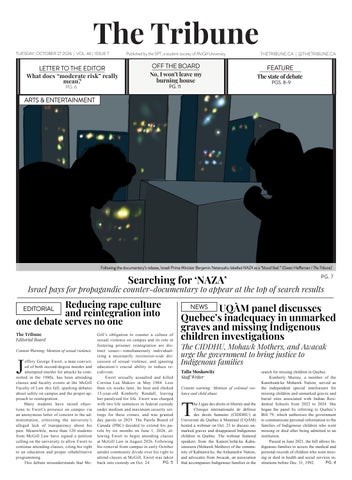
Following the documentary’s release, Israeli Prime Minister Benjamin Netanyahu labelled NAZA as a “blood libel.” (Gwen Heffernan / The Tribune)
Searching for ‘NAZA’
PG. 7
Israel pays for propagandic counter-documentary to appear at the top of search results
Reducing rape culture and reintegration into one debate serves no one EDITORIAL
The Tribune Editorial Board Content Warning: Mention of sexual violence
J
effery George Ewert, a man convicted of both second-degree murder and attempted murder for attacks he committed in the 1980s, has been attending classes and faculty events at the McGill Faculty of Law this fall, sparking debates about safety on campus and the proper approach to reintegration. Many students have raised objections to Ewert’s presence on campus via an anonymous letter of concern to the administration, criticizing the university’s alleged lack of transparency about his past. Meanwhile, more than 120 students from McGill Law have signed a petition calling on the university to allow Ewert to continue attending classes, citing his right to an education and proper rehabilitative programming. This debate misunderstands that Mc-
Gill’s obligation to counter a culture of sexual violence on campus and its role in fostering prisoner reintegration are distinct issues—simultaneously individualizing a necessarily institution-wide discussion of sexual violence, and ignoring education’s crucial ability to reduce recidivism. Ewert sexually assaulted and killed Corrina Lea Makiev in May 1984. Less than six weeks later, he beat and choked 15-year-old Kimberly Rendall, leaving her paralyzed for life. Ewert was charged with two life sentences in federal custody under medium and maximum security settings for these crimes, and was granted day parole in 2025. The Parole Board of Canada (PBC) decided to extend his parole by six months on June 1, 2026, allowing Ewert to begin attending classes at McGill Law in August 2026. Following his removal from campus in early October amidst community divide over his right to attend classes at McGill, Ewert was taken PG. 5 back into custody on Oct. 24.
UQÀM panel discusses Quebec’s inadequacy in unmarked graves and missing Indigenous children investigations NEWS
The CIDDHU, Mohawk Mothers, and Awacak urge the government to bring justice to Indigenous families Talia Moskowitz Staff Writer Content warning: Mention of colonial violence and child abuse
T
he Ligue des droits et libertés and the Clinique internationale de défense des droits humains (CIDDHU) at Université du Québec à Montréal (UQÀM) hosted a webinar on Oct. 23 to discuss unmarked graves and disappeared Indigenous children in Quebec. The webinar featured speakers from the Kanien’kehá:ka Kahnistensera (Mohawk Mothers) of the community of Kahnawà:ke, the Atikamekw Nation, and advocates from Awacak, an association that accompanies Indigenous families in the
search for missing children in Quebec. Kimberly Murray, a member of the Kanehsatà:ke Mohawk Nation, served as the independent special interlocutor for missing children and unmarked graves and burial sites associated with Indian Residential Schools from 2022 to 2024. She began the panel by referring to Quebec’s Bill 79, which authorizes the government to communicate personal information to the families of Indigenous children who went missing or died after being admitted to an institution. Passed in June 2021, the bill allows Indigenous families to access the medical and personal records of children who went missing or died in health and social services inPG. 4 stitutions before Dec. 31, 1992.
2
NEWS
news@thetribune.ca
TUESDAY, OCTOBER 27 2026
Ewert’s McGill attendance sparks debate about reintegration and safety
Public opinion split as Ewert taken back into custody on Oct. 23 Ilia Mehr-Bakhsh News Editor Content warning: Mention of sexual violence
O
n Oct. 6, 2026, McGill University exercised Section C29: Interim Orders (d) of the Code of Student Conduct and Disciplinary Procedures to issue an Order to Exclude, removing Faculty of Law student Jeffrey George Ewert from campus. On Oct. 23, Ewert was taken back into custody after breaching his parole conditions. Ewert was convicted of second-degree murder and attempted murder for attacks he committed in British Columbia in 1984. Ewert sexually assaulted and killed one woman and later choked and beat a 15-yearold girl, leaving her paralyzed for life. He was sentenced to life in prison and was granted day parole in 2025. After a few students reported their discovery of Ewert’s criminal history to the CBC, the subsequent publicization of Ewert’s McGill attendance in the news sparked a wave of backlash and debate across campus. Notably, an anonymous group of McGill community members published a letter of concern on Oct. 19. The letter outlined publicized Ewert’s social media use and comments, including examples of provocative remarks he has directed at women on X and Threads, most of whom are AI bots. His social media use also shows that he has saved images of young girls on a Pinterest board. The letter of concern was addressed to Provost and Executive Vice President Academic Angela Campbell, the Dean of Students and Associate Provost of Student Life & Learning Tony Mittermaier, and the Dean of the Faculty of Law Tina Piper, calling on McGill to strengthen safety frameworks to better support both Ewert and his student peers. Simultaneously, McGill’s removal of Ewert prompted the circulation of a petition titled, “Open Letter: Reconciliation and Reintegration Cannot Mean Exclusion.” Signed by hundreds of academics and students from across Canada—including McGill Law students—the letter calls on the McGill administration to restore Ewert’s access to the Faculty of Law, to discuss the terms of his exclusion with a view to reintegration, and to undertake a comprehensive review of the decisions McGill makes concerning Indigenous, racialized, and formerly incarcerated students. During his time as an inmate, Ewert has served as head of the Canadian Prisoners’ Labour Confederation (CPLC), and won a 2018 case before the Supreme Court in this role. In Ewert v. Canada, the Court held that Correctional Service Canada (CSC) continued to rely on certain instruments in risk assessments of Indigenous prisoners like Ewert without taking reasonable steps to ensure the validity of these tests for this demographic. In a written statement to The Tribune, McGill’s Media Relations Office (MRO), while not commenting specifically on Ewert’s case, spoke broadly about the decisionmaking processes behind acceptance and attendance at McGill, noting that the university will actively review its admissions
processes to prevent a similar situation from occurring in the future. “The safety and security of our students is paramount. Full stop. While criminal background checks are not typically part of Canadian universities’ admissions processes, McGill would act quickly and decisively should concerning information be brought forward about a student’s background or behaviour on campus,” the MRO wrote. The McGill Law Students Association (LSA) explained, in a written statement to The Tribune, that they were not notified of Ewert’s criminal history in advance of public discourse about his attendance. “We met [Ewert] along with the rest of the incoming cohort and were not made aware of his past. Members of the LSA Executive Council received this news at the same time and in the same way as the rest of the student body,” the LSA wrote. A 2L McGill Law student, who wished to remain anonymous, expressed concern over Ewert’s social media use since he was granted day parole. “I did see one photo of a little, young girl [....] He saved that photo […] to his [Pinterest] board,” the student noted. “He [comments], ‘Hotties like you [drive] us crazy,’ [on images of women significantly younger than him]. These are the same women who share the same demographic as [his former] victims, who share the demographics of the women that attend McGill.” The student then emphasized that equating support for rehabilitation with continued endorsement of Ewert’s presence on campus misconstrues the intentions of those who criticize his attendance. “The [McGill community members] who are treating this as [a debate about] if you believe in rehabilitation or not, I really don’t agree with them, and I [find] their reasoning quite unfortunate, because this is not a black or white question,” they said. The student also underscored McGill’s responsibility to put student security first. “The Faculty [of Law] clearly failed in ensuring not only [Ewert’s] reintegration, but also the safety of the many young, […] hardworking women who attend this faculty,” they said. A 3L McGill Law student who helped co-draft the open letter of support for Ewert’s reinstatement—and who wished to remain anonymous—explained in an interview with The Tribune that she is personally acquainted with Ewert. She spent several hours helping him with administrative tasks related to his onboarding at the Faculty of Law. Although she acknowledged students’ discomfort with Ewert’s attendance at McGill, she personally did not feel unsafe around him. “For me, the question of safety is, of course, justifiable, especially for survivors [of sexual violence], to feel strange when someone with [Ewert’s] past comes to the faculty. What they choose to do with those feelings of discomfort is what really matters,” she said. “The general public may just think that he’s just allowed to go wherever, but he has extremely restrictive safeguards placed on his release [....] He’s under extremely strict surveillance.” This student referred to Ewert’s work in prison as head of the CPLC, as well as the
case of Ewert v. Canada, to demonstrate his “There is an extensive history of camdedication to legal scholarship. puses neglecting women’s safety, particular“He basically taught himself law. He ly when it comes to sexual and gender-based pleaded in front of several courts [....] He violence, and McGill is no exception,” the started a labour union for prison labourers group wrote. “The conversation surrounding to advocate for fair wages [....] What he has it cannot happen in a vacuum.” done pre-law school is probably a lot more Ashley Kyne, a PhD student in the Dethan what a lot of people will do post-law partment of Criminology at the University of school,” she said. Ottawa, discussed Indigenous overrepresenShe argued that Ewert’s participation in tation in the Canadian correctional system the Faculty of Law is a valuable asset to the and the limits of risk assessments in an interMcGill community. view with The Tribune. “The fact that I was able to meet [Ewert] “The important question is: what proand to hear his story and to learn from his duces that overrepresentation?” Kyne asked. story has given me a much better under- “We can’t understand [incarceration rates] standing of the world, and the criminal jus- without considering the historical and ontice system,” the student said. “The purpose going consequences of colonialism, things of law school is to [...] to instill broader com- like residential schools, the Sixties Scoop, mitments [in] students to question how they, displacement, intergenerational trauma, and as lawyers, have a responsibility to advance systemic discrimination.” justice, [...] interrogate power structures, and While Ewert’s risk classification is commit [themselves] to improving them.” moderate to high, Kyne reaffirmed that such Amy Haysom, a 1L at McGill Faculty a classification does not necessarily mean of Law, is a classmate and friend of Ewert someone poses an immediate threat to public and believes McGill’s exclusion of Ewert safety. from the Faculty of Law is a breach of his “Risk classifications are estimates based rights. on particular factors, populations, and out“He is an intelligent man who has en- comes. They can’t predict with certainty gaged in legal activity while in prison in a whether someone will reoffend, let alone very meaningful and significant way, and in whether they will harm someone in a parparticular for Indigenous Peoples,” Haysom ticular setting,” Kyne said. “We also need to said in an interview with The Tribune. recognize that [Ewert’s] risk was reportedly Haysom expressed disappointment that assessed as moderate with close supervision. students chose to report their discovery of This distinction matters because he is on day Ewert’s criminal history to CBC, arguing parole, meaning he is subject to conditions that their actions did more to sensationalize and ongoing correctional oversight.” the issue rather than provide space for diaAs of Oct. 24, Ewert is back in custody logue. after a suspension warrant was issued against “It was irresponsible and not represen- him. Kyne highlighted that a technical viotative [....] [They should have gone] directly lation of a parole condition and behaviour to [the] McGill Law administration to talk indicating an increased risk of serious harm about it and bring concerns [....] Their fears are not one and the same. She articulated that were absolutely valid,” she said. the correctional system has a responsibility In a written statement to The Tribune, to assess the significance of this behaviour the Quebec Public Interest Research Group and respond appropriately. (QPIRG)-McGill highlighted the social re“What people are asking is a legitimate sponsibility to foster prisoners’ justice ini- question: ‘If someone’s on parole concerntiatives. ing behaviour emergence, how quickly can “The irony is that students are more cu- the system intervene?’ [....] But I also emrious than ever to learn about what sorts of phasize that parole is [meant] to manage risk violence people face in prison, while incar- while supporting reintegration, and not simcerated people themselves are having their ply to wait for someone to make a mistake.” educational opportunities stripped away Students seeking sexual violence supfrom them,” QPIRG-McGill wrote. “In just port may contact McGill’s Office for Sexual this past year, QPIRG organized a screening Violence Response, Support and Education of ‘Criminal Queers’ on campus; a panel on (OSVRSE), the Sexual Assault Centre of the anti-carceral struggles in so-called Canada; McGill Students’ Society (SACOMSS) , and and we were a core part of the organizing the Office for Mediation and Reporting. committee for the Prisoners’ Justice Day vigil, an annual memorial for people who have died in prison.” It’s On Us McGill is a student-led organization which works to raise awareness around sexual assault, consent, and survivor support on campus. In a written exchange with The Tribune, the organization called on McGill to prioritize student Indigenous Peoples represent 4.5 per cent of the Canadian adult safety and survivor population, but 26.3 percent of new admissions to federal prisons. (Tobias Izenberg / The Tribune) well-being.
TUESDAY, OCTOBER 27 2026
news@thetribune.ca
NEWS
3
SSMU BoD ratify motion regarding HUJI academic boycott
Students vote 77 per cent in favour of ratification of the HUJI motion Josette Chandler News Editor
O
n Oct. 20, the Students’ Society of McGill University (SSMU) Board of Directors (BoD) held a meeting during which the Motion Regarding the Academic Boycott of the Hebrew University of Jerusalem Exchange Program was ratified, after over 77 per cent of participating students voting in favour of the ratification. The motion was initially passed in the SSMU Fall 2026 General Assembly by over 96 per cent of students. The initial motion was proposed by Faculty of Law student Sumayya Kheireddine on Sept. 14. In the document, Kheireddine cited two existing SSMU documents—the Policy on Harmful Military Technology and the Policy Against Genocide in Palestine—which mandate the SSMU to cut ties with the Hebrew University of Jersualem (HUJI) for its involvement in Israeli military action against Palestine. In a written statement to The Tribune, Kheireddine explained that the motion comes at a crucial time as the McGill and HUJI exchange agreement nears a renewal window. “After three years of genocide in Palestine, students shouldn’t have to wait for the university to act on its own,” Kheireddine wrote. “The petition is a starting point: a concrete, achievable step toward severing ties between McGill and Israeli institutions complicit in the genocide. The timing matters because renewal terms are negotiated by late 2027, so the student body’s voice has to be heard before
that decision is made.” In a written statement to The Tribune, Rula Abisaab, professor in the Institute of Islamic Studies and member of Profs4Palestine, highlighted that the ratification of this motion demonstrates the resilience of McGill’s student body. “It reflects their commitment first, to stand up against genocide, and second, [their use of] democratic structures of the university, Quebec, and Canada to make their voices heard by the administration,” Abisaab wrote. Abisaab underscored the evidence tying HUJI to the Israel Defense Forces (IDF)—Israel’s military directly responsible for the ongoing genocide of Palestinians. “Independent reports offer unequivocal evidence that the [HUJI] works closely with the [IDF],” Abisaab wrote. “It is a pillar of Israel’s system of colonization; the killing, imprisonment, torture, and displacement of Palestinians and the stealing of their land in contravention of international law. By supporting exchange programs with HUJI, which has an army base on campus, and offers special support to student soldiers aside from training military intelligence, McGill is signing off on all these activities.” McGill has yet to renegotiate its exchange agreement terms with HUJI, but it does not currently permit students to travel to Israel on exchange due to Canada’s level 3 travel advisory against non-essential travel in the area. In a written statement to The Tribune, McGill’s Media Relations Office responded to student advocacy against the continuation of
the exchange agreement. student movement, they continue to side with “McGill recognizes the autonomy of its Zionism,” the representative wrote. “The stustudent associations to debate and adopt posi- dents will continue to advance this motion tions, and we take seriously concerns students within the university, from our professors to raise through their democratic bodies,” the the Senate and more.” representative wrote. “The University’s position on BDS has been consistent: McGill opposes the boycott, divestment, and sanctions movement, including academic boycotts, as contrary to academic freedom, equity, inclusion, and the open exchange of ideas. That principle guides how we approach our international academic partnerships.” In a written statement to The Tribune, a representative from Students for Palestine’s Honour and Resistance at McGill (SPHR), who wished to remain anonymous, expressed their disappointment in the university’s reluctance to condemn genocide in Palestine and to acknowledge their complicity in such. “[McGill’s] silence only confirms how spineless our administrators remain in the face of the genocide of Palestinians. Their choice is clear: They continue to accept and support the murder of Palestinians, and when faced with opportunities to divert funding from genocide 15 per cent of eligible voters participated in the ratification and answer the demands of the vote. (Eliot Loose / The Tribune)
PGSS AGM reviews graduate student funding and students’ precarious living situations
Councillors discuss Bill 9 and safe prayer spaces on campus Norah Adams Arts & Entertainment Editor
O
n Oct. 21, the Post-Graduate Students’ Society (PGSS) met in the Thompson House ballroom for their annual general meeting (AGM). McGill’s PGSS council members, as well as representatives from each graduate department, began the evening with a closed meeting to discuss which motions to address at the open AGM later that night. The university’s Biennial McGill Graduate Student Funding Report held priority in the closed meeting. This report details both financial survey results from graduate students and funding data provided by the McGill administration. Council member Juliette Gomes of the Adams Club questioned the report’s omission of the poverty line in the assessment of graduate student funding. In response, Steffy Velosa, PGSS funding and supervision commissioner, underscored that adding more information to the current graphs, which depict funding trends, would detract from the report’s goals. Instead, she suggested that a separate infographic might be necessary to address graduate students’ proximity to the Montreal poverty line. After this discussion, the report was ultimately accepted. After a break, including an extra ten minute wait to reach quorum, the AGM officially began. During announcements, Amina Bourai, PGSS university affairs officer, emphasized
how the newly passed Bill 9 affects students’ rights to religious practice on campus. She informed members that in light of this bill, abstaining from public prayer may be wise as McGill’s stance on penalizing public religious practice is not yet clear. Bourai then disclosed that the Students’ Society of McGill University (SSMU) will continue to allow students to pray in designated reflection rooms, and, in this announcement, she recommended that all who wish to pray on campus do so safely in these spaces. In response, Donald Morard III, secretary general, reaffirmed that the PGSS is a separate organization from McGill and, therefore, its spaces—including Thompson House—also remain safe places for prayer. Following this discussion, Velosa, alongside Sarah Fraser, master’s student at McGill, presented the Graduate Student Funding Report approved in the closed meeting to all in attendance. The survey information from graduate students revealed the different sources of financial insecurity—including limited funding from McGill—these students currently face. “We asked students how frequently they changed or reduced their eating habits due to insufficient funds in the last month, and our results show that 71 per cent, which is almost three-quarters of students, did so at least one time in the past month, and 50 per cent did so three or more times,” Fraser said. Alongside food vulnerability, financial insecurity also affects students’ healthcare, with close to 30 per cent of graduate students
reporting that they have forgone medical ser- useful report, and hopefully, you can use it vices due to insufficient funds. According to go to your faculties, departments, et cetera, to the report, these lifestyle impacts unveil and really push to get the funding that you dethat McGill’s graduate funding system inad- serve,” Morard III said. equately supports students’ needs. Moment of the Meeting Velosa decried the university’s lack of Zoe Neubauer, PGSS external affairs officer, standardized minimum stipends, noting that announced that the Teaching Support Union at many faculties do not offer livable or renewMcGill (TSUM), formerly known as Association of able stipends. She later presented a table illusGraduate Students Employed at McGill (AGSEM), trating which departments provide median net will enter into bargaining with McGill next year, funding that keeps graduate students below as their contract expires in summer 2027. the poverty line. Velosa highlighted that access to this Soundbite data is crucial for graduate students to advo“This bill applies to everyone. Staff, students, cate for better financial support. their moms, everybody, everyone.”—University “You can go to the funding report and Affairs Officer Amina Bourai during a discussion identify whether or not your specific departof Bill 9 ment and your program meet any of these thresholds, and you can use that to start conversations with your department leadership about funding challenges,” Velosa said. According to Morard III, the PGSS’ commitment to publishing data on McGill’s graduate student funding is laying the foundation for studentled advocacy for livable stipends. He mentioned using it earlier that day as a tool with professors. This year, the PGSS introduced a new council member role: the deputy “It is a really secretary general. (Tobias Izenberg / The Tribune)
4
NEWS
TUESDAY, OCTOBER 27 2026
news@thetribune.ca
SSMU BoD discusses HUJI boycott motion, ratifies Plate Club fee increase motion
Meeting addresses director duties, formal representation for athletic teams, and library accessibility Lulu Calame Opinion Editor
O
n Oct. 20, the Board of Directors (BoD) of the Students’ Society of McGill University (SSMU) met for the second time this academic year. The meeting opened with a presentation from Alison Glaser, SSMU internal counsel and corporate secretary, which outlined board members’ particular duties, as well as regulations on confidentiality, conflicts of interest, and members’ individual liability. After this presentation, the board entered a confidential session before returning to ratify the meeting notes from the Aug. 18 and Sept. 15 BoD meetings, followed by the ratification of the Executive Committee Public Report and the Nominating Committee Report. The board then moved into discussion of the proposed motions for the 2026 Fall Referendum, whose voting period began on Oct. 26. The first motion on the agenda was the Motion Regarding the Academic Boycott of the Hebrew University of Jerusalem Exchange Program—which passed in the Fall 2026 General Assembly on Sept. 28. SSMU President Hamza Abu-Alkhair presented the motion to the board, noting that the results speak for themselves, as the motion was overwhelmingly ratified by the student body. “[It was with] around 80 per cent [approval] that it passed, which frankly is surprising to me,” said Abu-Alkhair.
He also emphasized that unlike past motions condemning Israel’s genocidal siege in Gaza—such as the motion for a three-day student strike for Palestine passed in April 2025— this motion presents much more actionable demands to the administration itself. “We haven’t had motions like this that have been so tangible,” Abu-Alkhair said. “Mostly, [similar past motions have been] about policies that really don’t mandate certain executives or certain individuals to do [specific] things. This time, it directly tells the [Vice President (VP) University Affairs Meghan Lai], as well as [President Deep Saini], to bring a motion.” Rhys Jones, Arts Representative to SSMU, asked Abu-Alkhair how the legal consequences of this motion might differ from that of the 2023 motion for the Policy Against Genocide in Palestine, which precipitated serious legal consequences for SSMU by the Superior Court of Quebec. Abu-Alkhair said that he and Lai have already been in talks with members of the administration—including the Dean of Students, Tony Mittermaier, and the Provost, Angela Campbell—about how to avoid that very issue. The board ratified the motion, and went on to ratify motions allowing the CKUT radio station and the Quebec Public Interest Research Group (QPIRG)-McGill to run existence motions in the Fall 2026 Referendum. The board also ratified a constitutional amendment regarding official representation for athletic teams. VP Clubs and Services Acadia Knickerbocker then presented the Motion Regarding
Plate Club Fee Increase. The existing student Moment of the Meeting fee for the Plate Club is 14¢ CAD per student Knickerbocker argued a strong case for the per semester, and the proposed motion would Motion Regarding Constitutional Amendment increase this fee to 34¢ CAD. Knickerbocker for Athletic Teams, emphasizing that this motion explained that the 14¢ fee has been in place would recognize athletic teams as a club and allow for years, and that in that time, the Plate Club them proper representation under SSMU. has significantly expanded its services and increased its volunteer base. Soundbite “They have an entire volunteer [executive] “It has been abundantly clear that there team and 40 or so volunteers that help with the [are] severe issues in the data and reporting of operations of the service, which is up signifiactuals inside the society, and so the information cantly from previous years, where it [had] 0 exthat I am being provided to work for the budget ecutives and 2 to 5 volunteers,” Knickerbocker is fundamentally flawed, and so I am not able to explained. “With that, and with the increase in make a proper judgment as to how the budget the amount of orders that they are fulfilling, should be allocated.”—Wang on the state of their current operations are not sustainable.” SSMU’s finances The BoD ratified the motion to place the Plate Club fee increase motion on the referendum ballot, and moved on to discussing plebiscite questions for the upcoming referendum regarding the Library Improvement Fund and student affordability. VP Finance Jason Wang then presented a motion to postpone the presentation of the SSMU budget to the Legislative Council, citing faulty fiscal data. The motion was Plebiscite questions included in SSMU referendums collect important ratified, and the meeting information about student attitudes and what issues should be raised adjourned shortly after. as motions in future referendums. (Tobias Izenberg / The Tribune)
UQÀM panel discusses Quebec’s inadequacy in unmarked graves and missing Indigenous children investigations
The CIDDHU, Mohawk Mothers, and Awacak urge the government to bring justice to Indigenous families Talia Moskowitz Staff Writer Continued from page 1. Content warning: Mention of colonial violence and child abuse However, Bill 79 has been implemented and enforced by non-Indigenous authorities, which has led Murray to argue it does not sufficiently prioritize the needs of the Indigenous families it aims to address. “[That legislation] sits within the government of Quebec [....] Having that be governed by Indigenous People every step of the way is what First Nations communities have been talking about in other provinces to try and improve on the legislation in Quebec,” Murray said. Sandy Kalai and Aya Boucenna, students at UQÀM and members of the CIDDHU, then introduced the CIDDHU’s 2026 report on Quebec’s international obligations to follow standards set by the United Nations (UN) enshrining the rights of Indigenous Peoples. Canada’s federal UN Declaration on the Rights of Indigenous Peoples Act requires alignment of domestic laws with these international standards. The CIDDHU’s report specifically covered Quebec’s implementation of legislation regarding Indigenous children who
went missing in residential schools and healthcare facilities, and now may be buried in unmarked graves. Kalai explained that Quebec’s Cultural Heritage Act is currently exercised without mechanisms to protect former residential schools sites, leaving potential evidence of unmarked graves vulnerable to destruction. “The problem is that the [Act] calls for legislative measures that would allow for rapid designation of these sites, which may be altered […] even though some may still contain material evidence and human remains that are currently unprotected,” Kalai said. Boucenna underscored that currently, Quebec does not adequately ensure disappeared Indigenous children’s families have the same degree of access to information as the government does. “There is also a lack of oversight at the institutions in question, which are the only ones with exclusive access to the archives and records concerning missing or deceased children, with no obligations to share them with families,” Boucenna said. Activist and spokesperson for the Mohawk Mothers, Kwetiio, highlighted the ongoing legal battle between the Mohawk Mothers, McGill, and the Société québécoise des infrastructures (SQI) over construction on the grounds of McGill’s Royal Victoria Hospital.
In a written statement to The Tribune, have happened there, not only to our peoMcGill’s Media Relations Office (MRO) ple, but [also to] other Canadians,” Kwetiio stated that this Sustainability Park project said. “Right now, McGill and SQI have is being developed with consideration for motioned to dismiss once again. I don’t see Indigenous perspectives. how it’s not in their best interest to settle “Indigenous cultural monitors [have] with us, and to have some kind of proper been invited to observe the excavation work engagement and agreement to do the right of the project, in full respect of the 2023 thing.” Settlement Agreement that was reached with the [Mohawk Mothers],” the MRO wrote. Kwetiio restated the Mohawk Mothers’ aim to halt the Sustainability Park project in order to search for potential unmarked graves of Indigenous children and victims of CIA-funded MKUltra experiments at the site. “We have been investigating the grounds, the archives, the According to a 2026 report by the Quebec government, 129 individuals evidence of the have requested the government search for 221 missing Indigenous children. atrocities that (Zoe Lee / The Tribune)
T EDITORIAL BOARD Editor-in-Chief Mairin Burke editor@thetribune.ca Creative Director Zoe Lee creativedirector@thetribune.ca Managing Editors Asher Kui akui@thetribune.ca Ellen Lurie elurie@thetribune.ca Clara Smyrski csmyrski@thetribune.ca News Editors Ilia Mehr-Bakhsh Josette Chandler Helene Saleska news@thetribune.ca Opinion Editors Lulu Calame Julie Raout Camila Sierra Ordóñez opinion@thetribune.ca Science & Technology Editors Avery Berry Sarah McDonald scitech@thetribune.ca Student Life Editors Rachel Blackstone Tamiyana Roemer studentlife@thetribune.ca Features Editor Kaitlyn Schramm features@thetribune.ca Arts & Entertainment Editors Norah Adams Annabella Lawlor arts@thetribune.ca Sports Editors Merce Kellner Ivanna Zhang sports@thetribune.ca Design Editors Eliot Loose Gwen Heffernan design@thetribune.ca Photo Editors Emiko Kamiya Sophie Schuyler photo@thetribune.ca Multimedia Editors Will Dawson Daphne Short multimedia@thetribune.ca Web Developers Zola Ball Kate Lauro webdev@thetribune.ca Copy Editor Ella Bachrach copy@thetribune.ca Social Media Editor Chloe Ross socialmedia@thetribune.ca Business Manager Amy Xia business@thetribune.ca
TPS BOARD OF DIRECTORS Zain Ahmed, Nour Khouri, Celine Li, Lialah Mavani, Ilia Mehr Bakhsh, Aleks Rohozinski, Alex Hawes Silva
STAFF
Zain Ahmed, Julia Apitz-Grossman, Brooke Barak, Miranda Forster, Abigail Francis, Alex Hawes Silva, Helena Helms, Dylan Hing, Gretta Iraheta Palacios, Lialah Mavani, Shea McDonnell, Jenna Payette, Sofia Vidinovski Rokayah Bellaoui, Chloe Bhogal, Tobias Izenberg, Evy Shamber
CONTRIBUTORS Parker Aiken, Renata Firestone, Maya Hidalgo, Alice de Vlieger Louis Pardoe
TRIBUNE OFFICE Shatner University Centre, 3480 McTavish, Suites 404, 405, 406 The Tribune is an editorially autonomous newspaper published by the Société de Publication de la Tribune, a student society of McGill University. The content of this publication is the sole responsibility of The Tribune and the Société de Publication de la Tribune, and does not necessarily represent the views of McGill University. Letters to the editor may be sent to editor@thetribune.ca and must include the contributor’s name, program and year and contact information. Letters should be kept under 300 words and submitted only to The Tribune. Submissions judged by The Tribune Publication Society to be libellous, sexist, racist, homophobic or solely promotional in nature will not be published. The Tribune reserves the right to edit all contributions. Editorials are decided upon and written by the editorial board. All other opinions are strictly those of the author and do not necessarily reflect the opinions of The Tribune, its editors or its staff.
OPINION
opinion@thetribune.ca
TUESDAY, OCTOBER 27 2026
Reducing rape culture and reintegration into one debate serves no one The Tribune Editorial Board Continued from page 1. Ewert’s arrest reflects that since 2025, he has breached his release conditions multiple times: joining dating platforms, attempting to contact women, failing to disclose these relationships to the PBC, and keeping such breaches from his case management team. Students’ discomfort with Ewert’s presence on campus, given these breaches and the nature of his original crimes, is real and pressing. Correctional Service Canada (CSC)’s decision to suspend Ewert’s conditional release is a step toward prioritizing women students’ concerns about campus safety. While nothing alleviates the
egregiousness of Ewert’s crimes and subsequent breaches of his parole conditions, using him as a flashpoint for conversations about sexual violence obscures McGill’s endemic inaction against rape culture, enabled both by the university’s insufficient policies and negligent enforcement of them. The fact that students contacted media outlets about Ewert’s presence on campus before publishing any open letters appealing directly to McGill suggests a lack of faith in the administration’s institutional mechanisms for addressing sexual violence. It is not Ewert’s criminal history that makes his ongoing harassment of women condemnable; it is the fact that his behaviour is a manifestation and perpetration of this systemic rape culture. McGill’s Policy Against
Sexual Violence condemns sexual assault and harassment unconditionally; Ewert is thus neither the exception nor the rule. It is false to imply that removing Ewert will dismantle McGill’s pervasive rape culture entirely, and it is equally unproductive to scapegoat Ewert to claim that incarcerated people should never be allowed on university campuses. Education is a fundamental mechanism of prisoner rehabilitation, and until this year, CSC provided postsecondary education to prisoners in Quebec’s federal prisons in recognition of this fact. In February, however, CSC cut funding for this program, and in doing so undermined its crucial benefits: Post-secondary education drastically reduces recidivism rates, while also providing a monitored environment in
5
EDITORIAL
which incarcerated people can develop a sense of normalcy and practice prosocial behavioural skills. In this way, educational programming also acts as a litmus test for whether a prisoner is ready to safely reenter society. CSC’s decision to defund such programs has forced universities like McGill to become the stage for this test, posing risks to campus safety and student comfort. But these risks do not erase the proven benefits of prison education, nor the fact that education is a human right. CSC must re-enshrine its commitment to in-prison education systems, allowing rehabilitative programming to take place before a former or current prisoner ever steps foot on a university campus. Simultaneously—and separately—it is up to McGill to foster consent culture beyond circumstantial damage control.
Kebaowek ruling exposes Canada’s hollow commitment to Indigenous rights COMMENTARY
Alice de Vlieger Contributor
I
n a landmark ruling released on Oct. 16, the Canadian Federal Court of Appeal (FCA) sided against the Kebaowek First Nation, thus allowing for the construction of a nuclear waste facility on the banks of the Kichi Sibi (Ottawa River). While the decision itself marks a difficult loss for the Indigenous communities who fought against it, the precedent it sets is even more insidious: that the Government of Canada is not obligated to act in accordance with the United Nations (UN) Declaration on the Rights of Indigenous Peoples (UNDRIP), and is not required to seek the “free, prior, and informed consent” of Indigenous communities affected by state decisions. This ruling is not an isolated event: It is further evidence that despite Canada’s purported support for the rights of Indigenous Peoples, industry priorities ultimately prevail over the protection of Indigenous nations and their land. The proposed nuclear waste dump, the Near Surface Disposal Facility (NSDF), will be built at the site of Chalk River Laboratories, located on the unceded land of the Algonquin Anishinabeg Nation. Owned by Canadian Nuclear Laboratories (CNL), the nuclear waste dump is intended to permanently hold up to one million cubic
metres of the radioactive waste that has been piling up from decades of Canadian nuclear research and production. Kebaowek First Nation, an Algonquin Anishinabeg band government, has expressed concerns about the dump’s potential to lead to deforestation, nuclear contamination of drinking water, and the displacement of culturally significant species. After the Canadian Nuclear Safety Commission authorized construction of the NSDF in January 2024, Kebaowek First Nation challenged the approval in Canadian federal court on the grounds that the commission had failed to act in accordance with UNDRIP—which establishes minimum standards for the treatment of Indigenous Peoples worldwide. Article 32 of UNDRIP asserts that states must obtain the “free and informed consent” of Indigenous Peoples “prior to the approval of any project affecting their lands or territories and other resources.” This international measure was integrated into Canadian law in 2021 with the passing of the UN Declaration on the Rights of Indigenous Peoples Act (UNDA). Justice Julie L. Blackhawk ruled in favour of Kebaowek First Nation’s appeal in 2025, instructing that consultation on the NSDF project be resumed. The latest decision, however, marks a big step in the opposite direction. The FCA granted CNL’s appeal of Justice Black-
hawk’s ruling, holding that the UNDA is not law but a framework that guides lawmaking; until a process to implement UNDRIP is clearly laid out, it cannot override existing ones. This conservative interpretation of the obligations the UNDA Chalk River Laboratories was the site of the world’s creates denies In- first nuclear reactor meltdown in 1952. (Eliot Loose / digenous communi- The Tribune) ties their right to free, prior, and pipeline as a project of national informed consent. interest without obtaining consent Zooming out from this case, a from Indigenous communities. dangerous pattern emerges. While The government may say it Canada claims to uphold the prin- has a constitutional obligation to ciples laid out in UNDRIP, all consult with Indigenous groups three branches of government have to support reconciliation, but they separately made decisions that clearly think this consultation reundermine Indigenous Peoples’ quires only that Indigenous Peoples rights to consent and the Canadian are heard—not that their consent is government’s duty to consult. foregrounded. As UNDRIP frames In June 2025, Parliament it, active and informed consent is passed the Building Canada Act a crucial step toward recognizing as part of Bill C-5, a piece of leg- Indigenous self-determination. islation that aggressively reduces Canada must comply with regulatory timelines for critical UNDRIP’s consent standard by infrastructure projects deemed passing legislation that makes the projects of national interest in the resolution legally enforceable. name of economic growth. Indig- Until then, Carney will continue enous groups quickly raised red to approve environmentally devflags at the bill, expressing concern astating projects that favour ecowith its disregard for their rights to nomic growth at the expense of consultation on projects with nega- Indigenous rights. This harms the tive environmental externalities. very populations his government Backlash intensified when Prime has vowed to respect, and renders Minister Mark Carney’s cabinet Canada’s commitment to recondesignated the Pacific Link oil ciliation superficial.
6
OPINION
COMMENTARY
opinion@thetribune.ca
TUESDAY, OCTOBER 27 2026
Abolishing the Greek letter system is the first step toward combatting sexual violence
Niamh Maguire Staff Writer Content Warning: Mention of sexual violence
O
n Oct. 5, St. Francis Xavier University (St. FX) in Nova Scotia publicly condemned students from an off-campus rental house for draping a sign that the community argued perpetuated rape culture. The sign in question read, “Drop-off zone: Acadia girlfriends.” Amid community-wide backlash, the university demanded that the sign be taken down, while simultaneously launching an investigative code of conduct review of the students living in the house. St. FX president Andrew Hakin issued a public statement emphasizing that the university does not tolerate language or behaviours that objectify women, tolerate sexual violence, or promote rape culture. While St. FX does not have official fraternities or sororities, this incident reflects a broader rape culture across North American universities that is rooted in and perpetuated by Greek life. Greek letter organizations actively celebrate toxic power dynamics, and mere castigation is not enough. These institutions must be abolished in service of meaningful structural and systemic cultural change at McGill and universities beyond. The horrific sexual assault allegations coming out of Cornell University, where a woman is suing seven Chi Phi fraternity brothers—and the frat itself—for gang-rape in October 2024, have
raised global concerns regarding the role of collegiate institutions and Greek life organizations in defining sexual norms within and beyond university. At the time of the Greek letter system’s formation in the 1770s, only white, cisgender, wealthy men were entitled to enroll in university, and hence, the same rules applied to the Greek organizations born at those institutions. Fraternities’ white male foundations formed the enduring core of power inequities between men and women university students; by systematically upholding male dominance and aggression, fraternities in North America have fostered and propagated a dangerous and largely unchecked rape culture. Fraternity activities normalize excessive drinking, sexual harassment, toxic power dynamics, and the objectification of women. Fraternity members are three times more likely to commit an act of sexual assault than men not in a fraternity, while sorority members are 74 per cent more likely to be sexually assaulted than other women college students. McGill is no exception to the Greek life epidemic. Following historical and recent accounts of sexual violence involving McGill students, the university has attempted to implement protective and preventative measures, including the establishment of the Office for Sexual Violence Response, Support and Education (OSVRSE). Yet, so long as such measures are coupled with the ongoing existence of its seven fraternities and five sororities, McGill will remain illequipped to dismantle rape culture on campus.
In 1988, three men from McGill’s Zeta Psi allegedly gang-raped student Mary-Margaret Jones in an off-campus fraternity house, while an estimated 10 other fraternity members watched from the doorway. The charges against Zeta Psi were ultimately dropped, The first fraternity chapter at McGill, Zeta Psi, was established in 1883, and the though all were first sorority, Kappa Alpha Theta, was established three years later. (Louis Pardoe / The Tribune) reported to have been suspended from the fraternity itself. weeks for an appointment with OSVRSE after Similarly, in 2011, a Concordia student al- being sexually assaulted. She also alleged that leged that three McGill football players raped McGill administrators told her that it would be her, but charges were withdrawn due to a wit- “unduly punishing” to the perpetrator of her ness testimony that prosecutors believed con- assault to remove him from their overlapping firmed the assault was consensual. The three ac- classes, as it would threaten his ability to graducused men were allowed to continue playing for ate on time. McGill’s football team for 15 months after the One headline described Jones’ 1988 charges were laid, until they decided to quit fol- Zeta Psi gang-rape allegation as “‘Bad apple’ lowing the public disclosure of the charges and fraternity denounced at McGill,” but recent the conclusion of their season. events at McGill, Cornell, and now St. FX Still more recently, McGill’s sexual vio- highlight that the rape culture perpetuated by lence support services were brought under fire fraternities transcends a single frat’s walls, when an undergraduate student reported that in seeping into broader college environments the fall of 2021, she was forced to wait three and beyond.
LETTER TO THE EDITOR
What does “moderate risk” really mean? Emma Halpern Human Rights Lawyer
W
hen CBC reported that Jeffrey George Ewert, a man serving a life sentence, had been attending classes at McGill’s Faculty of Law while on parole, the public raised concerns. He had been assessed as presenting a “moderate-tohigh risk” of reoffending. Why, then, was he in a classroom? 42 years earlier, Ewert received a life sentence for killing Corrina Lea Makiev and grievously injuring 15-year-old Kimberly Rendall. He spent almost 40 years in prison and successfully earned a day parole release in 2025. He then enrolled in McGill’s law school and spoke openly in classes about his crime and incarceration. On Oct. 24, he was taken back into custody for his parole conditions to be reviewed. Universities must protect their communities, and women are entitled to have their safety concerns heard. But there is a profound difference between taking safety seriously and treating a risk label as scientific proof that someone is dangerous today. I represent people serving life sentences at parole hearings. I have seen how a few words—“moderate risk,” “high risk”—can
acquire the force of fact, even when the evidence behind them is far less certain than the label suggests. Risk assessment tools are often presented as objective, scientific measures of dangerousness. But what they actually measure is far more limited. Many assessments rely heavily on a person’s criminal history and characteristics statistically associated with recidivism among certain demographics. Some also incorporate professional judgment and evidence of change, but none can tell us with certainty whether a particular individual will commit another offence. Past violence is relevant and cannot be erased. But factors rooted in someone’s history cannot necessarily register every meaningful change in their maturity, conduct, relationships, treatment, or circumstances. A label like “moderate risk” may sound precise, but it is not necessarily a measure of that person’s actual likelihood of reoffending. Before repeating a risk label, we should ask: Which tool produced it? What outcome does it measure? How well does it predict that outcome for someone like this person? And what does the person’s current behaviour actually tell us? Ewert’s case makes these questions es-
pecially significant. In 2018, he won a landmark decision at the Supreme Court of Canada. In Ewert v. Canada, the Court held that Correctional Service Canada had breached section 24(1) of the Corrections and Conditional Release Act by continuing to rely on certain psychological and actuarial risk assessment instruments without taking reasonable steps to ensure their validity for Indigenous prisoners. Ewert is Métis. The instruments used to assess his risk of recidivism were developed and tested primarily on non-Indigenous populations, and Correctional Service Canada had long known of concerns about possible cultural bias. The Court found that the state’s statutory duty to ensure accuracy extends to the validity of assessments themselves. The Court connected this duty to Parliament’s broader direction that correctional practices respond to Indigenous peoples’ circumstances and advance substantive equality. In the Court’s view, treating everyone identically is not necessarily treating everyone fairly. This is not an abstract methodological debate. Risk assessment results can influence prisoners’ security classifications, access to programs, and recommendations
about their releases. Future decision-makers may then encounter a file dense with past ratings but thin on evidence of how the person functions in less restrictive conditions. The result can become circular: A person is denied opportunities because of their assessed risk, then their lack of progress or experience in the community is used to justify continued restrictions. None of this means that Ewert’s present conduct should be ignored, particularly his breaches of parole in contacting women. But rather than shutting down conversation about Ewert’s presence on campus with, “He is moderate-to-high risk,” we should begin by asking a more difficult question: What does an assessment actually tell us about the person in front of us today, and what other parts of a person’s life and experience need to be measured against this tool to ensure real, meaningful community safety? The stakes go beyond one law student. Education, work, and community are what have been proven to lower risk over time. Thus, if the term “moderate risk” is used to wholly define who an incarcerated individual is, they may end up isolated from the very conditions that create safety.
arts@thetribune.ca
TUESDAY, OCTOBER 27 2026
ARTS & ENTERTAINMENT
7
Rejoicing in the phenomenon of Angine de Poitrine The polka-dotted alien world of the musical duo goes global Gretta Iraheta Palacios Staff Writer
I
n late June, the Montreal Jazz Festival broke a historic attendance record when a paper-mâché-masked duo took the legendary main stage. Musicians from Saguenay, Quebec, Angine de Poitrine, drew in a massive crowd eager to travel through sonic dimensions. The two anonymous artists—who assume black-and-white polka-dotted personas Klek and Khn de Poitrine—define their music as “Dada Pythago-Cubist MantraRock.” They have constructed their sound as a multiplicative relationship of audio elements, creating music that is constantly in flux. Klek takes to the drums, grounding the rhythm of the strings—whether through the incremental inclusion of sonic elements, or the intentional use of silence. Meanwhile, Khn plays a double-necked microtonal guitar and bass, and uses an electronic looping module operated by his toes to record, layer, and harmonize various riffs. The music of these self-proclaimed “space-time voyagers” takes listeners on a journey far from their places in the audience. The layered component of their music creates a sense of progression—like you’re going on a transcendental quest, with no way of knowing where you’ll end up. Angine de Poitrine’s rock tracks take listeners to destinations way beyond the stratosphere.
Perhaps this explains the group’s peculiar name, which is the French term for angina pectoris: a condition characterized by chest pain or discomfort when the heart lacks oxygen or blood flow. Interestingly enough, the group’s polka-dot characters began as a joke. They were asked to perform at a venue they had played just days prior as a favour to their friend, the venue’s manager. Out of fear of deterring concertgoers by putting on a similar act, the two musicians decided to wear costumes and perform under a different name. Nonetheless, Angine de Poitrine stands firmly in its commitment to performance art. Kooky costumes aside, they communicate with each other using alien-like noises, and make triangle symbols with their hands over their heads, which has now become a widespread symbol of fan membership. These elements only accentuate the otherworldly experience of their performances. Furthermore, the duo’s true identities remain unknown, adding to the mystique of their art. The pair began to gain massive global traction in February 2026, when a video of their performance at the 2025 French Festival Trans Musicales was shared by Seattle radio station KEXP. The video now has 20 million views on YouTube. Their March 2026 appearance on Quebec talk show Tout le monde en parle only further cemented their household-name status in their home
province. music is uniquely theirs. The alien brothers Since then, the appeal of this eccentric combat conformity through a commitment band has grown exponentially. Fans and to the bizarre, one which seems to truly and festival lovers were thrilled when the alien deeply resonate with the masses. brothers became a last-minute addition to Tickets for Angine de Poitrine’s newly Osheaga’s 2026 lineup. Additionally, the announced 2027 world tour go on sale on duo’s sophomore album, Vol.II reached No. Oct. 30 at 10 a.m, though their “human 11 on the Billboard Canadian Albums top only” presale—a tactic to avoid bots and 100 chart just two weeks after its release ticket-scalping—begins Oct. 27. this past April. Angine de Poitrine’s work extends far beyond the realm of just a viral gimmick. The duo is also the 2026 recipient of two Polaris Music Prizes. They were awarded the album prize—along with a $30,000 CAD cash prize— for Vol.II, as well as the song prize and an additional $10,000 CAD for their track, “Fabienk.” These awards do not take into account sales or popularity; they are judged purely on artistic merit by a jury composed of over 200 Canadian industry experts. The duo sustains each moment on stage through surrealism, which is irresistible in an age of rampant curation to widespread trends and algorithms that dictate the quotidian. The group’s concept and approach are so authentically distinct, it would be impossible to reproduce the same work The musicians’ collaboration dates back to their first meeting with such a magnetic force—their at 13. (Gwen Heffernan / The Tribune)
Searching for ‘NAZA’
Israel pays for propagandic counter-documentary to appear at the top of search results Ellen Lurie Managing Editor
Y
uval Abraham and Rachel Szor’s second major documentary film, NAZA, premiered at the Venice International Film Festival on Sept. 10, 2026, and will be released on The Guardian’s website in late November 2026 for free global streaming. “NAZA”—an acronym for nezek agavi, which translates to “collateral damage” in Hebrew—describes the metric the Israel Defense Forces (IDF) uses to assess the number of “acceptable” civilian casualties that accompany the elimination of a single target. The film explores the concept of NAZA through anonymous interviews with 24 IDF soldiers, who describe their involvement in Israel’s genocide in Gaza. NAZA, much like Abraham’s Oscarwinning first documentary, No Other Land, is a masterpiece of investigative journalism. It lays bare Israel’s unyielding slaughter of Palestinians, forcing viewers to reckon with IDF officers’ knowing, proud involvement in the genocide. In interviews, soldiers describe their work with the IDF through statements like, “It’s so insanely fun,” and, “It’s like a video game.” One officer recounts eavesdropping on a 12-year-old girl through her phone, using the child’s words to confirm whether her father, an alleged Hamas fighter, had returned home. “You hack into her phone and then kill her,” the soldier
explains. When asked about the IDF’s killings of Palestinian civilians who cross into unmarked combat zones, another shares, “We never [collect] the bodies. The dogs eat them.” NAZA won the Special Jury Prize and received a record 25-minute standing ovation in Venice, sweeping the world even before it reaches most theatres. Yet, when you search “NAZA” on Google, an entirely different film appears. Naza: The Real Story glares at the top of the search results, calling upon internet users to “Hear the account, then decide for yourself.” A few clicks later, it becomes clear that this so-called “real story” is Israeli propaganda posing as a counter-documentary. The film appears at the top of search feeds as a sponsored result, with Google’s Ads Transparency Center confirming—on a webpage that has since been removed— that this promotional article was funded by the Israel Governmental Advertising Agency (IGAA), a state-run commercial bureau based in Tel Aviv. The Google promotion of Naza: The Real Story is just one of several other ads distributed by the IGAA, including “Famine Claims vs. Reality - The Truth About Gaza’s IPC,” “UNRWA Neutrality compromised - Alternative to UNRWA is needed,” and “Official NGO Neutrality Review - Aid to Gaza: Live Updates.” The ads’ subheadings shamelessly scream, “Get the facts,” “Stay informed with official data,” and “Review verified findings.”
The creators of the propagandic film and television platforms to shape internainsist that the IDF and the Israeli govern- tional narratives surrounding the genoment played no role in the making, fund- cide—a tactic referred to as hasbara. The ing, or advertising of the film—despite its IGAA and other advertising bureaus procreators being IDF officers, its promoter duce content that mimics official websites, being a government agency, and its thesis draws from the naming of media critical of closely mirroring the IDF’s official re- Israel, and propagates falsehoods regarding sponse to NAZA. Israel’s genocide. Naza: The Real Story makes reference So, take to cinemas and watch the real to NAZA’s title to force itself to the top of story. Learn from Abraham and Szor’s search results, leading viewers interested journalism, let IDF soldiers’ violent testiin viewing the original documentary down monies speak for themselves, and remain a wormhole of misinformation. According attentive to Israel’s insidious yet subtle to The Guardian, the Israeli film’s origi- hasbara campaign. nal website initially presented itself as a NAZA is streaming at Cinéma du promotional page for NAZA itself, stating Parc, Cinéma du Musée, Cinéma Moderne, that Abraham and Szor were its directors. La cinémathèque québécoise, and Le CiAlthough the website has since changed néma Public. to clearly identify its content as a counterdocumentary, viewers seeking to watch NAZA and inform themselves about the atrocities the IDF has inflicted onto Palestinians have nonetheless potentially been misled by the IGAA’s advertisements. This incident is unfortunately just one of a widely documented systemic effort by Israel to harness the Following the documentary’s release, Israeli Prime Minister Benjamin power of major digital Netanyahu labelled NAZA as a “blood libel.” (Gwen Heffernan/ The Tribune)
C
lipped into short-form and circulated into oblivion, a new form of clickbait has come to define online political content. Despite their sensational titles, numerical absurdities, and manufactured confrontations, viral political debate videos promise viewers an encounter with opposing perspectives, presenting ideological confrontation as an antidote to the polarization of contemporary political life. But the prospect of mutual understanding occupies a strained position alongside the demands of entertainment and monetization. The algorithmic incentive to evoke outrage both undermines the possibility of true deliberation and misrepresents the cultural conflicts at hand. Leading the charge into this new landscape is Jubilee Media, an industry behemoth with 11 million subscribers on YouTube alone. Originally founded by Jason Y. Lee in 2010 as a nonprofit company, Jubilee became for-profit in 2017. The Jubilee YouTube channel’s initial framing of opposition was innocuous; the most successful video from its series Both Sides, posted in 2018 and featuring conversations between friends and romantic partners, amassed 6.8 million views. However, Jubilee’s videos shifted toward politics following the 2016 United States presidential election, and the company has profited from placing contentious ideological debates in front of the camera ever since. During the 2024 American election, the channel’s Surrounded debate between conservative pundit Ben Shapiro and 25 Kamala Harris voters was the fifth-mostviewed piece of political content on YouTube, bringing in 17 million views to date. The marriage between political disagreement and entertainment is hardly new. In 1968, ABC News paired conservative commentator William F. Buckley, Jr. against liberal writer Gore Vidal for a televised series of debates during the Republican and Democratic National Conventions. The programming, which began as political commentary, ultimately devolved into a storm of castigating personal insults. The notorious verbal brawl is widely credited as establishing the confrontational model underlying contemporary, adversarial political television, which informs programs such as CNN’s Crossfire, a show that invited opposing political commentators together to argue on air. The eventual migration of political debate from television to YouTube cannot be fully attributed to a single channel. At the same time Jubilee engineered its discursive rebrand, Shapiro himself began posting clips on social media from his college speaking tour, helping to introduce the student-centred debate concept that rightwing personality Charlie Kirk would further
popularize. While the settings and structures of these videos may differ, they are all aligned in their strategic mixing of entertainment and political debate. However, neither Jubilee nor individual pundits present their work as a mere monetized spectacle. Shapiro and Kirk have framed their encounters as exercises in free speech, furnishing their content with a supposed democratic virtue. Lee presents Jubilee’s ambitions in still loftier terms, proclaiming that it is cultivating a “Disney for empathy” in which “radical empathy” can be extended across ideological rifts. Lee is comparatively more reticent about his company’s revenue, which is estimated at eight figures annually.
Who’s afraid of the echo chamber?
In an age characterized by harsh division, echo chambers are often criticized for deepening political polarization. The public is routinely chastised for their insular perspectives and encouraged to “break free” by seeking alternative opinions. By this logic, debate content is a valuable rupture to algorithmic homogeneity of thought, since it inherently exposes viewers to opinions they otherwise would not encounter. However, mere exposure to opposing viewpoints does not guarantee an increase in empathy—as Lee acknowledges—or even nuanced understandings of contentious political disagreements. Esli Chan, McGill Department of Political Science PhD candidate, noted that Jubilee’s casting often privileges extreme perspectives. “The casting is quite specific, whether it is for the kind of demographic of people they’re choosing or the type of reaction that they’re hoping to elicit from these people,” Chan said in an interview with The Tribune. “[The speakers are] not representative of the everyday person. They might represent somebody who has a more extreme or reactive personality, people who are looking for that exposure online. So you’re not necessarily getting opinions that are authentic or more transparent. You’re getting opinions that are kind of filtered through the types of people that are on these shows.” Underlying its alleged survey of diverse voices is Jubilee’s financial incentive to include the most provocative speakers possible. After all, most of the company’s revenue comes from programmatic advertising, namely YouTube ads. Its most-watched Surrounded debate, “1 Conservative vs 25 Liberal College Students,” has garnered over 45 million views, thanks to its platforming of Kirk—the inflammatory figure who openly opposed abortion, gun control, and the Civil Rights Act.
In the second-most watched Surrounded debate, “1 Progressive vs 20 Far-Right Conservatives,” British-American journalist Mehdi Hasan is encircled by a group that includes a self-proclaimed Catholic fascist and an alleged neo-Nazi. For these far-right participants, their very inclusion in a debate was a victory. The fringe admissions and arguments included in this video typically remain contained within extremist corners of the internet, but Jubilee put them on display for 18 million people, effectively welcoming this speech into the mainstream and profiting from its exposure. Despite the backlash following this episode, Lee argued that “the risk of us being in echo chambers is
The st of deb
Written by Tam Student Life Ed w a y worse than by Zoe Lee, Cre bumping into what I would say is real racism.” Are encounters with bigoted rhetoric truly preferable to ideological isolation? By selecting the most extreme versions of conservative ideology to represent broader systems of belief, Jubilee constructs a distorted picture of cultural conflicts. Not only does this framing do little to foster empathy, since viewers are encountering caricatures of opposing perspectives, but also its leveling of extremes with widespread liberal beliefs risks a rightward shift in the Overton window—the range of accepted political ideas and policies considered acceptable in mainstream discourse.
In defending its decision to platform extremists, Jubilee’s founder presents what is ultimately a commercially valuable format as an unqualified public good. There may be value in seeking perspectives beyond our own, but the rhetoric featured in Jubilee’s most popular videos does not deserve the legitimacy that a public debate confers upon it.
The performance of debate
Although online debate content draws on the conventions of formal debate, its adaptation for the digital medium undermines the principles that typically give the practice its intellectual rigour. Anders Woodruff, U3 Engineering and McGill Debating Union member, notes that the condensed nature of debate videos fundamentally
tate bate
Traditionally, debates require participants to establish premises, substantiate their claims, and demonstrate the strength of their conclusions. Online debate, by contrast, often dispenses with this process in favour of pithy yet flimsy assertions and provocative soundbites. The resulting exchanges reward the appearance of argumentative competence without necessarily requiring substance. “My impression is that most online [debaters] […] try to appeal to their ideological in-group,” Woodruff said. “If you listen to most of the [liberal] arguments, they’re only persuasive to people who are already liberal. [Shapiro] is mostly going to make arguments that are only precise to people who are already conservative, whereas formal debate is really trying to appeal to somebody who’s neutral at first glance on the topic.” In this context, the online debate’s measure of success is not whether a speaker’s argument survives critical examination, but whether it confirms the audience’s pre-existing assumptions andproduces a satisfying dismissal of an opposing view.
Deteriorating Discourse in The Digital Age
Student as scapegoat
miyana Roemer, comp r o m ises ditor & Designed their capacieative Director ty for cogen-
cy. “A competitive debate is very strict about timing, and obviously that’s because speaking for longer gives you significant advantages,” Woodruff shared in an interview with The Tribune. “[Additionally,] competitive debate relies on building arguments up through all of the logical premises, whereas I feel like [in] a lot of debates that you watch [online], people are not making a full argument. They’ll just make a few comments about an argument and assume that you share a bunch of beliefs with them or something. [That’s] part of the reason why I don’t find a lot of [these online] people persuasive.”
If there is one recognizable figure routinely disparaged in online debate content, it is the student. Jubilee’s casting of university students to debate Kirk on Surrounded evokes his role in cementing the college campus as a distinct digital battleground. Kirk and Shapiro have frequently tabled at universities, goading underprepared young adults into debates that devolve into public humiliation. This format has then been adopted by creators with smaller platforms, creating an internet subgenre of campus “gotcha” videos, in which students become unwitting foils for political content creators seeking virality. Thus, the university student, portrayed as naive at best and brainwashed at worst, has become the face of the intellectual and ideological shortcomings of the left that conservative speakers purport to expose. Chan finds that this content is the predictable result of conservatives’ longstanding distrust and dismissal of educational institutions. “[Campus debate content] weaponizes this idea that […] educational institutions are out of touch. [It affirms] this whole idea [that the] liberal elite and the students are being indoctrinated in certain ways,” she said. The elevation of the starring commentator depends on the defeat of the student. By presenting young people as representatives of an allegedly indoctrinated university population, these encounters position the content creator as a necessary author-
ity who will reveal the student’s rhetorical deficiencies. Yet, as Chan points out, this framing overlooks the purpose of university education. “Universities should be places where people are deliberating and […] forminxg their ideas. You don’t have to solidify your perspective on something [....] This is the time to figure out what you believe in, and be wrong and be right,” Chan said. Although these creators claim earnest interest in changing minds, they sustain their legitimacy by presenting the students they debate as objects of ridicule. In doing so, they undermine the possibility of true curiosity and deliberation. According to Talia Seknadje Askenazi, U2 Science and the McGill Debating Union’s exhibitions chair, the student portrayed can never win. “It’s such a double bind, and I really feel for the people who get caught on video like that because if you choose not to engage, [you] could so easily be clipped and [represented as unable to] respond to [the creator’s] point. And if you do engage and you don’t do so […] perfectly […] you could just as easily be clipped,” Askenazi said in an interview with The Tribune. “And then, let’s assume […] you have this perfect response and you debate as well as you can. By virtue of it being online content, it can be edited and changed [....] Even as someone who debates, I would never want to do that.”
Who wins?
Online debate content has maintained immense popularity over the last decade, and it will continue to flood digital platforms as long as it excites and scandalizes its viewers. To navigate this enduring political force, viewers must watch with skepticism and discernment, even though the digital format fundamentally eschews intentional engagement. Digital literacy, in this context, begins by recognizing the stakes of debates. The viral exchanges during “1 Conservative vs 25 Liberal College Students” were selectively fragmented and circulated by both Kirk’s supporters and the students’ supporters, offering competing versions of what transpired during the 90-minute video. Viewers are therefore more likely to encounter a terse takedown of the person they already disagreed with than a sustained account of any argument. There is certainly value in seeking opinions that challenge our own, but we should be wary of political content that rewards outrage. In the most viral exchanges, fraught with vitriolic jabs and desperate appeals, neither debater ever comes out truly victorious. It is those who profit from our investment who always will.
10
ARTS & ENTERTAINMENT
arts@thetribune.ca
TUESDAY, OCTOBER 27 2026
The timely release of ‘You Can See Everything’
Fielder and Oppenheim’s documentary is an expertly shot examination of reality Renata Firestone Contributor
In 2026’s You Can See Everything, Holmes’ portrayal lies somewhere in between these two public images. She wears edia imagery of the Elizabeth yoga pants and sweatshirts, cradles her newHolmes of the 2010s emphasizes born, and speaks softly in her signature bariher skinny black turtleneck, dirty tone. She has luminous, bug-like blue eyes: a blonde hair pulled back in an artfully messy pair of floodlights that she turns on director bun, lips painted with a shock of red, and fin- Nathan Fielder and, by extension, the audigers dramatically pinching a pill-sized vial ences absorbing the film in packed theaters of blood. Some 15-odd years later, the world across North America. met Holmes again in a khaki cargo shirt; Since the premiere of Fielder and Lance media outlets gave us access to her new life Oppenheim’s documentary on Holmes and its through the diamond-shaped gaps of a chain- surprise screening at the Telluride Film Festilink fence. In November 2022, Holmes was val in early September, the disgraced founder sentenced to 11 years and three months in of Theranos has reentered the spotlight for United States federal prison for defrauding the first time since her criminal hearings. In investors with her revolutionary medical the nearly five years between the conclusion tech start-up, Theranos—whose technology of Holmes’ case and the release of You Can turned out to be faulty at best. See Everything, the tech landscape has shifted dramatically. The return of a socially awkward startup persona from mid-2000s Silicon Valley (albeit one who endangered lives with false test results) is almost nostalgic compared to the founders driving an artificial intelligence development race that continues to escalate amid worldwide fears technological A24’s new release brought in $15 million USD in its opening weekend. (Zoe over safety and control. Lee / The Tribune)
M
The past few months in particular have seen large-scale pushback against tech companies and their fraudulent and abusive practices. This past week, a New Mexico court ordered Meta to pay $25 billion USD to the state for misleading its users about data privacy. The decision came on the heels of U.S.wide filings prompted by a landmark case in March 2026, where YouTube and Meta were found to have harmed a user through their addictive designs. Public concern about AI governance has rapidly increased, prompted in large part by the troubling public resignation of Jacob Coxon, an AI researcher at Anthropic. For a feature film that was primarily shot in 2023, You Can See Everything’s direction and production choices are eerily well-timed to its late 2026 release—even Holmes’ willingness to come before the camera mirrors tech giants’ increasing attempts to pledge transparency. Viewers are drawn uncomfortably close to Holmes, her partner Billy Evans, and Fielder, the camera magnifying pores, wrinkles, sweat, minuscule freckles, and the traces of sebum on an oily nose. There are many reasons to watch movies in the theater, but this one particularly benefits from the experience of forced proximity. You Can See Everything questions, among other things, whether we really want to see everything, or whether it’s better if some things remain unfocused. Holmes, for her part, leaves many things blurred. For all her promises of “radical
transparency,” the audience is left mirroring Fielder’s furrowed brow at a number of her particularly vague statements. It is unclear how much she knows, how much she believes. In many cases, Holmes talks around questions with an almost robotic cadence, punctuating her sentences with slight nods and hums—alternatively interpretable as requests for affirmation or self-soothing mechanisms. She seems to fall between android and human, but where exactly she ends up landing on the spectrum is unclear, leaving audiences to wonder: Is she the puppet master, or the puppet? You Can See Everything does not provide a satisfactory answer, which ends up being the point in and of itself. The audience sees things and hears things, but the veracity and intentionality behind those things remain highly debatable. Documentaries typically aim to leave the audience feeling that they have a greater understanding of their subject matter; in this case, the audience is left more perplexed than ever. We are living in a world layered with manipulation: Deepfakes abound, as do cases of AI psychosis. Politicians seem either unwilling or unable to shield the public from both new technologies and the ultrawealthy tech oligarchs that unleash them on the world. The release of You Can See Everything is thus incredibly fitting, as we turn from commercials for Grok assistants and AI friends to Holmes and her slowly blinking blue eyes.
Finding costume inspiration from 2026 pop culture hits How to put together a Halloween costume without time or a Hollywood budget
Dylan Hing Staff Writer
E
very year, it feels like Halloween arrives faster and faster. Amid the ever-present stress of midterms, finding the right costume might seem an exhausting task. For those short on creativity, the most popular movies, shows, and media moments of 2026 offer great inspiration for putting together a quick and easy costume. This first one is relatively easy: Wear a hockey jersey, and you’re officially dressed in a Heated Rivalry costume. There is no better way to celebrate television’s newest queer hockey icons on the first Halloween since the show’s release last November. Heated Rivalry is also perfect for a couples costume, and with it, you could be the pride of the town called McGill. To anyone who says that Heated Rivalry is a 2025 release and therefore out-of-fashion—nuh-uh. For those truly desperate for a quick costume, Clark (Chiwetel Ejiofor) from A24’s Backrooms is the perfect solution. It’s literally just a guy in a button-up shirt. You can easily spice things up by wearing a pirate costume—or double down on your laziness by simply donning a yellow shirt to mimic the colour of the backroom walls. I highly recommend the latter. Double duty as a banana, anyone? Ever thought of flying to the moon? While not everyone has Jeff Bezos’ bil-
lions, fulfill every child’s fantasy by dressing up as the Artemis II crew with an astronaut’s jumpsuit or matching blue shirt and pants. Jeremy Hansen, the Canadian member of the crew, was the first non-American astronaut to travel in the vicinity of the moon. Most of these costume ideas are rather tame, but for something more villainous, why not draw inspiration from the new
Lord of the Flies television adaptation and dress as one of the most evil characters known to media: a British schoolboy. You could either find a ragged-looking shirt, or simply go shirtless—though that second option may not fly during Montreal October. Young Sherlock, based on Andrew Lane’s book series, follows the adventures of Arthur Conan Doyle’s signature detec-
The tradition of wearing Halloween costumes is believed to have originated with the Celtic festival Samhain, where some participants wore disguises to blend in among arriving spirits. (Eliot Loose / The Tribune)
tive as he becomes embroiled in a murder case at Oxford University. Assuming Spirit Halloween has Sherlock Holmes’ signature deerstalker cap, this should be a rather elementary costume to put together. Just find a suitable coat, and with that, Montreal will welcome England’s premier detective. Maybe an aspiring investigator can solve the mystery surrounding McGill’s inhumanely short fall reading break… Tell me about a complicated man, or at least tell me about a costume that is not complicated to put together. Christopher Nolan’s recent blockbuster adaptation of The Odyssey may be a popular source of Halloween inspiration. Considering the film’s noted departures from the historical period of Homer’s Odyssey, it is well within the spirit of Nolan’s epic to wear just about anything, really. Whether attempting to create a punk rock costume based on Odysseus or Athena, or wearing a simple dress for comfort, don’t be shy about diverging from Homer or Nolan’s characterization to tell a good story. The days leading up to Halloween can be more trying than amusing, especially for students—but that doesn’t mean there isn’t fun to be had. Evidently, many of the most popular media events this year have been adaptations of previous material anyway. In this vein, it doesn’t matter if a costume is as grand as the original source material; as long as it brings joy or is fun to explain, wear it.
studentlife@thetribune.ca
TUESDAY, OCTOBER 27 2026
OFF THE BOARD
STUDENT LIFE
11
No, I won’t leave my burning house
Lulu Calame Opinion Editor
M
y Americanness is an identity that, until very recently, I have held in dismissive contempt. Like an endangered species, my patriotism has taken shelter in Trader Joe’s and roadside diners while I have otherwise treated my nationality like a receipt from the drugstore, crumpled in my pocket until I can find the trash. Trash, in this case, is the opportunity to get out—perhaps as a diplomat in Geneva, an ESL instructor in Madrid, or a college student in Montreal. America—
I declared throughout my teens—was a political disaster. As soon as I could, I would escape to Better Places, to mock my country’s political circus from a dinner table in northern Italy until my mouth dried up and I could wash the subject away with a sip of Lambrusco. But having followed every escalating act of American political theatre from non-American soil, whose protagonists fire at civilians at home and toss bombs into crowds abroad, the conviction has emerged quietly but surely that my home is on fire, and that there is nowhere else to direct my energies, words, and education but toward putting that fire out: and, eventually, rebuilding what it has burned. When Donald Trump first crashed and flailed his way into the Oval Office in 2016, so crashed politics into my young consciousness. I was inaugurated into a political awareness just as Trump’s inauguration sparked the largest women’s rights marches in American history—which I attended in my home state’s capital, Augusta, watching my mother and those of my friends express angry disgust from behind my homemade poster. The foundations of my political
awareness were built with no counterfactual America to that of Trump’s America, which I was ashamed of, disgusted by, and desperate to leave. This attitude served me comfortably for a long time. By the time I turned twenty, I had developed quasi-dependent parasocial relationships with Kristen Welker, Jonathan Capehart, and Tamara Keith, upon whom I still rely daily for commentary on our play’s most recent scenes. Through them, I learned the mechanics of Congress and the weight of cartoonish words like filibuster and gerrymandering, both of which continue to impoverish American democracy. Two years ago, I watched Trump get elected to a second term and fan the flames of his first. But as this fire grew, rather than solidifying my resolve to escape, it dawned on me that I would go back, and that, in fact, I wanted to go back, and that I had to go back, and I was absolutely terrified. It is scary enough to watch political theatre from a cross-border opera box; it is another thing altogether to watch this theatre knowing that soon one must either push one’s way backstage to confiscate the pistols, or be forced into the audience into which the pistol fires. And, armed as
one might be with a political vernacular and the trickle of hope a mayor in New York inspires, one has absolutely no idea what to do, or what can be done. Today, I can barely outline the shell of American democracy—which I can remember at best in the charred state in which I first encountered it in 2016. But of course this fear is better felt than evaded. If a university education does anything, it should be, above all, to push students out of their ivory opera boxes and into the fray—be that the script office, the sound booth, the fly gallery, or the stage itself—to see what they can do with their well-honed knowledge. I will return from my university tenure to a tattered and bleeding America, razed to the ground by Trump’s double tenure and a Democratic Party that couldn’t identify itself in a lineup. But my country is not its politicians, however despotically or despondently they may have dressed it. Go home I will, and begin, with the care and love I only recently embraced, to contribute a verse (or two) to the States’ political script— whether through conversation, publication, or protest. Post-Trump America is a political production that needs every member of its cast and crew on deck.
Trick or treat: The curse of midterms during Halloweekend Here’s what happens when Halloween and midterms collide Rachel Blackstone Student Life Editor
H
alloween speeds in from the left, and midterms fly in from the right. When social pressures meet academic demands, the intersection is bound to be scarier than any Freaky Nikki rendition you’ll find on boul. St.-Laurent this year. As students prepare costumes and make plans for arguably the biggest partying weekend at McGill, the reality of exams, presentations, and papers begins to feel more and more like a spooky, scary story than a hallmark of student life. So what really happens when a three-day bender meets two take-home midterms due on Nov. 1, and a 15-page paper due the next day? This year, The Tribune is dressing up as an oracle, here to predict the outcome of your Halloweekend. Choose your adventure carefully. Option one: Cash in on the fall back On Saturday, Oct. 31, the big Halloween night, after two restless evenings spent partying and two days spent recovering, you’re at yet another pregame—this time rallying for a big event at SAT. At 11:59 p.m., you look at your phone to receive the dreaded MyCourses reminder of a research paper deadline that’s a mere 48 hours away. This then reminds you of the two take-home midterms you need to start and finish by Sunday night. Before the panic takes over, you get a text from your mom reminding you that in the early hours of Nov. 1, specifically at the 2:00 a.m. mark, the clocks fall back, gifting everyone an “extra” hour. This
means one thing: The final—and always the most consequential—night of Halloweekend is a go. After having no luck finding a seat at the library on Sunday morning, the regret begins to settle in. By 5:00 p.m., you’ve scraped an essay draft together after 2 energy drinks and an hour lost to doomscrolling. By 1:00 a.m., your take-home exams are nowhere near finished, but the fear of your professors’ late penalties doesn’t faze you. How could it, when your crush just responded to your Halloween costume Instagram story from last night? Option two: Dress up as a focused student After two years of overspending on events that underwhelm you and costumes you’ll inevitably regret, the weight of schoolwork acts as a perfect excuse to opt out of the Halloweekend mania. Although you spent Friday night unable to focus because of your roommate’s loud pregame, you greet Schulich as soon as it opens, ready to have a productive day. It is mostly empty, as everyone else is still in recovery from the night before. The influx of posts on all platforms from the previous nights has generated a bit of FOMO, but you remain dedicated to your weekend of productivity. In the end, both your bank account and GPA thank you for prioritizing them; by the following Friday, Halloweekend feels like a distant, inconsequential memory. Option three: Who says you can’t do it all? With a mountain of schoolwork and
an even bigger mountain of social commitments, you use the end of October’s threeday window to put McGill’s work hard, play hard legacy to the test. You go out all three nights, but you utilize your days well. Relying on energy drinks and the leftovers of the previous night’s BOGO deal, you somehow pull it all off, submitting everything just before the deadline. While you know your grades could have been a little higher if you skipped the festivities, you know missing out on group costumes would have stung more.
classes, it’s five o’clock somewhere! The only obstacle is the weight of your guilt and the flakes of your academic integrity that scatter around you with each step on the dance floor. By Saturday afternoon, you feel a genuine tickle in your throat, but hit the town regardless, ignoring it until Sunday morning when you wake up feeling all of the symptoms you invented a mere three days ago.
Option four: Fake an illness After a week spent ignoring the realities of midterm season, Thursday rolls around, and you’ve done no work. You know yourself, and know you know that you have no other option than to fake an apocryphal illness. After inventing a sickness that conveniently debilitates all the skills required for exam-taking and essaywriting, you skip your afternoon class to get your Bar des Arts (BdA) costume ready. The BdA-to-Café pipeline is inevitable, and after trudging Final exams for the Fall 2026 semester begin on Dec. 7, just over a through your Friday month away. (Gwen Heffernan / The Tribune)
12
STUDENT LIFE
studentlife@thetribune.ca
TUESDAY, OCTOBER 27 2026
IGFS hosts panel for World Food Day
Academics tackle food access and sustainability in Canada and beyond Shea McDonnell Staff Writer
O
n Oct. 21, McGill’s Institute for Global Food Security (IGFS) held a panel alongside the Sustainable Growth Initiative Office of Sustainable Africa, celebrating World Food Day. Founded by the United Nations’ Food and Agriculture Organization in 1945, World Food Day is observed annually on Oct. 16 to foster discussion regarding food insecurity and world hunger. Before the panel, IFGS Senior Managing Director Patrick Cortbaoui gave an opening statement about the night’s presentation. “Our theme for tonight [is] from home to the world,” Cortbaoui said. “Culture, community, innovation, and food security bring this global responsibility close [....] Food is deeply personal. It carries memory, identity, and belonging.” Following Cortbaoui’s statement, Mwali Muray, associate professor in the Faculty of Health Sciences at the University of Ottawa, began moderating the panel, introducing the five panellists: Cate Laskey, Krystal Kehoe MacLeod, Perpetual Nin-Yenle, Issa Kamara, and Vincent Abi-Inge. The first guest introduced was Laskey, McGill student and founding member
of World Food Forum Quebec. In discussing her work with the World Food Forum, Laskey highlighted some of the difficulties in Quebec with meeting the growing demand for agriculture and food sector workers. “There’s this strange contradiction where […] there is a generational gap between how many people are actually engaged in the [agri-food] sector in Quebec, such that research has shown that by 2027, upwards of 25 per cent of jobs will be left unfilled in the sector,” Laskey noted. Laskey continued to explain that World Food Forum Quebec hopes to show the benefits of a career in agri-food and to lower barriers to participation in the industry. “A lot of what we found through consultations is not that [students] need training per se,” Laskey said. “It’s that they need […] post-training, to actually participate in the sector. They need mentorship. They need resources.” The next panellist to speak was Kehoe MacLeod, research fellow at the Bruyère Health Research Institute at the University of Ottawa, who discussed the importance of providing culturally relevant food in long-term and hospice care. “People don’t typically think of food insecurity in long-term care or nursing homes because they think, ‘People get
food put in front of them, and then they munity outreach in Alberta through sushave as much as they want to eat,’” Kehoe tainable farming initiatives. MacLeod said. “But when you don’t rec“Everything [at SCDO] has been ognize the food at all, […] it doesn’t bring [about] food security,” Kamara said. “Our those feelings of comfort or home in a participants, our volunteers, everybody is place that is supposed to be your home.” happy, because we’re going to move to the Later in the panel, an audience mem- next level of farming throughout the year, ber raised a question relating to a similar to make sure we provide our own culturexperience their father had, asking Kehoe ally familiar foods to people. So this is MacLeod how hospitals could better pro- when I started talking with Elizabeth [Onvide a multitude of different cultural cui- yango], […] I started hearing about differsines. Kehoe MacLeod responded by ex- ent, culturally familiar foods. So, what is plaining the idea of community food part- very interesting about this project is […] nerships between different groups. we have built a community.” “[Help] looks like partnerships within the community, where there is a Black-led restaurant that wants to bring food in or some meals for these people,” she said. “Maybe it’s a matching program where there are families in the community that match that person’s culture.” Kamara, founder of Sinkunia Community Development Organization (SCDO), further detailed the importance of promoting culturally World Food Day is celebrated in more than 150 countries. (Shea relevant food and com- McDonnell / The Tribune)
Guide to last-minute Montreal-and-McGill-themed Halloween costumes Who needs pop culture hits when we can take inspiration from our surroundings? Maya Hidalgo Contributor
W
ith Halloween just a few days away, many McGill students find themselves stressing about what to wear for the occasion. Some people frantically compile together all the pop references they know, just to put together an unoriginal outfit, but who needs all that when we live in Montreal—a city filled with unique style that an algorithm could never predict? Have no fear: The Tribune has curated several last-minute Halloween costume ideas that promise to be original, by speaking to the shared cultural language of our student body. What better way to keep the conversations flowing all weekend long? Pepper the raccoon Pepper the raccoon and his owner Louka Berman have gained popularity over the past few weeks thanks to their frequent presence around Milton-Parc. Berman found the injured Pepper on a construction site and decided to start rehabilitating him. Although Berman claims he is slowly releasing Pepper back into his home in nature, he now faces legal repercussions for housing a wild animal as authorities seek to take Pepper from his custody. To emulate this recent addition to the Montreal community, throw on any striped grey or black clothing you already have in your closet and a hairpiece, hat, gloves, or leg warmers, along with simple
face paint or makeup. Complexe Desjardins Contrary to popular belief, the green light hovering above Montreal’s downtown is not the result of alien activity or the northern lights. Complexe Desjardins, a multi-purpose public building hosting shops, office spaces, and diverse events throughout the year, lights up the sky each night. To evoke this iconic piece of the city, your costume could consist of all grey or beige attire, with a small handheld flashlight that you tint green by placing paper or tape over the light. You can embody your inner Complexe Desjardins by standing in the corner of the room stoically as you point your flashlight at the ceiling. Studious Redpath rat I remember my first run-in with a Redpath rat mid-study session at 2:00 a.m. when one scurried over my foot. No one else saw it, and I genuinely thought I was hallucinating. Now a year later, I’ve become quite familiar with these community members. Whether you’re a fan or a foe, why not pay your respects to the creatures whom we share our study space with? You can even carry a small book, wear classic black-frame glasses, or have a pencil behind your ear to symbolize the rats’ dedicated study efforts as part of the McGill community braving midterms. Couche-Tard winking night owl Although not local to Montreal specifically, Couche-Tard’s multiple loca-
tions around the city’s downtown—including their retail innovation lab on campus—make this store a staple for all McGill students’ snack needs. The company’s logo symbolizes the English translation of couche-tard: night owl. An essential part of portraying the night owl is the ability to wink. Further, have a bag of snacks that you can give out for a self-constructed price. The actual costume could be any red clothing, small red ears, a white beak, and even feathered wings, if you want to put in the extra effort.
smart chip on the side. Every time someone comes to greet you, let out a loud beep—the secret to reloading the card is a free drink and $3.50 CAD in exact change. That’s a sure way to reimburse yourself after an expensive Halloweekend of festivities!
OPUS card Every McGill student owns one, and every student has tapped theirs on the reader just for it to read Billets épuisés and produce a large beep alerting everyone in the station to your dilemma. To make all your friends relive this embarrassing experience, cut a face-sized hole in the middle of a rectangular piece of cardboard and paint it blue and orange. At 2:00 a.m. on Nov. 1, Daylight Savings Time ends and clocks will fall back You could even add a by an hour. (Eliot Loose / The Tribune)
scitech@thetribune.ca
TUESDAY, OCTOBER 27 2026
SCIENCE & TECHNOLOGY
13
This Halloween, ditch your skeleton costume and take care of your real skeleton How approaches to osteoporosis and sarcopenia care must adapt to Canada’s aging population Avery Berry Science & Technology Editor
B
reaking a bone probably isn’t on the top of your list of worries during midterm season, but maybe it should be. When we think of osteoporosis, we often associate it with old age. Yet, our bone health is established throughout life, with our everyday habits either creating stronger bones or increasing our risk for osteoporosis. Osteoporosis is a disease characterized by low bone mass and the deterioration of bone tissue, leading to fragility fractures that put aging generations at risk. With approximately 20 per cent of Canada’s population over the age of 65, the interventions needed to address the rise in fragility fractures associated with osteoporosis is urgent. Gustavo Duque, professor in the Department of Medicine’s Division of Geriatric Medicine at McGill, joined 20 coauthors to summarize recent evidence on managing osteoporosis and fragility fractures in the article “What’s New in Osteoporosis and Fragility Fractures,” published in the The Journal of Bone and Joint Surgery. In written correspondence with The Tribune, Duque highlighted this research and provided insight into how lifestyle choices can impact bone health. “50 per cent of our bone mass is determined by genetics, but 50 per cent is deter-
mined by our diet and lifestyle,” he wrote. “After [age 30], we start losing 0.5 per cent of our bone mass per year. It is always better to start that decline with a good peak of bone and muscle mass.” While bones take the spotlight in this research, sarcopenia—the loss of muscle mass and function—coexists with osteoporosis in the condition known as osteosarcopenia. Duque and his colleagues’ paper highlights the scale of this problem, with research citing that 83.6 per cent of patients with hip fractures have sarcopenia. Exercise and nutrition stand as pillars to managing sarcopenia, but responses to the coexistence of these conditions has to extend beyond individual actions into how society at large approaches bone health. Currently, Canada’s healthcare system does not sufficiently address the risk of secondary fractures or the lack of treatment adherence after an initial bone break. Duque and his colleagues’ review emphasizes the value of multidisciplinary care, early mobilization, rehabilitation, and the mitigation of subsequent fractures in osteoporosis prevention—elements that Canada’s system currently lacks. “Unfortunately, lots of patients discharged from their rehab still have certain levels of disability that cannot be corrected by attending regular community exercise programs,” Duque wrote. “[Instead, they] still require supervised exercise programs.” Beyond such follow-up care after fractures, there is a need to address the large
prevalence of fragility fractures among the need to build bone and muscle strength older adults through education about fall early, ensure fracture care continues beprevention. Duque and the review discussed yond the hospital, and implement societal evidence that demonstrates how prevention fall prevention. programs can make a difference. So as you walk through the Plateau “If we want to prevent fractures, we and see houses decorated with skeletons must predict and prevent falls and improve and your classmates dressed in the most muscle and bone mass before the fracture redundant Halloween costumes, associate occurs. This could be done via our new skeletons not only with your favourite fourplatform ICOPE, which identifies mobility day bender in the middle of midterms, but and nutritional issues in the community. If also with your lifelong approach to healthy we want to prevent falls in the community, aging. funding should go to effective programs like Vivifrail,” he wrote. Trials including The FAMILY Trial provide evidence for such programs’ effectiveness. Duque and the rest of the study’s team examined 2,610 participants over the course of a 12-month community health education program, during which some participants were taught balance and functional exercises. At the end of the study, only 29.7 per cent of the program participants reported falling at least once, compared to 38.3 per cent of participants who reported falling in the control group. Duque identified the current persistent barriers in osteoporosis treatment. “[There is] a lack of community and health professionals’ education, appropriate use of the [bone density] test, a limited number of exercise programs for seniors in the community, and [a lack of] prompt initiation of osteoporosis treat- Men with fragility fractures often have a higher ments when required,” he wrote. prevalence of sarcopenia than women with the same The team’s research points towards fractures. (Avery Berry / The Tribune)
Matheson presents the incredibly plastic newt
Neurobiology and Behaviour seminar series discusses how newts’ phenotypic plasticity supports water-to-land transitions Miranda Forster Staff Writer
ment of Biological Sciences, presented his research from Columbia University’s Tosches Lab on the phenotypic plasticity of newts at ewts are unassuming little creatures, McGill’s Neurobiology and Behaviour semioften confused with their broader nar series on Oct. 23 in McGill’s Stewart Bitaxonomic group, the salamander. ology building. But newts are incredibly habitat-flexible, able “There’s been significant work underto spend their adult lives both on land or in standing […] how animals work, how animals water. This makes them an ideal organism adapt to their environments, but it’s much less for studying phenotypic plasticity—an organ- understood how [plasticity] interacts with the ism’s ability to change in response to its en- nervous system,” Matheson said in his presenvironment. Understanding plasticity is crucial tation. to understanding a species’ resilience to enviMatheson’s research focuses on Iberian ronmental changes ribbed newts, or Pleurodeles waltl, a species Andrew Matheson, a postdoctoral re- native to the Iberian Peninsula and northwestsearcher from Columbia University’s Depart- ern Africa. Like all newts, Pleurodeles are born in water as aquatic larvae, and later metamorphose into adults who can survive on land as well as in water. They often transition to land in the warmer seasons, when their shallow pool habitats dry up. “[This makes newts] a really excellent framework for understanding the ways that nervous systems can change,” Matheson said. Matheson is particularly interested in sensory nervous system plasticity—an Newts can show us the 350-million-year-old building blocks behind organism’s ability to change tetrapods’ neural circuits. (Zoe Lee / The Tribune) the way it processes environ-
N
mental stimuli—with an emphasis on olfaction. To smell, an organism’s nose must detect chemicals which have been transmitted through a medium like water or air. As Matheson explained, the fluid dynamics controlling the way odour moves through water are completely different than through air. “Odour moves in these filamentous packets, and if you’re in water, you get these large, high-concentration chunks that are few and far between. While in the air, they come as these more uncertain but more constant lowflow types of filaments,” he said. The type of chemical that an organism can smell also differs between terrestrial and aquatic habitats: On land, a chemical must be volatile—meaning it can move through the air—while underwater, a chemical must be water-soluble in order to be detected. It is thus largely unknown whether animals in the two types of environments are perceiving smells the same way. Matheson endeavours to solve that mystery by examining the plasticity of newts’ olfactory systems between habitat types. To measure this, researchers like Matheson presented terrestrially-adapted and aquatically-adapted Iberian ribbed newts with either clean or odourized air or water to compare smelling behaviours. Results showed that on land, the terrestrially-adapted newts exhibited amplified breathing associated with smelling, while the aquatically-adapted newts did not. This
suggests that newts that move onto land cannot initially smell via the air, and plastically develop the ability over time. Terrestriallyadapted newts also retained the ability to smell underwater. Scientists used single-cell RNA sequencing to examine the gene expression of newts’ individual cells and determine whether changes in gene transcription are responsible for newts’ olfactory plasticity. They found that the transition from water to land involves an extensive remodeling of the olfactory epithelium, the part of the nose which contains sensory neurons that detect odours. These changes include reversible transcriptomic changes—alterations in gene transcription— to secretory cells and support cells in the nose. Additionally, Matheson and his colleagues found that there is an increase in the sheer number of neurons in the nose of terrestrially-adapted newts, coupled with a decrease in respiratory cells. “You just need more neurons [on land] because, in general, there are lower concentrations of odour in the air than [in] water,” Matheson explained. Matheson would like his future research to follow newts’ olfactory systems back to the brain. “I’m especially interested in how odours impact the way to tell you about where you are in space,” Matheson said. “For many animals, odours are super important for [locating] where they are.”
14
SCIENCE & TECHNOLOGY
scitech@thetribune.ca
TUESDAY, OCTOBER 27 2026
Your Halloween costume should be scary, not your drinking habits
Professor Rabin breaks down the science of tolerance, binge drinking, and staying safe this weekend Clara Smyrski Managing Editor
H
alloweekend is right around the corner. And while you may have your costume lineup set and your SAT tickets secured for a weekend of drinking, it is important to know how to do so responsibly. The Tribune sat down with Department of Psychiatry Associate Professor Rachel Rabin to discuss youth binge drinking trends and how you can stay safe this weekend—and every weekend after. Studies suggest that adolescent drinking has declined significantly since the early 2000s. This trend may be linked to a range of factors, from changes in alcohol’s social reputation to Gen Z’s fixation on health-conscious lifestyles. In Rabin’s PSYT 301: Issues in Drug Dependence course at McGill, students cited alcohol’s financial costs and rising cannabis use as other possible contributors to this decline. While overall drinking may be decreasing among young people, Rabin clarified that overall drinking trends differ dramatically from trends in binge drinking—defined as consuming four to five drinks within a twohour time frame. “If you ask [adolescents and young adults] if they drank in the last year or last month, over time, there’s a declining trend suggesting that less people are drinking. However, when you look at binge drinking specifically, […] those rates are not chang-
ing,” Rabin said. “So the people who are binge drinking are continuing to binge drink, and the people who are more recreational or occasional drinkers are the people we’re actually seeing the decline in.” And while it may seem like Halloweekend is the perfect time to celebrate finishing your midterms—or at the very least, ignore any upcoming midterms for a few hours— binge drinking is detrimental to both physical and mental health. “[Binge drinking is] associated with an increased risk of developing many different types of cancers. In terms of mental health, it’s associated with increased risk of addiction, increased risk of affective disorders, so having depressive symptoms, anxiety symptoms, and also it is very disruptive to academic and occupational functioning,” Rabin shared. People physically experience alcohol in very different ways. Unlike adults, adolescents tend to have lower sensitivity to some of alcohol’s effects—such as impaired motor coordination and sedation—which can contribute to younger people consuming larger amounts. “When adults start to feel really drowsy or feel like they’ve lost balance, it’s a cue [that] ‘Oh, I’ve drank too much,’ but adolescents don’t have that same cue,” Rabin said. “[Adolescents and young adults] can tolerate much more before they have those kinds of symptoms. [This] promotes binge drinking in a way [because it] doesn’t give [them] a cue to
when they’ve hit their limit.” good decisions,” she said. “People really need Beyond age, you and your friend may to set out on how much they’re going to drink, feel the effects of alcohol differently based on and stop at that point, because after that, even your size, gender, the amount of food or water having one drink starts to impair our judgeyou have consumed that day, or even genet- ment.” ics. Due to these interindividual variations, If you or someone you know is worried Rabin emphasized the importance of being about alcohol consumption, free, confidenaware of your own tolerance. Specifically, tial support is available to McGill students there are genetic polymorphisms in the en- through Keep.meSAFE, 24/7. For bilingual, zymes that metabolize alcohol in one’s body. confidential help with alcohol or drug use, This means that people with certain genetic you can call Drogue : aide et référence at variants may feel more nauseous or experi- 514-527-2626 or 1-800-265-2626. ence skin flushing when drinking, while others may not. Rabin suggested that these markers can actually protect against drinking too much, while people who lack them can dangerously consume alcohol without noticing the warning signs. Moral of the story: Don’t go drink-for-drink with your roommate at a Halloween house party. So what is a university student to do on Halloweekend if not drink excessively? While Rabin stressed that any amount of alcohol is bad for you, she recommended alternating each alcoholic drink with a glass of water to mitigate dehydration, as well as making a clear plan before the night begins. “I think people really need to do some preplanning because of University students consume 19 per cent more alcoholic the impairment that alcohol has on drinks on Halloweekend than the weekend before, and 37 per our prefrontal cortex and making cent more than the weekend after. (Eliot Loose / The Tribune)
McGill Chemistry Open House 2026
Visitors engage with fun science activities and lab tours
Sarah McDonald Science & Technology Editor
W
hat do ice cream and squishy worms have in common? More than you might think, as visitors of McGill Chemistry Outreach’s Open House discovered this past weekend. On Oct. 24, prospective students and their families explored campus, where they spoke with current students, professors, and advisors about life and degree programs at McGill. The Tribune attended the Open House, where the Chemistry Outreach Group partnered with the Department of Chemistry’s undergraduate lab teams to give prospective students a closer look at what the discipline looks like in action at the university. Walking into the Otto Maass Chemistry Building on Saturday, visitors were met with a series of volunteer-staffed tables, each boasting its own Halloween-themed chemistry activity. Alexandre Poulhazan, a postdoctoral researcher in the Harrington Lab, was one such volunteer, leading an activity where students were able to make their own “squishy worms” as an introduction to polymers. The hands-on activity let students squeeze viscous, coloured liquids into a clear solution to make the worms. Entirely food-safe, Poulhazan explained the science behind the activity in an interview with The Tribune. “As you might know, any kind of plas-
tic is a polymer. So here we are doing a more food-related polymer [activity], where you squeeze sodium alginate in solution, and then we polymerize them using calcium chloride ions [....] Calcium ions catch one alginate and then another, […] [and] attach all the molecules together,” Poulhazan said. “They [make] squishy worms, and it’s just by pouring your alginate into calcium chloride. So it’s [essentially] seaweed extract into seawater. That’s it. That’s how you make your polymer.” As students made their worms, Poulhazan explained that the same polymer science is used to create popping boba, candy, and ice cream. Ice cream was a great transition to the next table, where volunteers prepared the treat directly in front of visitors, which everyone then had the chance to taste. Beyond the interactive activities, lab tours were also available, which took prospective students through Otto Maass, showing off instrumentation and offering the opportunity for these applicants to ask questions. However, there was more than just instrumentation to show off. McGill Technology Transfer Manager Chris Corkery, who helped found the Chemistry Outreach Group in 2014, spoke with The Tribune about the greater benefits of this work in an interview. “At any time, all of the [Chemistry] Outreach Group people […] are around in red or green lab coats, and they’re gradu-
ate students or undergraduate students in said they wanted to thank me for talking chemistry. Which means any of the pro- to [their son] and convincing him to come spective students who are coming by tend here [through] the events that they saw to ask them questions about what [study- at that outreach day. It was exciting [for] ing] chemistry is like at the university,” him to talk to people about what it would Corkery said. “So that’s the addition to the be like. So I had my picture taken with this experience that really happens by having graduating PhD student who I’d seen eight the outreach group be part of the tours of years earlier when he was [applying to] unthe labs that are given by staff.” dergrad.” Gaining insight into what university Visitors continued to arrive at Otto life is really like by speaking to current stu- Maass throughout the afternoon, each dents is one of the best ways prospective greeted by the same volunteers: students students can decide if a university is the who have chosen to spend their time helpright fit for them. Corkery shared a story ing teach the public about science and where the Open House and the Chemistry McGill’s chemistry department—and, just Outreach Group played a central role in a maybe, helping prospective students imagstudent’s choice to enroll at McGill. ine themselves here on campus. “A student […] came and did the tour here with his parents. He remembered me showing them things to do with light with the spectrophotometer, and [he] decided to [study] here. [Eight years later], I wandered through the building by chance on the day of PhD graduates, and he was at the celebration with his PhD,” Corkery said. “His mother recognized There are currently over 250 graduate students in McGill’s Department of me, beetled over, and Chemistry. (Rokayah Bellaoui / The Tribune)
sports@thetribune.ca
TUESDAY, OCTOBER 27 2026
SPORTS
15
Redbirds miss victory by yards in Saturday’s homecoming matchup
Players Drapeau and Gioffre and Coach Surprenant comment on the crowd, the season, and the future of McGill football Clara Smyrski Managing Editor
R
edbirds Football faced off against the Université de Montréal (UdeM) Carabins in a McGill Homecoming 2026 match on Oct. 24 at Percival Molson Stadium. The Redbirds entered the competition with a 4–2 conference record and a third out of six Réseau du sport étudiant du Québec (RSEQ) standing, while second-ranked UdeM stood to earn home-field advantage in the RSEQ semifinals on Nov. 7. During Saturday’s sunny match, the teams battled scorelessly for the first 10 minutes before UdeM put points on the board with a touchdown and field goal. With the Redbirds offense—missing star running back Jerry Momo due to injury—coming up empty, the Carabins added a second touchdown to lead 14-0 after the first quarter, the largest score differential of the match. It was not until the second quarter that first-year Redbird receiver Olivier Jean ran 40 yards to put McGill on the scoreboard. The breakthrough had students, families, and alumni cheering on their feet. In an interview with The Tribune, quarterback Elliot Drapeau, U0 Management, said the crowd’s energy stood out. “It’s really fun, honestly. When there are timeouts [...] you’ll just take a second and [see] there’s just a sea of red. It’s nice to hear everyone scream. It’s a good vibe,” Drapeau stated. Head Coach Alex Surprenant also spoke on the crowd’s impact when discussing the importance of alumni support for the football program.
“[This is] probably our best crowd in [the] three years [I’ve been here] for homecoming [....] The [alumni] presence is there. We feel it,” he said in an interview with The Tribune. “They’ve [also] been supporting us financially [....] Without [the alumni] group, we would not be here today.” Speaking on this year’s overall success, fifth-year receiver Antonio Gioffre, U4 Economics, emphasized the importance of discipline, intensity, and fan support in an interview with The Tribune. “With the [team’s] new staff, it’s a different culture. Everybody’s more disciplined. [It also] feels like everybody cares more about the program, which […] helps our performance,” he said. “The sideline Over 5,000 fans attended Saturday’s match. (Eliot Loose / The Tribune) [also] helps a lot [with keeping intensity high]. We always say ‘next play’ men- the extra field goal kick, brought the game group is gaining confidence. It was a very tality. ‘Bring it on’ is our motto.” to 37-33 with just over six minutes left. The tight [game] today […] [which] was fun, and I UdeM kicked two field goals in the sec- Redbirds fought for another touchdown, and think show[s] that we’re growing as a team.” ond quarter, making the score 20-7, but Mc- while they pushed the Carabins to concede a Looking forward, the team is excited Gill answered with a touchdown from fourth- safety touch—advancing the score to a nail- about playoffs, which they have qualified for. year receiver Abdala Traore and a field goal biting 37-36—the Redbirds did not secure an McGill has one league game left on Oct. 30 by first-year kicker Hubert Drouin to bring the ultimate victory. against the Université de Sherbrooke Vert score to 14-20 at the half. Despite the loss, Surprenant is excited et Or. before the RSEQ semifinal against eiMcGill opened the second half with a not just for the rest of the season, but for the ther UdeM or the Laval University Rouge et field goal, and the teams traded touchdowns, longer-term future of McGill Football. Or. Drapeau commented on who they are up including one from third-year Redbird running “Football is a really simple game in the against. back Zachary Couture, keeping the score gap sense that you need to recruit good players, “[In the semifinals,] we’ll probably play at a familiar three points. A Carabin touch- which we did in the last two years,” he said. [one of] the two teams that we lost to [this down and a kick from each side put UdeM up “We’re still a very young team. 75 per cent season], which is super exciting for us.” 37-27 with 8:20 left in the game. of our players are either first- or second-year Drapeau said. “I think historically McGill Bolstered by a great catch from Gioffre, players, which is way more than any other has struggled, [so] we want to go out there Couture scored another touchdown that, with top team in our league. And we feel that this and win.”
Formula 1 makes controversial decision to bring racing to Rwanda Humanitarian groups heavily criticize F1 and the country for pattern of sportswashing Parker Aiken Contributor
F
ormula 1 (F1), the highest class of international single-seater, open cockpit car racing worldwide, announced a 10-year contract with Rwanda on Oct. 13; this deal will bring an F1 race to the country, starting in the 2030s with no specific date set yet. This F1 race is the first to take place on the African continent since 1993, when it was hosted by South Africa, and before that by Morocco in 1958. To accommodate for this race, the Rwandan Development Board is building a track 40 kilometres south of the nation’s capital, Kigali. The track will be a six kilometre loop with 17 corners and around 200 metres of elevation gain per lap. Additionally, Rwanda will need to finish construction on its new international airport, already under construction in partnership with Qatar Airways, to host the influx of F1 fans. “Africa represents one of the most exciting growth opportunities for the sport,” F1 wrote in regard to the deal, noting that Rwanda has established itself as a hub for international events. Beyond President Paul Kagame—who has lauded the long-term jobs, tourism, and business opportunities an F1 race will inspire in Rwanda—voices across the nation have also expressed their anticipation for the event.
“A Day to be remembered!! The African Grand Prix will be hosted at home. What an overwhelming joy!! What a moment for Rwanda, and for Africa. A dream becoming reality,” Queen Kalimpinya, Rwanda’s first woman rally driver, wrote in a post on X. However, this celebration has also been met with substantial controversy. Rwanda and F1 have been heavily criticized by human rights groups, including Amnesty International and Human Rights Watch (HRW), for ignoring the country’s war crimes. Felix Jakens, Amnesty International’s head of campaigns and political relations, identified this F1 project as an instance of sportswashing. Sportswashing refers to when a state or company uses sports programming and coverage to improve their reputation and to shift attention away from injustices they have committed. HRW, an organization dedicated to investigating and reporting abuses around the world, has accused the Rwandan government of numerous violations of human rights. These violations include backing the March 23 Movement, an armed group that has committed countless crimes against humanity in the eastern parts of the Democratic Republic of the Congo. The Rwandan government has also suppressed and tortured journalists who have challenged the positive image of the country the government has been trying to create. Jakens argued that the F1 deal shifts the
spotlight away from these injustices and in- sportswashing and hold countries accountstead builds a positive international reputation able for violating human rights, rather than for Rwanda: a project the country’s govern- wholeheartedly trusting how countries present ment has attempted before. themselves on the world sporting stage: as this Bringing international tournaments to can lead to overlooking the people who suffer home soil guarantees media attention and an under their governance. influx of tourists. Notable recent international sporting events hosted by the state include the 2025 Union Cycliste Internationale Road World Championships and the 2021 Fédération Internationale de Basketball AfroBasket championship tournament. The nation also sponsors big market sports clubs. Visit Rwanda, the official tourism brand of Rwanda, currently sponsors the National Basketball Association (NBA) Los Angeles Rams and Los Angeles Clippers, along with Paris SaintGermain F.C.—to name a few. Rwanda’s agreement with F1 is also not the racing organization’s first decision to cause controversy. Azerbaijan, Bahrain, China, Qatar, Saudi Arabia, and the United Arab Emirates have all hosted F1 races that sparked similar condemnations from human rights groups for these Rwanda is the most densely populated country in Africa. events’ sportswashing nature. It is important to recognize (Eliot Loose / The Tribune)
16
SPORTS
TUESDAY, OCTOBER 27 2026
sports@thetribune.ca
Know Your Team: Field Hockey
In a season of uncertainty, the program continues to grow Merce Kellner Sports Editor
A
midst the McGill Athletics Varsity cuts that saw 15 sports lose their varsity status, McGill Students’ Field Hockey has shown resilience—not only by finding ways to continue playing competitively, but also by actively recruiting new athletes. Being a self-funded program playing with interim club status under the Students’ Society of McGill University (SSMU), the team has completed an undefeated season in multiple organized matchups that emulated league play. On Sept. 5 and 6, the team also traveled to the University of Toronto to participate in an invitational, where they played against numerous Ontario universities. In an interview with The Tribune, team manager Erica Courtney discussed the biggest challenges the program has faced since it was cut by McGill Athletics. “[Losing our varsity status has] definitely [been] challenging because we had to learn how to do a lot of hotel bookings, rental car [bookings], [and much] more planning on our part, as [McGill Athletics] used to do a lot of that for us,” she said. “Financially, it [hasn’t been] a huge [change], because we were self-funded beforehand. [But] we did notice our community really came together and donated a lot to help us.” Recruiting 16 rookies to the roster this year, with only two seniors leaving, the team’s determination to ensure the pro-
gram continues growing is clear. In an interview with The Tribune, Head Coach Sharan Gill spoke to the importance of a new roster at such a turning point in the program. “Normally, the rookies are in the background, but this year, [they] stepp[ed] up and said, ‘Hey, we can help you to make this program better.’ So it was really nice to see that,” Gill said. Liv Heyries, U0 Arts, and Mattea Ngui, U0 Science, expressed interests in taking leadership roles into the next season to keep this momentum—and the team’s very existence—alive in an interview with The Tribune. “When we have new rookies, we are going to try and take on the role of teaching the younger year about what the team’s about,” Ngui explained. “Our McGill experience would not be the same without field hockey. The The team finished their season on Oct. 18 with a win against the University of Ottawa. (Mary Kay Wieler) discipline [and] consistency [you detawa, it worked. I think that was a good tensity as high as we have been and not, velop through] showing up to practice and highlight of showing how all our hard work just because we’re [now a] club, […] slack games [is] important. [These skills] play during practice paid off,” Ngui elaborated. off at all. We want to keep it as if we’re into [our broader] lives,” Heyries added. “As the season progressed, it really varsity. We’re competitive and we want to Between long car rides and pre-match showed how much we have come together stay that competitive,” she said. rituals, the team has bonded in many ways as a team by [our] plays working out efWith a substantial amount of new this season. These bonding moments paid ficiently,” she continued. “To see that cas- talent entering the team, the 2026 season off on the field. Heyries commented on cade of events lead up to goals and what serves as a launching pad for a new era of how special it was to see the team’s signa- we want to do on the field was really sat- field hockey at McGill. ture play succeed. isfying.” Managing Editor Clara Smyrski, Sci“We had a play that we had been pracAmid a season of uncertainty, McGill ence & Technology Editor Avery Berry, ticing a lot called ‘Batman,’ which [is] a Students’ Field Hockey remained unde- and Staff Writers Jenna Payette and Helspecial trick that we wanted to use when feated, proving themselves to be a program ena Helms are members of the McGill Stuwe had a shooting opportunity. And we that deserves to play at the highest univer- dents’ Field Hockey Team. They were not used it, and it failed the first time, but then sity level, as Courtney discussed. involved in the writing, editing, or publicain the third or the last quarter against Ot“As a team, we want to keep the in- tion of this article.
Lucky socks and the logic of ritual
Why some athletes trust habits that, theoretically, should not work Zain Ahmed Staff Writer
B
aseball Hall of Famer Wade Boggs ate chicken before every game. Tennis star Serena Williams refused to change her socks for as long as she stayed in a tournament. Basketball phenom Michael Jordan wore his University of North Carolina shorts under his Chicago Bulls uniform for each game he played. None of these rituals had any tangible effects on a ball or a basket, and yet these athletes treated such practices as absolutely sacred. Superstition is among the most enduring and baffling features of elite sport: Why do the most disciplined competitors in the world trust habits that have no evidentiary impact on their performance? The list of athletes’ quirks is long and often strange. Tennis icon Rafael Nadal always arranged his water bottles at his feet with the labels turned to the court, and refused to step on the baseline. Tiger Woods always wore red on the final day of a golf tournament. Turk Wendell, a baseball relief pitcher, chewed licorice and brushed his teeth between innings. Athletes—even professionals—clearly embrace unconventional rituals, especially in sports that balance timing with luck. Some athletes resist any superstitious interpretations of these habits. In his memoir, Nadal insists that his routine of lining
up the bottles on the court simply helped him concentrate. A distinction like that matters: A superstition claims an act’s hidden influence will dictate a match’s result, while a routine merely steadies the body and the mind, invoking nothing related to luck. Most superstitious behaviours are born by accident. In 1948, psychologist B.F. Skinner conducted an experiment by placing hungry pigeons in a box that released food at fixed intervals. Each pigeon returned to the same actions each time the food appeared, turning in circles or bobbing its head, as though the motion had manifested the meal. As the food kept arriving on schedule, the action continued. A baseball player behaves the same when he eats chicken, collects four hits, and credits the meal. The human instinct for finding patterns—apophenia— useful in many other realms of life, cannot differentiate intentional patterns from coincidences on the pitch, field, or court. Two forces keep these eccentric habits alive. The first is the illusion of control. People tend to believe they can sway outcomes that are governed by chance, and sport is full of chance: A ball fortuitously clipping the net, the wind shifting a golf ball an extra two yards, an official reading a tough play in favour of one team. A ritual offers the athlete something concrete in the face of uncertainty. The second force is anxiety. Supersti-
tions cluster around a game’s most pressured moments—the serve, the free throw, the final putt—where the gap between what is at stake and what the athlete can control is largest. None of this means the superstitious athlete’s faith is misplaced, be- Research finds that superstitious rituals become increasingly common as cause the belief competition levels rise, and tend to cluster around the high-pressure moments itself does real of sport. (Zoe Lee / The Tribune) work. In a 2010 study published in PsyHowever, this finding is not beyond chological Science, psychologist Lysann dispute. Later, larger efforts to reproduce it Damisch and her colleagues found that par- found no such effect, leaving the real impact ticipants successfully holed roughly one- of superstitions on athletic performance unthird more putts than their peers when told certain. Regardless, sports psychologists their golf ball was “lucky.” The cause, the widely agree that confidence and steadier study argued, was confidence: The supersti- nerves—which rituals can promote—aid tion raised the players’ belief in themselves, skilled athletic performance. which led them to set higher standards for Seen in that light, Williams’ lucky themselves and persevere longer. A putt or socks and the chicken Boggs ate before a serve depends on the athlete’s own execu- games are not just silly, superficial routines. tion, where composure is crucial. Conse- They influence the only variable an athlete quently, any pre-shot ritual that fosters this can always control: their mind. That is reafocus delivers a tangible, if indirect, advan- son enough for even the most rational comtage. petitor to keep superstitions around.