The Tribune
TUESDAY, OCTOBER 20 2026 | VOL. 46 | ISSUE 6
ARTS & ENTERTAINMENT
Boots on the ground journalism: An inside look at SPURS line dance nights PG. 7
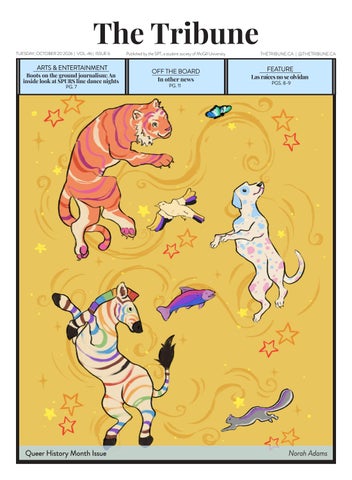
Queer History Month Issue
Published by the SPT, a student society of McGill University
OFF THE BOARD In other news PG. 11
THETRIBUNE.CA | @THETRIBUNE.CA
FEATURE
Las raíces no se olvidan PGS. 8-9
Norah Adams
2
NEWS
news@thetribune.ca
TUESDAY, OCTOBER 20 2026
IGSF hosts panel discussing Stryker’s book ‘Changing Gender’
McGill community reflects on Stryker’s impact on gender academics Asher Kui Managing Editor
O
n Oct. 5, the McGill Institute for Gender, Sexuality, and Feminist Studies (IGSF) hosted their annual public lecture titled “On Changing Gender: A New History of the Concept.” The lecture featured Susan Stryker—an American professor who currently holds a distinguished visiting appointment at Stanford University’s Clayman Institute for Gender Research. Stryker retired in 2020 with the title of Professor Emerita of Gender and Women’s Studies at the University of Arizona. The lecture is part of a tour showcasing Stryker’s new book, Changing Gender, published in August 2026. Stryker’s work challenges the conventional understanding that John Money was the first to conceptualize gender in the 1950s. Miranda Hickman, IGSF director and professor in the Department of English, began the event by giving a land acknowledgement. Ande Clegg, associate director of inclusive excellence at Equity at McGill, then highlighted the enduring identity of transgender people throughout history. “Stryker has improved the lives of countless trans persons, including my own, through her now-long career as scholar, activist, filmmaker, author, and public speaker,” Clegg said. “As Stryker commented, transness is now under deadly political assault, but it remains a persistent feature of human life. In this regard, it’s important to underscore that trans persons have existed for as long as humans have existed, and will continue to exist past this current moment in time.” Lisa Shapiro, dean of the Faculty of Arts, spoke next, underscoring the intersection between the academic discourse in the faculty and the notions of gender that Stryker examines. “We have a mission to really facilitate a spirit of inquiry in which we confront live questions,” Shapiro said. “Today’s lecture, and the discussion and questions that I’m confident will arise from it, are both timely and critical to facilitating, to bringing into being, a world that welcomes and celebrates our diversity.” Queer McGill resource coordinator Al Dervisevic subsequently provided an overview of the resources available to queer McGill students throughout the year. In his role, Dervisevic distributes free or bydonation resources under the purview of gender-affirming care, including binders, trans tape, tucking underwear, condoms, and lubricant. He also outlined Queer McGill’s programming and initiatives. “We had a job fair last year, and we also do political and advocacy-related events, such as events honouring Black History Month or Transgender Day of Remembrance,” Dervisevic said. “We also have a working group called the Trans Patient Union, which is a solidarity group which collects information and offers resources to those trying to navigate the system of transgender healthcare in Montreal.” Sahar Sadjadi, assistant professor in McGill’s Department of Social Studies of
Medicine, then praised Stryker’s account of gender for its reach beyond a European context. “The book shows the intellectual depth that gender has to Indigenous Peoples whose knowledge and ways of life […] anthropologists drew upon,” Sadjadi said. “The book, for the most part, is an American story [....] Some languages, including my first language, Persian, do not have grammatical gender. The book is attentive to the particularities of this history, and as [Stryker] herself noted, provincializes it. For these reasons, for those of us who engage with gender from outside [a] Euro-American history, while entangled with it in many ways, this rich and dense account of gender is a gift.” As a concluding introductory speech, Bobby Benedicto, associate professor in the Department of Art History and Communication Studies and IGSF, referenced Stryker’s 1994 article, “My Words to Victor Frankenstein Above the Village of Chamounix: Performing Transgender Rage.” Benedicto reflected that the essay—as an unapologetic response to the hostility that trans people face—remains ever-resonant in today’s political climate. “Some 30 years later, this argument feels more prescient than ever, as trans people have become ever more available as political scapegoats,” Benedicto said. “Disputes over gender have been made to carry anxieties about truth, expertise, language, and reality itself. The new book names this directly when [Stryker] writes that a shared sense of reality is ultimately what is at stake in the war over gender’s meaning in the moment of epistemic collapse.” Stryker then began her lecture by defining what it means to change gender in a sociopolitical context. “After noting the Latin infinitive for to breathe, spirare, I talk about how important it is to find things that inspire us […] that collective transpiration that aspires towards the vision of a better future,” she said. “It’s not changing gender in the sense that you used to be an X, but you always felt like a Y, and you did something about it. But rather, changing gender as a social system that seeks to lock us in place in an unjust political economic order based on unchosen aspects of our bodies. It’s a book about the abolition of a world that denies us our freedom and bodily autonomy.” Stryker recounted how the idea of writing a book first took shape during her research fellowship at the Stanford Humanities Center, where she attended a lecture by Matt Walsh about his film What is a Woman?. “My light bulb moment came when Walsh said in his talk, ‘I have no use for the term gender in the first place, unless we’re talking about the gender of words, masculine and feminine words, which is where the term originates. I see only males and females, men and women,’” Stryker cited. “He was in fact referencing what I’ve come to call the ‘orthodox history of the gender concept’, the idea that gender used to be strictly a grammatical term, but then in the middle of the last century, somehow became associated with sex.”
The orthodox history that Stryker described traces back to New Zealand American psychologist Money, who in the 1950s authored a handful of articles through which he introduced the concept of “gender roles,” extending a grammatical term to define people and tie gender to sex. According to Stryker, the term “gender identity” only followed when Evelyn Hooker later coined it to depathologize homosexuality. “By the 1980s, gender had nevertheless become a well-established concept [with] wide use in everyday discourse, so well-established that it’s difficult to think about things gender now refers to without using that terminology somehow,” Stryker said. “This standard story omits trans contributions to the development and dissemination of gender. Trans people have every bit as deep a stake in advancing a ‘biology is not destiny’ argument, as their cisgender feminist sisters do.” Stryker then challenged the misconception that gender is distinct from biological sex by explaining that the words “gender” and “sex” have always had an intrinsic relationship in the English language. “Both [words] are derived from Anglo-Norman French, and first started showing up in Middle English in the 14th century,” Stryker said. “Ever since that time, the words have sometimes been used interchangeably as synonyms [....] The dismissal of continuity between grammatical and social gender concepts involves elements
of transphobia at worst, or at the very least, a cissexist incomprehension.” Stryker also brought up other examples predating Money that discussed gender as a fluid concept. “[Orson Squire] Fowler wrote of what he called a ‘mental gender,’ [and] believed to be located in the brain region that controlled the amative faculty responsible for sexual desire [....] [It] is essentially gender identity, articulated 100 years before [Money],” Stryker said. “Madison Bentley, editor of the American Journal of Psychology between 1905 and 1950 […] fully [anticipated] the biopsychosocial model of personality development usually attributed to Money.” According to Stryker, the attribution of modern gender theory to Money emerges from Cold War geopolitics and cybernetics—the study of how feedback allows systems to self-transform. In this case, the widespread influence of cybernetics, which framed gender identity as transformable through deliberate intervention, allowed Money’s theory to gain traction. Stryker ended by reiterating that gender is not a restrictive ideology, but rather an emancipatory framework. “Gender is not a false ideology stolen from grammar and foisted onto people,” she stated. “It is a collective practice of transformation and liberation that we can undertake at any time, and there is no time like the present.”
Stryker currently resides in San Francisco. (Gwen Heffernan / The Tribune)
TUESDAY, OCTOBER 20 2026
news@thetribune.ca
NEWS
3
Hundreds rally on Oct. 7 in solidarity with Palestine
Protesters call for university divestment from Israeli institutions Parisa Rasul Staff Writer
A
t 2:00 p.m. on Oct. 7, students and community members gathered outside of McGill’s Roddick Gates for a rally organized by Students for Palestine’s Honour and Resistance at McGill (SPHR). On rue Sherbrooke, protesters were met with counter-protesters who assembled on the other side of a police-barricaded line down the centre of the gates. On one side, approximately 200 pro-Palestine protesters waved Palestinian flags and criticized McGill’s complicity in Israel’s ongoing genocide of Palestinians since Hamas’ attack on Israel on Oct. 7, 2023. Demonstrators yelled, “Israel bombs, McGill pays, how many kids did you kill today?” The protest also included students from Dawson College, Concordia University, and Université de Montréal (UdeM), along with other Montreal community members. On the other side, counter-protesters waved the flag of Israel, the prerevolutionary flag of Iran, and Quebec’s flag, along with signs that read, “Protect Quebec against terrorism*” and “No sharia.*” Soon thereafter, herded by Service de police de la Ville de Montréal (SPVM) officers, the pro-Palestinian group moved down av. McGill College to join another group of demonstrators. A McGill professor gave the first speech of the event, beginning her remarks by highlighting the significance of the date of Oct. 7 in relation to Palestinian casu-
alties. “Since October 2023, there has been an escalation in Israeli violence, arrests, expulsions, and destruction of whole communities in the occupied West Bank and Jerusalem,” she said. “Israeli settlers, with the backing of the army and police, have attacked and shot Palestinian civilians at point-blank range [....] They have invaded their homes and assaulted residents unprovoked.” The professor specifically referenced a genocidal tactic that Israel deploys: scholasticide, the destruction of the educational institutions, publications, and academic voices
of a targeted group. She commented on how Israel’s military assaults and policies have affected academic freedom in Gaza, the West Bank, and even within Israel itself. “Israeli apartheid has isolated and attacked Palestinian educational institutions,” she said. “It has menaced Israeli students and professors as well, and Jewish scholars who criticize Zionism and Israeli policies.” In an interview with The Tribune, a student leader and protester from Concordia spoke to the power of students’ influence in seeking to change their universities’ roles in global politics.
The Israel Defense Forces has killed over 1,500 Palestinians in Gaza since a ceasefire was announced in October 2025. (Zoe Lee / The Tribune)
“[The Students’ Society of McGill University boycott of the Hebrew University of Jerusalem] reaffirms the power of the student union,” they said. “We’re out here today to take things into our own hands. When university admins and other institutions don’t want to follow basic human values, we have to be there to remind them.” A student with the African Students’ Association of Concordia shared her motivations for standing with the Palestinian people and speaking at the demonstration. “The struggle for African liberation against imperialism is tied with the anti-imperialist struggle in Palestine,” she said. “We stand in unequivocal solidarity with Palestinians who are going through the same experience of colonialism and occupation.” The protest dissipated peacefully around 4:00 p.m. at Concordia University after travelling down boul. De Maisonneuve. In the protest’s final speech, a representative from UdeM emphasized that the genocidal murder and suffering Israel has inflicted on Palestinians must not demoralize the ongoing fight for Gaza. “We carry our martyrs not as burdens of fear, but as a living flame passed from one hand to another,” they said. “Their names are not footnotes. They are constellations by which we navigate.” *These slogans were translated from French. All sources’ identities have been anonymized to protect their privacy.
PQ win puts Santé Québec in a precarious position Plamondon promises abolition of Santé Québec August Thompson Contributor
O
n Oct. 5, Quebec provincial elections concluded with a Parti Québécois (PQ) victory, with the group now leading a minority government in the Quebec National Assembly. In the lead-up to this election, debate centred on the future of healthcare and social services in Quebec, specifically regarding Quebec’s provincially-operated healthcare corporation, Santé Québec. While all parties proposed new platforms aimed at improving access to medical treatment, the PQ—alongside the Parti conservateur du Québec—called for the abolition of the corporation. Quebec premier-designate and PQ leader Paul St-Pierre Plamondon claimed that Santé Québec’s abolition would realize up to $100 million CAD in savings for the provincial government, out of Quebec’s $68.7 billion healthcare budget. The PQ also explained that those savings would be earmarked for the centre local de services communautaires (CLSC) network, which comprises 147 community service centres providing frontline and routine primary care. In an interview with The Tribune, Alexandra Hays-Alberstat, a fourth-year PhD candidate in the Department of Political Science, explained how Quebec healthcare has shifted from a decentralized network of CLSCs into a provincially owned corporation. “Since the […] late 1990s, there [have]
been various organizational restructurings in the health system, but that’s slowly been merging into a major reorganization that occurred in 2015,” Hays-Alberstat said. “The previous structures were abolished, and this [Santé Québec] was […] largely deregionalized [....] These reforms were kind of characterized by a large increase in centralization.” That “major reorganization” came in the form of Bill 10, which in 2015 sought to cut government costs by eliminating regional health agencies—a bureaucratic layer that separated provincial and local healthcare. The province’s health infrastructure was then redivided into new regions. The Centre intégré de santé et de services sociaux (CISSS) administered regions without university-affiliated healthcare institutions, whereas the Centres intégré universitaire de santé et de services sociaux (CIUSSS) oversaw regions in which university-affiliated healthcare institutions were already integrated into the healthcare apparatus. President of McGill’s Nursing Graduate Student Association (NGSA) Noelle Leon-Palmer, who works within the Quebec healthcare system, pointed out that not all bureaucracy is the same in an interview with The Tribune. Leon-Palmer explained that some bureaucracy is needed for operating a hospital efficiently. In the case of Santé Québec, she argued, the bureaucracy is too concentrated in management, which may hinder day-to-day operation. “Bureaucracy in healthcare is always going to be necessary to a certain extent.
We need it for things like quality assur- body that health policy begins well before ance, for proper patient care, for research,” the hospital door, and that housing, food Palmer said. “The problem with […] the bu- security, income, [and] social support […] reaucracy of Santé Québec is that it’s not eventually shows up in our emergency de[…] focused on patient care [....] It seems partments,” Mouncef said. “As future phymore like extra layers of authority and bu- sicians, we have an obligation to care about reaucracy in terms of managerial initiatives, those determinants of health, and we hope executive bonuses, and then […] the hiring that this new government will also have this freezes that have been happening.” approach of tackling healthcare preventaWhile the PQ and Leon-Palmer thus tively.” agree that bureaucracy in administrative structure must be presently reconfigured to improve patient care, Leon-Palmer expressed concerns over how PQ’s third restructuring might impact nursing in Quebec. “Every time there’s a new change, […] [the NGSA is] renegotiating deals with the union, […] refiguring out how that works in terms of overtime, in terms of […] how the hospitals are organized. So there’s a lot of fatigue […] in terms of adapting to a new system,” Leon-Palmer said. While retention of nurses is an important pillar of improving patient care, Adam Mouncef, the vice president of government affairs at the McGill Medical Students’ Society, emphasized in an interview with The Tribune his hope that the elected PQ will recognize that treatment does not Aaron Derfel, an investigative journalist for the Montreal Gazette, reported Plamondon’s claim that bureaucracy is up just start at a clinic. “This should remind every- 70 per cent is misleading. (Gwen Heffernan / The Tribune)
4
NEWS
TUESDAY, OCTOBER 20 2026
news@thetribune.ca
SSMU LC discusses upcoming homecoming tailgate among procedural matters Council votes on MoAs with CKUT and QPIRG-McGill Francesca Hayes Contributor
O
n Oct. 8, the Legislative Council (LC) of the Students’ Society of McGill University (SSMU) convened for their third meeting of the 20262027 academic year. After a few last-minute additions to the agenda, the meeting opened with an announcement from McGill Athletics & Recreation business development officer Greg Trahan. Trahan and his colleagues consulted SSMU representatives on strategies to encourage students to attend the upcoming tailgate for McGill’s
CKUT is a non-profit, student-run radio station on 90.3 FM, with 24-hour broadcasts. (Emiko Kamiya / The Tribune)
homecoming football game on Oct. 25. McGill Athletics will host the tailgate at Parc du Mont-Royal on Oct. 24 as part of this year’s homecoming festivities. Despite over 23,000 seats available in the Percival Molson Memorial Stadium, McGill’s men’s football team saw an average of only around 2,300 of those seats filled in the 2025 season. Arts & Science representative Christina Dan suggested utilizing the social media accounts of various student groups to publicize student access to over a thousand free tickets to the game. Through these promotional efforts, Trahan explained, McGill Athletics hopes to drastically increase attendance. “The true nature of sports is to bring people together, and […] it’s something that should be stronger,” Trahan said. “This opportunity for both of us, in terms of [the Athletics Department] as business development, but also as SSMU, could only be the start of doing other projects together [....] In two, three years, we might be able to fill the stadium.” The subsequent LC discussion covered openings for SSMU Board of Directors and Judicial Board positions, available to in-
terested students on the SSMU job listings website. The council circled back to the topic of McGill Athletics with a brief mention of the upcoming Women in Sport panel, “From momentum to movement: Advancing women in sport.” Arts Representative Rhys Jones asked the council on the possibility of expanding the speakers list. “Given that SSMU [is decently involved] with this event, have we looked at the possibility of including the recently cut varsity teams?” Jones asked. However, since the panel is hosted by McGill Athletics and not SSMU, there was no further discussion on this topic beyond SSMU president Hamza Abu-Alkhair voicing his support for Jones’ idea. The LC next heard motions to reinstate SSMU’s Memorandums of Agreement (MoAs) with campus-based radio station CKUT and student-led resource centre Quebec Public Interest Research Group (QPIRG)-McGill, which both passed unanimously. These motions allow for CKUT and QPIRG to continue to receive funding from McGill through student fees. This year marks the end of each MoA’s five-year
term, thus requiring the SSMU to reinstate them for their upcoming cycles. The meeting then moved to executive reports, adjourned for a recess, and then reopened to discuss additional motions. These motions were almost entirely about McGill Athletics and Recreation, with the exception of a motion to increase the Plate Club fee, with each motion passing. Moment of the Meeting Council members discussed the implementation of a transportation system for students following the U-Pass model, which would allow for students’ unlimited usage of Autorité régionale de transport métropolitain services through the addition of a mandatory student fee. Soundbite “We’re going to sit down and analyze all of the details of their plan, but it does seem like they’re setting the groundwork for [a] referendum on the issue of sovereignty, and by default, that means that there will probably be things taken up with the anglophone communities that is not to our liking.”— Engineering Representative Hector Giraud, on the election of Parti Québécois.
The Tribune Explains: Sexual health resources on and off campus A guide to preventing STIs and seeking sexual health support at McGill Sofia Vidinovski Staff Writer
A
sexually transmitted infection (STI) is caused by bacteria, viruses, or parasites passed through sexual contact; these infections can develop into sexually transmitted diseases (STDs) that cause symptoms with negative health implications. Viral STIs, such as human immunodeficiency virus (HIV) and genital herpes, cannot be cured through medication, but can be managed.
Not experiencing the signs of an STI does not automatically mean one has not contracted it, nor does it mean it cannot be passed on to someone else. Regular prevention methods and checks ensure not only your own sexual health, but also the health of those around you. Queer individuals are increasingly affected by HIV and other STIs at a higher rate due to structural stigmas, specifically ones that historically arose during the AIDS crisis and endure today. As a result, the queer community may face barriers when reaching out for sexual
health care. McGill and Montreal provide a multitude of resources for students to keep up with their sexual health and seek support if they believe they have contracted an STI or HIV. If you or someone you know is in such a situation, The Tribune breaks down your next steps, and how to protect yourself and your partners moving forward.
What are some of the resources for STI prevention students can access? When it comes to sexual health, university students are encouraged to get regular STI and HIV screenings for all relevant contact sites, rather than waiting for symptoms to appear. Students are also encouraged to use external condoms, internal condoms, or dental dams to reduce the transmission of STIs during intercourse. Clear communications with partners about limits, desires, and safety before becoming sexually intimate can also help prevent STIs, especially in open relationships. Students can contact the McGill Student Wellness Hub in order to get tested. If you are covered by RAMQ or are a non-Quebec Canadian student, you can also book a test at Clic Santé. International students can also book an appointment with Biron Laboratories, where their insurance will be billed directly. If you believe you are at risk of HIV, you have access to pre-exposure prophylaxis (PrEP) or post-exposure prophylaxis (PEP) within 72 hours of sexual contact; you can receive PrEP directly through the university’s StuA majority of STIs, including HIV, can often go undetected due to minimal or no discernible symptoms. dent Wellness Hub, located on av. du (Gwen Heffernan / The Tribune) Docteur-Penfield. However, PEP must
be accessed through urgent care and medical clinics in Montreal. The Wellness Hub can be accessed Monday through Friday from 8:30 a.m. to 4:00 p.m. Students must book appointments in advance. What are some of the community organizations that help students of all sexual orientations address sexual health concerns? There are many resources in Montreal directed specifically towards queer students seeking help regarding sexual health. AIDS Community Care Montreal is a volunteer-driven community organization providing support services and treatment information for individuals living with HIV/AIDS and hepatitis C. Action Santé Travesti(e)s et Transsexuel(le) s du Québec promotes the health and well-being of transgender individuals through peer support and advocacy, education and outreach, and community empowerment and mobilization, such as mutual aid gatherings and community dinners. RÉZO is another community-based organization that provides sexual health resources— primarily for gay and bisexual men in Montreal— focused on overall health promotion and the prevention of HIV and other STIs. For more Montreal-wide options, you can visit the McGill Subcommittee on Queer People’s list of community resources. Is there a safe space at McGill for queer folks to chat, form community, and seek help collectively? There is! Queer McGill is a student-run support service for 2SLGBTQIA+ students and allies, providing queer students with a safe space for discussion, community resources, and advocacy groups. For more information or to book an appointment with the Student Wellness Hub, you can call the clinic at 514-398-6017.
opinion@thetribune.ca
TUESDAY, OCTOBER 20 2026
T EDITORIAL BOARD Editor-in-Chief Mairin Burke editor@thetribune.ca Creative Director Zoe Lee creativedirector@thetribune.ca Managing Editors Asher Kui akui@thetribune.ca Ellen Lurie elurie@thetribune.ca Clara Smyrski csmyrski@thetribune.ca
The Tribune Editorial Board
O
Multimedia Editors Will Dawson Daphne Short multimedia@thetribune.ca Web Developers Zola Ball Kate Lauro webdev@thetribune.ca
COMMENTARY
Opinion Editors Lulu Calame Julie Raout Camila Sierra Ordóñez opinion@thetribune.ca Science & Technology Editors Avery Berry Sarah McDonald scitech@thetribune.ca Student Life Editors Rachel Blackstone Tamiyana Roemer studentlife@thetribune.ca Features Editor Kaitlyn Schramm features@thetribune.ca Arts & Entertainment Editors Norah Adams Annabella Lawlor arts@thetribune.ca Sports Editors Merce Kellner Ivanna Zhang sports@thetribune.ca Design Editors Eliot Loose Gwen Heffernan design@thetribune.ca Photo Editors Emiko Kamiya Sophie Schuyler photo@thetribune.ca
Copy Editor Ella Bachrach copy@thetribune.ca Social Media Editor Chloe Ross socialmedia@thetribune.ca Business Manager Amy Xia business@thetribune.ca
TPS BOARD OF DIRECTORS Zain Ahmed, Nour Khouri, Celine Li, Lialah Mavani, Ilia Mehr Bakhsh, Aleks Rohozinski, Alex Hawes Silva
STAFF Zain Ahmed, Julia Apitz-Grossman, Brooke Barak, Miranda Forster, Abigail Francis, Alex Hawes Silva, Helena Helms, Dylan Hing, Gretta Iraheta Palacios, Lialah Mavani, Shea McDonnell, Jenna Payette, Sofia Vidinovski Rokayah Bellaoui, Chloe Bhogal, Tobias Izenberg, Evy Shamber
CONTRIBUTORS Cass Gagnon, Francesca Hayes, Julia Lok, Téa Paquin, Liam Sutcliffe, August Thompson, Éloi Versieux Peilun Li
TRIBUNE OFFICE Shatner University Centre, 3480 McTavish, Suites 404, 405, 406 The Tribune is an editorially autonomous newspaper published by the Société de Publication de la Tribune, a student society of McGill University. The content of this publication is the sole responsibility of The Tribune and the Société de Publication de la Tribune, and does not necessarily represent the views of McGill University. Letters to the editor may be sent to editor@thetribune.ca and must include the contributor’s name, program and year and contact information. Letters should be kept under 300 words and submitted only to The Tribune. Submissions judged by The Tribune Publication Society to be libellous, sexist, racist, homophobic or solely promotional in nature will not be published. The Tribune reserves the right to edit all contributions. Editorials are decided upon and written by the editorial board. All other opinions are strictly those of the author and do not necessarily reflect the opinions of The Tribune, its editors or its staff.
5
EDITORIAL Canada must sustain investment in 2SLGBTQIA+ communities to promote inclusion
n Oct. 6, representatives from more than 40 2SLGBTQIA+ organizations in Canada gathered on Parliament Hill to call for the renewal of the Federal 2SLGBTQI+ Action Plan. The action plan, initiated by former prime minister Justin Trudeau in 2022, is set to expire in March 2027—should current Prime Minister Mark Carney fail to allocate funding in the 2026 federal budget. The representatives requested $450 million CAD in funding for 2SLGBTQIA+ communities to be distributed over five years, citing increasing queerphobia and anti-2SLGBTQIA+ violence both domestically and internationally. Anti-2SLGBTQIA+ hate crimes in Canada quadrupled between 2018 and 2023, and a May 2026 Statistics Canada report outlined that Canadians have become less accepting of gender diversity since 2018. Amid growing hostility toward 2SLGBTQIA+ rights, Canada must continuously commit to queer equality through sustained federal investment in these communities’ right to freely and proudly exist. Renewing and expanding the Federal 2SLGBTQI+ Action Plan in the Carney government’s 2026
News Editors Ilia Mehr-Bakhsh Josette Chandler Helene Saleska news@thetribune.ca
OPINION
Cass Gagnon Contributor
S
ince March 2021, if you open Google Maps and look at the neighbourhood cradled by rue Ste-Catherine Est and rue Atateken, you will see it labelled as “The Village.” Officially called Montreal’s “Gay Village” until the Société de développement commercial dropped the name in October 2020, this metropolitan hub has been a safe space for members of the 2SLGBTQIA+ community since the 1980s and is one of the largest of its kind on the continent. The neighbourhood took form in the 1980s, when in the lead-up to the 1976 Montreal Olympics, the city’s police forces launched aggressive raids on queer bars in downtown neighbourhoods as part of a “cleanup” campaign. This violence forced 2SLGBTQIA+ people to seek refuge in more tolerant spaces east of the city centre, landing them in what is now known as the Gay Village. To this day, the neighbourhood remains an important space for the queer community of Montreal to gather, organize events, and foster community, and is the city’s epicentre of vibrant celebrations of queer identity. Why, then, did Montreal feel the need to alter the quarter’s name?
budget is essential to supporting 2SLGBTQIA+ organizations, upholding hard-won rights, and ensuring that Canada’s promise of safety and inclusion extends to all 2SLGBTQIA+ individuals—both at home and abroad. Since its introduction in 2022, the action plan has supported queer organizations through $100 million CAD in funding over five years. This financial backing enabled the expansion of the federal 2SLGBTQI+ Secretariat, responsible for developing community-led research, data collection, and national public awareness campaigns essential to Canadian queer development. The plan also adopted a whole-ofgovernment approach that supported and recognized the distinct experiences of Two-Spirit individuals. Despite these efforts, the Canadian Centre for Gender & Sexual Diversity (CCGSC) went bankrupt in 2024, only two years into the five-year federal funding plan. For 19 years, the CCGSC was a pillar for queer communities; it offered educational resources, provided sexual health toolkits, and promoted social justice and awareness initiatives. With the dissolution of the CCGSC—along with many other queer advocacy groups—and the 2026 federal budget still on the table, 2SLGBTQIA+ communities remain in the dark about
the future of the federal government’s protection of queer rights. Funding, uplifting, and protecting 2SLGBTQIA+ people is the bare minimum given Canada’s history of queer suppression and exclusion. Although homosexual activity was partially decriminalized in 1969, police continued to systematically raid queer spaces such as bathhouses and bars through the 21st century. Between the 1950s and 1990s, the federal government conducted what is known as the “LGBT Purge,” targeting and firing queer public servants, military personnel, and Royal Canadian Mounted Police officers. In the wake of this dark history, Canada has positioned itself as a safe haven for 2SLGBTQIA+ individuals fleeing persecution, offering pathways to asylum and refugee resettlement through organizations such as Rainbow Railroad. Yet, seeking refuge does not prevent racialized, queer newcomers from encountering racism and exclusion within 2SLGBTQIA+ spaces. If the action plan fails to receive renewed funding—and queer groups are therefore less able to address intersectionality in their efforts to foster inclusion—the Carney government risks leaving some of the very people it aims to protect without life-sustaining support.
Meanwhile, homophobic policies in the United States exacerbate homophobia in Canada. Throughout both his terms in office, President Donald Trump has issued executive orders restricting genderaffirming care for people under 19, limiting federal recognition of transgender identities, and curtailing federal support for 2SLGBTQIA+ programming. Amidst this context of queer exclusion in the U.S., McGill’s Student Wellness Hub suspended hormone replacement therapy access for American students under 19, citing concerns about potential legal repercussions from the U.S. Following extensive negotiations between the Wellness Hub and the Montreal Trans Patient Union, McGill reinstated access. Rather than bow to external pressures, campus organizations must resist intimidation at home and abroad, advocating for consistent, accessible care. The Carney government must respond to 2SLGBTQIA+ organizations’ demands: Increase funding for queer groups and programs, foreground intersectional inclusion, and protect 2SLGBTQIA+ people domestically and internationally. Canada’s commitment to inclusivity means little without the investments needed to uphold it.
A village for me, not for thee! Officially, it was because business owners and community members pushed back against the name, arguing that the term “gay” was not inclusive to the many identities that make up the 2SLGBTQIA+ community and could make some people feel unrepresented. Ultimately, however, removing the word “gay” from “Gay Village” demonstrates an attempt by the city of Montreal to sanitize the image of the city at the expense of queer Montrealers. Like many Montreal neighbourhoods as of late, the Gay Village has suffered the damages of gentrification. Touted as a touristic attraction by the city, the neighbourhood’s businesses have started catering to the heavy influx of visitors who flock to the Gay Village to enjoy its festive atmosphere, lively bars, and incredible musical and artistic events. As a result, the Gay Village has slowly transformed from a vibrant queer neighbourhood into a space of consumption appealing to heterosexual visitors; removing the term “gay” from “Gay Village” is just another step toward the progressive de-queerification of the area. With rates of anti-2SLGBTQIA+ violence and discrimination on the rise globally, Montreal’s renaming is particularly damaging. In ex-
punging queer designations, the City of Montreal has erased any explicit references to Montreal’s queer community, thereby striking out 2SLGBTQIA+ individuals’ intricate and historic relationship to the neighbourhood. This infringes upon More than 11 million tourists visit Montreal’s Gay queer spaces and insists Village every year. (Rokayah Bellaoui / The Tribune) upon the need to promote a palatable version of the area authentically themselves. for the sake of a more mainstream, Homophobia and transphobia touristy, and commercial image. are still, unfortunately, ever-present It is true that since early queer in Canada, even as decades of tirerights movements in the 1960s and less activism by the queer commu‘70s, there has been significant nity have made room for—among progress in Canada towards using many other things—a more expanmore inclusive and wide-ranging sive queer vocabulary. The queer terminology for queer identities. Not community of yesterday was the every person in the 2SLGBTQIA+ very one that put their lives on the community is comfortable using the line so that the queer community of word “gay” to describe themselves today could gain the legal rights they and might prefer other labels which have now. they feel are more closely aligned As a result, the term “gay” in with their identity. To be able to “Gay Village” is not simply a dechoose a label is the marker of the scriptor of a single identity. It is an tremendous progress that has been accolade to 2SLGBTQIA+ activists’ made since early liberation move- brave advocacy amidst a historical ments, when queer folks were threat- context determined to erase their ened with criminal charges for who identities. The Gay Village must be they loved, and faced threats to their renamed as such, to reflect its endursafety every time they chose to be ing queer community and vitality.
6
OPINION
opinion@thetribune.ca
TUESDAY, OCTOBER 20 2026
In allowing the loudest voices to speak for all, Fierté Montréal takes no pride in its mission of inclusion and solidarity COMMENTARY
Dylan Hing Staff Writer
F
ierté Montréal, the organization behind Montreal’s annual Pride festival, got into hot water last year due to its vacuous response to the ongoing genocide in Gaza. Palestinian activists and organizations like Helem, which represent Middle Eastern 2SLGBTQIA+ individuals, have long criticized Fierté Montréal for its silence on Israel’s siege. In response, the organization released a statement in July 2025 condemning the actions of the Israeli government. Fierté Montréal also excluded Ga’ava, a prominent queer Jewish advocacy group, and the Centre for Israel and Jewish Affairs (CIJA) from participating in its 2025 Pride Parade, citing the two groups’ contribution to hateful discourse against Gaza. Under pressure from pro-Israel activists and the excluded organizations themselves over the past year, Fierté Montréal ultimately reinstated Ga’ava and CIJA, who marched in the Aug. 9 pride parade. This reversal, coupled with Fierté’s overdue condemnation of Israel’s genocide, allows two Zionist organisations to remain the dominant representatives of queer Jewish voices at the event. In doing so, Fierté Montréal has not only alienated 2SLGBTQIA+ Jewish people who actively speak out against Israel’s colonial siege, but has also neglected its broader moral obligation to condemn genocide.
COMMENTARY
ultimately alienated both sides of the queer Jewish community. Neutrality, the historic backbone of Fierté Montréal’s response to controversial topics, is damaging in a context where some member groups are using the organization’s platform to promote violent ideologies and advance their Before Fierté Montréal, the Divers/Cité pride parade and arts festival was hosted starting in 1993. (Eliot Loose / The Tribune) own agendas. Silence regarding Israel’s genocide is not neu- organizations to condemn Israel’s genocide. trality; it is a de facto compliance with the While Fierté Montréal affirmed earlier oppressor. this year that it would not be retracting its The existence of Fierté Montréal is only pro-Palestine statement, it must rememmade possible thanks to the queer commu- ber that so long as its partner organizations nity that stood up to the Canadian govern- continue to promote Zionist and genocidal ment for its historic abuses toward and dis- ideologies, severing these organizational recrimination against 2SLGBTQIA+ people. lationships by condemning genocide is not a The organization must continue this history choice but a duty. now by standing up to Zionist organizations. Every organization, regardless of its poFailing to do so ignores the voices of queer, litical and social role, must condemn Israel’s anti-Zionist Jews and Arab and Palestinian ongoing genocide, apartheid system, and his2SLGBTQIA+ community members, and torical and ongoing colonialism. Fierté Monviolates the broader moral obligation of all tréal is no exception.
ICE’s inhumane treatment of trans people feeds global anti-2SLGBTQIA+ sentiment
Julia Lok Contributor
T
Considering the longstanding issues of racism and exclusion within 2SLGBTQIA+ communities across Canada, it is particularly damaging that Fierté Montréal caved to such divisive rhetoric by re-embracing Ga’ava and CIJA. Fierté Montréal claims to work toward queer rights and inclusion, but unity and representation cannot be fully achieved if the organization still accepts those who defend a apartheid regime and misrepresent the values of large swaths of the queer Jewish community. When Montreal’s queer Zionist organizations attempt to paint their political stance as important opposition to antisemitism and homophobia, they deny Israel’s violent regime under the misplaced claim of defending queer Jewish identities. In July, the anti-Zionist organization Independent Jewish Voices Canada pushed back on the Ga’ava president’s racist remarks regarding Palestinians, choosing to support Wild Pride instead of the Fierté Montréal parade for the latter’s failure to acknowledge that Zionist queer groups are discriminatory and exclusionary spaces. Fierté Montréal’s backtracking in its ban of Ga’ava and CIJA sends the message that there is no way to proudly include queer Jewish voices without also capitulating to Zionist organizations—which is far from the truth. This decision reveals a lack of effort on the behalf of the group’s organizers to incorporate Jewish voices and constructive condemnation of genocide. In the process, the organization has
hroughout his second term, United States President Donald Trump has empowered U.S. Immigration and Customs Enforcement (ICE) to commit heinous abuses of power. His administration has exploited technical and legal loopholes that allow ICE to take action outside its prior scope. This newly given authority allows ICE to target immigrants regardless of whether they are undocumented immigrants or American citizens. Targeted immigrants are sent to inhumane detention facilities, where ICE further subjugates them—particularly transgender individuals. Trump’s policies increasingly infringe on their human rights, manipulating gender identity into a catalyst that allows the administration to commit abuses against immigrants. The effects of this are not limited to America; they also reflect a similar anti-2SLGBTQIA+ sentiment in Canada. In 2015, under the Barack Obama administration, the U.S. Department of Homeland Security (DHS) signed the ICE Transgender Care Memorandum, which nominally emphasized the importance of specialized treatment of trans people in ICE detention centres. Attempting to address risks to this group’s safety, the memorandum expressed trans detainees’ rights to dedicated safe housing, clothing that aligned with their gender identity, and access to hormonal treatments. Presently, Trump outright refuses to legally protect trans detainees, effectively strik-
ing queer safety from being considered in detention housing decisions. In 2025, the current administration removed the ICE Transgender Care Memorandum from the DHS website, eradicating any federally granted security for trans people and now leaving them legally vulnerable to violence and discrimination. A 2018 study found that ICE officials disproportionately target 2SLGBTQIA+ migrants with abuse in detention facilities, including prolonged solitary confinement. In 2023, Immigration Equality interviewed 41 2SLGBTQIA+ and HIV-positive current and former detainees, 14 of whom were trans, and found that one-third of these immigrants had experienced sexual abuse, harassment, or physical assault during their time in detention. The Trump administration also denies hormone treatment to detained trans people—a human rights violation that causes intense emotional distress for trans individuals and robs them of dignity. The DHS told the The New York Times that it refuses to “waste U.S. taxpayer dollars” on hormonal treatments in detention centres, despite the proven harm this lack of access inflicts on trans and genderqueer individuals. Further, the U.S. government deports detainees through third-country agreements, under the pretense of protecting American workers and prioritizing safer communities. But this rhetoric is purely racist, xenophobic and illogical. Through third-country policies, ICE has deported individuals to places they are not from and have never been to: Trans people are particularly vulnerable in these
foreign countries, as many of these nations criminalize queer identities and are wrought with social discrimination against queer individuals in daily public life. These wrongful deportations thus especially threaten trans lives and subjugate gender-nonconforming people to the notion that their identity is a crime. Global anti-2SLGBTQIA+ discrimination in the U.S. has repercussions in Canada as well. Hate crimes in Canada that target gender identity and expression have nearly
tripled since 2020, with an eight per cent increase between 2023 and 2024. In 2025, Quebec’s 2SLGBTQIA+ hotline, Interligne, received more than double the calls regarding physical violence and discrimination it had taken the year before. Clearly, 2SLGBTQIA+ people and immigrants face mounting human rights crises globally, and the Trump administration’s abuse of those at the intersection of these communities exploits both xenophobic and transphobic sentiments: fueling the fire.
Camila Toro de Paula, a transgender woman detained in an ICE immigration facility, told The New York Times that she is afraid of dying there. (Eliot Loose / The Tribune)
arts@thetribune.ca
TUESDAY, OCTOBER 20 2026
ARTS & ENTERTAINMENT
7
Boots on the ground journalism: An inside look at SPURS line dance nights Welcome to the CUNT-ry revolution
Daphne Short Multimedia Editor Mairin Burke Editor-in-Chief
I
f you inadvertently stumble into Toscadura on a Wednesday night, you might mistake the scene for a cowboy boot convention. But hold your horses: You’ve been lucky enough to find SPURS, the primo 2SLGBTQIA+ line dancing destination in Montreal. Founded in 2023, SPURS offers any dancer—from those who have never hit an eight-count to those who have mastered the coaster step—the opportunity to stomp it out together, keeping the queer legacy of line dancing alive with each song. In an interview with The Tribune, host and organizer of SPURS Montreal Noel Vezina e mphasized the importance of challenging widespread cultural assumptions that line dancing only welcomes participation from a white, Western, and heteronormative group. In reality, line dancing has actually provided queer people with community and the space to move freely for over 50 years. “[Line dancing has a history] of being one of the ways in which queer people can dance together without necessarily dancing together,” he said. “There’s something really special [about] not depriving ourselves of that just because maybe the most obvious examples of line dancing […] don’t particularly spark an image of queerness and inclusivity.” Throughout the night, SPURS partici-
pants spin and scuff their heels under brightly coloured lights, backed by a medley of music by artists from Luke Bryan to Troye Sivan. Newcomers observe in awe as regulars show off vast repertoires on the dance floor. Fear not, beginners! The ease with which line dancing aficionados recall choreography can be trained through dedicated attendance or even at-home practice. Additionally, each SPURS night includes step-by-step tutorials to ensure everyone has the chance to scoot. In an interview with The Tribune, Gabriel Gaston, a SPURS enthusiast, gave great advice on how to begin a line dancing career, encouraging new dancers to embrace mistakes. “Throw yourself in the middle, up in the front, and pick out who’s good, and then at every wall you’ll have feet to follow,” he said. “Don’t be standing on the side.” Vezina echoed that SPURS is truly a place to let your self-expression shine, regardless of whether you’re just learning “Dirt on My Boots” or have already mastered “Fake ID.” “It’s a very truly queer space in that whatever your identity is, or maybe you don’t know, or maybe it’s somewhere different depending on the day, there’s space for you there,” they said. “You can walk into SPURS and look around the room and just see 100 different ways to be hot and happy. Everyone is so themselves.” Kurt Blais, another regular, grew up in small-town Alberta and has found in SPURS a safe place to marry their childhood roots in
social dance with their queer identity. celebrating individuality. “There is a large population of queer folks “Queer line dancing […] offers us an opwho love physical activity, who love to dance, portunity to tap into unity […] without a strict […] but don’t feel like they’re welcome in the obligation of uniformity,” Vezina emphasized. regular [line dancing] spaces at the big dance “The way that you do it and the way that I do halls, and I’m hoping that we can open [danc- it are all going to be so different, and that’s ing] up to folks [at SPURS],” he said in an in- okay because [...] we’re […] still together as terview with The Tribune. ourselves.” Gaston felt similarly about the liberating If you want to let your inner country girl power of 2SLGBTQIA+ line dancing, as it can shake it out on the floor, find the SPURS schedbreak down the gender roles that often confine ule on Instagram @spursnight. Tickets are $10 many forms of social dance. CAD, or pay-what-you-can at the door. “As a trans person, finding a space that is not only so trans-forward, but also is about moving your body and expressing yourself [is important, when] oftentimes, dance can be seen as very strictly masculine and feminine,” he said. “Here, we tear all [of] that down, and you can just move your body in a way that feels good, and that feels very grounding.” Much of the magic of SPURS lies exactly in how it mirrors the ways in which 2SLGBTQIA+ community members The founder of SPURS, Kathleen Munroe, was inspired by Stud engage with each other Country—a queer line dance collective in Los Angeles. (Mairin Burke / The collectively while still Tribune)
Exploring the Tragically Hip’s legacy of Canadian storytelling Revisiting the setlist of the band’s legendary final show, 10 years later Téa Paquin Contributor
W
ith the opening chords of “FiftyMission Cap” ringing out through the former Rogers K-Rock Centre in Kingston, Ontario, The Tragically Hip began the final show of their Man Machine Poem tour on Aug. 20, 2016. A concert that would become one of the most impactful performances in Canadian music history, the band played together one last time for a packed arena and millions of Canadian television viewers. The Tragically Hip delivered a 2.5-hour, 30-song setlist filled with some of their most iconic and familiar tracks—ones that tell stories of Canadian history and culture while also critiquing the nation’s systemic flaws. Following its rebroadcast a decade later, The Tribune revisits the final concert’s setlist: a collection of songs by a band that embodied quintessential Canadian identity while unabashedly condemning the country’s failures. Formed in Kingston in 1984, “The Hip” was composed of Rob Baker, Gord Sinclair, Johnny Fay, Paul Langlois, and theatrical frontman Gord Downie. They quickly rose to national fame with their breakthrough 1989 studio album Up to Here, which became a defining presence in the Canadian music scene in the following decades. In May 2016, the band announced their final Canadian tour after revealing that Downie had been diagnosed with terminal brain cancer. The news was met with heartbreak across
the nation, and tour tickets sold out within sec- as a platform to criticize some of Canada’s ization of these groups. Downie spent his final onds, reflecting fans’ desire to unite across the systemic injustices. Their performance of years speaking out and pursuing projects in country in support of Downie and in celebra- their 1992 song “Wheat Kings,” for instance, support of reconciliation. The Hip’s drive to tion of his life and musical legacy. detailed the wrongful conviction of David hold Canada accountable for its injustices is as With 6,700 fans in attendance and anoth- Milgaard, a young man from Winnipeg who much a part of their legacy as their celebration er 11.7 million Canadians tuning in through served 23 years in prison for a murder he was of the country. the CBC’s coverage, The Hip’s final concert later proven innocent of. 10 years later, the nationwide farewell to in Kingston demonstrated just how deeply Downie also took time in this perfor- Gord Downie and The Tragically Hip remains woven into Canadian culture the band had be- mance to advocate for Indigenous rights and as powerful as it was that night in 2016. It is come, a connection later reflected in the songs reconciliation, urging then-prime minister this willingness to celebrate Canada, while they performed that night. Justin Trudeau to work alongside and support challenging it to do better, that makes The The setlist was an ode to Canada from Indigenous communities after generations of Hip timeless. Their legacy remains ahead by start to finish. Beginning with a nod to Cana- government neglect and systemic marginal- a century. dian hockey culture, “Fifty-Mission Cap” told the tale of Toronto Maple Leafs player Bill Barilko, who scored the 1951 Stanley Cupwinning goal for the team and then disappeared following a plane crash; his life and death are now forever embedded within Canadian folklore. Next came Canadian cornerstones such as “Courage,” “Lake Fever,” and “Toronto 4,” all filled with nostalgic sentiments and references to the country’s landmarks and important figures. Fanfavourite anthem “Bobcaygeon” was met with tears, laughter, and dancing, its reference to Toronto’s infamous Horseshoe Tavern concert venue and portrayal of life in small-town Ontario clearly resonating with the crowd. The Hip also used the stage The Tragically Hip was founded when its members were in high school. (Zoe Lee / The Tribune)
LAS RAÍCES NO SE OLVIDAN HOW FOOD SUBVERTS COLONIAL UNDERSTANDINGS OF THE LATINO BODY AND CREATES POSSIBILITIES FOR MORE CARING FUTURES
Written by Camila Sierra Ordóñez, Opinion Editor Designed by Eliot Loose, Design Editor
F
or many members of the Latino diaspora, food is much more than mere sustenance. Food carries memory, histories, traditions, and relationships that tie us to our ancestors and construct our identities. It transgresses time and acts as a reminder of who we are and who we will become. Food also connects somatic experiences like flavour, temperature, and texture with key emotional moments in our lives. A warm caldo de pollo reminds us of loved ones that once cared for us when we were ill, freshly baked conchas take us back to evenings spent talking and pouring cafecito into each other’s cups, and a simple dish like frijoles or arepas brings us back home in a blink of an eye. The relationship between food and members of the Latino diaspora is also deeply tied to our social, historical, and cultural experiences. Colonization, migration, racialization, and cultural disconnection have all influenced how we perceive ourselves, and, most importantly, how we experience our bodies—the vessels that most deeply engage with food. This very physical embodiment thus becomes the basis for how we build Latino identity. Healing the way Latino bodies are perceived in relation to food both affirms Latino identity and builds better futures for Latinx communities.
RECLAIMING LATINIDAD BEGINS WITH RECLAIMING THE BODY
Latino bodies have often served as drawing boards for settler-colonial projects, reducing Latino identity to simplistic understandings of our diverse cultures, histories, and experiences. Under industrial capitalism and modern colonial structures, the Latino body is fractured into rudimentary functions, such as physical strength, which has bound generations of Latinos into underpaid and exploitative agricultural labour. Other forces of control of Latino communities have operated through legitimized systems of violence. Latino bodies are monitored and surveilled through punitive entities, such as the United States Immigration Customs Enforcement (ICE), which perpetuate racist stereotypes of Latinidad and conflate Latino identity with criminality. This systemic criminalization flattens our multifaceted identities and reduces our experiences to the inequalities we endure. In an interview with The Tribune, Keitlyn Alcántara, a bioarchaeologist and assistant professor of Anthropology at Indiana University Bloomington, described the worl-
dview underlying this extractive relationship with the body. “Colonialism [is] a very economically driven worldview. Your body is for labour, your body is to produce,” she explained. “And that is in contrast to a lot of Indigenous ways of viewing the body, where […] your body acts as a node that connects you to nature, to spirit, and there’s no separation between you and everything else that’s alive.” These worldviews allow individuals to exist in fundamentally different ways. In the former, the body is little more than a machine, expected to produce, perform, and obey; in the latter, it is living and deserving of dignity, care, and freedom. How our bodies are made to exist and thrive cannot be separated from the sociopolitical landscapes in which they are situated. This also extends to the ways Latino bodies are held against moralized biomedical standards of health and Eurocentric beauty standards. When traditional foods are deemed unhealthy, eating becomes a matter of compliance with racialized views of food and obscures the cultural memory and collective practices that are woven into it. Sarah Orejuela Pulido, U3 Political Science and Latin American and Caribbean Studies student at McGill University, and co-president of the Spanish & Latin American Students’ Association of McGill University (SLASA), has had to grapple with this contradiction. Growing up, she remembers how diet culture shaped the way women in her family approached food. “I remember my meal and my dad’s or brother’s meal looking the same. Arepas, eggs, [hot] chocolate. But my mom’s and my sister’s meal would just be eggs and if they were in a good mood, they would share an arepa between them,” she recalled in an interview with The Tribune. While the family shared the same food traditions, women seemed to experience a different set of expectations around eating. “Growing up with the women in the family, there was always a sense of guilt surrounding food, or, if not guilt, then weariness,” Orejuela Pulido said. “We’re supposed to celebrate our food, but somehow also maintain this very specific image of what a Latina should look like.” These pressures reveal how embodiment through food can become entangled with the demand to make one’s body fit constructed ideals of health or nutrition. Reclaiming Latinidad, then, means more than celebrating cultural foods or symbols. It requires questioning the systems that teach us to see our bodies as not good enough. It also means making room to cultivate various understandings of nourishment as a way to help us reconnect with our communities and ourselves.
“Food can serve as a really important glue for that,” she explained, describing how something as simple as sharing meals or taking somebody to the grocery store can help rebuild relationships. “It’s not even about the eating,” Alcántara added. “It’s
just about […] making space to check in with each other, care for each other.” For Alcántara, these everyday acts of care offer a way to resist the isolation of a society organized around time, money, and efficiency. She pointed to small, local projects that challenge the idea that bigger HOW FOOD CARRIES CULTURE is better, newer is better, and more is better— FORWARD Alcántara described the body as a “node”: a instead drawing on vessel through which we connect with others, longstanding pracform relationships, share knowledge, and care tices of sharing resources and for one another.
supporting one another. These methods are also how food knowledge survives across generations: through the ingredients we use, the meals we prepare, and the people who teach us how to make them. However, in a globalized economy that prioritizes profit over connection, these relationships can become harder to sustain. In an interview with The Tribune, Hanna Garth, food anthropologist and assistant professor of Anthropology at Princeton University, explains how food can anchor cultural identity in a world where food
import kaffir lime leaves before collaborating with University of California, Riverside to grow them locally. “They taste the difference, and it matters that much to them to be able to have access to it,” she said. When migration makes familiar ingredients harder to access, what is lost can be more than a taste of home; it can be a connection to cultural identity. These connections live in the knowledge passed down through family. Recalling how she learned to make arepas from her abuelita, Orejuela Pulido described spending hours removing kernels from corn cobs before using a manual grinder to turn them into the flour needed to make arepas from scratch. The experience left her with a skill she still carries today, but also a question about what happens when family knowledge is not passed on. “I know how to make arepas from scratch because an abuelita once made me spend hours grinding corn, but how many other recipes would disappear from my family if nobody took the time to learn them?” she said. Preserving foodways indeed requires more than celebrating family recipes or traditional dishes: It depends on the time, labour, and relationships required to pass down cultural knowledge from generation to generation. Rebuilding these connections to our foods requires spaces where individuals can share stories and learn to care for one another. At McGill, SLASA plays an important role in creating spaces for Hispanic and Latino students that feel like home, where they can simultaneously explore their own culture and appreciate others’. SLASA’s Coffee and Spanish events offer a chance for students to gather around some steaming cafecito and learn from one another. Events like these create unique opportunities where students can broaden and diversify their relationships. Such spaces cannot erase the structural inequalities that shaped Latino migration, food access, or body-image expectations. However, they can make cultural belonging something people create and define together. In that context, food acts as more than a social binder, becoming a way of carrying relationships forward.
REIMAGINING THE FUTURES WE WANT TO BUILD
is treated as a commodity—detached from the people, lands, and knowledge that give it meaning. “For many, many groups of people, consuming specific dishes […] is the thing that they feel is the vehicle that connects them to their culture,” she said. “If they can’t make their traditional cuisine as they believe it should be made, they question whether they are still the same people.” This connection can drive people to extraordinary lengths to preserve their foodways. Garth describes how Thai migrants in Los Angeles worked to
Where do we go from here, knowing that the ways we eat, inhabit our bodies, and understand health are shaped by systems that have rarely made room for Latino understandings of health, nutrition, and worldbuilding? For Garth, change begins with questioning who gets to define what a healthy life looks like. “We attach a lot of judgement and moralization to the ways that people eat,” Garth explained. Instead of perpetuating this negative connotation with specific foods, she proposes an openness to different understandings of what people need and what is good for them. Rebuilding our relationships with food allows us to challenge restrictive understandings of our health and our body; this also means refusing narrow views of nourishment. For Alcántara, reconnecting with food can also become a way of reconnecting with ourselves. During her graduate work she described spending most of her time outside talking with campesinos, which allowed her to connect with her Mexican roots. “I think those were just moments where I realized how disconnected from my body I had become, and it’s definitely been a very healing
journey to renegotiate how I want to exist in this world, how I want to exist in academic institutions,” she recalled. These changes, she explained, can begin with small, pleasurable acts that are often dismissed because they seem “unproductive.” Yet they can fundamentally change the way that we choose to go through life. Healing through food offers ways to reconcile the pain, anger, and alienation that colonial understandings of Latinx bodies have left behind for us to contend with. Food holds memory, comfort, and care, creating spaces to process grief and loss while reconnecting with parts of ourselves we may have learned to reject. This work, however, cannot stop at the individual level. Alcántara emphasizes that meaningful change need not begin with sweeping legislation, but can emerge through local relationships and everyday practices of care. She urges us to recognize the knowledge people carry beyond institutional credentials, reminding us that we are all beings who are learning our entire lives. Sharing meals, exchanging knowledge, tending to the land, and making time for one another become ways of rebuilding relationships that widespread social isolation has weakened. These practices cannot dismantle structural inequalities alone, but they can help create worlds in which different ways of knowing and living are allowed to flourish. Imagining a future beyond colonial understandings of Latinidad means reclaiming the diversity these systems have tried to flatten. “There were so many different cultures, kind of mirroring how there was so much biodiversity, so many forms of life in places,” Alcántara said. Colonialism collapsed these differences and left diasporic communities fighting to preserve their ways of living and caring. Día de los Muertos offers one way to remember what connects us: Through offerings to the dead, the tradition honours our relationships with ancestors and the living world. According to the philosophy of this traditionally Aztec holiday, the wellbeing of communities depends on balance between ourselves, our communities, and those who came before us. Latino bodies have long been made to fit categories that diminish the complexity of their experiences. We should instead allow them to hold the multiplicity of our histories, cultures, and futures. Broadening and redefining our relationships with food offers a glimpse into what Latinidad could look like if room were to be made for the various ways we can nourish, remember, grieve, and care for our communities.
10
ARTS & ENTERTAINMENT
arts@thetribune.ca
TUESDAY, OCTOBER 20 2026
The queer community takes centre stage at Couture Cabaret Exploring how 2SLGBTQIA+ performers forge safe spaces through performance
Norah Adams Arts & Entertainment Editor
O
n Oct. 15, excited patrons shuffled into local queer dance bar Le Club DD’s, escaping the crisp fall night to find refuge within the warm embrace of performance and community. The space sparkled with low red light, disco balls swinging from the ceiling and heavy velvet curtains lining the walls. Towering at the front of the dance floor stood, in all of its chrome glory, a spinning pole. The evening’s queer burlesque event, Couture Cabaret, featured 13 dancers, each with their own bespoke routine. Performances ranged from cheeky upside-down moves on the pole backed by Marilyn Monroe’s “Diamonds Are a Girl’s Best Friend,” to rollicking lip-syncs of Slovak artist ADÉLA’s “SexOnTheBeat.” In an interview with The Tribune, event organizer and performer Miss Couture (Tessa*) explained how organizing 2SLGBTQIA+ dance events can address the lack of opportunities for transgender artists to engage in the world of cabaret. “I started hosting Trans Night Montreal a few years ago […] because there was nowhere for trans girls to strip,” she said. Tessa described cabaret as a source of empowerment for 2SLGBTQIA+ people through its emphasis on performance and selfembodiment. In an interview with The Tribune, Madel,* a member of the Couture Production team and Miss Couture’s sister, detailed how
these events have created a safe space for her and other members of the queer community. “I felt like I wasn’t seen enough. I felt like there wasn’t enough visibility for all of us,” she said. “Being able to run these events with [Miss Couture] made me feel like I had space myself.” The liberation this event encouraged was felt in the laughs of attendees at a sassy high kick, hugs shared by fellow performers, and the twinkle of a crisp 20-dollar bill tucked into a twirling dancer’s G-string. DD’s regular Camryn McIsaac expressed in an interview with The Tribune how welcoming they have found the Montreal 2SLGBTQIA+ community since moving to the city from Newfoundland. “I’ve gotten into the habit of just going to queer events by myself [because] I just know I’ll run into someone I know,” they said. It takes rebellious efforts by artists like Miss Couture to carve out safe spaces for queer folks. Her dedication to fostering community and creating space for trans dancers is radical, but not new. Historically, trans women have been a vanguard of queer liberation. 2SLGBTQIA+ rights activist Marsha P. Johnson— who similarly worked as a performer—played a crucial role in the demonstrations which followed the 1969 police raid of Greenwich Village’s Stonewall Inn. Johnson, alongside many other trans women, marched on the front lines of protests for queer liberation throughout the 1970s, particularly fighting for the rights of gay men and lesbians. Later, she co-founded Street Transvestite Action Revolutionaries: an organization that supported and sheltered trans
youth who were rejected by their families. ple are on the rise, the work Miss Couture is Dancer Natalie Hope, a longtime member doing at Couture Production to cultivate safe, of Miss Couture’s roster, emphasized in an in- creative spaces holds a special weight. Every terview with The Tribune the need for events revolution spun around the pole is, in itself, an like Couture Cabaret to spread throughout the act of revolution against hate. rest of Canada, where few venues allow trans *Tessa and Madel did not provide their erotic dancers to perform. last names. “[Trans and non-binary people are] not allowed to perform at cis clubs [across Canada], so it’s great to have a safe space where we can do our own thing,” she explained. Hope highlighted how crucial stripping and dance have been for empowering her identity. “[Dance has] encouraged confidence in myself and my body,” she said. Queer pride has always shown up through performance; drag and erotic dance are foundational to much of mainstream 2SLGBTQIA+ culture. Acts of local pride and performance are what inspire creation by all your favourite big queer artists, from Chappell Roan to Troye Sivan. During today’s era of acceptance regression, wherein anti-2SLGBTQIA+ intolerance and crimes The event hosted a tarot reader, enlightening event-goers to their against gender-queer peo- yet-unknown futures. (Reggie Bickerstaff)
‘Sky Woman is All Around Us’ hails the resilience of Indigenous women
Shelley Niro’s exhibition grounds the Haudenosaunee creation story in the contemporary
Gretta Iraheta Palacios Staff Writer
I
n Haudenosaunee cosmology, Sky Woman is considered Turtle Island’s first human, fallen from Sky World while carrying a child in her womb. daphne exhibition Sky Woman is All Around Us characterizes this knowledge in contemporary terms, crosses temporal and spiritual planes, and bridges the past and the present through a multimedia approach. Nestled in the Mile End, daphne is a nonprofit art center run by Indigenous artists that aims to support and uplift working creatives through exhibitions, residencies and workshops. The art center has two galleries and several common rooms with bookshelves open to visitors and community members. The space is designed to open the possibility for meaningful communal exchange. Shelley Niro, a member of the Six Nations Reserve, Turtle Clan, is the Haudenosaunee multidisciplinary artist behind Sky Woman is All Around Us. She creates from a matriarchal worldview, taking inspiration from the women closest to her. Niro’s exhibition includes a mix of paintings, pastels, photographs, and found objects. Pamphlets offered to visitors at the entrance contain an essay written by executive director of daphne, Lori Beavis. Beavis explains some of the names of the pieces and their con-
nection to Niro’s retelling of the Sky Woman story. In her works, Niro uses vibrant colours to depict key ideas of this creation story. Some of her pieces are grouped as a series, using intentional framing and subject placement to reinforce themes of agency, adaptability, and emotional journeying. Others are stand-alone pieces, such as Sometimes Mother Earth is a Lazy Teenage Girl, which depicts Niro’s granddaughter lying in a chair, surrounded by wildlife, with the natural world as an active healing force. In this piece, Nature and Woman blend together: The figure’s strands of hair seem to merge into the field behind her, and human faces are sketched into the natural background. Beadwork is also a prominent artistic theme within Niro’s exhibit. Many of the pieces include dotted-line motifs, a reference to the cultural practice of beading that has been passed down for generations within Haudenosaunee communities. Four pillars in the gallery also display a variety of bead-ornamented objects, adorned by leaves and rocks. The continued practice of beadwork within Indigenous communities reflects an act of resistance to oppressive legislation. In 1876, Canada adopted the Indian Act, which prohibited Indigenous practices of self-expression; this contributed to the nation’s cultural genocide of Indigenous Peoples—the consequences of which are still deeply felt. The beadwork interwoven into Niro’s art al-
ludes to this cultural rebellion. Niro’s multimedia take on the story of Two of the pieces in the exhibition in- Sky Woman presents Indigenous feminine recorporate photographs of a middle-aged silience through endless cycles of creation. At woman—Niro’s mother, June Chiquita Dox- daphne, Sky Woman is evidently not a figure tater. The first piece is a framed photograph solely residing in the past; she is grounded, of Doxtater lying across the trunk of a car, tangible, and present in all the women around smiling with her head propped on her hand. us. The car’s Ontario license plate reads, “Keep Sky Woman is All Around Us runs until It Beautiful.” The second piece is a triptych— Dec. 12, 2026 at daphne, located on av. Casa series of three images—of Doxtater in the grain. process of dyeing her hair in her kitchen. Each Creative Director Zoe Lee is a former picture in this series is decorated with mark- employee of daphne. She was not involved er-drawn doodles, which highlight elements in the writing, editing, or publication of this within the shot and enhance the joy reverber- article. ating from these images of home. There is a sense of familiarity within these works, likely driven by the matriarchal figure’s earnest grins. Beholding these photographs radiating a mother’s love and pure joy, it is evident that these are the kinds of pictures of loved ones that you carry with you for life. If I had pictures like this of my own mother, I too would frame and display Niro obtained an MFA from the University of Western Ontario in 1997. (Rokayah Bellaoui / The Tribune) them for all to see.
studentlife@thetribune.ca
TUESDAY, OCTOBER 20 2026
OFF THE BOARD
STUDENT LIFE
11
In other news
Tamiyana Roemer Student Life Editor
F
our weeks ago, in the same issue in which my peers covered sovereignty debates, protests against artificial intelligence, and trade deals entangled with genocide, my contribution to The Tribune was a letter—facetiously written from the perspective of a backpack. Writers and editors at The Tribune work tirelessly to provide readers with critical coverage of the institutions, policies, and events that shape
and constitute our surroundings. Amidst these efforts, I think it’s safe to say that my “Where did all the backpacks go?” piece will not be awarded a Pulitzer any time soon. As a Student Life editor, I have often felt that my work occupies a less consequential corner of student journalism. Most of the time, our section does not carry the urgency of breaking news or the obvious stakes of investigative reporting. Instead, our pitches attend to the peculiarities, pleasures, and frustrations of everyday life as a McGill student. It is easy to dismiss this work as a fluff assignment, a welcome reprieve from the rigours of serious journalism. But finding something worth writing about in the quotidian lives of students is its own undertaking. Student Life covers the endless minutiae that will otherwise go unreported. Where else can we imagine the Montreal haunts we would take an ex to, or classify the most irritating figures in our weekly conferences? At its core, the ethos of Student Life calls for a commitment to something that journalism does not always prioritize: levity. Bombarded with disheartening cur-
rent events, younger generations increasingly disengage from the news as a form of self-protection. In order to address news avoidance, publications must reckon with the emotional weight that compels readers to avert their gaze. Although coverage of crises and controversies is vital to journalism, saving room within the pages of our papers to make readers smile is just as essential. There is profound pleasure in reading a newspaper issue and encountering a relatable sentiment in print. The characteristic humour of Student Life draws on our audiences’ shared experiences and gives readers an opportunity to recognize themselves in the lives of their peers. Campus-specific jokes turn a university of 40,000 students into an intimate audience, united by a shared cultural vocabulary of midterm-related despair and Montreal winter blues. In fostering a sense of collective recognition, our section reminds readers that the campus community they inhabit is worth paying attention to. University is a transient experience by nature. Each year, one cohort graduates, and another arrives to take
its place. Just as the McGill campus undergoes constant alteration, the community within it is continuously rebuilt. The value of the Student Life section thus extends far beyond the moment of publication. As an archive, a student newspaper like The Tribune preserves the fleeting details of student experience that institutional histories will overlook. What seems trivial as we live it may become a record of what made a particular moment in campus life distinctive. The students who see themselves in our pages today will soon leave McGill, and the campus they remember will continue to change in their absence. Our work is a promise to preserve the idiosyncrasies of their ephemeral experiences. The Tribune is the only McGill campus newspaper with a designated Student Life section, and I am proud to have dedicated the past three years to it. “Where did all the backpacks go?” is unlikely to be remembered as the pinnacle of student reporting, but if it has made someone laugh today and given them something they can look back on tomorrow, then I can think of few better uses of my time as a student journalist.
A guide to exploring Montreal’s queer history
Stories and spaces that have shaped Montreal’s 2SLGBTQIA+ community Elisabeth Lum Staff Writer
M
ontreal’s 2SLGBTQIA+ history is inscribed in the very streets students walk along to class, the crowded dance floors where they party, and even the tables they occupy at local eateries. Since Queer History Month invites us to take stock of the stories all around us, The Tribune has curated a guide to celebrating and learning about Montreal’s queer culture, both on campus and throughout the city. Celebrate queer history on campus McGill’s Queer History Month programming features Return of the Rainbow, a queer homecoming event, which will be held on Oct. 22 from 6:00 p.m. to 8:30 p.m. at Place Ville Marie. This event encourages the entire McGill community to celebrate current and past 2SLGBTQIA+ students, staff, and faculty over cocktails, light bites, and shared stories. Best of all, admission is only $5 CAD for students, which includes a drink ticket and refreshments. Explore Montreal’s activist history Behind the Pride celebrations found in Montreal today lies a rich history of queer activism. Montreal’s queer community fought, and continues to fight, relentlessly for equal rights, healthcare, and visibility. During the height of the HIV and AIDS crisis in the early 1990s, AIDS Coalition to Unleash Power Montreal (ACT UP Montréal) pushed for sufficient education and care for people living with HIV, revolutionizing both local activism and Quebec medical law.
To learn more about this vital and inspiring history, head to the Centre des mémoires montréalaises kiosque to see their exhibit, Active Grieving: The Aesthetic Activism of ACT UP Montréal. Open until Feb. 14, 2027, this exhibit brings the movement back to life through interviews with surviving members, photographs taken by the official organization photographer René Leboeuf, and artifacts from the Archives gaies du Québec. Enjoy a night out Le Club DD’s, nestled along the everfamiliar boul. St.-Laurent, is a queer-owned dance bar and performance venue housed in what was once the Blue Dog. Dancing at DD’s offers something for every kind of night out. From “Quiet Riots” nights for those seeking a more laid-back atmosphere, to pay-what-you-can entry nights for those on a budget, and “Queeraoke” for anyone ready to take the mic, DD’s creates a queer community hub for everyone. Just a flight of stairs above DD’s is its sister venue and sports bar Champs, voted Best LGBT Bar by Cult MTL readers in 2025. Champs is a chill spot where you can watch all the big games, play pool, and sip a beer. To keep up with the everchanging event lineups at Champs and DD’s, check out their Instagram accounts for monthly calendars and regular updates that will make it easy to plan your next night out. Support queer-owned businesses Of course, no Tribune guide would be complete without a few spots to sip and snack around the city. In Montreal, queerowned spaces help build a vibrant commer-
In 2004, ACT UP activists Michael Hendricks and René Leboeuf became the first same-sex couple to have their marriage legally recognized in Quebec. (Zoe Lee / The Tribune) cial community. Nueva Era, on rue Émery, brings together a stationary shop and vegan cafe, selling pieces from local artists and carefully curated international brands. Just a 10-minute-walk from campus is Sophie Sucrée on boul. St.-Laurent, a queer woman-owned vegan bakery committed to sustainable, eco-friendly practices. Further into the Mile End, Joie de livres is a queermanaged bilingual bookstore, cafe, and bar that offers a space inclusive to all languages and identities.
This Queer History Month, attend a local event, dance the night away at a new club, or check out different neighbourhood cafes. In doing so, you might find more than a new favourite hangout; you may discover more about the stories, struggles, and communities that have shaped Montreal’s queer community. Queer history may be honoured each October, but we must attend to it all year through our support of the safe spaces queer people create and the lived experiences that they share.
12
STUDENT LIFE
studentlife@thetribune.ca
TUESDAY, OCTOBER 20 2026
McGill celebrates Queer History Month 2026 with a keynote event and community activities
ekwuyasi speaks to the significance of queer publishing Liam Sutcliffe Contributor
O
ctober marks Queer History Month, during which McGill has celebrated 2SLGBTQIA+ communities since 2018. Throughout the month, the university’s campus will host a series of events such as creative activities, panels, and a keynote, put on not only by Equity at McGill but by advocacy groups on campus such as Queer McGill and the Trans Research in Education Collective. For this year’s keynote event, McGill invited award-winning writer francesca ekwuyasi, author of Butter Honey Pig Bread, co-author of Curious Sounds: A Dialogue in Three Movements, and filmmaker. She spoke alongside Amber Rose Johnson, assistant professor in McGill’s Department of English, at the panel on Oct. 15. Faculty, students, and queer organizations across Montreal attended the keynote to celebrate and learn about queer history. ekwuyasi began the keynote by describing the struggles she faced throughout her teenage years as a queer girl in Nigeria. “What I knew was that I was different, peculiar in a way that was strongly frowned upon in school and vehemently demonized at church, and so I had a secret,” ekwuyasi said. She explained further the political context of colonialism that is behind the harsh criminalization of same-sex relationships in Nigeria. “In the early 20th century, during the colonial era, British authorities imposed
laws criminalizing same-sex sexual activities. Then, in 1960, an independent Nigeria held onto those colonial penal codes, which were further reinforced when several northern states adopted sharia law, dictating severe punishments such as death or up to 14 years of imprisonment for the crime of same-sex sexual activities,” she explained. The difference ekwuyasi felt as a teenager, she clarified, was her attraction to girls, which she tried to navigate by seeking refuge in literature. “Reading and writing helped me feel less lonely in general, but also less lonely with my secret of […] lesbianism,” ekwuyasi explained. “Several of the first short stories I published were about young queer women trying, and at times failing, to see the possibilities of existing honestly and fully in their queerness and their Nigerianness.” Although she wasn’t intending to write about queerness as a sociopolitical issue, these stories coincided with heightened legislative repression of queerness in Nigeria between 2014 and 2018. “[One of these first stories was published] two years after the federal government signed the Same-Sex Marriage (Prohibition) Act into law, effectively banning same-sex marriage, civil unions, public displays of affection between same-sex couples, and advocacy for the civil rights of queer folk,” ekwuyasi said. ekwuyasi emphasized that although many queer people in Montreal and on McGill campus enjoy freedom from the “vehement demonization” she faced in Nigeria, they still experience prejudice to varying de-
grees. In a speech at the keynote event, Tynan Jarrett, director of Equity at McGill, emphasized the university’s commitment to fostering queer-centered spaces that resist this systemic discrimination. Jarrett commended the impact that 2SLGBTQIA+ organizations have on the queer community, empowering resilience against a global resurgence of anti2SLGBTQIA+ sentiment. “[Queer organizations] persevered out of tenacity and love of life,” Jarrett noted. For example, the keynote event itself featured many Montreal-based queer-focused publishing houses. In an interview with The Tribune, founding member of Metonymy Press and co-publisher Oliver Fugler under-
scored the importance of these organizations. “Queer publishers are the lifeline of queer voices in Montreal’s vibrant [2SLGBTQIA+] community,” Fugler said. ekwuyasi ended the talk with an extensive conversation about how writing has shaped her, made her into herself, and taught her not to be afraid of her own desires which she was made to fear so strongly as a child. “All of our work is touched and thus changed by our innermost selves,” she said. “Our queerness, desires, our ideological leanings, our entire histories, and I think we too, are changed by our creations. All that you touch, you change. All that you change changes you. The only lasting truth is change.”
In 1977, Quebec became the first Canadian province to prohibit discrimination based on sexual orientation in its provincial human rights charter. (Emiko Kamiya / The Tribune)
Caught wet-handed
Consequences of the removal of restroom paper towels at McGill Brooke Barak Staff Writer
W
hen a student goes to the bathroom on campus, they expect certain things: a toilet, a sink, student activist club stickers on the walls, and a functional way to dry their hands. For the past few months, McGill has only consistently provided three out of four. Across campus, paper towel dispensers in student restrooms have remained unreplenished, leaving students with no choice but to use mechanized hand dryers instead. Regardless of the university’s environmental intentions, one major issue remains: The majority of the hand dryers don’t work. Beyond leaving students with nothing but damp hands, this problem has created numerous other drawbacks. Many of the broken hand dryers are located in McGill’s busiest bathrooms, such as the women’s restroom of the Leacock basement. Not only is the bathroom a madhouse in between classes in one of McGill’s largest buildings, but during Bar des Arts (BDA)? Forget it. Dozens of girls crowd in the bathroom at any given time during BDA, fixing their hair, reapplying their makeup, or debriefing with their friends. Without working hand dryers, they are forced to wipe their hands on their carefully curated costumes, or flick them,
Paper towel manufacturing is significantly more expensive than hand dryer manufacturing, with hand dryers cutting up to 95 per cent of costs annually. (Sophie Schuyler / The Tribune) sending water onto their cluelessly clammy classmates. The Leacock basement is already sweltering; the inability to dry one’s hands only adds one more reason to break a sweat. Plus, without paper towels, what are students supposed to do about their runny and bloody noses? As we approach the end of October, warm weather is waning. If you go to McGill, you know just how snotty your nose can get during your routine -10ºC school days. But
it’s not just the weather: Most McGill students have felt the wrath of the “Frosh flu”— the first-sem never-ending cold that engulfs your sinuses for so long that Frosh feels like a distant memory. When the winter dryness kicks in, noses can get bloody, too. Are students then supposed to dry their noses under the broken hand dryers? There is the last resort of using toilet paper, but its thinness is usually insufficient in stopping a bloody nose. Perhaps worst of all, it’s bound to leave wet,
white residue on your hands. To make matters worse, studies have found that hand dryers spread far more germs than paper towels do, with hands dried by these machines transmitting up to ten times more contamination onto surfaces. Considering how many diseases McGill students are already encircled by, ridding the bathrooms of paper towels is bound to prolong the Frosh flu, as well as the many other variants of flu that burden students every year. At the end of the day, students just don’t want to go back to class with wet hands. Who does? It’s uncomfortable, and sitting in a lecture hall for an hour and twenty minutes is already uncomfortable enough. Luckily, there are still some campus bathrooms where savvy students can enjoy the last of campus’s paper towels. Even luckier for you, The Tribune is happy to share these last spots of refuge: the second floor of Leacock, the Birks basement, and in the Trottier building. If you are an avid paper towel user, or a student who is simply angry with the faulty state of our university’s restroom facilities, you might consider incorporating these locations into your daily routine. And McGill, come on. If you won’t provide paper towels, at least fix the hand dryers. Either way, we should all probably schedule flu shot appointments at Jean Coutu.
scitech@thetribune.ca
TUESDAY, OCTOBER 20 2026
SCIENCE & TECHNOLOGY
13
Stress indicators and blood pressure regulation in gender diverse individuals
The GoodHeart Study analyzes how blood pressure regulation relates to cardiovascular health in trans and non-binary people Helena Helms Staff Writer
A
lthough everyone experiences stress, different populations encounter it in different ways. Despite greater exposure to stress, many marginalized groups have historically been underrepresented in stress research. In an effort to shed light on some of these populations, the GoodHeart Study at McGill is researching minority stress indicators and their impact on blood pressure regulation in transgender, nonbinary, and genderqueer people. This study—funded by a Natural Sciences and Engineering Research Council of Canada Discovery Grant, and awarded to Associate Investigator Charlotte Usselman, an associate professor in the Depart- ment of Kinesiology and Physical Education—hopes to better understand the lived reality of chronic stress and develop stress-related healthcare for the gender diverse community. In an interview with The Tribune, Keila Turino Miranda, a PhD student working on the GoodHeart Study at the Cardiovascular Health and Autonomic Regulation Laboratory at McGill, provided some insight on the study. “The lab looks at the influence of sex and gender in blood pressure regulation and cardiovascular risk,” Miranda said. “Dr. Carl Streed was the first [to] outline that there was higher cardiovascular risk in trans and non-binary adults, but we didn’t understand the mechanisms.” Under normal circumstances, if a research question has not been broached before, scientists jump at the chance to get involved. However, despite the almost complete lack of research in
this field, it proved difficult for Miranda to get off the ground with this topic. In addition to being a somewhat complicated subject, gender-affirming care is also politicized, which can create issues, particularly with government-funded institutions. “A lot of supervisors [said] ‘We don’t do trans stuff, so forget about it,’ which was really disheartening,” Miranda explained. Fortunately, Usselman, despite having no prior experience with trans health studies, put faith in Miranda and allowed her to set up the GoodHeart research program. “My main goal was to gather feedback from trans and non-binary people, […] so I was presenting this work to try to recruit people to be a part of it [....] We had trans and non-binary community partners as part of the work […] and [we] co-developed the entire study together,” Miranda said. “They approved every single component, which was really important to me.” One reason that trans and non-binary individuals tend to be underrepresented in medical studies is that many of them use hormone replacement therapy, which has historically been treated as a confounding variable in physiological research. “We wanted to capture the impact of hormones on cardiovascular health, but also [study] something we think is equally likely to impact [it], which is chronic stress experiences,” Miranda said. “This [is the] framework of minority stress theory, [which] talks about chronic genderand sexuality-related stressors that can impact psychological and physical health.” The study is volunteer-based, and involves a series of questionnaires, as well as blood pressure readings and associated lab work. Every step
has been co-developed with the previously men- ing the study a template for other labs around the tioned community partners, including trans and world to use,” Miranda said. nonbinary individuals who wish to be involved The GoodHeart Study aims to continue colin the study, to maximize participant comfort and lecting data and gain more volunteers to improve safety. its validity. From here, analyses will be conduct“[The] questionnaire [aims to capture] these ed in the hopes of better understanding trans and minority stress experiences, but also other things non-binary stress indicators, and contribute to we know can have an impact on cardiovascu- the development of cardiovascular healthcare for lar health like socioeconomic status, race, [and] gender diverse people everywhere. sexual orientation,” Miranda said. “We’re slowly Interested genderqueer adults can learn building up the data set to look at those intersec- more about participating in the GoodHeart tions of different forms of discrimination, […] Study by emailing Miranda at CHARLab.Mcand why people feel they experience [it].” Gill@gmail.com. With regards to the experiment’s laboratory portion, blood pressure can be difficult to gauge accurately given its fluctuating behaviour with nervousness and apprehension. Miranda stressed that measuring true blood pressure requires ensuring patients are comfortable and eliminating possible anxiety-inducing variables. To lower participants’ unease, she has put additional measures in place, including an online form that provides pictures and videos to prepare participants for the labs’ study protocol. While the study’s data is pivotal, its development and processes are equally consequential. “‘How did we actually collaborate with trans and non-binary Past stress-related studies concerning trans people have focused partners? What did we change in only on hormone usage; however, hormone use and minority our physiology protocol?’ [....] I’m stress may actually have opposite effects on cardiovascular essentially in the process of mak- health markers. (Zoe Lee / The Tribune)
Mini Molars: The McGill club that fills crucial cavities in oral education
No scientific or dental background is needed to join Mini Molars Julia Apitz-Grossman Staff Writer
M
ini Molars is making McGill proud. The university is home to a plethora of clubs and societies, enough to easily get lost at Activities Night amidst a sea of tables, but McGill’s new club—Mini Molars—stands out. Created only last year, the club has already made a profound impact on both the McGill and broader Montreal community. Tara Naji, DMD III and co-president of Mini Molars, explained the club’s mission in an interview with The Tribune. “We are four dental students that share the same vision of trying to create a project that leaves a footprint, and also a project that allows students to go beyond the clinic and the classroom and apply the skills that they learn,” Naji said. “We all share the same mission, and that’s what drives the club forward.” Upon discovering the lack of children’s oral health education in Canada and throughout the rest of the world, Naji and her peers took action. Mini Molars was formed with the mission of making oral health education more fun and accessible while bringing dental and non-dental students together. The club hopes to give undergraduate students the opportunity to witness firsthand the influence that dental students can have on the community. To teach children how to care for their
teeth, Mini Molars runs workshops in schools and community centers that feature handson activities like proper brushing and flossing. The club works with French and English school boards across Montreal, and completed over 20 classroom visits last year. One that stands out to Naji was the final visit of the year, when a principal squeezed three classrooms together, eager for every child to take part. The club also leads workshops in spaces that support refugees and newcomers, women’s shelters, youth centers, and local community centers. “[We have taught adults] things that they told us they never had anyone teach them,” Naji said. In addition to dental education, Mini Molars fundraises to organize and distribute oral hygiene kits to those in need. Last December, the club handed out over 1,000 oral hygiene kits containing toothbrushes, toothpaste, and floss, and still faced overwhelming demand for more. “All the community centers in Montreal are in need of something like this, and there’s no one that actually donates to them,” Naji explained. Beyond its work with children, Mini Molars supports aspiring dental students through events like Casper test reviews and dental school admission interview prep. Naji explains that the team loves speaking with
pre-dental students and sharing knowledge organization’s Instagram reels, YouTube vidto help navigate the path to dental school, eos, and TikTok videos for kids. as they were all once in those shoes. Joining “I’m pretty sure that as soon as [people] Mini Molars is an excellent way for students become a volunteer and go to at least one interested in dentistry to gain real-world ex- school visit or one community center visit, perience of the field’s impact. they will be touched and they will want to The first step to getting involved is to come back,” Naji said. join as a general member and to attend the The club is also looking to grow its reach club’s future events, inclusive to students of by expanding to other universities, such as any age and faculty. Last year, the Paint & Université de Montréal. With continued Puppies event was a hit; a single post reached community support, it hopes to build on last over 25,000 views on Instagram. year’s fundraising milestones and bring even Naji says the Paint & Puppies event will brighter smiles to Montreal. return this year, and to keep an eye out for other upcoming creative events, such as cupcake embroidery. The only criterion to volunteer is a passion for giving back to the community. The next volunteer training session will take place on Nov. 7 and will educate students on basic dental knowledge and the skills needed to comfortably hold workshops. Virtual volunteering with Mini Molars is also possible, and it provides essential 31 per cent of Americans fail to brush their teeth at least twice a day. help with creating the (Peilun Li / The Tribune)
14
SCIENCE & TECHNOLOGY
scitech@thetribune.ca
TUESDAY, OCTOBER 20 2026
New research identifies a gap in suicidal trajectories for queer Canadian youth Queer youth have steeper suicidal trajectories than their cishet peers
Sarah McDonald Science & Technology Editor Content Warning: Mention of suicide
E
very day, there are more than 250 suicide attempts in Canada. Every day, 13 of those attempts are successful. Despite recent trends showing decreased suicide rates across most Canadian provinces between 2022 and 2024, suicide remains the second leading cause of death among young adults in Canada. To address this, the federal government implemented a three-year National Suicide Prevention Action Plan to help drive policy changes from 2024 to 2027. However, despite acknowledging the disproportionate suicidality of 2SLGBTQIA+ individuals within its statistical sections, this report fails to directly implement resources or action plans specifically designed for the queer community. Despite this lack of dedicated government programming, queer populations are not completely forgotten. The Canadian Institutes of Health Research (CIHR) awarded a grant to McGill researcher Sasha MacNeil and Department of Psychiatry Associate Professor MarieClaude Geoffroy in March 2024 to analyze existing data about the gender and sexuality of Canadian youths. “Our research focuses on understanding mental health disparities and suicidal distress among young people, with the goal of informing prevention,” Geoffroy, the Canada Research Chair in Youth Suicide Prevention, explained in an interview with The Tribune. “I wanted to use the Quebec Longitudinal Study of Child Development cohort to better estimate the mental health burden in [the queer] community, because although it’s something we know well, there was at that time not much evidence from Quebec and from population-based longitudinal datasets.” The grant awarded MacNeil and Geoffroy $75,000 CAD to use for data analysis. Their team has published three papers, all of which focus on the mental health outcomes of genderand sexually-diverse Canadian youths—a currently understudied field. In an interview with The Tribune, MacNeil, the first author on the second of the three papers, provided a brief overview of her colleagues’ work before speaking on her own research, which compared suicidal trajectories of queer and non-queer Canadian youths. “The first project was from master’s student Alicia Martineau, and she provided a comprehensive mental health portrait of youth who identified as sexually diverse compared to those who identified as heterosexual across a number of self-reported mental health outcomes,” MacNeil said. “The third study was led by Lauren Anzarouth, who was a master’s student in the lab [....] [Anzarouth] examined differences between those who identified as sexually- and gender diverse at age 23 compared to those who identified as cisgender and heterosexual at age 23, comparing their trajectories of inpatient and outpatient service use over time from early childhood into adulthood, specifically for mental health reasons.” Both studies showed poorer mental health outcomes—as measured by increased prevalence of mental health concerns, such as depression, anxiety, and suicidality, as well as steeper increases in mental health service use over
time—associated with sexually- and gender diverse youth compared to their cishet peers. Speaking about her own work, which was recently published in The Canadian Journal of Psychiatry, MacNeil highlighted the impact sexuality and gender identity have on suicidality trajectories. “We found that there were no differences between sexually diverse youth and heterosexual youth at age 13, but over time, into later adolescence at age 17, sexually diverse youth had steeper increases in their suicidality compared to heterosexual youth,” MacNeil said. “From ages 17 to 23, that suicidal distress tended to decrease, but still remained relatively higher compared to heterosexual youth.” These results highlight the impact of social stigmas and minority pressures on trans and non-binary teens. Adolescence is a time of increased self-awareness and anxieties for all teens, yet sexually- and gender-diverse people must often balance additional stressors—whether related to coming out, self-presentation, fears of discrimination, prejudice, or more general questions of identity—which can contribute to mental health struggles. Interestingly, MacNeil’s study also showed a sex difference in suicidality. “We found that there’s a greater suicidality disparity among [assigned females at birth] compared to [assigned males at birth]. [But] there were also more [assigned females at birth] in our sample,” MacNeil said. “But this is also consistent with past research showing that sexually diverse people assigned female at birth tend to show greater mental health difficulties compared to heterosexual females.” Geoffroy attributes this sex difference, in part, to social prevalence of bisexuality and pansexuality. She then went on to explain how these sexual orientations can add additional layers of minority and peripheral stressors, and
thus often lead to worse health outcomes. “It’s difficult because there is so much heterogeneity between countries and cultural contexts, but [those assigned female at birth] are more likely to be bisexual or pansexual,” Geoffroy explained. “Within the sexually and gender diverse community, people who identify as bisexual or mostly heterosexual […] may experience a double form of minority stress, where discrimination comes from both those who are straight and those who are exclusively gay, although research suggests it is more frequent from heterosexual individuals […] [and these queer individuals] tend to experience worse mental health outcomes, on average, compared to exclusively homosexual as well as exclusively straight folks. This double discrimination may partly contribute to these disparities.” However, these sex differences could also be caused, in part, by the sample the team received. All three studies used the same CIHRprovided dataset, which was a cohort of people born in Quebec between 1997 and 1998. Of this sample, 90 per cent of participants selfidentified as white, and Indigenous people were not included due to concerns of confounding variables. “The population of Quebec today has changed,” MacNeil said. “So we can’t necessarily apply these findings to youth who have arrived [since 1997-98], or who may be first or second generation immigrants.” Despite their limited generalizability, these three studies offer important contributions to the understanding of queer-specific mental health outcomes in Canada. While updated data should be sourced, in the meantime, these results provide strong evidence supporting the need for additional policies in Canada that address 2SLGBTQIA+ mental health discrepancies, especially when social acceptance rates are in decline.
“Canada is among the most inclusive [countries worldwide], but we have also recent data from Quebec showing that among high school students, there has been a decline in recent acceptance of sexual and gender diversity,” MacNeil said. “Whether it’s their peers or people they know, youth are less accepting than they have been previously.” MacNeil suggested that this worrying trend should be combatted with access to additional education concerning 2SLGBTQIA+ experiences, for students as well as for professionals. She emphasized the importance of educational spaces remaining safe and inclusive for all, as well as the value of inclusive representation in media. “Having spaces within schools where sexual- and gender diverse youth can meet up […] like gender and sexual alliances, clubs, or safe spaces where people can build their own sense of community, is also associated with better mental health outcomes,” MacNeil said. “Promoting acceptance beyond schools, in broader society, is also important. Media representation goes a long way for this. TV shows like Heated Rivalry have been really important for visibility and acceptability, […] [and for] represent[ing] these identities, their validity, and their diversity.” Together, these studies are doing critical work and providing insight into understudied Canadian populations. Through their findings, MacNeil, Geoffroy, and their colleagues illustrate the need for more concrete, communityspecific policy and infrastructure, as well as the importance of safe and accessible mental health services, for 2SLGBTQIA+ individuals. If you or someone you know is struggling with thoughts of suicide, support is available 24/7. Call or text 9-8-8, Canada’s Suicide Crisis Helpline, in English or French, or call (888) 843-4564 for the LGBT National Hotline.
4.4 per cent of the Canadian population aged 15 and older self-identifies as queer. (Sophie Schuyler / The Tribune)
sports@thetribune.ca
TUESDAY, OCTOBER 20 2026
SPORTS
15
Transgender athletes left in the lurch by gaps in collegiate sports policy
2018 U SPORTS regulations fail to adequately protect gender diverse students from broader transphobia Mairin Burke Editor-in-Chief
I
n September 2018, U SPORTS, which governs Canadian university athletics, announced it would allow transgender athletes across its member institutions to compete in the gender category that aligns with their gender identity—rather than being forced to compete among cohorts of the sexes they were assigned at birth, which often leads trans competitors to forgo collegiate athletics altogether. Lisen Moore, McGill Athletics’ manager of varsity sports and chair of the U SPORTS Equity Committee that rolled out this change, called the policy “leading-edge,” referring to the fact that these regulations do not require trans athletes—specifically trans women—to undergo hormonal medical intervention to tamp down their testosterone levels before competition. At the time, the National Collegiate Athletic Association (NCAA), U SPORTS’ United States counterpart, did mandate this invasive practice. As of 2026, the NCAA wholly prohibits trans women from competing on women’s teams. However, U SPORTS’ policy still has major gaps, reflecting criticism from stakeholders that trans individuals were not adequately consulted in its creation. The organization still dictates that trans student athletes comply with the Canadian Anti-Doping Program’s testosterone regulations, potentially implicating athletes undergoing hormone replacement therapy in doping charges.
The policy also prohibits athletes from switching gender categories during an academic year, which prevents the many trans individuals who begin their transitions at university from routinely competing on the appropriate teams. Moreover, despite any progress U SPORTS’ regulations represent, the conditions trans and non-binary athletes face in the broader Canadian sports scene remain precarious and exclusionary. For instance, in September 2025, Alberta banned trans athletes aged 12 and older from competing in women’s amateur sporting activities, thus preventing trans youth from advancing their athletic careers to potentially compete in university. Alberta’s legislation also allows non-trans athletes to submit complaints against competitors they suspect are trans; these competitors must then provide the government with documents proving their assigned sex at birth aligns with the gender category they perform in. Such invasive and oppressive regulations reflect the pervasive, uninformed arguments frequently wielded against trans women’s participation in sport worldwide. The idea that trans athletes have a biological edge over cisgender participants is not scientifically proven, and considering that biological difference is inherent to sport—with cis athletes such as Michael Phelps lauded for wins that come from their advantageous physiological traits—these discourses are solely aimed at keeping trans women out. Such exclusive policies and rhetoric alien-
ate trans student athletes from the activities ticipate at stake for trans athletes—as well as the they love, their teammates, their coaches, and stark overall disparities women’s sports teams the school communities they represent, put- face compared to men’s programs—is too often ting them at risk of harassment, violence, and obscured by discussion about what restrictions doxxing. These risks worsen mental health out- these athletes must be subjected to: hateful concomes for young trans people and deteriorate versation frequently propelled by those who do team cultures. not actually watch women’s sports. U SPORTS Furthermore, the false narratives that cis and its partner athletics programs—including women are at risk of being usurped by “bio- McGill’s—must penalize bad-faith actors like logical males” when trans women are allowed the Alberta government. While its 2018 polito participate in sports—perpetuated by gen- cy is a step in the right direction, in 2026 and der policing—are ultimately sexist articula- beyond, U SPORTS must take a further stand tions that imply that men are inherently better against anti-trans sentiments, exclusion, and viathletes, and undermine the strength and hard olence, ensuring all the athletes they represent work of all women. These transphobic dis- can access the fundamental joy of sport. courses therefore continually subject the entire women’s collegiate sport community to hegemonic masculinity. The fact that transphobia against athletes causes discrimination against women as a whole, and has dangerous implications for the overall culture of sport, has not gone unnoticed. Because of Alberta’s transphobic ban, Skate Canada—a partner of the Canadian Olympic Committee—will no longer host events in the province to ensure its athletes only compete in inclusive environments. Alberta’s anti-trans legislation has thus prevented young women skaters entirely from accessing competitive opportunities that As of 2024, the NCAA reported there were less than 10 could further their athletic career. trans collegiate-level athletes competing across the United The safety and the right to par- States. (Zoe Lee / The Tribune)
Ireland plays Israel without playing along
Black armbands and skipped handshakes test football’s neutrality Éloi Versieux Contributor
D
uring a Union of European Football Associations (UEFA) Nations League match between the Republic of Ireland and Israel in Debrecen, Hungary on Sept. 27, Irish players wore black armbands to represent lives lost during Israel’s genocide in Gaza. Ireland skipped customary pre-match handshakes before winning the match 3-0. After scoring Ireland’s third goal, Jack Moylan pulled off his armband mid-celebration and kissed it in front of the crowd. These gestures pushed back against the idea that playing the fixture against Israel meant treating it as a routine face-off. The resistance began before kickoff. A majority of the Irish squad voted to play, while goalkeeper Gavin Bazunu withdrew from both games against Israel. Bazunu said his decision targeted neither Israeli nor Jewish people, but “the atrocities in the region.” His teammates protested differently. They took to the field but chose to abstain from usual pre-game rituals in an effort to keep the matchup from appearing politically neutral. Playing the match carried sporting and financial logic. The Football Association of Ireland (FAI) estimated that boycotting the games could cost Ireland €10.3 million in total. Beyond monetary costs, under UEFA’s Disciplinary Regulations, a team that does not play forfeits the match and is deemed to have lost 0-3, among other potential sanctions. Ireland played and avoided that risk, but their bowed
heads and skipped handshakes throughout the nations commit indefensible war crimes. That match. FAI Communications Manager Kieran fixture meant that no one could call their par- precedent begs the question: Why is Israel not Crowley rejected the claim on the spot as wholticipation ordinary. receiving the same treatment? ly false. This protest extended Ireland’s solidarTension resurfaced at the teams’ second Ireland’s pre- and mid-game gestures and ity with Palestine. The country formally rec- matchup on Oct. 4: a 1-1 draw played behind procedural actions did not prevent either match ognized the State of Palestine in 2024, and its closed doors in Bačka Topola, Serbia. This from going forward. They did not get Israel football association later voted to back Israel’s time, both teams wore black armbands, Ire- suspended from UEFA. They did not change suspension from UEFA. land for Gaza and Israel for Oct. 7 victims. any material conditions in Gaza. However, Typically, athletes carry causes that their Israeli captain Dor Peretz kissed his armband symbolic action is not meaningless; athletes clubs, sponsors, and federations have already after scoring the equalizer, mimicking the ges- give sporting competitions their legitimacy cleared. However, if they attempt to choose the ture Moylan had made for the opposite cause. and their audience, and Ireland’s players spent message themselves, players are told politics UEFA has since opened a disciplinary investi- some of that credit to keep attention on Gaza. have no place on the field. The black armband gation into a half-time incident where a memIreland may not have stopped the games stopped being a standard, nondescript symbol ber of the Irish coaching team alleged that an from being played, but its players stopped the of mourning permitted in soccer the moment Israeli player spit on him. nation from appearing to acquiesce. In a sportthat Moylan pulled it off mid-celebration to At the pre-match press conference, an Is- ing culture that treats silence as professionalput Gaza under the spotlight, a gesture neither raeli journalist accused Irish players of calling ism, the players showed that following the rules UEFA nor Israel had approved. their Israeli opponents “monkeys” in the first does not require staying quiet. Ireland’s coach Heimir Hallgrímsson said in a press conference before both matches that Ireland would be “playing against genocide.” He faced backlash from the Israel Football Association, who called this statement stupid and hypocritical in a social media post on Sept. 21. Hallgrímsson later said genocide was a “strong” word for him to have used, despite the United Nations and Amnesty International upholding the term as accurate. The pressure Hallgrímsson faced reflects an inconsistent stance on global politics among soccer’s governing bodies. The Fédération Internationale de Football Association (FIFA) and UEFA has suspended Russian clubs and national teams from all competitions since the country invaded Ukraine in 2022, showing Israel joined UEFA in 1994, two decades after the Asian Football Confederation expelled the team. that teams can be barred from play when their (Zoe Lee / The Tribune)
16
SPORTS
TUESDAY, OCTOBER 20 2026
sports@thetribune.ca
Charline Labonté’s legacy: Advocacy on and off the ice rink
Olympic gold medalist, 2SLGBTQIA+ champion, and McGill alum Labonté’s legacy extends far beyond hockey Alex Hawes Silva Staff Writer
Q
uadruple Olympic gold medalist, three-time Canadian university champion, and proud 2SLGBTQIA+ advocate, Charline Labonté has spent much of her career making history as both an athlete and a voice for equality in sport. Raised in Boisbriand, Quebec, Labonté grew up to become one of the most accomplished goaltenders in Canadian women’s hockey. During her five seasons with the McGill Martlets from 2006 to 2012, she had an astonishing 81 shutouts in 180 starts, helping the team secure three national championships in 2008, 2009, and 2011. In 2023, Labonté’s achievements earned her a place in the McGill Athletics Hall of Fame, recognizing her career that included four consecutive Olympic gold medals with Team Canada in 2002, 2006, 2010, and 2014. Yet, beyond her impressive athletic accomplishments, Labonté’s open discussion of her sexuality has made her an equally important figure in the broader fight for 2SLGBTQIA+ representation. In June 2014, following the Sochi Winter Olympics, Labonté publicly came out as gay in a personal essay published by Outsports. Her announcement called out her experience of Russia’s controversial anti-2SLGBTQIA+ legislation during her time in Sochi, which drew international criticism ahead of and during the Games.
Although Labonté was not the first openly 2SLGBTQIA+ Olympian, her decision to share her story publicly was an important moment for visibility in Canadian hockey, a sport traditionally associated with strict expectations surrounding gender and sexuality. According to a 2015 Out On The Fields study, 74 per cent of lesbian athletes under the age of 22 reported having concealed their sexuality from teammates while playing youth sports. For young athletes who may have felt pressure to hide their sexuality, seeing an Olympic champion speak openly about her queerness is inspiring. It demonstrates the possibility of embracing one’s identity and remaining proudly authentic, even at the highest level of competition. Labonté’s advocacy work continued in 2014 when she became involved in the Canadian Olympic Committee (COC)’s efforts to improve 2SLGBTQIA+ inclusion in sport. The committee partnered with advocacy organizations like You Can Play and Egale Canada, introducing initiatives that combat discrimination and support 2SLGBTQIA+ athletes and coaches. These efforts included strengthening anti-discrimination protections and developing educational resources to encourage acceptance within Canadian schools and athletic communities. By addressing discrimination through such policy, the COC acknowledged that creating inclusive sporting environments requires more than encouraging athletes to be themselves on an individual level. More than a decade later, Labonté’s advo-
cacy remains relevant. In July 2026, she appeared as a special guest at Work Canada’s Vancouver ProPride event. The event brought together professionals and community members to discuss building more i n c l u s i v e Robert Dover, an equestrian, was the first openly gay Olympian. (Zoe Lee / The w o r k p l a c e s Tribune) and creating opportunities for 2SLGBTQIA+ While professional sports have made leadership. Her continued work illustrates how progress toward 2SLGBTQIA+ acceptance, her influence has seeped into broader conver- representation alone cannot eliminate discrimisations about representation and equality. nation. Lasting change requires continued acMeanwhile, Labonté remains connected tivism, institutional accountability, and envito the sport that first gave her a public plat- ronments where athletes feel comfortable being form. In January 2026, McGill announced her themselves. Labonté’s career demonstrates the appointment as a player development consul- importance of that work. Her medals and retant with the Professional Women’s Hockey cords have secured her place in hockey history, League (PWHL)’s Vancouver Goldeneyes, but her willingness to speak out about her sexumarking another chapter in her already re- ality has cemented her legacy as a queer activist markable hockey career. Her advocacy exem- and expanded conversations about belonging plifies how athletes at McGill and beyond can and equality in sports overall. use their visibility to challenge exclusion and Editor-in-Chief Mairin Burke is related to create opportunities for others facing similar the founders of You Can Play. She was not inexperiences. volved in the pitching or writing of this piece.
Women’s Rowing duo captures second gold of the season
Birtulescu and Fletcher overcome steering troubles and fatigue to secure additional regatta win Lialah Mavani Staff Writer
M
cGill Women’s Rowing competed at the 55th annual Head of the Trent Regatta in Peterborough, Ontario on Oct. 3 and 4. The weekend saw another strong showing from the team’s rowing tandem, Sarah Birtulescu and Maria Fletcher. The event marked the second consecutive win for the pair, who placed first in the Women’s University Doubles category with a raw time of 17:59.192, just a week after winning the Head of the Rideau Regatta in Ottawa. The doubles race provided an opportunity for the pair to experiment in the event’s signature smaller boat outside of Birtulescu and Fletcher’s primary events: the singles race and the women’s varsity eight race. The duo is quite new and first raced together at the Head of the Rideau, which allowed them to get used to the boat and gain experience navigating a longer and more technical race with lower stakes. Conversely, at the Head of the Trent, the pair faced a more experienced field of opponents on top of a more difficult course, featuring more turns and curves than in the week prior. The pair persevered through the course’s many obstacles and the smaller—and less stable—boat. Despite steering difficulties, Birtulescu and Fletcher secured the win. “For us, coming into this [event], we were gonna give it our all regardless. But we
Birtulescu and Fletcher were named McGill Athletes of the Week on Oct. 5. (Gwen Heffernan / The Tribune) thought we could win, 100 per cent. Once we you’re going all out,” Fletcher, U2 Arts, said realized the steering problems and how bad in an interview with The Tribune. “The fathey were, we thought, let’s make it the best tigue definitely hit, and the steering definitely that we can,” Birtulescu, MSc, said in an in- wasn’t super helpful.” terview with The Tribune. Despite those challenges, the pair pushed The double was, impressively, their third through the course, expecting to finish in the demanding event of the day. Both athletes had top five, only to learn after returning to the competed in their respective singles events dock that they secured first place. before racing the varsity eight, leaving little The win was especially notable for the time to recover before returning to the water two, given how little time the athletes had as a pair. spent practising together. Before their first re“By the time you’re two races in, you’ve gatta, they had trained the double only a few basically done 20 kilometres, 10 of which times. However, Birtulescu and Fletcher had
some familiarity working together before the season; the two both rowed at the Montreal Rowing Club throughout the summer, training under the same coach. Although they previously competed against one another for different universities, Birtulescu and Fletcher have developed a friendship outside of the boat that has translated into trust on the water. “[I] get to the start line, and […] I know [Birtulescu is] going to push,” Fletcher said. “She’s got my back.” Confidence and trust in each other are what allow the pair to succeed on the water, especially if something goes wrong during a race. Their friendship makes the experience more enjoyable, turning difficult moments into memories they will share beyond one regatta. Looking ahead, the Martlets will shift their focus toward the Ontario University Athletics Championships on Oct. 30 and 31, and the Canadian University Rowing Association Championships on Nov. 7 and 8. The team hopes to build on its recent results, with the varsity eight remaining a priority as coaches determine which events will offer the strongest overall performances. The pair’s future remains extra uncertain, as the doubles event was recently removed from the Canadian University National Championship lineup. Regardless, Birtulescu and Fletcher remain in high spirits and are continuing to look for opportunities to compete and grow together on and off the water.