The Tribune
TUESDAY, OCTOBER 6 2026 | VOL. 46 | ISSUE 5
OPINION
Gloria Steinem’s feminism left out calls for global liberation PG. 5
Published by the SPT, a student society of McGill University
OFF THE BOARD Let’s all be first years forever!
THETRIBUNE.CA | @THETRIBUNE.CA
FEATURE
Eleven students and a Catch-22
PG. 11
PGS. 8-9
NEWS
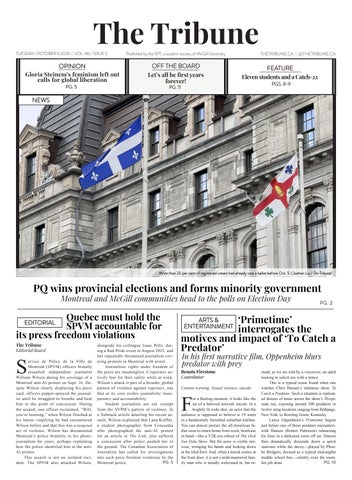
More than 25 per cent of registered voters had already cast a ballot before Oct. 5. (Jiazhen Liu / The Tribune)
PQ wins provincial elections and forms minority government Montreal and McGill communities head to the polls on Election Day
Quebec must hold the SPVM accountable for its press freedom violations EDITORIAL
The Tribune Editorial Board
S
ervice de Police de la Ville de Montréal (SPVM) officers brutally assaulted independent journalist William Wilson during his coverage of a Montreal anti-AI protest on Sept. 16. Despite Wilson clearly displaying his press card, officers pepper-sprayed the journalist until he struggled to breathe and beat him to the point of concussion. During the assault, one officer exclaimed, “Will, you’re learning,” when Wilson flinched at his baton—implying he had encountered Wilson before and that this was a targeted act of violence. Wilson has documented Montreal’s police brutality in his photojournalism for years, perhaps explaining how the police identified him at the antiAI protest. This assault is not an isolated incident: The SPVM also attacked Wilson,
alongside his colleague Isaac Peltz, during a Rad Pride event in August 2025, and has repeatedly threatened journalists covering protests in Montreal with arrest. Journalistic rights under freedom of the press are meaningless if reporters actively fear for their safety while at work. Wilson’s attack is part of a broader, global pattern of violence against reporters, one that at its core erodes journalistic transparency and accountability. Student journalists are not exempt from the SVPM’s pattern of violence. In a Substack article detailing his recent assault, Wilson explained that Lana Koffler, a student photographer from Concordia who photographed the anti-AI protest for an article in The Link, also suffered a concussion after police pushed her to the ground. The Canadian Association of Journalists has called for investigations into such press freedom violations by the PG. 5 Montreal police.
PG. 2
‘Primetime’ interrogates the motives and impact of ‘To Catch a Predator’ ARTS & ENTERTAINMENT
In his first narrative film, Oppenheim blurs predator with prey
Renata Firestone Contributor
Content warning: Sexual violence, suicide
F
or a fleeting moment, it looks like the set of a beloved network sitcom. In a brightly lit wide shot, an actor that the audience is supposed to believe is 19 waits in a handsomely furnished suburban kitchen. You can almost picture the all-American father soon to return home from work, briefcase in hand—like a Y2K-era reboot of The Dick Van Dyke Show. But the actor is visibly nervous, wringing his hands and looking down at the tiled floor. And, when a knock comes at the front door, it is not a mild-mannered family man who is timidly welcomed in, but in-
stead, as we are told by a voiceover, an adult looking to solicit sex with a minor. This is a typical scene found when one watches Chris Hansen’s infamous show, To Catch a Predator. Such a situation is replicated dozens of times across the show’s 20-episode run, exposing around 300 predators in twelve sting locations ranging from Bethpage, New York, to Bowling Green, Kentucky. Lance Oppenheim’s Primetime begins just before one of these predator encounters, with Hansen (Robert Pattinson) rehearsing his lines in a darkened room off set. Hansen then dramatically descends down a spiral staircase while the decoy—played by Phoebe Bridgers, dressed as a typical mid-aughts middle school boy—silently exits the room, PG. 10 her job done.
2
NEWS
news@thetribune.ca
TUESDAY, OCTOBER 6 2026
PQ wins provincial elections and forms minority government
Montreal and McGill communities head to the polls on Election Day Helene Saleska News Editor Liam Sutcliffe Contributor
T
he Quebec provincial elections fell on Oct. 5 this year, but advance polling began on Sept. 25 at McGill. Five main parties remained in the running to win seats in the National Assembly of Quebec as of last week: the incumbent governing party Coalition Avenir Québec (CAQ), Parti Québécois (PQ), Parti libéral du Québec (PLQ), Québec solidaire (QS), and Parti conservateur du Québec. The National Assembly holds 127 seats, with 64 seats necessary to form majority government. As Oct. 5 approached, the PQ was already anticipated to win the election, with polls showing the party even closing in on a majority government victory. During this contentious week of Quebec politics, The Tribune examined key events and insights into the political developments of this election at McGill and within the broader Montreal community. Bill 96’s advance polling on McGill campus, allegations of foreign interference On the main floor of the Redpath Library, students may have expected Élections Québec staff to greet them in French as they cast advance votes, conforming with Bill 96, which passed in June 2022. Bill 96 restricts the language of public communication in Quebec to French. Under this new amendment to the Charter of the French Language, Élections Québec staff are directed to speak to voters in French, with some exceptions outlined in a special directive. The Tribune conducted a survey with five anglophone students who recently cast their ballots. Out of these five voters who spoke English at the polling station, four were answered in English, and one was answered in French. The latter student confirmed that the Élections Québec staff continued speaking French throughout the interaction. The student further clarified that the ballot-casting process was explained to them in French, prompting them to switch to French for the remainder of their voting experience. While the discourse around French preservation and French language requirements in public institutions has always been a contentious one, it has also been a central issue in this provincial election. Paul St-Pierre Plamondon, PQ leader, stated that a sovereign Quebec would be a French-speaking country that rejects bilingualism, in a September 2026 Radio-Canada interview. In an interview with The Tribune, Kelly Gordon, assistant professor in the Department of Political Science, explained that the prominence of such rhetoric reflects a broader transformation in the political character of Quebec nationalism. “The PQ, and the sovereigntist movement more largely, used to be a party associated with the building of the welfare state and social democracy,” Gordon said. “I think Quebec nationalism has gotten increasingly conservative, and more focused
around […] controlling immigration and also the French language.” While this also corresponds to global trends towards right-leaning politics, Gordon warned against associating Plamondon’s conservative nationalistic rhetoric with what she calls “Trumpism.” “I’ve been seeing this everywhere in the Quebec media of [‘Plamondon-Trump’] and ‘This is Trumpism,’ and I think that kind of causal story is incorrect,” she said. This came after Plamondon and the PQ sought to arrange a meeting with the United States’ Department of State in March 2026, although the meeting was ultimately cancelled. However, Gordon maintained that Plamondon and Trump are distinct political figures and should not be compared. Instead, she suggested that the PQ’s popularity in the current election may reflect not simply a shift towards conservatism, but rather an evolution in how Quebec nationalism is articulated and mobilized in more right-leaning ways. Austerity measures and cuts to public funding expected As tensions ramped up towards election day, polls showed the PQ in the lead, the PLQ close behind, and support for the CAQ continuing to plummet rapidly throughout the week. Looking towards the aftermath of the election, Éric Bélanger, professor in McGill’s Department of Political Science, explained what might follow either a PQ or Liberal Party victory in an interview with The Tribune. “[With PQ] we know that a third [sovereignty] referendum is on the agenda, and would probably be underway sometime around 2029. So that issue is going to end up siphoning a lot of energy in Quebec
for the next three or four years, on top of all the other major issues that need to be addressed,” Bélanger said. “For a Liberal Party win, I think it will probably lead to some form of status quo.” Bélanger also highlighted the future reality of austerity measures, an issue that he expects will be common among all parties. “No matter which of these parties ends up being the next government in Quebec, one major change is that we’re going to see an austerity period for the next two or three years [.…] Four of the five parties have pledged that they would implement cutbacks in public financing and cut some public employees,” Belanger said. “That’s all because of the zero deficit law that was adopted in Quebec in 1996, which requires that when Quebec is in a deficit period, it is required to return to zero deficit over a three-year period.” Bélanger attested that this is one of the main motivations for PQ’s proposal to dismantle Santé Québec. However, he expects all parties will have to commit to some significant funding cuts, which he explained would primarily affect the education and healthcare sectors. “Some of the parties have been open to a greater role of the private sector in some areas, healthcare especially, and so there might be some opening up to the private sector again,” Bélanger stated. Indigenous rights and separatism in the Quebec election In an interview with The Tribune, expert in Indigenous rights and professor in the Faculty of Law at Université de Montréal, Karine Millaire, emphasized that the rights of Indigenous Peoples are often overlooked within Quebec provincial debates. She
reaffirmed that Indigenous Peoples are already a highly disenfranchised group, and that leaving them out of political campaign platforms can only exacerbate this problem. “We don’t talk really about [Indigenous communities] during the campaign,” Millaire said. “Last election, it was less than 15 per cent of Indigenous people who voted in Quebec [....] While in Montreal, we are on Mohawk territory, and in Kahnawà:ke, just next to here, it has been in the past election less than 1 per cent of the Kahnawà:ke people who vote because they do really feel like it’s not [their] government. It’s a stranger’s government, and so if we don’t talk about Indigenous issues in a campaign, things can get even worse.” Millaire also commented on how PQ’s plan to hold a referendum on Quebec sovereignty leaves out the voices of Indigenous nations, who have been continually advocating for their own sovereignty for a much longer period. She explained that since the 1995 referendum on Quebec separatism, international law around Indigenous Peoples has changed drastically. “[Now] there is a very strong argument to conclude that actual consent of Indigenous Peoples is really mandatory,” she said. ‘It’s clear this is really a different approach [from QS]. [PQ is] just saying, ‘We’re going to consult you, but actually, in the end, if you disagree, we don’t care’ [....] This would be a recolonization of the territory. That would be just to take over the territory, to force and impose sovereignty again, which would be also very contrary to international law itself.” As of 10 p.m. on Oct. 5, preliminary election results identify the PQ as having established a minority government.
More than 25 per cent of registered voters had already cast a ballot before Oct. 5. (Jiazhen Liu / The Tribune)
TUESDAY, OCTOBER 6 2026
news@thetribune.ca
NEWS
3
Hundreds gather on National Day for Truth and Reconciliation for Montreal Every Child Matters March
Speakers call for greater accountability from all levels of government ahead of provincial elections Ilia Mehr-Bakhsh News Editor
alongside the David Suzuki Foundation. Kevin Deer, a faithkeeper at the Mohawk Trail Longhouse, addressed the n the National Day of Truth and crowd, advocating for renewed respect for Reconciliation, hundreds gathered Indigenous knowledge, treaty relationships, in Tiohtià:ke (Montreal) to take and the responsibilities shared by all part in the Every Child Matters March 2026. people towards Mother Earth and future The march, which began in Westmount generations. Park, continued along rue Ste.-Catherine “Whatever is left of Indigenous to Square Cabot, honouring the children spiritual knowledge and wisdom, if we take murdered by the residential school system. it to heart, we can change the trajectory Demonstrators also paid tribute to survivors, that we are on [....] We have lessons to be calling for heightened governmental learned, and for you people that are in this accountability towards Indigenous treaty relationship with us, we have to polish communities. The Native Women’s Shelter those agreements of peace, friendship, (NWS) of Montreal organized the march and respect,” Deer said. “We have to start hearing different. We have to start speaking differently. And together, equally, we better start doing different.” Manitou Singers, a powwow singing group based in the Greater Montreal area, took the stage and shared a performance of drumming and singing with the large crowd. Bonnie Hannah, executive assistant at the NWS, has helped organize Montreal’s Every Child The Supreme Court ruled in 2017 that 40,000 residential school records will be destroyed in 2027. (Ilia Mehr-Bakhsh / The Tribune) Matters March over the
O
last four years. In an interview with The Tribune, she expressed hope that these annual commemorations will continue to influence Canada’s decision-makers, and that the march will become an opportunity for people to have necessary conversations about Canada’s ongoing genocide against Indigenous Peoples. “I hope that all of the marches and vigils that are happening across Canada [today] will bring attention […] to the issues that Indigenous [Peoples] are facing and continue to face and have faced,” Hannah said. “[I hope] that the government is listening, that the people who are running for these elections, especially in Quebec right now, that they are listening to the needs [of Indigenous communities].” Marjorie Michel, Minister of Health of Canada, was also present at the march. Michel explained in an interview with The Tribune that the federal government is committed to partnering with Indigenous Peoples. She detailed potential hurdles in the path to collaboration, particularly in light of Bill C-39, which aims to fasttrack major infrastructure project reviews at the expense of diligent consultations with Indigenous governments on project development. “Reconciliation is tough sometimes, but with love and hope, we will get there, so this is what we are doing,” Michel said. “Every single project, Indigenous Peoples
will be consulted and be part of those projects from the start […] and that’s a very strong commitment that we made [....] I’m expecting to have some bumps, but at the end of the day, we will work together.” Indigenous and non-Indigenous peoples alike marched together in solidarity, amid a series of speeches and performances. Near the end of the march, Barbara Kaneratonni Diabo performed a dance surrounded by the crowds at Square Cabot. The event ended with a speech by Ellen Gabriel, Kanien’kehá:ka (Mohawk) activist, artist, and member of the international Permanent People’s Tribunal. The Tribunal concluded on the day of the march that Canada has committed crimes against Indigenous Peoples, demanding substantive accountability and reconciliation at an international level. “Today, we are here to remind Canadian citizens and Indigenous Peoples alike [to] support the families of those children who never came home, to say we will not take this anymore and never again for our people,” Gabriel said. “Our people deserve justice [....] I thank Mother Earth. I thank our elder brother, the Sun, for shining for us today. I thank the waters we are still able to drink and wash ourselves with, and the medicines we find. If it was not for all our relations, we would not have survived colonization and this day would not have been possible.”
McGill undergraduate students pass motion regarding HUJI academic boycott SSMU GA sees 96 per cent of voters in favour of boycott Asher Kui Managing Editor
an academic boycott against the Hebrew University of Jerusalem (HUJI). The motion calls on the SSMU’s elected representatives n Sept. 28, the Students’ Society of to speak at the McGill Senate on behalf of McGill University (SSMU) held a the student body’s support for the academic general assembly (GA), during which boycott during or before January 2027. the Motion Regarding the Academic Boycott Signed in December 2023, McGill and of the Hebrew University of Jerusalem HUJI’s exchange agreement allows McGill to Exchange Program was approved—with over send three full-time undergraduate students 96 per cent of voters in favour. annually to study for one or two semesters The motion was submitted originally at HUJI, and to host three HUJI students to the SSMU on Sept. 14 by Sumayya in Montreal. However, this exchange is Kheireddine, Faculty of Law student. currently on hold due to McGill’s Policy Kheireddine’s submission cited two student- on Student Safety Abroad, which currently moved motions adopted in previous years— prohibits students from studying in Israel via the Policy on Harmful Military Technology a McGill program as a risk level 3 destination. and the Policy Against Genocide in The assembly was called to order at 6:31 Palestine—to mandate the SSMU to pursue p.m., where SSMU Speaker in Council James Thomas Reid delivered a land acknowledgement. Initially, there were not enough members present to reach the quorum of 350. Only at 7:24 p.m. did the council announce that the quorum was met. Between the call to order and the ensuing motion period, SSMU facilitated Since 2010, McGill has raised more than $1.5 million CAD in private a question period, donations for its partnership with HUJI. (Zoe Lee / The Tribune) in which some
O
executives delivered announcements and reports. In particular, Vice President External Harry Wang spoke to the importance of student voting, making a connection between attending the GA to vote on the HUJI motion and voting in the Oct 5. provincial election as an avenue to uphold democracy. “Please, if you are a registered voter in Quebec, I cannot stress how important it is for you to vote in the election,” Wang said. “The more students that vote, the more it is that we can show to [the] government that student voice still matters in politics.” During the question period, a student inquired about the unavailability of an alternative option to attend the GA online, which was offered during last year’s GAs, to which Reid explained that the typical standard has always been for students to attend these meetings in person. “In the previous general assemblies, there were other extenuating circumstances that prohibited people from showing up for quorum,” Reid said. “Last year, we had the STM strike, which made things very difficult accessibility-wise. However, the reason why we do it mainly in person is to keep, especially for voting, smooth representation [....] This is mainly a matter of confidentiality and ensuring the proper representation has been made.” After quorum was reached, Reid invited Kheireddine on stage, where she presented her motion to the assembly. She began by condemning McGill for not yet divesting
from companies complicit in Israel’s genocide in Gaza. “Last year, I stood here in front of all of you, my fellow students, and told you that McGill [refused] to divest from the genocide of our people in Palestine,” Kheireddine said. “Then I said it had been 723 days. Today, it’s been 1,086 days. 1,086 days in which the number of Palestinians killed continues to climb with innumerable lives lost. The demand has not changed. McGill must boycott [Israel].” Moment of the Meeting The HUJI boycott motion was passed, and the SSMU has proceeded to an online ratification process. Soundbite “It’s about our institution collaborating with another institution, and as students who care about the kinds of institutions that our universities are engaging with, it’s our duty to be aware of these things. [HUJI] proclaims itself to have the most important ties and collaboration with the Israeli Defence Forces [....] Our motion to end McGill’s relationship with [HUJI] follows the principle of academic boycott that has been called on by Palestinian academia and civil society since 2004.”—Kheireddine on why students should vote for the motion
Students with SSMU membership wishing to vote may do so via an email sent by Elections SSMU on Outlook. The voting period will end on Oct. 13.
4
NEWS
TUESDAY, OCTOBER 6 2026
news@thetribune.ca
Skátne Entewathahíta 2026: OII and Faculty of Education host annual We Will Walk Together event Madsen, King, and faculty representatives discuss meaningful reconciliation Asher Kui Managing Editor
A
s part of McGill’s 15th annual Indigenous Awareness Weeks (IAW), the Office of Indigenous Initiatives (OII), in tandem with the Faculty of Education, held the annual event Skátne Entewathahíta (We Will Walk Together). Through this series of events, McGill intends to promote Indigenous culture and to raise awareness regarding the continued oppression of Indigenous Peoples across Turtle Island (Canada). The We Will Walk Together event fell on Sept. 30, the National Day for Truth and Reconciliation, and featured an opening ceremony at Tsi Non:we Onkwatonhnhets (Y-intersection), followed by a land-based activity hosted by Brooke Rice and a medicine walk led by Robbie Madsen. Madsen began this event by referring to their colonial name, which is a result of the Sixties Scoop. Spanning more than three decades from the 1950s to the 1980s, the Sixties Scoop referred to a set of government policies that permitted child welfare workers to kidnap Indigenous children from their birth families or reserves, putting them up for adoption in mostly non-Indigenous or white households. “I don’t mind ‘Robbie Madsen.’ I’ve always thought it’s a beautiful name. It’s easily memorable. It works well in media. It’s also not a very common name,” Madsen said. “But Robbie Madsen is my name due to European colonization, namely the Sixties Scoop. My real name […] which is in Cree, in English translates to ‘They who hear the voice of the buffalo’ [....] We receive our First Nations traditional name by assignment, from our ancestors, in fullblown naming ceremonies.” Madsen continued with a land acknowledgement. “The city in which we live and work, named Tiohtià:ke, by the Kanien’kehá:ka and the Mooniyang communities of the Anishinaabe People, finds itself on a territory that has not been ceded,” they said. “We are conscious of the distance which separates us right now from the values of the First Nations communities. And in particular, their primordial notion of interdependence, with all forms of wildlife, the ground on which we are standing right now and its waters, for which they are the original and true guardians.” Madsen then discussed their book entitled Insanity and Lies: Goodbye Sixties Scoop, underscoring the recent ruling that the international Permanent Peoples’ Tribunal came to: Canada is guilty of an ongoing genocide against Indigenous Peoples. According to Madsen, this finding urges the repositioning of the Sixties Scoop as an ongoing event, rather than something of the past. “I discovered at age 45 that I was not born in a hospital in Grand Prairie, Alberta, as falsely stated, in my adoption records, but in a very big Indian residential school in St. Paul, 600 kilometres away from the said and supposed hospital,” Madsen said. “There are lies in my adoption record in reference to my genealogy [....] This kind of lying on First
Nations foster children’s documents […] is still going on right now [....] There are still a lot of areas in this story where we are not telling the truth yet.” Geraldine King, the OII’s senior advisor of Indigenous Curriculum and Pedagogy and assistant professor in the Faculty of Education, spoke next, highlighting the OII’s continued efforts towards reconciliation through organizing McGill’s 15th annual IAW. “We Will Walk Together is an annual event of IAW, and it is through these longstanding relationships and traditions that we keep these events authentic, we keep them alive, we keep them spirited,” King said. “We started this year’s IAW with a keynote by Phyllis Webstad, the creator of Orange Shirt Day, and IAW always ends on Sept. 30 [....] Having opportunities to learn from the land and [connect with] the land as [a] teacher is very, very important, and being together on the land creates a different kind of space for learning, reflection, connection, and relationship building.” King then introduced the Dean of the Faculty of Education Vivek Venkatesh, who discussed meaningful reconciliation as a settler on Turtle Island. “As a non-Indigenous person, I know that my role is not to define what reconciliation should mean for Indigenous Peoples, for their communities, or for their nations,” Venkatesh said. “Our responsibility is to listen, to make room for Indigenous leadership, and to help ensure that our institution is accountable for what it says it will do [....] I’ve learnt mainly that relationships take time, and also that meaningful collaboration depends on trust, reciprocity, and accountability.” Venkatesh then outlined a few initiatives that the Faculty of Education is working to
implement to strengthen reconciliation at McGill. “We’re working to develop a proposal for a School of Indigenous Education, and to establish stronger expectations for ethical, community-engaged Indigenous research. These commitments have to live in our practices,” Venkatesh noted. “For me, walking together means staying in relationships, listening when we’re challenged, and also accepting that reconciliation requires sustained action rather than symbolic gestures.” Madsen then sang a cover of “Penitent” by Suzanne Vega. King followed by inviting the crowd to share their thoughts on truth and reconciliation. One of those who spoke was Jordan Koch, associate professor in the Faculty of Education and the co-director of Onkwanaktí:io—a lab space dedicated to Indigenous-focused kinesiology research. Koch spoke to the crucial role that education plays in reconciliation. “For myself, and probably many of us in the Faculty of Education, [we] gravitated towards education for sometimes altruistic reasons. We want to be a part of contributing to building a better future, for children, for young adults,” Koch said. “Days like today remind us that the professions, the institutions of which we are part of, they’re not innocent, they’re not colonially benign. It invites really critical examination about our pathways, our institutions, and about ourselves, and the ways in which we might [inadvertently] reproduce these histories that we’re today trying to reckon with.” Claudia Mitchell, Distinguished James McGill Professor in the Faculty of Education, also shared her thoughts, in which she expressed hope that new and incoming McGill students will nuance and further deepen the university’s process of
deliberate reconciliation. “My new students who are in first year and second year bring with them such an amazingly new consciousness [....] As professors, we have a real responsibility to pull that forward, and not just say, ‘Oh, this is the way it was.’ There’s a lot happening and I’m excited to be part of that, and I’m excited to be here today,” Mitchell said. Pasha Partridge, Indigenous Representation and Events Officer at OII, emphasized the importance of allyship and sustained action in reconciliation efforts. “This morning, my partner brought my son to his bus stop, and he noticed that nobody was wearing an orange shirt,” Partridge noted. “My response to that? ‘Oh, that’s normal.’ I didn’t like that that was my response, so when I came onto campus and I saw all of you guys in your orange shirts, I was like, ‘We’re doing something right, at least in some of the places.’ We just need to be louder and more present. Keep talking, keep spreading, keep sharing, keep listening, because the numbers [are] what matters. Indigenous Peoples are a very small population in Canada. If only Indigenous Peoples wear orange shirts, the message isn’t going anywhere.” King wrapped up the ceremony by referring to McGill’s 52 Calls To Action, emphasizing that reconciliation is an ongoing process that doesn’t only take place on Sept. 30. “These awareness weeks [are] a part of [McGill’s calls to action],” King said. “I encourage you to look at those and see where you see yourself in that bigger picture, and not [simply] once a year wearing the orange shirt. As [Partridge] said, [it’s not about] everybody wearing them but what responsibility lies behind […] what that orange shirt actually means.”
In 2015, the Province of Manitoba formally apologized for the Sixties Scoop, mandating the inclusion of such history in the school curriculum. (Asher Kui / The Tribune)
opinion@thetribune.ca
TUESDAY, OCTOBER 6 2026
T EDITORIAL BOARD Editor-in-Chief Mairin Burke editor@thetribune.ca Creative Director Zoe Lee creativedirector@thetribune.ca Managing Editors Asher Kui akui@thetribune.ca Ellen Lurie elurie@thetribune.ca Clara Smyrski csmyrski@thetribune.ca News Editors Ilia Mehr-Bakhsh Josette Chandler Helene Saleska news@thetribune.ca Opinion Editors Lulu Calame Julie Raout Camila Sierra Ordóñez opinion@thetribune.ca Science & Technology Editors Avery Berry Sarah McDonald scitech@thetribune.ca Student Life Editors Rachel Blackstone Tamiyana Roemer studentlife@thetribune.ca Features Editor Kaitlyn Schramm features@thetribune.ca Arts & Entertainment Editors Norah Adams Annabella Lawlor arts@thetribune.ca Sports Editors Merce Kellner Ivanna Zhang sports@thetribune.ca Design Editors Eliot Loose Gwen Heffernan design@thetribune.ca Photo Editors Emiko Kamiya Sophie Schuyler photo@thetribune.ca Multimedia Editors Will Dawson Daphne Short multimedia@thetribune.ca Web Developers Zola Ball Kate Lauro webdev@thetribune.ca Copy Editor Ella Bachrach copy@thetribune.ca Social Media Editor Chloe Ross socialmedia@thetribune.ca Business Manager Amy Xia business@thetribune.ca
TPS BOARD OF DIRECTORS Zain Ahmed, Nour Khouri, Celine Li, Lialah Mavani, Ilia Mehr Bakhsh, Aleks Rohozinski, Alex Hawes Silva
STAFF Zain Ahmed, Brooke Barak, Miranda Forster, Abigail Francis, Alex Hawes Silva, Helena Helms, Dylan Hing, Gretta Iraheta Palacios, Lialah Mavani, Shea McDonnell, Jenna Payette, Sofia Vidinovski Rokayah Bellaoui
CONTRIBUTORS Lorenzo Costello, Renata Firestone, Max FungeRipley, Julia Lok, Liam Sutcliffe, Lawson Whitman, Garrett Woodson Peilun Li, Jiazhen Liu, Elliot Mairet
TRIBUNE OFFICE Shatner University Centre, 3480 McTavish, Suites 404, 405, 406 The Tribune is an editorially autonomous newspaper published by the Société de Publication de la Tribune, a student society of McGill University. The content of this publication is the sole responsibility of The Tribune and the Société de Publication de la Tribune, and does not necessarily represent the views of McGill University. Letters to the editor may be sent to editor@thetribune.ca and must include the contributor’s name, program and year and contact information. Letters should be kept under 300 words and submitted only to The Tribune. Submissions judged by The Tribune Publication Society to be libellous, sexist, racist, homophobic or solely promotional in nature will not be published. The Tribune reserves the right to edit all contributions. Editorials are decided upon and written by the editorial board. All other opinions are strictly those of the author and do not necessarily reflect the opinions of The Tribune, its editors or its staff.
OPINION
Quebec must hold the SPVM accountable for its press freedom violations The Tribune Editorial Board Continued from page 1. For the SPVM, whose bureaucratic system has frequently undermined investigations against officers, whose units have inflicted targeted racial violence against Black Montrealers, and whose systems prioritize officer anonymity over true justice, the journalist’s camera is one of the few remaining checks against these abuses of power. Journalistic footage often represents the most substantial evidence documenting police violence, including for Wilson, who chronicled his own recent assault through photographs. By attacking the very photojournalists who provide visual proof of police brutality, the police further protect themselves from accountability.
COMMENTARY Helene Saleska News Editor
G
loria Steinem, one of history’s most famous second-wave feminist authors and activists, died on Sept. 2, 2026. Her passing was met with an outpouring of mourning, with many crediting her almost singlehandedly for the increased empowerment of women over the last 50 years. From her beginnings as a journalist, Steinem’s career soon pivoted towards feminist activism. She became the founding member of Ms. Magazine, campaigned for the Equal Rights Amendment, and defended abortion during the Roe. v. Wade deliberations. Steinem also founded the National Women’s Political Caucus, a grassroots organization that supports women candidates running for public office. Some critics consider her an archetypal figure of second-wave white feminism—an institutionalized feminism co-opted by white women that fails to address the intersectionality of women’s oppression along racial, sexual, and class lines. At the same time, some Black feminists like bell hooks have commended Steinem for her feminism’s shift to intersectionality later in life. Furthermore, Steinem co-founded the Coalition of Labor Union Women, and was instrumental in grassroots organizing with Black and white women alike. Steinem’s ideology was more
Independent news outlets are crucial in providing a living record of the activism that institutions like the SPVM systematically try to stifle. Because the state does not fund such publications, independent outlets can assert and uphold critical political positions in ways that legacy news outlets cannot. Journalists from independent grassroots organizations and studentrun papers uplift and promote marginalized voices through ethical, anti-oppressive, and responsible reporting, particularly when covering protests. However, independent news outlets receive less funding and therefore lack access to legal resources and protection, placing them at risk of suppression. After all, the SPVM targeted Wilson due to his identity as an independent journalist. McGill itself has silenced
student journalism in the past. Wilson exposed McGill Security Services’s intimidation tactics while covering the Oct. 7, 2025, pro-Palestine protest on the university’s campus. Furthermore, the university filed a legal motion in 2013 to grant itself the ability to deny access to information requests from certain employees of campus newspapers—a tool student journalists have historically used to obtain information about McGill’s unethical behaviours. McGill’s own media apparatus, the McGill Reporter, propagates pro-university bias, spotlighting initiatives and news that reflect well on McGill while neglecting to acknowledge its harmful conduct. Today, McGill’s campus papers run on independently charged McGill student fees: Funding is ultimately in students’ hands, but administrative policy
5
EDITORIAL
still shapes how freely student outlets can investigate McGill. Citizens must help sustain smaller independent and student newspapers to preserve reporting that amplifies community voices and denounces institutional wrongdoings when legacy outlets fall short of doing so. The provincial government must hold the SPVM accountable for its threats and assaults to journalistic freedom. Montreal must open an investigation into the riot squad that assaulted Wilson to ensure both press and protestor safety and freedom. Moving forward, Montreal must also allocate funding to mandatory press freedom training for all SPVM officers. The purpose of the police is to serve and protect civilians, not to assault and silence them. It’s time for the SPVM to remember where their duties lie.
Gloria Steinem’s feminism left out calls for global liberation complex than either radical activist or whitewashed feminist. Debate over her vast influence, coupled with her involvement with the United States Central Intelligence Agency (CIA), begs the question of why she, and other white, middle-class women, came to define second-wave feminism despite the work of transformative Black feminists in the movement at the same time. While Steinem's rhetoric often aligned with these Black activists, her entanglement with the CIA shows that she never truly understood or championed a global liberatory feminism for all women. Steinem’s involvement with the CIA—through a front organization, the Independent Research Service—funded her early career. Working for the CIA, Steinem led a campaign to disrupt Soviet and communist students’ summits during the Cold War. Her anti-socialism efforts operated alongside the National Student Association, which infiltrated student movements within the U.S. and abroad, functioning as an arm of the CIA for gathering secret intelligence and working to change political outcomes. Steinem’s connections to these organizations were not insignificant. Beyond propelling her to the social and political success she enjoyed throughout her life, her CIA involvement also platformed certain feminist ideas that did less to challenge the status quo, while suppressing those that did.
Further, even as she later became involved with socialist and Black feminist movements, Steinem never apologized for her work with the CIA, nor did she criticize the agency inflicting destruction around the world and upon many of the very groups she claimed to champion. This blatant c o n t r a d i c t i o n In 1963, Steinem went undercover as a “Bunny” to expose at the heart of low pay and poor working conditions at the Playboy Club in Midtown Manhattan. (Zoe Lee / The Tribune) Steinem’s career shows that despite her apparently all forms of oppression, connectradical and intersectional ideol- ing the liberation of women with ogy, her activism ultimately still anti-capitalist revolutionary acserved the CIA's destructive in- tion. Gloria Anzaldúa’s feminism ternational programs that upheld goes even beyond this to assert a Western hegemonic status quo, that the mechanisms of colonialleaving the rest of the world’s ism, modern border enforcement, women out of her view of femi- and immigration policies contribnism. ute to sexism across Latin AmeriCalls to action from Black, ca and around the world. Latina, Indigenous, and other raHad people like Steinem not cialized feminists have long been overshadowed the breadth and rooted in calls for global libera- depth of the second-wave movetion. The Combahee River Collec- ment, collective understandings tive, for instance, fought for an un- of feminism could have evolved derstanding of the connection be- more truthfully to encompass tween the liberation of all women that the liberation of women has and all working-class people. An- always been, and always will be, gela Davis also addressed the un- dependent and connected with the derlying economic mechanisms of global liberation of all.
6
OPINION
COMMENTARY
opinion@thetribune.ca
Sports betting has become impossible to ignore
Lorenzo Costello Contributor
S
ince when did watching sports become an invitation to gamble? Seemingly every sports broadcast has suddenly become coupled with aggressive gambling references: Pre-game odds, player props, and over-unders cover the screen. Even during commercials, celebrities constantly show off the latest betting platforms. Since its legalization in 2021, sports betting has transitioned from a secondary activity surrounding professional sports to something that is integrated and unavoidable when participating in Canadian sport culture. This trend negatively affects younger men, who disproportionately struggle with gambling addictions, while also making it difficult for people with former gambling addictions to engage with sports in a healthy, sustainable way. Researchers from the Canadian Broadcasting Corporation (CBC)’s Marketplace and the University of Bristol analyzed seven National Basketball Association (NBA) and National Hockey League (NHL) games shown across Ontario, and found that betting themes and messages fill an average of 21 per cent of total broadcast time. Even more alarming is that less than three per cent of these messages mentioned age restrictions on gambling or addiction counseling. This normalized, constant exposure to sports betting encourages viewers to engage with dangerous mechanisms designed to hook users on their gambling platforms. This further erodes the boundary between gambling and sports media, mak-
COMMENTARY Max Funge-Ripley Contributor
B
TUESDAY, OCTOBER 6 2026
ing betting on sports increasingly alluring for younger men. Pop culture icons such as Sydney Sweeney and Timothée Chalamet, as well as professional athletes like LeBron James, have also contributed to the promotion of online betting companies. By attaching their product to recognizable figures, gambling companies have glamourized betting, attempting to obscure the addiction and financial stress that accompany the use of their platforms. These pop culture references specifically target men under 30, who make up the large majority of sports betting market users. Betting sites have also sneakily integrated their products into everyday life. On platforms like Kalshi and Polymarket, users can bet on whether it will rain the next day, on whether gas prices will increase, or on whether one country will strike another with missiles—offering more opportunities for users to continue engaging with their products. Before sports betting was legalized in North America, gamblers had to jump through hoops to place their bets, whether with a local oddsmaker or an offshore betting company. Now, consumers can simply open their phones, deposit money, and place bets—and certain platforms do not even require age-verifying identification to operate them, further increasing younger men’s gambling access. The immediate availability that modern cell phones provide to these sites also exacerbates risks to users’ mental health. Furthermore, the insidious nature of sports betting adverts means someone recovering from a gambling addiction will be
constantly exposed to this activity simply by watching evening TV or having dinner at a sports bar. A recent study conducted by the CBC found a 31.3 per cent increase in hospital emergency department visits for gambling-related addictions since 2012. The rise of online gambling has always been a public health concern; as these platforms’ services become more streamlined and ubiquitous, the threat only increases. Based on the scope of this crisis, universities should play an active role beyond just studying gambling addiction. McGill is already home to the International Centre for Youth Roughly 5.9 million Canadian adults—19 per cent of the adult Gambling Problems and population—bet on sports every year. (Gwen Heffernan / The Tribune) High-Risk Behaviours, which is dedicated not only to researching bling, the addiction associated with the highyouth gambling issues but also to develop- est suicide rates, deserves the same level of ing prevention tools. These efforts, however, attention. should be paired with more student-facing It should not be so easy for sports fans support. McGill could include information to casually encounter gambling in their daily about gambling harms in wellness-focused lives. Checking the score of a game or followclasses, or incorporate gambling support into ing your favorite player’s social media should the Student Wellness Hub’s services, making not be an automatic invitation to gamble. The information about gambling addiction easier problem is not how easy it is to sports bet, but to find. McGill already provides resources rather how difficult it has become to avoid surrounding alcohol, drugs, and sex; gam- being encouraged to do so.
Bill C-39 keeps Indigenous Peoples and the environment on the back burner
uild Canada now—the first portion of Bill C-39: An Act respecting certain measures to strengthen the economy—focuses on increasing the efficiency of Canada’s regulatory system, under which government officials review and approve large infrastructure projects. Bill C-39 constantly describes itself as aiming to bolster the economy while respecting Indigenous Peoples and safeguarding the environment. A worthy goal, but such phrasing positions the two concepts as competing priorities, implying that the government must choose between economic growth and protecting Indigenous communities and Canada’s ecology. This is a false dichotomy. Indigenous communities can be a seed for economic growth instead of a limit, and so can environmental protection. Bill C-39’s tone squanders the opportunity to lay the groundwork for projects that bring those two priorities into the cycle of development. At first glance, it’s not all negative: Bill C-39 proposes a “Regions of National Interest” framework, where selected areas of the country would undergo a single impact assessment. If the assessment is approved, future projects within the scope of that region’s designated industries could skip the individual approval process. This plan allows infrastructure projects to start more quickly and predictably—offering efficiency without forcing unexpected environmental sacrifices. However, other portions of the bill risk
opening the door for looser environmental restrictions. Currently, Minister of Environment Julie Aviva Dabrusin is forbidden from changing project approval requirements if doing so would worsen a project’s environmental impact. However, should the bill become law, the minister would be empowered to make regulatory exceptions for projects that are in the “public interest,” and allow for preliminary construction to begin before a formal environmental impact assessment is completed. Prime Minister Mark Carney’s government seems ready to hurt the environment for the sake of growth. Bill C-39 also aims to shorten approval periods to one year per project, as opposed to the current average of two to three years, solely by streamlining the bureaucratic process of approval. Indigenous consultation processes require focused, deliberate communication, already challenging under the current approval process. Although Bill C-39 insists that its targeted one-year timeline “includes the necessary time for the federal government to […] consult with Indigenous Peoples,” it is difficult to imagine that the bill’s administrative changes alone will somehow achieve this drop in wait times without the government reneging on its commitments to Indigenous communities. Respecting Indigenous voices is the federal government’s moral and legal imperative, as is improving the quality of life for remote Indigenous communities, where staple goods are ludicrously expensive due to a current lack of transportation infrastructure. Bill C-39 is well-positioned to address these infrastruc-
tural issues and, with them, food insecurity in tions like the 2 Billion Trees initiative which Indigenous communities, but rushing consul- created jobs, or into projects in Canada’s burtation processes will not lead there. geoning clean technology and environmental The bill language implies a tension be- products sector, which has grown eight per tween attracting investment and protecting the cent over the last five years. climate and Indigenous lands these projects With a more constructive approach to often run through. This tension is avoidable, if growth that ensures against environmental the government strives to incorporate environ- backsliding, and a more specific action plan mental protection and support for Indigenous for thorough Indigenous consultation, a rePeoples into tangible plans for economic pros- vised Bill C-39 could prove a boon for Canaperity, as opposed to framing them as caps on da. Though the bill’s current language implies growth. otherwise, government efficiency is not muGovernment programs like the Aborigi- tually exclusive with protecting Indigenous nal Entrepreneurship Program (AEP) allow communities and the environment. Indigenous members of Indigenous nations to voluntari- Peoples can drive economic development, as ly enter Canada’s loop of economic growth, can environmental protection. repositioning Indigenous Peoples as fonts of innovation. Distributing grants to startups fosters entrepreneurship skills, building a financially sustainable path forward for Indigenous communities. Canada needs to strengthen and broaden programs such as the AEP. Environmental protection can also be the impetus for economic growth. The pressing global climate crisis demands continued government Bill C-39 is organized into three parts: Build Canada now, Keep Canada investment into solu- moving, and Canada Strong for all. (Eliot Loose / The Tribune)
arts@thetribune.ca
TUESDAY, OCTOBER 6 2026
ARTS & ENTERTAINMENT
7
Chiharu Shiota’s newest exhibition debuts in North America at the MMFA Shiota examines her artistic journey in ‘The Soul Trembles’ Dylan Hing Staff Writer
I
t is rare that an artistic piece can transcend simply being viewed to unite viewers in a mutual, tangible feeling of awe. Chiharu Shiota’s immersive exhibitions, revolutionarily, are some of these rare exceptions. At the Montreal Museum of Fine Arts (MMFA), Berlin-based Japanese artist Shiota recently made her Canadian debut with the exhibition The Soul Trembles, showing until Feb. 14, 2027 and presented in collaboration with the Mori Art Museum in Japan. With her signature creations, Shiota offers visitors the chance not only of seeing her fibre art sculptures, but also of physically exploring her creations’ astonishing tunnels of red, black, and white yarn. Throughout her career, Shiota has lived and studied across the world, including in Japan, Australia, and Germany. The Soul Trembles, her largest exhibition to date, ponders the theme of memory, particularly the memory she holds of her search for artistic identity. As such, the first section of the show is dedicated to smaller yarn works and photographic representations of her previous exhibitions. Shiota’s journey of exploring different mediums is highlighted by a photograph of her piece One Line, a work she created after abandoning painting while studying in
Australia. Shiota, dressed in black, stands against a white background with black lines running horizontally across her face and hands. Representations of Shiota’s 2004 solo exhibition in Poland, Dialogue from DNA, are also rendered through photography. This exhibition featured a floor covered in shoes tied to pieces of yarn, which all ascend diagonally to a singular point on the ceiling. An explanatory panel at the MMFA showcases an old high heel and a note in Polish. Its unnamed writer mentions receiving the pair of high heels from the grandmother of a friend.
Through striking red thread, Dialogue from DNA connects the most unlikely memories. It details the ordinary story of a Polish woman from an unknown time, engaging in dialogue with an unknown reader. The letter and exhibition more generally weave a tale where, much as DNA represents the strands of a bloodline, ordinary shoes represent friendship’s metaphorical strands. By inviting visitors to imagine the story behind each of the shoes, Shiota brings the audience into the exhibition with her. The main exhibit, of course, is a red
Shiota has been awarded Japan’s Minister of Education, Culture, Sports, Science and Technology’s Art Encouragement Prize twice. (Dylan Hing / The Tribune)
yarn structure that blankets an entire room— the style of piece that Shiota is most known for. In this specific structure, titled Uncertain Journey, metal boats decorate the floor, yarn flowing out of them like a volcano, creating pillars that visitors can approach to better inspect Shiota’s intricate designs. When looking at the sculptural form long enough, it seems to morph into the image of a muscle. In the next room lies an equally impressive but more subdued installation of black yarn, titled In Silence. Unlike the red room, where yarn pillars are the only aspects of the structure that reach the ground, the black room takes the form of a tunnel, its thread covering tables, chairs, and a piano, crisping them so they appear burnt. Compared to the tinted red lighting of the other room, the lights illuminating the black yarn give the tunnel a decidedly sterile feel, creating a silent atmosphere despite the visitors all around. The immersiveness of the works challenge the notion that gallery frames separate pieces from viewers; rather, Shiota’s structures frame the visitors themselves. It is thus no surprise that Shiota’s work can make any soul tremble: The feeling of walking into a canvas that engulfs you is indescribable. To quote one visitor to the exhibition, overheard in conversation with a family member, there is but one word that can describe Shiota’s achievements: “Incroyable.” Tickets to The Soul Trembles are free for MMFA visitors under 25, if booked in advance.
The poignancy of a slightly sweaty student band venue
Jam for Justice brings music and activism together for a night of performance, community, and giving back Abigail Francis Staff Writer
A
ttending P’tit Ours, a little basement bar tucked away in the Mile End, for Jam for Justice McGill’s first big event of the year was an embodied delight. The alluring bar is bathed in deep reds, burnt oranges, and soft browns, with antique furniture and a velvet couch. It is the kind of venue that invites you to settle in, get comfortable and, perhaps, embrace a bit of sweat. The air was thick with the collective warmth of McGill students, the door handle damp with condensation. Conversations filled the small room, occasionally threatening to completely drown out the music itself. Everyone seemed to know someone, or at least know of someone. The crowd had that particular Montreal coolness about it: Plateau, but sans le français. It was the appropriate setting for Jam for Justice, a Students’ Society of McGill University (SSMU)-affiliated club that brings students together through a shared love of music and social development. The premise is simple: organize monthly events featuring student musicians, with ticket proceeds going toward Montreal-based charitable organizations. For co-president Rhiannon O’Brien, U3 Arts, who discovered the club through her friend and co-president Holly Kohler, U3 Arts, the connection between music and activism has always made sense. “Throughout history, a lot of musicians, some of the most important ones, were
working for social activism and civil rights,” O’Brien said in an interview with The Tribune. Jam for Justice selects the charities it fundraises for in light of current events in the wider social and political landscape. For this event, the club chose to support Apathy is Boring, a Canadian nonprofit that encourages young people to become active citizens and meaningfully participate in the democratic process. “We specifically thought of the Quebec provincial elections coming up,” O’Brien explained. “We thought it was a great time to bring up participating in democracy and using your right to vote.” The evening’s first act was a breathtaking acoustic set by Sofia Richter, a Chicago-based musician who began performing with her band, Neptune’s Core, in grade six. “I started the band before I knew how to play guitar,” Richter shared in an interview with The Tribune. “I would just kind of write these songs a cappella.” Richter highlighted that her songwriting is a personal, grounding practice. “I write songs when I feel overwhelmed, to bring me back to earth,” Richter explained. “I’ll catch something when I’m recording, and I’ll be like, ‘Oh, that’s what I’m feeling deep down.’” For all those looking for other music venues to visit, Richter mentioned that her favourite is Casa del Popolo. Goosehead closed out the night, a fourperson group of second-year McGill students who met through Frosh and mutual friends. In an interview with The Tribune, band member Noah Choi highlighted that the group’s
musical influences are all over the place, heard of, spend an evening in an undeniably ranging from Mariah Carey and The Faces to charming venue, and contribute to an Geese and Magdalena Bay. organization doing meaningful work in the “We all have very different music tastes, city. but then they overlap. Like a Venn diagram,” Design Editor Eliot Loose is the Vice he said. President (Graphics) of Jam for Justice. He The band first started playing together was not involved in the writing, editing, or in the SSMU basement jam room. Choi publication of any parts of this article. described it as somewhere between a rehearsal space and a storage unit. “It’s basically where they store kegs and a bunch of bikes,” he remarked. For now, Goosehead mostly plays covers, although the members are beginning to work on original material. Three of the four have been experimenting with writing songs, hoping to bring more of their own music into future sets. Between the acoustic intimacy of Richter’s opening performance and Goosehead’s rock-heavy closing set, the evening offered a little taste of the musical talent tucked away in McGill’s student community. And really, that’s the appeal of a night like this. You get to discover musicians you might Jam for Justice’s biggest event of the year is the Battle of the Bands, otherwise never have hosted annually in April. (Abigail Francis / The Tribune)
Eleven students and a Catch-22 How IRCC’s study permit interviews with Palestinian graduate students became interrogations, and eventually rejections Written by Lulu Calame, Opinion Editor Designed by Gwendolyn Heffernan, Design Editor
themselves. “Not a single question [was] about the master’s itself or the thesis or anything at all,” Nada n April 2026, Immigration, Refugees and degree. She submitted her complete Canadian said. “[The interview] was maybe 85 or 90 per Citizenship Canada (IRCC) reached out to 11 study permit application in December 2024, and cent political questions [….] More than half of Palestinian graduate students living in Egypt to had been waiting for a decision from IRCC for the interview [focused] on my [former] univerrequest that they go to the Canadian Embassy in over a year. sity.” Cairo for interviews regarding their study permit On May 3, 2026, IRCC sent an email to Nada, Nada received her Bachelor’s degree in Inforapplications. which she shared with The Tribune. mation Technology (IT) from the Islamic UniThese students had applied and been accepted “The interview will provide you with an opversity of Gaza (IUG) in 2018, where she stayed to some of the most competitive graduate proportunity to respond to concerns and to provide to complete her first master’s degree—also in grams in Canada—in areas including mechanical any explanations, clarifications, or documentaIT—in 2023. engineering, public health, and statistics. They had tion you wish to have considered in support of “[IUG] is known for having a political stance submitted their complete study permit applicayour application,” the email stated. [....] Most of the [interview] questions were relattions more than two years prior, and, until these It should be noted that while IRCC often ed to this topic specifically [with questions like,] interview requests, had heard nothing about the requires interviews for more permanent visas— ‘Did you see any of that? Did you interact with status of their applications. This delay was itself an such as permanent residence programs—interany of them? Did anyone ask you to join someabuse of process, trapping students in a bureauviews are not standard for temporary visas such thing?’ And I was being honest,” Nada said. “I cratic black box that prevented them from entering as study permits, unless an officer has a specific have nothing to do with politics [....] I don’t want Canada and beginning their programs. security concern about an application. to feel like this responsibility is being put on me, Between April and June 2026, all 11 students That said, after two years of silence from because I have nothing to do with it.” completed their interviews at the embassy, anIRCC, these interview requests came as a hopeful swering every question as accurately as they could. sign. Structural, not personal Within two weeks of their respective interviews, “We were really excited. We were like, ‘FinalStudents like Nada interviewed by IRCC are 10 of these students received a Procedural Fairness ly, this is what we were asking for,’” Nada El-Fapart of a population of Palestinian post-graduate Letter (PFL) from IRCC, citing concerns about the lou said in an interview with The Tribune. students who are some of the most distinguished truthfulness of their interview responses, and givEl-Falou is the director of student services scholars in their fields.Yet, rather than inquire ing the students a chance to provide further conat the Palestinian Students and Scholars at Risk about the students’ academic work or individual text. The students responded to the PFLs within network—an organization that provides univer- motivations to study in Canada, IRCC pushed 14 days, and between June and August 2026 all 10 sity and visa application support and academthem to answer questions aligned with the departreceived letters of rejection from IRCC regarding ic matching to Palestinian students pursuing ment’s own untenable assumptions about their their study permit applications; only one student post-graduate degrees in Canada, which had political affiliations. from the cohort was ultimately approved. been working with all students involved in these These assumptions were founded entirely on What follows is the story of these interviews, IRCC interviews. El-Falou is personally in touch students’ university enrollments and nationaliand the 11 Palestinian students involved—10 of with all 11 students, and is familiar with their ty—not on any evidence of political action, which whom have now been denied their right to purcase files. students clarified they had never taken, sue their graduate studies in Canada. It is a story “We felt that [these emails were] a good indi- and for which IRCC had no evidence that took place in the bureaucratic back corners of cator [at first] because it meant that the applica- in the first place. El-Falou, who public awareness, but which sits as a smoking gun tions [were] progressing in some way,” El-Falou has reviewed the interview of systematic discrimination within the Canadian said. “What we didn’t expect was the nature of transcripts, said the immigration department. the interviews.” students affiliated with a given university The interview request The interviews were all asked the same set One of the Palestinian students—who wished As opposed to the case-specific line of ques- of university-specific questions. to be referred to as simply “Nada”—shared her tioning fit to address gaps in an individual study Most students had completed experience with IRCC in an interview with The permit application, the questions IRCC posed to their bachelor’s at IUG or AlTribune. In July 2024, two months after evacuating the students were almost entirely impersonal— Azhar University - Gaza, as those Gaza and moving to Egypt, Nada was admitted to centred on students’ undergraduate alma maters are the top two highest-ranked McGill University’s Master of Science in Computer in Gaza rather than their intended academic universities in Gaza. Science program to pursue her second master’s work in Canada or the study permit applications “We’re talking about a systematic
I
issue here,” El-Falou said. “It’s unrealistic to judge a student, and not just a student, a whole student body of a certain university, based on one student club or one student group. It makes no sense. You’re discrediting the whole student body.” Not just content, but tone Beyond the content of the questions, what stood out about IRCC’s interviews was their tone. “Reading the transcript, I felt the interviews were very, very interrogation-style. [They were] pretty intimidating,” El-Falou said. Nada reported the same experience. “If you told them, ‘I don’t know,’ they will repeat the question and ask it again and say, ‘I don’t believe that you don’t know. You need to give me an answer’ [....] I felt, oh my God, you’re not asking me about myself,” Nada said. “It felt like an interrogation [....] It felt like they were trying to find any reason to say no.” Based on the transcripts reviewed by El-Falou, the other interviews were similarly impersonal and insistent. Two of the students interviewed were a married couple whom IRCC first interviewed separately, and then again together. After both interviews, IRCC officers claimed the woman’s answers had changed. Another student was interrogated about events that took place at his high school in 2005, while others were asked about the political affiliations of their primary schools in Gaza.
plained, referring to one student’s interview transcript. “And then later, they introduced a new piece of information, and asked the question again.” El-Falou reflected on the PFLs’ claims in the context of this interview tactic. “Of course the student changed their answer,” El-Falou said. “She changed her answer after they introduced a new piece of information. They set her up to change the answer and then didn’t like the fact that she changed it.” IRCC’s approach to these study permit interviews set up a convenient Catch-22 for subsequent rejections—where students’ truthful responses were considered untruths, but an alternative answer would have been condemning in its own right. Within a week of receiving the PFLs, all 10 students responded to IRCC verifying the authenticity of their initial interview answers, clarifying that they were not involved in any political activity on their previous university campuses, and reaffirming their commitment to study in Canada. “Many of the claims and information referenced in the letter are honestly new to me,” Nada stated in part of her own appeal to IRCC, which she shared with The Tribune. “My view is only about how the Islamic University is known for its academic achievements and its students’ participation in national and international competitions and events. My focus throughout my years there was entirely academic.”
appeal their cases in court, begin their applications anew, or choose a different path altogether. Students’ feelings about next steps are mixed. But El-Falou emphasized how, despite their experiences navigating Canadian bureaucracies, many Palestinian students still uphold Canada as a top academic destination. “An international mixed community of knowledge-sharing and experience-sharing is one of the things that makes our academic community here great. So the students still want to come [to Canada],” El-Falou said. “Some of them have not even been applying to other places because they’re so adamant to come here.” Others, like Nada, have lost hope in continuing their studies in Canada. To start the application process from the beginning is a daunting task, and one with a timeline not of months but of years. Appealing the decision in court is similarly onerous—both financially and psychologically. “If it’s going to end in a positive way, it’s going to take at least a year or two years,” Nada said. “I just want to move on from this whole situation.”
Looking ahead: the fight for legal precedent IRCC’s demonstrations of bureaucratic impunity are a targeted abuse of the permit system that excludes Palestinian students. The department must be retroactively held accountable, and prevented from further discriminating against these applicants, with legal precedent. After the interviews “We’re not giving up,” El-Falou said. “Our [leA week after their respective interviews, Rejections gal] system is all based on precedent. And if we just Nada—along with nine other students in the coOn July 5, 2026, Nada received her letter of give up and let all of our students not keep trying, hort—received a PFL from an IRCC officer, which rejection from IRCC. The other nine students […] the next generation is going to have the same she shared with The Tribune. were similarly rejected between June and August. problem.” “Based on the information available to me, Nada’s rejection, which mirrors the nine others, Securing that precedent is the first step towards including from your interview […] I have conwas shared with The Tribune. establishing an infrastructure of accountability cerns that you may not have truthfully answered “I am not satisfied, on a balance of probabilwithin a federal department that enacts a systematic all questions put to you during your examination ities, that you have truthfully answered all quesexclusion of an entire group based on false claims of as required pursuant to sections 16(1) and 11(1) tions guilt. of the [Immigration and Refugee Protection Act],” put to you [....] In the absence of truthful testiThe IRCC’s treatment of these 11 Palestinian the email stated. mony, I am unable to assess your admissibility students is unacceptable, and extends far beyond El-Falou added that in many of the PFLs, and, therefore, cannot conclude that you are not this cohort alone. An additional 26 Palestinian stuIRCC upheld its allegation of untruthfulness on inadmissible,” IRCC’s rejection stated. dents admitted to Canadian graduate programs are the claim that a students’ answers had changed in The evidence presented by IRCC to validate still awaiting decision on their study visa applicaresponse to the same questions—but these quesits rejections of these 10 Palestinian students was tions after evacuating from Gaza to Egypt, while 98 tions had been designed to give way to different both baseless and predatory. It established a logical more await visa decision from within Gaza. responses. trap in which alleged dishonesty was determined I myself am a student at McGill. Nada should “[The interviewer] kept asking, literally verby the department on the basis of students’ rehave been my colleague on campus two years ago. batim, the same question over sponses failing to align with its assumptions about Now, after having followed every step of the appliand over again, and the their political affiliations. cation process, and answering every one of IRCC’s student kept giving “IRCC is committed to a fair and non-disquestions with full truth and integrity, she will not the same answer,” criminatory application of immigration procemake it to our lecture halls at all. El-Falou ex- dures,” the IRCC’s Media Relations Office shared Nada’s story, the stories of the 10 other students in a written statement to The Tribune. “IRCC involved in these IRCC interviews, and those of the has been working with partners to expedite the 124 Palestinian students awaiting a path to purprocessing of this group of study permit applicasue the educational programs to which they were tions for 37 Palestinian students [....] IRCC has accepted on the basis of outstanding merit, must completed all required interviews for this group be platformed—in newspapers and on committee and decisions were made and communicated to floors. Equitable access to education is a right, and applicants.” Canada must choose today to uphold that right, as it claims to do, for all. The interviews’ wake Lulu Calame formerly served as a Digital In the wake of their rejections, students Marketing and Coordinator Intern for Palestinian like Nada are left with the choice to Students and Scholars at Risk.
10
ARTS & ENTERTAINMENT
arts@thetribune.ca
TUESDAY, OCTOBER 6 2026
‘Primetime’ interrogates the motives and impact of ‘To Catch a Predator’ In his first narrative film, Oppenheim blurs predator with prey
Renata Firestone Contributor Continued from page 1. Content warning: Sexual violence, suicide The would-be perpetrator is stunned, then shocked as Hansen reveals himself and the show, inviting his crew out of the shadows. The cameras have been rolling this entire time, capturing the man’s crime. It is obvious from the beginning of the movie, as well as from the promotional materials that came out prior to Primetime’s release, that Oppenheim is interested in the enterprise of Hansen’s reality television creation. In the nearly 22 years since To Catch a Predator premiered on Dateline NBC, reality television and true crime docuseries have become ever more prevalent. Hansen’s show straddled the line between the two genres, combining the real-world depravity that hooks audiences looking for shocking entertainment with the classic cheapened artifice of reality television. Yet what set the series apart from other shows in these domains was its shamelessly explicit approach: snare sexual predators and then, using Hansen as the staunch figure of divine retribution, distribute the footage as popular entertainment. Two birds with one stone. Of course, this formula has been
rightfully criticized, chiefly for flattening pedophilia and sexual violence into 15-minute news segments. To Catch a Predator was never interested in much beyond the righteous indignation it could stir and then direct at these sordid men. As journalist and author Mike Mariani wrote in 2025 for The New York Times, “[Viewers] weren’t tuning in to see a pathos-filled tragedy about human evil, shame and remorse; they were there for the primal gratification of watching predators raked over the coals.” As Pattinson plays it, Hansen is genuinely interested in raising awareness and clearing the streets of sexual predators—of an “ancient evil,” as he puts it. However, it is apparent that Hansen’s producer, Andie Bender (Merritt Wever), is not invested in the show for the same reasons. Rather, Bender relishes in the lucrative opportunities such a firebrand of television programming presents. Most compelling of all the characters is Dan Plum (Skyler Gisondo)—although Gisondo is 30, he can easily pass for 23 or younger. Naive, hopelessly devoted, disillusioned, and, in a particularly hard-towatch moment, legitimately traumatized, Plum is the prey, and Oppenheim takes pains to communicate that in his service to Hansen, he is made doubly so. To Catch a Predator was cancelled after one of the show’s targets—a wellrespected Texas prosecutor—took his
own life minutes before being arrested for attempting to solicit sex with a minor. If you are at all acquainted with Hansen’s show, it is relatively clear from Primetime’s opening that the film will end on this note. Today’s 24-hour news cycle constantly
churns out a sludge of sexual exploitation, corruption, and sensationalized trauma. Hansen, Oppenheim posits, was foundational in bringing real-life horror to television, deluging our screens with the same ancient evil he sought to banish.
To Catch a Predator host Chris Hansen has panned the film, calling it “bizarre.” (Zoe Lee / The Tribune)
Galerie Simon Blais spotlights Montreal artist Denis Juneau Exhibit immerses the viewer in Juneau’s colourful world
Julia Lok Contributor
M
ontreal has been home to some of the greatest artists in the world, including the late Denis Juneau. Born in Verdun, Juneau had an artistic passion that grew beyond the city to impact the global stage. His work belongs to the Plasticien movement, an artistic approach pioneered in Quebec that emphasizes the two-dimensional space of the canvas through highly organized abstract art. Described as “plastic” in reference to the artists’ focus on the structural properties of the canvas itself, Plasticien art appeared all over the world, including in Paris, New York, London, Brussels, Spoleto, and of course, cities across the rest of Canada. Galerie Simon Blais’s current exhibition features some of Juneau’s pieces on his home turf. The title of the exhibition, D’espace et de couleur, demonstrates Juneau’s interest in the Plasticien combination of colour and the immaterial world around us. In the exhibition’s accompanying booklet, Juneau discusses how even though empty space surrounds us constantly, it is often neglected. Juneau further posits that space is a critical aspect of reality, with this exhibit depicting his exploration of the vacuum. He asks, “How can we convey that space between you and me that we would instinctively call a void?” While attending the Centro Studi Arte/ Industria in Novara, which was later relocated to Milan under the name Scuola Politecnica di Design, Juneau learned about the connection
between art and the industrial environment. His studies became the foundation for his interest in Modernist design, heavily influencing his artistic style. He enjoyed mixing vibrant colours with geometric shapes, such as in his early work, Sans Titre, where warm colors fill triangles, trapezoids, and rectangles on the canvas. His love for vibrancy can be seen easily, from the vivid pieces on the walls of Galerie Simon Blais to their titles, which often refer to colours in their descriptions. For over a decade, Juneau focused on the art of the circle, evident in pieces like Blanc et vert, Rouge rythmique, and Ronds doubles.
Ronds doubles stands powerfully alone in front of the gallery’s window, playing tricks on visitors’ eyes. In an interview with The Tribune, Catherine Leonard, an assistant to the gallery, described Juneau’s approach in Ronds doubles as intriguing and playful. Through this work, Juneau draws the eye to his subtle exploration of colour and form. The painting operates as an optical illusion: On a bright red background, blue circles are perfectly aligned in column-like patterns. But if visitors look at them for too long, more circles appear that weren’t there before. According to a blurb by Juneau, this painting bears scientific meaning, particularly
Juneau designed the Université de Montréal logo. (Elliot Mairet / The Tribune)
depicting atoms’ continuous and unpredictable motion through space. Paintings ranging from 1959 to 2005 hang across the gallery. The visual evolution of Juneau’s art is fascinating; his style went through many iterations, as he continued painting until the year of his passing in 2014. Upon first glance, most of his works appear to contrast with one another, likely because of the gallery’s clever arrangement. But, with further inspection, and the help of Leonard’s eye, it is revealed that the modern works bear a gleaming similarity to those of his past. For example, paintings Terre and Cercles (#2005-13) were created a half-century apart, yet both depict a world through the fusion of squares and lines. Furthermore, Juneau’s 2010 painting, Sans Titre, and his 1962-1963 sculpture, Mouvement horizontal, are constructed with different mediums, but their structures are analogous. Both pieces depict an overlaying of rectangles— although Mouvement horizontal abandons the traditional Plasticien technique by entering the three-dimensional plane. In honour of what would have been his 101st birthday this year, Galerie Simon Blais celebrates Juneau’s legacy through careful and thoughtful curation. In the exhibition booklet, Blais wrote that he wanted to show works by Juneau that were either unconventional or not originally available to the public; as a result, all of the works on display are the curator’s favourites. The D’espace et de couleur exhibition runs through Oct. 24, 2026.
studentlife@thetribune.ca
TUESDAY, OCTOBER 6 2026
OFF THE BOARD
11
Let’s all be first years forever!
Clara Smyrski Managing Editor
I
STUDENT LIFE
hated first year. I spent winter break researching transfer programs, convinced the issue was this specific school. By second year, I realized the problem was never McGill. It was me— too afraid to see the abundance of openarmed communities all around me. The first weeks of first year exist within a bizarre, alternate universe. It’s rare that thousands of people your age descend all at once to live within ten blocks of each other, all vying to find their people. It’s even rarer that a stranger in a cafeteria will not only tol-
erate you, but try just as hard to be your friend as you are trying to be theirs. And then, sometime around midSeptember, this alternate universe will crumble, and in a blink of an eye, everyone will have friends except you. In your first month at McGill, you’ll meet hundreds of new faces and will have the opportunity to start hundreds of—albeit possibly awkward—exciting, new conversations: in the elevator, walking to the dining hall, at Café Tuesday. Maybe, if you’re lucky, you’ll know someone’s cousin’s friend and you’ll make a connection. Maybe they’ll become a roommate for four years and a best friend for life. Or maybe you’ll see them around campus, make awkward eye contact, and remember the time you sat together in the Molson Hall common room desperately trying to make small talk. If luck isn’t on your side, you’ll be from a small town and find yourself surrounded by people who know each other’s dog’s friend’s owner’s florist and be excruciatingly and insurmountably left out. And if you—little, 18-year-old you living in a new city, a new country, far away from the friends you’ve had since you were five years old—didn’t
find your community in the first three weeks of first year, then congratulations! You’re now the only person in the entire 28,000 undergraduate student population that has no one to talk to and you’re never going to make friends and you’ve made a horrible mistake leaving home and you should probably just crawl into a hole and cry. Am I projecting? Regardless, now all you have is Professor Sidney Trudeau’s impossible calculus exams and ridiculously expensive dining hall food. Well, I’m here to tell you two things, and they’re both wildly corny and annoyingly overused: You’re not alone. It pays off. Act like you’re in those first weeks of first year forever. Pretend like that alternate universe is alive and thriving. Those forced conversations plant seeds that will lead to self-growth and wonderful friendships. And, despite how it may feel, experiencing loneliness in first year is exceedingly common. On average, 58 per cent of university students feel lonely, and younger students feel it most. As much as it feels like you’re alone, statistically, you’re in the majority. Talk to the person sitting next
to you in Leacock 132, join a student group, play on an intramural or club sports team—I heard field hockey’s a great one—do 800-points-worth of scunts so you can be on a Hype Week team, join a student newspaper—not sponsored—and take any and every chance you can to put yourself in a position to talk to people. Will it be awkward? Duh. But the awkwardness is the point; it’s the bridge you have to cross to find the people who best compliment and support you. Scouting for community is not just a skill to get you through university. Eventually—and I’m going to hold your hand when I say this—there won’t be Frosh or a cafeteria of other students to sit with. You’ll need this skill on every first day of work and in every new city. Making friends post-grad, and for the rest of your adult life, means choosing to do what first year forces you to do. The goal is not just to “find your people,” it’s to never stop looking for them. You will not be lonely forever, but it helps to be proactive about getting out of it. Talk to people. You’ll find someone you click with. And, spoken like a true final-semester senior, let’s all be first years forever!
McGill students report feeling shortchanged by six-day fall reading break
Students voice concerns over condensed fall break and extended exam period Sophie Wedge Staff Writer
T
his semester’s reading week spans from Friday, Oct. 9, to Wednesday, Oct. 14, a period different from previous years, when reading breaks often lasted nine days including weekends. From some students being unable to go home at all, to others struggling with reduced time for catching up on schoolwork, many McGillians feel left in the lurch. In an interview with The Tribune, Mylène Burrows, U2 Arts, described why she thinks the administration has changed protocol, and why they should reconsider in the future. “I think they did this because of the [provincial] election,” Burrows said. “We already start earlier than most schools. There are lots of reasons to standardize the dates and duration of reading weeks. For parents, romantic partners, friends and jobs, things would run smoother.” Gabriel Whitehouse, U0 Arts, said in an interview with The Tribune that while he understands McGill is working with a difficult October calendar, this atypical break schedule has consequences for students. “I understand [the break schedule] is because of the election, but I don’t understand why they didn’t move Reading Week to [fall] with the election,” Whitehouse explained. “I think the on and off pattern of school days from Oct. 5 to Oct. 19 [is] going to throw off everyone’s schedules.” Burrows further emphasized the inconvenient rhythm that students may now
experience. ronmental Science, compared her experi- shortened length in conjunction with exams “[McGill] is not attaching [Fall Read- ence with past reading weeks to how she ending on Dec. 22. ing Week] to two weekends, so it feels that expects things to go this time around. “That is basically Christmas,” Murphy you cannot continue the flow of studying,” “Usually I […] rest and study,” Murphy said. “I had [an exam] on December 20 one Burrows said. “I am lucky because I am in said. “It serves as a great reset before mid- year and it was definitely my least favourite Ottawa, two hours away, and I have a full term season ramps up. In the past I’ve used finals season.” week off.” the break to visit family who I would not Burrows echoed a similar sentiment, 27 per cent of McGill’s student body see if I’m unable to go home for American calling McGill to be clearer when making is international, some of whom have pre- Thanksgiving [in November]. The shorter decisions that affect students’ well-being. viously been able to travel home during break makes it harder to balance school and “I don’t understand how [the days of longer reading weeks. Whitehouse under- clubs. As there is less time to catch up on school add] up,” Burrows stated. “I wish scored that for students whose families live studying, it pushes into the time I am able McGill was more transparent about why farther from Montreal, this year’s break to dedicate to my other responsibilities.” they need this. Other schools in Quebec puts them in an awkward position of having Murphy continued to express irritation, may have also had the election [day] off, to weigh the pros and cons of making the especially considering this reading week’s but are handling it better.” trip home. “I didn’t think I would be able to spend 12 hours [round trip going] home to Seattle,” Whitehouse explained. “It would have been nice to see [my family] because it is the only time I have off until the end of December, which is over two months [away], a long time.” Luckily, some professors have anticipated students’ scheduling struggles and prepared accommodations for those who might miss class on Oct. 15 and Oct. 16, according to Whitehouse. “I leave on Saturday and I come back right before classes start, so I don’t really have a ‘Reading Week,’” Whitehouse said. “My classes on Thursdays and Fridays are my most intensive classes. One of my professors who does not record anything is prerecording a lecture in expectation that students won’t be coming in.” In a written statement to The Tribune, Weekends inclusive, Concordia University’s fall reading week begins on Oct. 10 and ends on Oct. 18. Kate Murphy, U3 Agricultural and Envi- (Eliot Loose / The Tribune)
12
STUDENT LIFE
studentlife@thetribune.ca
TUESDAY, OCTOBER 6 2026
Point-counterpoint: The bike race’s great divide
UCI Road World Championships upends city life during two-week run Ellen Lurie Managing Editor In defence of the UCI Worlds: Finally, an excuse to wear spandex he 2026 Union Cycliste Internationale Road World Championships brought over half a million spectators to Montreal, along with approximately 1,000 elite cyclists who free-roamed around the city. With an estimated, additional 200 million watching the race via broadcast across the globe, the Worlds was one of the best publicity stunts Montreal has ever committed to. And it’s about time, given the city’s completely inexplicable refusal to host the 2026 Fédération Internationale de Football Association (FIFA) World Cup. Yes, the weeks that the UCI Championships were in town were fraught with inconvenience, but at least it was the first inconvenience in years that we could all finally agree on. Montreal’s incessant construction forces us to reroute our commutes every day, but it doesn’t seem to foster any long-lasting, city-wide solidarity. The bike races, though, provided a shared struggle; after all, it would take nothing less than a 30-minute detour or the endlessly clogged av. des Pins and av. du Parc footbridge to matchmake the Plateau hipster with the McGill bubble-dweller. I personally enjoyed the ritual of 50-some casual bikers attempting to drag their BIXIs across the pedestrian overpass. It’s great exercise, it reminds the professional racers that Montreal
T
will remain a city of bikes with or without them, and it’s less of a hassle than cycling through the city’s sea of potholes. And I’ve always found it riveting when a guy at the bar tells me about how he “could’ve gone pro if it weren’t for his knee injury”—the Worlds invited the “retired” athlete to start that conversation up again, and again, and again. So, lament defending champion and Quebecer Magdeleine Vallières Mill’s tragic mid-race crash with a $13 CAD matcha in hand, giggle with your neighbours about the racers’ ridiculous helmets and bold Lycra suits, and relish in the temporarily valid excuse that you can’t get to the library to study because of road closures. The Worlds is your oyster.
As my walk turned more into a jog, I found myself greeted by a near-endless barricade of fences and the booming voice of an announcer switching so quickly between English and French that I didn’t understand a word. The 2026 UCI Road World Championships had arrived—and the beginning of my class had passed me by. The following two weeks were filled with unpredictability as the road blocks changed each day, while the chances of being let through the barricade, Crossy Road-style, changed each shift turnover. With the routes constantly rerouting and the blockades perpetually blockading, arriving on time became impossible—I was either embarrassingly late or awkwardly early. The stairs installed above av. des Pins became second nature. I had
time to acclimatize because of just how slowly the people ahead of me crawled up them. While the bike race undoubtedly brought parts of the Montreal community together, it also actively excluded others. While walking around Jeanne-Mance, or over some stairs, was an annoying inconvenience for those who were able, people in the community with physical disabilities or those who rely on city transportation services were entirely disadvantaged. Furthermore, the road closures made some small businesses nearly inaccessible altogether, leading to decreased sales in a time where business would have been expected to boom. So, if it isn’t already clear, I’m not happy that it happened: I’m sad that it could ever return.
Rachel Blackstone Student Life Editor The UCI Worlds: A vicious cycle I dashed out of my apartment on Sept. 21, only to realize that it was 9:49 a.m. and I had class at 10:05 a.m. For most Milton-Parc residents, that’s a relaxed Thursday morning. But alas, I am a Plateau hipster; exclusively shopping at the Mont-Royal Maxi, lounging at Parc Jeanne-Mance, and eating at Kahwa Café. The intersection of av. du Parc and av. des Pins has always acted as an informal bridge to my campus life, but for the next two weeks, a literal bridge would stand in The 2026 UCI Road World Championships was the 93rd edition of the race. (Emiko Kamiya / The Tribune) the way of me and my academic success.
Quebec Elections 2026: MISC and IRPP panel examines electoral consequences
Panelists discuss a third referendum, Indigenous self-determination, and immigration Asher Kui Managing Editor
O
n Sept. 28, the McGill Institute for the Study of Canada (MISC) and the Centre of Excellence on the Canadian Federation—a research body within the Institute for Research on Public Policy (IRPP)— co-organized the MISC’s first roundtable of the academic year, a bilingual panel entitled “The Quebec Election: What Consequences for the Federation?” MISC director Daniel Béland moderated the event, which featured five panelists: Charles Breton, IRPP executive director; Toula Drimonis, journalist at The Montreal Gazette; Karine Millaire, assistant professor in the Faculty of Law at Université de Montréal; Mireille Paquet, professor in the Department of Political Science at Concordia University; and André Lecours, full professor in the School of Political Studies at the University of Ottawa. Béland began the event with a land acknowledgement, followed by a brief introduction of each of the panelists. Breton spoke first, pointing out the uncertainty in Quebec and Canada’s intergovernmental relations, amid polling results for the Oct. 5 provincial elections anticipating a Parti Québécois (PQ) victory. “The last time Quebec had a majority PQ government was [in the] early 2000s, more than 20 years ago,” Breton noted. “The only thing that [PQ] talks about is about the
possibility of a referendum [....] It’s unclear how the rest of the country reacts to that in all of the provinces and at the federal level [....] What is the vision that [Prime Minister] Mark Carney has for the country to respond to a [sovereigntist] government in Quebec? [....] It’s really unclear.” Drimonis then discussed the anxiety among Quebec’s English-speaking communities during the election period. “I’m seeing a lot of people disillusioned, disenfranchised politically [in] the English community,” Drimonis said. “Obviously a new Quebec government that has very clearly said that it would be interested in a referendum will trigger legal and political battles that could strain federal and provincial relations […] [and] reignite a constitutional anxiety across Canada and it could destabilize a lot of things in economic markets as well [....] We’ve seen it in this election specifically where there was no English language leaders’ debate. There was an instruction from the government for Elections Quebec not to send in bilingual [voting instructions].” Within Indigenous communities in Quebec, electoral participation has historically remained low. In Kahnawà:ke, the voter turnout rate has consistently been less than one per cent since 2007, except for in the 2012 election—where the turnout rate was still less than two per cent. Millaire emphasized that the inclusion of Indigenous voices in Quebec politics must go further than simply consulting Indigenous communities in nation-building
policy. presidency in the United States, but presum“When I compare Quebec to the rest ably soon,” Lecours said. “If we attempt to of Canada, […] it seems like we don’t talk envision a ‘Yes’ side, it would be more comabout [Indigenous Peoples’ rights] under the plex than in 1995 because obviously, between pretense of saying that Quebec has the right the PQ and Québec solidaire, […] relations to self-determination on its own territory,” have been really poor in the past years [....] Millaire said. “It’s not that simple [....] From [Furthermore], the PQ government’s position a legal standpoint, we really need the Indige- in 1995 was that Quebec can separate from nous Peoples’ consent, and knowing that well Canada, but Indigenous Peoples cannot sepa[…] could lead us to discuss or consider the rate from Quebec since Quebec’s territorial referendum question another way.”* integrity is inviolable. I’m certain that this poPaquet then highlighted the pertinence of sition, which was always paradoxical but has immigration levels in the Quebec elections. gone unnoticed in 1995, is not up for debate “The PQ [immigration] target for next anymore.”* year, the one they’re talking about in the elec*These quotes were translated from tion, is 35,000 permanent residents per year,” French. Paquet said. “With that level, the current level of population degrowth that Quebec is experiencing would accelerate [....] [This] has implications for electoral representation, so we can start thinking about less ridings, but perhaps more importantly for any provincial government, how much money we receive, or payment transfers. Everything having to do with equalization [payments from the federal government] is partially contingent on our population base.” Lecours spoke last, where he underscored key differences between a separatist referendum that could take place under a new PQ government versus the one that took place in 1995. “[The PQ is promising] a refer- The most recent PQ government, led by Pauline Marois, endum, not during Donald Trump’s dissolved in 2014. (Gwen Heffernan / The Tribune)
scitech@thetribune.ca
TUESDAY, OCTOBER 6 2026
SCIENCE & TECHNOLOGY
13
The status of Indigenous language revitalization efforts at McGill
McGill could do more, says Kanien’kéha teacher Mittelstaedt Miranda Forster Staff Writer
L
anguage revitalization is the attempt to promote the speaking of endangered languages. Indigenous language reclamation is crucial on Turtle Island (Canada), where all Indigenous languages except Inuktitut are considered critically endangered because of assimilationist policy. Contrasting McGill’s colonial roots, the university’s emerging Indigenous Language Revitalization program gives Indigenous and non-Indigenous students alike the tools to fight against the ongoing eradication of Indigenous languages and cultures. Wishe Mitchell Mittelstaedt is a PhD student in Indigenous Language Revitalization at McGill and a mem- ber of the Kanien’kehá:ka (Mohawk) First Nation. For the last 10 years, he has been learning and teaching Kanien’kéha, the language of the Kanien’kehá:ka. In an interview with The Tribune, Mittelstaedt described the urgent need for language revitalization for the Kanien’kehá:ka. “100 years ago, in most of our communities, if you walked around, most of the people would be speaking Kanien’kéha most of the time [....] Now it’s flipped. 100 years later, 99 per cent of our people are speaking English,” he said. The Indigenous Language Revitalization program prepares students like Mittelstaedt to conduct research, lead community language initiatives, and teach in Indigenous language
revitalization contexts. Mittelstaedt emphasized the importance of going beyond revitalization, striving for language reclamation in Kanien’kehá:ka communities. While language revitalization aims to reverse language loss and increase the number of speakers, language reclamation constitutes a deeper decolonial approach, where Indigenous communities define what “language” means on their own terms. “Language reclamation is more than just knowing the language. It’s having the spaces to use it, and it is the people actually using it in those spaces,” Mittelstaedt explained. “It’s having access to services and community in the language. It’s being able to go into a restaurant and speak your language, and order your food in your language.” Department of Linguistics professor Jessica Coon researches underdocumented languages and was one of three co-developers of the Indigenous Language Revitalization program. Coon works mostly with theoretical linguistics concepts, which can be applied to help communities teach, learn, and document their languages. Coon explained in an interview with The Tribune that for learners of Kanien’kéha, there are very few resources available. The teaching materials that would work for English or French do not work for Kanien’kéha, because its grammatical properties are entirely different—thus revealing the importance of studying underdocumented languages. Coon does not claim to be doing language
revitalization work per se, as she acknowledges that this work should be left to Indigenous community members. Nevertheless, she strives to find ways for her research to aid language revitalization efforts. Beyond the Department of Linguistics, other McGill programs have collaborated with Kanien’kehá:ka communities to promote language revitalization. Mittelstaedt described an innovative collaboration between McGill’s Office of First Nations and Inuit Education and the Kanien’kéha Adult Immersion Program in Kanesatake, where students in the Indigenous Language and Literacy Education certificate program at McGill did weekly immersion sessions on location. Mittelstaedt would like to see more collaborations of this type between McGill and local Kanien’kehá:ka communities. Moving forward, Indigenous language revitalization efforts would benefit from continued support from McGill. Mittelstaedt identified funding and training as two essential resources that McGill could provide to Kanien’kéha teachers, as funding is a primary challenge for Indigenous language revitalization programs across Canada. More funding would allow community Kanien’kéha language-learning programs to bring teaching outside the classroom, incorporating cultural events and outdoor activities into their curriculums. Mittelstaedt identified another gap in McGill’s support for Indigenous students: tuition. The university’s Indigenous Tuition
Initiative provides tuition for students from four Kanien’kehá:ka nations: Kahnawà:ke, Kanesatake, Akwesasne, and Six Nations of the Grand River. However, as Mittelstaedt pointed out, that selection excludes the other two Kanien’kehá:ka nations in Canada—Wahta and Kenhtè:ke—as well as nonKanien’kehá:ka Indigenous students, whose tuition is only covered by the initiative if their nation has a so-called “formal education partnership” with McGill. “Access to education, and money, and funding,” Mittelstaedt concluded. “We need more support in these areas.”
Mittelstaedt sees language as the basket that holds culture together. (Gwen Heffernan / The Tribune)
Electron microscopy: How we look into the building blocks of life
The Titan Krios Cryo-TEM and its impact on structural biology Helena Helms Staff Writer
M
icroscopes have been critical in the development of modern biology and medicine. Since their invention in the 16th century, consistent technological advancements such as electromagnetic lenses have allowed for incredibly precise imaging, leading to discoveries within microorganisms. Microscopy ranges from standard classroom applications to powerful electron microscopes which provide the most detailed resolution in the field. In 2010, McGill University obtained the Titan Krios 300kV Cryo-TEM: a 4.5-metre-tall cryoelectric microscope (cryo-EM) that flashfreezes samples. Accelerated electrons are then sent through these frozen samples, creating contrast and capturing photographs. Joaquin Ortega, professor in McGill’s Department of Anatomy and Cell Biology, and Scientific Director of the Facility for Electron Microscopy Research, discussed the technology involved in the Titan Krios, its functionalities, and its research applications in an interview with The Tribune. “The instrument was developed between 2005 and 2008 […] with the idea to make electron microscopy [EM] a technique to obtain the structures of macromolecules,” Ortega said. EM is essentially the gold standard in the field of structural biology, using electrons instead of light to view tiny objects. However, even within this field, the Titan Krios stands out. “Before the Titan Krios existed, cryo-EM
meant [putting] your [samples] in one at a time, and then you sat at the microscope for hours and hours taking pictures manually,” Ortega said. The Titan Krios microscope allows scientists to load up to 12 samples at once, and collect images automatically at a much quicker rate. “Before, [on] a good day for microscopy, you could get 200 to 300 images per day. Now [with the Titan Krios] working for only a couple of hours, you can get about 8,000 images on each sample,” Ortega said. McGill’s investment in EM technology throughout the 20th century made it a leader in the field of biology, and, by now hosting a Titan Krios—one of only three in Canada—the university cements this status. “When this microscope was purchased by McGill, [EM] was a mission that eventually would happen, but [was] not actually possible at the time,” Ortega said. “McGill had a vision that this would become very important for medical research in the future.” With the innovative technology built into this device comes a wide range of scientific applications involving cells, bacteria, and viruses. “Today in structural biology, we are trying to determine the structure of the cellular targets that are used to treat diseases,” Ortega said. “To understand how new drugs interact with the target enzymes, you need to see the structures in high resolution. This shows how the individual atoms interact with one another.” The Titan Krios was one of the first mi-
croscopes capable of seeing these structures at hope of better tracking what actually occurs the atomic level, and this process has been fre- in the cellular interactions that drive cancers, quently implemented in vaccine research and autoimmune diseases, and neurodegenerative manufacturing. Another current cryo-EM ap- conditions. plication is in biopharmaceuticals. In a process With the use of the Titan Krios and other called cryo-electron tomography, molecules cryo-EM microscopes, scientists are headed on must be separated through single-particle anal- the right path to a whole new world of mediysis before they can be purified and blown up cine, with progress being explored at the electo be seen under a microscope, which is cur- tron level. rently the primary way to obtain resolution images of cells and viruses. However, with the Titan Krios, this step is not necessary and cellular structures can be viewed in their natural context. Ortega likened this difference to observing human behavior in an isolated setting versus a social setting. He remarked that data from a group setting tends to be more valuable, as it is more reflective of how humans naturally exist in the world. “It tells us how the molecules are actually working in the natural context of the cell […] and how life happens within it,” Ortega said. While the Titan Krios is a powerful tool in biopharmaceuticals, its function expands beyond this sector. Most notably, researchers can use this microscope The Titan Krios was used in the development of the only to obtain a better understanding Canadian-manufactured COVID-19 vaccine distributed to the of health and disease, with the public. (Gwen Heffernan / The Tribune)
14
SCIENCE & TECHNOLOGY
TUESDAY, OCTOBER 6 2026
scitech@thetribune.ca
McGill’s 16th Trottier Symposium tackles ultra-processed foods
Gearhardt and Hall apply their expertise to the current issue of overconsumption of processed foods Avery Berry Science & Technology Editor
T
oday the question “What should I be eating?” is repeated and investigated by wellness influencers, carnivore diet advocates, and those who claim you should never eat anything you cannot pronounce. This topic was confronted by Joe Schwarcz, McGill’s director of the Office for Science and Society, when he introduced the 16th edition of the Trottier Public Science Symposium on Sept 29. and brought forth two leading researchers to discuss the topic of ultra-processed foods (UPFs). Opening remarks from McGill President Deep Saini and Dean of Science Alanna Watt highlighted the symposium’s long-standing mission: counteracting scientific misinformation with accessible, evidence-based research. As Schwarcz noted, while Canada and the United States are still formally defining UPFs, the underlying takeaway is clear: We eat too much of this food. Food addiction Professor of Psychology in the Clinical Science area at the University of Michigan Ashley Gearhardt—who helped create the Yale Food Addiction Scale in 2009—argued at the symposium that some UPFs should be judged by the same criteria used to label nicotine as addictive. Those criteria, from the 1988 U.S. Surgeon General’s report, include qualities of compulsive use, irritable mood
changes, reinforcing properties, and intense cravings. “I want to use that benchmark to help us think through this [ultra-]processed [food question],” Gearhardt said in her presentation. “We saw this in cigarettes [....] A lot of people who thought they were just using [them] casually, when they realized the link with cancer and [emphysema, and tried to quit,] found they were unable to stop [smoking].” By those measures, the problem became quantifiable and the evidence Gearhardt provided was undeniable. About 14 per cent of adults in community samples meet the criteria for food addiction, a rate she compared to alcohol use disorder. Gearhardt then explained how one of her studies had approximately 1,600 Americans rate the addictiveness of 297 common foods. Of the foods in the top percentile, 91.9 per cent were ultra-processed, and no minimally processed food made the cut. Gearhardt commented on how the items most linked to addictive-type behaviour were energy-dense and rich in carbohydrates and fat. “Nature does not give that to you,” Gearhardt said. A cautious counterpoint Kevin Hall, a nutrition and metabolism scientist known for his controlled feeding trial at the National Institutes of Health, offered a more cautious view of the addiction label. In his study, 20 adults living in a hospital research unit ate either UPFs or minimally pro-
cessed diets matched for calories, sugar, fat, and Hall landed on a similar directive: Priorifibre, and more. On the UPF diet, participants tize whole foods and stop relying on individconsumed roughly 500 more calories per day ual willpower. Gearhardt called for healthier and gained weight. school meals, limits on UPF marketing, and “[Put someone] in one environment subsidies for fruits and vegetables. Hall wants [where they are] exposed to zero ultra-pro- agricultural policy to apply directly to the cessed foods [....] You put the same individual foods people eat and a stronger regulatory in a [UPF] environment, that curve seems to definition of UPFs. shift,” Hall said. “It suggests that there really “[When] you have to go to the grocery might be a causal link in the chain of a food store, you feel like you need to have a PhD in environment that is enriched in these ultra- nutrition science,” Gearhardt said. “In many processed foods.” ways it’s much simpler [than that].” However, Hall noted that processing For McGill students hoping to adapt to alone may not be the whole story. In prelimi- these insights, the transition does not need nary results from his ongoing follow-up trial, to be complicated. Visit the Mac Market and a UPF diet was both energy-dense and high pick up fruits and vegetables grown by the in hyperpalatable fat-sugar or fat-salt com- Macdonald Campus farm until November. binations; participants ate about 1,000 more calories daily than on the minimally processed diet. By lowering intake of hyperpalatable combinations by about 170 calories, participants lost weight despite 80 per cent of their calories still coming from UPFs. This ongoing trial demonstrates the thermodynamic law of energy conservation that upholds caloric consumption as the main driver of weight gain and loss. Despite their different Nearly 50 per cent of the total daily energy intake for the average emphases, both Gearhardt Canadian comes from UPFs. (Peilun Li / The Tribune)
Blast off! An inside look at the McGill Rocket Team
The group accomplishes incredible exploits in rocketry and aeronautics Garrett Woodson Contributor
L
aunching rockets and satellites into space is a feat most people would expect to be incredibly challenging for a team of senior engineers at a global space company—and nigh impossible for a group of undergraduate students. However, the McGill Rocket Team (MRT) does exactly that. MRT is one of the largest design teams that exists within the Engineering Undergraduate Society. With over 200 members, the team works on space and rocketry projects that allow participants to apply the technical skills they have learned in class while helping to foster project management skillsets that will benefit them throughout their careers. The main division of MRT is, aptly, the Rocket Division, whose primary goal is to design, build, and launch a rocket into the stratosphere. Those who have walked through the McConnell Engineering Building lobby may be familiar with the team’s rocket from a 2018 competition, which hangs from the ceiling. The size of the rocket is daunting—measuring approximately 15 feet in length—and every inch is carefully engineered for efficiency, which allowed it to launch almost 30,000 feet in the air. The team competes annually at competitions hosted by Launch Canada, where
they are judged based on achieved altitude, efficiency, and safe recovery. Historically, the team has had great success, placing third in Canada for the last two years in the Advanced Category. In 2023, MRT officially launched a new subdivision: the Orbital CubeSat Division. Separate from the Rocket Division, the CubeSat team aims to create and eventually launch a small, cube-shaped satellite into Earth’s orbit. Santiago Padron, a U3 Computer Engineering student and project lead for the CubeSat team, explained the inner workings and challenges of this novel venture in an interview with The Tribune. “The project essentially aims to build a satellite that will hopefully go into orbit in space,” Padron said. “But, [unlike the Rocket Team], for the satellite, there is no yearly competition. Instead, we have to get a grant to get funding and the opportunity to launch our satellite.” As expected, creating and launching a satellite into space for the first time comes with plenty of obstacles. “One of the big challenges is that we have little to no experience in CubeSat [at McGill],” Padron said. “As opposed to the Rocket Division, where they have had previous launches and rockets built, we are very new. So a lot of the things we’re working on, we are the first people to work on at McGill.” But to Padron, the ability to work on a
new and uncharted project comes with its “It’s very fun. It brings a lot of different own sense of gratification. perspectives, and it’s a cool experience be“It’s definitely challenging because yond just going to classes.” we have to make our own path, but it’s also Students interested in joining the Mcvery rewarding,” he said. Gill Rocket Team can learn more by visitWhile the division is novel to McGill, ing mcgillrocketteam.com or by following other universities across Canada have had the team on Instagram @mcgill_rocket_ CubeSat teams for much longer. team. “Concordia [University], Polytechnique [Montréal], [and the University of] Alberta all have their own CubeSat teams,” Padron said. “So McGill [is] late to the party and we’re just trying to get to the level of those other universities.” Many of MRT’s members have future ambitions of working in the global space industry, but to Padron, his role in the club is much more than just an experience on his resume. “I really like the people. I’ve had the chance to meet a lot of talented people who are willing to work on a real engineering Though the MRT is based out of the Faculty of Engineering, it welcomes project,” Padron said. members from all faculties. (Gwen Heffernan / The Tribune)
sports@thetribune.ca
TUESDAY, OCTOBER 6 2026
SPORTS
15
Redbirds extend their Legacy Game win streak to five with 12-7 victory over Gaiters
Olson’s fourth-quarter hat-trick seals McGill’s win on the National Day for Truth and Reconciliation Jenna Payette Staff Writer
R
edbirds Lacrosse secured their fifth consecutive Legacy Game win on Sept. 30, defeating the Bishop’s University Gaiters 12-7 at Percival Molson Stadium. The win extended McGill’s undefeated record this season to 5-0 and kept the Redbirds atop the East Division of the Canadian University Field Lacrosse Association. For the players in special edition orange jerseys and fans wearing orange, however, the night was primarily an homage to Indigenous traditions and cultures. Held annually on the National Day for Truth and Reconciliation, the Legacy Game is presented by McGill Athletics and Recreation in partnership with McGill’s Office of Indigenous Initiatives. The event recognizes the Indigenous roots of lacrosse and honours residential school survivors as well as the children who never returned home from these institutions. The festivities began with a land acknowledgement, followed by a welcome from Elder Michael Kanentakeron Mitchell, longtime Kanien’kehá:ka (Mohawk) advocate and former Grand Chief of Akwesasne. Mitchell spoke of lacrosse as the Medicine Game, tied to the earth, land, and air. “May the game you play here today be dedicated to all the young people who did not make it back to their communities, who lost their language,” Mitchell said in his opening speech. “Today, we pledge we will
have a better tomorrow and treat each other in a better way than we have in the past.” A moment of silence was held for the children, survivors, and families impacted by residential and day schools. Once play began, McGill flew out of the gate and built a 4-2 lead after the first quarter. Bishop’s answered with two quick goals early in the second to tie the game 4-4, but third year attacker Zack Pagé restored the Redbirds’ advantage, and McGill carried a 6-4 lead into halftime. At halftime, Barbara Kaneratonni Diabo, a member of the Kanienʼkehá:ka Nation of Kahnawà:ke, performed a hoop dance in honour of those impacted by residential schools, telling a healing story that captivated the crowd. The Redbirds extended their lead to 9-6 through three quarters before the Gaiters closed the gap to two early on in the fourth. Rookie Callum Olson then took over, scoring all three McGill goals in the game’s final minutes: Completing a hat-trick and sealing the Redbirds’ win with a 12-7 final score. Pagé finished with four goals and two assists, earning his third straight hat-trick of the season. For first-year Redbirds head coach Andrew Meakes, who coached at Bishop’s for six seasons after playing four years for the Gaiters, Olson’s surge rewarded his team’s patience. “We kept hitting posts. I think we probably hit a half dozen posts tonight,” he said in an interview with The Tribune. “To have Callum’s three just go in was a reiteration that the approach we took was
the right one. We just needed to wait for the something that’s bigger than ourselves.” results to come.” After the final whistle, the teams He also reflected on the Legacy Game’s gathered in a ceremonial circle of friendship significance. before Benoît Gentil, McGill’s interim “The game was invented millennia ago senior director of athletics and recreation, by our First Nations people and gifted to presented the Legacy Game Trophy, a us,” Meakes said. “But it’s also an amazing hand-carved lacrosse stick, to the Redbirds vehicle to teach some people who may be captains. naive about the residential schools or the McGill Redbirds Lacrosse will return past colonial history of Canada. To have to action on Oct. 16, hosting the Carleton a bunch of 20-year-old men sitting around University Ravens, followed by the engaged in this topic, I think, is really University of Ottawa Gee-Gees on Oct. 17 important.” in a weekend doubleheader. The event was established in 2022 with the help of Isaiah Storm Cree, a Mohawk from Akwesasne and former Redbirds co-captain, who returned for this year’s game. Current co-captain John Miraglia, U4 Political Science, who scored twice this game in his return from injury, was Cree’s teammate. “It’s really nice to see [the tradition] start and grow,” Miraglia said in an interview with The Tribune. “Seeing the performance at halftime is always really special.” Defensive midfielder and co-captain Maverick Hoziel, U4 Engineering, echoed that sentiment in an interview with The Tribune. “It’s a game we circle on Mitchell, who opened the game, comes from a family of lacrosse the calendar every single year,” stick makers and was inducted into the Canadian Lacrosse Hall he said. “It’s fun to play for of Fame in 2003. (Eliot Loose / The Tribune)
McGill Rugby takes home the Dave Hardy Cup for the fourth season in a row
The Redbirds bounced back from a regular-season opener loss with a trophy honouring Dave Hardy Merce Kellner & Ivanna Zhang Sports Editors
from 1982 to 1989, as well as assistant coach for the Stingers, which is why the Cup is played between the two universities every n Sept. 26, McGill Men’s Rugby year. defeated the Concordia University After the Cup was introduced, the Stingers in dramatic fashion for Stingers won the first three editions, and the fourth consecutive year in the annual McGill took the following three matchups rendition of the Dave Hardy Cup at Percival prior to this year’s. In 2025, the Redbirds Molson Stadium. The game ended 29-27, came out on top with a score of 50-25, with the Redbirds winning the match in the ending their standout season on a high note. last second from a successful try by fourth- With the Cup record tied 3–3, the result of year inside back James Mason. this year’s seventh meeting decided who Inaugurated in 2019, the Cup is played would claim a superior head-to-head record. in celebration of Dave Hardy, an important The Redbirds had a slow start to the figure for the Quebec rugby scene. He game as Concordia pulled ahead with a served as bench boss—a rugby term for head penalty kick in the 18th minute, granting the coach—for the Redbirds Rugby program Stingers a 3-0 lead. Despite being reduced to 14 men just five minutes later due to a yellow card, fifth-year scrum-half Roberto Frascione scored on an unconverted try, giving the Redbirds their first lead of the game. The teams headed to halftime tied 10-10. McGill carried that momentum into the second half. With Frascione and fifth-year wing Nicolas Tissier scoring tries—and U4 Engineering flyhalf Max Bernhart converting both—the team built a strong lead of 24-10. The McGill Rugby team will play at home against the University of However, midway through Ottawa Gee-Gees on Oct. 10. (Eliot Loose / The Tribune) the second half, Concordia
O
regained the momentum of the match back with two consecutive tries and a conversion, tying the game. Then Omar Mokri gave the Stingers another three points with a penalty goal, putting them ahead with mere seconds remaining. Under pressure, the Redbirds maintained composure, and Mason scored a final try for McGill, sealing his team’s victory. In an interview with The Tribune, Head Coach Ian Baillie discussed the importance of the win for the Redbirds. “I think the team definitely demonstrated great resiliency, and character can come out in moments like this, and that’s definitely what our guys showed,” Coach Baillie said. “It can be, I suppose, kind of easy for heads to drop when you give up a lead in the game.” Club co-president and scrum-half Ashton Wright, U4 Engineering, emphasized this sentiment in a written statement to The Tribune. “The final minutes of the Hardy Cup game really tested our resilience and composure,” Wright wrote. “After falling three points behind Concordia with minimal time remaining, the team knew we had to rally with urgency.” Both Wright and Coach Baillie highlighted Dave Hardy’s impact on the current McGill Rugby program, emphasizing the need for varsity teams to maintain strong connections among current
players, coaching staff, and alumni. “The biggest impact that I take [away] is the relationship [Hardy] had with his players that shines through these days. [People like Hardy] are some of our greatest supporters in our alumni network,” Coach Baillie said. “They really understand the culture and the nature of our sport. Once you’re in, you always are in. Now, guys are in their 60s, and they’re still highly engaged with us.” Wright similarly shared the importance of having alumni players who played under Hardy keeping a strong connection to the team. “We feel their long-lasting passion and support as we progress through this season,” he wrote. McGill Rugby secured a dominating 71-0 win against the Carleton Ravens on Oct. 3, extending their winning streak and riding their high from the Hardy Cup win. With these successes under its belt, the team is currently fourth out of seven in the Réseau du sport étudiant du Québec (RSEQ) standings. With the RSEQ playoffs beginning at the end of October, the Redbirds hope to use the momentum they have accrued to propel them beyond last season’s semi-final loss to the Université de Montréal Carabins. Staff Writer Zain Ahmed is copresident of the Men’s Rugby team. He was not involved in the writing, editing, or publication of this article.
16
SPORTS
TUESDAY, OCTOBER 6 2026
sports@thetribune.ca
A rundown of the 2026 UCI Road World Championships Lawson Whitman Contributor
Cycling’s most prestigious event visits the streets of Montreal
T
he 2026 Union cycliste internationale (UCI) Road World Championships in Montreal has come to an end. After 9 days of racing across 13 events, consisting of time trials and road races, each event crowned a new world champion. The Tribune recaps the championships’ individual time trials and elite road races. Women Elite Individual Time Trial On Sept. 20, the UCI World Championships was opened by time trials—an individual race against the clock around this year’s 39.2 kilometre circuit. Start times of time trials are staggered as opposed to the mass starts of road races, leading to single riders along the course. With time trials eliminating the drafting benefits from cycling behind teammates, riders wear their most aerodynamic gear. Featuring space-like helmets, carbon rear disc wheels, and a more aggressive riding position, riders place their torso as low and flat as possible on the bike in an attempt to reduce wind resistance and log the lowest overall time. On her 35th birthday, Swiss cyclist Marlen Reusser became the back-to-back time-trial world champion. She averaged 46.6 kilometres per hour around the course, which started and finished on av. du Parc. Zoe Bäckstedt of Great Britain and Franziska Koch of Germany finished 40 and 45.5 seconds behind Reusser to earn second and third place, respectively. Reusser entered the first checkpoint of the time trial 10 seconds behind the best time so far that day, which was initially set by Bäckstedt. However, Reusser gained a 13-second lead by the third timing point and grew her lead to 40 seconds by the time she crossed the finish line straight through Parc Jeanne-Mance. Men Elite Individual Time Trial Later on opening day, Belgium’s Remco Evenepoel became the first cyclist in history to win four consecutive time trial world titles. As the defending champion, Evenepoel was the last rider to start, and he controlled the race from beginning to end, averaging 52.4 kilometres per hour over the same 39.2 kilometre course the women raced on just hours before. He set the best time at each checkpoint and finished 57 seconds ahead of second-place Filippo Ganna of Italy and 1 minute and 13 seconds ahead of third-place Frenchman Paul Seixas. Women Elite Road Race Demi Vollering of the Netherlands was victorious on Sept. 26, earning the iconic rainbow jersey—worn by the titleholder until the next year’s championship—for the first time in her decorated cycling career. This comes directly after her Tour de France Femmes win in August. The Montreal race featured 180.4 kilometres of cycling, including 8 laps on the 13.4 kilometre Mont-Royal circuit and up the voie Camillien-Houde. A strong Dutch team was crucial for Vollering. In road races, riders typically stay in close groups. Riding in the middle of a group can reduce air resistance by up to 90 per cent compared to those in the front. The aerodynamic benefit from riding directly behind another cyclist creates the opportunity for leadouts—when a teammate rides directly in front of an attacking rider, pushing the pace and paving the way for their team’s sprinter to
launch to the front of the race. With 38 kilometres of racing to go, Vollering took possession of first place behind a strong leadout from teammate Puck Pieterse. It was a three-woman race heading into the final lap, with Polish rider Kasia NiewiadomaPhinney, Italian Elisa Longo Borghini, and Vollering riding together. In an action-packed last kilometre on the uphill final straight on av. du Parc, Niewiadoma-Phinney began her sprint to the finish line early. She took a small advantage before Vollering powered past to cross the line just ahead of her to secure the win. The margin was so slim that Niewiadoma-Phinney finished with the same time as Vollering, and Longo Borghini was four seconds behind the pair. Defending champion from Sherbrooke, Magdeleine Vallieres, was part of a 15-rider crash with 94 kilometres left in her race. She got back up on the bike after a couple of minutes and tried to catch up with the rest of the race with help from teammate Adèle Normand. Unfortunately, due to bad scrapes on her right arm and thigh, Vallieres had to pull out of the race with 60 kilometres remaining, ending her hopes of wearing the rainbow jersey for another year. Men Elite Road Race In the surprise of the week, Brandon McNulty of the United States, a rider few had picked for victory, took home the rainbow jersey in the finale of the Montreal World Championship races on Sept. 27. He finished 13 seconds ahead of both Australian Michael Matthews and Dutch Mathieu van der Poel. This edition of the road race was truly global, including 184 riders representing 61 nations. The course was 273.7 kilometres long, with the first 100 kilometres of riding beginning in Brossard before cyclists entered Montreal and lapped 12 times around the Mont-Royal circuit for an elevation gain of 3,803 metres. When the racers entered Montreal, the French team upped the pace of the peloton— the cycling term for the main group of riders during a race, all riding close together to benefit from the drafting advantages of being right behind each other. The French leadout caught the breakaway, helping their teammate, Seixas, to the front. The middle of the race saw different attacks from groups of riders, with van der Poel, Quinn Simmons of the United States, and Oscar Onley of Great Britain seeing the lead 65 kilometres from the finish. With 33 kilometres to go, a group of 12 riders sat at the front of the race when McNulty made his solo breakaway. Almost immediately, he gained a minute lead on the rest of the race and held this gap until the closing lap. McNulty began the final lap with a 53-second lead on the next closest rider. Despite last-lap attacks by pre-race favourites—van der Poel, Evenepoel, and Isaac del Toro of Mexico—McNulty held on to become the first United States rider to win the Men Elite Road Race in 33 years. “The last climb on Mont-Royal, I was just dying, but I kept pushing [....] I knew something could happen today, but it would take miracles. And miracles happened,” McNulty told reporters moments after winning the race. After a 52-year wait, Montreal proved it was worth the return. Cheered on by roaring crowds lining the streets, the races delivered a week of shocking upsets, sprint finishes, and a bright future for cycling in North America.
Cycling festivities in Montreal opened on Sept. 13 with the Grand Prix Cycliste de Montréal. (Eliot Loose & Lawson Whitman / The Tribune)