The Tribune
TUESDAY, SEPTEMBER 29 2026 | VOL. 46 | ISSUE 4
SPORTS
McGill Athletics’ evolving relationship with Indigenous communities PG. 13
Published by the SPT, a student society of McGill University
OFF THE BOARD
Art should not have to earn its existence PG. 11
THETRIBUNE.CA | @THETRIBUNE.CA
FEATURE
Cowboys and narratives PGS. 8-9
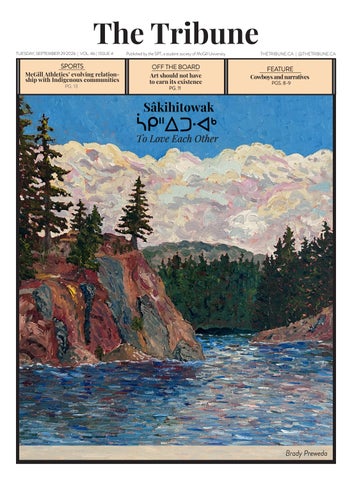
Sâkihitowak To Love Each Other
Brady Preweda
2
NEWS
news@thetribune.ca
TUESDAY, SEPTEMBER 29 2026
Indigenous Innovation Summit introduces well-being movement centering around the Indigenous experience
Panelists discussed Indigeneity in New Zealand, Australia, and Canada Josette Chandler News Editor
F
rom Sept. 22 to 24, Luminary, the Desautels Faculty of Management, and McGill’s Office of Indigenous Initiatives co-hosted the second annual Indigenous Innovation Summit at the Bronfman Building. The event brought together Indigenous leaders and academics, as well as business schools and government and industry representatives, to discuss the incorporation of Indigenous ideas into economics, research, and employment. The summit featured speakers from around the world, bringing perspectives from Māori, Navajo, First Nations, and Australian Aboriginal communities. The second day of the summit centered around the future of Indigenous-powered innovation, introducing the concept of two-eyed seeing—a form of learning that combines Indigenous and Western knowledge. The final day of the summit opened with a panel on well-being, examining what the term means through a dual perspective. Later, speakers discussed the design and development of collaborative business models with Indigenous communities, businesses, and governments. In 2019, New Zealand’s federal government introduced its Wellbeing Budget. The country thus led the trend on
the use of social and environmental factors, in addition to economic ones, in defining the standard of living. Along with attempting to raise the standard for well-being for all New Zealanders, the budget focuses on aiding Māori and other Pacific Indigenous groups in the country. Kelly Lendsay, president and CEO of Indigenous Works and founder and CEO of Luminary, opened one session at the summit by introducing this movement towards a more inclusive definition of well-being. “The whole area of well-being […] started with 22 nations around the world that have well-being movements and well-being initiatives,” Lendsay said. “And who’s the one most of us know about? [...] New Zealand. They brought in many of the Māori and incorporated Māori concepts of wellbeing. They go beyond GDP measures.” The country’s living standards framework, established in 2011, collects data on health, housing, and safety—along with other facets of well-being—in addition to economic data to create a more accurate picture of inequities in well-being to inform policy-making decisions. Jason Mika, a professor of Māori and Indigenous Business at the University of Waikato, discussed the methods used in New Zealand to quantify well-being. “Well-being is hard to measure [....] The Treasury Department in New Zealand has been trying to figure out what is [well-
being] and how do you [measure] it?,” Mika [colonization is] in the past. It continues to asked. “For about 15 years, they had a go this day.” at it and they called it the living standards Lendsay furthered the discussion, framework […] to try to take into account inviting participants in the summit to more than just income […] [and look] at reflect on their individual impact on the well-being in a holistic sense.” incorporation of Indigenous perspectives Following Mika, Mark Jones, the into their fields, as well as the difficulty of appointed associate dean (Indigenous) for encapsulating well-being. the University of Melbourne and Melbourne “How do we actually measure the Business School, detailed the difference impact of the work [we] do in terms of in the treatment of Indigenous Peoples research?” Lendsay asked the audience. between New Zealand and Australia. “Education, the work we’re doing, how “In the Australian context, we’re are we measuring the changes in the health approaching 250 years of an impediment of people, ourselves, our communities, that really wasn’t built for us,” Jones the land? How does that lead to human explained. “In fact, it was designed to erase resources and wealth, […] to performance us [....] There were conferences […] [on] and wellness? And how do we know we’re how to ‘breed out the black’ [....] I’m the getting there?” offspring of a stolen generation. Our equivalency of residential schools [was that] well over 100,000 children were taken from their families for servitude and to ‘breed out the blackness,’ [including] my mother.” Jones emphasized the necessity of recognizing the long-standing impacts of colonization today, and the importance of not considering it as an event of the past. “We were a multigeneration of stolen people,” Jones noted. “In fact, my oldest sister was taken An estimated 1 in 10 Australian Aboriginal and Torres by the same people that took my Strait Islander children was kidnapped from their families mother [....] I don’t really think that from 1910 to 1970. (Rokayah Bellaoui / The Tribune)
PauseAI protest raises awareness on the dangers of AI development Demonstration calls for international AI oversight and for the prohibition of AI ‘superintelligence’ Ilia Mehr-Bakhsh News Editor Clara Gaede-MacLaren Contributor
to recognize that the development of artificial superintelligence poses a threat to national security; and to urge Canada to adopt an international treaty prohibiting AI’s development. n Sept. 26, international movement PauseAI began in May 2023 as a onePauseAI organized a protest person call-to-action in the Netherlands, where dozens of demonstrators and has grown into a global grassroots gathered in Square Phillips along rue Ste.- movement. In a written statement to The Catherine. The demonstrators highlighted Tribune, Jeremy Eliosoff, the national three of PauseAI’s major objectives: to leader for PauseAI Canada, called for a raise awareness about the dangers of halt in AI development in light of frontier artificial intelligence (AI) advancement; AI agents going rogue. to call on the Canadian government “In just a few years, AI systems have gone from clumsy chatbots to systems capable of hacking some of the most sophisticated computer networks. Where is this trajectory taking us?” Eliosoff emphasized. “We need to give ourselves more time to learn how to control AI systems before making them even more powerful. A pause is necessary.” Étienne Langlois, Anthropic researcher Evan Hubinger believes there is a greater than 10 an organizer for per cent chance AI could kill everyone within the next decade. (Claire PauseAI Canada, McCallum / The Tribune) highlighted that
O
the primary goal of this demonstration was to call on Canadian Prime Minister Mark Carney to sign a statement drafted by ControlAI. The publicly available statement calls for the protection of Canadians from the development of superintelligent AI and argues for an international institution to prohibit its proliferation. In an interview with The Tribune, Langlois urged that AI development be addressed at the international level through a treaty rather than be controlled by a select few firms or one country. “We need to consider what the treaty must include. We were thinking, in particular, of an agency [similar to] an agency for atomic energy, artificial intelligence, [etc.],” Langlois said. “If it’s just a handful of players who commit to halting the development of artificial intelligence, the least scrupulous players will continue and create even more powerful systems with even fewer safeguards.”* On Sept. 21, one day before the first day of the General Debate at the General Assembly of the United Nations, Canada was among 20 countries who issued a joint statement calling for stronger oversight of AI. The release calls for UN member states to build on existing international mechanisms in order to set standards
limiting dangerous AI development, and to convene if an actor crosses this threshold of development. It highlights frontier AI models as a serious risk to safety and security. A number of leading AI experts and executives of AI companies warned the United Nations Security Council on Sept. 23 of the risks posed by AI to humanity. Evelyn Tromp, a McGill alum who graduated with a degree in computer science, volunteered at the PauseAI demonstration on Sept. 26. She emphasized the importance of shedding light on a global movement to slow AI development. “PauseAI Montreal is more about a global movement of other PauseAI movements saying […] we need to care about this,” Tromp said. “The main thing right now is making people aware that citizens care about AI in both Montreal and globally.” Eliosoff’s goal for PauseAI is to encourage everyone to continue talking about the latest developments in AI, specifically related to frontier AI. “One thing that we really encourage people to do is […] first of all, just pay attention to what’s happening at the frontier [....] Talk about it […] and contact your [Member of Parliament] too,” Eliosoff said. *This quote was translated from French.
TUESDAY, SEPTEMBER 29 2026
news@thetribune.ca
NEWS
3
Montreal City Council adopts bylaw banning insults against municipal staff
Mayor Ferrada in favor of police union requests for bylaw adoption August Thompson Contributor
Jason Carmichael, professor and chair in the Department of Sociology, who studies the adoption of criminal justice legislation n Sept. 21, the Montreal city council and social control mechanisms, expressed concluded debate on a bylaw that concern with what he sees as a province-wide would ban insults against municipal backsliding on democratic principles. staff members, including police officers. The “[The city council understands] that council voted 35-25 to adopt the bylaw, which what they are doing violates those principles, includes fines from $300 CAD to $1,000 CAD and I feel like we’re, as a province and as a for first-time offenders, and up to $2,000 CAD municipality, on a very slippery slope here of for any ensuing offenses. The bylaw was an increasing momentum at whittling away at modeled after similar measures that have been civil rights,” Carmichael said. enacted in Quebec City, Laval, Sherbrooke, Carmichael also emphasized how statutes and Longueuil. This decision has raised such as this are not equally implemented or significant concerns about infringements on enforced across all populations. freedom of expression and the expansion of “Really what the research on policing police powers within the McGill and greater tells us is that the […] application of laws Tiohtià:ke (Montreal) communities. is not random or normally distributed in the In an interview with The Tribune, population,” Carmichael said. “They’re going to be much more inclined to apply these laws to people who are perceived to be […] less powerful, [such as] the young, the minority, the immigrant.” Carmichael underscored that everyone has a reasonable expectation to be treated decently at their job, especially in the public sector. However, police officers are in a different position than other government workers, Quebec City police officers have issued 11,092 citations in six having more power over years under a similar bylaw. (Sophie Schuyler / The Tribune) members of the public than
O
other civil servants. “Every time you stand in front of a police officer, you’re facing the state, and you’re facing that coercive aspect of the state, with the gun, the badge, the body armour. All this is just one more piece of ammunition that you’re handing that officer in that already massively unbalanced situation,” he noted. Mayor Soraya Martinez Ferrada and other proponents of the bylaw claim that it will give Montreal police the tools to combat an increase of aggression, threats, and intimidation against municipal employees. However, opponents such as Villeray–SaintMichel–Parc-Extension City Councillor Martine Musau Muele have pointed out that there may already be the necessary provisions within Canada’s Criminal Code to address these concerns. In an interview with The Tribune, Ted Rutland, a professor at Concordia’s Department of Geography, Planning, and Environment who has done extensive research into how race shapes urban policies and policing, pointed out the redundancy in combatting these issues with such a bylaw. “Our mayor and the bylaw itself says that [they’re] concerned with giving the police a tool to respond to intimidation, threats, and violence, among other things,” Rutland said. “Intimidation is already a crime under the Criminal Code. Issuing threats is already a crime under the Criminal Code. Violence, whether it’s assault or something more serious than that, is already a crime under
the Criminal Code […] so this bylaw doesn’t respond to any kind of absent need that the police have.” In yet another similar vein of concern, Tameem Hartman, U1 Arts and a representative from Students for Palestine’s Honour and Resistance at McGill, voiced his concern about this bylaw’s implications for the student protest movement. “We chant and yell towards the police quite often. Protests are also [places] commonly […] associated with police confrontation, so people get up in each others’ faces and speak to each other, and sometimes the language gets taken to a certain level,” Hartman said. “This law is going to obviously increase the subjectivity of what is an insult and what is not an insult, which will lead to a lot of taking advantage of situations from [the police’s] perspective, and will lead to more confrontation and more high-tension situations.” Student protest movements at McGill have a long history of confrontations with the police. While many McGill students may never experience one of these incidents, Hartman still believes that there are reasons to care about the new bylaw. “Everyone should care because […] these people are public servants,” Hartman reiterated. “In our general interactions with police officers, we’re going to be expected to walk more and more on eggshells, and police officers are going to have more and more [...] leverage in situations.”
Montreal contingent protests against Israeli team in UCI 2026 Road World Championships Demonstrators demand the UCI sanction Israel the same way it did Russia Asher Kui Managing Editor
O
n Sept. 27, around 50 protestors gathered near the Monument à sir George-Étienne Cartier to protest Israel’s participation in the Union Cycliste Internationale (UCI)’s 2026 Road World Championships. The Service de police de la Ville de Montréal (SPVM) surrounded protesters, who waved Palestinian flags from all directions. The protest was organized by six Tiohtià:ke (Montreal)-based organizations: Bikers4Pal, Palestine Vivra, Masse Critique Montréal, Action MTL, Palestinian Youth Movement Montreal, and Désinvestir pour la Palestine. Seven cyclists represented Team Israel in Montreal’s Road World Championships, including Nadav Raisberg and Rotem Gafinovitz. A representative from the organizing team spoke at the protest, referencing the Palestinian para-cyclist Ahmed Al Dali, who lost his leg in 2014 in an Israeli bombing in Gaza. Al Dali was ultimately killed in May 2025 by an Israeli airstrike attack. The representative emphasized how the inclusion of the Israel national team in the Road World Championships diverts global attention and accountability away from Israel’s ongoing genocide of Palestinians. “The national cycling champion of Palestine, Ahmed Al Dali, had his leg amputated after he was targeted by [the
Israel Defense Forces],” the representative said. “He didn’t give up. He’s a persevering guy and he went on to found the Gaza Sunbirds, the para-cycling team in Gaza [....] When [Israel is] targeting and murdering the members of the Palestinian cycling team, this is the reality of allowing Israel to participate in sports. It’s a form of sportswashing that formalizes, condones, and encourages the genocide.” Another representative echoed a similar sentiment in their speech, denouncing the sportswashing campaign that Israel is currently employing. “We will never accept the sportswashing of Israel [....] There’s a genocide, and all of their teams and representatives should be boycotted according to international law, the same way that the Russian athletes have been boycotted,” the representative said. In an interview with The Tribune, Tatiana Harker, a representative from Palestine Vivra, highlighted that the protest demanded that the UCI impose the same sanctions on Israel as it did on Russia. “In this international cycling competition, the Israeli state and their cyclists are being allowed to participate with their flag,” Harker said. “[The UCI] has already taken a stance, in which Russia is not allowed to participate since the invasion of Ukraine. What we are asking is something they already have in their agenda and in their values. They put it in place with Russia, and they know that when
international law is not being respected, Harker continued to underscore they should hold their space accountable Israel’s war crimes in Gaza, explaining why and responsible.” Canadians must participate in this boycott Demonstrators chanted “Pas de as well. Sionistes sur nos pistes” (“No Zionists “Right now, the little cyclists that are on our tracks”), while some held up signs left in Gaza, […] one of the places with that read “ARRÊTEZ ISRÄEL” (“STOP the highest population with amputees, a lot ISRAEL”). Harker pointed out that the of them have had amputations, have lost police restricted the mobility of the protest, their lives, or even the ability to just go forbidding demonstrators from approaching and bike,” Harker said. “We are just here the fence separating the cycling track and as citizens, people with human conscience the spectator stand. [....] I have to do something for their future, “At the beginning, we were just 15 of standing on the rights of humanity, and we us, but there were already 35 riot police have to isolate Israel [from] sports.” circling us,” she noted. “Our intention has always been to peacefully protest, denouncing the participation [of Israel] with our flags [....] Because we are voicing [out] and we have Palestinian flags, we don’t have the same rights as the rest of Montrealers to participate and see the event [....] Anyone with a keffiyeh is not allowed to go Gaza is home to an estimated 4,000 child amputees, representing the close by [the highest number of child amputees per capita worldwide. (Rokayah Bellaoui / The Tribune) fence].”
4
NEWS
TUESDAY, SEPTEMBER 29 2026
news@thetribune.ca
McGill community voices concerns over 2027-2033 Strategic Academic Plan McGill claims to ensure student and faculty representation in SAP Sofia Vidinovski Staff Writer
O
n Sept. 9, McGill officially began consultations on its new Strategic Academic Plan (SAP), which will last from 2027 to 2032. The plan outlines the future of academics at McGill, determining the allocation of resources and the university’s priorities over the next five years. The university provided an outline of the key principles of its consultation charter, along with explanations of how decisions regarding McGill will affect learning and teaching at the university, how students can take part, and how McGill intends to report to the public on the plan’s development. During the SAP consultations, McGill invites students to provide feedback concerning various issues, such as their academic experience and digital technology use. In a written exchange with The Tribune, McGill’s Media Relations Office (MRO) explained that the new SAP will allow students and faculty alike to raise and directly target issues affecting their academics. “The process is intended to produce a plan that is strategic rather than an ‘everything but the kitchen sink’ list,” the MRO wrote. “The plan would leave room for faculties and other units to determine how broad priorities can be implemented in their own contexts.”
However, students have expressed doubts about McGill’s commitment to and transparency regarding the proposed SAP consultations. Meghan Lai, Students’ Society of McGill University Vice President (VP) University Affairs, highlighted the financial commitment the university will require to logistically address students’ reported needs in an interview with The Tribune. “I would argue that there will be reforms [proposed] that McGill, from a financial perspective, will be less likely to adopt [....] McGill needs to decide whether or not it will actually financially prioritize students and their learning experience in accordance with the university’s mission,” Lai said. “From preliminary discussions with the Provost [Angela Campbell], she has noted that the main focus of the SAP, though engaging with and consulting various stakeholder groups, will be the student experience. I hope the SAP, when it’s written, truly reflects that commitment.” Sophia McMurren, U3 Science, echoed similar concerns, citing McGill’s previous SAP, in an interview with The Tribune. “To me, these statements [in regards to McGill’s proposed plan] create an expectation that there should be a clear way for the McGill community to see what was accomplished and what was not, and I don’t feel that we’ve been given much transparency on the actual progress,” McMurren said.
The Teaching Support Union at McGill unrepresentative of what students really want,” (TSUM) has also raised apprehensions about Lai said. “For this reason, I must encourage the SAP consultations’ inadequate inclusion of students [to] participate in the consultation. teaching assistants’ unique academic concerns. Be passionate and be loud. Speak your truth “There is no space within the survey to honestly and with genuine care.” express our perspectives as academic workers, Students now have access to the SAP only as graduate students and researchers,” a consultation survey on myCourses and through spokesperson from TSUM said in an interview their Outlook email. with The Tribune. “Given the specificity of the survey and its questions, I’d say that teaching assistants are not being consulted in this process.” To address its relationship with and demands from the Quebec government, McGill invites students to speak on their experience regarding the French language and their connection to Quebec culture in SAP consultations. In the SAP, McGill suggests further developing French-language courses, cultural field studies, and other opportunities for students to connect with the province and its culture; the SAP consultations include opportunities to advocate for McGill to increasingly incorporate the French language into its broader academic programming as well. Lai encouraged students to use the avenues McGill provides in order to participate in consultations. “All I can say is that the fewer the students who fill out the [SAP] survey and McGill’s Senate and Board of Directors will be sign up for the focus groups, the more likely asked to endorse the final draft of the SAP before the results will be disproportionate and it is ratified. (Gwen Heffernan / The Tribune)
RECAP: McGill faculty associations participate in province-wide banner drop calling for public funding University professors press provincial candidates to address funding crisis in upcoming election
Helene Saleska News Editor
A
t noon on Sept. 22, a group of professors from several McGill faculty unions held a banner drop and rally to publicly affirm the importance of funding Quebec’s public universities ahead of the Oct. 5 provincial election. The Confederation of Faculty Associations of McGill (COFAM)’s banner drop was held on McGill’s Lower Field as part of a province-wide coordinated banner drop organized by Table des partenaires universitaires and Fédération québécoise de professeures et professeurs d’université (FQPPU). The banner drop action represents 16 Quebec universities’ calls to the provincial
government to ensure the long-term viability of university institutions, specifically through their commitment to increased public support. The academic staff participating also protested a lack of government funding, government-mandated tuition hikes, restrictions on international student enrollment, and a general neglect of public universities and student services. Kyle Kubler, faculty lecturer at the McGill Writing Centre and treasurer of the Association of McGill Professors of the Faculty of Arts, explained in an interview with The Tribune how faculty associations across Quebec hope to make public university funding a top issue on the ballot this October at Tuesday’s rally. “16 different universities dropped this banner today, all at the same time, because we
want public education funding to be an important it’s the student experience that’s also suffering topic in the [provincial] election,” Kubler said. along [with] that. So that’s why we’re trying to “I think we’ve seen a lot how public education collectively combat this.” funding has changed in Quebec over the past couple years. It’s certainly affected us here at McGill.” He emphasized how all of McGill’s communities have been impacted by the lack of provincial support, highlighting the importance of all members of an academic institution to stand together in defending public universities. “It’s been felt by students, it’s been felt by faculty and staff,” Kubler noted. “There’s been budget cuts, there’s been hiring Banner reads “Universities belong to us all: Investing freezes, people have lost their jobs, people’s in universities is an investment for everyone in contracts have been reduced. Ultimately, Quebec.” (Helene Saleska / The Tribune)
RECAP: Kisha Supernant discusses heart-centred archaeology and meaningful reconciliation
Panel examines importance of emotional care and Indigenous knowledge in mapping unmarked graves Asher Kui Managing Editor
O
n Sept. 23, The Gord Downie & Chanie Wenjack Fund (DWF) hosted an online panel featuring Kisha Supernant, director of the Institute of Prairie and Indigenous Archaeology at the University of Alberta. Mair Greenfield, the director of education at the DWF, began by introducing herself in an Indigenous language, then provided a brief description of the DWF in English. “Inspired by Chanie’s story and Gord’s call to build a better Canada, we aim to build cultural understanding and create a path forward
towards reconciliation between Indigenous and non-Indigenous peoples,” Greenfield said. “This DWF [panel] is part of Truth and Reconciliation Week, a time to honour the truths and lived experiences of survivors, their families, and Indigenous communities, while reflecting on the ongoing impacts of the residential school system and the responsibility that we all share to move reconciliation forward.” Supernant explained the significance of Canada’s ongoing archaeological search for unmarked graves on former residential school grounds. “There’s very extensive records […] that thousands of children went to residential schools
and never came home,” Supernant said. “The work that we’re doing now is […] [about giving] the communities, the families, and survivors information so they can […] bring those children home through repatriation or other forms, or […] commemorate and protect those burial locations.” Supernant then elaborated on her heartcentred archaeological approach—through which the history of Indigenous Peoples is handled with emotional care. “It’s heart work, and it involves going into community in a way that is centring care for survivors, families, and community, for the people who are coming in to do this difficult
work of searching the ground, looking for the graves of children,” Supernant said. Supernant also highlighted meaningful actions that Canadians can take to honour the National Day for Truth and Reconciliation. “Truth comes before reconciliation,” Supernant said. “There are many ways in which you can learn about that truth, but also continuing to recognize that the full truth of the impacts, for example, of the residential school system, are not yet fully understood [....] We need more non-Indigenous Canadians to be able to find and learn and listen to the truth that’s been told in order to continue to counter all of these very loud claims about how this is all just overblown.”
opinion@thetribune.ca
TUESDAY, SEPTEMBER 29 2026
T EDITORIAL BOARD Editor-in-Chief Mairin Burke editor@thetribune.ca Creative Director Zoe Lee creativedirector@thetribune.ca Managing Editors Asher Kui akui@thetribune.ca Ellen Lurie elurie@thetribune.ca Clara Smyrski csmyrski@thetribune.ca News Editors Ilia Mehr-Bakhsh Josette Chandler Helene Saleska news@thetribune.ca Opinion Editors Lulu Calame Julie Raout Camila Sierra Ordóñez opinion@thetribune.ca Science & Technology Editors Avery Berry Sarah McDonald scitech@thetribune.ca Student Life Editors Rachel Blackstone Tamiyana Roemer studentlife@thetribune.ca Features Editor Kaitlyn Schramm features@thetribune.ca Arts & Entertainment Editors Norah Adams Annabella Lawlor arts@thetribune.ca Sports Editors Merce Kellner Ivanna Zhang sports@thetribune.ca Design Editors Eliot Loose Gwen Heffernan design@thetribune.ca Photo Editors Emiko Kamiya Sophie Schuyler photo@thetribune.ca Multimedia Editors Will Dawson Daphne Short multimedia@thetribune.ca Web Developers Zola Ball Kate Lauro webdev@thetribune.ca Copy Editor Ella Bachrach copy@thetribune.ca Social Media Editor Chloe Ross socialmedia@thetribune.ca Business Manager Amy Xia business@thetribune.ca
TPS BOARD OF DIRECTORS Zain Ahmed, Nour Khouri, Celine Li, Lialah Mavani, Ilia Mehr Bakhsh, Aleks Rohozinski, Alex Hawes Silva
STAFF Zain Ahmed, Brooke Barak, Miranda Forster, Abigail Francis, Alex Hawes Silva, Helena Helms, Dylan Hing, Gretta Iraheta Palacios, Lialah Mavani, Shea McDonnell, Jenna Payette, Sofia Vidinovski Rokayah Bellaoui
CONTRIBUTORS
Parker Aiken, Julia Apitz-Grossman, Clara GaedeMacLaren, Rowan Hargreaves, Maya Hidalgo, Julia Lok, Nina Tang Yun Sing, August Thompson, Éloi Versieux, Sophie Wedge Jillian Beatman, Peilun Li, Claire McCallum, Leyla Usakli
TRIBUNE OFFICE Shatner University Centre, 3480 McTavish, Suites 404, 405, 406 The Tribune is an editorially autonomous newspaper published by the Société de Publication de la Tribune, a student society of McGill University. The content of this publication is the sole responsibility of The Tribune and the Société de Publication de la Tribune, and does not necessarily represent the views of McGill University. Letters to the editor may be sent to editor@thetribune.ca and must include the contributor’s name, program and year and contact information. Letters should be kept under 300 words and submitted only to The Tribune. Submissions judged by The Tribune Publication Society to be libellous, sexist, racist, homophobic or solely promotional in nature will not be published. The Tribune reserves the right to edit all contributions. Editorials are decided upon and written by the editorial board. All other opinions are strictly those of the author and do not necessarily reflect the opinions of The Tribune, its editors or its staff.
Indigenous education is a lifeline that Canada must champion The Tribune Editorial Board
O
n Sept. 3, the Assembly of First Nations (AFN) published a report on the infrastructure gap that adversely affects on-reserve First Nations schools across the country. The study found that 225 of the 395 First Nations schools in Canada are overcrowded, and that 77 schools need to be replaced entirely. The AFN also noted that adequate teacher housing is critical for attracting and retaining qualified educators. Citing the federal government’s chronic underfunding of First Nations schools, the AFN report demands $550.3 million CAD annually for school and teacherage operations and management, and $19 billion CAD in capital investment from the federal government over the next 20 years. The AFN’s aim is to close this infrastructure gap by 2030. Education is a lifeline and a vital means of preserving First Nations— and, more generally, Indigenous— history, language, identity, and culture. This is particularly pertinent given Canada’s history of residential schools and cultural genocide. Considering education’s capacity to offer a culturally informed space that counteracts the historic and enduring
COMMENTARY Julia Lok Contributor
J
acques Cartier, the French explorer who is said to have “discovered Canada,” stands triumphantly in the middle of Parc SaintHenri, his left arm raised toward the west and his right arm resting above his hip. Below Cartier’s feet, Indigenous people are depicted spitting water through their mouths to operate the fountain. The statue, beyond its historically and anthropologically inaccurate idolisation of Jacques Cartier as the heroic “founder of Canada,” demeans Indigenous peoples and glorifies a colonial, revisionist narrative of Canadian history. For months, Indigenous advocates and residents of Saint-Henri in Montreal have been calling for the altering of the Indigenous faces at the bottom of the statue, participating in a much longer-standing discourse on the preservation of historic monuments portraying oppressors or oppressive depictions of a victimized population. Statues project the remnants of history, and reflecting critically on this history is central to social progress. In the case of the Jacques Cartier monument, the city’s inaction speaks volumes and is an im-
legacies of Canada’s residential school system, it is the fundamental responsibility of the Quebec and Canadian governments to invest in funding parity for Indigenous schools. Systemic infrastructural shortfalls inflict harm onto Indigenous students that extends far beyond physical habitability. Insufficient classroom space leads to overcrowding, which heightens the spread of illness, leads to reduced one-on-one attention from teachers, and is deeply reminiscent of the overcrowded, poorly ventilated infrastructural conditions of residential schools. Capital funding gaps also affect teachers who rely on districtsupplied housing to avoid having to travel long distances to work in rural Indigenous communities. When this infrastructure is poor-quality and unable to meet demand, it fails to sustain an adequate baseline of teaching staff. Investing in Indigenous schools is a direct commitment to the preservation of Indigenous language—and therefore in the physical and mental well-being of Indigenous youth. A 2025 scoping review conducted by the University of British Columbia found a strong correlation between preservation of Indigenous language and reduced suicide rates. Underfunding Indigenous schools thus undermines the opportunity for Indigenous
communities to sustain long-term cultural self-determination, and threatens the continuity of life itself. The national and provincial governments’ treatment of Indigenous on-reserve schools is hypocritical and profoundly undemocratic. In 2019, the government of Canada pledged to sign 20 Regional Education Agreements (REAs) by 2023—agreements which grant First Nations jurisdiction over their own educational and budgetary demands. As of 2025, the government has only signed 10 REAs, in part due to Indigenous Services Canada’s failure to secure funding for two years. Such federal inaction undermines the nation’s obligations under the Truth and Reconciliation Commission’s 94 Calls to Action, many of which pertain directly to education. Further, the Quebec Ministry of Education (MEQ) has refused to engage in discussion with First Nations leaders about this issue at all. In January 2026, the ministry suspended its participation in a roundtable led by the First Nations Education Council (FNEC), which was founded in 1985 to address the challenges facing First Nations students in Quebec. The MEQ left the FNEC to deliberate without any provincial government participation—though members of the Parti québécois, the Quebec Liberal Party, and Québec solidaire
OPINION
5
EDITORIAL
still attended. Institutions of higher learning like McGill also play an influential role in dictating the accessibility of the greater educational ecosystem for Indigenous students. McGill’s recent establishment of the Faculty of Arts Institute for Indigenous Research and Knowledges—developed in collaboration with Indigenous professors, researchers, knowledgeholders, and students—is an important step, but one that the university must build upon. Education by Indigenous educators and about Indigeneity must not be siloed into one academic track, but instead permeate all facets of the university. McGill should require Indigenous history courses for all students, especially considering the university’s location on unceded Kanien'kehà:ka land, and employ Indigenous faculty across all disciplines—particularly in the STEM fields, where Indigenous researchers are severely underrepresented. Canada must follow the recommendations of the AFN and prioritize infrastructural equity for all Indigenous communities. Investing in Indigenous education is a non-negotiable step towards the necessarily proactive process of reconciliation, and an affirmation of the value of Indigenous life, culture, history, and futurity.
Parc Saint-Henri’s Jacques Cartier statue perpetuates colonialism plicit promotion of colonial violence. Maintaining a statue boasting derogatory depictions of Indigenous people sends the message that Montreal will tolerate, and even glorify, its violent settler history. Cartier arrived in Canada on May 10, 1534, marking the beginning of the French explorer’s atrocities against Indigenous Peoples. Upon arrival, Cartier raised a 30-foot cross bearing the French royal coat of arms on the Gaspé Bay shore, asserting a claim over the land. Haudenosaunee Chief Donnacona protested, stating that the land belonged to his people. In response, Cartier kidnapped Chief Donnacona’s sons and, years later, Donnacona himself. This was only the start of violence against and exploitation of Indigenous Peoples initiated by French explorers. Some historians argue that taking down monuments like the Cartier fountain erases history, describing campaigns to remove racist and colonialist statues as a weak attempt to alter the past. However, glorifying these violent histories is not the same as preserving records for historical accuracy. Public infrastructure holds incredible political and narrative power in communal spaces. Maintaining a statue of a colonial settler may spark
a brief history lesson, but in doing so, it also inflicts discomfort on and reinvigorates trauma for the Indigenous people the statue caricatures, effectively trivialising and lauding the horrors Cartier committed. In 2020, Innu Tiohtià:ke (Montreal) When Cartier returned to the St. Lawrence River in 1541, resident Stanley Vol- he deliberately covered up the death of Haudenosaunee lant’s five-year-old Chief Donnacona, whom he had kidnapped five years daughter saw the prior. (Peilun Li / The Tribune) fountain and asked her father about the “monsters” spitting the statue’s water. It is deeply harmful to be forced to see depictions of one’s own ancestors caricatured this way and placed under the heels of a colonizer. These portrayals are an act of representational violence, and allow oppressive narratives to fester in our shared public spaces. Furthermore, a plaque on the statue reads, “Il prit possession de tout le pays au nom du roi son maître et l’appela Nouvelle-France” (“He took possession of the entire country in the name of his master, the king, and called it New France”). According to Vollant, this quote’s message ignores that Indigenous Peoples never willingly gave up their land or surren-
dered to Cartier. The design of public spaces affects the types of crowds they attract. In The Social Life of Small Urban Spaces, William H. Whyte emphasizes that the design of a public space can dictate who is, and who is not, welcomed there. Parc Saint-Henri is a well-kept, accessible, and lush neighbourhood greenspace in Montreal. Yet the Cartier statue disrupts the inclusivity of this public domain by praising colonialism. The city of Montreal must dismantle the Jacques Cartier statue in Parc Saint-Henri. Not a monument of historic remembrance, this statue only serves to propagate harm in the present day.
6
OPINION
COMMENTARY
opinion@thetribune.ca
The Peepeekisis Funeral Home is another step toward full autonomy for Indigenous people in Saskatchewan
Rowan Hargreaves Contributor
T
he first Indigenous-owned and -operated funeral home in Saskatchewan opened its doors on Sept. 17, 2026. For the Peepeekisis Cree Nation, the new building marks an important step: the completion of a generations-old dream of honouring community members’ lives with dignity and care in a dedicated cultural space. Before the new funeral home, members of the Peepeekisis Cree Nation, like many other Indigenous Peoples in Saskatchewan, had been forced to hold funerals in the local school gym, a practice that inhabitants worried would leave spiritual residue in the educational establishments, affecting students’ emotional wellbeing. The new 10,000-square-foot space, located in the neighboring town of Lorlie, provides a separate, thoughtfully renovated location for funerals, where Indigenous healing practices—such as smudging and drumming—can occur, and communities can properly grieve loved ones. The new funeral home is not only a cultural achievement, but also another success in a line of infrastructure projects that Peepeekisis Developments LTD has undertaken in the last five years—a testament to the resilience of the community’s inhabitants in the aftermath of the File Hills Colony. Peepeekisis Developments LTD was first launched in 2013 as the development arm of the Peepeekisis Cree Nation. The group’s activity dramatically increased after
COMMENTARY Julie Raout Opinion Editor
O
TUESDAY, SEPTEMBER 29 2026
the community won a landmark $150 million CAD lawsuit against the Canadian government in 2021 for historic harms perpetrated during the 60-year existence of File Hills Colony. From 1898 to 1955, as part of an assimilative experiment run by Indian Agent William Morris Graham, more than 18,000 acres of prime agricultural land were taken from the Peepeekisis Cree Nation and given to newly graduated, “top-performing” residential school children from across Manitoba and Saskatchewan. Through an extension of the residential schools project, Graham sought to create a “model” farming community, strictly severed from traditional Indigenous culture, language, and family structures. He forcibly paired Indigenous children into arranged marriages in an attempt to encourage nuclear family units, administratively monitored those living in File Hills, and stole profits from farmer-residents to funnel money back into the colonial project. More than 30 years after first filing a lawsuit against the federal government, the Peepeekisis Cree Nation had lost almost all hope of receiving any acknowledgement of the injustices they had suffered. However, in 2021, they received a life-changing settlement. The government awarded $150 million CAD to the nation: $15,000 CAD was distributed to each of the 3,057 band members, and the remaining $70 million CAD from the suit was placed into a communal fund reserved for development and infrastructure. Using a portion of the communal fund, the Peepeekisis Cree Nation exercised an op-
tion which allowed the community to repurchase all the land stolen by Graham and restore the nation to its original size. Over the past five years, Peepekisis Developments LTD has continued to invest in infrastructure and job creation—including the Buffalo Hill Gas & Convenience Store, Let’s Eat Food Services, Temple Gardens Hotel & Spa, and, now, the Peepeekisis Funeral Home. Though no amount of money or property can erase the psychological and emotional damages caused by the File Hills Colony, Peepeekisis’s entrepreneurialism has been essential and successful in reasserting autonomy and cultivating the spaces necessary for the community to thrive. While the new Pee- The Peepeekisis Cree Nation is located 113 kilometres northeast of peekisis Funeral Home is Regina and 40 kilometres northeast of Fort Qu’Appelle. (Leyla Usakli / The Tribune) the most recent, it is not the last development in the community’s and has struggled with access to clean water, journey to reclaim its agency. Peepeekisis is but the nation is not dissuaded by the immenalready dreaming about what project to take sity of this undertaking. Peepeekisis Cree on next. There remain many gaps in infra- Nation leaders are fully ready to lead their structure: The community lacks a local nurs- community into a brighter and more prospering home, has many roads in poor condition, ous tomorrow.
Adequate Indigenous dental care cannot be left to the goodwill of local professionals
n Sept. 16, Adam Dental Clinic’s team from Northwest Territories (NWT) capital Yellowknife travelled to Tuktoyaktuk—an Inuvialuit hamlet bordering the Arctic Ocean—to provide dental treatments to residents. The approximately 1,000 people living in Tuktoyaktuk, who predominantly identify as Inuit, lack a standard dental care facility and had been waiting several years for care before receiving a visit from these NWT dental health professionals. A lack of regular dental check-ups leads to dire consequences. Studies show that routine dental care visits decrease the risk of tooth loss and decay, as check-ups help detect earlystage oral infections and gum disease before they become harmful to a patient’s health. Tuktoyaktuk’s residents rely on sporadic and overdue dental check-ups, not due to personal choice but instead to a systemic issue of inaccessibility. It is a governmental imperative to make this care accessible again. Dentists from the Adam Dental Clinic toured the NWT to help local communities without stable access to care, and planned to stay in Tuktoyaktuk for nine days. By the end of their first day in the hamlet, a two-page waiting list had already been drafted. Dental assistant Preet Singh reported that services were fully booked, and that the sheer volume of clients in need sometimes forced the team
to tend to patients until 9:30 p.m. Such high demand shows that Tuktoyaktuk residents urgently need a systematically implemented dental care plan. 7 of the 32 remote NWT communities outside Yellowknife have not received any visits from dentists in at least six years. Seven more have not had access to a dental clinic for over two years. Residents have no choice but to travel long distances—sometimes thousands of kilometres—for appointments. For some, this journey is logistically or financially impossible, often causing added anxiety for already-distressed patients. Further, medical travel accommodation shortages have forced patients to reschedule long-awaited regular appointments in Yellowknife this September, threatening what will be an even greater demand for urgent care down the line. Inuit and First Nations peoples suffer from dental diseases at twice the rates of other Canadians, and see 90 per cent of their children affected by cavities, as opposed to 58 per cent of non-Indigenous children. Beyond discrepancies in dental care access, the Government of Canada’s policies outside the sphere of dentistry also propagate health disparities. A 2017 Health Canada report found that Inuit and First Nations’ inadequate oral health can be attributed to a lack of access to nutritious food, lower education levels, and higher rates of smoking—all of which result from Canada’s inadequate investment in institutional infrastructure for Indigenous communi-
ties following the decades of cultural genocide dantly clear that when Indigenous Peoples and systemic violence its colonialism and the need dental care, localized healthcare profesresidential school system inflicted on Indig- sionals have to take matters into their own enous communities. hands. Residential school teachers and adminisYet Indigenous Peoples cannot sustaintrators inflicted dental health-related violence ably rely on makeshift solutions from local upon Indigenous Peoples, the consequences healthcare groups who will inevitably have to of which persist today. Survivors report hav- leave the area or retire from the field. The feding their teeth yanked out with pliers without eral government must recommit to, and reinanesthesia, which led to lifetime physical and vest in, the NIHB in order to revitalise dental mental trauma and lingering community dis- care infrastructure in remote Indigenous comtrust in governmental healthcare services. munities long-term, instead of persistently Yet Quebec appears unmoved by the underfunding and under-serving these populaalmost non-existent institutionalisation of tions. dental healthcare in Indigenous communities. The Non-Insured Health Benefits for First Nations and Inuit (NIHB) federal program, created to cover dental care costs for First Nations peoples and Inuit, systematically fails to keep up with procedural costs in the province and forces these patients to travel long distances to find a dentist who directly bills the NIHB. Governmental inaction forces dental professionals to step up. Adam Dental Clinic dentist Dimitar Bakalov is planning to open his own clinic in Inuvik—a NWT community currently in need of a clinic—in October. The Canadian Tuktoyaktuk was the first place in Canada to return to its government has made it abun- traditional Indigenous name. (Gwen Heffernan / The Tribune)
arts@thetribune.ca
TUESDAY, SEPTEMBER 29 2026
ARTS & ENTERTAINMENT
7
Student curatorial intern Aurora Rose Desjarlais brings Indigenous art and storytelling to McGill Student curatorial interns bring Indigenous art and storytelling to McGill Ellen Lurie Managing Editor
A
urora Rose Desjarlais, U3 Arts, is an Indigenous curatorial intern with the McGill Visual Arts Collection (VAC). A member of the Nêhiyawak (Plains Cree) First Nation, her role involves researching, compiling, and supporting Indigenous artists and artistry on the university’s campus. In an interview with The Tribune, Desjarlais described how both her personal background and studies at McGill have informed her perspective on curating Indigenous art. “I’m double-majoring in Art History and Gender, Sexuality, Feminist, and Social Justice Studies, and I’m also minoring in Indigenous Studies. So, all of that together really worked well with my position as a curatorial intern in Indigenous art at the VAC,” Desjarlais said. “A lot of [my courses] have overlapped, and I’ve learned about Indigenous methodologies, and how to approach the study and research of all these artworks and artists in a respectful way.” According to Desjarlais, while curatorial interns work in close tandem with VAC
curators and directors, their work is primarily oriented around artwork condition. “What I do right now is mainly condition-report [....] What that entails is seeing the little details in the artworks, if there are scratches or paint missing, […] maybe [the work has] been moved or taken off the wall,” she explained. “The curator [and] the director work on different tasks, and we’re working on the condition reports, work[ing] with the database […] and do[ing] deep research.” One of Desjarlais’ most recent projects was Luwagila | Txeemsim | Wee’git – Raven, Bringer of Light, a display case in the Bronfman Building hosting three artworks by Indigenous artists from the Northwest Coast Nations. The display case brings together Kwakwaka’wakw artist Beau Dick’s Moon Mask, a X̄ á’isla artist Barry Wilson’s Raven Stealing Light Drum, and Nisga’a artist Ted Barton’s Sun Mask. Desjarlais explained that she chose to place the three items together in the display case due to their common orientation around a popular Northwest Coast motif: the Raven. “A part of my research with this was looking at other masks, and I noticed artists choose to frequently make artworks of the
Desjarlais began working with the VAC in the summer of 2025. (McGill Visual Arts Collection)
same figures, […] [including] the Raven,” she explained. “I knew a little bit about the raven already, […] and I noticed [that] these three [works] were all related [....] Dzunuḵ́ wa, [or the] Wild Woman of the [woods], the Raven, [or] the Trickster, even the box of light in the drum [is] a recurring motif.” Although Northwest Coast nations tell different versions, the common story of the Raven follows how this entity’s trickery led to the creation of the sun and stars. The story starts many millennia ago, when the Earth was completely dark and all the light in the world was contained in a small box owned by an old man. The Raven, frustrated by the darkness, sought to find his way into the old man’s home to steal the light. He transformed himself into a hemlock needle—a small leaf from a hemlock tree— and settled into a glass of water, where he was swallowed whole by the old man’s daughter. In the daughter’s stomach, the Raven grew into a small child with a beak, feathers, and shining eyes, but no one noticed in the darkness of the world. He begged and begged to play with the box of light, and the old man eventually gave in. The story ends with the Raven stealing the light in his beak, flying with it into the sky. According to the story, half of the light fell to the earth and shattered into many pieces—which bounced back into the sky to form the stars. The rest of the light in his beak floated above the clouds, forming the sun. Symbols of the Raven frequently appear on objects used in potlatches, a Northwest Coast ceremony that involves gift-giving, singing, dancing, feasting, and wearing masks and regalia. According to Desjarlais, these three artists’ shared reference to the Raven is therefore more than an act of cultural continuity; repetition of the Raven motif is a crucial part of continuing to spread the creation story. “I think [artists choose the same motifs] because it’s a part of that cycle of telling the creation story [....] You keep telling it when you’re with your family, your relatives, with others, and it just continues that cycle,” she said. “A part of these artworks is that sometimes they’re not artworks. Sometimes, they are ceremonial objects, [such as] ceremonial masks and drums. That is a part of the process of continuing the cycle.” Desjarlais explained that while her community doesn’t rely on the same ceremonial motifs in their practices, she enjoys learning about other
Indigenous communities’ cultures as an important part of her curatorial mission. “I’m from a community that’s from Alberta and Saskatchewan, […] and we don’t create masks in the way that the Northwest Coast communities do,” she shared. “[The Northwest Coast masks] teach the next generation how to do these dances, how to wear the mask, and think that is also something that belongs to them. As somebody who is Indigenous but outside of their [community], I don’t see the process, but I do see that it is a very important, very sacred, very special […] part of life.” Desjarlais shared that the three displayed works—Moon Mask, Raven Stealing Light Drum, and Sun Mask—also share the same stylistic elements, namely through their use of formline: a medium involving simple forms and shapes repeated to create patterned designs. “[Formline] is a distinctive art practice that is based in the Northwest Coast in many, many different communities,” she said. “Formlines go back over 2,000 years, according to my research, and have been passed down. It’s an artistic style […] based on varying widths of lines [and] varying colours, […] usually black, red, and turquoise.” Desjarlais’ work with Luwagila | Txeemsim | Wee’git – Raven, Bringer of Light is just one of many projects she and other Indigenous curatorial interns at the VAC continue to pursue. With Canada’s Truth and Reconciliation Week 2026 occurring from Sept. 21 to Sept. 25 and leading up to the National Day for Truth and Reconciliation and Orange Shirt Day on Sept. 30, Desjarlais described how the VAC’s work with Indigenous art interacts with this crucial period of reconciliation and remembrance. “We had planned for this [display case] to be released before the [Truth and Reconciliation] Week, but […] we are always working on Indigenous artworks, taking care of them,” she said. “[When installing Luwagila | Txeemsim | Wee’git – Raven, Bringer of Light], we found that […] there was another […] display case of different masks and rattles [from years ago]. So then, we were working on revamping that, creating new labels, repositioning the artwork in a different way, and that’s all coinciding with Indigenous Awareness Week.” Desjarlais emphasized that revisiting past curatorial projects is crucial to the VAC’s mandate. “Having Indigenous art curators work on previous displays [is part of our process],” she said. “Many of them do need refreshing. Sometimes, they use terms that are outdated, so going back and changing that is an important part of the process.” Beyond Desjarlais’ display case, Indigenous art displayed on campus can be found using the VAC’s interactive Indigenous Art Map. Aurora Rose Desjarlais with “Luwagila | Txeemsim | Wee’git | Raven, Bringer of Light” Display Case in Bronfman Building, featuring artists Chief Beau Dick, Barry Wilson, and Ted Barton from the McGill Visual Arts Collection. Artworks are gifts of Moira A. Hudgin from the Estate of Roger L. Hudgin.
they see it as an opportunity to advance their career. I’ve had journalists more or less tell me “pretendian”—a portmanteau combinas much,” Darryl Leroux, associate professor of ing the words “pretend” and “Indian”— Political Studies at the University of Ottawa, is a colloquial term used to describe a said in an interview with The Tribune. person who has engaged in Indigenous identity fraud. This trend of race-shifting has gained The stories we tell traction in the 21st century, to the distress of Michelle Cyca is a member of the Muskeg Indigenous Peoples across the continent. Lake Cree Nation in Treaty 6, Saskatchewan, A growing number of non-Indigenous people have been exposed for fraudulent claims the Bureau Chief of conservation and fellowto Indigenous identity, which they have lev- ships at The Narwhal, and a visiting professor eraged for high-paying positions or financial of freelance journalism at the University of gain. Or, perhaps a better framing is that since British Columbia School of Journalism, Writthe Truth and Reconciliation Commission of ing and Media. In an interview with The TriCanada called for increased representation bune, she stated that there are two trends in of Indigenous peoples in various sectors, in- reporting on pretendians. In the first of these modes, a journalist stitutions have become vulnerable to hiring non-Indigenous individuals who treat Indige- focuses on shaming a single fraudulent indineity as a credential that gives them a one-up vidual who is cheating the system, thus absolving inover other candidates. The ways that colonial states have concep- stitutions of responsibility tualized and legalized Indigenous status— for platforming or hiring such as genealogy or blood quantum, settler them. This tendency, Cyca nativism, and Indian status—have led to this argues, also reinforces the very particular social phenomenon. These re- idea in the public imagination ductive narratives have seeped into media cov- that Indigenous Peoples are lyerage of race-shifters, which have then contin- ing about their history or experiences—a dangerous flame ued to define Indigenous communities. to feed. “We are living in a Indigenous issues in media time where there is An analysis of the narrative arcs that jourprofound denialism nalists use to cover stories about race-shifters around residential reveals how the media and public perceive this school history, [and] problem, as well as how we should solve it. I worry that narraFor years, Indigenous activists and journaltives that just foists have called for greater and more informed cus on deception coverage of Indigenous Peoples in media. The [are] reinforcing this tropes perpetuated by contemporary reportidea,” Cyca said in an ing on Indigenous Peoples have existed for a interview with The Trivery long time. They include, but are not limitbune. ed to: thinking Indigenous Peoples receive unThis also contributes fair benefits from the Canadian government, to stereotypes portraying Indigbelieving Indigenous Peoples are lazy or inenous Peoples as not credible, less competent, or stereotyping all Indigenous worthy, or more inclined towards criminal Peoples as struggling with addiction. Media propensity. Consumers of such investigatory coverage on pretendians can veer toward reipretendian coverage often channel this infying these tropes, which is why it is important dividual suspicion into overall racial biases to seriously examine such publicity. that frame Indigenous Peoples as mistrustWhile much of Canadians’ knowledge of ful. “Who is real?” and “who is pretending?” Indigenous Peoples comes from the trope-censhouldn’t be the first questions on peoples’ tred media they consume, what they don’t know minds when engaging with Indigenous folks. is also due to this lack of accurate coverage. For Furthermore, such stories in which one example, Vinita Srivastava, the editorial direcperson or piece of proof exposes a pretenditor of The Conversation and host of the Don’t an can disempower the numerous Indigenous Call Me Resilient podcast, in conversation with colleagues or community members who have Duncan McCue, award-winning Anishinaabe been aware of their shaky claims to Indigenejournalist and director of Carleton University’s ity for years. For example, Cherokee communiSchool of Journalism and Communication, exty members maintained that Thomas King was plains that legacy media’s failure to report on not Cherokee well before his identity fraud critical Indigenous stories has contributed to was exposed. many Canadians remaining unfamiliar with “There [have been] whispers for a long the history of residential schools. time about these people, and questions [like] In the past decade or so, journalists have ‘Where are they from?’ ‘What community been scrambling to fill this historical gap of are they from?’ ‘Do you know them?’ and so coverage. Indigenous experiences do urgently on,” Wahéhshon Shiann Whitebean—who is need to be platformed, but not in a hasty way Kanien’kehá:ka from Kahnawà:ke and an asthat sacrifices their quality and accuracy. sociate professor of Indigenous Studies at Mc“[Journalists are] doing the story because Gill— said in an interview with The Tribune.
A
Pretendi-what-now?
Additionally, this mistrust can negatively impact Indigenous people who are now trying in good faith to find belonging taken from them by generations of colonial dispossession and forcible familial separation by the Canadian government. “[This pretendian discourse is] unfortunate because then it can take over [and] overbear that message of rebuilding relationality,” Whitebean said. “It [creates] a barrier for people who are genuinely Indigenous and reconnecting.” The second media trend that Cyca has observed, which is harder to capitalize on in a single news story, reports on the institutional mechanisms that have allowed non-Indigenous actors to occupy public or prominent positions that were meant for Indigenous Peoples. It outlines how institutions have tried to diversify hiring and dictate how we understand Indig-
Cowboys an
How media coverage harmful tropes abou
Written & Designed Gloqowej Lee, Cr
enous identity. While the first narrative arc of the prominent pretendian is exciting and scandalous, coverage of hiring policies is not as glamorous, and thus garners less public attention. One solution Cyca presents is to report on these types of stories over longer periods of time, to address fallout and put pressure on institutions to reconsider their hiring processes or how they mitigate internal concerns of fraud. “The New Yorker gets people to read 30,000 word stories [on topics like] why printers jam. [Journalists] can make anything compelling [....] Even if it’s complex, it’s your job to find out how to convince someone to read it,” Cyca emphasized. The media’s one-and-done formula of covering Indigenous issues can do Indigenous communities more harm than good. Many Indigenous folks are left reeling in the aftermath of bombshell pretendian stories. Treat-
ing Indigenous stories in the news as a scattering of isolated events means that connections are harder to draw, thus leading to confusion around solutions. “[What] we really need is more connection, more understanding [....] I don’t see much of that communicated well in these big stories,” Whitebean said. “There’s this tendency to just sensationalize [pretendian stories], get the coverage, and then we’re left with the fallout. We’re left picking up those pieces.”
Uncertain, not unknowable Through the colonial policies of the Sixties Scoop, residential schools, and the modern welfare system, many Indigenous folks hold non-linear relationships with their communities. This discontinuity has been exploited by
[could] tell you.” These confusing discourses over pretendians’ status can lead to the public perceiving Indigeneity as unknowable, and thus neglecting the responsibility to comprehensively understand and engage with Indigenous histories. Conceptions of identity across hundreds of Indigenous communities are variable and often irreconcilable within a Western paradigm. At the same time, settlers and institutions should not be afraid to ask people where they are from or who they are connected to, both in the spirit of deepening non-Indigenous people’s understanding of community, and to hold individuals accountable when they claim to come from a particular place or culture. Respectful and open dialogue about belonging is important to fostering meaningful relationships. This is not permission to interrogate Indigenous folks and their identities, but rather an invitation to engage more deeply with the people in our lives. “[When] I meet other Cree people from Saskatchewan, they’re often like, ‘Oh, Muskeg Lake! I know this guy from Muskeg,’” Cyca stated. “[It’s] pretty easy to put those connections together, and I don’t think it’s offensive to do it.”
The exact defining terms of Métis identity are contested; however, the Eastern métis sect Leroux discusses conflates this distinct identity with the outdated framing of being métis as any proportion of mixed European and Indigenous heritage, even if the Indigenous heritage is derived from a singular ancestor generations removed from the present. Leroux argues that race-shifting is gendered and class-based; the media primarily focuses on cases of people in the public eye, who happen to be mostly women and high-paid individuals. This promotes the notion that the issue of pretendianism is a strange, individual personality quirk or psychological phenomenon unique to high-paid women. “But then there’s this whole other group of people who don’t get covered, and so it leads to this sort of gender disparity and also class disparity [in coverage],” said Leroux. This other major demographic of pretendians is composed mostly of men who are hunters, fishermen, or landowners, who turn themselves into Indigenous people or métis to protect the rights they believe they have to the land. Leroux claims this phenomenon is tied to maintaining forms of white masculinity, given that these organizations have an interest in Indigenous hunting rights. He describes how this can be an even more violent process than the more conventional story of pretendian academics or artists, as these hunting groups block the roads to protest against hunting or mobilize to oppose land claim negotiations. For example, the Métis Nation of Ontargroup which the Chiefs of Ontario and Race-shifting io—a other First Nations leaders argue has no lebeyond the gitimacy and threatens Indigenous rights— has signed an updated Métis self-government individual agreement with the federal government and Focusing on individhas received a total of $819,836,061 CAD over uals can be a misguided the last 20 years. approach to discussions of race-shifters. When the media focus on breaking stories that are perJournalism’s responsibility sonalized, the public is led away from considIt’s essential that journalists and their readering race-shifting a structural issue exploited ers, watchers, and listeners reexamine how Caby thousands of people. nadian media has engaged with pretendian “There’s been very little work on the whole narratives to better understand settler-colocontroversy around the Algonquins of Ontarnial misconceptions of Indigeneity. The narraio, which to me is a much more striking story. tives used in reporting on these issues can help It’s not just about a person. It’s literally a couor harm the communities one intends to covple thousand people, actually five thousand er. Journalists need to be aware of their ethical people, [who have] convinced various [...] govresponsibility to avoid perpetuating reductive ernment representatives and others that they tropes about Indigeneity, cover underreprehad to be considered Algonquin [in land negosented Indigenous voices, and stop tokenizing tiations],” Leroux said. Indigenous identities in their stories. In 2019, Leroux published his book, DisPretendians are not going away anytime torted Descent: White Claims to Indigenous soon. White people have fancied “playing Identity, which focused on Indigenous idenIndian” for generations. But it is important tity fraud. His work documents the Frankenthat we, as journalists, consider the nuances stein creation of an “Eastern métis” identity behind these topics before diving headfirst by otherwise white settlers, including those in into the next burning story. The coverage of Quebec. Eastern métis groups consist of indirace-shifting can serve as an important reviduals who are descended from white settlers minder to journalism that the most pressing who have “discovered” an Indigenous ancesstories ought to be told, but not in a way that tor born hundreds of years ago as the basis of disserves the communities that they cover, estheir claims to Indigeneity. Their métis idenpecially when those groups have been historitity is distinct from the Métis people, a group cally marginalized by the media. with a specific history, language, and territory.
nd narratives
of “pretendians” reifies ut Indigenous Peoples
d by Zoe Gesasetreative Director
pretendians, who tend to weave complicated stories of their histories to try and hide that they are creating a fictitious lineage. For example, musician Buffy Sainte-Marie maintained that she was born on the Piapot First Nation reserve, was adopted and raised by a Massachusetts couple, and then was later adopted back into the community after reuniting with her Piapot relatives. She also claimed multiple affiliations, including Cree and Mi’kmaq, throughout her career. These swirling discourses may lead some to believe that the opaqueness of her identity equates to an impermanence within every Indigenous identity. But being uncertain is not the same as being untraceable. “I find there’s this kind of squishy dialogue sometimes [where people will ask], ‘Who can say what the truth is?’” Cyca said. “Like [with] the [Thomas] King exposé, people were like, ‘I guess we’ll never really know’ [....] And it’s like, no, you could call the Cherokee Nation. They
10
ARTS & ENTERTAINMENT
arts@thetribune.ca
TUESDAY, SEPTEMBER 29 2026
In ‘Rising Suns,’ the MMFA centres contemporary Indigenous artists from the Northeast The exhibition unites artists from the Great Lakes and Rivers across a variety of mediums
Dylan Hing Staff Editor
I
n a technical sense, the Montreal Museum of Fine Arts (MMFA) cannot be said to have forgotten Indigenous artists. The museum’s vast galleries do create space for Indigenous artistry from First Nations, Inuit, and Métis communities. However, make no mistake: These exhibitions are usually temporary showings, with contemporary Indigenous artists rarely exhibiting for more than a few months. The MMFA must make significant progress in better representing the diversity of Canada’s current and historical landscape year-round. Recently, the museum has been showing more promise. Opened last fall, Rising Suns: Art from the Confederacies of the Great Lakes and Rivers is the MMFA’s first yearlong exhibition on the Claire and Marc Bourgie Pavilion’s reimagined fourth floor, a space now dedicated to promoting diversified perspectives on Quebec and Canadian art history through lengthier exhibitions. This transformation of part of the MMFA represents a large step forward from the museum’s past of predominantly shortterm Indigenous showings. The Rising Suns exhibition, running until Oct. 11, showcases art by contemporary Indigenous artists from the 1970s onward. It features artists from several Northeastern Indigenous societies, including the Rotinonhsión:ni, W8banaki, and Wendat confederacies, as well as the Anishinaabeg alliances.
The pieces in this exhibition all, in some way, deal with the displacement of their creators’ nations in recent history, while focusing on how Indigenous traditions continue in a drastically different North America. Upon entering the exhibition, visitors are immediately brought face-to-face with the piece pine stretched toward a clearing by Greg Staats of the Kanien’kehá:ka (Mohawk) Nation. The piece features 50 strands of handmade white wampum beads strung across the centre of a wooden frame. The placement of this piece in the entranceway could represent light, renewal, and simultaneously, a dawning focus on Indigenous artwork in a white-dominated museum. Throughout the remainder of the exhibition, contemporary Indigenous artists dive headfirst into the dark history and ongoing reality of Indigenous-colonial relationships. Artists Carla and Raohseraha:wi Hemlock of the Kanien’kehá:ka Nation are the creators behind Rising Sun’s arguably most impactful work: In the Arms of the Natural World. Highlighting the brutal history of Canada and the United States’ respective residential school systems, videos by Raohseraha:wi depict nature’s takeover of the remnants of these institutions as keeping watch over the unmarked graves of children who remain lost. The snow, the birds, and the trees all move in harmony in these recordings—a startling portrait of life in the shadow of the Canadian government’s cultural genocide of Indigenous Peoples.
Carla brings her son’s cinematography contemporary Indigenous issues to the forefront into physical space through two quilts next with Chantier, which translates to “construction to the projected videos, upon which she has site.” Echoing her family’s history in embroidered the number of residential and construction, the word chantier, massive and boarding schools funded by Canada and the neon, overlays thin sheets of polyester vapour United States—139 and 408, respectively. She barrier. The work shouts that the Canadian also highlights the infamous “Indian Problem” government has failed to meet its infrastructural and “Kill the Indian, save the man” quotes in obligations to Indigenous Peoples regarding bold letters. housing, sanitation, and countless other aspects Robert Houle of the Saulteaux First Nation of life. echoes these denunciations of colonial violence Although Indigenous artistry still makes with Kanehsatake X, an abstract diptych which up a minority of the MMFA’s displayed represents the 1990 Kanehsatà:ke Resistance exhibitions, Rising Suns reflects a growing (Oka Crisis). The Oka Crisis was a 78-day respect for contemporary Indigenous artists standoff between Kanien’kehá:ka protestors and at the institution. Indigenous artistry, as the the Canadian army and police forces over a real exhibition shows, is inherently Canadian— estate development project on a Kanien’kehá:ka without qualifiers, without exceptions, and, if burial ground. this exhibition indeed marks a new beginning Houle’s presentation features two canvases, for the museum, without transience. one vertical and one horizontal, with an X placed above to represent resistance. The vertical canvas, representing the Oka golf course using green on the left and black on the right, is cut in half by a stripe of red-and-yellow squares. The central stripe also includes two arrowhead road signs. The horizontal canvas is painted blue, representing the power of water. Elsewhere in Rising Suns, Anishinaabe-French The exhibition contains both rarely-exhibited works and recent artist Caroline Monnet brings acquisitions. (Dylan Hing / The Tribune)
Balattou’s ‘Nuits d’Afrique’ bring global music to the legendary St.-Laurent club An interview with the club’s GM unpacks Balattou’s lively history
Sophie Wedge Contributor
A
t Club Balattou’s fall programming, “Cabaret Acoustique: Nuits d’Afrique,” artists perform music from Africa, the Caribbean, and Latin America. This upcoming weekend, from Oct. 2 to 4, Balattou will host performances ranging from Algerian chaabi to reggae. The Tribune received a special look into Balattou’s past 41 years of operation from Suzanne Rousseau, the general manager of the club and co-founder and executive director of the Festival International Nuits d’Afrique de Montréal. Rousseau explained that she started working at the club in its earlier days. “I was part of the adventure and learned all […] the roles at Balattou,” she said. “At ‘Nuits d’Afrique,’ I touched all the departments because it started small. It wasn’t big, like now.” Rousseau added that the club’s name is symbolic of the diversity of artists and artistry that its programs showcase. “Balattou means all the rhythms, all the cultures. [Our goal was to] represent […] many different countries [....] That’s why [Balattou] is so important to people. That’s why it’s grown,” she said. “From the very first edition, we had local [and] international artists from Africa, the Caribbean, and Latin America […] in [an] intimate venue with a
capacity of 150 people.” Rousseau described how Battalou’s founder Mohamed Lamine Touré expanded the club’s Nuits d’Afrique concept into the world-renowned Festival International Nuits d’Afrique, which celebrated its 40th anniversary in 2026. This summer, Touré’s festival ran from July 7 to 19, featuring artists such as Tiken Jah Fakoly and Oumou Sangaré. Rousseau touched on how the festival’s music performances attract showgoers from across the world year after year. “There [are] 13 indoor days and six outdoor shows for free in downtown Montreal [during the festival], with not just live shows, but workshops, an intimate cabaret, and flavours of the world,” she said. “We receive about 200,000 festival-goers every year [....] 20 per cent are tourists, many of whom come from overseas.” Rousseau noted that the 2026 festival’s closing performer, Tiken Jah Fakoly, was particularly memorable. “The first time [Fakoly] came to Canada was [for] Nuits d’Afrique [....] We brought artists [to the 40th anniversary festival] that have a special connection to us,” she explained. “To see the closing show and the happiness of the public, you felt that […] people were really celebrating the festival with us [....] You saw their happiness of being part of this special edition.” As the anchor institution of the Festival
International Nuits d’Afrique, Balattou than the typical three-minute pop song, the makes it possible for Montrealers to enjoy group’s performance allowed listeners to African music year-round at its club nights. fully immerse themselves in the music. Rousseau stated that the club’s resonance In an interview with The Tribune, in Montreal’s music scene stems from its Myster Jay emphasized how Balattou’s appeal to listeners of all backgrounds. Nuits d’Afrique make it possible for him to “It caters to all kinds of people, practice the fluid nature of Congolese rumba. [whether] you’re a music buff [or] you want “The first time I played [at Balattou] to [connect with] your country of origin,” was in 2022. I’ve played at [its festival] she said. twice,” he said. “[Balattou] is a legendary On Sept. 20, singer Jeremie Langi, also place. Even if it seems small, it’s legendary.” known as Myster Jay, brought the sounds Club Balattou is open Thursday and of Kinshasa to Balattou through Congolese Sunday from 8:30 p.m. to 12:00 a.m., and rumba. Jay played alongside Christian Friday and Saturday from 8:30 p.m. to 3:00 Mukeba on drums, Christian Kakenga on a.m. Tickets to Balattou’s Nuits d’Afrique piano, Ken Lukena on guitar, and Dauphin cost $15 CAD at the door. Mbuyi on bass— although for every other song, Mbuyi passed the instrument to Ezechel Okito. The group brought energy to the small venue, with people of all ages and backgrounds up on their feet dancing and singing along within minutes; some audience members even spontaneously joined the performers up on stage. As the Touré once served as a dancer and choreographer for the African Ballets of tracks were longer Guinea. (Sophie Schuyler / The Tribune)
studentlife@thetribune.ca
TUESDAY, SEPTEMBER 29 2026
OFF THE BOARD
STUDENT LIFE
11
Art should not have to earn its existence
Gwendolyn Heffernan Design Editor
I
“Modern art isn’t art.” have heard this phrase often, especially coming from a specialized arts high school. I remember a particular instance when my class took a field trip to the Art Gallery of Ontario (AGO) and came across a piece of modern art. I don’t remember the name of the artwork or exactly what it looked like—just what was being said about it: “This is so stupid,” “This isn’t
art,” and, “Anyone could do this in five minutes.” What stayed with me is how quickly someone could dismiss something made by another person, stripping away the thought, effort, and identity behind it. It made me wonder what we are asking art to be before we consider it worthy enough to be called art. I said nothing back then because, really, who am I to say definitively what art is. I only knew that art is fluid, everchanging, and transformative. Dismissing a work because it isn’t realistic or detailed feels wrong to me, as this discredits the intention behind it. I consider myself an artist not because of my technical skills, but because I try to make everything with love and intention. This love extends far beyond visual arts and writing; it includes baking madeleines for the Roncesvalles United Church back home, crocheting hats for my friends, and putting intent into anything else that I create. These things may not be art as we typically recognize it, but they share one origin point: I believed they deserved to exist, and poured love into creating them. This is my “art.” It took me a while to get to this
point. By developing my artistic skills throughout high school, I learned to see a clear divide between what was considered artistic or unartistic, good or bad. The key difference was defined by how visually appealing and technically advanced the work appeared to be. Compare a hyperrealistic oil portrait to an acrylic painting of colourful squares with visible brushstrokes. I would have considered the first piece to be good art—impressive and detailed. But the second? Simple and easy—and therefore bad art. This way of thinking about art has a longer history than I realized at the time. Indigenous creative practices have often been judged through Eurocentric standards that prioritize realism, detail, and certain forms of artistic creation. The AGO itself notes that Indigenous art encompasses creative modes outside these traditions of artistic categorization, but when we assume there is only one correct way for art to look or function, we carry forward a history of deciding whose creative practices are valuable. This over-obsession with detail and realism obscures why the artist made a piece in the first place. Creating
art benefits our mental health because it increases serotonin and gives us a space to relax and express ourselves. It’s also an outlet for cultural continuity. When we treat the institutionalized criteria for technical skill as a prerequisite for artistic expression, we reserve creativity for people who have already “mastered” it under a Eurocentric definition. We forget that creativity is fundamentally an act of personal exploration, play, and fun—regardless of the final result. I know this is not an answer that will satisfy everyone, but I don’t want to spend my life evaluating art based on whether it is good enough to be praised. Looking back on that field trip, I wish I had spoken up for the validity of all artistic creations, or even said something like, “Sure you could’ve made that, but it’s not like you tried.” You do not have to be technically skilled, study in a creative faculty, or always make something worthy of a gallery to be an artist. You can create simply because you love the act of bringing something that is completely yours into existence—because art matters the moment we give form to anything that matters to us.
Events and community spaces centring Indigeneity in Tiohtià:ke Where to find Indigenous-led services and gatherings this week Maya Hidalgo Contributor
A
s Sept. 30, the National Day for Truth and Reconciliation, nears, it’s an appropriate time for students to amplify support for Indigenous communities. Tiohtià:ke (Montreal) will host multiple different opportunities to engage with Indigenous voices in Montreal as the city showcases the art, community, and cultures of Indigenous Peoples in the coming days. During times when our sociopolitical climate focuses heavily on damage-centred media, it is important to highlight positive representations of and reflections on Indigenous Peoples’ cultures to illustrate that Indigeneity is an integral part of the Montreal community. Café Maison ronde As the only Indigenous cafe in Montreal, Café Maison ronde, or Roundhouse Cafe, provides job opportunities to Indigenous people who are currently experiencing or at risk of homelessness. Located in Square Cabot, this establishment also distributes food to around 300 Indigenous people experiencing homelessness locally. This cafe operates under Le Groupe communautaire L’Itinéraire, a non-Indigenous organization that carries out general aid for adults who are socially or economically vulnerable. Established in 2015, Café Maison ronde became the first cafe in Montreal to serve an Indigenous menu. This includes different variations of bannocks, which are also incorporated into their Indigenous scone dogs, Northern Delight Inuit herbal teas, and fusion foods like
their Indigenous taco. First Peoples’ House This community group is operated by McGill and is dedicated to providing First Nations, Inuit, and Métis students at McGill with academic and social support. Throughout McGill’s Indigenous Awareness Weeks programming, which spans from Sept. 18 to 30, the First Peoples’ House has held, and will continue to hold, events honouring Indigenous stories and celebrating different aspects of the Indigenous community. Events earlier this month included the 25th annual Pow Wow, a sealskin Red Dress pin-making workshop with Inuk artist and educator Vanessa Brousseau, and the second annual Indigenous Innovation Summit. More events will be held on Sept. 30 to honour the National Day for Truth and Reconciliation. The day will begin with “We Will Walk Together,” a session combining a landbased activity presented by Brooke Rice, and a medicine walk presented by Robbie Madsen. Rice’s event requires registration, as spots are limited. With Madsen, students will have an opportunity to learn more about their campus through an Indigenous medicine framework. There will also be a presentation by Jarita Greyeyes, assistant professor of Indigenous Studies at McMaster University, discussing Indigenous leadership and what institutional transformation can look like in academia. To conclude the day, Elder Michael Kanatakeron Mitchell will open the fifth lacrosse Legacy Game at 6:00 p.m. McGill’s team will play Bishop’s University, accompanied by a half-time performance by Kanien’kehá:ka
(Mohawk) hoop dancer Barbara Kaneratonni Diabo. Tshuapaminan’a – Recommendation Book Ceremony Hosted by the NETWORK, a community-built project that focuses on supporting urban Indigenous communities within Montreal, this gathering centers the Tshuapamitin Recommendation Book, written by the Tshuapamitin organization. This event will feature panel discussions regarding the book, as well as the importance of learning about and engaging in reconciliation, followed by an open buffet on Sept. 30 at 1:30 p.m. in Parc La Fontaine.
Every Child Matters March Led by the Native Women’s Shelter of Montreal, this march marks a day of action in remembrance of the actively missing residential school children, those murdered by residential schools, residential school survivors, and the long-standing impacts of residential schools on Indigenous Peoples today. On Sept. 30, attendees are encouraged to gather at 12:30 p.m. at Parc Westmount and march from 1:00 p.m. to 4:00 p.m., ending in Square Cabot. There will be opening and closing speakers in both locations, along with guest speakers from Westmount High School. For more information, please consult McGill’s 2026 Indigenous Awareness Week schedule.
The National Day for Truth and Reconciliation became an official federal statutory holiday on June 3, 2021. ( Sophie Schuyler / The Tribune)
12
STUDENT LIFE
studentlife@thetribune.ca
TUESDAY, SEPTEMBER 29 2026
“Do I have everything?”
The reality of first-year move-ins Nina Tang Yun Sing Contributor
I
magine having to fit your entire life into a suitcase, just to be told it is overweight. Maybe it was your mother’s cookbook you had to leave behind, or the stack of birthday cards you used to keep in a shoebox beneath your bed. Describing first years’ move-in period as a “stressful time” is far from an adequate description. It does not quite capture how you are left hollowly wide-eyed, blinking into the darkness, as you stare at a ceiling which isn’t yet yours. Nor does it capture the moistening of your palms or quickening in your chest as you wrestle to recall what exactly it is that you’re studying, when the overzealous eyes in the rows before you seem to know it all. This is what moving into residence first asks of you. Triage. But this isn’t simply about which sweater to leave behind. It is about choosing what to say, how to act, and who to be in a sea of reinvention, unfamiliar faces, and possibility. Faced with ever-sprouting questions and ever-hatching doubts, it is inevitable that your body begins to fall behind in the race against your mind. From Ontario, Peyton Parliament, U0 Science, moved into Royal Victoria College in August. In an interview with The Tribune, she expressed her uncertainty prior to
moving to Tiohtià:ke (Montreal). “[Travelling from] seven hours away, it wasn’t easy getting everything here,” Parliament said. “I kept asking myself, ‘Do I have everything? Do I have everything?’” But somewhere between the suitcases tied to the thule and the stuffed boxes in the backseat, “everything” was already missing the dog she could not have tagged along. Coming from all over the globe, each with their own set of baggage, there seemed to be a singular underlying concern for our new arrivals. And as it turned out, their “everything” was never really a thing at all. For Heloise Rembauville, U0 Arts & Sciences, having just relocated at the second week mark from Upper Residence to New Residence Hall, “everything” was something as small as a slight rolling of an “r.” “At first, I couldn’t make friends because it was only Americans and I feel like the mindset is kind of different,” Rembauville said in an interview with The Tribune. “I was kind of desperate, and then I heard a girl say her name to someone else. She said, ‘My name is Marine,’ [in a French accent] […] and I just turned around and I was like, ‘You’re French! You’re French!”’ This was relief in recognition—the small victory of finding pieces of home in a place where all else feels unknown. A 5 hour flight to Istanbul, followed by a 14-hour flight to Montreal, definitely
had Abdur Rehman, U0 Engineering, feel- door was pushed open. ing a little shaken. Moving from Pakistan to I began this article with the notion that Canada is quite a leap, and not just across my sleepless nights in residence were a proda map. uct of the new scratchy IKEA sheets laid over “The first two days were a big, big cul- my sinking mattress. I pinned my jittery hands ture shock for me, because obviously the and pitted stomach on the creeping feeling of way life works, even the way that you open having forgotten something: a poster left unthe doors is different here, right?” Rehman stuck or a picture frame left unhung. But this noted in an interview with The Tribune. feeling of unsettledness was never over someWhen we think of the stress of mov- thing tangible. People, friends, community— ing into residence, we tend to zoom into knowing and feeling that no matter how far the physicality of the move-in: the size of you are from home, you are not quite alone. In our dorm, the furniture we may not be able the end, that was “everything.” to fit in, and the loudness of our neighbours. We take the simple things for granted. For an international student, unfamiliarity can be as encompassing as “the way life works.” Swooped into this whirlwind of new, perplexing customs, Rehman found resolution in connection. “I was stressed out for three days, and then Frosh came around, and that was the best week of my life,” Rehman said. McGill welcomes over 3,000 students into its residences every year. And with that, a (Gwen Heffernan / The Tribune)
Ryland Diome brings Indigenous cuisine to McGill dining halls Revitalizing Mohawk generational knowledge through food Tamiyana Roemer Student Life Editor
H
ow do you revitalize a food tradition when so much of the knowledge behind it has been lost? For Ryland Diome, a chef from the Kanien’kehà:ka (Mohawk) Nation of Kahnawà:ke, that question is at the heart of the Indigenous menu he created for McGill residence dining halls, where students will be able to enjoy traditional Mohawk food on Sept. 30. While preparing to open his own restaurant, Screaming Chef Cuisine, Diome began to consider what it meant to cook Mohawk food. But exploring and discovering that culinary tradition proved more difficult than he expected. “Usually on Sunday, a lot of the restaurants [in Kahnawà:ke] serve cornbread, but that’s really the only thing you can get, and it’s one day a week,” Diome said in an interview with The Tribune. “I started asking myself what I knew about Mohawk food, and [when] I realized how little [that knowledge] was […] I started asking around my friends, my family, even people I ran into locally in the store. I started asking them what they thought Mohawk food was, and I realized that most of us didn’t really know [....] A lot of people said [things] like Christmas food, meat pie, [and] chicken and dumplings […] but they’re not traditional Mohawk foods at all, right?” Diome turned to community members and the internet to reconstruct Mohawk cuisine. However, the difficulty of that search reflected a broader loss of Indigenous cultural knowledge, stemming from the Canadian government’s colonial disruption and destruction of Indigenous communities.
“Along with 99 per cent of our people being eliminated, we lost 99 per cent of our knowledge about everything, and that includes ceremonies that include food because we had an oral history [....] Nothing was written down [....] When people died from diseases or wars, all the information went with them [....] Every person that died was like losing an encyclopedia,” Diome said. In 2024, Diome officially opened Screaming Chef Cuisine, where his original dishes blend ancestral traditions with modern techniques. This Wednesday, he will bring his revitalization of Mohawk cuisine to McGill dining halls, where students will find cornbread and strawberry juice on the menu. “What I wanted the menu to reflect was what everybody knows as Mohawk food […] Mohawk cornbread [is] texturally very different from anything [many people have tried],” Diome said. “Lots of nations have what they call ‘bannock,’ but what was different about our culture is we were big into boiling things [....] And the strawberry juice [is something] everybody drinks when they’re a kid. Everybody loves it.” In preparation for Sept. 30, Diome collaborated with McGill’s dining hall staff. It struck him that this was likely the first time cornbread had been made in that setting. “I went down and showed them how to make the cornbread,” he said. “You know, it was really special too because I asked them, ‘Is this the first time cornbread’s being made in this kitchen?’ [....] I kind of already knew the answer, [but] they [said yes] [....] It’s about time. This food’s been around for thousands of years on the very ground that we’re standing on [....] How is it that this food is not on every menu?” Diome hopes that McGill students will un-
derstand Indigenous cuisine not as a relic of the past but as an expression of the enduring culture from which it comes. “I want them to realize that this food is from this land,” Diome emphasized. “Our food is who we are, as Indigenous people, as Haudenosaunee, as Kanien’kehá:ka, and
we’re still here too. Not only are we still here, but we’re making a comeback. We’re learning [our] languages, we’re learning […] who we were, and we’re learning who we’re going to become. So the food is really about us. It’s about the people here. It’s a story of resilience [about] a culture that was almost erased.”
Corn bread, in the Mohawk tradition, is made with ground white corn and kidney beans. (Gwen Heffernan / The Tribune)
sports@thetribune.ca
TUESDAY, SEPTEMBER 29 2026
SPORTS
13
McGill Athletics’ evolving relationship with Indigenous communities
Various varsity games each year are dedicated to celebrating Indigenous heritage Parker Aiken Contributor
W
ith Canada’s National Day for Truth and Reconciliation and Orange Shirt Day occurring on Wednesday, Sept. 30, The Tribune reflects on the changes McGill Athletics has made to better celebrate Indigenous heritage and to reframe their historic treatment of Indigenous Peoples. The complex history begins with McGill’s men’s varsity teams’ branding—now the “Redbirds,” but before the 2019 change, called “Redmen.” The former name originated in the late 1920s and was chosen in reference to the teams’ red uniforms. However, the term “redmen” is widely considered to be offensive to Indigenous Peoples, and it was not long until a connotation with Indigenous Peoples became associated with the teams’ names. Starting in the 1940s, the men’s teams were regularly referred to as the “Indians,” a slur historically used to discriminate against and demean Indigenous Peoples. Similarly, the women’s teams were nicknamed the “Squaws” in the 1960s, a term used to degrade Indigenous women. From 1981 to 1991, McGill used a logo of a headdress on the men’s football and hockey teams’ uniforms, bringing the association between the name “Redmen” and Indigenous Peoples even closer. An Indigenous student on the Varsity Track and Field team, Ned Blackhawk, led a 1991campaign to eliminate the name “Red-
men” from McGill team names. The following year, the McGill Athletics Board announced they would remove the headdress logo from the varsity teams’ uniforms. However, at this time, McGill Athletics director Robert Dubeau stated that the administration did not consider the name “Redmen” to be a derogatory or degrading term for Indigenous Peoples. It took a member of the McGill Rowing team, Tomas Jirousek—a student from the Kainai First Nation—leading another campaign in 2018 for any change to occur. After gaining huge traction across the McGill community from students and professors alike, the campaign finally pushed the university to change the name to “Redbirds.” “The Redmen name is not one that our community would choose today, and it is not one McGill will carry forward into our third century,” Principal and Vice-Chancellor Suzanne Fortier announced on April 12, 2019. Now, McGill Athletics works to look forward by highlighting Indigenous communities across a variety of varsity sports. The university’s Legacy Game—this year against the Bishop’s University Gaiters—is a lacrosse game held every year on the National Day for Truth and Reconciliation, as part of McGill’s Indigenous Awareness Weeks. Admission to the game will be free for anyone wearing an orange shirt to commemorate the Indigenous children who were forced to attend residential schools and suffered their violence. Elder Michael Kanatakeron Mitchell of the Akwesasne Nation will speak before this year’s game. Mitchell is a leader in preserving
the Indigenous foundations essential to under- educate attendees on Indigenous cultures. standing lacrosse, both culturally and spirituThese games also provide a space for ally. In 2003, he was inducted into the Canadi- student organizations and services to lead an Lacrosse Hall of Fame for his contributions Indigenous-oriented initiatives. For examto Indigenous representation in the sport. ple, First Peoples’ House—a McGill service Beyond lacrosse, the McGill Martlets aimed at supporting Indigenous students— played against the Université du Québec accepted donations at the Truth and Reconà Montréal (UQÀM) Citadins in the Truth ciliation Women’s Soccer Game, and the and Reconciliation Women’s Soccer Game lacrosse team will be accepting donations on Sept. 18. The game ended in a victory for of clothes and food for Resilience Montreal, the Martlets, with Zahra Metivier and Sasha an Indigenous-led homeless shelter, at the Merk each scoring once to contribute to a Legacy Game. 2-1 win. While McGill Athletics has a history of Similarly, Mikisiw Awashish, an ath- alienating and insulting Indigenous students lete who played on the McGill’s Men’s Ice and communities, it is now working toward Hockey team and is from Mashteuiatsh— better including and celebrating Indigenous an Innu community in northern Quebec— heritage. has contributed to McGill Athletics’s celebration of Indigenous culture. In 2025, Awashish organized a preseason men’s hockey game in his home community that connected the team with Innu culture. In a statement to The Tribune, McGill’s Media Relations Office credited these athletic events as providing opportunities to not only McGill’s 15th annual Indigenous Awareness Weeks boast 16 activities entertain, but also between Sept. 18 and Sept. 30. (Eliot Loose / The Tribune)
Mbappé’s rolled-up shirt shows how athletes get drafted into politics Real Madrid stars paid for hiding a cause they never chose
Éloi Versieux Contributor
K
ylian Mbappé walked out for Real Madrid’s Sept. 15 match against Elche CF with his pre-match shirt rolled up to his chest, concealing part of a slogan about Ceuta, a Spanish enclave on the coast of Morocco. The backlash that followed demonstrates that when clubs take a stand, it is ultimately the players who bear the consequences. Players from both teams wore the shirts as part of a campaign backed by the business chair of the Valencian Association of Entrepreneurs and former Real Madrid president Vincente Boluda. The front of the shirts read “Todos somos caballas,” Spanish for “We are all mackerels,” a nickname for Ceuta’s residents. A second line read “Nuestra ciudad, nuestra patria,” or “Our city, our homeland.” Mbappé, Vinícius Júnior, and Ibrahima Konaté avoided displaying the full message by rolling up their shirts and later on, removing them before kickoff. “It was the club’s decision […] to wear the shirt. We players had to wear it,” Mbappé told AS, a prominent Spanish sports newspaper, in a comment translated from Spanish. He said he stood with Ceuta, but also wanted to honour migrants who died and those who continue living in harsh conditions, without ranking anyone’s suffering. Ceuta is a Spanish autonomous city on the North African coast, a territory Morocco claims. On July 30 and 31, roughly 72,000 migrants, most of them young Moroccans, crossed into
Ceuta by land and sea. Many were seeking entry into Europe. Spain’s Minister of the Interior Fernando Grande-Marlaska said that approximately 70,000 migrants had returned to Morocco within days, but the scale of the human cost remains disputed. By Aug. 4, Spanish authorities had confirmed 77 migrants had died, while the humanitarian organization Caminando Fronteras counted 141 deaths on both sides of the border. The three Real Madrid athletes drew fire from Spain’s political leadership within days. The Partido Popular, Vox, as well as LaLiga president Javier Tebas Medrano criticized the athletes, while José Manuel Rodríguez Uribes, president of Spain’s National Sports Council, defended the players’ freedom of decision. Wearing the Ceuta shirt offered no protection from public opinion either. Real Betis Balompié’s winger Abde Ezzalzouli, who holds both Moroccan and Spanish nationality, wore it before a game against Villarreal CF. Social media users from Morocco accused him of abandoning his homeland, forcing Ezzalzouli to explain that the gesture was meant to support a population facing challenges, regardless of nationality. Neither wearing the shirt nor hiding it allowed players to escape political interpretation. Football’s rules leave players little room to promote causes of their own. Law 4 of the International Football Association Board (IFAB) bans political, religious, and personal slogans on anything players wear. The IFAB chooses which causes reach the pitch, thus deciding the messages players represent. Morocco World News argued that the Ceuta shirts turned players into
advocates for a territorial position. A business campaign wrote the message and In the past, athletes who chose their own their club put it on their chests, yet the criticism causes have faced consequences. In January landed solely on the players. 2009, Sevilla FC’s striker Frédéric Kanouté Athletes’ influence on the public is what lifted his jersey after scoring against RC De- makes their gestures matter. When clubs place portivo, revealing a T-shirt reading “Palestine.” political messages on players’ shirts, they He received a yellow card and a €3,000 fine from use that influence to advocate for causes the Spain’s football federation, and later explained players may not have chosen themselves. The that he felt responsible to advocate for Palestine. Ceuta controversy reveals the level to which In 2016, San Francisco 49ers quarterback players are held responsible for their clubs’ acColin Kaepernick knelt during the United States tions, sometimes for something as small as a national anthem to protest police brutality and ra- rolled-up shirt. cial injustice. He was blacklisted for his actions and has not played in the National Football League (NFL) since that season. The Fédération Internationale de Football Association (FIFA) has treated different political causes unequally as well. At the 2022 FIFA World Cup, the German Men’s National Team’s starting lineup covered their mouths in their team photo before facing Japan, after FIFA threatened to give yellow cards to captains wearing the “OneLove” antidiscrimination armband. The German football federation said denying the armband meant denying the team a voice. Kanouté, Kaepernick, and the German Men’s National Team each selected a cause and a method, then bore the consequences. The three Real Madrid players also made a choice: to raise awareness around migrants’ suffering. The dif- Autonomous Spanish cities Ceuta and Melilla form the ference is that Mbappé, Vinícius Júnior, European Union’s only land borders with Africa. (Gwen and Konaté did not initiate the situation. Heffernan / The Tribune)
14
SPORTS
TUESDAY, SEPTEMBER 29 2026
sports@thetribune.ca
Know Your Athlete: Marina Kane
More than a sport: Kane discusses lacrosse, family, and identity Lialah Mavani Staff Writer
F
or Marina Kane, U1 Education, lacrosse has always been more than a sport. The second-year midfielder on the McGill Women’s Lacrosse team has made her mark both on and off the field. The game is a family affair for Kane— both her father and older brothers also play. “When we went on family vacations, everybody would bring their sticks. We [would] just pass around the ball by the pool or by the beach. It was just something we all loved watching and telling stories about,” Kane said in an interview with The Tribune. “It is a big thing in my family that kind of brought everyone together.” Originally from upstate New York, Kane grew up in Kahnawà:ke, where lacrosse was central to her community and upbringing. Her journey in the sport actually began on a boys’ team. “For the first four years I played lacrosse, I had to play on the boys’ team, and then eventually there were enough girls who were interested to create an all-girls team,” she said. As opportunities for girls in the sport grew in her community through the creation of the team, training camps, and community-led workshops on field lacrosse, so did Kane’s own ambitions. She went on to compete throughout high school, and eventually represented the Haudenosaunee
Confederacy at the 2024 World Junior Lacrosse Championships in Hong Kong. For Kane, one of the most meaningful parts of her journey has been connecting with people from all across the globe. “The special thing about lacrosse is that no matter where you’re from or what your background is, whether it’s your traditional sport or not, [you] are united under one love for the game of lacrosse,” Kane said. This sense of connection is particularly important to Kane as an Indigenous athlete. Over the past few years, she has had the opportunity to play with and coach other Indigenous women, sharing cultural knowledge and personal experiences. At the pinnacle of lacrosse’s significance is the sport’s designation as the Medicine Game. “We all try to keep the mindset that lacrosse is a privilege and it’s the Medicine Game. It heals all,” Kane said. “Every time we step onto the field, we have to acknowledge how fortunate we are to be able to play and that we’re playing for something greater than ourselves.” That perspective has shaped how Kane approaches playing at McGill, following the university’s decision to cut its women’s lacrosse program’s club team status. Although the team was already self-funded and received little to no support from McGill Athletics, Kane explained that the decision created new challenges for the group, particularly considering the team
had hoped to become a varsity program. “Being cut by McGill definitely ruined those plans. It’s been harder for scheduling games, finding field times, and even transportation,” Kane said. “Just the logistical things that our team [was] really relying on to try to take the step forward to make the sport at McGill grow, at least for the women’s program.” These challenges do not take away from
what lacrosse has given Kane. From playing on a boys’ team as a child to representing the Haudenosaunee Nation on an international stage, lacrosse has remained a source of family, culture, and community. Every time she steps onto the field, she carries that history with her—not just as an athlete, but as someone playing a game that connects her to something larger than herself.
The team honours the Indigenous roots of lacrosse by wearing orange shirts for the National Day for Truth and Reconciliation. ( Zoe Lee/ The Tribune)
A legacy beyond the ice: Indigenous athletes shaping Montreal hockey
How Carey Price and Abby Roque have used hockey to celebrate their Indigenous heritage and inspire the next generation Alex Hawes Silva Staff Writer
F
or Indigenous athletes, earning a spot on a professional hockey team can mean more than making it to the sport’s biggest stage. It is a symbol of what is possible for young people who rarely see themselves represented there. In Tiohtià:ke (Montreal), athletes Carey Price and Abby Roque have used their careers and visibility to connect hockey with Indigenous identity and culture. Price spent 15 seasons with the Montréal Canadiens from 2007 to 2022, becoming one of the most accomplished goaltenders in Canadiens history. A five-time major National Hockey League (NHL) award winner and an Olympic gold medalist for Team Canada, Price established himself as one of the defining Canadians players of his generation. But his influence has extended well past his performance on the ice. Price is of Ulkatcho and Nuxalk First Nations heritage and grew up in the small community of Anahim Lake in British Columbia. His mother, Lynda Price, served as chief of the Ulkatcho First Nation as he started his NHL career. During the Canadiens’ Indigenous Celebration Night in 2022, Price spoke about his upbringing and encouraged Indigenous youth to celebrate their heritage and become positive examples for those coming after them. Additionally, he and his wife, Angela Price, have
supported youth and sports initiatives in his home community through their organization, the Price Family Foundation. In 2024, the University of Northern British Columbia awarded Price an honorary Doctor of Laws degree, recognizing not only his hockey career but also his contributions as a role model for Indigenous youth. Meanwhile, Roque is extending the legacy of Indigenous advocacy and visibility to a new generation, particularly young Indigenous women hockey players. Being of Ojibwe heritage from the Wahnapitae First Nation, Roque made history at the 2022 Beijing Olympics as the first Indigenous woman to play Olympic hockey for the United States, and won a silver medal for Team USA. She joined the Professional Women’s Hockey League (PWHL)’s Montréal Victoire in June 2025, after previously playing for the New York Sirens. Roque emphasizes the importance of young Indigenous girls seeing someone like themselves succeed in professional hockey. After arriving in Montreal, she developed a relationship with the nearby Kahnawà:ke community. In February 2026, she visited Kahnawà:ke Survival School, where she spoke with students about her hockey journey and showed them her Olympic medal and championship rings. She later returned to run a hockey clinic for the children of the community, furthering her support. This relationship was visible during the Victoire’s Indigenous Peoples Celebration
Unity Game in March 2026. Around 50 youth young players watching from the stands. For an hockey players and community members from Indigenous child dreaming of playing profesKahnawà:ke attended the game, where Roque sional hockey, seeing someone who shares their scored a goal and had two assists. For young play- heritage on the ice can turn a dream into someers in the stands, her presence offered something thing that feels real and achievable. more tangible than a long speech or celebration. It was proof that someone who had grown up just like them was able to achieve her dreams, and to do so while proudly sharing and embracing her Indigenous heritage. Price and Roque have played in different eras and had very different careers. Yet, their stories share a common theme: Professional hockey gave them a platform, and they used that platform to represent Indigenous communities. Their influence also plays a part in a larger shift in Montreal hockey, in which organizations are increasingly creating opportunities for Indigenous youth to participate in the sport themselves—including the Canadiens’ five-year BLEU BLANC BOUGE initiative, which provides culturally respectful skating, ice hockey, and ball hockey programs in First Nations communities across Quebec. Roque’s and Price’s impacts can be seen not just on the ice, but through countless hockey clinics, Roque was born in Sault Ste. Marie, Michigan.. (Jillian school visits, youth programs, and Beatman / The Tribune)
scitech@thetribune.ca
TUESDAY, SEPTEMBER 29 2026
SCIENCE & TECHNOLOGY
15
The child welfare system must adequately protect First Nations children in Canada Examining gaps in Canadian child welfare Sarah McDonald Science & Technology Editor
T
urtle Island (Canada)’s last residential school, Muscowequan Indian Residential School, closed much later than many people realize: less than 30 years ago, in 1997. Created and operated jointly by the Canadian government and Christian churches for over 150 years, residential schools forcibly removed First Nations children across Canada from their homes and constrained them to school grounds. These schools had one central aim: To “kill the Indian in the child” and expedite Indigenous children’s assimilation into colonial culture. To this end, children were punished for speaking their traditional languages or engaging with their cultures in any detectable way; they were forced to leave all traces of their identity behind and dress, speak, and act like the Europeans who colonized the land we now call Canada. The colonial violence imposed by these schools continues to impact First Nations communities today. Generational trauma has led to high levels of alcoholism, abuse, and mental health concerns as individuals struggle to cope with the pain thrust upon them and their families by the residential school system. Cindy Blackstock, a professor in McGill’s School of Social Work and executive director of the First Nations Child & Family Caring Society of Canada, spoke about the lasting impacts of residential schools on First Nations children in an interview with The Tribune. “I am from the Gitanmaax First Nation in northern British Columbia [BC], and so I grew
up in the bush all over northern BC. And after I went to [the University of British Columbia], I started working as a child protection worker for the provincial government, and I saw so many First Nations children entering the doors,” Blackstock said. “Often, when I peeled back the layers, there were issues that were beyond the ability of parents to control on their own, and that sent me on a little bit of a lifelong journey to identify those factors, and then to work with others in community to really leverage substantive equality to end the gaps.” In her recent paper, published in Child Abuse & Neglect, Blackstock identifies systemic challenges First Nations children face. She stresses the importance of accurate data collection for First Nations youth beyond the scope of the Canadian Incidence Study of Reported Child Abuse and Neglect (CIS)—a recurring federal government investigation which examined the determinants of health for these children three months after leaving the Canadian child welfare system. “[The CIS reporting does not measure] the quality of care that First Nations children receive if they go into child welfare care, or what happens to them if they receive a variety of prevention resources before that’s necessary,” Blackstock said. “That’s why the Truth and Reconciliation Commission recommended that Canada establish a national child welfare data system on First Nations, Inuit, and Métis children [....] I think [Canada is] the only Western industrialized nation without a national child welfare data system.” Blackstock stressed the importance of developing a national registry, explaining
that First Nations children are overrepresented in welfare cases to begin with, with her study indicating that an estimated 76 per cent of these cases take place off reserve. “When we say on and off reserve, we’re not just talking about where [Indigenous Peoples] live, we’re talking about which level of government views itself as having funding obligations,” Blackstock explained. “If you’re a First Nations child, you [are in] this weird situation where if you’re on reserve, the feds will pay, but if you’re off reserve, the province pays […] so you can experience drastic differences […] and disconnects in services.” Blackstone’s research underscores the need for institutional reforms in Canada. Structural barriers must be removed in order to address The Canadian government recognizes three groups of Indigenous Peoples: First Nations, Inuit, and Métis. (Zoe First Nations’ overrepresentation in Lee / The Tribune) Canadian welfare cases. Communities must be given access to resources such as that we can do a better job of measuring how clean water. Reconciliation efforts must be kids are doing and holding our service providers active rather than passive, and the Canadian accountable […] and the government is just government must take responsibility for choosing not to do it.” children in the Canadian child welfare system. The current Canadian child welfare “We had thousands of survivors system does not effectively service First testify during the Truth and Reconciliation Nations children; they are disproportionately Commission, and the top thing they asked of represented in the arrangement and have higher the rest of us was to make sure their children rates of out-of-home placements, with each outdidn’t suffer again. So all of the calls to action at of-home placement constituting further cultural the very top of the list deal with this generation removal. The Canadian government must of children and the ones to follow,” Blackstock provide consistent funding at the federal level in said. “We have all these recommendations order to abolish structural barriers and give First about setting up really good data systems so Nations children the support they need.
Meet Your Prof: Erik Cook
Cook hopes to explore and unravel the mysteries of perception Julia Apitz-Grossman Contributor
M
ost of what enters the eye never becomes part of our conscious experience. On a typical walk to class, you might pass hundreds of people, buildings, and trees without retaining a single detail. Now, imagine walking while you are extremely hungry. Restaurants, food stands, and lunchboxes suddenly become the focus of your visual perception. It is fascinating how the violent churn of an unfed stomach can alter the perception of even the most mundane parts of life. Erik Cook, associate professor in McGill’s Department of Physiology, explores this shifting of attention in conscious visual perception. Cook’s academic journey began at Arizona State University, where he followed his passion for computer vision and studied electrical engineering long before the rise of modern artificial intelligence (AI). Cook then worked as a National Aeronautics and Space Administration (NASA) engineer, gaining unique experiences like flying in a zero-gravity aircraft to test how quickly astronauts drift without gravity. Despite enjoying this career, Cook longed to carry out his own research. He left NASA to pursue a master’s degree at Rice University. There, a conversation with a professor changed his trajectory: Biological smart machines were being studied across
the street at Baylor College of Medicine. Though he had not taken biology since high school, Cook followed his professor’s advice to look into Baylor’s smart machines, earned his PhD in neuroscience at Baylor, and launched a career in neurophysiology. “If you had told my Arizona State, 22 year-old self that one day [I would] be in Montreal, Canada, teaching students physiology and neurobiology, I’d [have said,] ‘Huh? What are you talking about?’” Cook recounted in an interview with The Tribune. Despite this, Cook believes that shifts in academic path are among the most valuable experiences in a career, and encourages students not to fear them. One of his own pivotal moments was meeting Arjun Krishnaswamy, another associate professor in McGill’s Department of Physiology. Cook had been studying attention in monkeys when Krishnaswamy suggested they collaborate using mice instead. This opened a new world of scientific possibility: Molecular genetic tools selectively activate, inhibit, or record specific neurons in mouse brains as mice complete attention tasks to determine how those neurons play a role in that behaviour. These tools are highly advanced in mouse models, and Cook credits Krishnaswamy with encouraging him to take the leap. Thus began a productive partnership, with Cook bringing expertise in computation and systems neuroscience and
Krishnaswamy contributing knowledge of together a percept. In the future, the pair mice, genetics, and imaging. Together, they plan to study how movement and exercise aim to understand where in the brain attention influence attention, two processes that are originates, how neurons generate it, and more intertwined than expected. how these signals shape perception. While Vision relies on neurons and synapses, the mechanics of sight are well understood, and studying this relationship reveals how perception remains an expanding frontier. humans are, in many ways, biological “We don’t know how [this process] machines. Yet for Cook, this understanding works in our brains, we don’t know where does not diminish the magic of seeing the this beautiful image that [we perceive] world: It adds significance. In an era when actually comes from,” Cook stated. “We attention is constantly demanded, it is know it comes from the retina [in] the eye, important to slow down, look around, and we know how the sensory information gets notice everyday beauty. there, but how does that perception get there?” Research has shown the brain minimizes unnecessary effort, discarding vast amounts of information in favour of what matters in the moment. Cook and Krishnaswamy’s research contributes to this literature by showing that the filtering process works similarly in mice, and, intriguingly, that there are potentially parallels between human and AI vision. Unlike humans, AI lacks efficient filtering, and requires enormous computational power to approximate what the brain does effortlessly. “How come [my vision] runs on a burger, and theirs runs on the power of a small city?” Krishnaswamy asked in an interview with The Tribune. Cook has observed that running may give mice a mental The difference hints at something boost, revealing a link between exercise and brain fundamental in how humans stitch function. (Gwen Heffernan / The Tribune)
16
SCIENCE & TECHNOLOGY
scitech@thetribune.ca
TUESDAY, SEPTEMBER 29 2026
Indigenous scientists in Canada you should know
From labs to the Senate floor, these trailblazers are reshaping who gets to lead in science and medicine Clara Smyrski Managing Editor Avery Berry Science & Technology Editor
I
ndigenous Peoples living in Turtle Island (Canada) make up four per cent of the adult population, yet represent less than two per cent of people working in STEM careers. Against these odds, Indigenous scientists, researchers, and doctors across Canada have broken systemic barriers and succeeded in driving innovation. Yet for many Canadians, these names remain unfamiliar and lack the recognition they deserve. The Tribune highlights some of the Indigenous scientists you should know about. Lillian Dyck Lillian Eva Quan Dyck—a Nêhiyawak (Plains Cree) woman in science living in Canada, and a first generation ChineseCanadian—excels despite her position at the intersection of three unique identities that are often underrepresented in the STEM field. Born in 1945, Dyck sought higher education at the University of Saskatchewan (USask) with fierce resolve, despite a substandard early education experience. She earned a Bachelor of Arts in chemistry in 1966, an honours degree in biochemistry in 1968, and a Master of Science in 1970. Then, she became the first First Nations woman in Canada to earn a PhD in science—focused on biological psychiatry—in 1981. After graduation, Dyck accepted a professor position in USask’s Neuropsychiatry Research Unit, where she conducted research on neural components and expressions relative to brain disorders such as Alzheimer’s, schizophrenia, and depression. She was then appointed associate dean of the College of Graduate Studies & Research at the university. Dyck got a call in 2005 from thenprime minister Paul Martin asking her to join the Canadian Senate and, upon acceptance, became not only the first First Nations woman senator, but also the first Canadian-born Chinese senator. She would go on to make essential contributions to Indigenous rights in Canada—notably introducing Bill S-215 to address violence against Indigenous women, and leading the effort to pass Bill S-3 to restore Indian Status to more than 80,000 Indigenous women. Lillian Dyck is a role model for young Indigenous women and advocates for longoverdue rights for Indigenous communities. “Throughout my career, I have always endeavored to inspire future generations,” Dyck said while receiving an honorary degree from the University of Regina. And inspire, she has; the number of Indigenous women in science professions has recently increased, with role models like Dyck showing what can be achieved. Dr. Nadine Caron Nadine Caron finds herself introduced by a string of titles beginning with “first.” She was the first woman First Nations student to graduate from the University of British Columbia (UBC) Faculty of Medicine in 1997, the first woman Indigenous general surgeon in Canada, and the first co-director of the Centre for Excellence in Indigenous Health at UBC. A member of the Sagamok Anishnawbek First Nation, Caron was inducted into the
Canadian Medical Hall of Fame in 2025 and confronted the weight of this title of “first” in her acceptance speech. “It can no longer be about the firsts when it comes to Indigenous Peoples in healthcare careers, research roles, [and] leaderships at post-secondary institutions. Because the opposite side of the coin of being the first is being the only,” Caron said. Her familiar label of “first” began at UBC, the morning after her graduation when she received a call from the president of the university. “Thank you, sir, but it’s 1997—is me being the first really something to be proud of?” Caron recounted. Despite the weight of “first” she carried after this call, Caron continued making strides in medicine; she went on to obtain her Master of Public Health from Harvard University in 2001, followed by a fellowship in Endocrine Surgical Oncology at the University of California, San Francisco. This path ultimately led to her current position working as a general and endocrine surgeon at the University Hospital of Northern British Columbia, alongside teaching at UBC’s Department of Surgery and in the Northern Medical Program, where she treats rural and Indigenous patients who are often otherwise excluded from Canada’s health system. The plethora of accomplishments that Caron has deservingly earned outline her advocacy for stronger Indigenous rights in healthcare and research. “When will we start to openly discuss why [there was] never anyone [advocating for these groups] before? I think we need to redefine [and] re-explore what we celebrate when we combine an individual’s achievement with our country’s history,” Caron said in her 2017 TedX talk. Myrle Ballard Myrle Ballard—associate professor in the Department of Earth, Energy, and Environment at the University of Calgary and founding director of the Indigenous Science Division at Environment and Climate Change Canada— has connected Indigenous knowledge and practices to the globe’s adaptation to and mitigation of the climate crisis. Ballard was one of 287 experts from around the world invited to the seventh edition of the United Nations’ Global Environmental Outlook event, which aims to provide an exhaustive assessment of the state of the environment. She is also a lead author for a chapter in the Intergovernmental Panel on Climate Change’s Seventh Assessment. An Anishinaabe from Lake St. Martin First Nation, Ballard developed a threeeyed seeing framework that aims to connect Indigenous knowledge, Western science, and relationality—an environmental approach that views humans as profoundly connected to all living things, ancestors, and the land itself. Ballard has redefined what humans’ relationship with the environment should be, and has exemplified what knowledge-sharing and collaboration—integral parts of combatting climate change—look like. “[Getting the Canadian government to recognize Indigenous science] is going to take time because you can’t change Western scientists. But you have to start with awareness and that’s what we’re trying to do right
now, creating that awareness and leading by example [to demonstrate] how [Western and Indigenous] sciences can work together,” Ballard said in a Co-management Commons podcast episode. Ballard spoke on her experience going from on-reserve education to university as inspiration for developing the framework. “When you train from the Western perspective, it’s boxed in. And it’s only when I started to think outside the box that I realized that what my mama used to teach me was so important [because] it is exactly the way [nature] is,” Ballard said. James Makokis On Sept 9., Saddle Lake Cree Nation, located northeast of Edmonton, expressed their intention to contradict provincial law in Alberta by establishing a safe haven for gender-affirming care. Present at the announcement, James Makokis grew emotional at speakers’ descriptions of violence against TwoSpirit and transgender people. “That is a public health emergency that has to stop,” Makokis said. In 2019, Makokis, Nêhiyaw from the Saddle Lake Cree Nation, with his husband Anthony Johnson, became the first Two-Spirit, Indigenous married couple to win The Amazing Race Canada as “Team Ahkameyimok”— Cree for never give up. “We wanted to participate in the race because it was an opportunity to educate people,” Makokis said in a broadcast to a national audience midrace. His platform is built on his Bachelor of Science in Nutrition and Food Sciences from the University of Alberta, a Master of Health Science from the University of Toronto, and a Doctor of Medicine from the University of Ottawa. Makokis now practices medicine in his own nation, emphasizing Cree teachings in his care. Each intervention accumulates in a life oriented to awareness about Indigenous and untreated cohorts in medical spaces. Makokis finds himself at the forefront of many 2SLGBTQIA+ and First Nations matters, using the tools he has achieved in his academic career and a line of certifications obtained to help him cultivate a culturally grounded and fair future for Indigenous Peoples in healthcare. Recognition as reconciliation From medical practice to environmental administration to psychiatry research, these four Indigenous people living in Canada and a growing number of others have made immense strides in the scientific community. Beyond their individual achievements, Dyck, Caron, Ballard, and Makokis refuse to let their success exist in isolation from the communities that shaped them. Only four stories were highlighted here, but they represent a much larger, largely unrecognized, legacy. Learning
about the scientific contribution of Indigenous Peoples is a responsibility given how long these communities have been excluded from the fields they have quietly and persistently shaped. Lillian Dyck
Dr. Nadine Caron
Myrle Ballard
James Makokis
Only 0.9 per cent of Indigenous people aged 15 and older hold a bachelor’s degree in a STEM field, and just 0.2 per cent hold a graduate STEM degree. (Zoe Lee / The Tribune)