2-1206 Cornet Exhibit Catalog:21-906 Made In Mobile Catalog
1/4/07
3:12 PM
Page 1
INSIDE THE CONGO: An Introduction to the Field Research Archives of Frère Joseph Cornet
2-1206 Cornet Exhibit Catalog:21-906 Made In Mobile Catalog
1/4/07
3:12 PM
Page 3
INSIDE THE CONGO: An Introduction to the Field Research Archives of Frère Joseph Cornet
2-1206 Cornet Exhibit Catalog:21-906 Made In Mobile Catalog
1/4/07
3:12 PM
Page 4
This catalog accompanies exhibitions held at the New Orleans Museum of Art March 3 through September 30, 2006 and at the Collins C. Diboll Gallery, Loyola University New Orleans December 11, 2006, through February 28, 2007 and was supported, in part, by a grant from the Louisiana Endowment for the Humanities
4
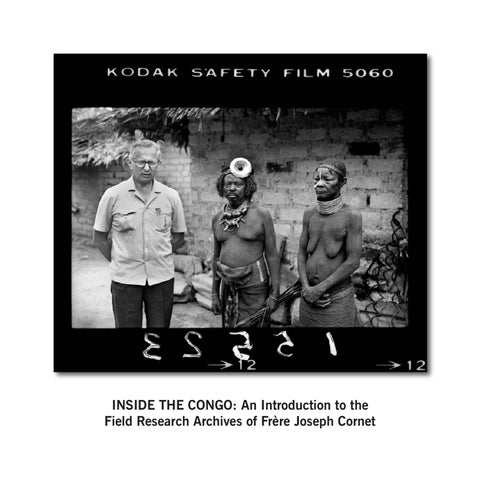
Front cover photo: Frère Cornet with a chief and his wife (Notebook 35, p. 21, neg. no. 15523) Title page photo: Frère Cornet with Kuba villagers (Notebook 7, p. 53, neg. no. 3321) Back cover photo: The matweaver’s children (Notebook 6, p. 119, neg. no. 2961)
© Copyright 2007, Loyola University New Orleans, Office of Publications and Marketing Communications ISBN: 978-0-9678146-9-8
2-1206 Cornet Exhibit Catalog:21-906 Made In Mobile Catalog
1/4/07
Frère Joseph-Aurélien Cornet spent nearly 30 years, from the early 1960s to the early 1990s, as a missionary of the Christian Brothers in the Congo region. Trained as an art and architectural historian, his great passion and academic pursuit became the art of the Congolese region and people. Traveling from village to village, Fr. Cornet documented the art and artistic traditions, iconography, and cosmology of Congolese indigenous communities. His long tenure in the Congo enabled him to compare, over time, artistic traditions by region. Fr. Cornet’s remarkable career coincided with profound cultural and political change in the Congo during its transformation from a Belgian colony to the independent state of Zaire and subsequently to its present incarnation as the Democratic Republic of Congo. Between 1998 and 2001, Fr. Cornet gave his field notebooks to Loyola University New Orleans, and in 2001, he bequeathed the remainder of his collected scholarly research to Loyola. Following Fr. Cornet’s death on January 20, 2004, the Cornet archives were transferred from his home in Belgium and are permanently housed in the J. Edgar & Louise S. Monroe Library at Loyola. Fr. Cornet is recognized as one of the world’s foremost scholars of African art, and the Cornet collection is an archive of global significance to the study of the art and ethnography of Africa. The most important material in Cornet’s collection are the 44 field notebooks, which document his work on a number of cultural groups in the Congo region, but are especially rich in the study of the art and culture of the Kuba peoples. In addition to the field notebooks, the collection consists of more than 20,000 photographic negatives, slides, and prints and approximately 50,000 pages of research notes, as well as Cornet’s published works and private library. During his years in the Congo, Fr. Cornet became the director of the Institut des Musées Nationaux du Congo (IMNC), later the Institut des Musées Nationaux du Zaire (IMNZ). The museum’s collections consisted in large part of works that Cornet gathered, as well as some that he repatriated from the Belgian colonial period. Selections from the museum’s collections were exhibited in Europe and
3:12 PM
Page 5
the United States, most notably at the National Gallery of Art in Washington, D.C., and at the New Orleans Museum of Art, in 1978. Following the collapse of the Mobutu government in 1997, the museum’s collections were tragically looted and many objects dispersed. Fr. Cornet had developed a comprehensive archive of the provenance of these works and continued tracking sales and transfers of the objects until the end of his life, with the intent of restoring as many pieces as possible to the museum. Although a modest man, typical for a Christian brother, Fr. Cornet had an appropriate understanding of the importance of his studies and of the critical need to make his work available to students and African scholars. He chose Loyola University New Orleans because he felt that, within a secure environment, both undergraduates and scholars would be able to have access to his collections, and also because these resources would complement the highly regarded collection of African art at the New Orleans Museum of Art. Additionally, Fr. Cornet was keenly aware of New Orleans’ distinctive heritage as a major site of the African Diaspora and as the home to a number of distinguished private African art collections. Two exhibitions, Inside the Congo: An Introduction to the Field Research of Frère Joseph Cornet, Parts I and II, have given the public a first opportunity to view Fr. Cornet’s magnificent accomplishment as well as for scholars to have a preview of the wealth of rare, new information available for study. They have also afforded an opportunity for collaboration between the New Orleans Museum of Art and Loyola University, which has proved to be immensely rewarding. The notebooks themselves provided a wealth of material for both exhibitions. Indeed, that very richness led from an original plan for one exhibition to two. These exhibitions included samples of Fr. Cornet’s meticulously composed notebooks consisting of thousands of thumbnail photos, his drawings and diagrams, and his thorough notes of the people, the villages, and ceremonies he documented, as well as positive prints made from Cornet’s original negatives. The first exhibition was held at the New Orleans Museum of Art, March 3
5
2-1206 Cornet Exhibit Catalog:21-906 Made In Mobile Catalog
6
1/4/07
3:12 PM
Page 6
through September 30, 2006, as part of the celebration of the reopening of the museum following Hurricane Katrina. The Collins C. Diboll Gallery in the J. Edgar & Louise S. Monroe Library at Loyola University provided a venue for a second exhibition (December 11, 2006, through February 28, 2007). The first exhibition consisted of five components: an introduction to Cornet as a priest and scholar; a selection of photographic portraits of the people of the Congo; a look at artisans at work; a presentation on Cornet’s documentation and study of art objects; and a photographic display of a Kuba peoples’ mwaash a mbooy dance performance shown with two masks of a variant type (mukyeen) in NOMA’s collection. Other objects exhibited in Inside the Congo, Part I, were drawn from NOMA’s and Loyola’s collections. Inside the Congo, Part II, was planned to highlight Cornet’s documentation of various occupations; village architecture and buildings; costuming and regalia; musicians and dancers; craftsmen at work; and death rituals, as well as rare photographic documentation of the performance of the large, ndunga masks of the Woyo peoples worn with proportionately voluminous costumes of dried banana leaves that fully cover the dancers’ bodies and resemble small domed shelters. This exhibition of photographs was beautifully augmented by an exhibition of related works from private New Orleans collections. For both exhibitions, didactics were drawn from Cornet’s own writing.
Aside from their value as research materials, the photographic materials reveal Cornet’s remarkable skill as a photographer, and the portraits show exquisitely interesting and beautiful people. And despite the passage of generations and geographical separation of people from their indigenous culture, Cornet’s work helps us reflect on the Congo region as a major well-spring of our own rich New Orleans cultural heritage. We are grateful for the shared enthusiasm for this wonderful collection and support for our work by our NOMA colleagues E. John Bullard, Steven Maklansky, and Tao-Nha Hoang; our Loyola colleagues Edward Kvet; Mary Lee Sweat; David Stueber, who printed the photographs from Cornet’s original negatives; Kent Davis and Mark Grote, who curated the complementary show of objects for Inside the Congo, Part II; Colette Stelly, who translated from Cornet’s tiny handwritten French; Karoline Schleh, director of the Diboll Gallery; student assistants Thomas Stover and Sarah Brewer; and David Binkley, from the Center for Advanced Studies, National Gallery of Art, whose consultancy has been invaluable as we begin to understand the Cornet archives. The exhibitions and this publication were supported, in part, by a grant from the Louisiana Endowment for the Humanities. Dr. Binkley’s consultancy has been underwritten by a grant from the Fertel Foundation.
Darla H. Rushing Coordinator for Library Development & Special Collections, Associate Professor J. Edgar & Louise S. Monroe Library, Loyola University New Orleans
William A. Fagaly The Françoise Billion Richardson Curator of African Art New Orleans Museum of Art
2-1206 Cornet Exhibit Catalog:21-906 Made In Mobile Catalog
1/4/07
3:12 PM
Page 7
PORTRAITS
7
Notebook 18, p. 123, neg. no. 13876
Woman wearing a gold collar
2-1206 Cornet Exhibit Catalog:21-906 Made In Mobile Catalog
1/4/07
3:12 PM
Page 8
ARTISANS
8
Notebook 15, p. 33, neg. no. 8292
Women of Kwete Mwana at their sewing
2-1206 Cornet Exhibit Catalog:21-906 Made In Mobile Catalog
1/4/07
3:12 PM
Page 9
ARTISANS
9
Notebook 33, pp. 26, 27
Fabrication of a small pottery funerary vessel
2-1206 Cornet Exhibit Catalog:21-906 Made In Mobile Catalog
1/4/07
3:12 PM
Page 10
ART OBJECTS AND DOCUMENTATION
10
Notebook 25, pp. 111, 112, and foldout
These pages illustrate Fr. Cornet’s meticulous documentation of motifs, in this case, the seashell.
2-1206 Cornet Exhibit Catalog:21-906 Made In Mobile Catalog
1/4/07
3:12 PM
Page 11
CRAFTSMEN
11
Notebook 3, p. 38, neg. no. 3138
Weaving a fish trap
2-1206 Cornet Exhibit Catalog:21-906 Made In Mobile Catalog
1/4/07
3:12 PM
Page 12
OCCUPATIONS
12
Notebook 34, p. 53, neg. no. 15048
“The schools were founded by P. Beasin, who realized that the pygmies were not well accepted in the schools of Noluye. The schools were established half way between the village and the camps approaching the forest. The monitors served as our interpreters.” —Fr. Cornet
2-1206 Cornet Exhibit Catalog:21-906 Made In Mobile Catalog
1/4/07
3:12 PM
Page 13
MUSICIANS
13
Notebook 6, p. 132, neg. no. 3008
A drummer performing
2-1206 Cornet Exhibit Catalog:21-906 Made In Mobile Catalog
1/4/07
3:12 PM
MUSICIANS AND DANCERS
14
Notebook 18, p. 132, neg. nos. 13719, 13720
Costumed dancer
Page 14
2-1206 Cornet Exhibit Catalog:21-906 Made In Mobile Catalog
1/4/07
3:12 PM
Page 15
ARCHITECTURE AND BUILDING
15
Notebook 31, p. 112, neg. no. 11058
A house under construction
2-1206 Cornet Exhibit Catalog:21-906 Made In Mobile Catalog
1/4/07
3:13 PM
Page 16
ARCHITECTURE AND BUILDING
16
Notebook 5, pp. 80, 81
Types of village buildings and architectural diagrams
2-1206 Cornet Exhibit Catalog:21-906 Made In Mobile Catalog
1/4/07
3:13 PM
Page 17
COSTUMING AND REGALIA “A chief speaks to his people:
‘My People, I’m asking you to clean up our village. Our village must be clean, if not, one day someone will bump up against a tree stump and get hurt. That is not as it should be.
‘In the second place, I must ask you to work, that is to say, to work in the fields. Because, every man who doesn’t work spends his time being jealous of those who do work. One always hears: “they say this,” “they say that.” This has to stop. It is not said that the only work to be done is making art. No, you must also occupy yourselves with other work, for after all, I don’t want to be the chief of poor, lazy people. I would like you to have money, so that I myself might live. Without you, what would I be! I live because of you.
17
Notebook 2, p. 139, neg. no. 1106
‘In the third place, I will tell you the name of my village. You know that a child receives his first education from his parents. I’m asking you to educate your children. To tell them: ‘respect this, — he’s your paternal or maternal uncle; she’s your paternal or maternal aunt.’ This is why I say that the name of my village is Ntshieyi Minene... ‘We must have justice and peace, if not, children will live in prison.
‘I would like to close by asking God to bless you and give you the courage to work.’”
—Fr. Cornet
2-1206 Cornet Exhibit Catalog:21-906 Made In Mobile Catalog
1/4/07
3:13 PM
Page 18
COSTUMING AND REGALIA
18
Notebook 32, p. 52, neg. no. 13998
The photographer, Angelo Turconi, shooting the royal court for Fr. Cornet’s book, Art Royal Kuba.
2-1206 Cornet Exhibit Catalog:21-906 Made In Mobile Catalog
1/4/07
3:13 PM
Page 19
COSTUMING AND REGALIA
19
Notebook 7, p. 111, neg. no. 3544
The dance of the moshambwooy mask at the royal court.
2-1206 Cornet Exhibit Catalog:21-906 Made In Mobile Catalog
1/4/07
3:13 PM
Page 20
LEAF COSTUME
20
Notebook 23, pp. 76, 77
Frère Cornet documents in numerous photographs and extensive writings a dance performed by the Woyo peoples. The large ndunga masks are worn with proportionately voluminous costumes of dried banana leaves that fully cover the dancers’ bodies and resemble small domed shelters. On these pages, he describes the various elements used for the ceremony: “three ndunga masks already consecrated, one mask to be consecrated, the tail of a buffalo, Nibooryo or the roots of a reed tied with blue string, leaves of the malembalemba for the aspersions, white kaolin, spring water drawn in the late morning before other parts of the ceremony, palm wine, liquor (bagaceira), and a knife.”
2-1206 Cornet Exhibit Catalog:21-906 Made In Mobile Catalog
1/4/07
3:13 PM
Page 21
LEAF COSTUME
21
Notebook 37, p. 61, neg. no. 15972
Preparing for the Woyo ndunga masked performance
2-1206 Cornet Exhibit Catalog:21-906 Made In Mobile Catalog
1/4/07
3:13 PM
Page 22
DEATH RITUALS
22
Notebook 31, p. 70, neg. no. 10878
The grand tomb in cement of a deceased long-drummer whose name was Kuka Pwati.
2-1206 Cornet Exhibit Catalog:21-906 Made In Mobile Catalog
1/4/07
3:13 PM
Page 24