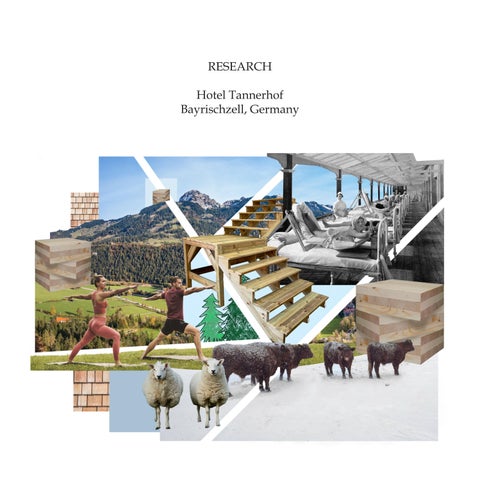
RESEARCH Hotel Tannerhof Bayrischzell, Germany
MATERIAL CONTEXT
The Tannerhof has received several architectural prizes and awards for these huts (“Current Architecture in Upper Bavaria”, BDA Award for Bavaria for “Room Effect”, German Timber Construction Award for “Building in Stock”) The German Architecture Museum included the Tannerhof in the German Architecture Yearbook 2013. And the BDA still awarded the architectural “Nike” for “composition”. Wooden shingle cladding adds texture and dimension, in a lightweight form, to the simple shape of the building, whilst still remaining an environmentally friendly and sustainable choice. Cross-laminated timber (CLT) is used for the structure of these huts. It is an affordable and environmentally sustainable material, which is also incredibly strong due to its layers. In the roofing 3-ply lumber-core plywood is used, and has excellent strength and rigidity. Plywood has a naturally high sound and thermal insulating properties, consequently making it a common choice for insulating roofs, floorings, and ceilings. Wood-fibre insulated boards, and acoustic boards, tend to be six to twelve times the density of synthetic options, making them a better choice for vibration absorption. This in turn creates quieter and more relaxing spaces, and aids in creating the effect of a serene hut in the mountains. The re-inforced concreted base, which is partially embedded into the slope the building resides on, is a waterproof material that won’t allow for the hut to sink into the ground, like a timber foundation could have. Reinforced concrete is concrete in which steel is embedded in such a manner that the two materials act together in resisting forces. The reinforcing steel absorbs the tensile, shear, and compressive stresses in the structure, therefore increasing the overall strength of the structure. This also makes it better for withstanding against natural disasters, like earthquakes and blizzards.
ENVIRONMENTAL CONTEXT
Bayrischzell is situated in the foothills of the Balvarian Alps, providing a beautiful alpine landscape, with surrounding mountains, forests and lakes. Mountain and lakes in the immediate vicinity include: Schliersee, Tegernsee, Chiemsee, and Thiersee. The Hotel Tannerhof was created with the concept of sustainability from the beginning, even being considered an ‘eco-hotel’ and ‘nature hotel’. Electricity is generated partly by itself, and additionally comes from Greenpeace Energy. Plastic is dispensed with as much as possible, and the waste is seperated. The huts are dominantly constructed with timber, which is a renewable material, making it environmentally sustainable. Even the food served in the hotel is organic and regionally sourced, as well as being preared to the “slow food” ethos, which is a global movement of activists ensuring everyone has access to good, clean and fair food. The climate conditions of Bayrischzell range from -2 °C in January, to a high of 26 °C in July. The front of the wooden huts face west, meaning the exterior stairs face east. The use of floor-to-ceiling glazing allows for natural daylight to flood the space, contrary to the simple gable roof, which has no way to permit light to enter from above.
CULTURAL CONTEXT
Bayrischzell is a winter resort town and deemed one of the most beautiful places in the Bavarian Alps. It is home to around 41 km (25.2 miles) of prepared ski runs and slopes, as well as 19 ski lifts, and a cable car for transportation to ski resorts. There’s also an active centre with 96 km of grommed trails for cross-country skiing in Winter. An association called “Kultursprung eV-Kunst und Soziales am Tannerhof” is dedicated to the cultural and social projects within the region. The hotel itself has an in-house cultural programme for guests to enjoy. The only architectural style unique to Bavaria is its regional variations of farmhouse. The typical Bavarian house style can be identified through traditional design elements like; steeply pitched roofs with overhanging eaves, decorative woodwork, and colourful external facades. These residencies frequently boast balconies embellished with flowers, and may include window shutters and window boxes. Bavaria is one of the few major Geran powers to remain Catholic, and it also happens to be where Pope Benedict XVI was born. The number of Catholics in Bavaria is declining, but the state’s politicians still see it as a predominant aspect of its culture. A recent law required a Christian cross to be displayed in the lobby of every public building, which made international headlines due to controversy, but the politicians simply said, “This is about culture, not religion”. Bavaria is often considered different compared to the other states of Germany due to its Catholic plurality and conservative traditions. However, Bavaria is also known for its pristine countryside, clean air, wealth of culture, and infamous laid-back Bavarian attitude. Bavaria is famous is famous for its trditional festivals, including Oktoberfest in Munich which showcases Bavarian culture with music, dance, traditional attire, and Bavarian beer.