Community Voices
inside this issue
Don Dunstan Centenary
NG 2026 SPRI
Nepal Flood Vigil
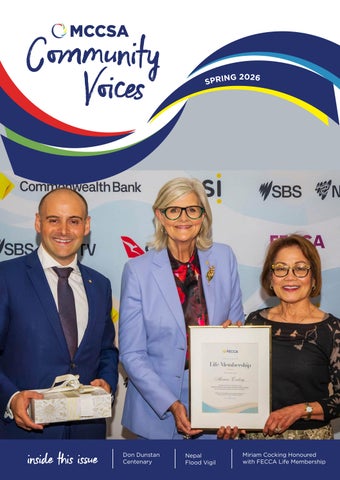
Miriam Cocking Honoured with FECCA Life Membership
Highlights FECCA Conference – Dr Bulent (Hass) Dellal AO
MCCSA BOARD 5
Every Name Tells an Australian Story
P14
MOSAIC Festival 2026
P18
Frank Miller – A Lesson in Volunteering
P24
Ombudsman SA: ensuring fairness, integrity and transparency in South Australian Government
P28
Beyond Borders: How SAIMA Connects Cultures and Communities Through Music
P35
Ageing Well in a New Country: Learning from Multicultural Communities
P40
Executive Chairperson: Miriam Cocking Deputy Chairperson: Dr Ian Harmstorf OAM BVK Treasurer: Silvio Iadarola OAM
Board Members Con Katsambis Gosia Skalban OAM Manju Khadka Nasir Hussain Patrizia Kadis Ranielson Santana de Silva Suren Edgar Zainab Jimie
Photo Credit: The MOSAIC Ensemble | MOSAIC Festival 2026
SPRING 2026 | P2
FROM THE CEO
HELENA KYRIAZOPOULOS OAM
BUILDING EQUITY, BELONGING AND A SHARED FUTURE The Federation of Ethnic Communities’ Councils of Australia (FECCA) Conference, held in Canberra from 14 to 16 October 2026, brought together multicultural leaders, policymakers and community organisations to reflect on the future of multiculturalism, social cohesion and belonging in Australia. MCCSA was pleased to have a strong presence at the conference, contributing to important national conversations about equity, inclusion and the role of our diverse communities in shaping Australia's future. A particularly proud moment was the awarding of FECCA Life Membership to our Chairperson, Mrs Miriam Cocking, in recognition of her longstanding leadership and outstanding contribution to multicultural Australia. This prestigious honour is not bestowed lightly and reflects Miriam's tireless commitment to strengthening community
representation and ensuring that multicultural voices are heard and respected. On behalf of MCCSA, I congratulate Miriam on this well-deserved recognition. Another highlight was the presentation by Katie Trinh, Principal Strategic Advisor, CALD Health Equity, who showcased MCCSA's work on Equity by Design, an approach that has attracted significant interest and support, including from Australia's Race Discrimination Commissioner, Giridharan Sivaraman. Equity by Design challenges organisations to move beyond good intentions and embed fairness and equal opportunity into their systems, policies and decision making. It is about ensuring that equity is not an afterthought, but a fundamental principle guiding how institutions operate and serve their communities. It was encouraging to see this work gaining recognition at a national level.
The importance of moving beyond good intentions towards meaningful action was also reflected in one of the conference's most thoughtprovoking contributions, delivered by Dr Bulent (Hass) Dellal AO, Chairperson of the Australian Multicultural Foundation, who addressed the theme Identity, Belonging and the Way Forward. Dr Dellal reminded us that while 83 per cent of Australians support multiculturalism, our sense of national belonging has declined. He challenged us to consider whether we have done enough to build a shared Australian identity alongside our cultural diversity. His message was particularly powerful: “Don't just tell Australians that we belong together. Give us reasons to belong together.” These words resonate strongly with MCCSA's work over the past 50 years. Multiculturalism is not simply about recognising and celebrating difference.
P3
It is about creating the conditions in which everyone can participate, contribute and feel a genuine sense of belonging. It is this understanding of belonging that continues to drive MCCSA's advocacy for a new home for our multicultural communities. Our current facilities have served us well, but growing demand has placed increasing pressure on our capacity. Each year, thousands of people from diverse backgrounds access our facilities for cultural activities, educational programs, community meetings and social connections. For many smaller, new and emerging communities, MCCSA is more than a meeting place. It is somewhere they can maintain their cultural identity, strengthen their organisations, build relationships and find a sense of belonging.
SPRING 2026 | P4
Our vision for a purpose-built multicultural hub is to provide our communities with a place they can truly call home. We continue to advocate for investment from both the State and Commonwealth Governments to realise this vision. This is about much more than bricks and mortar. It is an investment in the social cohesion, participation and wellbeing of our communities, now and for future generations. There is a strong connection between this vision, our Equity by Design work and Dr Dellal's message. Belonging cannot be achieved through words alone. It must be supported by fair institutions, genuine opportunities and spaces where people can connect and contribute. As we look ahead, we must continue to move beyond statements of commitment
towards meaningful action. Australia's multicultural success has been built over generations, but its future depends on our willingness to strengthen the fairness, trust and shared sense of purpose that bring us together. For MCCSA, this means continuing to advocate for the needs of our communities, challenging the systems that create barriers and working with governments and partners to ensure that equity and inclusion are reflected in practical outcomes. Our commitment remains clear: to build an equitable, cohesive and thriving multicultural South Australia where everyone has the opportunity to participate, contribute and belong. A full copy of Dr Hass Dellal's address, Identity, Belonging and the Way Forward, is available on the following pages.
Helena
FECCA PLENARY OPENING AND CLOSING REMARKS DR BULENT (HASS) DELLAL AO Chairperson, Australian Multicultural Foundation Identity, belonging and the way forward Friday 16 October 2026 | Old Parliament House
OPENING ADDRESS Good morning, everyone. I acknowledge the Traditional Custodians of the land on which we meet, the Ngunnawal and Ngambri peoples, and pay my respects to Elders past and present. I also acknowledge the Aboriginal and Torres Strait Islander people joining us today. Thank you to FECCA for bringing us together to consider identity, belonging and the way forward; and whether we have a genuine sense of place in Australia we share. That brings us to the questions at the heart of this plenary. Who are we? Where do we belong? And where do we go from here? We addressed this topic in many ways yesterday. Let me make a few observations before we lead into the panel discussion. So, let’s go back to foundations. Australia's problem is not that we chose multiculturalism. The problem is that we have sometimes stopped short of the second half of the accord: building a strong, shared civic identity around it. The data doesn’t support the idea that Australians have broadly rejected multiculturalism at all.
As we know, the 2025 Scanlon survey found that 83 per cent agreed that multiculturalism had been good for Australia. I am not aware of any other social policy with such a level of acceptance.
Australia's own Multicultural Framework Review explicitly describes national identity as something that has developed from First Nations traditions, British institutions and successive waves of migration.
But there is a genuine problem underneath the political noise.
I would build identity around fairness, freedom, democracy, equal citizenship, human rights, mutual respect, personal responsibility and the rule of law. A willingness to contribute. And the belief that someone else's success does not diminish yours.
The same Survey also found that national belonging and pride have declined from earlier levels, while economic and housing concerns and global conflicts weigh on social cohesion. And at the same time, neighbourhood-level connections remain relatively strong. So, my answer to this is maybe we need to change the question. Instead of asking “How do we make different groups feel included?” We should ask: what are we asking all Australians to belong to? A country needs more than a collection of demographic identities. Eventually there has to be a civic identity: a set of things we believe we share despite our differences. And I don't think that requires choosing between Indigenous heritage, British institutions, migration or multiculturalism.
These principles must mean something in everyday life. Fairness must be visible in the workplace. Equal citizenship must be evident in how institutions treat people. Democracy must include the opportunity to be heard, to disagree and to help shape decisions. A shared civic identity is credible only when people can see its principles at work. And that commitment works both ways. You cannot tell someone that they will never be genuinely Australian because of their surname, religion, skin colour or birthplace, and then ask why they do not feel they belong.
P5
Nor can any of us claim this society's freedoms while refusing to respect others' equal freedoms. We should expect everyone to respect our laws and democratic institutions, gender equality, diversity, and freedom of religion, including the freedom not to believe. That includes participation in the broader community and commitment to Australia and its people. Government must make sustained participation possible. Responsibility without opportunity is an incomplete bargain. These expectations apply to everyone, whether their family arrived recently or has been here for generations.
SPRING 2026 | P6
There should be no hierarchy of citizenship. I'd also stop treating difference as the destination. Difference is the starting point. The destination should be belonging. You don't need Australians to become culturally identical. You need them to feel that, despite enormous differences, they are part of the same national project. And the evidence gives us a clue about how to achieve that. People who experience strong neighbourhood cohesion and participate in community life are substantially more likely to feel they belong. It’s the work you do out there every day.
So, while a campaign about diversity and the benefits of a managed migration program would be helpful to inform all, what’s more important is that we need more sporting clubs, volunteering, local organisations, shared schools, community events, civic participation, apprenticeships, workplaces and public spaces where people actually can live alongside and interact with one another. People should be able to retain their heritage and be unequivocally Australian. They should also have an equal opportunity to help shape what Australia becomes next. In other words: Don't just tell Australians that we belong together. Give us reasons to belong together.
DR BULENT (HASS) DELLAL AO
To me, that's the heart of the answer. Australia doesn't need to choose between diversity and identity. We need to build an identity strong enough to contain our diversity. The most useful way to put it is that Australia hasn’t necessarily gone wrong because we became more diverse; we’ve struggled because we haven’t developed a sufficiently compelling shared story alongside that diversity.
I see three places where we need to get the debate back on track. First, we have too often turned Australian identity into a culture-war question. Preserving what is valuable about Australia and valuing its people's diversity are compatible ambitions. For years, the argument has tended to bounce between: •
Australia must preserve its traditional identity.
•
Australia must become more inclusive and recognise diversity.
Those aren't necessarily opposing propositions. The harder task is creating an identity that says: You don't have to stop being Chinese, Lebanese, Greek, Indian, Aboriginal, English, Jewish, Vietnamese or anything
else to be Australian. But being Australian has to mean something shared. Australia's own multicultural framework recognises that national identity is fluid rather than permanently fixed, while also acknowledging the importance of a shared sense of belonging. Our national story must recognise the unique place, rights and continuing cultures of Aboriginal and Torres Strait Islander peoples, whose relationship to Country and their experiences of dispossession cannot simply be folded into a story of cultural diversity. Acknowledging injustice and unfinished responsibilities does not diminish Australia. It gives us a more honest foundation on which to build its future. We can value our democratic institutions, recognise how migration has transformed the country, and take pride in our achievements while accepting that there is more to do. Multiculturalism and social cohesion are closely interconnected, but they ask different questions. Multiculturalism concerns recognition, equal rights, the freedom to retain our heritage, obligations and responsibilities. Social cohesion asks whether we trust one another, feel we
belong, and can work together within shared institutions. We need both! Second, we have allowed economic anxiety to become an argument about who belongs. History should teach us the danger of turning insecurity into suspicion of people who are different. People worried about rent, work or their children's prospects deserve serious answers. Migration levels, housing supply, infrastructure and workforce needs are legitimate matters for democratic debate. But a debate about how many people Australia can responsibly accommodate must not become a debate about whether Australians from particular backgrounds are really Australian. If we answer economic insecurity with cultural blame, we leave the insecurity unresolved and add division to it. Political leadership should offer a credible way forward, rather than an ever-changing list of people to blame. Third, we have forgotten that belonging has to be experienced, not simply announced. You cannot build a shared identity by demanding that everyone tell the same story about the past.
P7
DR BULENT (HASS) DELLAL AO Australians should be able to say simultaneously: •
Indigenous Australians have an ancient connection to this continent.
•
British institutions profoundly shaped modern Australia.
•
Immigration transformed the country.
•
Australia's history contains serious injustice.
•
Australia has also built an extraordinarily successful democratic society.
Government needs a clear vision, coordinated action and accountability. Towards Fairness, Rebuilding Trust, and other reports draw on extensive consultations and set out substantial recommendations on multiculturalism, racism, and inclusion. These reports provide a roadmap – not perfect, but a good one – that shows we know much of what needs to be done. The failure has been in implementation. Will the recommendations from the Royal Commission into antisemitism and social cohesion meet the same fate? So, the task now is implementation: what will be delivered, who is responsible, and how will we know it is working? Community organisations must build bridges beyond their memberships. Service providers must make equity a reality. Our public institutions, including parliaments, councils,
the judiciary, public boards and the public service, should by now reflect the diversity of the people they serve. Academics must help us understand what works. Political leaders must model the respect they ask of the public.
What if Australia's real failure isn't multiculturalism—but our failure to build a strong enough shared identity around it?
We need partnerships with business, unions, schools, sport and faith communities. The case for a confident multicultural Australia should be made across Australian society.
CLOSING REMARKS AFTER THE PANEL
Don't just tell Australians that we belong together. Give us reasons to belong together. Finally, I don't think the problem is necessarily that Australia has become too diverse or not diverse enough. The problem is that we haven't been sufficiently confident about the “we” in “we are Australians.” And that is a question worth asking.
That is a much harder question for both sides of the debate to answer.
The way forward requires a shared civic commitment that people can see in their lives: fair opportunity, equal rights and responsibilities, and the capacity to influence the decisions that shape their future. The question before us is how to make a shared civic identity real: through the responsibilities we accept, the relationships we build and the institutions we are prepared to change. Australia does not have to choose between diversity and identity. We need an identity strong enough to embrace and value our diversity, and institutions fair enough to make that promise real.
SPEAKING THE SAME LANGUAGE:
PARTNERING WITH INTERPRETERS TO SUPPORT WOMEN TO PARTICIPATE IN BREAST CANCER SCREENING For more than 35 years, interpreters have played a vital role in supporting women from multicultural communities to access breast cancer screening in South Australia. BreastScreen SA has built strong relationships with interpreter services to make screening more accessible, welcoming and culturally appropriate. By working closely with interpreters, we’ve been able to improve communication, encourage participation and build trust with women who speak a language other than English. From the moment a woman makes an enquiry or books an appointment, interpreters can help make the process easier. Women can request a telephone interpreter to assist with booking, and during this process, they’re also asked whether they would like a female interpreter to attend their clinic appointment. This service is provided at no cost. Interpreter services are professional and confidential, allowing women to ask questions, clarify information and learn more about cancer and cancer screening. At screening appointments, interpreters facilitate sensitive and informed conversations with our staff, helping women feel comfortable in our clinics.
Developing the skills and confidence to work effectively with interpreters is a priority for BreastScreen SA. We see this as a two-way relationship, where everyone has something to learn. Alongside professional development for our own staff, BreastScreen SA hosts training workshops to help interpreters learn more about the program and what clients and interpreters can expect when attending screening and assessment appointments. Over the past 2 years, more than 50 interpreters have attended our workshops, resulting in positive benefits for both interpreters and clients. Just as importantly, the workshops give interpreters an opportunity to share their experiences, ask questions and provide feedback in an open, supportive environment. By discussing real-life scenarios and identifying potential challenges, interpreters have helped BreastScreen SA identify opportunities to improve the way we deliver our services.
The training workshops have built goodwill and positive connections that can only enhance the experience for all multicultural clients and interpreters working across our screening and assessment clinics. BreastScreen SA is proud to lead the nation in participation rates among women from multicultural backgrounds. This achievement reflects the commitment of our staff, our ongoing work to make screening accessible and, importantly, the contribution of the local interpreters who help women feel heard, understood and supported. Regular breast cancer screening saves lives, to make an appointment phone 13 20 50 or visit www.breastscreen. sa.gov.au to make an online booking. For more information phone CALD Project Officer, Marita Aldridge on 8274 7169 or email marita.aldridge@sa.gov.au
Building positive relationships with interpreters has also opened doors to new connections with smaller, hard to reach cultural groups.
P9
TOGETHER WE THRIVE:
COMMUNITY-LED ACTION TO IMPROVE MEN’S MENTAL HEALTH ADELAIDE: When communities lead, men find their way to wellbeing. This was the powerful message shared at a special Mental Health Month gathering in Adelaide on Wednesday 21 October 2026, bringing together multicultural community leaders, health professionals and government representatives to shine a light on men's mental health and wellbeing. Organised by the Multicultural Communities Council of South Australia (MCCSA), the event aligned with Australia's national Mental Health Month theme, Together We Thrive, and South Australia's theme, Find Your Way to Wellbeing. It highlighted the importance of culturally responsive, community-led initiatives in breaking down stigma, encouraging open SPRING 2026 | P10
conversations and ensuring men from culturally and linguistically diverse (CALD) backgrounds feel supported to seek help. Opening the evening, MCCSA CEO Helena Kyriazopoulos OAM emphasised the importance of investing in conversations, relationships and community-led initiatives that create safe and welcoming spaces for men to talk about their mental health. The Hon. Hilton Gumbys MLC, Chair of the Joint Committee on Men's Health and Wellbeing, delivered a keynote address on behalf of the Hon. Blair Boyer MP, Minister for Health and Wellbeing. The evening also featured an engaging panel discussion and audience Q&A with Professor
Gary Wittert and John Mannion, CEO of Breakthrough Mental Health Research Foundation. Their contributions encouraged reflection on the challenges affecting men's mental health and the importance of creating opportunities for meaningful conversations, connection and early support. At the heart of the event were six MCCSA community partners who are taking action within their own communities: » Men's Arabic Speaking Association (MASA) » Farda TV CALD Network » Latin American Society SA (LASSA) » Association of the Burundian Community of SA » The Chinese Language School of SA » Australian Sikh Support
Through their leadership and involvement in the Taking Care of Me project, these organisations are helping make mental health conversations more accessible, culturally relevant and connected to the everyday experiences of men in their communities. MCCSA also acknowledged the important leadership of its Men's Council, whose ongoing advocacy continues to champion men's health and wellbeing across multicultural South Australia. The event was made possible through the support of funding partners Preventive Health SA and The Hospital Research Foundation Group.
MCCSA was pleased to welcome Camilo and Yvonne Muyambi from Preventive Health SA, alongside Jim Deed, Head of Grants at The Hospital Research Foundation Group, in recognition of their continued commitment to preventive health and community wellbeing. A central message emerged throughout the evening: improving men's mental health requires more than encouraging individuals to seek help. It requires communities to create the trust, understanding and connections that make those conversations possible.
For many men, a conversation with a trusted community leader, a familiar face or a fellow community member can be the first step towards seeking support. By empowering multicultural communities to lead, initiatives such as Taking Care of Me are helping build stronger connections, challenge stigma and create pathways to better mental health. When men are healthy, then women are healthy, the family is healthy, the society is healthy and the country is healthy. When communities are supported to lead, men connect, men talk and men look out for one another. Together, we thrive.
P11
DON DUNSTAN CENTENARY – A PLACE FOR EVERYONE PARLIAMENT HOUSE Monday 21st September 2026
Honourable Speaker, Hon Dr Lomax Smith – Chair Don Dunstan Foundation, distinguished guests, community leaders, ladies and gentlemen. It is a privilege to join you in this Chamber to mark Don Dunstan’s centenary and reflect on his legacy for multicultural South Australia. I speak today as CEO of the Multicultural Communities Council of South Australia— MCCSA—peak body representing culturally and linguistically diverse communities across our state. It is impossible to tell the story of MCCSA without placing it within the extraordinary social transformation led by Don Dunstan.
Our organisation’s foundations were laid in 1975 with the formation of the Ethnic Communities Council of South Australia, during an era of landmark reforms that redefined who belonged, whose voices mattered and the society we wanted to become. Don opposed the White Australia policy and advocated for a more open, inclusive nation. His anti-discrimination reforms made South Australia a national leader in equality and protection from racial discrimination. Don understood something that was not widely accepted at the time: people should not have to surrender their culture, language or identity in order to belong.
He rejected the expectation that migrants should simply assimilate into a single version of Australian identity. Instead, he advanced the idea that people could be fully Australian while maintaining pride in their heritage. That was a profound shift. This enabled multicultural communities to organise, speak collectively and participate more fully in civic life. It also established that governments should listen to communities— not merely make decisions on their behalf. Fifty-one years later, MCCSA continues that work. Today, our 140-plus member organisations represent communities encompassing
The full event can be viewed on YouTube SPRING 2026 | P12
MCCSA CEO - Helena Kyriazopoulos OAM was fortunate to be one of the speakers at the Centenary Event – the following is her short presentation.
more than 85 per cent of South Australia’s culturally and linguistically diverse population. Some have been part of South Australia for generations. Others were formed by people arriving through skilled migration, family reunion or humanitarian pathways. There is no single multicultural experience. Our culturally, linguistically, religiously and socially diverse communities include longestablished migrants and young South Australians who carry several identities with confidence. Together, they contribute to every part of South Australian life—our health and care systems, businesses, universities, public services, arts, food, sport and civic institutions. But Don Dunstan’s legacy asks us to go beyond celebrating diversity and ask whether everyone can participate equally in the society they helped build. Belonging is not created through festivals and speeches alone. It requires access to
opportunity, representation in decision-making and confidence that our institutions understand and serve the whole community. This remains unfinished work. Too many people still encounter barriers of language, culture, race or unfamiliar systems. Too often, diversity is considered only after a policy, program or service has been designed. At MCCSA, we advocate for equity by design—recognising that our multicultural reality is part of the mainstream and designing our systems accordingly from the very beginning. This is, I believe, is entirely consistent with Don Dunstan’s vision. He did not simply invite people into the South Australia that already existed. He helped reshape South Australia so that more people could see themselves within it. His leadership demonstrated that laws matter, institutions matter and political courage matters. But he also showed that culture matters—the food we share, the stories we
tell, the art we create and the relationships we form across communities. As the daughter of migrants, I understand personally what it means to build a life in a new country while holding firmly to the culture and values that shaped you. I am Australian. Our members are Australian. The communities we represent are part of the South Australian story—not outside it and not separate from it. A century after Don Dunstan’s birth, South Australia is more diverse than he could perhaps have imagined. Yet the principle at the heart of his vision remains simple and powerful: this must be a place for everyone. Our responsibility now is not merely to admire that legacy, but to continue it—with the same confidence, imagination and courage. Thank you.
P13
EVERY NAME TELLS AN AUSTRALIAN STORY On the waterfront at the Australian National Maritime Museum, thousands of names etched in bronze form the National Monument to Migration, known to many as the Welcome Wall. Each belongs to someone born overseas who made Australia home—and carries a story of departure, arrival, challenge and opportunity. The museum tells Australia’s maritime story, and migration is central to it. Generations crossed oceans to build new lives, bringing languages, traditions, skills and ideas. The Monument, collections and programs connect these journeys to our shared national story.
SPRING 2026 | P14
A monument for the whole nation
Why adding a name matters
First unveiled in 1999, the Welcome Wall became Australia’s National Monument to Migration in 2021, recognising migration as central to our history. Today it carries tens of thousands of names from more than 140 countries.
Adding a name is a lasting way to honour your own journey or that of a relative, friend or community member. It places their story in the national record for future generations to visit.
Although it stands beside Pyrmont Bay, it is national in every sense. Its names belong to families across Australia, including South Australians whose cultures, skills and leadership have strengthened the nation. It is a living tribute to the courage, resilience and hope behind migration.
Families can also add a short online profile preserving memories of homelands, voyages, work and community, helping younger generations explore their heritage and recognise those who came before them.
Who can be registered? Anyone born overseas who settled in Australia can be registered. You can add your own name or honour a relative, friend or community member. A donation applies, and registrants and their families are invited to a museum ceremony where new panels are unveiled.
How to take part To search existing inscriptions, learn more or register a name, visit sea.museum and follow the links to the National Monument to Migration. The Monument team can also help on (02) 9298 3777 or at nationalmonument@sea. museum .
Registrations remain open, and the museum welcomes families to two unveiling ceremonies each year honouring those named on the Monument.
Whether your family arrived generations ago or recently, adding a name makes a simple but lasting statement: this journey mattered, this person belongs, and this story is part of Australia.
P15
MIRIAM COCKING HONOURED WITH FECCA LIFE MEMBERSHIP Celebrating more than four decades of service to multicultural Australia Miriam Cocking, Chairperson of the Multicultural Communities Council of SA (MCCSA), has been awarded Life Membership of the Federation of Ethnic Communities’ Councils of Australia (FECCA), recognising more than 40 years of dedication, advocacy and service to multicultural communities. The prestigious honour was presented by the GovernorGeneral at the FECCA National Conference in Canberra, celebrating Miriam’s longstanding contribution to strengthening multicultural Australia and advocating for people from culturally and linguistically diverse backgrounds. Since arriving in South Australia from the Philippines in 1981, Miriam has dedicated much of her life to community service. Joining MCCSA in 1983, she has played an important role in supporting migrant communities, promoting social justice and advocating for equitable access to services and opportunities. She became MCCSA Chairperson in 2015 and has continued to champion the voices and needs of multicultural communities across South Australia.
SPRING 2026 | P16
Her contribution extends across education, healthcare, aged care, women’s empowerment and settlement support. Through her advocacy and community leadership, Miriam has helped create pathways for culturally diverse communities to participate more fully in Australian society, while ensuring their experiences and perspectives are heard. Miriam has also contributed to multicultural advocacy at the national level through her involvement with FECCA, helping strengthen the connection between community organisations and the broader national
conversation on multicultural affairs. This recognition is a proud moment for MCCSA and the many communities Miriam has supported throughout her remarkable journey. Her commitment reflects the importance of sustained community leadership, the power of volunteering and the lasting impact one person can make through service to others. MCCSA congratulates Miriam on this well-deserved honour and thanks her for her unwavering dedication to building a more inclusive, equitable and connected Australia.
NEPALI COMMUNITY COMES TOGETHER TO REMEMBER FLOOD VICTIMS The local Nepali community came together at Oaklands Wetland Reserve in Oaklands Park on the 29th of August for a candlelight vigil honouring those who tragically lost their lives in the devastating floods in Nepal. The gathering brought together the Hon. Nadia Clancy MP - Minister for Multicultural Affairs, Members of Parliament, local mayors, community leaders, members of the Nepali community, local residents and people from diverse cultural backgrounds. Attendees gathered to pay their respects, express their condolences and stand in solidarity with the people of Nepal. Candles were lit in memory of those who lost their lives, while prayers and messages of support were offered to those injured and affected by the disaster. The vigil provided an important opportunity for members of the Nepali community to come together, share their grief and support one another during a difficult time. The gathering also highlighted the connection between South Australia’s Nepali community and the wider multicultural community. People from different backgrounds stood together in recognition of the devastating impact of the floods on families and communities across Nepal.
During the vigil, Minister Clancy also shared that the South Australian Government is providing $200,000 to UNICEF’s humanitarian response in Nepal. The support will contribute to urgent humanitarian needs, including food, clean water, shelter, healthcare, rescue assistance and protection for affected communities. The announcement was warmly welcomed by the Nepali community, particularly at a time when families are facing significant challenges in the aftermath of the disaster.
The vigil also provided an opportunity to reflect on the broader impacts of climaterelated disasters. Communities with fewer resources to prepare for, adapt to and recover from extreme events can be disproportionately affected. As the community stood together in remembrance, the gathering served as a reminder that those affected should not be forgotten once the immediate crisis passes. It was not only a moment to remember lives lost, but also an opportunity to strengthen a collective commitment to climate action, community resilience and shared global responsibility.
P17
MOSAIC FESTIVAL 2026
Interculturalism in Action. There are moments when interculturalism moves beyond policy, speeches and statistics — and becomes something you can see, hear and feel. At the Dom Polski Centre on 19th September, MOSAIC Festival 2026 was one of those moments. For a fun afternoon that blended into a vibrant evening, communities and cultural traditions were more than just simply gathered together under one roof; they became part of one shared story. Stories of migration, stories of finding belonging, the
SPRING 2026 | P18
colours of traditional dress, the flavours of classical cuisine, the rhythm of music and dance, the conversations between strangers and the pride of communities sharing their heritage transformed the venue into a vivid portrait of modern South Australia – all with a single aim to foster greater empathy, understanding and inclusion. MOSAIC Festival was a living, breathing testament celebrating what our multicultural community is building together – creating opportunities to learn from one
another, create space and build intercultural connections. Against the backdrop of an increasingly diverse South Australia, the festival brought together families, performers, community organisations and cultural groups in an atmosphere shaped by inclusion, curiosity and connection. Each performance and cultural expression carried its own identity, yet collectively they reflected something larger — a society enriched by the many stories that now form part of its Australian identity.
One of the many philosophies underpinning this year’s festival included: “There’s a difference between an event and communitybuilding. An event is where you have people facing forward focusing on what the organiser has created. Communitybuilding is where you have people facing each other.” The occasion was further distinguished by the presence of representatives across all three levels of Government – local, state and federal – including The Hon. Nadia Clancy MP Minister for Multicultural Affairs, The Hon. Michelle Lensink MLC Shadow Minister for Multicultural Affairs, The Hon. Mira El Dannawi MLC, dignitaries, government representatives, multicultural leaders, community organisations and invited guests. Their participation highlighted the importance of meaningful engagement between government, community leadership and the people who form the
multicultural fabric of South Australia. Throughout the festival, representatives from diverse communities met, exchanged ideas and strengthened relationships. These many tiny interactions gave MOSAIC a significance extending beyond ‘entertainment’: it became a platform for communities to be visible, heard and connected. Among many participating groups, featured in this year’s upstairs MOSAIC Bazaar was Australian Sikh Support, including a turban-tying experience that invited visitors to engage with one of the most recognisable symbols of Sikh identity and heritage. Experiences such as these created opportunities not merely to observe another culture, but to be curious, ask questions and understand it through genuine human interaction. Most importantly, MOSAIC Festival 2026 hosted the first iteration of ‘The Living Library’
– a series of ‘Books’ where various speakers (chapters) shared their stories of finding belonging, the migration experience, challenges of adapting to life in South Australia and more. The Living Library provided a further platform within the festival environment for authentic human-to-human stories to be shared, connections to be made and bonds to be strengthened. For younger generations especially, celebrations such as MOSAIC create an important bridge between heritage and contemporary Australian identity. They provide a space where cultural traditions can be preserved with pride while being openly shared with the wider community. MOSAIC Festival 2026 ultimately reflected the evolving face of South Australia: many cultures, many journeys and many identities, woven into one increasingly rich Australian story.
P19
SPRING 2026 | P20
P21
THE KASHTAN UKRAINIAN SONG ENSEMBLE CHARITY CONCERTS The KASHTAN Ukrainian Song Ensemble held its charity concerts on the 31st October and 1st November to raise funds for humanitarian aid for Ukraine and to honour the spirit of the Ukrainian people fighting for their survival in Ukraine. Two concerts were given one on Saturday day evening and the other on Sunday afternoon. Together with a 14-piece backing orchestra audiences were treated to a 2-hour spectacular showcase of Ukrainian folk songs and
dancers by the 30-member mixed choir and supported by the Volya Ukrainian Cossack Dancers. The audience comprised and included many people from other nationalities and Australians who saw the advertising on Facebook and who wanted to come and show their support for the fundraising effort. For Artistic Director and choir conductor Stephen Misiajlo who also led the orchestra, this
was his third major concert in four years, since reforming the group after Russia’s illegal invasion of Ukraine in 2022. His son and granddaughter spanning two generations, also sing in the choir. Ukrainian music is the fundamental heartbeat of Ukrainian national identity, serving as a historical shield for cultural survival and a powerful engine for wartime resistance. Ethnographers have compiled over 200,00 thousand Ukrainian folk songs.
P23
FRANK MILLER – A LESSON IN VOLUNTEERING. By Vera Ubaldi Frank Miller is 95 years old, and still full of life. He has a sharp sense of humour, a deep passion for the things he loves, and a strong sense of purpose. That desire to be useful—to contribute—has guided him throughout his life. He has lived independently in West Lakes since losing his wife more than a decade ago. Only now is he considering moving into supported retirement living. This change means letting go of his belongings— including his life’s work: the beautifully handwritten Italian
SPRING 2026 | P24
lesson plans he created over many years. Frank himself is unfazed. “Why hold on to the past?” he shrugs. The lessons had served their purpose. But his carer, Tracey, saw their value and reached out to the Multicultural Council of South Australia to see if they could be preserved. Luis Cohen reached out to me and I responded. Could I use them or pass them on to someone who would find value in them?
That’s how I came to meet Frank. Being a volunteer with the Multicultural Council of SA I was asked to look at the lessons—but over coffee and a long conversation, it became clear that it wasn’t just the lessons worth preserving. It was Frank’s story. This is his story, as much as I can share, and how I came to be involved with his request. Frank’s life is as interesting and diverse as the main protagonist in a novel. Indeed, at present his life story is being written by a noted author.
Frank Miller was born in Rome Italy in 1931 to a catholic Italian mother and a protestant Italian father with aristocratic descendance from Florence. This made a difference to Frank as a child as the catholic church at the time did not allow Catholics and protestants to marry. Frank was born with his mother’s surname, as Frank Morone Criulzi, he could not legally take the name of his father. His father was an engineer, Frank embraced the love of structure and design from his father, working in and learning skills, as a child and adolescent, in his father’s engineering firm. He did attend college in Florence but withdrew when he became disillusioned with the Italian bureaucracy. Frank’s father instilled in Frank the motto that he himself lived by and Frank adopted all his life. He was told, "Knowledge is like manure—it’s only useful when spread and shared around." This motto has been the driving force of Frank’s life. He came to Australia because of this frustration with the Italian institutions and because he has a strong pull for adventure and new horizons. He set sail with his wife Dora on the ship Aurelia in 1957 on the immigration run to Australia.
It was a three-month journey on the open sea that gave Frank the love of boats and being on the ocean. A love that translated into a love of fishing and owning throughout his lifetime, a total of 16 boats over the years. The ship docked in Sydney and Frank fell in love with the structure and design of the Sydney Harbor bridge, but he was headed for the Bonegilla migration camp in Victoria, rather than Sydney. While at Bonegilla Frank put his skills to work in improving the grounds with his innovations which drew the attention of the staff. They offered a work placement for Frank in Melbourne, which he declined as he had his heart set on Sydney. He did get his wish and when transferred to Sydney was employed by Braemar Engineering company who enrolled him in a technical college where he qualified as a boiler maker. True to his nature, and his frustration with not being able to create and have control of his own designs, he started his own engineering company in Sydney which he named FM Engineering. The initials of the name he changed to as Frank Miller when he arrived in Australia.
A new beginning with a new name that was easy to pronounce and easy on the tongue and for his future children. Once settled in Sydney where his two sons were born, he brought out his parents and siblings in 1962. His parents were finally able to marry in Australia. A reversal of destiny had his father working for him in his engineering firm. After a successful interlude in Sydney and many interesting and varied experiences Frank decided to come to Adelaide in 1976. He sold his business and he and his wife and two sons came to Adelaide. He restarted his business. Amongst his many clients, as a subcontractor, the army was his biggest for whom he worked with for six years. In the early 80’s, with a retired army soldier joining him as a partner, he opened AMS Engineering. During these years he designed and patented a boat anchor named the Trustwell Anchor which attracted the attention of the Marine and boat world. Over 10,000.00 anchors were sold during his tenure of the business.
P25
FRANK MILLER – A LESSON IN VOLUNTEERING.
He also used his creative skills to design sculptures in wrought iron of many world landmarks, which he freely gave to family and friends. Frank sold out of his company 1989-1990. After a mutual divorce he travelled back to Italy for a period. He also spent much time fishing on his boats with his sons and grandson until his wife Dora was diagnosed with ill health. Despite their divorce, Frank willingly cared for her during her decade-long illness. In 2003 Frank was approached by a friend of his who worked as a Doctor at the Enable College. Would he like to teach Italian to English speaking students as a conversational exercise. Frank agreed. From 2003 onward, through caring for Dora and volunteering as an Italian language instructor, he discovered a renewed sense of purpose. What followed became one of his most meaningful contributions. Frank saw that many students struggled with Italian’s complexity—its gendered nouns, shifting grammar, and verb conjugations. Rather than accept this as a barrier, he set out to simplify it.
SPRING 2026 | P26
He developed his own teaching system—rewriting conjugations, restructuring lessons, and creating three levels of study that made the language more accessible without losing its integrity. He taught for years, volunteering his time at Marion Council and women’s shelters across Adelaide. He wasn’t just teaching a language. He was sharing a culture. Frank retired from teaching in 2019. But his impact remains clear in the words of his students. “Not only did he teach us the language,” one student said, “he taught us the history, geography, and culture of a place he loved.” Frank is remembered not just for what he taught, but how he taught it—with warmth, humour, and that unmistakable twinkle in his eye. A bit of a larrikin, a bit of a gentleman, and entirely himself.
to share what he knows—has carried him through. At nearly 95, Frank still has a way of drawing people in. You leave a conversation with him feeling lighter, as though you’ve been given something. He has no agenda other than to share his passion for what brings him joy, be it his eye for beauty, design or the excitement of teaching a language he loves to others, his energy is contagious. Of course, I agreed to help preserve his lessons. During one of my visits, Frank asked why I wanted to help preserve his lessons and showed such interest in his work. I struggled to explain the impact he had on me. I hadn’t expected to walk away with something myself—a renewed sense of purpose. A simple question: how do I show up for others? Can I leave people with the same feeling Frank leaves behind? I’ll try.
Frank is also honest about his life. He doesn’t claim perfection. He reflects openly on where he could have done better—as a man, a father, a husband. But he accepts that life is imperfect. You do what you can.
Frank’s lessons are now held by the Dante Alighieri Society of South Australia, preserved as a contribution to the teaching and sharing of the Italian language.
Fishing, he says, taught him patience. Stillness. Perspective.
A fitting legacy for a man who believed knowledge is only valuable when it’s shared.
He has faced his share of hardship, like anyone else. But his love of life—and his desire
ST JOSEPH ITALIAN COMMUNITY CENTRE A PLACE FOR THE WHOLE COMMUNITY Rocco Carpentieri (President) Since opening its doors in 2009, the St Joseph Italian Community Centre at Paralowie has been a place for people to come together. The Centre has strong roots within Adelaide’s Italian community, but from the beginning its doors have been open to the wider multicultural community. Over the years, the facility has hosted cultural celebrations, meetings, fundraisers, family occasions and many other gatherings involving people from a wide range of cultural backgrounds. The St Joseph Italian Community Centre was established by La Festa di San Giuseppe Association Inc., founded by Italian migrants in Adelaide’s northern suburbs in 1972 and today northern Adelaide’s longest-running multicultural organisation. The Centre remains owned and operated by the Association and continues the same tradition of bringing people together, preserving culture and serving the wider community that has been at the heart of the Association for more than five decades.
thousands of people from across the wider community each year. That longstanding commitment is also reflected in the Centre itself, which has recently undergone a significant renovation to improve and modernise the facility while retaining its original purpose as a place for people to gather. The newly renovated Centre provides a large and versatile space suitable for cultural celebrations, functions, weddings, meetings, seminars, fundraisers, family occasions and private events. St Joseph Italian Community Centre Inc. is a proud member of the Multicultural Communities Council of SA and is keen to continue building connections with the many cultural and community organisations represented by MCCSA.
As part of that commitment, special hire rates are available to MCCSA Member Organisations for eligible community and not-for-profit events. Facilities such as the St Joseph Italian Community Centre play an important role in giving people somewhere to meet, celebrate traditions, share food and maintain cultural and social connections. Having served Adelaide’s Italian and wider multicultural communities since 2009, the Centre looks forward to continuing that role for many years to come. Further information, photographs and booking availability can be found at stjosephsalisbury.com.au. MCCSA Member Organisations wishing to discuss special community hire rates can contact the Centre at bookings@stjosephsalisbury. com.au
Each March, the two organisations also present the annual Festa di San Giuseppe at the Community Centre. Continuing a tradition that began in 1972, the Festa is Salisbury’s longest-running multicultural event and the largest of its kind in northern Adelaide, bringing together P27
OMBUDSMAN SA:
ENSURING FAIRNESS, INTEGRITY AND TRANSPARENCY IN SOUTH AUSTRALIAN GOVERNMENT Ombudsman SA is a complaints body that holds state government departments, statutory authorities and local councils in South Australia to account.
The Ombudsman: » is independent from government » looks at complaints about agencies such as schools and universities, SA Housing Trust, the Public Trustee, public health networks, child protection, prisons and local councils » decides whether an agency has acted fairly, has complied with the law and policy, or has acted otherwise reasonably » where possible, resolves the complaint by reaching agreement with the agency about a revised decision or remedial action » investigates serious allegations and makes formal recommendations to government aimed at systemic improvement.
Ombudsman SA also looks at:
How to contact Ombudsman SA
» allegations of misconduct by public officers
You can contact Ombudsman SA by calling (08) 7322 7020 or by completing the online complaint form at www. ombudsman.sa.gov.au.
» allegations that agencies have mismanaged public resources » decisions made by agencies under the Freedom of Information Act » complaints about breaches of service standards by Return to Work SA, selfinsured employers and claims agents. If you think an agency has acted unfairly, unreasonably or without transparency, contact Ombudsman SA. It is a free service.
You can make a complaint for yourself or, with their permission, on behalf of a family member, friend or someone you support. If you would like to speak in your preferred language, call the Translating and Interpreting Service (TIS National) on 131 450 (within Australia) and ask to be connected to Ombudsman SA. Interpreter services are free.
Complaint example: Delays in addressing housing maintenance issues A tenant of SA Housing Trust complained about a long-running termite infestation and delays in testing for possible asbestos in their home. Despite raising the issues several times, the problems were not resolved promptly. Following Ombudsman SA's involvement, SA Housing Trust agreed to apologise, reimburse the tenant for asbestos testing costs, investigate potential asbestos contamination, and reassess the tenant's housing needs. Ombudsman SA monitored the agreed actions to ensure they were completed.
Complaint example: Student excluded from a school activity because of attendance issues A student's family complained after the student was excluded from a public school sporting activity because of poor attendance. The school was aware that the student was experiencing mental health challenges, which had affected their attendance. Ombudsman SA found that the school had applied its attendance rules too rigidly and had not properly considered the student's individual circumstances. Following Ombudsman SA's involvement, the school agreed to apologise to the student and their family, review its approach to similar decisions, and apply the guidelines more flexibly in future.
SPRING 2026 | P28
CELEBRATING LEBANESE CULTURE, COMMUNITY AND CONTRIBUTION IN WEST TORRENS ALA Exhibition 2026 There is something special about walking into a place where culture is not simply displayed on the walls, but shared through music, conversation, food and genuine hospitality. That was exactly the experience awaiting guests at the Adelaide Lebanese Bakery in Thebarton, where the Australian Lebanese Association hosted a special community gathering celebrating Lebanese culture, history and the enduring contribution of Lebanese Australians to South Australia. The Australian Lebanese Association Exhibition at the Lebanese Bakery, was filled with History, Music and Hospitality in July 2026. The Adelaide Lebanese Bakery was transformed into far more than a popular local bakery. Its walls told the story of Lebanon through historical displays, artwork, migration stories and the remarkable contribution Lebanese Australians have made to South Australia’s cultural fabric. The Australian Lebanese Association (ALA) welcomes people of all ages who want to volunteer, contribute ideas, support community events or help preserve Lebanese culture for future generations. Young people are particularly
encouraged to become involved, helping shape the future of the Lebanese Australian community while honouring the traditions of the past. Throughout the venue, English interpretations of the music of legendary Lebanese singer Fairuz created a warm and welcoming atmosphere while guests enjoyed authentic Lebanese and Middle Eastern hospitality. The table was filled with traditional pastries, falafel, savoury dishes, sweets and freshly brewed Lebanese coffee, encouraging people from different backgrounds to sit together, share stories and enjoy conversation. Food has a unique way of bringing people together; regardless of culture or language, sharing a meal creates connection, and throughout the afternoon those connections could be seen everywhere. Community volunteers spoke with government representatives, residents met visitors, and conversations flowed naturally between people who may never otherwise have crossed paths. It was a reminder that multiculturalism is experienced through people rather than policy.
Preserving Culture for Future Generations The exhibition showcased Lebanese culture, history, migration, art and the stories of Lebanese ANZACs who served Australia. Visitors were also able watch a short documentary titled “Bridge to Beirut: Homeland of Lebanon”, a short documentary exploring how younger generations of Lebanese Australians continue to connect with their heritage and identity. This event was made possible through a grant from the City of West Torrens and supported by the Adelaide Lebanese Bakery, CJ Productions, RTS Cultural, Shabeb Entertainment and Myriad Ardor. If you’ve been looking for an opportunity to discover another culture, enjoy exceptional food and experience genuine hospitality, the Australian Lebanese Association created exactly that. Sometimes the most memorable journeys don’t require travelling overseas— they begin with accepting an invitation, sitting around a shared table and taking the time to listen to someone else’s story.
Contact Details
Australian Lebanese Association Incorporated Website: www.alainc.org.au Email: australianlebaneseassociation@gmail.com Facebook: www.facebook.com/AustralianLebaneseAssocation/
P29
100 DAYS TILL ADELAIDE FRINGE 2027 Adelaide Fringe, Australia's biggest arts festival, is preparing to launch its 2027 program next month, with planning for next year's festival well underway. In the meantime, Adelaide Fringe is inviting everyone in our diverse community, especially those who haven't experienced Fringe before, to come along and see what all the excitement is about. Now in its 67th year, Adelaide Fringe is one of the world's largest open access arts festivals, running for four weeks in 2027, from 19 February to 21 March. Adelaide Fringe brings more than 8,000 independent artists from across the globe to South Australia, filling the state with theatre, comedy, cabaret, music, circus, visual art and everything in between. Unlike curated festivals, Adelaide Fringe doesn't limit its program as anyone can be involved. This open access model has made Fringe a launching pad for emerging
SPRING 2026 | P30
local talent while also drawing established international artists, with hundreds of industry professionals attending each year to scout shows for future touring. As a not-for-profit, Adelaide Fringe is also deeply committed to celebrating diversity and building social cohesion through cultural exchange, giving artists from all backgrounds a platform to share their stories with local and global audiences. The scale of that impact was clear in 2026, when the festival generated $238.3 million in total expenditure for South Australia, including $165.8 million in new money to the state, up from $144.2 million the year before. The 2026 program also reflected the diversity of our community, with 24% of shows featuring performers or creatives from cultural and linguistically diverse backgrounds. Alongside this, audiences can also explore a huge range of shows from local and interstate artists,
giving audiences a chance to discover both the familiar and the completely new. With thousands of shows across every price range, including plenty of free events, there really is something affordable for everyone. Fringe isn't just in the CBD — with venues spread across metropolitan Adelaide, the suburbs and regional South Australia, chances are there's a stage close to home, wherever you live. There are so many ways to get involved with Fringe beyond being an audience member — you can volunteer with Fringe (registrations usually open in November, so stay tuned), open up your venue to artists or it's not too late to register as an artist to perform and showcase your culture. Now is the perfect time for anyone who hasn't yet experienced Fringe to start thinking about it. There's a place for everyone at Adelaide Fringe. Visit adelaidefringe.com. au to find out more.
SPIRIT OF UKRAINE CONCERT BRINGS COMMUNITY TOGETHER IN CELEBRATION AND SUPPORT SLAVA Ukrainian Cultural Centre recently hosted its Spirit of Ukraine concert at the Brighton Theatre, drawing together members of the Ukrainian community and the broader public for an afternoon of traditional and contemporary Ukrainian music and dance. The program featured a rich lineup of performers. The Mriya choir took to the stage alongside a newly formed community musical ensemble, performing under the direction of Yaroslav Luchkovskiy. Virtuoso violinists Marta and Matej Sutora also performed, their playing bringing a wave of emotion over audience members. Bandura player Sarah Straschko brought the sound of Ukraine's traditional folk instrument to the stage, and SLAVA's adult dance group and its children's vocal and dance groups rounded out an afternoon celebrating the full breadth of Ukrainian artistic tradition. The children's dance ensembles and the adult dance group proved a particular highlight of the afternoon, with audiences praising the inspiring choreography of Anna Rybakova. Her work brought a fresh, dynamic energy to traditional Ukrainian dance, showcasing dancers of all ages with striking precision and creativity.
Among the youngest performers were students from SLAVA's Ukrainian Language School, led by teacher Olena Butenko, who sang a wide variety of traditional and modern Ukrainian songs. Ranging from preschool age through to their teenage years, the students’ performance reflected months of preparation and a program designed to build language skills, cultural connection, and confidence side by side. For many families in attendance, the concert was more than a cultural showcase — it was a reminder of the community’s strength in the face of ongoing hardship. Funds raised through the event will go directly toward supporting an orphanage in Ukraine's Cherkasy region, as well as 400 children with disabilities in foster care in the Kharkiv region, continuing SLAVA's long-standing commitment to translating community spirit into tangible support for those still affected by the war.
Attendees described the concert as an emotional and uplifting experience. Hearing the Mriya choir, the new ensemble, the resonant tones of Sarah Straschko's bandura, and the youngest children's voices raised in song together captured the full range of talent nurtured within the Ukrainian community. The event also underscored the importance of intergenerational participation, from professional musicians to toddlers taking their first steps on stage. Events like Spirit of Ukraine form part of a broader program of concerts, exhibitions, and workshops run by SLAVA throughout the year, aimed at preserving Ukrainian culture within the diaspora while raising vital funds for humanitarian causes. For a community shaped by displacement and loss, the concert offered a rare and powerful moment of joy, connection, and collective pride.
P31
INTRODUCING
THE ITALIAN AUSTRALIAN WOMEN’S ALLIANCE OF SOUTH AUSTRALIA
For generations, Italian Australian women have been the heart of our families, communities and cultural traditions. They have nurtured, volunteered, led, advocated and contributed in countless ways to the social, cultural and economic life of South Australia. Today, a new chapter is being written. The establishment of The Italian Australian Women’s Alliance of South Australia reflects a shared vision to create a strong, visible, connected and influential community of Italian Australian women. Bringing together women of all ages, backgrounds and professions, the Alliance aims to provide opportunities for connection, leadership, advocacy and community engagement while celebrating the rich Italian heritage that has shaped so many lives. The idea for the Alliance emerged from conversations between women who recognised the importance of creating a contemporary organisation that honours the contributions of past generations while inspiring and supporting future leaders.
SPRING 2026 | P32
One of our founding working group member explains: "Italian Australian women have made an enormous contribution to our community, often quietly and behind the scenes. The Alliance provides an opportunity for women to come together, share their experiences, support one another and ensure our collective voice continues to be heard for generations to come." The Alliance is committed to being inclusive and representative of women from across the Italian Australian community. Whether born in Italy or Australia, whether newly arrived or from families who have called Australia home for generations, all women will have an opportunity to contribute to the future direction of the organisation. Founding working group members believe that meaningful change occurs when women are given opportunities to connect, collaborate and lead. "We want to create a space where women can build relationships, exchange ideas, develop leadership skills and advocate on issues that matter to women and families," said another member of the working group.
Guiding the Alliance are four strategic pillars that will shape its activities and priorities:
Connection and Culture Celebrating Italian heritage, traditions and identity while fostering meaningful connections between women across generations and communities.
Leadership and Development Supporting personal and professional growth through mentoring, networking, skills development and leadership opportunities.
Social Advocacy Providing a collective voice on issues affecting women and families, including health and wellbeing, domestic and family violence, elder abuse, financial security, mental health and social inclusion.
Thriving Community Building partnerships and creating opportunities that strengthen participation, wellbeing, resilience and longterm community sustainability. The Alliance has already commenced consultation with women across the community through focus groups and discussions to identify priorities and opportunities for future activities.
O GO LO CKUP
THE ITALIAN AUSTR ALIAN WOMEN’S ALLIANCE OF SA Culture Connection Community
These conversations have reinforced the importance of creating a network that is responsive, relevant and forward-looking. The official launch of the Alliance will take place on Friday 4 December 2026 at Amadio Wines, where community members, supporters, dignitaries and invited guests will gather to celebrate this significant milestone. The launch will mark more than the introduction of a new organisation. It will celebrate the achievements of Italian Australian women, acknowledge the sacrifices and resilience of those who came before us and inspire future generations to continue
building strong and connected communities. The Alliance also acknowledges the important role that multicultural organisations have played in supporting culturally diverse communities across South Australia. As a new community organisation, the Alliance looks forward to working collaboratively with community partners, including the Multicultural Communities Council of South Australia (MCCSA), which for more than 50 years has supported, empowered and advocated for culturally and linguistically diverse communities throughout the state. Our history gives us the strength to shape our future. Through our culture, our connections and our willingness
to support one another, we can connect generations, strengthen our community and create opportunities for women to thrive. The Italian Australian Women’s Alliance of South Australia invites women to be part of that journey; to share their stories, embrace our heritage, build meaningful connections and help shape a strong and vibrant future together. As preparations continue for the December launch, the message from the Alliance is simple: this is an opportunity for women to connect, contribute and help shape a vibrant future for Italian Australian women in South Australia.
P33
HOW TO CARE FOR SPACE, FOR EARTH? First Nations’ Sustainable Knowledge
Combining Cultural and Legal Ideas of Space
“Country includes lands, seas, waters, rocks, animals, winds and all the beings that exist in and make up a place, including people. It also embraces the stars, moon, Milky Way, solar winds and storms, and intergalactic plasma. Land, Sea and Sky Country are all connected, so there is no such thing as ‘outer space’ or ‘outer Country’ — no outside. What we do in one part of Country affects all others”.
In international space law, a series of United Nations agreements frame how countries should conduct activities in Outer Space. The 1967 Outer Space Treaty is the central agreement, and it provides that Outer Space is “the province of all [hu] mankind”. This aligns with the First Nations understanding of the need to interact with Outer Space in a way that ensures future generations’ relationship with Space and therefore, to regulate Space activities to prevent any challenge to this.
(Bawaka Country 2020) Australia’s First Nations peoples have the longeststanding relationship with Country, which encompasses Outer Space as well as Earth’s environment. As humanity expands our presence in space, will this relationship be honoured? Researchers at the Australian Research Council (ARC) Centre of Excellence (CoE) in Plants for Space are planning for the future of space exploration with these ideas in mind. How does this relationship with Country inform sustainability? Many First Nations peoples see humans as temporary custodians of Earth and Space and “say that our decisions and actions need to be considered for seven generations in the future.” Based on this, humans’ actions should be responsible and ensure the sustaining of a relationship with Earth and Space now and in future generations.
SPRING 2026 | P34
The Plants for Space Law and Ethics team is working to highlight the necessity of including First Nations perspectives in discussions around regulating Outer Space activities. These conversations are just as important in deciding how the on-Earth benefits of space
research, such as optimised agricultural practices, should be implemented in Australian communities.
About Plants for Space The CoE in Plants for Space is a multi-disciplinary research centre spread across five universities in Australia and funded by the ARC until 2031. The Centre’s research investigates the optimisation of plants so that humans can survive and thrive in Outer Space, with many on-Earth applications. This research is divided into four research missions, all with a sustainable focus; including the research being conducted by the Law and Ethics team. To inform an ethical and sustainable approach towards regulating activities in Outer Space and the application of on-Earth benefits, the Law and Ethics team are investigating diverse perspectives, including those of First Nations peoples.
When setting sights on the Moon and beyond, Australia has the opportunity to draw on knowledge from our oldest living culture. Credit: Pexels | Prashant Umakathan
BEYOND BORDERS:
HOW SAIMA CONNECTS CULTURES AND COMMUNITIES THROUGH MUSIC The South Australian International Musicians Association (SAIMA) brings musicians and communities together through performances that celebrate cultural heritage, artistic collaboration and shared human experience. Established in Adelaide, SAIMA provides a platform for professional musicians, emerging artists and young performers from diverse cultural backgrounds. The association believes that music can both preserve cultural heritage and foster meaningful exchange and understanding between communities. This vision is embodied in its two continuing concert series: the annual multicultural series Melodies Across Cultures and the charity concert series Harmony of Hope. Each year, Melodies Across Cultures explores cultural identity, intercultural exchange and shared human experience through a different theme. In 2024, Impression of China introduced Adelaide audiences to the depth and diversity of Chinese musical culture through a carefully curated program. In 2025, A Journey of Brilliance: From the Silk Road to the Renaissance extended
this vision by using the Silk Road as a symbol of cultural exchange and exploring the musical connections formed as traditions, peoples and ideas travelled across regions. On 24 October 2026, the series will present its third concert, Voices Beyond Borders. Centred on historical memory, peace and human dignity, the program brings together music from different cultural traditions to express emotions and experiences shared across humanity. It invites audiences to consider how music can transcend language, culture and national borders while encouraging understanding, empathy and an appreciation of peace. Community service is another longstanding part of SAIMA’s artistic practice. Through Harmony of Hope, the association uses music to raise funds and public awareness for a range of community causes. The series brings professional artists, young singers and child performers together on the same stage, enabling younger generations to use their talents in service of the community. SAIMA also regularly brings live music to aged care residents.
On 16 October 2026, SAIMA’s Harmony of Hope musical theatre charity concert at Adelaide’s Royalty Theatre brought together performers aged 5–15 and raised over A$2,000 for the Childhood Cancer Association. Beyond fundraising, the concert demonstrated how music can inspire compassion, social responsibility and a spirit of giving among the younger generation. In 2027, Harmony of Hope also plans to support a children’s vision-care initiative. Through charitable concert proceeds and partner support, the initiative aims to help children from low-income families access essential eye examinations, frames and lenses. From the cultural dialogue created through Melodies Across Cultures to the community care embodied by Harmony of Hope, SAIMA is building more than a program of concerts. It is creating a platform where cultures are respected, young artists are encouraged, and music becomes a powerful means of connection, understanding and care.
P35
FINDING BELONGING
HOW MOSAIC FOSTERS INTERNATIONAL STUDENT MENTAL HEALTH Thành Long (James) Trãn | Executive Team Member, MOSAIC Adelaide Inc. Three months after arriving in Adelaide from Vietnam to study Civil Engineering, I still felt quite alone. I’d spent months preparing for uni, worried it would be nothing like school back home. However, I never expected the hardest part would be making local friends. I came here not just for the degree, but eager to get to know people from all over the world. Making friends with other Asian international student peers was easy, however, I felt a little lost in a city I had been so excited to call home. I’m far from alone. In 2024, South Australia recorded around 59,000 international
SPRING 2026 | P36
student enrolments from more than 130 countries. ¹ Behind that number are thousands of young people starting a new journey, far from family and everything familiar. A 2026 review of 86 studies, led by Australian researchers, found that international students’ mental wellbeing is shaped by many connected pressures: culture shock, academic pressure, language barriers, financial stress, racism, and a lack of social support and belonging. ² Belonging is essential to wellbeing. Having a place to genuinely connect makes a real difference, and for me, that place was MOSAIC. Then came MOSAIC Festival 2026 in September, my very
first volunteering experience in Australia since arriving in July! Food and culture from Filipino, Italian, Greek, Burundian, Colombian, Uyghur and Latvian communities (to name a few), all under one roof – communities that have called South Australia home for generations. Just hearing about it, it sounded amazing, and on the day, it was even bigger than I had imagined. My volunteer role was on the Hospitality Team, but I jumped in wherever I could help. Along the way, I discovered that even the smallest tasks carry their own lessons, and that every little contribution helps bring something extraordinary to life.
What touched me most, though, was the people. The MOSAIC team is so supportive and full of energy. It isn’t only the leaders who understand everyone; every volunteer genuinely looks out for one another. Fellow volunteers were always ready to lend a hand, share a laugh or check that everyone was okay. For the first time in Adelaide, I didn’t feel like a newcomer. I felt like part of a team. So how does MOSAIC support mental health? From my experience, in three ways: MOSAIC gives everyone a reason to connect. It isn’t only international students. Local Australians volunteer side-byside to listen and learn from multicultural communities. I finally gained some local Aussie friends with some things in common, and I picked up plenty of slang and a bit of the Aussie accent along the way!
MOSAIC makes everyone feel seen. At the end of the festival, tired but buzzing, we all sat together in a circle. We talked through everything we had done, what we could improve next time, and the moments we’ll never forget. Everyone had a say, whether they had volunteered for years or, like me, for just one night. Sitting in that circle, listening to everyone’s stories, I realised I had found a home of likeminded people like me. MOSAIC gives everyone purpose. I went from festival volunteer, to Friend of MOSAIC, to Executive Team member. In October, that role gave me the chance to attend MCCSA’s Community Leaders Networking Event. Leaders I’d helped at the festival came up excited to see me again, and my heart was so full. In high school, I only planned ideas on paper. Now I get to make them happen!
My friend count is no longer zero. More importantly, I’ve found where I belong. So, if you’re a new international student feeling a bit lost, come along to a MOSAIC event. We would love to welcome you! I’ll personally be there too, armed with my best secret tips on cheap groceries, handy apps and surviving first year. After all, giving is receiving. REFERENCES 1. Governor of South Australia, StudyAdelaide Awards speech, governor. sa.gov.au 2. Koirala, I., Chakraborty, S., Barua, P. D., Welch, M., & Banik, B. (2026). Factors impacting tertiary-level international students’ mental well-being: A systematic literature review. Journal of International Students, 16(6), 107–132. https://doi. org/10.32674/dgdak347
P37
CULTURAL COMPETENCE STARTS WITH LEADERSHIP: MCCSA WORKS WITH SA HEALTH How can South Australia’s health system ensure its services meet the needs of diverse communities from the beginning? This question was central to a culturalQ masterclass delivered by the Multicultural Communities Council of South Australia (MCCSA) for SA Health’s leadership team, including Professor Nicola Spurrier, South Australia’s Chief Public Health Officer. Delivered by Hanaa’ Grave and Vicky Arachi, the masterclass explored how Cultural Intelligence and organisational Cultural Competence influence leadership decisions, policies, workplace practices and healthcare delivery.
SPRING 2026 | P38
Cultural competence is an organisational responsibility Understanding cultural differences and communicating respectfully are important skills in healthcare. However, cultural competence cannot depend solely on individual staff members. It must also shape how organisations operate. Healthcare leaders make decisions about service delivery, workforce development, resource allocation, communication and community engagement. These decisions can remove barriers or unintentionally create them. When people from multicultural communities experience difficulty accessing healthcare, is the issue automatically attributed to language or culture, or are the systems themselves
difficult to understand and navigate? When information is translated, do people know the service exists, understand their eligibility and have a realistic way to access it? Are communities involved in designing health initiatives from the beginning, or consulted after decisions have been made?
Equity by Design: From priority populations to Priority Action This approach aligns with MCCSA’s Equity by Design and Priority Action position statement, prepared by Katie Trinh, MCCSA’s Principal Strategic Advisor for CALD Health Equity. The position calls for governments and service providers to focus on structural barriers that prevent people from accessing services, rather
Putting equity at the centre of healthcare leadership in South Australia than defining multicultural communities as vulnerable or difficult to reach. If a service is difficult to navigate, the response should not rest solely with the people trying to use it. Organisations need to examine their communication, eligibility requirements, processes and service delivery. Equity by Design means considering accessibility and inclusion before policies and services are implemented, rather than responding only after barriers emerge. MCCSA calls on the South Australian Government to apply this approach consistently across government, with accountability in policy, funding and procurement. Priority Action directs attention and investment towards removing demonstrated barriers. This includes maintaining quality universal services while providing additional support where evidence shows greater need.
Why leadership matters Cultural Intelligence helps individuals recognise their assumptions, understand different perspectives and adapt how they communicate. Organisational Cultural Competence extends this responsibility to the systems, policies and decisions that shape people’s experiences.
A healthcare professional may communicate sensitively in an individual interaction, but this cannot compensate for inaccessible information, complicated processes or services designed without community input. Senior leaders can examine these arrangements and support changes across their organisations. Cultural competence therefore belongs in leadership, governance, workforce development and service planning, not simply in staff training.
Communities must be part of the design Community organisations and people with lived experience have knowledge that should inform the design of policies, programs and services from the outset. Multicultural communities should not be approached only when organisations need help reaching particular groups. As South Australia’s peak multicultural body, MCCSA works with community organisations and government to bring community perspectives into decision making. Through culturalQ, MCCSA also supports leaders and organisations to examine assumptions and develop practical ways of working across cultural differences.
A positive response from SA Health The masterclass received very positive feedback and gave MCCSA an opportunity to engage directly with senior healthcare decision makers. Discussions focused on how leaders can question established approaches and reflect cultural competence in everyday organisational decisions. From awareness to action South Australia’s cultural diversity must be considered in how healthcare is planned and delivered. Systems and services should be designed to serve everyone from the beginning, with resources directed towards removing barriers and addressing demonstrated needs. The culturalQ masterclass, alongside Katie Trinh’s Equity by Design and Priority Action work, reflects MCCSA’s advocacy for health systems that respond to communities rather than expecting communities to adapt to systems. Culturally competent leadership requires organisations to examine what they can change so everyone has a fair opportunity to access the care and support they need. To learn more about MCCSA's culturalQ training and consultancy, visit www.mccsa.org.au/culturalq
P39
AGEING WELL IN A NEW COUNTRY:
LEARNING FROM MULTICULTURAL COMMUNITIES For many older migrants and refugees, ageing well is deeply connected to family, community, cultural identity and belonging. These relationships shape how ageing, care and wellbeing are understood. What can Australia learn from communities where mutual care and collective responsibility are central to everyday life? This question was explored in Ageing Well in a New Country, a South Australian research project involving 58 older migrants and refugees, 25 community leaders and service providers, and three community program case studies.
SPRING 2026 | P40
Ageing through a different cultural lens The research found that ageing well extends beyond physical health and independence. Family and community relationships were central to wellbeing, with older people contributing through caring for grandchildren, sharing cultural knowledge and supporting others. As one participant explained: "It's very important for me to keep surrounded by people. That part is huge and deals with everything, whatever phase it is and in whatever age."
These experiences highlight collectivist approaches to ageing, where mutual support, respect and shared responsibility are valued.
Recognising community strengths Multicultural organisations, leaders and networks played an important role in supporting older migrants and refugees. Shared language, culture and lived experiences fostered trust, belonging and practical assistance. Remaining involved in community life also provided opportunities to contribute and maintain a sense of purpose. As one participant described:
"I'm trying to…put in practise what I've done back then, back home which was working… so I am trying to bring these skills here and I service the community that way. Yeah, serving community that helps me to keep busy mentally as well." The research identified challenges that could limit opportunities to age well including language barriers, transport difficulties and limited culturally appropriate support could restrict participation. Community organisations and bicultural workers helped older people navigate unfamiliar systems, access services and maintain social connections.
Building more inclusive approaches These findings reinforce the importance of recognising multicultural communities as partners with valuable knowledge and expertise. The project developed eight recommendations, including community-led programs, flexible funding, culturally safe services, bicultural perspectives and stronger collaboration between government, services and community organisations. Importantly, the research encourages policymakers to learn from collectivist approaches that value family connections, mutual support and respect for older people. These perspectives offer valuable lessons for developing inclusive approaches to ageing
that recognise the strengths and contributions of older people from all backgrounds. Ageing well is not only about receiving support, but also about continuing to contribute, connect and belong. Research Team: Prof Anna Ziersch (Flinders University), Prof Lillian Mwanri (Torrens University), Dr Emily Miller (Flinders University), Dr Tirani Kodippili (Flinders University), A/Prof Ruth Walker (Flinders University), A/Prof Clemence Due (Adelaide University), Dr Moira Walsh (Flinders University) Full report available on our website: https://migranthealth. weebly.com/ageing-well.html
P41
ADELAIDE SEASIDE HOLIDAY HOME
AN ITALIAN LEGACY, AND STORIES THAT CONNECT GENERATIONS Written by Claudia Callisto for Creating Inclusive Communities (Coordinating Italian Committee Inc) Adelaide’s Italian-Australian cultural storyteller, Author, Performer and Podcaster Claudia Callisto opens her family’s Middleton holiday home to Coordinating Italian Committee (CIC) participants, sparking shared memories of immigration, sacrifice and belonging. For Claudia Callisto, Middleton on South Australia’s Fleurieu Peninsula is more than a seaside destination. It is a place of childhood memories, family history, and a father’s dream of finding peace far from his Italian homeland.
SPRING 2026 | P42
Claudia, also the Finance Officer for the Coordinating Italian Committee, recently shared her family stories of Middleton with the Parallel Outings Coordinators Sally and Tony, they then invited her to host a Wednesday bus excursion for 15 CIC participants and share her story about her bestselling book, The Good Italian Girl, and the holiday home that has been part of her life since she was 14. Coordinating Italian Committee (CIC) organises weekly bus excursions for its elderly participants within the weekly Parallel outing program. This program offers opportunities
for social connection and exploration. This outing, however, was a little different, allowing participants to discover a part of Adelaide’s surrounding coastline they had not previously experienced in this way. The visit began with a tour of Middleton, including the sweeping ocean views, rocky coastline, and lookout popular with whale watchers. Claudia also guided the group through the quiet residential streets surrounding her family’s home, sharing the places that shaped her childhood beyond the usual tourist attractions.
Her father immigrated to Australia from Abruzzo, Italy, but remained melancholy for his birthplace. With limited opportunities to return to the other side of the world, he wanted a place where he could look out and see rolling green hills and the ocean to relax, find comfort and connect with his Italian birthplace in his heart. In 1981, he built the modest house in Middleton, spending weekends painting and preparing it for the family’s annual summer holidays. With basic kitchen facilities, one table, six chairs, one television, a radio, a couch and a bed for each family member, the house was furnished with what the family could afford at the time. Yet for Claudia and her three sisters, it offered something priceless: summer holidays by the sea, with direct access through the open land behind the house to the nearby reserve and Basham Beach.
Home life in Adelaide was more structured, with strict Italian parents and limited opportunities to go out without parental supervision. In Middleton, the girls enjoyed a wonderful sense of freedom, riding their bikes around the neighbourhood, exploring local streets, collecting shells, walking along the beach, coming, and going independently. The rule was simply to be home in time for dinner and stay together as sisters. Those carefree days became treasured childhood memories. Although Claudia’s father has since passed away, his legacy lives on. His daughters continue to care for the house in keeping with his wishes, while his grandchildren now enjoy the special retreat he worked so hard to create over 40 years ago.
The group CIC visit continued inside the family holiday home, where Italian coffee and cake provided the setting for Claudia to share her writing journey about her book published called The Good Italian Girl. Many participants were of the same generation as Claudia’s immigrant parents. Her father’s connection to his birthplace and determination to provide experiences for his family resonated deeply, prompting guests to share their own immigration journeys, memories of Italy and experiences of immigration and building new lives in Australia. The conversations revealed shared experiences of sacrifice, resilience, and hope for future generations. Hearing Claudia’s perspective as a daughter of Italian immigrant parents encouraged participants to reflect on their own stories and the lives they had built for their families.
P43
MAKING A DIFFERENCE
MCCSA's diverse programs for a vibrant community Minibus Hire MCCSA provides an affordable and reliable transport solution for communities and organisations in the Adelaide region. Our fleet consists of 3 minibuses with capacity for 11 passengers, and one wheelchair-accessible minibus. MCCSA also provides experienced volunteer drivers and is currently seeking expressions of interest for our "Going Places" guided tours. For more information, please contact transportadmin@mccsa.org.au or call 8213 4605.
Aged Care Volunteer Visitor Scheme CVS has expanded and has been renamed to ACVVS. This program facilitates oneon-one friendships between older people and visitors speaking their language. They visit to build relationships and add warmth to the lives of senior citizens, reducing their loneliness and isolation. If you would like to volunteer, please email Aveen Muhamad via aveen.muhamad@mccsa.org.au or call 8213 4604.
Community Facilities MCCSA offers a variety of community spaces for meetings, forums, workshops, and functions. These facilities include a 50-seat hall that is free of charge for registered MCCSA community groups, with a donation appreciated for rubbish removal and electricity. The hall is also available for commercial hire. To hire an MCCSA community space, call us on 8345 5266 or email mccsa@mccsa.org.au
Men's Health & Wellbeing MCCSA's Men's Council serves as a specialist advocacy body that represents the voices of multicultural men, identifies priorities, and guides strategic direction. It gathers community input to shape advocacy, engages in lobbying and policy awareness, and builds partnerships with stakeholders. Through MCCSA, it supports communityled initiatives, promotes men's health and wellbeing, positive masculinity, and socio-economic participation, while strengthening grassroots leadership, health literacy, service access, and accountability. For further information, contact Lenard Sciancalepore via lenard.sciancalepore@ mccsa.org.au
SPRING 2026 | P44
Community Boards and Governance MCCSA's Community Boards and Governance Program supports community organisations to strengthen governance capacities. Key focus areas include: Governance: Providing training and resources for board members to navigate local policy and advocacy effectively Financial Capabilities: Ensuring that organisations understand management of resources, budgets and grant acquittals Strategic Oversight: Aligning activities with goals, succession planning, sustainability, professional networking Organisational Cultural Competence: a core governance capability for fair, informed and effective leadership Using AI to support administration, grant writing, effective leadership skills and more. For further information, please email Teresa Camaioni at teresa.camaioni@mccsa.org.au
Multicultural Playgroup MCCSA's Multicultural Playgroup provides a safe and inclusive space for parents and children from diverse cultural backgrounds to connect and socialise. It aims to support children's development and help families overcome isolation through a range of social activities. To get involved, contact Abby Liu via abby.liu@mccsa.org.au
Market Research & Insights Through The New Mainstream, MCCSA connects businesses, industries, and researchers with culturally and linguistically diverse communities across Australia. With decades of experience and a multilingual team speaking over 20 languages, we deliver qualitative and quantitative research including focus groups, surveys, interviews, and concept testing. Our trusted relationships with CALD communities in urban and rural settings provide unparalleled access to multicultural markets. Contact George Gouzounis, Coordinator, at george. gouzounis@mccsa.org.au
culturalQ Intercultural Communication & Management Training Build culturally intelligent teams and leaders with culturalQ. Strengthen collaboration, inclusion, and client engagement across community, public, and private sectors. Move beyond awareness to practical action - driving innovation, stronger relationships, and lasting organisational capability in today's ever-more diverse environment. Contact us to get started. culturalq@mccsa.org.au
Connect, Access Belong - CAB Project Connect Access Belong is a community participation initiative that helps people with disability from culturally and linguistically diverse backgrounds, and their families and carers, to connect, access, and belong in mainstream community settings through personalised support. Email project coordinator, Katherine Greer with your details or those of someone you think would benefit at katherine.greer@mccsa.org.au
Interested in Volunteering? MCCSA offers many exciting volunteer opportunities for those seeking a meaningful way to give back to their community. From Playgroup volunteers to tour guides and bus drivers, community visitors, and guest speakers, there's something for everyone. By volunteering with us, you'll be making a positive impact on the lives of CALD individuals and families, while also gaining valuable skills and experience. Join our team today and make a difference! Email your CV and cover letter to mccsa@mccsa.org.au
g n i d l Buif ul ss e cc Su ommunities C P45
Multicultural Communities Council of SA Inc. 113 Gilbert Street, Adelaide | Phone 8345 5266 | www.mccsa.org.au
Your Voice Matters. Share your story by emailing communications@mccsa.org.au