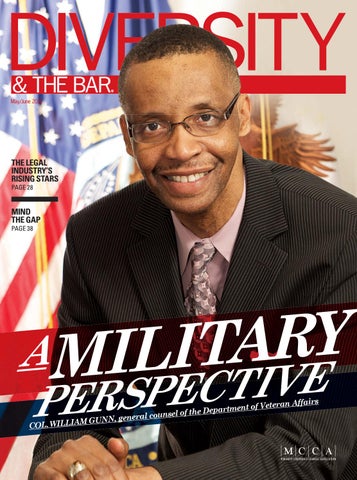
® May/June 2012
THE LEGAL INDUSTRY’S RISING STARS PAGE 28
MIND THE GAP PAGE 38
Y R A AMILIT E V I T C E P S R PE
ran Affairs te e V f o t n e epartm unsel of the D o c l a r e n e g , M GUNN COL. WILLIA
E
R
E
SIT
R S I T Y
E X C E L L E N C E | E D U C AT I O N | E Q U I T Y
EC
DIV
D I V
B KLIST
SH
Y
CH
COL. WILLIAM GUNN OUTSIDE THE DEPARTMENT OF VETERANS AFFAIRS IN WASHINGTON, D.C.
May/June 2012
FEATURES
18 A Military Perspective Lack of diversity and inclusion in the military is a national security risk. Unlike corporate legal departments and law firms, the military cannot hire laterally. All of its legal minds are promoted internally. The military’s unique perspective offers insights that can be applied to the civilian practice of law. BY JONATHAN GRONER
28 The Next Generation
p.18
The future of the legal workforce is here. The next generation of legal minds has arrived and is ready to boldly lead the legal industry in the coming years. The profiled attorneys represent America’s leading companies and firms. From Google to Krispy Kreme, these lawyers are the stars of the next generation.
p.28
BY NIKI MITCHELL
38 Mind the Gap COLUMNS
DEPARTMENTS
8 Notes from the President & CEO
42 Association Focus
10 Perseverance in Profile
BY MICHELLE NEALY
Highlighting the contributions and talents of attorneys with disabilities.
44 Diversity News
Kareem Dale
The Inclusiveness Manual
BY TOM CALARCO
BY JOSHUA SHIELDS
12 Lawyer’s Lantern
48 Movers & Shakers
Offering illuminating professional guidance for your career. BY LORI L . GARRETT
14 Spotlighting
Ms. JD
50 The Scale MCCA Weighs the News BY JOSHUA SHIELDS
Dru Ramey BY PATRICK FOLLIARD
2011 STRATEGIC DIVERSITY SPONSORS
For the first time in our nation’s history there are four generations working side by side. Each generation takes a different approach to its workload, and conflicts can easily arise from misunderstandings. Yet age is just one factor when attempting to dissect the disconnect. Our dependence on technology, and the way we use it, is central to understanding the generational differences in communication. BY CHANA GARCIA
p.38
Join Us!
13th
Annual
13th Annual Creating Pathways to Diversity® Conference Marriott Marquis Hotel | New York, NY
! 12 2 1 0 2 in 20 d e s v y o r a p New & Im om/pathw
a.c c c m . w Go to ww
Monday, September 10, 2012 See the website for conference agenda and confirmed speakers! ®
Sponsors as of 5/1/2012
REGISTER ONLINE www.mcca.com/pathways2012
MCCA completely reimagined the tracks for its 13th Annual Creating Pathways to Diversity® Conference. The new tracks are Career Development Tools for Diverse Attorneys, Investing in Diverse Talent, Creating Organizational Change, and Diversity & the Profession. Each session will provide clear strategies and tools you can imediately implement in both your career and workplace. Join us at the Creating Pathways to Diversity Conference – a diversity conference redesigned just for you.
13th
Annual
Advisory Board
Conference Agenda
Michael P. Allen Senior Attorney Environment, Safety, & Compliance Microsoft Corporation
MONDAY, SEPTEMBER 10, 2012 7:30 - 9:00 AM
BREAKFAST & REGISTRATION
9:00 AM -10:30 AM
OPENING PLENARY SESSION
10:30 - 11:00 AM
11:00 AM - 12:30 PM
12:30 - 2:30 PM
BREAK Career Development Tools for Diverse Attorneys
101.
4:00 - 4:30 PM
6:00 - 7:30 PM
Diversity & the Profession
201.
301.
401.
Walk A Mile in Her Shoes: Working Mothers & Career Advancement
Measuring Your Organization’s Inclusiveness Efforts
Diversity in the Courtroom
The Explicit Impact of Implicit Bias: Understanding Your Implicit Biases & How You Affect Others
202.
Growing a Crop of Inclusive Leaders through Development of Core Competencies
302.
Implementing an LGBT Employee Resource Group that Drives Organizational Change
402.
Demographics in Corporate Legal Departments
203.
Creating Diversity Internship Programs in Your Corporate Legal Department
303.
Using Diversity as a Strategy for Increased Law Firm Profitability
403.
Success Stories from Corporate America’s Partnership with Minority- & Women-Owned Law Firms
Joan M. Haratani Partner Morgan, Lewis & Bockius LLP Rob Jones, Jr. Corporate Attorney American Airlines, Inc.
NETWORKING RECEPTION
REGISTRATION CONFIRMATION
Registration is NOT confirmed until payment has been received by MCCA. Electronic confirmation of your registration will be sent within ten business days of receipt of payment or upon completion of payment process if registering online. Full registration includes access to conference sessions, electronic course materials, and scheduled meals. Program sessions are subject to limited attendance due to facility capacity constraints, so please pre-register for your desired courses. MCCA is not responsible for any expenses associated with travel, lodging, or other costs incurred by the registrant, including any cost incurred due to cancellation of the conference. Audio or video recording or transcription of any portion of the seminar is prohibited unless express consent is granted by MCCA. MCCA is holding a block of rooms at the Marriott Marquis Hotel at the rate of $369/night (single/double). For reservations, call 800-843-4898 and indicate you are attending MCCA’s 2012 Creating Pathways to Diversity® Conference to receive the group rate. You can also reserve a room online by visiting www.mcca.com/ pathways2012 and clicking on the Marriott link in the right column.
Nimesh M. Patel Executive Director - Diversity & Inclusion, Office of the Chief Human Capital Officer U.S. Department of Homeland Security Peter M. Reyes Senior Intellectual Property Lawyer Cargill, Incorporated Ryan Smith Partner Zuber & Taillieu LLP
Conference Details
HOUSING
Janice P. Brown Founder & Senior Partner Brown Law Group
Paul Marchegiani Senior Counsel, Legal Affairs NBCUniversal Television Group
BREAK Judgment, Common Sense & Trusting Your Gut: A Tool Box for Developing Business Acumen
Andrea V. Arias Federal Government Employee
Deborah Epstein Henry Founder & President Law & Reorder, A Division of Flex-Time Lawyers LLC
LUNCH & PLENARY
103.
4:30 - 6:00 PM
Investing in Diverse Talent
Creating Organizational Change
Soft Skills & Your Career Advancement
102.
2:30 - 4:00 PM
Richard Amador Partner Sanchez & Amador LLP
SUBSTITUTIONS AND CANCELLATIONS
All cancellations must be received in writing; telephone cancellations will not be accepted. Cancellations received in writing by August 17, 2012, will be fully refunded minus a $50.00 administrative fee. Individuals canceling in writing after August 17 but prior to September 3 will receive a full credit towards attendance at MCCA’s 14th Annual Creating Pathways to Diversity Conference (only monies paid for the 13th Annual Creating Pathways to Diversity Conference will be credited; after applying credit, any balance due is the responsibility of the registrant). If written confirmation of cancellation is not received by September 3, no refunds or credits of any kind will be issued. Credits will be processed after the meeting. Substitutions are always welcome; please submit a written request along with a completed registration form for the new individual in order to transfer the registration. Cancellations and requests for substitutions should be submitted to education@mcca.com.
DISCOUNTED AIRFARE
Travel discounts are valid September 8-13, 2012 to New York, NY (EWR, HPN, JFK, LGA).To make a discount reservation, please call American Airlines Meeting Services Desk at 800-433-1790 or go to www.AA.com and use promotion code5892BS.
Join us for MCCA’s Diversity Honors Gala! September 11, 2012 Contact Jennifer Chen at 202-739-5902 or visit www.mcca.com/gala
Joanne Suh Senior Attorney Intel Corporation Walter L. Sutton Associate General Counsel Walmart Stores, Inc. Adonica-Jo R. Wada Partner Simon Gluck & Kane LLP Peter Wilson Director of Diversity & Inclusion Proskauer Rose LLP Linda Wong Partner & CEO Wong Fleming, P.C. Justin A. Xenitelis General Counsel Thor Equities LLC
See the website for confirmed speakers!
Session Descriptions Career Development Tools for Diverse Attorneys Track 101. Soft Skills & Your Career Advancement
301. Measuring Your Organization’s Inclusiveness Efforts
102. The Explicit Impact of Implicit Bias: Understanding Your Implicit Biases & How You Affect Others
302. Implementing an LGBT Employee Resource Group that Drives Organizational Change
Are you trusted? How strong are the relationships in your organization with those above and below you? Do you listen actively and effectively? Can you adroitly manage conflict? This in-depth panel will address the “soft skills” you need to you advance your career. You will leave this panel learning how to develop self-awareness, make the most of your professional relationships, and enhance your communication techniques.
Much has been written about implicit and unconscious bias, but what do those terms actually mean? How does bias impact our lives and work? This presentation will address how implicit biases affect the way we learn, work, and lead. Learn the steps to overcome bias and unleash the potential of every member of your organization.
103. Judgment, Common Sense & Trusting Your Gut: A Tool Box for Developing Business Acumen
6
Creating Organizational Change Track
How adept are you at dealing with situations in ways that lead to positive outcomes? When should you trust your gut? Good judgment is essential to good lawyering, but can judgment be improved? This panel of experienced professionals will teach you techniques to improve business acumen and advance your client’s objectives.
Investing in Diverse Talent Track 201. Walk A Mile In Her Shoes: Working Mothers & Career Advancement
How do working mothers “balance” both their careers and family obligations? This panel discussion will spotlight the special challenges working mothers face while advancing their career. You will learn key recommendations for supervisors and organizational leaders on how to support team members juggling child-rearing duties.
202. Growing a Crop of Inclusive Leaders through Development of Core Competencies
Many corporations and law firms that are focused on diversity have sought to reduce the role of bias in performance evaluations. Organizations have increasingly developed core competency models to achieve this aim. This panel will discuss how to develop a strong core competency framework that also fosters a diverse and inclusive workplace.
203. Creating Diversity Internship Programs in Your Corporate Legal Department
Is your legal department looking to impact the pipeline of diverse lawyers entering the profession, but unable to hire directly from law schools? Are you with a law firm looking to engage your clients on pipeline issues? This how-to discussion will teach legal departments the ins and outs of creating an internship program for diverse law students. Law firm leaders will learn how firms can partner with corporate legal departments to support these programs. Hear from experienced panelists who have created successful internship programs.
DIVERSITY & THE BAR®
MAY/JUNE 2012
Are you engaged in systemic changes in your organization with the intent to lead to greater diversity and inclusion? How do you know if your organization is more inclusive? How do you develop metrics with respect to inclusiveness, as opposed to traditional diversity metrics? Attend this workshop and learn how to assess and measure your organization’s success at creating an inclusive environment.
This workshop will provide participants with tools and strategies to successfully implement an employee resource group that enhances the experience of your LGBT employees. Learn how resource groups differ from affinity groups. Topics to be covered include: what are the right employee policies and benefits, the value of financial sponsorship of external organizations, and the importance of community outreach.
303. Using Diversity as a Strategy for Increased Law Firm Profitability
A panel of law department and law firm leaders will discuss how diversity and inclusion can be used as a strategy to increase law firm profitability. The panel will discuss systems for integrating diverse lawyers into business development teams; promoting diverse lawyers’ engagement with their own communities; rewards to encourage lasting cultural change; and measuring and communicating the impact of diversity initiatives on bottom line results.
Diversity & the Profession Track 401. Diversity in the Courtroom
This program will explore diversity in the courtroom from three different perspectives: judges, in-house counsel, and outside counsel. The panel will discuss the role that diversity plays in a trial setting; including how concerns about diversity impact a jury; issues companies should remember when selecting a legal team to represent them in court; and diversity related issues that litigators encounter in the courtroom.
402. Demographics in Corporate Legal Departments
MCCA released its groundbreaking research report, A Comprehensive Examination of Diversity Demographics, Initiatives, and Policies in Corporate Legal Departments, which studies the diversity demographics, initiatives, and standards that exist in corporate legal departments. This panel discussion will focus on where women and minorities stand in corporate legal departments, and how corporations are tracking retention and promotion. This discussion will also provide excellent benchmarking opportunities for corporate legal departments looking to advance diversity and inclusion in their companies.
403. Success Stories from Corporate America’s Partnership with Minority- & Women-Owned Law Firms
Are you aware of the significant number of successful relationships that exist between corporate America and minority- and women-owned law firms? Are you familiar with the programs and resources that exist to increase the number of minority- and womenowned firms that represent companies in the Fortune 1000? This discussion will address the current state of diversity in the representation of corporate America and how to obtain a slice of the Fortune 1000 legal spend pie. MCCA.COM
Monday, September 10, 2012
13th
Annual
REGISTRATION FORM CONTACT INFORMATION
13th Annual Creating Pathways to Diversity® Conference | Marriott Marquis Hotel | New York, NY NAME TITLE ORGANIZATION ADDRESS CITY
STATE
PHONE
ZIP CODE
FAX
REGISTRATION ITEMS
Please indicate your registration type*:
$350 Early Bird (Deadline: August 6, 2012) $350 MCCA** and ACC members/FANs/Pathways Sponsor Rate $350 Group Rate (Rate is per person; 3+ from the same organization) $450 General Registration (After August 6, 2012)
ONLINE www.mcca.com
Add a ticket to attend MCCA’s Diversity Honors Gala
MAIL form and check to: Minority Corporate Counsel Association 1111 Pennsylvania Avenue NW Washington, DC 20004
at Alice Tully Hall, Lincoln Center on Tuesday, September 11, 2012
3 WAYS TO REGISTER (credit card only)
FAX form to (202) 739-5999
$625 MCCA Diversity Honors Gala, Non In-House Counsel $475 MCCA Diversity Honors Gala, In-House Counsel Ticket $450 MCCA Diversity Honors Gala, Member/FAN Ticket $375 VIP Reception Only $ Total Amount
PAYMENT METHOD
Note: Registration is NOT CONFIRMED until payment has been received. QUESTIONS? SPECIAL REQUESTS? CHECK (Enclosed) CREDIT CARD NUMBER
VISA
AMERICAN EXPRESS
EMAIL education@mcca.com
MASTERCARD EXP. DATE
PRINT CARDHOLDER’S NAME CARDHOLDER’S SIGNATURE BILLING ADDRESS
Check here if billing address is the same as listed in contact information
*By submitting this form, you agree to MCCA’s cancellation policy and grant MCCA the right to photograph, film, and use your likeness and voice in MCCA related publicity and advertising. MCCA is a not-for-profit organization classified under section 501(c)(3) of the Internal Revenue Service Code. MCCA’s tax identification number is 13-3920905. ** MCCA corporate members receive up to 3 complimentary registrations to attend the Creating Pathways to Diversity® Conference. Contact a staff member at education@mcca.com for details.
Notes From the President & CEO
FISHER V. UNIVERSITY OF TEXAS – A SEMINAL MOMENT Much has been made of the various high-profile matters pending before the nation’s highest court. One case in particular will likely have far-reaching implications on diversity in higher education and beyond.
8
Fisher v. University of Texas at Austin is a case challenging the admissions policy at Texas’ flagship university. In Fisher, two white female plaintiffs denied undergraduate admission to UT allege that UT considers race in a constitutionally impermissible manner. However, the Austin Division of the United States District Court for the Western District of Texas and the Fifth Circuit Court of Appeals rejected this claim. The District Court, in particular, held that UT’s use of race was permissible because an applicant’s race “is not considered individually or given a numerical value; instead . . . [it is used] to provide a better understanding of a student as a person.” UT’s policy is modeled on the University of Michigan’s admission policy that was deemed constitutional in Grutter v. Bollinger. In the 2003 Grutter decision, the U.S. Supreme Court held that it was acceptable for University of Michigan’s School of Law to engage “in a highly holistic review . . . [that gives] serious consideration
to all the ways an applicant might contribute to a diverse education environment.” More importantly, the Supreme Court expressly linked diversity to success. Justice Sandra Day O’Connor wrote that the benefits of diversity “are not theoretical but real, as major American businesses have made clear that the skills needed in today’s increasingly global marketplace can only be developed through exposure to widely diverse people, cultures, ideas, and viewpoints.” MCCA’s stakeholders set the standard by which excellence in the profession is measured. You realize that homogeneity imperils success and that access to the deepest possible talent pool is essential. Fisher represents a game-changing moment for educational diversity and the lawyer pipeline. We hope that Justice O’Connor’s well-reasoned support for the business case for diversity will hold sway. MCCA_law
www.facebook.com/mcca.law
Publications Staff President & CEO Joseph K. West Founder and Publisher Emeritus Lloyd M. Johnson Jr. Editor-in-Chief Joshua H. Shields
DIVERSITY & THE BAR®
MAY/JUNE 2012
Publishing Consultants Bill Cox Toni Coleman Advertising Don Cooksey Design/Art Direction QuadCreative
MCCA® Staff Jennifer Chen Mahzarine Chinoy David Chu Donna Crook Brandon M. Fitzgerald Lori L. Garrett Jessica Martinez Andrea Pimm Connie Swindell-Harding
Contributing Writers Tom Calarco Patrick Folliard Chana Garcia Lori L. Garrett Jonathan Groner Nicki Mitchell Michelle J. Nealy Nicki Mitchell Joshua H. Shields MCCA.COM
MCCA® Law Department Members The Minority Corporate Counsel Association (MCCA) acknowledges the support of the following law departments whose financial contributions have helped to advance the goal of furthering diversity in the legal profession.
MCCA® Board Of Directors Michelle Banks Executive Vice President, General Counsel, Corporate Secretary & Chief Compliance Officer, Gap, Inc.
Clarissa Cerda Senior Vice President, General Counsel & Secretary LifeLock, Inc.
A. B. Cruz III Chief Legal Officer & Corporate Secretary Scripps Networks Interactive, Inc.
Anthony K. Greene Director, Jamison Insurance Group
Gary F. Kennedy Senior Vice President, General Counsel & Chief Compliance Officer, American Airlines, Inc.
Don H. Liu Senior Vice President, General Counsel, & Secretary Xerox Corporation
Hinton J. Lucas Vice President & Assistant General Counsel DuPont Company
Robbie E. B. Narcisse Vice President-Global Ethics & Business Practices Pitney Bowes Inc.
Samuel M. Reeves Senior Vice President, General Counsel Walmart U.S. Legal
Thomas L. Sager Senior Vice President & General Counsel DuPont Company
Robin H. Sangston
3M Company AT&T Accenture LLP AdvoServ AECOM Allstate Insurance Altria Group, Inc. American Airlines, Inc. American Express Company American Lawyer Media Aon Corporation Areas USA, Inc. AstraZeneca Pharmaceuticals Bank of America Behr America Inc. Benistar Admin Services, Inc. Boehringer Ingelheim Corporation Booz Allen Hamilton BP America Inc. Bristol-Myers Squibb Company Capital One Financial Corporation Caraustar Industries, Inc. Cargill Inc. Catalent Pharma Solutions CBIC Construction & Development, LLC Chevron Corporation CIGNA Corporation CITGO Corporation Colgate-Palmolive Company Compass Group, The Americas Computer Science Corporation ConAgra Foods, Inc. ConocoPhillips Consolidated Edison Co. of N.Y. Constellation Energy Cox Communications Credit Suisse First Boston LLC Deere & Company Del Monte Foods Corporation
Dell Inc. DHL America Diageo North America Inc. Dignity Health Duke Energy DuPont DynCorp International Eaton Corporation Eli Lilly and Company Entergy Corporation Estée Lauder Companies Inc. Exelon Business Services Company Fannie Mae Federal Home Loan Bank of San Francisco Flagstar Bank Freddie Mac Gap Inc. General Electric Company General Mills Inc. GlaxoSmithKline Graduate Management Admission Council Hewlett-Packard Company HJ Heinz Company H.J. Russell & Company Halliburton Harley-Davidson Inc. Honeywell International IBM Corporation Ingersoll-Rand PLC Intel Corporation International Paper Company ITT Corporation JC Penney Company, Inc. JetBlue Airways Corporation Johnson & Johnson JPMorgan Chase Bank NA JM Family Enterprises, Inc. Kaiser Foundation Health Plan, Inc. KeyCorp Kraft Foods Law School Admission Council (LSAC) Leo Burnett Company
LexisNexis Liberty Mutual Insurance Company Lifelock, Inc. Lighthouse Document Technologies Liquidity Services, Inc. Macy’s, Inc. Marriott International, Inc. MassMutual Financial Group Mattel, Inc. McDonald’s Corporation Merck & Co., Inc. Microsoft Corporation MillerCoors Monsanto Company Morgan Stanley National Grid Navistar, Inc. Neighborhood Defender Service Newegg Inc. New York Life Insurance Company Nike, Inc. Nsoro, LLC Nuclear Electric Insurance Limited Office Depot Pacific Gas and Electric Company Pepco Holdings, Inc. PepsiCo, Inc. Pfizer Inc. Pitney Bowes, Inc. PPG Industries, Inc. Porzio Pharmaceutical Services, LLC PRAXAIR, INC. PreCash Premier Media, Inc. Prudential Financial Quest Diagnostics Incorporated Qwest Communications Reckitt Benckiser, Inc. Reed Elsevier, Inc. Rockwell Collins Rolls Royce North America Inc.
Sara Lee Corporation S.C. Johnson & Son, Inc. Sears, Roebuck and Co. Sempra Energy Shell Oil Company Sodexo Sony Electronics, Inc. Southeastern Freight Lines, Inc. Southern California Edison Company Science Applications International Corporation (SAIC) Staples, Inc. Starbucks Coffee Company Starwood Hotels & Resorts Worldwide, Inc. Spanish Broadcasting System Inc. Synopsys, Inc. Target Corporation Tessera North America, Inc. The Church Pension Fund The Clorox Company The Coca-Cola Company The Dow Chemical Company The Juilliard School The Vanguard Group, Inc. The Walt Disney Company The Williams Companies, Inc. Tyson Foods Inc. UBS UnitedHealth Group United Parcel Service United Technologies Corporation U.S. Food Service, Inc. Verizon Communications Walmart Stores, Inc. WellPoint, Inc. Waste Management Wells Fargo & Company Xerox Corporation XO Holdings, Inc. Yazaki North America Inc. Zenith Insurance Company
Vice President, Chief Compliance Officer, Cox Communications, Inc.
MCCA® Law Firm Affiliates
Kenneth S. Siegel
MCCA® acknowledges the decision of the following law firms who have joined with MCCA to advance the goal of furthering diversity in the legal profession.
Chief Administrative Officer & General Counsel Starwood Hotels & Resorts Worldwide, Inc.
Mary E. Snapp Corporate Vice President & Deputy General Counsel Legal & Corporate Affairs, Microsoft Corporation
Lawrence P. Tu Senior Vice President, General Counsel & Secretary Dell, Inc.
Simone Wu Senior Vice President, General Counsel, Corporate Secretary & Chief Compliance Officer Choice Hotels International, Inc. Advertising For advertising inquiries, contact Don Cooksey, Montrose Media Sales, at donald.cooksey@verizon.net. MCCA® Membership Please visit our web site at www.mcca.com for membership and other information. General Information and Address Changes Send your questions, complaints, and compliments to MCCA®, Editor, Diversity & the Bar®, 1111 Pennsylvania Avenue, NW, Washington, DC 20004. Address changes should be sent to MCCA’s Director of Membership and Development at 1111 Pennsylvania Avenue, NW, Washington, DC 20004. Permissions and Reprints Reproduction of Diversity & the Bar in whole or in part without permission is prohibited. The Copyright Act of 1976 prohibits the reproduction by photocopy machine or any other means of any portion of this issue, except with the permission of MCCA. To obtain permission, contact: Joshua H. Shields, Editor-in-Chief, 1111 Pennsylvania Avenue, NW, Washington, DC 20004.
MCCA.COM
Bressler, Amery & Ross PC Bricker & Eckler LLP Buchanan Ingersoll & Rooney PC Butler, Snow, O’Mara, Stevens & Cannada, PLLC Cavich, Familo & Durkin Co., LPA Clifford Chance US LLP Cozen O’Connor Crumbie Law Group, LLC Davis & Gilbert LLP DeMahy Labrador & Drake, PA Dickstein Shapiro LLP Duane Morris LLP Epstein, Becker & Green, PC Finnegan, Henderson, Farabow, Garrett & Dunner, LLP
Fish & Richardson P.C. Fitzpatrick, Cella, Harper & Scinto Frost Brown Todd LLC Goldberg Segalla, LLP Gonzalez Saggio & Harlan LLP Hamilton Miller & Birthisel LLP Helms & Greene LLC Hinkley Allen & Snyder LLP Ice Miller LLP Igbanugo Partners International Law Firm Kaufman Dolowich Voluck & Gonzo LLP Kenyon & Kenyon LLP King Branson LLC Kirkland & Ellis LLP Kumar, Prabhu, Patel &
Copyright Copyright® 2012 by the Minority Corporate Counsel Association. Diversity & the Bar is published six times a year and is distributed to supporters and subscribers, 1111 Pennsylvania Avenue, NW, Washington, DC 20004. The information contained in this publication has been provided to the Minority Corporate Counsel Association (MCCA®) by a variety of independent sources. While MCCA makes every effort to present accurate and reliable information, MCCA does not endorse, approve, or certify such information, nor does MCCA guarantee the accuracy, completeness, efficacy, or chronological sequence of any such information. Use of such information on the readers’ part is entirely voluntary and reliance upon it should be undertaken only upon independent review and due diligence. References herein to any commercial product, process, or service by trade name, trademark, service mark, manufacturer, or otherwise shall not constitute or imply endorsement, preference, recommendation, or the favor of MCCA. MCCA (including its employees and agents) assumes no responsibility for consequences resulting from the use of the information herein, or in any
Banerjee Lathrop & Gage LLP Littler Mendelson P.C. Loeb & Loeb LLP Maynard Cooper & Gale PC McGuireWoods LLP Miles & Stockbridge P.C. Montgomery, Barnett, Brown, Read, Hammond & Mintz LLP Morgan, Lewis & Bockius LLP Ogletree Deakins Nash Smoak & Stewart P.C. Pepper Hamilton, LLP Peter Law Group Phelps Dunbar LLP Porzio, Bromberg & Newman, PC Quarles & Brady LLP
Rivero Mestre, LLP Rooney Rippie & Ratnaswamy, LLP Sanchez & Amador, LLP Saul Ewing LLP Snell & Wilmer LLP Steptoe & Johnson PC Steptoe & Johnson PLLC Stevens & Lee Sughrue Mion PLLC Sutherland Asbill & Brennan LLP The Goldstein Environmental Law Firm P.A. Thompson Hine LLP Waas Campbell Rivera Johnson & Velasquez LLP Winston & Strawn LLP Zuber & Taillieu LLP
respect for the content of such information, including (but not limited to) errors or omissions, the accuracy or reasonableness of factual or other data, including statistical or scientific assumptions, studies or conclusions, the defamatory nature of statements, ownership of copyright or other intellectual property rights, and the violation of property, privacy, or personal rights of others. MCCA is not responsible for, and expressly disclaims and denies liability for, damages of any kind arising out of use, reference to, or reliance upon such information. No guarantees or warranties, including (but not limited to) any express or implied warranties of merchantability or fitness for a particular use or purpose, are made by MCCA with respect to such information. Copyright in this publication, including all articles and editorial information contained herein, is exclusively owned by MCCA and MCCA reserves all rights to such information. MCCA is a tax-exempt corporation organized in accordance with section 501(c)(3) of the Internal Revenue Code. Its tax ID number is 13-3920905.
MAY/JUNE 2012
DIVERSITY & THE BAR®
Perseverance in Profile
KAREEM A. DALE, SPECIAL ASSISTANT TO THE PRESIDENT ON DISABILITY POLICY
K
10
areem Dale casts an imposing figure on the podium. Well over six feet tall, with broad shoulders like a linebacker, he exudes confidence and commands attention despite his soft-spoken demeanor. Legally blind, Dale walks slowly with a cane, the result of a genetic condition, retinitis pigmentosa, which leads to total blindness. Yet the 38-year-old attorney’s life is anything but dark. The special assistant to the president on disability policy, he rolls with the punches and makes no excuses. “I also have two other eye diseases,” he says. “All my diseases are incurable, and they worsen as I get older. I only have a very small percentage of my sight remaining. I deal with my disability like millions of persons with disabilities—I make no excuses, don’t want sympathy or empathy from anyone, never feel sorry for myself, expect excellence from myself, and continue to pursue my dreams.”
DIVERSITY & THE BAR®
MAY/JUNE 2012
WHITE HOUSE PHOTO OFFICE
BY TOM CALARCO
Dale, who was raised in Chicago, comes from a family of high achievers. Both his mother and his brother are attorneys, but Dale says they never influenced his decision to go into law. Rather, he says, their concern was that he pursue a career that made him happy, and that he work hard to become successful in his chosen field. For a time, he thought of acting. “I got involved with the Black Ensemble Theater of Chicago because my father was a supporter of the theater, and the founder of the theater is a lifelong family friend,” he says. “I consider myself a good actor and it was my first love.” When asked if he also is a gifted singer like Stevie Wonder, as suggested during one of his speaking engagements, he laughs. “That is funny,” he says. “I am definitely not an accomplished singer—in fact, I am virtually tone-deaf.” While in his junior year at the University of Illinois Urbana-Champaign, where he earned a degree in advertising, he decided to give up his desire to become a professional actor. “Reality struck,” he says, and he decided to go to law school. He took a leadership role at the University of Illinois College of Law and became president of the Black Law Students Association. It was there that he reached out to then state Senator Barack Obama and asked him to speak at MCCA.COM
the law school. It was fortuitous that he agreed; Obama talked about the same things that have always motivated Dale. “[He] talked about many of the same things he talks about today— making sure everyone has a fair shot to achieve the American dream, everyone should play by the same set of rules, and people should give back to their communities.”
and help others.” For his contributions, Winston & Strawn awarded him their Pro Bono Commitment to Legal Service Award in 2000. He also was active in community service through the Black Ensemble Theater, serving as president of its board of directors. In addition to providing entertainment, the theater educates the public concerning
I deal with my disability like millions of persons with disabilities– I make no excuses. Dale never imagined what the future held for Obama, or for himself. “I certainly had no idea he would ever become president,” he says. “I first officially worked for him as the national disability director on the Obama for America campaign in June 2008. I had volunteered on the campaign on his Arts and Disability Policy Committees since 2007.” After he graduated cum laude from law school in 1999, Dale went to work for the Chicago law firm Winston & Strawn, where he represented individuals and their families in the areas of personal injury, wrongful death, product liability, catastrophic injuries, and medical negligence. During this time, he often did pro bono work. “I believe in the African proverb—to whom much is given, much is expected,” he says. “I have been very fortunate in my life to have a great family, great friends, great support structure, and many other benefits so it’s my obligation to give back MCCA.COM
the history of African American entertainers such as Jackie Wilson, Marvin Gay, and Aretha Franklin. It also teaches performing arts in the Chicago public schools. In 2007, Dale founded his own law firm in Chicago, the Dale Law Group, but he suspended operations when he got the call from President Obama. In Dale, Obama found an individual with similar goals and values in helping others reach their full potential, and when he became president, he called on Dale to become the first-ever special assistant to the president for disability policy. “Working for the president is an extraordinary honor,” Dale says. “The real important factor is working for a president who cares and wants to make a difference for the American people. That’s what we are trying to do every day. Since I met President Obama in 1998, he has had the same focus of helping people reach for the American dream and providing full
opportunity for all Americans.” And some of Obama’s personal characteristics have obviously rubbed off on Dale, like his public speaking style. Dale’s oratorical flourishes are similar to the president’s measured delivery. For a short period at the start of the Obama administration, Dale wore two hats. In addition to his position dealing with disability policy, he also coordinated outreach to the arts community for the Office of Public Engagement. The latter responsibility lasted only a few months. “I worked both in the Office of Public Engagement and Domestic Policy Council,” he says. “I coordinate the administration’s work on disability policy and outreach to ensure people with disabilities are on a level playing field with all Americans. The importance is so that we are doing everything we can so that people with disabilities have equal access to employment, education, transportation, technology, emergency preparedness, health care, housing, and so many more things.” Dale is a busy man and his work extends to a variety of decisions and policies that the president is involved in. “[My work] covers many areas, such as executive orders, presidential memoranda, legislation related to disability issues, and any other policy initiatives that impact people with disabilities. Certainly the ADA is a major disability law along with many other laws,” he says. Regarding his career, Dale does not look too far into the future. “My goals right now are focused on my current role,” he says, “and continuing to work on policies to improve the lives of the millions of Americans with disabilities.” D&B Tom Calarco is a freelance writer based in Altamonte Springs, Fla. MAY/JUNE 2012
DIVERSITY & THE BAR®
11
Lawyer’s Lantern
OVERCOMING THE OUTSIDER EXPERIENCE BY LORI L. GARRETT
12
She is a junior associate. She is the first in her family to have gone to law school. She was at the top of her class in school, but her school is in the third tier. She is 27 years old. Her parents are immigrants. She has a partner, but is unmarried. She is childless. She has strong opinions but is soft-spoken. She was born in a rural Midwestern town. She speaks two languages and is learning a third.
DIVERSITY & THE BAR®
MAY/JUNE 2012
I
magine this person being the newest hire in your organization. Is she different than the majority of your colleagues? What would you expect to be the quality of her experience in your organization? Will her ideas be accepted? Will her perspective be welcomed? Will she be included or will she feel like an outsider? The value of diversity in an organization can be described as the collective strength of experiences, skills, talents, perspectives, and cultures that each employee brings to the table. Diversity is how an organization brings a dynamic business environment to the clients or customers it serves. It is well documented that a more diverse organization is more creative and solves problems better. We at MCCA say that diversity is, in part, about counting the people who make up the organization. Inclusion, on the other hand, is about respecting and valuing the unique dimension each employee adds to the organization. An inclusive work environment allows all employees to be their creative and productive best. Helping people feel included is what allows organizations to sustain diversity. Inclusion is about making the diverse individuals in the organization count. Organizations that focus exclusively on diversity, without focusing on inclusion too, often experience high turnover MCCA.COM
of diverse candidates. Such organizations have chronic retention problems, which can be expensive, inefficient, and demoralizing for the organization and the dedicated individuals working within the organization to make it more diverse. It may leave organizations questioning the value of diversity recruitment and retention programs altogether. MCCA has been at the forefront of diversity and inclusion efforts in the legal profession for many years, and it continues to strive to bring valuable tools for advancing diversity and inclusion to its corporate members, the law firms participating in its Firm Affiliate Network (FAN), as well as to its larger network of supporters. This year, MCCA created the Academy for Leadership & Inclusion, a program that offers organizations what they need to ensure that people like the young lawyer described here have better experiences in legal organizations than in years past. This new program is designed to teach organizations how to focus on both diversity and inclusion, and how to stop the chronic turnover
that plagues so many organizations with well-intended diversity programs. The Academy for Leadership & Inclusion is an in-depth, interactive training program designed to show leaders of legal departments and law firms how to define, create, and sustain diverse and inclusive workplaces. The Academy training consists of a fourhour educational program facilitated by the Center for Legal Inclusiveness (CLI) and its executive director, Kathleen Nalty. CLI is dedicated to advancing diversity in the legal profession by actively educating and supporting private and public sector legal organizations in their own campaigns to create cultures of inclusion. CLI has worked diligently for a number of years developing the content of a very extensive program for helping organizations learn to be more inclusive. MCCA and CLI have a partnership to bring an abbreviated version of this program to a wider network. (For more information go to page 46.) Academy courses are being offered in 10 cities across the country: Atlanta, Chicago, Houston, Kansas City,
The Academy for Leadership & Inclusion is an in-depth, interactive training program designed to show leaders of legal departments and law firms how to define, create, and sustain diverse and inclusive workplaces. MCCA.COM
Los Angeles, Miami, Minneapolis, New York, Seattle, and Washington, D.C. This cutting-edge and intensive program is an exclusive benefit MCCA is offering at no charge to its members and to the law firms participating in FAN. You might be wondering what is actually covered in this training. Let me tell you. You will learn where we stand as a profession in terms of diversity and what the national research studies reveal about the reasons attrition rates are higher for women and attorneys of color. We will discuss hidden barriers in legal organizations that limit career paths and how unconscious bias negatively impacts efforts to be more inclusive. Attendees will engage in a discussion about the difference between traditional diversity efforts and inclusiveness, how to create a diversity and inclusion committee, and how to make structural, behavioral, and cultural changes to create a more inclusive workplace. Attendees will walk away with the key steps on how to make their organizations more inclusive, and attendees can implement these take-aways immediately. You will receive a binder full of valuable information that can be shared internally, including an excerpt of CLI’s Inclusiveness Manual, which is a 500+ page how-to guide for inclusiveness initiatives. This training is not to be missed. Earlier I posed the question, what will be the quality of the young lawyer’s experience that is described here in your organization? After this training, and the implementation of its principles, your organization will have a different answer. D&B To register for the Academy for Leadership & Inclusion please visit www.mcca.com/academy. You can also learn more about the Center for Legal Inclusiveness at www.centerforlegalinclusiveness.org, or by contacting Executive Director Kathleen Nalty at knalty@legalinclusiveness.org. MAY/JUNE 2012
DIVERSITY & THE BAR®
13
Spotlighting
F 14
A DIFFERENT DEAN Drucilla Stender Ramey BY PATRICK FOLLIARD
Heading up a law school entails more than ceremony and fundraising. As dean of Golden Gate University School of Law in San Francisco since 2009, Drucilla Stender Ramey regularly goes “mano a mano” with the university administration to ensure that her students get what is owed them. “Law schools are typically a university’s cash cow. Without our fair share of the budget,” she says, “it would be impossible to have a quality program.” DIVERSITY & THE BAR®
MAY/JUNE 2012
ighting for what’s fair is a theme that threads through Ramey’s dynamic and enduring career. And whether that means pushing to guarantee equal opportunities for women and minorities in the legal profession or providing legal counsel to underrepresented clients, she wouldn’t have it any other way. For 17 years (1985-2002), Ramey served as executive director and general counsel of the Bar Association of San Francisco (BASF). She describes her diversity efforts with the organization as among the most satisfying accomplishments of her career. “My theory was that you try almost anything you can think of to chip away at patterns of discrimination and economic inequality that have been centuries in the making. Fortunately, our board took, and still takes, a similarly committed position on the responsibilities of the organized bar to advance equality in the justice system. “In 1988,” says Ramey, “Dennis Archer, who at the time was a Michigan Supreme Court justice and the most powerful African American member of the American Bar Association (he would later be elected ABA president), asked me to launch the first statewide bar association minority counsel program to increase diversity in the profession. I was a little nervous—my corporate contacts weren’t too strong at the time—in fact, they included just one, Guy Rounsaville Jr., the longtime general counsel of Wells Fargo Bank, with whom I had recently had lunch.” Her first move was to seek assistance from Rounsaville. After some consideration, he concluded that he and his company would benefit by diversifying both its legal department and outside counsel, and shortly thereafter joined Ramey in co-founding the California Minority Counsel Program (CMCP). Known and respected in the region, Rounsaville swiftly persuaded many of his fellow GCs from some of California’s largest corporations to join in leading the new CMCP, paying the dues and pledging to increase racial and ethnic diversity in the lawyers they retained. “He also almost single-handedly brought dozens of major law firms into CMCP,” says Ramey, “by the simple expedient of impressing upon them, as a major client, his strong support for the program and his MCCA.COM
hope that they, too, would see their way clear to becoming active paying members of the program.” Since its inception, CMCP’s mission has been to promote diversity in the legal profession by providing attorneys of color with access and opportunity for business and professional development. “But the Bar Association of San Francisco,” Ramey says, “was also extremely active in attacking disturbing patterns of exclusion of women, people with disabilities, and the LGBT community in the legal profession. We took a position in favor of same-sex marriage in the 1980s, for example, long before other associations and other groups became active around this issue, prompting far more area lawyers to join BASF for the first time than the few who seized that moment to [often temporarily] quit.” CMCP cofounder Rounsaville, who is now director of diversity at Allen Matkins in San Francisco, says, “Working with Dru [Ramey] to establish the programs was easy. She created the vision/strategy and the rest of us, including myself, merely did what was necessary to implement it. During this time, I became aware of Dru’s commitment to working hard and long in order to achieve her
Ramey was never driven by money. Her goal was always to become a civil rights lawyer and make a difference, particularly in matters of race and gender. “Honestly, had I gone into corporate law, my family would have sat shiva,” she says. Her late parents were forward thinkers who deeply believed in, and virtually insisted upon, public service. Ramey’s mother— Dr. Estelle Ramey—was both a Georgetown Medical School professor specializing in endocrinology and an eminently quotable, nationally known feminist speaker. Her father, James T. Ramey, was one of the most powerful members of the old Atomic Energy Commission throughout some of the Cold War’s tensest years. And though her parents came from very different backgrounds—she the ambitious, blue-stocking daughter of illiterate and impoverished Jewish immigrants and he the scion of a well-off Southern Baptist family with Kentucky roots— they agreed that their daughter must be well educated and have a career. Ramey grew up in the suburbs of Chicago and Washington, D.C. After graduating magna cum laude from Harvard University, she entered Yale Law School in 1968. “It was a
Honestly, had I gone into corporate law, my family would have sat shiva. – DRU RAMEY vision. When she believes in something, she never gives up and won’t let others give up. Her tenaciousness has been of critical importance in the campaign to make the legal profession a place where fairness and opportunity are more than just words.” MCCA.COM
watershed year,” she says. “The confluence of the end of deferments for men from the draft for the Vietnam War and the maturing of the Civil Rights Movement resulted in substantially more women and minorities in my class than ever before. For many
students, black and white, law school provided their first personal experience of integration.” Looking back, she adds “When I was at Yale, I’m not sure I even knew who my dean was, and if I did, it was only to complain or fight for a ‘Women in the Law’ class. Things have changed a lot since then. One of the most pleasant surprises of my experience as dean has been the warm welcome that I’ve received from the students. It’s something I never expected. “Seeing the law students at GGU, especially the night students who come to class after having worked all day, I’m always reminded just how easy I’ve had it.” Nonetheless, ample advantages have never curbed Ramey’s passion for hard work. After graduating from law school, Ramey was set to start as a criminal litigator at the Public Defender’s Office in Washington, D.C., but the night before she was scheduled to go to work, Ramey’s best friend advised her to change course. “My parents were living in D.C., and because I had romanticized them, especially my mother, my friend suggested I make a clean break. I knew she was right, so I bolted to San Francisco. And though I didn’t really know anyone there and had only visited once, I knew it was the right place for me.” In the early ’70s few firms were hiring women. Fortunately for Ramey, she landed at the progressive Oakland-based firm of Treuhaft, Walker & Bernstein, where her law school classmate Hillary Rodham Clinton had recently held a summer job. It was just what Ramey was seeking—many of the firm’s cases were cutting edge. They represented the Black Panthers, Angela Davis, the Indians who had occupied Alcatraz, the Vietnam Veterans Against the War, and the leader of the People’s Park Movement. Ramey handled discrimination cases, but the bulk of her clients were low-income people from Oakland or nearby Emeryville MAY/JUNE 2012
DIVERSITY & THE BAR®
15
Spotlighting
16
who would otherwise not have been able to afford an attorney. From there, Ramey’s passion for civil rights led her to the Mexican American Legal Defense and Educational Fund. “I mostly worked on appeals of massive tri-ethnic school desegregation cases from Texas involving segregation of both Chicano and African American students. These were primarily appellate test cases, and while I found them fascinating, especially because we were establishing new law for Latinos under the Constitution and under modern as well as post-Civil War civil rights statutes, it was often lonely work, with very little client contact.” Following a brief stint handling civil rights cases with a small private firm, often co-counseling with now-U.S. Judge Thelton Henderson, and in search of new stimulation and a livable paycheck, Ramey went on to become a professor at GGU Law School, hired by then-Dean Judith McKelvey, one of the nation’s first two female law deans. “Back then (the late ’70s and early ’80s), like now, GGU Law School had a highly diverse, heavily female, and very gutsy student body. As a teacher, I spent time using topical, politically charged subjects to get the students’ attention. I’d insist students use ‘he or she’ rather than simply the generic male pronouns, when referring, say, to hypothetical parties in a case. There weren’t a lot of women professors around then. I think it was good for the students to be exposed to a strong woman with a solid background as a civil rights lawyer.” Today, she has concerns about the lack of diversity in the profession. “Large firms, whose record in advancing women and minorities to the higher reaches of their partnership has never been good, are moving away from lockstep advancement for associates, and relying on more subjective criteria and on early rainmaking success. As soon as subjectivity comes into the picture so do prejudices and DIVERSITY & THE BAR®
MAY/JUNE 2012
unconscious biases, and that doesn’t bode well for women and minorities. Neither does the expectation that newer associates be rainmakers from the get-go. Rainmaking has historically been a substantially closed system of white-male-to-white-male hand-offs of business, and though inroads have been made via programs like CMCP and otherwise, it hasn’t really changed much.”
More than her experience litigating or teaching, Ramey credits her background in associations (she was also executive director of the National Association of Women Judges from 2005 to 2009) with preparing her for her current position. “When I left the San Francisco Bar, there were 140 employees. As executive director I learned the ins-and-outs of dealing with people; how to delegate, how
“As soon as subjectivity comes into the picture so do prejudices and unconscious biases and that doesn’t bode well for women and minorities.” – DRU RAMEY One of the ways the GGU helps to prepare students for the workplace, says Ramey, is to give them, in addition to thorough analytic skills, the practical skills necessary to practice law from the day they graduate, or even before. “When I emerged from Yale Law School I didn’t know what a deposition was,” she says. “Contrary to popular belief, there’s never really been a lot of training in large firms, and what there is has disproportionately gone to white male associates with whom the largely white male partnership feels most comfortable, so we do a great job in ensuring that our very diverse graduates possess the skills they need to meaningfully represent clients from day one. It is also important for both for-profit lawyers and those seeking to enter public interest law to know something about the business of running a law firm or a nonprofit.”
not to sweat the small stuff; [how to manage] big budgets; and how to deal with an extremely active, deeply committed, and progressive board of directors. That kind of experience is invaluable for deans who often come to the job as professors with a parttime secretary.” Despite an abiding affection for GGU Law School faculty and students, Ramey plans to step down from the deanship at the end of July. After that she wants to focus her efforts exclusively on improving diversity in the profession, possibly heading a small family foundation. Most assuredly, says Ramey, she will continue to work and do her best to make a difference. D&B Patrick Folliard is a freelance writer based in Silver Spring, Md. MCCA.COM
creating a diverse
THAT’S WHAT WE DO, EVERY DAY.® At Special Counsel, diversity is an ongoing commitment. That’s one of the reasons why our clients rely upon our full range of legal staffing solutions. They know that we actively recruit the best and most diverse talent in the market. From contract staffing to direct hire, we’re connected to the people who can positively impact your bottom line. Call us today and find out how we can help you.
800.737.3436 specialcounsel.com
©2012 Special Counsel, Inc. All rights reserved.
17
Congratulations to our associate Tarsha Phillibert for being recognized as a
Rising Star
Congratulations to all of the 2012 Rising Star Honorees ChiCago | Los angeLes | new York | washington, DC 353 n. CLark st. ChiCago, iL 60654-3456
Jenner & BLoCk LLP MCCA.COM
Jenner.Com MAY/JUNE 2012
DIVERSITY & THE BAR®
P ARY
AMILIT
NER O R G N A H BY JONAT
COL. WILLIAM A. GUNN
IF THE JUDGE ADVOCATE GENERAL (JAG) CORPS OF ANY OF THE NATION’S LARGER MILITARY SERVICES WERE A LAW FIRM, IT WOULD BE AMONG THE LARGEST IN THE NATION.
E V I T C E P S PER
20
DIVERSITY & THE BAR®
MAY/JUNE 2012
MCCA.COM
AS OF 2010, THE U.S. ARMY JAG CORPS EMPLOYED 1,858 MILITARY ATTORNEYS, THE AIR FORCE 1,237, THE NAVY 857, AND THE MARINE CORPS 473. THE ARMY JAG CORPS REFERS TO ITSELF AS THE NATION’S OLDEST LAW FIRM, FOUNDED BY GENERAL GEORGE WASHINGTON ON JULY 29, 1775.
Today, the nation’s military lawyers, sometimes informally referred to as JAGs, practice in a broad array of legal areas beyond their well-known duties of prosecuting, defending, and presiding over courts-martial. Given the nation’s broad military commitments abroad and the JAGs role in advising military leaders on the rules of engagement in war, it’s clear that military lawyers play a key role in national security as well. The uniformed services record on diversity has not been stellar, though the branches have come a long way in achieving racial and gender diversity among their attorney staffs since recognizing they had a problem in the 1960s and 1970s. The racial conflict within the military during that time and perceptions that the military legal system was stacked against African American servicemen necessitated the drive toward racial diversity. Attempts to bring about gender diversity in the military legal system had to contend with the legal restrictions in those days on women service members’ assignments, as well as longstanding prejudice against women among military men. “Back in those days, there were racial incidents on Army bases at home and in Vietnam, and in the Navy on such ships as the Kitty Hawk,” says retired Air Force Col. William A. Gunn, who is now the general counsel of the Department of Veterans Affairs and who has studied the history of race relations in the uniformed services. Gunn retired from the military in 2005 after a distinguished career in which he supervised the legal defense of Guantanamo detainees and was widely lauded for ensuring that they received effective representation. In 1972, between 100 and 200 African American sailors on the USS Kitty Hawk, stationed off the coast of Vietnam, mutinied and assaulted several white sailors in what was widely described as a race riot. They were armed with chains, wrenches, bars, and similar weapons, and three white sailors were seriously injured. Among the rioters’ grievances was the allegation that white crewmen received lighter punishments than African Americans for the same
“THERE WAS A RECOGNITION BY THE MILITARY OF THE NEED FOR CHANGE. DIVERSITY BECAME A NATIONAL SECURITY ISSUE.” – COL. WILLIAM GUNN
MCCA.COM
MAY/JUNE 2012
DIVERSITY & THE BAR®
21
22
conduct—in other words, that the military justice system had racist elements. They also complained that African Americans were assigned to menial and degrading duties on the ship. Twenty-six African American sailors were charged with offenses against good order and discipline. Gunn also says that in cases of all sorts, African American defendants in military prosecutions often wanted to be represented by African American lawyers, but at that time in the 1970s, there were only six African American Army JAGs in the entire U.S. military presence in West Germany, then a major site for U.S. military bases in the Cold War and a presence that included hundreds of thousands of soldiers. “There was a recognition by the military of the need for change,” Gunn says. “Diversity became a national security issue. Without diversity, we were experiencing racial unrest and riots, and we could not have good order and discipline, and without good order and discipline, you can’t have a military.” At the Army, the duty of recruiting more minority lawyers to that branch’s JAG Corps fell to now-retired U.S. Army Maj. Gen. Kenneth D. Gray. In 1972, there were only 16 African American attorneys and only eight female attorneys in the entire Army JAG Corps. Gray, who in 1993 became the first African American lawyer to reach the rank of general in the Army JAG Corps
REAR ADM. NANETTE M. DERENZI
DIVERSITY & THE BAR®
and held the second-highest-ranking position in the corps, was serving as a young lawyer assigned to the Pentagon in the early 1970s. He worked as a personnel management officer and helped launch the process of recruiting African American lawyers to the Army JAG Corps. The lawyers in the corps, like the JAGs of all the services, not only administer the military justice system but also provide guidance on government contracts, administrative law, environmental law, international law, and many other subjects, and help individual service members, retirees, and their families on a host of issues from wills to leases and personal finance. “I thought the programs that we established worked well,” says Gray, now vice president of student affairs at West Virginia University. “We entered into an agreement with the National Bar Association, a bar group devoted to the needs of African American lawyers, to help us recruit. We’d set up recruiting booths at their conferences to talk to lawyers and law students. As a result, a military law section was created.” Because of intense efforts to diversify the Army’s attorney staff, including initiatives by Gray and many others to reach out to African American law students over the decades, at the end of fiscal year 2010 approximately 123, or nearly 7 percent, of the 1,858 Army JAG Corps members were African American. In 2009, 21.5 percent of Army active duty soldiers were African American.
Rear Adm. Nanette M. “Nan” DeRenzi assumed duties as the Deputy Judge Advocate General of the Navy (DJAG) and Commander, Naval Legal Service Command (CNLSC) in August 2009. As the DJAG, she serves as the deputy Department of Defense representative for ocean policy affairs. As CNLSC, she leads the judge advocates, enlisted legalmen, and civilian employees of 17 commands that provide prosecution and defense services, legal services to individuals, and legal support to commands around the world. DeRenzi was born in Philadelphia, and raised in Pennsauken, N.J. She graduated magna cum laude from Villanova University in 1983. She was commissioned through the JAG Corps Student Program and, in 1986, graduated from Temple University School of Law. She later earned a Master of Laws degree (Environmental Law) from George Washington University School of Law. Before her appointment to flag rank, she served as the senior staff judge advocate for Commander, U.S. Southern Command; special
MAY/JUNE 2012
assistant for Legal and Legislative Matters to the Secretary of the Navy; legislative counsel for Environmental Programs in the Navy Office of Legislative Affairs; and executive assistant to the JAG. In command, she served as commanding officer, Naval Legal Service Office, North Central. Afloat, DeRenzi served as the Fleet Judge Advocate to Commander, U.S. 7th and 3rd Fleets, as well as staff judge advocate to Commander, Carrier Group 7. DeRenzi began her career as a litigator, first as a defense counsel and later as a trial counsel (prosecution) in Newport, R.I., followed by assignments in appellate defense and civil litigation in Washington, D.C. DeRenzi is admitted to practice before the courts of the State of New Jersey and the Commonwealth of Pennsylvania. She holds various decorations and awards, including the Defense Superior Service Medal, the Legion of Merit (four awards), the Meritorious Service Medal (four awards), and the Navy and Marine Corps Achievement Medal (two awards).
MCCA.COM
23
FROM D E T I B I H WERE PRO N E SHIPS M T O N W A , T 4 A 9 9 B 1 M UNTIL NAVY CO IGHT BE EXPOSED . .S U N O G SERVIN ANY UNIT THAT M AND WITH COMBAT. TO DIRECT MCCA.COM
MAY/JUNE 2012
DIVERSITY & THE BAR®
as DeRenzi with essential experience at sea had greater opportunity to rise through the ranks. Although DeRenzi was commissioned through the JAG Corps Student Program as a Temple University law student in the 1980s and has spent her entire legal career in the JAG Corps, she says she didn’t feel her career would be complete unless she had a chance to go to sea, to “do what the Navy does.” DeRenzi served for two years on the aircraft carrier John C. Stennis as part of a career path that led her to become the Navy’s Deputy Judge Advocate General and the highestranking woman in the history of all the service JAG Corps. Gunn, the VA counsel, notes that it can be more difficult to increase the number of African Americans or women in the JAG Corps than in a civilian law firm, since there’s no such thing as a mid-level lateral hire in the military.
24
There were also 57 Hispanics (3 percent), and 85 Asians and Native Americans (4.6 percent) in the corps in 2010. In 2009, minorities other than African Americans comprised 4.6 percent of the Army. Twenty-four percent of lawyers in that JAG Corps are women, which far surpasses the female percentage in the Army as a whole, which was 13.2 percent in 2009. Women make up a high percentage of the 857 attorneys in the Navy 31.5 percent for a Navy that is 17 percent female. The second-highest Navy military attorney, Rear Adm. Nanette M. DeRenzi, is a woman. The advancement of women in the Navy JAG Corps had been hampered by laws that until 1994 prohibited women from serving on U.S. Navy combatant ships and with any unit WITHOUT DIVERSITY, WE WERE EXPERIENCING that might be exposed to direct combat. After these RACIAL UNREST AND RIOTS, AND WE COULD NOT barriers were lifted in the HAVE GOOD ORDER AND DISCIPLINE, AND WITHOUT Clinton era, women such
GOOD ORDER AND DISCIPLINE, YOU CAN’T HAVE A MILITARY. – COL. WILLIAM GUNN
COL. LINDA STRITE MURNANE DIVERSITY & THE BAR®
Col. Linda Strite Murnane (U.S. Air Force, Retired) currently serves as the Chief, Court Management and Support Services, International Criminal Tribunal for the Former Yugoslavia (ICTY) in The Hague, Netherlands. In her present position, she leads teams involved in the daily operation of the courtrooms in which the trials of alleged war criminals are being tried under the mandate of the United Nations Security Council. She is also responsible for implementing components of the European Union-funded War Crimes Justice Project, providing training to court professionals and others in the Balkans, transcribing verbatim local language transcripts and providing translation of the ICTY’s Appeals Chamber Case Law Research Tool in Balkan languages. She served as the Executive Director for the Kentucky Commission on Human Rights
MAY/JUNE 2012
in the United States, a gubernatorial executive cabinet commission, from February 2005 until July 2007. Prior to that, she served for nearly 30 years on active duty with the United States Air Force. In her Air Force career, Col. Murnane served in a variety of positions, including 10 years as a chief circuit military judge, or military judge. She was the Chief Circuit Judge for Europe and the Eastern Judicial Circuit, Bolling AFB, Washington, D.C. She presided at the first criminal trials for the U.S. Air Force during Operations Iraqi and Enduring Freedom in the war zone, deploying five times in support of those operations between 2001 and 2003. Col. Murnane began her career as an Airman Basic, the lowest enlisted grade in the U.S. Air Force, and retired as a colonel in 2004. Her military decorations include the Legion of Merit, and the Meritorious Service Medal with bronze and silver oak leaf cluster.
MCCA.COM
COL. WILLIAM A. GUNN
25
MCCA.COM
MAY/JUNE 2012
DIVERSITY & THE BAR®
26
“In the military, you have “AS A LAWYER, YOU’RE ALREADY SOMEWHAT OF to grow your own talent,” AN OUTSIDER IN THE NAVY, WHETHER YOU ARE Gunn says. “It takes at least 20 years to grow a general. A MAN OR A WOMAN, AND YOU HAVE TO WORK There’s only one way to do so: HARD TO UNDERSTAND THE NAVY ITSELF AND Recruit them as an entry-level ITS CAPABILITIES, AND THE CAPABILITIES OF attorney and develop them. You can’t lateral-in a lieutenOUR ENEMIES.” ant colonel. You must nurture – REAR ADM. NANETTE M. DERENZI your own talent.” Gray says that in his 28-year military legal career, of a discussion I had with one of the most senior women which began in 1969, he does not remember any situation serving in the JAG Department during her career. I asked or incident that he could identify as based on racism for her assistance in something that I thought she should or discrimination. tackle, given her senior status among all women in the JAG “I saw myself as competing for the best job I could get Department. Her response was, ‘I don’t think of myself as a within the Army, and I saw my responsibility as that of woman. I am a JAG and an officer.’” putting myself in a position to be competitive. If I wasn’t Murnane says that she never forgot that she was a selected for a particular position, I would know that it woman in the military, with all its history of stereotyped wouldn’t have been because of my race,” he says. attitudes toward women and outright exclusion from Still, Gray is somewhat disappointed that other African some assignments. American attorneys have not yet achieved the military rank “I always thought of myself as a JAG, and an officer, and that he did, even though thousands have entered the ranks a woman,” Murnane says. “It seemed that in terms of being of JAGs over the years, usually right out of law school or a role model for someone who might want to be a general early in their careers. He does not know why there appears officer, I would have had to overlook the fact that I was a to have been a ceiling on African American JAG officers’ woman—which I was not willing or able to do.” accomplishments, other than the “extremely competitive” DeRenzi, the Navy JAG leader, knows that women startnature of the selection process for a very few high positions. ing their careers in the JAG Corps look up to her, and she “Being the only black flag officer in the history of the believes she has a duty to mentor them—but she extends Army JAG is a distinction that I would gladly lose,” Gray that duty to mentoring any junior officer, regardless of says. “I stood on the shoulders of many others before me. I gender, willing to work hard for the Navy and their clients. just came along at the right time. One would think that in “When I came up through the ranks as a young officer, that time, in 15 years, there would have been other African there was no one in the Navy whom I knew who looked Americans worthy of being promoted to general [in the like me,” DeRenzi says. “But that didn’t affect my ability JAG Corps].” to find a mentor—I had incredible leaders who believed in Retired Air Force Col. Linda Strite Murnane, who my abilities and helped me make the right decisions in my served four terms as a trial judge in the Air Force JAG career. I didn’t see any sexism. As a lawyer, you’re already Corps, says she felt the sting of sexism, especially early in somewhat of an outsider when it comes to integrating on an her career. operational staff, whether you are a man or a woman, and “There was both ‘subtle sexism’ and outright contempt you have to work hard to understand the Navy itself and its for women in the military during my time on active duty. capabilities, and the capabilities of our enemies, to advise on There were many opportunities that were not open to operational law matters. women during my time in the military,” says Murnane, “I don’t think of myself as a pioneer in the Navy JAG who retired in 2004. Corps,” she says. “There were women in the Navy before me “As for whether I served as a role model,” Murnane says, who blazed those trails. The path was already smoothed for “I think some would say that is so, and others would say me. The Navy gave me every opportunity to succeed. Merit that I was too vocal about the glass ceiling, the doors closed is what counts. They don’t care what you look like.” D&B to women, and other issues of principle. I say this because
DIVERSITY & THE BAR®
MAY/JUNE 2012
MCCA.COM
Will A. Gunn was sworn in as the General Counsel for the Department of Veterans Affairs on May 26, 2009. As the department’s top lawyer, Mr. Gunn oversees approximately 450 attorneys within the Office of the General Counsel, which provides proactive legal advice and representation to the department concerning all aspects of its program and management responsibilities. The General Counsel supervises over 700 employees in Washington, D.C., and in field locations across the United States. Mr. Gunn is a retired Air Force colonel, having served as a military lawyer in the Air Force Judge Advocate General Corps. In 1990, he was selected as a White House Fellow and served in the Executive Office of the President in the Office of Cabinet Affairs. In 2003, Mr. Gunn was named the first-ever Chief Defense Counsel in the Department of Defense Office of Military Commissions. Mr. Gunn built a defense team and supervised all defense activities for detainees selected for trial before military commissions—the first proceedings of their kind to be conducted by the United States in over 60 years. Mr. Gunn won acclaim for his principled leadership and commitment to ensuring that detainees received effective representation. In doing so, he set the tone so that the military lawyers under his leadership were able to vigorously defend their clients. These efforts radically changed public perceptions about military lawyers and raised international attention on the Guantanamo prison camp. In 2005, Mr. Gunn retired from the military and was named President and CEO of Boys &
Girls Clubs of Greater Washington where he led one of the largest affiliates of Boys & Girls Clubs of America. In 2008, he founded the Gunn Law Firm to provide representation to military members and veterans in a range of administrative matters. A native of Fort Lauderdale, Fla., Mr. Gunn graduated from the U.S. Air Force Academy with military honors in 1980. He is a 1986 cum laude graduate of Harvard Law School and while at Harvard, he was elected President of the Harvard Legal Aid Bureau, the nation’s oldest student-run legal services organization. Mr. Gunn also has a Masters of Laws degree in Environmental Law from George Washington University School of Law and a Master of Science degree in National Resource Strategy from the Industrial College of the Armed Forces. Mr. Gunn has served as chairman of the American Bar Association’s Commission on Youth at Risk and has served on the boards of Christian Service Charities and the Air Force Academy Way of Life Alumni Group. He has held leadership positions in a host of other bar association and community organizations and has also received numerous awards and honors including the Harvard Legal Aid Bureau’s Outstanding Alumni Award, a Human Rights Award from the Southern Center for Human Rights, and the American Bar Association’s Outstanding Career Military Lawyer Award. In 2002, he was elected to the National Bar Association’s Military Law Section Hall of Fame. Mr. Gunn is also a licensed minister. He and his wife, Dawn, live in northern Virginia.
COL. WILLIAM A. GUNN
TO GROW S R A E Y 0 2 AT LEAST AN’T LATERAL-IN IT TAKES L . ... YOU C EL. A R E N E G A OLON C T N A N E T A LIEU MCCA.COM
MAY/JUNE 2012
DIVERSITY & THE BAR®
27
28
DIVERSITY & THE BAR®
MAY/JUNE 2012
MCCA.COM
THE LEGAL INDUSTRY’S
Rising
Stars L AST Y E A R THE GENER ATION WHO VOWED TO NEVER TRUST ANYONE OVER 30 REACHED AGE 65. Now baby boomers are retiring at the rate of 8,000 per day or more than 300 per hour. Since nearly 70 percent of law firm partners are baby boomers, the profession faces the possibility of unprecedented losses that will also include executives, senior support staff, and legal managers. The old guard is about to hand the reins over to a bright new corps of attorneys who will confront some unforeseen challenges as they shepherd the profession into a new world where diversity will matter more than ever and global divisions and differences will matter even less.
MCCA.COM
MAY/JUNE 2012
BY NIKI MITCHELL
DIVERSITY & THE BAR®
29
30
Michelle K. Lee Just as they have over the last 10 years, Google and other technological innovators will continue to break new ground in how we use and share knowledge, connect, and communicate. As technological advancements race forward, patent law must assume a similarly brisk pace to fulfill its promise of promoting and protecting innovation. Achieving the balance between these prospects is what gets Michelle K. Lee, deputy general counsel and head of patents, patent strategy, and partnerships at Google, Inc., up in the morning.
President Obama helped address some of the nation’s patent-reform issues when he signed into law last year the America Invents Act, which will help American entrepreneurs and businesses bring their inventions to market sooner, reduce costly delays and unnecessary litigation, and increase the ability of American inventors to DIVERSITY & THE BAR®
MAY/JUNE 2012
MCCA.COM
THE COUNTRY’S IP LAWS NEED TO BE BALANCED. IF THEY ARE TOO STRONG, OUR LAWS CAN QUASH INNOVATION; IF TOO WEAK, THEY DON’T CREATE ENOUGH INCENTIVES FOR PEOPLE TO INNOVATE BECAUSE THEIR IDEAS CAN BE STOLEN. – MICHELLE K. LEE protect their intellectual property (IP) abroad. Nonetheless, much work remains to be done in implementing the most extensive patent-law reform in the past 50 years. Lee is helping with that task through her work on the U.S. Patent and Trademark’s Patent Public Advisory Committee to which she was appointed by former U.S. Commerce Secretary Gary Locke in 2011. “The country’s IP laws need to be balanced,” explains Lee. “If they are too strong, our laws can quash innovation; if too weak, they don’t create enough incentives for people to innovate because their ideas can be stolen. Striking the right balance is difficult but important to any society, especially one that wants to foster an environment of top-notch innovation.” Lee is passionate about the work she does because of its significance to society. “Intellectual property laws are critical given our current economic situation,” says Lee. “Innovation is how our economy will prosper.” Lee cites examples such as innovations in electrical engineering and physics which launched the semiconductor industry and enabled the subsequent development of the computer, software, and Internet industries. These industries account for tremendous U.S. economic prosperity as evidenced by the market capitalization, exports, and jobs created by companies such as Hewlett Packard, Cisco, Apple, and Google. She sees this aspect of innovation and the law from a unique vantage point. Prior to attending Stanford Law School, Lee graduated at the top of her class from the Massachusetts Institute of Technology with a bachelor’s degree in electrical engineering and a master’s degree in computer science. While earning her degrees at MIT, Lee did computer science research at the MIT Artificial Intelligence Laboratory and the Hewlett Packard Company. In 1988, Apple, Inc. filed a copyright infringement lawsuit against Microsoft Corporation seeking to prevent Microsoft from using its graphical user interface elements (such as windows, icons, and menu bars), that were similar to those in Apple’s operating systems. Apple lost on most of its claims, but Lee was intrigued by the questions raised in the suit, mainly whether or not copyright protection extended to the visual elements of computer software as described above. The court ruled that Apple could not get patent-like protection for the “idea” of a graphical user interface, or a desktop metaphor. MCCA.COM
Lee yearned to become a player and not just a spectator in this legal realm. Stanford Law School welcomed her in 1989. After law school, Lee clerked for Judge Vaughn R. Walker in the U.S. District Court for the Northern District of California. During that time, she worked on the same precedent-setting Apple Computer, Inc. v. Microsoft Corporation copyright infringement case (it lasted four years) and never looked back. A native of the Silicon Valley, Lee went on to become a partner in private practice at Fenwick & West LLP where she advised Silicon Valley technology start-ups on a range of intellectual property matters. In 2003, she gave up her partnership at Fenwick to join the yet-to-become-ahousehold-name Google because she viewed the company as “exceedingly innovative.” Lee loves the challenge of looking at and applying case law to brand new facts. The Apple Computer, Inc. v. Microsoft Corporation case is one such example. Given the pace of technological innovation it seems she will be able to indulge her passion with few limits well into the future. She is a founder and current board member of ChIPs (Chief IP Counsels), a local organization dedicated to advancing the careers of women in patent-related fields. ChIPs provides an opportunity for leading women IP attorneys to share their career experiences and lessons learned and mentor young women attorneys starting new careers in IP law. Since 2005, ChIPs has welcomed more than 100 highly loyal members. Lee is a co-founder of the Google legal department diversity committee, the goal of which is to attract, retain, and promote diverse attorneys. In addition, she persuaded the legal department to join the “Inclusion Initiative,” a collaboration of corporations committed to increasing their annual spend with minority- and women-owned law firms. As a result, the combined companies pledged to spend $30 million and actually exceeded the pledge by spending $42.6 million with diverse law firms in 2010. Lee is also a board member of a number of organizations including Stanford Law School’s Board of Visitors. The Board of Visitors plays a critical role in helping the law school respond to challenges facing legal education and define the law school’s long-term plans. Lee, a first-generation Chinese American, is one of a few female and minority board members. MAY/JUNE 2012
DIVERSITY & THE BAR®
31
SOME DAYS [IP LAW] FEELS LIKE AN EXPLORATION IN UNCHARTED WATERS, AND I COULDN’T BE HAPPIER. – DANIEL H. MARTI
DANIEL H. MARTI Daniel Marti is an intellectual property (IP) lawyer with the soul of a poet. While it may sound as if the road from Lannan Fellow in poetry as a Georgetown undergraduate to IP law was a circuitous one, it’s not quite the winding journey that one might think. 32
“Many lawyers major in or have a love for literature, the arts, or philosophy,” says Marti. “For me it wasn’t a big leap from focusing on my creativity to protecting the creativity of others.” Daniel Marti is a partner at Kilpatrick Townsend in his native Washington, D.C., where he concentrates his practice on the protection, management, and enforcement of intellectual property assets in the U.S. and abroad. Marti has represented clients in a wide range of cases involving false advertising, unfair competition, trade secrets, cybersquatting, and computer fraud before various U.S. federal courts as well as the Trademark Trial and Appeal Board (TTAB) and the World Intellectual Property Organization (WIPO). Marti works with some of the best-known brands, including adidas, American Eagle Outfitters, Butterball, Costco, and Marriott. Marti, who is of Spanish and Chilean heritage, also chairs Kilpatrick Townsend’s diversity council. Marti’s path to law began when he was an undergraduate student interning at the U.S. Department of Commerce (DOC). There, he met Carol Hayashida, the deputy director for the DOC’s Diversity Task Force, who advised, mentored, and introduced Marti to her contacts at the U.S. Patent and Trademark Office. He eventually landed an internship in the Office of the Assistant Commissioner for Trademarks. “While working there I was bitten,” says Marti. “I knew what I wanted to do.” DIVERSITY & THE BAR®
MAY/JUNE 2012
Marti worked at the Patent and Trademark Office in Alexandria, Va., during the summer break after his first year at Emory University Law School in Atlanta where he focused on IP law. Afterwards, he interned at Atlanta-based Coca-Cola in its trademark department and never looked back. The head of the Coca-Cola trademark department suggested that Marti might be interested in working for Leslie Lott, who founded one of the top IP law practices in the state of Florida, where Marti had spent part of his childhood. For the first few years after law school he worked as a trademark lawyer with Lott & Friedland (now Lott & Fischer). While practicing in South Florida, Marti was appointed by then-Miami-Dade County Mayor Alex Penelas to the Community Relations Board. As a board member, Marti advised high-ranking officials on issues impacting intergroup relations, mutual understanding, tolerance, and respect among all economic, social, religious, and ethnic groups. Marti has had a few great mentors at different stages of his life and career, so he understands that any commitment to diversity and inclusion must focus on the day-to-day relationships. He believes that more experienced attorneys must make significant investments in the next generation of attorneys to foster successful development and retention of a diverse and competitive legal workforce. Younger lawyers need “super” mentors, who might be better defined as “sponsors,” Marti says. This is not just someone who will have lunch with a young colleague once a month, but someone who will put more on the line. “A sponsor is a seasoned lawyer who will put some skin in the game,” says Marti. “It’s someone who will invest their credibility and reputation—or professional capital, if you will— into advancing a younger lawyer’s development and progress.” For Marti, one such key person is J. David Mayberry. A senior partner at Kilpatrick, Mayberry is a well-respected IP attorney who has been exceedingly generous with his time and expertise as a sponsor, according to Marti. “He’s invested hundreds if not thousands of hours helping me to develop the necessary skill set to be a good lawyer, MCCA.COM
33
and frankly, a good human being,” says Marti. While discussing his relationship with Mayberry, Marti further notes that although sponsorship cannot be mandated, it can be promoted, supported, and encouraged. He sees the diversity council as an incubator for ideas and a forum for discussion in the effort to further diversity and inclusion initiatives, including sponsor-sponsee relationship building. In addition to challenges to the continued diversification of the legal workforce, Marti sees other challenges ahead, particularly for IP law. He welcomes those future tests. “Technology has certainly made the world a smaller and more interesting place,” Marti adds, “and we all need to be involved, in one way or the other, in the continued push forward. To paraphrase T.S. Eliot, we must not cease from our pursuits of exploration, and at the end of all our exploring, we will know more about ourselves and where we first started. Some days it does feel like an exploration in uncharted waters, and I couldn’t be happier.”
34
TARSHA PHILLIBERT Tarsha Phillibert just knew she wanted to practice medicine. After receiving her bachelor’s degree from Boston University, she went back to her native New York to work as a research coordinator in the Medical Genetics Lab at Columbia University. She did a lot of research, writing, and problem-solving during the course of her daily duties, but began to realize that she was thinking less about medical school and more about where else she might apply her skills.
“My sister was in law school and I talked to her about the opportunities available there,” says Phillibert. “I realized that law school was a great platform to research, analyze, and write and to help people as well.” Phillibert was a dean’s list honoree, merit scholarship recipient, and two-time Computer Assisted Legal Instruction (CALI) Excellence for the Future Awards DIVERSITY & THE BAR®
MAY/JUNE 2012
MY PARENTS TAUGHT ME TO PERSEVERE AND FOCUS ON MY OBJECTIVES. AN OVERARCHING THEME IN OUR HOME WAS TO ALWAYS WORK TO BE BETTER, NOT JUST GOOD. – TARSHA PHILLIBERT winner. The CALI is given to the highest scoring student in each law school class at Case Western Reserve University Law School. She is thrilled with her decision to attend law school. Afterwards, she clerked for Judge E. Richard Webber in the Eastern District of Missouri, where she researched and drafted opinions on employment, product liability, intellectual property, and antitrust law. “Just watching Judge Webber conduct trials was an education,” says Phillibert of the jurist she considers a role model and mentor. “He is smart and capable and yet humble and caring. He works really hard to understand all the actors in any case before his court. I want to bring similar sensibilities to the clients I serve.” After working for Webber, Phillibert clerked for Judge Charles S. Haight Jr., in the Southern District of New York, where she also conducted research, edited, and drafted opinions on constitutional, securities, labor, and admiralty law. From the broad platform of her clerkships, Phillibert landed at the New York office of Jenner & Block, a national law firm with approximately 450 attorneys and offices in Chicago, Los Angeles, and Washington, D.C. At Jenner, Phillibert is an associate in the litigation department and a member of the complex commercial litigation practice. She also has significant experience in white-collar defense matters and in corporate internal investigations. Phillibert recently represented the court-appointed examiner in the Lehman Brothers bankruptcy case. She believes it is important to give back and is therefore very active in pro bono matters. Among other recent cases, Phillibert successfully represented a victim of domestic violence in an appeal for an extended order of protection and MCCA.COM
represented an immigrant in a waiver of removal proceeding in Immigration Court. The daughter of Jamaican immigrants who settled in Scarsdale, N.Y., Phillibert says her parents have been integral to her growth and development as well as her commitment to excellence. “My parents taught me to persevere and focus on my objectives. Perhaps more importantly, an overarching theme in our home was to always work to be better, not just good,” says Phillibert. “Those values and principles guide me in whatever I do.” Phillibert has focused those values on building a firm foundation in her chosen career, but she believes it is equally important to make sure that young people know of the opportunities that exist if they are willing to work hard and apply themselves. “I’d like my reach to be broader than just Jenner,” says Phillibert. “I’d like to influence young people to come into the profession.” Phillibert draws inspiration from attending networking and professional development events like the National Bar Association’s Corporate Counsel Conference where she has encountered a number of black legal professionals including judges, law firm partners, and in-house general counsel. “I felt empowered because in interacting with them I realized I can do this too,” says Phillibert. Phillibert intends to work more closely with clients and with senior members of Jenner. “It is important to keep my long-term objectives in mind because I want to be a leader, not just a player,” says Phillibert. MAY/JUNE 2012
DIVERSITY & THE BAR®
35
MANY PEOPLE HAVE HAD A HAND IN MY PROFESSIONAL GROWTH, BUT KRISPY KREME SENIOR ATTORNEY JAMILA GRANGER IS THE PERSON WHO TAKES THE TIME TO MENTOR AND TEACH ME WHAT IT MEANS TO BE A GOOD ATTORNEY. – KIMBERLY KENNEDY
KIMBERLY KENNEDY 36
Krispy Kreme takes its mission—to touch and enhance lives through the joy that is Krispy Kreme—to heart. For Kimberly Kennedy, the company’s corporate counsel, and her co-workers, this is more than just an aspirational slogan. She tells a moving story to demonstrate it.
Kennedy took advantage of an opportunity to volunteer at one of the Winston-Salem, N.C., retail shops where the company is based to make and sell doughnuts. Kennedy encountered a family whose young daughter had some dietary restrictions, so her mother requested a specially made treat for her. Kennedy made a doughnut with significantly less sugar glaze than commonly used and just a couple of sprinkles for the little girl. When the child took her first bite, she lit up with absolute delight. In myriad ways, Kennedy says, that is precisely what Krispy Kreme strives to do for every store patron, for the people who work for the company, and for those who live in the surrounding communities. For example, Krispy Kreme provides four additional paid days off known as “Faith, Family, and Community Days,” for employees to spend time with family or working in the community. Last year, the legal department used one such day to volunteer at a local food bank. “It’s what we do,” she says. A 2003 graduate of Wake Forest University Law School in Winston-Salem, N.C., Kennedy came to Krispy Kreme as a paralegal in September 2006. She had worked in the same capacity at BB&T bank after law school. During her first year in the Krispy Kreme legal department, she worked long hours on a variety of DIVERSITY & THE BAR®
MAY/JUNE 2012
projects, including managing preparations for biannual meetings of shareholders. With several half-hearted attempts to pass the bar behind her, Kennedy decided to take the test again in 2009. Instead of a review course, she downloaded materials from the internet and buckled down. From 7 to 10 a.m. each weekday she kept her head in her law books, and from 10 a.m. to 7 p.m. she went to work at Krispy Kreme headquarters. When she eventually passed the bar, everyone in the company was excited for her. Krispy Kreme CEO Jim Morgan even came by to congratulate her personally. “Then he, the epitome of a Southern gentleman, asked if he could give me a hug,” she laughs while relating the story, adding that she responded with, “Of course!” Today, Kennedy’s primary responsibility is to provide advice and counsel to the human resources department. She also handles corporate governance and securities issues, drafts and negotiates various contracts, and manages outside counsel among other duties. The company’s legal department is small with only five people, but has a significant commitment to diversity. Women and people of color make up the majority of the department, and Krispy Kreme is dedicated to increasing the amount of money it spends with diverse law firms. The company is a member of the National Association of Minority and Women Owned Law Firms’ (NAMWOLF) Corporate and Public Entities Partnering Program and has set an aspirational goal of spending a minimum of five percent of its outside counsel budget with certified minority- and women-owned law firms. The purpose of NAMWOLF is to encourage major corporations and public entities to utilize the services of minority - and women-owned law firms. Kennedy also represents Krispy Kreme at the National Bar Association’s Commercial Law Section Corporate Counsel Conference and has participated in the American Bar MCCA.COM
37
Association’s Minority Counsel Program. Kennedy says she has benefited greatly from the wisdom of numerous mentors. But, the one person who really stands out is her colleague, Krispy Kreme Senior Counsel Jamila Granger. “She is not only my friend and colleague, Jamila is my go-to person for advice and guidance,” Kennedy says. “Many people have had a hand in my professional growth, but she is the person who takes the time to mentor and teach me what it means to be a good attorney.” Kennedy pays it forward by managing and mentoring the interns who come to the legal department. In addition to a better comprehension of corporate law, Kennedy wants the next generation of lawyers to walk away with an understanding of the practical aspects of the law as applied to business. For example, Kennedy says she often includes interns in meetings with the Krispy Kreme human resources and legal departments so that they can observe firsthand how balance between employment or workplace policies and applicable laws is achieved. It’s just her way of enhancing lives through the joy that is Krispy Kreme. D&B
38
Addressing conflict, miscommunication, and the generational divide BY CHANA GARCIA
DIVERSITY & THE BAR®
MAY/JUNE 2012
MCCA.COM
GREAT, TEXT ME! STOP BY MY CUBE AND WE'LL TALK
CALL ME!
39
IT’S A DECADES-OLD DEBATE that is becoming increasingly relevant in our fast-paced, high-tech world: the generation gap and the BARRIERS IT POSES TO EFFECTIVE COMMUNICATION in today’s workplace. In recent years, the volume of material published on generational differences has surged, from audio books promising to uncover what makes Gen-Xers tick to books offering practical solutions for managing Millennials. And law firms big and small are trying to stay ahead of the troubling trend, hiring experts and specialists to help multigenerational attorneys AVOID SERIOUS ON-THE-JOB CONFLICT and FIND COMMON GROUND. MCCA.COM
MAY/JUNE 2012
DIVERSITY & THE BAR®
40
At the core of the discussion is an unparalleled phenomena: For the first time in our nation’s history there are four generations working side by side— Traditionalists (born 1922–1943), Baby Boomers (born 1944–1964), Generation X (born 1965–1980), and Millennials (born 1981–2002). With such a wide range in age and world view, it’s easy to understand generational clashes at work. Yet age is just one factor when attempting to dissect the disconnect. According to Dr. Arin Reeves, J.D., author of The Next IQ: The Next Generation of Intelligence for 21st Century Leaders, technology, our dependence on it, and the accelerated rate at which it is transforming our world also lie at the heart of the matter. “Technology is moving so fast that it has literally changed the way people think,” Reeves says. “Our neurological networks literally have changed how we learn. We process information so quickly now. For instance, if a Boomer calls a Millennial associate and the associate emails back, the Boomer might think that’s disrespectful. But Millennials, who don’t use the phone because they prefer emailing and texting, think that if the Boomer picked up the phone then it must be really important, so their goal
DIVERSITY & THE BAR®
MAY/JUNE 2012
is to turnaround the information as soon as possible, which is through email. This is how an innocent misinterpretation becomes real conflict down the road, and technology is the root. It is the cause of disappearing boundaries and has totally erased the 9-to-5 workday.”
BEHIND THE LABELS
When attempting to understand the barriers of cross-generational communication, Reeves says to start with each generation’s outlook but move beyond the typecasting. Traditionalists, with a population of 75 million (25 percent of whom are still in the workforce), are loyal, a trait heavily influenced by world events that took shape when they were coming of age during the Great Depression, World War II, and the Cold War. Traditionalists tend to prefer more formal styles of communication, such as memos, over-the-phone conversations, and straightforward content with details and data. In other words, keep your PowerPoint presentations simple. Boomers are generally viewed as workaholics who favor a top-down approach at the workplace. For Boomers, success is critical, and they’ll put in the time and energy to achieve it. At 80 million, they are the largest population in the workplace. Influenced by the war in Vietnam and the Civil Rights Movement, they want to make a difference and have built their careers working at one or two firms. Gen-Xers and Millennials, at populations of 46 million and 76 million, respectively, are hardworking yet not afraid to express their desire for better work-life balance. Gen-Xers grew up as latchkey kids and are the product of high divorce rates. They are widely credited with shaping the culture of “instant results” as the generation that ushered in our modern-tech nation. They are tech-savvy and communicate by texting, email, and cellphone. Millennials are interested in work that has both professional and personal fulfillment and are highly optimistic. They are entering the workforce at the height of technological advancement and communicate primarily by texting and email.
“I could very well offend someone just in how I greet them. And if the end goal is to get the message across then why wouldn’t I do a little Laranda Moffett Walker, research?” - Phelps & Dunbar associate
THE CHANGING WORKPLACE
While these archetypes are important when engaging in a larger study of people’s work and communication habits, what’s key for any associate is the ability to adapt to various workplace cultures. “I’ll Google people to find out who I’ll be talking to, say, if it’s opposing counsel or an attorney in different office to figure out if they’re close to my age or if they are a senior partner,” says Laranda Moffett Walker, an associate at Phelps Dunbar in Baton Rouge, La. “It prepares me for the communication style they may best respond to, not that I’ll change the content of what I’m going to say, but I could very well offend someone just in how I greet them. And if the end goal is to get the message across then why wouldn’t I do a little research? My own communication style is email, but I believe valuable conversations should also take place over the phone.” That’s a sentiment shared by Pamela Robertson, a partner at the New York office of Edwards Wildman Palmer. “Email is a very effective method of communication; it can be done almost anywhere and almost anytime,” says Robertson, a Baby Boomer. “Sometimes, however, if an email exchange is going on its third turn of explanations and clarification, or if someone is delivering information which could be sensitive, or if you need to hear or convey tone in order to refine the communication in the right way, you have to pick up the phone or walk into an office.” For Munish Dayal, a junior associate in the Los Angeles office of Barger & Wolen, however, adapt-
MCCA.COM
ing to a partner’s preferred communication style has proved important. Dayal’s managing partner dislikes being interrupted when sitting at his computer, so Dayal, a Millennial, communicates with him primarily via email so as not to be disruptive. “It’s a bit intimidating calling back a senior-level attorney, but there can be a lot lost in email,” says Dayal. “That’s the dilemma of the junior-level associate. Sometimes a face-to-face conversation is good, but so is having an awareness of the people you work with and their styles. Different attorneys have different ways of doing things.” Improving communication between the generations won’t happen overnight, but the solution may be pretty simple. The answer, says Reeves, is placing value on everyone’s input and encouraging open dialogue. While younger workers may lack experience, they are creative and knowledgeable about new technologies, including social networking sites that can be used as recruitment tools and forums for their firms. More experienced workers can share their wisdom by serving as mentors and project leaders. It’s about finding that balance and re-examining our expectations. “What I always recommend to my clients is that there is a way to structure the workplace where you really are creating an environment that’s best for everyone,” said Reeves. “We have to get away from ‘us versus them.’ Within a firm, it’s important to create leadership teams and problem-solving teams that are intergenerational, so you always see how something can be done in the best way possible for everyone.” D&B
MAY/JUNE 2012
DIVERSITY & THE BAR®
41
ASSOCIATION FOCUS
BY MICHELLE J. NEALY
MS. JD
42
WHEN ELIZABETH PEDERSON DISCOVERED, the law review in greater numbers. DURING HER SECOND YEAR IN LAW SCHOOL Data about the status of women in the legal profession IN 2006, THAT THERE WAS NO NATIONAL paints a more troubling picture. ORGANIZATION CONNECTING FEMALE LAW Findings in a recent law review conducted by Ms. JD STUDENTS ACROSS THE COUNTRY TO EACH show that female law students constitute only a third of OTHER, SHE CREATED ONE. law review editors-in-chief in the nation’s top 50 schools, Fast forward six years and the nonprofit she created, Ms. although they have comprised nearly half of the student JD, is strengthening links between female law students and body in law school for more than two decades. Moreover, legal professionals across the country and around only a third of full-time law professors are women. the world. Despite the prevalence of women in law schools, there As a student at Stanford Law School, Pederson had are breaks in the professional pipeline. According to Ms. no intentions of launching a nonprofit organization. JD’s law review, women only represent 15 percent of equity She simply wanted to create a dynamic online forum for partners at major law firms. female law students anywhere on the map to compare The statistics for women attorneys of color are even experiences and share more sobering. best practices. Catalyst, a research Fueling Pederson’s firm that focuses fervor to launch Ms. on women JD was the idea of in the workplace, connecting female found that minority law students. But her women comprise larger aim was to naronly 2 percent of row the achievement partners and just — ELIZABETH PEDERSON gap between genders 11 percent of equity in the legal profession partners. and trailblaze a pathway of success for female law students There is a lot of speculation as to why women are falling finding their niche in the legal industry. Pederson’s “each behind in the legal industry. One theory is that women one teach one” strategy for success is empowering female still take on most of child care responsibilities in a family law professionals across the country. and the 60-hour workweek of a lawyer doesn’t bode well “There was, and still is, a women’s law organization at for women when combined with familial responsibilities. Stanford Law, but there wasn’t a line of communication “For many women who want to have careers and families, even with women’s organizations at nearby schools like Boalt there isn’t a means to that successfully,” Pederson says, noting Hall—let alone law schools in other states,” Pederson says. that unconscious biases are still a factor in the legal industry. In law school, Pederson noticed that male students “Women are perceived negatively if they attempt to spoke up more often in class and seemed more comfortable negotiate their salaries while men are respected for the building relationships with professors. Men were same behavior,” Pederson says. “A judge cut off one of my also snagging top clerkships or leadership positions on colleagues at the District Attorney’s office by complain-
“WE WANTED A SUPPORTIVE WAY TO INTERACT WITH EACH OTHER AND TO MOVE FORWARD TOGETHER.”
DIVERSITY & THE BAR®
MAY/JUNE 2012
MCCA.COM
43
ELIZABETH PEDERSON
S. CAROLYN RAMOS
ing that she reminded him of his mother when she was passionately arguing a point of law on a case. Another extremely accomplished woman prosecutor was referred to as a pit bull with lipstick.” Creating awareness throughout the profession, says Pederson, is the key to narrowing the legal industry’s gender gaps. “There are a lot of men who are also extremely committed to seeing a legal profession that reflects equality. The reality is that if you have a situation where women are not succeeding, men lose too. It’s bad for everyone,” Pederson says. She is quick to note that men have championed Ms. JD’s efforts by attending events hosted by the organization, supporting Ms. JD financially, and contributing to the organization’s blog. Ms. JD is committed to changing the face of the legal profession and its blog, which features a diverse group of audacious women in the legal profession, is leading the charge. Ms. JD’s blog attracts nearly 120,000 visitors each month with content ranging from “Advice on Taking the Bar Exam” and “How to Get a Clerkship” to “What to MCCA.COM
Wear to an Interview” and “Networking Advice for Female Law Students.” Butt Thornton & Baehr shareholder and director S. Carolyn Ramos is a popular blogger on Ms. JD’s site. Her blog, “Once Upon an Abogada” explores the multifaceted lives of female lawyers of color, the challenges they face, and the experiences they share. Every year, Ms. JD selects a group of legal professionals to write about a topic of their choosing for one year. Ramos, whose practice focuses on catastrophic personal injury defense, joined Ms. JD’s writers-in-residence ranks in 2012. “I am a first-generation Latina and single mother, practicing law as a partner in a defense firm. I have lots to say and lots to learn,” Ramos says. “I write from the frank perspective of one Latina, but the column crosses all racial and ethnic barriers.” Ramos insists that Ms. JD’s blog plays a vital role in the legal community by providing female law students an education they won’t receive in a classroom. continued on page 44 MAY/JUNE 2012
DIVERSITY & THE BAR®
ASSOCIATION FOCUS
CONTINUED
continued from page 43
44
“I read blogs by my fellow writers-in-residence and am Ms. JD maintains a digital library that boasts the most blown away by the gutsy women writing about California’s comprehensive collection of resources about women in the Proposition 8, (a ballot measure that defines marriage to law, and a global fund that enables women in developing one man and one woman), marketing yourself, tips for countries to pursue legal educations who otherwise would financial success, and innovative takes on balancing not have access to further education. It currently sponsors life and family,” Ramos says. four Ugandan students at Makerere University in Uganda. Several notable con“It’s so rewarding tributors have graced to be able to support the home page of Ms. women who’ve worked JD’s blog, including: so hard to have an former U.S. Supreme education in a country Court Justice Sandra ravaged by civil war Day O’Connor and like Uganda has,” says current Justice Elena Pederson. “I find it Kagan, Slate.com’s humbling that we play Dahlia Lithwick, a role in helping other — S. CAROLYN RAMOS and Herma Hill Kay, women’s educational law professor at the dreams come true.” University of California at Berkeley Law. In 2008, the organization formed the National Women Ramos says, “The diverse viewpoints nurtured by Law Students’ Organization, bringing together women Ms. JD empower each of us making our way in this from 70 law schools across the country for a founding profession in ways that go from courtroom to boardroom conference in New York City. to rec room.” The volunteer-run Ms. JD hosts an annual conference. Anyone can submit a blog entry to Ms. JD, and anyone Past speakers include former New York Court of Appeals can also leave a comment on the organization’s blog site. Chief Judge Judith Kaye, Allstate General Counsel Michele The free flow of information creates a platform for nittyMayes, former Shell Oil General Counsel Catherine gritty uncensored advice, Pederson says. Lamboley, and District Judge Joan Lefkow. Pederson insists that her organization is not composed Pederson is now clerking for a federal court judge in San of a bunch of whining women. “We didn’t want a group of Francisco but she remains committed to the mission women sitting around complaining about how things are,” of Ms. JD. she says. “What we wanted was a supportive way to interact With each empowered female law student, with each new with each other and to move forward together.” fellow and each new class of writers-in-residence, Pederson Since becoming a 501(c)(3) nonprofit organization, is inspired. A global contingency of female law students that Ms. JD has launched a fellowship program that matches didn’t exist to her liking six years ago, now does. D&B high-achieving female law students with mentors. Female law students entering their second or third year Michelle J. Nealy is the assistant director of The H.O.P.E. at an accredited U.S. law school and working the summer Scholarship Initiative, a nonprofit organization designed to of 2012 at least 35 hours per week for a minimum of six empower financially challenged students with need-based weeks at a government agency or nonprofit organization scholarships. She is also a freelance writer and videographer in qualify for $500 scholarships by submitting an application the Chicago metropolitan area. via Ms. JD’s website.
“I WRITE FROM THE FRANK PERSPECTIVE OF A LATINA, BUT THE COLUMN CROSSES ALL RACIAL AND ETHNIC BARRIERS.”
DIVERSITY & THE BAR®
MAY/JUNE 2012
MCCA.COM
DIVERSITY NEWS THE KEY TO INCLUSIVENESS
The only guide to inclusiveness is the Inclusiveness Manual
46
SINCE YOU ARE READING THIS MAGAZINE, YOU PROBABLY KNOW WHY INCLUSIVENESS IS IMPORTANT TO THE LEGAL INDUSTRY. BUT TO RECAP, SINCE 2004 THE LEGAL PROFESSION HAS OCCUPIED LAST PLACE FOR RETENTION, DEVELOPMENT, AND ADVANCEMENT AMONG ALL WHITE-COLLAR PROFESSIONS. It’s a major problem without a solution—until now. understand, give concrete action items to them to keep them The cornerstone of MCCA’s new Academy on Leadership involved, such as involving more white males. A successful & Inclusion is the Inclusiveness Manual. The manual was diversity committee will include at least one white male. developed by the Center for Inclusiveness, which is based Lathrop & Gage LLP implemented the Inclusiveness in Denver. The next step in establishing truly inclusive Manual in February 2011. The firm merged with Kamlet workplaces is to transition from a diversity mindset to an Reichert, one of the original members of the Center for Legal inclusive philosophy. Inclusiveness (CLI) and among the first adopters of The distinction between diversity and inclusion is pivotal. the manual. The goal of diversity is getting people in the door. Inclusion “Honestly, it has been easy for some and a stretch for othkeeps them there through engagement. Talented workers ers,” says Lathrop attorney Tripp Lake, who is a white male will not stay if they are not challenged by their employers. in the firm’s Denver office. “The firm’s CEO, Joel Voran, is So how can a firm keep their talent from leaving? How a white male and has supported and participated in all of can we make diversity sustainable? The Inclusiveness Manual the firm’s diversity is the only answer and inclusiveness on the market efforts. Mr. Voran right now. hired [Diversity There are hurdles and Associate to implementing Development the plan. Leaders Manager] Dionne need to establish King who has been an inclusiveness instrumental to the committee that can firm’s diversity and recruit white male inclusion efforts.” allies and overcome There are external apathy about diversupport networks sity. It is critical to — TRIPP LAKE that can be leveraged have white male to help your orgaallies in an inclusive nization maintain momentum. An external advisory board, organization. Educate them about the difference between consultants, and bar associations or other legal organizations diversity and inclusion. Many white males are not aware of can act as sounding boards for problems that may arise. the hidden barriers women and minorities face. Once they
“THE BIGGEST BARRIER TO INCLUSIVENESS IS INERTIA, THE OLD WAY OF FOCUSING PRIMARILY ON DIVERSITY IN RECRUITING TO SOLVE THE RIDDLE OF CREATING A MORE DIVERSE WORKPLACE.”
DIVERSITY & THE BAR®
MAY/JUNE 2012
MCCA.COM
The manual outlines specific steps in order to achieve the end goal of an inclusive work culture. After taking stock of your organization’s culture, determine whether or not action is necessary (in most cases it is). The next step is to gather and analyze information. Diversity metrics, employee surveys, anecdotal observations, and billable hours are all game. The next step is asking: How does one remove the structural barriers to inclusiveness? These include intangibles that are critical to advancement. Examples include a lack of informal or formal networking opportunities, information from internal networks, work assignments that build skills, mentoring, and sponsors, training and development, and substantive contacts with clients. “The biggest barrier to inclusiveness is inertia,” Lake says. “We have found exceptional support from the firm’s leadership who, to a person, is interested in improving our firm’s diversity and inclusion. The barrier that we refer to as inertia is that old way of focusing primarily on diversity in recruiting to solve the riddle of creating KATHLEEN NALTY, THE DEVELOPER OF THE INCLUSIVENESS MANUAL a more diverse workplace. It is inadequate by itself. Overcoming the idea that hiring a diverse workforce What does Lathrop look like a year after implementing the will ultimately result in a diverse workplace is very much plans outlined in the manual? “It does not look substantially ingrained in many legal workplaces, and that is probably different, but it does have a different understanding of what true of Lathrop & Gage for some time.” our goals should be in the diversity and inclusiveness arena,” Change is required on two levels. Organizations need to Lake says. “The inclusiveness efforts are in their beginning change policies and procedures. Individuals need to change stages and have yet to bear fruit in terms of retention and behaviors to allow the policies and procedures to work. certain other inclusiveness benchmarks. “We are changing our firm culture,” Lake continues, “We have had success. For example, we revamped our asso“from having diversity as the goal to having inclusiveness ciate evaluation process to incorporate many of the CLI prinas a goal, and that requires conversations, education, and ciples, and we are currently working to retool the mentoring diligent practice of inclusiveness principles outlined in the program to be more sponsorship-oriented than the traditional Inclusiveness Manual. The same conversation, education, mentoring approach. The difference between sponsorship and diligence necessary to overcome inertia also create a and mentoring is explained in the CLI Manual, but in short culture that allows everyone to be in it together.” it involves a senior attorney taking a greater personal stake in Once an action plan is ready it needs to be supported by the development and involvement of young attorneys in areas everyone in the organization, especially top management. that really matter, such as marketing, significant roles in legal Everyone has some responsibility for diversity and inclusion. work, and involvement in firm leadership.” It should be built into job duties, evaluations, and compensaThere is a Japanese proverb that sums up inclusion pertion decisions. fectly. “None of us is as smart as all of us.” D&B MCCA.COM
MAY/JUNE 2012
DIVERSITY & THE BAR®
47
MOVERS & SHAKERS
48
COMPILED BY JOSHUA H. SHIELDS
JOHN IINO
KEVIN M. ROY
APRIL SAVOY
Managing Partner Reed Smith
Partner Shipman & Goodwin LLP
Vice President and Associate General Counsel Titan Insurance
Reed Smith announced the appointment of John Iino as managing partner of the firm’s Los Angeles office. Iino is taking on the role of office managing partner after a successful stint as chair of the firm’s Business & Finance Department, which includes approximately half the lawyers in the firm. In that role, Iino spent significant time in each of Reed Smith’s offices around the globe. He will continue his position as head of Reed Smith’s Japan Business Team. Reed Smith’s Los Angeles litigators and business lawyers currently provide legal representation and counsel to the national and international businesses and industries that have fueled the community’s historic and continued growth. Iino graduated from Pomona College and earned his J.D., Order of the Coif, from the University of Southern California Law School.
Kevin M. Roy is now a partner at Shipman & Goodwin LLP’s Hartford, Conn., office. Roy represents public sector clients in Connecticut with respect to the full complement of labor and employment matters, including contract negotiations, interest arbitration, contract administration issues, grievance arbitration cases, and prohibited practice proceedings. He also counsels board of education and municipal employers with respect to a wide variety of employment law issues including the pre-employment hiring process and application issues, personnel policies and practices, disciplinary issues, termination and separation matters, unemployment compensation, and workers’ compensation matters. Roy holds a B.A. from University of Massachusetts and a J.D. from Western New England University School of Law, cum laude.
April Savoy is the new Vice President and Associate General Counsel of Titan Insurance, an affiliate of Nationwide Insurance. Savoy and her team will provide legal consultation to the $900 million company, which distributes nonstandard and mid-market auto and commercial vehicle insurance to a diverse customer base in 45 states and through more than 80 retail locations, and direct, exclusive and independent agents. Previous to this role, Savoy was the Associate Vice President and Regional Counsel for Nationwide’s Southern States Region, providing legal governance in the states of Alabama, Georgia, and South Carolina. Savoy is a graduate of Spelman College, summa cum laude, and Harvard Law School.
KORIAMBANYA (KORI) CAREW Director of Strategic Initiatives Shook, Hardy & Bacon
Koriambanya (Kori) Carew recently joined Shook, Hardy & Bacon as the firm’s Director of Strategic Diversity Initiatives. Carew will be based in Kansas City but will work actively with the firm’s nine offices. Carew is currently an active member of the JCBA Foundation, which has provided 33 diversity scholarships since 1998 to students attending the four area law schools. She has served as a mentor for the Missouri Bar program and to diverse law students at the University of Kansas. Carew joins SHB after nearly eight years at Baker Sterchi Cowden & Rice, where she was the relationship partner for a Fortune 100 client and tried several multimillion dollar exposure cases. She is a graduate of Drake University Law School.
Please send your submissions to our Movers & Shakers feature to joshshields@mcca.com Please include a high-resolution photo (300 dpi or greater), along with an electronic version of the applicable announcement. DIVERSITY & THE BAR®
MAY/JUNE 2012
MCCA.COM
Featuring the Presentation of the Thomas L. Sager Award
Three People. Three Perspectives. Failure. Spontaneity. Do Overs. Doubt. Courage. Real talk. Real people.
Join MCCA for our Regional Networking Forum, an intriguing and candid conversation series with diverse leaders in the legal profession. Panelists share compelling issues of failure, doubt, and courage, and how the experiences impacted their careers. Learn valuable lessons during this closed-door honest exchange ripe with straight talk, no recordings, and no media. Following each panel, MCCA will reveal the regional winner for the prestigious Thomas L. Sager Award, as well as host an exclusive networking reception in a unique venue.
Save the Date! June 5, 2012 — Mid-Atlantic Regional Networking Forum, Newseum, Washington, DC
For more information, please contact: Jessica Martinez at 202-739-5901 or jessicamartinez@mcca.com
+67
he Scale MCCA WEIGHS IN ON THE NEWS
Seeking the U.S. Dream Abroad At least 100,000 people of Indian descent have immigrated to India in 2010, according to a former senior official at the Ministry of Overseas Indian Affairs. The sons and daughters of U.S. immigrants are returning to their parents’ country of origin in larger rates. The trend is common among highly educated children of immigrants who see their ancestral countries as verdant lands of opportunity, the exact characteristic that brought their parents to American shores. For generations, developing countries have suffered from “brain drain,” the flight of their brightest minds to America. Many scholars and business leaders don’t believe the emigration is bad for the United States. They say that they spread American knowledge and skills abroad, while carrying back networks—a pattern known as “brain circulation.” The question is whether they will return to the United States or not. Even
50
Goldman Sachs and MetLife to Release Diversity Data Goldman Sachs and MetLife have agreed to publicly disclose information about the racial and gender breakdowns of their staffs. New York City’s public pension funds, whose assets exceed $118 billion, requested the companies disclose the data because they have large stakes in Goldman and MetLife. “Studies have shown the benefits of a diverse workforce on company performance and long-term shareowner value, and many companies say they are making serious efforts to recruit, retain, and promote women and minorities,” says John C. Liu, who is a trustee of the pension funds. “But without quantitative disclosure, shareholders have no way to evaluate the effectiveness of these efforts.” New York City has the nation’s highest concentration of advertising and finance jobs, industries that have traditionally been slow to move minorities and women into their management ranks. +3
Buyouts Still Hitting Papers, Affecting Minorities More Than Others The Washington Post is offering another round of buyouts to its Newspaper Guild. More than 32 members have applied for the buyouts and more than a dozen are minorities, mostly black workers. In 2011, the percentage of African American, Asian, Latino, and Native American journalists declined in U.S. newsrooms, from 5,500 to 5,300. “At a time when the U.S. Census shows that minorities are 36 percent of the U.S. population, newsrooms are going in the opposite direction. This is an accuracy and credibility issue for our newsrooms,” says Milton Coleman, American Society of News Editors president. -1 DIVERSITY & THE BAR®
MAY/JUNE 2012
Is the U.S. Economy Biased Against Men? Marty Nemko, who holds a Ph.D. from the University of Berkeley, writes in the Atlantic that an oftrepeated phrase—“women earn 77 cents for every $1 earned by a man”—is calculated with bias. He points out that while men earn more than women among all physicians, male physicians are more likely to be in specialties requiring longer training, high stress, and irregular hours such as surgery and cardiology. In contrast are women pediatricians. Men also account for 90 percent of workplace deaths, military deaths, and severe workplace injuries. Dangerous work justifies higher pay for men. Company policies that are meant to help women may actually retract from men, since they are less likely to take advantage of on-site child care or formal or informal policies that allow parents to leave work early. Non-parents, especially men, feel like they cannot object for fear of being deemed sexist. It’s a viewpoint that is valuable and worth a closer evaluation. -1
Help MCCA weigh the news! Send diversity related news articles to joshshields@mcca.com.
THIS ISSUE’S READING: +1 LAST ISSUE: 63
MCCA.COM
Gala
The MCCA Diversity Honors Gala Alice Tully Hall | Lincoln Center New York | NY
Join MCCA for an amazing evening honoring the nation’s foremost corporate and industry leaders at one unforgettable awards presentation, celebrating diversity and inclusion in the legal community.
Tuesday
September 11, 2012 Honorees
Mid-Atlantic Region
Midwest Region
Northeast Region
Southwest Region
Western Region
Morgan Stanley For more information you can contact: Jennifer Chen Vice President – External Relations 202-739-5902 or jenchen@mcca.com
To learn more visit www.mcca.com/gala
Sponsored by