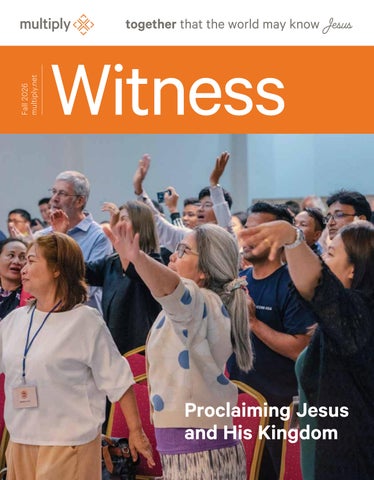
Fall 2026 multiply.net
together that the world may know Jesus
Witness
Proclaiming Jesus and His Kingdom
Witness Fall 2026 Contents Proclaiming Jesus and His Kingdom........... 2
Proclaiming Jesus and His Kingdom
Reaching the Stans.................................................4
By Bruce Enns
An Unchanging Mandate....................................6 The Posture of Proclamation..........................10 Pressing On............................................................... 12 The Kingdom has Come Near........................14
Staff Managing Editor................. Christopher Lane Layout & Design........................ Darcy Scholes Illustration & Design ................... Colton Floris Writer/Prayer Mobilization......... Nikki White Circulation ...............................Wendy Gerbrandt Communications Director........ Daniel Lichty
Contact 1.888.866.6267 witness@multiply.net We welcome your feedback. Read online: multiply.net/witness If you would prefer not to receive a printed copy of Witness, please contact us.
Offices 4867 E. Townsend Avenue, Fresno, CA 93727-5006 USA 300-32040 Downes Road, Abbotsford, BC V4X 1X5 Canada For other office locations, see multiply.net
Parting Words The final instructions of someone who is leaving and placing valuable things into the hands of others are worth paying attention to. They matter. They usually contain the things we most need to remember. Parents do this when leaving their kids home alone. We do it when asking someone to look after our house while we’re away. We make sure they know what matters most. The beginning of Acts records this kind of moment, but on a much bigger scale. The disciples had just lived through the most tumultuous days imaginable—moving from the horror and grief of Jesus’ crucifixion to the wonder and joy of seeing Him alive again. Now Jesus was preparing to leave them, return to His Father, and give them His Spirit. So what did Jesus talk about in these final days?
After His suffering, He presented himself to them and gave many convincing proofs that He was alive. He appeared to them over a period of forty days and spoke about the Kingdom of God. ~ Acts 1:3 Luke highlights two things. First, Jesus continued to address their doubts, giving them “many convincing proofs” that He was alive. Second, He spoke to them about the Kingdom of God (Acts 1:3). We can relate to both. We too need God to gently and continually deal with our doubts, fears, and struggles to reconcile faith with what we see happening around us. We need the Holy Spirit to do this heart work within us. And one of the ways God does this is by lifting our eyes beyond our immediate circumstances to see the much bigger reality of His Kingdom. It is significant that Jesus began His public ministry proclaiming the Kingdom of God (Matthew 4:23; Mark 1:14–15; Luke 4:43–44), and He ended His earthly ministry doing the same.
Printed in Canada
The disciples, however, were still trying to understand what this kingdom would look like. Their vision remained fairly small: “Lord, are you at this time going to restore the kingdom to Israel?” ~ Acts 1:6.
Lifting Our Eyes Jesus lifted their eyes to something much bigger: “But you will receive power when the Holy Spirit comes on you; and you will be my witnesses in Jerusalem, and in all Judea and Samaria, and to the ends of the earth.” ~ Acts 1:8 The Kingdom was bigger than they imagined, and Jesus was inviting them to see it and live into it. We need our eyes lifted as well. “The Kingdom of God has come near. Repent and believe the good news!” Jesus announced at the beginning of His ministry (Mark 1:15). Later, when asked when the Kingdom would come, Jesus responded that the Kingdom of God was already “in your midst” (Luke 17:21).
Living in the ‘Now and Not Yet’ This is part of the beautiful mystery of God’s Kingdom. It is a long-awaited promise. It is a present reality among us. And it is a future reality that we will one day experience in all its fullness. The Kingdom is evident wherever Jesus is King. But the Kingdom is still present and God is still on the throne even if people do not bow down - but do we see it? We can experience more of this ‘now and not yet’ Kingdom as we submit our lives to Him, live as churches who embody His reign and participate in His Kingdom mission. The New Testament describes God’s people as expanding beyond the boundaries of Israel to include Jew and Gentile together in one new family. Paul gives us a remarkable vision of this in Ephesians. The Church is not an afterthought in God’s mission. It is central to God’s purposes in the world—a people reconciled to God and one another, displaying the wisdom, grace, holiness, justice, peace, and love of King Jesus. Of course, we know the ‘now and not yet’ Church does this imperfectly. It’s easy to see how the Church we experience now is not yet in its fullness. We see the brokenness and gaps in leadership, relationships, holiness, justice, peace, and love. Yet Scripture also gives us a picture of what God’s people will one day become when His Kingdom comes in its fullness (Revelation 21:9–22:5). Until that day, we are called to be faithful, united by the Spirit, being His witnesses - to make Christ visible to the world. So we live in this tension of the now and the not yet.
We proclaim a kingdom that has already come near in Jesus and is still coming in its fullness. We announce Jesus as King while learning ourselves what it means to surrender more fully to His reign. We tell the Good News while also living as a people whose life together offers an alternative to the stories and kingdoms of our world. And we do this in the power of the Holy Spirit. Jesus’ final instructions were not simply, “Go work harder.” They were, “You will receive power when the Holy Spirit comes on you; and you will be my witnesses.” This is our calling as well.
Proclaiming Jesus and His Kingdom Proclaiming Jesus and His Kingdom is one of our core values, but it is much more than a statement on a page. It is an invitation to lift our eyes. To see where King Jesus is already at work. To surrender ourselves again to His reign. To participate in what the Spirit is doing. And to bear witness—in our words, our lives, our churches, and our relationships—to the good news that Jesus is King. As you read and pray through the stories and articles that follow, my prayer is that the Spirit would lift our eyes and enlarge our vision—that we would see more clearly what God is doing among us and around the world, and that we would faithfully join Him in proclaiming Jesus and His Kingdom. multiply.net | 3
Reaching the Stans CENTRAL ASIA | By Nikki White
“In Bible school, we asked a teacher which people groups are the most unreached in the whole world,” Heinrich related. “I was certain it would be Africa.” Instead, the guest teacher shared that the most unreached people group were the Turkic people of Central Asia. At the time, there was no known church and almost no known believers in Kazakhstan, Kyrgyzstan, Tajikistan, Turkmenistan, or Uzbekistan. “This really struck me, because this is the region where I was born,” Heinrich paused. “My parents were believers; my grandparents were believers. How could we live in the midst of the most unreached people in the whole world, and not bring them the Gospel?” Multiply’s Heinrich Rempel, a third-generation Christian born in Tajikistan, never forgot that day in
class. He and other students from Central Asia went on to form a group that prayed for the five “stans,” asking God for opportunities to bring the hope of the Gospel to these countries.
In desperate times, hearts open. And with open hearts, come open doors. It was a season in Central Asia when hope was in short supply. With the fall of the Soviet Union, infrastructure in Central Asian countries was falling apart—factories shut down, medical facilities closed, basic resources available only on the black market, unemployment rampant, and poverty at a critical level. Many were already living with a shortened life expectancy from exposure to nuclear waste. In desperate times, hearts open. And with open hearts, come open doors.
Embrace Kyrgyzstan Ministry and Training Center
4 | witness
So it was that in 1991, Heinrich and his new bride headed to Kyrgyzstan for what they would come to look back upon as their three-year, extended honeymoon. “We lived in a place with no shower, no heating, no running water,” he remembered, then smiled. “But it was just like our childhood, so not such a big burden!”
Meanwhile, Johann Matthies—a German seminary student at the time—received a call from believers in that same region. “They told me, ‘We know about evangelism, but we have no idea about follow-up. Do you have any idea about follow-up ministry?’ And I said, ‘Barely.’ The next thing I knew, I was headed to Kazakhstan.” For Johann, there was poignancy in being called by God to bring new life to a region where many of his mother’s family members had been killed. “I had history in Kazakhstan, and the history was not good,” he commented. “But because of that history, there was also an inbuilt empathy.” His empathy was about to be challenged by the exhausting pace of ministry. “I preached the Gospel fifty-five times in eleven weeks,” Johann declared. “Fifty-five sermons! I counted.” It quickly became evident to both Johann and Heinrich that there was a critical lack of training resources needed to equip more nationals for the work of mission. And deterrents to mission in Kyrgyzstan and Kazakhstan were already not insubstantial.
churches to fulfill their missional calling. “We wanted to help them to raise up a new missionary generation for Central Asia,” said Heinrich, “but there was no safe place for them to gather.” The lack of a secure gathering venue was keeping discipleship fragmented, fellowship limited, and leaders stretched to their limit. A vision emerged to establish an accessible training center in Kyrgyzstan, where existing and emerging leaders could be resourced. Construction of the Embrace Kyrgyzstan ministry and training center began—ready to provide a safe venue for local believers to gather, and a strategic base for local, regional, and international mission networks. “Our prayer is that this center will be a place where believers can be encouraged,” Johann concluded. “A place to deepen their theological roots, receive leadership training, pray together, and be equipped to serve with wisdom and courage—in their own communities, and beyond.”
“We wanted to help them to raise up a new missionary generation for Central Asia,” said Heinrich, “but there was no safe place for them to gather.” Believers in Central Asia were facing the increasingly hostile opposition of new religious controls. Children known to be Christians faced bullying at school, with their mothers subjected to social ostracization. Outright bans on evangelism and proselytizing meant harsh punishments for any infraction: house arrest, community expulsion, even physical violence. Despite this, Heinrich and Johann saw that believers not only continued to serve the Lord—quietly, faithfully, and often at great personal risk—but that there was increasing passion among the churches to be on mission, both within and beyond their borders. Several local churches are already working to reach those living in the Pamir mountains—an exceptionally high-altitude range spanning both Tajikistan and Kyrgyzstan.
Heinrich (left) and Johann (right) continue to work together, as close friends. In his role as Regional Team Leader for Europe and Central Asia, Johann resources Multiply workers and projects in this combined region, while Heinrich provides essential administrative support as the Director of Operations to the European Multiply base in Germany.
GIVE You can help raise up a new missionary generation in Central Asia by supporting the Ministry and Training Center. Go here to learn more and to donate: multiply.net/embrace
In the face of such courage and faithfulness, Johann and Heinrich grew in their resolve to support these
multiply.net | 5
An Unchanging Mandate USA | By Fred Leonard
It’s not complicated, it’s just hard. I like to keep things simple. Jesus told us in Matthew 28:18-20 to announce that He had all authority, thus, all Christians should go make disciples of all the nations, baptizing them in the triune God and teaching them to obey all the commands—and that we would never be alone. Then we see in Acts 1:8 that we would receive the promise of the Father and power to be His witnesses. This is for everyone, not just the disciples as they were sent out to announce the Kingdom in Matthew 10:7-8: “Go and announce to them that the Kingdom of Heaven is near. Heal the sick, raise the dead, cure those with leprosy, and cast out demons. Give as freely as you have received!” When I read these verses, when I think of announcing Jesus and His Kingdom, I am reminded that the Church,
6 | witness
local and universal, has had this mandate for over 2,000 years, and we still have it today. We are to go and proclaim the Kingdom, to tell people there is a King and His name is Jesus.
There are places where, if we don’t GO, GIVE, PRAY, people will never hear about Jesus. Someone asked me this week why I would care about the world and support global work when so many people right here don’t know Jesus. My answer was simple. I have 3.34 billion reasons. In today’s world there are roughly 8.142 billion people. Roughly 4%, or 3.34 billion people, have no witness to the Gospel of Jesus Christ. They have never heard
of Jesus, have no Christian friend, and many have no access to the Gospel. What does that do to you? How do you respond? Do you know where any of the almost 7,000 unreached people groups are? What should our response be? We must GO! There are places where, if we don’t GO, GIVE, PRAY, people will never hear about Jesus. Jesus came to seek and to save the lost (Luke 19:10) and we want to join Jesus in His mission.
It is not complicated, it’s just hard. And God is here to help us obey the hard. Hear me: I am not against nice buildings, carpet, cafes, landscaping, cars, homes, and vacations. I am against giving towards our own comfort with no concern for the global lost. We can’t focus only on ourselves at the expense of the global lost. We must do both. Be a tither to you local church—yes, 10%. Then be a generous giver to the global lost. We want to invest in people hearing the Gospel, coming to faith in Jesus, being discipled, forming into
a church, and then being disciples that make disciples and churches that plant churches. This needs to be our passion. I want to see this happen in our cities, states, country, and the global world. We should go simultaneously, not in succession, to Jerusalem, Judea, Samaria, and the ends of the earth—all at the same time. If you are feeling the call from Jesus to the global world, be it to GO, GIVE, or PRAY, give me a call. Give us a call at Multiply. We would love to talk with you and help you discern the call of Jesus to join Him. You may not be sure what your next step is, but as you ask Jesus and we pray together, Jesus will tell you where He is calling you to go, what He is calling you to give, and how He is calling you to pray. It’s an honor to serve Jesus with you. Finally, remember, it is not complicated, it’s just hard. And God is here to help us obey the hard.
GO Multiply’s US Missionary Candidate School can help you discern your calling, clarify your gifting, and be discipled while serving and discipling others. For more information, multiply.net/go
multiply.net | 7
that the world m
“...Everyone who calls on the name of the Lord will be saved.” How, then, can they call on the one they have not believed in? And how can they believe in the one of whom they have not heard? And how can they hear without someone preaching to them? And how can anyone preach unless they are sent? As it is written: “How beautiful are the feet of those who bring good news!” ~ Romans 10:13-15 After His resurrection from the dead, as Jesus prepared to ascend to the Father, He gave His disciples one final command: “Go and make disciples of all nations” ~ Matthew 28;19. Commonly known as the Great Commission, these words direct our focus as Christians, compelling us to take that Good News to the very ends of the earth. In the centuries since Jesus issued the commission, great progress has been made. Thanks to advances in technology and travel, much of the world has had the opportunity to encounter the Gospel and put their faith in Christ. But there are still many people waiting to hear the message of salvation. According to Joshua Project, an organization that highlights people and places with the least access and response to the Gospel, just over 40% of all people groups are considered “unreached.” That means they have no indigenous community of believing Christians with adequate numbers and resources to evangelize without outside assistance. This represents nearly 3.5 billion people—more than the populations of India and China combined.
“The spirit of Christ is the spirit of missions. The nearer we get to Him, the more intensely missionary we become.” -Henry Martyn
may know Jesus “We must be global Christians with a global vision because our God is a global God.”
-John Stott
Together, Sharing Jesus “And behold, I am with you always, to the end of the age.” ~ Matthew 28:20 Jesus promised to be with us in this mission to make disciples of all nations. So while the numbers of those who are unreached can be daunting, we know that as we work together with Him, faithfully proclaiming His Kingdom, more and more people will encounter Jesus and receive the Good News of eternal life in Him. Please pray for Multiply missionaries and our global partners as they faithfully engage people of other cultures and faiths, inviting them into relationship with God. Ask Him how you can be part of what He is doing in the world – praying, giving, going... How would God have you invest your time, treasure, and talent to help fulfill the Great Commission?
“There is no higher calling or greater privilege known to man than being involved in helping fulfill the Great Commission.”
- Bill Bright
The Posture of Proclamation CANADA | By Derek Parenteau
A number of years ago, I was having tea with a good friend of mine who was visiting from India. My friend had decades of testimonies from the front lines of missions in India and beyond. I was captivated by his stories and his lessons on evangelism, disciple making, and house church movements. His stories included first-hand testimonies of multitudes surrendering their lives to Jesus and experiencing radical freedom in their lives. As I hungrily consumed all that he had to share, I was struck by a question: Why don’t we experience more of those things here in North America? His answer hit me hard. He said, “In North America, there is much talk about the Gospel. You have a deep understanding of what the Gospel is and you highly value it. You discuss it regularly and put it in your statements of faith. But it is rare to hear a North American boldly proclaiming the Good News of Jesus and His Kingdom.” I didn’t necessarily disagree with him, but I also didn’t love his answer. It poked at something deep inside me.
I struggled to see how boldly proclaiming the Good News of Jesus and His Kingdom could be reconciled with the Way of Jesus and His Kingdom. The image that the phrase brought to mind was of an aggressive street preacher harassing people and forcing tracts into the hands of disinterested bystanders. Given that the word “proclamation” is unmistakably scriptural, somehow it was still hard to imagine how to do it without being rude and hurtful. I could feel the protest from within me: “What about
10 | witness
the fruit of the Spirit? What about gentleness and patience and kindness?” On a gut level I struggled to see how boldly proclaiming the Good News of Jesus and His Kingdom could be reconciled with the Way of Jesus and His Kingdom. But Jesus clearly didn’t see a contradiction between these things, so why did I? My friend’s words caused me to reassess what I understood and imagined proclamation to be. My internal sense of conflict was clearly hindering me. When it comes to the Good News we can share it, explain it, and preach it. These are all good things. But what does it mean to proclaim it? In Luke chapter 4, Jesus begins His public ministry with a statement of purpose: “The Spirit of the Lord is upon me, because he has anointed me to proclaim good news to the poor. He has sent me to proclaim liberty to the captives and recovering of sight to the blind, to set at liberty those who are oppressed, to proclaim the year of the Lord’s favor.” ~ Luke 4:18-19 (ESV) The Good News is beautiful, vast, and deep. We will mine its depths for eternity. But notice what Jesus does with it here. He proclaims it. In a Spirit-empowered, royal declaration of reality, He announces that freedom has come. Proclamation is not about persuasion. Its focus is not extensive teaching. It does not need to be loud or formal. Rather, it is a clear and authoritative announcement about the present reality of mercy and freedom that flows from Jesus’ reign and kingdom. The posture of proclamation is an ideal pairing for the message of the Gospel. It highlights the very nature of the most important announcement ever made in history. Notice how Jesus was anointed and sent to proclaim this message. Proclamation positions us as royal messengers entrusted with a critically
important announcement that has profound implications for everyone who hears it. The message is not oppressive, nor is it a suggestion. It is a liberating reality that mercifully demands a response: repentance, belief, surrender. This way of communicating the Good News is not only liberating for the hearer but also for the speaker. A royal messenger does not carry the weight of having to convince anyone. Rather, they can rest in the knowledge that they have been sent by the King with an incredibly good and critically important announcement. How wonderful it is to be entrusted with a declaration of forgiveness, healing, and freedom by the King of Kings!
Proclamation positions us as royal messengers entrusted with a critically important announcement that has profound implications for everyone who hears it. This brings us to something at the very root of proclamation: our identity as “sent ones.” One of the great mysteries of our faith is that not only was Jesus sent to proclaim the Good News of His Kingdom to this world, but that He likewise says to His followers, “As the Father has sent me, even so I am sending you” ~ John 20:21 (ESV). If we truly believe this, our understanding and practice of evangelism will change significantly. It will flow from our identity in Christ and will be empowered by the Spirit. It will be characterized by the fruit of the Spirit, because that is the nature of the one who sends us. It will be joyful and restful, because our responsibility is not to produce a response in someone else, but to live in our God-given identity as ambassadors of the Kingdom. The Apostle Paul says, ‘But how can they call on him to save them unless they believe in him? And how can
they believe in him if they have never heard about him? And how can they hear about him unless someone tells them? And how will anyone go and tell them without being sent? That is why the Scriptures say, “How beautiful are the feet of messengers who bring good news!”’ ~ Romans 10:14-15 (NLT). This passage has such a beautiful flow, like a mighty river. At its source is our commissioning as sent ones. It flows outwards as we live out our calling to go and proclaim Jesus and His Kingdom, reaching thirsty souls awaiting the freedom that only Jesus brings. Recovering biblical proclamation is not just great news for the believer who has been weighed down with false expectations. It is uniquely great news for our neighbours and for the nations. We do not need to carry the burden of producing a response. Rather we need to faithfully proclaim the Good News we have been entrusted with. Our Lord has heard the cries of the oppressed and He has sent you!
GO Explore ways you can join God on His mission to reach a lost and dying world. multiply.net/go
multiply.net | 11
12 | witness
Pressing On Twenty years ago, Bashir* was the most feared man in his village. A powerful witch doctor, he was believed to wield dark spiritual forces. But when his own child became gravely ill, his power failed him. He tried every ritual, every chant. Nothing worked. “Why do I have power,” he wondered, “yet can’t even heal my own child?” That cry of desperation led him on a different kind of search–not for spirits, but for truth. One day, a friend told Bashir about Jesus, the One who had healed him from a tormenting illness. Desperate and intrigued, Bashir traveled to meet the man who had introduced his friend to this Healer. There, he opened the Bible for the first time and read a verse that pierced his soul: “...Those who practice magic arts... will be consigned to the fiery lake of burning sulfur. This is the second death.” ~ Revelation 21:8 Bashir was undone. “I have power,” he realized, “but I am a fraud. I have lied to so many, pretending to be more than I am.” That day, he fell to his knees, repented of his sin, and received Christ’s love and forgiveness. Because he lived in a country that is hostile to the Good News of Christ, the moment Bashir declared his faith publicly, he was arrested. While in prison, the government and local people persecuted and starved his family. Tragically, his wife and ten children all died. “The Holy Spirit spoke to me while I was in stocks and chains,” Bashir recalls. “He said, ‘Never look back, Bashir. Your eternal reward is waiting for you.’” Putting his faith completely in Jesus, Bashir found the strength to go on. Comforted and empowered by God’s Word, he pressed forward with a heart full of Christ’s love, determined to forgive the enemies that had destroyed his family. Twenty years passed. Bashir remarried and had ten children. The small band of believers grew to 156 house churches! Still severely persecuted, they continue to share the Gospel among unreached people groups in their region–tribes that still wait to hear the name of Jesus for the first time. Please pray for Bashir and these courageous brothers and sisters as they seek to faithfully serve the Lord and proclaim Jesus in a very difficult part of our world. “...One thing I do: Forgetting what is behind and straining toward what is ahead, I press on toward the goal to win the prize for which God has called me heavenward in Christ Jesus.” ~ Philippians 3:13,14 *We use aliases for our workers and partners serving in sensitive areas to ensure their safety and security.
multiply.net | 13
The Kingdom Has Come Near SUB-SAHARAN AFRICA | By Doug Hiebert
One of our core values at Multiply is “Proclaiming Jesus and His Kingdom.” I like this. In fact, sitting down to write about the King and His Kingdom makes me want to jump up, shout, and do a backflip. It gets me pretty fired up. My 20+ year journey in Africa, wrestling with its challenges—war, poverty, power-abuse, and more—has brought God’s Kingdom into clearer focus. I was in university at the time of the genocide in Rwanda. More than 800,000 Rwandans were killed by their fellow countrymen in the space of 100 days. But what made it even more disturbing was that Rwanda was supposed to be one of the most Christian nations in the world.
Jesus’ arrival, the Kingdom of God comes near. He tells how we are to respond to this news: Repent! It means to turn 180 degrees—to do an about-face. It’s a turning from sin, and from sinfulness, from wrong ways of thinking about God, about ourselves, about this world, and about our place in it. We turn from the kingdom of darkness and towards the Kingdom of the Son of God. To repent and believe in Jesus is to take on a new and rightful identity and purpose. It means living in faith and living in a new reality, with the expectation of joining God in His work of redeeming ALL things.
I wondered: How could this happen? Is this how the Church is to act? Isn’t the Church to be proclaiming— preaching, seeking, contending for—God’s Kingdom? To capture what it means to proclaim Jesus and His Kingdom, we must look at the entire biblical story. From the start, God’s intention was on display. > Creation: God purposefully made all things and all things were good. This includes how things worked… symbiotically, synergistically, PERFECTLY. > Mankind: We were mandated to contend for, take care of, and steward God’s world. Bearing His image means modeling but also actively living and doing the Kingdom. > The Fall: This brought separation from God, marring our identity and purpose. > Israel: God’s people, chosen particularly to know Him, were to reveal Him and His Kingdom to the world. Then we come to Jesus. Remember that He began His ministry by declaring: “The time has come, the kingdom of God is near. Repent and believe the good news.” With
14 | witness
Jesus traveled “from one town and village to another, proclaiming the good news of the kingdom of God” (Luke 8:1). He preached and proclaimed the principles and attributes of that Kingdom: healing the sick, casting out demons, providing food for the hungry, accepting the outcast and unwanted, confronting injustice. Jesus said that next to loving Him, the most important thing we must do is love others as we love ourselves. That sounds pretty holistic to me. Sounds like the Kingdom.
Paul caught on to this amazing message. By the end of his life, “from morning till evening [he] explained and declared to them the kingdom of God and tried to convince them about Jesus…” ~ Acts 28:23.
He’s seeing himself differently, seeing his potential differently. He plans to continue pastoring, but only parttime as he lives into his God-given gifts and takes care of his family.
This is explosive! Jesus, and then Paul, contended for a whole new way of being. It’s a new worldview where Jesus is at the centre, on the throne, filling up the viewfinder. It defines our identity—children of the King— and it explains our purpose: to fulfill the plans and design of our Father and Lord here and now.
The Kingdom has come near to all of us. We long for Jesus’ return and the complete fulfilment of that Kingdom. Until then, we follow Jesus’ command to seek His Kingdom first. Our belief and our longing for the coming Kingdom propels us to live the Kingdom, preach the Kingdom, contend for the Kingdom, and reveal the Kingdom here and now.
We all long for the Kingdom. Even those that don’t yet know the King. It’s IN us: the desire for a world without war, without pollution, without poverty. A world of equality, of peace, love, and righteousness. You know what I’m talking about. So what does “the Kingdom of God coming near” look like in the context of Africa? One truth of the Kingdom is that nobody has nothing. God gives His people resources. A second truth is that one must use what they have. And it works even better when we do it together. Nobody has nothing, use what you have, do it together.
As it draws near, the Kingdom evidences itself like this: people confessing their sins and coming to know Jesus, stepping into their rightful identity as sons and daughters of the King. This is accompanied by a sense of purpose as we enter into Father’s business as co-labourers with Christ. Experiencing the Father’s love, we express that to others and live with a holy expectancy, ready to proclaim Jesus and His Kingdom. Amazing! Exciting! What a privilege.
We were teaching about the Kingdom on my last trip to Malawi and some of the testimonies illustrate these truths. One pastor stood up and announced “I dress like I’m poor, I think like I’m poor, I act like I’m poor.” Then he admitted, “This is not true.” He proceeded to explain that his family had a piece of land that they were renting out for a pittance. If they would just farm it themselves, he suddenly realized, they would have enough so that they would never go hungry. You see what happened there? At some point in his life, this pastor had acknowledged that Jesus is the Author and Perfecter of his faith. And now he’s beginning to see God as his provider and recognized that God’s Kingdom has come near. Freed from a poverty mentality, he can now join God on His mission. His sense of identity has shifted as has his sense of agency. He is now contemplating his future and taking stock of his life. Jesus saying “I have come that they may have life, and have it to the full” comes to mind. Another pastor in that series of meetings stood up and said, “God made me a good carpenter.” Some years ago, he had abandoned that to be a full-time pastor. But this meant that his family would often go hungry. “I need to do what God made me good at. I know we will never go hungry again.”
One pastor stood up and announced “I dress like I’m poor, I think like I’m poor, I act like I’m poor.” Then he admitted, “This is not true.”
P R AY Ask God to continue advancing His Kingdom in Africa—and throughout the world. Pray for discernment about how you can join His mission. And may He give us all boldness to proclaim Jesus and His Kingdom until He comes.
multiply.net | 15
e
unity mm co
Lear n
d join th
l y. n
li
er
ult ip
s
at m
become a multiplier
m
an e r o
e t /m u l t i p
join a community of monthly givers who want the world to know Jesus. Right now, across the world,
Someone is seeking Jesus but needs an introduction, A future missionary senses God’s call but feels alone, A leader has a vision for their community but longs for partnership.
Together, let’s help them take their next step. together that the world may know Jesus