Mennonite Brethren Herald is published bimonthly by the Canadian Conference of Mennonite Brethren Churches, primarily for the use of its members, to build a Canadian MB community of faith. We seek to 1) share the life and story of the church by nurturing relationships among members and engaging in dialogue and reflection; 2) teach and equip for ministry by reflecting MB theology, values, and heritage, and by sharing the good news; 3) enable communication by serving conference ministries and informing our members about the church and the world. However, the opinions expressed here are not necessarily those of the church as a whole.
“Canada is a mission field which we are all called to reach with the gospel.”
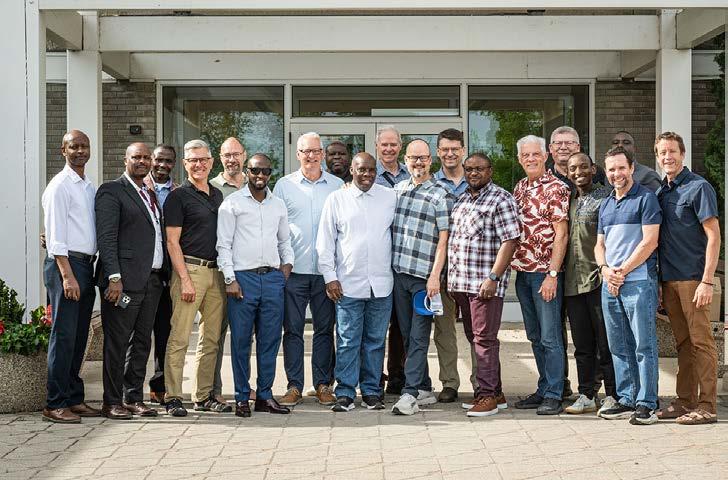
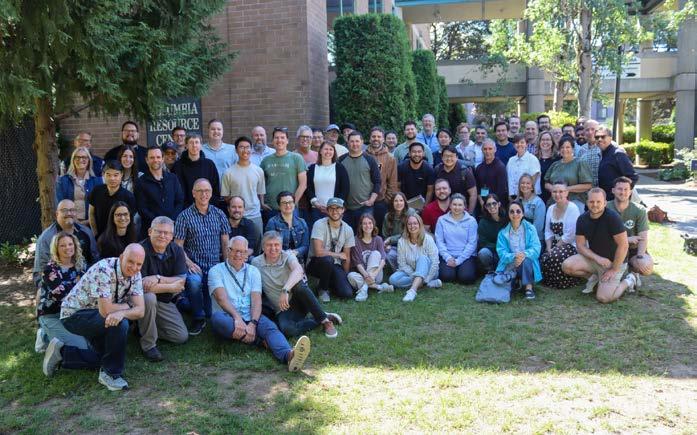
The National Ministry Team gathered with leaders from African diaspora congregations to listen and learn together. Read the full story on page 17
Digest
AUG/SEPT 2026 | VOLUME 65, NO. 04
EDITORIAL OFFICE
1310 Taylor Avenue Winnipeg, Manitoba R3M 3Z6
Phone: 204-669-6575
Toll-free in Canada: 888-669-6575
MBHERALD@MBCHURCHES.CA WWW.MBHERALD.COM
ISSN: 0025-9349
The Mennonite Brethren Herald is a publication of
CANADIAN CONFERENCE OF MENNONITE BRETHREN CHURCHES
CONFÉRENCE CANADIENNE DES ÉGLISES DES FRÈRES MENNONITES
Sharing the life and story of Mennonite Brethren in Canada
7
PCO 2026: WELCOME TO THE FAMILY
MB Herald Staff
12 COVER STORY GOD’S WAITING ROOM
Phil Gunther
16 RUSTY, YET VALUABLE
Helen Guenther
18 TUNE TO CHRIST Traci Johnston
20 PRAYING FOR PEACE IN OUR MARRIAGES Terri-Lee Broesky
God makes everything happen at the right time. Yet none of us can ever fully understand all he has done, and he puts questions in our minds about the past and the future.
— Ecclesiastes 3:11 (CEV)
JUST THIS WEEK, I SAT IN A WAITING ROOM while a loved one underwent tests. The minutes stretched on as I waited, feeling helpless, weak and afraid. We will stay in this holding pattern for at least a couple more weeks, waiting, fretting, ruminating.
I’ve spoken often about my mental health struggles, and those who know me know that anxiety and depression walk with me every day. For me, anxiety is often rooted in fear of the future, while depression can pull me toward the past and an unhealthy sense of nostalgia.
Whenever I want to sound learned on the subject of mental health, I quote my lifelong friend, Blaise Pascal, who says, “We never keep to the present. We recall the past; we anticipate the future as if we found it too slow in coming and were trying to hurry it up, or we recall the past as if to stay its too rapid flight...The fact is that the present usually hurts. We thrust it out of sight because it distresses us, and if we find it enjoyable, we are sorry to see it slip away.”
Same, Blaise, same. I struggle in liminal spaces; the present rarely feels bearable. If the present is difficult as it is, imagine my heightened panic in this moment. Off the charts, friends, off the charts.
When reading Phil Gunther’s feature article (page 12), I’m convinced that Phil (a more recent friend than Blaise is) speaks directly to me: “God is present in the space where past, present, and future intersect. He has a perfect understanding of the best unfolding of our lives. We see what is in front of us; God sees what is beyond us.”
Bam! Depression — gone! Fear and anxiety — eradicated! Well, maybe not exactly, but comfort comes from the Word of God. The presence of the Holy Spirit calms even the wildest heart, and the understanding
that God’s gigantic plan for the world includes you and those you care about brings peace.
Yesterday, a coworker and I asked each other if God could completely cure us of one affliction, what would it be? Without hesitation, we both said, “Our anxiety.” My coworker likened it to silencing the endless static in their head. We pontificated on how wonderful that would be, and even though we knew that God heard our conversation, I think neither of us fully believed that the healing would come.
I thought of Paul, who in his letter to the Corinthians describes his own particular affliction as a “thorn in the flesh.” He pleaded with God three times to have it removed, but ultimately, it was not to be. He lived with his pain for the rest of his life. And perhaps it is the same for me: that I will never be rid of my anxiety; perhaps this is your situation as well.
God’s response to Paul, which I imagine was hard for Paul to accept, tells us that we have access to the greatest power ever known. “My grace is sufficient for you, for my power is made perfect in weakness.” God waits with us, aware of the outcomes we cannot see. He understands our fears and hears every prayer, whether spoken or unspoken. His unfailing strength supports us in our weakness.
If living in the present is hard, let’s make our hearts at home in his presence.
Carson
CARSON SAMSON Editor
WE EXIST TO PROVIDE MINISTRY-FOCUSED FINANCIAL SERVICES TO FACILITATE KINGDOM GROWTH.
Legacy serves as a resource to the conferences, churches, agencies, and employees of the Canadian Conference of Mennonite Brethren Churches. We provide payroll and accounting services, administer CCMBC’s group benefits plan and pension plan, and offer lending and investment services. Our investors enable churches and pastors to have a presence in the communities they serve.
OUR VALUES
WE OPERATE IN DEPENDENCE ON GOD. We live in prayerful and obedient attentiveness to God – Father, Son, and Holy Spirit. We seek to glorify His name.
WE SERVE OUR MINISTRY PARTNERS.
We support the charitable objectives of CCMBC as described in our Bylaws and in our Memorandum of Understanding with CCMBC. Our initiatives support and serve our ministry partners.
WE STEWARD RESOURCES ON GOD’S BEHALF.
We exercise care and integrity as we oversee the funds and ministry assets entrusted to us. We demonstrate accountability and transparency in our reporting, policies, and actions.
WE PROVIDE HIGH-QUALITY, PROFESSIONAL SERVICE. We serve MB churches, conferences, agencies, employees, and constituents responsibly and competently.
WE VALUE THE WELL-BEING OF OUR EMPLOYEES. We support a flourishing workplace culture by attracting and retaining outstanding Christian talent. We provide opportunities for staff to learn and grow, give opportunity to leverage skills and spiritual gifts, offer inspirational leadership, provide rewarding compensation, and a team atmosphere to create consensus, direction, and momentum.
ABMB GATHERING: PLANT THE SEED, GROW THE FOREST
BY PAUL LOEWEN
Camp Evergreen was the perfect setting for Gathering 2026. Surrounded by tall evergreens, the sounds of birds, wonderful spring air filled with the cedar-sweet smells of forest and fauna, Gathering 2026 (May 8-9) provided refreshment for participants, encouragement of the soul, and challenges to invest in the seedlings and sprouts of the next generation.
Plant the seed, grow the forest focused on the development of the next generation of leaders for Christian influence in our homes, churches, and marketplace. It was refreshing to see families come with their kids and enjoy a stay in a cabin. We were very encouraged as we heard stories of God’s faithfulness from the youth around the campfire Friday night. Jon Kornelsen (Central Community Church in Chilliwack) provided his “Youth Ministry Blueprint” to equip youth leaders. Steve Kim from Apologetics Canada spoke on the challenges facing our youth regarding AI and Transhumanism, a timely presentation for understanding the implications of technology on our future. Steve Brown (president, Columbia Bible College) provided valuable understanding regarding discipling youth and young adults. Students from the new ADVANCE Academy of Ministry provided hosting for the event.
Intentional time was built in to enjoy camp activities such as trail rides and wall climbing, be part of a prayer walk, meet new friends, or connect with ones we haven’t seen in a while. Valuable clinics/workshops provided practical tools for ministry, such as kids and youth ministry.
Direction
For over fifty years, Direction has served Mennonite Brethren and others as a semiannual forum for biblical, theological, historical, and church-related scholarship.
The ABMB Board provided opportunity for information on vision, financial reports, and the budget overview for 2026. National ministries shared stories of God at work; details of the CCMBC national governance proposal gave opportunity to ask questions and provide input. Many participants shared how they enjoyed the event and were encouraged about what God is doing.
“THANKS FOR TIME TO CONNECT WITH OTHERS.”
“WHAT A GREAT SETTING TO TALK ABOUT NEXT-GEN VISION!”
“I WISH MORE PEOPLE FROM MY CHURCH COULD HAVE HAD THIS EXPERIENCE!” SAVE THE DATE - GATHERING 2027
˚ Are you interested to hear what God is doing in our churches?
˚ Do you have a desire to be part of the bigger family of MB churches in Alberta, Canada and around the world?
˚ Do you want to be better equipped for the ministry God has called you to?
If you have never been to ABMB Gathering, plan for May 7-8, 2027.
>> Watch the ABMB Gathering video here
Scan the QR code or click on this ad for more information
TORNADO STRIKES REDBERRY BIBLE CAMP
GOD’S PEOPLE RESPOND TO SAVE CAMP MINISTRY
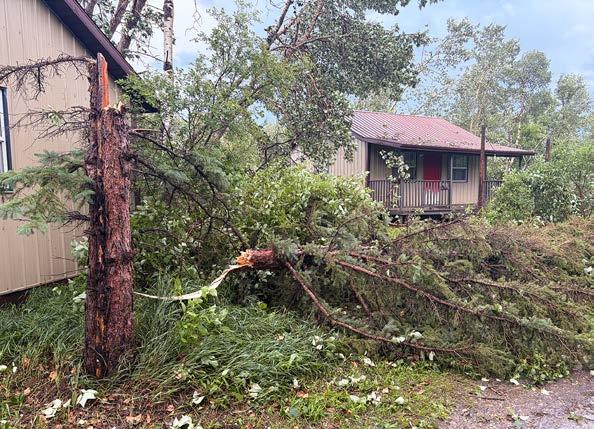
A tornado seemed to come out of nowhere as it hurdled toward Redberry Bible Camp, witnesses said. It struck the camp on Friday, July 10. Though it didn’t touch the ground, the tornado snapped treetops and thrust other trees to the ground, pulling their roots up!
On Redberry Lake, tumultuous winds picked up the floating dock, canoes, kayaks, and a storage shed, destroying equipment and blowing others a long distance away. The tornado cut power lines and destroyed a ropeclimbing activity area.
Branches and treetops cluttered the entire camp. Trails and walkways were impassable. Hail the size of baseballs struck at the same time. Miraculously, no one was hurt, and the camp buildings — cabins, dining hall, office, and gym — were virtually unscathed.
The immediate challenge for Dave Carey, Redberry’s Executive Director, was to keep the upcoming ministry week on track. Campers would register on Sunday, just two days away. An urgent appeal for help went out to Redberry supporters; the Saskatchewan MB Conference (SKMB) sent a similar appeal to the family of MB churches in the province.
God’s people showed up, more than 100 of them! Many brought chainsaws, skid steers, tractors, trucks, and other equipment to clear
broken branches and toppled trees. SKMB covered the cost of feeding the volunteers during the recovery. After more than eight hours of non-stop labour by volunteers, the camp was cleared enough to allow the upcoming ministry week to proceed.
Redberry Bible Camp’s Facilities Director Myrd Harder stated that the devil may have sought to stop the camp’s upcoming ministry week, but God used the tornado to bear witness to the incredible response and support from God’s people. People volunteered to support Redberry who had never been to camp before. The camp’s work will prevail and even flourish because of this tornado. The gospel will be shared, and young people will come to know Jesus.
While SKMB’s Director of Ministry Phil Gunther was at the camp several days after the tornado, Harder received a call from a supporter who wanted to donate a brand-new chainsaw. During and after the storm, God’s blessings keep coming!
Donations to help restore the camp to full operating capacity are welcome. Please go to redberrybiblecamp.com
SKMB COMMUNICATIONS
Tornado damage at Redberry Bible Camp following the July 10 storm.
IN CASE YOU MISSED IT
We regularly publish website-exclusive stories on mbherald.com. Here are a few articles we’ve posted online in the last few months.
Colombian church community sets Venezuelan migrant up for success By Jason Dueck
Dairy Yamillet Ruedas Marquez’s journey from Venezuela to Colombia shows the life-changing impact of Teusaquillo Mennonite Church’s work with refugees in partnership with MCC.
When Dairy Yamillet Ruedas Marquez migrated from Venezuela to Colombia in 2019, she couldn’t know how her life would look seven years later. Those first steps would take her through sorrow and joy, challenges and triumphs — a winding path that today, finds her supported and successfully running her own small business.
Venezuela was in the midst of a political upheaval in 2019. President Nicolás Maduro (who was in January 2026 seized by U.S. armed forces and charged with drug trafficking) was re-elected in what many world governments labelled an illegitimate election. The country’s economy was collapsing, seeing record-breaking inflation and mass protests. (Read the full article here)
A place to call home again in Indonesia By Adi Nugroho and Linda Espenshade
A family in Sumatra, Indonesia, describes the impact of MCC partners helping to build a new, semi-permanent house for them after a November flash flood washed theirs away.
The morning after a rushing wall of water full of mud, stones and logs swept through Lopian Village in Sumatra, Indonesia, Nurlaila Sari Dawolo stood silently in front of the ruins of her home. Mud reached up to her calves and covered what was once the floor of their small house. It was late November 2025. In the corner where her kitchen used to stand, only piles of stones and broken boards remained. The flash flood, which was as high as 6.5 feet (2 meters), had swept away their house and the motorbike of her husband, Muhammad Syarif Aritonang. The motorbike was the family’s only means of transportation and livelihood. (Read the full article here)
WELCOME TO THE FAMILY!
2026
From June 2 to 4, 60 registrants from BC to Manitoba participated in the two and a half day Pastors Credentialing Orientation (PCO) hosted at Columbia Bible College in Abbotsford, BC. PCO 2026 was a joint effort between the National Faith & Life Team, MB Seminary, and the BC, Alberta, and Saskatchewan MB conferences.
PCO is intended to provide a basic understanding of our MB history and theological roots, our CCMBC structures and mission, and our MB Confession of Faith, while at the same time introducing registrants to our agencies and leaders. In addition, a key goal of PCO is to have each person leave with a strong sense of encouragement, blessing, and welcome to our MB family.
PCO is a key part of the credentialing requirements for MB pastors/leaders across Canada. Ministry credentialing is an expectation for all church staff employed half-time or more who carry the title “pastor” and all ministry staff employed half-time or more with a spiritual leadership and/or teaching role in a local church or MB organization. All MB credentialed leaders are required to commit to and abide by a “Code of Personal and Ministry Ethics” designed to encourage their own personal, spiritual, and relational health as well as safeguard and promote the overall health and ministry effectiveness of the churches and ministries where they are serving.
The vast majority of PCO 2026 registrants were new to the MB
family so this was a time of welcome as well as invitation to truly join with us on mission together. During the two and a half days, PCO 2026 registrants participated in seven interactive presentation sessions, toured the Mennonite Heritage Museum, heard from leaders related to the MB Seminary, Multiply, and Legacy, enjoyed some fun interaction time outside hosted by staff from Columbia Bible College, and enjoyed coffee breaks and meal times together. PCO 2026 concluded with an informal “graduation” where each participant received a certificate of completion (triggering enthusiastic applause!).
Please pray for these leaders as they serve in our churches and ministries! Pray that they will continue to grow and mature as disciples ever more into the character and mission of Jesus! Pray that they will serve with faithfulness and integrity in their ministry contexts! Pray that they will embrace the Great Commandment and the Great Commission, helping us to become an MB community of healthy disciple-making churches and ministries, faithfully joining Jesus in his mission! And pray that all the glory will go to King Jesus! (For information on PCO 2027, keep an eye on our web page: www.mennonitebrethren.ca/pco).
MB HERALD STAFF
Q&R CORNER
Q&R corner provides responses to questions that readers may have about CCMBC and its work collaborating with provincial MB conferences in areas of spiritual health and theology, leadership development, mission, and organizational health in order to achieve the overall mission: “To cultivate a community and culture of healthy disciple-making churches and ministries, faithfully joining Jesus in his mission.” If you would like to contribute a question, please send it to questions@mbchurches.ca
Please note that we will not be using your name in the MB Herald Digest in order to respect those who prefer anonymity. There may not be space to respond to every question—and sometimes we might not really have the ability or authority to respond to some questions (for example, those that relate more directly to one of our provincial MB conferences or to a local church leadership). We apologize in advance if we are unable to publish a response to your specific question.
What do the Mennonite Brethren believe about speaking in tongues? R.
Thank you, R., foR youR ques T ion. This ques T ion is ultimately about the nature and role of the Holy Spirit in the life of each believer and in the life of the church. When the Mennonite Brethren movement began in 1860, there was a significant emphasis on the Holy Spirit’s role drawing people to Jesus, building the church, growing new disciples into the image of Jesus, and providing guidance for biblical interpretation and the discernment of God’s will. In the early years, it would be certainly fair to call the MB movement “charismatic,” but this impulse became much more muted in the decades that followed. (For more on MB history and the Holy Spirit, see here.) While in normal English usage the word “tongues” is synonymous with the word “languages,” in religious parlance it refers to an extraordinary Holy Spirit gift where a believer is at least on occasion able to speak in
an unlearned foreign language (e.g., Acts 2:4-11) or is able to speak in a normally unintelligible “angel” language (1 Cor 13:1; 14:1-2) but when interpreted provides a divine message for the recipients (e.g., Acts 10:46; 1 Cor 14:1-25). Most people today associate the word “tongues” with this unintelligible angel language. The unusual spiritual gift of tongues is unexplainable as a natural phenomenon which should cause its recipients to give it special authority when they receive the message.
Our MB Confession of Faith has a brief description of Holy Spirit giftings in Article 6: Nature of the Church: Gifts for Ministry. Through the Holy Spirit God gives gifts to each member for the well-being of the whole body. These gifts are to be exercised in God’s service to build up the church and to minister in the world.
Explanatory Note 16 provides the following commentary on this section:
1 Corinthians 12:5 describes “different kinds of gifts” which verse 7 calls a “manifestation of the Spirit” given to “each one” for the “common good.” 1 Corinthians 12-14 highlight how all these gifts are to be exercised in the context of love. These three chapters provide key implications for how spiritual gifts should function in the church today:
First, because all believers (male and female, rich and poor, Jew and Gentile, etc.) have received the Holy Spirit, each and every believer has at least one of these gifts given for ministry in the church and in the world (cf. 1 Cor 12:11; 1 Peter 4:10). Therefore, the hope is that every believer will become a member of a local church using their gift(s) “to build up the church and to minister in the world.”
Local churches wanting to function at the highest capacity will need to encourage widespread involvement from each and every member as they use their individual spiritual gifts.
Second, the Spirit has distributed church leadership gifts (e.g., apostles, prophets, evangelists, teachers, pastors, cf. Eph 4:11-12) to many people rather than concentrating them on only one or two individuals. Therefore, local church leadership structures should include multiple leaders who meet together regularly to pray, discern, and serve the congregation, rather than placing all leadership and decision making into the hands of only one leader.
“The unusual spiritual gift of tongues is unexplainable as a natural phenomenon which should cause its recipients to give it special authority when they receive the message.
”Third, no one should take individual credit for the spiritual gift they have received since this would be a fundamental denial of the nature of a “gift” (cf. 1 Cor 12:11). While we want to be people of gratitude to those serving well in our churches (cf. Heb 13:17), excessive veneration of certain individuals with very public spiritual gifts loses sight of how God’s gifts have been given for the well-being of the church and its mission (cf. 1 Cor 3:21-4:1).
Disciples of Jesus have been given gifts so that “in all things God may be praised through Jesus Christ” (1 Peter 4:11). The emphasis is on the praising of God and the building up of the body.
Fourth, all spiritual gifts are to be exercised in the “way of love” (1 Cor 14:1; cf. 13:1-3) “to serve others” (1 Peter 4:10). Gifts are to nurture and strengthen the entire church rather than function to benefit solely the one entrusted with the gift (Phil 2:3-4). Individuals who lose sight of this larger purpose are betraying the Holy Spirit’s purpose.
When all the New Testament texts about the Spirit’s gifts are brought together (1 Cor 12-14; Eph 4:11-16; Rom 12:3-8; 1 Peter 4:1011), it becomes clear that the Bible does not provide a single comprehensive list of these gifts. It could well be that the Spirit gifts individual believers in many ways beyond those mentioned in the New Testament, based on the specific needs of the church at a given time.
The Explanatory Note then highlights the “sign gifts”:
Some of the spiritual gifts, often called the “sign gifts” or “miraculous gifts,” have been the source of much debate and dispute in the history of the church (cf. 1 Cor 12:9-10). These include the gifts of “tongues/languages” where the Holy Spirit gifts a believer with the ability to speak in an unlearned human language (cf. Acts 2:4-11) or possibly in an unlearned “angel” language (1 Cor 13:1; 14:1-2); the gift of interpretation of these tongues/ languages (1 Cor 14:27-28); the gift of miraculous powers where people experience healing through the prayers or actions of a human agent given this gift (1 Cor 12:9); and the gift of prophecy (1 Cor 13:2) where an individual is able to speak God’s words into specific situations that leads to building up the body of Christ and to unbelievers being “convicted of sin” (1 Cor 14:24).
For many reasons, these gifts have been at the forefront of disputes between Christians. Many Christians argue that the Holy Spirit gave these gifts out during the very first days of the early church as recorded in Scripture, but the Holy Spirit has ceased giving them out to Christians today. Many other Christians argue that the Holy Spirit continues to distribute these spiritual gifts to faithful believers who are open to receiving these gifts. Although there is no uniform practice in local Mennonite Brethren churches around the praying for, reception of, and practice of the so-called “sign gifts,” the MB Confession of Faith does not put any restrictions on these gifts.
What MBs specifically believe about the presence and practice of “tongues” was shaped in part through several biblically supported resolutions where church delegates came together to discuss and then affirm a particular stance that they committed themselves to abide by. In 1972, MB delegates came together to discuss the “Charismatic Movement.” The resolution advocated for taking seriously Paul’s warning not to quench the Spirit and suggested that we be “charitable toward those whose experience of God is attended by somewhat unusual phenomena.” It recommended that we “not value certain gifts out of proportion to others” but that we “recognize that love (and the other gifts of the Spirit) are of much greater significance than spiritual gifts.” It warned against both pride and the expectation that all believers would give
“What MBs specifically believe about the presence and practice of “tongues” was shaped in part through several biblically supported resolutions where church delegates came together to discuss and then affirm a particular stance that they committed themselves to abide by.
”evidence of the same gifts or have the same spiritual experiences. It acknowledged the validity of the “gift of tongues” but suggested that we should refrain from calling that experience the “baptism of the Spirit.” This resolution was approved by the delegates. (For the full resolution, see page 194 of this document.)
In 1981, there was another resolution, this time specifically on the topic of the “Gift of Tongues.” It acknowledged that “the church cannot fulfill its mission unless God empowers it by his Spirit and enables it by spiritual charisms [gifts]” and that God “does not bestow the same gifts on all.” It advises that we be “thankful” if God “gives the gift of tongues to some of our brothers and sisters” but also that such claims about having this gift be tested by the “believer’s confession of Christ’s lordship in his life.” It gave four pieces of guidance related to the gift of tongues: 1) it is not an indication of greater spirituality; 2) it should not be practiced in public “where it is not understood and easily leads to division within the congregation; 3) no one should insist that others also try to get this gift; and 4) the “fruits of the Spirit (particularly love) and are a clearer manifestation of Christian maturity than the possession of certain gifts.” This resolution was also approved by the delegates. (For the full resolution, see pages 61-62 of the third section of this document.)
Our MB Confession was approved in 1999 and is in line with the 1972 and 1981 Resolutions. While the MB Church agrees that the Holy Spirit does give some believers the gift of tongues — and we should be thankful for that gifting — the overall attitude toward the public (and even the private) practice of the gift of tongues certainly leans toward significant caution in most circles. The updated “Living the Confession (FAQs)” for Article 6: Nature of the Church responds to the question why that is:
Q#11 — Article 6 mentions the Holy Spirit giving gifts for the building up of the church. Does this include the “sign gifts” (miracles, prophecy, tongues/languages, interpretation of tongues/languages)? If so, why do we not see more of these gifts present in our MB churches?
The New Testament teaches that all disciples of Jesus have received gifts (or “manifestations”) by the Holy Spirit for ministry in the church and in the world (1 Cor 12-14; Eph 4:11-16; Rom 12:3-8). These gifts are to be exercised solely for the nurture and strengthening of the entire church. Every local church should pray regularly for a greater filling of the Holy Spirit (Eph 5:18), for the increased transformation of every disciple in terms of the “fruit” of the Spirit (Gal 5:22-23), and for Holy Spirit gifts that can build up the body (1 Cor 12:4-7; Eph 4:11-16; Rom 12:3-8)….
In the past, some of these sign gifts have been misused in ways that have hurt the church, created division rather than building unity, and harmed the witness of the church in the larger community. Some individuals became prideful regarding their spiritual state because of being given one of these very public and amazing gifts. Others became suspicious about the authenticity of the giftings that a person had claimed for themselves. For these and other reasons, many local congregations have become very cautious about praying for and practicing the sign gifts in the life of the congregation. It seems like the sign gifts have the potential for amazing fruit but also for significant division and harm.
In 1 Corinthians 14, Paul speaks about these special Holy Spirit giftings with the assumption that they are present in the church, but Paul’s constant priority is the well-being of the church (v.5; 12; 17; 26; cf. Eph 5:12-13)
rather than the practice of this or that spiritual gifting. What matters most to Paul is the overall impact of that gift on the church body, a priority that he highlights in his own life (cf. 1 Cor 9). Our goal and top priority should always be the health and mission of the church which involves “unity in the faith and in the knowledge of the Son of God” (Eph 4:13). As we pray for this maturity, God may or may not provide us with people who have these giftings. We must live with an open posture to what God wants to give us, but also with a spirit of trust that God has and is giving us all that we need to thrive and be a healthy faithful church in our context. Thank you again, R., for your important question that is certainly on the minds of many believers within our churches. May we welcome and be guided by the Holy Spirit as we live into our vision of “faithfully joining Jesus in his mission.”
KEN ESAU National Faith and Life Director
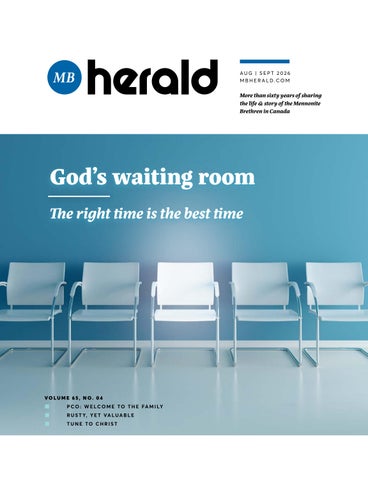
God’s waiting room
The right time is the best time
BY PHIL GUNTHER
“he has made eveRy Thing beauTiful in iTs Time.” ecclesiasTes 3:11
“all we have To decide is whaT To do wiTh The Time ThaT is given us.”
J.R.R. Tolkien
Idon’ T know abou T you, bu T i dislike waiting rooms. Sitting for long periods in an uncomfortable plastic chair and reading a tattered five-year-old Country Living magazine tests my patience. As a person of faith, waiting for God to answer a prayer can likewise be a disquieting experience. No matter how you slice it, waiting is a proving ground.
Over the years, I’ve discovered that existing in God’s waiting room is about his time (his overarching redemptive plan for creation) and timing (his plan specific to our individual situations). This truth, however, does not generally make time in God’s waiting room less of a challenge. As disciples of Jesus, we look to our faith and the Bible’s counsel for guidance in navigating these issues of God’s time and timing.
We pray for something significant in our life, and then we wait and wait and wait. We think, God, what is holding you back from acting on my prayers? God, I need help now! Why are you so slow to act?
There is no shortage of tensions in God’s interaction with our prayers and in his timing in responding to them. We won’t resolve all of them on this side of heaven; however, understanding some truths can help us navigate these tensions in our current season.
God has a timetable for everything
There are many biblical texts about God’s redemptive plan which employ phrases like: “At just the right time,” or “when the time was right,” or “in the course of time,” or “at the proper time,” or “at the appropriate time.” In addition, we have texts like Ecclesiastes 3:1: “There is a time for everything, and a season for every activity under the heavens.” And Psalm 139:16b says: “…
all the days ordained for me were written in your book….” The point is that when God looks at the world and your life, he has a timetable worked out specifically for them.
IN OUR MINDS, WE MAY THINK IT WOULD BE GREAT TO KNOW GOD’S DAY-TIMER FOR OUR LIVES. BUT WOULD IT REALLY BE GREAT?
God’s timing is largely an enigma
God reveals very little about his redemption timetable. For example, Jesus, responding to intense questions of when the kingdom of Israel would be restored, says: “…It is not for you to know the times or dates the Father has set by his own authority” (Acts 1:7). In the same way, God reveals very little about his timetable for the individual life journeys of disciples. Consider Ecclesiastes 3:11 (CEV): “God makes everything happen at the right time. Yet none of us can ever fully understand all he has done, and he puts questions in our minds about the past and the future.”
In our minds, we may think it would be great to know God’s day-timer for our lives. But would it really be great? Are there reasons why God does not reveal his timetable for the goings-on in our individual lives? Are there reasons we have to wait for God’s timing to play out?
I have some thoughts on these questions.
˚ Perhaps it is because the Creator God has not created humans to know these things. The Bible discloses that other than on very rare occasions, the future (the outworking of God’s timetable) is not ours to know.1
˚ It could be because we don’t have the capacity to understand God’s timetable; it would likely overwhelm our finite minds.
˚ As fallen people, we would likely default to using such knowledge selfishly.
˚ Perhaps God wants us to trust him and walk by faith because faith pleases him. Lysa Terkeurst writes, “God is working even when we can’t draw straight lines that show certain events are good for us.” 2
IN GOD’S WAITING ROOM, HE WANTS US TO MOVE FROM “GOD, WHY AREN’T YOU DOING THIS FOR ME?” TO “GOD, I WANT TO KNOW WHAT YOU WANT ME TO DO.”
God’s timing is perfect
This is a tough one for us. We have no hesitation declaring that God is omniscient (all-knowing), but we tend to doubt that he knows what he is doing when it comes to our particular lives. We give an affirming nod to the timelessness of God in songs like “Everlasting” by the late Brian Doerksen. We sing demonstratively the hymn “O God, Our Help In Ages Past” by Isaac Watts, which declares: “From everlasting you are God, to endless years the same.” In Christian circles, we say with conviction that God knows the beginning from the end. However, if we are honest, we don’t have a robust grasp of his timelessness. I would suggest that it means that God
1 Proverbs 27:1; Ecclesiastes 7:14; 8:7; 9:12; James 4:14
is present in the space where past, present, and future intersect. He has a perfect understanding of the best unfolding of our lives. We see what is in front of us; God sees what is beyond us. And so, God’s timing in our lives is never too early or too late — it is perfect. We want to hurry things along! God is right on schedule. We see the right now; God knows the right time. If God is perfect, his timing is also perfect. When you understand that God is never late, you wait differently.
God’s time and timing are a mystery this side of heaven; they are not random like the rolling of dice. There is a purpose here. What then should we think of the Bible’s instruction to wait on God? How do we position ourselves in God’s waiting room?
Waiting: a proving ground
In our current culture, we expect everything to be available now. We have almost zero patience. For many, to wait for something bends them out of shape. If I’m honest, when I’m waiting in a line for service of some kind, and things are moving too slow for my liking, I begin to chafe at the bit! If he wanted to, the Lord could make things happen the moment we express our request to him. Why doesn’t he? Why does God have us occupy his waiting room?
I’m convinced that God has us occupy his waiting room to:
˚ Strengthen our faith. It takes faith to wait. Consider also that waiting is a form of discipline that is intended to produce good in us (Hebrews 12:10b). The more we exercise our faith, the more resilient it becomes.
˚ Build our character. It is common wisdom that hard circumstances can foster godly character. Waiting for God to act when we have a heartfelt need and a pressing prayer is taxing. If waiting is causing us distress and doubt, ask, “Is the reason my situation isn’t changing because God is using it to change me?”
˚ Slow us down. We know all too well that we are hyper-busy people. Rush is the enemy of spirituality; waiting on God is its strength. Waiting on God strengthens our faith.
˚ Teach us something important. There are things we can only learn in God’s waiting room. Waiting time is not wasted time. Consider the Bible’s counsel: “Be still and know that I am God” (Psalm 46:10).
˚ Stop us believing we are the centre of the universe. The prophet Isaiah records the word of God: “Remember the former things, those of long ago; I am God, and there is no other; I am God, and there is none like me. I make known the end from the beginning, from ancient times, what is still to come. I say, ‘My purpose will stand, and I will do all that I please’” (Isaiah 40:9-10). The message is bold: God is God, and his purposes, plans, and timing prevail.
In God’s waiting room, he wants us to move from “God, why aren’t you doing this for me?” to “God, I want to know what you want me to do.” In God’s waiting room, he wants us to concede, “Your will be done in my life, in my marriage, at my work, in my school, with my health.”
As I mentioned earlier, God’s waiting room is a sort of proving ground. Just because you are in God’s waiting room does not mean he has given up on you, so don’t give up on him. 3 What should I do while I’m waiting for God to act? Can a disciple do more than just survive in God’s waiting room? I am convinced one can thrive there. Here are several helps:4
1. Fear not – trust God “But I trust in you, Lord; I say, ‘You are my God. My times are in your hands…’” (Psalm 31:14-15a). Trust God’s timing. Believe that our “right time” is scheduled. Scripture teaches: “…he who began a good work in you will carry it on to completion until the day of Christ Jesus” (Philippians 1:6). God knows that for some things, later is better. Joyce Meyer writes, “We don’t need to know all of the answers as long as we know One who does know, and that is Jesus.”5 In the waiting room, God is up to something. There is a deep purpose in the waiting. Part of our discipleship is learning to wait in faith. As I noted earlier, it is essentially a shade of discipline.
4 I acknowledge the influence of Rick Warren on the material that follows, from his sermon “When Your Plan Doesn’t Match God’s Plan.” YouTube
5 https://www.youtube.com/watch?v=m6pLtqFXRaA
Fretting is like running on a treadmill. It leaves us exhausted but gets us nowhere. Fretting never brings answers, just anxiety. Listen to the counsel of Scripture: “Don’t fret or worry. Instead of worrying, pray. Let petitions and praises shape your worries into prayers, letting God know your concerns” (Philippians 4:6 MSG). “If you will humble yourselves under the mighty hand of God, in his good time he will lift you up” (1 Peter 5:6 TLB).
3. Forget not – remember God’s blessings and promises
I find it amazing how the practice of identifying blessings transforms one’s heart posture toward God and moves one to worship. Philanthropist John Templeton once said, “Let no day go by without counting your blessing.” Regarding God’s promises, the Bible records: “God is not a man, so he does not lie. He is not human, so he does not change his mind. Has he ever spoken and failed to act? Has he ever promised and not carried it through?” (Numbers 23:19 NLT). There are many promises for disciples revealed in the Bible. These are rock-solid. God is faithful to his promises.
4. Faint not – persevere Don’t give up. Keep on keeping on. A delay is not a denial. Hear the encouragement of God’s Word: “Let us not become weary in doing good, for at the proper time we will reap a harvest if we do not give up” (Galatians 6:9). “So then, just as you received Christ Jesus as Lord, continue to live your lives in him” (Colossians 2:6). Friends, time and timing matter to the Father, and they mattered for Jesus’ ministry. Jesus understood that. The overarching truth regarding God’s time and timing is echoed in Isaiah 60: “At the right time, I, the LoR d, will make it happen” (Isaiah 60:22b). In short, what God has designed for you will be given to you. And so, my friends, fear not, fret not, forget not, faint not.
“TIME BRINGS ALL THINGS TO PASS.”
AESCHYLUS
PHIL GUNTHER is director of ministry for the Saskatchewan Conference of MB Churches.
Rusty, yet valuable
BY HELEN GUENTHER
As i appRoached the shopping carts at my local grocery store, I noticed that the next cart-for-hire was the rusty one. The thought of using it stopped me in my tracks. Based on previous experience, I presumed its service would be as lacklustre as its appearance. I sighed and reluctantly extended the cart some grace by slipping in the required fare. As we rolled into the store together, I had no idea of the adventure lying ahead.
As I walked past the produce, the cart’s wheels stiffened up, making it almost impossible to propel; I pushed the cart a little harder. By the second aisle, the wonky frame was pulling me off course; I hung on a little tighter. When I rounded the corner, the gummed-up bearings erupted into a cacophony of squeaks. At this point, I almost gave up on the old clunker and traded it in for a newer model!
That’s when it hit me — I am a lot like this rusty cart. As a retiree, the similarities between it and my own physique are undeniable. My pace has slowed
over the years. I am less steady on my feet than I used to be. And my joints have been known to groan in protest.
I also recognized that this cart, despite its shortcomings, still has a purpose — and I do, too. Even though my performance levels have waned, I am still able to provide my family with cooked-from-scratch dinners, organize you-are-always-welcome-here games nights for friends, and host thanksfor-loving-me-anyways cousin gatherings.
The slowed pace hasn’t stopped me from serving in church, either. I still have ample energy to make soul-boosting soups for shut-ins, enough strength to advocate for those with mental health challenges, and sufficient balance to climb the stairs to wash clothes for the homeless.
As time ticks on steadily and my physical abilities gradually decline, I’m trying to keep a positive perspective on growing older. There are plenty of “well-preserved” role models that God used in the Bible: Moses was 80 when God called him to lead Israel out of Egypt; Sarah was 90 when she gave birth to Isaac;
Noah was hundreds of years old when he helped build the ark. Truthfully, there are days when I’d like to trade in my worn-down body for a spryer one. But I would never want to give up the spiritual wisdom I have gained over the decades. Through all of life’s ups and downs, I’ve learned that God can take the less than capable things and use them for his more than glorious purposes.
Although I have no idea what adventures lie ahead in my golden years, I’m looking forward to rolling into the future with God, knowing that I’m as valuable today as I was in my youth (despite my age-related challenges). The continued fare I have to offer him is my surrendered heart. What I am sure of is that I’ll keep clinging tightly to God, just like I did when I was partnered with that rusty shopping cart. In doing so, I know I’ll stay the course until he finally calls me home.
HELEN GUENTHER is a freelance writer from Winnipeg, Manitoba. She attends One88 Church.
LISTENING AND LEARNING:
SUMMIT WITH LEADERS FROM AFRICAN DIASPORA CONGREGATIONS
On June 5-7, 2026 at Steinbach Bible College, nine pastors and an elder representing African diaspora churches met together with leaders from CCMBC, various provinces, and Multiply. As the number of newcomer congregations continues to increase within our MB family, the purpose of the gathering was to listen and learn from one another. All participants wanted to better understand how they could support one another in the shared mission of cultivating healthy disciple-making churches.
The summit began with participants introducing themselves, their families, and ministries. Each person was then asked to share about their family’s immigration story, whether it was recent or many years ago. Most described a desire to escape severe hardship from war, famine, persecution, and a lack of any type of future for their children.
The weekend focused on responding to the following four questions:
WHAT ARE THE CHALLENGES FACED BY NEWCOMER CHURCHES?
˚ Language barriers
˚ Lack of financial resources
˚ Facility needs
˚ Next generation divide
WHAT DOES TOGETHERNESS LOOK LIKE?
˚ New Canadian churches willing to contribute
˚ New Canadian leaders involved in the denomination
˚ Increased curiosity about each other
˚ Growing opportunities for networking and fellowship
WHAT DOES FRUITFULNESS LOOK LIKE?
˚ “Legacy” and new Canadian churches must “go” out with the gospel: making disciples who make disciples
˚ We must empower, train, and release into ministry the next generation
WHERE DO WE GO FROM HERE?
˚ Focus on leadership training
˚ Help with evangelizing in a Canadian culture
˚ Provide resources for the ministry of the church
Participants proposed viewing Canada itself as a joint mission field where both groups can learn together: “Canada is a mission field which we are all called to reach with the gospel.” There was also a call to move beyond “newcomer culture” vs. “Canadian culture” to build a unified “Kingdom culture” where everyone feels like they belong. The summit closed with this challenge from the newcomer leaders: for this meeting to be fruitful, denominational leadership needs to be responsible for providing feedback, next steps, and concrete timely follow-up.
SKMB COMMUNICATIONS, WITH FILES FROM MB HERALD STAFF
TUNE TO CHRIST
BY TRACI JOHNSTON
Come, thou Fount of every blessing; Tune my heart to sing thy grace; Streams of mercy, never ceasing, Call for songs of loudest praise.
—From Robert Robinson’s 1757 hymn “Come, Thou Fount of Every Blessing”
IT ’s one of my favouR i T e hymns. i’ve sung “Come, Thou Fount of Every Blessing” more times than I can count. Recently, when I came upon the line, “Tune my heart to sing thy grace,” I reflected on the occasions I had seen an orchestra perform.
Have you ever experienced the brilliance of listening to orchestral instruments tune before they play a symphony? The hall goes quiet as the crowd silently anticipates what is to come. The lead violinist stands and motions for the oboe to play a “concert A,” and section by section, the orchestra tunes to that note.
There is something magical about the process. The musicians have yet to perform any music, but they begin by really listening to each other. Although there are many different instruments, they play in unison, fine tuning until an individual cannot be heard over the group. Each instrument is a vital contributor, and through the tuning process, individuals come together to make a full, beautiful, unified sound.
It strikes me that this is a beautiful description of what the church should be like. Everyone has distinct gifts, and each person is needed to be the church. Yet not one person is more important than the other. We are to be unified and support each other, meeting together and encouraging each other. We are to be a community coming together to praise the name of God and make his name known.
And why is it that the oboe is the instrument to which the orchestra tunes? The oboe’s sound does not fluctuate with temperature and humidity like other instruments. The oboe does not have adjustable slides and strings, so its tuning is set before the performance, making it a reliable reference for the entire orchestra. The oboe also
has a clear and penetrating sound that cuts through any ambient noise.
To me, the oboe is a picture of God. God is unchanging, reliable, and stable. He is our immovable rock. We can count on God to be the same yesterday, today, and tomorrow (Hebrews 13:8). Jesus’ voice is also recognized by his followers (John 10:1-5). We learn to hear God’s still, quiet voice above the ambient noise and distractions in the world. Like the oboe, the Lord is pure. We are instructed to be holy because he is holy.
JESUS IS OUR CONCERT A. WE NEED TO TUNE TO HIM. WHEN WE DO SO, THE ENTIRE CHURCH, REGARDLESS OF INDIVIDUAL, NATION, OR DENOMINATION, WILL BE PERFECTLY ALIGNED AS WE FOLLOW CHRIST.
performance. This reminds me of I Corinthians 3:11:
“For no one can lay any foundation other than the one already laid, which is Jesus Christ.” Christ is our foundation, our cornerstone, and unless the Lord builds the house, the workers labour in vain (Psalm 127:1).
Jesus is our concert A. We need to tune to him. When we do so, the entire church, regardless of individual, nation, or denomination, will be perfectly aligned as we follow Christ. We will all be singing the same song in harmony and unity as we praise God.
Without tuning, the orchestra can never achieve unity and coherence. It’s why even the youngest musicians learn to tune early on, as it builds a solid foundation for their musical ear. Tuning is the bedrock of a great orchestral
So let’s tune our hearts to God, concentrating on him, connecting with each other. After all, we are in rehearsal for the greatest concert of the age when we meet in heaven. Let’s live in anticipation of that glorious time!
TRACI JOHNSTON is a farmer’s wife and mother to two adult children and their spouses. She attends Westside Community Church in Morden, Manitoba.
Our CCMBC theme for 2026 continues to be Pray First! Pray Always! 1 Thessalonians 5:17 is the foundation verse telling us to “pray continually.”
For 2026 we want to deliberately and intentionally pray for the “peace of Christ” to rule in our hearts (Col 3:15). When the peace of Christ rules in our hearts, we will have a peace with God that overflows into peace with others, peace with ourselves, and peace with creation.
Each month, we will focus on a certain element of the peace of Christ so that we can more fully appreciate the depth and beauty of this peace and live it out in all our relationships. These prayers should lead us to greater worship of the Triune God who has brought peace through Jesus Christ (Acts 10:36). We are praying that the “peace of God, which transcends all understanding” will guard our hearts and minds in Christ Jesus (Phil 4:7). We are also praying that through our prayers we will become more faithful peacemakers who can rightly be called “children of God” (Matt 5:9) and “reap a harvest of righteousness” (Jas 3:18). Finally, we are praying for the peace of Christ to become real for family, friends, neighbours, and enemies who do not yet know this peace. May there be peace on earth!
We are excited again this year to welcome a variety of writers from our MB family across Canada as they share their own insights and guide us to pray more faithfully. May 2026 be a year of transformation so that we would embrace and live out the peace of Christ faithfully in a world of hostility, vengeance, and violence! “Now may the Lord of peace himself give you peace at all times and in every way. The Lord be with you all” (2 Thess 3:16).
Please note: this month’s prayer column specifically addresses married disciples of Jesus within our churches. In an upcoming month, we will be writing to and praying with single disciples of Jesus.
AUGUST 2026 PRAYER GUIDE
Praying for peace in marriage
Put on then, as God’s chosen ones, holy and beloved, compassionate hearts, kindness, humility, meekness, and patience, bearing with one another and, if one has a complaint against another, forgiving each other; as the Lord has forgiven you, so you also must forgive. And above all these put on love, which binds everything together in perfect harmony. And let the peace of Christ rule in your hearts, to which indeed you were called in one body. And be thankful.
—Colossians 3:12-15
We have been inviT ed To pR ay for Christ’s peace in several important areas over the last few months. This month, we pray for peace in marriage. This sacred covenant, uniting a man and woman before the Creator, is one of the most important things we bring before his throne in prayer. Christ’s peace is not the absence of conflict or hardship. It is his ruling presence that enables spouses to respond to one another with humility, truth, forgiveness, and love, even when their marriage is under attack. We see evidence all around us that one of the enemy’s favourite strategies is to destroy this beautiful covenant by tempting husbands and wives toward pride, selfishness, deception, and unforgiveness.
Peace in marriage — the foundation of our homes — sets the tone for just about everything else in our lives: as we parent, as we serve in ministry or in the marketplace, and even our simple, everyday interactions.
In Colossians 3, Paul in his no-nonsense way tells the church that for those who have been raised with Christ, there is a whole new way to live, a putting on of a “new self” (v. 9)! As God’s chosen ones, we are to clothe ourselves in these styles that are not so “on-trend” in the world around us. Although Paul is addressing the whole church, nowhere are these Christlike qualities tested more consistently than in marriage.
Picture a glowing bride, at long last, taking those final steps down the petal laden aisle toward her awaiting groom. As my husband Scott and I took each other’s hands on our wedding day, the aisle continued before us into the future, laden with a whole life of fragrant hopes and vibrant
dreams. In that moment, love and peace were so easily slipped into as garments for the journey.
Marriage is often painted as “Happily Ever After.” While God has created it to be our most fulfilling and intimate earthly relationship, Scripture never promises it will be easy. It is critical to understand that we must prepare ourselves as a couple, because the attacks will come.
What does preparation look like? It begins on our knees. We can do nothing in our own strength, so we ask God to help us with putting on the “armor” of our new self. Compassionate hearts, kindness, humility, meekness, patience, and forgiveness become protection against all that threatens our marriages. As we let the peace of Christ rule in our hearts, the enemy loses his foothold. Though attacks may still come, Christ strengthens us to stand faithfully and to respond in ways that honour him.
As a young newlywed, it was not the true peace of Christ I sought, but a false peace manufactured by avoiding conflict, pretending everything was fine. I didn’t want to rock the boat in our relationship. It seemed easier to ignore the nudges to have necessary hard conversations. Our marriage looked perfect on the outside — but the enemy thrives in an environment of false pretenses. Paul says, “Do not lie to one another seeing that you have put off the old self with all its practices” (v.9). Because I was doing very little to intentionally invite Christ’s peace to rule in my own heart, it was a slippery slope from avoiding conflict and pretending to outright lying and deception. My old self crept up from the grave and, after 10 years of marriage, I walked out on my husband to pursue a relationship with another man. The firm foundation that our two little boys knew was shattered. Oh, how Satan must have cheered!
I was consumed with self. This part of my story is so ugly, but I simply cannot talk about the importance of marriage without including what I almost destroyed, but for the grace of God. For two and a half years, in his pain and heartache, Scott “sought the things that are above, where Christ is seated at the right hand of God” (v.1). As he began to meet
regularly with three other godly men for prayer and Bible study, his words and actions toward me were kind and compassionate, quite contrary to the world’s response. Scott was quietly allowing Christ to prepare his heart while I was blindly bowing to the enemy. God used Scott’s witness, the mentorship of a dear couple from our church, and the prayers of many — especially those of my sons — to open my eyes to the destruction I was causing and bring about humility and repentance. The commentary in my Bible describes the humility Paul calls us to put on as “the perfect antidote to the self-love that poisons human relationships” — and I couldn’t have described it better!
Through Christ in him, Scott forgave one of the worst betrayals one can experience. I truly believe this would be impossible for anyone to do in their own strength. In fact, marriage as designed by the God who is love cannot be done well in our own strength. This is why we must put on our new self every day, continually growing to be more like Christ in our words and actions with our spouse. In May, Scott and I celebrated 26 years of marriage and 13 years since God brought hope to our desperately hopeless situation, restoring our marriage and healing our relationship. As we daily strive to put on compassion, kindness, humility, meekness, patience, and forgiveness (however imperfectly) Christ’s peace continues to guard our marriage and has helped us make it into a marriage that is far better than before!
As we pray this month for peace in our marriages, may we ask God to renew us daily to make us more like Christ. Whether our marriages are flourishing, struggling, or in need of miraculous restoration, may the peace of Christ truly rule in our hearts and homes.
CONSIDER:
As we pray for peace in our marriages today, let us spend some time doing the following: Praise God for his design of marriage and thank him that his peace is available even amid conflict and brokenness.
Pray that Christ’s peace would rule in your own heart first, clothing you with compassion, kindness, humility, meekness, patience, forgiveness, and love toward your spouse.
Confess any areas where pride, selfishness, bitterness, avoidance, or unforgiveness have taken root, and ask God to help you put on your new self each day to become more like Christ.
Pray for protection over marriages in your family, your church, and your community, asking God to strengthen couples against the enemy’s attacks and to bring hope and restoration where relationships have been wounded.
PRAYING FOR PEACE IN MARRIAGE:
Holy God, you are perfect love. You have designed marriage as a beautiful covenant that unites us with our spouse in a way intended for no one else. In our brokenness, we often turn it into something that is not so beautiful. We are grateful that in your perfect love for us, you show us how to love one another. Help us who are husbands and wives to put off our old, inwardly focused selves so that we may reflect your character to one another. Help us to let the peace of Christ rule in our hearts, so that our marriages may be a testimony of the gospel of Christ. Give us wisdom, as a church, in how to be advocates for healthy marriages, willing to encourage, walk alongside, and pray for couples in every season so that our homes are filled with your peace, and our marriages bring glory to your name. In the name of Jesus, our Prince of peace, amen.
TERRI-LEE BROESKY
lives in Woodridge, Manitoba and is the moderator at Steinbach Mennonite Brethren Church.
Praying for peace in our schools
Finally, all of you, be like-minded, be sympathetic, love one another, be compassionate and humble. Do not repay evil with evil or insult with insult. On the contrary, repay evil with blessing, because to this you were called so that you may inherit a blessing. For,
“Whoever would love life and see good days must keep their tongue from evil and their lips from deceitful speech. They must turn from evil and do good; they must seek peace and pursue it. For the eyes of the Lord are on the righteous and his ears are attentive to their prayer, but the face of the Lord is against those who do evil.”
Who is going to harm you if you are eager to do good? But even if you should suffer for what is right, you are blessed. “Do not fear their threats; do not be frightened.” But in your hearts revere Christ as Lord. Always be prepared to give an answer to everyone who asks you to give the reason for the hope that you have. But do this with gentleness and respect, keeping a clear conscience, so that those who speak maliciously against your good behavior in Christ may be ashamed of their slander. For it is better, if it is God’s will, to suffer for doing good than for doing evil.
—1 Peter 3:8-17
As a new school yea R begins, we want to spend some time praying for those who are going back to school. From our youngest new students to our oldest staff members, let’s pray that our fellow followers of Jesus would be people of integrity and courage, who turn from evil, do good, and seek peace.
Schools are filled with people who hold differing worldviews and strongly held opinions and beliefs, which will inevitably result in disagreements and conflict. Peter reminds believers to hold tightly to the message of the gospel and to live out their convictions of being people who bless and serve others, especially towards those who would oppose them. He reminds us that as followers of Christ, we ought to lead with compassion and love, to generously bless rather than stoop to the same low level that others might use against us. To live in such a way that when someone speaks ill of us, others would instead believe the reputation that our good behaviour has built.
Schools provide students with great pressure to conform to the crowd, and it takes deep courage and conviction for students to swim against the tide. In addition to normal peer pressure, students today also face additional challenges in our fast-moving world. Technology adds extra layers of complexity to students who are already in a vulnerable season of life. Through social media, they can see in real time when all their friends are hanging out together without them and feel the pain of not being included. They could be victim to cyber bullying. Any mistake they make could be posted online for all to see, and a permanent record of a juvenile bad decision could have serious consequences for their future opportunities. The pressure to appear perfect can feel crippling. AI can tempt them to take shortcuts that ultimately teach them
nothing — the path of least resistance appears irresistible to many, while the path of righteousness feels lonely and hard.
Peter’s ancient words still hold wisdom for the unique challenges this generation faces. Love, compassion, humility, speaking words of truth and blessing, turning from evil to pursue good, seeking peace, focusing on God even as he is attentive to your prayers, trusting in his protection, being ready to share the hope found in Jesus, defending your beliefs with gentleness and respect, being prepared to suffer for doing what is right.
Students can heed Peter’s call to live with integrity, with their actions aligning with their stated beliefs. This can be expressed through small choices, as simple as going to class on time with homework done and school supplies ready. Or it could be demonstrated through staying calm and gracious when conflict arises between a peer or teacher. When students show compassion and curiosity rather than become defensive and rude, they can demonstrate how highly they value others, even those with whom they disagree. These are the kinds of ways they can build good reputations that will withstand slander.
Peter reminds believers to always be prepared to share their own story of hope in Jesus, and we want students to be able to articulate their faith clearly. When they stand firm in their convictions, it’s likely that someone will notice.
One helpful tool is to prepare a 15-second testimony to open the door to further conversation. This can sound like, “Before I knew Jesus, my heart was filled with pride and judgment, but when I received his forgiveness and decided to follow him, he helped me stop being so self-focused and filled my heart with compassion for others. Do you have a story like that?” Using a simple tool like this can take some of the pressure from students feeling like they have to know all the answers to all the questions before they can share their faith with others.
CONSIDER:
˚ Pray for students to walk with integrity. It is so easy to compromise values to try to fit
in, but this keeps them from experiencing inner peace when their beliefs and actions are in conflict.
˚ Pray for opportunities for students to share their faith with others.
˚ Ponder how you might compose your own 15-second testimony to always be prepared to give a reason for the hope that you have. (I once was _______ and _______ but Jesus saved me and taught me to follow him. Now I am becoming _______ and _______. Do you have a story like that?)
˚ Pray for students to respond graciously when a teacher or peer says something offensive.
˚ Pray for students to have courage to respectfully live out their convictions, keep their words pure, pursue righteousness, and be peace-makers.
Jesus, our students face pressures in schools that we don’t fully understand. They truly want to be your followers whose lives look more and more like you, so help them to embrace others with welcome, curiosity, and compassion, to turn the other cheek rather than strike back, and to be marked by love. When their natural inclination is to go along with the crowd to fit in, even when it goes against their values, help them to walk in integrity, to love you above all else, and care more about your kingdom than the opinions of those around them. Rather than avoiding suffering at all costs, give them courage to do what is right even when it hurts. Fill them with your peace that isn’t contingent on circumstances and hear their prayers. Amen.
MEGHAN PLETT
is a member Cornerstone Community Church in Virgil, Ontario and is also a member of ONMB’s Board of Directors. She works at Eden High School Spiritual Life Centre in St. Catharines, Ontario.
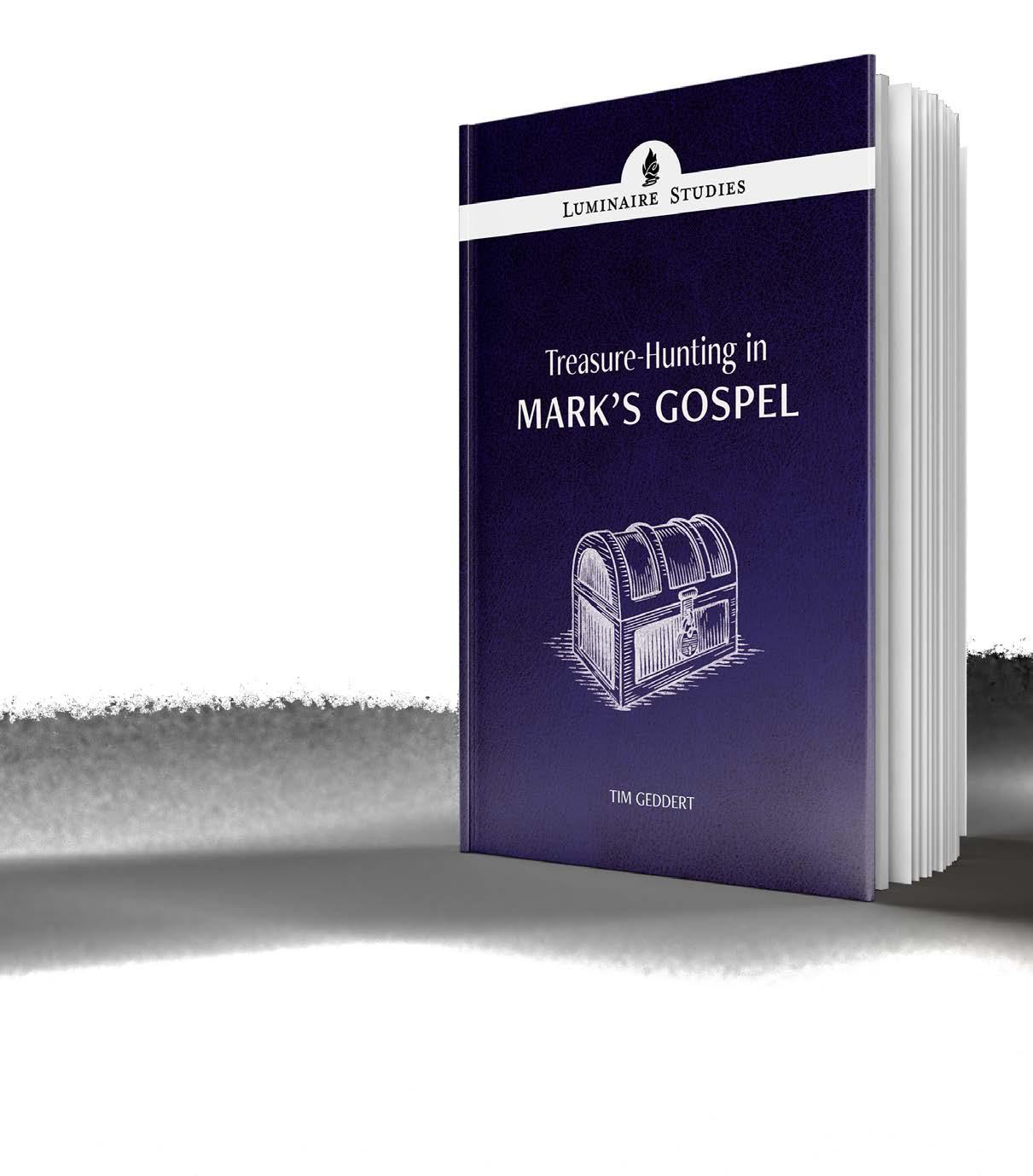
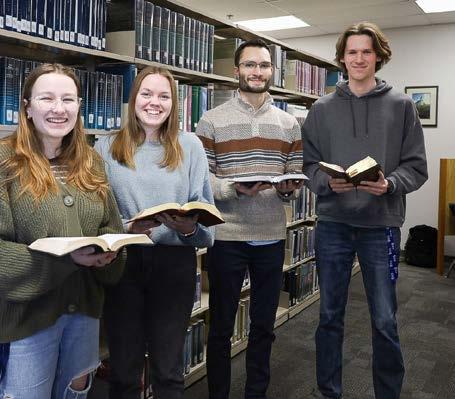
A prolific author and respected theologian, Tim Geddert has resourced churches, schools, and conferences around the globe. For 37 years, he served as a professor of New Testament at Fresno Pacific University in Fresno, California.
HENRY H. DUECK
Henry H. Dueck accepted Jesus as Saviour in his early teens and was baptized in the South Saskatchewan River near Borden, Sask. Along with leading church choirs in whatever city he lived and working to support himself, Henry’s life could be explained in three phases. His first phase is characterized by his love of studying: he graduated from Briercrest Bible College, the University of Alberta in Edmonton, and the University of Calgary. Before his university studies, he also obtained the accounting designation of CPA. Henry’s second phase started in 1980 when he joined the staff at the Canadian-built Kenya Technical Teachers’ College in Nairobi. From there, he was accepted by the International Mission Board of the
Southern Baptist Convention. This took him to Zimbabwe, Botswana, back to Kenya, and then South Africa for 20 years. Phase three began in 2003 when he retired from the mission and began being treasurer – first for the Strata in which he lived, and then for Clearbrook MB Church. He retired again in 2025 – this time to continue his life-long practice of Bible reading and prayer for needs at home and around the world. Henry died at Abbotsford Regional Hospital at age 90, and he was ready to go. He felt his life was marvelously blessed.
Birth: January 17, 1936, Birthplace: Langham, Sask., Death: March 23, 2026, Parents: Henry A. & Anna Dueck, Married: Ila-Mae Beck, June 10, 1960, Saskatoon, officiated by his brother Abram Dueck of Watrous (Sask.) MB, Family: nieces & nephew Denise VanDijk of Vancouver, R. Renee Lepp of Surrey, B.C., David Dueck of Edmonton Church: Clearbrook MB, Abbotsford, B.C.; Mount Baker Baptist Church, Wash.; churches in Zimbabwe, Kenya, Botswana, South Africa
Delegates approve changes to CCMBC’s General Operating Bylaw and adopt new governance structure
During CCMBC’s online Annual General Meeting (AGM) held on June 18, 2026, over 100 delegates from member churches across Canada voted in favour of changing the structure of their governance model.
Delegates voted to approve the draft revised and updated CCMBC General Operating Bylaw (GOB) as well as the 4.0 Updated Governance Proposal.
Going forward, delegates for CCMBC’s AGM are from Member Organizations only — which includes delegates from each provincial conference, MB Seminary, Multiply, and CCMBC Legacy Fund. Individual church members are welcome to attend the AGM as guests but would not have any voting rights or responsibilities. In matters pertaining to changes to General Operating Bylaws and the MB Confession of Faith, a special member assembly will be created, inviting members of churches to directly participate in these discussions and decisions.
Before the voting commenced, Executive Board Governance Committee member Michelle Knowles outlined some of the reasons why these changes are necessary. The new governance proposal, said Knowles, will better align CCMBC to the original collaborative model that was accepted in 2019. Additionally, it has potential for greater communication and feedback, as members are more inclined to participate in the various provincial gatherings over a national AGM, said Knowles. The feedback provided at the provincial level will make its way to the National Council for collective discernment. Also, Knowles acknowledged, quorum has become difficult to achieve at a national AGM.
During the discussion time, some members had concerns about how these changes will affect the capacity of people to hear from other provinces and perspectives on the issues being discussed. There were also practical questions on how delegates are chosen and the mechanisms by which they will be representing the collective viewpoints of their provincial members. Various members of the Executive Board spoke to these issues, including Vijay Manuel,
Michelle Knowles, Tim Doerkson, and Cam Stuart.
After the vote, Executive Board Moderator Tim Doerksen said, “As a board, we are excited for where this can lead us as churches in our conference.” He acknowledged the time and effort the governance committee has spent on updating these policies, as well as for member engagement in these discussions at the provincial gatherings these past few months.
Verbal updates were also heard from CCMBC Executive Board Moderator Tim Doerkson, CCMBC’s National Director Cam Stuart, Director of National Faith and Life Team Ken Esau, CCMBC Legacy Fund CEO Jason Krueger, MB Seminary President Mark Wessner, and Multiply Director Bruce Enns. All reports were accepted.
During his verbal report, National Director Cam Stuart said he was encouraged by the unity, shared vision, and quality of leadership he has seen as he travelled across the country this past spring. He thanked God for this season in our denomination. He said he wants to continue to learn how to collaborate effectively for a collective impact within the areas we have churches — and beyond.
Cory Regier, FAC Chair/Treasurer and Jim Bell, CFO of CCMBC Legacy Fund, presented the 2026 budget. There were significant cuts made to ETEQ, ICOMB, and MB Seminary. Bell acknowledged this difficult decision: “The expense lines are as thin as they are going to get. We want to do everything we can towards making break-even — or better.”
The 2026 budget was passed.
The following new members were accepted, or terms extended:
Executive Board
Tim Doerksen — Executive Board Moderator
Vijay Manuel — Executive Board Assistant Moderator Corey Regier — FAC Chair/ Treasurer
Walter Fast — MBCM Representative Gord Schroeder — SKMB Representative Glen Madden — BCMB Representative Bertha Dyck — Executive Board Member at Large Ryan Jantzi — Nomination Committee
MULTIPLY BOARD
Bryan Born
NATIONAL FAITH AND LIFE TEAM
Kristal Toews Gil Dueck
MCC ANNUAL GENERAL
MEETING REPRESENTATIVE
Dave Ens
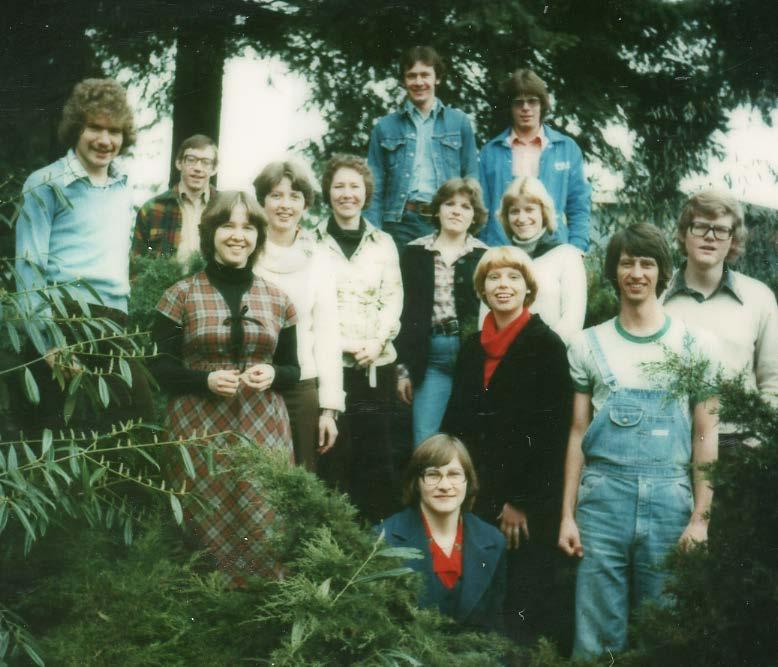
A MOMENT IN TIME
ABBOTSFORD, BRITISH COLUMBIA | 1978
Columbia Bible Institute students going into their summer assignments. Students pictured are (l-r): Dan Zacharias, David Reimer, Carol Riekman, Doreen Daniel, Carol Sawatzky, Delores Peters, Eleanor Neufeld, Howard Wall, Etta Leigh, Lisa Bock, Arnie Wall, Randy Klaassen, and Harold Dick.
Courtesy of Mennonite Archival Information Database.
SUBSCRIBE TO MB HERALD DIGEST WWW.MBHERALD.COM/SUBSCRIBE-VIA-EMAIL