Mennonite Brethren Herald is published bimonthly by the Canadian Conference of Mennonite Brethren Churches, primarily for the use of its members, to build a Canadian MB community of faith. We seek to 1) share the life and story of the church by nurturing relationships among members and engaging in dialogue and reflection; 2) teach and equip for ministry by reflecting MB theology, values, and heritage, and by sharing the good news; 3) enable communication by serving conference ministries and informing our members about the church and the world. However, the opinions expressed here are not necessarily those of the church as a whole.
Digest
JUNE/JULY 2026 | VOLUME 65, NO. 03
EDITORIAL OFFICE
1310 Taylor Avenue Winnipeg, Manitoba R3M 3Z6
Phone: 204-669-6575
Toll-free in Canada: 888-669-6575
MBHERALD@MBCHURCHES.CA WWW.MBHERALD.COM
ISSN: 0025-9349
The Mennonite Brethren Herald is a publication of
3 UNDERSTANDING CCMBC LEGACY’S CURRENT CIRCUMSTANCES
CANADIAN CONFERENCE OF MENNONITE BRETHREN CHURCHES
CONFÉRENCE CANADIENNE DES ÉGLISES DES FRÈRES MENNONITES
14 A HERITAGE WORTH PRESERVING Traci Johnston
20 MENNONITE BRETHREN: IT’S NOT JUST A NAME
Stephanie Christianson
22 PRAYING FOR PEACE IN THE CHURCH Andrew Dyck
Sharing the life and story of Mennonite Brethren in Canada
16 COVER STORY HOW TO AI-PROOF YOUR CHURCH Mike Engbers
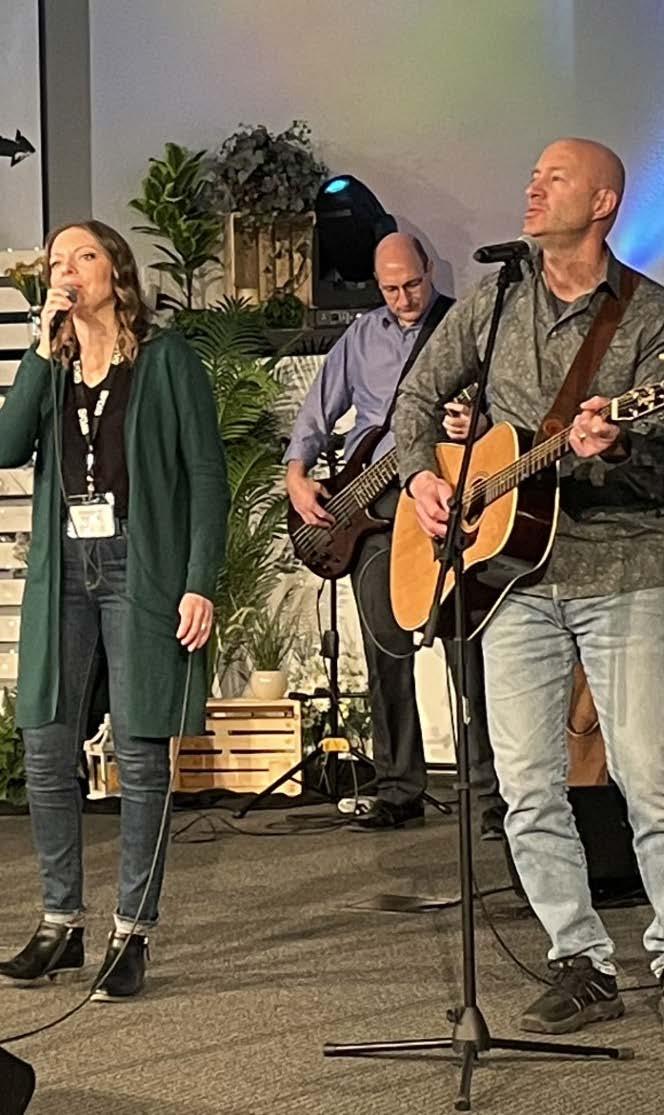
West Portal Church’s Andrew Klassen and team lead worship at the SKMB Assembly on March 27-28.
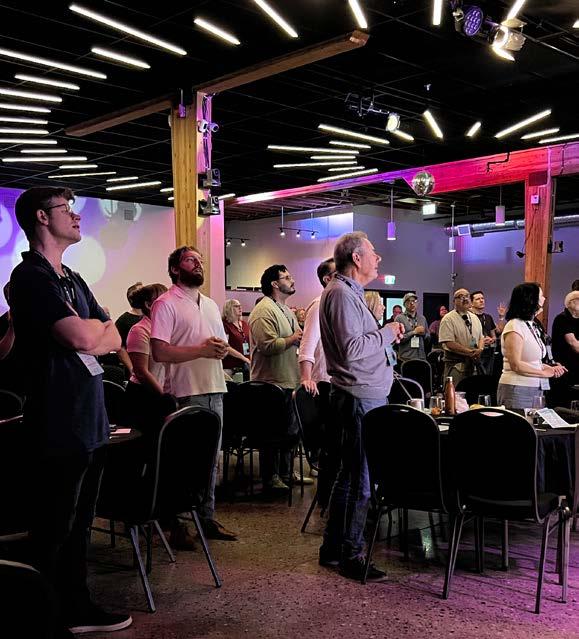
Read summaries of the British Columbia, Saskatchewan, and Quebec assemblies starting on page 5.
26 PRAYING FOR PEACE BETWEEN GENERATIONS
Renée Serez
FROM THE EDITOR
I’M NOT A FAN OF ARTIFICIAL INTELLIGENCE. AT ALL. Still, I use it every day to proofread messages, craft social media captions, generate book summaries (of books I have read — honest) and more. My gripe with AI is its propensity to replace skilled human labour and expertise. Think of writers and researchers bypassed by chatbots, the graphic designers, and, believe it or not, the therapists usurped by AI.
I am a visual artist. I draw birds and wildlife and post my work online. AI combs through my artworks, dicing them into bits and pieces (along with other artists’ work) to generate new works. Brushstrokes replaced by keystrokes; hours of time and effort cut down to minutes of computer processing, human emotion substituted with ones and zeros. My art is dear to me—it’s what gets me through difficult times and is part of my identity.
Imagine, then, how much greater the anxiety might be when we apply AI in the context of the church. We find comfort and belonging in community; we feel both grounded and uplifted by (authentic) theological teaching. What happens when AI enters the walls of the church? Now imagine the pressure put upon our pastors and leaders to navigate this well.
It’s human nature to fear what we don’t understand, and we need trusted opinions and sound advice before we feel remotely comfortable adopting new things. Thankfully, we have discerning, theologically trained new adopters in our midst who are leading the conversation around AI and sharing their learnings with the broader MB family. In our cover story, Mike Engbers (who, last I checked, is a living, breathing human being) tells us that “AI-proofing [the Church] involves shaping the church around our identity as followers of Jesus, not around AI.” Mike recommends focusing on four key areas to ground our ministry in Christ and address the negative effects of AI on the church: truth, community discernment, relationships, and care.
Additonal perspectives are given on pages 20 and 21. MB’s are talking about AI—a lot. If you’re open to continuing the conversation with MB Herald, I encourage you to contact us—we want to hear from you.
Our Annual General Meeting is fast approaching. It’s a significant meeting for CCMBC as we bring updated General Operating Bylaws to the floor. Before I sign off, I want to encourage you to connect with your church and be registered as a delegate. These changes affect us all, and we don’t want to leave anyone out of the process.
My thanks to all of our contributors, to our advertisers, and also to you, the readers.
Peace,
Carson
CARSON SAMSON Editor
VISIT THE WEBSITE TO READ MORE ARTICLES BY MIKE ENGBERS ON AI AND THE CHURCH:
Developing a theology of technology
Five questions to ask
Tools for Gospel Ministry
VISIT THE AGM WEBSITE TO VIEW THIS YEAR’S MOTIONS AND REGISTER
na.mennonitebrethren.ca
A LETTER TO OUR CHURCHES
UNDERSTANDING CCMBC LEGACY’S CURRENT CIRCUMSTANCES
Dear Brothers and Sisters, Grace and peace to you in Christ.
We recognize that many within our churches are hearing about Legacy’s current circumstances for the first time. When information is incomplete, it is natural to draw conclusions or connect what we are hearing today with what has happened in the past. Some have understandably linked this situation with what was shared in 2019 in the report “Telling our financial story.”
We are writing to provide a clear and simple explanation so that you can understand what is happening, and just as importantly, what is not.
WHAT THIS IS NOT
Our present situation is not a continuation of the issues described in “Telling our financial story.”
That earlier period involved challenges such as overspending relative to income, governance gaps, write-downs related to building valuations and certain loans, and the complexity of expanded ministry efforts. Those realities were acknowledged openly, and meaningful changes followed.
(For additional background on that season, you may also find helpful the article “A wake up call.”)
We operate differently today because of those lessons, through stronger governance, clearer accountability, and improved financial practices.
WHAT HAS HAPPENED NOW
Legacy stewards funds entrusted by individuals, churches, and partner organizations to provide ministry-focused financial services that facilitate Kingdom growth. Legacy serves as a resource
to CCMBC conferences, churches, agencies, and employees. This includes providing payroll and accounting services, administering group benefits and pension plans, and supporting churches and pastors through mortgage financing.
For more than 40 years, investors have supported CCMBC’s church mortgage program, an expression of shared stewardship that enables churches and pastors to establish and sustain a faithful presence in the communities they serve. Through this partnership, investors facilitate Kingdom growth across our conference, impacting more than 230 MB congregations and approximately 1,000 employees from British Columbia through Quebec. Today, almost every MB church and church employee uses at least one of Legacy’s services.
Over time, this program has helped fund nearly 800 Mennonite Brethren church and pastor mortgages, supporting ministry across Canada. Legacy also accepts deposits from MB churches and partner organizations. CCMBC Investments, which is part of Legacy, sells notes to individual investors and non-MB organizations, with these funds used primarily to finance mortgages for MB churches and related organizations across the country.
For those interested in how this ministry began, more information is available here.
From time to time, when more funds are received than are immediately needed for mortgages, excess funds have been invested through an external manager in a diversified investment portfolio.
In early 2026, we learned of the magnitude of a significant write-down in portions of that investment portfolio and promptly informed investors.
CANADIAN CONFERENCE OF MENNONITE BRETHREN CHURCHES
In simple terms:
˚ Some of the investments lost value unexpectedly
˚ These losses reduced the overall value of the portfolio
˚ This affected Legacy’s overall financial position
At the same time:
˚ Access to these invested funds has been restricted or delayed by the external manager
˚ Some risks and liquidity limitations were not clearly communicated to us as they changed
˚ Repayment requests increased to levels significantly above what we typically experience
This combination of loss in value and limited access to funds, together with a significant increase in repayment requests, has created the current challenge. As a result, we are not always able to access cash as quickly as needed, and repayments to individual investors are being made proportionately as funds become available, while church-related withdrawal requests have continued to be met in full. We remain committed to honoring all repayment requests.
WHAT THIS MEANS
This situation is best understood as a liquidity challenge shaped by investment losses, not a failure of the core ministry.
˚ Repayments will continue as funds become available
˚ All participants are being treated fairly and consistently
˚ Timing depends on when funds can be accessed
And importantly: The mortgage program supporting our churches continues to be the backbone of Legacy’s work.
OUR COMMITMENT TO YOU
We recognize that those who partner with Legacy, both individuals and churches, have entrusted us with resources that are deeply meaningful.
We understand that this situation may create concern, and we do not take that lightly.
We are committed to:
˚ Transparency – communicating clearly and honestly
˚ Fairness – treating all consistently
˚ Stewardship – carefully managing what has been entrusted to us
˚ Accountability – taking responsibility for our decisions and actions
OUR PATH FORWARD
We are actively working on a plan to move forward from this situation.
This plan exists to ensure:
˚ Financial recovery. Addressing the impact of the investment losses and rebuilding financial strength over time.
˚ Operational credibility. Strengthening processes, oversight, and decision-making to reinforce confidence and trust.
˚ Long-term ministry sustainability. Ensuring Legacy can continue serving churches faithfully for years to come.
This work is being guided by the values that have always shaped Legacy: stewardship, service, accountability, and transparency.
While this process will take time, it is grounded in a clear commitment to rebuilding both financial strength and trust.
A CLOSING WORD
We recognize that trust, when strained, must be rebuilt with patience and care. That is our commitment.
We are grateful for your prayers, your patience, and your partnership in ministry.
Above all, we are reminded that our confidence rests not in financial systems, but in the Lord who sustains his church.
“Let us hold unswervingly to the hope we profess, for he who promised is faithful.” (Hebrews 10:23)
With gratitude,
Tim Doerksen Moderator,
CCMBC Cory Regier Board Chair, CCMBC Legacy Fund
BCMB: REIMAGINE HOW WE LEAD
RICK BAYER
God is actively at work across British Columbia! Recently BCMB leaders gathered from April 24-28 in Kelowna to celebrate and share stories of God moving in our midst.
The five days featured three events designed to train, encourage, and refresh pastoral leaders, their spouses and church delegates.
The weekend began with a Friday equipping day for leaders called Elevate. Keynote speakers Mark Wessner from MB Seminary and Steve Brown from Columbia Bible College addressed the themes of humility and courage. This teaching was reinforced through interactive roundtable discussions, where pastors explored practical applications for their personal lives and ministry contexts.
The day also included breakout session for participants. Topics included: leading for gospel multiplication; a flourishing leader has a constellation of relationships; staying on the line: guide for faithful leadership and ministry; walk the talk: leading people to practically live out the gospel of Jesus; and building resilience in ministry.
The day concluded with a meaningful Friday evening pizza and prayer night. Using the acronym of A.C.T.S. the participants adored God, confessed sins to one another, gave thanks and interceded for one another.
Saturday’s convention was a celebration of God stories connected to our four pillars in the BCMB: church renewal, developing leaders, multiplying churches, and building community. A highlight included welcoming five new churches into BCMB membership: Praxis Church (Kelowna), Promontory Church (Chilliwack), Sunrise Church (East Vancouver), Redeemer City Church
(Surrey), and Christ Church Kitsilano (Vancouver).
Attendees also heard testimonials of church renewal from New Hope, Greendale, and Killarney Park. These churches have engaged in an 18-month journey of church renewal in partnership with City-toCity Australia. We also celebrated stories of BCMB church-to-church partnerships and heard from our ministry partners. We are grateful for Willow Park Church graciously hosting us for these two days.
The last event was our Refresh retreat, a get-away for pastoral couples and singles. The retreat began with a connection time over charcuterie and mocktails setting the tone for Refresh. For the next two and half days, we were engaged in passionate worship and heard biblical teaching. We listened to testimonials from BCMB pastors and honoured our retiring pastors. We played interactive games and laughed with comedian Matt Falk. Pastors and spouses stayed at the beautiful Grand Okanagan Resort in Kelowna and were cordially hosted by Metro Church.
As pastors and spouses left the retreat, they continually remarked how refreshed and recharged they were for the next season of ministry. Across all three events, we celebrated how God was present and met with us during our five days together.
RICK BAYER is Director of Pastoral Ministries at BCMB.
JESUS’ NAME WAS LIFTED HIGH: SKMB ASSEMBLY 2026
PHIL GUNTHER
Assembly 2026 was an inspirational rally to mission for the Saskatchewan MB Conference. Held on March 27-28 at West Portal Church in Saskatoon, some 175 event participants enjoyed a Friday banquet and program and then a full day of worship, connecting breakouts, communion and AGM on Saturday.
After the Friday banquet, delegates and guests heard a rallying declaration from the SKMB Director of Ministry, Rev. Phil Gunther:
“Welcome to our 80th Conference gathering. We have gathered for Assembly to make known the name of Jesus. This is our mission. We have gathered for Assembly to become like Jesus. This is our discipleship. May the Spirit of Christ prepare, prompt, and pilot our hearts during Assembly 2026.
The state of our family of churches and camps is unified and striving to always be on the mission of making disciples. SKMB is not putting out fires of conflict or challenges to our Confessional integrity. SKMB is not distracted from our mission and ministry by drama. SKMB is bolstered by the Spirit-fueled prayers, fired-up workers, and faithful giving of its family of churches and camps. We are Christ-oriented, together on mission, and focused on being a gospel witness.
My gratitude goes out to those
in our family of churches who have genuinely leaned into our collective mission and ministry. To those of you who are somewhat reticent, somewhat timid or somewhat inward-focused, start a fresh path with SKMB. Lean in to praying for our collective work. Lean in to financially supporting our collective mission. Lean into opportunities to serve on our ministry teams for a greater cause. Lean in in 2026, lean in as you have never done before! You, my friends, are SKMB. SKMB was created by you, is sustained by you, and only by your will and work does it have a future. Lean in.”
Rev. Gunther then introduced several new leaders to the SKMB family:
Nik Amadeo – Anchor Church (Regina)
Bruce Kashuba – Northwest Community Church (Meadow Lake)
Austin Christianson – Faith River Christian Fellowship (Saskatoon)
Bree Young – Forest Grove Community Church (Saskatoon)
Jamie Ramer – Chaplain Candidate, CDN Air Force Base (Moose Jaw)
Daniel Markin – Church Planter Candidate (Moose Jaw)
Daniel Markin, a church planter candidate for Moose Jaw, shared his testimony of God’s faithfulness during some very difficult years and how he carries a passion and vision for planting an MB church in Moose
Jaw. Markin hails from Northview Community Church (Abbotsford) and several years ago moved to Moose Jaw where his wife’s family resides. Markin stated, “I love the prairies! This place is an unknown treasure in Canada. It is a great place to live and raise a family!” SKMB continues to partner with Markin on his vision for a church plant in Moose Jaw.
Pastor Matthew Blackaby (Forest Grove Community Church) brought the evening’s address on the Assembly theme: All of Us, All the Time, For Jesus. Blackaby called delegates to cut off anything that hinders us from living lives pleasing to God and to strengthen our relationship with Jesus. He proclaimed the gospel as being our source of genuine forgiveness; Jesus forgives, restores, redeems and heals. He called churches to be places of healing where people are welcomed, introduced to Jesus, and encouraged to honestly deal with their struggles and troubles. The church is not a palliative care centre, but a healing centre.
On Saturday, delegates again enjoyed celebrating Jesus with West Portal Church’s worship team led by Pastor Andrew Klassen. Pastor David Berg (West Portal Church) delivered the second theme address, urging delegates to fix their eyes and hearts on a heavenly vision of the resurrected and glorified Jesus. When we face trials and troubles in this life, our focus should be on the one who conquered death and rose to life. We are resurrection
people, and our minds and hearts are to be securely fixed on our risen Saviour and Lord. Though we may encounter trouble in this life, Jesus in us is greater than any foe in this world. Jesus gave everything for the forgiveness of our sins, which brought h im to the cross. Now, our response, out of love and gratitude, is to give him all of ourselves — heart, mind, body, and soul.
Connecting breakouts included:
˚ Ken Esau – Peacemaking and the Confession of Faith
˚ Britten Banerjee – Oh Canada! The Church and Politics in 2026
˚ Glen Madden – Re-Think Giving
˚ MB Seminary, Horizon College & Seminary, Columbia Bible College – Finding Leaders for Tomorrow’s Churches
˚ Cam Stuart – The MB Church of Canada
˚ Rita Mae and Gary Braun –Prayer Walk
˚ Tony Marten – Equipping, Professional Development, and Coaching
˚ Mike Engbers – The Church in an AI World
˚ Bruce Enns – Rebooting LocalGlobal Missions in my Church CCMBC National Director Cam Stuart led delegates in communion, calling them to be bold and faithful witnesses of peace because we serve a living Prince of Peace. Our world needs our witness. Our world needs to see the church as a non-anxious, life-transforming reality where real hope and healing can be found.
AEFMQ ASSEMBLY REPORT: GOD’S PRESENCE AND GRACE IS AMONG US
ZACHARIE LECLAIR
On Saturday March 21, 2026, AEFMQ church delegates gathered at the Ste. Rose Church in Laval, Quebec for the first of the two conventions of delegates held every year. Six churches were represented, along with the three voting agencies recognized by AEFMQ (ETEQ, Camp Péniel, and MCC Québec).
David Miller and his team led the assembly in a time of worship and prayer. As the chair of the AEFMQ board Véronique Beaudin was absent, we prayed for her health. The main topics of the Assembly were the selling of the building 4824, Côte-des-Neiges and the relocation of ETEQ, the construction of new and more spacious cabins at Camp Péniel, and CCMBC’s new collaborative model. Delegates also spoke of their appreciation for the contribution of MCC Quebec’s Migration and Resettlement Coordinator in helping churches welcome newcomers and develop peaceful practices together. Additionally, two more board members were elected.
The AEFMQ board also consulted the delegates on the idea of an AEFMQ retreat for church leaders in the fall of 2026. The gathering was followed by a meal together, rejoicing for God’s presence and grace among us and for his wisdom expressed through our community decisions.
COALDALE MB CHURCH CELEBRATES 100 YEARS (MAY 15-17, 2026)
BY GAYLE PETKER
Inspiration for the weekend came from the theme “Taste and See God as…”. In June 2025, past and present attendees were invited to submit testimonies of how they had experienced God at work in and through Coaldale MB Church (CMBC). Reading through the submissions, we looked for names or characteristics of God represented in each one. From there, three names were chosen as the foundation for the weekend: Taste and see God as… (1) Saviour, the One we adore, (2) faithful King, and (3) the Word. Each name was highlighted in a variety of ways such as Scripture, testimonies, music (40-voice choir, octet, children’s choir), a puppet play, a skit, and the application. There was also time for fun and fellowship as we enjoyed good food; the Cub Car Show ‘N’ Shine; a movie (The Russlaender); and the Silent Auction.
Another theme throughout the weekend was the work of Canadian Peacemakers International (CPI) in launching computer-assisted learning (CAL) schools in Sub-Saharan Africa. All money collected over the weekend will be used to launch CAL schools in the Democratic Republic of Congo, a project connecting our past to our future. (For more information about CPI, see canadianpeacemakersinternational.org). Some highlights from the weekend were:
˚ Gathering many people from different eras of CMBC’s history under one roof (both our former and current buildings) to worship, serve and celebrate God and his faithfulness.
˚ Glorifying our great God together through music (a foretaste of heaven!) as well as the joy and worship seen in the kids’ choir, the future church!
˚ Watching the church be the church. Experiencing the camaraderie and laughter as people of all ages, both new attendees and long-time attenders, worked side-by-side demonstrating community, the family of God. It was beautiful!
To watch the services from the weekend, go to the Coaldale MB Church YouTube page
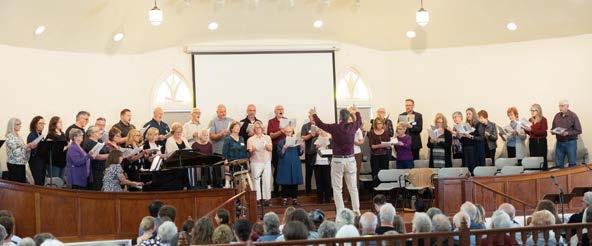
Randy Klassen leads the choir at Gem of the West Museum, Coaldale MB Church’s former building.
IN CASE YOU MISSED IT
We regularly publish websiteexclusive stories on mbherald.com.
Here are a few articles we’ve posted online in the last few months.
Banana leaves and brothers
“There was a moment when he wondered, ‘What am I doing here, trimming dead leaves off banana trees, week after week?’” Read the story from Multiply about what God has been teaching Kyle Schmidt through his work on a farm in Uganda.
HIV-positive mothers in Nigeria, and their children, stay healthy through free health care
A family of triplets is thriving in Nigeria because MCC’s partner Faith Alive Foundation provides free health care to pregnant or nursing women with HIV and their children.
The Doctor will see you now
Rita Mae Braun’s reflection about how she was reminded of the power of the true Physician at the recent SKMB Assembly.
MCC partner keeps children in Gaza warm with winter clothing distribution
MCC’s partner in Gaza provides winter clothing to protect 1,500 children from the cold as they and their families shelter in bombarded houses with no heat.
Risk of famine in Gaza remains as MCC partner distributes emergency food
Despite the incredibly dangerous reality around them, MCC partner Al-Najd Developmental Forum recently provided emergency food to 2,000 families — around 12,000 individuals — in Gaza.
Book Review of SQ: The Transforming Potential of Spiritual Intelligence
Mike Engbers shares his thoughts on Randy Friesen’s book about Spiritual Intelligence.
Darryl Loewen, MCC Manitoba executive director, has resigned effective June 1.
MCC shares meals with displaced people in Lebanon
MCC’s partner is providing 34,000 meals over 30 days at various shelters in the Bekaa and Baalbek-Hermel governates in Lebanon. More than 1 million people have been displaced by Israeli military attacks in Lebanon.
Watch for these upcoming episodes!
June 10: Phil Gunther
SKMB’s Phil Gunther is a deep well of wisdom. In our conversation, he shares his insights on the impact suffering has on the soul, what to do when God seems silent, and why humility is essential in the life of a disciple. He also discusses his book Hello Again, and talks about what motivates him to keep writing.
July 8: David Balzer
“Fake news,” the blessing and curse of social media, how to bring peace to any story… it’s all on the table as we talk to CMU’s David Balzer, Associate Professor of Communications and Media.
Q&R CORNER
Q&R corner provides responses to questions that readers may have about CCMBC and its work collaborating with provincial MB conferences in areas of spiritual health and theology, leadership development, mission, and organizational health in order to achieve the overall mission: “To cultivate a community and culture of healthy disciple-making churches and ministries, faithfully joining Jesus in his mission.” If you would like to contribute a question, please send it to questions@mbchurches.ca
Please note that we will not be using your name in the MB Herald Digest in order to respect those who prefer anonymity. There may not be space to respond to every question—and sometimes we might not really have the ability or authority to respond to some questions (for example, those that relate more directly to one of our provincial MB conferences or to a local church leadership). We apologize in advance if we are unable to publish a response to your specific question.
The NaT ioNal FaiT h a Nd liFe Team (NFLT) is continuing its project of updating all the MB Confession of Faith resources (Commentary; Pastoral Application) that were produced in 1999. The updated resources (Explanatory Notes; Living the Confession [FAQs]) are shared widely for feedback from individuals, churches, and MB member organizations. The draft resources for Article 16: Work, Rest, and the Lord’s Day are posted right now on the CCMBC website inviting feedback, encouragements, and suggestions (see here). This Q&R Corner will present two responses to key questions that come from the Living the Confession (FAQs) resource for Article 16. If you have feedback, encouragements, or suggestions, please share them at Article 16 Explanatory Notes Feedback Survey.
Question #1: Should we not be using the word “sabbath/Sabbath” in Article 16? If God’s institution of Sabbath was not only one of the Ten Commandments (Deut 20:8-11; Deut 5:12-15) but a “lasting covenant” and a sign “forever” (Exod 31:14-17), why does Article 16 not explain the eternal importance of Sabbath observance for believers?
Article 16 bases its convictions about work and rest for believers on God’s example in Genesis but it does not use the word “sabbath/Sabbath” or highlight the formal Israelite institution of Sabbath (Exod 20:8-11; 23:12; 31:12-17; Deut 5:12-15).
The Hebrew word “sabbath” essentially means “stop,” “cease,” or “pause,” so technically, when Christians embrace rest and step away from work, they are practising sabbath. This does not mean that they are practicing the Old Testament “Sabbath” institution given to Israel in the Ten Commandments (Exod 20:8-11; Deut 5:1215) and called a “lasting” and “forever” covenant sign in Deuteronomy 31:16-16.
The question of course is why, in light of these verses, does Article 16 use the word “rest” rather than “sabbath/Sabbath” to describe what believers are called to practice? The biggest reason seems to be that if Article 16 embraced the word “sabbath/Sabbath,” it would need to explain how the institution of Sabbath can legitimately be moved from a Friday evening to Saturday evening event to a 24-hour Sunday/ Lord’s Day event.
Recognizing how this is a significant problem, some Christians (e.g., Seventh-Day Adventists) have embraced Friday evening to Saturday evening Sabbath observance as a “lasting” (NIV) or “forever” (ESV) covenant sign (Exod 31:15-16) that requires continued observance by disciples of Jesus today.
Other Christians have said yes to Sabbath as an “eternal” sign (Exod 31:16-17) but transferred it to Sunday or to another day of the week even though the New Testament writers did not seem to make this transfer. It is difficult to find biblical support for moving this eternal sign to Sunday or moving it around to any other day.
The final option is that while a 24-hour weekly time of “rest” is an ongoing and life-giving expectation of believers based on God’s model in Genesis 1-2, the formal and eternal Old Testament institution of Sabbath (Exod 31:1617) has been fulfilled and therefore transformed in Jesus (cf. Matt 5:17). This is a parallel with the “everlasting covenant” sign of male circumcision
(Gen 17:13), that because of its fulfillment in Jesus, is now transformed into an inward sign that Paul called “circumcision of the heart, by the Spirit” (Rom 2:28-29). “Keeping God’s commands is what counts” which means physical circumcision is now “nothing” (1 Cor 7:19). This is also parallel with the Passover, called a “lasting [or eternal] ordinance” in Exodus 12:14. But it has now been fulfilled in Christ the Passover lamb (1 Cor 5:7) and transformed into the Lord’s Supper (1 Cor 11:17-34). Other activities in the law like sharing part of the fellowship offerings with the Levites (Lev 7:36), setting out bread in the tabernacle every Sabbath (Lev 24:8), or maintaining food restrictions (Lev 11; Deut 14) were also “eternal” or “everlasting” commandments which are fulfilled and transformed in Jesus. These biblical examples of “eternal” or “everlasting” laws being fulfilled, transformed, and ended in Jesus means that there are times when the Hebrew words for “eternal” or “everlasting” mean “a very long time” (cf. Ps 74:3; Jer 25:9) or else that they are “eternal” but they have been transformed so dramatically that they are
While it is clear that Jesus cared about “rest” (Matt 14:31; Mark 6:3132) and he made it a “custom” to attend the synagogue service (Luke 4:16), the New Testament writers appear to view the formal Jewish institution of Sabbath to be fulfilled and ended in Jesus.
difficult to recognize without discernment. This seems to be the case for the formal institution of Jewish Sabbath. Jesus declared himself the “Lord of the Sabbath” (Matt 12:8; Mark 2:28; Luke 6:5) and did acts of healing on that day (Mark 1:29-31; 3:1-6; Luke 13:10-17; John 5:1-15; 9:1-12). When confronted by the Jewish leaders, Jesus makes the startling claim: “My Father is always at his work to this very day, and I too am working” (John 5:17). While it is clear that Jesus cared about “rest” (Matt 14:31; Mark 6:31-32) and he made it a “custom” to attend the synagogue service (Luke 4:16), the New Testament writers appear to view the formal Jewish institution of Sabbath to be fulfilled and ended in Jesus.
If this were not the case, we would certainly expect a much greater emphasis on formal Sabbath-keeping in the New Testament epistles addressed specifically to non-Jewish converts. The directives toward Gentiles in Acts 15:19-21 make no mention of Sabbath. The 21 New Testament epistles contain only two references to the Sabbath (Col 2:16; Heb 4:9) and the second is a metaphor for Sabbath rest in the new creation. Paul, in Colossians 2:16 shockingly says: “Therefore do not let anyone judge you by what you eat or drink, or with regard to a religious festival, a New Moon celebration or a Sabbath day.” He also tells the believers in Rome: “One person considers one day more sacred than another; another considers every day alike. Each of them should be fully convinced in their own mind. Whoever regards one day as special does so to the Lord…. You then, why do you judge your brother or sister?” (Rom 14:5-10; cf. Gal 4:9-10).
Article 16 seems to imply that the original form of seventh-day Sabbath has been fulfilled in Jesus and is transformed into the covenant sign of regular times of “rest” foreshadowing the eternal Sabbath rest in the new creation (Heb 4:9).
Question #2: Article 16 makes work a positive good for Christians. Does this mean that all work is good? What does this mean if someone is disabled or in declining health, unemployed, or retired — or for a person who hates their work?
Note 1 defines work as …all physical and mental efforts that guide, shape, and transform the physical, economic, human, and cultural world in a desired direction. For an activity to be “work” does not require it to involve a formal contract, financial remuneration, or public recognition and validation. People who are unemployed or retired can still be involved in activities that should be called work. A key characteristic of human work is that it is ultimately depleting in some significant way — physically, mentally, emotionally, relationally, and/or spiritually. Work itself when expended for good purposes and in proper proportion with rest, is a divine gift designed to promote creational flourishing and God’s Kingdom life, even though work is tainted by sin in the present age.
Article 16 implies that paid and unpaid work, although tainted by sin, can be a positive good for Christians. Good work is that done for the common good and done in such a way that
it glorifies God. Good work is good work regardless of its perceived value in the eyes of others. As Martin Luther King Jr. once said to students in a Philadelphia public school: “If a man is called to be a street sweeper, he should sweep streets even as Michaelangelo painted, or Beethoven composed music or Shakespeare wrote poetry. He should sweep streets so well that all the hosts of heaven and earth will pause to say, ‘Here lived a great street sweeper who did his job well.’” However, even though work is a good, not all work is good. If a work activity is incapable of bringing glory to God and serving the common good — or worse, it causes significant damage to others, one’s own self, and/or creation — then it is not a positive good regardless of its status, or financial and/or personal rewards.
The biblical writers expect that those who are physically and mentally able should do work that can provide them with the means to take care of themselves and others. In the letter to the Thessalonians, Paul mentions how they (Paul, Silas, and Timothy) “worked night and day, laboring and toiling so that we would not be a burden to any of you.... We did this…to offer ourselves as a model for you to imitate” (2 Thess 3:8-9). The “rule” given by Paul is described in verse 10: “The one who is unwilling to work shall not eat.” This basic principle is adapted by Paul in his first letter to Timothy: “Anyone who does not provide for their relatives, and especially for their own household, has denied the faith and is worse than an unbeliever” (1 Tim 5:8). It is clear that caring for oneself and others in one’s sphere of responsibility is an expectation for believers (1 Tim 5:4).
There are those facing unemployment, disability, declining health, or personal/family crisis who may not be able to do formal employment work for a specific or ongoing period of time. There are also individuals in retirement who no longer need to do employment work to provide for themselves and those in their sphere of responsibility. However, as much as is physically and mentally possible, all such individuals should seek to engage themselves with good work that contributes to the common good and brings glory to God. This can mean committing themselves to prayer, good works in their neighbourhood, or service within their church community. For some with significant
“Article 16 implies that paid and unpaid work, although tainted by sin, can be a positive good for Christians. Good work is that done for the common good and done in such a way that it glorifies God. Good work is good work regardless of its perceived value in the eyes of others.
limitations, their good work may simply be to serve as the recipient of love and kindness while the givers of such love and kindness grow into Christlikeness as a result of their presence. If someone hates their work (either paid or unpaid), this could mean that: 1) their work does not glorify God and serve the common good; 2) their work requires physical, mental, relational, or spiritual resources that they don’t have and thus is a poor fit for them; 3) their work is good work but they have not developed a faithful biblical understanding of work or embraced the needed character qualities to make their work a joy rather than an endless burden.
For responses to the following questions (Is it OK for Christians to join unions, seek more money, and go on strike? What exactly is “rest” — and what does that look like? Is working in my yard fitting for a day of rest? Is shopping or eating out OK? Is playing sports OK? Should farmers plant or harvest on that day? If someone loves their work so much and they find it refreshing and revitalizing, why do these people need to rest?), visit the CCMBC website link here.
A heritage worth preserving
An interview with Agatha Bock from the documentary Agatha’s Almanac
BY TRACI JOHNSTON
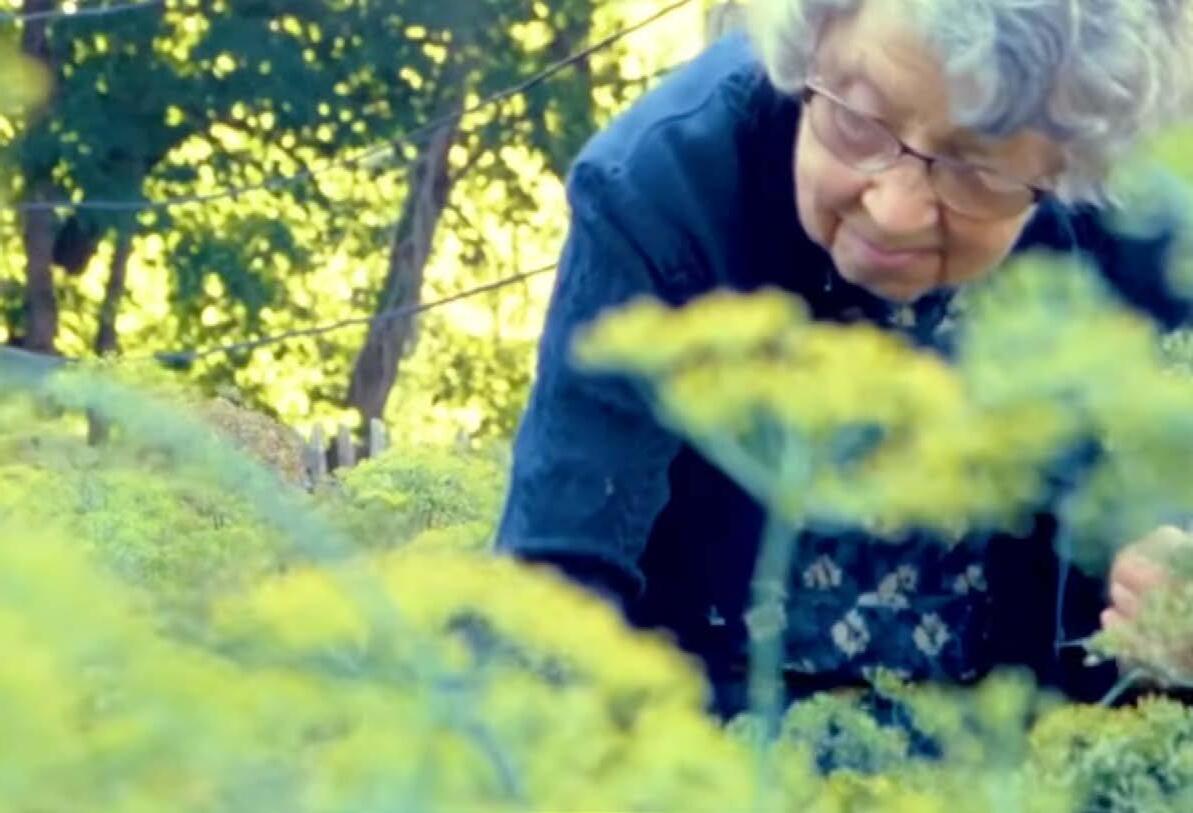
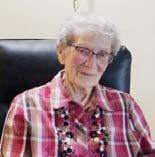
AGATHA’S ALMANAC is a docume NTary about Agatha Bock, an independent, now 92-year-old woman, who attends North Kildonan Mennonite Brethren Church in Winnipeg, Manitoba. Agatha’s niece, Amalie Atkins, directed the film that highlights the slow, peaceful life on a farm where Agatha lives from May to November, tending 16 rows of dry beans that she sells, and four rows of her own herbs and vegetables that she preserves or gives away. After viewing the film, I interviewed Agatha about her way of life.
Meeting Agatha was like going back to my grandma’s house. Agatha was the quintessential host, serving me coffee and sweets, walking me to the door when I left, and inviting me to visit any time. She made me feel comfortable in her
simple apartment, full of colourful knit blankets, wall plaques with German prayers, and keepsakes from friends and family.
While the film states that Agatha tends her 55-acre garden entirely by hand, and does not have a drivers license, running water, or landline, Agatha is quick to point out that is a bit of a misnomer. Her brother, John, uses the tractor to cultivate the garden on the farm, which was once their parents’. Agatha had a drivers license but now relies on others or public transportation in Winnipeg, where she currently lives in an apartment. She does have a telephone but, when she is at the farm, she tells people not to phone until after dark. Even then, they might not reach her because the moon is bright and she is busy in her garden.
I asked Agatha how she felt about being the star of a documentary, to which she immediately replied that she did not mind. She shared that the film had always been sold out in Canada, with some places adding extra showings. The movie was also shown in the Netherlands, Germany, and Australia. She attended showings in Winnipeg, Toronto and Vancouver. When she was in attendance, there was a Question-and-Answer period afterwards, when she clarified things like her gardening clothes usually consisted of black pants and a white shirt, which protected her from the sun and mosquitoes. Amalie, however, wanted bright colours in the film.
When the film showed in Vancouver, Agatha’s niece phoned all the relatives in BC and Alberta. Since there was a family reunion of sorts, Agatha decided she wanted to be present. After that, she matter-of-factly stated, “That’s enough. I don’t need to see the film again. I know what’s on it.”
When asked what motivated Agatha to live this way on the farm, she explained that she was not about to sit around in the city. She enjoyed the fresh air, sunshine, and gardening, just like her father. He was a teacher, but summers were spent on the farm, where they planted bean seeds, originally bought from a Russian lady at the market. Not knowing the type of bean these were, Agatha called them “quick-cooking beans,” since they cook up in 30 minutes. After her parents died, Agatha continued the garden, which grew in size to meet the demand, until two years ago when health challenges kept Agatha in Winnipeg for most of the summer. Unfortunately, she is now reliant on her walker, which is not the all-terrain vehicle that is required on the farm, but she still hopes to visit.
People are another reason Agatha goes to the farm. Back when her parents lived there, everyone in the rural area knew each other. Agatha continues that legacy, making a point of meeting new neighbours. Therefore, she is not lonely since she has so many friends. Even when a friend abandoned Christ, Agatha never gave up praying or being her friend.
Although Agatha’s faith was not the focus of the film, it came out clearly in conversation. While gardening, God taught her to rely on him. Since she only had a cistern for water, she did not water the garden unless God supplied the rain. Some years brought drought and half the produce. Other years brought a bumper crop of 650
pounds of beans! That year, God proved that he was the provider of both produce and customers.
Values of hard work and living frugally are all part of who Agatha is. She shares tips such as planting onion pieces with seed potatoes to keep the potato bugs away. If wind and rain come in the storm windows, Agatha advises how to seal them up by putting masking tape under duct tape, so the tape will never come off. She knows how to make things last!
The art of contentment is exhibited in Agatha, which applies to so many circumstances in life, including aging. “You do what you can. What you can’t, you can’t. Grumbling doesn’t change anything. You can only change your heart. Face it and accept it,” she urged.
There is so much more to Agatha. She was a teacher and then got education to work in a lab. She went to Ecuador, Brazil, and Germany on missions, where she taught or helped with shortwave radio programs that shared the gospel to Russia and South America.
What does Agatha hope viewers get out of the film? “I hope they realize they are not here forever. Every day is a gift from God to enjoy. However, we never know when our day will come, so prepare now to meet your Maker. Face reality and think about your future.”
A poignant scene in the film portrays four empty chairs in the woods and Agatha shares how her four sisters died, one as an infant, another dying at age 20 in the arms of an 18-year-old Agatha. Our life is in God’s hands. She has also seen God miraculously save her brother’s life three times!
While the film is about preserving heritage dry beans, I think Agatha’s life is about dying to self in order to produce a crop 30, 60, or 100 times greater. That is a heritage worth preserving!
Follow Agatha’s Almanac on Instagram (@agathasalmanac) for information on showings in your area.
TRACI JOHNSTON
is a farmer’s wife and mother to two adult children and their spouses. Missions, whether across the road or across the world, has been her life’s call. She attends Westside Community Church in Morden, Manitoba.
BY MIKE ENGBERS
“your eyes are bigger T ha N your s Tomach!” i heard that more than once while growing up. Plate piled high, I imagined eating all the delicious food I had dished up, only to realize halfway through my meal that I would make myself sick if I scraped my plate clean. I had envisioned myself capable of something much greater than reality.
Many of us are like this with technology — we imagine something much more impressive than the reality we encounter. For example, decades ago, we celebrated the potential of the personal computer to make life easier through automation, communication, and digital organization. Yet instead of freedom, many of us feel chained to our devices, carrying them everywhere, succumbing to notifications, email checks, and constant connectivity. We’ve also sacrificed our privacy, as companies sell our data and work spills into our free time. We didn’t foresee the societal toll of the
digital revolution. This doesn’t mean computers are bad, but our initial optimism blinded us to the challenges that technology would bring.
In a similar way, we may be overly optimistic about the benefits of Artificial Intelligence (AI). The ability for a computer to think and work for us as if it were truly intelligent is amazing, and it only takes a little imagination to see what AI could achieve. While we may be more aware of the extreme concerns surrounding AI due to science fiction stories, we also see its potential. New AI developments are praised in the media almost daily.
If we look closely, we can begin to perceive the negative impacts AI will have on everyday life. Some of them are professional, some personal, and some affect us as a whole society. AI is transforming how our society operates, and not all the changes are for the better.
To AI-proof the church from AI impacts, some
may imagine avoiding all AI technology. But, since escaping AI is impossible without radically living off-grid, the goal is to prevent AI from distracting us from our biblical calling — loving God and others and making disciples. AI-proofing involves shaping the church around our identity as followers of Jesus, not around AI. I suggest focusing on four areas to ground our ministry in Christ and mitigate the negative effects of AI on the church: rooting ourselves in truth, community discernment, relationships and hospitality, and care and compassion.
ROOTED IN TRUTH
Scrolling through social media or other online platforms, there is an abundance of opinions or claims of what is really true, leading to alternative scientific theories, various interpretations of historical events, and even conspiracy theories. We sarcastically joke, “I read it on the internet, so it must be true!” Yet we often hear of people “doing their own research” — things that were once clearly editorial may be perceived by some as authoritative. And now with AI, we have yet another source of truth that people can hold to.
Despite all the claims to truth in our world, we are reminded in scripture of what truth is, or more correctly, who is truth. Jesus declares that he is the truth as we read in John 14:6 (NIV): “Jesus answered, ‘I am the way and the truth and the life. No one comes to the Father except through me.’”
As we explore the use of AI in our world, we need to begin by recognizing that the truth found in Jesus is greater than any truth of this world.
DISCERNING IN COMMUNITY
AI has the capacity to generate a wealth of information in a short amount of time. It can leave us feeling efficient and empowered and gives us an incredible ability to produce our work as individuals. This ability can either be a useful tool or a temptation, depending on the approach.
A recent Barna Group study1 found that over 50 percent of people disagreed on some level with AI and the church interacting, and 52 percent would be disappointed to learn their church is using AI. With the potential benefits and temptations for ministry and the uncertainty (or even division) within the church, charging ahead with individual empowerment without engaging the community around us can be dangerous.
AI CAN BE DIVISIVE IN THE CHURCH, ESPECIALLY IF ITS USE IS NOT APPROACHED WITH DISCERNMENT AND INTEGRITY. IT CAN ALSO REFLECT LARGER ISSUES.
AI-proofing the church begins with conversations among the pastors, church leadership, and the congregation about how they would feel comfortable or interested in using AI for ministry purposes. It involves grounding ourselves in prayer as a community, listening, and discerning.
What boundaries should be set? Can it support a ministry role, or should it be avoided in certain areas? AI can be divisive in the church, especially if its use is not approached with discernment and integrity. It can also reflect larger issues. For example, if a pastor relies on AI as a shortcut to write sermons, the problem may not be AI itself but the workload or demands in other parts of the ministry. Using AI to solve the problem then becomes a quick fix, rather than addressing the true underlying concerns.
AI can seem to be empowering for an individual. AI is leading to greater individualization of work. Where teams have traditionally collaborated on projects, individuals can now simply use AI. AI becomes an easier way to accomplish tasks without community support. However, God calls us to live in community. As Mennonite Brethren, we value Spirit-led community discernment. AI can threaten this deeply cherished value if we are not careful.
To counter individualization, our church communities must discern the implications of AI. By having an open dialogue about concerns and fears, as well as the opportunities AI can bring, we determine together, by listening to and obeying the leading of the Holy Spirit, how to utilize new technologies to honour God. We explore the ways in which we can experiment and explore AI and set
our boundaries and limits. By prayerfully discerning a path forward as a church community on AI, we root ourselves in the Holy Spirit’s guidance. We ground ourselves in the community of faith and counter the isolation and individualization that AI can cause.
INVESTING IN RELATIONSHIPS
In the mid-1990s, people of all ages became obsessed over their Tamagotchi — a pocket-sized digital pet dependent on its owners for food, cleanliness, sleep, and happiness. The graphics may have been basic, but the Tamagotchi’s needs were great!
Virtual relationships have only increased in sophistication and quality. Many websites now offer AI companionship: boyfriends, girlfriends, or just friends. AI has an inherent desire to please the person requesting information. Imagine a relationship without conflict or contention, zero work involved! As our society becomes increasingly individualized, we should not be surprised to see people withdrawing from the mess of real community so they can nurture “perfect” virtual relationships. This is especially true as we see a decline in our communication skills thanks to digital communication.
As a church, we value relationships. We cherish our relationship with God through Jesus and our connection with other believers. Scripture goes even further, calling on us to “Love your enemies” (Matthew 5:44, NIV). Our witness as a church depends on this. The great commandment instructs us to “‘Love the Lord your God with all your heart and with all your soul and with all your mind and with all your strength.’ The second is this: ‘Love your neighbour as yourself’” (Mark 12:30-31, NIV).
Real relationships both challenge and encourage. We risk being hurt while being blessed by the care of others. AI cannot replace the humanness of relationships. To AI-proof the church, we must ground ourselves in our love for God and love for others. This is more than just making decisions together. To establish a relationship is to embrace a core practice of discipleship — hospitality. Invest in genuine relationships, invite people into your home, spend time together. Small groups are a key part of many churches. Moving forward, they may be even more essential to living out a gospel-centred life as we model real relationships to a world that longs for them. Our witness may well depend on our integrity in having authentic relationships and demonstrating this through practices like welcoming others and hospitality. AI cannot provide real relationships — this is central to our identity as a church.
EMBODYING CARE AND COMPASSION
I always find it humorous when my daughters are in their “phone zone.” They are busy texting away, and quite often, after a minute of waiting, they lament that there is no response. I suggest giving them a phone call, and they then remind me, “Daadddd! That is so embarrassing. No one calls anymore.” Our technology has shifted how we interact — we’ve gone from face-to-face encounters to phone calls, emails, text messages, and even to just sending a simple photo or a 30-word social media post.
REAL RELATIONSHIPS BOTH CHALLENGE AND ENCOURAGE. WE RISK BEING HURT WHILE BEING BLESSED BY THE CARE OF OTHERS. AI CANNOT REPLACE THE HUMANNESS OF RELATIONSHIPS.
THE WITNESS OF THE CHURCH IS ROOTED IN OUR LOVING THOSE THE WORLD OVERLOOKS AND REJECTS. CARE AND COMPASSION CAN BE MIMICKED BY A COMPUTER BUT NOT LIVED OUT. TRUE CARE AND COMPASSION IS ROOTED IN CHRIST-LIKE LOVE.
AI is also changing how we relate, moving us away from the reality of the world. One of the foundational challenges that AI presents is that it becomes an escape from our surrounding world as we immerse ourselves into the virtual reality where AI resides. As we interact with AI, we can become distracted from the problems and struggles of the real world. We can stop seeing and hearing with the eyes and ears of Christ. Scripture warns us, though, to be intentional in how we interact in the world. Micah 6:8 answers the question of what God asks of us. We read:
“He has shown you, O mortal, what is good. And what does the Lord require of you? To act justly and to love mercy and to walk humbly with your God” (Micah 6:8, NIV).
When we are immersed in virtual reality, whether for legitimate and meaningful reasons or simply for the pleasure of wasting time, we are artificially removed from a world filled with injustice, sin, brokenness, and suffering. There is a need for the body of Christ to be the hands and feet of Jesus by reflecting the values of God’s kingdom — justice, love, and mercy — to the world around us. Our actions in caring for those who are forgotten by society serve as a reflection of God to the world. In Deuteronomy, we are told that God “…defends the cause of the fatherless and the widow, and loves the foreigner residing among you, giving them food and clothing” (Deuteronomy 10:18, NIV).
The witness of the church is rooted in our loving those the world overlooks and rejects. Care and compassion can be mimicked by a computer but not lived out. True care and compassion is rooted in Christ-like love. We need to share the reality of Christ through our actions. When we do, we distinguish ourselves from any reality AI tries to offer.
Reading this article, you may have realized that AI-proofing the church is really about living intentionally as the church. Christ has already prepared his bride to live faithfully in every generation — including this one. The question isn’t whether we should use AI or not. Rather it is whether our lives are centred on Christ, using tools that serve his mission.
The church’s glory doesn’t lie in what we do or how we do it, but in whom we serve. If our use of AI distorts truth, undermines relationships, weakens community, or dulls compassion and discernment, it cannot glorify God. AI cannot glorify God on its own — it reflects the heart of those who use it. That’s why our hearts must remain rooted in Christ.
Jesus declared that not even the gates of Hades will overcome his church (Matthew 16:18). AI, like any cultural force, will not prevail against the church when our lives are grounded in Christ. Our witness is not in avoiding technology, but in faithfully following our King. To AI-proof the church is to live with courage, clarity, and compassion — anchored in truth, led by the Spirit, and shaped by the gospel of Jesus Christ.
is the Lead Pastor at Parliament Community Church in Regina, SK.
CHURCH
In a recent conversation with my wife Karina Dyck (Worship Coordinator, Crossway Elm Creek), she asked if MBCM had any guidelines for how pastors should use modern Artificial Intelligence tools. When I responded that we didn’t have anything, she said, “Well, you should!” She was right, as she often is.
The MBCM way is to process and collaborate, so that’s what we did.
On April 15, we held a Nuts and Bolts equipping day at Westwood Community Church about the ethical uses of AI tools in a ministry setting. We navigated theological places from which to discern AI usage, the do’s and don’ts of AI usage as a pastor, how to help our congregations think theologically about AI, and a variety of other factors. A goal of this continued work is to provide AI tool guidance for pastors and church leaders. While that resource remains under development, the pastors’ contributions to one another were the best part of the day.
JASON DYCK Director of Church Ministries, Mennonite Brethren Church of Manitoba
I think a caution of the use of Al is the loss of a need to know. There is a difference between knowing intuitively and knowing intimately. It is like learning a language. When I was thinking about learning biblical Hebrew, I consulted the academic dean at my Bible College and he pointed me to a few tools like interlinears or Logos’s Al helper. He also cautioned me that the downfall of these tools is that, while they are helpful, you do not actually know the language.
With the help of an AI tool, you can see that in Genesis 1, the Greek word used for “God breathing into Adam” is pneuma, which is Spirit, breath, wind. But if you know Greek, you will recognize that the New Testament also uses this word in 2 Timothy 2:16 to say the Bible is God breathed/spirited, along with many other passages that are connected through the word pneuma. You cannot see the nuances of the language and culture if you just ask a tool. But if you know the biblical languages, you can see the beauty of the Bible in a new light, which is something that the tools cannot give you. The process is key to knowing, and AI cuts that out.
GAVIN BROESKY Student at Steinbach Bible College
The following reflection comes from my reading of a book called AI Goes to Church by Todd Korp, 2025. (See page 30.)
The prevailing culture of busyness is one of the great challenges to and in our faith communities. When reading the account in Genesis we discover a deep longing for that day of rest which follows the days of creation. Right after God provides the marching orders to the human stewards of the earth, he insists that they take a sabbath. They hadn’t done the work, he had. If we follow the order of these events, we are reminded that we are to “work from rest,” not “rest from work.” Humanity has been struggling to put those things in the right order ever since. We very often miss out on the rest we read about and subsequently long for it in our homes and in our churches.
Along comes AI. Recently I took a document I had carefully crafted and asked ChatGPT to make it more “formal” in tone. What very likely would have taken me 45 minutes was accomplished in a split second. Could it be that AI would make it possible for us to gain greater efficiency in our work, and we would finally be able to engage in the rest originally intended for us? Just a brief revisit of the past tells us that when we gain efficiency in our work (printing press, email, scheduling tools, etc.) we don’t recalibrate to include a thorough sabbath. No, we fill our time with more work. Instead of receiving the benefit of more evenings off, more time with family and friends, more time pursuing soul refreshing moments of slowing down, we ask, “What else can we get done with the time we’ve gained?”
I use AI now and no doubt I will expand my use of it over time. I just want to be honest as we enter the AI revolution, that unless we steward the time gained via the use of this new tool well, it will simply increase the pace of our already very busy lives.
BOB MARSCH
Lead Pastor at The Meeting Place in Winnipeg, Manitoba.
Our CCMBC theme for 2026 continues to be Pray First! Pray Always! 1 Thessalonians 5:17 is the foundation verse telling us to “pray continually.”
For 2026 we want to deliberately and intentionally pray for the “peace of Christ” to rule in our hearts (Col 3:15). When the peace of Christ rules in our hearts, we will have a peace with God that overflows into peace with others, peace with ourselves, and peace with creation.
Each month, we will focus on a certain element of the peace of Christ so that we can more fully appreciate the depth and beauty of this peace and live it out in all our relationships. These prayers should lead us to greater worship of the Triune God who has brought peace through Jesus Christ (Acts 10:36). We are praying that the “peace of God, which transcends all understanding” will guard our hearts and minds in Christ Jesus (Phil 4:7). We are also praying that through our prayers we will become more faithful peacemakers who can rightly be called “children of God” (Matt 5:9) and “reap a harvest of righteousness” (Jas 3:18). Finally, we are praying for the peace of Christ to become real for family, friends, neighbours, and enemies who do not yet know this peace. May there be peace on earth!
We are excited again this year to welcome a variety of writers from our MB family across Canada as they share their own insights and guide us to pray more faithfully. May 2026 be a year of transformation so that we would embrace and live out the peace of Christ faithfully in a world of hostility, vengeance, and violence! “Now may the Lord of peace himself give you peace at all times and in every way. The Lord be with you all” (2 Thess 3:16).
JUNE 2026 PRAYER GUIDE
Praying for peace in the church
Therefore, remember that formerly you who are Gentiles by birth and called “uncircumcised” by those who call themselves “the circumcision” (which is done in the body by human hands) remember that at that time you were separate from Christ, excluded from citizenship in Israel and foreigners to the covenants of the promise, without hope and without God in the world. But now in Christ Jesus you who once were far away have been brought near by the blood of Christ.
For he himself is our peace, who has made the two groups one and has destroyed the barrier, the dividing wall of hostility, by setting aside in his flesh the law with its commands and regulations. His purpose was to create in himself one new humanity out of the two, thus making peace, and in one body to reconcile both of them to God through the cross, by which he put to death their hostility. He came and preached peace to you who were far away and peace to
those who were near. For through him we both have access to the Father by one Spirit.
Consequently, you are no longer foreigners and strangers, but fellow citizens with God’s people and also members of his household, built on the foundation of the apostles and prophets, with Christ Jesus himself as the chief cornerstone. In him the whole building is joined together and rises to become a holy temple in the Lord. And in him you too are being built together to become a dwelling in which God lives by his Spirit.
Ephesians 2:11-22 (NIV)
This moNT h we’re iN vi T ed To pray for peace in the church. So far in 2026, we’ve been invited to pray for peace with God, with others, with creation, and in our neighbourhoods. Now we are to pray for shalom (holistic well-being) in the church.
This is a timely invitation because the church of Jesus Christ has divided into a vast number of denominations during the past 1,000 years. Sadly, this is a far cry from Jesus’ prayer that believers would be one as the Trinity is one (Joh 17:22). Today, denominations continue subdividing as they disagree over many questions. Who may lead, and
how? How did God create the world? How will we worship? How is the atonement to be explained? How will we respond to people of sexual and gender minorities? How is the Spirit evident? What does God intend for Israel? Who may participate at the Lord’s Table? What is the mission of the church? Because matters like these have caused disciples of Jesus to break fellowship, I have chosen to focus this prayer guide on the entire church—not only on MB churches and conferences.
Yet not everyone sees divisions in the church as a problem. Protestants have often considered separation to be a mark of faithfulness or holiness. The history of the MB church includes many stories of believers separating—long ago and recently. Even the Apostle Paul writes that factions may be a sign of genuineness (1 Cor 11:19). However, Paul is probably making a concession, and maybe even being sarcastic — since the context for this verse is Paul’s appeal for unity at the Lord’s Supper.
The New Testament writers, by contrast, consistently emphasize the importance of church unity. In addition, when Paul addresses the Christians of Ephesus, he makes it clear that church unity is a matter of peace.
BEFORE YOU PROCEED WITH THIS PRAYER GUIDE, PLEASE PAUSE TO READ OR LISTEN TO EPHESIANS 2:11-22.
If you were to read this passage several more times—maybe even memorize it—you might be struck by the many words Paul repeats: Christ, aliens, strangers, without, with, far, near, peace, two, one, and Spirit.
Commentators have pointed out that Paul’s repetitions are in the pattern of a chiasm. A chiasm is an X-shaped writing pattern used by the ancients so that their main point was at the centre of the passage. As I once heard a youth pastor preach, you can think of a chiasm as a “meaning sandwich.” The slices of bread are on the outside; there is mayonnaise on the bread slices; the tomato slices are on the mayonnaise; and right in the middle is the meat.
Tom Yoder Neufeld (writing in the Believers Church Commentary Series) proposes a simple chiasm for Ephesians 2:11-22:
Once you were alienated and strangers—without God (vs.11-12).
Christ has brought near the far off (vs. 13).
Christ is our peace (vs. 14-16).
Christ proclaimed peace to the far and the near (vs. 17-18).
You are no longer strangers and aliens, but God’s dwelling (vs. 19-22).
Lines 1 and 5 are related, as are 2 and 4; but the crux (!) of the matter is line 3: Christ is our peace. By Christ’s body and blood on the cross, God has killed the hostility between two enemy groups and reconciled both into one new humanity. For the Ephesian readers, those enemy groups were Jews and Gentiles. This enmity continued in the church between Christian Jews and Christian Gentiles.
As I’ve continued studying this passage, I’ve noticed additional parallel words and themes that could make for a more extended chiasm. For instance, Paul begins the chiasm by emphasizing the human, hand-made nature of circumcision (even though circumcision was part of the Mosaic law). And Paul ends the chiasm by highlighting that the church, God’s dwelling place, is made by the Spirit.
Another detail of the chiasm is in verse 15a, at the centre of the chiasm’s crux. Here Paul explains that Christ has made peace by “…abolishing [i.e., nullifying] the law of commandments in ordinances…” (ESV). The word “ordinances” is yet another kind of human endeavour, having to do with written dogmas or decrees.
Yet in what way did Christ Jesus nullify the holy law of Moses? This question is important because Jesus himself said that he came not to abolish but to fulfil the law (Matt 5:17); and Paul wrote that the law is good (Rom 7:12; 1 Tim 1:8).
Yoder Neufeld suggests three overlapping ways in which Christ removed the Mosaic law’s negative effects. All three are true at the same time. Christ took away the law’s function of separating Jews from Gentiles (Acts 15:1-21). Christ took away the law’s function of condemning sinners (Col 2:13-14). And Christ extended the law’s prioritization of
written documents by embedding the law in the hearts of all believers, so that they comprise a new humanity of both Jews and Gentiles (Heb 10:16 quoting Jer 31:33; cf. 2 Cor 3:3).
By now, you may be asking what all this has to do with a prayer guide about peace in the church. These reflections are a few of the many treasures in Ephesians 2:11-22; and they suggest at least two directions for how we can pray—and then act— for peace in God’s church.
First, the peace of unity is not made by human hands, but by the Holy Spirit. Christ is our peace, not we ourselves. The Mosaic law with its commands in dogmas or decrees could not demolish the walls between “enemies”—whether walls based on people’s ethnicity, majority or minority social standing (aka caste), wealth, power and marginalization, depth or superficiality of Bible knowledge, or progressive or traditional approaches to law-keeping. Instead, the unity of the early church was rooted in the peacemaking work of Christ. Still today, the unity of Christ’s body is not grounded in the clarity of our decrees, doctrinal statements, creeds, confessional statements, or bylaws. It is the Spirit who binds all Christians together with the chain of peace (Eph 4:3). This is the mystery of the gospel (Eph 3:4-5). We are therefore called not to create unity, but to trust the unity God has created. I invite us to pray for faith to recognize this unity.
Second, when we trust in that God-created unity, we will work to make that unity visible in the world—as Paul says, “making every effort to maintain the unity of the Spirit…” (Eph 4:3, NRSV). It has been said that a primary theme of Ephesians is learning to live out our surprising identity as saints (Eph 1:1). One of our callings as saints is to
visibly demonstrate the unity of the saints beyond our MB churches and conferences.
Visible unity does not require organizational or denominational ties. Yes, those ties help make unity visible concretely; but by themselves they are always limited in their effect. I’ve observed that human denominations and Christian organizations are always limited in scope because none of them can be all things to all people; only God can do that, working through the entirety of God’s church. As well, whenever people organize for the sake of God’s kingdom, that endeavour must have limits because organizations need shared agreements about specific convictions, resources, and ministries. Thus, no single denomination or local church can adequately display all the riches of God (cf. Rom 11:33).
We can, however, make the church’s unity more visible by developing even modest partnerships with Christians and churches of other traditions and denominations. We can cooperate in a mission or ministry. Or share in worship. Or hear, study, and heed the Bible together. Or have loving, honest theological dialogue grounded in our common dependence on Christ. Or provide a joint prophetic voice to the rulers and authorities in our cultures and countries. Or pray together. Or link hands through a network. There are many ways by which we can make the church’s unity visible beyond our MB circles. I invite us to pray for creativity and courage to make this unity visible. I pray that the Christ of communion will inspire us to pray for peaceable unity in God’s church.
CONSIDER:
CONSIDER OFFERING THESE PRAYERS AS INDIVIDUALS, AS A CONGREGATION, OR AS AN MB CONFERENCE:
˚ Praise and thank God for the unity Christ has established, reconciling us with all other Christians across history and the globe.
˚ Pray for eyes to see where we have visibly demonstrated our unity with Christians with whom we differ.
˚ Confess to God occasions when we have neglected the unity Christ has already accomplished (for instance, by focusing too much on our own efforts).
˚ Pray for ears to hear whether God is inviting us to an activity by which we could visibly demonstrate the unity Christ has already accomplished.
PRAYER:
PRAYING FOR PEACE IN THE CHURCH (BASED ON EPHESIANS):
Blessed are you, the God and Father of our Lord Jesus Christ, who has made known to us the mystery of your will to gather up all things in Christ, things in heaven and things on earth, to the praise of your glory. We remember that through Christ Jesus’ body and blood you have brought us near to your chosen people, so that we can be citizens and householders together instead of aliens and strangers; and we give thanks that by your Holy Spirit you are building all your people together into your own dwelling place. We bless you for making all your people fellow heirs, members of the same body, and sharers in the promise in Christ Jesus through the gospel.
As we trust in the Lord Jesus, enable us to love all your saints, so that through the church your multi-coloured wisdom might now be made known to everyone on earth, and to the rulers and authorities in the heavenly places. Whatever our life circumstances, empower us to make every effort to maintain the unity of your Spirit in the chains of peace, for in love you have given one body, one Spirit, one hope, one Lord, one faith, one baptism, and your very self—one God of all, who is above all and through all and in all. Amen.
ANDREW DYCK
is Assistant Professor of Christian Spirituality and Pastoral Ministry at Canadian Mennonite University. He attends One88 Community Church in Winnipeg, Manitoba.
Praying for peace between generations
Then Peter stood up with the Eleven, raised his voice and addressed the crowd: “Fellow Jews and all of you who live in Jerusalem, let me explain this to you; listen carefully to what I say. These people are not drunk, as you suppose. It’s only nine in the morning! No, this is what was spoken by the prophet Joel:
‘In the last days, God says, I will pour out my Spirit on all people. Your sons and daughters will prophesy, your young men will see visions, your old men will dream dreams. Even on my servants, both men and women, I will pour out my Spirit in those days, and they will prophesy.’”
Acts 2:14-18 (NIV)
IreceNT ly T ur Ned 30. i k Now T haT this is still very young, but after working with high schoolers for the past 10 years it was hard not to feel my age as I crossed over into a new decade. Around the time of my birthday, I was reading the origins of movements like Youth With a Mission and 24/7 Prayer — remarkable stories of young 20-somethings giving their all in response to God’s calling. But as I read them, I found myself thinking a crazy thought: “Is it too late for me to be a part of a great move of God? Have I already graduated into the role of ‘supportive mentor’ for someone younger to respond in radical obedience?” I sat there with my books, wondering if already my generation was dictating my spiritual fruitfulness.
It seems like everywhere you go, people are talking about generations. The news is always reporting on Gen Z culture trends, Boomer spending habits, or predictions for Gen Alpha. Amidst poking fun at each other’s preferences, we poke fingers at perceived faults. Increasingly we see angry debates on housing prices, social inequality, work ethic, and more, all with the theme of “they just don’t understand,” be it older or younger.
This is a new name for an old conflict. Generations have been wary of one another for, well, generations. This is unfortunately just as true in the church as it is in the rest of the world. The last 60 years has seen churches squabble and split over everything from worship styles and dress code to social justice and biblical fidelity. As we hear a growing number of reports of Gen Z coming to Christ, how can we prepare for passionate, inexperienced believers to flood churches filled with faithful — though sometimes less flexible — communities of believers? Will this be a beautiful opportunity to benefit from one another’s gifts, or will it lead us again to division?
As I ponder these questions, my mind turns to the second chapter of Acts.
Peter quotes the prophet Joel with a word of encouragement and life to the people gathered at Pentecost. God’s Spirit is not just for the young. God’s Spirit is not just for the old. It is not reserved for men or for women, and they will soon learn that it is not just for the Jews. The Spirit of God, the mission of God, is for all people. In the last days (in which we currently find ourselves), young and old, men and women, will be empowered by the Holy Spirit to bring about God’s Kingdom. We are called to do this together
How beautiful is this prophecy? Young men receive visions, old men are gifted dreams. So often we leave dreaming to the young, but what would it look like for the church to be filled with the dreams of older men and women? What future, what hope, is God planting in the hearts of aging generations? What vision, what inspiration, is he sharing with the young? And how might we pursue his will together?
My heart races with the opportunity of generations joining together in the work of the Kingdom, but it is not always easy. There are many struggles that come with such partnerships, but I would like to challenge us on one in particular. As we’ve discussed, our culture loves to put labels on generations. I find we can give ourselves small permissions to think poorly about other generations. Even stereotypical observations as simple as “Boomers struggle with technology” or “Gen Alpha has a painfully
small attention span” plant seeds of judgment in our hearts. When we give ourselves permission to think in terms of “the other,” we hinder the progress of unity. We hinder the progress of peace. Let us not allow ourselves to sow seeds of separation. Let us instead look towards the God who made all of us and the Spirit who unites us.
CONSIDER:
As we consider peace among generations today, let us spend some time doing the following:
˚ Praise: Thank you God, that you do not limit your Spirit by age. Thank you for inviting young and old to glimpse the future of your Kingdom through visions and dreams. Thank you for partnering with us, and for giving us the gift of your church so that we may not do this alone.
˚ Ponder: God, how are you calling me to partner with other generations for the work of your Kingdom? What insight, passion, experience, or understanding has your Spirit gifted me with that will bless another believer?
˚ Pray: Lord Jesus, I pray for my generation. I surrender to you all the stereotypes that accompany people my age. I’m sorry for the ways we have limited peace amongst ourselves. I pray that your Holy Spirit will fill my generation with the desire for peace. May we partner with those younger and older than us for the sake of your Kingdom, for the sake of perfect peace.
Holy God, may we see visions. May we dream dreams. And may every person who calls on the name of the Lord be saved. Amen.
RENÉE SEREZ
is Pastor of Missional Engagement at Waterloo Mennonite Brethren Church (WMB) in Waterloo and Kitchener, Ontario.
Chosen humility: What Genesis 13 teaches leaders about power
BY MARK WESSNER
There is humili T y we choose, a Nd T here is humili T y T haT chooses us.
In 2017, I ran my first 50-kilometre trail race. I was confident, perhaps naïvely so, and underprepared because I assumed I was the exception. I started too fast, hit the wall hard, and spent the last quarter of the race seriously considering whether I would finish at all. Humility arrived — not because I invited it, but because reality won.
Most of us have stories like that. Life delivers humility without asking permission, through failure, fatigue, loss, or limits we did not see coming. These moments humble us whether we want them to or not.
But Scripture speaks of another kind of humility. A humility that is decided, not merely experienced. This is the humility that interests me most because it is the kind that leaders can intentionally practice.
A LEADER WITH ALL THE OPTIONS
When we think of humility in the Bible, Jesus and Moses usually come to mind. But there is a figure who predates both of them, who demonstrates remarkable humility while holding immense authority.
His name is Abram.
Consider Abram’s stature in Genesis 13. He is wealthy. He leads a large household. He is the elder, the patriarch, holding social, political, and even military authority in the Ancient Near Eastern world. God has already spoken promises to him.
Genesis 13 is not a story about a leader with no options. It is a story about a leader with all the options.
THE CRISIS
After numerous life-altering moves from Mesopotamia, through Canaan, to Egypt, and then back to Canaan, Abram found himself as the leader of a large tribe with great wealth. The next closest in power was his nephew Lot, who was migrating with Abram. Both tribes grew larger, and as the story unfolds, we read about the inevitable conflict between them.
There were not enough resources to support both groups. Quarrelling and tensions had increased beyond any easy solution. This was not a minor disagreement between individuals. This was a community-level leadership crisis.
Abram, the older and more experienced leader, took the initiative and named the obvious: the two groups needed to separate. But then he did something unexpected.
He gave Lot first choice.
“If you go to the left, I’ll go to the right. If you go to the right, I’ll go to the left.”
Lot chose the land that looked like it had the best resources, the well-watered Jordan Valley, lush and promising. Abram took what remained.
WHAT ABRAM GAVE UP
Consider what Abram surrendered.
First choice. In the ancient world, the elder had cultural entitlement to select first. Abram waived this right.
Strategic advantage. Lot chose what appeared to be the superior land. Abram accepted whatever was left.
GENESIS 13 IS NOT A STORY ABOUT A LEADER WITH NO OPTIONS. IT IS A STORY ABOUT A LEADER WITH ALL THE OPTIONS.
Control over outcomes. By letting Lot decide, Abram could not guarantee his own provision or position.
This is not the behaviour we expect from someone with power. Leaders with authority typically use that authority. They secure their interests. They hedge against uncertainty.
Abram did none of this.
WHAT
ABRAM DID NOT GIVE UP
Here is where the story deepens. While Abram released his grip on outcomes, he held tightly to something else.
His calling. God had spoken promises to Abram about descendants, land, and blessing. Abram did not abandon his sense of purpose simply because circumstances were difficult.
His trust in God. Notice the framing of the narrative. At the beginning, “Abram called on the name of the Lord” (v. 4). At the end, “Abram built an altar to the Lord” (v. 18). Worship brackets the entire episode.
His confidence in God’s character. After Lot departed, God spoke again. He reaffirmed his covenant promises. Abram’s decision to release control did not leave him empty. It opened space for God to speak.
This is the theological engine driving the story. Abram’s ability to let go was directly connected to his confidence in who was guiding him.
THE POSTURE BENEATH THE DECISION
So why would Abram, the patriarchal leader with enough social, political, and military power to do whatever he wanted, give up control and let Lot have the first choice?
The answer is found in the narrative’s framing. Abram’s leadership was built on a
deep-seated conviction that God could be trusted with his word. That confidence was not theoretical; it was the foundation from which every decision flowed. When you believe that God’s promises are reliable, you no longer need to secure your own future through power and position. You can afford to release.
This is the heart of chosen humility. It is not the absence of strength. Humility is strength under restraint, exercised because of a prior confidence in God’s faithfulness.
Humility is only possible when we trust God more than ourselves.
THE CONTRAST
The text offers an implicit contrast. Lot “looked up and saw” the well-watered plain. He chose based on what his eyes could assess, the immediately visible, the apparently advantageous.
There is nothing wrong with evaluation and discernment. But Lot’s decision was shaped entirely by sight. Abram’s decision was primarily shaped by promise.
When our confidence rests in what we can see and secure, we grasp. When our confidence rests in the character of God, we can release. This distinction matters for every leader facing scarcity, conflict, or uncertain futures.
THE UNEXPECTED RESULT
After Lot left, God spoke to Abram directly: “Look around from where you are, to the north and south, to the east and west. All the land that you see I will give to you and your offspring forever.”
Notice the irony. Lot chose the visible abundance. But God invited Abram to look beyond what he could immediately see, and then promised all of it.
God speaks. God promises. God delivers. Chosen humility acknowledges this. It recalibrates the burden of leadership. The fate of our churches, organizations, and ministries does not rest entirely on our shoulders, because the primary actor in the story is not us.
THREE POSTURES
Genesis 13 reveals three postures that leaders occupy, often without realizing which one they are in.
CHOSEN HUMILITY IS NOT A LEADERSHIP TECHNIQUE. IT IS A SPIRITUAL AND LEADERSHIP DISCIPLINE.
Scarcity. This posture assumes there is not enough: not enough resources, recognition, or security to go around. Leaders operating from scarcity grasp, protect, and compete. They cannot release because they believe survival depends on what they can secure.
Security. This posture is anchored not in circumstances but in confidence. Confidence that God’s promises are reliable, that his character can be trusted, that outcomes are ultimately in his hands. Leaders operating from security can release, because their identity and future are not at stake in the decision.
Generosity. Security enables generosity. Abram did not simply tolerate Lot’s choice; he offered it. He created space for another to flourish, even at apparent cost to himself. This kind of generosity is only sustainable when it flows from genuine security in God.
If you lead a church or ministry, Genesis 13 presents some uncomfortable questions.
To what extent is quarrelling or conflict normative in your context? What does that reveal about your leadership culture, and your own posture?
Are there rising leaders around you who seem to be gaining influence? How do you process that personally? Does it provoke anxiety or celebration?
If you are the senior leader, how often do you feel that the fate of your church falls entirely on your shoulders? Where does that narrative come from? And to what extent does a perspective like that invigorate or paralyze you?
To what degree do you have a sense of calling from God, and how often do you let it shape your leadership decisions?
And perhaps most directly: What would it look like for you to make a decision this week that expresses chosen humility, not because you lack options, but precisely because you have them?
RECLAIMING CONFIDENCE
Here is my conviction: the level of humility we can sustain is directly connected to the level of our trust in God.
If we are uncertain about God’s promises, we will protect ourselves. If we doubt his faithfulness, we will hedge our bets. If we forget his sovereignty, we will carry burdens he never asked us to carry.
Chosen humility is not a leadership technique. It is a spiritual and leadership discipline. It reveals where our confidence actually rests. So let me offer a reframe. Instead of striving for humility, which can quickly become another performance metric, perhaps we should pray for unshakeable confidence in the character and promises of God.
Humility will follow.
A FINAL WORD
In the midst of everything on your plate, 10 minutes of unhurried reflection on a promise from
God may be more transformative than you expect. Acknowledge and thank him for his sovereignty and faithfulness, even in the midst of chaos. Ask him for wisdom and courage to make the difficult decisions you are facing. And then trust him.
Leadership is not measured by the amount of power we possess, but by the way we decide to use it.
Abram had every cultural right to secure his own advantage. He chose otherwise, not from weakness, but from strength. Not from passivity, but from trust.
The God who spoke to Abram still speaks. The promises that anchored Abram’s confidence are still reliable. And the same invitation stands before every leader who finds themselves navigating seasons of loss, conflict, or an uncertain path forward.
Will you grasp, or will you release?
Chosen humility is not the absence of options. It is the disciplined decision to trust God with your present and future.
MARK WESSNER is the president of MB Seminary and Associate Professor of Biblical Studies for Leadership.
ERNA FRANCES HAMM
Erna died following a 101-year-long life of service. She left Russia, as a 2-week-old baby along with her 5 older siblings, for Canada, where her family moved around during the Depression. Finally, the Franz Toews family settled in Yarrow, B.C., after her mother’s death and her father’s subsequent remarriage. After high school in Chilliwack, Erna married Herbert Hamm in 1945. When Herb became ill with TB for 9 years, Erna worked for UIC with the federal government for 17 years. During this time, Erna sang in the choir, taught Sunday school for 20-plus years and was the children’s storyteller on the Gospel Light Radio Hour for 3 years. In her late 40s, she retrained
as a teacher and taught until her retirement in 1984. Herb and Erna moved to the drier climate of the Okanagan where they lived first in Okanagan Falls and then in Penticton from 1993, worshipping at Grace MB Church until its closure in 2018. They became snowbirds to Indio, Cal., until Herb’s stroke in 1991. For 33 years, Erna was a super volunteer as a literary tutor and at the Penticton hospital where she put in 13,000 hours until she was 94. Predeceased by all her siblings and her husband Herb in 1998, she leaves behind many nieces and nephews who loved her dearly as their favourite aunt.
Birth: August 31, 1924, Birthplace: Suvorovka, Russia, Death: January 26, 2026, Parents: Franz & Lena (Berg) Toews, Married: Herbert N. Hamm, Apr. 29, 1945 [d. July 18,1998], Family: many nieces & nephews, Church: Broadway MB, Chilliwack, B.C.; Grace MB, Penticton, B.C., Baptism: Yarrow MB Church, July 20, 1941
HELEN JANZEN PAULS
Helen Pauls was born Mar. 12, 1927, the fourth child of Jacob & Katharina (Peters) Janzen. Helen enjoyed school, playing with her older sister and brothers, and swimming in the Dnieper River, and remembered fondly Ukraine’s fruit trees, vegetable gardens, and animals. She lost her father to the Great Terror of 1937–1938. Faith in God, which became Helen’s own during World War II, was an important aspect of her life. Her faith journey began in her homeland, even though church, Bible reading, and prayer were forbidden and done in secret. Later, with more freedoms, Helen professed faith and was baptized in the Dnieper River. She made the Great Trek, escaping Stalin’s rule with thousands of Mennonite refugees, and miraculously came out of Russia to Poland. With the help of MCC, sponsored by relatives, Helen, her brothers, and mother came to Canada in June 1949. With valour and resilience, Helen embraced this new home, even the difficult English language, and learned a new way of life. Her first jobs in Canada were as housekeeper and laundry staff at the Manitou (Man.) Hospital. Her marriage to the love of her life, Henry Pauls on Mar. 12, 1955 (her 28th birthday) and the 2 sons and 3 daughters that followed made for
a busy life, one filled with meaning. She was hardworking and dedicated in all she did for the family and the family farm at Purves, near Crystal City, Man.: sewing for her girls, knitting and crocheting blankets, baking delicious things, and bringing meals to the field. Helen’s hobbies included travelling, music, and books. Singing was one of Helen’s loves, especially in her later years as she remembered all the words of beloved hymns, even while other words were fading from memory. After retiring from the farm, Helen and Henry moved to Morden where they enjoyed 12 years at Oakwest Estates. Because of health issues, both Helen and Henry entered care, first in St. Claude and then Tabor Home, Morden. Helen was predeceased by Henry in 2022; her parents Jacob in 1938 in the USSR and Katharina in 1957 in Manitou; three siblings Jacob, John, and Tina; cousins, Sarah, Elizabeth, and Mary Kasper, and their parents, Uncle Heinrich and Aunt Sarah Kasper. Helen died Apr. 18, 2026, at 99. Her loved ones rejoice that she is “present with her Lord” (2 Corinthians 5:8). “Precious in the sight of the Lord is the death of his saints.” (Psalm 116:15).
Birth: March 12, 1927, Birthplace: Adelsheim, Ukraine, Death: April 18, 2026, Parents: Jacob & Katharina (Peters) Janzen, Married: Henry Pauls, Mar. 12, 1955 [2022], Family: children Ernie (Alvina), Kathy (Rocky) Wiebe, Mary Anne (Aron) Friesen, Susan, James (Shawna); 11 grandchildren; 9 great-grandchildren; brother Peter, Church: Manitou (Man.) MB; Westside, Morden, Man., Baptism: Ukraine, 1941
Mennonite Brethren: it’s not just a name
BY STEPHANIE CHRISTIANSON
WheN you T hiNk oF your spiritual past, what do you see?
I am transported back to a small Mennonite Brethren church in rural Saskatchewan where I encountered God through Scripture and community. I remember printing Bible verses from our clunky old computer to decorate my Sunday School classroom. I remember my wonder when our church sanctuary seemingly transformed before my eyes during a renovation job. I remember sitting in the pews, Sunday after Sunday, as Scripture poured over me, as if I was a plant in need of water.
These anecdotes are only my brief recollections of this particular MB church. If I asked those who also called this church home to recall their
memories, the impact of this small church on many individuals and our broader world would become clear. And, if we sat around a table and drank enough cups of coffee, our remembering might even take us all the way back to the inception of the Mennonite Brethren Church in Ukraine in 1860.1
1 Canadian Conference of Mennonite Brethren Churches Board of Faith and Life, Family Matters: Discovering the Mennonite Brethren (Winnipeg, MB: Kindred Productions, 2017), 14.
MennoniteBrethren
The Past is Past?
In a world of constant innovation, the role of the past in our spiritual lives and in our spiritual communities presents a conundrum. On one hand, isn’t the past just that — past? Maybe it’s nice to remember your childhood church for a dose of nostalgia, or maybe it’s interesting to learn about the inception of the Mennonite Brethren Church for a bit of historical trivia. But the past is the past, and we can’t return to it. Rather, we are moving forward into the future, beyond old traditions that don’t speak to 2026 with any meaningful relevance.
Yet, at the same time, as a people who orient our spiritual lives and our spiritual communities around a sacred text that spends a significant amount of time dwelling on the past, we must pause. Is the past truly ever just the past? Why do we see the Israelites remembering God’s deliverance of their people from Egypt through the celebration of Passover, year after year (Exodus 13:3-10)? The past seems to reach forward into the present; the Israelites are who they are because of what God has done for them in the past. And, if they forget this, they may as well forget their very identity as the people of God, chosen and set apart for a purpose (Exodus 19:4-6).
Similarly, the words “Mennonite Brethren” are not just a particular grouping of letters that we use to identify ourselves. Rather, “Mennonite Brethren” carries a story between its letters. It is a story of radical Reformation, of the church as a voluntary group of believers, of accountability and mutuality,
of nonviolent discipleship to Jesus, of persecution. Though we may be tempted to see ourselves in 21 st century Canada as disconnected from those who gathered in a home in Molotschna colony in 1860 for the first meeting of what would become the MB Church,2 we are not. By carrying their name, we carry their history, in all its glory and shame. A Mennonite Brethren by any other name would not be, well, a Mennonite Brethren.
The Communion of Saints: Then, Now, and Future
There is another way in which we need to pause to consider the importance of the spiritual past — what the Apostles’ Creed calls “the communion of saints.”3 When we talk about the communion of saints, we tend to think about those in our immediate contexts — our church,
2 Canadian Conference of Mennonite Brethren Churches Board of Faith and Life, Family Matters: Discovering the Mennonite Brethren, 14.
3 Margaret Bendroth, The Spiritual Practice of Remembering (Grand Rapids: Eerdmans, 2013), 113.
our small group, our parachurch ministry, etc. We might even include those who gather in Jesus’ name in Malawi, India, and Panama in our “communion of saints.”
Yet, this merely scratches the surface of the term. In her book The Spiritual Practice of Remembering (see my review in the MB Herald here), Margaret Bendroth proposes that “all of God’s people — past, present, and future — form a single, interdependent whole.”4 Thus, when I read Menno Simons’ work, I am not just passively reading thoughts from a Christian who lived long before me and has nothing to do with me. Rather, I am engaging with a brother in Christ, hearing his exposition of Scripture and theological convictions, much like I might do in my small group or a Sunday School class.
Bendroth grounds her claim in Hebrews 12, which describes “a ‘cloud of witnesses,’ standing around us and cheering us on as we ‘run the race set before us.’”5 In this way, the dead are not buried, or somewhere inaccessible to us, but are fundamentally involved in what it means for us to live out our faith in this time and in this place. Suddenly, the beginning of the MB Church in Ukraine is not some factoid to memorize for an Anabaptist History and Theology course, but rather an event that sends its fingers forward into the future — the one we inhabit and the one beyond even us — influencing how we think, speak, and live in light of Jesus. We share a “spiritual solidarity with all the people of God, past as well as present and future.”6
So, when I say I am a Mennonite Brethren, I’m not just making a comment about my theological and ecclesiological convictions, or about my cultural heritage (granted, I’m not ethnically Mennonite anyway). Rather, I am saying that these are my people — from that house church meeting in 1860, to my office at a Christian leadership college affiliated with the Mennonite Brethren. These people have shaped my theology, practices, and ways of understanding who Jesus is and what he asks of me. They are my coworkers in the faith, my brothers and sisters, though they were dead many years before I was born.
4. Margaret Bendroth, The Spiritual Practice of Remembering, 115.
5. Margaret Bendroth, The Spiritual Practice of Remembering, 116.
6. Margaret Bendroth, The Spiritual Practice of Remembering, 117.
Historical Humility
There is a thoroughly modern idea that is common as we think about the past — “we ‘stand on the shoulders’ of our ancestors…we have a higher vantage point and better light than those trapped in the dark recesses of the past.”7 Because “we know better now,”8 we can be tempted to disregard the past, or casually mine it for bits and pieces that may somehow prove useful.9 Instead, we should view ourselves as necessarily and intimately connected to those who have gone before, with a good dose of humility as we know that those in the future will shake their heads at some of our decisions and priorities today.10 So, whatever comes, we will always be Mennonite Brethren in a way that reaches beyond names and into the very essence of our corporate being. You can’t outrun the past — and frankly, I don’t think we should want to.
STEPHANIE CHRISTIANSON is the Assistant Academic Dean at Horizon College and Seminary in Saskatoon, SK. She also serves on the National Faith and Life Team.
7. Margaret Bendroth, The Spiritual Practice of Remembering, 26.
8. Margaret Bendroth, The Spiritual Practice of Remembering, 77.
9. Margaret Bendroth, The Spiritual Practice of Remembering, 12.
10. Margaret Bendroth, The Spiritual Practice of Remembering, 49.
A LETTER TO OUR CHURCHES
CANADIAN CONFERENCE OF MENNONITE BRETHREN CHURCHES
WE ARE UPDATING OUR BYLAWS
Greetings CCMBC Churches, Agencies, Pastors and Leaders,
We are eager to share with you our draft revised and updated CCMBC General Operating Bylaw (GOB).
As communicated at EQUIP 2025 last October, at our November National Council, and at provincial gatherings during this winter and spring, the Executive Board has been working on a governance proposal to change the decisionmaking structure of our national conference. The most recent version of this proposal is the document, 4.0 Updated Governance Proposal March 25 2026, which can be found here.
We now bring to you a draft GOB which has been revised to align with the proposed governance changes. In addition, further revisions have been made to better incorporate the collaborative model, bring clarity in certain areas, and strengthen compliance with our Charter.
Our goal is to bring both the Governance Proposal and the General Operating Bylaw to our CCMBC AGM on June 18 for approval by the delegates. We are eager for your engagement in this process and for your feedback on the draft GOB ahead of this meeting.
WE STRONGLY
ENCOURAGE YOU TO SEND REPRESENTATIVES FROM YOUR CHURCH OR AGENCY TO ATTEND OUR AGM ON JUNE 18.
Lastly, our Executive Board Governance Committee is glad to receive questions, feedback, or requests for conversation at any time. Please feel welcome to contact us via email.
Thank you for sharing in this important activity as we continue to deepen our ministry partnership as a national family of churches. We are grateful for your participation and continue to ask for your prayers for wisdom and discernment in this process. This has been reviewed and approved by our lawyer, who provided feedback regarding alignment to our Charter and charity law, best practices, and general clarity and consistency. Changes or new content related to the governance proposal have been highlighted in blue, with accompanying comments.
Other changes or new content have been highlighted in yellow, with accompanying comments
Much of this document has been re-worded and re-ordered compared to our existing GOB. While much material will read differently, it retains the content of our current GOB. For reference, you can find our existing GOB here. Given the extent of the changes, the final version of our draft GOB, presented to delegates at the June 18 AGM or at another special members meeting to follow, would be presented as a single motion for approval in its entirety, without amendments.
>> Register for CCMBC’s AGM here
From the CCMBC Executive Board
CANADIAN CONFERENCE OF MENNONITE BRETHREN CHURCHES
CONFÉRENCE CANADIENNE DES ÉGLISES DES FRÈRES MENNONITES
A MOMENT IN TIME
WINNIPEG, MANITOBA, JANUARY 22, 1985
Mary Jantz, speaking into a microphone at her 100th birthday party, celebrated at North Kildonan MB Church in Winnipeg, Manitoba. She is pictured with her granddaughter Marjorie Kort (left) and Luise Martens (right). About 150 people attended the party.
Courtesy of the Mennonite Archival Information Database
ccmbclegacyfund.com
1-888-669-6575
legacy@mbchurches.ca
CCMBC Legacy Fund exists to provide ministry-focused financial services to facilitate Kingdom Growth.
Whether you are an individual looking to invest while making a difference, or a church looking for financial administrative support to free you for ministry, CCMBC Legacy Fund can help.
Investing in Kingdom Growth Together
For Churches
Legacy Accounts
Save excess funds, fund building projects, or diversify investments. Enjoy faithbased investing with competitive rates, no fees, and no terms.
HR Advisory Services
Three HR advisory service options available within our Canadian MB family. Each provider brings experience supporting Christian organizations and offers practical assistance across the HR lifecycle.
Payroll Services
We’ll take care of your CRA remittances, T4s, ROEs, direct deposit pay, and best of all, peace of mind that your payroll is being processed correctly and on time, each time.
Accounting Services
Free your staff from the burden of bookkeeping. We strive to provide our churches and conferences with high-quality financial information in a timely manner.
For Employees of CCMBC Churches
Pension
The CCMBC pension plan is a defined contribution plan held with Canada Life. You contribute 5% of your gross earnings, and your employer matches 100% of these required contributions.
Benefits
Held with Canada Life, the CCMBC group insurance benefits include extended health, dental, life, and disability coverage, along with offerings to support your and your family’s physical, financial, and mental wellbeing.
Employee & Family Assistance
Through our national benefits plan, Homewood Health offers a wide range of resources and support, including short-term counselling for employees and their dependents. Assistance is available for a variety of challenges, from work and family issues to personal concerns, whenever it’s needed.
Wills & Power of Attorney
As a CCMBC employee, you and your family have access to affordable will and
For Everyone
Free, Confidential Estate Planning.
Professional estate advisors at Advisors with Purpose help you create a personal estate plan and will to reflect your life, faith, and values.
Donation of Securities. With CCMBC Legacy, we make it easy for you to give publicly traded securities to your local MB church or ministry. This no-fee service lets you support ministry work and receive a charitable tax receipt for your gift.
Investing through CCMBC Investments.
Your investments help provide mortgages to MB churches and pastors, supporting ministry growth in practical ways. Enjoy faith-based investing with competitive interest rates, no fees, and no terms.
If you’re interested in learning more about any of CCMBC Legacy’s services, please contact our office by email at legacy@mbchurches.ca or by phone at 1-888-669-6575.
SUBSCRIBE TO MB HERALD DIGEST WWW.MBHERALD.COM/SUBSCRIBE-VIA-EMAIL