
with special guest
with special guest
As a courtesy to the artists and for the uninterrupted enjoyment of your fellow patrons, please turn off all electronic devices. No portion of this performance may be photographed, recorded, filmed, taped, broadcast or mechanically reproduced without the written consent of the Artist and/or the Presenter. Mayo Performing Arts Center is not responsible for lost or stolen items. Program subject to change.
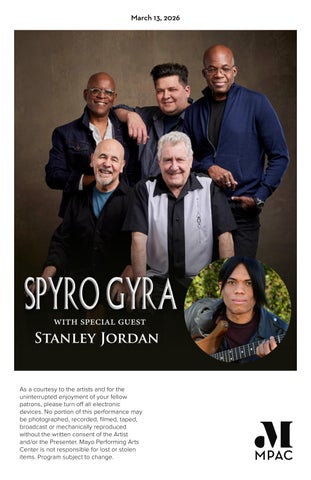
Spyro Gyra
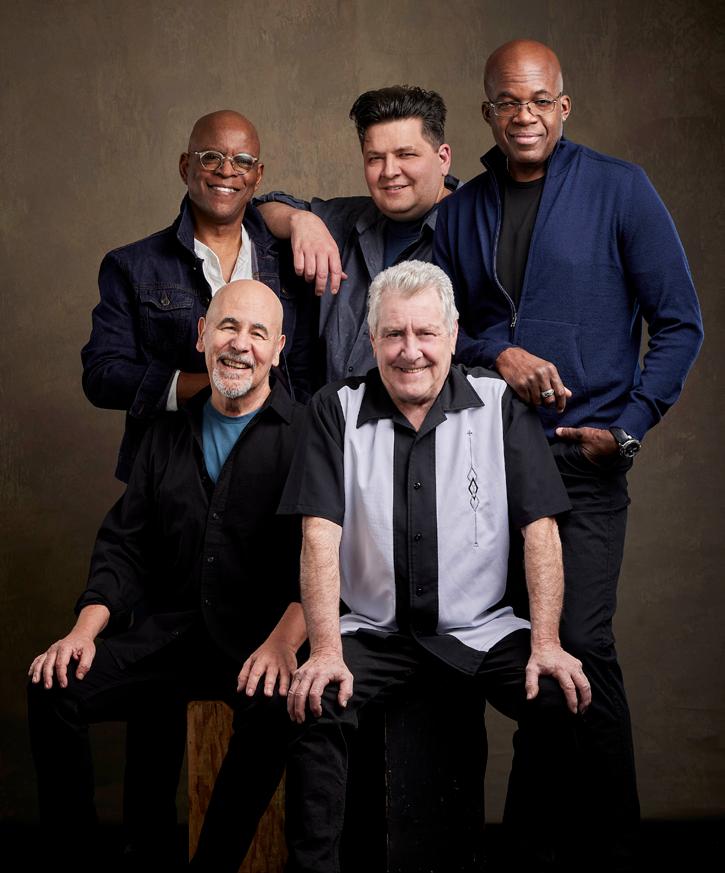
In 2024, Jay Beckenstein and band observed the 50th anniversary of what started as a diversion, something that was just for fun (and twenty-five cents at the door). It’s a time that Beckenstein remembers fondly. He describes the beginning as “that period of time when I was in my 20s, when it was all raw and there were no expectations. It was all about having a good time and playing hard. It was a golden time.”
It’s a story that is familiar to fans of Spyro Gyra the world around. It began inauspiciously in 1974 when Jay Beckenstein and a few musician friends in Buffalo NY organized a get-together on their shared night off from working in bands that actually made money. It was a simple, humble idea with a name that was likewise simple and humble, “Tuesday Night – Jazz Jam.” Every week a core group, Beckenstein and co-founder Jeremy Wall along with Jim Kurzdorfer and Tom Walsh, the rhythm section from the Buffalo Jazz Ensemble who Beckenstein and Wall had been playing with, would gather to jam. They were joined by various players from around town, including long time Spyro Gyra keyboardist Tom Schuman, who just wanted to have some fun playing jazz and its relatively new cousin, jazz fusion.
The idea grew and so did its audience until one week when the club owner insisted that Beckenstein comes up with a name for the group to display on his new sidewalk sign. Beckenstein flippantly suggested “spirogyra” which is an algae he remembered from his biology classes. The next week, there it was adorning the sign out front mistakenly spelled Spyro Gyra. And so it began and continued to grow.
After a couple of years, Beckenstein started to plan his next move which, at
the time for a musician, meant moving to New York City or Los Angeles. The band was successful enough in Western New York that they were able to get studio time in a local sixteen track studio to record an album. Beckenstein has long said that it was intended as a farewell statement to that era of his life and to Buffalo. Then fate stepped in and people started buying that eponymous release.
Soon people with more means were interested in being involved and the band was able to expand its horizons. Lucky? Maybe. “I’ve always felt incredibly fortunate. Not only do I get to do what I love for a living, but I’ve never really had a boss. I’ve been the commander of my own ship and and how fortunate is that? How many people get to go through life in control of something that they love. It’s been fantastic.”
Soon he was in New York City recording his songs with some of the hottest session musicians while keeping the core performing band busy with shows in an ever increasing geographical area. Beckenstein refers to that early period as “the days of making Catching The Sun and Morning Dance in New York City where I got to meet so many great musicians and worked in an environment where I had all the resources we could want to do exactly what we want. We had a blast. We were somewhat excessive at the time but we had a blast.”
Spyro Gyra’s sound has remained instantly identifiable despite several personnel changes over the years. Beckenstein denies that it was the result of any strategy, “Having released 30+ albums, we often made an effort to create something that didn’t sound like the ‘Spyro Gyra sound’. But my saxophone playing is the vocal lead of the band and I have the voice I have.
I’m not a saxophone chameleon. I’m just me. The good side of that is that there is only one me, so it’s effortless. So that has kept a very consistent identity to the band. However, I would say that the band approach changed greatly at different times. Drummers and bass players, the rhythm section, have had an enormous influence on what the band sounded like at any given time. I think that the drummer, whoever he has been, has had a big say in how the band felt and how the band created music. So that’s been a reliable agent of change. When you’re talking about lasting 50 years, thank God for change.”
Beckenstein attempts to sum up the opposing values of continuity and change. “There have been a number of forces that have acted upon us. For one thing, technology. The early days of Spyro Gyra were very much analog. They were very laborious and time has brought us all sorts of new technologies and opened up different kinds of production possibilities, that’s one. The other thing is that any group of musicians who are sincere about what they do keep their ears open. And a whole lot of music has gone down since the beginnings of Spyro Gyra. There’s a lot of things that the people in the band have listened to and that has certainly crept into the music. And I think that kept it current. Then there’s the third thing which is over the years personnel in the band have changed. There’s still been a lot of consistency. Some guys in the band have 30 or 40 years or more.”
And now? “Spyro Gyra of today is more of a team than it’s ever been. I’ve been doing this for a long time and I’m happy not feeling like I have to carry the whole load,” Beckenstein offers. “I’ve managed to surround myself with these really talented guys, terrific musicians, who all have a lot to say. At one time, maybe it
was more of an autocracy. But now it’s more like a basketball team. There’s a lot of passing the ball back-and-forth. There is a cumulative effect of being a true ensemble with inter-ensemble respect.
When asked about the prospect of retiring, Beckenstein demurs. “Hey, I think about it. But I got a taste of it during the height of the Covid pandemic and I didn’t like it. I didn’t like it at all. It gave me a slight feeling of being purposeless.” He explains further, “On the road, there are many times when getting from Point A to Point B is painful and I might wind up muttering under my breath. ‘Why am I doing this?’ But there’s no question, when I’m not doing it, it can feel like there’s no reason for me to be around. So I’m in for as long as I can do it.”
In 2024, Jay Beckenstein and band started its observation of the 50th anniversary of the band. What started as a diversion, something that was just for fun (and twenty-five cents at the door) continues its evolution into 2025. It began inauspiciously when Beckenstein and a few musician friends in Buffalo NY organized a get together on their shared night off from working in bands that actually made money. It was a simple, humble idea with a name that was likewise simple and humble, “Tuesday Night – Jazz Jam.” Fast forward 50 years and this jazz super group has released over 30 albums, garnering gold and platinum along the way. They’ve played over 10,000 concerts on six continents. Spyro Gyra has maintained its standards of excellence and that has sustained them on the “A list” of live attractions in jazz for 50 years.
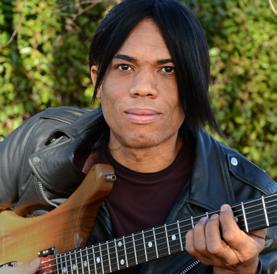
In a career that took flight in 1985 with commercial and critical acclaim, guitar March 13,
virtuoso Stanley Jordan has consistently displayed a chameleonic musical persona of openness, imagination, versatility and maverick daring. Be it bold reinventions of classical masterpieces or soulful explorations through pop-rock hits, to blazing straight ahead jazz forays and ultramodern improvisational workssolo or with a group-Jordan can always be counted on to take listeners on breathless journeys into the unexpected.
Key to Jordanʼs fast-track acclaim was his mastery of a special technique on the guitarʼs fretboard. Instead of conventional strumming and picking, Jordanʼs innovative “touch technique” is an advanced form of two-handed tapping. While a handful of other players were using similar techniques, Stanleyʼs fluid, multi-layered textures and sheer virtuosity raised the bar for excellence. But his technique, though impressive, is always a means to a musical end. His music is imbued with a warmth and sensitivity that has captured the imagination of listeners worldwide. A classically trained pianist before playing guitar, Jordan wanted greater freedom in voicing chords on his guitar, so he applied piano principles to do so. Jordanʼs touch technique allows the guitarist to play melody and chords simultaneously with an unprecedented level of independence. It also allows Jordan to play simultaneously on two different guitars, or even on guitar and piano. He says, “I think of it as a single instrument, but one with a wide range of tonal colors-that's why I do it.”
To date Jordan has performed in over 60 countries on 6 continents. He has performed at many festivals, including the Kool Jazz Festival, the Concord Jazz Festival, and the Montreaux International Jazz Festival. During the 1980s he collaborated with a diverse array of artists, including performances
with Art Blakey and Richie Cole and recordings with Stanley Clarke and Kenny Rogers. The track with Rogers, “Morning Desire,” became Americaʼs #1 country song in 1986. Later Jordan became a frequent guest with Les Paul during Paulʼs legendary Monday nights at Iridium in New York. Today Jordan performs frequently as a soloist and with his band, as well as collaborating with other guitarists such as Kevin Eubanks, Sharon Isbin and Muriel Anderson. Heʼs also a frequent guest with jam bands such as the Dave Matthews Band, the String Cheese Incident, Phil Lesh, Moe and Umphreyʼs McGee.
Jordan has received four Grammy nominations. His most recent album Friends was nominated for an NAACP Image Award. Los Angeles Times jazz critic Leonard Feather wrote, “Genius is a word often tossed around in musical circles, but it has been rightfully applied to Stanley Jordan.”
Stanley Jordan was born in Chicago, Illinois, and grew up in the San Francisco Bay Area. He began his music career at age six studying piano, then shifting his focus to guitar at age eleven. He then began playing in rock and soul bands. In 1976, while still in high school, Jordan performed with Quincy Jones and tied for first place as a soloist at the Reno International Jazz Festival. In 1981 he earned a BA in music from Princeton University, where he studied theory and composition with composer Milton Babbitt and computer music with composer Paul Lansky. While still at Princeton, Jordan performed with Benny Carter and Dizzy Gillespie.
Jordan came to prominence with the release of his 1985 album Magic Touch, a revolutionary project that placed him at the forefront of re-launching legendary
Blue Note Records into a contemporary entity in jazz and beyond, as also established the then-twenty-something Jordan as among the most distinctive and refreshing new voices of the electric guitar. Jordan had begun applying his unique technique to his already exemplary traditional playing ten years prior to the Magic Touch album. Though Jordan showcased the technique in a variety of musical styles from swing to rock, it was smooth jazz radio support for his singular versions of “The Lady in My Life” (first recorded by Michael Jackson) and the Beatlesʼ “Eleanor Rigby” that sent Magic Touch to the top of Billboardʼs jazz chart for a stunning and recordbreaking 51 weeks. The album became a gold-seller (over 500,000 sold in the U.S. alone) - outstanding for any jazz or instrumental CD.
Subsequent albums found Jordan ushering his audience into deeper levels of his artistry and stretching his music beyond stylistic boundaries. These projects included a solo guitar album titled Standards Volume 1 (1986) where Stanley made the bold statement that songs by the likes of Stevie Wonder and Jimi Hendrix deserved recognition as standards just as much as older chestnuts like Hoagy Charmichaelʼs “Georgia On My Mind.” He followed that with the dance-pop album Flying Home (1988) and the especially edgy Cornucopia (1990), which spanned the gamut from straight-ahead jazz recorded live to multi-dimensional originals recorded in the studio. Still later in 1994 after a move to Arista Records (then helmed by pop music maverick Clive Davis), he recorded the bracingly eclectic Bolero album, featuring covers of Herbie Hancockʼs “Chameleon,” Jimi Hendrixʼs “Drifting,” his original “Platoʼs Blues” and the CDʼs centerpiece, a 17-minute arrangement
of Ravelʼs “Bolero”, which flowed seamlessly between rock, African, Latin, “groove” and “industrial” sections. During this era, Jordan also made history by creating the seminal “startup” sound for the first generation of Power Macintosh computers.
In 2002, Stanley released the album Dreams of Peace with the Italian band Novecento. It was remixed and re-released in the USA in 2004 on Steve Vaiʼs Favored Nations label. Independently, he recorded two CDs: Ragas (a collaboration with musicians from India featuring Jay Kishor on sitar) and Relaxing Music for Difficult Situations Volume 1, an audio extension of his interest in music therapy. In 2007 Jordan signed with Mack Avenue Records and released State of Nature in 2008 and Friends in 2011. For Friends, he invited musical guests including guitarists Bucky Pizzarelli, Mike Stern, Russell Malone and Charlie Hunter; violinist Regina Carter; saxophonists Kenny Garrett and Ronnie Laws; trumpeter Nicholas Payton; bassists Christian McBride and Charnett Moffett; and drummer Kenwood Dennard. The results proved truly outstanding on numbers ranging from a Bela Bartok piece to a Katy Perry pop smash, a heady original blues and three jazz classics spanning swing, cool, samba and modern.
Jordan has been known to TV and film audiences as well. In 1987 he made a cameo appearance in the Blake Edwards movie Blind Date, starring Bruce Willis and Kim Basinger. In the tribute film, Les Paul: He Changed the Music Jordan performed with a guitar supergroup including Les Paul himself, Eddie Van Halen, BB King, Steve Miller, David Gilmour, and Brian Setzer. In 1995 Jordan created the score for the short film One Red Rose, starring Hill Harper
Spyro Gyra with special guest Stanley Jordan
and Victoria Rowell, directed by Charlie Jordan. In 1996 he created the score for an ABC afternoon TV special Daddyʼs Girl, directed by Diane Wynter. Since the mid 80s he has performed on numerous television shows, including The Tonight Show with Johnny Carson, The David Letterman Show and the Grammy Awards. One notable appearance was a duet on The Tonight Show with the late rock superstar Robert Palmer.
Stanley is committed to music as an artistic, spiritual, and even healthpromoting endeavor. He has been immersed for more than a decade in
music therapy, towards which he is now working for a masterʼs degree at Arizona State University. His involvement with music therapy leads him to do outreach in schools, hospitals and other venues wherever he tours. He is an artistspokesperson for the American Music Therapy Association, and he has done numerous lectures and demonstrations on the healing applications of music.
Jordan is a resident of Sedona, Arizona. He has one daughter, Julia. Julia Jordan is a singer/songwriter living in Lancaster, Pennsylvania who sometimes collaborates with her dad.
Grade 11; Whippany Park High School; Nominated by Carl Sabatino
I would like to nominate junior alto saxophone player Braden Babb for the March student of the month. Brayden is an up and coming saxophone player in our school and has worked very hard to get to where he is in our program. He is always looking to challenge himself and is an avid listener to jazz music in particular.
Grade 12; Pequannock Valley High School; Nominated by Anthony Streifer Dora has been a phenomenal member of our Jazz Band for the past four years, in addition to her five years in Marching Band and four years in Concert Band. Throughout that time, she has consistently demonstrated exceptional dedication, humility, and work ethic. What has been most impressive is her growth. She entered high school as a developing fourth trumpet player and, through persistence and disciplined effort, has become a confident soloist and lead player. Dora is a powerful example of how commitment, resilience, and a positive attitude translate directly into musical and personal success. She is an outstanding leader: musically and personally.
Grade 8; Pequannock Valley Middle School; Nominated by Michael Kertesz
Ahlam Diab is an exceptional 8th grade alto saxophonist who has been an integral part of our music program for the past three years. She currently performs in Jazz Band, 8th Grade Band, and Marching Band, and in each ensemble she consistently demonstrates outstanding musicianship, maturity, and commitment. Ahlam brings a high level of preparation and focus to every rehearsal and performance. In Jazz Band, she shows confident improvisational skills and a deep understanding of ensemble balance and blend. In Concert Band, she serves as a reliable leader within the saxophone section, modeling excellent tone quality, technique, and attention to detail. As a member of the Marching Band, she demonstrates dedication, resilience, and a positive attitude, always willing to put in the extra effort required for successful performances. Beyond her musical abilities, Ahlam exemplifies responsibility, leadership, and kindness. She is supportive of her peers, receptive to feedback, and consistently strives for growth. Her work ethic and passion for music elevate the entire ensemble, making her a role model for younger students in the program. For her musicianship, dedication, leadership, The 2025-2026 Music Student of the Month program is supported by The Walter F. and Alice Gorham Foundation, Inc.
Outstanding Horn Players
and lasting impact on our school’s music community, Ahlam Diab is most deserving of recognition as Outstanding Horn Player.
Matthew LaRose
Grade 8; Mount Olive Middle School; Nominated by Jacqueline Burkat
Matthew is an excellent student and horn player who is always striving to improve. He collaborates often with his section and other band members during our rehearsals and has worked hard to improve, especially this year. Matthew actually left Band for a little, but decided to return and has been a highly contributing member ever since. I am proud of his tenacity. The fact that he decided on his own to come back to band and put in the extra effort to catch up to everyone else is admirable. He is also a student who stays engaged in rehearsal and responds very well to feedback.
Anthony Lucariello
Grade 11; Mount Olive High School; Nominated by Daniel Pasquale
Anthony Lucariello is a saxophonist who has shown tremendous growth this year as a member of the Mount Olive High School band and music program. He is a dedicated member of the Wind Ensemble Honors, Marching Band, Jazz Ensemble, and Pit Orchestra for two musicals this year. His musical skills are well versed: he carried a solo in our marching band show, "Once Upon a Howl," and is a member of our Tri-M Music Honor Society chapter. In addition to being a frequent presence in the music wing of MOHS, Anthony proudly represents our program at various honor bands. Anthony has earned baritone sax chairs in the North Jersey Area Band Symphonic Band, North Jersey Region I Wind Ensemble, and New Jersey All-State Symphonic Band. His dedication to growing as a saxophonist this year has been evident. Not only is Anthony a rising performer, but he is also exploring his compositional and arranging skills with a trombone trio work for a Tri-M recital and transcriptions for wind band that will be premiered in the coming year. Anthony looks forward to carrying his musicianship into an undergraduate music program.
Stephen Quad
Grade 9; Morristown High School; Nominated by David Gallagher
Steven is an incredibly strong French Horn player and has already accomplished so much as a Freshman. They play in our Honors Wind Ensemble, Marching Band, Jazz Band, and Pit Orchestra. Outside of school Steven auditioned for several honor ensembles and made it into all of them! He played for the North Jersey Area Band Wind Ensemble, Region Wind Ensemble, and NJ All State Symphonic Band. He is wonderfully talented and adds so much to our ensembles as a fabulous role model.