4 minute read
A Map of the British Colonies in North America

from Grandes Mapas
The most important map in North American history
A Map of the British Colonies in North America
Advertisement
1755 ENGRAVING 4 FT 5½ IN × 6 FT 4¾ IN (1.36 M × 1.95 M) LIBRARY OF CONGRESS, WASHINGTON, DC, USA
JOHN MITCHELL
SCALE
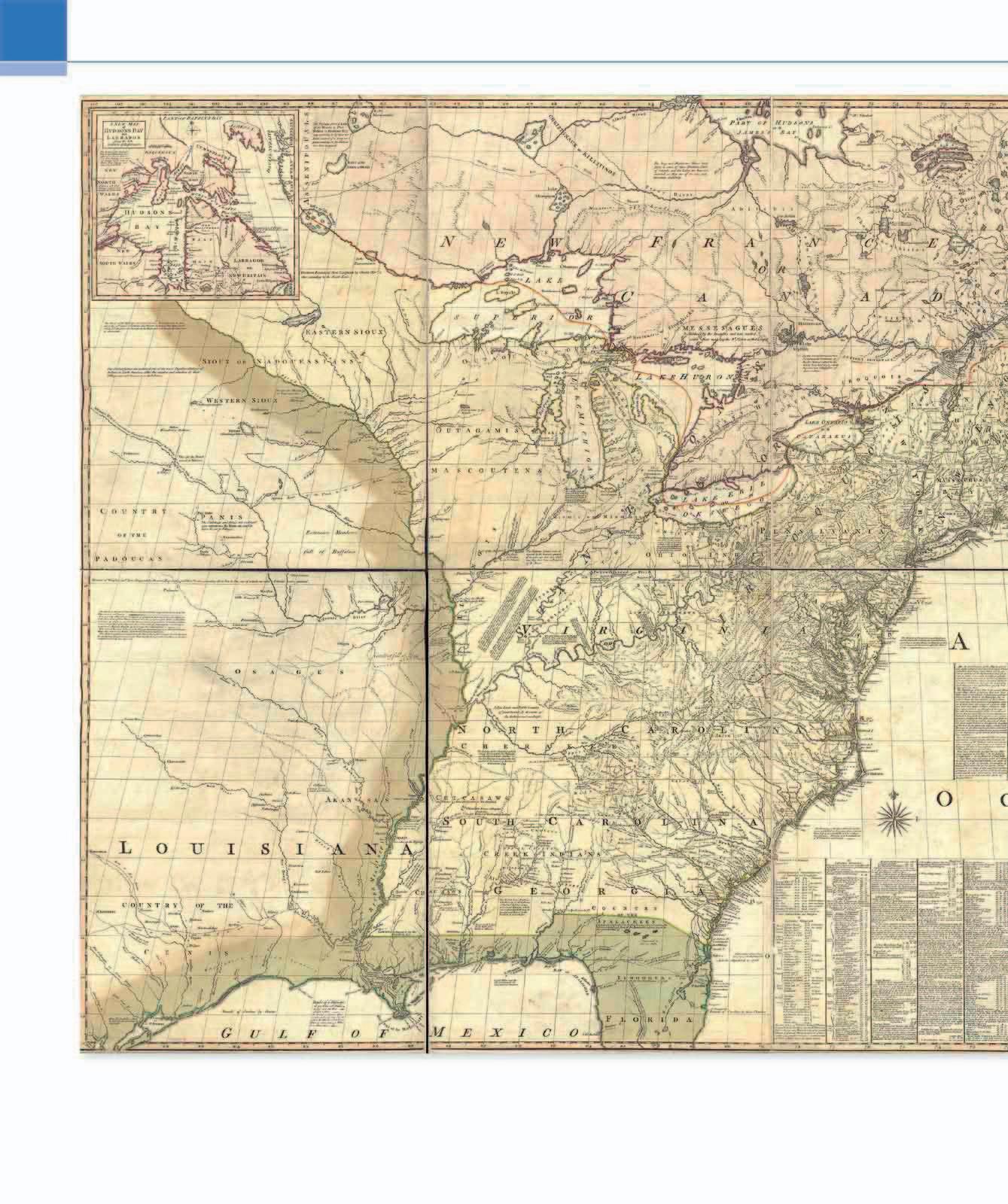
The most significant map in the history of the United States was designed by a doctor and botanist, John Mitchell, to chart Britain’s North American colonial territories, and to help defend them from French encroachment. The map was supported by George Dunk, 2nd Earl of Halifax and President of the British Board of Trade and Plantations with responsibility for Britain’s overseas colonies, to whom the map is dedicated. Both Mitchell and Dunk were concerned that the boundaries agreed between Anglo-French colonial territories under the Treaty of Utrecht (1713–14) were being eroded by French settlers. Halifax’s data enabled Mitchell to produce a map of unparalleled detail, showing British dominions in blue-red (with the French in green-yellow) stretching from the Atlantic to beyond the Mississippi, and from the Great Lakes to the Mexican Gulf.
Ironically, although the map was created to demarcate the regions of America under British control, it was subsequently used to agree the boundaries of the newly independent United States at the Treaty of Paris in 1783, at the end of the American Revolutionary War. It was even used to help settle Maine fishery disputes as recently as the 1980s.
JOHN MITCHELL
1711–1768
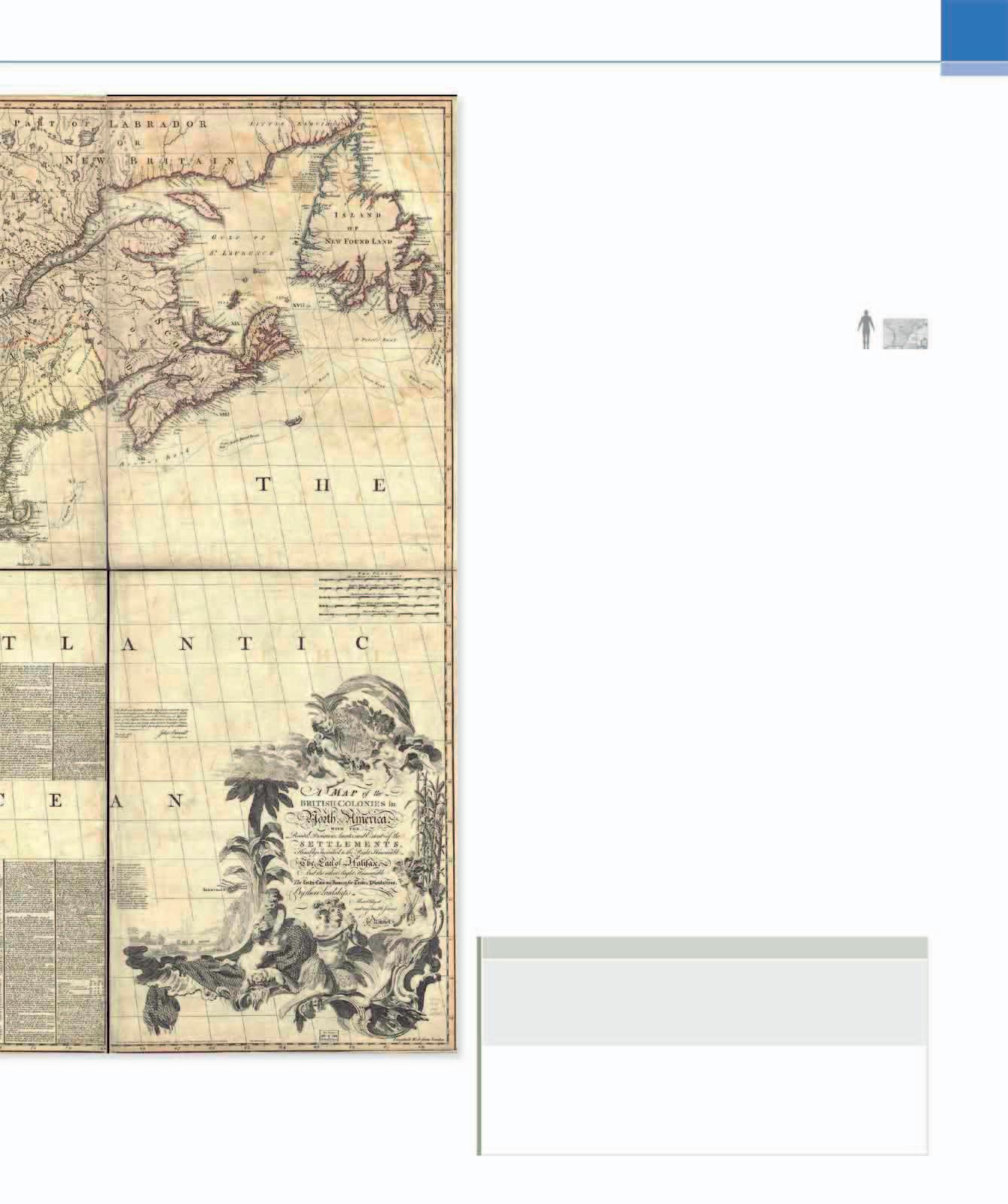
Born in Virginia, USA, and educated in medicine at Edinburgh University in Scotland, UK, John Mitchell was an enthusiastic and respected botanist and student of natural history.
Mitchell returned to his homeland and set up a medical practice in Urbanna, Virginia, in 1735, but moved back across the Atlantic from America to London in the 1740s to seek treatment for both his own and his wife’s ill health. After settling in London, he became a member of the Royal Society, met the Earl of Halifax, and began work on his famous map.
Visual tour
5 2
7 4
6
KEY
3 1
3 LEGEND Mitchell’s legend describes how he made the map. He gives details of the astronomical observations he used to calculate latitude and longitude to produce some of the most accurate figures ever recorded. Since he was not a trained cartographer, Mitchell explains that he had synthesized various sources of astronomical data, coastal manuscripts, maps, and local surveys that were available at the time, but which had never before been combined into one map.
1
2
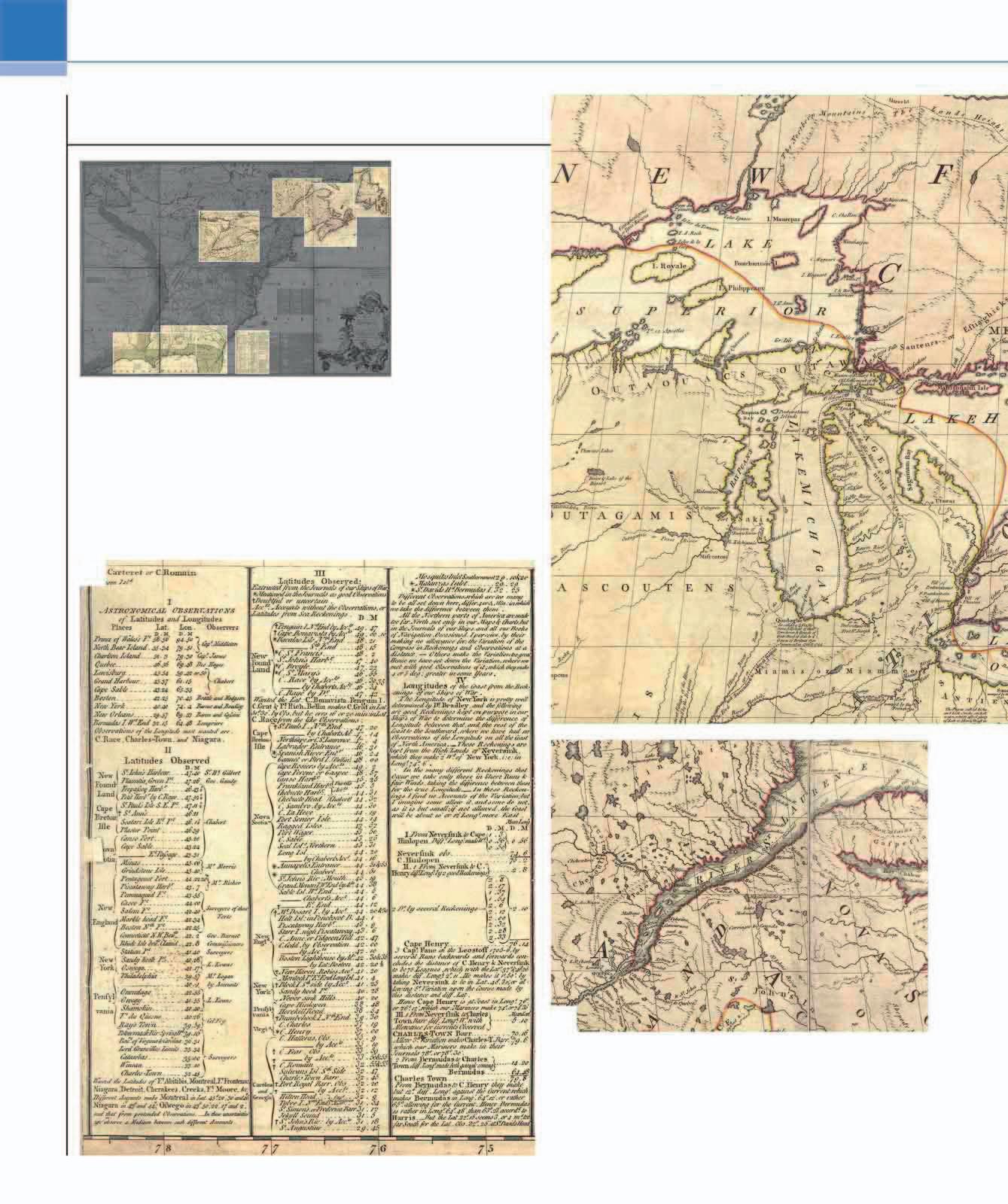
1 ST. LAWRENCE RIVER One of the map’s most contentious regions was the boundary between New England and the French colony of Québec (bottom left). The British claimed all land to the north, up to and including the strategically important St. Lawrence River, an area that contained a large concentration of French settlers. The Treaty of Utrecht left the boundary unclear, leading to confusion and conflict between the two sides. Mitchell’s boundary asserts quite clearly that this is British territory.
6
1 GULF OF MEXICO The mouth of the Mississippi and the Gulf of Mexico were strategically important and bitterly contested territories between the French and the British. Mitchell warns the map’s British supporters that France has almost complete control over the area, although he criticizes their ability to rule effectively, describing “Savage Indians” along the west coast, and inland “Nauchee” locals “extirpated” (massacred) by the French.
5
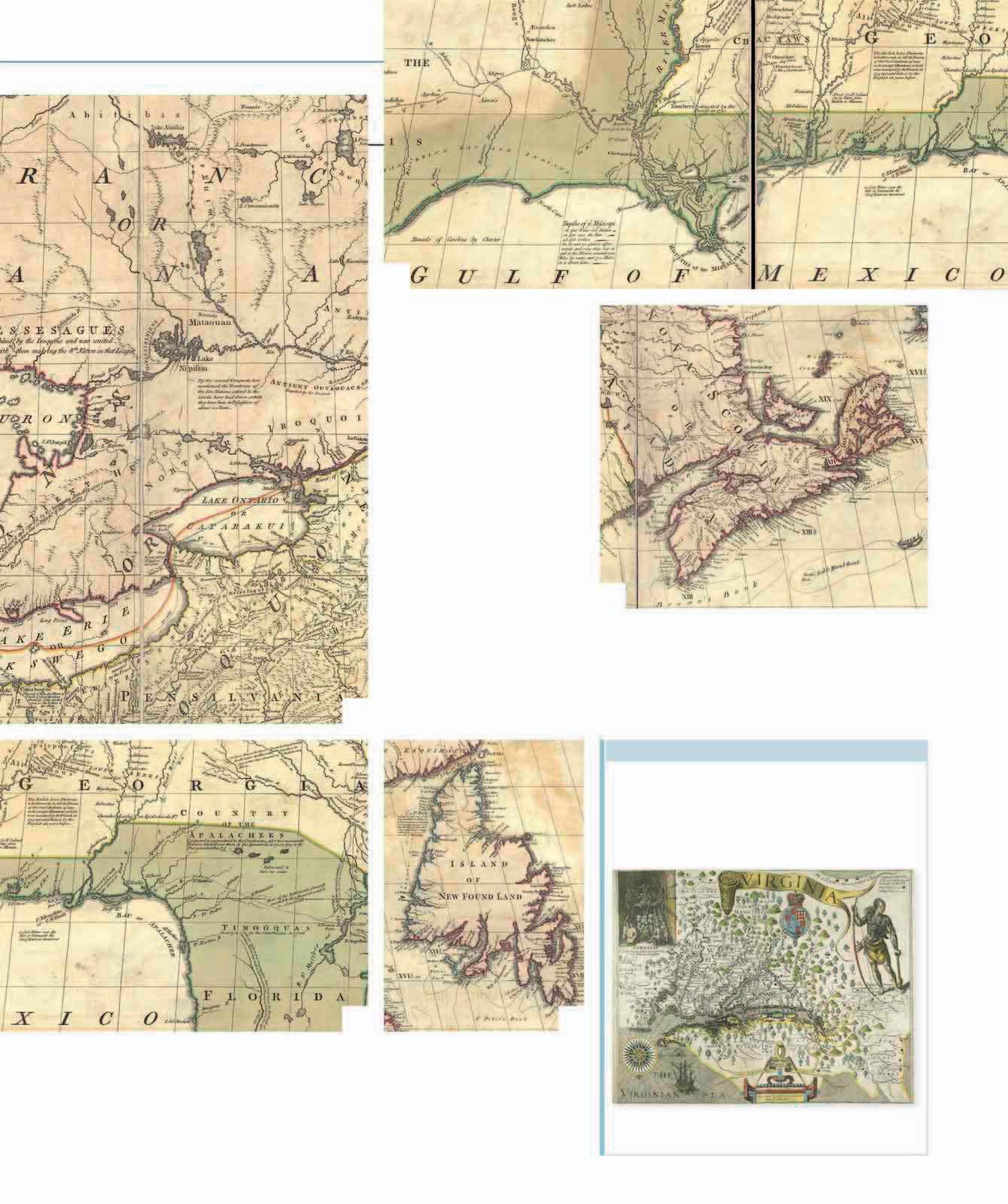
2 AROUND LAKE ONTARIO French and English trading posts clustered around Lake Ontario, a flashpoint in the French and Indian War (1754–63), which began as Mitchell worked on his map. The colored lines show how far French claims clashed with British ones. Mitchell also records the presence of the Native American Huron and Iroquois peoples in his name places and descriptions, explaining where they aided the British—and abetted the French. 7
1 NOVA SCOTIA The Treaty of Utrecht enlarged Britain’s control of Nova Scotia to include French territory in eastern Québec and Maine (named here as “Acadia”). Mitchell’s first attempt to show the Nova Scotia coastline came under severe criticism in the form of John Green’s Nova Scotia map, published in 1755. Mitchell accepted the criticism and revised his map in later editions in acknowledgment of the area’s importance.
IN CONTEXT
Mitchell’s colonial mapping was part of a history stretching back to the 17th-century British plantations in Virginia, where settlers drew lines on maps to indicate ownership, regardless of local claims. In 1783, as British diplomats annotated their copy of the Mitchell map with King George III’s preferred territories, it became known as “George III’s map.”
3 4
1 GEORGIA AND FLORIDA Georgia and Florida’s borders, including the southern Appalachians, were strenuously contested by Britain, France, and Spain. Mitchell pushes the British border farther south than Spain agreed. To the west, Mitchell declares Georgia as British due to their early established “factories” (trading posts), while on the coast he seems to claim an “abandoned” Spanish fort. 1 ISLAND OF NEWFOUNDLAND The French ceded much of Nova Scotia’s coastline to the British in 1713–14, including the islands of St. Pierre and Miquelon, anglicized here as “St. Peters” and “Micklon.” On the northwest coast, Mitchell tries to erase French rights to what he calls “Cape Rich” (Port au Choix).