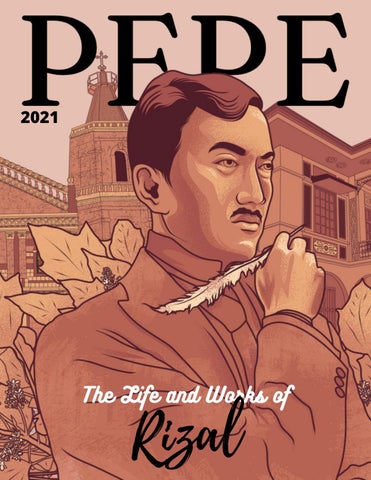
2021
The Life and Works of
l a z i R
Featuring works of MARIA AHRA HANEDINA BASILIA AL DIEGO FUSELERO MAURINE CLAIRE KIM HANNAH MAE PORTUS
An Integrating Project Submitted in Partial Fulfillment of the Requirements for RZL110 – The Life and Works of Rizal
C O N T E N T S
01 03 05 07 MAURINE CLAIRE KIM
WHAT IF RIZAL WAS A MODERN YOUTH?
MARIA AHRA HANEDINA BASILIA
RIZAL: HERO BUT NOT A HERO
AL DIEGO FUSELERO
THE NEW FILIPINO IS NOT LAZY!
HANNAH MAE PORTUS
RIZAL IN QUARANTINE
RIZAL'S (YOU ONLY LIVE ONCE)
“One only dies once, and if one does not die well, a good opportunity is lost and will not present itself again.”
Illustration by CK Robbins
Social Media Noli Me Tangere and El Filibusterismo may have taken longer to write. Without the need for urgency, Rizal would be distracted by all of the things on the Internet. He would probably be busy doing one of the following things: re-sharing posts on Facebook on various advocacies, reading publications around the world from The Guardian to The New Yorker and even Al-Jazeera, watching TED Talks, or browsing reddit.
Traveling He’d be a pro at watching out for promo fares and couch surfing (or booking via Airbnb) across Europe. How else could a student afford to travel across the world? Besides, that’s how he met many of the women linked to him: he met Gertrude Beckett while boarding in the Beckett household in London; Nellie Boustead is the daughter of his host in Biarritz, France; Susan Jacoby and her sister owned the boarding house he stayed at in Brussels.
Online Dating It's no secret that he's dated several women, two of them he was engaged to. This also became the butt of jokes, calling Rizal a “f*ckboy.” His profile would read: Currently swiping in Madrid “It's necessary to have wished for death in order to know how good it is to live.” -Alexandre Dumas, The Count of Monte Cristo. Ophthalmologist looking for great conversations. Proud Filipino.
WHAT IF RIZAL WAS A MODERN YOUTH? Maurine Claire F. Kim
It's easy to become confused by the plethora of concerns demanding our nation's attention these days. We wonder what Rizal would make of the way we rule ourselves today, with the freedom that he and other warriors fought so hard to secure for us. How would he conduct himself and deal with the difficulties we're experiencing if he were in our or our shoes? He'd probably start by railing against fake news. Rizal was a lifelong learner who understood the value of knowledge. He was a master of many trades himself. He'd take precautions to guarantee that his decisions were founded on facts rather than a skewed representation of them. He would constantly assert autonomy and independence, defending our laws and our territory. He would encourage his peers not only to speak up, but also to think and think critically rather than repeating scripted statements that are loud but pointless. He would undoubtedly accept and promote a free interchange of views. If someone disagreed with him, he would engage the person in a rational, respectful discussion rather than attacking them.
Rizal: Hero but not a hero By: Maria Ahra Hanedina Basilia
Ask anyone to name a hero and you’re sure to hear “Jose Rizal” as an answer. Thanks to his status as our National Hero and his ubiquitous presence 160 years after his birth. His profile is on the one-peso coin- an indispensable piece of currency. Brands, streets, and a province bear his name. Almost every plaza has some statue or memorial to him—a measure of his stature in the national psyche. Historian Ambeth Ocampo writes often: “Rizal’s greatest misfortune was becoming the National Hero of the Philippines. He is everywhere and therefore nowhere.”
Renato Constantino’s Veneration Without Understanding provides an in-depth analysis on Rizal’s heroism by understanding his nature historically. From Rizal’s reformist ideologies, racial aspirations, definition of liberty to his battle towards our freedom, the paper provides an in-depth analysis on how we could learn from Rizal’s limitations just as we have learned from the strength of his characters and virtues. We can’t deny that Rizal is definitely a hero we can be proud of, but we cannot make him to be the infallible determinant of our national goals. We must see Rizal historically and understand that he is not the zenith of our greatness. Therefore, hero-worship must be both critical and historical.
Rizal’s certain qualities allow him to recognize the problems of his time and take an active part in seeking the necessary reforms. This is what made him a hero. However, his repudiation of the revolution movement would have stopped or altered the course of events. The truth of this statement is demonstrated by the fact that the Revolution broke out despite his refusal to lead it and continued despite his condemnation of it. He condemned the revolution because he instinctively underestimated the power and the talents of the Filipino people. He believed that freedom is something to be deserved and not a national right.He did not equate liberty with independence because Rizal, as an ilustrado, believed that liberty is the demand for those rights which the elite needed to prosper economically. He did not consider political independence as a necessary step towards freedom. He did not want us to fight for independence, rather, he wanted us to wait for the time when Spain would abandon us.
However, Rizal served the Filipinos by giving form and articulation and color to the aspirations of the people. He saw that the system was broken and felt with intensity the problems of the country, though his viewpoint was limited because of his social status and upbringing. As Constantino said, he was the first Filipino but he was only a limited Filipino, the ilustrado Filipino who fought for national unity but feared the Revolution and loved his mother country, yes, but in his own ilustrado way. Rizal and the propagandists was the manifestation of a consciousness without movement. While Bonifacio and the Katipunan embodied the unity of revolutionary consciousness and revolutionary practice. While some people would agree that Constantino was trying to give Bonifacio a spotlight, I don’t think he was. If anything, Constantino encourages us to be skeptic about the information we are fed.
He was simply trying to elaborate how shallow our knowledge of Rizal is and how this ignorance can be used to relate to the challenges that we’re going through today – abhorring colonial mentality, attaining national identity, and yearning for independence. To say the least, Constantino was merely saying that social demands change overtime, thus, we cannot rely on Rizal alone. Now more than ever, we need heroes who can help us solve our pressing problems.
We must discard the belief that heroes are exceptional beings, who stand above the masses and apart from them because the true hero is one with the masses: he does not exist above them.
Photo by: ChinoF, https://www.getrealphilippines.com/2017/10/bad-filipino-attitudes-work/
THE NEW FILIPINO IS NOT LAZY! IT IS DEEP-SEATED BUT NOT NATURAL.
In the times of Rizal, Spanish authors have been pointing out the laziness of our ancestors. As a defense, Rizal wrote his longest essay about why Filipinos are lazy. In today’s time, are Filipinos lazy and on what grounds do we invalidate this assumption? Filipinos are lazy – even Rizal agreed to this statement. Unseen in the naked eye are the root causes why early Filipinos were called such. For more than three centuries, our natives were deprived of normal lives as they were forced to work and coerced using religion by the usurpers. He explained that the laziness comes from the notion that indios were oppressed, underpaid, overworked, exploited, and were struggling to survive in their own motherland. Therefore, to solve this laziness means to know its roots. If we have set ourselves free from the Spaniards, shouldn’t we reclaim ourselves and detach the slothful branding of the new Filipino? Not really – the bigger problem is that the colonization took so long that it disrupted our sense of identity. We were birthed from a system of oppression, and we took fragments of it as we are refiguring our ways to build our new selves.
by: Al Diego P. Fuselero
The indolence of the new Filipino may not be directly rooted to the colonizers but are from societal factors. Our farmers were struggling to make ends meet because of the very little support they are getting from the government; requires a high amount of capital but the output has a low price. Similar to their crop, you will not expect high throughput and excellent quality products if they were planted without the nutrients and support they need. Just like our farmers, you will not expect them to work at their bests if you deprive them of their basic human rights. In general, it is always implied that poor people are poor because they were lazy. This is an invalid generalization because they were not all given chances to improve their situation; more doors of opportunities are closed to poor people. Personally, I was also branded by my grandmother as a lazy person because I was not working in the farm; she has a concept that only farmers are hardworking. I realized that this is coming from the fact that she only sees us to be working in the farm because of the unstable and less opportunities for us in the world.
Students are also perceived as lazy because of speaking out for the need of academic breaks. The branding that they are lazy is invalid because their petition is coming from a multitude of reasons. Classes are still ongoing during the pandemic but the education system lacks the capability to support the shift to distance learning. It has to be understood that not everyone is privileged and has the resources to continue studying in this time. Hence, making education exclusive to those who can afford. Across time, it is seen that indolence is not in our nature, but rather brought about by various factors in the society. We have to be mindful of that fact that one’s productivity and performance is reliant on the opportunities available to them and their capability to realize these. In the end, we must remind ourselves to check our privileges and understand the complexity behind this phenomena.
Artwork by Carlo S. Tanseco
RIZAL IN QUARANTINE
BY: HANNAH MAE S.A. PORTUS
It has been over a year since the World Health Organization (WHO) declared the outbreak of COVID-19 as a public health emergency of international concern. The pandemic has caused many losses and many communities were forced to adapt to the “new normal”. Governments had to issue temporary restrictions and protocols to decrease local transmissions. Recently, the Philippines have reached its 500th-day mark of being in lockdown. With the resurgence of the virus’ subvariant and our lack in proper planning, tracking, and response to transmissions, the lockdown in all likelihood would last longer. During the 19th century, as Dr. Jose Rizal made his way back to Paris from London after publishing his Annotations of Morga’s Sucesos de las Islas Filipinas, the flu epidemic “Russian flu” was wreaking havoc in Europe. While Rizal was busily preparing the printing of his Annotations, the epidemic has already spread in Paris and London where he was during the period. Though the situation then is different to the situation now as advancements of many technologies progressed in the field, it is interesting to know the measures and approach Rizal might have done in handling or addressing the current pandemic.
Many remembers Rizal for writing novels that prompts national consciousness and identity, but only few appreciates him on how he also serviced his fellowmen as a great physician and a philanthropist. During this pandemic, where most people’s mind are mostly clouded on how to survive, as a healthcare worker, Rizal would’ve advocated towards addressing the pandemic in a health-centric manner while also identifying and correcting the current system lapses. We have been on lockdown for quite a while now, some countries have already recuperated and is now back to their normal lifestyles. Isn’t it only right to change our approach to this pandemic and tackle it with proper health plans, since the current system is distinctly feeble? Millions of Filipinos have lost their jobs and are at loss because of the pandemic and not even bare minimum assistance to many families are given. During one of Rizal’s stays in the Philippines after releasing El Filibusterismo, Rizal practiced his medical knowledge to help his townspeople and gave them essential services, such as schools and hospital-houses, free-of-charge. Rizal took the opportunity to help his people with the land resources present. That is how we should handle the pandemic, taking opportunities in creating better livelihood for the people, maximizing precious resources, and correcting the flawed systems involving essential services. The spirit of Rizal lives today as our medical professionals, who takes care of the ill and does not make them feel alone in their hospital beds and continues to assure them that everything would be all right as they fight on with the virus. Rizal would’ve been one of the frontliners who died in the line of duty as a healthcare practitioner, who calls out those in power in improving the country’s situation. Rizal may have went beyond curing many people in this pandemic; he also would’ve sought to treat the current social system. For this, we should draw inspiration and courage from Rizal’s exemplary would-have behaviors in handling the pandemic.
The youth is the hope of our future.