Unlocking Financial Value Through Better Data by Matthew Roskoff
Data has become one of the most valuable resources in modern finance. Every day, financial institutions and businesses collect information from transactions, customer activity, investments, sales, expenses, and market movements. However, having large amounts of data does not automatically create better results. The real value comes from turning raw information into meaningful financial insights that support smarter decisions, as explained by Matthew Roskoff.
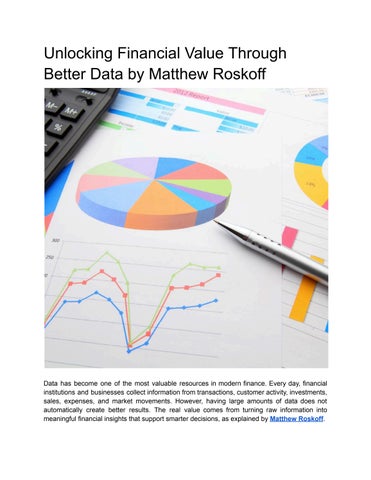
Raw financial data often contains numbers without clear context. A long list of transactions may show what happened, but it may not explain why it happened or what could happen next. Data analysis helps transform these numbers into useful information. By examining patterns, changes, and relationships, financial professionals can better understand business performance and identify important opportunities. Data quality is an important part of this process. Incorrect, incomplete, or outdated information can lead to misleading results. Before analysis begins, financial teams need to organize and clean their data. Removing duplicate records, correcting errors, and filling important gaps can improve the accuracy of financial reports and analytical results. Once data is prepared, analytical tools can help reveal valuable patterns. Businesses can study revenue changes, customer spending, investment performance, operating costs, and cash flow. These insights can help managers understand where the business is performing well and where improvements may be needed. Instead of relying only on assumptions, decision-makers can use evidence to guide their choices. Financial data analysis can also improve risk management. Unusual transactions, sudden changes in spending, or unexpected financial activity may indicate potential problems. By monitoring data regularly, organizations can identify warning signs earlier and take appropriate action. This can help reduce financial losses and support stronger business stability. Modern technology has made data analysis more efficient. Artificial intelligence, machine learning, cloud computing, and business intelligence platforms can process large amounts of financial information quickly. These tools can identify patterns and provide useful insights that might take much longer to discover through manual analysis. However, professional judgment remains important because data needs context before it can support meaningful decisions. Clear communication is another key part of turning data into insight. Financial findings should be presented in a simple way so that managers and decision-makers can understand them quickly. Reports, dashboards, and visual charts can help turn complicated information into practical messages. Turning raw data into meaningful insights in finance is ultimately about making information useful. Organizations that collect reliable data, analyze it carefully, and connect findings to business goals can improve decision-making, manage risks, and discover new opportunities. As financial data continues to grow, the ability to understand and apply that information will become increasingly important for sustainable business performance.