THE
CORAL CRISIS
“The Florida Aquarium proudly serves as an industry leader in protecting, sexually reproducing, and developing the husbandry techniques needed to care for many threatened and endangered species of coral - and we’re making history again, and again, and again!” Debborah Luke, Ph.D. Senior Vice President of Conservation The Florida Aquarium
C
oral reefs play a critically important role in the health of our planet’s marine ecosystems. Florida’s Coral Reef spans 360 miles and is the third largest barrier reef in the world! Unfortunately, many stressors have led to the decline of Florida’s Coral Reef, including increasingly warmer and acidic water conditions, the dying off of key symbiotic species of algae-eating herbivores (such as long-spined sea urchins), and most recently, Stony Coral Tissue Loss Disease (SCTLD), which spans almost the entirety of the reef, affecting 22 species of stony corals, many with complete mortality. It is estimated that Florida’s coral reefs generate $2 billion in annual revenues and support over 70,000 jobs; without healthy corals, the reefs will no longer provide areas for recreation and tourism, habitat for seafood, or coastal protection to beaches. In order to save Florida’s Coral Reef, immediate and innovative actions were needed. In 2018, the Florida Fish and Wildlife Conservation Commission and NOAA Fisheries implemented a bold plan to rescue healthy corals to prevent them from becoming infected, preserve their genetic diversity, and facilitate their ability to reproduce for future restoration activities. Most of these species had never been in human-care and little to no information is known about their reproduction or husbandry needs.
OUR APPROACH
T
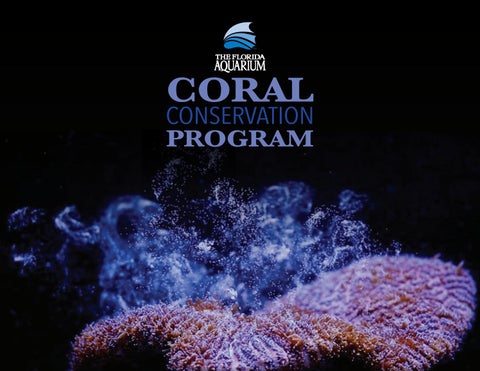
he Florida Aquarium’s Coral Conservation Program is effectively addressing the coral crisis by focusing its efforts on several interconnected strategies specifically designed to protect species that are at risk of extinction, as well as increase coral sexual reproduction rates and advance coral health to help restore Florida’s Coral Reef. Specific science-based, impactdriven projects are integrated within each strategy to create a comprehensive conservation approach that amplifies our expertise, leverages partnerships, and advances our mission.
Extent of coral disease outbreak across Florida’s Coral Reef
OUR COMMITMENT
T
he Florida Aquarium is committed to caring for threatened species of coral and serving as the leader of critical initiatives that significantly advance coral protection, reproduction, and healthcare techniques to accelerate restoration of Florida’s Coral Reef. To achieve these goals, we need support from our community and philanthropists who want to join us on our quest to address the coral crisis. Our team of coral experts and state-of-the-art Induced Coral Spawning Laboratory, Coral Care & Rearing Greenhouses, and research areas are located at The Florida Aquarium’s Center for Conservation (CFC) campus in Apollo Beach, Florida. In 2019, we made history by inducing the spawning of several species of Atlantic coral in a laboratory setting for the first time ever! In 2020, we again made history by reproducing the Ridged Cactus Coral, the Spiny Flower Coral, and even our own 3 year old staghorn corals. We also induced spawning in a third coral species, the Grooved Brain Coral. These ground breaking, globally recognized advancements allow us to increase the genetic diversity of coral offspring, improve coral care and husbandry techniques, and increase coral propagation so valuable resiliency research and restoration work can be conducted. These breakthroughs are made possible by grant funding as well as corporate and personal support. Without donors who believe in our mission and share in our vision, our scientists would not be able to test their theories and practices. With their innovative thinking and with private support…there are oceans of possibilities!
Aquarium employees working towards their environmental stewardship goal.
1980 2017
25-40% is how much healthy coral covered Florida’s Coral Reef.
2% is how much healthy coral currently covers Florida’s Coral Reef.
Carysfort Reef, Florida Keys
Photo Credit: Dr. Phil Dustan
Photo Credit: Dr. Phil Dustan
Assure the long-term health of rescued healthy corals PROTECT
Preserve & bank staghorn/elkhorn coral genetics Cryopreserve coral sperm for assisted reproduction processes Collect gametes from protected corals for sexual reproduction Collect gametes from wild corals for sexual reproduction
REPRODUCE
Induce laboratory spawning & coral sexual reproduction Increase genetic diversity via selective coral reproduction Develop/maintain excellent coral care & welfare techniques Raise large numbers of healthy juveniles
CARE
Manage an algae-controlled habitat Increase availability of genetically diverse coral offspring for resiliency research
RESTORE
Release genetically diverse corals onto Florida’s Reef Coral Enhance reef health through co-release of herbivores
“Florida Fish and Wildlife Commission’s (FWC) partnership with FLAQ is proof of what can be accomplished with public-private partnerships working towards a common goal for restoration of the Florida Reef Tract. The FWC recognizes that continued support for the groundbreaking work that FLAQ is doing with both corals and other coral reef-related species is essential to meeting State of Florida coral reef restoration priorities.”
Lisa Gregg Program & Policy Coordinator Division of Marine Fisheries Management
CORAL CONSERVATION PROGRAM STRATEGIES PROTECT The Florida Aquarium provides long-term care for 15 species of healthy coral, including three threatened species. Many of these corals were rescued before being affected by SCTLD. Techniques have also been refined to preserve staghorn/elkhorn coral genetics and cryopreserve coral sperm, with the world’s largest collection of staghorn coral sperm being managed at the CFC. Both the archiving of living corals as well as the genetic banking of cryopreserved corals are critically important techniques that can be used to build healthy, genetically diverse coral populations into the future.
REPRODUCE The Florida Aquarium successfully raises coral offspring from gametes collected both from the wild and CFCduring natural spawning cycles. Unfortunately, these efforts yield only a small amount of the coral needed for coral research & reef restoration. To help solve this problem, The Florida Aquarium implemented a bold reproduction method that distinguishes our coral conservation work from others. Rather than using the traditional fragmentation technique to divide an individual coral into smaller pieces to increase quantity (same genetics, in essence a clone) or spending extraordinary time and effort collecting gametes from highly variable wild spawning events, we have refined the techniques needed to induce spawning of Atlantic corals in a laboratory to increase genetic diversity via selective coral reproduction! By inducing sexual reproduction, we are charting the course for others, which can lead to a collective movement towards more resilient, diverse coral reefs.
“The Florida Aquarium has been an important partner to the Florida Keys National Marine Sanctuary. The Aquarium's leadership in expertly caring for 117 of the Florida Keys National Marine Sanctuary’s rescued corals and sexually reproducing them to provide genetically adaptable corals is critical for future reef restoration. The Aquarium’s role in the management and restoration of Florida’s Coral Reef, including Mission: Iconic Reefs, will be integral to our success.” Sarah Fangman Superintendent of NOAA’s Florida Keys National Marine Sanctuary
CARE The Florida Aquarium provides excellent coral health and welfare care throughout all life stages, resulting in an unprecedented ability to raise large numbers of healthy juveniles! Corals, both in the wild and in human care, require an algae-controlled habitat to thrive. To meet this need, The Florida Aquarium is also facilitating the sexual reproduction of long-spined sea urchins and other reef herbivores in a laboratory setting. We now have the capacity to strategically manage coral populations in a manner that increases genetic diversity and reef health, which is critical for long-term sustainability and restoration efforts.
RESTORE Restoration of Florida’s Coral Reef requires a consistent supply of corals to be outplanted that are resilient to environmental stressors in tandem with the release of herbivores. The Florida Aquarium’s ability to reproduce corals via its Induced Coral Spawning Laboratory and co-culture herbivores that are produced along with genetically diverse coral offspring presents a pioneering approach to help solve the coral crisis. Coral and herbivore production rates will be increased to a scale that can advance resiliency research and meet restoration needs.
OUR ACCOMPLISHMENTS CORAL & HERBIVORE CARE, REPRODUCTION & REARING Maintain the world’s largest collection of Atlantic pillar coral fragments. Induced laboratory spawning of 4 highly disease susceptible coral species. First institution to successfully raise maze coral offspring. Successfully spawned and reared long-spined sea urchins & American star snails. Raised corals produced with cryopreserved sperm from different parts of the Caribbean.
CORAL & HERBIVORE DISTRIBUTION Outplanted >500 staghorn corals in 2019. Supplied >3,000 staghorn & 200 elkhorn corals to partner coral nurseries in 2019. Supplied 1,000 of coral larvae to partner researchers from 2017-2020.
KNOWLEDGE SHARING Actively participate in working groups, meetings, and conferences regarding coral propagation and restoration. Advise partners on care and propagation of rescued corals and their offspring. Shared gamete collecting techniques and assisted with formaton of a coral nursery with the National Aquarium of Cuba.
EXPANSION OF OUR CORAL CARE & REARING FACILITIES Secured funding to build and outfit Coral Care & Rearing Greenhouse #3. Secured funding to build a 4800 sq. ft. Coral Care Complex
“The world-class husbandry and lab-induced spawning being used at The Florida Aquarium is changing the way we think about protection and restoration of threatened coral species. Our partnership over the years has yielded amazing results and we look forward to continuing to cross new conservation thresholds with their ground-breaking techniques.” Jennifer Moore Protected Coral Recovery Coordinator, Southeast Region NOAA Fisheries / U.S. Department of Commerce
The Florida Aquarium Center for Conservation Apollo Beach, FL
OUR NEEDS
T
he Florida Aquarium’s expertise, partnerships, and scientific breakthroughs are exactly what’s needed to provide genetically diverse offspring at a scale required for successful resiliency research and reef restoration. Predictable and sustained landbased spawning, sexual propagation, and rearing of rescue corals, survivor corals, and herbivores are critical to maintaining genetic diversity along Florida’s Coral Reef. While much has been accomplished to date, several specific needs must be filled if we are to meet our coral conservation commitment. These include:
“We’ve made great strides with research methods that are helping us understand coral in new ways. With philanthropic investment, the possibilities for hope are endless.” Kara Wagner, Chief Development Officer The Florida Aquarium
ONE-TIME INFRASTRUCTURE NEEDS
ANNUAL OPERATIONAL NEEDS
$250K Research and Induced Spawning Laboratory equipment for the Coral Care Complex
$190K/YEAR Coral propagation and rearing operations
$250K Secure and outfit a new coral personnel office structure
$65K/YEAR Coral Field Operations
$175K Secure web cams & high-definition video streaming to main campus & website
$280K/YEAR Coral Conservation Program facilities operations
$50K Increase reverse osmosis production, holding, and distribution.
$532K/YEAR Coral Conservation Program Salaries
$75K Boardwalks & Awnings around new Coral Care Complex
$40K/YEAR Coral Conservation Program scientific transfer of knowledge
$45K Purchase a generator for Coral Care Complex $10K Purchase golf cart The Florida Aquarium is a 501(c)(3) not-for-profit organization whose mission is to entertain, educate and inspire stewardship of the natural environment. With such a bold mission, we approach our programming from a comprehensive view in which we value the education of the next generation through our learning programs, we fight for the protection of our wildlife on both sea and land, and we strive to be a leader in the conservation of our oceans and coral reefs. While we host over 840,000
visitors a year at The Florida Aquarium and delight guests with our exhibits and programming that fosters natural wonderment, we know that the future of our blue planet relies on more than just entertainment; it relies on the dedication from our entire community to fight with us for a healthier tomorrow. By addressing the coral crisis, you are taking important action that will make a difference today, and ultimately, make a difference for the next generation on our blue planet tomorrow. Thank you for your consideration of support for your Florida Aquarium and for the oceans that we share.
OUR PARTNERS
For more information visit: www.flaquarium.com/coral
The Florida Aquarium supports the following UN Sustainability Goals: