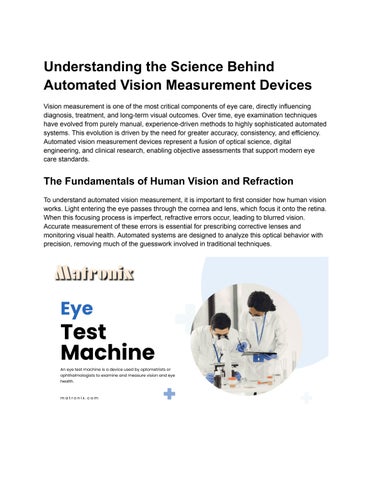
Understanding the Science Behind Automated Vision Measurement Devices Vision measurement is one of the most critical components of eye care, directly influencing diagnosis, treatment, and long-term visual outcomes. Over time, eye examination techniques have evolved from purely manual, experience-driven methods to highly sophisticated automated systems. This evolution is driven by the need for greater accuracy, consistency, and efficiency. Automated vision measurement devices represent a fusion of optical science, digital engineering, and clinical research, enabling objective assessments that support modern eye care standards.
The Fundamentals of Human Vision and Refraction To understand automated vision measurement, it is important to first consider how human vision works. Light entering the eye passes through the cornea and lens, which focus it onto the retina. When this focusing process is imperfect, refractive errors occur, leading to blurred vision. Accurate measurement of these errors is essential for prescribing corrective lenses and monitoring visual health. Automated systems are designed to analyze this optical behavior with precision, removing much of the guesswork involved in traditional techniques.
From Subjective to Objective Measurement Traditional refraction relies heavily on patient feedback, requiring individuals to compare lens options and report which appears clearer. While effective, this method introduces subjectivity influenced by patient understanding, fatigue, or communication barriers. Automated vision measurement devices shift this approach toward objective analysis. By using measurable optical data rather than perception, these systems provide consistent baseline results that enhance clinical reliability.
Optical Principles Behind Automated Devices At the heart of automated vision measurement devices lies advanced optical engineering. These systems project controlled light patterns into the eye and observe how the light is reflected back. By analyzing changes in the returning light, the device determines how the eye focuses images. This process is based on fundamental principles of optics, including refraction, reflection, and wavefront behavior. Precise alignment and optical calibration ensure that measurements remain accurate across repeated tests.
The Role of Infrared Light in Measurement Accuracy Many automated vision measurement devices utilize infrared light during examination. Infrared wavelengths are invisible to patients, allowing measurements to be taken without triggering
natural eye responses such as pupil constriction. This enables testing under more natural conditions, improving accuracy. Infrared light also penetrates ocular structures effectively, allowing detailed data capture without causing discomfort.
Sensors and High-Resolution Data Capture Sensors play a crucial role in transforming optical information into usable data. High-resolution sensors detect minute variations in reflected light patterns and convert them into electronic signals. These sensors are designed to be highly sensitive, capturing subtle refractive differences that might be overlooked in manual testing. The quality of sensor data directly impacts the precision of measurement, making sensor technology a cornerstone of automated vision systems.
Algorithms and Computational Analysis Once optical data is captured, sophisticated algorithms process the information to calculate refractive values. These algorithms are designed to filter noise, compensate for eye movement, and analyze complex light patterns. Automation ensures that calculations follow standardized rules, reducing variability between tests. This computational accuracy enhances diagnostic confidence and supports consistent clinical decision-making.
Repeatability and Scientific Reliability Repeatability is a key scientific advantage of automated vision measurement devices. By following identical measurement protocols each time, these systems produce consistent results across multiple examinations. This is essential for monitoring changes in vision over time, evaluating treatment effectiveness, and conducting comparative studies. Scientific reliability strengthens trust among clinicians and supports evidence-based eye care practices.
Minimizing Human Error in Vision Assessment Human factors such as fatigue, distraction, or technique variation can affect manual measurements. Automated devices minimize these influences by standardizing the testing process. By reducing manual adjustments and interpretation, automation lowers the risk of error. This consistency is particularly valuable in high-volume clinics and screening programs where efficiency and accuracy must coexist.
Applications Across Diverse Clinical Settings Automated vision measurement devices are designed to perform reliably in a wide range of environments. From routine eye exams to large-scale screening initiatives, the underlying
science supports adaptability without sacrificing precision. Technologies such as the auto refractometer portable solution demonstrate how advanced optics and digital processing can deliver dependable results in both clinical and non-traditional settings.
Enhancing Patient Comfort Through Science Patient comfort is an often-overlooked aspect of diagnostic science. Automated vision measurement devices shorten examination time and reduce the need for repeated questioning. This is especially beneficial for children, elderly patients, and individuals with limited communication abilities. By simplifying the process, automation improves cooperation and contributes to more accurate outcomes.
Digital Integration and Data Science The science behind automated vision measurement extends beyond optics into data management. Digital integration allows measurement results to be stored electronically, enabling long-term tracking and analysis. Data science techniques can be applied to identify trends, monitor population eye health, and support research. This digital ecosystem enhances the overall value of automated diagnostic systems.
Calibration and Quality Control Scientific accuracy depends on proper calibration and quality control. Automated vision measurement devices undergo rigorous calibration to ensure that optical components and sensors operate within defined parameters. Regular quality checks maintain measurement integrity over time. This scientific discipline ensures that devices continue to meet clinical standards throughout their lifecycle.
Supporting Preventive and Public Health Initiatives Automated vision measurement plays a vital role in preventive eye care. Accurate and rapid assessments enable early detection of refractive errors and visual abnormalities. This supports public health initiatives aimed at reducing avoidable vision impairment. Scientific consistency ensures that screening results are reliable, even when conducted at scale.
The Future of Vision Measurement Science As research advances, automated vision measurement devices will continue to evolve. Emerging technologies such as artificial intelligence, adaptive optics, and advanced wavefront analysis are expected to enhance diagnostic depth. These innovations will allow more
personalized assessments while maintaining speed and usability. The scientific foundation of automation will remain central to future progress.
Conclusion: Science as the Backbone of Automated Vision Care Automated vision measurement devices are built on a robust scientific framework that integrates optics, sensor technology, and computational analysis. By delivering objective, repeatable, and precise results, these systems have transformed modern eye care. Understanding the science behind them highlights why automation has become essential for accurate diagnosis, efficient workflows, and improved patient outcomes in today’s vision care landscape.