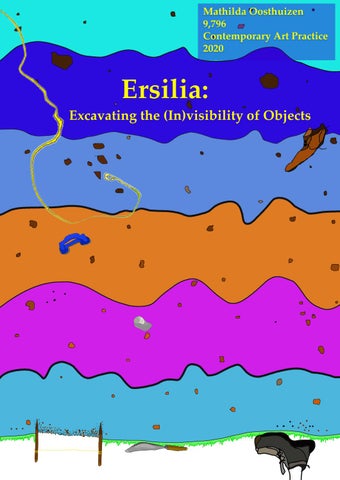
Mat hi l daOos t hui zen 9, 796 Cont empor ar yAr tPr ac t i c e 2020
Er s i l i a :
Exc avat i ngt he( I n) vi s i bi l i t yofObj ec t s
Contents Illustration List
Part 1
Excavation Director Map of the Site Ecologies of the Site and Surroundings Site Significance Approach of the Site
Part 2
Staff
1
2-27 3
10 16 23 28-58
Digger 1
29
Site Photographer
37
Processing of Finds
51
Bibliography
59
–––––––––––––––––––––––––––––––––––––––––––––––––––––––––––––––––––––––––––––––––––––––––––––––––––––––––––––––––––––
Ersilia____________________
Illustration List Figure 1. Mathilda Oosthuizen, Dead Toe, 2020.
Figure 2. Mathilda Oosthuizen, Map of Ersilia, 2020.
Figure 3. Mathilda Oosthuizen, Fluorescent String, 2020.
Figure 4. Mathilda Oosthuizen, Fluorescent Markers, 2020.
Figure 5. Mathilda Oosthuizen, Trowel, 2020.
Figure 7. Mathilda Oosthuizen, Illustration of a Shoe, 2020.
Figure 8. Mathilda Oosthuizen, Old Shoe, 2020.
Figure 9.a Mathilda Oosthuizen,
Packaged Unmarked by Peggy Phelan
Figure 9.b Mathilda Oosthuizen, Unpackaged Unmarked by Peggy Phelan, 2020. (photograph depicts the front cover of Peggy Phelan’s book which features a photograph by Robert Mapplethorpe).
Figure 6. Figure 10. Mathilda Oosthuizen, Mathilda Oosthuizen, Digger 1 Shoe, Hole Punch, 2020. 2020. –––––––––––––––––––––––––––––––––––––––––––––––––––––––––––––––––––––––––––––––––––––––––––––––––––––––––––––––––––––
1
Ersilia____________________
Excavation Director Part 1
–––––––––––––––––––––––––––––––––––––––––––––––––––––––––––––––––––––––––––––––––––––––––––––––––––––––––––––––––––––
Ersilia____________________
Map of the Site
Figure 1.
Come this way. Only through the trees can you see the tenebrous sky. This is particularly true now; spindly lopsided rectangles of blank greyness are intercepted by a parallelogram of blank greyness interrupted by multiple criss-crossings of indistinguishable shapes and blank greyness.
Just below where the wily magpie sits, follow your eyes along the longest branch of gangly elm, the one leaning north, and that is the site of the first trench at Ersilia.1 You can see the edges of the dense bramble bushes … there, that’s the far end, making the total width 10.25m, with the cavern just off the centre of the site.2 The area is not so large at present but this is subject to change as I will explain. There are currently four persons on site not including myself. In the next few days we are expecting more diggers, a photographer and a group of consultants, some of which have already made their mark.
How do we know what is where?
A name borrowed from Invisible Cities by Italo Calvino, Trading Cities 4. This short micro-story is a beautiful tale of a town that uses coloured strings to ‘sustain the city’s life’; they mark out social connections that remain after the residents have left which occurs once it’s impossible to navigate between the strings. An alternative material signifier, making visible that which does not usually have a physical presence; a marker that only exists through strings. Written by Calvino and translated by William Weaver, the book was written with only a vague idea of a structure that was to become the foundation and joists for Invisible Cities; existing somewhere between poetry and novel by Calvino’s own reckoning. William Weaver and Damian Pettigrew, ‘The Art of Fiction CXXX: Italo Calvino.’, Paris Review, 34 (1992), p57–81. 1
2
See figure 2 for orientation.
3
Ersilia____________________
Oh, that’s easy, the hovering strings.3 It’s about two inches off the ground. It’s enough, we don’t need any stronger lines.4 Sure, the great big bold lines5 are everywhere, but we prefer dotted lines. And they change, shift; here the lines are closer to the foam line on a moving tide. Yes, it is fluorescent yellow, it does demand your gaze but only to avoid you tripping over itself,6 it doesn’t want you to fall in the whole or on your face. Why would it? It doesn’t know what it’s like to even have a face.
We have the edges of the hedge, we have the line of the copse but we don’t see them as markers here, that isn’t because we have only subterranean eyes. It comes down to Lucy Salmon’s way of seeing – one of the first consultants we hired. As a Landscape Archaeologist7 ‘she sees reflections of past traditions of land use and the layering of this history’8 through the view from any window. You can’t put all finds
An archaeological dig site is divided into a grid so the excavation area can be documented; that way each find can be easily located within the excavation area. To create these grids, stakes and strings are used. 4 ‘No, she quite calmly reached the conclusion that the notion of distinct domains separated by homogeneous borders does not make much sense.’ Bruno Latour, An Inquiry into Modes of Existence: An Anthropology of the Moderns (Cambridge, Massachusetts: Harvard University Press, 2013), p.29. 5 ‘[T]here is chaos, the whirling forces of materiality without limit, without boundaries. Life emerges from chaos.’ E. A. Grosz, Becoming Undone: Darwinian Reflections on Life, Politics, and Art (Durham: Duke University Press, 2011), p.77. 6 ‘[S]ince at the end of the line, it seems, it is precisely the wordless vocalization of suffering that marks the limits of linguistic translation here.’ Judith Butler, Precarious Life: The Powers of Mourning and Violence (London ; New York: Verso, 2006), p.134. 7 ‘Landscape archaeology refers to the understanding of archaeological remains (artefacts, sites, and site complexes) in terms of the wider spatial realms (both physical and meaningful) of past human experience.’ Tim Denham, ‘Landscape archaeology’, in Encyclopedia of Geoarchaeology, ed. by A.S. Gilbert (Dordrecht: Springer Netherlands, 2017), pp.464–68, (p.464). 8 Marina Moskowitz, ‘Backyards and beyond: Landscape and history’, in History and Material Culture: A Student’s Guide to Approaching Alternative Sources, ed. By K. Harvey, The Routledge Guides to Using Historical Sources, Second Edition (New York: Routledge Taylor & Francis Group, 2018), pp.71-88 (p.72). 3
4
Ersilia____________________
in a small plastic bag, what may be considered an artefact (or to give it its broader term, object) elsewhere, at Ersilia is enlarged significantly to encompass ‘different historical traces’ that can be 'haphazardly combined rather than layered physically on top of one another’.9
You’re asking how that affects us all here, those of us on site? If we were to continue the same thinking as we had before we started the dig, when we were outside the site, except of course when organising off site and in our dreams … I digress, what I mean to say is, we whisper. We must be quieter and alter our ears to hear those that would usually be ignored.
I can hear your question, you don’t want to ask it, I’ll ask it for you:
How can they have any ability to do anything?
Jane Bennett has something to say here, Jane go ahead, they have what she calls a ‘curious ability of inanimate things to animate, to act, to produce effects dramatic and subtle’.10 Are you surprised? And you thought you were coming to a frozen archaeological site with soil and sieves, well we have those too. Not too shocked I
9
Moskowitz, p.73. Jane Bennett, Vibrant Matter: A Political Ecology of Things (Durham: Duke University Press, 2010), p.6. A selftermed Vital Materialist, seeking to reposition matter and things as significant and active through rethinking the distribution of politics in favour of a more ecological thinking can take place. 10
5
Ersilia____________________
hope, because there is more to come. As Jane was saying, we are not alone in this, they do ‘produce effects’ and envelop us. Plenty has been forgotten here, and no doubt I will neglect elements while showing you around the site today. But that’s alright as Theodor Adorno points out ‘we knowers are haunted, he says, by a nagging feeling that something’s been forgotten or left out’.11 We are not conducting this dig to remember; here, we can contend with not knowing and begin considering there is more than what we do and do not know – there is the possibility of ‘nonidentity’.12 After all this is a place of parts, of fragments, we expect to find remainders, ‘objects do not go into their concepts without leaving a remainder’.13 Adorno’s Negative Dialectics14 has a place here at Ersilia, there is space for those of us here to apprehend that things are placed inside cells to which they have been sentenced.
We should go back, and back to Jane’s answer to your question, you see it’s not about learning from the things we hope to find here at this site. Oh, sorry, I thought you had seen the trowel there. Are you ok? You perhaps should have paid more Bennett, p.14. When considering the impossibility of fully grasping what an object is Bennett quotes Adorno’s Nonidentity given to ‘that which is not subject to knowledge but is instead “heterogeneous” to all concepts.’ Bennett, p.14, l.6. What was later to develop into Negative Dialectics, formed from the negation of bourgeois reality with reality. Adorno posits that there will always be parts of concepts and reality that can never synthesise into a whole. Susan Buck-Morss, The Origin of Negative Dialectics: Theodor W. Adorno, Walter Benjamin and the Frankfurt Institute (New York: Free Press, 1977), p.63-67. 13 Theodor Adorno, quoted in Jane Bennett's, Vibrant Matter, (Durham: Duke University Press, 2010), p.14. 14 Adorno’s term dedicated to the strain of accepting that not all dualisms can be reconciled and there needs to be an acceptance of this state. Originating with that of History and reality Bennett utilises Adorno’s thinking, reworking it to that of the object and representation. We cannot squeeze all of the object into a concept, the gap between an object and that which it tries to represent is the challenge of Negative Dialectics as Bennett frames it. Stemming from both Nonidentity and Adorno’s Logic of Disintegration, he puts forward a new system, going beyond that of Dialectics to a process closer to the reality, and the frequent incompatibility of reality and reason. 11 12
6
Ersilia____________________
attention to your shoes this morning, coming to an archaeological dig in those!
There is little attention paid to these things, even if you had the forethought to wear more appropriate footwear, you wouldn’t really have contemplated the shoes themselves. Which is partly Jane’s point here, I believe. We all have a presence here, some different to others. What we hope to find in the next few days, now the first trench has been excavated, are these different presences that wouldn't usually warrent such attention, just like your stubbed toe and the un-stubbed toes.15
Here, hold this. I know it’s a lot to take in on your first site visit. No doubt it wasn’t what you were expecting. Hold it steady, yes. OK. Drink that now. Yes? Ok, good.16 No need to give me that look. I’ll drive you to the station if you like. I’m astonished you managed to walk here in those. You’ve heard of Olsen of course, our lead consultant. There’s much we have gathered from him with regards to how to operate the site, that began with his question, ‘[h]ow do things and objects “mix” with human beings to form those configurations we call society and history?’17 He too utilises a multiplicity of 'usable bits and pieces that may be reassembled with
15 At the beginning of Vibrant Matter, Jane Bennett sets out what it means to see things differently or see them at all ‘[b]y “vitality” … the capacity of things–edibles, commodities, storms, metals–not only to impede or block the will and designs of humans but also to act as quasi agents or forces with trajectories, propensities, or tendencies of their own.’ Bennett, p.viii. ‘The ‘lively powers of material formations, such as the way omega-3 fatty acids can alter human moods’. Bennett, p.vii. 16 The drink was tea, black tea with milk and 2 sugars in a large flask, 1l, which he had had for over 20 years, a turquoise plastic looking vessel with a white plastic cup lid from which you avidly drank. 17 Bjørnar Olsen, In Defence of Things: Archaeology and the Ontology of Objects, 2013, p.2.
7
Ersilia____________________
other appropriate spare parts'18 much in the same way as Ersilia does. After the neglect and even abhorrence towards objects, this question is a useful entry point for contemplating our relationship with them. But of course at Ersilia, we go beyond this; it’s not how we relate to them but about their existence. This ‘mixture’ that occurs needs to be considered as much as possible from their position – the implications of taking their side into account whilst always maintaining the impossibility and limitations of considering that which is not ourselves. This does not inhibit us at Ersilia and the attempt is far from futile. The consequence of this on our perception, interaction and organisation of our surroundings are acute at Ersilia, they could and should be disseminated outside of this site.
A microcosm exists here where we see things differently, no wait, things isn’t the right word! Let me rephrase that … perhaps that is an apt iteration, in that it clearly indicates the treatment of things and objects around us; there is an ‘image of societies operating without the mediation of objects’.19 Here we can permit ourselves to do what is avoided elsewhere. When we came here, there were things we expected to find, those we wouldn’t ever find and an acknowledgment to the presence of the immaterial. A physical presence does not dispel an immaterial one – what is visible is usually not all there is to see.
18 Olsen, 19
p.13.
Bjørnar, p.2.
8
Ersilia____________________
Figure 2. Map of Ersilia archaeological site, showing initial areas to be excavated, including three approaches to the site.
9
Ersilia____________________
Ecologies of the Site and Surroundings
Figure 3.
We share the site with many others. We are definitely not alone, particularly at night. Otters: would that surprise you? We had thought badgers, but no, otters move the fluorescent lines at night. Near the processual and post-processual20 approaches is a reed bed; this has been a concern from the outset and one of the reasons it took so long for Ersilia to get going. We got them to approve it anyway after a chance encounter at the commemoration of the PUF;21 an event hosted by MaMa cultural institute — Graham Harman22 is on hand. He has been an instrumental consultant; he’s a good person to have on your side given his argumentative nature.23
When evaluating the impact on the purlieus area, it became impossible to segregate it from the site. Ecology draws on a multitude of entities; upon assessing the environment before the excavating commenced, we were in touch with Tim Morton
In the 1980s there was a move away from considering an archaeological site as merely scientific (processual) and a recognition that other factors would inevitably sway a thought process or decision. One of the main repercussions is the realisation that it is impossible not to have a bias; the specific environment of an archaeological site would also affect the readings and organisation of the finds. 21 See Bell and Whistles: More Speculative Realism (Alresford: Zero Books, 2013), p.133. 22 Author of Object-Orientated Ontology: The theory of everything, who coined the term OOO in 1999. The definition of which he sets out in Bells and Whistles as: ‘[i]ndividual entities of various different scales are the ultimate stuff of the cosmos … being against reducing these individual entities to their relations.’ Graham Harman, Bell and Whistles: More Speculative Realism (Alresford: Zero Books, 2013), p.6. This differs from what had gone before as other object centred theory had considered the object through the position of the subject, through a metaphysical existence and therefore only being present as a result of an other i.e. the subject. 23 For examples see: ‘Object-Oriented Philosophy | “The Centaur of Classical Metaphysics Shall Be Mated with the Cheetah of Actor-Network Theory.”’ <https://doctorzamalek2.wordpress.com/>[accessed 10 April 2020]. 20
10
Ersilia____________________
to hear his ecological thoughts.24 After reciting a long list of what he considers to be an ecological thought, he ends with: ‘[i]t has to do with ideas of self and the weird paradoxes of subjectivity. It has to do with society. It has to do with coexistence’.25 A 'weird paradox’ indeed, bringing in ‘the self’, is no doubt what came into your mind as I said it!
We take this ‘coexistence’ a little further at Ersilia. We cannot exist in the same way as the otters do or the electricity, and yet they contribute, are the environment, the area, the site, the ecologies that we are concerned with here – ‘[t]hey unfold into a manifold, they don’t order themselves into a duality’.26 The otters may have been disturbed by the fluorescent lines but it was mainly those of us concerned with the areas to be trenched that were disturbed. In part, the otters had no regard for it, no dislike for the lack of the line; ‘ambivalence, ambiguity, uncertainty, and elasticity bothered only humans groping their way toward phenomena that were in themselves secure’.27 A light can be shed on the movement of the line by Bruno Latour – whom I'll tell you about momentarily –
another consultant, brought
in at the planning stage. It’s us humans that see a difference, a divide, and a lack in our own comprehension of what we cannot ourselves possess, empathise
24 Timothy Morton, The Ecological Thought, 1. Harvard University Press paperback ed (Cambridge, Mass.: Harvard Univ. Press, 2012). 25 Morton, p.2. 26 Bruno Latour, Pandora’s Hope: Essays on the Reality of Science Studies (Cambridge, Mass: Harvard University Press, 1999), p.148. 27 Latour, p.152.
11
Ersilia____________________
and simulate. Don’t you think you’ve taken on too much here? Isn’t everything too much? I hear you ask. All, totally, everything, there is no such thing! I’ll show you what I can. If, of course, your feet can stand up to it in those. It was the research consultant Jane Bennett who delivered an indispensable insight, I mentioned her earlier, when we were looking around the first trench, remember? She’s a very clever little thing. Jane came across an event concerning an electrical power grid in North America, the electricity created the event, or rather the lack of it did. Jane will give you an idea of what transpired:
“Yes quite: ’What seems to have happened on that August day was that several initially unrelated generator withdrawals, … caused the electron flow pattern to change’.”28
And this afforded Jane the discernment that events happen yes, but how they happen, the affects that things have, objects have, should be fully acknowledged and brought to the forefront of our politics – there is a liveness29 to them.
Take a seat under this elm, we may be a while with this one and no doubt you are
Jane, Bennett Vibrant Matter: A Political Ecology of Things (Durham: Duke University Press, 2010), p.25. “Liveness", a term used by Philip Auslander in Liveness: Performance in a Mediatized Culture; in which Ausladner states that a ’devaluation of the live event’ has taken place (Auslander, p.62.) and that ‘the main audiences for the performances in question, … did not seem to care whether their idols sang or not’ (Ausladner, p.61). Used here to stress the significance of the actions of objects, that here the opposite is true in terms of the presence of objects being active. 28
29
12
Ersilia____________________
weary. As Jane was talking, you may have heard smaller voices appearing in your mind, I know I did: Felix Guattari and Giles Deleuze, Jane too has mentioned hearing these voices. They speak of diverging from a reaction of one side to another, in their words: ‘[n]ature doesn’t work that way: in nature, roots are taproots with a more multiple, lateral, and circular system of ramification, rather than a dichotomous one’.30
Both
Ersilia,
and
the
electricity
blackout
Jane
relayed,
operate
in
an
ecological vein. ‘Electricity sometimes goes where we send it, and sometimes it chooses its path on the spot, in response to the other bodies it encounters’,31 this is the case with Ersilia too, iterating the underlying mechanisms of how the site functions. In attempting to rid ourselves here of dualisms, and actualising a more rhizome-like32 process when deciphering, or rather, not allowing ourselves to detangle those deductions; instead allowing for continuations growths in how things are considered and actualised at Ersilia.
30 Gilles Deleuze and Félix Guattari, A Thousand Plateaus: Capitalism and Schizophrenia (London: Bloomsbury Academic, 2013), p.3. 31 Bennett, p.28. 32 Deleuze and Guattari set out the meaning of the rhizome in the introduction to A Thousand Plateaus as the following. ‘Principle 1 and 2: Principles of connection and heterogeneity […] The rhizome itself assumes very diverse forms, from ramified surface extension in all directions to concretion into bulbs and tubers.’ (p.7.) ‘3. Principle of multiplicity’ (p.8.) ‘4. Principle of asigning rupture’. (p.9.) ‘5 and 6. Principle of cartography and decalcomania’. (p.12.) ‘[T]he rhizome connects any point to any point, and its traits are not necessarily linked to traits of the same nature’. (p.21.) ‘The rhizome operates by variation, expansion, conquest, capture, offshoots.’ (p.21, l.31.)
13
Ersilia____________________
When nonhumans and humans are considered not in opposition to one another but as elements of an assemblage that are a ’relation obtaining between the parts of a volatile but somehow functioning whole’,33 it could be said that this incongruous mass brings together all and any that is relevant. Jane may maintain that at Ersilia, we are an assemblage:34 fluorescent strings, ecologies, brambles, remainders, otters, all tied together to make sense of each other. To do so would be omitting the significance of relatioanality as a reduction. We don’t want to be mistaken for implying the otters are acting on anything other than their own volition.
By all of us nonhumans and humans knocking into each other, events are created; as each grain of soil is disturbed, otters interrupt fluorescent markers and trowels toy with toes. An assemblage would account for the different parts acting. The different elements (in this case nonhumans and humans) produce events independently of the other: they can be a part of the same. In the frame of the ‘“agency-versus-structure ”debate’35 – it becomes apparent there is no agency afforded to the nonhuman. As Jane puts it, ‘the categories of “structure” are ultimately unable to give the force of things its due’.36
Bennett, p.23. Used by others such as Giles Deleuze and Felix Guattari and comparable to Spinoza’s “modes”: ‘form alliances and enter assemblages: it is to mod(e)ivy and be modified by others.’ (Bennett, p.22.) As described by Bennett in Vibrant Matter. There was a need for another way to organise and conceptualise things as Globalisation indicated parts and wholes now related in a different way to each other. As the world simultaneously become more networked and increasingly disconnected from anything Other. 35 Bennett, p.29. In which structures are debated as working with and 'against human purposes.' Ibid. 36 Bennett, p.29, l.19. 33 34
14
Ersilia____________________
Let's bring in the other consultant I mentioned to you. Bruno Latour brought the importance of the associations between nonhumans and humans and things acting to our attention. His
example of Louis Pasteur37 and Jane’s
electrical blackout very much assimilate. When Actor Network Theory (ANT) is taken into account, the connection of the object becomes interconnected to their uses and meaning. But to place nonhumans and humans in such a system as an assemblage, to see them together as such, would be to disregard difference – particularly when concerning forms of existence.
Latour would like nothing more than for the nonhumans and humans to work together, to have ‘speech, association and recalcitrance’38 as elements present on both sides – they have the opportunity in his eyes to be a ‘collective’. ANT provided useful considerations for how the Ersilia dig could be conducted before the digging even began. It does, however, allow for a passing by of many difficulties pertaining to an object's (in)visibility. It does away with the inability to reconcile difference. Objects are more than the action and relations to humans. After all you can't flatten difference.
In Pandora’s Hope, Latour brings in Louis Pasteur’s ‘discovery‘ of the pasteurisation process as a way to consider the affect of nonhumans on humans, ”[i]f the microbes “lead Pasteur in his thinking” then it is he who is the passive observer of their activity” (Latour, p.147). As one acts upon the other, the structure of human domination is thwarted, Latour’s example reminds humans of their limitations, very relevant to the 2020 Covid-19 global pandemic. When Latour talks of the Historicity of microbes, the previous illusion of the passivity of objects is undermined. Instead – as events such as a global pandemic show – there is action: passed from nonhumans to humans and humans to nonhumans rather than a one way interaction. 38 Bruno Latour, Politics of Nature: How to Bring the Sciences into Democracy (Cambridge, Mass: Harvard University Press, 2004), p.82. 37
15
Ersilia____________________
Site Significance
Figure 4.
Perhaps you should spend the night, there’s plenty of room in my trailer. Place is a specificity that has a distinct affect on how things are seen: where they are seen, or in fact, where they are not seen, a familiar concept in such an arena as an archaeological dig. One thing we can be sure to see is the lack. The gap. There are many gaps we could fall into here. The largest of them is a well traversed cavern.39 Many diggers will descend to its depths; a well excavated hole, never to be made whole. I wouldn’t recommend going out at night here, I’d hate for you to fall in.
There can of course be no gap without something to be a gap from, a between, and this site is no exception. We have the privilege here of minding the gap from an alternative angle. Scaffolding will be built to reveal what is down. In order for us to reconfigure the gap, there first of all needs to be access for the diggers. Maurice Merleau-Ponty, ‘[h]e now insists that even to speak of “subjects” and “objects” implies a gap between them, such that the relation between them can only be that of contemplation’.40
A note on the word cavern as used by Foucault in his essay Utopian Body featured in the book Sensorium, for describing his mind. And for his body: ‘I cannot move without it. I cannot leave it there where it is, so that I, myself may go elsewhere … Where I am. It is here, irreparably: it is never elsewhere.’ My object instead of ‘my body’ could be the next two words so dependant are humans upon things. The Phenomenologist, Merleau-Ponty admits the object to the body. The object is coerced into a sensual hierarchy, where it is not permitted to have sensational independence. But they do embody their own field of experience. Sensorium: Embodied Experience, Technology, and Contemporary Art, ed. by Caroline A. Jones and Bill Arning, 1st MIT Press ed (Cambridge, Mass: MIT Press : The MIT List Visual Arts Center, 2006), p.229. 40 Bjørnar Olsen, In Defense of Things: Archaeology and the Ontology of Objects, 2013, p.130.
39
16
Ersilia____________________
We are at a loss here then, if we are to follow Merleau-Ponty down, for we here, are at a site of activation, of movement. The implied gap will remain, however, whether the site is in action or not. The cavern reveals a certainty in the lack of similitude between the two; the subject and object will remain at an up and down to each other whilst being irreversibly connected. Much more than ‘contemplation’ as you have probably gathered already, if not, there’s still time. I’ll get someone to set up your camp bed next to me.
Those bodies that do find themselves inside the cavern, remain in the dark, ‘[u]ntethered, invisible, protected’41 by what they can never be. As they search, teetering along the scaffolding, all they see is an ‘insistent reminder of a mystery as familiar as it is unexplained’.42 The light that is there only produces shadows, anything that is grasped down there, that is dug up, ‘we are separated from ... by all the thickness of the look and of the body’.43 Down there, in the gap, ’the gaze itself envelops them, clothes them with its own flesh’44 so nothing is really seen. What is claimed to be seen, always remains at a distance even to those who claim ‘[t]he things and the world are given to me’.45 There is much to be found down there, as
Sensorium: Embodied Experience, Technology, and Contemporary Art, ed. by Caroline A. Jones and Bill Arning, 1st MIT Press ed (Cambridge, Mass: MIT Press : The MIT List Visual Arts Center, 2006), p.229. 42 Maurice Merleau-Ponty and Claude Lefort, The Visible and the Invisible: Followed by Working Notes, Northwestern University Studies in Phenomenology & Existential Philosophy (Evanston: Northwestern University Press, 1968), p.130. 43 Merleau-Ponty and Lefort, p.135. 44 Merleau-Ponty and Lefort, p.131. 45 Maurice Merleau-Ponty, Phenomenology of Perception, trans. by Colin Smith (London: Routledge, 2005), p.237. 41
17
Ersilia____________________
you too must think, hence you being here at all, but it is always worth bearing in mind the ‘distinction between experiencing self and the experienced world’.46
At Ersilia there is much consideration for different ways of being present and as such when it is suggested by ‘Merleau-Ponty, the experience of things is a “full”, bodily experience’,47 although the diggers use their limbs to clamber the ladders down to the depths of the cavern, between the object and the subject, their experience is of themselves. ‘As beings of a tactile world, there must be a close relationship and correspondence between my body, my movements, and things’48 but in imagining this, we disappear their difference and forget that although we feel the reassurance of the aluminium edge of the ladder, the gravitational pull and atoms are not understood by humans and nonhumans in the same way. With each step, the fingers clench as the foot feels its way without eyes to guide it down:
“‘This same body, which is so visible, is also withdrawn, captured by a kind of invisibility from which I can never really detach it’!”49 Michel Foucault can be heard from the bottom of the cavern as he has claimed the cavern to be his utopia:
46
reconcile the materiality of his bodily form with his brain functions. Olsen, p.131.
47 48 49
Bjørnar Olsen, In Defense of Things: Archaeology and the Ontology of Objects, 2013, p.130. Olsen, p.131, l36. ed. Jones and Arning, p.231.
18
Ersilia____________________
“‘My body, in fact, is always elsewhere’”,50 he yells from the bottom, unable to reconcile the materiality of his bodily form with his brain functions.
He broke51 his leg and after which ‘I become a thing’52 he said, and this has meant he is stuck down there as to be a thing by his reckoning makes him nothing.53
When the additional lighting for the cavern does finally arrive, still ‘one cannot say if it is the look or if it is the things that command’.54 And in this case Merleau-Ponty has granted that there aren’t such straight forward rulings of who/what is acting upon what/who. As is the case both inside and outside the cavern at Ersilia.
***** Take this map here (see figure 2), across the area here there are two main sections of the site where we are hoping to find objects that will highlight the importance of excavating this area. Voids had been spotted from aerial photographs.55 And what was in these voids I hear you ask? Well Foucault for one, as I have explained. We expect there will be other objects concealed within the voids. To get a better ed. Jones and Arning, p.233. When an object – or tool – is broken, its relationship to the subject changes, so says Heidegger. It is at this point, he posits, that the object becomes visible, within a larger system. See Making Things Public: Atmospheres of Democracy, ed. by Bruno Latour and Peter Weibel (Cambridge, Mass.: [Karlsruhe, Germany]: MIT Press; ZKM/ Center for Art and Media in Karlsruhe, 2005), p.268-271. 52 ed. Jones and Arning, p.231. 53 ‘Nothing is less thing than my body’, ed. Jones and Arning, p.231. 54 Merleau-Ponty and Lefort, p.133. 55 Steven Morris, ‘Amateur Archaeologists Redraw Map of Roman Britain – from Home’, The Guardian, 12 May 2020, section Science <https://www.theguardian.com/science/2020/may/13/amateur-archaeologists-redrawmap-of-roman-britain-from-home> [accessed 7 May 2020]. 50 51
19
Ersilia____________________
understanding of this site it is necessary to look beyond its perimeters, if we are still considering perimeters at all that is. There have been several indicators that have drawn us to these conclusions. In a house in Sittingbourne,56 Kent nothing was meant to be found, but in this case nothing had been concealed for many years. Whether it was meant to be found or not remains to be seen but ‘[t]he concealments are believed to serve a protective function … against incoming malevolent forces’.57 Such practices have been going on
since the
Ages58 prescribing
of that which has
objects
with
a
long-standing
role
Middle
unknown but powerful properties. Little is known of this practice ‘the very lack
of
documentation
is
a
feature’.59
But a
pattern
has emerged:
‘concealments were made at the juncture of old and new parts, in voids, and at points of entry or access (doorways, windows and chimneys)’.60
The sites are temporal, moments of renovation or demolition, unlike Ersilia they are unintentionally stumbled upon. The space an object occupies, the context in which it is understood is immensely effecting especially when constructing a narrative of the object such as our colleagues in the Material Culture sector do.61 ‘In the overall ‘life’
The location of the Sittingbourne Cache, one of the sites documented in the Deliberately Concealed Garment Project. https://www.concealedgarments.org [accessed 2 April 2020]. 57 Dinah Eastop, ‘Outside In: Making Sense of the Deliberate Concealment of Garments within Buildings’, TEXTILE, 4.3 (2006), pp.238–55, (p.239). 58 See History and Material Culture: A Student’s Guide to Approaching Alternative Sources, ed. by Karen Harvey, The Routledge Guides to Using Historical Sources, Second Edition (New York: Routledge Taylor & Francis Group, 2018). p.31. 59 Eastop, pp.238–55, (p.245). 60 Eastop, pp.238-55, (p.246). 56
20
Ersilia____________________
of this object, it has been characterized by one specific stage, that of concealment’,62 such is the case with these concealed found objects. With the lack of knowingness the objects are often inscribed with humanness and ‘container-like properties shared by one’s own body, by a garment and by a building’;63 both having an inside and an outside, physically and metaphorically.
In the 1960s there were indications that this would be a point well worth exploring due to the evidence found at the Sonnabend Gallery. In another void under the floor, the potential for an object to not be present at all was revealed. As in the practice of intentionally concealing objects in the hope that their invisible presence would ward off unwanted presences, here what was not present and what was concealed had a very deliberate intention. In a site that expected an object none was given, instead a human was installed (partaking in an action I shall not submit your delicate ears to).64
Henry Glassie maps the course of transformation an object takes and the different worlds it becomes a part of: it generates different meanings along the way. There’s a biography of an object, a carpet, where he covers the different facets of an object's existence and the different networks it inhabits and transmits from. It also notes the difficulty and ultimate impossibility of it only containing one meaning. Olsen, p.49. 61
History and Material Culture: A Student’s Guide to Approaching Alternative Sources, ed. by Karen Harvey, The Routledge Guides to Using Historical Sources, Second Edition (New York: Routledge Taylor & Francis Group,
62
2018, p.33.
Eastop, p.249. In 1973 Vito Acconci performed Seedbed, a performance piece in which he was positioned under the floor of the Sonnabend gallery and masturbated, whilst Acconci's voice was fed to speakers in the gallery. Among many of Acconci’s work that enacted the body as a material and questioning the need of the gallery space. Interestingly, although his body became the material for the work,‘you can’t think of it in terms of an object’ according to Acconci. Which points towards the difficulty of commercialising performance art and questions when something is considered to be an object and what that can mean. Vito Acconci, quoted in Nick Kaye's, Site-Specific Art: Performance, Place, and Documentation (London ; New York: Routledge, 2000), p.160. 63
64
21
Ersilia____________________
Outside the Ersilia site, one can see the significance placed on the space an object is in ‘presenting an object evacuated of ‘content’ which specifically resists the viewer’s attempt to read it’.65 The attempt at a space devoid of everything outside of it is problematic, which is what I believe Vito Acconci was getting at along with the postprocessual archaeologists.66
Both Acconci, and the concept of post-processual archaeology, indicate the significance of where an object is placed – Acconci with his body being under the floor and the post-processual in recognising the impact of the environment on the meaning of the find. As we dig deeper and increase the boundaries from which the fluorescent lines denote the site, the more we are likely to find the overruling of the object. We are here to witness the disparate ways in which objects can be (in)visible.
When a foot steps inside the site, when we step across the fluorescent lines, we are bringing something that had previously been unseen, into visibility. Disconnecting the unseen from its position, destabilising it, what does this mean here at Ersilia? How might we be estranging those (finds) from (the soil) where they depart?
65 66
Nick Kaye, Site-Specific Art: Performance, Place, and Documentation (London; New York: Routledge, 2000), p.27. See page 10 for definition
22
Ersilia____________________
Approach of the Site
Figure 5.
There were requests at the start of the dig for different approaches to be taken, this would effect everything from how the finds were documented to the way they were excavated and subsequently how the site was written up and organised. I’ll tell you over Ovaltine, you can wear these.67 The formal structures of organising and thinking go far beyond dualisms and the way we organise has far-reaching implications on the thing itself. We can take the example of Foucault, particularly his book, The Archaeologies of Knowledge, where objects, or nonhumans, are just out of sight.
In the ‘imprecise disciplines that are perhaps doomed for ever to remain below the threshold of scientificity’,68 a demarcation takes place and objects are ostracised in place of the quest for total knowledge and the mastery that that can imply. Very quickly the object, a book, is cast aside as it 'is caught up in a system of references'69 and as such ‘it loses its self-evidence’.70 Unlike in Negative Dialectics, Foucault has inadvertently neglected the impossibility of placing everything within parameters. Foucault seems to suggest things need to become visible within categories and norms, but if instead we ‘create a way of living that opens up and develops … (for nature is
The item that was passed over was neatly folded pyjamas, dark green with large ferns repeated across the faded fabric. They were accepted with the justifiable trepidation of not being in control of a circumstance and a defence of careful politeness to avoid confrontation and the ramifications of not doing so.
67
Foucault, Archaeology of Knowledge , Routledge Classics (London ; New York: Routledge, 2002), p.196. Foucault, p.25. 70 Foucault, p.26. 68 Michel
69
23
Ersilia____________________
never fixity but endless resource.)’71 Leaving space for the ‘imprecise’ that lacks what could be called specificity – that which cannot be clearly defined. What happens to the gaps left over, I hear you cry! We can bring in someone here who has dug into this deeper, tilled the soil that Foucault has trodden. The formation of … not things but subjects has concerned them both which would seem out of kilter with Ersilia, and goes against the reason why we are here. But bear with me.
The circumstances that germinate the conditions of the suppression of minority
groups
in
some
ways
concerns
them
both.
But
Foucault
doesn't contend with what cannot fit and what happens when this occurs. It is a theme of the object, that no space has been made available for it. Yes let's lose unity but let's not lose the 'imprecise' too.
How can the formation of the object72 be released from the authoritative relation and instead act on its own? For is this not where the object is lost? When it can no longer be identified within the system (formation) it has been forced to become a part of? It is Judith who recognises the necessity of a 'form of relating to norms and
E. A. Grosz, Becoming Undone: Darwinian Reflections on Life, Politics, and Art (Durham:Duke University Press, 2011), p.150.
71
Foucault’s Archaeologies of Knowledge chapter on ‘Object Formation’ indicates the objects genealogy being relational and isolates Foucault’s limitations on how objects can be seen. This is in contrast with Butler and Athanasiou who instead open up modes of enquiry to increase who is seen where and why: ‘think about how the dialectics of recognition, as defined by identity categories, is potentially decentered in moments of selfrecognition and self-determination by those who remain objected by hegemonic racial, gender, and sexual norms even though they might be occasionally “recognised” or “tolerated” by formal liberal reason.’ Judith Butler and Athena Athanasiou, Dispossession: The Performative in the Political (Malden, MA: Polity, 2013), p.64. 72
24
Ersilia____________________
to others that does not "settle" into a new regime.'73 And here we get back to Ersilia. What happens as the trowel enters the soil?
Parts of the ground have yet to be excavated. The little diggers are due any day now, I forget exactly the date their trowels will enter the soil, the very same I mentioned Foucault treading on. It is Judith Butler, a scrupulous consultant, who would say, ‘[i]dentifications belong to the imaginary; they are phantasmic efforts of alignment . 74
The forming of Foucault and Judith’s ideas here seem to stem from an equally prevalent nuclei, of the significance of the process of identification. In Foucault’s theorising of the formation of History into knowledge, the forming is done by a group of authoritative relations and it is these relations that shape what is made visible. Judith, on the other hand, moves towards the structures in which these subject formations take place and what happens to those that remain. The structures produce a ’struggle against the categories of gender […] forms of collectivity that are struggling against the norms’.75
‘[I]dentification does not belong to the world of events’76 she goes on to say, no not the digger, Judith. And you could argue I suppose that the moment a digger happens
Butler and Athanasiou, p.68. Judith Butler, Bodies That Matter: On the Discursive Limits of ‘Sex’, Routledge Classics (Abingdon, Oxon ; New York, NY: Routledge, 2011), p.68. 75 Butler and Athanasiou, p.67. 76 Butler, Bodies That Matter, p.6 73 74
25
Ersilia____________________
upon a shoe in the soil, it is an event. It is not. The shoe has been there all along, the shoe itself hasn’t changed. What has changed is how we, the humans, identify it. If we adhere to Judith’s view that no event had occurred, nothing will be found at Ersilia, nothing will take place here. For what are the items in the ground77 if not mini identifiers marked off in order to form a single larger identification of a time and place? An identification that would separate each soil granule from that which surrounded it, lay within it, trapped, consumed, oblivious to the clutches, the suffocation. They don’t distinguish one from the other, no difference is seen between the two, for ‘identifications belong to the imaginary’.78 The physical form of the shoe in the soil or ground, its presence, is no different to that which enfolds it. The difference is a phantom, they have converged as a “we”, into a “we”. And we hope to distinguish them, to cover them with our monopoly, our own constitution, our own ‘alignment’ that has very little to do with their alterity even though perhaps it could claim to. Does it obtain its alterity from our identification or can it only ever exist within its own “I” which is significantly distinct from what we call it, how we process it, even here at Ersilia.
77 Not
all objects can be found. There are ‘conditions’, ‘for new objects suddenly to … emerge out of the ground’ that , , Routledge depend on, can only be understood from those related to it. Michel Foucault, Archaeology of Knowledge Classics (London ; New York: Routledge, 2002), p.49.
78
Butler, Bodies That Matter, p.69.
26
Ersilia____________________
You are looking weary, those really do not give the form underneath the credit it deserves, unlike your previous outfit. Is it all a fantasy? Or at least a phantom? Have we imagined we have seen something that is in fact not there? Something that can never be there? If we are reconfiguring these boundaries we are still in need of identifying one from the other. Ersilia is a site that provides glasses from which we can look through and see that which is usually not seen. What would be considered as by-products or a means to an end, are in fact pivotal in order to achieve anything at all. Ersilia can show us all that we ignore. As Graham would put it when considering these finds or non-finds, they have, ‘largely been ignored by analytic philosophers, and when not ignored [have] been quickly dismissed’.79 Relying on the philosophers as consultants to provide an input on approaches to the site may seem an eccentric recruitment choice but it is quite the opposite.
79 Graham Harman, Object-Oriented Ontology: A New Theory of Everything, Pelican Book, 18 (London: Pelican Books, 2018), p.197.
27
Ersilia____________________
Staff Part 2
–––––––––––––––––––––––––––––––––––––––––––––––––––––––––––––––––––––––––––––––––––––––––––––––––––––––––––––––––––––
Ersilia____________________
Digger 1
Figure 6.
The last dig I was on, I was flaccidly sieving soil for six weeks and only found out after we’d finished they had uncovered a body. There was a shoe dangling from the leathery corpse that dated back from 200 AD1 and another shoe2 inside the building. An illustration was made (see figure 7) of the shoe as a way to preserve, reproduce the original. It’s some kind of work I guess being on site, it’s not all about getting paid. He said he would pick me up from the station which was a nice touch and meals are included too. That wasn’t all in the building at the Sittingbourne site, I heard from Dinah there were a few unexpected finds, objects hidden in peculiar places she’d said. 3
It reminds me of camping, most of us are staying on site in caravans or tents but there’s one trailer. How did they manage to get funding for that? How can they rent a 25ft trailer but not pay me? There’s some sense of autonomy at least with staying
The Damendorf body, found in peat which has the effect of somewhat preserving certain elements of a body such as skin, hair, leather belt and shoes. Bryony Coles, and J.M. Coles, People of the Wetlands: Bogs, Bodies, and Lake-Dwellers, Ancient Peoples and Places (New York, N.Y: Thames & Hudson, 1989), p.181. 2 ‘[T]hen my hand touched something that was quite clearly not brick it was quite clearly not-um- anything else that, well any rubble, and I just pulled it towards me an it turned t … as it came out to be a shoe, very long, ladies shoe [...] the the look of shock on both our faces we’d found anther shoe -um- and then we”. A quoted shoe recovery from the below archive from the Deliberately Concealed Garment Project, Hampshire, Wessex Film and Sound Archive, AV950/2/D1. 3 The Deliberately Concealed Garment Project was instigated by Dinah Eastop in 1999. The focus of which was identifying sites where items had been hidden inside buildings. A house in Sittingbourne was one such place where the project recorded finds. The buildings the objects are within are often being demolished or restored and as such the objects are often overlooked. In the Sittingbourne Cache, a large number of items were found dating back to 1620-1630 and included items such as ‘shoes, a felt hat, fabric scraps, scraps of leather harness’.(Dinah Eastop, ‘Deliberately Concealed Garments’, The Deliberately Concealed Garments Project, Sittingbourne Cache, 2010 <https://www.concealedgarments.org/2010/10/sittingbourne-cache/> [accessed 2 April 2020]) The project reveals much on how objects are treated, their significance at times, and their disposal. 1
29
Ersilia____________________
in the caravan, it does mean sharing, Dinah brought so much stuff with her;4 I mean really, in comparison, we will dig up more objects than I carefully tucked inside my holey rucksack, which is saying something given the great possibility there’s no physical evidence of anything down there.
Quantity is everything to Dinah. There’s never enough for some. And that’s why a part of me hopes we don’t find anything; instead of things being useful they are now a source of suspicion and resentment – they have ‘ended up assuming the villain’s role’.5 And it all comes from wanting more: things, food, money, they are now ‘a threat against authentic humans and social values’.6 I mean why bring three pairs of shoes to a dig site? I’m sure she has her reasons. I could say the shoe selection Dinah has made is a reflection of her wish to be herself. ‘[O]nly if the buyer is offered a whole range of choices can he transcend the strict necessity of his purchase and commit himself personally to something beyond it’7 as Baudrillard says. And it’s a he of course, like most things. I can feel it here, on site, all the he-ness.
At two I need to attend the health and safety brief before it all starts. Maybe I will find a shoe, brush around the toe with my 2 inch soil encrusted paint brush, could happen. I read somewhere that ‘from a theoretical point of view human actors
4
Including: three pairs of shoes, multiple pairs of earrings, three notebooks, various moisturisers. Bjørnar Olsen, In Defense of Things: Archaeology and the Ontology of Objects, 2013, p.91. 6 Bjørnar, p.90. 7 Jean Baudrillard, The System of Objects, Radical Thinkers, 3 (London ; New York: Verso, 2005), p.151. 5
30
Ersilia____________________
encode things with significance’.8 If I did find a shoe it might mean more to me than to this dig. I could bury one of Dinah’s shoes but I think that may be frowned upon.
But let’s say I did. I will do such a thing, I am going to! An when it’s found, it will be treated as if it ‘no longer has any practical application, its role being merely to signify’.9 The shoe’s role and how it is seen now ‘[m]anifests itself ... as an authentic presence’10 – the buried shoe is now caught in Baudrillard’s web: it’s now an ‘antique’! A fictitious excitement would erupt; the 'antique object ... presents itself as a myth of origins’.11 Where and when it had come from!? The ’newly found’ shoe's consumer object12 seduction powers begin to fade and with it, they can no longer be bought and possessed like Dinah’s other shoes. Instead a fistful of soil burrowed under the finger nails.
Would there be enough time to bury both the left and right shoe? How long should I leave it before I ditch this safety brief to perform this act? What would it say about the dig if only one is found? Perhaps ‘[t]heir detachment is obvious’,13 would
Appadurai, ed., The Social Life of Things: Commodities in Cultural Perspective, 11. print (Cambridge: Cambridge Univ. Press, 2013), p.5. 9 Baudrillard, p.77. 10 Baudrillard, p.79. 11 Baudrillard, p.80. 12 According to Appadurai the human makes the object ‘in motion’ and it is from this that information can be gathered. But as seen in both Latour and Bennett’s examples of electricity and Pasteur, it is not necessarily that they become active from the human. So it would be useful to think about objects, even as commodities, in a different way. Yes they do have and show our social values but they are more than only that one thing. And yes they were exchanged for something but they are more than that exchange and cannot only be defined as a commodity even if they were in that exchange moment. When they are limited to such, we limit the repercussions of their usage solely to production. 13 Jacques Derrida, The Truth in Painting (Chicago: University of Chicago Press, 1987), p.261. 8 Arjun
31
Ersilia____________________
they always wonder where the other had gotten to? 14 ‘[W]hat is a pair in this case?15
It would most likely trigger the widening of the excavation area. A task that I would most likely be doing ‘[f]aced with a procedure […] that is so sure of itself, that cannot in its certainty be dismantled, the thing, pair or not, laughs’16 along with me as I dig to find the other one that may or may not be present.
What if Dinah herself is the one who digs them up? Would they become hers once more? Would yelling ‘“they’re mine”’17 reclaim them? Or now in the site are they of the site. Is it possible they ‘might well not come back to anyone’?18 A spat19 breaks out over whose they are, where they came from and ‘something like a pairing-together in the difference of opinion’20 as both raise a valid question of origins and identifying.
‘[C]aesuras that are only apparent, you won’t deny it, and a purely faked multiplicity. Your periods remain without remunerable origin, without destination, but they have authority in common. And you keep me at a distance’ Jacques Derrida, The Truth in Painting (Chicago: University of Chicago Press, 1987), p.261. 15 Derrida, p.261. 16 Derrida, p.262. 17 Derrida, p.260. 18 Derrida, p.260, l.11. 19 Emanating from Jacques Derrida’s Truth in Painting, this section plays with Derrida’s assessment and additions of a ‘conversation’ between Meyer Shapiro on Kurt Goldstein and Martin Heidegger concerning Heidegger’s essay The Origin of the Work of Art. Specifically on the subject of Van Gogh’s painting of shoes and their potential owner’s. Heidegger concluded the shoe in the painting was a part of a pair worn by a ‘peasant’. Shapiro was against Heidegger’s findings, questioning Heidegger’s analysis and which painting he was referring to along with the ‘truths’ Heidegger ‘found’ in the paining(s). 20 Derrida, p.263.
14
32
Ersilia____________________
There is always the chance that neither would be found. Should this be considered an option? Should it be left as a possibility i.e. that I bury them in such a place that this becomes possible? Say they are not found now, instead ‘remaining for a greater or lesser period, or even forever, out of use? What do they mean? What are they worth? More or less’?21 Would there still be a reason for burying them even if the digging up was not witnessed by me?
And they wouldn’t be able to trace it back to me if they ever found out, Dinah is size 7 but I’m 5. But maybe ‘its a question of knowing whether the shoes in question are haunted by some ghost or are ghosting/returning … itself’.22 The ghosts of the shoe’s past could lay trapped with the shoe(s) underground – keeping the area around it in the shadow of its past. Would it be me or Dinah or some other former location of the shoe(s) that would be haunted?
‘[S]omething takes place when shoes are abandoned’23 which is what they would think but it's not true. The very purpose of the 'abandonment' is a cryogenic process, they are planted to wait for the moment of ‘discovery’ ‘in strange, worrying, perhaps threatening and slightly diabolical fashion’.24 They can't be torn apart from me, the person who buried them, or can they? Or maybe ‘these abandoned
21
Derrida, p.265. Derrida, p.259. 23 Derrida, p.265. 24 Derrida, p.265, l.22. 22
33
Ersilia____________________
shoes no longer have any strict relationship with a subject … they become anonymous’25 – ripping the shoes and myself (the subject) apart. And it's me that ‘returns to haunt the open form’,26 hovering over the spot I had dug for the shoe(s) giving the game away, signposting the concealment.
‘But do I really want to undertake this procedure?’27 How different would it be to give the shoes back now or after they had been buried? And when returned to the owner, if I did ‘hand them over to [Dinah] the subject, to the authentic wearer or owner’28 would they be back? Where they belonged? They would be brought backwards into their before? Cleaned up? Made wearable again? Once the ‘owner’ is found.
With each bang against the tree, clods would fall to the ground. What had (for possibly a short period of time) clinged so surely, crept so avidly inside its form will instead be banished, the ‘deprivation of ground and the place of these shoes, their taking-place or their standing-in’29 not as they were and now they can't ever be.
When the ‘owner’ is found ‘quite simply these shoes do not belong, they are neither
Derrida, p.265, l.28. Derrida, p.265, l.32. 27 Derrida, p.263. 28 Derrida, p.273. 29 Derrida, p.288. 25 26
34
Ersilia____________________
present nor absent, these are […] shoes, period.’30 And from which period, I know, because I put them there. So if I were to bury Dinah’s shoe(s), which I’m not admitting to, but if I were to do so, are they really Dinah’s? And do they need to be buried to say their piece?
30
Derrida, p.274.
35
Ersilia____________________
Figure 7, Illustration of a Shoe by Mathilda Oosthuizen. Archaeological illustrations act as a tool to reconstruct fragments, reproduce and restore. Recreating the possible outcomes of the past and going beyond what can be seen in the present. The illustration provides a representation of what was; in these moment of careful reconstruction, the past and the present are thrust together. Often leading to the mass reproduction of said illustrations for resources of knowledge or tourism as in the 18th century Il Campo Marzio illustration by Giovanni Battista Piranesi (e.d, Smiles and Moser, p.116.).
36
Ersilia____________________
Site Photographer
Figure 8.
She had been waiting for the package, unsure of how it would arrive. Did the site even have an address? How would they find me, she had wondered. Even if it had somehow found its way here, who would it go to, who should she ask? It had become a necessity. Technically she had the camera, spare memory cards, charger, there wasn’t anything else she needed, technically.
This wasn’t her norm. She usually got on with it, especially here, on her preferred type of job but she couldn’t focus. Not without it. Something had caught hold of a thought that wouldn’t let it go; the tentacles of her mind had been wrapped around it and all the others had now connected itself to it, whether they were related or not. Making it inescapable. She had managed to mask her lack of presence on site, but it wouldn’t last for much longer, soon people would start asking questions.
This subject then, that is not visible here, would say something like, ‘Lacan’s theory of sexual difference ... asserts that it strands woman on a dark continent, outside of language’1; that's why I am here, in the footnote. Still a subject? Being down here incites an objectivity, the material that runs alongside language with dates, places and names. Where did the subject come from, this is the question. Gender is brought into the question right at the beginning: ‘the subject has been conceptualized as inherently masculine’2 says Susan Hekan, she continues ‘maintaining the inferior status of women’.3 There is a line of inquiry dedicated to how ‘women are socially constructed and excluded from the masculine realms of subjectivity’.4 So what does this have to do with the object? Are there not
37
Ersilia____________________
Another day passed. She was left with no choice but to feign illness, staying in her tent with periodic visits to the Portaloo. The tent air became heavy despite the cold bite of a February breeze outside. Every nearby voice and footstep became a tension of potential relief of her hiding place: would they be bringing it, had it arrived? It wasn’t until the morning of the third day she had been at Ersilia that any respite became possible. All night she had wallowed in her own mental and perfumery state, drifting in and out of fantasies neither dreams nor thoughts, of
different scenarios of its arrival. The last envisioned the package never
arriving, that she would be pulled out of her tent in shame, not having taken one
similarities here berween the invisible underrepresented object and the female subject? Should I be reiterating the theories of the formation of the Cartesian subject, perhaps Plato, the human centering of Levinas or Hegelian phenomenology, forming a unified univocal consciousness through Kant? Probably. Instead I’d like to ensure there isn’t a weight placed there and use this lack to recognise the problem. By not focusing on the historic nature of the subject and its formation I would like to alert the reader once again to the significance of visibility and the potential power of not being seen. In not supporting a thesis of the object with that of the subject, I oppose the opposition on the one hand and instead highlight the impossibility of keeping the subject outside of the picture. There is a value and a danger in not being recognised, witnessed, seen, acknowledged. A power in the gap, lack, refusal. When invoked with a deliberate intention which has been the case with Agnes Martin and Lee Lozano as examples; an unpacking process takes place, a possibility for reconfiguring systemic inadequacies. Whereas, when there is a univocal gaze, unknowingly eliminating a difference, what happens instead is a removal, an eradicating of space, a leaving out, a dismantling of bodies that do not fit. A space for doubles erupts. So what is a subject? Who is human? How is it that we have marked ourselves (by ourselves I am meaning those who set this up, who invited the divide between ‘us’ and ‘them’, constructed what it
38
Ersilia____________________
photograph and asked to leave, or worse, someone would ask her what’s wrong. She emerged from her tent, pitched at the back near the reed bed, just after dawn hoping to get some water before anyone saw her.
Cupping her hands under the outside tap, the first gasp of water to purge itself from the pipes since yesterday evening emptied itself into her which she hastily flushed over her sleep tight face. As she positioned the bottle opening under the icy torrents, her arms twitched wetting her sleeve as her ears caught an engine turning near the main gate. Could this be the package? Without thinking she left the running tap, carrying her mostly empty water bottle along with her almost running to where a small van was parked just past the gate.
means to be called a human and fermented it. And by ‘we’ I was referring to the univocal sovereign sentiment, pasted, planted, superimposed, covering, entombing what is a sense of self) off from everything else that has ‘cast man on the other side of the animals’.5 There is a legitimised platform here, a widely theorised altercation concerning assumptive systems that ‘privilege not only the human but a particular kind of (European, masculine, upright, and erect carnivorous- a carnophallologocentric subject’6 a quote from the aptly named book, Becoming Undone. A discourse which undoes (or hopes to undo the accrual of power and how it is bestowed. How should one be granted ones own agency, as many ‘cannot exercise the agency for liberatory political activity’?7 There are passes needed to gain access to such a thing and they are not readily available from those who set up this so called subjectivity. The necessity for a pass, an entry token, a visible queue that one requires to be allowed in is preposterous. Out of sight, a trace that is buried. Buried in a visible site on the ‘dark continent’. What if there was more than the eye, that it didn’t amount to being seen, as Peggy Phelan puts it: ‘what would it take to value the immaterial within a culture structured around the equation “material equals value”’?8 That to be buried or not was not a distinguishing factor, it didn’t inhibit value but ‘contemporary culture finds a way to name, and thus to arrest and fix, the image of that other'.9 And it has already
39
Ersilia____________________
“Janna Fox?” He said through the unwound window. She stretched out her hand in a premature gesture. “You?” She could see it now, he had it in his grasp. She opened her hand out once more. Why wasn’t he giving it to her? Both waiting. “Yes! Yes. Please!” She blurted, uttering the secret password. He released the package into her possession. She turned around, it needed to happen in private, but her tent didn’t seem like the right place. The place had to be just right. He shook his head and drove away.
Now she had it Janna didn’t know what to do with it. Something was about to happen that could only happen once. It couldn’t be re-enacted, transcribed or reproduced. Once the seal had been broken, once the tab had been pulled back with the aid of the translucent red tape, that would be it. The rush to her head made it
happened, the image has been fixed and continues to be repeated. Can it be undone? When considering the presence of the subject and the wish for an absence of sorts, the ‘undoing’ becomes about the division of the formation of identity and how life is distinguished. In Becoming Undone, Elizabeth Grosz’s ushers in Henri Bergson, who upon coming to an understanding of life sees it as a ‘double orientation: out to matter’10 and ‘in, to its own past … memory, virtuality, the past’.11 Putting aside the dualistic oppositions, when the ‘in’ and ‘out’ are not pulled apart, there are some alliances with Peggy Phelan; with seeing, (visibility and the desire to value the immaterial, the ‘virtuality’, that which cannot be seen. Perhaps it is not the value of the immaterial but the oppositional position that it occupies, or rather where it placed. When placed facing each other the material and immaterial (the body, eyes, matter and memory, the past and love) follow the human organisation imposed on the world. And so ‘the immaterial construction of identities - those processes of belief which summon
memory, sight, and love - fade from the eye/I’.12 As they separate this separation sparks, and alights what is the other, the object, and ‘representation produces ruptures and gaps’13 perpetually. How humans treat themselves and each other, whether that be in a political, sexual or economic
40
Ersilia____________________
unclear, her breathing was increasing as she looked around the excavation site, searching for where she could privately unpack this moment, this event.
It would only be her eyes that would see, it would only be her who would feel not only the tension as the cardboard was torn back on itself, as it was separated from the package, but the undoing of what was concealed within it. She could see her breath in the air entombing the package. She tucked it under her coat, under the jumper and t-shirt. She inhaled sharply as the cardboard touched the tiny hairs on
her stomach. It lay against her,
touching her as
if it had been the much
anticipated caress of an estranged lover. Still holding the near empty water bottle in one hand, she pressed the package into her body with the other.
context, relates to the structural formalisation of objects. Thus the significance of the object is great, in focusing on it in a non-hierarchical framework there is a hope in relaxing and reconfiguring structures of ordering. It’s shut out and shut in. Flittering from eye to eye but is never seen. An anterior is glimpsed every now and then but ‘[t]his “not seeing” in the midst of the seeing, this not seeing that is the condition of seeing, became the visual norm’14 and it is this that remains the ‘visual norm’. What is not seen is also a part of the image. The frame of the object, its outline, says much about who put the frame there, ‘[t]o lean to see the frame that blinds us to what we see is no easy matter’.15 As a ghost that appears to some but not others, that is but a trace of incorporeal matter, of a partial lining of unconscious thought, the Other is always in the frame but never really there simultaneously. And the name of this ghost? ‘[T]he face and the name are not ours to know’,16 adding to its lack of substance which is how it can hold on to its identity, through remaining anonymous. Previously, it had been a place of ‘fixity’, the naming provided the anchor of the Other as noted by Peggy Phelan; does taking away this ‘fixity’ act as a releasing mechanism? Peggy Phelan remarks ‘[i]dentity is perceptible only though a relation to an other …. It is a form of both17 resisting and claiming the other’,18 and yet following Judith Butler’s thoughts on the Abu Ghraib19 photographs in Frames of War, it is this relation that maintains a gap between them and
41
Ersilia____________________
***** “Could you pause there for second. Yea, looks like this would be good point to, er, get that in there. Great, thanks.” Janna pressed down, briefly holding pressure before firmly pushing all the way. And again. “Ok great. And I’ll get in there a bit closer for the next one.” She placed her right foot down into the neatly excavated hole, placing a scale to the right side of the heel which protruded from the soil. And twice more she pressed down, briefly holding pressure before firmly pushing all the way. “Great, thanks guys.” Even as a site photographer she could feel her right knee beginning to express angst when she placed all her weight on it from years of bending and scraping to find the ideal angle for each artefact. She would come back in an hour or so to photograph the progress.
There was plenty to document on a site like this one. Several different excavation areas across the site, Janna looked for those moments where finds weren’t quite uncovered. Perhaps not even yet comprehensible, not enough visible material to
it is the gap that allows for a difference. The relation allows, in this case, the prisoners, an “I” (an “I’ that perhaps desires a splitting, a chopping off at the before). Rather than the relation forming the “I” ‘the point would not be to locate what is “in” or “outside” the frame, but what vacillates between those two locations’20 and the moment begins the forming. In this moment, one where the frame is present, the ghost is appearing, ‘if the photograph can be said to reiterate and continue the event’21 is the “I” trapped? Are the identities trapped? Preparing for a perpetual infinity? Always known as what the frame has included. Not if Susan Sontag’s integration is conceded as the photographic frame ‘lacks narrative continuity and remains fatally linked to the momentary’.22 What a relief, that there can be an end. But is it true? Is that the real Real? Can the prisoners, the Other, be released from their past? Even when their anonymity has been
42
Ersilia____________________
piece together what the object was. These moments drew Janna in, reminding her of detective shows where the perpetrator had to be there at the moment of death, watch the life as it was taken from their victim’s eyes. In one of the X-files23 episodes a forensic photographer was accused of orchestrating the moment of death in order to capture the release of life from the bodies. It seemed odd she had thought that the perpetrator chose to photograph the last act, the last breath. Janna considered these moments to be fleeting and transitory, an event that could only happen by being there, making the photograph redundant.
Each object that Janna took a photo of was in a void, ‘absenting the authors of the archaeology from its presented reality’,24 creating a mask, an aura of singularity; that the object appeared as an immaculate conception, devoid of any human existence. All exertions vanish, as do the other objects involved, all tools, broken or otherwise, are abandoned. Now all we have to decipher
protected, with the photo sitting in front of them, with the memory in their mind, can the past be moved from the present? The image retains a ‘fixity’ but the image is an image. The confusion becomes pronounced when an identity is formed based only on the image. At the beginning of Peggy Phelan’s Unmarked she reproposes Judith Butler’s comment from Force of Fantasy ‘representation becomes a moment of the reproduction and consolidation of the real’,25 reinforcing what is seen rather than what is. The forming of the subject, going back to Darwin in Becoming Undone and what is seen to be human, brings back into question how we have come to understand and organise, ‘who to include or exclude when characterising the human’.26 There’s a vast falsity on who and what has this status. When we appear to be a a part of a group, do we not act the part? Do what we think we are supposed to do and behave in a way that we think we are supposed to?
43
Ersilia____________________
the object is 'the limited data available in the light, it can never be more than provisional’27 and although a document, it is one that ‘actively argues for an interpretive position’.28 But at least they can argue in peace Janna thought. They have no proximal obstructions to be in conflict with apart from the absence, ‘various forms of absence are central to the study of material culture’29 or so they say. In which case these photographs were saying more than the materials they depicted. Even without the objects’ presence they are still here. Janna took some comfort in this, not only was the heel of the shoe more than it was but loss could be a gain.
There are two invisible exceptions, the finger of a human and the tool used to produce the reproduction. This bothered Janna, as she liked the void. She wanted to be in this void, to exist in it and at times she did. She wanted to be consumed by the blackness and blankness. But each way she looked there was light.
In the case of the Abu Ghraib photographs, Judith Butler says ‘the torture is, in some sense, for the camera’,30 there is an act of performance when an image is reproduced, whether that be by a camera or an immaterial image. The site a camera captures, is a performed site, so too is the site where the Other is located. The act of being in front of the camera is a reflection of what happens when the camera is put away, ‘[w]e imagine what people might see when they look at us, and then we try to perform (and conform to) those images’.31 This would suggest that the “I” is entirely relational. Although it cannot be denied that there is a certain performativity surrounding the formation of the “I”, to say that it is based around what is ‘outside’ seems like a reduction particularly when the Abu Ghraib photographs are taken into account. Looking back at the represented image a camera copies, ’[t]he performative nature of portrait photography complicates the traditional claims of the camera to reproduce an authentic “real”’.32 Performance itself sets itself off from memory by the Real being only now and the image acts as an ‘encouragement of memory to become present’.33 There is a temporal restriction then
44
Ersilia____________________
Each time her eyes opened the signals were converted by the retina and light bounced from the object into her whether she liked it or not. And it was she who then decided what it all meant, that and a history of ancestors and culture of perceiving; if it could be rewritten, she thought, that would be no bad thing. Instead she was copying it, altering it. Moving it further from what it might have been.
As Janna's gaze shifted from one excavation site to the next, she was struck by the inadequacy of her role. This was what she had wanted to do but since the arrival of the package, things were not as they had been. Each time she chose a subject to photograph it was held prisoner; an A-board had been attached to it, even before it had been born in some cases. Giving directions is tough when your awareness has not yet amounted to that of speech .34 And nor will it ever in the case of these finds. We've come from a position that ‘health professionals made life, as an ultimate
to performing an image; each time the camera is pointed towards a subject, a performance is given based on an unreal false image and each time it is a premier show and ‘[t]he speech act of memory and description … becomes a performative expression’.35 A rebirth, a desire to move past the false image to become another (an Other?). In order for a rebirth, the elimination of the image needs to take place. What better form than a re-writing, without a solid image to turn to, false representations could be swiftly overturned. Is it not preservation that has permitted a stasis? An image fastened to that which is ‘other’, unable to shake off a representation formed through a before, a captured moment, a frame penning on and penning out the rest. With the appearance of solidity, it is writing that needs to ‘re-mark again the performative possibilities of writing itself’36 to bring it into the present, to move away from repeated representations that can’t preserve the gap or difference. Instead of hoping to hold and uphold, writing needs to have room to print shades of grey to work ‘towards disappearance, rather than the act of writing toward preservation’.37
45
Ersilia____________________
value, trump all other considerations except when it came to those who threatened these values: for example criminals, and also abortionists’. 38 This thing in the dirt never had a chance, thought Janna, and her photographing it removed it a second time from it ever having anything other than what the subject had given it. If she were to delete the photographs, removing herself from this process (if one were to ignore the rapid reproduction of her role by another that would take place) there would be no signposting reproduced; at once putting a limiter on who could see the object and allowing for it to only be seen in its material form. Would the object retain more possible alternative rhizomes if it were to only be witnessed in real time? Either way there was little choice as she saw it. Janna didn't want to become superfluous and so she clicked away as she wondered and wandered around the site.
The past is reiterated from inside, perpetuated. The roles are performed repeatedly, locked inside. Glimpses of the ghost act as sparks of hope, the haunting of what is not “I” are reminders that there are other sites other than what is understood, that to be in a place of not understanding, and to be accepting of such a position is hope. Only then can an oppositional position be discounted, a reduction of what is not a gap, a sight that doesn’t see a discount as less, that a gap is not small because it is less valuable. It would seem the space is running out, not everything will fit in here. The footnote is too small after all, similar to ‘the precariousness of the human as a state of being',39 the footnote too has a lack ‘[p]hilosophy has attributed the man a power that animals lack (and often that women, children, slaves, foreigners’40 and footnotes too experience. Perhaps it can pertain to the acknowledgment of struggles to be represented, the place language is situated with its ‘we’s’, ‘[w]hat would the study of ... language which did not privilege the human as its paradigm look like?’41 Elizabeth Grosz asks; she continues discerning what the ‘linguistic elaboration of life’43 could additionally include and what is absent, emphasising its function as a tracing device. That is, a device which functions always as a trace, a secondary sight, a whisper.
46
Ersilia____________________
Figure 9a, 9b. Photographs by Mathilda Oosthuizen: left, 9a a packaged copy of Unmarked by Peggy Phelan and right, 9b a copy of the same book after it had been taken out of the packaging.43
47
Ersilia____________________
***
She had it between her thumb and index finger. A clear entry point. She took a breath in and held it; as her hand exhaled, the cardboard drew away from her. Once to the end, she released the air that had culminated in her lungs, through her throat past her lips. She felt the edges one last time, felt the entirety, this was the last moment it would be a whole. It would soon become defunct. In a few seconds it would become nothing. In this second it was still the sum. Her next action would erase a past much like the diggers at this site. But unlike at Ersilia, the only one who would know about this loss was her, Janna.
This was a moment to pause, to consider that the extraction would be taking away the essence of another. She could sense the pain of the moment , the grief of a before and after. Her fingers edged towards the opening, her middle finger protruded longingly, feeling the confines of the malleable cardboard [figure 9a] on either side, and retreated. This moment would need to end and it was this that spurred her on. Not that she wanted to receive its contents, this became secondary to the event itself. This is happening, she said to herself. She grasped the contents in her mind's eye [figure 9b]. It wasn’t that the thing inside had much to do with her being but she was reminded of the person she was before, before she ordered it, before she knew she had to have it, before she was waiting for it, before she couldn’t do anything without it, even though she had done so before.
48
Ersilia____________________
1
Joan Copjec, Read My Desire: Lacan against the Historicists (Cambridge, Mass.: MIT Press, 1995, p.216.
2
Susan Hekman, ‘Reconstituting the Subject: Feminism, Modernism, and Postmodernism’, Hypatia, 6.2 (1991,
pp.44–63, p.45. 3
Hekman, p.45.
4
Hekman, p.47.
E. A. Grosz, Becoming Undone: Darwinian Reflections on Life, Politics, and Art (Durham: Duke University Press, 2011, p.12. 5
Grosz, p.14. Jane Flax, Disputed Subjects (RLE Feminist Theory : Essays on Psychoanalysis, Politics and Philosophy (London, Taylor & Francis Group, 2012, p.170. 6 7
8
Phelan, p.5.
9
Phelan, p.2.
10
Grosz, p.27.
11
Grosz, p.28.
12
Phelan, p.5, l.22.
13
Phelan, p.2, l.12.
14
Judith Butler, Frames of War: When Is Life Grievable? (London New York: Verso, 2016, p.100.
15
Butler, Frames of War, p. 100, l.15.
16
Butler, Frames of War, p. 95.
17
Phelan, p.13.
18
Phelan, p.13, l.29.
The name of a US military run prison near Bagdad, a site of torture where ‘Photographs and videos taken by the soldiers as the abuses were happening’ Seymour M. Hersh, ‘Torture at Abu Ghraib’, The New Yorker <https://www.newyorker.com/magazine/2004/05/10/torture-at-abu-ghraib> [accessed 30 June 2020]. 19
20 Butler, 21 22
Frames of War, p. 75.
Butler, Frames of War, p. 83.
Butler, Frames of War, p. 69.
23
‘Tithonus’, X-Files, Fox. WXIA, Atlanta. 24, Jan. 1999. Television.
24
Envisioning the Past: Archaeology and the Image, ed. by Sam Smiles and Stephanie Moser, New Interventions in
Art History (Malden, MA: Blackwell, 2005, p.194. 25
Phelan, p2.
26
Grosz, p.16.
27
Tim Ingold, The Perception of the Environment: Essays on Livelihood, Dwelling and Skill, 1st edn (Routledge, 2002,
p.246. 28
ed. by Sam Smiles and Stephanie Moser, p.182.
History and Material Culture: A Student’s Guide to Approaching Alternative Sources, ed. by Karen Harvey, Routledge Guides to Using Historical Sources, Second Edition (New York: Routledge Taylor & Francis The Group, 2018, p.240.
29
30
Butler, Frames of War, p.85.
31
Phelan, p.36.
32
Phelan, p.36, l.32.
33
Phelan, p.146.
This isn’t to say that there is an inclination here to anthropomorphise the object but as a way of making visible the difficulties of what is an object. As it would seem nonhumans can too be objects, this can be seen in the lack of agency experienced and the presence of an overruling subject. 34
49
Ersilia____________________
35
Phelan, p.146, l.32.
36
Phelan, p.148.
37
Phelan, p.148, l.33.
38 Penelope Deutscher, ‘Judith Butler, Precarious Life, And Reproduction’:, in Foucault’s Futures, A Critique of Reproductive Reason (Columbia University Press, 2017), pp.144–90 p.159-160. 39
Grosz, p.12
40
Grosz, p.12, l.23.
41
Grosz, p.14.
42
Grosz, p.14, l.24.
In marking the book as invisible, there is a comment made concerning the significance of presence and invokes the contents of the book itself. Unmarked tells of the politicization of visibility taking specific examples such as photographs by Robert Mapplethorpe. Phelan interprets Mapplethorpe's use of portrait photography as a form of possible disappearance – whether that be reproduction, death, self-image or race. In the context of recent photographs of gymnast Simone Biles – taken for the front cover of Vogue magazine – one has to wonder, if the they had been taken by Mapplethorpe, what the outcome would have been. Annie Leibovitz, who took the photographs of Simone Biles, a black woman, has been criticized by many (@allisonhopstad, 10 July 2020., @NoelenWebb, 10 July 2020., ‘Critics Pile On Vogue Over Simone Biles Photos, Call For More Black Photographers | HuffPost UK’ <https://www.huffingtonpost.co.uk/entry/critics-pile-on-vogue-oversimone-biles-photos-call-for-more-black-photographers_uk_5f09e28bc5b67a80bc081fd0> [accessed 09 July 2020] etc) for not knowing how to light dark skin effectively. Mapplethorpe, although focusing explicitly on the tones present in dark skin, has also been noted as proliferating racial stereotypes and the 'power of whiteness' (Phelan, p.47). In both cases there is tension between the acknowledgment of difference and conflict between that which is made visible and who/how the visibility is brought into view. 43
50
Ersilia____________________
Processing of Finds
Figure 10.
Everything ends up here. That’s the aim. It’s a gathering where everyone present plays their part but no one gets drunk. Water is instead sometimes dusted across the fascias, and bristles trace contours of surfaces reducing any soil that has joined
uninvited.
It’s
quiet,
no
large
expanses,
instead
boxes
and
computers, numbers and forms.
A recovering process, layering on the strata of bureaucracy, of signs we can read in order to place them where we can see them. Where our human eyes can see them, in the numbers and forms we can see them, they have been found.
Landing on the expanse of table, they all become an oversight, ‘”oversight” exactly captures the two meanings of this domination by sight, since it means at once looking at something from above and ignoring it’.1 Once unpacked and laid out, the finds from GR213 jostle in their plastic covering; the previous residence, a navy blue A4 hole-punch, remains ‘“too close” to draw explicit attention’.2 The retrievals become rigorously ignored then, marking itself off from the hole-punch in its separate invisibleness.
Latour, Pandora’s Hope: Essays on the Reality of Science Studies (Cambridge, Mass: Harvard University Press, 1999), p.38. 1 Bruno 2
Bjørnar Olsen, In Defense of Things: Archaeology and the Ontology of Objects, 2013, p.90.
51
Ersilia____________________
Is it the problem then that they are seen? Should the anticipated collector shut her eyes? Fondle her bags, graze her fingers over the numbers instead ‘the classified, specimens from different locations and times become contemporaries of one another on the flat table, all visible under the same unifying gaze’.3 Without a ‘unifying gaze’, would there be a possibility of transforming into a status of an absent hierarchy of the object? It’s not possible. It is stuck, ‘I cannot want at all, ... what I call my desire is so bound up with these categories that without them I may find myself not desiring at all'.4 As Judith Butler discusses with Athena Athanasiou the difficulty in working within a system which is the very tool to which ‘non-compliance to established terms of recognizability calls into question the viability of one’s own life’.5
‘In losing the forest, we win knowledge of it’.6 Could there be a way of, to continue the metaphor, maintaining the forest and still winning the knowledge? In Pandora’s Hope, Latour is on a field excursion with a pedologist and a botanist who take samples from a forest which is temporarily made their laboratory. By Latour’s own admission, the samples are taken away to their ‘calm and cool office’7 to Latour, Pandora’s Hope , p.38, l.9. Judith Butler and Athena Athanasiou, Dispossession: The Performative in the Political (Malden, MA: Polity, 2013), p.77. 5 Butler and Athanasiou, p.78. 6 Latour, p.38, l.35. 7 Latour, p.38, l.20.
3 4
52
Ersilia____________________
‘examine at their leisure’ 8 . How would it look if instead there was a strategy of working with this environme nt, that the entire the process was centred instea d around finds themselves. This is the mode of thought for which Ersilia was there to foster.
The write up. ‘[W]hat does it mean to re-present objects in words? Is this not a domestication of their differences?'9 The interstices at this point grow. Grow up around and apart. With an attempt to write up, the objects are instead written through or written off. What was once difficult to see is now at once invisible and centrefold. Covered up by that which wishes to Each find reveal it and represent it. adheres to a methodology or it should do. Eachfind is part of a cultural pattern , a grouping of artefacts. Each find accords itself to some form of criteria.
Adherence to strictly defined conventions for the operations, the construction of useful classification. Validation lying in culture signification, seeking to identify patterns. How then shall we unwrite these objects? For it seems this is what needs to happen to take them back to Ersilia. They were dropped off with such expectation Lo em of ip
Latour, p.38, l.5. Christopher Y Tilley and others, Handbook of Material Culture, 2013 <http://www.vlebooks.com/vleweb/ product/openreader?id=none&isbn=9781446206430> [accessed 24 May 2020], p.11. 8 9
53
Ersilia____________________
the importance of the classification that would take place. The question remains as to how the object can enter this process without losing anything.
Can the way in which the finds are written about offer any subtraction? Something other than the ‘(objects)treatment in scientific discourse is somehow analogous to Western blindness toward the other’;10 a form that could simultaneously offer and protect: allow the object to become visible without masking its own objectless? A system in which the object can grow tendrils, ’Neither is it a mere blank slate for inscription or an arena for the free play of our imagination’,11 perhaps imagination is more than ‘free play’ and should be credited with more than a flippant openness but a productive one. However, the object is written, it is unavoidable, but ‘to write is to make ourselves subject to narrative formation processes, to literary techniques and conventions (rhetoric, allegories, plots),blurring the strict border between scientific and fictional literature’12 whether scientific or otherwise.
There is another option, what if the object, the find from the Ersilia dig, can align itself to performance as it ‘becomes itself through disappearance’.13 They could be aligned in many ways, more than in the practical performance of retrieval and reenactment but the pressures applied to what remains. Performance leaves it
10
Olsen, p.54. Olsen, p.51. 12 Olsen, p.53. 13 Peggy Phelan, The Unmarked, 4th ed (London: Routledge, 1993), p.146. 11
54
Ersilia____________________
unresolved by staying at a jar with representation and documentation. Having been moved, the finds could remain in orbit. Unencumbered by pressures of reproducing results, ideals, narratives, without documentation no one would speak of them except those who witnessed their uncovering. They would remain only in that moment. Not attributed to any moment of history they were not aware of.
Are they important enough to remove? Or important enough to reenact? Significant enough to grant a re-remembering? Back to how the finds ended up here, the transitional process, a question asked by Judith Butler, ‘What does this social passion qua collective movement (e-motion) owe to the ec-static character of subjectivity - to our being beside ourselves and moving beyond the powers by which we are enabled?’14 From here it’s not far from the van to which the finds were moved. The fragments rattled to be sure. Even through their thin plastic coverings they bumped up against each other until all vibrated ‘in stasis and in motion created space not as a static physical location’.15 The pieces brought into one place here, did not lie unmoved, were provoked as the key entered the ignition, they were brought into action, ‘a contingent field of flows and forces, extension and intension’
.16
In transit
both literally and ontologically. 14
Butler and Athanasiou, p.176-177. Ibid, p.177. 16 Ibid, p.177, l16. 15
55
Ersilia____________________
They were important enough to be moved, and they were moved. Into a moment of reenactment but ‘The disappearance of the object is fundamental to performance; it rehearses and repeats the disappearance of the subject who longs always to be remembered’.17 In this instance there are no rehearsals other than for the reinstatement of use for the object. Multiple points of ‘lost’ and ‘found’ reveal themselves and the object is pulled around, instead of hovering, the lines become taut, knots stemming availability of plurality in reproductive options. The possible affects are quenched some way.
in
On this elevated surface then, they now ‘employ the hyper-visibility of the runway to secure the power and freedom of invisibility’;18 in the environment they are expected to be in, in this setting they have a role. A fast- forwarded rehearsal based on expectation, ‘another twist to the already knotted set of reversals and inversions around the politics of visibility’,19 they can now be seen. But for what? And by whom? Will each viewer play their own reenactment over the object? Better to rewind, to before they were retrieved to let them retain the ‘power of the unsurveyable’,20 give them the space back so they can once agai n be unseen, left in the temporal drough t of the soil. What is going on here? It’s ju st as well there are no finds on the table, th at there is no table, as put as put by by Peggy Phelan, ‘The paradox of 17
Phelan, p.147. Ibid, p.93. 19 Ibid, p.93, l19. 20 Ibid, p.94. 18
56
Ersilia____________________
using visibility to highlight invisibility is complex and quite often misfires'.21 It's all becoming clearly unclear, especially with regards to the object or the - or the el3jeet, its all coming out now (or going back in). Best to think of the rhizome and forget the whole th i n g.
'The risk of visibility then
risk of any translation - a weaker version of the
original script'22 but if there is no 'original' then there is nothing to fear after all? A change or c hanges will take place comes
as it was. and with these changes
loss, will it be a loss for the oppositional view of the subject? A grieving for a conflict that has raged endlessly, indisc riminately and ruthlessly. Would the grieving be for what had been in the dark for so long? The grieving for the realisation of what had not been present 'such open and public mourning, in disrupting the order and hierarchy of the soul, would disrupt the order and hierarchy of political authority', 23 reworki
gain what was understood to be a life that mattered, a life that was
'counted'. And when it is 'counted' seen recognised made visible marked it is made to 'work to reprodu
equal liberal regimes of power and imaginaries of
national cohesion'.24 Which is where it becomes all the more important to begin the grieving process, to begin the 'different sets of affects and invoke different ' 5 to histones · ... to cata1yse d1"fferent publ"1cs 2 eke out the difference and hope it's 21
Phelan, p.96. Phelan, p.97. 23 Judith Butler, Frames of War: When Is Life Grievable? (London New York: Verso, 2016), p.131. 24 Butler and Athanasiou, p.76. 25 Jane Be1mett, Vibrant Matter: A Political Ecology of Things (Durham: Duke University Press, 2010), p.111. 22
57
Ersilia____________________
enoug
us see more than ou elves.
58
Ersilia____________________
Bibliography Anonymous, ‘The Secret Life of an Archaeologist: Soil in Your Sandwiches and Sexism on Sites | Anonymous’, The Guardian, 25 April 2016, section Opinion <https://www.theguardian.com/
commentisfree/2016/apr/25/secret-life-archaeologist-soil-sandwiches-sexism-sites> [accessed 16 May 2020]
Appadurai, Arjun, ed., The Social Life of Things: Commodities in Cultural Perspective, 11. print (Cambridge: Cambridge Univ. Press, 2013)
Atkins, Ed, A Primer for Cadavers (London, United Kingdom: Fitzcarraldo Editions, 2016)
Auslander, Philip, Liveness: Performance in a Mediatized Culture, 2nd ed (London ; New York: Routledge, 2008) Balibar Etienne, Commonalities:Citizen Subject. (New York:Fordham University Press, 2016) Barthes, Roland, Camera Lucida, Vintage Classics (London: Vintage, 2000)
Baudrillard, Jean, The System of Objects, Radical Thinkers, 3 (London ; New York: Verso, 2005)
Bennett, Jane, Vibrant Matter: A Political Ecology of Things (Durham: Duke University Press, 2010)
Blackson, Robert, ‘Once More... with Feeling: Reenactment in Contemporary Art and Culture’, Art Journal, 66.1 (2007), 28–40
Buck-Morss, Susan, The Origin of Negative Dialectics: Theodor W. Adorno, Walter Benjamin and the Frankfurt Institute (New York: Free Press, 1977)
Butler, Judith, Bodies That Matter: On the Discursive Limits of ‘Sex’, Routledge Classics (Abingdon, Oxon ; New York, NY: Routledge, 2011)
———, Frames of War: When Is Life Grievable? (London New York: Verso, 2016)
———, Gender Trouble: Feminism and the Subversion of Identity, Routledge Classics (New York: Routledge,
2006)
———, Precarious Life: The Powers of Mourning and Violence (London ; New York: Verso, 2006)
Butler, Judith, and Athena Athanasiou, Dispossession: The Performative in the Political (Malden, MA: Polity, 2013) Calvino, Italo, Invisible Cities, Vintage Classics (London: Vintage, 2009)
Candlin, Fiona, and Raiford Guins, eds., The Object Reader, In-Sight (London ; New York: Routledge, 2009)
Coles, Bryony, and J. M. Coles, People of the Wetlands: Bogs, Bodies, and Lake-Dwellers, Ancient Peoples and Places (New York, N.Y: Thames & Hudson, 1989)
Copjec, Joan, Read My Desire: Lacan against the Historicists (Cambridge, Mass.: MIT Press, 1995) Dallas, Costis, ‘Jean-Claude Gardin on Archaeological Data, Representation and Knowledge:
Implications for Digital Archaeology, Journal of Archaeological Method and Theory, 23.1 (2016), 305–30
Deleuze, Gilles, and Félix Guattari, A Thousand Plateaus: Capitalism and Schizophrenia (London:Bloomsbury
Academic, 2013)
Denham, Tim, ‘Landscape Archaeology’, in Encyclopedia of Geoarchaeology, ed. by Allan S. Gilbert
(Dordrecht: Springer Netherlands, 2017), 464–68
Derrida, Jacques, The Truth in Painting (Chicago: University of Chicago Press, 1987)
Deutscher, Penelope, Foucault’s Futures: A Critique of Reproductive Reason, Critical Life Studies
59
Ersilia____________________
(NewYork: Columbia University Press, 2017)
Eastop, Dinah, ‘Deliberately Concealed Garments’, The Deliberately Concealed Garments Project,
Sittingbourne Cache, 2010 <https://www.concealedgarments.org/2010/10/sittingbourne-cache/> [accessed 2 April 2020]
———, ‘Material Culture in Action: Conserving Garments Deliberately Concealed within Buildings’, Anais Do Museu Paulista: História e Cultura Material, 15.1 (2007), 187–204
———, ‘Outside In: Making Sense of the Deliberate Concealment of Garments within Buildings’, TEXTILE, 4.3 (2006), 238–55
———, ‘Sense of the Deliberate Concealment of Garments Within Buildings’, 1-18
———, ‘Sound Recording and Text Creation: Oral History and the Deliberately Concealed Garments Project’, 1-6
Fabian, Johannes, Time and the Other: How Anthropology Makes Its Object (New York: Columbia University Press, 2014)
Flax, Jane, Disputed Subjects (RLE Feminist Theory) : Essays on Psychoanalysis, Politics and Philosophy (London, United Kingdom: Taylor & Francis Group, 2012)
Foucault, Michel, Archaeology of Knowledge, Routledge Classics (London ; New York: Routledge, 2002)
Grosz, E. A., Becoming Undone: Darwinian Reflections on Life, Politics, and Art (Durham: Duke University Press, 2011)
Harman, Graham, Bell and Whistles: More Speculative Realism (Alresford: Zero Books, 2013)
———, Object-Oriented Ontology: A New Theory of Everything, Pelican Book, 18 (London: Pelican Books, 2018)
Harvey, Karen, ed., History and Material Culture: A Student’s Guide to Approaching Alternative Sources, The Routledge Guides to Using Historical Sources, Second Edition (New York: Routledge Taylor & Francis Group, 2018)
Heidegger, Martin, Julian Young, and Kenneth Haynes, Off the Beaten Track (Cambridge ; New York: Cambridge University Press, 2002)
Hekman, Susan, ‘Reconstituting the Subject: Feminism, Modernism, and Postmodernism’, Hypatia, 6.2
(1991), 44–63
Herman, Barbara, ‘Agency, Attachment, and Difference’, Ethics, 101.4 (1991), 775–97
Hersh, Seymour M., ‘Torture at Abu Ghraib’, The New Yorker <https://www.newyorker.com/ magazine/2004/05/10/torture-at-abu-ghraib> [accessed 30 June 2020]
Hudek, Antony, ed., The Object: Documents of Contemporary Art, Documents of Contemporary Art
(Cambridge, Mass: MIT Press, 2014)
Ingold, Tim, The Perception of the Environment: Essays on Livelihood, Dwelling and Skill, 1st edn
(Routledge, 2002)
Institut d’Etudes Politiques de Paris (Sciences Po), and Bruno Latour, ‘On Actor-Network Theory. A Few Clarifications, Plus More Than a Few Complications’, Philosophical Literary Journal Logos, 27.1 (2017), 173–97
‘Job Roles - Archaeology’ <https://www.futurelearn.com/courses/archaeology/0/steps/15254> [accessed 30 April 2020]
Jones, Caroline A., and Bill Arning, eds., Sensorium: Embodied Experience, Technology, and Contemporary Art, 1st MIT Press ed (Cambridge, Mass: MIT Press : The MIT List Visual Arts Center, 2006)
Kaye, Nick, Site-Specific Art: Performance, Place, and Documentation (London ; New York: Routledge, 2000)
60
Ersilia____________________
Latour, Bruno, An Inquiry into Modes of Existence: An Anthropology of the Moderns (Cambridge,
Massachusetts: Harvard University Press, 2013)
———, Aramis, or, The Love of Technology (Cambridge, Mass: Harvard University Press, 1996)
———, Pandora’s Hope: Essays on the Reality of Science Studies (Cambridge, Mass: Harvard University
Press, 1999)
———, Politics of Nature: How to Bring the Sciences into Democra cy (Cambridge, Mass: Harvard University Press, 2004)
———, Reassembling the Social: An Introduction to Actor-Network-Theory , Clarendon Lectures in Management Studies (Oxford: Oxford Univ. Press, 2007)
Latour, Bruno, and Peter Weibel, eds., Making Things Public: Atmospheres of Democracy (Cambridge, Mass. : [Karlsruhe, Germany]: MIT Press; ZKM/Center for Art and Media in Karlsruhe, 2005)
Looser, Devoney, ‘Feminist Theory and Foucault: A Bibliographic Essay’, Style, 26.4 (1992), 593–603 McNay, Lois, Gender and Agency : Reconfiguring the Subject in Feminist and Social Theory (Somerset, United Kingdom: Polity Press, 2000)
———, ‘The Trouble with Recognition: Subjectivity, Suffering, and Agency’, Sociological Theory, 26.3 (2008), 271–96
Merleau-Ponty, Maurice, Phenomenology of Perception, trans. by Colin Smith (London: Routledge, 2005) Merleau-Ponty, Maurice, and Claude Lefort, The Visible and the Invisible: Followed by Working Notes , Northwestern University Studies in Phenomenology & Existential Philosophy (Evanston: Northwestern University Press, 1968)
Meyers, Diana Tietjens, ‘Who’s There? Selfhood, Self-Regard, and Social Relations’, Hypati a, 20.4 (2005), 200–215
Morris, Steven, ‘Amateur Archaeologists Redraw Map of Roman Britain – from Home’, The Guardian, 12 May 2020, section Science <https://www.theguardian.com/science/2020/may/13/amateurarchaeologists-redraw-map-of-roman-britain-from-home> [accessed 4 June 2020]
Morton, Timothy, The Ecological Thought, 1. Harvard University Press paperback ed (Cambridge, Mass.: Harvard Univ. Press, 2012)
‘Object-Oriented Philosophy | “The Centaur of Classical Metaphysics Shall Be Mated with the
Cheetah of Actor-Network Theory.”’ <https://doctorzamalek2.wordpress.com/> [accessed 10 April 2020]
Olsen, Bjørnar, In Defense of Things: Archaeology and the Ontology of Objects, 2013 Phelan, Peggy, The Unmarked, 4th ed (London: Routledge, 1993)
Rée, Jonathan, ‘Voice to Voice: Reflections on the Art of Conversation’, New Literary History, 32.3
(2001), 787–92
Rendell, Jane, Site-Writing: The Architecture of Art Criticism (London: Tauris, 2010)
Richards, Kevin Malcolm, Derrida Reframed: A Guide for the Arts Student, Contemporary Thinkers Reframed Series (London ; New York: I. B. Tauris, 2008)
Schapiro, Meyer, ‘The Still Life as a Personal Object—A Note on Heidegger and van Gogh’, in The
Reach of Mind, ed. by Marianne L. Simmel (Berlin, Heidelberg: Springer Berlin Heidelberg, 1968), pp. 203–9[accessed 30 April 2020]
Smiles, Sam, and Stephanie Moser, eds., Envisioning the Past: Archaeology and the Image, New Interventions in Art History (Malden, MA: Blackwell, 2005)
Tate, ‘Seedbed', Vito Acconci, 1972’, Tate <https://www.tate.org.uk/art/artworks/acconci-
61
Ersilia____________________
seedbed-t13176> [accessed 24 April 2020]
Tilley, Christopher Y, Webb Keane, Susanne Kuchler, Michael Rowlands, and Patricia Spyer,
Handbook of Material Culture, 2013 <http://www.vlebooks.com/vleweb/product/openreader? id=none&isbn=9781446206430> [accessed 24 May 2020]
‘Tithonus’,The X-Files. Fox. WXIA, Atlanta. 24, Jan. 1999. Television.
Tyburczy, Jennifer, ‘Sex Toys after NAFTA: Transnational Class Politics, Erotic Consumerism, and the Economy of Female Pleasure in Mexico City’, Signs: Journal of Women in Culture and Society, 42.1 (2016), 123–52
Weaver, William, and Damian Pettigrew, ‘The Art of Fiction CXXX: Italo Calvino.’, Interview, 34
(1992), 57–81
Young, Iris Marion, ‘Lived Body vs Gender: Reflections on Social Structure and Subjectivity’, Ratio, 15.4 (2002), 410–28
62