MasterFormat: 07 92 13 32 13 73
POURTHANE® SL Sellador
de juntas autonivelante


DESCRIPCIÓN
POURTHANE SL es un sellador de poliuretano de primera calidad, elastomérico, de un solo componente,auto-niveladoryquenogeneraburbujas desarrollado especialmente para utilizarse como sellador multiuso de juntas horizontales. El producto es un sellador de curado húmedo con excelentes propiedades adhesivas y resistencia al envejecimiento y eldesgaste.
USOS
Se usa POURTHANE SL para sellar juntas de expansión horizontales en losas de concreto, tales como aceras, balcones, pavimento, terrazas, almacenes, fábricas, estructuras de obras civiles, plazas y pistas. POURTHANE SL también se puede usar como un sellador de cubrejuntas.
CARACTERÍSTICAS/VENTAJAS
Un componente, sin mezcla.
Autonivelador.
Puede aplicarse la fórmula que no genera burbujas al concreto verde o húmedo.
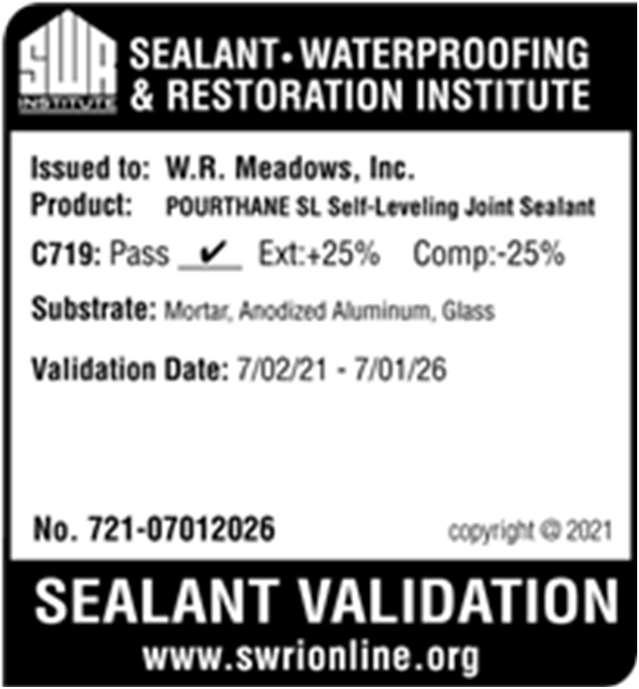
Capacidad de movimiento de +/-25 %.
Curado acelerado.
Altamente resistente a los combustibles, incluido el combustible de aviones.
Resistente a la exposición incidental al etanol.
Permanentemente elástico.
Alta durabilidad.
Resiste el envejecimiento y la intemperie.
Excelente adhesión.
Empaque conveniente, fácil de usar.
Bajo contenido de VOC.
EMPAQUE
Cartuchos de 825 mL (29 oz) (12/Caja)
Cubetas de 18.93 L (5 gal)
COBERTURA
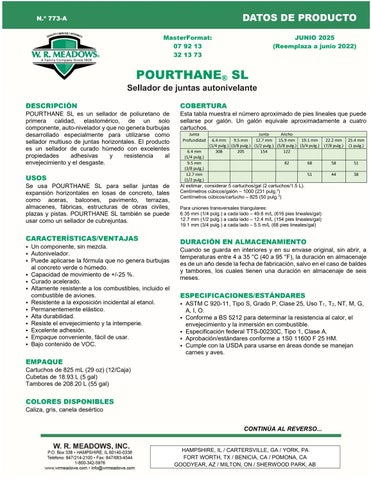
Esta tabla muestra el número aproximado de pies lineales que puede sellarse por galón. Un galón equivale aproximadamente a cuatro cartuchos.
Junta Junta Ancho
Al estimar, considerar 5 cartuchos/gal (2cartuchos/1.5 L).
Centímetros cúbicos/galón –1000 (231 pulg.3)
Centímetros cúbicos/cartucho– 825 (50 pulg.3)
Para uniones transversales triangulares:
6.35 mm (1/4pulg.) acadalado –49.6 m/L (616 pies lineales/gal) 12.7 mm (1/2 pulg.) acadalado –12.4 m/L (154 pies lineales/gal) 19.1 mm (3/4 pulg.) acadalado –5.5 m/L (68 pies lineales/gal)
DURACIÓN EN ALMACENAMIENTO
Cuando se guarda en interiores y en su envase original, sin abrir, a temperaturas entre 4 a 35 °C (40 a 95 °F), la duración en almacenaje esdeunañodesdelafechadefabricación,salvoenelcasodebaldes y tambores, los cuales tienen una duración en almacenaje de seis meses.
ESPECIFICACIONES/ESTÁNDARES
ASTM C 920-11, Tipo S, Grado P, Clase 25, Uso T1, T2, NT, M, G, A, I, O.
Conforme a BS 5212 para determinar la resistencia al calor, el envejecimiento y la inmersión en combustible.
Especificación federalTTS-00230C, Tipo 1, Clase A.
Aprobación/estándares conforme a 1S0 11600 F 25 HM.
Cumple con la USDA para usarse en áreas donde se manejan carnes y aves.

Tambores de 208.20 L (55 gal)
COLORES DISPONIBLES
Caliza, gris, canela desértico

DATOS TÉCNICOS
Propiedad Valor típico
Resistencia de tensado, MPa (psi) 1.23 (180)

Método de prueba
ASTM D412
Estiramiento 785 % ASTM D412
Resistencia a desgarros, kN/m (pli) 5.8 kN/m (33 lb/pulg.)
ASTM D624
Dureza Shore A 30 ± 5 ASTM C661
Capacidad de movimiento ±25 ASTM C719
Tiempo de formación de piel
50% HR, 23° C 60 - 120 minutos
Resistencia a la intemperie
Cambio de manchas y color
Excelente ASTM C793
Aprobado ASTM C510
Temperatura de aplicación 5° a 40 °C (41° a 104 °F)
Rango de servicio -40° a 82.2 °C (-40° a 180 °F)
Propiedades reológicas
Aprobado
ASTM C639
APLICACIÓN
Preparación de la superficie… Limpie todas las superficies. Las paredes de la junta deben estar en buen estado, limpias, secas, sin escarcha y sin aceite ni grasa. Los residuos de compuesto de curado y todo otro material extraño deben quitarse totalmente. Instale la cinta rompeuniones o KOOL-ROD™ de W. R.MEADOWSpara prevenir la uniónen la base de la junta. Al aplicar sobre el concreto verde, espere 24 horas después de haberquitadolasformas.Elconcretopuedeestarhúmedodurante la aplicación, pero no realice la aplicación cuando haya agua estancada dentro o cerca de las juntas.

Pelar en aluminio - seco 25 c.f. ASTM C794
Pelar en vidrio - seco 26 c.f. ASTM C794
Pelar en morteropara concreto - seco 24 c.f. ASTM C794
Compatibilidad con pinturas
Al agua: Compatible A base de solvente: Revisar la compatibilidad
Contenido de VOC 47 g/L
Imprimado… Generalmente no se necesita imprimar. Los sustratos solamente requieren imprimado silas pruebas indican la necesidad o donde el sellador se someta a inmersión en agua después de curar. Si se necesita imprimador, use REZI-WELD™ LV de W. R. MEADOWS.
Método de aplicación Acondicione el material a 18.3°23.9°C(65°-75°F)antesdeusar.Debeinstalarseelselladorcuando lajuntaestá amitaddecamino del movimiento previsto. Apliquecon pistola el sellador en la abertura de la junta en una dirección y deje que fluya el sellador y se nivele según sea necesario. Use las herramientas requeridas; se necesita usarlas al mínimo. Las dimensiones de la junta deben permitir un mínimo de 6.35mm (¼pulg.)y12.7mm(½pulg.)máximodeespesorparaelsellador.El diseño adecuado es con una relación de 2:1 deanchura a profundidad. Siempre use cinta rompeuniones o KOOL-ROD de W.R.MEADOWSamododeapoyoenlasjuntashorizontales.
Limpieza Las herramientas aplicadoras pueden limpiarse con tolueno o xileno antes del curado. Posteriormente, se requerirá limpieza mecánica.
PRECAUCIONES
Deje curar una semana en condiciones estándar al usarse en aplicaciones de inmersión total en agua. El nivel máximo de exposiciónalcloroesde5ppm.Nolocureenpresenciadeselladores de silicona. Evite el contacto con el alcohol y otros limpiadores de solventes durante el curado. POURTHANE SL no es resistente al etanol en condiciones de inmersión completa o remojo continuo. La profundidad máxima del POURTHANE SL debe ser de 12.7 mm (1/2pulg.).Nousecalafateos,arenaniincomprimiblescomofondoen una junta. No lo instale cuando se espere lluvia antes de que el producto desarrolle una película sustancial. Si se guarda a temperaturaselevadassereduciráladuraciónenalmacenamiento.
Para la hoja de datos más reciente, información de sostenibilidadylaSDS,visitewww.wrmeadows.com .


Product:
Manufacturer:
SAFETY DATA SHEET
SECTION 1: PRODUCT AND COMPANY IDENTIFICATION
POURTHANE® SL W. R. MEADOWS, INC.
Telephone: (847) 214-2100
Revision Date: 1/12/2023
Product Use: Polyurethane Adhesive
|Health| |Flammability| |Reactivity|
|Personal Protection|
Part Number: 4542000 Page 1 of 3
Address:
300 Industrial Drive
Hampshire, Illinois 60140
In case of emergency, dial (800) 424-9300 (CHEMTREC)
SECTION 2: HAZARDS IDENTIFICATION/EXPOSURE LIMITS
HAZARD STATEMENTS
DANGER!
Causes skin irritation. (Category 2)
May cause allergy or asthma symptoms or
breathing difficulties if inhaled. (Category 1)
Harmful if inhaled. (Category 4)
May cause damage to organs through
prolonged/repeated exposure. (Category 2)
PRECAUTIONARY STATEMENTS
Avoid direct contact/breathing vapors.
Wear appropriate personal protective equipment. Use only in well-ventilated areas.
SECTION 3: HAZARDOUS COMPONENTS


Chemical Name:
1. Diphenylmethane 4,4'-Diisocyanate
2. Xylene
3. Isocyanate Blend* N/A: Mixture
*: Isocyanate blend contains Diphenylmethane Diisocyanate (CAS# 9016-87-9) &
Diphenylmethane 2,4' Diisocyanate (CAS# 5873-54-1)
Vapor Pressure
(mm Hg@20°C) N/A 9 @68°F (@25°C) N/A
Under the reporting requirements of Section 313 of Title III of the Superfund Amendments and Reauthorization Act of 1966
SECTION 4: EMERGENCY AND FIRST AID PROCEDURES
EYE CONTACT: Flush eyes with water for fifteen (15) minutes. Seek prompt medical attention. Materials containing
isocyanate may react with moisture of the eye forming a thick material that may be difficult to wash from the eye.
SKIN CONTACT: Remove contaminated clothing. Wash affected area with mild soap and water. If symptoms persist, seek
N/A = Not Applicable medical attention.
INHALATION: If respiratory symptoms develop move victim from exposure source and into fresh air. Treat symptomatically.
If symptoms persist, seek medical attention.
INGESTION: No adverse effects are anticipated by this route of exposure incidental to proper industrial handling.
MOST IMPORTANT SYMPTOMS/EFFECTS, ACUTE AND CHRONIC: See Section Eleven for Symptoms/Effects.
FLASHPOINT: >141 °F
SECTION 5: FIRE AND EXPLOSIVES HAZARDS
EXTINGUISHING MEDIA: Carbon dioxide, dry chemical, or foam. If water is used, it should be applied in large quantity. The
(SARA) and 40 CFR Part 372, chemicals listed on the 313 List (40 CFR Part 373.65) are identified under the heading "SARA 313." reaction between water and hot isocyanate may be vigorous.
CHEMICAL/COMBUSTION HAZARDS: Potentially cyanide containing compounds, carbon monoxide, carbon dioxide, and
incomplete combustion products.
PRECAUTIONS/PERSONAL PROTECTIVE EQUIPMENT: Do not reseal contaminated containers as pressure build up may
rupture them. Responders should utilize full bunker gear and a self-contained breathing apparatus.
Date of Preparation: 1/12/23
SAFETY DATA SHEET
SECTION 6: ACCIDENTAL RELEASE MEASURES
SPILL OR LEAK PROCEDURES: Evacuate personnel as necessary. Absorb with sawdust or other absorbent and shovel into open top containers. Do not make pressure tight. Transport to a well-ventilated area (outdoors) and treat with a neutralizing solution consisting of water and a 3-8% Ammonium Hydroxide solution or a 5-10% sodium carbonate solution. Add about ten parts of neutralizer per part of spill while mixing. Allow to stand forty eight hours allowing evolved carbon dioxide gas to escape.
SECTION 7: HANDLING AND STORAGE
SAFE HANDLING PROCEDURES: Avoid direct contact. Avoid sources of moisture contamination.
SAFE STORAGE: Store in cool, dry location. Keep containers closed when not in use. Protect from freezing. Store at temperatures between 50 and 95 degrees Fahrenheit.
SECTION 8: EXPOSURE CONTROLS/PERSONAL PROTECTION
OSHA ACGIH
Chemical Name:
TLV/CEILING
1. Diphenylmethane 4,4' Diisocyanate N/E
2. Xylene N/E
3. Isocyanate Blend N/E
ENGINEERING CONTROLS: Not required under normal use conditions.
PERSONAL PROTECTIVE EQUIPMENT: Safety glasses, chemical-resistant gloves.
BOILING POINT: N/D
EVAPORATION RATE: <1 (ether = 1)
WEIGHT PER GALLON: 12.5
ODOR: Mild Organic
FLASH POINT: See Section 5
VAPOR PRESSURE: N/D
PARTITION COEFFICENT: N/D
SECTION 9: PHYSICAL AND CHEMICAL PROPERTIES
VAPOR DENSITY: N/D
pH LEVEL: N/A
PRODUCT APPEARANCE: Paste
ODOR THRESHOLD: N/D
FLAMMABILITY: N/D
RELATIVE DENSITY: N/D
AUTOIGNITION TEMPERATURE: N/D
N/E: Not Established
% VOLATILE BY VOLUME: N/D
% VOLATILE BY WEIGHT: N/D
VOC CONTENT: 47 g/L (Method 24)
MELTING/FREEZING POINT: N/D
UEL/LEL: N/D
SOLUBILITY: N/D
DECOMPOSITION TEMPERATURE: N/D
VISCOSITY: N/D N/A = Not Applicable N/D: Not Determined
STABILITY: Stable.
SECTION 10: STABILITY/REACTIVITY
HAZARDOUS POLYMERIZATION: May occur.
CONDITIONS AND MATERIALS TO AVOID: Oxidizing agents, strong acids/alkalies, alcohols, amines, metal compounds, and
surface active materials. Avoid water as it reacts to form heat, carbon dioxide, and insoluble urea.
HAZARDOUS DECOMPOSITION PRODUCTS: Carbon monoxide, carbon dioxide, incomplete combustion products, and
potentially cyanide containing compounds.
SECTION 11: TOXICOLOGICAL INFORMATION
EYE CONTACT: Direct contact or exposure to vapors may cause mild to moderate eye irritation. Corneal injury is unlikely.
SKIN CONTACT: Direct contact may result in mild to moderate irritation. Prolonged contact may result in skin irritation.
Sensitization reactions are possible.
INHALATION: Exposure may produce irritation to the nose, throat, respiratory tract, and mucous membranes. After repeated
overexposures or exposure to a single large dose, certain individuals may develop isocyanate sensitization (chemical asthma) that will cause them to react to a later exposure to isocyanate at levels below the TLV. Isocyanate sensitization may be temporary or permanent. Once sensitized, an individual may experience these symptoms upon exposure to dust, cold air, or
Chemical or hypersensitive pneumonitis with flu-like symptoms have also been reported. These symptoms can be delayed diagnosed as being sensitized to isocyanate, no further exposure can be permitted. Chronic overexposure to isocyanate has also been reported to cause lung damage (including decreased lung function) which may be permanent. Acute overexposure to isocyanate may also lead to bronchitis, bronchial spasm, and pulmonary edema. These effects are usually reversible.
up to several hours. other irritants. This increased lung sensitivity can persist for weeks and in severe cases for several years. Once an individual is
SAFETY DATA SHEET
Date of Preparation: 1/12/23 Page 3 of 3
Section 11 continued
INGESTION: Single dose oral toxicity is low. Ingestion may cause irritation of the gastrointestinal tract. No hazards are anticipated from ingestion incidental to industrial exposure.
SIGNS AND SYMPTOMS: Symptoms of eye irritation include pain, tearing, redness, and swelling. Symptoms of skin irritation include reddening, swelling, rash, and redness. Symptoms of respiratory irritation include runny nose, sore throat, coughing, chest discomfort, shortness of breath, and reduced lung function. Symptoms of gastrointestinal irritation include sore
throat, abdominal pain, nausea, vomiting, and diarrhea. Lung sensitization results in asthma-like symptoms: chest tightness, shortness of breath, wheezing, and coughing. These symptoms may be immediate or delayed up to several hours.
AGGRAVATED MEDICAL CONDITIONS: Pre-existing skin, eye, and respiratory disorders may be aggravated by product exposure. Persons with asthmatic-type conditions, chronic bronchitis, or other chronic respiratory diseases, recurrent skin eczema, sensitization or allergies should be excluded from working with isocyanates.
OTHER HEALTH EFFECTS: None recognized.
ECOTOXICITY: N/E
SECTION 12: ECOLOGICAL INFORMATION
DEGRADABILITY: N/E
SOIL MOBILITY: N/E OTHER ADVERSE EFFECTS: N/E
BIOACCUMULATIVE POTENTIAL: N/E
N/E = Not Established
SECTION 13: WASTE DISPOSAL INFORMATION
WASTE DISPOSAL INFORMATION: Unreacted material requires disposal via a hazardous waste facility. Completely solid
(polymerized) product would be classified as a non-hazardous waste.
SECTION 14: TRANSPORTATION INFORMATION
HAZARDOUS/NON-HAZARDOUS MATERIAL: Not regulated by domestic ground shipments. PACKING GROUP: None.
UN NUMBER: None.
UN PROPER SHIPPING NAME: None.
HAZARD CLASS:
None.
BULK TRANSPORTATION INFORMATION: Not applicable. Product is not shipped in bulk.
SPECIAL PRECAUTIONS:
ENVIRONMENTAL HAZARDS: None recognized. None.
SECTION 15: REGULATORY INFORMATION
OTHER REGULATORY CONSIDERATIONS: None.
SECTION 16: OTHER INFORMATION
PREPARED BY: Dave Carey
PREPARATION DATE: 1/12/2023 from the use thereof. We assume no responsibility for injury from the use of this product described herein.
The information contained herein is based on the data available to us and is believed to be correct. However, we make no warranty, expressed or implied regarding the accuracy of this data or the results to be obtained