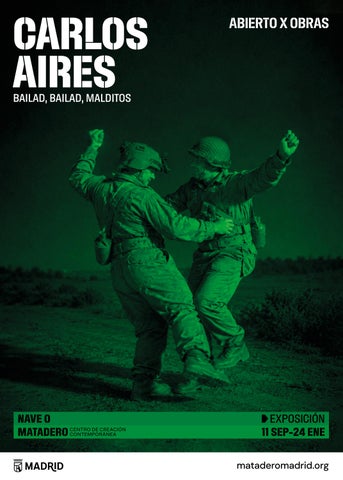
CARLOS AIRES
ABIERTO X OBRAS
BAILAD, BAILAD, MALDITOS
NAVE 0 MATADERO
L EXPOSICIÓN 11 SEP-24 ENE mataderomadrid.org
BAILAD, BAILAD, MALDITOS
Carlos Aires Carlos Aires (Ronda, Málaga, 1974) es un artista multidisciplinar que reside y trabaja en Madrid. Su práctica artística explora las relaciones entre poder, economía, violencia, deseo y memoria, articulando una reflexión crítica sobre los mecanismos que configuran la sociedad contemporánea. La música constituye un eje fundamental de su investigación, empleada como archivo cultural, lenguaje político y dispositivo crítico. Licenciado en Bellas Artes por la Universidad de Granada, completó estudios de posgrado en Fontys Academie (Países Bajos), HISK (Bélgica) y Columbus State University (Estados Unidos). Su obra se ha presentado en bienales e instituciones internacionales como la Bucharest International Biennial (Rumanía), la Thessaloniki Biennale (Grecia), el SMAK (Bélgica), el MACAM (Portugal), el Belvedere Museum (Austria) y el Museo de Arte Carrillo Gil (México), entre otras. Forma parte de colecciones públicas como las del MACBA, CA2M, ARTIUM, Banco de España, BPS22 (Bélgica), Les Abattoirs – FRAC (Francia) y MAK (Austria), y ha sido distinguido con el Premio Generaciones Caja Madrid, el Young Belgian Art Prize y la beca Fulbright.
© Matadero Madrid / Arde Visual / Fernando Tribiño
ABIERTO X OBRAS
Abierto x Obras, en Matadero Madrid, es un programa de intervenciones site specific que invita a artistas a realizar una pieza de nueva producción incentivando el carácter experimental de la creación contemporánea a través de planteamientos que exploran la relación entre el arte y el lugar que lo acoge, La que fue cámara frigorífica del antiguo matadero municipal. Una sala de más de 800 metros cuadrados que todavía conserva su aspecto original y las huellas de un incendio sucedido en los años noventa. Un espacio característico por su estructura diáfana de arcos volados y columnas. En su etapa anterior, entre 2007 y 2018, el programa Abierto x Obras ofreció al público madrileño intervenciones únicas de artistas como Daniel Canogar, Jannis Kounnellis, Román Signer, Carlos Garaicoa, Fernando Sánchez Castillo, Jordi Colomer, Los Carpinteros, Cristina Lucas, Cabello/Carceller, Elena Alonso y Teresa Solar, entre otros. En 2025 Matadero Madrid reimpulsa Abierto x Obras en una clara apuesta por la promoción de las prácticas artísticas contemporáneas que buscan una interrelación con el lugar en el que se desarrollan.
Carlos Aires invita al espectador a entrar en una pista de baile dentro de una arquitectura que parece detenida en un momento incierto, entre aquello que todavía se sostiene y aquello que podría desaparecer. La ruina y la euforia conviven en una instalación atravesada por el baile y un inquietante paisaje sonoro. A medida que el visitante se adentra en ella, lo familiar comienza a resultar extraño y ciertas presencias parecen acompañarlo sin terminar de revelarse. Bailad, bailad, malditos supone su primera exposición individual en una institución pública de Madrid. El título de la exposición hace referencia a la película They Shoot Horses, Don't They? (1969), de Sydney Pollack. Ambientado en la Gran Depresión estadounidense, el filme muestra a varias parejas obligadas a bailar durante jornadas maratonianas para escapar de su miseria. Los cuerpos son llevados hasta el límite en una competición en la que continuar bailando significa continuar dentro. Bailar aparece así como celebración, pero también como resistencia, agotamiento y necesidad de continuar. Titulada en España como Danzad, danzad, malditos, Aires ya usó este guiño en una exposición hace más de veinte años. Esta referencia conecta con la importancia que el cine, la música y la cultura popular han tenido a lo largo de la trayectoria de este creador multidisciplinar, desde donde ha abordado cuestiones relacionadas con el poder, la economía, la violencia, el deseo y la memoria. Las imágenes que atraviesan la instalación sitúan al visitante ante una tensión entre la euforia y el desasosiego, la celebración y la amenaza. Aires se aproxima a un presente en el que imágenes y acontecimientos se superponen a una velocidad que apenas permite asimilarlos, mientras nuestra vida cotidiana continúa su curso. Lo extraordinario y lo banal, la celebración y la catástrofe, pueden ocupar así un mismo tiempo y una misma mirada. En la nave 0, antigua cámara frigorífica del matadero, Carlos Aires ha desplegado más de 150 puntales de obra, artefactos muy finos que sin embargo están pensados para soportar una gran carga de peso. El resultado es un bosque de metal que funciona como conjunto escultórico y nos traslada a un espacio de resistencia.
Sujetas a estos metales, el visitante encontrará una veintena de pantallas en las que se muestran vídeos cedidos por usuarios de redes sociales (TikTok, Instagram…). Ninguno de ellos contiene IA, son vídeos grabados en la intimidad de sus hogares o en el espacio público, vídeos de bailes espontáneos o coreografiados, realizados tanto por bailarines profesionales como por gente corriente. A todos ellos queremos agradecerles su implicación con este proyecto colaborativo. A medida que avanza la experiencia, nuestra relación con el espacio y con aquello que creemos ver se vuelve más incierta. Incluso las tecnologías bélicas creadas para permitirnos mirar en la oscuridad encuentran aquí sus propios límites. El sonido adquiere entonces una presencia fundamental: voces, rastros y presencias invisibles acompañan al visitante sin terminar de revelarse. Algo parece acompañarnos, aunque la mirada no consiga encontrarlo. Este inquietante espacio sonoro, concebido como una holografía acústica, ha sido creado en colaboración con el artista mexicano Federico González, alias Suricata, a partir de audios reales. Conflictos armados, catástrofes naturales, crisis humanitarias e incendios recientes irrumpen así en la instalación a través del sonido, superponiéndose a las imágenes de cuerpos que continúan bailando. En Bailad, bailad, malditos, la ruina y la fiesta ocupan un mismo lugar: una suerte de discoteca subterránea, un after bajo una estructura cuyo derrumbe no vemos, pero presentimos. Bienvenidos a la pista de baile.
(THEY SHOOT HORSES, DON’T THEY?)
Carlos Aires Carlos Aires (Ronda, Málaga, 1974) is a multidisciplinary artist who lives and works in Madrid. His artistic practice explores the relationships between power, economics, violence, desire and memory, offering a critical reflection on the mechanisms that shape contemporary society. Music is a core element of his research, employed as a cultural archive, political language and critical device. With a degree in Fine Arts from the University of Granada, he completed postgraduate studies at the Fontys Academie (Netherlands), the HISK (Belgium) and Columbus State University (United States). His work has been presented at international biennials and institutions such as the Bucharest International Biennial (Romania), the Thessaloniki Biennale (Greece), the SMAK (Belgium), the MACAM (Portugal), the Belvedere Museum (Austria) and the Museo de Arte Carrillo Gil (Mexico), among others. It is held in public collections including those of MACBA, CA2M, ARTIUM, Banco de España, BPS22 (Belgium), Les Abattoirs – FRAC (France) and MAK (Austria), and he has been awarded the Premio Generaciones Caja Madrid (Caja Madrid Generations Award), the Young Belgian Art Prize and a Fulbright scholarship.
@Cheveeyo @MalaFamaEstudios
ABIERTO X OBRAS
Abierto x Obras, at Matadero Madrid, is a programme of site-specific interventions that invites artists to produce new work by encouraging the experimental nature of contemporary creation through approaches that explore the relationship between art and the place in which it is housed, the former cold storage unit of the slaughterhouse. An 800-metre room that still retains its original appearance and the signs of a fire that broke out in the 1990s. A space characterised by its diaphanous structure of cantilevered arches and columns. In its previous incarnation, between 2007 and 2018, the Abierto x Obras programme offered the Madrid public unique interventions by artists such as Daniel Canogar, Jannis Kounnellis, Román Signer, Carlos Garaicoa, Fernando Sánchez Castillo, Jordi Colomer, Los Carpinteros, Cristina Lucas, Cabello/Carceller, Elena Alonso and Teresa Solar, among others.
Carlos Aires invites the spectator to step onto a dance floor set within an architecture that seems frozen in an uncertain moment, between that which still holds itself aloft and that which might well disappear. Ruin and euphoria co-exist in an installation permeated by dance and an unsettling soundscape. As the visitor ventures inside, the familiar begins to feel strange, and certain presences seem to accompany them without ever fully revealing themselves. Bailad, bailad, malditos (Dance, Dance, You Bastards) is Aires’ first solo exhibition in a public institution in Madrid. The exhibition’s title references Sydney Pollack’s 1969 film They Shoot Horses, Don't They? (released in Spain as Danzad, danzad, malditos). Set in the United States during the Great Depression, the film depicts couples for whom marathon dance contests were their only opportunity to escape poverty, pushing their bodies to the absolute limit in an endurance test where to keep dancing was to remain in the game. Dance thus emerges as celebration, but also as resistance, exhaustion, and the need to keep going. Aires previously drew on this same reference for an exhibition he held over twenty years ago. It connects with the central role that cinema, music, and popular culture have occupied throughout this multidisciplinary artist’s career, during which he has addressed issues such as power, the economy, violence, desire, and memory. The images running through the installation confront the visitor with a tension between euphoria and unease, celebration and threat. Aires explores a present day in which images and events overlap at a speed that barely allows them to be assimilated, while our daily lives continue on their course. Thus, the extraordinary and the banal, celebration and catastrophe, can occupy the same time and the same gaze. In Nave 0, the former cold storage chamber of the slaughterhouse, Carlos Aires has deployed more than 150 construction props, slender structures nevertheless designed to bear heavy loads. The result is a metallic forest that serves as a sculptural ensemble that transports us to a realm of resistance. Attached to these steel supports, the visitor will find around twenty monitors showing
videos contributed by social media users (TikTok, Instagram, etc.). None feature AI; rather they are spontaneous or choreographed dance videos featuring professional dancers and ordinary people alike, recorded in the privacy of their homes or in public spaces. We would like to thank all those who took part in this collaborative project. As the experience unfolds, our relationship with the space, and with what we think we see, becomes increasingly uncertain. Even military technologies designed to allow us to see in the dark reach their own limits here. Sound then takes on a crucial presence: voices, invisible traces, and presences accompany the visitor without ever fully revealing themselves. We sense something accompanying us, though it remains out of sight. This unsettling soundscape, conceived as an acoustic hologram, was created in collaboration with Mexican artist Federico González, aka Suricata, using real audio recordings. Armed conflicts, natural disasters, humanitarian crises, and recent wildfires thus burst into the installation through sound, layer over images of bodies that just keep on dancing. In Bailad, bailad, malditos, ruin and revelry occupy one and the same place: a kind of underground night-club, an afterparty beneath a structure whose collapse we cannot see, but can feel is imminent. Welcome to the dance floor.
EXPOSICIÓN Comisario / Curator José Luis Romo Coordinación / Coordination Marta G. Salas Producción artística / Art Production Curru Garabal Asistente de producción artística / Art Production Assistant Valeria Tarsitano Asistente Producción / Production Assistant Manuel Calderón Diseño sonoro / Sound Desing Federico González-Suricata Diseño audiovisual / Audiovisual Desing Hyper Studio
Montaje expositivo e instalación técnica / Exhibit Setup and Technical Installation Intervento Instalación, Romero Iluminaciones, 4dsound, Mala Fama Estudios Jurídico/Legal Advisor: Alicia Domínguez Renderizado/Rendering: Irene Gaume Arquitecto/Architect: Carlos Liniers Equipo de rodaje/Filming crew: Raquel Fernández Núñez, Pablo Rosso, Fernando Menéndez, Pepo Ruiz Dorado, Jorge Varela, Javier Garcerá, Ignacio Mentrasti, Rebeca Durán y Beatriz Cieza.
MATADERO MADRID Gerente / General Manager Alma Fernández Rius
Gestión operativa / Technical Operations Víctor Díaz Pérez
Director artístico / Artistic Director José Luis Romo
Producción / Production Saturio Gómez, Santiago Jiménez, Gabriel Lucas, Natalia Salazar, David Romero, Vicente Fernández, Rodolfo Cortés
Subdirectora Adjunta Gerencia / Deputy General Manager Myriam González Coordinación gerencia/ Management Coordination Adela Fernández Gestión de proyectos / Project Management Aitor Ibáñez Comunicación / Press and Communication Marisa Pons, Mariajo López, Iñaki Manjarrés, Gloria Inglis, Raúl González
Infraestructuras / Infraestructure Raúl Cano
Nº Depósito Legal: M-18511-2026
Edición Video / Video Editing Begoña Ruiz Ulibarri
Jurídico / Legal Advisor Montserrat Rivero Administración y gestión / Administration and Management Ana María Cubillo, Ana María Escobar, Álvaro Estévez, Nieves Montealegre
Educación y públicos / Education and Audience Javier Laporta, Beatriz Bartolomé, Pablo Gallego
Matadero Madrid Paseo de la Chopera, 14 28045 Madrid T. 91 318 46 79 info@mataderomadrid.org @mataderomadrid
De martes a jueves de 17 a 21h. Viernes, sábados, domingos y festivos de 12 a 21h. Acceso a la sala hasta las 20.45h. Lunes cerrado
mataderomadrid.org