Art Collection
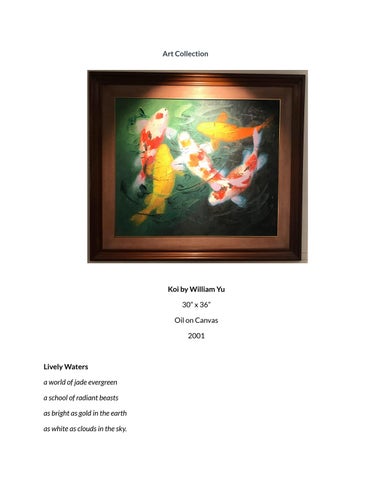
Koi by William Yu 30” x 36” Oil on Canvas 2001
Lively Waters a world of jade evergreen a school of radiant beasts as bright as gold in the earth as white as clouds in the sky.
2
some marked with crimson and black, one marked with the sun and blood in frolic, with twists and turns. a murky world filled with life
Housed in the Mana Kitchen house of Shambala Silang, as part of the private art collection of Riza Matibag Muyot, is William Yu's 30”x 36” oil on canvas painting named Koi, dated 2001. With thin, black, and wispy strokes of paint, William Yu breathes energy into his painting of five koi fish frolicking. The work takes its place, both as an experiment with a different style, as well as the precursor to Yu's future koi fish-themed works. Out of the five koi fish in depicted, two are yellow, two are white with red and black spots, while the one in the center is white with orange and red spots. The fish are painted in an overhead view, as if it was literally from a bird's eye view, making it so that only the top of the fish are visible. Four out of the five are painted facing the top of the frame, while the white with red and black spots on the lower right is the only one facing down. However, the aspect that is perhaps the most interesting about this specific painting is how it is a stylistic departure by William Yu from how he typically constructs his other works. Born in Baculin Baganga, Davao Oriental in 1954, Yu deals in abstractions, specifically with cubism. This is more evident in his early works, where he uses polygons conjoined with one another to denote figures in composition. In the artist biographies and descriptions across different art market websites, it is noted that he primarily uses a palette knife “instead of a paintbrush in rendering oil color on canvas”1, and that he only started incorporating brushwork in more recent years. This is evident in the listed and subsequently sold works available for display in sites like MutualArt, where his departure from strictly geometric compositions are more evident in works dated post-20102. In the work dated 2001 housed in Shambala Silang, the Koi fish depicted are not as abstracted like much of his early works, nor are the figures painted solid and whole like the other Koi paintings from his more recent works. While it is not clear if he utilizes brushstrokes in this particular painting, it is still a very clear departure in style when compared with his other works in the same time period. The clear use of palette knife that is evident is employed experimentally with thin and wispy strokes to imply movement, 1 2
Nami Art Gallery, “William Yu” MutualArt Services, Inc., “William Yu”
3
giving the piece a more frantic energy. The soft edges of the fish also give the effect of ethereality. As a student of National Artist, Cesar Legazpi3, there is a clear influence in the fusion of abstraction and realism that can be gleamed from Yu's own works, both early and more recent. However, the visual identity Yu establishes to distinguish himself from his own teacher appear to lie in the choice of color palette. Where Legazpi uses more warm colors, with dark shading to evoke visceral emotion4, Yu had opted for more blues and cool-toned colors. This choice of a brighter and more vibrant color palette had only become increasingly more evident as the years had gone by, well into the artist's current phase of increasingly abstract and loose shapes and hues. Nevertheless, within the context of Philippine art history, this specific work itself holds in itself a special moment and freezes that moment in time as what is potentially the artist's first foray into the art phase that he finds himself in today. Like most artists (such as Picasso himself), Yu began with more typically definitive forms and shapes in the cubist style he found notability (and sales) with using just a palette knife. Since then, he has moved on to pursue more abstracted figures, hues, and shapes through his incorporation of brushwork along with the palette knife as a step beyond forms and figures and into the more loose and dynamic phase he is in today. What is perhaps the most interesting is the development of the Koi series of paintings, of which his documented Koi works were all produced around the 2010s. This is in stark opposition to this one work in the collection of Shambala Silang that is dated as produced in 20015. Perhaps something in the artist's life led him to go beyond the deconstruction of form that comes with abstraction in order to present a simpler truth to figures and work towards a middle ground that can better portray both an inner and outer truth to his subjects. All of which coincide with a unique space in his life for the Koi series to get produced. Considering the possibility that this particular work in Shambala is an early experimental work as part of the artist's transition to his current, more abstract, style with the use of brushwork. Koi as part of the artist's journey in developing his style beyond abstraction could be referential to the symbolic meaning of the Koi fish for peace, luck, and perseverance 6. Perhaps in that in a time period where the artist's own creative identity was in flux, there is peace to be found in persevering. 3
Art Circle Gallery, “William Yu” MutualArt Services, Inc., “Cesar Legaspi” 5 MutualArt Services, Inc., “William Yu” 6 Britannica, s.v. “Koi” 4
4
References Britannica, T. Editors of Encyclopaedia. "koi." Encyclopedia Britannica, October 17, 2024. https://www.britannica.com/animal/koi-fish. Yu, William. 2017. “William Yu | 58 Artworks | MutualArt.” Mutualart.com. https://doi.org/104342773760.ingest.sentry.io/4506179198386176. “William Yu - Nami Art Gallery.” 2024. Namiart-Gallery. 2024. https://www.namiart-gallery.com/collections/william-yu?srsltid=AfmBOopRpuvMMNoH Evg_1D7cpst9KcTGXmShX-LtpsPLUuL5YegXv8bF. Legaspi, Cesar. 2016. “Cesar Legaspi | 285 Artworks at Auction | MutualArt.” Mutualart.com. https://doi.org/104342773760.ingest.sentry.io/4506179198386176.