
Why a Mastery-Based Approach Matters
Traditional test prep often falls short because it tries to do too much, too quickly, and without enough focus on how students actually learn. Students who need the most support are frequently the least served by conventional approaches—arriving disengaged, multiple grade levels behind, and without the test-taking habits needed to succeed.
Drill-and-kill review won’t fix that. Neither will a rapid-fire content sweep. What schools need is a more focused, mastery-based approach—one that prioritizes the skills that matter most and gives students the support to actually build them.
That’s the idea behind Master What Matters.
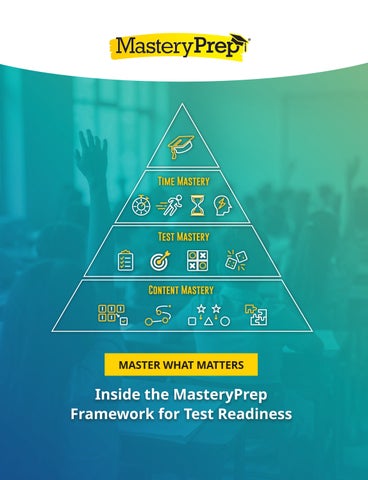
This framework helps educators understand where score gains on high-stakes tests—from the ACT® and SAT® to state-specific End-of-Course exams—actually come from and how to make the most of limited instructional time. It organizes test readiness around three distinct but connected areas of growth: Content Mastery, Test Mastery, and Time Mastery.
The chapters that follow explore each area in depth—showing how schools can put this framework into practice on their own, and how MasteryPrep’s programs and resources are designed to support that work when needed.
Master What Matters Framework
Traditional Prep Mastery-Based Prep
Broad review of too many topics
“Cover everything” mindset
Cramming and rapid-fire review
Short-term exposure of content students may never have mastered
Prioritization of the hightest value skills
Focus on what will move the needle most
Scaffolded instruction that builds true proficiency
Builds understanding over time
Drill-and-kill practice
Repetitive without a clear purpose
Repetition with purpose
Through isolation, intervals, interleaving, and integration
One-size-fits-all review
Same for all students, regardless of need
Targeted support
Based on what students are ready to learn
Assumes students will pick up testtaking skills on their own
Strategies are not explicitly taught
Explicit instruction in test-taking strategies
Elimination, pacing, and mark-and-move
Emphasis on short-term exposure
Leads to low retention
Low engagement for struggling learners
Leads to frustration and low confidence
Emphasis on retention, transfer, and independent application
Skills that last beyond test day
Intentional engagement and confidence-building
Students feel capable and prepared
Master What Matters: A Proven Framework for Test Prep Success
At MasteryPrep, we know that effective test preparation isn’t just about cramming information—it’s about mastering the skills and strategies that lead to real success. That’s why we designed our curriculum and end-toend solutions around the Master What Matters framework, which focuses on three key areas: Content Mastery (70%), Test Mastery (20%), and Time Mastery (10%)
This balanced approach ensures students are well-prepared for assessments like the ACT and SAT, where each of these elements plays a crucial role in achieving high scores. We want to support educators in helping students score college-ready as well as achieve their state accountability requirements.
“Content mastery has a bigger impact,” says Craig Gehring, Founder and CEO of MasteryPrep. “You can get more score gain from content mastery than test mastery, and you can get more score gain from test mastery than time mastery.”
Time Mastery
Builds the pacing, decision-making, and stamina students need to manage time and maximize points on test day.
Test Mastery
Develops the strategies and thinking processes students use to navigate questions accurately and efficiently.
Content Mastery
Builds the deep, lasting understanding of core academic skills that drives the greatest impact on test performance.
The shape of the pyramid is intentional, with content mastery serving as the foundation.
Content mastery has a bigger impact. You can get more score gain from content mastery than test mastery, and you can get more score gain from test mastery than time mastery.”
—Craig Gehring, Founder and CEO of MasteryPrep
Content Mastery: The Foundation of Success (70%)
By honing key academic skills and reinforcing the most important concepts, we help students achieve the content mastery they need to succeed on test day.
While time management and test-taking strategies are vital, they can only take students so far. Ultimately, success on any standardized test depends largely on knowing the content. At MasteryPrep, we focus on building a deep, lasting understanding of the subjects tested on high-stakes assessments.
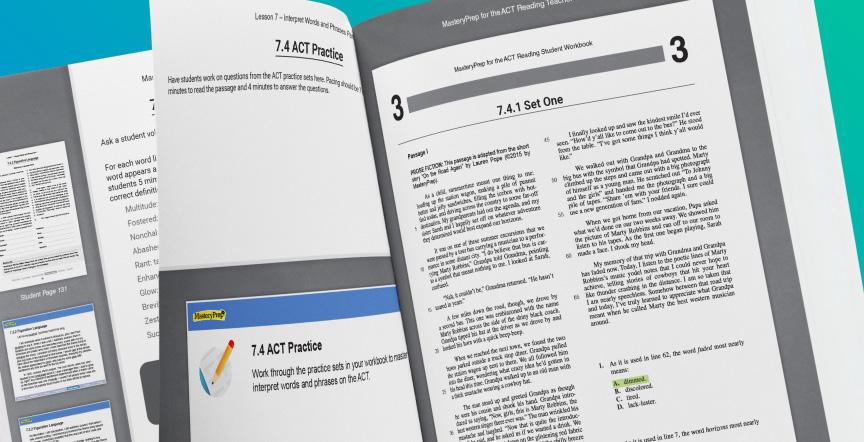
Our curriculum goes beyond surface-level review, providing scaffolded lessons that gradually build student skills to match the rigor of the exam. Through a comprehensive approach, students engage with hundreds of practice questions, each designed to replicate the format and style of actual test items. This ensures students aren’t just familiar with the content but also with the precise way the test will assess their knowledge.
By honing key academic skills and reinforcing the most important concepts, we help students achieve the content mastery they need to succeed on test day.
Test Mastery: Strategies That Make a Difference (20%)
Students are surprised to learn that test-taking isn’t about luck— it’s about knowing the right techniques.
In addition to content knowledge, test-taking is a skill that can be developed through practice and strategy. Many students, especially those who consider themselves “bad test-takers,” are surprised to learn that test-taking isn’t about luck—it’s about knowing the right techniques.
MasteryPrep’s curriculum incorporates specific strategies for each section of high-stakes standardized tests, helping students navigate the test with confidence. For example, students learn the art of elimination—a powerful strategy for answering tricky multiple-choice questions. In addition, we provide subject-specific strategies, such as tricks for quickly spotting the correct answers in math problems or mastering the rules of punctuation in the English section.
By learning these essential strategies, students gain the tools they need to approach every question with a clear, focused mindset. These techniques are practical, accessible, and can make a significant difference in a student’s score.
Test Mastery in Action
ELIMINATING
Narrow the choices by elimination answers that are clearly wrong.
STRUCTURED PROBLEM-SOLVING
Use a step-by-step approach to break down and solve each question methodically.
SECTION-SPECIFIC STRATEGIES
Apply proven techniques tailored to each section of the test.
CONFIDENCE UNDER PRESSURE
Trust your preparation, stay focused, and make smart decisions on every question.
Time Mastery: Pacing for Peak Performance (10%)
We emphasize the importance of the “mark and move” strategy— encouraging students to quickly mark difficult questions and move on.
Time management is one of the biggest challenges students face when preparing for the ACT and SAT. Each section is strictly timed, and many students find themselves either rushing through questions or running out of time entirely. That’s why MasteryPrep also emphasizes time mastery—helping students develop the pacing habits they need to stay on track throughout the test.
To help students manage their time effectively, we teach them time goals for each section—for example, how many minutes students should spend on a particular reading passage within the context of the larger assessment, and how to reserve time for more challenging questions.
In addition, we emphasize the importance of the “mark and move” strategy—encouraging students to quickly mark difficult questions and move on. This prevents them from getting stuck on one question and running out of time for others.
Finally, we simulate timed conditions in practice sessions, so students become comfortable with the pressure of the clock and learn how to pace themselves during the real test.

Mastering Content: The Foundation of Standardized Test Success
Of all the elements of standardized test preparation, content mastery often requires the most time and strategic planning. While students can improve time management in hours and test-taking strategies in days, developing content knowledge takes weeks, months, or even years of consistent instruction.
At a recent MasteryPrep webinar, Dr. Mya Asberry, Director of Instructional Services at MasteryPrep, emphasized the importance of a structured approach to content: “We don’t introduce the skills all at once. We always start off in what we call at MasteryPrep, isolation. This is going to be taking those singular skills and helping our students improve their proficiency on that single topic or skill.”
This methodical approach ensures students build a strong foundation before moving on to more complex applications of knowledge. Below are MasteryPrep’s key strategies for effective content mastery.
Prioritizing High-Value Content
Not all test content is created equal. Some topics appear frequently and carry significant weight, while others are rare or absent altogether. To help teachers focus on what matters most, MasteryPrep uses a tiered system to categorize content by importance:
MasteryPrep Tier System
TIER 1 TIER 2 TIER 3
TIER 4, 5, & 9
HIGHEST PRIORITY
The most tested. The most important.
HIGH PRIORITY
Frequently tested. High impact.
SECONDARY PRIORITY
Occasionally tested. Moderate impact.
LOW PRIORITY / MINIMAL PRIORITY
Topics with minimal appearance or no presence on the test
This prioritization helps teachers allocate instructional time more effectively.
“If we’re not aware of that, we could end up spending a lot of time teaching content that’s not even going to be assessed on these college readiness assessments,” Asberry says.
By focusing primarily on Tier 1 and Tier 2 content, educators can ensure students master the material that will make the biggest impact on test scores.

Aligning College Readiness Skills With Curriculum
One of the most powerful strategies for content mastery is aligning college readiness standards with your existing curriculum. MasteryPrep works with schools to create custom alignment documents that map test-relevant standards to existing scope and sequence plans.
This alignment helps teachers:
• identify when college readiness skills naturally fit into their instructional calendar
• integrate targeted warm-ups or activities that connect classroom learning to test expectations
• emphasize real-world applications of test content without derailing their curriculum
“We always encourage people to align the college readiness skill with what they’re already teaching,” says Asberry. “It’s easy, it’s simple, and it really creates that seamless integration of how you are going to move your students through these college readiness skills.”
“ If we’re not aware of [the tiered system], we could end up spending a lot of time teaching content that’s not even going to be assessed on these college readiness assessments.”
—Dr. Mya Asberry, Director of Instructional Services
“ We always encourage people to align the college readiness skill with what they’re already teaching. It’s easy, it’s simple, and it really creates that seamless integration of how you are going to move your students through these college readiness skills.”
—Dr. Mya Asberry, Director of Instructional Services
The Isolation–Intervals–Interleaving–Integration Approach
MasteryPrep’s content mastery model follows four key phases:
• Isolation
Start by teaching individual skills in isolation until students show proficiency. This focused practice eliminates distractions and reinforces understanding of foundational concepts.
• Intervals (Spaced Practice)
After initial instruction, review concepts at regular intervals throughout the year to strengthen long-term retention. Dr. Asberry recommends themed review days: “When are you going to reintroduce those previously taught topics? You can do memory Mondays, targeted Tuesdays, wayback Wednesdays, throwback Thursdays, or flashback Fridays.”
• Interleaving
Once students have mastered individual skills, begin mixing them together in practice sessions. This helps students learn to identify which skills apply in various contexts—just like on the test.
• Integration
Finally, integrate all skills through full-length practice tests and authentic activities that simulate the real test environment.
ISOLATION
Learn one skill or concept at a time with focus.
INTERVALS
Review at increasing intervals to strengthen long-term retention.
INTERLEAVING
Mix skills and question types to build flexibility and deeper understanding.
INTEGRATION
Apply your knowledge holistically in realistic, high-impact practice.
Putting Content Mastery Into Practice
Here’s how schools can implement these strategies effectively:
Conduct a Content Audit
Identify which standards are covered and where gaps exist
Create an Alignment Calendar
Map key standards to your instructional timeline
Develop Isolation Lessons
Design focused instruction for each priority concept
Plan Interval Reviews
Schedule regular review sessions throughout the year
Design Interleaved Practice
Combine concepts once basics are mastered
Implement Full Integration
Use full-length practice assessments and activities to prepare students for the real test
The Cumulative Impact of Strategic Content Mastery
When implemented consistently, these strategies create a cumulative impact on student outcomes. Instead of treating test prep as a last-minute effort or an add-on to regular instruction, this approach integrates college readiness seamlessly into the classroom.
Students don’t just memorize content—they understand how and when to apply it. This deeper level of learning leads to stronger performance on standardized tests and greater academic confidence overall.
By following MasteryPrep’s content mastery strategies, schools can elevate their existing curriculum while ensuring students are fully prepared for the content demands of standardized testing—making test prep a natural extension of great instruction.
CHAPTER 3
Beyond Content Knowledge: MasteryPrep’s Guide to Test-Taking Strategies
While content knowledge forms the foundation of standardized test success, effective test-taking strategies can significantly boost scores by helping students navigate the unique challenges of high-stakes assessments.
As Dr. Mya Asberry, Director of Instructional Services at MasteryPrep, explained at a recent webinar, “Test-taking is a life skill. There’s almost no job in the world that you can get without having to take some type of assessment. So, it’s critical that students have a solid grasp of content, but also possess basic test-taking skills to effectively navigate through a test.”
Understanding the structure, format, and common patterns of standardized tests gives students a significant advantage—one that extends beyond the classroom into college admissions and future career opportunities.
The Three-Phase Approach Strategy
One of MasteryPrep’s core test-taking techniques is what we call “the approach,” a repeatable, predictable process for tackling standardized test questions. This approach consists of three distinct phases.
PHASE 1
THE ENTRANCE
In this initial phase, students identify the question type. Each standardized test contains predictable question patterns, and recognizing these patterns will help students determine which strategies they should apply. For example, when encountering an underlined portion of text in the ACT English section, students should quickly determine if it’s testing for grammar, punctuation, concision, or another skill.
PHASE 2
SOLVE OR STRATEGIZE
Once students identify the question type, they can gather evidence and methodically consider each answer choice. Depending on the subject, this might involve:
• For Math: applying formulas, working through calculations, or using estimation
• For Reading: finding evidence in the passage, making inferences, or analyzing relationships
• For English or Writing: applying grammar rules, checking for concision, or evaluating the logic of transitions
This phase also includes making eliminations, a critical step in the process.
PHASE 3
THE EXIT
In the final phase, students check their work and, if necessary, make an educated guess. Dr. Asberry emphasizes that students should never leave a question unanswered on the ACT or SAT, as there’s no penalty for guessing.
By following this systematic approach to each question, students develop confidence and efficiency in their test-taking.
The Three-Phase Approach Strategy
Entrance
Solve or Strategize
UNDERSTAND THE QUESTION.
Read carefully. Identify what’s being asked. Know your goal.
PLAN YOUR PATH. SOLVE WITH PURPOSE.
Choose the best strategy. Work efficiently and accurately. Use process, not guesswork.
The Power of Process of Elimination
Exit
CHECK AND MOVE ON.
Review your answer. Eliminate errors. Move forward with confidence.
Perhaps the most powerful test-taking strategy MasteryPrep teaches is the process of elimination. Rather than searching for the correct answer, students should focus on identifying and eliminating incorrect options.
Dr. Asberry shares her personal perspective on this approach: “My personal favorite strategy really changed how I approach test-taking with any student. It’s using the process of elimination. Instead of focusing on whether D is correct, I focus on eliminating the ones that clearly aren’t correct.”
This shift in mindset—from confirmation to falsification—is crucial for success on multiple-choice tests. As MasteryPrep teaches students, “We are not here to defend correct answers; we’re here to prove answers incorrect,” Asberry says.
“
Test-taking is a life skill. There’s almost no job in the world that you can get without having to take some type of assessment.”
—Dr. Mya Asberry, Director of Instructional Services
Falsification vs. Confirmation Bias
MasteryPrep specifically addresses the concept of falsification versus confirmation bias:
Confirmation Bias Falsification
The tendency to look for evidence supporting a particular answer
The mental act of proving something wrong or incorrect
By training students to adopt a falsification mindset, teachers help them avoid the common trap of selecting the first plausible answer. Instead, students methodically eliminate options that contain errors or contradictions, increasing their odds of selecting the correct answer.
Recognizing and Avoiding Trap Answers
Standardized tests often include deliberately deceptive “trap” answers designed to catch students who are rushing or who have a partial understanding of concepts. MasteryPrep teaches students to recognize these common traps, which may include:
• answers that contain information from the passage but don’t address the specific question
• options that would be correct if the question asked something slightly different
• choices that include common mathematical errors
• selections that represent a misapplication of a concept or rule
By making students aware of these traps and teaching them specific techniques to avoid them, teachers help students navigate the strategic elements of standardized tests.
Implementing Test-Taking Strategies in Your Classroom
To effectively teach these strategies, consider implementing the following practices:
• Explicitly teach the three-phase approach: Demonstrate each phase using sample questions
• Practice process of elimination consistently: Have students verbalize why each incorrect option is wrong
• Incorporate strategy cycles: Follow MasteryPrep’s model of introducing, demonstrating, and reinforcing specific strategies
• Use authentic test questions: Practice with actual released test items to build familiarity
• Create opportunities for reflection: Have students explain which strategies they used and why While these strategies are designed for standardized tests, they build analytical thinking skills that transfer to other academic and professional contexts. The ability to systematically evaluate options, recognize patterns, and make evidence-based decisions serves students well beyond test day.
By incorporating these test-taking strategies into regular instruction, teachers not only improve test scores but also equip students with problem-solving approaches that will benefit them throughout their educational journeys and into their careers. As Dr. Asberry notes, these skills aren’t just about tests—they’re life skills that help students navigate assessments and evaluations in virtually any field.
CHAPTER 4
Integrating Time Management Strategies Into Your Readiness Plan
When it comes to standardized tests like the ACT and SAT, content knowledge is only part of the equation. Time management can make or break a student’s success on high-stakes assessments, regardless of how well they understand the material.
Drawing on insights from MasteryPrep Professional Development sessions, Dr. Mya Asberry, Director of Instructional Services at MasteryPrep, explained at a recent webinar: “The ACT and SAT are both timed assessments, and students can miss out on valuable points if they have ineffective pacing. It’s super important that they’re able to manage their time effectively, therefore maximizing their opportunity to gain points.”
Even for untimed assessments like the TSIA2, effective time management helps students maintain focus and stamina throughout the test. Teaching students how to manage their time isn’t just about test performance—it’s developing a life skill that will serve them in college and beyond.
Time Management Strategies for Standardized Tests
During the webinar, Dr. Asberry offered four examples of time management strategies that teachers can share with students and integrate into their daily instruction.
The Mark-and-Move Strategy
One of MasteryPrep’s most effective time management techniques is what they call “mark and move.” This strategy helps students avoid getting stuck on difficult questions that can drain precious minutes.
How It Works:
Students identify questions they can answer quickly based on their skills or available strategies.
When encountering a difficult or time-consuming question, they:
• mark their best guess based on available information
• move on to the next question without spending excessive time
• leave a note to return if time permits
Mark and Move
TRY
Read the question and answer choices. Do your best.
DECIDE
Can you solve it quickly? If yes, answer and move on. If no, make your best guess.
MARK
Flag the question so you can return if time allows.
RETURN IF TIME ALLOWS
MOVE
Go to the next question. Keep your momentum.
“
Students can often miss out on valuable points if they have ineffective pacing. It’s super important that they’re able to manage their time effectively, therefore maximizing their opportunity to gain points.”
—Dr. Mya Asberry, Director of Instructional Services
Dr. Asberry emphasizes that this approach requires training: “Students have to be trained to utilize your time to identify those questions that can either be answered quickly or strategized through… For [challenging] questions, the students need to be trained to mark and move.”
It all boils down to a “numbers game” where the goal is to accumulate as many points as possible. Getting stuck on a single difficult question can cost students multiple easier questions they might have answered correctly.
Establishing Pacing Guidelines
Another crucial strategy is teaching students specific pacing guidelines for each section of the test. These guidelines help students allocate appropriate time to each portion, ensuring they can attempt every question.
For example, on the ACT English section, which allows 45 minutes for 75 questions across 5 passages, MasteryPrep recommends:
• 8 minutes per passage
• 3 minutes to read the passage
• 5 minutes to answer the questions
The key to making these guidelines effective is practice. Teachers can incorporate timed activities into their regular instruction, reminding students to focus on pacing rather than just test content.
“Students can often miss out on valuable points if they have ineffective pacing,” Asberry says. “It’s super important that they’re able to manage their time effectively, therefore maximizing their opportunity to gain points.”
Implementing Mini-Tests
One of the most practical ways to help students develop time management skills is through regular mini-tests— short 5- to 10-question assessments that focus on both content and pacing.
When reviewing these mini-tests, teachers should focus not just on correct answers but also on how students managed their time. This is where MasteryPrep’s “strategy cycle” comes into play:
• Introduce a specific test-taking strategy, such as process of elimination
• Model the strategy’s application on a specific question type
• Demonstrate the test-taking strategy
• Close the cycle with repetitive reinforcement: “When you see this type of question on the ACT, you’re not going to panic. What are you going to do?”
MasteryPrep’s Strategy Cycle
1 INTRODUCE
Introduce a specific test-taking strategy, such as process of elimination.
4 CLOSE THE CYCLE
Close the cycle with repetitive reinforcement.
REINFORCE. PRACTICE. PERFORM.
2 MODEL
Model the strategy’s application on a specific question type.
3 DEMONSTRATE
Demonstrate the test-taking strategy.
When reviewing these mini-tests, teachers should focus not just on correct answers but also on how students managed their time
By regularly implementing these mini-tests and focusing on specific strategies, teachers can help students develop automatic time management habits that will serve them well on test day.
Build on Existing Practices
Many teachers already use timing techniques in their classrooms, like bell ringers, “do now” activities, and timers for various tasks. These existing practices can be leveraged to reinforce test-specific time management skills.
Consider adding these elements to your existing timed activities:
• specific time allocations per question type
• verbal reminders about pacing strategies
• brief reflections on time usage after activities
• gradual reduction of time allowances as students become more proficient
The Payoff: Boost Student Confidence and Scores
When students master time management strategies on high-stakes tests, they not only improve their scores but also experience less anxiety on test day. By knowing how to allocate their time and having strategies for difficult questions, students approach tests with confidence rather than panic.
As Dr. Asberry emphasizes, the goal isn’t perfection—it’s maximizing opportunity: “Remember, that is the name of the game with ACT and SAT. How many points can I gain during this session? And if I leave questions blank, I’m leaving opportunity on the table.”
By incorporating these time management strategies into regular instruction, teachers can help students develop skills that will serve them well beyond standardized tests and into their college and professional careers.
CHAPTER 2 CHAPTER 5
MasteryPrep’s
One-Day Readiness Boot Camps: The Master What Matters Framework in Action
When schools ask what can really be accomplished in a single MasteryPrep Boot Camp, the honest answer is: a lot—but only when the work is grounded in the right framework.
Our Boot Camps are designed specifically to operate within Master What Matters. In a compressed window of three to six hours, these workshops, held either online or in person, focus on the areas where students can make the fastest, most meaningful gains.
Fastest Gains
Stronger time management creates immediate gains—more attempts, fewer rushed answers, higher scores.
Quick Gains
Proven test-taking strategies help students approach, analyze, and answer questions with confidence and accuracy.
Biggest Impact
Deep content knowledge builds the foundation for lasting, meaningful score improvement.
Why Boot Camps Emphasize Time and Test Mastery
Because Boot Camps operate within a limited time frame, the focus shifts to the areas where students can make the fastest score gains. That distinction is critical when schools are working within tight calendars and limited instructional windows.
“Content mastery takes much more time than test mastery, and test mastery takes more time than time mastery,” Gehring says. Boot Camps are optimized for that reality. One of the most common misconceptions about test prep is that students struggle because they are “bad test-takers,” according to Gehring.
“There is no such thing as a bad test-taker,” Gehring says. “A bad test-taker is just a student who has not yet learned the critical thinking skills and time management skills that they need to be a good test-taker.” Those skills are teachable—and they’re exactly where Boot Camps shine.
Time Mastery in Boot Camps: Turning
Strategy Into Measurable Gains
Many teachers already use timing techniques in their classrooms, like bell ringers, “do now” activities, and timers for various tasks. These existing practices can be leveraged to reinforce test-specific time management skills.
Item Speed
Item speed is about how long a student spends on a single question and whether they’re using the most efficient path to a solution. In Boot Camps, instructors help students recognize when they’re moving too slowly, even on easier items, and model faster solution pathways when opportunities arise.
The goal isn’t for students to rush but to be fast when they can, so that they have time for the items that require more thinking.
Mark & Move
One of the most powerful strategies taught in Boot Camps is mark-and-move—knowing when to make a best guess, flag a question, and move forward, rather than getting stuck.
“Mark-and-move is about the student knowing when it’s time to cut bait and run,” Gehring explains. Instead of falling into what he calls “black-hole questions,” students learn to prioritize points and protect their energy.
Pacing
Pacing is another major focus. Many students struggle not because questions are too hard but because they don’t reach questions they could answer correctly. Boot Camps create space for students to practice pacing in real time, often for the first time, with instructors actively coaching and reinforcing discipline across sections.
That structure helps students reach the end of the test and avoid uneven time spending when difficulty varies from one question to the next.
Stamina
Stamina matters because many standardized assessments are longer than what students are used to in class. As fatigue sets in, students slow down and make more mistakes, often late in the test when points are still available.
In Boot Camps, instructors coach students on staying focused, maintaining energy, and applying the same disciplined strategies late in the session that they use early on.
“Standardized tests are much longer, typically, than what students are used to dealing with,” Gehring says. “When the student’s energy level goes down, they start slowing down and making mistakes.”
Test Mastery in Boot Camps: Thinking Like a Strong Test-Taker
Test mastery focuses on how students think during an assessment. In Boot Camps, instructors explicitly teach four core test mastery skills: approach, accuracy, elimination, and guessing.
approach
Strong test-takers don’t jump straight into answering a question. They use a repeatable mental process to understand what’s being asked, determine a strategy, and work through the item methodically.
Boot Camps model this structured approach step by step: how to enter a problem, how to work through it, and how to exit by checking accuracy before moving on. This reduces careless errors and helps students slow down in the right moments without losing time overall.
Accuracy
Students are often told to “check their work” but are rarely taught how to do it effectively. In Boot Camps, accuracy is reframed as a specific skill rather than a vague reminder.
Students learn that checking work doesn’t mean doing the same process again. Instead, they are taught to pressure-test answers from a different angle—plugging results back in, checking for feasibility, or using answer choices themselves to reveal potential mistakes.
elimination
Elimination is one of the most powerful—and most misunderstood—test mastery skills. “The naturally developing thought process is not the process of elimination,” Gehring says. “The naturally developing thought process is confirmation bias.”
Boot Camps teach students how to intentionally eliminate both obvious and non-obvious wrong answers. Even when students can’t solve a question outright, eliminations increase the odds that a guess will be correct, turning partial understanding into real points.
GUESSING
Guessing is not treated as a last-ditch effort but as a skill that can be learned and applied strategically.
“If there’s a strategy or technique for [students] to be a better guesser, we’re going to share that with them,” Gehring says.
Students learn how to avoid common overthinking traps and how to make informed guesses that improve outcomes in a norm-referenced testing environment.
Where Content Mastery Fits in a Boot Camp
While Boot Camps prioritize time and test mastery, content mastery is not ignored but approached strategically.
Rather than “drill and kill,” instructors isolate high-leverage, non-negotiable skills and reinforce them using strategies such as spacing, callbacks, and interleaving. Students may encounter the same concept multiple times across the day, strengthening retention and transfer.
“We don’t just give students a bunch of questions over and over again,” Gehring says. Instead, skills are revisited at intervals, helping lock learning into mid-range memory.
Mini-tests play a key role here, simulating the mixed practice students will face on the actual assessment while reinforcing pacing and stamina.
A Framework That Scales Beyond a Single Day

Boot Camps are just one expression of the Master What Matters framework—but they’re a powerful one. In a short window, students make meaningful gains in how they manage time, approach questions, and think under pressure. Those gains improve scores and build confidence.
“You can have a student, from a time and a test mastery perspective, really make major gains and change how they’re testing,” Gehring says.
That’s why Boot Camps work—and why they fit so naturally within MasteryPrep’s broader approach to helping students master what matters most.
“ There is no such thing as a bad test-taker. A bad test-taker is just a student who has not yet learned the critical thinking skills and time management skills that they need to be a good test-taker.”
—Craig Gehring, Founder and CEO of MasteryPrep
Extending the Framework Across MasteryPrep Solutions
The same framework that drives results in a single day also underpins MasteryPrep’s broader set of solutions, ensuring consistency across instruction, intervention, and long-term skill development.
Professional Development
MasteryPrep’s Professional Development equips educators to bring the framework into their own classrooms. Teachers learn how to model test-taking strategies, reinforce time management habits, and integrate content mastery into daily instruction.
Curriculum
MasteryPrep Curriculum is designed to build content mastery over time, with scaffolded lessons, aligned standards, and structured practice that reinforce the most important skills. At the same time, it embeds test mastery and time mastery throughout, ensuring students are not only learning content but also how to apply it under real testing conditions.
Master What Matters
CURRICULUM
Builds content mastery over time with aligned lessons and targeted practice.
PROFESSIONAL DEVELOPMENT
Equips educators to teach the framework and sustain student success in the classroom.
BOOT
CAMPS
Drives rapid gains in test mastery and time mastery when students need it most.
CONCLUSION
From Coverage to Mastery
The strongest test-readiness programs don’t treat preparation as a last-minute sprint or a disconnected add-on. They focus instruction around what matters most, build skills deliberately, and help students transfer those skills under real testing conditions.
That is what makes the Master What Matters framework so effective. It helps schools move beyond broad review and toward a more strategic model built on content mastery, strengthened through test mastery, and executed through time mastery.
It also reflects a broader mastery-based philosophy. Students need enough runway to learn, clear definitions of proficiency, scaffolds that lead to independence, and purposeful practice that builds confidence over time.
When mastery becomes the expectation rather than the exception, students are better prepared not only for test day, but for what comes next.
And that is the goal: not just better preparation, but better outcomes.