TOWER The Masters School 49 Clinton Ave, Dobbs Ferry, N.Y. 10522 Volume 82, Issue 1 Oct. 17, 2025
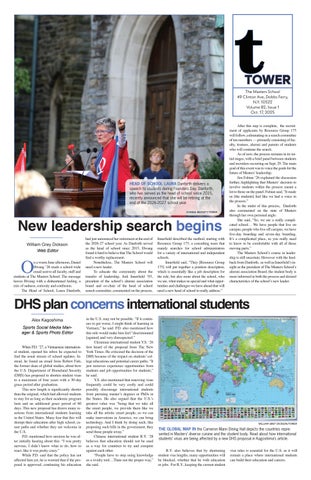
HEAD OF SCHOOL LAURA Danforth delivers a speech to students during Founders Day. Danforth, who has served as the head of school since 2015, recently announced that she will be retiring at the end of the 2026-2027 school year. AYANNA BECKETT/TOWER
New leadership search begins William Grey Dickson Web Editor
O
n a warm June afternoon, Daniel Hwang ‘26 reads a school-wide email sent to all faculty, staff and students at The Masters School. The message leaves Hwang with a disheartened feeling, a mix of sadness, curiosity and confusion. The Head of School, Laura Danforth,
had just announced her retirement at the end of the 2026-27 school year. As Danforth served as the head of school since 2015, Hwang found it hard to believe that The School would find a worthy replacement. Nonetheless, The Masters School will need a new leader. To educate the community about the transfer of leadership, Jodi Innerfield ‘05, president of the school’s alumni association board and co-chair of the head of school search committee, commented on the process.
Innerfield described the method, starting with Resource Group 175, a consulting team that mainly searches for school administrators for a variety of international and independent schools. Innerfield said, “They [Resource Group 175] will put together a position description, which is essentially like a job description for the role, but also more about the school, who we are, what makes us special and what opportunities and challenges we have ahead that will need a new head of school to really address.”
After this step is complete, the recruitment of applicants by Resource Group 175 will follow, culminating in a search committee of ten members — primarily consisting of faculty, trustees, alumni and parents of students who will continue the search. As of now, the process remains in its initial stages, with a brief panel between students and recruiters occurring on Sept. 29. The main goal of this event was to voice the goals for the future of Masters’ leadership. Jim Fabian ‘26 explained the discussion further, highlighting that Masters’ decision to involve students within the process meant a lot to those on the panel. Fabian said, “It made us [the students] feel like we had a voice in the process.” In the midst of this process, Danforth also commented on the state of Masters through her own personal angle. She said, “So, we are a really complicated school… We have people that live on campus, people who live off campus, we have five-day boarding and seven-day boarding. It’s a complicated place, so you really need to know to be comfortable with all of those moving parts.” The Masters School’s course in leadership is still uncertain. However with the feedback from Danforth, as well as Innerfield’s insight as the president of The Masters School’s alumni association Board, the student body is more informed in both the process and desired characteristics of the school’s new leader.
DHS plan concerns international students Alex Kagoshima Sports Social Media Manager & Sports Photo Editor When P.D. ‘27, a Vietnamese international student, opened his inbox he expected to find the usual stream of school updates. Instead, he found an email from Robert Fish, the former dean of global studies, about how the U.S. Department of Homeland Security (DHS) has proposed to shorten student visas to a maximum of four years with a 30-day grace period after graduation. This new length is significantly shorter than the original, which had allowed students to stay for as long as their academic program lasts and an additional grace period of 60 days. This new proposal has drawn many reactions from international students learning in the United States. Many fear that this will disrupt their education after high school, career paths and whether they are welcome in the U.S. P.D. mentioned how anxious he was after initially hearing about this: “I was pretty nervous, I didn’t know what to do, how to react, like it was pretty crazy.” While P.D. said that the policy has not affected him yet, he is worried that if the proposal is approved, continuing his education
in the U.S. may not be possible. “If it continues to get worse, I might think of learning in Vietnam,” he said. P.D. also mentioned how this rule would make him feel “discriminated [against] and very disrespected.” Ukrainian international student Y.S. ‘26 first heard of the proposal from The New York Times. He criticized the decision of the DHS because of the impact on students’ college educations and potential career paths. “It just removes experience opportunities from students and job opportunities for students,” he said. Y.S. also mentioned that renewing visas frequently could be very costly and could possibly discourage international students from pursuing master’s degrees or PhDs in the States. He also argued that the U.S.’s greatest value was “being that we take all the smart people, we provide them like we take all the artistic smart people, so we can make innovations in America, we can bring technology. And I think by doing such, like proposing such bills in the government, they send those people away.” Chinese international student R.Y. ‘28 believes that education should not be used as a way for countries to try and compete against each other. “People have to stop using knowledge as a rivalry tool…Thats not the proper way,” she said.
WILLIAM GREY DICKSON/TOWER
THE GLOBAL MAP IN the Cameron Mann Dining Hall depicts the countries represented in Masters’ diverse cuisine and the student body. Read about how international students’ visas are being affected by a new DHS proposal in Kagoshima’s article. R.Y. also believes that by shortening student visa lengths, many opportunities will be blocked, whether that be with education or jobs. For R.Y., keeping the current student
visa rules is essential for the U.S. as it will remain a place where international students can build their education and careers.
TOWER Editors-in-Chief Neena Atkins Allie Faber
Lead Opinion Editor Ayanna Beckett Lead Lifestyle Editor Mila Benson Lead Arts Editor Ella Liu Lead Sports Editor Thomas McCallum Lead News Editor Elaina Barreto Lead Copy Editor/Accountability Manager Siena Versaci Opinion Editor Helen Gao
@masterstower
@masterstower
t
2025-
2026
TOWER
Tower is hand-delivered on the day of publication to the Upper School. 650 copies are printed. A copy is sent to each of our advertisers. Tower is the winner of the Pacemaker Award for Overall Excellence, an award-winning member of the National Scholastic Press Association (NSPA), Columbia Scholastic Press Association (CSPA), Journalism Education Association (JEA) and Quill and Scroll. We encourage Letters to the Editor, which can be submitted to the following email address: TowerEditors@MastersNY.org. Published approximately six times a year, Tower is a public forum, with its Editorial Board making all decisions concerning content. Commentaries and opinion columns are the expressed opinion of the author and not of Tower and its Editorial Board or its advisers. Furthermore, the opinions conveyed are not those of The Masters School, faculty, or staff. Unsigned editorials express views of the majority of the Editorial Board.
Lifestyle Editor Jaden Laboriel Arts Editor & Copy Editor Brielle Broomes Sports Editor Loewy Nalle News Editor/Illustration Editor Olivia Shim Photo Editor Zara Murray Sports Photo Editor/Sports Social Media Specialist Alex Kagoshima Social Media Manager Jack Bilman Marketing Director Brooke Muntner Web Editor/Technology Coordinator Grey Dickson Faculty Advisors Ellen Cowhey Matt Ives Columnists Julia Panos Gigi Wheeler Jasmine Mao Avery Gosnell Photographers & Illustrators Annadele Dyott, Johnny Ye, Maria Viniegra, Siena Olay, Alexandria Abadir, Etienne Millet, Catherine Yi, Madeleine Dermansky, Mark He, Andrew Berman, Knox Gary, Sofia Ding, Sam Haas, Mya Recinos, Niki Agrawal, Aviana Kinon, Rose Yuan, Clara Chu and Roni Barkan
LOEWY NALLE/TOWER
ACCORDING TO THE INSTITUTE for Transporation and Development Policy, e-bikes make up 15% of the market for all electric vehicles globally. E-bikes are slowly gaining in popularity, and the Rivertowns are joining in on the trend.
Dobbs Ferry introduces an e-bike system Project MOVER is the Rivertowns’ latest plan to make transportation more sustainable.
Polyglot showcases diverse cultures on campus
On September 27, Masters Mainstage hosted their annual Polyglot, where students perform in any language except English.
Social burnout drains student leaders
Olivia Shim ‘27 shares her opinion on how social burnout takes a toll on student leaders.
Track star Emma Barnes embraces next chapter at Union College Emma Barnes ‘26 is committed to further her track career at Union College.
3 8 9 12
NEWS
FRIDAY, OCT. 17, 2025 To w e r
3
Dobbs Ferry introduces an e-bike system Loewy Nalle Sports Editor
project manager at this company. Maccallini and Baron met and walked around the village to discuss where the best places to put the bikes were. The next steps were listing those ideas to the village administrators to get the project moving. “These spots are strategically placed to serve a variety of uses. Tourists, people visiting to shop the local businesses and especially commuter workers use the bikes the most,” Maccallini noted. “Gould Park and the Metro North [Waterfront] location confirm that there is a substantial population using it for commuting.”
Some of the village’s busiest hot spots– Gould Park, Dobbs Ferry Public Library, the Waterfront Park and Memorial Park – were once bustling with only pedestrians. On July 15, that changed, with several e-bikes now lining the sidewalks donning one distinct name: Project MOVER. Project MOVER, according to their website, is an “electric bike program designed to provide a sustainable and convenient way to travel around the Westchester Rivertowns.” Project MOVER initially began in Ossining in July 2024. Af“Cycling is a more space-efficient ter a one-dollar unlocking fee, it is 20 cents for every minute a person is riding the bike. way to get people moving around There is also a monthly plan, which is $20 ... it doesn’t contribute to the car per month. Compared to New York City’s congestion on Ashford Avenue.” Citi Bike, which charges $5 for 30 minutes and 38 cents per minute after, it’s far cheap- Robert Baron er. Back in 2008, Dobbs Ferry established the “Dobbs Ferry Energy Task Force” (ETF). Launched in mid-July, Project MOVThe ETF, composed of residents, aims to ER saw strong, early use, with August as the help the town become better stewards of the first month of data showing a total of 393 environment. In 2017, Dobbs Ferry was rec- trips. There were a total of 178 trips for Sept. ognized as the first village in the state to be When analyzing the data, Maccalinni a Clean Energy Community (a designation found a clear pattern regarding the usage in given by the state government). certain parts of the day – specifically during Robert Baron, a Dobbs Ferry resident commuting hours. since 1998, has been a part of another cli“In the morning, people are coming mate initiative, “Sustainable Dobbs,” and from higher elevation points in the village, the village traffic committee since 2007. In and at the end of the day, it is the opposite,” recent years, this committee turned its atten- Maccalini said. tion to a new plan: a bike-share program. Commuting hour in Dobbs Ferry is the “I took a trip to Montreal in 2010. They notorious time when traffic is at its peak behad protected bike lanes, and I used bike- cause of the load of the different transporshare for my whole trip,” Baron said. “There tation situations: Masters cars, Dobbs Ferry were a number of people who asked for a school drivers, pedestrians and the rest of bike-share program. It’s a complicated en- the town running their errands or getting to deavor, but we ended up being approached work. by a consortium.” Senior Louisa Knauss rides her bike to Shared Mobility, based in Buffalo, is school every other day, but is still affected by one of the companies partnering with the the immense traffic in Dobbs Ferry. project since 2023. Alex Maccalini is the “I think it’s mostly because the streets
JUNIOR ELLA LIU RIDES an e-bike downtown in Dobbs Ferry, New York. Project MOVER, since July 2024, aims to provide a convenient way for Westchester residents to travel. Read more about E-bikes in Westchester and its effects on the residents in Nalle’s article. LOEWY NALLE/TOWER
are so narrow, and there are cars parked on either side that you have to wait your turn to go through,” Knauss said. “But it looks like Project MOVER is actively trying to solve this issue, as well as improve CO2 output.” Baron sums up the relationship between cars and bikes in terms of space (that being the narrow roads in Dobbs Ferry). “Cycling is a more space-efficient way to get people moving around. A bicycle doesn’t take up as much space as a car, so it doesn’t contribute to the car congestion on Ashford Avenue,” Baron said. Project MOVER helps cars move around more efficiently, reduces vehicle miles traveled, gets people active and even has safety precautions towards the potentially dangerous lithium-ion batteries. Maccallini said, “E-bikes are such great assets that you have in your community. We want to enhance them with more hubs across different towns. Our goal is to expand this project.”
1 2 3 4
SOURCE: EVELO.COM
Hub motor is the most common type of motor for e-bikes.
Batteries are a major part of e-bikes.
E-bikes do not need licenses.
The top speed for e-bikes is 20 mph.
A LINE OF E-BIKES waits for a rider. The implementation of Project MOVER in Westchester helps clear notorious traffic, especially for our Masters community. Read more about Project MOVER’s impacts on Westchester’s residents in Nalle’s article. LOEWY NALLE/TOWER
OPINION
4
Opinion
FRIDAY, OCT. 17, 2025
To w er
EDITORIAL
Don’t yank the welcome mat from under our international community
D
iversity is a lived experience. At Masters, it appears in late-night dorm conversations where a friend from Serbia explains how their country’s basketball team works, or during lunch when a Spanish classmate breaks down the differences between high school in America and Spain. We experience diversity in friendships, classrooms, and on the field that spans time zones and cultures. These moments of cross-cultural connection enrich our worldviews and give our community depth. That’s why it’s so important that we keep our doors open to newcomers. Having students from around the world makes our education better. The political issue of immigration can sometimes feel far away from our daily lives, but that couldn’t be further from the truth.
In August, the U.S. Department of Homeland Security (DHS) proposed to shorten student visas to a maximum of four years with a 30-day grace period after graduation. This new length is significantly shorter than the original, which had allowed students to stay for as long as their academic program lasts and a grace period of 60 days. We covered the proposal in this issue, and wrestled with publishing the names of quoted students critical of the government. In light of the detainment of international Tufts University graduate student Rümeysa Öztürk for publishing an opinion article in the Tufts Daily criticizing the Trump administration, Tower’s editorial board debated whether it would be responsible to publish attribution. We decided against it for our online edition. That’s the harsh reality of the
America we live in, one that yanks away the welcome mat to international students. Students from all over the world fuel the way we learn, whether it’s differing perspectives around the Harkness table teaching students civil discourse, or bringing new perspectives to our newsroom. Moments where Masters students, faculty and families gather to celebrate these differences are special traditions of increasing importance. Two weeks ago, Masters Mainstage hosted Polyglot, the annual multilingual, multicultural showcase in the Experimental Theater. Students performed everything from Israeli poems in Hebrew to pop songs in French to a packed theater, highlighting their cultural backgrounds and illuminating the diversity on campus. Just outside of our newsroom,
the Student Life Office hallway is home to the new art exhibit “Portals Home.” The year-long installation is a collection of photographs by international students and faculty capturing scenes from all over the world. The exhibit, like Polyglot, celebrates the diversity of our community and relishes our differences. When political leaders attack immigration, they attack the cultural richness of our states, cities and towns, and negatively alter the makeup of our campus, classrooms and dorms. Immigrants and our international community fill spaces, like the Masters campus, with voices from around the world. To implement barriers to immigration and withhold welcome for international students is to threaten the exchange of ideas, stories and perspectives that make education vibrant.
Online hostility on social media fuels political polarization Elaina Barreto Lead News Editor In the aftermath of the assassination of conservative political activist Charlie Kirk, news outlets and social media exploded with voices detailing the rise of political violence in America and debated how the country should respond to his death. People on both ends of the political spectrum mourned not only the death of Kirk, but the end of peace in America as we know it – a fear further amplified by other recent political attacks, such as the murder of two Minnesota state lawmakers in June or the attempted assassination of then-presidential candidate Donald Trump in July 2024. These instances, however, do not necessarily mark a rise in political violence, which has always existed in America, from the Revolution to the Civil Rights Era. What’s new is not the political aggression itself, but rather, the way social media transforms these incidents into symbols of nationwide division by blaming political parties’ ideologies and attacking their morality. Just hours after Kirk’s killing, users on X began blaming the rhetoric of the radical left for the tragedy. They claimed that the Left’s ideologies encouraged the hate that motivated Kirk’s killer, despite the confirmation that Tyler Robinson, the suspected killer of Kirk, was nonpartisan having not voted in the past two general elections. Meanwhile, some Democrats on TikTok and X have refused to honor Kirk’s memory, calling him out for being “a genocide apologist, anti-immigrants, anti-abortion,
anti-women’s rights, anti-anything human rights” and more. Instead of using Kirk’s assassination as an opportunity to unite the nation, both the Left and Right are experiencing an increase in political polarization. The posts on X and TikTok comments demonstrate the hate from which political violence stems. Yet, a future of increased political violence is not likely. The data recorded by the Director of the Polarization Research Lab, Sean Westwood, shows that less than 2% of Americans believe political murder is acceptable. Westwood believes that the real issue America faces is the misperception of the other party’s opinions. “My data also show that Americans estimate nearly a third of their political opponents support partisan murder. This belief that one is facing a vast, murderous faction, rather than a few isolated extremists, creates a phantom enemy that makes the country feel far more dangerous than it actually is,” he said. Westwood’s concerns are justified by the obvious attacks by individuals on the opposite party’s morality instead of political opinions. Rather than disagreeing with the ideologies of the left, one X user rejected the left as a political affiliation completely. “[The left is] a death cult, h---bent on the destruction of America and humanity itself… Once you realize we are fighting literal evil, you can never unsee it.” Democrats on the left are not the only individuals facing resentment; the right has also been portrayed as vile online. “The right isn’t confused. They aren’t misinformed. They’re committed to being
cruel — and pretending they are the real victims,” another X user said. It is nearly impossible to scroll through social media without witnessing the hate expressed through the whirlwind of hostile political debates online. Americans must end this cycle of political resentment by refusing
to partake in arguments about political parties’ morals and focus more on the shared values of all Americans. The right of freedom of speech has been the backbone of American society from the beginning; Americans must be cautious that its use does not lead to a permanent split in the nation.
AVI KINON/TOWER
BARRETO ARGUES THAT CHARLIE Kirk’s assassination does not necessarily signal a rise in political violence. Where there has been a change, however, is in the ways in which social media inflames political polarization in America.
FRIDAY, OCT. 17, 2025 To w e r
OPINION
5
We’re not a typical American high school, our traditions shouldn’t be typical either Ella Liu Lead Arts Editor Looking back, “High School Musical” is seen as a classic portrayal of an American high school with things like intense school spirit and “star” athletes. However, since Masters does not fit what a stereotypical high school might look like — as a small private school, not known for title-winning sports teams, and instead boasting an impressive arts program — the traditions we have are much different. Our traditions, like Founders Day, Wintermission, and our Halloween skit celebration, are molded by our differences. Recently, new school traditions were added, spearheaded by the Dobbs Athletic Association, or DAA, like Homecoming and the pep rally that debuted recently. DAA leaders Emma Barnes ‘26 and Danse Mobray ‘26 spoke about the importance of sports events to school spirit. Barnes said, “Everyone can come together on a set of bleachers and watch a sports game. It’s something that is
very accessible to everyone.” These are all paired with a new push from the sports department in strengthening school spirit and the performance of sports teams. “A lot of people have come to the school very interested in our athletics. Our teams are doing really well, and that’s attracting more people, specifically for sports,” said Mobray. The student reaction to the pep rally has been a mixed bag, with some citing confusion on the exact point of it. Sophomore Caitlyn Berry said, “The point of a pep rally is to get hyped, and it did not get hyped.” The issue lies in the fact that it feels unnatural for the school to try to push these new events into spaces where students are not receptive to it. In fact, before the recent expansions of the sports program, it felt like few students would come to Masters for sports, specifically. When Masters shifted from an allgirls school to a co-ed one, the school decided that having a football team didn’t fit what they envisioned the school to be like, and therefore didn’t add one. Thus, this new shift towards sports
traditions rubs against the idea that students previously held about the school. Coupled with the fact that the Claudia Boettcher Theatre is currently unavailable, handicapping the performing arts program, the school feels like it is changing. However, change is inevitable, and as Masters gains more students and attempts to strengthen its athletics program, things have to change. Students should see these changes as good or, at the very least, necessary as the student body changes. Of course, traditions take a while to fully take hold within the school culture, and something that may seem lame right now may be one of the most exciting events at school in the future. As we all consider the changes happening at school, we must also keep in mind that while they may not seem like the best for us, they may be what we need for the future.
AYANNA BECKETT/TOWER
SENIOR ZACH GOTTHELF WAVES the Delta flag in spirit during this past annual Founders Day, a unique Masters tradition. This year, the opposing team, Phi, took the victory.
Supreme court decision limits judicial power amid presidential over-reaches Ayanna Beckett Lead Opinion Editor The Supreme Court’s ruling in June represents another damaging blow to the system of checks and balances established by our Founding Fathers. In its 6-3 decision in Trump v. Casa, the court ruled that federal courts do not have the equitable authority to issue universal injunctions: court orders that halt the enforcement of federal policy across the entire country. In the case of Trump v. Casa, the Supreme Court reviewed whether federal courts had the power to stop an executive order from taking effect nationwide. The order in question, Executive Order 14160, challenged the longstanding principle of birthright citizenship. A lower court issued an injunction to block it, arguing about the constitutionality of the order. The Supreme Court countered the injunction by ruling that such actions did, in fact, surpass the powers given to the courts by Congress. Historically, universal injunctions were very rare until the 1960s. Courts issued an average of only 1.5 nationwide injunctions per year against the Ronald Reagan, Bill Clinton and George W. Bush administrations, and 2.5 per year against the Barack Obama administration. In recent years, however, the use of injunctions has dramatically increased as political fragmentation has developed. Within the first year of the first Trump administration, there were 20 injunctions against his executive orders alone. During Joe Biden’s presidency, 14 universal injunctions were used, many of them against measures meant to help the U.S. recover after the COVID-19 pandemic. While injunctions were once rare, their rapid increase over the last 20 years shows a trend of increased tensions not only be-
CLARA CHU/TOWER
UNDER TRUMP’S ADMINISTRATION, PRESIDENTIAL power has been stretched beyond the Founding Father’s ideas for the executive branch. In the case Trump v. Casa, the Supreme Court reviewed whether the federal courts had to power to stop an executive order from taking effect nationally. tween the courts and the executive branch, but between the two political parties. Injunctions have both pros and cons; however, the Supreme Court is tying the hands of the lower courts at a time when they are trying to combat the aggressive
flood of executive orders from the president. Now these orders can go into effect immediately, even if they are later ruled unconstitutional. But by that time, the damage may already be done. This also leads to legal fragmentation. Each citizen
can live in 50 different versions of America. By stating that each state can sue the executive branch and potentially have that law be null and void in that particular state, it means that each and every state will have a different version of federal law. In New Jersey, birthright citizenship may still be in effect, but a few states over, suddenly, you are not a U.S. citizen. This decision by the Supreme Court has broad implications for the United States. By essentially removing the judiciary’s ability to quickly halt potentially harmful and unconstitutional acts, the court has fundamentally shifted power toward the presidency, upsetting the delicate balance of power that has existed between the three branches of government for centuries. Over the last few months, we have seen major overreach by the executive branch, such as the mass firings of government officials and the restriction of journalists in the White House. These overreaches of power, coupled with the erosion of checks to rein in the executive branch, mean dangerous things for our democracy. We have already seen some of these consequences, with the unrestricted and unethical deportation of undocumented immigrants, the vast amount of firings of federal officials and the use of the judicial system to publicly shame and prosecute Trump’s personal enemies. By limiting the courts’ power in the system of checks and balances, the Supreme Court has not only changed the law but also changed the stability of American democracy.
See page 11 for our columnist stories!
ARTS
8
FRIDAY, OCT. 17, 2025
To w er
Portals Home exhibit opens outside student life office Elaina Barreto Lead News Editor Imagine boarding a ship to travel to another continent for your education as an international boarding student. During Morning Meeting on Wednesday, Oct. 1, Dean for Inclusive Excellence Esperanza Borrero talked about how this daunting experience was the reality for the earliest international students who came to Masters. That same day marked the opening of the “Portals Home” exhibit, curated by the Center of Inclusive Excellence (CIE), featuring pictures representing international students’ homes. Borrero said the CIE asked students to send photos that portray home, along with short descriptions of the scene and the country in which it is located. The “Portals Home” exhibit will serve as the permanent exhibit outside the Student Life Office this year, only to be taken down for two other temporary installations in the coming months. While many Masters students have had the privilege of travel- ing abroad for va-
cation or for educational purposes through the Global Studies Program at Masters, these trips are not as long and demanding as the international boarding experience. Masters has partnered with other schools in the Caribbean, Africa and Asia, which allows for international trips such as the spring trip to Shenzhen and Chengdu, China in 2024 in which students are encouraged to participate in cultural activities and broaden their perspectives on global issues. International students do fulfill these goals, in addition to other expectations, such as immersing themselves in the culture and classes at Masters and forming close connections with peers. Borrero said the goal of the exhibit was to portray the international student experience and create a greater understanding of the obstacles they face that other students may not recognize. She said, “I think it’s a unique experience to be coming from another country at like 14, 15 years old and be far away from home, spending your whole day speaking a language that might not be the one you speak at home all the time.” In one photograph, the camera focuses on the skyline of the road coming down from Beverly Hills in Kingston, Jamaica. The student wrote in the description, “It kind of represents Jamaica’s motto of ‘Out of many, one people.’” The motto reflects Jamaica’s diverse origins and mirrors the diversity of the exhibit itself, which features photographs from seven different countries: Jamaica, England, Vietnam, Serbia, Croatia, China and Ukraine. Another picture depicts a building located in the center of Kyiv, Ukraine, where the student
FREE SVG/CREATIVE COMMONS
said they have many memories of spending time with friends and family. The student noted that the photo was taken on Ukraine’s Independence Day, adding, “This building, with the Ukrainian flag, represents peace, support and a united people.” Despite differences in location or meaning, all the photographs portray their respective countries’ cultures and the students’ unique experiences and memories. Borrero said that she believes international students are resilient for taking the
opportunity to explore a different culture and community despite challenges, such as homesickness and culture shock, that they might have to overcome. Borrero also said, “I hope [other students] feel inspired to be international students. I hope it inspires people to say, ‘I think I could do that.’ International students are, I think, role models for us to go and [live] somewhere for a little while and sort of challenge ourselves.”
JACK BILMAN/TOWER
PHOTO FROM GUANGZHOU EXEMPLIFIES the sharing of cultures in the Portals Home exhibit. The photo was taken at a market in Guangzhou, China named “Yongqing Fang.” The exhibit is aimed at giving Masters students a window into the lives of international students.
Polyglot showcases diverse cultures on campus Siena Versaci Lead Copy Editor & Accountability Manager Blues and greens rippled across the stage, silky fabric whirling into twists and circles to the trill of the music notes and beats. Words were not necessary. The message of nature’s harmony and beauty was conveyed thoroughly through this mesmerising cultural dance. It was not junior Jay Klainbard’s performance alone that packed the Masters’ Experimental Theater with students, parents, and teachers alike. Polyglot, essentially a talent show with no English allowed, featured multiple performances that showcased the many cultures of the students and teachers who participated. Polyglot-performer Adrian Ciubotaru '27 said, “I was interested in performing because I am the only [foreign] Israeli student in school, I wanted to
share the culture and language.” “I've never, ever seen such a diverse community… It is really interesting how Polyglot and many other events at Masters allow people to share their culture, which is very kind of uncommon and a bit scary. For me personally, with the current situation, not just in the U.S but around the world. I wouldn't speak Hebrew on the street,” Ciubotaru said. At Polyglot, Ciubotaru performed a famous Israeli folk song (later turned into a poem) called "Chorshat Ha'Eucalyptus" (The Eucalyptus grove). “I like the fact that Polyglot is very non-political. It gives a stage for anybody in any culture,” Ciubotaru said. Polyglot also got students involved from outside of the Masters Mainstage program giving students within the Mainstage the chance to learn new skills in production logistics. The Upper School Theater Teacher and Director Beth Manspeizer said “I think that it is a really valuable learning lesson for the theater students to get an understanding of production work, the promotions, the flyers, the submissions and the creation of a running order.” Manspiezer sees this performance as “an opportunity to include the whole school community. It [is not] just supposed to be for the Mainstage Theater Program, but for everyone in our community.”
PUBLIC DOMAIN PICTURES/CREATIVE COMMONS
SIENA VERSACI/TOWER
JAY KLAINBARD ‘27 PERFORMS a dance at Polyglot, taking inspirations from Mexican, Indian and Latin American cultures. Much of this performance was influenced by the culture at Klainbard’s old school, which was largely Ecuadorian immigrants.
FRIDAY, OCT. 17, 2025
LIFESTYLE
9
Lifestyle
To w e r
“Unknown Number” film sheds light on cyberbullying Neena Atkins Editor-In-Chief
SPOILER ALERT The cruelest messages didn’t come from a stranger. They came from a mother, disguised behind an unknown number. Netflix’s “Unknown Number: The High School Catfish” pulls viewers into a dark story showing how cyberbullying can take root in unexpected places and just how easily it can spiral. Directed by Skye Borgman, the film follows the real-world case of Lauryn Licari and her then-boyfriend, Owen McKenny – teenagers from suburban Michigan whose phones began buzzing with harassing texts in 2020 lasting over 15 months. Investigators eventually revealed the messages were sent by Lauryn’s mother, who used spoofing apps to conceal her identity, shocking the teens and the wider community. Lauryn and Owen’s story is compelling for how familiar its mechanics are to students. Nearly half of American teens, 46%, say they have experienced some form of cyberbullying, according to a 2022 Pew Research Center survey. Offensive name-calling, rumor-spreading and the receipt of explicit images are among the most common forms. Upper School Associate Dean of
Health and Wellness Jodie Goldberg discussed how difficult managing cyberbullying is. She said, “It’s not necessarily happening in front of a teacher or a parent. Sometimes adults don’t even know what’s going on if we don’t have access to your accounts.” The film landed close to home for many students. Senior Bella Henriquez said she was struck by how convincing the accused appeared on screen before the reveal. “It made me think about how [the bully] could be anybody,” she said. “You can’t always trust what people say in-person.” Henriquez also reflected on witnessing cyberbullying firsthand. “It was hard to watch because you could tell the person was really hurt. They ended up deleting a lot of their online content, which was upsetting to see because the bully stripped their confidence.” In the film, Owen’s experience demonstrates how cyberbullying can ruin friendships. At one point, his closest friend Khloe was suspected of sending the messages, creating tension in their circle. The documentary portrays the stress of being targeted while questioning whether friends can be trusted. Goldberg emphasized how bystanders shouldn’t feel pressured to stay silent. “I know few people who have sat silently and haven’t felt a certain sense of guilt. It’s going to be uncomfortable either way. You might as well be on the side of discomfort
helping someone else,” she said. Unknown Number also highlights how institutions can falter when confronted with reports of bullying and harassment. Interviews with school officials featured hesitation and missteps leaving the victims more vulnerable. Henriquez contrasted that with the environment of Masters. She said, “At Masters, I think people would turn to the administration more quickly. Our
school is very anti-bullying.” Masters has taken steps to stimulate conversations surrounding cyberbullying. Goldberg said, “I think as much as we can, we try to talk about it in classes and have open and honest conversations. I do think removing phones is a good start. We can’t stop what happens after hours, but I do think when we are made aware of it, accountability is put into place.”
ROSE YUAN/TOWER
LAURYN AND OWEN RECEIVE hateful messages from an anoynomous phone number in “Unknown Number.” Owen originally suspected his close friend Khloe of being the perpetrator, but it was in fact someone closer to Lauryn. The twist left viewers in shock and made the message against cyberbullying heavier in the mind of audiences.
Social Burnout drains student leaders Olivia Shim News Editor & Illustration Editor
On a quiet weeknight in the dorms, a knock on the door can mean anything— from a homesick classmate, a friend fresh from an argument or someone simply looking for a listener. For Masters students in leadership roles, whether it be peer leaders, dorm proctors or club presidents, those knocks arrive often and without warning. Their reputation for empathy draws people in, but it also carries a cost: emotional fatigue that can slide into burnout. Burnout is more than everyday stress. The World Health Organization classifies it as an “occupational phenomenon,” of mental, emotional and sometimes physical exhaustion. Research by Arnold Mascarenhas identifies five stages: a honeymoon phase of excitement, mounting stress, chronic stress, full burnout and “habitual burnout,” when exhaustion becomes the default. Symptoms range from headaches and fatigue to isolation, pessimism and a sense of helplessness. At first glance, students with high emotional intelligence, who have skills such as self-awareness, empathy and relationship management, may seem less vulnerable to burnout. They, in theory, are equipped with more skills to protect themselves. However, the same qualities that make them strong leaders can make them more vulnerable. Masters School Counselor John Price said, “When we’re worried about meeting other people’s needs before we
take care of ourselves, that will lead to burnout pretty consistently.” He further explained that this behavior “also leads to a little bit of resentment towards others because they’re annoyed, but they’re still doing it.” Emotional intelligence can help people recognize their limits, but it can also increase their exposure to others’ stress. Without clear boundaries, that heightened sensitivity easily moves from stress to burnout. Junior Gabriela Heredia, a dorm proctor in Cole Dorm, described the pressure as “casual but constant,” noting that conversations about other people’s problems can surface between classes or late at night. She admits that the responsibilities as a proctor can be difficult as it can be unpredictable. Over time, even small demands add up, blurring the line between friendship and unpaid counseling. Heredia said, “When you’re someone, [people] may look up to, if you’re an upperclassman, if you’re a proctor, whatever it may be, you want to be someone who they can genuinely trust.” In 2014, a CBS News article noted that from survey results by the American Psychological Association, 31% of teens reported feeling overwhelmed. Burnout is real and is everywhere, though recognizing early signs and treating self-care as an important factor may be one of the simplest ways Masters students can keep their mental health thriving. As Price reminded, “If we don’t fill our own cup up, we’re not going to be able to help other people fill theirs.”
MYA RECINOS/TOWER
STUDENT LEADER POURS OUT energy to help younger peers. This can be an significant issue for student leaders because they may endure social burnout. This illustration represents how a student “filling up their peers’ cups” can lead to detrimental effects of losing their own energy.
LIFESTYLE
10
FRIDAY, OCT. 17, 2025
Tower
Uber Eats delivery gets lost in campus maze Helen Gao Opinion Editor On a weekend evening last winter, I hiked across the dark campus to find my food. My Uber Eats driver gave up on finding Ford Dorm and uploaded a photo of my delivery in a random spot on campus. My legs, wrapped in thin pajamas, were shaking in the sharp wind. By the time I discovered the bag at the back of Strong Dorm, both my meal and I were freezing. For many students at Masters, such misadventures are not rare incidents. Senior boarder Anna Caponnetto Insa shared, “Many orders get dropped off at the back of FC (Fonseca Center), or the Masters circle.” Part of the problem stems from unclear or incorrect addresses. Security guard Diana Corrao recalled one freshman’s address appearing as “Ardsley” due to a Google Maps error. Since students rush to class and silence their phones, early morning orders are often left without sufficient guidance. The vast span of the 96-acre Masters campus may be the greatest obstacle for drivers. After reaching campus, many drivers struggle to navigate to a specific dormitory. For immigrant drivers unfamiliar with English or Google Maps, the campus can feel like a maze. Miscommunicated and frustrated drivers often leave small bags scattered across the 96-acre campus. The delivery dilemma also reflects the broader social struggles faced by immigrant drivers. According to El País, a
Spanish newspaper, 3.5 to 4.5 million immigrants work for platforms like Uber and DoorDash nationwide, comprising approximately 45% of all delivery drivers. In New York City, this proportion can reach 90%. Many drivers face relentless pressure from the platform to reach many customers within a tight window. According to Business of Apps, the average Uber Eats delivery takes about 30 minutes per customer, including long travel distances, leaving little time for careful navigation. Drivers on Reddit posted about wasting 10 to 15 minutes waiting for the restaurants to prepare their orders, forcing them to rush to compensate. For most drivers, the hourly wage ranges from $15 to $25 per hour. Approximately 90% of Uber Eats customers tip drivers, which accounts for a significant portion of driver income. The drivers’ rush poses a potential danger to the campus. Corrao said, “You may see them [delivery drivers] speeding up the hill.” Students searching for their orders risk encountering fast-moving vehicles. The Associate Head of Upper School for Student Life, Jeff Carnevale, shared that some drivers once attempted to enter dorms, regarding them as regular apartments. “The top priority of our policy is safety”, Carnevale said. These incidents led to tightening and reclarifying rules to guarantee student safety, such as not propping the door open under any circumstances. The security office plays an understated role in safeguarding campus boundaries. Corrao explained, “When we find a lost order during patrol, we email
AVIANA KINON & NIKI AGRAWAL/TOWER
BOTH STUDENTS AND UBER Eats drivers are left stranded in navigating the complex maze to cross paths. This time-consuming issue is frustrating for all ends of communication and has brought up safety risks from the drivers rushing to make deliveries. Security guards at Masters continue to make it a top priority to find ways around this barrier and keep the community safe. dorm parents and notify the student.” Their quiet effort to manage deliveries deserves both acknowledgment and gratitude. In response to the struggle, Corrao suggested installing three pick-up
shelves around campus. Correspondingly, students can attach standardized, photo-based navigation guides to help drivers locate the correct buildings.
New MISH manager strengthens service goals Brielle Broomes Copy Editor & Arts Editor As Rose Yuan researched and discovered the experiences of sex-trafficking survivors, she knew that she had to share their struggles so that their voices would not be forgotten. That's when Yuan had the idea of bringing her discovery to her broader school community. Now, Yuan ‘28, a project manager of Masters Interested in Sharing and Helping (MISH), strives to bring that same advocacy to Masters. “I know that with this project in mind, Yuan hopes that we can expand our thinking on what it means to care for one another, and really empower ourselves as high schoolers to know that we can make a difference,” - Marie-Louise Miller MISH has served a prominent role in the Masters community for 147 years. MISH has aimed to connect Masters’ students to the greater cause of service. Over the years, MISH has organized numerous food drives and service fairs, and at the forefront are its project managers, who propose and discover new organizations for MISH to connect with. Though this year marks Yuan’s first year as part of the project management staff, her previous efforts have played a pivotal role within other communities, creating a strong basis for her this year. Originally from Dongguan, China,
ZARA MURRAY/TOWER
ROSE YUAN, A MEMBER of the project management staff of Masters Interested in Sharing and Helping, or MISH, makes it her mission to spread knowledge about the severity of sex trafficking. Yuan stresses that advocacy isn’t just about action, but awareness as well. Using her knowledge and experience, Yuan brings a new perspective to Masters that empowers high school students to feel capable of making a difference. Yuan previously worked with Eden, an international organization that spans over eight countries. This organization supports survivors of human trafficking and sexual exploitation by selling survivors’ handmade jewelry and donating the profits to fund their path of independence. At her former school, Yuan organized fundraisers and campaigns to share the organization's mission. “I got to help them [Eden] advertise and get more people at my old
school to know their stories,” Yuan said. For Yuan, advocacy is not just about action, but awareness as well. Yuan said, “I feel like it's an opportunity for the students to get to view the world in a different perspective, because a lot of students don't even know that there’s sex trafficking still existing until now.” She added, “I think it's very important to acknowledge the privileges we have, how we can help them, and how even to raise
awareness is some form of helping.” Though she has not continued to work with Eden during her time in Masters, she strives to broaden her area of focus as a MISH project manager by bringing light to the importance of cancer awareness and research. Yuan had been inspired by the research that she had conducted at Johns Hopkins University this summer, and wants to bring a new perspective to Masters. Marie Louis Miller has been the MISH advisor for the past two years. Miller has worked closely with Yuan and other project managers to fully form service proposals and understand their impact. “I know that with this project in mind, Rose hopes that we can expand our thinking on what it means to care for one another, and really empower ourselves as high schoolers to know that we can make a difference,” Miller said. Yuan hopes that the previous contributions and skills that she has learned will help deepen her commitment and involvement in MISH. Yuan said, “I feel there's a huge opportunity and potential in MISH, because of the platform that Masters has provided, how they promote students, and they encourage students to reach out to, especially out-ofschool organizations.” Yuan’s consistent advocacy reminds students that, as high school students, they have the capacity to shed light on important issues and share that impact with each other.
FRIDAY, OCT. 17, 2025 To w e r
COLUMNISTS
Leaping into new adventures Freshman Focus
Avery Gosnell Columnist Coming to The Masters School is not just about looking for a school. To Carter Mack, an incoming freshman, being a Panther is far more than just sitting at a Harkness table. It is about joining a deep community where there’s a place for everyone. It’s about finding new passions. It’s about becoming a new, better person. At her old middle school in Bronxville, there were fewer opportunities to try new things. She would stay quiet in class,
not put herself out there, and was hesitant about joining clubs and activities. At Masters, though, Mack said, “Everyone is open to trying new things and will always cheer you on when doing so.” She hopes to take advantage of that and explore herself. This year, she is excited about new writing opportunities, including the Creative Writing Club, the student performing group Outspoken and her own personal literary endeavors. Wearing her purple and white, Mack is also a center midfielder on the girls’ varsity soccer team. Outspoken is not something she would have initially tried out for, but being openly invited at the club fair to audition inspired Mack to share her original poems. On the field, Mack has taken a risk by joining the varsity soccer team. Despite the high standards and demands of being
a varsity athlete as a freshman, Mack has risen to the challenge and grown, both as a teammate forming connections and as a player competing on the field. She is also pursuing her first year of high school club soccer, and is looking forward to an upcoming tournament. “There is really a place for everyone [at Masters],” Mack said. Despite only being here for almost two months, she has formed connections everywhere - from the classroom, to the soccer field, to new clubs, and beyond. It takes time to find yourself and find a place, but Mack is a freshman who is not scared to go for it. She is going into her next four years at Masters with an eagerness to grow. And if that does not sound like the perfect start to high school, what does?
Nothing to say, everything said Culture Shocks
Jasmine Mao Columnist “Yo, what’s up?” During his first few weeks in the States, Chinese international student Wei Hu’s head swirled with question marks every time someone greeted him and held their hands up. He said, “What do they mean by ‘dap me up?’ ? I was really confused.” I, also an international student from China, find this culture shock highly relatable. How should I respond to ‘what’s up?’ Nothing is up! In much of Western culture, including all English and Spanish-speaking countries, small talk is a regular routine. Refer to con-
versations that establish a mood of sociability instead of communicating information or ideas. It can fill in “awkward” silences, promote warmth and plow the soil so meaningful conversations might sprout. However, there are cultures without small talk. For instance, in Nordic countries and East Asia, how do people greet each other? Hu explains that in China greetings are: a simple ‘Hi’ between friends. There’s no greeting waiters, or asking about the cashier’s day. Hu said, “In China, people are less inclined to express their emotions, especially in public with people you’re not familiar with.” Although it might seem impolite and frigid to many outsiders—this summer in Shanghai, China, a foreigner berated the rude nature of Chinese people to me—I believe it is just a difference in the societal atmosphere. In America, every interaction reassures friendliness and positivity. Social warmth is guaranteed when small talk is present. In China, the default interpersonal tension is not
attractive, but rather neutral. Silence is not viewed as awkward, disregard is not interpreted as disrespect. There is just no need to interact with people constantly. For many introverted people, the neutral atmosphere in Chinese socialization is instead more comfortable and serene. I personally prefer the absence of small talk, since it makes all communications more efficient and whole-hearted. On the other hand, after experiencing both cultures, Hu expressed fondness for the small-talk culture. “You can really feel the energy of other people, whether they actually mean it or not. I think it sets a really good environment,” he said. The ways of communication across the world are different, and they each carry their own advantages and disadvantages. Talking to diverse people around the world, do not let the silent absence of small talk or the overly friendly “wassup” freeze you, because respect and kindness are transnational and transcultural.
The history behind the white dress Fashion Over Time
Gigi Wheeler Columnist It’s common for girls in America to be told that, for certain formal events, you must wear a white dress. White was seen as a color reflecting purity and innocence. Queen Victoria wore a white dress to her wedding in 1840. Others were inspired by her choice, and the trend of wearing white dresses really started to pick up as people became wealthier and more willing to splurge on fancy white wedding dresses. More and more actresses and public figures followed suit, and before you knew it, it had become this
unspoken rule for brides to wear white to a wedding. I, too, have had my fair share of situations (not weddings) where I have been told that I cannot wear the blue or green dress, and I have to wear a white dress. It was not only my parents who told me, either; it was peers, friends and teachers — the endless examples in the media were enough for even a very young me to get the idea. I distinctly remember before my eighth-grade graduation when everyone was asking what dresses each other was wearing. When I told people I wasn’t wearing a white dress because, firstly I thought the color was boring, and secondly in all honesty, middle school me wanted to be ‘different,’ the reaction I got from my peers was confusing. They told me that I wasn’t allowed to wear a different color dress, that I had to wear a white dress. When I asked “why,” they didn’t have an actual reason: their answer was essentially that you ‘just had to wear white,’ no other way around it.
I’ve asked a lot of people if they understood why it is expected that women wear white dresses, and no one has ever had a full, confident answer. It is interesting that such a progressive school like Masters would have an unwritten expectation that female-identifying students should wear white dresses at graduation. To me, there are some uncomfortable connotations with the fact that female-indentifying students are pushed to wear a color that has historically been associated with virginity and wealth. We pride ourselves on our creativity and individuality among students, yet at one of the most important moments in our lives, we are told what color to wear. Why is that? Is there no answer besides the fact that ‘this is how it’s always been?’ I can respect the idea of staying true to the past, but there is equally, if not more, motive in the idea of stepping into the future, and leaving dated “traditions” behind.
11
Congress plays politics, Westchester pays the price Westchester Politics
Julia Panos Columnist
A
s of October 15, Congress has failed to reach an agreement on federal funding, resulting in the government shutdown that has dominated the headlines. While it might seem like business as usual in Washington, the consequences have already begun hitting hard here in Westchester. The partisan battle between Democrats and Republicans in Congress risks repercussions for many New Yorkers in the Lower Hudson Valley. The specific clash between the two parties in the Senate revolves around Medicaid cuts and Affordable Care Act premium subsidies. The Democratic refusal to compromise on the healthcare of our nation’s working people is currently being met with Republican contempt for allegedly attempting to protect healthcare for “illegal aliens.” Instead, according to the New York State Department of Health, healthcare for nearly 80,000 New Yorkers is at risk during this shutdown. In the Hudson Valley specifically, premium costs are expected to rise by 31% if current funding subsidies are allowed to expire in December. Despite not receiving paychecks during the shutdown, federal employees continue to provide certain essential services at various locations in Westchester. By law, services like Social Security must remain funded and available to the people. Thankfully, people are currently still able to apply for benefits, Social Security cards and submit appeals. The agency won’t be able to grant benefits to new applicants, or replace Medicare cards. This is expected to exacerbate the effects of previous attacks on Social Security. The most important issue of the shutdown is in food assistance programs which are especially vulnerable to losing funding– the risk increases as the shutdown continues. In New York, the Supplemental Nutrition Assistance Program (SNAP) benefits are guaranteed to be administered through the end of October, and will still accept applications. But the status of November, SNAP benefits are unclear. 3 million people in our state rely on these benefits to eat, 80,000 in Westchester alone. This shutdown is not simply a national matter; it is an issue that will be felt deeply in our own communities, and should the Republicans maintain their harmfully stubborn position on federal funding, we must find ways to take action in our community. On campus, the Feeding Westchester club is already planning to take action by reaching out to local elected officials and raising awareness about this issue. Co-chair Talia Hird explained, “I think the combination of this government shutdown, recent legislation and ICE agents targeting people outside of food pantries is detrimental to people in need because of the constant need for adaptation.”
SPORTS
12
FRIDAY, OCT. 17, 2025
To w er
Sports
Track star Emma Barnes embraces next chapter at Union College Jack Bilman Social Media Manager This summer, senior and mid-distance track and field athlete Emma Barnes made her verbal commitment to the Union College track and field team where she will be running on the college stage next year. Union College is a National Collegiate Athletic Association (NCAA) Division III school just outside of Albany in upstate New York. Barnes described her excitement for participating in college athletics, and said that she is “Looking forward to the team environment…It’s almost similar to Masters in the way that everybody’s super close and tight knit, and I’m really excited to be part of such a big team.” One of Barnes’ track coaches and Upper School Math Teacher Ian Mook said, “It’s not an easy journey, and I think college track in particular becomes way more time-intensive. You’re doing fall, winter and spring training, and it’s a long year, so I hope she’s able to stay consistent, healthy, motivated and make good connections with her teammates.” However, college-level track has not always been the plan for Barnes. “I didn’t plan
on trying to run track in college, so it was kind of a decision I made at the end of last year,” Barnes said. Barnes also explained what the process was like connecting with coaches. “I just reached out to some coaches, I was talking to about five of them, and Union was the school that stood out to me most, for sure. I loved the coach, campus and really everything about it, so the decision wasn’t really that hard to make,” she said. Despite Barnes’ track success, it hasn’t always been her number one sport. In addition to track, Barnes plays soccer and basketball. Her commitment to multiple sports has produced many benefits. “There are a lot of fitness aspects and for my position in soccer specifically, it’s a lot of stop and go, like running and sprinting,” she said. Mook added that being a multi-sport athlete has not only benefitted Barnes’ physical abilities, but also her competitive mindset. He said, “I learned one thing about Emma as a racer: she is just so very competitive. You can tell she’s a multi-sport athlete. She’s a soccer player, a basketball player and in those sports she has learned about the value of teamwork and fighting tooth and nail to win, and that shows up in track.”
JACK BILMAN /TOWER
SENIOR ATHLETE EMMA BARNES shows off her merch from Union College, where she has verbally commited for track and field next year. Barnes is looking forward to competeing at the collegiate level. Barnes has had an acomplished athletic career at Masters, playing on the girls varsity basketball and soccer teams in addition to track and field.
Shooting for the stars:
WNBA reaches new heights Allie Faber Editor-in-Chief Women’s basketball is quickly emerging as one of the country’s most popular spectator sports. Stand-out stars like Caitlin Clark and A’ja Wilson have become fan-favorites, selling out arenas from Phoenix to New York City and attracting massive online followings. And, as of late August, the Women’s National Basketball Association (WNBA) saw record-breaking attendance numbers. At over 2.5 million fans in the 2025 season, viewership was the highest it has been in 23 years. The WNBA and its star players are becoming increasingly culturally relevant– but why? One possible reason for the striking rise in popularity can be found outside of the professional league. Women’s March Madness, the national tournament for women’s college basketball teams, has seen all-time-high viewership in recent years. Across ESPN networks, game viewership averaged at 1.2 million viewers, up 22% from 2023. Diligent media attention and digital accessibility through broadcasting platforms like ESPN, CBS and ABC, along with audience bracket participation, identifies excellent players earlier in their career-before they even step foot onto a WNBA team. “[Women’s] March Madness has become so much bigger as well,” Mia Steinwurtzel ‘26, an avid women’s basketball
fan, explained. “Men’s March Madness has always been big, but as soon as you have players like Caitlin who are breaking records, people think, ‘Wow, I want to actually watch the game to see if she’s like, actually doing that, or go to the game to be in that environment.’” March Madness for women’s college basketball is a relatively new development. Created in 1984, the tournament initially only included 34 playing teams. Since then, the women’s bracket has more than doubled, boasting 68 teams from schools across the country. Another draw to the women’s professional league is the style of play. “It’s just a completely different game. And personally, I enjoy watching women’s [basketball] more,” Steinwurtzel said. She explained that because of the women’s physical size relative to the court, they have to “do more” to get to the basket. “They’re just smaller, like, they just can’t literally take five [steps] down the court.”
ER TOW
T/ KET
BEC NNA AYA
This extra room and the discrepancy in physical athletic ability relative to NBA players creates more room for passing and technical plays. So, those in
search of a more collaborative, team-focused style of game, may feel more inclined to watch women’s games rather than the “isolation play” associated with men’s basketball. “There’s a lot more finesse,” Mikelle Sacco, the assistant athletic director, said. “It’s kind of like the difference between [boys and girls] lacrosse. You have the girls that are all finesse and all about the passing and the movement, and the boys get to just tackle each other.” Additional drivers for the WNBA’s vogue are the digital spaces created around the league. Social media communities precipitate endless rounds of memes, fan pages and even hate posts (which sometimes reach the broadest audience). Younger players with their own pages, like Clark with 3.6 million followers on Instagram and over 800,000 on TikTok, feed their fans locker room content and provide a window into their personal lives, fanning the flames of cultural fame. On the business side of the equation are the brand deals and subsequent marketing campaigns that trail players
with massive followings. Whether the sponsorships or fame come first is debatable. However, it is undeniable that these marketing ploys tied to players and the league at large for beauty brands, sportswear and even contraception, further the WNBA’s popularity. Even more, despite cult-following and broadening appeal, WNBA players make substantially less money than male athletes in less popular leagues, and suffer a gap between their own, and NBA wages. Claudia Goldin, a professor of economics at Harvard University, estimates that WNBA players should be paid approximately one-third relative to NBA players, crunching the numbers to account for discrepancies in viewership and additional factors. But, Goldin points out, the women are only paid one-eightieth of the average NBA salary. So, a big chunk of the players’ income derives from these campaigns – a motivating factor in securing brand deals and sponsorships. From both the platform that the women’s college basketball scene provides, a distinct style of play and subsequent media fame, players like Clark and Bueckers have become household names, reaching an audience outside of devoted basketball fans. “There’s now a following [surrounding the WNBA]. It’s a bigger deal. People are seeing it, more people. And it’s just not women, it’s men and women watching the games, which is fantastic,” Sacco said.