The Masters School - 49 Clinton Ave, Dobbs Ferry, N.Y. 10522
Editors-in-Chief
Neena Atkins
Allie Faber
Lead Opinion Editor
Elaina Barreto
Lead Lifestyle Editor
Mila Benson
Lead Arts Editor
Ella Liu
Lead Sports Editor
Thomas McCallum
Lead News Editor
Ayanna Beckett
Lead Copy Editor/Accountability Manager
Siena Versaci
Opinion Editor Helen Gao
Lifestyle Editor
Jaden Laboriel
Arts Editor & Copy Editor
Brielle Broomes
Sports Editor
Loewy Nalle
News Editor/Illustration Editor
Olivia Shim
Photo Editor
Jack Bilman
Social Media Manager
Alex Kagoshima
Marketing Director
Brooke Muntner
Web Editor/Technology Coordinator
William Grey Dickson
Faculty Advisors
Ellen Cowhey
Matt Ives
Columnists
Julia Panos
Gigi Wheeler
Jasmine Mao
Avery Gosnell
Annadele Dyott
Mason Dwek
Alex Kritzer
Alex Pinnock
Photographers & Illustrators
Annadele Dyott, Johnny Ye, Maria Viniegra, Siena Olay, Alexandria Abadir, Etienne Millet, Catherine Yi, Madeleine Dermansky, Mark He, Andrew Berman, Knox Gary, Sofia Ding, Sam Haas, Mya Recinos, Niki Agrawal, Aviana Kinon, Rose Yuan, Clara Chu and Roni Barkan
t
TOWER 2025-2026
Tower is hand-delivered on the day of publication to the Upper School. 650 copies are printed. A copy is sent to each of our advertisers. Tower is the winner of the Pacemaker Award for Overall Excellence, an award-winning member of the National Scholastic Press Association (NSPA), Columbia Scholastic Press Association (CSPA), Journalism Education Association (JEA) and Quill and Scroll. We encourage Letters to the Editor, which can be submitted to the following email address: TowerEditors@MastersNY.org. Published approximately six times a year, Tower is a public forum, with its Editorial Board making all decisions concerning content. Commentaries and opinion columns are the expressed opinion of the author and not of Tower and its Editorial Board or its advisers. Furthermore, the opinions conveyed are not those of The Masters School, faculty or staff. Unsigned editorials express views of the majority of the Editorial Board.
MOHAN ZHANG ‘26 HOLDS the mouth of the dragon at the Morning Meeting Lunar New Year event on Feb. 6. International Club led the presentation, which explained how Lunar New Year is celebrated in different countries. Read sophomore Jasmine Mao’s story on navigating the naming of the holiday.
New Dobbs Ferry Mayor Christy Knell maps out goals
Christy Knell, a freelance graphic designer in Dobbs Ferry, is now mayor and focusing on several issues.
Looksmaxing: Social media’s fuel for self-hatred
“Looksmaxxing” highlights how social media propels male insecurity and harmful mental and physical health consequences.
Snowday policy changes bring trouble on the on the horizon
Thomas McCallum ’26 argues that replacing traditional snow days with remote learning harms students’ mental health, social development and classroom cohesion without improving academic outcomes.
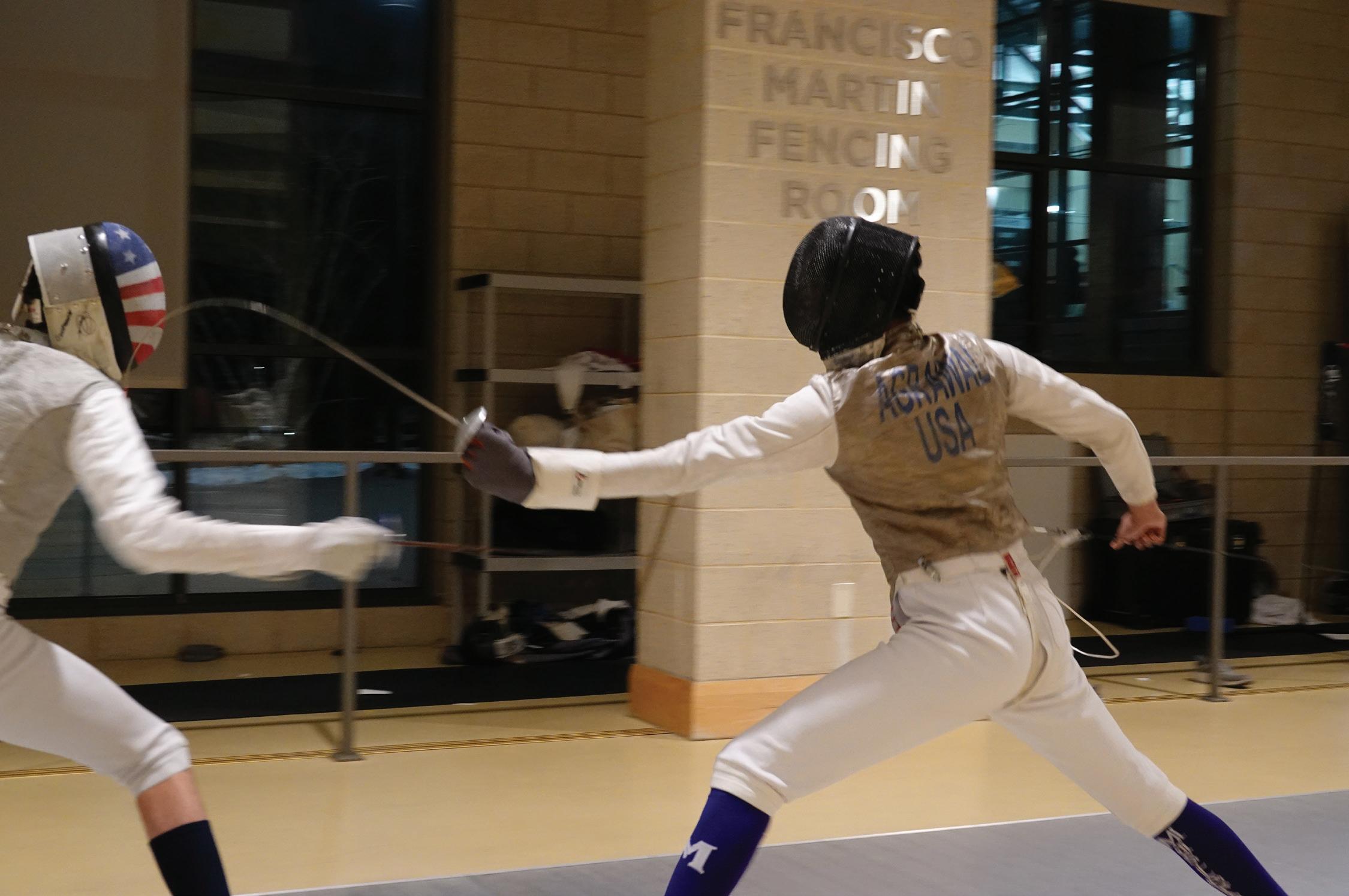
Agrawal finds his home on the piste
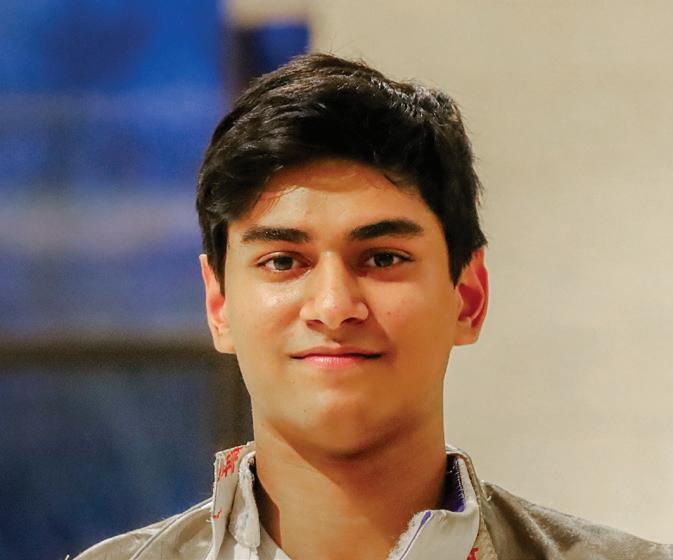
Nikhil Agrawal ‘28 finds community and success on the fencing team after transfering to Masters from a California school.
New Dobbs Ferry Mayor maps out goals
Allie Faber Editor-in-Chief
Nearly a decade ago, Christy Knell was driving around downtown Dobbs Ferry. She had a vision.
“I would look at this corner next to Rochambeau Wines & Liquors. They had this empty storefront, and I would drive by it, and I just kept wondering…‘How you might get people to want to open business in Dobbs,’” Knell said.
Years later, Knell was elected as mayor of Dobbs Ferry at the end of 2025. She will serve a two-year term, and is eligible to run for re-election in 2027.
“As you get into it, you see all the other parts of government, and how all anyone’s trying to do is come up with solutions that make the most people happy,” she said.
Before her election as mayor, Knell sat on the board of the Chamber of Commerce and joined the Nominating Committee. She also worked with the Village Board of Trustees and served as a trustee for five years. Outside of civil duties, Knell is an award-winning graphic designer and co-founder of HudCo, a coworking and event space in downtown Dobbs Ferry.
Knell’s inauguration signifies a turning point for the Village government since the previous mayor, Vincent Rossillo, held a six-year tenure in office. When Rossillo announced that he would not be running
for re-election during his last term, Knell offered herself up for consideration as his replacement and was endorsed by the Dobbs Ferry Democratic Committee.
When the election rolled around at the end of last year, she ran unopposed. This is not an isolated event — according to a report by the Carnegie Corporation, fewer than 15% of eligible voters turnout for municipal elections. Nevertheless, Knell and her team held a traditional campaign.
“If we don’t campaign, then no one knows it’s happening. And I feel like that’s why it is important to have contested elections. But in lieu of not having them, then it’s still our place to make sure people know there’s an election, and what the names are, and why we’re running,” Knell said.
to vote at a public meeting
the
Before her election as mayor, Knell worked for five years as a trustee, joined the Nominating Committee and sat on the board of the Chamber of Commerce. Knell will serve as mayor for a two-year term and is eligible to run for re-election in 2027.
As Knell transitioned from campaigning to governing as mayor, she appointed Nitin Gupta, The Masters’ School Doctor, to fill her seat. Gupta said, “She’s got a great vibe. She’s very open. When residents email her, she really responds to them as quickly as any mayor can.”
Now that she’s in office, Knell has a number one goal: “I want to have a capital plan so that we know what we’re spending big money on over the next five years, just get that in place.”
Nitin explained the importance of a strong capital plan: “Increasing the economic diversity of this village is important and that starts by kind of making sure we’re making fiscally responsible choices as a board. If we’re spending irresponsibly, taxes go up, rents go up. People are priced out.”
For several years, Dobbs Ferry has suffered from infrastructure faults. So, once budgeting is sorted out, the underground is at the top of Knell’s list.
“The big thing that you’ll hear is all of our infrastructure, like the pipes and everything underground — like the super un-sexy stuff — all of it’s really old, the whole state kind of falling apart underneath,” she said.
Structural concerns have been an ongoing issue in Dobbs Ferry, and have been the focus of Village government for several years.
The new mayor is also focused on making Dobbs Ferry more liveable above ground, by continuing an affordable housing project initiated under Rossillo’s term. In the spring, the Village partnered with Kearney Realty & Development Group to build mixed income housing on Cedar Street.
“Keeping that moving is definitely on the agenda,” Knell said.
Over the course of her term, Knell further hopes to bolster civic engagement.
“I’m always trying to get as many voices in the room as we can,” she said. “That’s going to be a part of this year, too; trying to figure out more interesting and innovative ways of connecting with more residents.”
She elaborated, “I like the idea of getting high school students, middle school students, elementary school students, and having them be a part of all the decisions that we make.”
The Board of Trustees meets on the second and fourth Tuesday of every month. Watch the livestreams of the meetings on Youtube or attend a meeting in-person at Village Hall.
Dobbs Ferry Board of Trustees petitions to end ICE and Customs and Border Protection abuses
Allie Faber & Ayanna Beckett
Editor-in-Chief & Lead News Editor
At a public meeting in the Village Hall on Feb. 10, the Dobbs Ferry Board of Trustees approved a resolution condemning the recent violence from Immigration and Customs Enforcement (ICE) and petitioning local and federal representatives to recall, reform and investigate ICE and Customs and Border Protection (CBP).
“The Board of Trustees believes that these tactics and practices by ICE and CBP have violated the constitutional rights of residents of our communities and are contrary to best practices and therefore detrimental to otherwise appropriate and effective law enforcement,” the resolution read.
The resolution, initially proposed to the Board by a former trustee of the Village of Ardsley, passed unanimously with no public comment. Dobbs Ferry Mayor Christy Knell explained that the resolution is a reaction to ICE and CBP abuses in Minneapolis.
“This was our first meeting that we could have passed [the resolution] after some of the worst events in Minneapolis,” Knell said. “I think of the people who do the most good in jobs and volunteer the most…and that idea of one of them being murdered by our own [law enforcement] I mean, it’s just heinous.”
Nitin Gupta, the school doctor at Masters and a Dobbs Ferry trustee, also weighed in. He said, “We want to acknowledge that we’re very aware, to let our people, our citizens know that we are upset by what’s going on and we do want some accountability.” He added, “Even though we’re a small village, our voice does matter collectively.”
Knell clarified that the Village usually focuses on local issues, rather than national headlines.
“What we try to do at a village level is we try to keep village things, village things. So we don’t represent the entire village in political ways most of the time, because our goal is to just focus on our village,” she said.
THE DOBBS FERRY BOARD of Trustees met to discuss a resolution condemning recent violence from Immigration and Customs Enforcement (ICE) and petitioning federal officials to take action. The resolution, which was put to a vote on Feb. 10, passed unanimously. Dobbs Ferry Mayor Christy Knell said that as of that evening, she had received emails supporting the resolution from constituents.
Fifth Amendments to the U.S. Constitution.
Neighboring towns Hastings-on-Hudson and Ardsley have already approved similar resolutions. Knell explained that the Dobbs Ferry resolution was edited to include additional language, citing the Fourth and
As of Feb. 10, Knell said that she had received several emails of support from her constituents and no pushback from any members of the community. Knell added that she hopes the resolution will empower state and federal officials to take action.
“We have George Latimer in the House, and we have Schumer and Gillibrand, I would just hope that the more they know that they have the support of all the levels of government, they’d be more willing to defend and to take a stand and put themselves out there, because I think it’s really hard for them to be convinced to do that,” she said.
TRUSTEE MICHAEL PATINO (LEFT), Mayor of Dobbs Ferry Christy Knell, Trustee Matt Rosenberg and Trustee Nitin Gupta, prepare
in
Village Hall.
AYANNA BECKETT/TOWER
Operational staff battle harsh weather
Helen Gao Opinion Editor
Along the campus walkways, foothigh piles of shoveled snow line the paths. These piles mark the hard work of Masters maintenance crews during snowstorms.
In late January, the Hudson Valley experienced its heaviest snowstorm in five years. By nightfall, snow had totaled over 12 inches in most of Westchester County, prompting New York State to declare a state of emergency.
“We came in Sunday morning and worked from around 7 a.m. to 11 p.m.”
- Joseph Azzone
To keep the campus operating, the maintenance crews shoveled paths and entrances for over 12 hours to keep the Cameron Mann Dining Hall and Fonseca Center open. Director of Buildings and Grounds Joseph Azzone said, “We came in Sunday morning, worked from about 7 a.m. to 11 p.m.”
“It took me six minutes [from Ford
Dorm] to get to the Dining Hall because the paths were slippery and the wind was strong, but I saw crews shoveling all around in these conditions,” boarder Esther Ni ‘27 said.
Due to hazardous road conditions, the grounds crews faced commuting challenges. Most workers traveled by car, with commutes of 20 to 45 minutes.
Azzone said, “If the roads are iced and you're driving a sedan, it's unsafe.” He added, “Even if you get home, parking can be a struggle. You might have to spend hours looking for a spot and park blocks away.” Despite the difficulty, all members of the grounds crew returned home and arrived back at 6 a.m. the next morning to prepare for the school day.
According to Azzone, the grounds team primarily focused on the pathways and car roads. Another branch of the maintenance office, the Environmental Services team, worked on doorways and stairs. Because they were working late, they stayed in the nurses’ suite overnight.
“We have permission to crash in the McCormack infirmary and the beds there,” Azzone explained.
The Brock & Company dining services also adjusted to continue feeding students amidst the snowstorm. According to Lee Bergelson, the general manager of dining services, Brock ensured all deliveries through the start of the school week arrived by Friday, two days
before the storm hit New York.
On Sunday, Jan. 25, dining service closed at 6 p.m., 30 minutes earlier than usual, so staff could be home before the storm worsened.
Since many Brock staffers do not own vehicles, the shutdown of public transportation affected their commutes.
“Staff communicated with one another and arranged rides with coworkers, which is how most people were able to get to campus,” Bergelson said. “In supporting the ground crews, we put out coffee and food for them so they can come in during the late night to grab something to eat.”
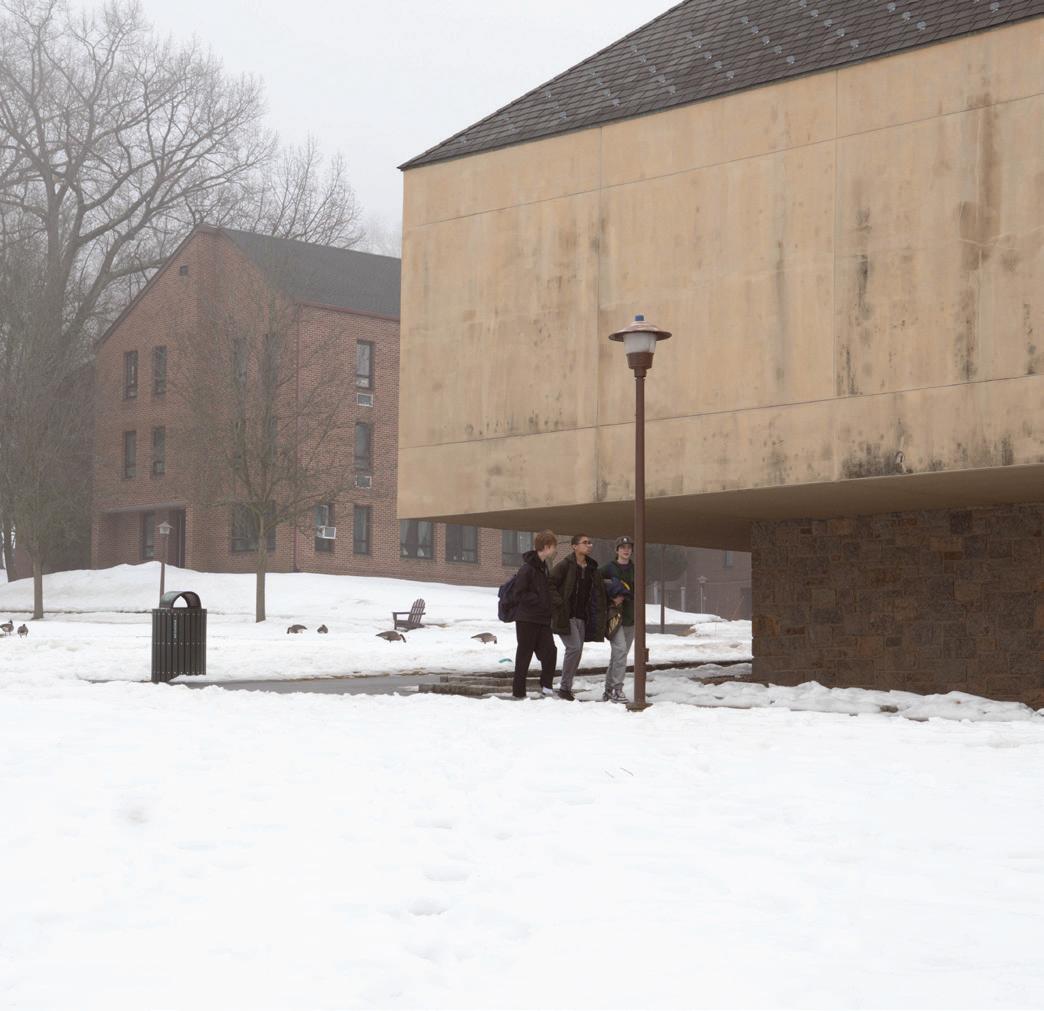
STUDENTS WALK SAFELY ALONG a cleared pathway after maintenance staff spent hours shoveling during the Hudson Valley’s heaviest winter storm in years. Working late hours through over a foot of snow, staff ensured that campus remained accessible.
To appreciate their efforts, boarders in each dorm wrote separate “thankyou” cards.
Ni expressed her gratitude: “They sacrificed time they could have spent with their own families during the snow to keep us safe.”
Pointing to cards pinned on the wall of his office, Azzone responded, “It was very nice to get things like this. Recognition means a lot.”
“I think everyone is important in this community, and Masters can’t be Masters without them [the maintenance crews],” Ni said.
Students fear abridgements of their rights
Siena Versaci Lead Copy Editor
As the first semester came to a close, while many students focused on semester grades and juggling extracurricular activities, many students at The Masters School had other matters to attend to.
Some students learned about challenges to young people’s rights to access media, while over 200 other students, marching amidst mountains of mucky ice, armed with large signs and colorful chants, protested Immigration and Customs Enforcement (ICE) actions in Minnesota. Increasingly, students fear growing restrictions on their constitutional rights, especially violations of First and Fourth Amendment rights.
After seeing the violent events committed by ICE in Minnesota, Illinois and Los Angeles, the National Shutdown on Jan. 30 inspired the Masters community to participate in a school walkout and subsequent march around the town of Dobbs Ferry.
Gus Skiptunis ‘28 said, “With all of the bad things going on in the world right now, I feel it’s our responsibility to be a part of the fight.”
Unfortunately, throughout the U.S., there have been many attempts to impede the First Amendment. A Masters WinterMission group learned about one way that First Amendment rights might be stifled when a group visited the Davis Wright Tremaine Law firm.
STELLA CAREY/TOWER
STUDENTS IN THE AI for Good: Power, Policy and Possibility WinterMission visited the Davis Wright Tremaine Law firm to deepen their understanding of the First Amendment and the ways it’s being challenged today. Students saw firsthand how the firm is standing up to the Texas Appstore Accountability Ac t and its challenges to constitutional rights.
This firm is challenging the recent Texas Appstore Accountability Act (TAAA) on the grounds of the First Amendment. The act attempts to block youth from “harmful content” by age verifying and requiring parents to approve each app their kids download.
This harmful content includes “liberal” media.
Abigail Everdell, counsel at Davis Wright Tremaine and a lawyer on the case, explained more about the act. She said, “The act is clearly an attempt by the state to limit what the state believes
to be harmful content.” Everdell continued, “The reason we have the First Amendment is to prevent the state from making those kinds of value judgments.”
Many students at Masters also see the value of their First Amendment right. Julia Panos ‘27 said, “I think that the First Amendment is a really critical part of being an American, so it's really horrifying to me that these rights are being so adamantly threatened right now by the current administration.”
In light of the recent events in Minneapolis, Panos noted, “I think that the crackdown and backlash that these protests have seen in Minneapolis has horrified me and has made me want to act and speak out and exercise my right while I still can.”
The abridgment of First Amendment rights does not stop with protesting. As seen with the TAAA, some students now fear an inability to access media from disparate perspectives. If students aren’t able to access all kinds of information, they may be at a disadvantage compared to their peers.
Everdell said, “Students in Texas were concerned that when they got to college, they would be less informed than their peers from outside of the state because they could be limited in what they're able to access when they're under 18."
In the same vein, Panos said, “If you are seeing such a polarized or skewed version of the media, you are not going to get a true sense of the political state of the nation.”
ANNADELE DYOTT/TOWER
LOOKSMAXXING :
Social media’s fuel for self-hatred
Jack Bilman & Jaden Laboriel
Photography Editor & Lifestyle Editor
My jawline isn’t defined enough, my skin isn’t clear enough, my facial structure isn't masculine enough. These aren’t faraway concerns of many young men; they are a real consequence of modern media and toxicity.
“Looksmaxxing” is the process of "maximizing" your appearance through methods ranging from skincare and fitness to cosmetic surgery and extreme weight loss.
Despite gaining popularity in recent years on platforms such as Instagram and TikTok, looksmaxxing has been around since the 2010s, originating on message boards like 4chan. In these discussions, users discuss “hardmaxxing,” which involves permanent facial structure changes through extreme methods like surgery.
Around 2022, looksmaxxing emerged from the depths of internet culture to the front page of TikTok, with creators promoting “softmaxxes” like using a gua sha (a tool to help lymphatic drainage and promote decreased facial fat) and going to the gym instead of hardmaxxes.
This trend, rooted in male insecurity, reflects a substantial gap in men’s mental health compared to women’s mental health. According to the National Center for Health Statistics, men commit suicide at a rate approximate-
ly four times that of women.
Furthermore, the role of women as supporters of each other seems to be on the rise, whereas male support structures seem to be crumbling.
Eileen Kang ‘26 said, “I've actually seen more confidence in positivity and support in the female side of the internet and I've seen more men driving other men down or men comparing themselves to other men who they think are more attractive.”
This gap in mental health has existed long before the creation of social media, but there is no doubt that social media has had an impact on the mental health of people of all genders.
Associate Dean of Health and Wellness Jodie Goldberg said, “I think generally, beauty standards have remained the same in terms of expectations, but the pressure on people has increased because of how much access we have to one another visually, mostly in social media, and how much freedom people feel they have to comment on other people’s looks.”
Regarding the negative mental health effects of social media in general, Upper School Counselor John Price said, “My concern is that people get a false view of what is reality and what is realistic in terms of body image for both boys and girls. Honestly, it's not just a female problem.”
Oftentimes, people can take looksmaxxing to extremes, and cause irreparable damage to their physical and mental health.
Gideon Silkowski ‘26, speaks from experience when he says that, “Looksmaxxing is dangerous. It has some good messaging behind it, mainly the ideas of self-betterment and the virtue of constantly trying to be the best thing, which I do sympathize with. But the way that it’s going about nowadays is all wrong.”
Silkowski experienced major health problems as a result of looksmaxxing. He intentionally lost 90 pounds over the course of four months after his ninth grade year, causing heart failure and forcing him to wear a heart monitor. Silkowski said, “I saw all these people online talking about their perfectly sculpted bodies, and I constantly got to the point where, even at just 14 years old, I was thinking, ‘If I’m not like that by 18, I’ve failed in doing something.’”
At the forefront of the looksmaxxing community lies 19-year-old internet personality Braden Peters. Known online as Clavicular, Peters has amassed a large following across popular social media platforms like Tiktok and Instagram by pushing harmful looksmaxxing rhetoric. Peters attributes an indi-
vidual’s worth in society based on their physical attractiveness.
Peters’ content is shown to millions of children and young adults daily, who spend hours watching short-form content. On top of looksmaxxing videos, this creates more of a chance for viewers to feel anxious and obligated to change themselves. According to Handspring Health, adolescents who spend large amounts of time on social media have reported having a negative self-perception and tend to compare themselves to others more often.
Jack Ma, a junior at Tappan Zee High School in Orangeburg, NY, explained why teens get sucked into looksmaxxing and find it appealing. He said, “It sprouts from insecurity.”
From looksmaxxing, Ma has accepted the idea that achieving peak attractiveness will inevitably allow you to achieve more in life. He stated, “You’d be more noticeable if you’re more ideally attractive or taller. It will definitely give you more of [memorable] face. Like someone would notice you more. Give you more attention.”
A HAMMER CRASHES DOWN on a skull, symbolizing the negative mental and physical effects of looksmaxxing. A common looksmaxxing technique, “bone-smashing,” harms participants in the hopes of creating micro fractures to increase bone mass. While no students have gone on the record as having engaged in bone-smashing, they have talked about various other ways in which they have succumbed to the trend of looksmaxxing.
Propaganda competes for control in the digital age
Elaina Barreto Lead Opinion Editor
When students scroll through TikTok, they can encounter topics spanning from funny stories, cool cooking recipes, makeup tutorials and movie clips all the way to emotional footage of wars or protests happening in major cities. Current events constantly infiltrate social media algorithms, shaped by the biased perspective of the individual relaying the information. Although Americans no longer have Uncle Sam posters hanging outside retail stores, digital propaganda still infiltrates daily life.
I feel like with protests being broadcast on national or local news, [you see] the power of the people coming together for a single purpose to make waves within the community.”
- Chloe Roh ‘27
While propaganda is usually used by governments to push certain narratives, messaging has also been used by individuals in opposition to the government.
For example, when trying to increase support for the revolution against Great Britain, Paul Revere famously depicted the Boston Massacre in an engraving in 1770, shaping public perception of the event by portraying the soldiers as the main aggressors, even though in reality, the colonists attacked first.
While Revere depicted the government’s revolutionary messaging through physical materials, the current White House administration uses digital methods for propaganda today.
On Jan. 22, the New York Times con-
*NOTE FROM ADVISOR
firmed that the White House had altered a photo of a protester, which they posted on social media, using AI to depict her as a crying, hysterical individual. In reality, the demonstrator was calm and collected when arrested.
AP United States History and political science teacher Colleen Roche talks about historical examples of propaganda in her American history classes. However, she pointed out that the information coming from the White House today is no longer just biased but plainly incorrect.
“What we’re seeing now is just flat-out false. It’s not just with a biased lens. I don’t think we’ve seen that from the White House to the same degree in the past because we’re seeing [disinformation now] on basically a daily basis,” she said.
As disinformation spreads more easily through social media, students must learn to navigate the digital propaganda.
Although Roche states she is not an expert in detecting digital propaganda, in her political science class, Roche still teaches her students ways to analyze a news source. In order to determine accurate information, she recommends individuals read articles from politically opposite news outlets to fully examine news events.
For students, social media influences perspectives through the constant outpouring of biased information, and in some cases, completely false narratives. However, APUSH student Chloe Roh ‘27 said she recognizes that social media is not necessarily only used to spread harmful propaganda, but also used to unite individuals to a common cause.
Roh said, “There is strength that comes with [social media], too, in that, you can use those platforms to spread awareness [and] use it for a greater good. I feel like with protests being broadcast on national or local news, [you see] the power of the people coming together for a single purpose to make waves within the community.”
Student press matters
Ellen Cowhey Tower Advisor
Teenagers are living in a moment where witnessing the truth through reporting the news has never been more challenging.
AI images and videos mesmerize from the tiny screens peers clutch in their hands. First Amendment rights Americans relied on as a country are being renegotiated. Distrust of the media has never been higher, and a local newspaper closes every week in the U.S. so that news deserts abound.
And yet, student journalists still write, still record, edit, fact-check, take photos and get the news out in campuses all over our country. They dare to tell the stories of their local communities. They hold leadership accountable. They spotlight successes. They ask questions and demand answers.
This past week, when the mayor of Dobbs Ferry and the board of trustees passed a resolution condemning
the recent violence from Immigration and Customs Enforcement (ICE) and petitioning local and federal representatives to recall, reform and investigate ICE and Customs and Border Protection (CBP), only two people remained in the gallery to hear the proclamation. Both were Tower reporters there to cover the story.
In communities where local newspapers close, voter engagement in non-presidential elections and other civic engagement slips at an alarming rate. In the past 10 to 20 years, student media has helped to fill that community news coverage gap.
Student journalists are usually unpaid. Full-time students, athletes and sometimes part-time workers, a student journalist’s time is precious and scarce. And yet, they still prioritize getting the news out because getting the story out makes us all a more abundant, informed community. The truth matters.
Thank you for supporting student journalism. Perhaps you even want to take a moment this Thursday, National Student Press Freedom Day, to thank
FROM PAUL REVERE’S ENGRAVING of the Boston Massacre to AI-altered images shared by the White House, propaganda has evolved with the technology of its time. In today’s digital landscape, social media algorithms amplify both awareness and misinformation. As students scroll, they must learn to question, compare sources and recognize how narratives are shaped online.
HOW TO IDENTIFY AI PROPAGANDA
1
2 3 4
Morphing background images and waxy skin
Unreadable signs. AI often has trouble with writing
Learn to do “reverse image searches” to find the source of an image
Above all, do lateral research. If the image seems strange, do some Googling on sites that you trust to find out what actually happened.
AVIANA KINON/TOWER
Elisabeth Merrill shapes students’ journey through personal story and science
Mila Benson Lead Lifestyle Editor
A once-quiet, boring classroom transforms into a bustling student hub of all things biology when Elisabeth Merrill steps in the room. Many students, even those she has never taught, regard her and her classes as inspirations to study not only science, but the current world around them. Seldom can you find a teacher with a journey more compelling than that of Merrill, a biology and anatomy teacher in the Upper School.
Students often credit Merrill with her ability to switch between having serious lectures and dynamic student-based discussions. Gideon Silkowski ‘26 is currently taking AP Biology, which has a reputation for being a “GPA killer” in many schools across the nation. Despite this, Silkowski has found Merrill’s version of the class to be engaging rather than grade-draining.
“[The class] feels fairly college-like, which I really enjoy. She pulls up the OneNote starts writing on her tablet for all of us to copy down.”
-Gideon Silkowski ‘26
“[The class] feels fairly college-like, which I really enjoy. She pulls up the OneNote, starts writing on her tablet for all of us to copy down. It’s very useful, and it’s incredibly efficient in terms of just getting notes down in time,” Silkowski said.
At the same time, Merrill’s class can also be discussion-oriented and more lighthearted. “When we’re talking bio, we’ll be making jokes, we’ll be laughing… We’ll listen to her; we’ll talk. We’ll have a genuine conversation about where we are in the world and what we think of our current position going into the future,” Silkowski said.
This teaching style didn’t come to be accidentally, though. It was built early on.
Merrill grew up in Florida to a mother who dropped out of high school and had
six children by the time she was 24. Her father, while very intelligent, wasn’t a good student, Merrill reported. So, education wasn’t especially emphasized in her household.
“Growing up, I had a speech impediment, so I was really isolated in the beginning and I always felt stupid. I didn’t think I was stupid, but I felt really stupid in school,” Merrill said.
After high school, Merrill made her way to Mercy University where she graduated with the top GPA in both of her majors (English and Biology) and became the first person in her family to attend college.
in AP Biology during club time with Adriana
and Gideon Silkowski ’26
She engages students through in-depth discussion as well as humor. She uses examples such as the Whirlington Jet to illustrate scientific concepts.
“I remember thinking that if I ever became a teacher, what I wanted to work at was not having people feel incapable,” Merrill said. “A lot of the way I teach is really informed by trying to make things accessible… a lot of kids are smart in ways that schools don’t assess.” While struggling to keep up with the rigorous material of AP Biology, Ash Munitz ‘27 saw Merrill’s patience firsthand.
“I always found that Ms. Merrill is super patient with me and she genuinely wants to help me,” Munitz said. “She’s really good at seeing me as a person and not just as a student who was struggling in her class.” Although Munitz made the tough decision to drop the class after the first semester, she is grateful to have a teacher that made it so conflicting for her to do so.
“I remember thinking that if I ever became a teacher, what I wanted to work at was not having people feel incapable.”
-Elisabeth Merrill
When starting a new unit in either of Merrill’s classes (h uman anatomy and AP Biology), an article relating to current events is often assigned to give students a real world perspective on what they’re about to learn. Before beginning the immune system unit in her human anatomy class, Susie Brown ‘27 read an article about vaccines and the recent challenges the vaccine approval process is facing in America.
“Due to changes in politcs, a lot of people have been leaning away from vaccines.” Brown further explained, “That can be really harmful because immunocompromised people will now be less safe without what’s called a ‘herd immunity’.”
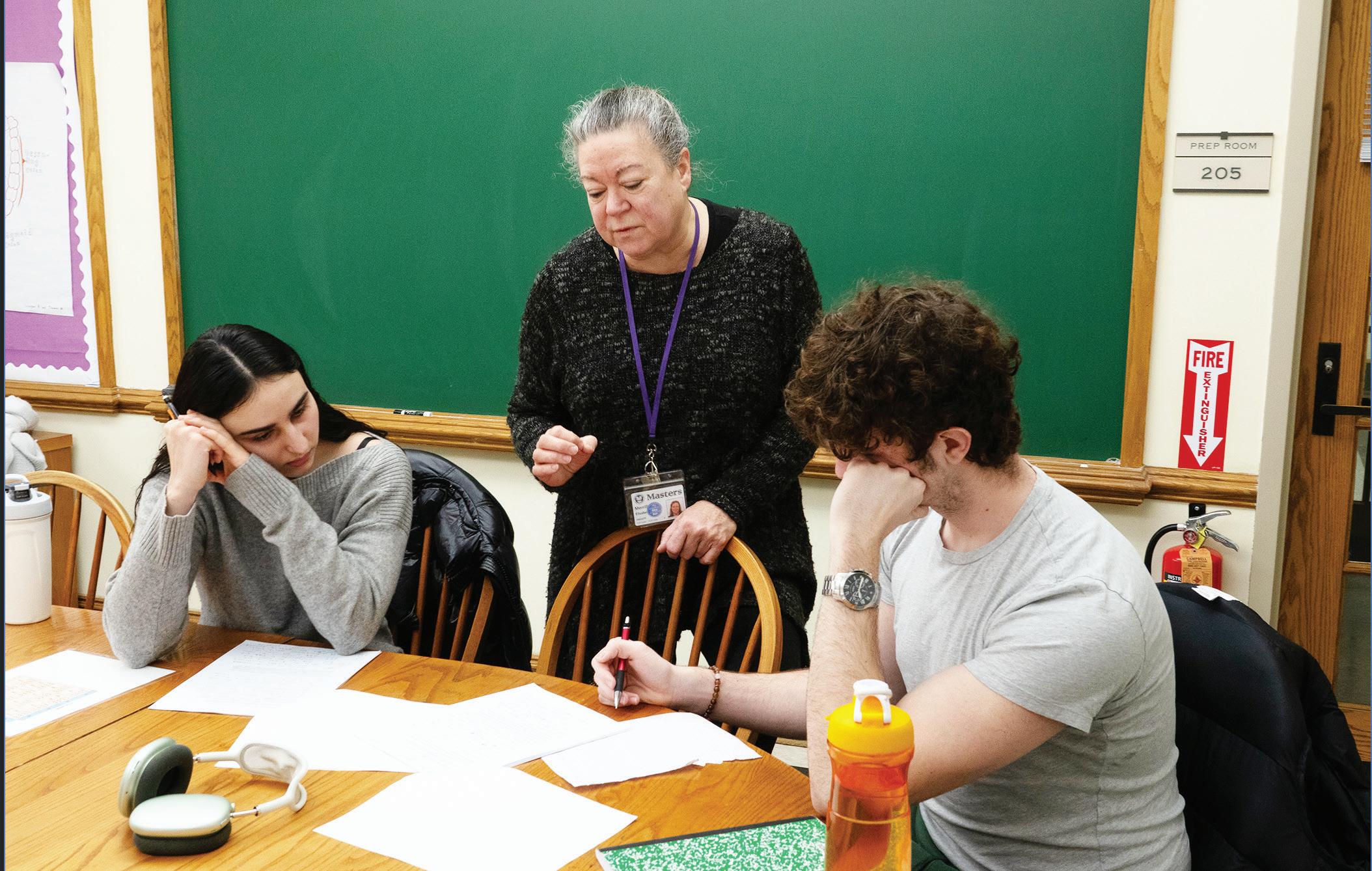
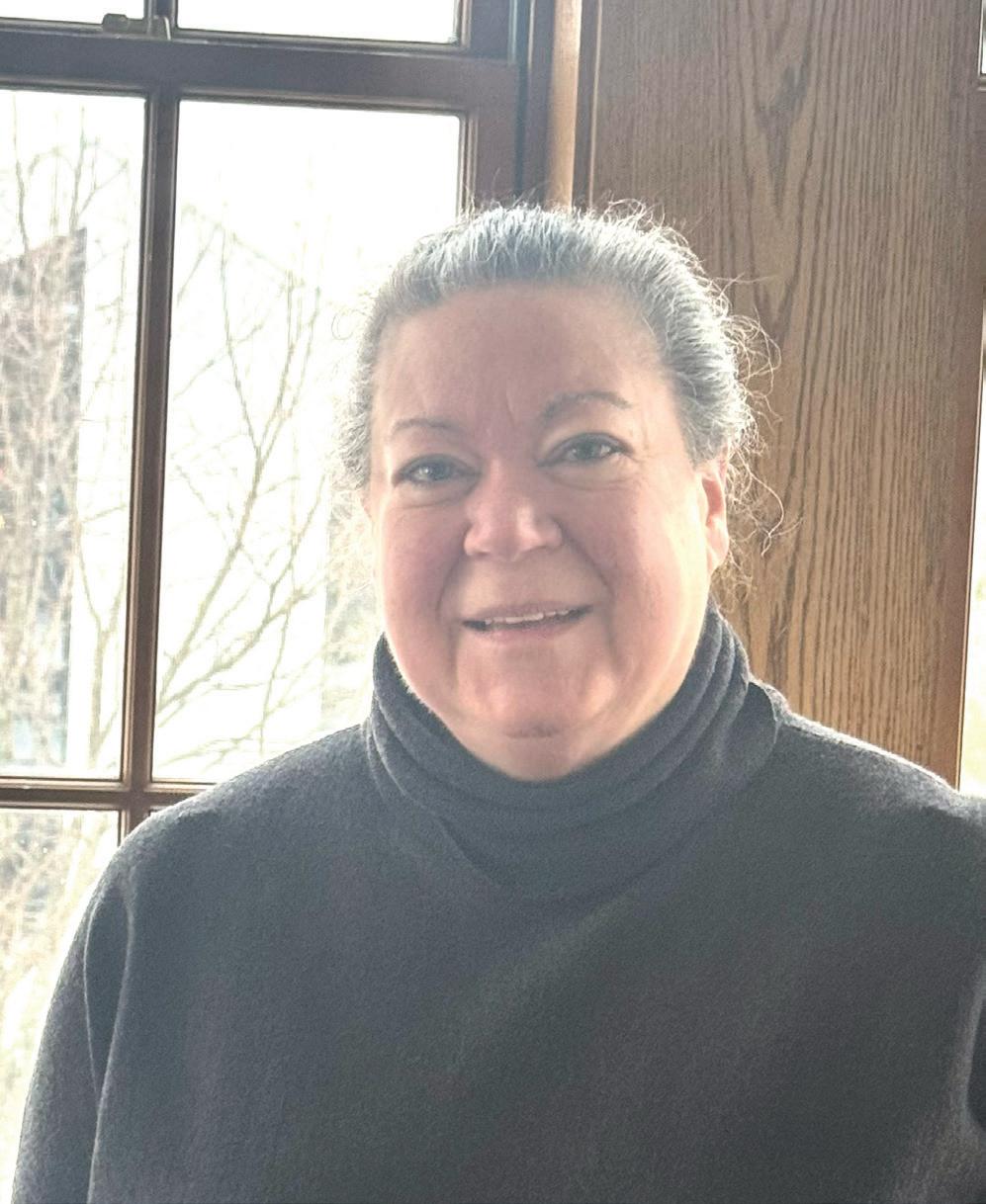
ELISABETH MERRILL REFLECTS ON her teaching journey before a Morris Hall morning X-band study session at 8 a.m. This is a daily routine for Merrill and many AP Biology students.
WILLIAM GREY DICKSON/TOWER
ELIZABETH MERRILL COACHES TOPICS
Pottier ‘26 (left)
(right).
JACK BILMAN/TOWER
MONDAY, FEB. 23,
Students command the DJ decks
Neena Atkins Editor-in-Chief
Bass echoed through the bottom floor of the Dining Hall as students crowded around a folding table turned DJ booth, watching classmates cue tracks and adjust knobs. As the beat shifted, Nico Khoury-Levy ‘26 stepped in, headphones pressed tight against his ears and tested a transition while friends looked on from the floor.
Scenes like this have become more common as a growing group of students have begun DJing independently, buying their own equipment and practicing during free periods and after school.
Several students were introduced to DJing through the WinterMission course “Spinning Culture: A Dive into the World of the DJ,” and have shared that their interest has intensified
since the program ended. Budding DJers are now investing in DJ boards and learning new genres to perform for peers. Many are reaching out to classmates and friends to offer their services for upcoming parties and student-run events.
Senior Nico Khoury-Levy said his interest in DJing began before WinterMission when he started independently mixing music on his computer. After receiving a DJ board, he started practicing more seriously.
“Once I got my board, I was really able to dive deep and start learning techniques. A central part of the process has been learning how to respond to a crowd,” Khoury-Levy said.
Under the guidance of Upper School Math Teacher Michele Dennis and Upper School History and Religion Teacher Nyasha Chiundiza, students like Khoury-Levy were pushed out of their comfort zones in the WinterMission
course.
“The hardest part [of the WinterMission] was probably learning about different music genres, yet now I have more confidence in the range of my DJ abilities,” Khoury-Levy said.
DJing has also become a new way for stu dents to engage with music they already loved.
Leon Samuels ‘29 said mixing tracks made his interest in music more active and personal.
“By mixing music, it can connect my pas sion with listening to music even more,” Sam uels said.
Allat Yussupova ‘26, who also took the Wintermission course, discussed how DJing has become a creative outlet.
“I love listening to music and before the class, I had never touched a DJ board, but now I definitely want to keep practicing,” she said.
“It’s cool to see something we learned in a week actually turn into something real.”
Female fans frenzy in fandom phenomenon
Ella Liu Lead Arts Editor
he unexpected rise to popularity of the TV show “Heated Rivalry” seems to be a step towards the acceptance of queer media within the mainstream. But strangely, the show’s main fan base reveals that young women are particularly drawn to media about relationships between gay men.
The show “Heated Rivalry” is inspired by the “Game Changers” novel series by Rachel Reid, about two top hockey players who have a decade-long secret relationship and public rivalry. The show suddenly rose to popularity and by the time the final episode was released, it had more than 324 million streaming minutes.
Nearly two-thirds of this enormous fan base is dominated by straight women. This is a pattern; media that centers around a romance
between two men, such as “Red, White, & Royal Blue” and “Heartstopper,” have a primary audience of straight women.
It may be that casting two attractive male actors – like “Heated Rivalry’s” Connor Storrie and Hudson Williams – draws in lots of straight women.
Or it could be the result of the traditional representation of women in romance media, which typically involves an unequal power dynamic. The woman is sometimes written with harmful stereotypes, like being a damsel in distress, and the man usually does not have any emotional development or vulnerability. Gay romance sidesteps that entirely by taking out the opportunity for this uncomfortable trope.
When the two main characters are men, and while gay relationship stereotypes certainly exist, writers cannot rely on overused gender roles for characterization, meaning the
characters are more likely to undergo proper emotional development.
Junior Class Dean Mariah Peña said, “There’s something about watching men on screen be vulnerable and intimate in a way that goes against this gender norm that’s been, I think, fed to us. That masculinity doesn’t have to be emotionally avoidant.”
This is especially true when it comes to the show’s many explicit scenes.
“Because often women are objectified or feel degraded, and it’s hard, even if the people on screen who have sexual chemistry are two women, then you’re thinking about, ‘Who wrote this scene, who directed it? Was it a man? Is this from a male gaze? And how realistic is this?’” Peña said.
Of course, explicit scenes with men should also be handled carefully to ensure that it doesn’t feel exploitative, but many viewers say that the intimate scenes in “Heated Rivalry” are part of the appeal, as it doesn’t shy away from accurately portraying adult relationships.
straight women, which could take away from equal queer representation.
“I think it is good that the show is attempting to normalize [explicitness] in queer relationships even if it is very sexually explicit and heavy-handed. At least it is staying true to what most people’s adult lives do look like,” senior Ayalah Spratt said.
As bigger companies see the potential in producing gay shows, it’s important to consider whether they will go the route of catering to
However, it is undeniable that “Heated Rivalry” has created an opportunity for conversations around queer representation.
“I think this show will be a great pathway forward, as people have seen how successful it is,” Spratt said. “I think this will really be a catalyst, since it’s become so successful, and people know that they can make it big by making projects about these topics.”
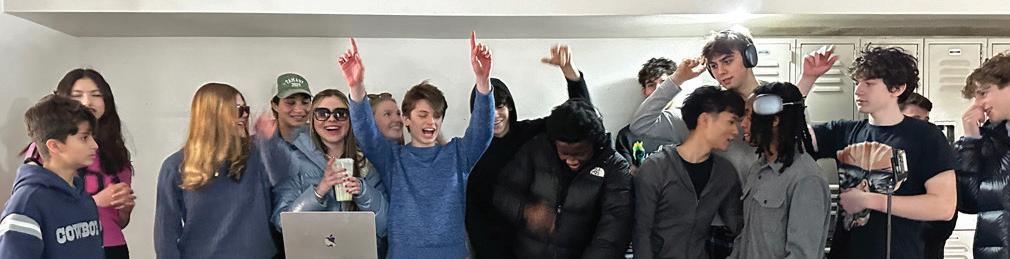
LEON SAMUELS ‘29 MIXES it up in the DJing WinterMission sha Chiundiza and Michele Dennis. Samuels is one months, with some going as far as purchasing their
HUDSON WILLIAMS (LEFT) AND Connor Storrie (right) face off in “Heated Rivalry,” a Canadian TV series based on the novel by Rachel Reid. The show, a new cult-favorite, follows the secret fling between major-league hockey stars.
SABRINA LANTOS/HBO MAX
Gay hockey romance, DJ decks and... 2016 ? Masters students are surfing the trend wave
Social media celebrates 2016
Loewy Nalle Sports Editor
my For-You Page, along with celebrities posting,” said Sophie Ricks ‘27, a junior who has seen and has participated in the trend.
The cheers and positive nostalgia may have emerged simply because 2026 marks a 10-year anniversary. But over 1.6 million TikTok posts about 2016 don’t suggest just a 10-year anniversary: it suggests a tidal wave of feeling.
“I don’t have vivid memories of 2016 due to my age, but I remember a lot of them being happy. Participating in the trend brought me back to memories that I haven’t thought about in years.” Ricks
Maureen Steinhorn, advancement team senior manager of annual giving and major gifts, was in college in 2016, studying abroad in Cape Town.
“Things reached Cape Town slower than in the United States. There was a big Chainsmokers song that year,” Steinhorn noted. “We all knew that song dropped, but we didn’t have Wifi at the house, so we went to [University of Capetown] campus and sat at a table and listened to it. It was a good memory.” The Chainsmoker’s Alex Pall is a Masters School graduate, by the way.
The overused peace signs in photos from 2016 didn’t align with how the actual year felt for some. 2016 had some bad occurrences. For one, there was heavy loss in the music industry. When I was seven, I vividly remember lying on the couch watching TV and hearing a gasp of surprise from my dad, say- ing, “David Bowie died!” I had no idea who David Bowie was at the time, but I could tell it was a major death that hurt my dad. I could feel his emotions again when I learned the news of Prince’s death, because this time, I knew a couple of his songs and admired him. George Mi- chael died on Christmas that year. Stella Ervi, a ju- nior who performed at last year’s Great Gig, which was a perfor- mance of Prince’s Purple Rain al- bum from start to finish, recalls Prince’s leg-
“In 2026, after he’s been gone, his listeners and people on social media can still carry his message of empowerment,” Ervi said.
World events dimmed the supposed vibrancy in 2016. On June 12, 2016, there was a mass shoot- ing at Pulse Nightclub that killed 49 individuals. The election of Presi- dent Donald Trump left some Americans discouraged.
“Probably the worst moment was the election, because we went from this moment of so much freedom and love. I remember just feeling like I didn’t understand that could’ve been an option,” Steinhorn said.
So why is social media celebrating such a nuanced year?
BEGINNING IN EARLY 2026, there has been a massive trend that has hit social media everywhere: “2026 is the new 2016”. Whether it’s a slideshow depicting nostalgic photos, or even people living a lifestyle that aligns with the era, there is an evident yearning for past times. However, there were aspects of 2016 that were bad for some. So why is it being celebrated?
2016 trending can be marked as a centralized yearning for the feelings brought up in that year, not necessarily about rewinding history. With so many difficult issues happening in early 2026, remembering and romanticizing 2016 in a light-hearted way pulls people from their unhappy present - even though 2016 might not have been as positive as it seems on social media.
“It [2016] was really the highlight ing moment right before things started to feel, at least politically in this country, very divided,” Steinhorn said. “We defi nitely look back on it with rose colored glasses.”
Ricks spotlights an additional reason why it is trending, not necessarily based on current politics.
“I think a lot of people are feeling nostalgic for the easy-going vibes of 2016,” Ricks said.
Whether it’s mimicking the matte makeup look, taking photos in front of the iconic pink wall in Los Angeles, or just listening to a hit from 2016, this wave of nostalgia offers people a brief escape from the troubles of the present.
CLARA CHU/TOWER
WinterMission led by Upper School teachers Nyaone of many teenagers drawn to DJing in recent their own boards to mix at home.
NEENA ATKINS/TOWER
Tech week brings “Pippin” to life
Olivia Shim News Editor & Illustration Editor
Scenes were stopped and restarted mid-song. Lighting cues were adjusted down to the second. Costume racks crowded the wings as actors rehearsed changes that had to happen in less than a minute. During tech week for this year’s winter musical “Pip-
pin,” every detail was pushed toward precision in the days leading up to opening night.
Much of the work that had been practiced separately throughout rehearsals came together for the first time in complete runs of the show. That integration also heightened the stakes for performers.
The majority of the pressure of the show builds around quick changes: moments when actors have only seconds to change costumes before returning to the stage. These changes were carefully practiced in advance, but during tech week, timing became critical.
most importantly, himself. Scenes like these were carefully rehearsed by actors and crew during tech week to ensure that they ran smoothly.
Junior Jack Sobolewski, who plays Pippin, explained that quick changes are rarely simple. Recalling a past production, he described a moment when an actor had to be transformed into Cinderella’s ball gown.
“That was literally six people trying to get one person into a dress. It’s one look to another, but it takes an entire village,” he said.
For performers, the mental preparation also intensified once technical elements were added. Freshman Alice Hoffman, who plays Fastrada, described how she prepared before stepping onstage.
“I take a deep breath, shake out my body, and put myself in the character’s shoes… I ask, ‘What would they do?’ and make bold choices,” Hoffman said.
JACK BILMAN/TOWER
ANNETTE CHOI ‘26 DANCES on stage as Leading Player. The musical this year, “Pippin,” was performed in the Strayer Theater, posing unique challenges due to the theater’s layout. Students have had to adjust to the high visibility of the wings of the stage, meaning they have to stay vigilant while there as they are in audience view.
The layout of Strayer Theater added another challenge. The wings sit close to the audience, which requires actors to practice staying alert and quiet even when they are off stage. During tech week, when cues were tightly timed and carefully rehearsed to re-
“I take a deep breath, shake out my body, and put myself in the character’s shoes… I ask, ‘What would they do?’ and make bold choices.”
- Alice Hoffman ‘29
main seamless, even small distractions could disturb the flow of a scene.
“It’s hard to fully get into your zone. You’re tucked into the wings, trying to support each other without making a sound,” Sobolewski explained.
Behind the scenes, tech crew members experienced the production differently. As lighting and sound were refined, they watched scenes repeatedly, noticing details that audiences may never see. Former tech member and sophomore Jiwoo Won said that repetition built appreciation.
“We usually get to see the musical at least five times and it makes us love the musical more and more,” Won said.
By the end of tech week, the separate elements of music, lighting, movement, and costume had moved together into one, shaping the polished production audiences ultimately saw onstage.
JACK BILMAN/TOWER
VINCENT VON JAN ‘27, who plays Lewis, stands on stage under the focus of a bright spotlight. In this scene, he has just been introduced by Leading Player who describes him as loving weightlifting, wrestling and,
JACK BILMAN/TOWER
PIPPIN, PLAYED BY JACK Sobolewski ‘27 speaks to his father King Charlemagne, played by William Jin ‘26 in this year’s winter musical “Pippin.” Students, both actors and crew, have been preparing for the production for the entirety of the winter season. The musical had two performances and one invited dress rehearsal for students and faculty to enjoy.
We’re
in the Epstein files.
In early February, texts swirled in group chats, the student gossip mill ran and faculty meetings were called. The news had dropped: The Masters School and its Board of Trustees were named in the Epstein files.
“Hi Jeffrey,” Paul Barrett, Jeffrey Epstein’s family banker of several years and ex-JP Morgan employee, wrote. “My son Jason was waitlisted at Riverdale School, Fieldston and The Masters (in Dobbs Ferry) for 8th grade. Do you by any chance know anyone on the boards (listed below)? Contracts are due back next week so hopefully some spots open up but any help from you would be greatly appreciated.”
Encoded in his email with the subject “Favor” was not information incriminating our school or its trustees in a scandal of sexual abuse, but an exposé on the web of gifts exchanged between the rich and powerful.
Epstein replied the next morning, in un-punctuated lowercase text that illuminates the perceived casualness of Barrett’s request, “late, but ill try.”
Nearly a month later, Epstein haphazardly confirmed his efforts to pull strings
in private school admissions to fulfill his banker’s plea for a favor: “yes i called , i will check.”
The casualness of Epstein’s messages demonstrates more than a powerful man too busy to respond in full sentences. It brings to light the normalization of favors through networks of the rich and powerful, ones that place people in a class that supersedes systems – like private school admissions – by which most of us abide.
And yet, the news of our school’s mention, alongside our Head of School Laura Danforth and current and previous trustees, sent shockwaves through the student body. But why are we so surprised? Masters is an overwhelmingly privileged community deeply connected to the networks of the wealthy and powerful.
The 96-acre campus, complete with a state-of-the-art Innovation and Entrepreneurship Center, brand-new hall for performing arts and hyper-qualified faculty, is nestled in Westchester – one of the country’s wealthiest counties. Our Board of Trustees comprises heads of foundations, real estate moguls and managing partners, embedded in the favor trade by
their wealth.
As much as we’d like to mask our connection to Epstein’s gossamer web of evil, our distance is an illusion. However, our proximity is exactly what empowers us to change the system. The only way to shift the status quo is from the inside.
Many of us will end up with lots of power – powerful friends, money or important leadership positions – because of our education. In those positions, it is our duty to use that power to enact tangible and positive change. As Masters students walk across Graduation Terrace and are handed a key to circles of the elite, we are obligated to move throughout this unlocked territory with the mission statement as our North Star.
It will be up to us to challenge the corruption and evil enveloping so much of the world that we move through, and to do what we can to use our position of privilege and power to fix that unjust system from within. In the end, it’s the action we take with power that matters. Our mandate is to enter the world as powers for good.
College and niche partitioning
When evolution opts to innovate So what?
overcompeting the other.
When you apply for colleges, they usually ask you what major you’re planning to take, even if the school doesn’t let you commit in your first year. Some people apply for less popular majors to increase their chances of being accepted. Surprisingly, this strategy also applies to the natural world. In fact, this process happens all the time in the varied ecosystems that our planet holds. It’s called niche partitioning.
Niche partitioning is the process where when similar organisms come to live in the same environment, they tend to diverge in their ways of life to avoid direct competition with one another.
A famous example would be the relationship between two different species of canids: wolves and coyotes. Even though both animals have very similar body plans, when they coexist in the same environment, wolves tend to pursue larger prey animals, such as elk, during the day, while coyotes prefer to target smaller animals, like rodents, at night. This allows both species to thrive in the same area without one
As with most evolutionary processes, we’ve also found evidence for this phenomenon in the fossil record. In the Morrison Formation, one of the most famous sites for fossils in the United States, evidence has shown that about 150 million years ago, Jurassic North America was home to not just one, but
at least three groups of large carnivorous theropod dinosaurs (distant relatives of modern birds and the iconic Tyrannosaurus). Namely, Torvosaurus, Ceratosaurus and Allosaurus. How could these large animals live together in the same territories without killing one another? Once again, niche partitioning sheds light on an answer.
In order to compete with the larger sauropod-hunting (think massive longnecked animals like Argentinosaurus) Allosaurus and the heavy-built Torvosaurus, it has been proposed that, based on its morphology and environment, Ceratosaurus might have had a semi-aquatic lifestyle or, at the very least, been known to eat aquatic food more often than the others.
In more relevant terms, it’s like applying for Egyptology in an engineering school to avoid fighting for spots with the kid who just made their own time machine in their basement. Despite all three animals looking very similar to an untrained eye, niche partitioning allowed them to coexist in ancient North America. Overall, this goes to show that even though two species look alike, there’s much more to their behavior than might meet the eye. I challenge you to go outside and see the many ways similar animals in your dayto-day life manage to live with one another, and for you to begin to draw conclusions yourself about the diverse ways in which life on our planet has adapted to the ever-changing world. For you seniors and juniors getting ready for college applications and decisions, don’t sweat it. Wherever you end up will be just where you need to be.
ALEX PINNOCK ANALOGIZES THE college application process to a natural phenomenon: niche partitioning. Throughout the school year, Pinnock leads popular presentations on all things biology during Morning Meeting. More of his work can be found online at tower.mastersny.org.
Alex Pinnock Online Columnist
Snowday policy changes bring trouble
Thomas McCallum Lead Sports Editor
For as long as there have been schools in cold places, there have been snow days. For generations, an imminent blizzard brought hope for a day of freedom. As kids, many of us put spoons under our pillows, wore our pajamas inside out and even flushed ice cubes down our toilets, hoping to increase our chances of a school cancellation.
However, in recent years, things have changed. In January, on the doorstep of a snowstorm set to shut down many parts of the country, New York City Mayor Zohran Mamdani announced that public schools in the city would not have a snow day because of the storm. Instead, weather-related cancellations would result in remote-learning days.
This announcement follows the change instituted in the 2020 school year that completely replaced snow days with remote learning days for NYC public schools. This decision was made in order to preserve the 180 school days mandated by the city while also adding multiple holidays to the calendar, including Diwali and the Lunar New Year.
Following Mamdani’s announcement, members of the Masters community received an email on Friday, Jan. 23 from Head of Middle School Tasha Elsbach and Head of Upper School Peter Newcomb. The email stated that, while the following Monday would likely be a snow day, if the conditions remained bad enough, Tuesday would be a remote-learning day.
This decision sets a concerning precedent for Masters and the New York City
public school system, as well as schools across the country. By taking away snow days, schools are preventing kids from gaining the many positives they bring with them, such as cognitive development and mental health benefits.
According to University of Maryland professor Melanie Killen, snow days are very beneficial to the social and cognitive development of children. Children learn to interact with others in various situations outside of their normal interactions.
Additionally, snow days tend to occur during the stretch of the school year between winter and spring breaks, a long period that can become depressing and monotonous. Snow days provide a much-needed break from the cold and dark depths of winter.
The primary reason for the switch from traditional snow days to remote learning days is to make sure that student learning doesn’t suffer from a weather-related closure. However, according to a study from Harvard professor Joshua Goodman, school closures due to snow days result in no downturn of students’ academic performance on cumulative assessments.
On the other hand, remote learning on snow days has significant adverse effects. When classes switch to remote learning, it is harder for teachers to keep the entire class on the same page and ensure that all students have grasped the concepts, resulting in students falling behind.
This can occur for a multitude of reasons, including an inability to pay attention outside of a classroom, learning differences that are difficult to accommodate over Zoom or connection issues. This results in a negative impact on the class when they return to in-person learning.
Students are all in different places
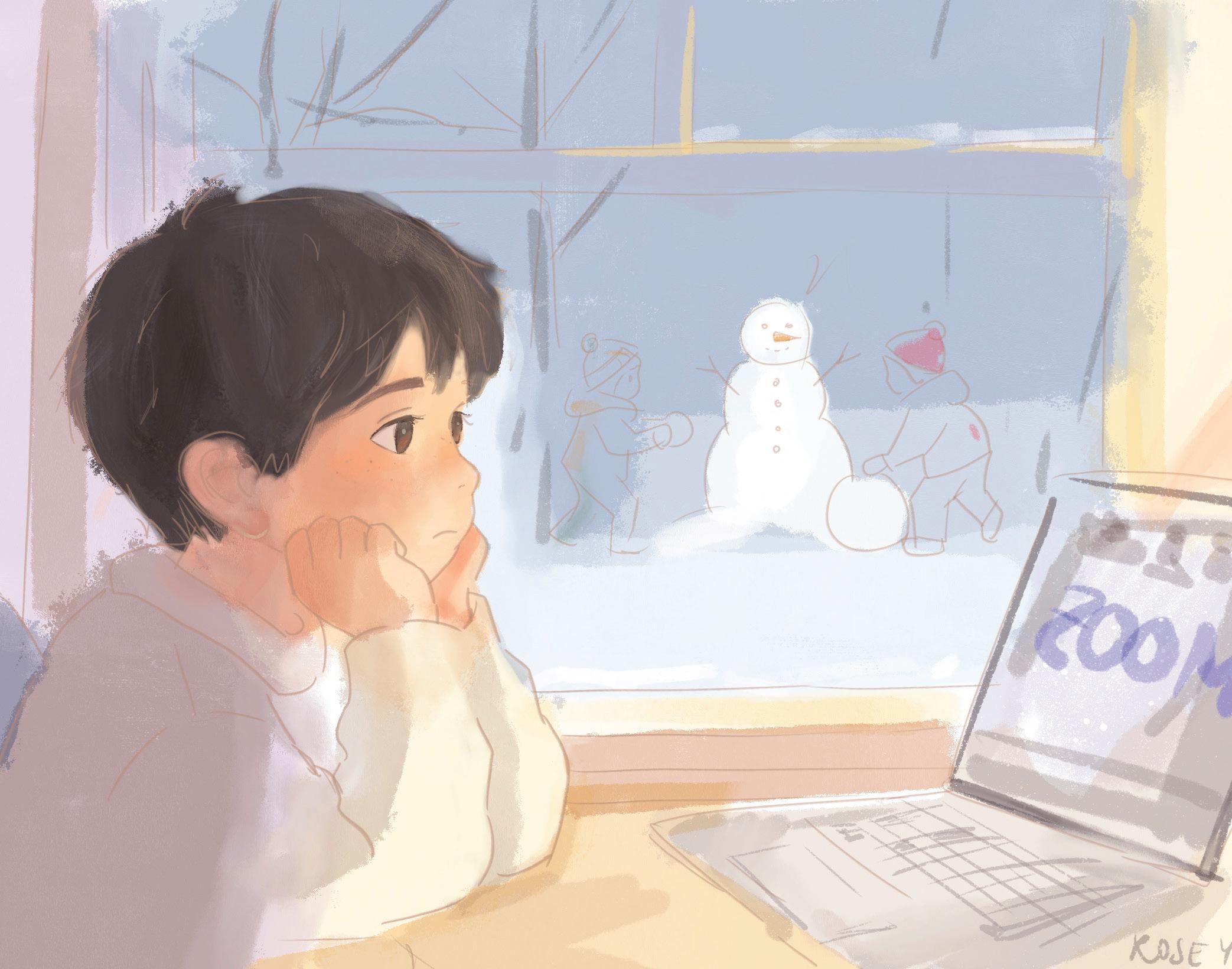
MCCALLUM EXPLAINS THE DETRIMENTAL effect of remote learning. While sacrificing their resting time, students attend inefficient online sessions on Zoom. Moreover, the lack of in-person interaction harms long-term academic performance and well-being.
when it comes to the material, causing one of two detrimental outcomes. Firstly, the teacher spends a lot of time trying to catch up individual students who have not grasped the concept, while other students halt their progress. Alternatively, the teacher continues the pace of the class, not realizing that some students have fallen behind, eventually compounding into students not grasping subsequent topics and struggling on assessments. Additionally, teachers struggle to turn in-person curricula into online ones on such short notice. Classes planned for in-person learning simply cannot be successfully trans-
ferred onto Zoom, forcing teachers to come up with lesson plans in a rush, leading to less effective teaching.
Overall, remote learning nowadays is, at best, ineffective and, at worst, actively detrimental to students’ learning and the cohesion of the class when they return in person. On the other hand, traditional snow days are beneficial to children’s mental health and development. For these reasons, Masters, and other New York schools, need to take action to preserve and revive the beauty of a snow day.
A generation of defiance demands change
been forced to dwindle. According to Iran International, military units have been deployed across urban areas and communi-
cation is under tight government control. Efforts to fully document these atrocities have been hindered because of an internet
When you scroll past a headline about a protest in a different city, or even a different country, it may seem like just another news update. However, behind the chants, marches and walkouts are young people who have decided that silence is no longer an option, and that their future is worth fighting for.
The modern era of global activism has been marked by a generation that refuses to inherit the silence and oppression of the past. On Dec. 28, 2025, shopkeepers and merchants at the Tehran Grand Bazaar –one of Iran’s most prominent marketplaces – went on strike to protest the collapse of Iran’s currency, the rial.
Originally starting in the capital Tehran, the protest stemmed from extreme economic desperation and outrage due to high inflation. These protests quickly escalated into anti-government demonstrations in all 31 provinces of Iran.
According to the Iran Primer, unlike other political movements in the past, this one is driven by a population in which 60% are under 30 years old. Young Iranians view the immense restrictions of their current political climate as a direct threat to their liberties.
Despite brutal forces from various groups within the Iranian state security apparatus — that have left an estimate of 6,000 - 30,000 dead, imprisoned and 330,000 injured — the spirit of defiance remains deeply rooted in Iranian society.
However, outward expression has
blackout of nearly four weeks.
The desire for accountability is not only unique to the younger generations of Iran but has become a global sentiment.
On Jan. 7, Renee Good was fatally shot and killed by an Immigration and Customs Enforcement (ICE) agent during an immigration raid in Minneapolis, Minnesota. Following her death, major protests erupted statewide and nationally.
The youth’s response was almost immediate; hundreds of high school students walked out of classrooms in Minneapolis and St. Paul areas in protest of ICE’s brutality. These demonstrations were not only concentrated in Minnesota.
A national shutdown on Jan. 30 was organized throughout the country in retaliation for ICE’s brutality. Similar to the occurrences in Minnesota, students departed from classrooms, marched, chanted and waved signs in protest of ICE. By participating in the National Shutdown, younger generations have proven that they are tired of negotiating with policymakers for their safety – they are now demanding it.
This generation has seen that institutions that are supposed to protect them are the very same ones that have been using lethal force against them. They have realized that even though they lack political power, that is not an excuse to accept oppressive systems. Rather, their power lies within their refusal to be controlled by fear.
You do not need a title, a platform or political influence in order to think deeply about an issue. If you notice injustice, vocalize your concerns. Every movement begins with someone realizing that their voice is worth using.
ROSE YUAN/TOWER
JACK BILMAN/TOWER
A MASTERS STUDENT WALKS out on the National Shutdown Day on Jan. 30. Chanting and holding signs, students protest against the Department of Homeland Security’s violent actions. Across the ocean, the student protest in Tehran, Iran, attempted to hold the Iranian government accountable.
Brielle Broomes Copy Editor & Arts Editor
Sherwin crunches numbers in AP Calculus BC
Freshman Focus
Avery Gosnell Columnist
It is not often you see a freshman sitting in AP Calculus BC alongside seniors who have spent four years already taking math classes in high school. Hank Sherwin, who came to Masters this year, is the kid sitting in that class.
During the COVID-19 pandemic, when Sherwin was in third grade, schools went online and time became more available. Sherwin’s dad enrolled him in an online math school, The Russian School of Math (RSM), where he began studying pre-algebra. At his regular in-person school, Edgemont Junior/ Senior High School (EHS), he wasn’t allowed to move up a grade in math. However, Sherwin continued with RSM, and by fifth grade he was taking algebra 1, working at a seventh-grade math level.
Sherwin continued to take high-level classes independently, and by eighth grade, he
switched to a faster-paced online math program called Art of Problem Solving (AOPS) to take pre-calculus and a generalized calculus course.
Soon, Sherwin applied to Masters. He recalls scoring almost everything correct on his math placement test, which only tested up to pre-calculus level math.
Upper School Math Teacher Ian Mook, Hank’s AP Calculus BC teacher, explained that the transcript is often used for math placement, and since Sherwin took algebra at EHS in eighth grade, his transcript would’ve implied geometry was the next step.
However, his work outside of school and success on the placement test pushed the math department to put him in Honors Precalculus BC. Almost immediately, Sherwin’s teachers realized he wasn’t being sufficiently challenged, and moved him to AP Calculus BC.
Despite his advancement in RSM and AOPS, Sherwin acknowledged that taking higher-level classes full-time at Masters was a change.
“I haven’t really had a challenge in a school math class for a while, and it was strange finally being challenged. I was really surprised when I got my first B because that [had] never happened [before],” he said.
Mook acknowledged Sherwin’s transition to Masters was an adjustment, since he
was used to doing high-level math without teachers viewing his work or peer collaboration.
Still, Sherwin stayed with AP Calculus BC and continues to chase after higher levels of math. “I find that math is … like a puzzle. You can move the numbers around, like in algebra, and eventually get to a solution.”
“He’s so excited about math, and loves math just as a subject, as a discipline, as a space to be creative and a space to just problem solve,” Mook said.
Calculus has also offered more than just a mathematical challenge. Sherwin enjoys a “second friend group” with older students, including seniors.
“There was some friction around the [age gap]...” Mook recalled. “But then I started to notice these really nice big-sibling little-sibling dynamics happening between Hank and others in the class… people started taking him under their wing, and welcoming him in a familial sense.”
Sherwin said he knows his math abilities will always be a large part of his identity, and teachers like Mook see it as something to be proud of.
“He’s an impressive representative of the Class of 2029 and holds his own in the classroom,” Mook said.
Clothing size should not dictate your life
Fashion Over Time
Gigi Wheeler Columnist
After recently visiting my grandfather, who sadly, towards the end of his life, has gained habits and a mindset not dissimilar to an eating disorder, I was reminded of how your self-perception can affect the clothes you wear. As too many young people believe about themselves, my grandfather fervently believed that no matter how much weight he’d lost, it wasn’t enough, and that many of his bigger clothes were only “tempting” him to stay a larger size.
It hurt my heart to watch this frail old man cut off his oxygen by squeezing into a
belt far too small and convince himself it was good motivation to lose more weight that he didn’t need to lose. Seeing his actions were a stark reminder of the dilemma of people using their clothes as a way to focus on their weight.
As he piled pair after pair of his jeans in my arms that he deemed weren’t his size anymore, he insisted that I take them – not because they didn’t fit him, but by giving his bigger pants to me, he had no other option but to fit in the smaller pants.
I thought back to the videos I see on social media where people record their progress of fitting into a piece of clothing; each month documenting how tight a shirt still is on them, or whether or not they can fit into a specific outfit by the time of their event.
I don’t know where this stigma in society started, the idea that if clothes don’t fit, then somehow, you have failed. With the rise of weight loss medication and gym culture, social media is a constant flow of people with weight loss goals, working towards and celebrating
shrinking down a size or two. Seeing brands like Brandy Melville only offering “one size fits most” clothing encourages being a specific size to fit into clothes, and influencers who make a 10-mile run look like an effortless feat can lead viewers to feel insufficient in their body’s abilities.
It poses the question: if everyone focused on making themselves comfortable by purchasing and owning clothes that fit their current body instead of constantly trying to change their body, could people’s mindsets change?
Your clothes should fit you; you shouldn’t have to fit in the clothes. If your pair of jeans from last winter can’t button or your dress from last summer can’t zip, there is no reason to hold onto them. You are only doing yourself a disservice by keeping them around.
What I learned from my grandfather is that life is truly too short to wear clothes that don’t fit you. And life is too short to try to fit into clothes that don’t fit you.
Know your rights, silence the rumors
Westchester Politics
Julia Panos Columnist
Protests have a way of exposing what people know – and what they assume. When students marched into Dobbs Ferry on Jan. 30, in response to local and national U.S. Immigration and Customs Enforcement (ICE) activity, the protest itself felt straightforward: student-led, intentional and calm. What was more revealing was the immediate aftermath, which exposed that many students are unsure of their legal standing when protesting and interacting with law enforcement. The protest was filled with many questions: What if the police show up? Or ICE? Can we film interactions with law enforcement? Do we have to answer any questions they ask?
As ICE-related protests continue
across Westchester County, understanding our rights while demonstrating matters. The American Civil Liberties Union (ACLU) is clear: everyone in the U.S., regardless of citizenship or immigration status, has the right to peacefully protest government actions, including immigration enforcement. Peaceful protest doesn’t mean passive or polite – it means nonviolent and non-obstructive. Expressing a controversial political view is not, on its own, unlawful.
One of the most important and misunderstood rights concerns interaction with law enforcement. If you are questioned by the police or federal agents, you have the right to remain silent under the Fifth Amendment. You are not required to explain where you are going, where you were born, or why you are protesting. You can ask, “Am I free to leave?” If the answer is yes, you may walk away. If not, you still do not have to answer questions without a lawyer present.
While these rights apply to everyone, undocumented students can take extra proactive steps to stay safe. Ad -
Naming the New Year
Culture Shocks
Jasmine Mao Columnist
On the Chinese internet, videos and posts condemning the use of the term “Lunar New Year” instead of “Chinese New Year” accumulated hundreds of millions of views. On Bilibili, the Chinese alternative to YouTube, the top video under the search “Lunar New Year” is titled “Why must South Koreans celebrate Chinese New Year? Are 50 million Koreans’ ambitions behind it?”
Lunar New Year commonly refers to the long festival celebrated by many Asian countries, including China, North Korea, South Korea, Vietnam and diaspora communities of those countries across the world. It is celebrated at the beginning of a new year on the Chinese calendar. Over a period of 2,000 years, the Korean peninsula and Vietnam slowly adopted the Chinese calendar through trade, immigration, Chinese conquest and rule.
While Chinese culture has influenced these other countries in the past, nowadays, China’s current negative political image now overshadows the country’s rich history and culture. Globally, countries such as Japan and Korea that have “borrowed” major Chinese advancements and culture in the past are more culturally influential than China. Therefore, calling the holiday Chinese New Year is an attempt to regain the cultural appreciation they deserve.
The holiday also does not actually fall on the new year of a pure lunar calendar, but rather the Chinese lunisolar calendar, which is based on the phases of the moon but adjusted according to positions of the sun and climate. The Islamic calendar, on the other hand, is a pure lunar calendar with no adjustments to keep the years at an even length.
Thus, it would be an inaccurate translation to call it Lunar New Year. A post on Chinese social media argues that if “English” and “Spanish” languages can be named based on their origin despite people all over the world speaking them, the New Year based on the Chinese calendar, should also continue to be called “Chinese New Year”.
However, after adopting the Chinese calendar, Koreans and Vietnamese developed distinct traditions to celebrate the Chinese/Lunar New Year.
vocacy groups like the Immigrant Legal Resource Center (ILRC) recommend carrying a “Know Your Rights” card to explain your choice to remain silent without speaking. If identification is required, U.S.-issued documents like a municipal ID or a student ID are often the safest options.
Another key protection applies to recording. According to the First Amendment, you have the right to record law enforcement performing their duties in public, provided you don’t interfere. Officers cannot legally force you to stop, delete footage or search your phone without a warrant. Recording is not provocation; it is a protected form of speech and accountability.
Knowing these rights helps students move past the anxiety of the unknown. By replacing “protest rumors” with legal clarity, students can act with confidence rather than fear. These protections matter because they shape the kind of society we live in – one in which every voice, regardless of status, can safely participate in the conversation.
International student Jiwoo Won ’28 from Seoul, South Korea, said, “We wear Hambok, [traditional Korean formal attire] and we don’t really associate Lunar New Year with red.” In China, Chinese/Lunar New Year is associated with red, which represents joy and good fortune.
Vietnamese and Korean people have been independent and possess their own national and cultural identities for thousands of years. Thus, it is understandable that they do not want to celebrate under the label of “Chinese.”
Man Dang ‘26 from Ho Chi Minh City, Vietnam, said, “I think when the foreign people (Americans) only say the celebration and the holiday as Chinese New Year, they are neglecting the other countries that also celebrate the holiday.” He continued, “I think calling Lunar New Year is better because it’s more general, and we’re not Chinese.”
I believe people should use Lunar New Year to encompass the diversity of different celebrations, but simultaneously emphasize the significance and impact of its Chinese origin.
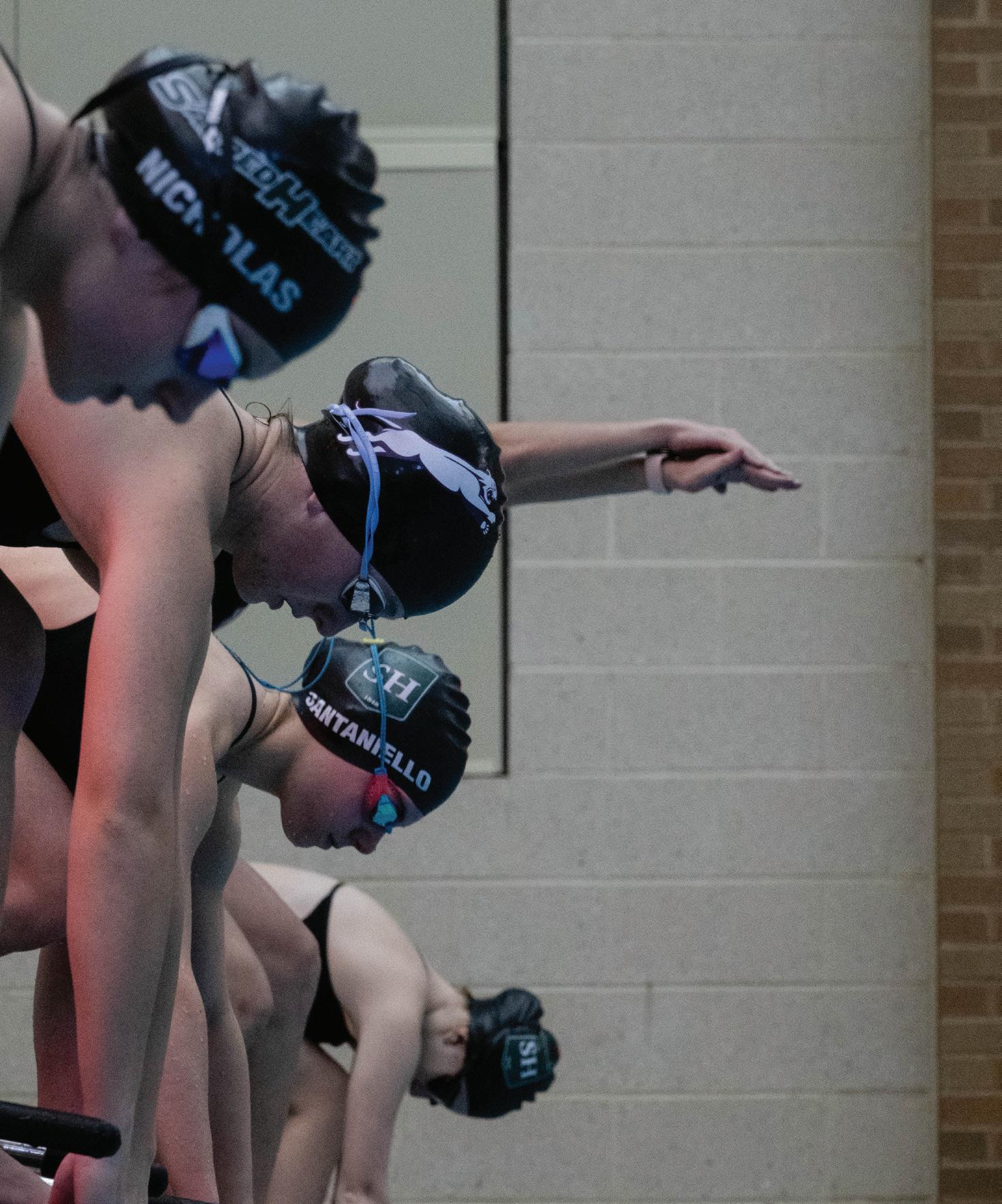
Club swimmers bring progress, not just records
to dive into the pool during a meet against Sacred Heart School. The varsity girls’ swim team improved to a 2-3 record on the season after this meet concluded.
Building connections beyond the court
Emma Greene Contributing Writer
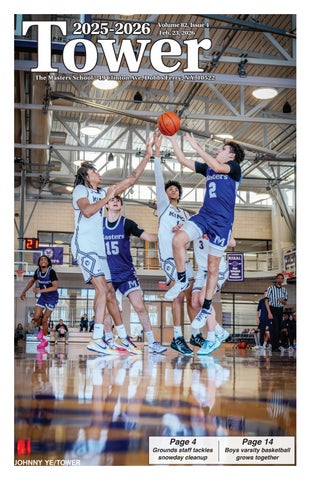
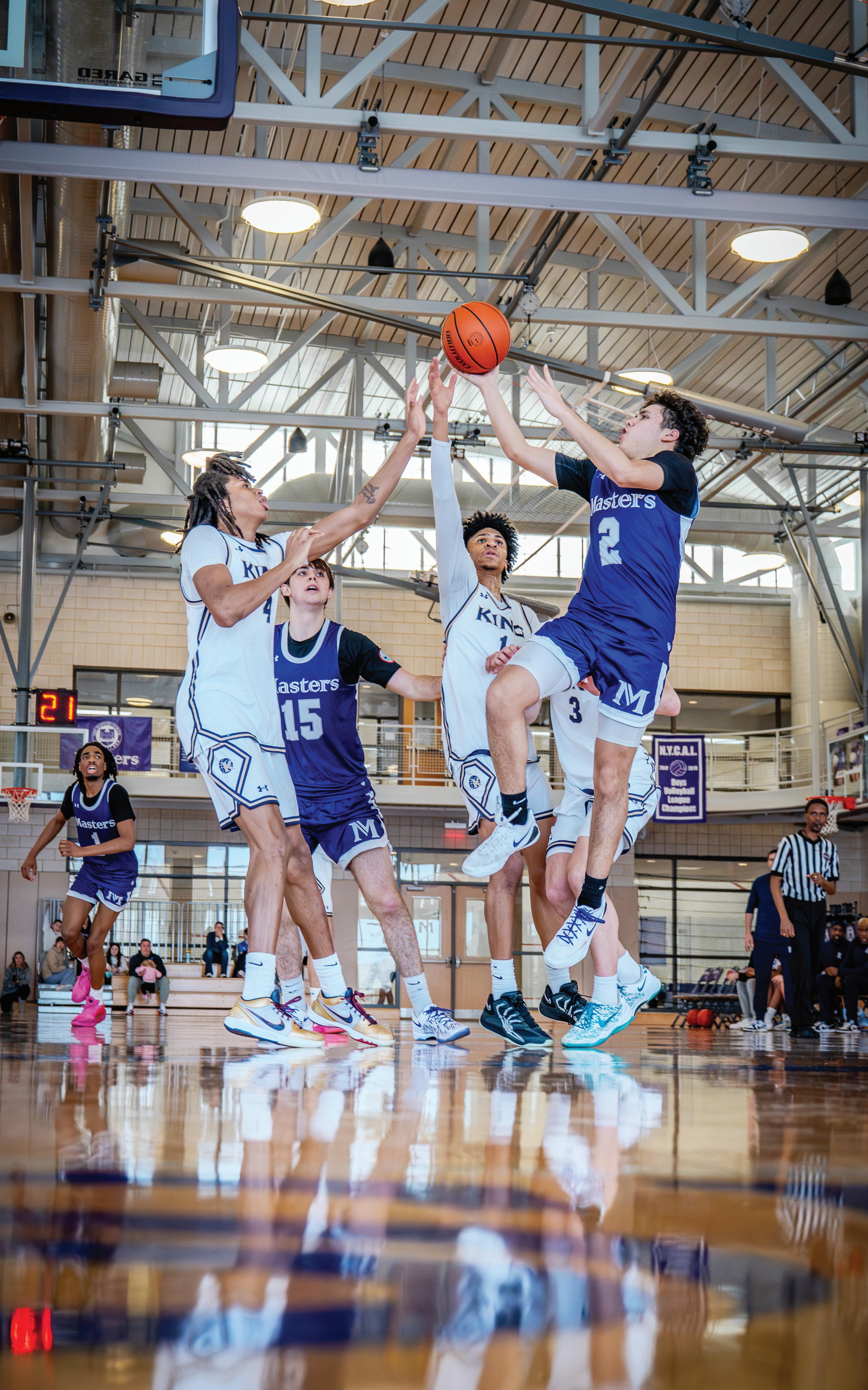
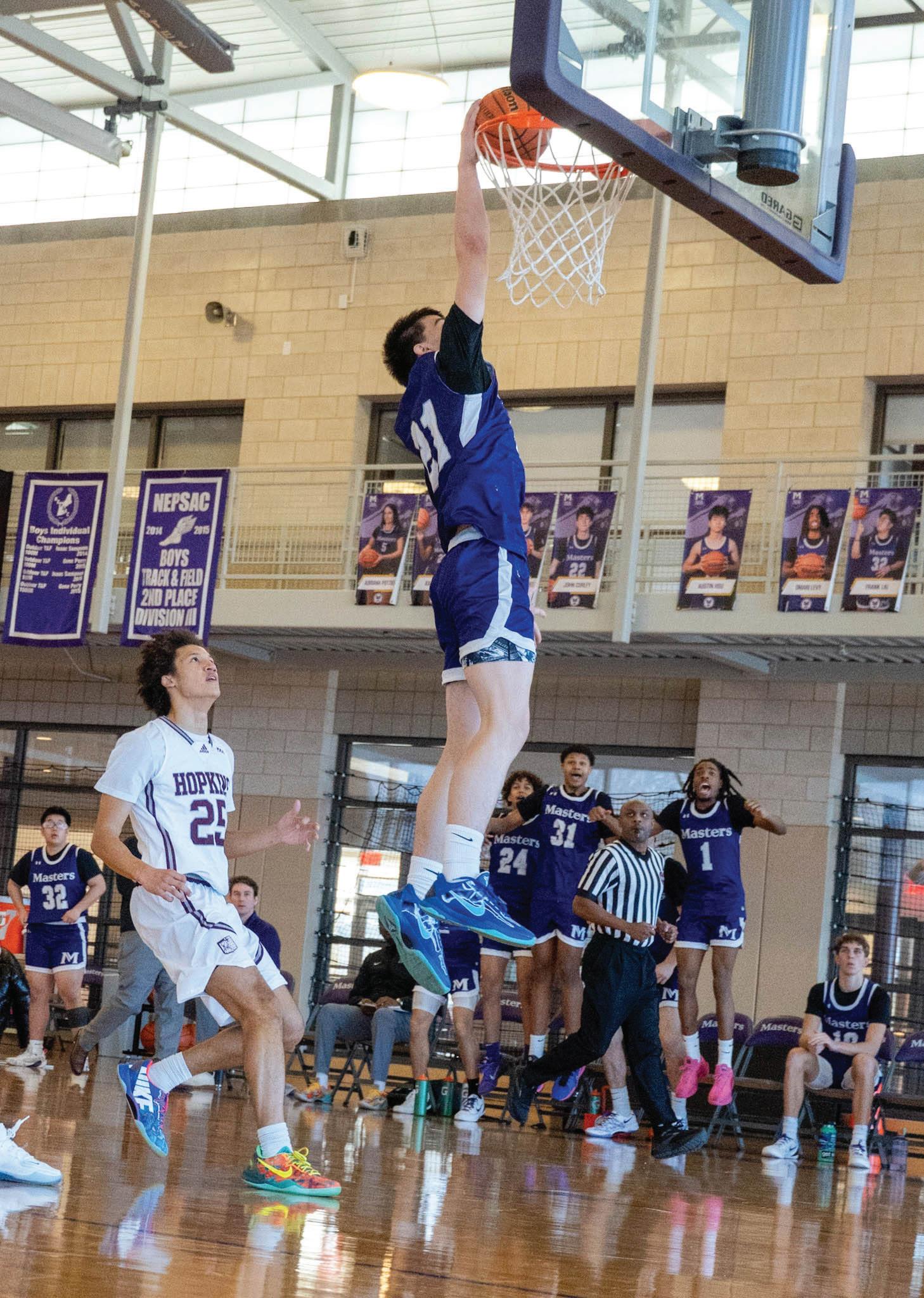
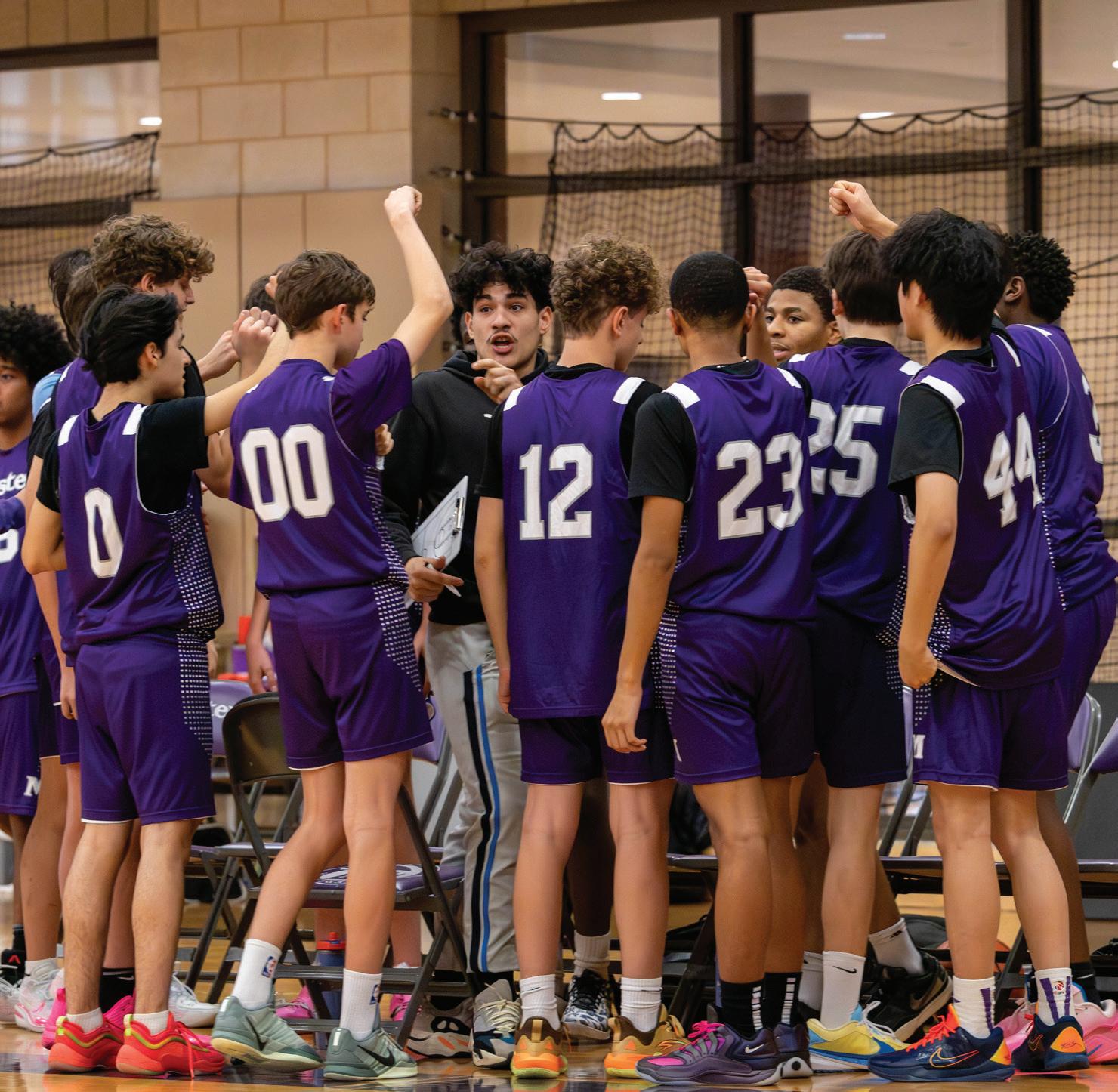
Energy is pulsing through the room, the music is loud and sneakers thump against the floor. Before the game even starts, the boys varsity basketball team is already locked in and in sync with one another. It’s not solely about the plays they run or the shots they make. The team has become like a second family to one another, and they prove it in the way they show up in games.
One moment where this can be seen evident happens to be a tradition that takes place before every game they play. According to co-captain Luc Brongniart ‘26, “We circle, and we make sure that we're on cadence, and we're stretching together. And then another thing: right before the game starts, Jake (Toomer ‘29) throws an alley-oop to Damien (Mojica ‘28), and it gets us all hyped. First bucket of the game, and I think that really gets us going.”
According to Brongniart, what might just seem like a simple dunk to spectators and opposing teams can affect the energy of the whole game.
That connection doesn’t just happen on the court. The players spend hours together every day, whether it is between classes, working together at practices, study halls, getting late meals in the dining hall or even just hanging around each other's dorms.
“It feels more like a family than a team,” Brongniart said. “We’re together all the time. Eating, studying, just being around each other.” All of the hours spent with each other have built bonds that have given them the ability to dominate on the court.
Head Coach Joey Kuhl has noticed the difference this season, too. He said the team’s chemistry has grown a lot in the past few years.
From the first summer workouts, it was clear to him that this group genuinely enjoyed being around each other.
Kuhl said, “It wasn’t just five guys here and five guys there, It was the whole group.”
That togetherness has given them the strength to stay focused and motivated through long, late-night practices and tough stretches of the season.
In times of need, the team always shows up for one another. Junior Lucas Laungayan ‘27 said, “A specific moment I felt connected to the team was when I got injured. I sprained my ankle pretty badly early on into the season and my teammates were supportive of me by checking on me before practice, in the dorms, after practice, and just made me feel like I still had a major role on the team.”
Kuhl said one of his proudest moments came during a rough patch in the beginning of their season, when the team responded to adversity by leaning on each other instead of falling apart.
“We had a back-to-back loss early in the year. We had Frederick Gunn at home, our first home game, and then we had Berkshire on the road, a team that had beaten us, and it was a long bus ride. And I think just in general, the way the guys conducted themselves in that, I mean, really, it was less than a 24 hour period, having to play two games against really good opponents. With some stuff happening, you know, some real stuff happening behind the scenes, and to watch them take care of one another, to navigate, to communicate, and then push themselves physically,” he said. “That’s when I knew this team was special.”
The team’s success isn’t just about wins or stats. It’s about the relationships that were formed by a sport they all love. And when they step on the court, that connection is hard to miss.
Jasmine Mao Contributing Writer
At 4:30 a.m., the alarm rings. Staring at the dark silhouette of snow settling on branches, JJ Fishman ’30 dreads the two hours morning practice ahead of her. After finishing 4000 yards of swimming, her damp hair freezes in the early morning wind. Ahead of her is 75 more minutes of Masters swim practice in the afternoon.
This is what a day looks like for club swimmers on the varsity girls swimming team. Club swimming is a year-long sport, practicing four to five times a week; many club teams focus on long yardage, with practices lasting over two hours. This amount of physical training “is a lot of strain on their body”, as head coach Cortney Grant describes it.
From the student perspective, balancing club and school teams demands a big time commitment.
“It's a lot less time to do homework. On days that I do have a free, I try to get as much homework as I can done. It also puts kind of a strain on me hanging out with my friends,” club swimmer Gabbie Graham ‘28 said.
This heavy workload prompted many swimmers to quit one of the two teams. However, senior captain Annadele Dyott took on the challenge of balancing the two teams for all four years of high school. The Masters swim team reminds Dyott of her passion for swimming.
“I've wanted to stay on Masters because it brings an excitement and an aspect of fun that you kind of lose when you swim on a
club team. [Club swimming] is a lot more focused on only bettering yourself.” Dyott said, “When I'm at a club meet, I'm thinking only about, ‘Oh, I really don't want to swim this, what if I add time?' And it kind of takes away from the actual act of swimming.”
Fishman ’30 highlights the enjoyment of socializing on the Masters team.
“I thought it'd be pretty helpful [to have more practice chances], and also another way to expand friends,” Fishman said.
The Masters team reciprocates club swimmers' fondness for the school team. Their outstanding performance scores points for the team by placing in swim meets. For instance, Fishman broke two school records and scored 12 of the 68 points in the meet on Dec. 11.
Nevertheless, club swimmers’ positive impact extends well beyond points at swim meets. “[With club swimmers] your non-experienced swimmers, or swimmers that don’t have that opportunity to [go to] swim club, now they can see the proper way to do strokes, the proper way to turn.” Grant said, “So you can use your club swimmers to help your non-experienced swimmers become better, and it also inspires them to get better, get faster,”
The athletic department allows flexible team obligations to help club swimmers balance two teams. They are required to participate in every meet, but only obligated to attend two team events per week.
Dyott offered advice for younger swimmers amid athletic stress.
She said, “You need to find what works for you at the end of the day. You're supposed to love the sport.”
MADDIE BARNES ‘26 PREPARES
VELJKO STANIC ‘26 SLAMS down dunk in a varsity boys basketball match versus Hopkins School while teammates Omari Levy ‘26, Jake Toomer ‘29 and Damian Mojica ‘28 cheer him on from the sidelines. The team won the game with a final score of 61-29. The team now boasts an impressive record of 17 wins and 4 losses.
ANDREW BERMAN/TOWER
JACK BILMAN/TOWER
Squash players: What makes them play, what makes them stay
Nate Mohney Contributing Writer
Amelie Henzler ‘28 dons her goggles, grabs her racket and steps into the squash court for another game. As the ball begins to fly, she is again reminded of how the small court feels claustrophobic. But she grits her teeth and keeps playing. But why? What motivates her, and other squash players like her?
Henzler started squash last season, and made the varsity team this year. Her family has always played squash, and so she decided to try it out herself. After a few practices, she decided to stick with it.
You’re in a room contained with one other person, and you guys are hitting hard balls at each other, like, how much more intense can it get?
- Rio Imanishi ‘28
Henzler’s main sport is soccer, which works on a timed system: whoever scores the most points in 90 minutes wins. However, squash is different; it’s whoever scores 11 points first.
“I really like how it’s a point system, because I’m used to timed games and sets. So it was really cool to learn how the rules worked and the point system,” said Henzler.
Squash may not be her main sport, but she keeps playing because she enjoys the change of pace. Rio Imanishi ‘28 has been playing squash since seventh grade. Just like Henzler, her main sport is soccer, but she needed something to do in the offseason, and thought squash was a good choice. Ever since then, squash has found a special place in her heart, because she loved the competitive side of it.
Imanishi said, “I think, comparatively speaking to all the other sports, it’s one of the most intense, fast paced games out there. You’re in a room contained with one other person, and you guys are hitting hard balls at each other, like, how much more intense can it get?”
Clover Graves, ‘27 joined the Junior Varsity (JV) squash team in her freshman year, because she wanted to play with her friends. After stepping away, she joined again in her junior year for the same reason, this time becoming a varsity athlete. She likes how the games are fast-paced, and winning requires outsmarting the opponent. Similar to Henzler, Graves feels the courts are a little too small, and finds herself bumping into the walls constantly.
Nevertheless, Graves keeps playing for the same reason she joined in the first place.
“I love being with my friends. [I like to] hang out, have fun [and] play with my friends.”
She also uses the sport to calm herself down when she is angry.
Imanishi doesn’t like the ranking system. Henzler thinks the courts are too small, and Graves thinks it’s too easy to bump into walls.
Despite this, they keep playing. Imanishi likes the competitive nature. Henzler wants to play with her family, and Graves with her friends. It seems that each squash player has their own motivation specific to them, that gets them through the things they don’t like about squash. It keeps them playing the sport they’ve grown to love.
RIO IMANISHI ‘28 PLAYS squash in one of four courts in the Fonseca Center. Imanishi focuses on soccer in the fall, but for the winter season, she decided to try squash. Read more about Imanishi’s experience playing squash in Mohney’s article.
HENZLER ‘28 PLAYS squash, one of the many sports offerings at Masters. After starting squash last season, she joined the varsity team this year. Read more about her experience trying squash in Mohney’s article.
MARISSA GOLDFARB
AMELIE
MARISSA GOLDFARB
CLOVER GRAVES ‘27 HITS a ball in a squash court. Graves began playing squash as a freshman, when she joined the junior varsity team. This year, she returned to the sport as a varsity athlete.
MARISSA GOLDFARB
Coach Rocco hypes up team before tip-off
Alex Kagoshima Social Media Manager
As the tip-off of a boys Junior Varsity 2 (JV2) game nears, the team waits on one thing before anything else: Head Coach Rocco Gutierrez’s electric pre-game ritual. Known for his energy and lively presence, Gutierrez’s pre-game ritual unites his team and motivates them to play their best, setting the tone of the game early.
The ritual is simple but powerful as Gutierrez roars, slaps lockers, claps and fills the locker room with energy. This electrifying ritual ensures that every player is locked in before the game even begins.
Gutierrez’s routine happens before every game, with Gutierrez raising the team’s energy reminding them that they are capable of winning against every team and easing their nerves before they step on the court.
“The biggest thing for my team is to go out there and play hard, to be dogs,” Gutierrez said. “You can’t always control if shots fall, but you can always control your energy and effort,” he continued.
Gutierrez’s ritual is rooted in his own playing career. When he played Division 2 basketball at SUNY Sullivan he recounted how nervous he would feel before games. That would change when his coach came to the locker room lighting up the team’s energy.
“Automatically, all the nerves went away,” Gutierrez said. Now inspired by his old coach, he brings this same approach to JV2.
The purpose of the ritual isn’t just to hype up players pointlessly, it’s to help them lock in and not be afraid of making mistakes, Gutierrez said.
THE JUNIOR VARSITY 2(JV2) Boys Basketball team huddles up during a timeout to regroup and change their tactics. Coach Rocco Gutierrez has led the team this season with passion and intensity. His pregame ritual has inspired the team to play their best, resulting in a successful season.
“A lot of guys get caught up in not wanting to mess up. They forget the real reason why we’re on the court, to have fun and come together as a team,” Gutierrez said.
Players have felt the impact of this ritual. Sophomore shooting guard Farid Fuseni said “His energy before the game gets us really excited. It gets us pumped up to play and makes us ready to go against our opponents.”
“He gets us in the right mindset,” said sophomore Robert Mercedes, a power forward for the team. “He makes us focus and play the game the right way.”
That focus and energy has paid off so far this season with the JV2 team currently holding a 3-2 record, marking the second year in a row under Gutierrez that the team has had a winning season.
Gutierrez mentioned how energy before tip-off affects everything. “Even if we’re having a bad game, we’re always going to fight because we’re together,” he said. “Effort keeps you alive in games.”
Beyond wins, Gutierrez hopes his players will take important life skills from his ritual. He wants them to understand the importance of staying connected, bringing energy and not giving up even if things are not going the way they want. As the JV2 season winds down, Gutierrez’s ritual has helped his players be energized, united and ready to compete before the first points are scored.
Agrawal finds his home on the piste
Brooke Muntner Marketing Manager
For sophomore Nikhil Agrawal, stepping onto The Masters School’s piste nearly 3,000 miles from his California home felt transformative.
Agrawal’s mother, Reena Agrawal, said the move was exciting and nerve-racking for their family. “It was a really hard decision to move Niki in the middle of high school,” she
said. “But right when we saw Masters, Niki really liked it, and we felt very hopeful that he would be happy and make friends there.”
With six years of fencing experience, Agrawal discovered that team fencing brought new dynamics that deepened his appreciation for the sport.
“I learned that I like team sports more than I thought,” Agrawal said. “National tournaments were all individual, so this was a change when coming here, and those are definitely tighter moments between my team-
mates and me.”
Head fencing coach Shomari Moore, a Masters alumnus, helps transfer athletes adjust.
“The first thing when approaching a transfer student is to get them used to the team culture,” Moore said.
Agrawal quickly found that culture welcoming. “For tryouts, everyone fenced with each other, which was really fun because I met everyone quickly. Everyone on the team is nice and many have become my really
good friends,” Agrawal said.
Moore praised Agrawal’s transition. “It was easy for him to adjust to fencing here,” Moore said. “He’s gotten along with his teammates well and he’s very easy to work with.” Agrawal’s previous public school lacked fencing teams, so he fenced individually at a club that’s only foil, three times a week. Masters’ five-times-weekly practice schedule was significant. “Most of my friends at school are on the fencing team because I stay at school later with the team. It’s fun having practice so often,” he said.
Reena said fencing helped him find belonging. “It’s a different feeling to represent your school,” she said. “It’s a fast way of making tons of friends, which was really good for him.”
Agrawal has since secured the number two spot in the private school fencing league and positioned himself for an undefeated first season at Masters.
His rapid success has made his parents proud. “His dad and I thought he would do well, but he’s completely exceeded our expectations. We’re so happy that he’s happy and that he’s so involved in the school,” Reena said.
Moore credits both Agrawal’s talent and growth.
“As far as growth, he’s been quickly understanding how to become a leader. Just for anyone looking, he’s number two in the league. Obviously as coaches, we love to take credit, but you don’t make stars overnight. He came in trained and ready.”
Agrawal’s parents have also seen him grow. “I’ve seen him take on the role of coaching other kids, giving them pointers and cheering on his teammates,” Reena said. He’s really taking advantage of what Masters offers, ” Reena said.
Reflecting on his journey, Agrawal said, “I would tell my first-day self that it’s going to be a lot of fun and I’m happy that I’m here.”
MARISSA GOLDFARB
NICKI AGRAWAL STANDS ON the piste calmly awaiting his next bout. The sophomore’s weapon is the foil, and he sits at the number 2 position in the private school fencing league. With an undefeated season, Agrawal has made a huge impact in his debut season.