Tower 2026-2027
Volume 83, Issue 1 Oct 22, 2026
The Masters School - 49 Clinton Ave, Dobbs Ferry, N.Y. 10522
6
OVERVIEW OF THE HISTORY OF FOUNDERS DAY ALLY ABADIR/TOWER
8-9 11
ANALYSIS OF STUDENT BODY POLITICS MARÍA VINIEGRA OCAMPO/TOWER
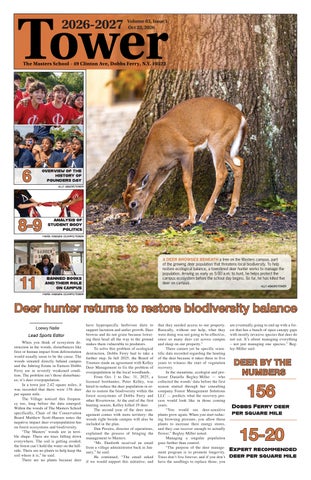
A DEER BROWSES BENEATH a tree on the Masters campus, part of the growing deer population that threatens local biodiversity. To help restore ecological balance, a town-hired deer hunter works to manage the population. Arriving as early as 5:00 a.m. to hunt, he helps protect the campus ecosystem before the school day begins. So far, he has killed five deer on campus.
BANNED BOOKS AND THEIR ROLE ON CAMPUS
ALLY ABADIR/TOWER
MARÍA VINIEGRA OCAMPO/TOWER
Deer hunter returns to restore biodiversity balance Loewy Nalle Lead Sports Editor When you think of ecosystem destruction in the woods, disturbances like fires or human impact from deforestation would usually seem to be the cause. The woods situated directly behind campus and the Juhring Estate in Eastern Dobbs Ferry are in severely weakened condition. The problem isn’t those disturbances; it’s deer overpopulation. In a town just 2.42 square miles, it was recorded that there were 156 deer per square mile. The Village noticed this frequency too, long before the data emerged. Within the woods of The Masters School specifically, Chair of the Conservation Board Matthew Scott-Hansen notes the negative impact deer overpopulation has on forest ecosystems and biodiversity. “The Masters’ woods are in terrible shape. There are trees falling down everywhere. The soil is getting eroded; the forest can’t hold the water on the hillside. There are no plants to help keep the soil where it is,” he said. There are no plants because deer
have hyperspecific herbivore diets to support lactation and antler growth. Deer browse and do not graze because lowering their head all the way to the ground makes them vulnerable to predators. To solve this problem of ecological destruction, Dobbs Ferry had to take a further step. In fall 2025, the Board of Trustees made an agreement with Kelley Deer Management to fix the problem of overpopulation in the local woodlands. From Oct. 1 to Dec. 31, 2025, a licensed bowhunter, Peter Kelley, was hired to reduce the deer population in order to restore the biodiversity within the forest ecosystems of Dobbs Ferry and other Rivertowns. At the end of the first hunting season, Kelley killed 19 deer. The second year of the deer management comes with more territory: the woods right beside campus will also be included in the plan. Dan Pereira, director of operations, explained the process of bringing the management to Masters. “Ms. Danforth received an email from a village administrator back in January,” he said. He continued, “The email asked if we would support this initiative, and
that they needed access to our property. Basically, without our help, what they were doing was not going to be effective, since so many deer cut across campus and sleep on our property.” There cannot yet be specific scientific data recorded regarding the hunting of the deer because it takes three to five years to witness the start of vegetation recovery. In the meantime, ecologist and professor Danielle Begley-Miller — who collected the woods’ data before the first season started through her consulting company Forest Management Solutions LLC — predicts what the recovery process would look like in those coming years. “You would see deer-sensitive plants grow again. When you start reducing browsing pressure, you allow those plants to increase their energy stores, and they can recover enough to actually flower,” Begley-Miller noted. Managing a singular population goes further than control. “The purpose of the deer management program is to promote longevity. Trees don’t live forever, and if you don’t have the seedlings to replace those, you
are eventually going to end up with a forest that has a bunch of open canopy gaps with mostly invasive species that deer do not eat. It’s about managing everything – not just managing one species,” Begley-Miller said.
DEER BY THE NUMBERS
156
Dobbs Ferry deer per square mile
15-20
Expert recommended deer per square mile
TOWER Editors-In-Chief Elaina Barreto Jack Bilman
@masterstower
@masterstower
Lead Opinion Editor Ella Liu Lead News Editor Siena Versaci Lead Lifestyle Editor Jaden Laboriel Lead Sports Editor Loewy Nalle Lead Arts Editor Helen Gao Lead Copy Editor/Accountability Manager Brielle Broomes Lifestyle Editor Avery Gosnell News Editor & Lead Web Editor Grey Dickson
t
20
TOWER
Tower is hand-delivered on the day of publication to the Upper School. 650 copies are printed. A copy is sent to each of our advertisers. Tower is the winner of the Pacemaker Award for Overall Excellence, an award-winning member of the National Scholastic Press Association (NSPA), Columbia Scholastic Press Association (CSPA), Journalism Education Association (JEA) and Quill and Scroll. We encourage Letters to the Editor, which can be submitted to the following email address: TowerEditors@MastersNY.org. Published approximately six times a year, Tower is a public forum, with its Editorial Board making all decisions concerning content. Commentaries and opinion columns are the expressed opinion of the author and not of Tower and its Editorial Board or its advisers. Furthermore, the opinions conveyed are not those of The Masters School, faculty, or staff. Unsigned editorials express views of the majority of the Editorial Board.
Arts Editor Emma Greene Sports Editor Alex Kagoshima Opinion Editor Jasmine Mao Copy Editor & Newsletter Editor
Zadie Collins
Marketing Director Brooke Munter Illustration Editor Olivia Shim
Co-Social Media Managers Noah Ferguson Luka Kisselev
Associate Web Editor Harrison Arak Staff Writer
Akari Kawabata Sports Photo Editor Ally Abadir News & Features Photo Editor
María Viniegra Ocampo Faculty Advisers Ellen Cowhey Mathew Ives Tower Columnists Carter Mack Eamon Wall Annie He Jia Shah Harrison Charlebois
Tower Illustrators & Photographers Rose Yuan, Clara Chu, Mya Recinos, Natalie Ambrosio, Quinn Mohney, Anya Peri, Jenny Wu, Aviana Kinon, Siena Olay, Zoe Lei, Knox Gary, Sam Haas, Johnny Ye, Tess Youngren, Adriana Houck, Emma Casey, Helen Gimbel, Aurelia Levene and Ester Ni
JACK BILMAN/TOWER
FROM LEFT TO RIGHT: Seniors Raven Jarvis, Julia Panos, Vincent Von Jan and sophomores Lila Seltzer and Ashe Davis practice for the upcoming fall play: “Clue,” a murder mystery play. The most captivating aspect is the fact that any one of the characters could be the murderer. The play will be available for audiences to watch from Friday, Oct. 23 to Saturday, Oct. 24.
As brain-computer interfaces advance, the fight for brain rights begins Technological developer Galen Buckwalter’s ambition to help fellow paraplegics has resulted in a legal dispute between him and Caltech over his brain rights. As technology advances, the question of ethics persist.
Founders day continues to honor our history
Founders day is regarded as one of the most integral parts of the Masters community, however its history is unbeknownst to many. Collins and Kawabata explore how Founders Day has made a lasting impact on current and previous Masters students.
Faculty art gallery splashes color onto campus
The Faculty Art Exhibit highlights the creativity of members of both Masters’ Upper and Middle school arts faculty. Many of the inspirations of faculty comes from their personal experiences.The focus is the uniqueness of artistic journies.
Coach PJ Johns looks to transform the field hockey program
PJ Johns makes his debut as the new varsity field hockey coach. Through team building, he strives to empower them.
3 6 12 16
7
02
-2 26
THURSDAY, OCT. 22, 2026 To w e r
NEWS
3
COURTESY OF KRISTEN MATHEWS
GALEN BUCKWALTER SITS WITH his panel, including his lawyer Kristen Mathews on the far right. Mathews has been leading the legal fight for his brain data by writing a new Bill of Rights to assist future BCI participants. This case is setting the stage for the first discussions regarding brain rights.
As brain-computer interfaces advance, the fight for ones own brain rights begins Siena Versaci Lead News Editor After suffering a spinal cord injury that left him paralyzed from the neck down, data researcher Galen Buckwalter became a participant in a Brain-Computer Interface (BCI) Study with Caltech to help advance technology and aid fellow paraplegics. He has also embarked on a legal crusade that has raised an interesting question: should he have the right to access his own brain data? In January 2024, Buckwalter underwent a craniotomy and had 384 microbes implanted, forming his BCI. Then the study began. Buckwalter said that during sessions his brain signals and data are “all decoded and turned into control signals for digital manipulation.” Through this manipulation Buckwalter said, “I can move a robotic arm just by thinking about it, and I can move all the digits,” “They also stimulate, so it’s not just reading my brain activity as I think about doing different things, which also produces sensation.” He continued, “They are trying to better understand how stimulated sensations are compared to actual tactile sensations.” As the study progressed, Buckwalter began to think of other applications for his BCI. In his free time, he and his band wanted to use his brain waves to compose music. “I wanted to see if I could directly use my neuronal activity to make tones that I could control, and we’ve actually been able to do that, which is very trippy,” he said. He added, “I think about moving my toe, and I can make a tone go up, so, now,
I am trying to put all that together because I have control over a lot of channels, and it’s kind of like I have this orchestra in my head.” However, when Buckwalter asked Caltech for access to his brain data to make his music, they refused. “I was recording with a friend of mine, and I was like, ‘This would sound great on this song that we were doing…And so I asked Caltech for a copy of what we had produced from my brain, and they said, ‘No, you can’t have it, it’s not yours,” he said. When Buckwalter referred back to the consent forms he had signed, he realized that he had signed away his rights to his brain data. When Upper School History & Religion teacher and lawyer Benjamin Thorn started exploring the advances to neuro technology, he noticed the potential privacy risks. He said, “From a gut perspective, we think our brain is our inner citadel. It is the most sensitive, information we have, our thoughts.” Seeing his dilemma, Buckwalter tried to leverage his position. Caltech wanted to extend the study to 10 years rather than eight.“Instead of signing it, I wrote up a list of what I hoped to happen, including things like more transparency with what they were doing with my data,” Buckwalter said. After Caltech received his new Bill of Rights, they came back with a more stringent consent form. In essence, they said no. “They’re saying the quiet parts out loud, and they do explicitly own this, that they don’t need to tell me what they’re doing and that I have no ability to engage in any other research,” Buckwalter said.
He continued, “If I don’t sign this new consent form, I’ll be basically kicked out of the study, which means that I have to get a massive surgical procedure. They do a full craniotomy where they take half of my skull. Consent is supposed to be voluntary, but yet, here, if I don’t consent, I have to go get the BCI taken out. How can that be voluntary consent?” After hearing about Buckwalter’s predicament, Thorn evaluated it from a legal perspective. He said, “A provision that was requiring you to have surgery to repossess something from your body seems against public policy.” Overall, Buckwalter wants to expand the research on BCIs to help glean its possible healthcare applications. “I’m not anti-re-
search. I’m pro research. If anything, I want to be moving faster than just Caltech. That’s why I’d love to be able to work with other research groups,” Buckwalter said. He continued, “If we can get regulation on the books, about absolute privacy, and absolute ownership we can build ways to keep them safe.” He continued, “I think hopefully we are more systematic about our approach to this, and come up with some moral and ethical frameworks that we can agree on. But if we don’t do it soon, they’re gonna be snagging all the data and using it to manipulate us.” “If we’re breaking our brain, we’re breaking our humanity. I just don’t see any way to rein that in other than having laws with teeth,” Buckwalter said.
Proposed Brain RIghts bill and privacy protection of bci participants - Participant may take part in additional studies using their BCI if non-interfering and in regulatory compliance. - Participant has the right to personal and commercial use of their own data (subject to embargo/scope agreements). Participant, and or designee, has ongoing right to access their own BCI data (raw, impedance, processed). - Commitment to share de-identified bci data publicly on an open-source basis for community benefit. - De-identification standards must account for advances in re-identification technology and size of BCI population. Commitment to Hippa/Hitech security standards for BCI data.
NEWS
4
THURSDAY, OCT. 22, 2026 Tow er
Heavy rain creates challenges across campus Olivia Shim
H
Illustration Editor
eavy rainfall can overwhelm drainage systems, flooding homes, roads and school campuses. At The Masters School, stormwater runoff has created drainage challenges that the school plans to address over the next two years. According to the New York State Department of Environmental Conservation (DEC), New York has experienced an above-average number of days with at least two inches of precipitation since 1995. The frequency of these events has also increased statewide since 1950, peaking between 2010 and 2014. Masters sits on a hill that creates particular challenges. Dan Pereira, director of operations, said rainwater flows downhill across campus through fields and along both sides of the quad. The area above Reunion Hill and around the Fonseca Center is especially vulnerable to water that does not enter the drains. “We have two kinds of problems,” Pereira said. He continued, “We have too much water in our drains for the Village to keep up with our water, and then we also have some water that we need to contain.” Pereira notes that unpredictable rainfall makes flood prevention difficult because engineers must account for soil type, rainfall volume, surface materials and drainage capacity.
“We have too much water in our drains for the village to keep up with our water, and then we also have some water that we need to contain.” -Dan Pereira
ALLY ABADIR/TOWER
DURING A PROJECTED DRY spell, contractors arrived on the quad in the front of Follet Hall to dig a new drainage ditch and ameliorate flooding and runoff conditions in and around Follett Hall. Flooding also affects residents throughout Westchester County. Viviana Rolston ‘28, who has lived in the county for 16 years, because it sits at the bottom of a hill. “My house kind of always floods, especially my basement,” Rolston said. During particularly heavy rain, her family has to board up the basement and use towels to manage the water. Rolston also recalled flooding on the Saw Mill River Parkway, which she uses to get to school, leading to infrastructure improvements. In January 2023, New York State announced the completion of a $38 million
project to replace two bridges over the Saw Mill River in Pleasantville, including the stabilization of a 1.3-mile stretch of a roadway. Rolston added that schools should consider the difficulties students from floodprone areas may face when commuting during severe weather, particularly when flooding blocks roads and delays commutes. As heavy rainfall continues to challenge drainage systems across Westchester, projects planned for the next two years at Masters could help the school better manage water on campus and beyond.
ANNUAL PRECIPITATION IN DOBBS FERRY
42.5’’ AS OF OCT. 19, 2026 (YEAR TO DATE) THE AVERAGE PRECIPITATION PER YEAR WAS
39.8’’
NEWS
THURSDAY, OCT. 22, 2026 To w e r
5
American literacy declines Harrison Arak
Associate Web Editor The ability to read and write is something that many find necessary, whether it be through schoolwork, sending emails to a boss or simply reading a book, but what would happen if we begin to lose that ability, and why is it happening now? Literacy rates are decreasing around the world, and the country that is falling victim to this the most is the United States. According to National University, 54% of American adults read below a sixth grade reading level. According to the results from the National Assessment of Education Progress, the average reading scores among high school seniors are the worst that they’ve been since 1992, and there are several beliefs for why this could be happening. Many of these theories tie back to COVID 19, and how remote learning affected the ability to learn to read and write proficiently. However, the entire picture is much larger, as literacy rates had been decreasing before the pandemic. In 1990, the government began to raise its funding for American public schools, which led to a steady rise in the math and reading skills of fourth through eighth graders. At the climax of this rise, in 2013, the average fourth grader had the reading level of the average sixth grader in 1990, but they
began to decrease in 2016 for many reasons. One of the leading causes of a decline in literacy is digital devices. The National Library of Medicine researched the effects of screen exposure on literacy, and realized that the lowering attention span and increase in dopamine makes reading something that many simply just don’t care to do.
“It’s disheartening to know that literacy rates are going down. You know, we don’t have as many materials as we used to, and also just people’s understanding of what they read isn’t as good.” -Miriam Emery Another issue is the lack of government funding to education. According to the national education association, due to President Donald Trump cutting the funding of the education system last year, there is just not enough money being given to the public school systems, and it is making it much harder for children to learn. Miriam Emery, chair of the english department, said, “It’s disheartening to know that literacy rates are going down. You know, we don’t have as many materials as we used to, and also just people’s understanding of
NATALIE AMBROSIO/TOWER
LITERACY RATES IN THE United States drastically decreased after peaking in 2013. Now, high school seniors’ reading ability is at the worst level since 1992, calling for changes from the American school system. what they read isn’t as good.” Emery also spoke about the changes that the American school system might need to make. “I think something that’s going to change is the way information is communicated to people. So if people can’t read as well, but they’re watching videos, they can still potentially learn a lot,” Emery said.
There is a wage gap between jobs that require high literacy rates and jobs that don’t, and it is expected that the jobs that need literate people will start to have a higher pay, whereas jobs that don’t require literacy will earn less money, regardless of how much work is actually being done.
Housing crisis in Dobbs Ferry hides from plain sight Alexander Kagoshima Sports Editor
Dobbs Ferry is mostly known for its waterfront, walkable downtown and friendly suburban community. But behind the village’s streets there is a growing challenge — finding affordable places to live. The village has acknowledged this housing shortage problem. According to the Dobbs Ferry Downtown Affordable Housing Initiative, 36% of renters in Dobbs are either moderately or severely cost-burdened, meaning renters spend more than 30% of their household income on housing. Additionally, another alarming development the initiative flagged was a report in which rent increased by 50% between 2000 and 2020. This issue extends beyond just Dobbs Ferry. According to Nitin Gupta, a Masters school doctor and a member of the Dobbs Ferry Board of Trustees, Dobbs is part of a larger statewide housing crisis affecting towns along the Hudson River the most. “We are in a housing crisis, because the supply just doesn’t meet the demand and therefore the prices rise,” Gupta said. Gupta explained how Dobbs Ferry is a desirable place to live, but limited space for new construction is not enough to accommodate the growing demand for housing. He mentioned how only around 6% of the land in Dobbs is available for develop-
ment. The housing crisis raises the anxiety of owners about whether they can pay their monthly rent or will be forced to leave their community. This struggle can be complicated for people working in Dobbs Ferry, but unable to afford living here. According to the initiative, teachers,
police officers, firefighters and other local workers cannot afford to live in the community they work in. Gupta stated that the majority of the Dobbs Ferry police officers do not live in the village, commuting from approximately an hour north. “Our own village employees don’t necessarily work
and live here, and that’s hard,” Gupta said. Gupta warned about how the situation could affect the village by not being able to attract or retain employees. If workers cannot afford to live nearby, this could lead to them choosing jobs in other communities. “We are functioning well as a village, but it does come at a cost as these home values keep rising,” Gupta said. Dobbs Ferry has taken steps to create more housing options including allowing for accessory dwelling units which would provide more living spaces. Additionally, according to Gupta, new residential developments must dedicate at least 10% of their units to affordable housing. Although the village currently does not allow buildings taller than four stories, Gupta questions if this will remain the same in the future. Ultimately, Dobbs Ferry’s housing crisis is more than just rising property values. It is about the people who sustain this community not being able to afford being a part of it. As Dobbs Ferry looks toward the future, the challenge is finding a way to keep developing while ensuring people can still afford to live here.
JENNY WU/TOWER
LOCAL EMPLOYEES STRUGGLE TO afford housing in Dobbs Ferry village due to major rent increases and limited land for housing development. Dobbs Ferry took measures such as allowing accessory dwelling units in order to create more housing options.
6
LIFESTYLE
THURSDAY, OCT. 22, 2026 To w er
F unders D y
continues to honor our school history Zadie Collins & Akari Kawabata Copy Editor/Newsletter Editor & Staff Writer
One day a year, the whole Masters community forms a sea of red and blue, partaking in fun-filled challenges for an afternoon of playful competition. Split between Delta for Dobbs and Phi for Ferry, Founders Day is a celebration of our school’s history. Sam Barek ‘27, one of three Dobbs Athletic Association (DAA) co-chairs, spoke about the past of DAA, one of our oldest clubs on campus, during the event. Barek referenced DAA’s journal—made during its very early stages—in terms of giving insight into where the premise of Founder’s Day started. “This journal is filled to the brim from 1901 with all these values of DAA,” he said. “It’s really cool to know a club spans back that far.” In “An American Schoolmistress: the Life of Eliza B. Masters”—a 1927 biography written by Marion Brown Shelton—DAA is repeatedly quoted with their original ties to Delta-Phi competitions. “We have instituted several minor sports of which archery and ‘organized games’ are the most popular,” Shelton notes in the chapter named, “The Aims of the DAA.” Through the decades, DAA’s presence hasn’t diminished either, with its current role involving the organization of annual Delta-Phi festivities. Yet the actual tradition has shown much evolution, even before the institution of Founders Day in 2004. According to Amie Servino ‘95, director of parent engagement, the presence of Delta-Phi
at Masters has been around for more than a century. “In the late 1800s, there were no other allgirls schools for us to compete against in this area,” she said. “In order for her [Eliza Masters] to instill the values of teamwork, collaboration and athletic competition in her girls, the only solution she could come up with was to divide her own school into two teams.” As other independent girls schools emerged, and our own became co-ed, sporting competitions were no longer restricted to just Delta vs. Phi. Yet DAA chairs found a way to keep the tradition meaningful and alive, opting to move the Delta-Phi rivalry from regular athletics to an annual school-wide battle. After speaking with alumni, Barek shared how Delta-Phi activities actually used to span across the whole year. He said, “There was a Delta-Phi snowball fight at some point.” Servino provided more details on this, explaining the custom of a coveted Delta-Phi cup during her schooling at Masters. “Throughout the course of the year, your team could earn points for doing a whole variety of things, like doing community service or taking part in a quiz bowl,” she said. She continued, “They were called X points, and each team had a captain.” The competition unfortunately tapered out in following years, replaced with more modern Delta-Phi activities. This included Founders Day, started in 2004, but emanating from a monumental decision eight years prior: the shift to coeducation. “The reason why Founders Day was created was because—following the move to coeducation—our alums were really concerned that some of the history and the tradition of the
school was being lost,” Servino said. She continued, “Not necessarily because boys were arriving on campus, but because the school was in such a time of transition…so the alumni board had an idea to create Founders Day in order to bring some of that tradition back.” During Dr. Maureen Fonseca’s tenure as headmistress (2000-2015), Founders Day became a hit, with Fonseca happy to add her own historical spin to the celebration, in addition to the tug-of-war. “She would dress up in an Eliza Masters style dress and embody the role of Miss Masters,” Servino recalled. “It was crazy because a lot of the little kids, especially the fifth graders, really thought she was a ghost.” Mary Ryan, class of 2000, also shared her experience with the Delta-Phi tradition regarding the X-point system. “You got points for going to everything, so even a dance performance or the musical.” She continued, “It
was kind of school spirit and community engagement in a cool way.” Ryan also spoke about recently visiting with alumnae from the 50s and 60s. She said, “When we were introducing ourselves, everybody said ‘I was a Delta’ or ‘I was a Phi,’” showing the lasting effect the tradition left on students. She continued, “I think that so much has changed. It’s neat to have a few things that stay the same.”
AARON GUERRERO ‘27 DIGS into the turf at Greene Field in an effort to help team Phi win the annual tug-of-war match. Each year, members of team Phi and Delta compete from faculty and each grade 5-12 in a series of nine matchups. In 2014, former Head of School Maureen Fonseca made a dramatic entrance, arriving to the event on horesback, dressed as Eliza B. Masters. JOHNNY YE/TOWER
SIENA OLAY/TOWER
SCHOOL MASCOT “PAWS” ENERGIZES the crowd at Founders Day. During the winter of the 2024-25 school year, DAA sent out a google form to select the name of the panther. Throughout Founders Day, Paws can be seen taking photos with students and cheering people on.
JOHNNY YE/TOWER
THOMAS DUKE ‘27 WAVES the Delta flag in support of the faculty on the Delta team. Typically, flags in both teams’ colors are handed out for students to create a more competitive atmosphere. Additionally, each person is in the same team as their family, embedding the traditions into each Masters family.
THURSDAY, OCT. 22, 2026 To w e r
LIFESTYLE
7
The past informs the present for alumnae Brooke Muntner Marketing Director Years after graduating from The Masters School, Gabrielle Torres returned to the same dorm she once lived in as a student with her closest friends. But this time, she returned as a staff member. For some Masters alumni, graduating didn’t mean leaving Masters behind permanently. After pursuing careers, several alumni returned as faculty members, bringing their experiences as former students into their work with the next generation at Masters. Now Associate Director of Admissions, Torres never imagined her career would lead her back to Masters. As a student, she planned to become a lawyer, a goal she held onto through most of college. “I never thought I would be back at Masters. I was very much into the plan that I had at the time and that plan didn’t change for me for a while,” Torres said. After graduating during the pandemic, Torres worked at a law firm before going into sales at Politico Pro and later marketing. Still uncertain with what she wanted to pursue, she spoke with Richard Simon, an upper school language teacher she stayed in contact with after graduation. “I told him, ‘I’m really lost and I’m not sure what I want to do next,’” Torres said. “He was the one who said, ‘Have you ever thought of education?’” For Director of Residential Life and Upper School English Teacher Pilar Méndez-Cruz, a former Masters student, returning was also unexpected. After teaching in California for four years, Méndez-Cruz accepted a one-year position at Masters to learn
how to apply the Harkness method she loved as a student to her teaching. “It was fully my intention to come to work for a year,” Méndez-Cruz said. She continued, “And then, as life does, [it] had other plans for me and here I am.” Similarly, Director of Parent Engagement Amie Servino, class of 1995 graduate, returned in 2012 after discovering a job opening while working at a nonprofit in New York City. With a son and a major commute, the opportunity initially appealed to her for practicality. “I applied because I was getting tired of my old job and commuting, but I thought it would be cool coming back. It ended up really working out,” Servino said. For all three alumnae, returning has offered a different perspective on the community that shaped them. Torres explained that she can better understand that students need room to make mistakes. “You’re kids. You are going to make mistakes and we should expect you to make mistakes,” she said. She continued, “I was very fortunate to have adults on this campus when I was [a student] here who looked out for me. If I could be that for other students, that’s all I could want.” Now in her sixth year at Masters, Méndez-Cruz works alongside former teachers who inspired her career in education. “The opportunity to come back and work alongside them and learn from them is an incredible honor,” she said. For Servino, returning has also meant witnessing the school’s evolution firsthand. Since she graduated, Masters has become coeducational, expanded its campus and introduced Harkness.
COURTESY OF GABRIELLE TORRES
ALUMNA GABRIELLE TORRES LIVED in Ford dorm during her high school years. She now gets to relive her days in Ford, this time as a dorm parent. “Jeff Carnevale said [to me], ‘Wouldnt it be funny for you to live in the same dorm as you did as a student?’ I’ts a very full circle moment for me,” Torres said. From L to R: Gabrielle Torres, Yana Serry, Ciara Escobar and Jamilah Grizzle. “Despite all of Masters’ transformations, the heart of what the Masters experience is to me has remained the same,” Servino said. Similarly, Torres feels many changes have been made since being a student, specifically the stigma there was surrounding financial aid and being a student of color. She said, “There would be one [student] in a classroom and being the only one of anything is tough.” She noted how she has seen the school changes to make the institution more welcoming to students of color. “They do a really nice job of saying, ‘Hey, the students do come first. Let’s con-
stantly be changing to see how we can make it even better.’ That’s something I have really enjoyed seeing,” Torres said. She continued, “I get to talk to kids about it and they don’t feel any shame because there’s no reason to.” Méndez-Cruz said, “I think all the ways in which we [as a Masters community] are weird, chaotic, funny and unconventional have remained true since I was a student to now.” Looking back, Servino would tell her younger self, “You will have an opportunity to pay back to this place all of the things that it did for you.”
Boarding community weekends knit a sense of home Jasmine Mao Opinion Editor Shakira’s voice singing “Tsamina mina, eh, eh. Waka waka, eh, eh,” is blasting in the Cole dorm common room at 1 a.m. on a Friday night. Several girls are dancing to the music in preparation for the annual tradition of the lip sync contest. The lip sync contest is one of the many community building activities for the boarding students of Masters, which includes community meals, dorm olympics, open dorms and many other small activities. This year’s lip sync contest on Sept. 26 was attended by around 150 students and faculty members. Each of the six dorms: Cole, Cushing, Ford, McCormack, Strong and Thompson–choreographed a six-minute performance for their remix of songs. For instance, first place McCormack danced to the Nigerian song “Shekini,” the Chinese song “Blueprint Supreme,” and the Spanish song “La Mama de La Mama” to present their theme: different cultures of McCormack girls. Senior John Zachariah, a seven-day boarding student in Thompson, described that he “hated” lip sync during his freshman year, but eventually grew to appreciate it, and danced a lot. Zachariah said, “Freshman year, I was really in my own shell. [But when] I saw
MARÍA VINIEGRA OCAMPO/TOWER
MASTERS’ BOARDERS GATHER IN the dining hall for a community dinner. On Oct. 18, Thompson dorm hosted a “Facing Our Fears” themed dinner represented by Halloween decorations and attire. Events like these happen around seven times a year, where a dorm hosts a meal and provides entertainment for the boarding community. older people I looked up to do it, it kind of encouraged me to get out of my shell and venture out of my comfort zone more.” The lip sync contest takes place every year during September community weekend. Community weekend is hosted on campus about seven times a year, where all seven-day boarding students are obligated to stay on campus, and five-day boarding students are encouraged to stay. Every community weekend a dorm would host either a brunch or dinner, featuring elaborate meals, student speeches and perfor-
mances. For instance, Thompson dorm hosted a community dinner this past weekend on Oct. 18 centered around the theme “Facing Our Fears.” The dining hall was decorated in Halloween decorations, and guests came in costumes of black and orange. Senior Zachary Ryan, a five-day boarding student in Thompson dorm, sang “Stand By Me” and made a reflection cherishing the boarding community. In his speech, Ryan said, “Back at Fordham, they preached community and
brotherhood, but nobody does it better than the six dorms, all the families and staff sitting in front of me right now.” Other smaller events happen throughout the year for boarders to have fun and reinforce a sense of community. Boarding representatives Alex Cho ‘27 and Gabriela Heredia ‘27 organize these events alongside Resident Life Director Pilar Méndez-Cruz and Student Activities Director Ed Gormley. “We usually like to do what works best and what we’ve seen good reviews about,” Heredia said. Then she mentioned a few popular interdorm competitions. “Whether that be pumpkin-carving or gingerbreadhouse making – just little stuff that can be done within your dorm and makes you more active within your dorm life,” The boarding community, while unbeknownst to many members of Masters, took many measures to create an entertaining and welcoming experience. Méndez-Cruz said, “I think that it [being a part of the boarding community] helps adults see students as more than just people in their classroom who are working on developing skills, but also as people who come from different parts of the world and therefore have different values, perspectives, senses of humor and traditions,” Mendez-Cruz said. She continued, “Boarding life is really where all of that is shared.”
8
THURSDAY, OCT. 22, 2026
NEWS
NEWS
Where do we lean?
9
An analysis of a community political poll
School-wide poll reveals community’s opinion on immigration policies
I
Elaina Barreto Editor-in-Chief
mmigration is an increasingly relevant issue in Westchester County, the home for many of The Masters School’s students and faculty. In 2025, local organizations in Westchester donated food and supplies to asylum seekers settling in Ardsley, and in January 2026 the Masters community participated in a walkout protesting the increased violence of Immigration Customs Enforcement (ICE). These local, public examples of immigrant support represent the majority of viewpoints within the Masters community on issues such as border enforcement spending or the status of long term undocumented residents. In a recent poll conducted at Masters, data shows that 56.5% of students, faculty and staff who responded to the survey at the school believe border enforcement spending should be decreased. However, there is a significant difference between faculty and students’ opinions on border enforcement. 69.1% of faculty and 52.1% of students chose decreased border security spending, which means that students were more likely than faculty to select the other options: that border enforcement spending should be kept the same or increased. Similarly, with regard to which policy the U.S. government should hold for undocumented immigrants in the U.S. who have not committed serious crimes, 73.4% of respondents, students and faculty, believe undocumented immigrants should be provided a pathway to legal status or citizenship. Yet, 69.4% of students, in comparison to 84% of faculty, chose this option, also demonstrating that students were more likely than faculty to select that undocumented immigrants should be given temporary work status without a pathway to citizenship or deported to their origin countries. However, the data should not discount the fact that the majority of student respondents said that border enforcement spending should be decreased and that undocumented immigrants should be given a pathway to citizenship, or that students’ opinions on politics at Masters lean liberally overall. Students in the political science class were asked to take a quiz, created by Pew Research, to determine where they fit in the spectrum of political typology. Once all students had taken the quiz, they found that the majority of the class fell into the category of leftward progressives. In comparison, only 7% of respondents nationwide aligned with that category. A student in political science, Sam Friedman ‘27, said the quiz results reflected the students’ overall political view on how the government should run, a topic explored during class discussions. Yet, she said she believes that students differ in their opinions on specific issues. Friedman said, “I think that we have general things that we agree upon, like some things that Trump is doing are terrible and that the government should be a certain way, but I think when it comes to individual issues, I might not feel the same way about stuff in foreign relations or taxes or as someone else might.” She continued, “Sometimes [class] is a place where I feel like I wouldn’t be able to say that opinion if not a lot of people have it because,
Tower Survey on National Policy and Public Issues
School leans left on social spending, centrist on spending overall
I know of course we’re seniors, and we know ly fewer faculty and staff who answered the poll wanted to keep spending the same amount or The Tower staff created a 19-question survey covering how to have Harkness discussions and disagree than students: 81 faculty members responded to reduce it. William Grey Dickson key national topics, including federal spending, immirespectfully, but I think [class] is a place where, the survey as compared to 221 students. Given At the same time, there were calls for inLead Web Editor & News Editor if you don’t have that main opinion, it’s not real- that there are 147 faculty members who were creased specific government spending. 63.8% of gration policy, healthcare models, climate change, forly like a good [place] to say ‘I don’t agree with sent the survey, the margin of error for faculty all those who participated believed that safety net eign policy, AI regulation and gender identity. Students, n anticipation of national and midterm and low-income assistance should be increased, you guys.’” responses is +/- 7.8 percent. elections, a mass political survey was while only 12.9% believed that aid programs faculty and staff in the Upper School participated in the According to research on generational trends The results can also indicate that the methsent throughout The Masters School should be kept the same and only 6.6% believed conducted by the Pew Research Center, young- od in which individuals obtain their news about survey. In this print edition, we are covering responses community on Oct. 10. Students and that the federal aid budget should be decreased. er generations lean more liberal than older gen- national issues and policies may influence indito the questions about federal spending and immigrafaculty answered questions that applied to cur- 67.9% of Masters respondents believe in an erations. viduals’ perspective on such topics. In the poll, tion issues. Check for future updates on our website rent federal policy, rather than party allegiance. Friedman said she believes young adults lean the majority of students said they receive their increase in funding for science, research and A set of seven questions asked about feder- technology. An overwhelming majority, almost at Tower.mastersny.org for complete poll results and more liberal because they are more insistent on news from discussions with family, friends or al spending overall, and on specific programs 75% of all respondents, believe in an increase in making change than older adults. teachers, and also from social media. In contrast, further coverage of other issues covered in the survey. ranging from welfare to defense spending. In funding for climate change and emerging global She said, “I think we care a lot more about faculty and staff said they mostly learn the news terms of federal spending, the results were dis- weather patterns. things because we have so many feelings and from reading news websites, digital newspapers tinct. Only 16% of Masters respondents (staff, A selected group of students took the survey in their we have so many thoughts, and everything or newsletters and also listening to podcasts or The results might suggest that Masters wants faculty and students combined) felt that the gov- it both ways: less spending overall and more feels so urgent. So that’s why [young] people radio. history classes, and the survey was distributed to facernment should increase overall spending, and spending on some specific programs. Howevtend to lean more liberal: because they want ulty and staff via email. The total population surveyed apart from those who were uncertain, 48.7% er, a potential way in which participants offset change. Because conservative [means] going was 697, and 303 responses were collected, resulting back to the way things were once in a margin of error of +/- 4.2% at a 95% confidence upon a time and, level, applying the standard Finite Population Correction [being] liberal factor. We recognize that, unlike the student body, the means making faculty and staff sample relied on voluntary participation changes to our current govern(81 out of 147 responded, a 55.1% response rate), ment.” introducing potential self-selection bias among staff. H o w e v e r, the percentage of students versus faculty who chose the more liberal approach for the questions dealing with immigration issues reveals that faculty and staff lean more liberally than students. As reported by the Pew Research Center, the liberal political perspective promotes creating pathways for legal status for undocumented people, and the conservative viewpoint supports increases in border security. Colleen Roche, an Upper School history teacher and the teacher of the political science class, discusses the differing political perspectives of older and younger generations within the course. Although she said younger people are typically more liberal, she said their political view also depends on their location. Roche said, “I have friends who moved from New York to Texas with their teenage kids, and living in Texas gave their teenagers a different point of view. One hardened more into a liberal, and the other got a little more conservative.” However, Masters tends to be a predominantly liberal environment. Roche said that while teaching political science for many years, she has noticed that the majority of her students have had more left-leaning views. The results of the poll, which showed facMaría Viniegra Ocampo/Tower ulty choosing more left-leaning answers for TWO STUDENTS TUG AT an American flag. In a survey sent to the School community, participants voted on senior class. The implications of the results were compared and discussed in conjunction with current trends questions related to immigration, could be at19 different questions, each centering on different political policies involving economic and immigration issues. and national surveys surrounding similar topics. tributed to the fact that there were significantThe poll had 302 responses from faculty, staff, and students. The majority of responses, 29.9%, were from the
I
STUDENT OPINIONS
“I think the amount spent on the border should stay the same but be spent with different purposes. Less money should be spent on things like ICE (Immigration and Customs Enforcement) and more on finding safe ways to cross the border legally.” - Marni Graves ‘29 “I think it was hard to take a stance [in the poll] without saying, ‘I’m not sure’ or ‘I don’t have enough information.’ I guess maybe that was part of the point?” - Liam Chappelear ‘27
this desired increased spending was in a call for a decrease in the defense budget, which as many as 48% of respondents advocated for. Nonetheless, it is important to note that none of these questions featured quantitative data, including the actual amounts currently spent on these programs, and it was not clear that those who wanted reduced military spending also wanted increased social and science spending.
How does Masters compare to the nation?
Finding direct comparisons between these questions and similar recent national polls is not easy. However, a May 2026 USA Today poll shows that 59% of Americans do not favor a current White House proposal to increase defense spending from 1 trillion to $1.5 trillion. This largely tracks with the results from our school, although the questions were not exactly identical. In contrast, Masters respondents are much more likely than the national average to favor increases in spending for low-income assistance. A national Pew Research poll, conducted in the spring 2024, found that only 52% of participants supported additional aid to the needy and 45% of respondents said that “The United States can’t afford to do much more to help the needy.” This contrasts with the nearly 64% of Masters respondents who favor increasing spending for the less fortunate. In general, pollsters see support of increasing federal spending as a left-leaning position, and cutting federal spending as a right-leaning position. If this is true, Masters is a relatively centrist place when it comes to overall spending, but leans left in terms of spending on social programs, science research and infrastructure. After these results came in, Masters student leader Noah Adler ‘27, who worked directly with Cait Conley, a democrat running for New York’s 17th congressional district, was not surprised by these findings. Adler said, “I think that when we look at these kinds of opposing ideas being supported heavily at Masters…it’s just based on our values as a school community, and…people all want other people to be safe and have the resources they need and the money they need to survive and to get by.” He continued, “Our identity as a school [is] just caring about other people…[but it] can sometimes be contradictory to what that requires.” Upper School English Teacher Paul West also reflected on the poll’s results - and the difficulty of answering some of the questions. It is notable that for some of the spending questions, over 30% of the responses indicated uncertainty. West said, “It’s easy to have an idea about a single area. But when you start putting that together into a larger theory of government, that becomes harder.” He continued, “But no, we shouldn’t necessarily be spending money on [the] military. [Perhaps] you’re not raising money for spending, you’re raising it to maybe pay down the debt. So it’s hard to capture the nuance in a multiple-choice format [of] one thought about this one direction in this one area.” These reflections highlight that polls can yield mixed insights. While simple qualitative questions allow participants to engage with their opinions, without quantitative responses, the extremes to which governmental change can be advocated for are undetermined.
LIFESTYLE
10
THURSDAY, OCT. 22, 2026 Tow er
Food waste consumes our livelihoods Luka Kisselev Co-Social Media Manager In human society, food and waste are practically synonymous. Trash cans and dumpsters around the world see billions of pounds of perfectly edible, usable ingredients, produce and meals discarded every day. In fact, almost one-fifth of food produced annually is wasted, showing that global hunger is amplified not by a lack of food, but by the disturbing misuse of such a valuable resource. Every day, members of The Masters School are served up to three meals in the Cameron Mann Dining Hall along with a constant rotation of snacks. Unfortunately, one can observe people carelessly wasting food or taking more than they need. This is directly addressed in the Innovation and Entrepreneurship Center (IEC), where Entrepreneurship, Sustainable Design, and Leadership teacher Charles McNamee recently concluded a unit focused on understanding and reducing food waste. He notes that the dining hall staff has placed a helpful new infographic that tracks daily food waste levels from the Masters community and predicts what they will reach by the end of the month. Displaying such information is crucial for a close-knit community like Masters to recognize and take accountability for its actions. McNamee combines this data with the University of Delaware’s entrepreneurship curriculum to inspire his students and the
broader Masters community to approach problems creatively and optimistically. Encouraging others to view food waste with a fresh and positive perspective is essential. McNamee said, “The way things are right now today does not define or constrict the way that things can be in the future.” McNamee stresses that the strongest forces driving food waste start with small, individual choices. He said, “The biggest driver behind some of the food waste problems that we see day to day starts with … being aware of the impact your decisions have.” Additionally, he emphasizes that food waste begins with becoming conscious of your decisions and understanding how the little moments can drastically shape the future. Outside Dobbs Ferry, founder of local nonprofit Our New Way Garden Amy Benerofe emphasizes that food waste is systemic and stems from improper distribution and handling rather than a lack of food. Benerofe notes that modern shopping habits can easily disconnect us from reality. “In the supermarket, we’re so used to seeing food that looks perfect,” Benerofe said. The expectation that food and produce reach a certain aesthetic look to be trusted is what leads to large amounts of nutritious, safe food never reaching grocery store shelves and being accessed by people and communities who need it. While food pantries typically receive food that supermarkets refuse to sell, Benerofe notes that this ends up placing a heavy burden on them to manage rotting food. To effectively combat careless
MARÍA VINIEGRA OCAMPO/TOWER
THIS NEW MONITOR DISPLAYS helpful information showing how much food members of the Masters community waste on a daily basis in the Cameron Mann Dining Hall while providing a roadmap as to where the school would stand by the end of the month. American K-12 schools create about 530,000 tons of solid food waste a year. waste, Benerofe cites education and hands-on experience as the best way to grow a general awareness of the resources and time needed to bring food from a farm to the grocery store shelf or a family’s dinner table. In-
dividuals and communities that possess an elevated sense of awareness of food waste and its adverse effects can adopt healthier and more sustainable habits to reduce food waste.
Female athletes take a stand in response to Sweeney ad Avery Gosnell Lifestyle Editor Sydney Sweeney’s recent ad for the betting platform Novig has caused female athletes and clubs like Girls Who Play to worry that years of progress towards including more women in sports might be unraveling. From Kathrine Switzer becoming the first female runner in the Boston Marathon in 1967, even with officials attempting to take her off the course, to 28 members of the 2019 U.S. women’s national soccer team suing U.S. soccer for equal pay to the U.S. men, women athletes have fought to prove themselves. Sydney Sweeney, an American actress starring most recently in the HBO Max series “Euphoria,” was said to be working against that in her most recent ad with the betting platform Novig. Novig’s goal with the ad was to emphasize that their betting platform is focused solely on sports — not wars, politics or other controversial topics. At the beginning of the ad, Sweeney repeats this claim, explaining that Novig thus wanted to show “just sports.” She continues to repeat the word “sports” as she plays a variety of them wearing nothing but sports equipment and balls. At one point, she lies on a pool table and admits, “You can’t trade this. I just look good here.” Bea Hopper, a senior lacrosse player committed to Franklin and Marshall, said, “She just sexualized women in sports so
much, and we’ve been trying to move away from that.” As a track and field athlete, Aviana Kinon ‘29 has seen the stereotypes around women showing their bodies through the controversy of smaller track suits. Sweeney herself reposted images of ESPN’s The Body Issue with professional athletes wear-
“It sucks that we have to prove it, but [we need] to prove to everyone that we’re not just a pretty-looking girl.” - Bea Hopper ‘27 ing no clothes. “There’s nothing wrong with showing a woman’s body,” Kinon said. She continued, “That’s their body doing the sports they love, not Sydney Sweeney acting like a kind of commodified version of the sports they’re betting on.” After the ad, Novig raised their company’s value by 400%, increasing their company value from $500 million to $2 billion. However, the success comes with immense backlash from female athletes. Professional female athletes have taken to social media to express their frustration, and to share the real values and hard work at play in female sports. Kinon created the Girls Who Play club at Masters to discuss issues of female athlete representation and stereotypes. “It’s really important that there are spaces where people can come and be ath-
letes and just athletes– not women athletes,” she said. Kinon hopes in the future that female athletes will be “praised for their accomplishments instead of just other factors.” In the meantime, Kinon explained that Girls Who Play will continue to lead the Masters female athlete community in supporting each other. The group hopes to put together a female-identifying athlete dodgeball game, as well as a handbook for female athletes. Hopper said, “It sucks that we have to prove it, but [we need] to prove to everyone that we’re not just a pretty-looking girl.” Kayla Hanley, varsity girls soccer and girls basketball coach at Masters, also shared her frustration over the ad, yet she still believes in the improvement she’s seen in women’s sports. Hanley said, “I’ve been in the progression and incline of women’s sports as a player and as a coach.” She continued, “It’s going to take time, but we’re getting there.”
ZOE LEI/TOWER
FEMALE ATHLETES WATCH SWEENEY’S new ad for Novig. Many found this ad upsetting and took to social media or other platforms to speak out on the sexualized implications of her message. Sweeney lost roughly 200,000 Instagram followers within a week of the ad’s release.
LIFESTYLE
11
THURSDAY, OCT.22, 2026
To w er
Recent event sparks Title IX conversation Jaden Laboriel & Siena Versaci Lead Lifestyle Editor & Lead News Editor While in recent decades society has made great strides against sexual misconduct, recent collegiate rape scandals have highlighted the ever-present need for title IX regulations. Recently, a civil lawsuit was filed against seven former and active students of Cornell University for sexually assaulting a 20-year-old sophomore in 2024. This situation has sparked a nationwide conversation about how colleges and universities handle cases of sexual violence. Rue Wiser ‘25, a sophomore at Cornell, blames the “culture of entitlement” in elite universities across America as the catalyst for sexual violence. “I do believe that prestigious universities, with enormous wealth and prestige, can breed these cultures of entitlement that allow these situations to happen in the first place, which then gave the university even stronger reasons to protect its reputation because they’re so prestigious,” Wiser said. The Masters School is also a relatively elite school, making it susceptible to this trap. To prevent this, Jeff Carnevale, the as-
sociate head of the upper school for student life, along with a number of other faculty members, spent time building a new iteration to the school handbook in 2019 with the help of an international expert on sexual misconduct and student safety, Katie Koestner. Carnevale said, “We created policy and practices here on campus that have become the gold standard for independent schools
across the country. [Independent schools] reach out to us every year.” Carnevale noted the importance of not only keeping the logistics in order, but also educating students at a young age about ethical health practices. “We try to keep the topics really fresh in the health curriculum and advisory curriculum, in terms of talking about opportunities for consent, boundaries, and healthy
ROSE YUAN/TOWER
STUDENTS ON COLLEGE CAMPUSES around the country protest in response to universities’ failures to adequately respond to sexual assault cases. Specifically, students protested the insufficient repercussions given to the members of Cornell’s Chi Phi fraternity who raped Jane Doe. Laura Danforth and Jeff Carnevale each addressed the community to promote awareness of sexual misconduct procedures and reinstill community values.
relationships,” he said. This call to action is not just in the wake of the Cornell situation, but has been recognized at the federal level. In 1972, Title IX was passed into law by Congress. To summarize, the statute states that gender-based discrimination must not occur in any educational institution around the country; this includes sexual misconduct. For New York specifically, “Enough is Enough” is a New York state law that mandates all New York institutions to create sexual assault prevention guidelines. New York State institutions follow a higher and more expansive policy than Title IX at the federal level. New York State has two policies. Other institutions might choose to have their own policy that is more encompassing than Title IX, but they don’t need to. In New York, they enforce both. According to the official Masters family handbook, students can make reports of sexual misconduct by contacting an adult through the student life office, or even the student resource tab of the student portal. The guidelines also note that all reports will be meticulously investigated, and authorities will be notified if necessary.
Community embraces challenged and banned books in an era of censorship Brielle Broomes Lead Copy Editor/ Accountabilty Manager A library shelf may seem like a collection of paper and ink, but inside lives the spectrum of the human experience. Yet across the nation, surges of book challengers seek to choose which books should be on shelves, and which should not. While public schools around the country navigate the waves of book challenges and bans, independent schools can cultivate their own interdisciplinary courses and are not obligated to follow state-mandated restrictions. Though The Masters School is an independent school, it remains engaged in the discussion of censorship within select literature. As Head Librarian and Coordinator for Digital Info and Learning, Jillian McCoy notes that exposure to a diverse array of literature and perspectives is critical for student development. “There are a couple of things that the American Library Association (ALA) highlights. One is intellectual growth: if you’re only ever exposed to very similar ideas, you don’t expand your thinking,” McCoy said. “And it’s important to be exposed to different ideas. And sometimes banned books contain very different ideas that people find challenging, and that’s why they end up banned.” During the 2025-26 school year, 114 school districts banned 11,982 books nationwide. According to PEN America, this is the highest recorded in the past five years. In addition, state legislation in states such as Florida and Texas have put additional pressure on school districts and teachers regarding which books are allowed in classrooms. Many of these targeted books address fundamental issues regarding identity, human experience and the marginalization of underrepresented groups such as people of color and the LGBTQIA+ community. According to the ALA, 40% of challenged books in 2025 represented the struggles of people of color and those who identified as
LGBTQIA+. National Banned Books Week took place from Oct. 4 through Oct. 10. This annual initiative was established by the ALA and activist Judith Krug in 1982. After a surge of book challenges and the Supreme Court case Island Trees School District v. Pico—which ruled that public school boards did not have the right to ban books solely because they disagreed with them—the ALA launched Banned Books Week to advocate for unrestricted access to literature. The Tang Library held its own rendition of Banned Books Week during the week of recognition, accompanied by both upper school and middle school presentations and the opportunity to write letters to authors of banned books. Banned books mentioned Junior and co-chair of the Upper School Book Club, Amalie “Ami” Bagaria helped McCoy and Library Assistant Ellie Quigley prepare for the celebration. “I think reading banned books is really important, especially for younger people, because we need to understand our intellectual freedom, and also, for us to develop proper critical thinking and empathy,” Bagaria said. She continued, “We need to be able to read books that may be difficult to read or have different perspectives, because nothing good will come out of erasing historical events or pretending like things didn’t happen just for the sake of us being comfortable.” McCoy has developed a “Request for Reconsideration of Materials,” a platform where students, faculty and parents are able to voice their concerns about certain book content for it to be reassessed. The process then continues with a panel comprised of Masters faculty members and Head of School Laura Danforth to discuss the challenge. Though a challenge has never been formally submitted, McCoy recognizes its importance in the case of future, potential incidents. McCoy said, “It’s beneficial to have a policy because if you don’t know what to do when a challenge comes up, it can leave you scrambling, and the book might end up being unfairly removed from library shelves.”
MARÍA VINIEGRA OCAMPO/TOWER
BANNED BOOKS CONTAINING CLASSICS like “Perks of Being a Wallflower” by Stephen Chbosky and “The Giver” by Lois Lowry were part of a wave of book bannings in 2021. On Oct. 15, librarians Jillian McCoy and Ellie Quigley invited students to write letters to the authors.
ARTS
12
THURSDAY, OCT. 22, 2026 Tow er
Fall play’s killer comedy takes the stage Jack Bilman Editor-in-Chief Colonel Mustard did it in the library. Or wait, was it Miss Scarlet in the ballroom? This fall, Masters Mainstage takes on the murder mystery “Clue,” where every character is a suspect, and nobody can be trusted. The play follows suspects under suspicion of killing Mr. Boddy, played by Jesse Ostrom ‘27. The six main suspects are Miss Scarlet, played by Raven Jarvis ‘27; Colonel Mustard, played by Gemma Gilmartin ‘27; Mrs. White, played by Lila Seltzer ‘29; Mr. Green, played by Vincent Von Jan ‘27; Mrs. Peacock, played by Julia Panos ‘27; and Professor Plum, played by Ash Davis ‘29. A British butler named Wadsworth, played by Oisin Scully ‘27, hosts the play. Scully added, “A lot of his [Wadsworth’s] stuff is driving the play and the way the other characters kind of bring a lot of the comedy.” Upper School Theater Director and teacher Beth Manspiezer chose “Clue,” a
VINCENT VON JAN: MR. GREEN
comedy, for its lighter tone. “One of the reasons I chose it was because we will be doing “Rent” in the winter and “Macbeth” in the spring, and those are more dramatic, heavier pieces, so I wanted something lighter in the fall,” she said. The rehearsal process began in early September and has been demanding for everyone involved. Cast member Raven Jarvis stressed the importance of the costume designers, noting, “The play is so based off of the way we look, and our identities are kind of the whole point.” She continued, “The show isn’t the show without the costumes.” Jarvis also mentioned the vital work of the tech team. “They put in a ridiculous amount of effort to put the show together,” she said. Notably, this year’s cast includes a large number of seniors, helping create a strong group of mentors for less experienced cast members. Jarvis said, “As seniors this year, we’ve been having a really great time getting to know all the younger kids, bringing a bunch of new people into Mainstage and setting up how the theater community is gonna be after we leave.”
JULIA PANOS: MRS. PEACOCK
ALL PHOTOS BY MARÍA VINIEGRA OCAMPO/TOWER
THE CAST OF THE fall play, “Clue,” shines on stage during their dress rehearsal. The play takes place during a dinner party in a remote mansion in 1950s England, where the host, Mr. Boddy, falls dead in a suspenseful yet theatric fashion. The performance took place on Friday Oct. 23 and Saturday Oct. 24 at 7 p.m. in Strayer Theater.
RAVEN JARVIS: MISS SCARLETT
OISÍN SCULLY: WADSWORTH
How technology transforms expression Art in the Modern World
Carter Mack Arts Columnist Inside a lab at the neuroscience department of the University of New England, machines worked to slice the brain cells of pigs and mice into microscopically thin layers. The razor-thin cells were placed onto a slide and dyed neon green in order to be studied. These images of cells sparked an unlikely inspiration to my aunt, Honour Mack, a professor of painting at Maine College of Art and Design and a contemporary abstract artist.
Art is constantly changing at a rapid pace, leaving artists no choice but to follow the evolving path to fill in the gaps between tradition and expansion. Mack’s work titled “Images of Neuroscience, Images of Transcendence” in collaboration with the Center for Excellence in Neurosciences, features images of biological samples produced by scientists in conversation with the work of Mack. The exhibit reflects the effect modern technology has on present-day artists and whether or not they choose to embrace it in a constantly evolving world. This artwork reflects her ability to embrace technology and use it as a source of inspiration for creativity. “I would describe the art as very layered and organic,” Mack said.
She continued, “The colors and shapes that they were using to differentiate between the cells produced in the lab were really interesting to me.” As technology and hardware continue to evolve and transform art at a rapid pace, it is especially prominent in its role in the classroom. Mack has noticed that students’ brains and creative processes have changed significantly since the introduction of artificial intelligence (AI) throughout her experience teaching. “My students – their whole creative process – their brains are different,” Mack said. A study aimed to learn about the impact of generative AI on students’ creative thinking skills showed that with AI, the flexibility, fluency and elaboration of students significantly increased. However, maintaining a balance
between human creativity and AI ensures that one enhances rather than overshadows the other. “As a teacher at an art school, half my job with my students is to separate them from their screen in order to practice creativity independently before returning back to it as a tool for further expansion,” Mack said. Recent technological innovations have transformed future generations of artists and opened the door for animation, game design, illustration and so much more. Digital tools and software platforms such as Adobe Illustrator and Procreate have transformed art and graphic design. Mack said, “It’s a tool that if misused or overused, like anything, can become a crutch. It has to be used wisely and intelligently.”
THURSDAY, OCT. 22, 2026 To w e r
ARTS
13
Faculty art gallery splashes vibrant color onto campus Emma Greene & Ella Liu Arts Editor & Lead Opinion Editor The Wenberg Gallery, located on the third floor of the Fonseca Center, is always filled with rows and rows of the colorful and shining art of students. However, this fall the gallery was instead filled with something a little more unique—the art created by faculty. Opening on Sept. 22 to Oct. 12, the gallery features the art and creations of seven faculty members. Visual Arts Department Chair Rachel Langosch, Upper School Visual Arts teachers Cheryl Hajjar, Stephanie Mestyan, Adrian Sas, and Middle School Visual Arts teachers Vicente Saavedra and Bruce Robbins. While the participants were given no concrete theme, the exhibit serves as a reflection of all the contributors. Langosch, one of the contributors, shared her takes on the gallery. “There wasn’t a central question or a theme, but the overarching message that the gallery sends out is that we’re all art teachers, and we all are working artists,” Langosch said. As Langosch stated, the gallery is a way for the teachers here at Masters to showcase their work and show their students that, just like them, they are artists themselves. It can be easy to forget that the people who spend their days teaching the fundamentals of art are truly masters of their craft. And while there was no given theme, each artist went in a different direction that focused around a central idea. .
HELEN GAO/TOWER
Cheryl Hajjar Upper School Visual Arts teacher For Hajjar, it is not solely about technique and precision, but seeing what is around you. Her gallery work was deeply inspired by the animals she spends her time with while volunteering at an animal sanctuary. “I make work based on my relationships with these creatures and the time that I’ve spent with them,” Hajjar said. “I am trying to speak to compassion and perception about how we view animals in our lives. I guess the same way people can open up their minds to differences between various groups of people, different cultures, and different ages,” she continued. Through ink and paint, she conveys her compassion and love of animals.
JOHNNY YE/TOWER
Rachel Langosch Head of the Visual Arts Department & Upper School Photography teacher When Langosch began curating the pieces she wanted to represent her work in the gallery, she just picked what spoke to her the most. From there, she was able to string together a collection of images that shared two stories. “One body of work is the image, or the images that I shot on film, and it’s kind of like looking, almost from a photojournalistic lens at Paris and Amsterdam,” Langosh said. “There’s kind of a separation between me and the places where I was visiting.” She continued, “And then the other lens, or the other body of work, was almost from within what it feels like to be a passenger in these foreign spaces, but kind of navigating that in between [space] with my family, in domestic spaces, or in the country, or wherever we were.”
HELEN GAO/TOWER
Stephanie Mestyan
Upper School Visual Arts & Ceramics teacher With the complicated chemical process of ceramics that comes with forming, glazing and firing a piece, Mestyan said she enjoys the experimentation and mystery that pottery entails. She believes that part of the appeal of ceramics is the ability to create art that can be held and felt with your fingers, especially as technology changes the landscape of art creation. “It’s really special to have something, an intimate object, that you’re going to hold and use. It’s the notion that it was created for a purpose from someone… I think it’s really exciting,” Mestyan said.
HELEN GAO/TOWER ALLY ABADIR/TOWER
MARÍA VINIEGRA OCAMPO/TOWER
Adrian Sas Upper School film teacher & Yearbook advisor Sas is an artist who expresses herself through many different media. For her works displayed in the gallery, she chose photos that she took over the course of the year, displaying the cityscapes of places from all over the world on a grand scale of approximately 2 x 6 ft. From Athens to New York City, Sas shares the marvel and awe she has for these places. “I wanted to communicate this sense of wonder when I had found myself perched in these places where I got these vantage points,” Sas said. “I became mesmerized by them in a way, and did my best to capture that.” Sas continued, “I think it’s also interesting that at this scale, the people kind of disappear from these [cityscapes], and I think that makes the viewer think about the natural and constructed architecture of the landscapes in a whole different way.”
JOHNNY YE/TOWER
Luke Wilde Upper School Visual Arts Teacher
Bruce Robbins Middle School Visual Arts Teacher
In their fifth year of participating in the faculty exhibit, Wilde said they enjoy how it shows students the capabilities of the visual arts department faculty beyond just what they have seen in class. Moreover, Wilde explains that it inspires them as well and hopes that it encourages students to take advantage of the resources available to them. “I get the chance to bring my students to the gallery to show them things that maybe I can’t do necessarily, but we have these professional artists here that are also teachers that are so technically skilled and also a great resource,” Wilde said.
Displaying art around the theme of his childhood pet crow, Robbins wants his students to see that art can take many forms like zines, photography and traditional painting. Since he first started making art, Robbins remembers losing track of time whenever he would sit down to create, but he also recalls the persistence that allowed him to make it as an artist. “Even when I got frustrated in the process of it, I just pushed myself to work through it, from my very beginning and through the years up to now,” Robbins said.
Vicente Saavedra Middle School Art & Spanish Teacher Using playful ways to depict geometric shapes, Saavedra said he wants his art to show his students how they can creatively use art after they have mastered the basics. However, beyond this exhibit, he also enjoys creating art for himself without any expectation of showing or selling. Currently, he’s been working on a personal project for three years: an 8 x 9 ft painting of the Greek goddess Artemis after a hunt. “The [art] process is trying to achieve something that is already in your imagination. [Imagining] how you wanted it to look or feel like, and try to go for that, and then discover how,” Saavedra said.
SIENA OLAY/TOWER
WENBERG GALLERY SHOWS SNIPPETS from the Upper School arts faculty exhibit are shown. This year’s exhibit contains a wide array of arts, including animal sketches, global cityscapes and intricate ceramics. Behind these works lie unique and divergent backstories that inspired their creation.
OPINION
14
THURSDAY, OCT. 22, 2026 Tow er EDITORIAL
We think we’re woke, but we’re not all awake
I
t’s common to hear the term “woke” when referring to awareness of social injustices or discrimination. With the 2026 midterm election approaching, it is especially important that individuals are “awake” and not “asleep” with regard to current issues and policies. Yet, in a poll about political issues Tower recently sent to the Masters community, many of us seem far from awake. The survey consisted of 19 broad questions concerning topics such as government spending, immigration policy, U.S. global involvement, healthcare and technology policies. In the poll, many students reported feeling uninformed. 43% of students self-reported that they don’t follow the news closely or at all. 81.9% of student respondents selected “unsure” for at least one question. On average, students selected “unsure” 4.7 times out of the 19. This is not far out of line with the broader American public. In fact, we’re probably doing better than the average. A June 2026 Pew Research Center poll found that 73% of U.S. adults describe themselves as not extremely or not very informed on topics such as healthcare coverage, immigration and citizenship policies, economic and tax policies, U.S. foreign policy and federal regulation of technology and media companies. We aren’t awake — and neither is the country as a whole. It is valuable to admit we are uninformed and select the “Unsure/Need information” option, because then we are aware of gaps in our knowledge.
However, this uncertainty regarding knowledge of U.S. policy leads to the question: how much information do you need before you can make a decision about what you believe? And where should you get your information? It turns out that interest and the news sources consulted do matter. Our poll indicates, for example, that students who say they don’t follow the news were much more likely to answer “Unsure/Need more information.” Our poll also shows that the 76.5% of our students who said they get their news from social media are much more uncertain in their responses, compared to students who got their news from television news/broadcasts and news websites/digital media. This is because when we get our news from social media, we might need to scroll past five videos covering the same event just to start to believe it’s true. The videos we watch could span from political debates by college students to broadcast coverage of protests. These 30-second videos provide only fragments of information. We might feel inspired by passionate yelling or speeches we witness online, but not confident in our understanding of the policies we watch people shout about. We are not calling to abandon Tik Tok or Instagram. Social media is still important for drawing attention to major news events. Recently, reports on a woman filing a lawsuit accusing several men of sexually assaulting her at a fraternity at Cornell
University have circulated rapidly through social media. But being vaguely aware of an issue or event because you saw an Instagram post about it is not the same as being awake. One way to awaken to current events is to follow local reporting — maybe even student journalism. It was the Cornell Sun, Cornell’s student newspaper, that originally wrote about the alleged assault when the report was made in 2024. Then, they broke the story about the lawsuit filed against the accused assaulters in 2026, triggering coverage of the lawsuit by other major newspapers. Following local reporting is a step towards being more informed about the world. However, being awake doesn’t just mean being confident in your opinion on politics. It also means knowing accurate information on recent news. Consuming news is like following a diet; just like a healthy body needs to stick to a healthy diet, we need to feed our news diet with various sources in order to stay informed. But don’t fill them solely with the news you see on social media. Like junk food, social media reports may give quick satisfaction, but once that sugar high dies down, you might still be unsure of your opinion on the news. Focus on the main meal: read well-researched news stories from trusted sources. They might be less exciting, but they will nourish your news diet and help keep you truly “awake.”
Protein obsession subverts nutrition Ella Liu & Helen Gao Lead Opinion Editor & Lead Arts Editor Strolling through a grocery aisle, you’ll see brightly packaged chips and cookies. Recently, they wear a new label on top, underscoring their grams of protein. These previously unhealthy treats now ironically entice shoppers by their supposed nutritional value. However, the protein consumption trend results not from more consciousness of health, but from social media and corporate marketing. “Protein-maxxing,” according to the American Medical Association, is a trend promoting maximized protein intake to build muscle. NPR news states that, to build muscle, one should consume around 0.7g of protein per pound of body weight per day. This trend has reached the campus of The Masters School. Over the summer, the Davis Café supplanted many traditional snacks with protein-infused alternatives. Nutritionist Amy Stephens, who advises the Masters varsity track and field team, attributes the protein trends to social media. “Athletes watch ‘what I eat in a day’ videos and see how much protein is being fitted in to follow the latest trends,” Stephens said. The Trump administration, led by Health and Human Services Secretary Robert F. Kennedy Jr., contributed to this trend by introducing a new food pyramid, critiqued as less scientific and transparent. This new pyramid features steak, cheese and milk at its broad top, with whole grains at its narrow bottom. This redesign reverses the traditional pyramid’s grain-based design, further promoting “protein-maxxing.” Consumers’ fixation on protein creates
SAM HAAS/TOWER
“PROTEIN-MAXXING,” A TREND FOCUSED on protein consumption in order to build muscle, has become increasingly popular among young adults. Recently, the Davis Café has added protein snacks to their array of food options. Although protein is important for human health, the trend has influenced individuals to focus less on other important food nutrients, such as fiber and carbohydrates. lucrative opportunities for businesses to invent new products. Products like protein pasta and candy grow in market share. Last year, Americans spent about $90 billion on products advertised for their protein content. Stephens highlights influencers’ role. “Often, those influencers are making financial gains by endorsing a powder or protein-rich food,” she said. This trend not only exploits the consumers’ concerns, but also rarely provides the nutrition advertised. The Food and Drug Administration (FDA) has relatively lax regulations on the usage of the word “protein” on packages. Thus, producers may exaggerate the quality of the protein source, leading consumers to overlook its sugar, sodium and calorie contents.
Four donuts with protein are still donuts, and their substantial saturated fat content will still clog your arteries. “They’re still highly processed and have lots of different additives and preservatives,” Stephens said. Moreover, the protein craze has been accompanied by demonization of carbohydrates. Many protein-maxxers blame rice and noodles for weight gain while social media champions “0-carb diet” plans. This approach overlooks carbohydrates as the body’s main fuel source. “Protein helps build and repair muscle, but carbs provide energy,” Stephens said. The protein trend can also carry class connotations. For wealthier individuals, “protein-maxxing” is comparatively effort-
less because they have access to gyms, more time, and energy to optimize their diet. Furthermore, protein-rich foods such as protein yogurt are usually marked at a high price, making them more accessible to wealthy individuals. In comparison, people closer to the poverty line often rely on carbohydrate-heavy food, because it supplies more energy for a lower price. Furthermore, on Chinese social media, some protein-maxxers mock others for their “carb face,” a derogatory term for a puffy face with a blurry jawline that they attribute to carbohydrate consumption. This label often targets working-class people who are supposedly unable to afford a high-protein diet and presents a low-carb diet as an upper-class lifestyle, turning food choices into a marker of wealth. Of course, being health-conscious can benefit health, but relying on protein powders and bars comes at the expense of a varied diet. American adults, on average, are in accordance with the recommended protein intake, according to the National Health and Nutrition Examination Survey. In contrast, only 5% of Americans meet the Recommended Dietary Allowance (RDA) for fiber. “Look at your plate and make sure there’s a combination of carbohydrates, protein and vegetables,” Stephens said. She continued, “Food [rather than protein powders or bars] is more nutritious because it’s less processed.” Let’s enjoy food for what it is. We can eat both protein and carbohydrates without fretting about the grams of intake. Have a treat when you need one, and don’t penalize yourself for choosing regular PopCorners over the protein-added version.
COLUMNISTS
15
THURSDAY, OCT. 22, 2026
To w er
Video games form art that reflects the players and creators Level Up, Culture MARÌA VINIEGRA OCAMPO/TOWER
Eamon Wall Columnist Video games are often not considered art. Newspapers like The Wall Street Journal that review films, books, fine art and theater avoid video games. Even The New York Times gave video games its own subsection only four years ago. This has perpetuated the idea that video games are not worth writing or thinking about. The way creative directors are able to utilize the possibilities of video games as a medium is unparalleled. When players are the driving force of the story, they become more immersed and invested in it. The game tricks your brain into thinking you experienced the content yourself instead of passively consuming it. For example, I’ve spent 174.3 hours in “Euro Truck Simulator” trucking around Europe delivering goods.
STUDENTS FREQUENTLY PLAY VIDEO games in their free time. This controller lives in the Thompson Dorm. Though sometimes videogames are seen as mindless entertainment, Wall argues that sometimes videogames can cross the line and become a true art form. After driving around the French countryside the following year, I kept pointing to houses, signs, cars, traffic lights and more, saying, “it’s just like the game!” I would not have felt that if I had only watched a movie. Game developers are still inventing new ways to play the game. For example, “Vampire Survivors,” developed by game studio Poncle and released in 2022, has a unique combat system where the player only walks around, automatically hitting enemies. This is instead of the typical design where the player manually aims and shoots them. Many games have since borrowed from this and are part of a new subgenre known as “survivors-like.”
“When players are the driving force of the story, they become more immersed and invested in it. The game tricks your brain into thinking you experienced the content yourself instead of passively consuming it.” - Eamon Wall
Additionally, like any other form of art, video games are a reflection of their creators. For instance, “Citizen Sleeper” is a role-playing game where you play as a robot worker who escaped from slavery. You hide from your previous employer on a lawless space station and have to fix your failing body. The developer, Gareth Damien Martin, stated that they based the story on their “time working zero-hour contracts and gig work, my struggles with mental health and my journey as a nonbinary person.” 4A Games, a game studio based in Kyiv, Ukraine, said that the Russia-Ukrainian war (they have a bomb shelter and backup generators at the office) has influenced their upcoming game, “Metro 2039,” and made it the darkest entry yet. “Metro 2039” is a post-nuclear apocalypse shooter featuring mutant zombies and an underground civilization living in the Moscow Metro. The next time you pick up a controller, think beyond the entertainment and notice the unique ways that video game developers are utilizing the medium. And if you haven’t picked up a controller, now is a good time— maybe with a “survivors-like.”
Upper School students get off the college admissions bus Beneath the Norms
Annie He Columnist Congratulations! You have been accepted to your dream school. You may now get off the bus. What bus? There is no actual bus. But for Chinese applicants to American colleges, a bus is involved in the metaphorical language for getting accepted by a college. As early decision applications are submitted, many students enter one of the most anxious stages of the college application: awaiting. In online communities where Chinese students applying to U.S. colleges share admissions experiences, the expression of“下车”(xià chē), which literally means “getting off a vehicle,” is often used to describe receiving an acceptance. But the phrase implies more than simply succeeding in college admissions. “Getting off a vehicle” implies a process with a clear starting point and a destination. Through this idiom, success is understood as a journey. This cognitive process is explained and defined as a conceptual metaphor by George Lakoff and Mark Johnson in the book “Metaphors We Live By.” They argue
that metaphors help humans understand abstract concepts through concrete experiences. This process occurs by making connections that transfer features from the concrete experience to the abstract concept. For example, in the conceptual metaphor of “Success is a journey,” the features of a journey are mapped onto the abstract concept of success. In the context of college admissions, the journey becomes the application process, the traveller becomes the student, and the destination becomes acceptance. Perhaps we are more familiar with this type of metaphorical language than we realize. In the English language, people often say “reach” your dream school, or apply to “target” schools. Both “reach” and “target” emphasize the goal admissions processes ultimately lead to. In “getting off a vehicle,” however, the journey metaphor is very suggestive of a journey. To get off the vehicle is to reach a stop, where students can take a pause before beginning their new adventures — a relief before starting new lives at colleges. In addition, placing students in a “vehicle” suggests every applicant is on the same trip, the same bus, along with many others, even when each may head toward different stops. This anxiety of waiting in uncertainty becomes a collective experience that reminds students that they are not alone. Ultimately, the college application can feel like an intense individual process. However, calling it “getting off a vehicle” turns an individual struggle into a moment that is part of a shared experience, where millions of students are travellers on the same bus, but moving toward their own destinations.
LETTER TO EDITOR: HAVE A STORY IDEA OR COMMENT FOR TOWER? Email tower.editors@mastersny.org to pitch your article idea. (Must include your signature) Pitch ideas include, but are not limited to: - Opposing opinions on recent articles - Comments on works - Clarifications - Questions
All submissions must meet the editorial board’s standards for civil discourse and relevance to our readers. Tower reserves the right to edit all work for clarity, style, brevity and accuracy. Tower may choose not to publish a letter if it fails to meet these standards. Letters to the editor will only be promoted on Tower social media if they are directly in response to an article published in Tower.
SPORTS
16
THURSDAY, OCT. 22, 2026 To w er
Coach PJ Johns looks to deepen a culture of character in the field hockey program Noah Ferguson Co-social media manager For a new coach, coming into a new program, with a new set of values and a whole new team of players is hard work. But Field Hockey Head Coach PJ Johns is not discouraged by the challenge; rather, he embraces it. But this switch does not come without its speedbumps, as five of his players have never even touched the sport before. This has forced him to change the way he coaches the team. He said, “It changes my philosophy a little bit, but it’s all about the funda-
ALLY ABADIR/TOWER
DURING A MATCH, COACH PJ Johns leans forward and projects his voice across the turf to direct the team.
mentals. Can you pass and receive a ball? When you can do that, then we can keep stacking on top of that.” For Johns, the wins and losses are less important. What’s more important to him is his players learning how to handle adversity, support their teammates and most importantly follow through with their responsibilities. At the start of the season, Johns made the team listen to the “Make Your Bed” speech by Admiral William H. McRaven, from when he spoke to the University of Texas on May 17, 2014. That speech laid the foundation for the team. “All the cadets are on the beach, you’re dressed in your uniform, and you think you’re all perfect and everything, and you’re not,” McRaven said. He continued, “Your drill sergeant is sending you into the surf, and you come out, and you gotta roll around in sand, and you’re standing there in your uniform, and everybody is a sugar cookie.” There’s a lesson Johns is trying to teach. He said, “There’s gonna be some little thing, but as sugar cookies, you’re all identifying as one unit, as one team. You’re in it to win it. You’re in it to suffer through it. You’re in it to be there for each other.” Beatrice “Bea” Hopper ‘27 is a second-year captain for the field hockey team, and has had to adjust just as much as anyone, captaining each of the years with a different coach. While this may present challenges, Hopper was enthusiastic when asked how she felt about the change. “It was a really comfortable adjustment for me. I think he brings a really great, really positive, competitive, wel-
ALLY ABADIR/TOWER
JOHNS STANDS DEEP IN thought on the sideline. The field hockey team faces a total program transformation with five players completely new to the sport. Johns’s positive mindset reflects a determination to teach his team resilience and accountability. pects in the game, putting it all together, coming energy,” Hopper said. and at the end of the season, look back She continued, “You can tell, even if and be like, ‘We learned this and we you weren’t on the team, that he wants the learned that.’ But that’s not my real job,” best for us.” Johns said. Johns said he wants what’s best for He continued, “My real job is to the team and more, as he has an expectateach life lessons, because in the scale tion for the team to declare for postseason of life, your high school career, it’s mayby the end of the season. But throughout be three centimeters long, and there’s so that process, Johns believes very strongly much else to learn.” in his job. “It’s helping them understand the as-
Former captain takes on new role in the boys soccer program Jack Bilman Editor-in-chief Instead of warming up alongside his former teammates, class of 2026 graduate Alan Eskenazi has taken on a new role helping lead practices from the sidelines. For the fall season, Eskenazi secured a coaching position within the boys soccer program after committing to Babson College, where he will play once his gap year finishes. Eskenazi, former captain of the boys varsity soccer team during the 2025-26 season, stumbled upon this opportunity at the team’s preseason in early September while speaking to boys varsity soccer coach Sanel Klinevic. “I was giving someone a ride to preseason. Then, while I was saying hi to everyone, Coach K offered me a position,” Eskenazi said. Since then, Eskenazi has been working with the Middle School and junior varsity 2 (JV2) teams during their practices, then helping out with the later varsity practice. Eskenazi noted that it can be difficult to coach his former teammates. He said, “It’s definitely been hard to balance, but at the same time, the job of a coach is also to get along with and be friendly with their players.”
Varsity captain Dan Zagorsky ‘27 noted that Eskenazi is able to bring a different perspective to the coaching staff. “He’s able to be a part of the coaching staff while actually knowing what it’s like to be one of the players at Masters.” He continued, “Rather than just organizing the team, he can guide players through the season which I think is very helpful.” Eskenazi has also provided a lot of coaching value to the Middle School team. Chris Valverde, the boys Middle School and JV2 soccer coach, added, “We’re blessed to have a player like Alan here. I’ve seen him play when he was on varsity, and it’s great to have somebody with his level of knowledge and skill set to come along and help out with the Middle School team.” Middle School boys soccer player Preston Porcelli ‘32 highlighted Eskenazi’s ability to assist the development of less-experienced players. “I’m new to soccer, so it really helps to have someone to be conversing with to help you be the best player that you can be,” Porcelli said. Conrad Tague ‘32 also emphasized Eskenazi’s ability to keep the team focused. “He’s kept us on pace, disciplined and able to stay on track” Tague said.
AURELIA LEVENE/TOWER
FORMER VARSITY CAPTAIN ALAN Eskenazi stands on the field as he transitions from teammate to assistant coach for the boys soccer program. Taking a gap year before playing collegiate soccer, Eskenazi leads drills for the Middle School and JV 2 team. His unique perspective brings an authentic and relatable energy to the athletes.