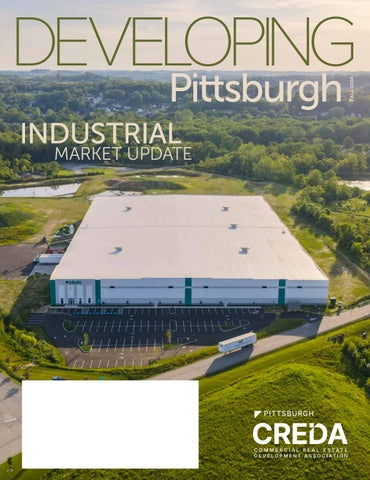
Fall 2026
INDUSTRIAL
MARKET UPDATE
FULL-SERVICE CIVIL ENGINEERING
Gateway Engineers is a full-service civil engineering and consulting firm that can design and manage your project from concept to completion. For over 70 years, the company has been at the forefront of innovation in the engineering industry. Today, the company effectively and efficiently manages thousands of projects a year for a diverse group of clients throughout the country.
PROJECT MANAGEMENT
SURVEYING
SITE CIVIL
GEOTECHNICAL
LANDSCAPE ARCHITECTURE
MUNICIPAL ENGINEERING
ENVIRONMENTAL
TRANSPORTATION
STRUCTURAL
ASSET MANAGEMENT/GIS
CONSTRUCTION ADMINISTRATION
INSPECTION/ TESTING
PITTSBURGH | BUTLER | SELMA | 412-921-4030 WWW.GATEWAYENGINEERS.COM
TRANSFERING A LEGACY
For decades, Domenic Dozzi’s leadership, vision, and unwavering commitment to quality have shaped Jendoco into one of the region’s most respected construction rms. His contributions have left a lasting legacy of excellence, integrity, and strong client and community relationships. Michael Kuhn, after working his entire professional career at Jendoco and serving as the company’s President since 2015, is honored to assume ownership and carry forward this proud tradition. With deep experience in the construction industry and a clear vision for the future, Michael is committed to building on Jendoco’s strong foundation while continuing to deliver exceptional service, innovation, and value to clients. Domenic will retain ownership of Jendoco Real Estate and related entities and remains committed to supporting the continued success of Jendoco Construction.
WWW.JENDOCO.COM
(412) 361.4500
2000 LINCOLN ROAD - PITTSBURGH, PA 15235
www.volpatt.com
#WeAreVolpatt commercial industrial institutional
BUILT ON INTEGRITY.
FOR COMMUNITY.
WITH QUALITY.
As a family-owned business, we are committed to strengthening the communities where we live and work.
PJ Dick | Trumbull | The Lindy Group Full-Service Construction • ( 412) 807-2000 • pjdick.com
CONTENTS
| Fall 2026
07
President’s Message
09
Executive Director’s Message
31
Developing Pittsburgh Interview DP Sits Down With Lou Oliva of Newmark to Break Down Pittsburgh’s Industrial Market
37
Eye on the Economy
45
Office Market Update Hanna Commercial
10
Industrial Market Update Industrial is finding its footing again as the pandemic supply wave recedes and new manufacturing opportunities bubble up.
49
Multifamily Market Update
55
Capital Market Update JLL Capital Markets
59
News from the Counties
67
People / Events
71
2026 CREDA Pittsburgh Buyer’s Guide
23 Development Profile The Chelsea Building Products Distribution Center Fall 2026 | DEVELOPING PITTSBURGH
5
th
26 ANNUAL
NIGHT AT THE FIGHTS
SAVE THE DATE
Thursday, November 12, 2026 5:00 PM - 9:00 PM Omni William Penn Hotel www.CREDApgh.com
PUBLISHER Master Builders’ Association of Western PA www.mbawpa.org MANAGING EDITOR Ben Atwood 412-922-3912 ben@mbawpa.org PRODUCTION Carson Publishing, Inc. Kevin J. Gordon kgordon@carsonpublishing.com GRAPHIC DESIGN Blink Advertising blinkadvertising.com CONTRIBUTING PHOTOGRAPHY CREDA ARCO Pittsburgh RVP Photography MBA CONTRIBUTING EDITOR Jeff Burd 412-366-1857 jburd@talltimbergroup.com ADVERTISING SALES Master Builders’ Association of Western PA 412-922-3912 info@mbawpa.org MORE INFORMATION: DevelopingPittsburghTM is published by the Master Builders’ Association for NAIOP Pittsburgh 412-928-8303 www.naioppittsburgh.com No part of this magazine may be reproduced without written permission by the Publisher. All rights reserved. This information is carefully gathered and compiled in such a manner as to ensure maximum accuracy. We cannot, and do not, guarantee either the correctness of all information furnished nor the complete absence of errors and omissions. Hence, responsibility for same neither can be, nor is, assumed. Keep up with regional construction and real estate events at: www.buildingpittsburgh.com
President’s Message
“A
bout two years ago I attended a township meeting where the supervisors were discussing a new ordinance around large solar panel installations. A resident testified that, in her research, she found that the noise emitted by cooling fans used in some of the electronic components measured 20 dB, and therefore, since hundreds of these units might be used, the resultant noise would be as deafening as a rock concert (#math). She received some approving nods from supervisors on the panel. In the following months, several Western PA municipalities have or are considering instituting ordinances that restrict solar development by increasing setbacks, physical screening requirements, and other punitive measures. Many are doing this because they’ve considered actual facts and the rights of private landowners versus the character of the community (you know, nuance). But let’s face it, we have A LOT of municipalities in our area, so determining motivation is a crap shoot. Solar development, like natural gas well pads and chicken coops, has had its moment in the public land-use discourse. A casually-informed public goes up against a largely out-of-town developer contingent with a clunky, niche use, speculators come in to fan the flames, and Facebook goes nuts. Rinse and repeat across municipal buildings throughout Western PA, and the local business landscape for an industry changes virtually overnight.
all agree on!). To clarify, I’m not promoting any particular development or sympathizing over the plight of an industry (though I can say with confidence that every industrial developer in CREDA with land in sight of a power line is salivating over the prospect of landing a datacenter). I am, however, reminded of the uniquely important role that we, the well-informed, local professionals of the CRE community can play in the public debate. In my two years as president of the Pittsburgh Chapter, Advocacy was always a top priority. While we can celebrate some development tail winds, it remains clear that our chapter’s core mission, including Advocacy and Education, is as relevant as ever. Thank you to all our members – you are experts in your fields and share a deep appreciation for the connection between good development and healthy, vibrant communities. Thank you for your continued leadership and energy you bring to our events and initiatives. We have a bright future. – Nate P.S. To our friends at CREDA Corporate in DC, my apologies on behalf of the Pittsburgh chapter. NAIOP, like Star Lake and Heinz Field, may stick around in the vernacular for a bit.
And then came datacenters. I’m pretty sure even the solar folks secretly wince at the public beating that datacenters are taking right now. Even utility companies are taking collateral damage (Harrisburg voted to cut utility company profits 30-40% last month – it’s the only thing they Nate Phillips NAIOP Pittsburgh President
Chelsea Building Products New Westmoreland facility image courtesy of RVP Photography
Fall 2026 | DEVELOPING PITTSBURGH
7
It’s a win-win for our region when labor and business are aligned. At Pittsburgh Works Together, we cover the impact of labor and business on Western PA’s economic health. Access research briefs, data insights and expert analysis at pghworks.com.
Pgh WorksTogether
Pgh_works
PittsburghWorksTogether
PghWorks
EXECUTIVE DIRECTOR’S MESSAGE
T
here is a lot to share as we look back on 2026, and I am proud of what this chapter has built through another busy year of advocacy, education, and connection. Your engagement remains the engine behind all of it, and the policy work in particular has carried real momentum into the back half of the year. Advocacy has been the story of the year. In the city, we stayed at the table on Mayor O’Connor’s permitting reform, one of the most meaningful changes to the city’s development timelines in years, and we kept the pressure on to make sure it delivers. We also hold our seat on the Steering Committee for Pittsburgh’s 2050 Comprehensive Plan, where our job is to keep the long-range vision grounded in how development actually works. At the state level, we turned our attention to Harrisburg’s SPEED program, the Streamlining Permits for Economic Expansion and Development initiative that lets qualified professionals move key DEP permits through review far faster
than before. For an industry where time is money, we will keep pushing to expand it. You may have noticed something different at the top of this letter. NAIOP Pittsburgh is now CREDA Pittsburgh, the Commercial Real Estate Development Association. This summer, after nearly six decades, our national organization retired the NAIOP name for one that says plainly what our members do across retail, multifamily, industrial, life sciences, and everything in between. The mission has not changed. We advocate, we educate, and we connect. The name simply caught up to the work, and it sharpens our voice with the policymakers we sit across from every day. I am also thrilled that Skyline Academy is back, welcoming its first cohort of high school students to a summer immersion in commercial real estate, run in partnership with Carlow University. Investing in the next generation of this industry is some of the most rewarding work we do.
volunteers, and Board of Directors, and to our chapter administrator, Erica Loftus, who keeps the whole operation running. A special thank you to our Board Chair, Nate Phillips, who completes his term at the end of the year. Nate’s time, energy, and leadership over the past two years have left this chapter stronger than he found it, and we are grateful for every bit of it. On a personal note, I got married on August 22nd to my beautiful wife Catie and I want to thank everyone who has reached out with words of wisdom and congratulations. It has truly meant a lot to see the support from our chapter. Here is to a strong finish to 2026, and to whatever we build together next.
Tom Frank Executive Director CREDA Pittsburgh
None of this happens without the people behind it. Thank you to our sponsors,
Get the best bank for your business. Your business is on the move. Making things, building things, and growing. At First Commonwealth Bank®, our promise is to help keep your business on the move with confidence. Contact us today to learn how we can be the best bank for your business.
Let’s make it happen, together. Jon Kowalski Regional President 724-778-3971
Fall 2026 | DEVELOPING PITTSBURGH
9
INDUSTRIAL MA
Let’s begin this feature inside your living room, where you’re on the couch, watching Love Is Blind with your wife. With a start, you realize your father’s birthday is two days away and you don’t have a gift. Time is tight, so you won’t be able to hit up Home Depot or Lowe’s. Instead, you hop onto Amazon, find a power drill, plug in his address, your payment info, and click order. Then you forget about it until two days later, when he calls to say thanks.
10
www.naioppittsburgh.com
ARKET UPDATE
“We're in a growth phase in Lawrence County.” That observation from Chip Abramovic, CEO of Forward Lawrence, captures the sentiment of most of the county and municipal leaders in the community of 85,000 people. In 2023, the Office of Management and Budget added Lawrence County to the defined Pittsburgh Metropolitan Statistical Area (MSA). That designation was probably overdue, as Lawrence County has many of the same challenges and characteristics as the Pittsburgh MSA overall. Once a manufacturing hub located between Pittsburgh and Youngstown, Lawrence County faced the same industrial decline that challenged those cities 40 years ago, and has seen success come from economic diversification.
Fall 2026 | DEVELOPING PITTSBURGH
11
F
N
ow let’s pull out a little. At the exact moment you pressed purchase, your neighbor is ordering a new hat. Across town, someone’s buying a Steelers jersey. A restaurant is replenishing its napkins. A contractor is ordering drill bits. A hospital is restocking surgical supplies. Throughout that very same evening, thousands of purchases are made across Western Pennsylvania. Hundreds of thousands across the Commonwealth. Millions nationwide. And every customer expects exactly the same thing: It’ll be there when I need it. If it’s not, I’ll be annoyed and start using a different site. This all occurs through a screen, most often one that is on a handheld device smaller than a sock. It has become so rote that we forget how incredible that is. Every order is unique. Every product comes from a separate location, many originating on other continents. Hundreds of millions of inputs and outputs so seamlessly integrated that you can get almost anything within 48 hours.
That’s absolutely wild. And it wasn’t always this way. Us ancients remember a time
12
www.naioppittsburgh.com
E
A
T
U
R
E
before Amazon, when wanting something meant going somewhere and if they didn’t have it stock, well that’s just what it was. How did such a remarkable improvement in capabilities come about? The answer isn’t a single technology, company or innovation but rather an insanely complex logistics ecosystem. This network is composed of ports, highways, railroads, trucks, aircraft, software, forecasts, workers, software, robots and warehouses all functioning flawlessly together. Every piece of that puzzle matters, but the most important for this audience is the distribution center. These remarkably plain buildings have been driving real estate development for years and their rather boring exteriors often hide extremely sophisticated organizational systems. These systems have been evolving for years, and while Amazon gets the lion’s share of credit for the explosion of warehouse development, it was Wal-Mart that got the ball rolling. They were the first retailer to develop military grade logistics capacity for consumer goods, which meant you could go there and
buy nearly anything cheaper than you could anywhere else. When Amazon began heating up, they poached a lot of Wal-Mart’s logistics specialists and took their ideas into the digital age. In doing so, they enabled almost anyone to buy almost anything from a screen. This proved quite popular with the populace, and Amazon immediately began eating into traditional retail sales. Big chains quickly realized that to compete with Amazon they needed to reorganize and expand their supply chain. This resulted in an explosion of warehouse development. From 2013 to 19, developers raced to construct hundreds of millions of square feet across the country. The pandemic poured gasoline on that fire. Almost overnight, Americans couldn’t shop in person and they couldn’t go anywhere. So, they stopped spending money on vacations, concerts, restaurants and sporting events. Instead, they redirected those dollars toward physical goods. Home offices needed desks and monitors. Backyards got new grills and patio furniture. Garages filled
E-Commerce continues to gain market share on retail purchasing (Source: Federal Bureau of Labor Statistics)
F
with exercise equipment. Bored children needed toys, televisions, computers. “The coronavirus was the greatest impetus for industrial real estate development, primarily warehousing, in a generation,” said Lou Oliva, Executive Managing Director at Newmark. “Interest rates dropped, industrial development exploded, and major users like Amazon were expanding aggressively. There was a huge appetite.” CoStar data shows that from 2020 to 23, over a billion square feet of industrial square footage came online across the nation. That’s about 36 square miles of warehousing, and remarkably, most of it leased. Vacancies only began to rise as the pandemic waned and consumer behavior shifted again. That meant fewer grills, home gyms, and televisions were moving through the supply chain. Durable goods spending, which surged 6.4 percent in 2020 and another 22.8 percent in 2021, settled into more sustainable low-single-digit annual growth, while services spending rebounded sharply.
E
A
T
U
R
E
Retailers suddenly found themselves with excess inventory and the frantic race for distribution space subsided. CoStar data shows a rapid decline in net absorption levels, which sent national vacancies from 3.5 percent to seven percent in two years. Developers pulled back, and construction starts began to drop in late 2022. As the market returned to a more sustainable pace governed by the traditional economic fundamentals that drive warehouse demand: consumer spending. By these measures, the sector’s outlook remains quite encouraging. Monthly retail sales have risen from roughly $453 billion in 2016 to approximately $747 billion through the first months of 2026, another alltime high. Online sales, a primary driver of warehouse demand, reached $326.7 billion during the first quarter of 2026, up 9.8 percent from a year earlier and now accounting for 16.9 percent of all U.S. retail spending. The nation’s rail network tells a similar story. Average monthly intermodal rail traffic has increased from roughly 1.09 million containers and trailers
Investment volume and total transactions have trended up for the third consecutive year (Source CoStar)
in 2016 to more than 1.21 million in 2026, the highest level in the series. So, the national softening of the market appears to be driven more by excess pandemic supply than collapsing demand. Multiple recent reports by major firms in the industry as well as data from groups like CoStar support the idea that the cooling was actually a healthy return to normalcy. A second quarter Cushman & Wakefield report on the sector indicates that leasing activity has strengthened as new development slows, particularly among larger users occupying modern logistics facilities. Prologis, the world’s largest industrial developer, reported record second-quarter warehouse leasing activity with 67 million square feet of leases signed and raised its full-year earnings and development outlook, citing strengthening demand for logistics space and rapid growth in data centers. A good sign a recovery is underway: investors have also begun returning to warehouse purchases after a two-year lull. CoStar’s data shows that national industrial property investment peaked in
Fall 2026 | DEVELOPING PITTSBURGH
13
F
2021, when more than 42,600 properties traded hands for approximately $166.3 billion. Activity slowed sharply over the next two years as higher interest rates reduced transaction volume, with annual sales falling to roughly $81.5 billion across 26,200 transactions in 2023. Since then, the market has steadily recovered. Annual sales volume increased to $95.5 billion in 2024 and $108.3 billion in 2025, while transaction activity climbed to more than 35,100 sales. Cushman & Wakefield’s 2026 report on the national industrial scene found that overall industrial capitalization rates averaged 6.23 percent, down slightly from 6.29 percent a year earlier, suggesting property values have stabilized after the rapid repricing that followed higher interest rates.
E
A
T
U
R
E
Cushman and Wakefield also noted that value-add projects with weighted average lease terms of three years or less are particularly attractive because they allow owners to capture market-rate rents more quickly. Location remains paramount, with investors favoring infill properties near population centers, interstate highways, available labor and reliable power infrastructure. An analysis of CoStar’s sales comps reveals where that capital is flowing at a more granular level. Every major region of the nation recorded higher industrial investment activity in 2025, although the pace of recovery varied. The South remained the nation’s largest destination for capital, with approximately $31.6 billion in industrial property sales, up 17.2 percent from the prior year. The
The increasing power and capability of artificial intelligence, which is what these power-hungry data centers are being developed for, promises to have an enormous impact on how distribution center’s function. Their study notes that the average cap rates declined from 5.36 percent to 5.28 percent for Class A properties and from 6.16 percent to 6.02 percent for Class B assets. They believe that acquisitions will likely accelerate in the coming quarters as buyers and sellers continue closing the gap between asking and offering prices. While Class A facilities in major distribution markets remain highly sought after, many investors are increasingly targeting well-located Class B industrial buildings with below-market leases that offer opportunities to raise rents as tenants renew.
14
www.naioppittsburgh.com
West Coast followed with $24.0 billion, an increase of 14.9 percent, while the Northeast reached $20.3 billion, up 10.5 percent. The Southwest posted the fastest growth, with sales volume climbing 17.8 percent to $16.8 billion and transaction activity increasing 29.4 percent. The Midwest recovered more gradually, with sales volume rising 3.9 percent to $15.6 billion despite transaction counts increasing 19.3 percent, suggesting a larger number of comparatively smaller transactions. The recovery has occurred without a meaningful decline in asset values. Average industrial sale prices increased
from $130 per square foot in 2021 to $153 in 2022, remained relatively stable at $151 in 2023, then climbed to new highs of $156 in 2024 and $157 in 2025. The strongest demand has centered on the largest facilities. Sales of buildings exceeding 500,000 square feet rose from 236 in 2024 to 342 in 2025, a 44.9 percent increase and the highest level since the pandemic-era boom. Mid-sized facilities also posted double-digit gains, while transactions involving industrial buildings larger than 100,000 square feet reached 36,471 in 2025, surpassing their 2022 level. In other words, the market is selfcorrecting after the greatest logistics disruption in the history of the planet. Barring another black swan event or serious economic slowdown, the longterm national forecast is bullish. That’s true nationally and locally, though the story in Western Pennsylvania is a bit more nuanced than in hubs like Columbus, Lehigh Valley, or Inland Empire. First, the overhead view: Pittsburgh’s industrial market has cooled but remains quite stable according to CoStar data, regional reports, and intel from local experts. “Our market is still very healthy, but things have normalized since the pandemic,” said Oliva. “Vacancy has ticked up a little but there’s a series of buildings that hit the market at roughly the same time so that’s not worrisome. The airport market, which has been our hottest area, has softened.” Rich Gasperini, Principal at Genfor Real Estate, concurs. “We definitely saw a slowdown in tenant demand throughout 2023 and 2024, but the market began improving toward the end of last year despite the initial macroeconomic uncertainty surrounding tariffs. Today, we’d characterize the industrial market as stable and continuing to improve, with supply and demand remaining in balance in Pittsburgh, which leaves us optimistic about where the market is headed.” Vacancies have climbed slightly, but at 5.6 percent, they remain some of the tightest in the country. This is due in large part to constrained construction. Pittsburgh’s
F
E
A
T
U
R
E
The south continues to attract the strongest levels of investor interest (Source CoStar)
industrial inventory has grown from approximately 238 million square feet in 2021 to 244 million square feet today, an increase of just 2.7 percent. Developers have delivered roughly 6.4 million square feet of new industrial space during that period, including approximately 623,000 square feet over the past 12 months, well below the pace seen in many competing logistics markets. Development was also not concentrated exclusively in large distribution centers. Of the roughly 38 projects completed during that period, 25 ranged in size between 10,000 and 50,000 square feet, underscoring the region’s continued demand for smaller and mid-sized industrial facilities alongside larger logistics assets. “The deal size here is a lot smaller here than at the national level,” said Dom Broglia, the head of Business Development at ARCO. “Leases are typically done are anywhere from 10,000-50,000 SF. A large sized
projects here is 200,000 square feet.” And demand has largely kept pace with the new supply. CoStar shows that vacancy among buildings completed since 2022 currently stands at approximately 11.5 percent, an improvement of 1.8 percentage points compared with one year ago. The region has recorded approximately 542,000 square feet of positive net absorption over the past 12 months, and much of that has been driven by a handful of major occupiers. EOS Energy signed a 430,000-squarefoot lease at 150 Thorn Hill Road in the North Pittsburgh submarket, while Mondi Packaging USA committed to 232,000 square feet in West Pittsburgh. U.S. Steel also expanded its footprint, leasing 225,000 square feet in South Pittsburgh. Over the past 12 months, the strongest leasing activity is concentrated in just a few submarkets. CoStar shows that Beaver County led the region with nearly 490,000 square feet of positive net
absorption, followed closely by North Pittsburgh at more than 493,000 square feet. Westmoreland County also posted healthy gains with nearly 191,000 square feet absorbed. Those gains were offset by notable moveouts in South Pittsburgh, which recorded negative absorption of roughly 520,000 square feet, and Parkway East, where occupancy declined by approximately 200,000 square feet. The market’s strength can also be seen by a return of capital. After peaking at nearly $500 million in 2021, Pittsburgh’s industrial investment market cooled sharply as rising interest rates, higher borrowing costs, and a widening gap between buyer and seller pricing slowed transaction activity. Sales volume fell to just $128 million in 2023 before rebounding over the following two years, reaching $362 million in 2025. While annual dollar volume remains below the post-pandemic peak, transaction activity tells a different story. The market
Fall 2026 | DEVELOPING PITTSBURGH
15
F
E
A
T
U
R
E
Investment activity continues to pick up, though figures have not yet returned to pandemic levels (Source: CoStar)
recorded a five-year high of 270 completed sales in 2025, suggesting investors have returned with greater confidence, albeit focused on smaller transactions and more disciplined pricing rather than the large portfolio acquisitions that characterized the market’s earlier surge. CoStar currently tracks just seven industrial projects under construction across the Pittsburgh market, reinforcing the region’s measured approach to new supply. Together, these projects represent a little more than 1.1 million square feet, with only one development exceeding 300,000 square feet. The largest is a 325,000-square-foot building at 360 Keystone Drive, followed by a 232,400-square-foot warehouse on International Drive. Beyond those, the pipeline consists primarily of buildings ranging from roughly 85,000 to 160,000 square feet, including projects geared toward manufacturing, distribution, and warehouse users.
16
www.naioppittsburgh.com
The reason for the regional’s subdued development is simple: Pittsburgh is not and will never be a logistics hub in the way that markets like Lehigh and Columbus are. “We’re what I call a ‘tweener’,” said Oliva. “Columbus can cover us and Lehigh Valley can cover us. But both can still go the other direction and hit millions of people. Pittsburgh’s geography made it an industrial powerhouse during the era of rivers and railroads. Modern distribution networks, however, are built around interstate highways, truck drive times, and proximity to population centers.” “There aren’t many developers here that are interested in building speculatively,” confirmed Broglia. “But there are a lot of opportunities here with data centers and manufacturing.” While much of the country focuses on where data centers are being built, Western Pennsylvania is increasingly
positioned to manufacture the equipment, electrical systems, specialty metals, and industrial components that make those projects possible. Take another look at those most recent leases and headlines: EOS Energy, U.S. Steel, Lighthouse Electric, Mitsubishi Power, GE Verona. They all deal with power production or components needed to make hyperscaler data centers function. In fact, of the 15 deals larger than 100,000 square feet that were signed since the end of 2024, 11 were for companies producing energy and construction equipment that will likely be needed by the data centers. “Lighthouse Electric kind of explains where it’s going,” said Broglia. “Energy storage, battery storage. Pittsburgh and Western PA is finding its footing with the manufacturing for these centers.” Gasperini agrees. “Companies in this energy supply chain—supplying components for data
BUILDING EXCELLENCE
CHALLENGING OURSELVES TO EXCELLENCE AND BEING THE LEADER IN THE MECHANICAL CONSTRUCTION INDUSTRY Instagram / Facebook
@mckamish.inc
McKamish Inc.
Phone
412-781-6262
Website
www.mckamish.com
Named a Top Architecture Firm by Architectural Record
We Make Building Projects a Better Value •
Ranked a Top Workplace Interiors Architecture Firm by Building Design + Construction Recognized as a Top Multifamily Architecture Firm by Building Design + Construction
Architecture • Engineering • Interior Design • Planning + Project Services
412-287-7333
18
www.naioppittsburgh.com
aeworks.com
Pittsburgh, PA • Washington, DC
F
E
A
T
U
R
E
(Source CoStar)
centers—their business is good. All indications are it will remain good for the next five to ten years. Thankfully, they’re making sizable investments in the region, and we think that will continue.” Of course, the controversy stemming from these data centers largely pertains to the strain they place on the power grid. And this issue, rather than lack of demand, is likely the biggest impediment facing the market right now. “Unfortunately,” said Oliva, “I’ve had to become much more conversant on that topic because it’s the first time in my career that power has become a limiting factor.” “What I’ve learned is that once Duquesne Light got out of the generation business and became strictly a distribution utility, the economics changed. I don’t pretend to understand every PUC regulation involved, but the bottom line is this: it’s becoming a real problem.” For decades, industrial developers evaluated prospective sites based
on access to interstate highways, rail service, available labor, water and sewer infrastructure, and proximity to customers. Those criteria remain essential, but the surge in electricity demand from advanced manufacturing, warehouse automation and artificial intelligence has added another question that, in some cases, outweighs all the others: Is there enough power available to support the project? The challenge has been years in the making. As detailed in Breaking Ground’s March/April 2025 Energy Market Update, the nation’s electric grid entered this decade with supply and demand already moving in opposite directions. Coal-fired power plants have continued to retire, replacement generation has struggled to come online quickly enough, and PJM Interconnection’s lengthy approval process has slowed the addition of new capacity. At the same time, electricity demand has accelerated as homes, vehicles and industries become increasingly electrified. Artificial intelligence has amplified that
trend rather than created it, exposing constraints that energy producers and utilities had warned about for years. Industrial development has become one of the clearest examples of those changing dynamics. Modern warehouses consume substantially more electricity than their predecessors because of sophisticated conveyor systems, robotics, automated storage and retrieval equipment, and increasingly complex building management systems. Advanced manufacturers require even greater electrical capacity to support high-powered machinery, precision production equipment and climatecontrolled processes. Data centers have fundamentally altered the scale of the discussion altogether. Engineers interviewed for the Energy Market Update explained that traditional data centers typically required between 100 and 300 watts per square foot, while new artificial intelligence facilities can approach 1,000 watts per square foot and often require liquid cooling
Fall 2026 | DEVELOPING PITTSBURGH
19
F
systems that dramatically increase overall energy consumption. Some projects now demand hundreds of megawatts of electricity—enough to rival the consumption of small cities. Those unprecedented requirements are reshaping development strategies nationwide. Rather than waiting years for utility upgrades, many of the country’s largest industrial projects are now being designed with dedicated on-site generation or “behind-the-meter” power systems that operate independently of the traditional electric grid. Others are locating near existing power infrastructure or pursuing sites capable of supporting future transmission upgrades. At the same time, shortages of transformers, turbines and other electrical equipment have created another bottleneck, extending project schedules while increasing costs. The increasing power and capability of artificial intelligence, which is what these power-hungry data centers are being developed for, promises to have an enormous impact on how distribution
E
A
T
U
R
E
center’s function. Cushman & Wakefield argues that AI will fundamentally reshape logistics by reducing one of the industry’s greatest challenges: uncertainty. Today’s supply chains rely on large inventories, excess warehouse space, and complex distribution networks because companies cannot perfectly predict what consumers will buy or when they will buy it. AI promises to dramatically improve demand forecasting, allowing businesses to position inventory more intelligently, optimize transportation routes in real time, and automate warehouse operations. The report also suggests these advances will change the types of industrial properties companies seek. Rather than functioning simply as places to store products, warehouses are expected to evolve into highly dynamic fulfillment hubs where AI continuously orchestrates inventory, robotics, labor, and transportation across an entire logistics network. As warehouses become increasingly automated and AI-powered, access to
reliable electricity, digital connectivity, and modern infrastructure will become as important as traditional site-selection factors such as highways, rail access, and labor availability. This strongly hints that the power issues that have surfaced in the past few years is a long-term challenge for the industrial sector. Overcoming this power issue will likely be the story of the next few years. It will be immensely complicated and expensive. But imagine the payoff. One day an AI may know that a thunderstorm is about to knock out power in Washington County, a Steelers playoff win will send jersey sales soaring, a contractor in Cranberry is likely to run short on conduit by Tuesday afternoon, and that you’re about to remember your father’s birthday approximately seventeen minutes before dinner. Hundreds of robots begin moving simultaneously—not because anyone ordered them to, but because the future has become predictable enough that the warehouse starts acting before America does. DP
At Desmone, we design buildings and spaces that allow people to thrive – physically, emotionally, and spiritually. Our unique service journey is rooted in effective delivery strategies and informed by principles of health and wellness. We believe that healthy spaces lead to healthy people, and healthy people lead to a healthy world.
Pittsburgh, PA | Morgantown, WV | Cleveland, OH
desmone.com
DESIGNED TO THRIVE 20
www.naioppittsburgh.com
S&T and your business, better together. Our commercial real estate team can identify the strategies and financial solutions to help meet your business goals. Talk to us today!
800.325.2265 • stbank.com MEMBER FDIC
LEGAL INFRASTRUCTURE FOR EVERY DEAL
MBM Lawʼs Real Estate Team structures, negotiates, and closes complex transactions for owners, developers, and investors. From financing, joint ventures, and leasing, we help you get the deals done. Award-winning team all recognized in Best Lawyers in America® 2024, 2025, and 2026 for Real Estate Law Lawrence J. Maiello | John H. Prorok Jennifer L. Cerce | Kathleen C. McConnell Contact us to support your next acquisition, redevelopment, or repositioning. 412.242.4400 | mbm.law Fall 2026 | DEVELOPING PITTSBURGH
21
OUR SERVICES General Contracting Design/Build
TRUSTED EXPERTS SINCE 1956
Development Owner’s Representation
Our history and expertise as commercial real estate investors allow us to understand and actively participate in all phases of the deal cycle as no other general contractor can. Our team efficiently manages all aspects of construction, ensuring quality workmanship, adherence to timelines, and cost-effectiveness for our clients’ development and construction projects.
Move Management
INTERESTED IN SEEING MORE OF OUR PORTFOLIO?
EDGEWORTH SECURITY Moon Township
TOASTIQUE Mt. Lebanon
WASHINGTON COUNTY PUBLIC SAFETY BUILDING Washington County | New Public Safety Building
THE VISION ON FIFTEENTH Pittsburgh
EAU STREET ENTRANCE
dd 1
3/9/2026 2:09:49 PM
ARMADA SUPPLY CHAIN SOLUTIONS Wexford
412.250.3000
LONGEVITY LABS South Oakland
FOR MORE INFORMATION CALL 412 .250.3000 OR VISIT NAIBURNSSCALO.COM
Development Profile
The Chelsea Building Products Distribution Center
I
n December of 2023, Chelsea Building Products purchased nearly 30 acres of land inside the Commerce Crossing at Westmoreland industrial park and announced their intentions to build a new 228,000 square foot manufacturing facility on the site.
I-70 and the Pennsylvania Turnpike, the state’s two major trade corridors. Highway routes are a fundamental demand driver for logistics, and quick access to them are a main reason that Westmoreland County operates on a difference scale than the rest of Pittsburgh’s industrial market.
In a press statement, Chelsea CEO Peter Dewil expressed enthusiasm for the company’s expansion, their second location in the Pittsburgh region and third nationally. He also noted that the site offered an incredibly strategic spot for growth.
Just look at the data. CoStar shows that Westmoreland contains nearly 42 million square feet of industrial square footage, dwarfing every other submarket in the Pittsburgh MSA. Though there are several industrial nodes within the county, one of the most active is inside an eight-mile radius around New Stanton.
This is certainly undeniable. Located just west of New Stanton, the Commerce Crossing industrial park butts up against
Why is that? A quick glance at a map and its obvious: New Stanton sits right at
the aforementioned juncture of I-70 and the turnpike, giving manufacturers and distributors the direct access they crave to major markets throughout the Midwest, East Coast, and the entire Pittsburgh MSA. But why do these routes converge in New Stanton? And what makes Westmoreland County Pittsburgh’s logistics node rather than Fayette or Armstrong? That is a little less clear and to understand it, you have to go back a few years. Roughly 300 million of them, to be precise. That’s when the land mass we now call the North American continent was crashing into Africa. This titanic impact buckled the earth’s crust for thousands of miles and created the
Fall 2026 | DEVELOPING PITTSBURGH
23
Appalachian Mountains, whose peaks once rivaled the Himalayas of today. And behind the mountains, it created an enormous plateau of elevated rock, which we all live on. Look at a topographical map of the region and the differences are clear. In the center of the state, roughly running from Bedford to Williamsport, the Appalachians form long, parallel ridges that resemble the crest of a giant wave frozen in stone. That’s (obviously) the mountain range. But west of Altoona, the orderly ridges disappear. There, the landscape dissolves into a chaotic maze of hills, hollows and winding stream valleys stretching toward Pittsburgh and into the Ohio River Valley. That’s the plateau. From a logistics standpoint, navigating through the Appalachians is easy enough to understand. Because of their north/ south length, it makes little sense routing north of Harrisburg a few hundred miles only to pivot west and hit them anyway. So, any westward journey must begin at the edge of the Susquehanna River Valley near Shippensburg. Traverse those ridges and you will eventually arrive at the chaotic plateau. It’s rugged hills, rivers, and creeks placed hard limitations on the flow of movement but provide plenty of options. For logistics, the trick is to find the most efficient path. And by sheer geological happenstance, the best routes through that labyrinth were located inside of what would become Westmoreland County. Throughout this state’s history, logistics planners repeatedly returned to Westmoreland in order to move goods in and out of Western Pennsylvania. The British army created a fort in Ligonier because it was the ideal point for a supply chain link connecting its soldiers with food and munitions from the east. Later, industrial barons utilized this same region to haul thousands of tons of coke and coal from their mountain mines to the Pittsburgh mills. And later still, planners for the Pennsylvania Turnpike realized the best route across the Commonwealth ran through the county.
24
www.naioppittsburgh.com
The highway routes converge in New Stanton because the region offers the best plateau access routes east and west, as well as north and south. And access to that intersection was a primary driver behind the creation of the Commerce Crossing Industrial Park. The park’s origins trace back over a decade. The Westmoreland County Industrial Development Corporation had pinged the site as ideal for future growth. It was close to the highways, Westinghouse already had a presence nearby and were contemplating expansion, and a rail spur already existed. But it was still mostly 206 acres of raw land. Starting in 2013, they began funding and installing utilities like water and sewer lines, before purchasing the site in 2018. They then performed grading and site prep work and carved it out into five parcels, ranging in size from 18 to 29 acres. “The convergence of rail, Westinghouse and I-70 essentially placed a big X on the map at that location,” said Brian Estadt, Director of Marketing at the Westmoreland County Industrial Development Corporation. In 2019, AI. Neyer (now Merus) optioned 53 of those acres. In 2021 they broke ground on a 250,000 square foot spec warehouse. Shortly after that facility opened, Chelsea Building Products committed. And for their project, they chose ARCO Pittsburgh. ARCO is one of the nation’s largest design-build construction firms and it
opened its Pittsburgh office in 2023. It operates under the leadership of Pittsburgh native Gary Gabor, who cut his teeth building industrial facilities from the company’s King of Prussia office, working in areas like the white-hot Lehigh Valley. Although ARCO has completed projects across the country, the firm entered a market where few owners knew its name. The firm initially pursued a strategy of leveraging its relationships with national developers and manufacturers
to bring new investment into Western Pennsylvania; however they soon realized that Pittsburgh is a far different market than Lehigh. “We realized that the relationships run a lot deeper in the Pittsburgh market,” said Dom Broglia, ARCO’s director of business development.
The timing was also less than ideal. Just as the office opened, rising interest rates and tighter financing sharply slowed speculative industrial development nationwide. Instead of arriving during a warehouse boom, ARCO found itself entering one of the quietest construction markets in years.
Rather than retreat, the young office used “Coming here, nobody even knew who the slowdown as a chance to plant seeds. ARCO really was, even though we were one “The market across the nation was having of the bigger players across the country.”
a hard time just making things pencil,” said Gabor. “We used it as an opportunity to develop a lot of good relationships.” The firm used the development lull to cultivate relationships with developers, manufacturers and economic development organizations throughout the region, positioning itself for projects when investment returned.
Fall 2026 | DEVELOPING PITTSBURGH
25
Industry Intelligence. Focused Legal Perspective. Unparalleled Value. HIGH-YIELDING RESULTS.
Real Estate
Acquisitions & Development
Land Use & Zoning
Environmental & Regulatory
Construction Services
Commercial Litigation
We are critical thinkers who are focused, driven and cost effective in everything we do. Meet our attorneys at babstcalland.com.
PITTSBURGH, PA | CHARLESTON, WV | HARRISBURG, PA | LAKEWOOD, NY | STATE COLLEGE, PA | WASHINGTON, DC
That opportunity arrived later in 2023 when Chelsea Building Products selected ARCO to design and construct its new 228,000-square-foot manufacturing facility at Commerce Crossing. For Chelsea, the project would provide room to expand production. For ARCO, it became the Pittsburgh office’s first major opportunity to prove that a national
builder could successfully establish itself in Western Pennsylvania’s relationshipdriven industrial market. At first glance, Chelsea’s new facility appears to be a straightforward industrial building. “The box itself is pretty simple, said Jack Perfett, Design/Build manager at ARCO.
“It’s four concrete walls, a concrete slab and a roof.” But like many modern warehouses, the simple exterior hides the complexity required within. “We built it with warehouse in mind,” Perfett elaborated. “But really looked into the future of, ‘What are you guys, in 10 years, going to utilize this building for?’” The answer is manufacturing. Chelsea Building Products produces something that nearly everyone has but scarcely ever notices. Most homeowners and apartment dwellers never think about what holds their window together. They see glass, a latch and a white vinyl frame. Hidden inside that frame, however, is an intricate network of hollow chambers engineered to support hundreds of pounds of glass, resist decades of ultraviolet light, shed water, improve insulation and withstand the constant expansion and contraction caused by changing temperatures.
Fall 2026 | DEVELOPING PITTSBURGH
27
Those structural components are the products Chelsea Building Products manufactures. The process begins with a specialized PVC compound. Chelsea blends its own proprietary formulations before melting the material and forcing it through custom-machined steel dies under immense pressure. As the plastic emerges, it takes the shape of highly engineered profiles, continuous lengths of precisely formed material whose dimensions are controlled to within thousandths of an inch. The profiles are then cooled, cut and shipped to window and door manufacturers across North America. The new facility expands that role by producing both the PVC compound itself and the finished extruded profiles. Some of the material will be converted into window and door components on site, while the remaining compound will be shipped to Chelsea’s manufacturing operation in Greenville, Texas, where it will be used to produce the same engineered profiles. Rather than simply adding another manufacturing plant, the project strengthens a key link in the supply
28
www.naioppittsburgh.com
chain behind one of the most common products in modern construction.
production, all of that infrastructure will be in place.”
Plans call for as many as 30 PVC extrusion lines to eventually occupy the facility, each requiring water, power and process utilities. To avoid disrupting future production, ARCO incorporated an extensive network of underground utility trenches beneath the concrete floor, allowing those services to be installed and expanded without tearing apart the building as new equipment comes online. Likewise, the electrical infrastructure was designed to accommodate the significantly higher power demands of a fully built-out manufacturing plant, even though much of that capacity will not be needed for years.
This pre-wiring of utilities was the most complex part of the build, but nature created its own natural challenges. Because the Chelsea parcel was engineered as a flat pad-ready site, heavy rainfall tended to pool on the property during construction. During one of the wettest construction seasons in recent memory, repeated rainstorms threatened to delay earthwork as crews struggled to establish a stable building pad. To keep the project moving, ARCO stabilized the site with soil cement, creating a firm working surface that allowed vertical construction to begin despite the saturated conditions.
“The more complicated the tenant is and the more complicated their requirements are the interiors and the utility package and those can get complicated pretty quickly,” said Perflett.
Even with those setbacks, the project stayed on schedule. ARCO credited that success less to field improvisation than to months of planning before construction ever began. Working under a design-build delivery model, the firm’s architects, engineers and construction managers developed the building, site layout and
“Some of may not be used for 20 years, but when they do decide to ramp up their
In many ways, Chelsea Building Products' new facility is simply the latest chapter in a logistics story that has been unfolding for centuries. Long before there were interstate highways or industrial parks, the geography of Westmoreland County directed people, commerce and investment through this corner of Pennsylvania.
By the time excavation began, many of the coordination issues that typically generate delays had already been solved. The approach allowed Chelsea to move forward with a guaranteed cost, simplified decisionmaking and a facility that was delivered roughly two weeks ahead of schedule.
for centuries. Long before there were interstate highways or industrial parks, the geography of Westmoreland County directed people, commerce and investment through this corner of Pennsylvania. The British recognized it. Railroad builders recognized it. Highway engineers recognized it. And today, manufacturers continue to reach the same conclusion.
In many ways, Chelsea Building Products’ new facility is simply the latest chapter in a logistics story that has been unfolding
But geography alone doesn’t determine success. People do too. And Commerce Crossing at Westmoreland exists because
budget simultaneously, resolving conflicts before they reached the field.
local leaders understood that enduring advantage and spent years transforming raw land into a construction-ready industrial park. ARCO’s first major Pittsburgh project, Chelsea’s expansion, and the jobs expected to follow are the dividends of that vision. While the building itself may be new, the forces that brought it here are anything but. In Western Pennsylvania, the map has been pointing to this location for generations. DP
Fall 2026 | DEVELOPING PITTSBURGH
29
Developing Pittsburgh Interview DP Sits Down With Lou Oliva of Newmark to Break Down Pittsburgh’s Industrial Market Thanks for sitting down with us, Lou. Give our readers a real quick intro: How long have you been doing this and how’d you end up in the industrial world? I started in 1986, when I joined Oliver Realty after graduating from Carnegie Mellon. At the time, they handled the leasing and property management for Oliver Tyrone Corporation, one of Pittsburgh’s longtime developers whose roots traced back to steel industrialist Henry W. Oliver. Shortly after I came aboard, Oliver Realty was acquired by Grubb & Ellis, one of the first commercial real estate firms to build a national platform by acquiring established regional companies. Grubb & Ellis eventually became part of what is now my current firm, Newmark. When I started, most brokers were focused on office leasing and property management, but I looked around and saw an opportunity in industrial real estate. It wasn’t a glamorous side of the business, but many of the brokers specializing in it were nearing retirement. Even though Pittsburgh was still working through the collapse of the steel industry, I believed there was an opportunity in the sector. Forty years later, that decision has given me the opportunity to work on some incredible projects and watch the market evolve into one of the region’s most important sectors. It’s certainly been an interesting period for the industrial sector. How has it evolved in the years since COVID? Obviously, the coronavirus was the greatest impetus for warehouse development in a generation. Interest rates dropped and major users like Amazon were expanding aggressively, so development exploded. There was also a huge appetite for investment as cap rates hit record lows while valuations reached historic highs. The markets are still very healthy, but things have since normalized. Development
has slowed in response to the cooling demand and also because construction costs and interest rates remain high. As a result, the lease rates needed to make new construction work are becoming increasingly difficult to justify. Another potentially interesting byproduct of the pandemic that I’m watching out for is what happens as the pandemic leases roll over and the COVID-builds need to be refinanced. We saw something similar happen in the office sector: buildings were financed in a lowinterest-rate environment, then demand softened and lenders couldn’t support the same valuations. And how would you describe the health of the Pittsburgh market? Things have normalized here, too. Vacancies have ticked up a little but there’s a series of buildings that hit the market at roughly the same time, so that’s not too worrisome. The airport market, which has been our hottest area, has softened a little. There’s also a handful of buildings that have been vacant two or three years in other submarkets that make you wonder why they haven’t leased. But at the same time, we see buildings lease that we thought were, I don’t want to say functionally obsolete, but challenging, to say the least. And there’s certainly demand for more industrial space. Amazon now has seven or eight facilities here, including two that are more than a million square feet. We’ve also heard from other large users looking at major sites. We’re still healthy. I’ve always said that Pittsburgh is the tortoise, and the big markets like Columbus and Lehigh Valley are the hares. We’re slow but steady and have been that way for a long time. Where does Pittsburgh fit in with the national logistics market. Are we primarily a pass-through distribution node, or is it more of a last-mile market serving the local region?
Our market is unique. Pittsburgh’s geography made it an industrial powerhouse during the era of rivers and railroads, but modern distribution networks are built around interstate highways, truck drive times, and proximity to population centers. Much of the nation’s warehouse development is in locations where a single distribution center can reach the most customers in a day’s drive. These are places like Columbus, Dallas, Lehigh Valley, et cetera. We’re what I call a “tweener”, meaning that we’re between Columbus and Lehigh Valley. They can both cover us and can also go in the other direction and hit tens of millions more people. Consequentially, there’s not going to be many mega-centers built here. But companies have a few different models for large-scale distribution depending on their needs and resources. Some might have five mega centers across the country; others want a more regional footprint. We tend to attract the latter, companies that operate regional networks with 15 to 20 distribution centers. Our terrain and history create unique challenges, too. Our geography is a bit constricting and finding suitable sites isn’t as straightforward as it is in competing markets. Also, our industrial market isn’t concentrated in one large region like in many other cities. Instead, it’s made up of dozens of smaller industrial pockets spread throughout the area. Take the Route 28 corridor. Historically it was riverfront industry, and now much of that has disappeared. But there are very few sites where you could build a modern 100,000 square- foot or 200,000-squarefoot multi-tenant industrial building along that corridor. The same is true south of the city along the Route 51 corridor. That’s tied into our manufacturing past, but the larger issue is that Allegheny County has 130 municipalities, each with their own zoning. That can also make
Fall 2026 | DEVELOPING PITTSBURGH
31
the market harder for outside developers and investors to understand, because they expect to find one large industrial corridor, when in reality our market is much more fragmented. You mentioned being an industrial powerhouse. U.S. Steel seems to be making some big moves, have you seen
any other signs of a local push toward more domestic manufacturing?
but I think it will ultimately be a positive for the region.
There are definitely signs of it. The new federal policies are encouraging companies to bring manufacturing back to the U.S., and we’re starting to see that reflected in our market. The Nippon Steel situation will take time,
What’s particularly interesting to me is how much of that investment is tied to energy. Mitsubishi Electric Power Products is expanding transformer manufacturing. ATI continues investing in Brackenridge. GE Verona acquired a large facility along I-70 for future expansion. Lighthouse Electric is growing in Washington; EOS Energy is growing in Cranberry. These aren’t isolated projects—they’re all connected to the nation’s growing demand for electrical infrastructure and power generation. I think that’s the next wave of manufacturing that could shape Pittsburgh’s industrial market. The challenge isn’t demand; it’s capacity. We’re site constrained. Most of the industrial sites we have today can accommodate buildings in the 200,000- to 300,000-square-foot range. We’re probably not a million-square-foot market, but if someone came to us tomorrow looking for a site to build a facility that size, we simply wouldn’t have one to offer. Can that change, or is that just the reality of this region because of the topography? Topography is certainly part of it, but it’s not the whole story. There’s very little private industrial land development happening in Allegheny County. Other than my client, Imperial Land Corporation, there haven’t been many active private developers creating new industrial sites. Most of the heavy lifting has been done by a few industrial development organizations. Westmoreland County IDC, for example, has developed nearly 20 business parks and has done an outstanding job accommodating both local companies and national users. Butler County has had success as well through its development corporation, with projects like Victory Road Business Park. Within Allegheny County, though, it’s a different story. Outside of airport properties and a handful of isolated sites, I don’t know where the next 1,000-acre industrial site is going to come from.
32
www.naioppittsburgh.com
What makes the airport area so appealing to logistics firms? The reason the airport area has been so desirable is that we created a supply of development-ready sites over the course of decades. We solved an infrastructure problem. People your age or my son’s age have no idea that in the 1990’s if you were heading south on I-79, you couldn’t go west of the airport. If you were coming in from the airport, you couldn’t go north on I-79. The airport has really been the focus of my career. When we started Pittsburgh’s NAIOP chapter, six of us were looking around after the collapse of the steel industry asking what the next engine of growth would be. We quickly realized Pittsburgh was the only airport without a full interstate connection. We spent years pushing for improvements to I-376, building coalitions, applying political pressure. We worked with local governments, the school district, and the Turnpike Commission to finance water and sewer improvements through tax increment financing, which solved utility challenges making development possible. So much had to happen behind the scenes, and places like Findlay Township are great. They were so welcoming for development. It’s a two-meeting process and you’re up and running in 60 days. In a lot of areas, that isn’t the case, which is why there are certain regions that haven’t developed because they haven’t solved that infrastructure problem. Will the recent airport expansion have an impact on the industrial market? I think the airport’s done a great job. It’s fantastic and important for corporate office users to enable growth. The other day I heard an interesting stat: we now have more origination and destination travelers in Pittsburgh now than we did when it was a US Air hub. That’s truly remarkable. How can we get industrial development to take advantage of that? The more industrial application would be from air cargo opportunities. We’re still not a huge air cargo player but when you hear about New York or New Jersey being at capacity, we’re an inexpensive alternative. That could be a potential growth opportunity. And has the Southern Beltway been an economic generator for the industrial sector? Much of the land along the corridor was acquired years ago with the expectation that it would eventually connect to I-79 and I-376. Now that the extension from Route 22 to I-79 has been open for a couple of years, those plans are beginning to materialize. The Fort Cherry development is one example. Its first phase is underway, Old Dominion Freight Line has committed to a major truck terminal, and other industrial users — including data center developers — have explored the site. That said, the Southern Beltway is unlikely to become an endless corridor of warehouses. There simply isn’t that much land along
Fall 2026 | DEVELOPING PITTSBURGH
33
I-576 that’s zoned for industrial development. I think we’ll have a couple million square feet at some point in time, but I think my son will probably be taking care of that over the next decade. If you could solve one problem that would immediately improve the region’s industrial competitiveness, what would it be? It’s a tie between electric and permitting. And the permitting…is that the fragmentation we were talking about earlier, where Findlay Township has one set of development rules and Scott Township has another? Correct. Is that just a PA thing? I think it’s very much a Pennsylvania issue. Markets like Phoenix and Columbus are much more organized around regional growth. In many cases, development and zoning decisions are made at a county level rather than by dozens or even hundreds of individual municipalities. Western Pennsylvania is far more fragmented. Allegheny County alone has 130 municipalities, each with its own zoning and development process, making it much more difficult to coordinate large-scale projects. I’ve always said that if we simply consolidated those municipalities along the lines of our 42 school districts, we’d probably be better off from an economic development standpoint. Is that possible or is that just what it is. It hasn’t happened in my career. I hope it might happen during my son’s career. What about the power situation? Is that fixable? Unfortunately, I’ve had to become much more conversant on power because it’s the first time in my career that it’s become a limiting factor. What I’ve learned is that once Duquesne Light got out of the generation business and became strictly a distribution utility, the economics changed. I don’t pretend to understand every PUC regulation involved, but the bottom line is that power has become a real issue. Take Findlay Township. It’s been one of the most successful industrial development corridors in Western Pennsylvania over the past 15 years, yet we’re effectively out of electrical capacity. We found that out the hard way. We had a project that was ready to close. Early on, we were told power wouldn’t be an issue. Six months later, the answer changed. Suddenly, the capacity wasn’t there. To me, that’s backwards. When a region consistently attracts industrial development, utilities should be planning for that growth instead of reacting after projects are already underway. You can see the same issue playing out across the region in different ways. Homer City has tremendous transmission
34
www.naioppittsburgh.com
infrastructure and electrical capacity, which is why I’ve always thought it was a natural candidate for a hyperscale data center. Then you have places like Beaver County and Springdale, where developers are increasingly being told they’ll need to provide their own on-site power generation for data center projects.
clear picture of what electrical capacity is actually available. What we need is better communication on the front end. What’s available today? Where are the shortfalls? What upgrades are already planned? Developers need those answers before they’re investing millions of dollars into a project. The challenge is that no individual landowner can afford to build a new 20- or 40-megawatt circuit on speculation. They’re preparing sites and waiting for end users. Once those users commit, the infrastructure can move forward. But somebody has to identify what’s needed before we get to that point. That’s the piece we’re missing today.
But that’s only part of the equation. These companies don’t just want on-site generation—they also want a strong utility connection. They want the reliability and redundancy that comes from having both. Building your own power plant may work for a hyperscale data center, but it still doesn’t solve the problem for a typical 100,000-square-foot warehouse or manufacturing facility. That’s not a realistic Have power issues hampered option for them. development across the country? That’s where I think there needs to be Oh, absolutely. To me, that’s the biggest some common sense. I’m hopeful these issue facing the industry moving issues get resolved because they’re forward. How do markets like Columbus, becoming a real obstacle. Whether it’s Pittsburgh and others meet the growing Westport and Findlay or some of the demand for power—not just for data outlying counties served by FirstEnergy, centers, but for industrial development as I’m hearing the same thing: projects are a whole? taking longer because nobody has a
My biggest concern in Pittsburgh is that we’re already seeing challenges getting electrical service for your bread-andbutter industrial projects. Data centers consume such an enormous amount of electricity that they’ve changed the conversation. Everyone is asking where that power is going to come from, what it’s going to cost and whether it’ll even be available. That’s putting pressure on utilities and on local developers who are simply trying to secure enough power for a typical 200,000-square-foot warehouse. In some cases, that capacity just isn’t there. It’s frustrating, and it’s hampering growth— not just for data centers, but for industrial development across the board. And finally, what would our GCs would find most pertinent about the industrial market now? What I don’t understand is how the pricing for smaller office buildouts and warehouse or manufacturing facilities has escalated to the point where it’s impacting deals.
Fall 2026 | DEVELOPING PITTSBURGH
35
Take a 100,000-square-foot warehouse. It might only have a 5,000-square-foot office component. That’s not a huge contract, but the pricing on that work has gone up so much that, in my mind, there’s an opportunity for somebody to capture that market. Maybe contractors don’t see it that way because they’re smaller jobs and they’d rather stay focused on larger projects, but I think there’s an opening there.
Brockway Commerce Center - Developed by Crossgates, Inc. and The Elmhurst Group CREDA 2026 BEST BUILD-TO-SUIT INDUSTRIAL BUILDING
Building Solid Investment Returns for Tomorrow and Creating Union Jobs Today Financed by AmeriServ Financial Bank Trustee PenTrust Real Estate Advisory Services, Inc. Investment Advisor For more information call 412-279-4100.
The same goes for smaller industrial buildings. If somebody can figure out how to build a 20,000- to 30,000-square-foot building economically—one that fits within what those businesses can realistically afford to finance or lease—I think there’s a huge opportunity. Right now, new construction costs for buildings that size have gone up exponentially, and it’s created a gap in the market. Instead of building new, we’re seeing people buy older buildings and renovate them because it still costs less than starting from scratch. Developers generally aren’t building anything under 100,000 square feet anymore because the economics don’t make sense. But when you look at many of the sites that remain in outlying markets, they’re only two to five acres. Those sites were never intended for massive distribution centers—they’re ideal for the bread-and-butter industrial users. In my mind, that’s a market somebody is going to figure out how to serve, and there’s a real opportunity for contractors who get there first. DP
ARCHITECTURE I INTERIOR DESIGN We are a full-service architecture and interior design firm that continually look forward to innovate and to consider each commission to a new opportunity to solve in a new way.
CONNECT WITH US
36
www.naioppittsburgh.com
www.next-architecture.net
The industrial real estate market has entered a new phase. After a historic wave of warehouse development fueled by the pandemic, developers, brokers, and investors are now navigating a market defined by higher interest rates, evolving supply chains, power constraints, and renewed interest in domestic manufacturing. Breaking Ground sat down with Lou Oliva, Executive Managing Director at Newmark, to discuss the forces shaping Pittsburgh’s industrial market. Drawing on nearly four decades of experience, Oliva shared his perspective on logistics, site selection, infrastructure, manufacturing, and the challenges that will define the region’s next generation of industrial development.
EYE ON THE ECONOMY
I
n mid-June, the U.S. and Iran signed a 60-day memorandum of understanding to halt military operations and pursue a negotiated peace settlement. This agreement lasted about three weeks before collapsing, with President Donald Trump declaring the truce over on July 8.
of tighter global crude supplies. Oil was on pace to gain roughly 20 percent in July, while St. Louis Fed data showed average U.S. gasoline prices rising to about $4.10 per gallon. Renewed hopes for a more permanent agreement resurfaced in early August, however, these are largely tentative and subject to disruption.
Since then, U.S. strikes inside Iran have resumed while Iran has sought to disrupt shipping through the Strait of Hormuz, one of the world’s most important oil corridors. The brief ceasefire allowed oil prices to retreat after months of dramatic increases, easing pressure on consumers and financial markets.
Trade policy is also entering another uncertain phase thanks to a change in tariff policy. According to July 31 reporting by The Wall Street Journal, the Trump administration has replaced its temporary global tariffs with new 10 percent to 12.5 percent duties imposed under Section 301 of the Trade Act of 1974. This was in response to a Supreme Court ruling which dealt the administration’s previous policy of tariffs a sharp blow.
The renewed fighting quickly reversed that trend. Ongoing threats to shipping in the Strait of Hormuz, disruptions affecting Black Sea exports, and security concerns near the Suez Canal have renewed fears
Covering more than 80 countries representing roughly 99 percent of
Both the price at the pump and oil futures rose after the brief cease fire between the U.S. and Iran fell apart. (Source: NYMEX RBOB Futures, U.S. St. Louis Federal Reserve)
U.S. trade, the new framework rests on firmer legal authority and could remain in place indefinitely while allowing the administration to adjust rates over time. The Journal also reports the administration is using tariff negotiations with Canada and Mexico to strengthen its position ahead of a renegotiation of the U.S.-Mexico-Canada Agreement. While the immediate economic impact is expected to be modest because tariff rates are similar to those already in place, businesses now face a trade policy that appears more permanent, leaving manufacturers, importers, and contractors with continued uncertainty over supply chains, material costs, and long-term investment decisions. Despite those headwinds, global trade has remained resilient. The Netherlands Bureau for Economic Policy Analysis
Fall 2026 | DEVELOPING PITTSBURGH
37
reported that trade volumes increased one percent in May, marking a second consecutive monthly gain. Continued investment in artificial intelligence infrastructure has helped support demand for semiconductors, electrical equipment, and other industrial products, with exports from China and Japan increasing alongside U.S. imports.
Michigan’s consumer sentiment index rose to 55.2 from 49.5 in June as lower gasoline prices lifted household optimism. That improvement may prove short-lived, however, as renewed fighting in the Middle East has pushed average gasoline prices back above $4.10 per gallon, renewing concerns about inflation and consumer spending.
And the U.S. economy grew, albeit at a slower-than-expected 1.5 percent annualized rate in the second quarter. But the underlying economic data remains curiously resilient and slightly contradictory. Much of the slowdown reflected a surge in imports of semiconductors, servers, and other AI-related equipment, which reduce GDP in federal accounting despite supporting domestic business investment. Consumer spending accelerated to a 3.2 percent pace, investment in AI infrastructure remained strong, and a key measure of private-sector demand posted its strongest gain since early 2023.
Blue-collar Americans have also seen financial conditions improve in recent months. Labor Department data show weekly earnings increased 5.5 percent for lower-income workers and 4.6 percent for median earners during the second quarter, both outpacing inflation, while Bank of America reported after-tax wage growth for lower-income households reached its fastest pace since mid-2023. Economists again caution that those gains could come under pressure if higher energy costs, tariffs, and AI-driven investment continue to fuel inflation in the months ahead.
And while consumer confidence also improved modestly in July, it remains stubbornly low. The University of
38
www.naioppittsburgh.com
Inflation is becoming a real concern at the Federal Reserve, which experienced its sharpest internal divide over inflation in a decade at their July meeting. Three
policymakers—Cleveland Fed President Beth Hammack, Minneapolis Fed President Neel Kashkari, and Dallas Fed President Lorie Logan—publicly dissented from the board’s decision to leave interest rates unchanged, arguing inflation has remained too persistent to assume it will return to the Fed’s two percent target without additional tightening. Kashkari went further, suggesting a series of rate hikes may ultimately be necessary if price pressures persist. Although the Federal Open Market Committee voted 9-3 to hold rates steady, three dissents in the same direction are unusual and increase pressure on Chairman Kevin Warsh ahead of the September meeting. The central debate is whether inflation—driven by tariffs, renewed conflict in the Middle East, resilient consumer spending, and heavy investment in artificial intelligence infrastructure—will prove temporary or become entrenched enough to require higher interest rates. If additional Fed officials shift toward the dissenters’ position, the benchmark federal funds rate could rise from 3.5
Investors demanded higher yields for both 10 and 30 year treasuries. (source: St Louis Federal Reserve)
724.524.1280
205 West Water Street Saxonburg, PA 16056
etzelengbld.com
Data Center Development Support
Prepurchase Agreement Services • Compliance & Liability Issues Assessment
• Purchase Price Allocation Support Critical Issues Analysis • Site Feasibility Analysis • Zoning and Land Development Ordinance Reviews
• Geohazard Assessment • Surface Water Analysis • RTE Species Desktop Analysis • Permitting Matrix Development
Field Investigation Services • Geotechnical Investigations • Cultural & Archaeological Resource Assessments
• Phase I/II Environmental Site Assessments
• Stream & Wetland Delineations • Topographic & Boundary Surveys
• Traffic Impact Studies
Design & Permitting • Stream & Wetland Impact
Permitting and Mitigation
• Geotechnical Engineering Design • Legacy Environmental Impact Remediation
• Civil & Transportation Engineering Design
• Air Quality Permitting & Dispersion Modeling
• Environmental Consulting & Permitting
• Water/Wastewater Management Planning & Design
Construction-Phase Services • Management Support • Inspection, Oversight & Monitoring
Monroeville
Offices Nationwide 800.365.2324 www.cecinc.com
Scan QR to learn more
Pittsburgh
to 3.75 percent, increasing borrowing costs for mortgages, commercial real estate, business loans, and corporate debt. Interestingly, Chairman Warsh is refusing to forecast future cuts or hikes, a decidedly different approach from previous chairs. This has led to a reaction from the bon market, as investors had already pushed long-term Treasury yields higher ahead of the July meeting, anticipating further rate increases. After the Fed voted to hold rates steady on July 29, however, Warsh argued that higher bond yields had already tightened financial conditions, potentially reducing the need for additional rate hikes. Markets interpreted those remarks as signaling a less aggressive approach to fighting inflation than many investors had expected. Long-term Treasury yields rose sharply as investors sold bonds. While short-term yields declined on expectations that an immediate rate hike was less likely, longer-term yields increased as investors demanded greater compensation for the risk that inflation could remain elevated.
homeowners remain reluctant to give up lower-rate mortgages, keeping inventory tight and home prices elevated. Major U.S. banks are returning to commercial real estate lending after largely pulling back in the years following the pandemic, according to a July 30 Wall Street Journal article. Rather than expanding office exposure, lenders are targeting sectors with stronger fundamentals, including multifamily housing and industrial real estate. As banks work through troubled office loans and delinquencies improve, commercial real estate mortgage originations increased more than 50 percent in the first quarter from a year earlier, including an 80 percent increase in lending by banks. The recovery is also reflected in transaction activity. CoStar data shows commercial real estate sales totaled nearly $160 billion during the first half of 2026. At the current pace, annual sales would reach roughly $320 billion—slightly below 2025’s $369 billion but ahead of 2024’s $317 billion. Industrial and multifamily assets have led investor
confidence in the AI sector. The trend has direct implications for Western Pennsylvania. The Wall Street Journal reported that Meta has signed a long-term lease for the more-thanthree-gigawatt data center campus under development in Shippingport by Aligned Data Centers, with banks expected to provide roughly $10 billion in construction financing. Locally, the economy remains on solid footing. Pittsburgh’s civilian labor force grew to 1.255 million in June, employment rose to 1.208 million, and the unemployment rate held steady at 3.8 percent. Total nonfarm employment reached 1.213 million jobs, led by gains in leisure and hospitality (+6,200), education and health services (+4,000), construction (+1,800), other services (+1,600), financial activities (+1,000), and manufacturing (+700). Government employment declined by 1,900 jobs. Manufacturing and construction remain the sectors to watch. While Western Pennsylvania is attracting relatively few
CRE Sales volume is on pace to surpass 2024 figures but still lags slightly behind 2025. (Source: CoStar)
A July 30 Wall Street Journal analysis framed the move as a debate over whether higher market interest rates can substitute for Federal Reserve action. Warsh argued that rising Treasury yields had already tightened financial conditions, potentially reducing the need for further rate hikes. Bond investors, however, countered that those higher yields reflected confidence the Fed would act aggressively if inflation persisted, warning that any retreat from that commitment could push long-term borrowing costs even higher. Mortgage rates have followed Treasury yields higher, with the average 30-year fixed mortgage rising to 6.66 percent, its highest level in a year. According to Freddie Mac and Redfin, rising oil prices tied to the conflict in the Middle East, persistent inflation concerns, and uncertainty over future Fed policy have all contributed to higher borrowing costs. The result has been slower home sales, with pending transactions falling to their lowest level since early April, while
demand, each generating nearly $50 billion in sales so far this year. The rapid buildout of artificial intelligence infrastructure is helping drive the renewed lending cycle. Beyond financing technology companies, banks are increasingly funding the construction of data centers and other industrial facilities that support AI, directing more capital toward logistics, industrial, and multifamily properties backed by long-term demand. That investment boom is also increasing the cost of capital. AI-related bond issuance reached a record $270 billion by early July 2026—nearly double the amount raised during all of 2025—as companies race to finance new data centers. With more borrowers competing for investment dollars, lenders are demanding higher returns. Meta’s recent $12.55 billion financing for a Texas data center, for example, carried a higher interest rate than a comparable deal last year, reflecting stronger investor demand for yield rather than weakening
hyperscale data centers, it is increasingly becoming a supplier to the AI economy, producing the electrical equipment, power systems, specialty metals, and industrial components those facilities require. Since the end of 2024, 11 of the 15 industrial leases larger than 100,000 square feet have gone to companies manufacturing energy or construction equipment tied to the data center supply chain, including EOS Energy, U.S. Steel, Lighthouse Electric, Mitsubishi Power, and GE Vernova. That momentum has continued through mid-2026. Texas-based Protec Equipment Resources has opened a regional office in Leetsdale Industrial Park to provide electrical testing equipment, calibration, repair services, and technical support for contractors and industrial customers. Meanwhile, Pittsburgh-based Hellbender is expanding at Hazelwood Green by relocating its headquarters to the Roundhouse and opening a 60,000-square-foot manufacturing facility at Mill 19. The project will create more
A map of the TRID zone. (courtesy of the URA)
than 500 jobs over the next five years, double the company’s local footprint, and expand production of AI hardware and edge-computing systems. Interestingly, Westinghouse Electric has confidentially filed for an initial public offering (IPO), a move that would give the Cranberry Township-based nuclear technology company access to public capital markets as demand for nuclear energy continues to grow. Jointly owned by Brookfield Asset Management and Cameco following their roughly $8 billion acquisition in 2023, Westinghouse has not yet disclosed the size or timing of the offering. The filing follows last year’s agreement under which the U.S. government will help finance and facilitate approvals for at least $80 billion in nuclear reactor projects using Westinghouse technology. Outside the industrial sector, development activity remains steady if unremarkable across the region. The Pittsburgh Planning Commission reviewed three major residential proposals totaling nearly 600 housing units, including a 124-unit active adult (55+) townhouse community in
42
www.naioppittsburgh.com
Banksville, a 450-bed first-year residence hall for the University of Pittsburgh in Oakland, and a 23-unit townhouse development in the Strip District. The commission also unanimously approved Walnut Capital’s 200-unit James Flats redevelopment of a former South Side hospital site, with the projects advancing largely without opposition.
include apartments, medium-box retail, drive-through businesses, and a Discount Tire, along with an extension of American Way to improve connectivity between Route 228, Dutilh Road, and the Streets of Cranberry. The project still requires Board of Supervisors approval, with construction targeted to begin next spring.
The commission also approved Walnut Capital Partners’ six-story, 199-unit apartment building at 6325 Penn Ave., marking the first expansion of Bakery Square onto a long-vacant East Liberty site. The project, which includes office space, structured parking, and affordable housing, was scaled back from an earlier 400-unit proposal because of construction costs and financing challenges. Construction is expected to begin in August.
The Washington School Board approved a nearly $10 million modernization of Washington High School Stadium, including a new field house, replacement of the football field and track, and expanded parking. The new facility will feature updated locker rooms, athletic offices, and support spaces, while the track will be rebuilt to current competition standards. Funded entirely through the district’s capital reserve, construction is expected to begin in spring 2027 and finish in 2028.
Beyond Allegheny County, development activity continued to expand. Cranberry Township’s Planning Advisory Commission approved preliminary infrastructure work for North Pointe, a mixed-use redevelopment of the former Doyle Equipment brownfield site. Plans
Several legislative and regulatory developments also warrant attention. Pittsburgh City Council voted 6-3 to approve the Golden Triangle Transit Revitalization Investment District (TRID), advancing a financing mechanism that could generate up to $200 million
for downtown redevelopment and infrastructure. The plan begins with a $50 million bond backed by future property tax growth from major developments in the Strip District and North Shore. Supporters argue the investment is essential to rebuilding downtown’s tax base, while opponents questioned whether the district’s boundaries comply with state law. The proposal now awaits approval from Allegheny County and Pittsburgh Public Schools. The City of Pittsburgh also launched a new online permit tracker through its OneStopPGH portal, allowing applicants to monitor permit status, inspections, reviewer comments, and assigned inspectors in real time. Introduced as part of Mayor Corey O’Connor’s permitting reform initiative, the tool is intended to improve transparency and efficiency for contractors, businesses, and residents, with additional permit types expected in future updates. At the state level, Pennsylvania agencies are preparing a broad wave of regulatory
changes over the next 12 to 24 months, according to the Governor’s Office Regulatory Agenda published in the July 25 Pennsylvania Bulletin. While the agenda is not binding, it provides the clearest indication of the Shapiro administration’s regulatory priorities. Among the most significant proposals are revisions to the Department of Environmental Protection’s sewage facilities regulations, which could expand land available for development by modernizing site suitability standards and permitting requirements for the first time in decades. DEP is also advancing updates to brownfield cleanup standards, dam safety permitting, drinking water regulations, PFAS standards, methane emissions rules, and carbon capture oversight, all of which could influence project costs, permitting timelines, redevelopment, and future industrial investment.
implementing Act 144 of 2024 through updated rules governing architects, certified interior designers, and continuing education. Taken together, the agenda suggests the Commonwealth is focused less on creating sweeping new mandates than on modernizing regulations that, in many cases, have remained largely unchanged since the 1990s. DP
On the workforce side, the Department of Labor & Industry is reviewing Pennsylvania’s Minimum Wage Act regulations, while the State Architects Licensure Board is
OPENING SPRING 2027
ELEVATED LIVING, WHERE PITTSBURGH PLAYS
FOR MORE INFORMATION
RESORT LIFESTYLE
WELLNESS & WORK
SOCIAL SPACES
Sky Deck Pool · Rooftop Lounge Grilling Stations
Elevated Unit Finishes · Fitness Club Co-Working Spaces
Sports Bar · Game Room Marketplace Café
430 WEST GENERAL ROBINSON STREET | PIT TSBURGH, PA 15212
Fall 2026 | DEVELOPING PITTSBURGH
43
417 Plum Industrial Ct., Pgh, PA 15239 ph:(724)733-5216 www.AceLightning.net
44
www.naioppittsburgh.com
OFFICE MARKET UPDATE
F
or the better part of five years, nearly every conversation about office real estate has started with the same statistics: vacancy is up, companies need less space, Downtowns are struggling, and remote work has permanently changed demand. All of those statements remain true but they’re also becoming less useful. This summer, Pittsburgh boasted one of the largest office leases completed in Western Pennsylvania in over a decade. The commitment will nearly double the company’s footprint, bring approximately 1,000 new jobs to the region, and fully occupy a 600,000-square-foot campus that had struggled to redefine itself. On its face, the transaction appears to contradict nearly every national office headline.
Large office users aren’t supposed to be expanding. Suburban campuses aren’t supposed to be filling up. Office demand isn’t supposed to be returning. Yet all three have happened and will continue to happen. The reality is that Pittsburgh’s office market has entered a new phase—one where the story is no longer simply about how much office space companies need, but rather which office space they still value. Over the past eighteen months, the market has quietly shifted from
broad-based contraction toward selective demand. Vacancy remains elevated at 17.6%, new leasing activity still trails prepandemic levels, and many commodity office buildings continue to face difficult futures. Yet beneath those headline statistics, a more nuanced story is unfolding—one defined by reinvestment, repositioning and a growing separation between buildings that continue to evolve and those that do not. A Market Finding Its Footing Pittsburgh spent much of 2024 working through the aftershocks of the pandemic. Companies continued to reduce footprints, vacancy climbed toward levels not seen since the Global Financial Crisis, and nearly four million square feet of office space had been returned to the market over the previous five years. At the same time, however, asking rents remained remarkably resilient. Rather than competing solely on price, landlords increasingly competed through capital improvements, amenities and tenant experience. By early 2025, subtle but meaningful changes began appearing in the data. New leasing activity increased approximately 24% year-over-year. Average deal size climbed from roughly 3,700 square feet in 2023 to approximately 4,800 square feet by the
end of 2025—within five percent of prepandemic norms. Positive net absorption returned after several years of decline, and the market posted approximately 286,000 square feet of positive absorption during the third quarter of 2025 alone, one of Pittsburgh’s strongest quarterly performances since March 2020. Those aren’t statistics that suggest a market in full recovery, but they do suggest a market beginning to make decisions again. The nature of those decisions, however, has changed dramatically. Beyond Flight to Quality For years, “flight to quality” has been the defining narrative across the office industry. Companies sought newer buildings with stronger ownership, better amenities and more desirable locations. Pittsburgh certainly reflects that trend. Buildings delivered since 2020 captured more than 465,000 square feet of positive net absorption throughout 2025 while office properties developed during the five years preceding the pandemic collectively lost occupancy. Likewise, office development has nearly ground to a halt. Today, only about 300,000 square feet— roughly 0.2% of Pittsburgh’s inventory—is under construction, compared to nearly three times that percentage nationally.
Fall 2026 | DEVELOPING PITTSBURGH
45
However, something else is happening beneath the surface. Increasingly, the market isn’t rewarding buildings simply because they’re newer; tenants are flocking to properties because they’re relevant. Consider some of the region’s most significant office transactions over the past eighteen months: • •
•
•
•
Duquesne Light committed to more than 120,000 square feet at Nova Place. Morgan Lewis relocated to One PPG Place following substantial reinvestment by Highwoods Properties. S&T Bank expanded on the North Shore after First National Bank consolidated into its new headquarters. Triple, a fintech company born from PNC’s innovation platform, committed more than 26,000 square feet at Liberty East. Eos Energy relocated its global headquarters to Nova Place while simultaneously expanding its manufacturing presence elsewhere in the region.
Then came Bechtel and its decision to nearly double its footprint in Monroeville, which demonstrated that companies continue to value flexibility, expansion opportunities and operational efficiency every bit as much as an urban address. More importantly, it demonstrated that an existing campus—thoughtfully repositioned over time—could compete successfully against virtually any alternative in the market. Each transaction occurred in a different submarket, a different industry and solved a different business problem. Yet, together they illustrate a broader trend. Today’s tenants aren’t choosing office space based solely on age, address or building class. They’re evaluating workplace strategy through a much broader lens: operational efficiency, employee experience, flexibility, access to talent, parking, technology infrastructure, ownership quality and longterm adaptability.
46
www.naioppittsburgh.com
That represents an important evolution in how office demand should be understood. Pittsburgh’s Emerging Winners Perhaps nowhere is this more evident than in Greater Downtown. Including the Strip District, North Shore and Lower Hill, Greater Downtown has quietly become Pittsburgh’s most dynamic office submarket. It has consistently led the region in leasing activity while attracting an unusually diverse tenant base spanning financial services, law, robotics, healthcare, technology and advanced manufacturing. Over the past two years alone, the submarket has welcomed commitments from Duquesne Light, Huntington Bank, Mitsubishi Power, PJ Dick, New York Life, Govini, S&T Bank and Eos Energy, among many others, with many more coming. No single industry is driving that success; diversity is. Just a few miles away, an entirely different story is unfolding. Although the East End represents only about four percent of Pittsburgh’s office inventory, it consistently commands the highest office rents in the region—now exceeding $30 per square foot on average for Class A options, outperforming both Downtown and Greater Downtown. The reason extends well beyond real estate. Between Bakery Square and Liberty East, more than twenty artificial intelligence companies now operate within what has become known as “AI Avenue.” Anchored by Google, Duolingo, UPMC Enterprises and a rapidly expanding collection of AI, robotics and software companies, the corridor has evolved into one of the country’s most concentrated innovation ecosystems. Liberty East alone has announced nearly 200,000 square feet of leasing in fewer than three years while attracting tenants willing to pay some of the highest office rents in Western Pennsylvania. Meanwhile, Pittsburgh’s suburbs have quietly reminded the market that they remain
highly competitive; three of the five largest office leases completed during the second quarter of 2026 occurred outside the urban core. Parkway West generated more than 113,000 square feet of leasing activity during the quarter, while Washington County continued outperforming expectations through a combination of accessibility, campus-style environments and competitive operating costs. The Next Chapter Nationally, many office markets continue waiting for demand to return. Pittsburgh’s experience suggests demand never disappeared entirely. It simply became more selective. That distinction matters because it fundamentally changes where owners, investors and developers should focus their attention. The next competitive advantage in Pittsburgh won’t necessarily belong to the newest building or even the most recognizable address. It will belong to owners willing to continually invest in their properties—to modernize common areas, improve amenities, increase flexibility and create workplaces that genuinely support the way companies operate today. The market has already begun rewarding those investments. Buildings like Nova Place, One PPG Place, Liberty East, The Vision on Fifteenth, One North Shore Center and Next Tier Connect look remarkably different from one another. Yet they all share one common characteristic: ownership made a deliberate decision to evolve rather than wait for demand to return. That’s an encouraging sign for Pittsburgh. For years, the defining question was how much office space companies no longer needed. The next chapter of Pittsburgh’s office market will answer a far more interesting question: Which office buildings have earned the opportunity to serve them?. DP
engage. grow. lead.
ENGAGE professionals from development, design, and construction as well as transactions, leasing and management. Our members form a dynamic community.
Annual Wine Dinner November 17 PPG Paints Arena
GROW and learn from accomplished women and industry leaders. From large signature events to intimate gatherings, members build meaningful relationships and expand their professional networks. LEAD one of our many committees to expand your skill set and make a difference.
Commercial Real Estate Women
Fall 2026 | DEVELOPING PITTSBURGH
47
MULTIFAMILY MARKET UPDATE
N
ational multifamily fundamentals continue to improve as the unprecedented wave of apartment construction subsides. CBRE, Cushman & Wakefield and CoStar all report that renter demand is now catching up with — and in some cases surpassing — new supply after nearly two years of record deliveries. CBRE found that net absorption exceeded completions during the first quarter of 2026, while Cushman & Wakefield reported demand outpaced new deliveries on a trailing four-quarter basis for the first time since early 2022. CoStar similarly concluded that the national market has largely worked through the worst of the supply surge, though absorption still trails deliveries slightly over the past 12 months.
The improving outlook is being driven primarily by a sharp slowdown in new development. CBRE reported apartment completions declined 30% year over year, while Cushman & Wakefield found deliveries fell 27% and the national construction pipeline dropped to its lowest level since 2013. CoStar estimates annual deliveries will decline another 27% in 2026 as the number of units under construction has fallen by more than half from its 2023 peak. CoStar shows approximately 618,400 apartment units under construction in the first quarter of 2026, down nearly 20 percent from early 2021 and almost half the 1.17 million-unit peak recorded in early 2023. Development remains concentrated in the Sun Belt, which accounts for 31 percent of all units under
construction, followed by the Southwest at 22 percent. The Northeast represents 20 percent of the national pipeline, while the Midwest and West Coast account for 15 percent and 12 percent, respectively. Although rent growth and investment activity remain below the highs reached during the pandemic, both appear to be stabilizing. CBRE reported national rents growth averages were essentially flat year over year but noted pricing has likely found a floor, while Cushman & Wakefield observed the first acceleration in rent growth since mid-2025 as occupancy improved. CoStar likewise believes rent growth has bottomed, with the strongest 2026 performance occurring in supplyconstrained Midwest and coastal markets while oversupplied Sun Belt metros continue to work through excess inventory.
A rapid cooldown in development has led to vacancies gradually sinking across the country (Source CoStar) Fall 2026 | DEVELOPING PITTSBURGH
49
The sunbelt continues to see strong levels of multifamily development (Source CoStar)
Investment sales remain selective, but all three firms point to improving investor confidence. Following a steep decline in transaction volume during 2023, when annual sales fell to just $86.7 billion, investors returned in force over the next two years. CoStar recorded $114.5 billion in apartment sales during 2024 before volume climbed to $130 billion in 2025 across 17,885 transactions, a 14 percent increase in dollar volume from the previous year. That recovery, however, has come with a reset in pricing rather than a return to peak valuations. CoStar data shows that national transaction counts increased 27 percent in 2025 while the number of apartment units sold rose 32 percent, yet the average sale price declined to $139,000 per unit, down from $161,000 a year earlier and below the post-pandemic highs. In other words, liquidity has recovered faster than valuations. Investors are once again deploying capital, but only after
50
www.naioppittsburgh.com
prices adjusted to reflect a higher-cost borrowing environment. Pittsburgh’s multifamily market remains one of the more balanced apartment markets in the Midwest despite a modest softening over the past year. During that time, developers delivered 1,840 units while net absorption totaled 1,813 units, leaving supply only marginally ahead of demand. Vacancy increased 70 basis points year over year to 5.7 percent, but that remains well below the national average of 8.1 percent. The pressure has been concentrated almost entirely in new luxury product, where vacancy has climbed to 9.8 percent, while mid-tier and workforce housing continue to post much healthier occupancy rates of 4.9 percent and 4.5 percent, respectively. CoStar expects vacancy to drift only slightly higher before stabilizing as the construction pipeline continues to shrink.
1,840 units were delivered over the past year, but CoStar shows only 1,963 units remain under construction—representing just 1.8 percent of existing inventory, well below the national benchmark of 2.6 percent. Tall Timber Consulting, which specializes in hyper-local knowledge of regional construction, shows that nearly 3,255 units have started construction since 2025, still well below the national growth benchmark. This restraint, whether self-imposed or the result of local challenges, is quite remarkable. For instance, while multifamily developers across Pennsylvania have faced the same high interest rates, elevated construction costs and tighter lending standards, many of the state’s secondary markets have continued to build at a steadier pace.
CoStar data shows the combined apartment pipeline in markets including The Pittsburgh market continues to benefit Lehigh Valley, Harrisburg, Lancaster, York, Reading and Scranton has remained near from disciplined construction. Roughly
This chart tracks units under construction across the state, interestingly, Lehigh Valley has nearly as many units underway as the entire Pittsburgh MSA (Source CoStar)
5,000 units under construction, while Pittsburgh’s pipeline has contracted to fewer than 2,000 units. Remarkably, Lehigh Valley region has roughly the same number of units underway as Pittsburgh, despite having about a third of Allegheny county’s population. The contrast suggests that capital has not abandoned Pennsylvania’s apartment market—it has become increasingly selective, raising questions about whether local economic and development conditions are playing a larger role in Pittsburgh than financing alone. But that restraint shelters the market from big swings and doesn’t entirely eliminate development. Several notable apartment developments continued advancing across the Pittsburgh region in 2026. The Esplanade has emerged as one of the Pittsburgh region’s most significant multifamily developments. After years of planning, Piatt Companies officially broke ground in December 2025 on the approximately
$740 million mixed-use development, which is expected to be completed by 2029. Beyond retail, entertainment, office, hotel, and public spaces, the residential component will include more than 750 apartments across two buildings, a 14-story condominium tower with approximately 126 units, and a commitment that 20 percent of all residential units will be affordable to households earning around 80 percent of the area median income. In the spring, Woda Cooper officially broke ground on Smithfield Lofts, a nearly $30 million office-to-residential conversion at 4 Smithfield Street in Downtown Pittsburgh. The project will create 46 apartments, including 39 affordable units, and is one of several developments included in the Commonwealth’s downtown revitalization initiative. Around that same time, Pittsburgh Regional Transit announced it had selected Pennrose LLC as the development partner for
the Dormont Junction Transit-Oriented Development, a proposal calling for approximately 180 apartments adjacent to the light rail station. The project entered exclusive negotiations and the public planning process following approvals by both the PRT Board and Dormont Borough Council. Momentum also continued in the East End. On June 16, 2026, Walnut Capital presented plans to the Pittsburgh Planning Commission for the first phase of its Bakery Square expansion, replacing the former Club One shopping plaza with a six-story mixed-use building containing 199 apartments. Company representatives described the development as the first phase of a multiyear expansion, marking a shift away from previously planned office construction toward residential development. Rent fundamentals remain healthy despite softer leasing conditions. Average market asking rent reached $1,460 per month, up
Fall 2026 | DEVELOPING PITTSBURGH
51
2.5% over the past year, outperforming the national average of 1.0% while remaining approximately 23% below the U.S. average. Downtown Pittsburgh continues to command the region’s highest rents at nearly $2,000 per month, while suburban and workforce-oriented submarkets have generally posted stronger occupancy and rent growth than luxury developments.
Investors have remained active, with approximately $297 million in multifamily sales over the past year. Activity has been driven largely by private capital targeting Class B and C assets, although headline transactions—including JRK Property Holdings’ $122.5 million acquisition of Edge 1909 in the Strip District—demonstrate continued demand for high-quality institutional assets.
While apartment construction has remained restrained, asking rents continue to move higher across nearly every corner of Allegheny County. CoStar’s daily rent data shows every major submarket posted positive rent growth over the past year, led by Monroeville at 4.8 percent, followed by Parkway East at 3.5 percent and Greater Downtown at 2.9 percent. Even the county’s weakest-performing submarkets finished the year with higher asking rents than where they began, suggesting demand remains robust.
CoStar recorded 282 reported multifamily sales across the region over the past three years, with 96 occurring in the most recent 12 months alone. South Allegheny led all submarkets with 75 transactions, followed by East Pittsburgh with 61, suggesting investors remain willing to deploy capital where they see durable demand and long-term value. In terms of pricing, Downtown occupies a tier of its own. Disclosed sales averaged approximately $279,000 per unit over the past three years, reflecting
its concentration of newer, institutionalquality assets. Beyond the urban core, pricing declines sharply. North Allegheny averaged roughly $155,000 per unit, while South Allegheny, Butler County and most suburban submarkets generally traded between $75,000 and $85,000 per unit. Markets including Washington, Beaver, Lawrence and Armstrong counties largely changed hands for less than $70,000 per unit. Nationally, the apartment market appears to be emerging from one of the largest construction cycles in its history. Pittsburgh never experienced that same surge. Instead, the region entered the downturn with a comparatively modest pipeline and is emerging with rents still rising, vacancies below the national average and investors continuing to transact across the market. With only a handful of new major builds on the way, the market remains in a health position for the rest of 2026 and likely through next year. DP
This tracks daily rent fluctuations across Allegheny’s submarkets, and shows that all regions of the county experienced year over year rent growth. (Source CoStar)
52
www.naioppittsburgh.com
The south hills continues to be the most active spot for investment (source CoStar)
www.perkinseastman.com
Carnegie Mellon University: Robotics Innovation Center | Pittsburgh, PA
Fall 2026 | DEVELOPING PITTSBURGH
53
Built for Expansion Timeless Craftsmanship Game-Changing Spaces
Intervala HQ | Westmoreland County Raines Feldman Littrell, LLP Buildout | 11 Stanwix
54
www.naioppittsburgh.com
Scan to explore our projects View our Projects
CAPITAL MARKET UPDATE
by Nick Unkovic
R
eal estate capital markets enter the back half of 2026 on a foundation of general stability, with transaction volume continuing its rebound from recent lows in 2023 and 2024. While the conflict with Iran, stubborn inflation, and unclear Fed guidance are contributing to a heightened sense of uncertainty across the broader economy, the commercial real estate market continues to play through the noise.
the average life company spread was 185 basis points over an average 10-year Treasury of 4.21%, producing a 10-year borrowing rate of 6.06%. As of the second quarter of 2026, the average life company spread tightened to 172 basis points, while the average 10-year Treasury ticked up to 4.31% – resulting in a nearly identical 10-year borrowing rate of 6.03% (note, the 10-year Treasury is currently 4.65%, so all-in rates today are slightly higher).
In the following pages, I will dig into three aspects of real estate capital markets with a particular focus on the Pittsburgh MSA: debt markets, multifamily, and office. These three topics are a small subset of the broader capital markets, but they are highly relevant and dynamic in today’s environment.
After several years of these stable yet elevated rates (since the lows of 20202022), borrowers are adjusting to the new paradigm and gaining conviction in their decisions. However, there is still a divergence between borrower and lender preferences: many borrowers continue to focus on shorter-term loans of three to five years, while permanent lenders generally prefer terms of seven years or longer. Since 2024, 82% of JLL’s loan volume has been five years or less, a significant increase from the 2015-2021 period, when only 55% of loan volume was five years or less.
Debt Markets Debt markets remain the strongest component of the capital markets with exceptional liquidity among all lender types. We continue to see more debt capital than deals, which results in highly competitive terms for the best properties. As a result, credit spreads for life insurance companies are at historic lows for “best of the best” transactions. Although interest rates are still subject to short-term swings in Treasury rates, we have seen relative stability for all-in borrowing rates. The numbers tell the story: in 2024, based on JLL data across our platform,
Another sign of strength in the debt markets is a healthy diversification among lender types. Origination volumes are evenly split among banks, life companies, CMBS, Agencies, and debt funds, which reflects reasonable underwriting metrics and competition among lenders. By comparison, in 2007, 55% of all originations were CMBS loans – what we now know was a precursor to the
mortgage bubble in 2008. Construction debt markets are also gaining liquidity, as new lenders enter the market and existing ones sharpen their terms. Loan-to-cost ratios are rising, and rate spreads are compressing — the two primary metrics for construction loans. Lenders continue to require completion guarantees but are becoming more flexible on repayment guarantees. In Pittsburgh, local and regional banks still dominate, though national banks, life companies, and specialty construction lenders have made inroads in recent years. As office transaction volume awakens from its hibernation (more to come on this), office lending is also slowly rebounding. Lenders remain highly selective, focused on weighted average lease term (WALT), diversified rent rolls, high-quality buildings, strong submarkets, and low leverage. Nationally, the number of active office lenders increased 174% from 2023 to 2026 – a clear signal that confidence, however cautious, is returning to the sector. Multifamily While certain multifamily markets (not Pittsburgh) struggle with soft fundamentals resulting from oversupply, transaction volume continues to rebound nationally – though at a slower pace than other property types. A bid-ask gap remains on many deals, and swings in Treasury rates over the course of a sale process can widen that gap. In the Pittsburgh market, transaction volume is following this trend – increasing from the trough in 2023, when just 4 transactions closed totaling $87 million in volume. The market rebounded in 2025, with 14 transactions totaling $450 million – approaching the $487 million recorded in 2022, prior to the interest rate spike.
Fall 2026 | DEVELOPING PITTSBURGH
55
Pittsburgh volume has pulled back slightly in 2026, due in part to the recent rise in Treasury rates. Because multifamily yields are tighter than other property types, many transactions rely on “positive leverage” – meaning the cap rate exceeds the cost of borrowing. The 10-year Treasury began the year at 4.15%, dropped to a low of 3.95% in February, and has since climbed to 4.65% – up 50 basis points from the start of the year and 70 basis points from its low point. This rise in rates has pushed cap rates higher and widened the bid-ask gap for deals that may have otherwise transacted. Even in its most active years, Pittsburgh transaction volume is a fraction of other markets – for example, 2025 multifamily volume in Charlotte was five times that of Pittsburgh, and Boston’s was ten times. While limited transaction volume is a fundamental characteristic of Pittsburgh multifamily, it should not be confused with a weak market. The fundamentals of Pittsburgh multifamily remain strong: rent growth has been positive for every year on record, and market vacancy has stayed below 5.5% since 2019. At the top of the market, Class A properties tend to be the most susceptible to supply shocks. Even this subset of the market has posted positive rent growth in 19 of the last 22 quarters since the beginning of 2021,
56
www.naioppittsburgh.com
with annualized rent growth of 2.5% over that period. Vacancy for stabilized Class A properties currently stands at 4.5% and has never exceeded 10% since COVID. This stability attracts long-term – and in many cases, multigenerational – ownership, which results in limited turnover. I often hear concerns about oversupply from market observers who cite activity in the Strip District and Lawrenceville. While there is certainly concentrated development in these 2 neighborhoods – they make up 3% of the City’s area and account for 45% of multifamily development – it is not an indication of
oversupply. In fact, the opposite is true – the strength of our multifamily market is rooted in the inherent constraint on new supply, which is a result of Pittsburgh’s topography, density of development, high construction costs, and inefficient government systems (although the political headwinds are easing significantly with the election of Mayor O’Connor). Over the past five years, the Pittsburgh MSA has increased its multifamily inventory by just 6.7%, a noticeable deficit relative to comparable markets such as Philadelphia (11.6%), Columbus (15.3%), and Cincinnati (11.1%) – and far below growth markets including Phoenix (22.1%) and Nashville (26.3%). While other markets continue to experience softness in occupancy and rent growth as a result of this new supply, Pittsburgh’s fundamentals have remained extremely strong and new supply is successfully absorbed, as evidenced in the comparative charts below.
We do not see this dynamic changing in the coming years. While Pittsburgh has a robust pipeline of multifamily developments, the thin common equity market for development projects, combined with the local barriers mentioned above, means that many of these projects will remain in planning and predevelopment for the foreseeable future. Office After years of inactivity, the freeze in the office sector is finally starting to thaw, with many office properties changing hands. 2025 office transaction volume in Pittsburgh totaled $302 million – nearly four times the volume recorded in 2024 and eighteen times the volume in 2023. We expect this pace of transaction activity to continue in 2026 and the coming years. However, many of these sale transactions are being driven by lenders. While office fundamentals have remained relatively stable, values have declined significantly in the post-COVID environment, making it challenging – and in some cases
impossible – for owners to refinance or sell properties to cover the loan balances at maturity. In these situations, lenders control the disposition process through receiver sales, note sales, or REO sales. These properties sell at a deep discount to their pre-COVID values, and while existing owners and lenders are taking losses on these assets, we believe we are at a critical point in the market cycle. New capital is being invested in office properties at a lower, reset basis, allowing for renewed investment in capital projects, renovations, and leasing efforts at properties that have been frozen for years. This “reset” will continue through the coming years and will result in a healthier and more stable office market for Pittsburgh.
office capital is finally resetting to a basis that will support renewed investment for years to come. We are a slow and steady market – what we lack in transaction and development volume, we make up for in stability and consistency through all economic cycles. This has always been the Pittsburgh story, and the market will remain a bellwether for investors and developers who value cash flow, stability, and long-term appreciation. DP
Conclusion So, what does this mean for Pittsburgh? Debt capital remains deep and competitive, multifamily fundamentals continue to outperform national trends despite a smaller pool of transactions, and
Fall 2026 | DEVELOPING PITTSBURGH
57
The Pittsburgh region moves forward when leaders invest together. Regional Investor Council members represent a wide range of businesses and organizations - across industry, size, and sector committed to strengthening the region’s economy and quality of life. For more than 80 years, the Allegheny Conference has brought partners together to advance a shared regional agenda. This work depends on engaged, forward-thinking investors. Join the Regional Investors Council today. Learn more at AlleghenyConference.org/membership Or contact: Kailyn Hendrickson, Vice President, Investor Relations khendrickson@alleghenyconference.org, 724.601.4505
News from the Counties LAWRENCE NEW CASTLE
BUTLER BUTLER
KITTANNING
ARMSTRONG
BEAVER
INDIANA
BEAVER
INDIANA
ALLEGHENY PITTSBURGH
WESTMORELAND GREENSBURG
WASHINGTON WASHINGTON
FAYETTE WAYNESBURG
UNIONTOWN
GREENE
Allegheny County Allegheny County Economic Development Koppers Building 436 Seventh Avenue, Suite 500 Pittsburgh, PA 15219 412-350-1000 (T) Lauren Connelly, Director www.alleghenycounty.us/econdev
Allegheny County has many of the ingredients needed for long-term economic growth: strong communities and business districts, worldclass research institutions, an experienced workforce, and growing industries with significant potential. Under the leadership of County Executive Sara Innamorato, our work now is about connecting those strengths and making sure our investments, partnerships, and plans are moving in the same direction. There are three distinct efforts currently underway across the County that put this into practice and highlights how we are working to create better conditions for development and private investment. Through Main Streets Allegheny, the County is investing $5 million to strengthen commercial corridors and the small businesses and community organizations that anchor them. This summer, the County announced $1.4 million in implementation grants to 22 recipients, supporting projects that activate business districts, improve public spaces, and build on what makes each community unique.
Fall 2026 | DEVELOPING PITTSBURGH
59
That investment is complemented by more than $800,000 supporting 52 community events, bringing residents and visitors into business districts and creating new opportunities for local businesses. Technical assistance is also helping communities build capacity and move projects from ideas to implementation. These investments are about creating stronger business districts, supporting the people already investing in these communities, and helping create the conditions for more investment to follow. At the regional level, ACT NOW is focused on positioning Allegheny County to compete for investment and jobs in clean technology and advanced manufacturing. This initiative brings together industry, universities, organized labor, philanthropy, investors, workforce partners, and government to focus on opportunities where this region has the assets and expertise to compete. We know that attracting a single company or landing one project isn’t enough. Longterm success requires an environment where businesses can invest confidently, grow sustainably, and access the talent and resources they need right here in our region. ACT NOW is focused on strengthening the connections between companies, capital, and skilled workers; better coordinating public and private investment; supporting supply chain development; and ensuring residents can access the jobs being created. Just as importantly, ACT NOW brings the right partners together to identify opportunities, align efforts, and move forward collaboratively. This coordinated approach creates a stronger, more resilient business ecosystem where companies can innovate, expand, and compete more effectively. While Main Streets Allegheny and ACT NOW are helping us act on opportunities today, Allegheny Forward is helping us think about where we need to go next. It is the county’s first comprehensive plan update in nearly two decades and will help guide decisions around
60
www.naioppittsburgh.com
housing, transportation, economic development, infrastructure, land use, and quality of place. A comprehensive plan must be more than a long-term vision; it should provide clear, actionable guidance for decisions we make today. This plan will help target public investment where it can be most effective, identify barriers to development, and align infrastructure, housing, and economic opportunity. It will also support better coordination across municipalities and partners by aligning resources and establishing shared priorities. Ultimately, it will equip Allegheny County with a practical framework to inform investment and strengthen efforts to build resilient, vibrant communities. Main Streets Allegheny, ACT NOW, and Allegheny Forward are different efforts working at different scales, but there is a common idea behind them. We want strong communities where people want to live and businesses want to invest. We want to compete for companies and jobs in industries where this region has real advantages. And we want to be thoughtful about how the decisions we make today set us up for growth in the years ahead. For developers, businesses, and investors, we also want this work to open the door to more conversations with the County. We want to hear about the projects and opportunities you are considering, challenges that we can help you to overcome, and how we can work together to move good projects forward. Learn more and participate in the Allegheny Forward planning process at engagement.alleghenycounty.us/ allegheny-forward or connect directly with Allegheny County Economic Development at acedplanning@ alleghenycounty.us.
Indiana County Indiana County Center for Economic Operations 801 Water Street Indiana, PA 15701 724-465-2662 (T) 724-465-3150 (F) Byron G. Stauffer, Jr., Executive Director byronjr@ceo.co.indiana.pa.us www.indianacountyceo.com Indiana County Economic Development: Year in Review Capital investment, site readiness, and workforce alignment across the county! Indiana County enters the second half of 2026 with the largest capital investment in Pennsylvania history under construction within its borders, a maturing industrial site portfolio, and a growing set of state grant commitments supporting infrastructure and workforce capacity. The following summarizes principal developments over the past eighteen months. Homer City Energy Campus In April 2025, Homer City Redevelopment (HCR) and Kiewit Power Constructors announced the conversion of the decommissioned Homer City Generating Station — formerly the largest coal-fired plant in Pennsylvania — into a campus exceeding 3,200 acres combining on-site generation with data center capacity serving artificial intelligence and highperformance computing demand. Project parameters as announced: Metric
Figure
Initial Capital investment
$10B+, with additional data center investment to follow
Generation Capacity
Up to 4.4 GW
Generating Equipment
Seven GE Vernova 7HA.02 hydrogenenabled turbines
Construction Employment
10,000+ direct onsite jobs over an approximately fiveyear build
Permanent Employment
~1,000 direct and indirect positions at full capacity
Emissions Profile
60–65% lower CO2 per MWh versus the legacy coal plant
First Power Target
Early 2028
The project reached a significant execution milestone in August 2026, when HCR and Kiewit confirmed more than 1,800 workers active on site — currently the largest natural gas-powered energy facility under construction in the United States.Procurement and labor commitments have carried meaningful local implications. Sixteen building trades unions have committed to prioritizing regional membership across Indiana, Cambria, Jefferson, and Clearfield counties, and Kiewit has confirmed that local contractors are eligible to bid on subcontract packages. Businesses seeking supplier or subcontractor information should coordinate through Kiewit. Environmental permitting remains under active Department of Environmental Protection review, with public comment periods held and reopened over the course of the project. Site Development and Infrastructure Windy Ridge Business & Technology Park. The county’s flagship industrial site — approximately two hundred acres in White Township at the intersection of U.S. Route 422 and State Route 286 — continued to advance toward full build-out. In January 2026, Sen. Joe Pittman and Reps. Jim Struzzi and Brian Smith announced more than $4 million in state awards to the county, including $2.3 million from the Multimodal Transportation Fund for a roadway extension linking Windy Ridge Road and Rustic Lodge Road. The improvement opens additional development lots to prospective tenants. The Indiana County Development Corporation separately secured $1 million through the Commonwealth’s site development pilot program, PA SITES, to advance parcel readiness. Available parcels are served by water, sewer, electric, and fiber optics. The park has also absorbed near-term demand from
the Homer City project, with the White Township Planning Commission reviewing site plans in spring 2026 for a Kiewit construction laydown area. State Investment Summary: Recent awards supporting county infrastructure conservation, and public safety include: •
$2.3 million — Multimodal Transportation Fund, Windy Ridge roadway extension
•
$2.1 million — Growing Greener awards across Armstrong and Indiana counties for streambank stabilization, riparian buffers, and agricultural conservation
•
$1 million — Site development pilot program, Indiana County Development Corporation
•
$318,506 and a subsequent $230,000+ — Fire Company and Emergency Medical Services Grant Program awards to departments countywide.
•
$1.5M - HUD EDI/Community Project Funding award to Indiana County for the Windy Ridge Business & Technology Park – Phase 3 Roadway Construction.
The Indiana County Revolving Loan Fund remains available for gap financing, providing low-interest, fixed-rate capital covering up to one-third of eligible project costs or $250,000, whichever is less, with job creation or retention requirements. An Indiana County firm was also included among the commitments announced at the Pennsylvania Defense and Innovation Summit in July 2026: Firepoint Energy (Tunnelton) — A pilot facility converting waste coal into synthetic jet fuel, power, and critical minerals, with testing showing 12 of the 13 minerals sought by the Department of War present in the feedstock ($170 million–$2 billion, creating 50 jobs). Workforce Development Talent availability is the principal constraint on realizing the county’s near-term growth. Indiana University of Pennsylvania has convened superintendents, higher
education leaders, and workforce partners to align curriculum with digital infrastructure occupations — including data systems and planning alongside HVAC, welding, and electrical trades. Existing capacity includes the IUP Small Business Development Center, which provides no-cost confidential consulting to entrepreneurs and small businesses; the Indiana County Community College Center, a branch of Westmoreland County Community College; and PA CareerLink Indiana County. Employers with customized training needs can engage IUP’s Office of Strategic Partnerships. Land Use Policy The Indiana County Commissioners accepted public comment from June 19 to July 20, 2026, on a proposed amendment to the county Subdivision and Land Development Ordinance (SALDO), which the Indiana County Planning Commission administers on behalf of thirty-two municipalities. The amendment addresses community impacts associated with large electric load andlarge-scale industrial projects, including data center development. While land use authority in Pennsylvania rests primarily with municipalities, the amendment is intended to establish consistent safeguards and provide guidance to local officials evaluating projects of this scale. Outlook The county’s competitive position rests on three factors: available generation capacity at a few rural markets can offer pad-ready industrial land with completed infrastructure, and an institutional partnership structure that consolidates site selection, financing, and workforce services in a single point of contact. The Indiana County Center for Economic Operations, established in 1994, is a county-wide public-private partnership of the Indiana County Commissioners, the Indiana County Chamber of Commerce, the Indiana County Development Corporation, the Indiana County Tourist Bureau, and Indiana University of Pennsylvania. For site selection, incentives, financing, or business assistance: 724-465-02662
Fall 2026 | DEVELOPING PITTSBURGH
61
Washington County Washington County Chamber of Commerce 375 Southpointe Boulevard #240 Canonsburg, PA 15317 724-225-3010 (T) 724-228-7337 (F) Jeff Kotula, President jeff@washcochamber.com www.washcochamber.com This year is shaping up to be another significant year for Washington County. From major manufacturing investments and the redevelopment of long-vacant commercial properties to new industrial development and the advancement of one of the county’s longest-discussed projects, investment is occurring across the county and creating new opportunities for businesses, workers and residents. A significant announcement in the Mon Valley came this summer with Governor Josh Shapiro joining GE Vernova officials and leaders across the private and public sectors to announce $166.0 million in private investment, supported by a $6.0 million incentive package from the Commonwealth. The company will expand operations at three Western Pennsylvania locations to help meet rising demand for electrical grid equipment. This project will add new manufacturing equipment, create 714 new jobs and retain 735 existing full-time positions. This investment in Speers Industrial Park is an important reminder of the strength of Washington County’s manufacturing workforce and its role in the region’s energy economy. The redevelopment of the former Washington Mall is another highly visible example of investment and transformation. The deteriorating property was an eyesore to those traveling on Interstate 70 and the demolition and development taking place will create a new commercial hub anchored by Costco. Demolition is complete, with infrastructure and utility work progressing as well. The project also includes a new Campers Inn RV dealership, a fuel station, the relocation of the Harbor Freight store and additional retail space to create a new commercial destination at one of county’s most prominent locations.
62
www.naioppittsburgh.com
A few miles away, the former Washington Crown Center Mall is undergoing its own reinvention, with a different approach to redevelopment tackling a similar problem. PREP Funds and Industrial Realty Group are investing $40.0 million to convert the traditional enclosed mall into the newly renamed Franklin Crossroads Park, a combination retail center and business park. The eastern side of the property features approximately 100,000 square feet of retail space complimented by existing retail businesses, and the western portion will see more than 335,000 square feet of industrial space, with flexible unit sizes and build-to-suit options for tenants. Construction is underway, with the first new retail tenants expected to open during 2026. Industrial development is also gaining momentum in northern Washington County with Fort Cherry Development District announcing that Old Dominion Freight Line purchased approximately 55.9 acres for a new trucking and logistics facility. The project represents the first major development at the growing industrial park and demonstrates the importance of the Southern Beltway and its connections to Interstate 79, Pittsburgh International Airport and the broader regional transportation network. Construction of the facility is underway, marking an important milestone for the business park and its future tenants. Cool Valley in Cecil Township is moving forward after years of planning and changes to the proposed development. The project cleared a significant hurdle in August when the Cecil Township Board of Supervisors unanimously approved the new site plan. The revised project encompasses approximately 215 acres and calls for more than 1.1 million square feet of commercial and residential development, including seven retail pads, approximately 70 townhomes and 225 apartment units. The developer, T&R Properties, is targeting the start of site work later this year and the first retail pads on the market in 2029. These projects represent more than individual developments. Taken together, they reflect the formula that has powered Washington County’s growth for years and illustrate the county’s continued economic development strategy of diversification. Through the strengthening of the
manufacturing base, repositioning of obsolete properties, the creation of new industrial capacity and the expansion of commercial and residential opportunities across the county the momentum shows no signs of slowing.
Westmoreland County Westmoreland County Industrial Development Corporation 40 North Pennsylvania Avenue # 520 Greensburg, PA 15601 724-830-3061 (T) 724-830-3611 (F) Jason W. Rigone, Executive Director wcidc@wpa.net www.westmorelandcountypa.gov Electrical equipment manufacturers provided a major spark for economic development in Westmoreland County during the first half of 2026. The year opened with Hitachi Energy wrapping up a $75 million investment to expand its Westmoreland operations and then continuing with approximately $10 million in complementary projects that are further increasing output. The company expanded its manufacturing facility in Westmoreland Distribution Park East in East Huntingdon Township and opened a new research and development lab and customer-experience center in Merus’s Hempfield Commerce Center at Westmoreland Technology Park II. Hitachi Energy has added more than 100 employees in conjunction with the expansion and continues to hire. The investments expand the production of high-voltage switchgear and electrical grid components, including next-generation SF6-free technologies designed to reduce environmental impact. They also bolster and consolidate the company’s highvoltage services business in Greensburg. The investment has enabled Hitachi Energy’s Westmoreland operation to triple its output, according to Andreas Wrener, vice president and general manager of breakers and modules. Westmoreland County serves as Hitachi Energy’s headquarters for high-voltage business in the Americas.
WESTMORELAND COUNTY BUSINESS PARKS Business-friendly Westmoreland meets your site-selection needs
Available Properties | Qualified Workforce
724-830-3061
WestmorelandCountyIDC.com
YOUR JOURNEY. YOU’RE HOME. OPENING FALL 2027
FOR MORE INFORMATION
224 Class A Multifamily Apartments
Units With Partial Riverviews
Game & Co–Working Rooms
Outdoor Patio & 24/7 Fitness Center
2700 RAILROAD STREET | PITTSBURGH, PA 15222
Fall 2026 | DEVELOPING PITTSBURGH
63
In April, GE Vernova generated a lot of buzz with its purchase of the 750,000-squarefoot Amcel Center Two in Rostraver Township. Already occupying a fifth of the building as a tenant, GE Vernova later announced plans to invest $166 million to expand its western Pennsylvania operations. The expansion is expected to create 714 new jobs across GE Vernova’s locations in Westmoreland and Allegheny counties. The Rostraver location will support expanded switchgear production. The Hitachi Energy and GE Vernova projects come during an industry supercycle that has been spurred by investments in data centers, generative AI, advanced manufacturing, grid modernization, and efforts to connect renewable energy resources to the power grid. Chelsea Building Products Opens New Facility In May, Chelsea Building Products celebrated the opening of its new 228,000-square-foot manufacturing and distribution facility at Commerce Crossing at Westmoreland in Sewickley Township, reinforcing Westmoreland County’s position as a strategic logistics and manufacturing location within southwestern Pennsylvania. The $18 million facility is currently operating as a distribution center, with plans to phase in manufacturing and eventually relocate the company’s window- and door-profile production lines from Oakmont. Chelsea manufactures PVC and composite profiles that are used in windows, doors, and siding throughout the building products industry. During the ribbon-cutting event, Chelsea Building Products President and CEO Peter Dewil said the company values the site’s access to Interstate 70, the Pennsylvania Turnpike, and rail infrastructure, and he said the location broadens the company labor pool while keeping the operation close to its Allegheny County headquarters. The company’s long-term plans include adding a rail spur. Developed by the Westmoreland County Industrial Development Corporation, Commerce Crossing at Westmoreland currently has two pad-ready sites available, including one that offers rail connectivity.
64
www.naioppittsburgh.com
PennSTART Construction Advances Construction of the Pennsylvania Safety, Transportation and Research Track, known as PennSTART, accelerated during the first half of the year, with the two-mile autonomous vehicle test track taking shape at RIDC Westmoreland Innovation Center near New Stanton. After site work began in late 2025, crews moved more than 650,000 cubic yards of earth, completed major grading operations, and continued cut-and-fill operations in preparation for paving. Crews also completed renovations to an on-site conference facility that provides meeting and training space that already is being used by emergencyresponse organizations. The first phase of PennSTART is expected to be completed within the next year. PennSTART will serve both as a shared testing, training, and research center for autonomous transportation technologies and as Pennsylvania’s first statewide hub for traffic-incident management training. The facility is positioned to further
strengthen southwestern Pennsylvania’s leadership in next-generation mobility while creating a valuable businessattraction asset for the region. Blight Remediation and Redevelopment The Westmoreland County Redevelopment Authority and Land Bank completed its 300th ARPAfunded demolition this year. Since launching this program in 2021, RA/ LB has reduced blighted, vacant, and abandoned properties in the county by 30 percent. Made possible by the county commissioners’ 2022 decision to direct American Rescue Plan Act funding toward blight remediation, the program has positioned these cleared sites for business development, affordable housing, community revitalization and more. At the time of publication, the organization had more than 90 properties available through its land bank. For details, call 724-830-3050 or see WestmorelandCountyPA.gov.
Indiana County Center for Economic Operations Available for Development!
Windy Ridge Business & Technology Park This emerging 210-acre business park features a premier development-ready environment with all utilities, sidewalks, water features and natural open spaces. The Windy Ridge Business & Technology Park is strategically located for retail, restaurants, office, advanced manufacturing and is Keystone Opportunity Expansion Zone (KOEZ) designated through December 31, 2029.
www.IndianaCountyCEO.com | 724-465-2662 | info@indianacountyceo.com
· 119 Business Park
Available Properties
· Interchange Center · Corporate Campus Business Park · HighPointe at Indian Springs · Windy Ridge Business & Technology Park
™
™
When your Customer Counts,
Count on Eisler.
800-420-8733
EislerLandscapes.com 1031 New Castle Road Prospect, PA 16052 PAHIC#001400
David L. Lawrence Convention Center Planters and pavers by Mascaro Construction
People & Events
Fall 2026 | DEVELOPING PITTSBURGH
67
People & Events
68
www.naioppittsburgh.com
INDUSTRIAL REAL ESTATE ADVISORS Genfor Real Estate is a commercial real estate services firm serving owners and occupiers of industrial properties in Western Pennsylvania and the surrounding region. Whether you are an industrial business owner, investor, tenant, or developer, we are here to serve you and help you make informed and strategic real estate decisions.
R e l a t i o n s h i p D r i v e n | I n d u s t r i a l F o c u s | L o c a l M a r k e t Ex p e r t i s e | E n t r e p r e n e u r i a l M i n d s e t w w w. g e n f o r r e a l e s t a t e . c o m • 4 1 2 . 5 6 4 . 0 7 5 0 • r g a s p e r i n i @ g e n f o r r e a l e s t a t e . c o m
PROFESSIONAL. SKILLED. COMMITTED. PROUD. C ATED ~ AFL-CIO, CL
Local Union #9
Local Union #2
RO OF E RPROO ATE FE W R S, R
F
S
Local Union #526
O
F IL I
D NITE UNIO N •U
AF
Local Union #154
These are the hallmarks the region’s union construction trades and contractors bring to the jobsite everyday. Our professional tradespeople and contractors bring the dreams and visions of our fast-growing region to life with a dedication that only those who live here, work here, and raise their families here can commit to. It is, after all, our home, our legacy.
&
LIED WOR AL KE R
Pittsburgh
S
Local Union 66
We are also committed to providing opportunity for all who share these values and want to pursue a lifelong, lucrative and satisfying career. For more information on building with our union trades and contractors, or to explore career opportunities, please visit www.buildersguild.org where you will find direct links to our Trade Unions, Joint Apprenticeship Training Centers and Contractor Associations.
Local Union #37
of Western Pennsylvania
Local Union 27
District Council #57
Local Union #5
Local Union #6
Jeff Nobers • Executive Director • 631 Iron City Drive • Pittsburgh, PA 15205 • 412.921.9000
www.buildersguild.org Builders Guild - January 2018 Ad - Color.indd 1
1/16/19 9:00 AM
Fall 2026 | DEVELOPING PITTSBURGH
69
ORGANIC
IN A WORLD WHERE RESILIENCY IS NEEDED MORE THAN EVER, Who will you trust with your next project?
Rooted in Pittsburgh, our client demand expanded the firm’s reach to 19 offices in 10 states. Call us for construction and surety-related questions.
+ iwbuildsbetter.com 70
www.naioppittsburgh.com
William D. Clifford & W. Alan Torrance, Jr. Included in The Best Lawyers in America 2023 Commercial Litigation, Construction Law, and Litigation-Construction 412-281-7272
ARCHITECTS
2026 BUYER’S GUIDE LOOKING FOR AN ARCHITECT, ENGINEER, CONTRACTOR OR LENDER? THE 2026 CREDA PITTSBURGH BUYER’S GUIDE LISTS DOZENS OF FIRMS FROM AROUND THE REGION THAT CAN FIT THE BILL. Architects...................................................................................................... 71
AE Works 418 Beaver Street, Sewickley, PA 15143 www.aeworks.com T: 412.287.7333 Michael Cherock, PE – Founder, CEO, & Chairman aeworksinfo@aeworks.com
Leverage the power of diverse services delivered by one team. AE Works combines building design and consulting specializations to enhance project value. United by innovation and entrepreneurial spirit, our team focuses on efficiency, ideation, and trust, optimizing your time and money for capital projects. An award-winning firm, AE Works has been named to the 2026 Architectural Record Top 300. Experience spans commercial, healthcare, science and technology, energy & infrastructure, government, and higher education projects. Services include architecture, interior design, building systems engineering, and planning + project services.
ASA Specialty Contractors ........................................................................ 75 Civil Engineers.............................................................................................. 75 Contractors................................................................................................... 75 Developers.................................................................................................... 78 Economic Development............................................................................ 80 Engineers....................................................................................................... 80 Environmental ............................................................................................. 81 Industry/Trade Group................................................................................. 81 Interior Designer.......................................................................................... 82 Legal Services............................................................................................... 82 Real Estate Brokers...................................................................................... 82 Solar Solutions ............................................................................................ 83
AE7, LLC 2840 Liberty Ave., Suite 403, Pittsburgh, PA 15222 T: 412-932-2044 www.ae7.com Mark Witouski – Mark.witouski@ae7.com
AE7 Interior Design, part of the globally renowned AE7 Architects, specializes in creating innovative and functional interiors for corporate and commercial clients. With a deep understanding of the unique needs of these sectors, AE7 delivers tailored design solutions that enhance productivity, reflect brand identity, and add value to properties. Our team’s expertise spans office spaces, commercial developments, residential projects, and food and beverage venues ensuring each design is both aesthetically pleasing and highly practical. Committed to excellence, AE7 Interior Design leverages cutting-edge technology and sustainable practices to create environments that inspire and engage. Discover more at www.ae7.com.
Design 3 Architecture PC 300 Oxford Dr. Suite 120, Monroeville, PA 15146 T: 412-373-2220 www.d3a.com Anthony Scruppi - tScruppi@d3a.com
Design 3 Architecture has been offering architecture, planning, and interior design services to the Pittsburgh region since 1982. We view inherent project constraints as potential opportunities for innovative design solutions. With a philosophy grounded in team collaboration, providing both personal attention and project leadership, Design 3 Architecture does more than solve problems. We provide solutions that are unique, exciting and affordable.
Fall 2026 | DEVELOPING PITTSBURGH
71
Desmone Architects 3400 Butler Street, Pittsburgh, PA 15201 412-683-3230 www.desmone.com Eric Booth, AIA, President ebooth@desmone.com
Great design is inspired by vision. We design buildings and spaces that allow people to thrive – physically, emotionally, and spiritually. Our unique service journey is rooted in effective delivery strategies and informed by principles of health and wellness. Our work reflects the range and diversity of the clients we serve. Each project is informed by a unique set of opportunities and constraints and is inspired by our client’s vision. We design high performing buildings and spaces optimized for the people who live, work and play within. Health and wellness are a consideration on all projects, regardless of size, scale or type. Our work is designed to thrive.
LGA Partners, LP Pittsburgh | Cleveland 444 Liberty Avenue, Suite 1500, Pittsburgh, PA 15222 T: 412-243-3430 Paulette Burns, Partner pauletteb@lga-partners.com
LGA Partners is an award-winning, full-service architecture and interior design firm with offices in Pittsburgh and Cleveland, serving clients across the region and beyond. Since our founding in 1993, we’ve grown to become the largest Pittsburgh-based architecture firm while consistently earning recognition as one of the region’s Best Places to Work. With more than 90 architects, interior designers, planners, and preservation specialists serving clients across Aviation, Education, Healthcare, Housing, Retail, and Workplace, we combine the expertise and resources of a large firm with the responsiveness and personalized service our clients value. We partner with clients to create thoughtful design solutions that solve problems, foster growth, and fuel innovation, advancing our clients’ goals through collaborative efforts and processes.
DRAW Collective 470 Washington Road, Pittsburgh, PA 15228 www.drawcollective.com T: 412.561.7117 Daniel Engen, AIA, President DanielE@drawcollective.com Sheena Sundin, CPSM, Marketing Director SheenaS@drawcollective.com
DRAW Collective is an award-winning, full-service architectural firm specializing in projects that matter in the lives of people. For 80-plus years, our firm has provided thoughtful architecture and design for educational, health + wellness, and community places. DRAW’s talented team of architects, interior designers, and project managers are passionate about elevating the conversation around design and providing empathetic client services. We strive to assemble the best team to meet each individual project’s needs, resulting in long-term relationships that have lasted generations. DRAW Collective designs places that matter, together.
NEXT architecture
Since 1911, IKM Architecture has delivered innovative, cost-conscious architecture, interior design, programming, and planning services that create lasting value. With offices in Pittsburgh, Cleveland, and Columbus, we offer regional expertise with the capacity to support projects across a broad footprint. Our work spans healthcare, behavioral health, science and technology, workplace, education, and civic sectors. We align design with client goals - whether optimizing patient flow, advancing research, or enhancing learning environments. Through immersive stakeholder engagement and tools like VR, 3D modeling, and laser scanning, we transform complex ideas into clear, actionable plans.
72
www.naioppittsburgh.com
PWWG Architecture + Planning 408 Blvd. of the Allies, Pittsburgh, PA 15219 T: 412.391.2884 | F: 412.391.1657 www.pwwgarch.com Lisa Carver, AIA, LEED AP, Principal lcarver@pwwgarch.com
Forward-looking clients partner with PWWG for exceptional design and detailing; cost-effective, buildable designs using sustainable principles; our meticulous, ethical approach to professional responsibilities; and the partnerships we nurture. PWWG works throughout the tri-state area from offices in Pittsburgh and Cincinnati. Projects for developers and private clients include multi-family housing, cultural buildings, mixed-use commercial, and adaptive re-use of existing structures. PWWG’s portfolio is 50% new construction and 50% renewal and re-use, creating new value for original buildings. Our turnkey services include: feasibility and space programming, concept studies, forensic assessment, support for funding applications, architectural & interior design, 3D visualizations, and project management.
NEXT architecture 1133 Penn Avenue, Suite 100 Pittsburgh, PA 15222 412-681-1145 www.next-architecture.net Daniel J. DeLisio, Principal/Owner d.delisio@next-architecture.net
NEXT architecture is a full-service architecture and interior design firm located in Pittsburgh, PA. With a focus on innovation and collaboration, NEXT approaches every project as unique and utilizes talented individuals along with intentional principal involvement to ensure every project’s success. Our philosophy – no ego, every project is unique, and challenges are opportunities – is the driving force behind everything we aim to accomplish at NEXT. We are steadfast in communication and honest in our work, always ensuring that the final product is the best version. With a history of embracing challenges, our team is always evolving to deliver the best product possible.
IKM Architecture Pittsburgh | Cleveland | Columbus HDQ: 11 Stanwix Street #2200, Pittsburgh, PA 15222 T: 412-281-1337 www.ikminc.com Joel R. Bernard, AIA, NCARB, LEED AP, Principal jbernard@ikminc.com
Perkins Eastman is a global design practice founded on the belief that design has the power to enhance people’s lives and safeguard the environment. With 1,000 professionals across twenty-six multidisciplinary studios worldwide, our Human by Design philosophy places people at the center of every solution. This approach has guided the firm for forty-five years and produced sustainable environments that respond to complex needs. Transforming challenges into opportunities, we connect people with their surroundings and each other—creating meaningful places that uplift clients and communities.
Perkins Eastman 525 William Penn Place, Ste. 2510, Pittsburgh, PA 15219 Jeff Young AIA Co-Managing Principal and Executive Director T: +1 412 894 8308 j.young@perkinseastman.com Lee Michael Pellegrino AIA, WELL AP Co-Managing Principal T: +1 412 894 8337 l.pellegrino@perkinseastman.com
Perkins Eastman is a global design practice founded on the belief that design has the power to enhance people’s lives and safeguard the environment. With 1,000 professionals across twenty-six multidisciplinary studios worldwide, our Human by Design philosophy places people at the center of every solution. This approach has guided the firm for forty-five years and produced sustainable environments that respond to complex needs. Transforming challenges
Wildman Chalmers Design 1622 Lowrie St, Pittsburgh, PA 15212 412.436.9303 wildmanchalmers.com Chad Chalmers, RA, AIA, NCARB, LEED AP, Partner chad@wildmanchalmers.com
Wildman Chalmers Design is an award-winning mid-size architectural and interior design firm based in Pittsburgh, PA that works collaboratively with clients, regionally and nationally, to transform their goals and visions into creative design solutions. The firm comprises a diverse group of professionals dedicated to delivering high quality design, documentation and execution, and client service. Our experience covers a wide range of new construction and adaptive reuse projects including commercial, institutional, education, hospitality, retail, residential, and workplace.
You don’t build great things without a solid plan. Neither do we. When companies want to engage customers, we help build a strategy for success.
BlinkAdvertising.com | 844.321.2565
JOIN THE MASTER BUILDERS’ ASSOCIATION! L EA D I NG T HE IN D US TR Y, BUI L D I N G TH E RE GI ON
Fall 2026 | DEVELOPING PITTSBURGH
73
THE INDUSTRY IN REAL TIME Stay informed with Breaking Ground. Your source for the latest news, trends, and current events impacting builders, developers, and the construction industry as a whole. Visit us on the web:
BREAKINGGROUNDPITTSBURGH.COM
Financial Expertise Built for Construction Successful construction companies need strategic financial planning that keeps pace with industry changes and drives growth. HBK’s Construction Solutions helps you maximize company value, optimize shareholder returns, and plan for your financial future.
Let’s build something solid together.
6603 Summit Drive | Canfield, Ohio 44406 | (330) 758-8613
hbkcpa.com
The HBK Construction Solutions Team
T: 412-921-4030 | F: 412-921-9960 www.gatewayengineers.com David M. Heath, P.E. dheath@gatewayengineers.com
ASA SPECIALTY CONTRACTORS
Overhead Door Company of Greater Pittsburgh 400 Poplar Street, Pittsburgh, PA 15223 T: 412-781-4000 Ext. 216 | F: 412-781-2446 www.overheaddoorpittsburgh.com Jason Henze – jhenze@ohdpgh.com
Overhead Door Company of Greater Pittsburgh is a Veteran-owned business specializing in commercial, industrial, and residential door systems, loading dock equipment and operable partitions. Overhead Door has always produced and installed the highest quality products. Our superior craftsmanship and dedication to excellence has made us the leader in door systems for Western PA and the Tri-State Region. Our Red Ribbon trademark is your guarantee for receiving unequaled personalized service and expertise –from assistance with product selection through the timely completion of product installation. We also offer our customers preventative maintenance plans as well 24/7 emergency repair service 365 days a year.
Pellman Electric Associates 1133 Woodward Drive, Greensburg, PA 15601 T: 724-838-7150 or 412-431-5955 www.pellmanelectric.com Darren Pellman, President Darren@pellmanelectric.com
Pellman Electric Associates LLC was built by a team of professionals who established a reputable and customerpleasing electrical contracting company in Greensburg PA. Our high-level customer satisfaction rate is attributed to our ethical and professional office staff and our firstclass field support team. Pellman Electric is focused on complete design-build services, thorough and competitive bidding, accurate accounting, and an excellent project management group complemented by warehouse “on time” material and tool expediting. Whether the project is a residential call or a large-scale commercial project, we recognize that quality and reliability are essential to our clients’ success. Our clients and community deserve the highest level of service. Our experienced professionals arrive on time with materials needed to complete the project in a timely and efficient manner.
CIVIL ENGINEERS
Since 1954, Gateway Engineers and its predecessors have played an active role in the development of this region. The tradition of providing value-added engineering solutions carries on as the company continues to grow and expand its reach into other parts of the United States. Our team of professional engineers, surveyors, construction inspectors, and landscape architects, along with qualified technicians, is ready to provide the expertise and personalized service which every project deserves. Our mission has always been to help our clients reach a higher level of success through knowledge, experience, and responsiveness. This year marks our 70th anniversary, but our brightest days lie ahead. For more information, visit www.gatewayengineers.com.
CONTRACTORS
Burchick Construction Company, Inc. 500 Lowries Run Road, Pittsburgh, PA 15237 T: 412-369-9700 www.burchick.com Dave Meuschke – meuschke@burchick.com
Burchick Construction is a full-service general contractor founded on the commitment to excellence that Joe Burchick brings to each project. Burchick’s management approach is designed to ensure optimum results for our clients while setting the performance standard for construction services. Our executives and managers have broad-based experience delivering construction to the highest of standards with every delivery method preference. Burchick’s project team and professional engineers on staff are equally comfortable with a completed design or with providing pre-construction assistance at the earliest stages of design. Burchick has managed commercial, institutional, and industrial projects from $1 million to $73 million with equal attention. Burchick Construction – Setting the Performance Standard.
A. Martini & Company 320 Grant Street, Verona, PA 15137 T: 412-828-5500 www.amartinigc.com Emily Landerman – Emily.Landerman@amartinigc.com
As a fourth generation, family owned and operated General Contracting and Construction Management firm, we are celebrating our 75 years of operation. The principals of A. Martini & Co. continue to provide hands on participation as a commitment to our clients and each of their projects. We believe that building projects as a true partner to the owner, utilizing sustainable building practices, and promoting true diversity in our subcontractor selection are the best practices for our region. As a mid-sized CM/GC, we utilize current technology for project tracking and scheduling coupled with personal attention to details, and our client’s needs. A. Martini & Co. provides construction management, general contracting and design build services for corporate, healthcare, senior living, restaurant, religious, retail, non-profit, residential, industrial, historic, and education clients.
Cuddy Roofing 22 Rutgers Road, Suite 102, Pittsburgh, PA 15205 412-780-6932 Zack Brown brownz@cuddyroofing.com www.cuddyroofing.com
Established in 1991, Cuddy Roofing is one of the largest, premiere union roofing companies in the area. We specialize in difficult, high-end, and sheet metal sustainable applications as well as full-service repair and maintenance. Using state-of-the-art technology, Cuddy Roofing has topped some of the largest and most prestigious buildings in downtown Pittsburgh. We offer our customers superior roofing products that are backed by the best warranties in the industry.
PITTSBURGH
ARCO Pittsburgh 322 North Shore D., Bldg 1B Suite 200, Pittsburgh, PA 15212 T: 412-667-8488 www.arcopittsburgh.com Gary Gabor, Division Manager ggabor@arcodb.com
ARCO Pittsburgh is an industry-leading design-build general contractor with more than 30 years of experience providing clients with complete project delivery throughout the United States. With a local team in Pittsburgh and 46 offices coast to coast, ARCO offers the strength and presence of a national builder with the personalized attention of a small company. Specializing in industrial, cold storage, commercial/specialty, and tenant improvement projects, ARCO’s Pittsburgh team offers local expertise, as well as complete turnkey construction solutions for projects nationwide, regardless of complexity or scale.
Dick Building Company 46 South Linden Street, Duquesne, PA 15110 www.dickbuilds.com T: 412.567.8200 Alexander Dick – agdick@dickbuilds.com
Dick Building Company combines the knowledge acquired from four generations of industry leadership with the latest in construction technology to maximize value for our clients. We maintain integrity and an unwavering work ethic at all levels of the company and promote open communication in our relationships with clients, design professionals, subcontractors and vendors. Dick Building Company carries these values across our spectrum of services, which include preconstruction consulting, construction management, general contracting, and design-build.
The Gateway Engineers 100 McMorris Road, Pittsburgh PA 15205 T: 412-921-4030 | F: 412-921-9960 www.gatewayengineers.com David M. Heath, P.E. dheath@gatewayengineers.com
Since 1954, Gateway Engineers and its predecessors have played an active role in the development of this region. The tradition of providing value-added engineering solutions carries on as the company continues to grow and expand
Fall 2026 | DEVELOPING PITTSBURGH
75
Etzel Engineer and Build 205 West Water Street Saxonburg, PA 16056 T: 724 524 1280 Twitter: @Etzel_Eng_Bld www.etzelengbld.com Rege Etzel - retzel@etzelengbld.com
Avison Young creates real economic, social and environmental value as a global real estate advisor, powered by people. Our integrated talent realizes the full potential of real estate by using global intelligence platforms that provide clients with insights and advantage. Together, we can create healthy, productive workplaces for employees, cities that are centers for prosperity for their citizens, and built spaces and places that create a net benefit to the economy, the environment and the community.
Etzel Engineer and Build is a design-build contractor serving the mission critical and commercial construction industries. We are located in Saxonburg, Pennsylvania with roots dating back to 1987. Etzel has built strong relationships with subcontractors and equipment vendors serving the area. These relationships allow Etzel to better understand the local bid market; a more aggressive bid process reduces overall construction cost. Our capabilities reach beyond the Western Pennsylvania. We have completed construction projects from Kansas to Boston. We specialize in an open book, owner focused delivery method.
Gilbane Building Company 11 Stanwix St Suite 701, Pittsburgh, PA 15222 T: 412-207-1700 Chris Perez, Business Development Manager CPerez1@GilbaneCo.com | 412-207-1673
Gilbane Building Company provides a full slate of construction and facilities-related services – from preconstruction planning and integrated consulting capabilities to comprehensive construction management, general contracting, design-build, and facility management services – for clients across various markets. Founded in 1870 and still a privately held, family-owned company, Gilbane has more than 45 office locations worldwide. Gilbane first established a presence in the Pittsburgh market in 1987 and has built a wide range of projects in markets such as healthcare, higher education, and commercial in the area.
Independence Construction 171 Hillpointe Dr., Suite 101, Canonsburg, PA 15317 www.ind-con.com Kimberly Ridenour, MBA, CPSM kridenour@ind-con.com 352-978-6151
Independence Construction is a full-service construction management and general contracting firm delivering complex commercial, industrial, healthcare, higher education, multifamily, mixed-use, and civic projects throughout the Midwest. As part of the DiGeronimo Companies, we combine the personalized service of an entrepreneurial builder with the resources and expertise of an integrated organization. Our services include preconstruction, construction management, design-build, and self-perform capabilities in concrete, demolition, and environmental services. We partner with clients to solve challenges proactively, maximize value, and deliver highquality projects that create lasting impact for our clients and the communities they serve.
76
www.naioppittsburgh.com
Restoring the Past Building the Future
Jendoco Construction Corporation 2000 Lincoln Road, Pittsburgh, PA 15235 T: 412-361-4500 | F: 412-361-4790 www.jendoco.com Michael Kuhn – mkuhn@jendoco.com
Mascaro Construction Landau Building Company
JENDOCO Construction, founded in 1957, is located in Pittsburgh’s East End and provides building construction services to the Western Pennsylvania region. Jendoco believes that the built environment should have a NetPositive impact on people, nature, and communities and that designing and constructing the places in which we live, work, worship, learn, heal and play should be collaborative, creative, and fun. Through proactive solution development, sustainable building practices, community engagement, and charitable support, Jendoco continues to demonstrate our commitment to the Greater Pittsburgh Region.
4378 Craighead Road, Allison Park, PA 15101 T: 724-935-8800 www.landau-bldg.com Jennifer Landau, President – jplandau@landau-bldg.com
Landau Building Company, with a legacy spanning 130 years, has established itself as a leading construction management and general contracting firm in Western PA and the surrounding region. As a sixth-generation familyowned and operated company, we have cultivated a diverse portfolio of commercial, healthcare, institutional, and community-based projects, ranging from ground-up construction to major renovations. In 2006, we expanded our services to include northern West Virginia through our subsidiary, Marks-Landau Construction. To learn more about our services and experience, we invite you to visit our website at www.landau-bldg.com.
1720 Metropolitan St, Pittsburgh, PA 15233 T: 412-321-4901 www.mascaroconstruction.com Michael R. Mascaro - mcclp@mascaroconstruction.com
Founded in 1988, Mascaro Construction Company is one of the region’s largest and most trusted contractors. For 38 years, Mascaro has consistently delivered great experiences for their clients, trade partners, and the communities they serve. Mascaro serves a range of commercial and industrial markets including buildings, power, education, research, manufacturing, healthcare, sports and entertainment, heavy highway, energy, and water as a construction manager, design-builder, and general contractor. From sports stadiums to infrastructure projects, when you build with Mascaro, you build with the best. Learn more at www.mascaroconstruction.com.
Eastern Atlantic States REGIONAL COUNCIL OF CARPENTERS
LEADING THE WAY... Over 40,000 highly skilled Carpenters Over 90,000 sq. ft. state of the art J.A.T.C. Trained in all aspects of Carpentry Commercial | Mill Cabinet | Millwrights | Heavy Highway Pile Drivers | Floor Coverers | Residential
Pennsylvania | New Jersey | Maryland | West Virginia Virginia | Delaware | District of Columbia eascarpenters.org | 412.922.6200 77
www.naioppittsburgh.com
Shannon Construction Company McKamish, Inc. 50 55th Street, Pittsburgh, PA 15201 T: 412-781-6262 | F: 412-781-2007 www.mckamish.com John Jordan – jjj@mckamish.com
McKamish is a full-service mechanical contractor serving the Mid-Atlantic region for over 50 years. We specialize in commercial HVAC, plumbing, piping, industrial process piping, custom metal fabrication, engineering, and 24/7 service and maintenance. As a family-owned company rooted in the Pittsburgh community, we are committed to building lasting partnerships by delivering quality craftsmanship, innovative solutions, and exceptional customer service.
3257 West Liberty Ave., Pittsburgh, PA 15216 T: 412-341-1155 F: 412-341-2955 www.shannon1.com Ken Schultz, President ken@shannon1.com
Shannon Construction is a commercial builder with a rich legacy handed down from generations of family. Our objective is to develop and deliver customized building programs that meet our client’s goals. Shannon utilizes a creative, collaborative project approach to ensure client satisfaction and successful outcomes on every project. Clients benefit from our service philosophy rooted in personalized attention to every detail. We believe the best way to do business is to treat people fairly and do the right thing. Our services include General Contractor, Construction Management, Design & Build, Self-perform Construction, Building Construction Maintenance, and Green Building techniques. Building trust through quality work for all of our projects
PJ Dick Inc. 225 North Shore Drive, Pittsburgh PA 15212 T: 412-807-2000 www.pjdick.com Bernard J. Kobosky | Bernie.kobosky@pjdick.com
PJ Dick provides best-in-class construction management staff to estimate, plan, and build the Mid-Atlantic region’s most prominent projects. Since 1979, PJ Dick has constructed buildings for the commercial, government, hospitality, healthcare, higher education, industrial, K-12 education, multi-family, senior living, and sports and entertainment markets. Consistently ranked among the nation’s top firms, PJ Dick offers unsurpassed general contracting, design/build, construction management, and consulting services while maintaining its values of safety, sustainable building, quality construction and innovative technology.
Rycon Construction 2501 Smallman St., Suite 100, Pittsburgh, PA 15222 T: 412-392-2525 www.ryconinc.com Stephen Kosmer, President - Pittsburgh
Founded in Pittsburgh, Rycon Construction is an employeeowned company (ESOP) that provides construction management, general contracting, design-build, and program management services nationwide. An ENR Top 400 Contractor, ENR Top 100 Green Contractor, and BD+C Top 150 Contractor with nine offices, Rycon specializes in new construction, renovations, and adaptive reuse projects. From large-scale developments to small, fast-track interior fit-outs, Rycon is equipped to deliver a comprehensive range of services across all project types. Rycon’s portfolio includes projects in aviation, healthcare, higher education, industrial/warehouse, multi-unit residential, student housing, food service/dining, commercial, retail, data centers/mission critical, financial, self-storage, government/ municipality, and LEED facilities. We have an in-house Architectural Finishes & Specialty Fabrication Division that ships/installs nationally, and an in-house Service Division offering 24/7 emergency service/restoration and term service work in Western PA.
78
www.naioppittsburgh.com
WOMAN OWNED | WBE CERTIFIED
Specializes in Interiors/Exteriors Building Systems and Construction Specialties
TRE Construction & Real Estate A Commercial Construction Company
1800 Pine Hollow Road, McKees Rocks, PA 15136 COMMERCIAL T: 724-650-5544 CONSTRUCTION www.treconstruction.net COMPANY Angie Eger, Owner/Managing Member
724-650-5544 angie.eger@treconstruction.net TREConstruction.net
#buildbettertogether #TRE
Pennsylvania region, our roots run deep; for over a century, we’ve helped shape Pittsburgh’s skyline by playing a vital role in the development of many of the area’s most iconic and transformative buildings. Since establishing a full-time office in Pittsburgh in 1976, we’ve become the trusted builder for a variety of clients across the region. Today, our Pittsburgh team—more than 100 strong—continues to build upon this legacy with a forward-thinking approach that embraces technology, sustainability, and collaboration. As Pittsburgh continues to grow and evolve, Turner stands at the forefront, ready to deliver the next generation of innovative, complex projects that will define the future of our region.
Volpatt Construction Corporation 100 Castleview Road, Pittsburgh, PA 15234 T: 412-942-0200 www.volpatt.com Michael Volpatt – michael@volpatt.com
From our first renovation in 1991, to over 900 industrial, commercial, and institutional projects, Volpatt Construction has successfully positioned itself as one of the most respected building contractors in the Tri-State area. With a focus on high quality, hands-on service, competitive pricing, and timely project completion, Volpatt Construction has built and maintained a long list of repeat clients, partnering with the finest businesses and institutions in the area. Today, the family-operated company continues to play an integral role in building the region into a top global destination for healthcare, education, and research.
DEVELOPER
Formed in 2022, TRE Construction focuses on being a high-quality and trusted commercial interiors subcontractor specializing in interior/exterior building systems, doors, frames and hardware, construction specialties, and casework/millwork installations in Greater Western PA, OH, WV, DC, MD, VA. Family-owned and operated, we provide the highest quality of work and deliver cost-effective projects on schedule by employing and supporting motivated, flexible, and focused teams. Our clients count on our dependability, drive, and integrity. People and Safety are the most important assets to building better with TRE. We are a member of the Master Builders’ Association, Master Interior Contractors Association and NAIOP Pittsburgh.
Ambridge Regional Center and ConAm3PL 2301 Duss Avenue #1, Ambridge, PA 15003 T: 724-266-4661 www.AmbridgeRegional.com www.ConAm3PL.com Ric Ford rford@ambridgeregional.com
The Ambridge Regional Center offers over 1 million square feet of warehouse, distribution, manufacturing, lab and yard space for lease. Our tenants include Fortune 100 firms as well as small private companies.
Turner Construction Company 600 Grant Street, Suite 2740, Pittsburgh, PA 15219 T: 412-255-5400 Chris DiLorenzo cdilorenzo@tcco.com
Founded in 1902, Turner is the leading general builder in the United States, recognized for our unwavering commitment to excellence, innovation, and service. With nearly 50 offices nationwide, Turner combines the strength of a national organization with the responsiveness and insight of a local partner, delivering industry-leading construction solutions tailored to each community we serve. In the Western Pennsylvania region, our roots run deep; for over a century, we’ve helped shape Pittsburgh’s skyline by playing a vital role in the development of many of the area’s most iconic and transformative buildings. Since establishing a full-time office in Pittsburgh in 1976, we’ve become the trusted builder for a variety of clients across the region. Today, our Pittsburgh team—more than 100 strong—continues to build upon this legacy with a forward-thinking approach that embraces technology, sustainability, and collaboration. As Pittsburgh continues to grow and evolve, Turner stands at the forefront,
ConAm3PL offers full third party logistics to international conglomerates as well as regional companies whom all utilize our distribution capabilities to maximize their operational efficiencies.
The Buncher Company One Waterfront Place 1251 Waterfront Place #201, Pittsburgh, PA 15222 412-422-9900 www.buncher.com
The Buncher Company, headquartered in Pittsburgh, Pennsylvania, is a recognized leader in all phases of real estate development, including site acquisition, construction, brokerage and leasing, and property management. With a portfolio totaling more than 7.6 million square feet, we have the experience, resources, and market knowledge to deliver successful real estate solutions across a wide range of property types.
The Buncher Company, headquartered in Pittsburgh, Pennsylvania, is a recognized leader in all phases of real estate development, including site acquisition, construction, brokerage and leasing, and property management. With a portfolio totaling more than 7.6 million square feet, we have the experience, resources, and market knowledge to deliver successful real estate solutions across a wide range of property types.
DESIGN THAT
We are experienced in providing innovative solutions to prospective clients and tenants, and we understand what it takes to effectively adapt to the constantly changing real estate business environment. Through Buncher Realty Services, we also provide comprehend\sive third-party brokerage services, helping property owners, investors, landlords, and tenants achieve their real estate objectives with expert representation and market insight.
PITTSBURGH / CLEVELAND
Our highly experienced staff of real estate and construction specialists can help clients navigate the complexities of finding the perfect location to build and lease. They bring indepth industry expertise and knowledge of every property, and consistently deliver high-level, tailored service, unlimited accessibility, and timely results.
Elmhurst Group One Bigelow Square, Suite 630, Pittsburgh, PA 15219 T: 412 281-8731 www.elmhurstgroup.com Eric R. Schindler, Director of Leasing eschindler@elmhurstgroup.com
Elmhurst is a Pittsburgh-rooted real estate firm with more than 52 years of operational history and a 135-year family legacy of investment in the city. Elmhurst was built with a clear and enduring purpose: to strengthen Pittsburgh through thoughtful, long-term investment. From its earliest projects to its modern portfolio, Elmhurst has remained focused on creating lasting economic value — developing properties that generate opportunity, support local enterprise, and contribute to the city’s vitality.
ARCHITECTURE INTERIOR DESIGN PRESERVATION
Today, Elmhurst owns and manages over 3.7 million square feet of real estate across office, industrial, hospitality, multifamily, and mixed-use properties. The Elmhurst portfolio serves leading regional and national tenants, from research institutions and healthcare providers to technology companies and government agencies.
Realizing potential in every dimension Fourth River Development LLC 7112 Front River Road, Pittsburgh, PA 15225 412-231-4444 www.frd.us.com John R. Watson, Principal watson@frd.us.com
Fourth River Development LLC, established in 2006, is a leading full-service commercial real estate firm, specializing in brokerage, development, property management, and consulting services. Our team over their careers, has successfully creating and managing more than 4 million square feet of commercial real estate. Our approach is driven by an “owner’s perspective,” allowing us to deliver innovative solutions that prioritize long-term value and economic benefits for our clients. Whether you’re a developer, investor, or tenant, Fourth River Development offers strategic insight and expertise that align with your goals. With a diverse portfolio encompassing commercial and residential properties, brownfield developments, publicprivate partnerships, and smart growth communities, we offer end-to-end services from market research and strategic planning to detailed execution.
We See More 412.471.9500
Fall 2026 | DEVELOPING PITTSBURGH
79
ECONOMIC DEVELOPMENT
ENGINEERS
Oxford Development Company 2545 Railroad Street, Pittsburgh, PA 15222 412.261.1500 www.oxforddevelopment.com
For over 60 years, Oxford has stood at the forefront of the marketplace as a developer and full service commercial real estate services provider with experience in the local, regional, and national marketplace. Oxford’s mission is to forge dynamic centers where community thrives alongside commerce, through real estate solutions that uplift and ignite inspiration for our people, partners, and communities alike. We deliver real estate solutions to our clients that are innovative, cost-effective, and sustainable. Our team has the depth of experience to manage, lease and develop all types of facilities. Oxford’s ability to create unique partnerships and complete complex transactions makes us a preferred real estate partner.
NAI Burns Scalo
Indiana County Center for Economic Operations 801 Water St., Indiana, PA 15701-1705 T: 724-465-2662 | F: 724-465-3150 www.indianacountyceo.com Byron G. Stauffer, Jr., Executive Director byronjr@ceo.co.indiana.pa.us
The Indiana County Center for Economic Operations (CEO) serves as a public-private partnership promoting economic growth, development, and prosperity in Indiana County, PA. The CEO serves as a hub for businesses, government agencies, and community organizations. The CEO provides services and resources for businesses throughout their life cycle. The CEO offers site selection assistance, an array of pad-ready sites and buildings and coordinates financial incentives. The CEO seeks to support the continuous improvement of Indiana County through increased business activity, economic growth, education, tourism and quality of life.
965 Greentree Rd., Suite 400, Pittsburgh, PA 15220 T: 412-250-3000 www.naiburnsscalo.com Travis Raught, Vice President of Construction traught@naiburnsscalo.com Jim Scalo, CEO jscalo@naiburnsscalo.com
NAI Burns Scalo is a full-service commercial real estate investment and advisory firm providing brokerage, property management, development, construction, and investment services. Founded in 1956 and headquartered in Pittsburgh, Pennsylvania, with offices in Florida and West Virginia, our nearly 100 professionals deliver strategic solutions tailored to each client’s goals. Backed by decades of experience and a collaborative approach, we combine deep market knowledge with hands-on expertise to help clients create value, navigate complexity, and capitalize on opportunities. From site selection and leasing to property operations, development, and construction, we deliver real estate solutions that support long-term growth and success.
Civil & Environmental Consultants, Inc. 700 Cherrington Pkwy, Moon Township, PA 15108 T: 800-365-2324 www.cecinc.com Mike Archer, P.E. – marcher@cecinc.com
CEC provides integrated design, engineering, surveying, environmental, and construction-related services with a tailored approach to address diverse development/ redevelopment requirements. We have the local and national expertise necessary to support developers and architects with cost-effective designs for projects of all sizes. We understand the desire to minimize cost and maximize your return on investment. We will provide objective opinions regarding project feasibility to enable you to make informed business decisions. The complete real estate development life cycle... WE OWN IT.™
KU Resources, Inc. Westmoreland County Industrial Development Corporation 5th Floor, Suite 520, 40 North Pennsylvania Ave., Greensburg, PA 15601 724-830-3061 www.WestmorelandCountyIDC.com Jason W. Rigone, Executive Director WCIDC@westmorelandcountypa.gov
Westmoreland County Industrial Development Corporation helps businesses, developers and site selectors bring projects to life in Westmoreland County. As the county’s site-selection specialist, WCIDC connects businesses with development-ready industrial land, available buildings and redevelopment opportunities while linking them to local, regional and state resources that help move projects forward. From industrial parks and brownfield redevelopment to business expansion and investment, WCIDC offers the experience, partnerships and local knowledge to help deliver successful projects.
22 South Linden St., Duquesne, PA 15110 T: 412-469-9331 | F: 412-469-9336 www.kuresources.com Tysen Miller, PE, LEED AP, CPESC Tmiller@KUResources.com
KU Resources, Inc. provides a full range of environmental management and site development engineering services to industrial, commercial, and community based clients. The firm specializes in brownfield redevelopment, environmental site assessment, economic revitalization assistance, regulatory permitting and compliance, remediation design and implementation, and environmental risk management strategies. The firm’s engineering and environmental consulting capabilities also include the areas of civil and geotechnical engineering, site development engineering, water resources engineering, mining and quarry services, water quality monitoring, and air quality compliance and permitting.
LSSE Engineers and Surveyors, Inc. 846 Fourth Ave., Coraopolis, PA 15108 T: 412-264-4400 www.lsse.com Kevin A. Brett, P.E. – kbrett@lsse.com
LSSE Civil Engineers and Services, Inc. (LSSE) has been a leading provider of civil engineering and surveying services for over 40 years. Our multidisciplinary team partners with municipalities, utilities and developers to plan and deliver infrastructure that anticipates future needs. LSSE specializes in civil engineering, landscape architecture & planning, GIS, surveying, mining permitting, and grant & funding assistance. We focus on sustainability, resilience and long-term community impact.
80
www.naioppittsburgh.com
ENVIRONMENTAL
INDUSTRY / TRADE GROUP CREW Pittsburgh
CREW Network 1201 Wakarusa Drive, Suite D, Lawrence, KS 66049 www.crewpittsburgh.org Admin@crewpittsburgh.org
KU Resources, Inc. 22 South Linden St., Duquesne, PA 15110 T: 412-469-9331 | F: 412-469-9336 www.kuresources.com Dominick Anselmo danselmo@kuresources.com
KU Resources, Inc. provides a full range of environmental management and site development engineering services to industrial, commercial, and community based clients. The firm specializes in brownfield redevelopment, environmental site assessment, economic revitalization assistance, regulatory permitting and compliance, remediation design and implementation, and environmental risk management strategies. The firm’s engineering and environmental consulting capabilities also include the areas of civil and geotechnical engineering, site development engineering, water resources engineering, mining and quarry services, water quality monitoring, and air quality compliance and permitting.
American Subcontractors Assn. of WPA 2219 Ridge Road, South Park, PA 15129 T: 724-538-8227 www.asawpa.org Erin Joyce, Executive Director erin@asawpa.org
ASA Western PA is the united voice dedicated to improving the business environment and representing subcontractors before all branches of government, other construction industry groups, and the media. We strive to promote quality construction, ethical and equitable business practices, safety in the work environment, and best industry practices. Our scholarship program reaches students interested in the trades through partnerships and school visits. A Mentorship Program is available for all scholarship recipients. ASA’s Emerging Leaders create an environment of young professionals who have the potential to serve in leadership roles and provide networking opportunities that help to expand their careers.
Commercial Real Estate Women (CREW) offers unparalleled business development, personal leadership growth, and networking opportunities, both in our local Pittsburgh market and across 80+ affiliates in the US, Canada, France, Mexico, and the United Kingdom with 14,000+ members. The Pittsburgh chapter has 20+ years of providing educational programs and networking events to its members and the CRE community. Whether male or female, join CREW to have a global commercial real estate network at your fingertips and your contact info in that worldwide network.
Ironworker Employers Association of Western Pennsylvania 135 Technology Drive #311, Canonsburg, PA 15317 T: 412-922-6855 www.iwea.org Danielle Harshman, Executive Director dharshman@iwea.org
Terracon 3280 William Pitt Way, Pittsburgh, PA 15238 T: (412) 426-7034 Bradley S. Reese, Operations Manager bsreese@terracon.com
Terracon is an employee-owned, consulting engineering firm that provides expertise in environmental, geotechnical, facilities, and materials testing services, including commercial, industrial, and data campus development. Negotiating the complexities of environmental issues can be challenging and time-consuming. Terracon relies upon demonstrated experience and knowledge of local conditions and regulations to deliver solutions that are timely, practical, and make good business sense. Due Diligence + Transactional Support Site Investigation + Closure Remedial Design + Implementation Brownfields + Site Redevelopment Building Environmental Sciences Industrial Hygiene Environmental Planning + Permitting (Natural Resources and NEPA) Cultural Resources (Historic Structures and Archaeology) Regulatory Compliance
Builders Guild of Western PA, Inc. 631 Iron City Drive, Pittsburgh, PA 15205 T: 412-921-9000 Jeff Nobers, Executive Director jnobers@buildersguild.org
A unique, non-profit labor/management initiative, representing 16 building trade unions and nine affiliated contractor associations. The Builders Guild is a positive forum for labor, management, and community relationships, and fosters a cooperative and productive climate for regional commercial construction development. Through the Builders Guild, unions and management have forged fair and equitable working partnerships which promote economic and professional growth. Guild initiatives include: • Promoting the professionalism, skill, and pride inherent with union construction; • Training for long-term careers in the construction trades; • Providing a reliable, skilled and diversified workforce; Facilitating diverse partnerships with like-minded organizations throughout Western Pennsylvania.
CREDA Pittsburgh PO Box 100085, Pittsburgh, PA 15233 www.credapgh.org Tom Frank, Executive Director info@credapgh.org
The IWEA is a Trade Association of Union Contractors who work in all aspects of the ironworking trade within the construction industry. We are a resource for all owners, developers and contractors who are looking for a qualified contractor with a well-trained workforce. Visit our website or call our office for additional information.
Master Builders’ Association of Western PA, Inc. 631 Iron City Dr., Pittsburgh, PA 15205 T: 412-922-3912 www.mbawpa.org David D. Daquelente, Executive Director dave@mbawpa.org
Master Builders of Western Pennsylvania, Inc., is a trade association and influential voice in the construction industry, including 301 general contractors, construction managers, specialty contractors, service, and supplier companies. Members are responsible for more than 80 percent of the Pittsburgh area commercial construction. MBA awarded $800,000 in scholarship support to students in industry-related categories, brought nearly 1500 representatives of our industry together to celebrate the MBA Building Excellence Awards, and supports mental health through its acclaimed Yinz Good? campaign. MBA’s affiliation with Associated General Contractors of America affords members with broader access to national resources. For more information visit http://www.mbawpa.org/
ACREDA Pittsburgh is the regional association of developers, owners, investors, and professionals in commercial real estate. We are the leading industry resource to foster business relationships, promote responsible development and support growth of the region through education, leadership, and advocacy. Visit credapgh.com for additional information or contact info@credapgh.org. Fall 2026 | DEVELOPING PITTSBURGH
81
INTERIOR DESIGNER Pittsburgh Works Together
Meyer, Unkovic & Scott
631 Iron City Drive, Pittsburgh, PA 15205 Jeff Nobers, Executive Director info@PghWorks.com | www.PghWorks.com
Pittsburgh Works is committed to creating an inclusive vision of economic progress that embraces and respects both traditional legacy industries and emerging ones, while honoring the diversity of cultures and traditions inherent to each, while ensuring a sustainable environment. We seek a Pittsburgh and a region in which the lines between “old” and “new” economy are erased and respect is shown for our work ethic and dedication to community, while building a future for all. Pittsburgh Works Together knows that we need an economy that works for everybody. Created after meetings of union leaders and officials from the manufacturing, steel, and energy sectors, our organization is committed to working with leaders of tomorrow’s industries by reminding them that without everybody, there is no New Pittsburgh.
AE7, LLC 2840 Liberty Ave., Suite 403, Pittsburgh, PA 15222 T: 412-932-2044 www.ae7.com Mark Witouski – Mark.witouski@ae7.com
AE7 Interior Design, part of the globally renowned AE7 Architects, specializes in creating innovative and functional interiors for corporate and commercial clients. With a deep understanding of the unique needs of these sectors, AE7 delivers tailored design solutions that enhance productivity, reflect brand identity, and add value to properties. Our team’s expertise spans office spaces, commercial developments, residential projects, and food and beverage venues ensuring each design is both aesthetically pleasing and highly practical. Committed to excellence, AE7 Interior Design leverages cutting-edge technology and sustainable practices to create environments that inspire and engage. Discover more at www.ae7.com.
Henry W. Oliver Building 600 Grant Street, 50th Floor, Pittsburgh, PA 15219 T: 412-456-2800 www.muslaw.com W. Grant Scott – wgs@muslaw.com Patricia E. Farrell – pef@muslaw.com Amanda M. Daquelente - amd@muslaw.com
Understanding each client’s business objectives, we provide timely, creative, and cost-effective solutions. We represent those in the business of real estate and companies who must have real estate in order to do business: our clients include manufacturers and service providers as well as owners, developers, managers, lenders, landlords and tenants, investors, contractors, brokers, and design professionals. Clients rely on us to counsel them on all facets of commercial real estate, retail, multifamily, office, and industrial, working with them on purchases and sales, land use and development, construction, financing, leasing, title insurance, property tax, assessment appeals, zoning, and eminent domain throughout the region and across the US. Our multipractice firm enables us to ensure time and resources are used wisely and your deal closes on time.
Society for Marketing Professional Services SMPS – Pittsburgh Chapter www.smpspittsburgh.org Kyra Sarver, Chapter President Higley Construction 285 Kappa Drive, Suite 250, Pittsburgh PA 15238 T: 412-301-5566
The Society for Marketing Professional Services (SMPS) is a diverse community of marketing and business development professionals working together to move the Architecture/Engineering/Construction (A/E/C) industry forward. SMPS is the only organization dedicated to creating business opportunities in the A/E/C industry. Companies large and small are able to tap into our powerful national and regional network to form partnerships, secure business referrals, and benchmark performance. The Pittsburgh Chapter offers educational programs, professional development seminars, and networking opportunities to professionals from architectural, engineering, planning, interior design, construction, and consulting firms serving the Pittsburgh region. SMPS Pittsburgh has over 100 members representing more than 50 firms in the built industry.
82
www.naioppittsburgh.com
REAL ESTATE BROKERS Design 3 Architecture PC 300 Oxford Dr. Suite 120, Monroeville, PA 15146 T: 412-373-2220 www.d3a.com Anthony Scruppi - tScruppi@d3a.com
Design 3 Architecture has been offering architecture, planning, and interior design services to the Pittsburgh region since 1982. We view inherent project constraints as potential opportunities for innovative design solutions. With a philosophy grounded in team collaboration, providing both personal attention and project leadership, Design 3 Architecture does more than solve problems. We provide solutions that are unique, exciting and affordable.
LEGAL SERVICES
Hanna Commercial Real Estate 11 Stanwix Street, Suite 1024, Pittsburgh, PA 15222 T: 412-261-2200 http://www.hannacre.com Michael Connor – mconnor@hannaCRE.com
Hanna Commercial Real Estate (HCRE) is rooted in the history of the Pittsburgh region. Our legacy in Pittsburgh real estate spans nearly 90 years through various companies and names, culminating with the merger of Langholz Wilson Ellis, Inc. and Hanna Commercial Real Estate. HCRE thrives by providing responsive, personalized service. Our disciplines of specialty include retail, office, industrial, and investment commercial brokerage services. We service all Western Pennsylvania and West Virginia. Our greatest asset is our people, who maintain the integrity of HCRE. Our unique structure creates an environment in which our agents and staff are often teamed together to extend both competence and energy to each client’s requirement.
NEWMARK 210 Sixth Avenue #600, Pittsburgh, PA 15222 T: 412-281-0100 www.nmrk.com Gerard McLaughlin – Gerard.mclaughlin@nmrk.com Louis Oliva – Louis.oliva@nmrk.com
Since 1970, the Pittsburgh Newmark office has been a key contributor to the firm’s strength in the Midwest. Our services have evolved to address the real estate needs of property investors, multi-market corporations and single-location tenants and landlords. Today, Newmark offers a full range of commercial real estate services, with brokerage professionals specializing in office, industrial, retail and investment product types, and a highly-skilled management services group that provides property, facility and construction management services for a diverse portfolio of properties. In addition, our team handles client accounting and lease administration for property investors and corporations.
BUILDING QUALITY BUILDING RELATIONSHIPS BUILDING COMMUNITY
SOLAR SOLUTIONS
Scalo Solar 22 Rutgers Road, Suite 101, Pittsburgh, PA 15205 412-458-3888 Mark Heckathorne – Chief Operating Officer heckathornem@scalocompanies.com www.scalo-solar.com
Scalo Solar Solutions has been helping residential, commercial, and industrial properties gain their energy independence using our expertise in PV design, construction, yield analysis, tax models, and financial engineering. Scalo Solar Solutions provides tremendous expertise and strategic resources for the roofing and sheet metal needs required by PV solar installations. We can install both your roof and solar array, so you won’t have to communicate between multiple contractors. Scalo Solar aims to help businesses, homeowners, institutions, and non-profits take ownership of their energy future.
©2025 ED MASSERY
PITTSBURGH, PA • CLEVELAND, OH WWW.MISTICKCONSTRUCTION.COM
Fall 2026 | DEVELOPING PITTSBURGH
83
2026 MBA Building Excellence Awards Project Submissions due Friday, September 11
It’ YOUR turn to win a Crystal!
Save the Date: February 25, 2027 FO R MOR E IN F O, E M AI L I N FO @ M BA W PA .OR G
JLL Pittsburgh Capital Markets would like to thank our clients for a record year in 2025 Notable transactions
McCandless Crossing FINANCING
STRUCTURED REFINANCING
Tower 260
Gateway Center
One Oxford Centre
Liberty Center
Station Square
400 Bertha Lamme
Dalian Lawrenceville
Eighth & Penn
Tower at North Shore
SALE
SALE
NOTE SALE
FINANCING
SALE & FINANCING
FINANCING
SALE
FINANCING
We are the real estate capital market. Guardian Storage Portfolio FINANCING
Monroeville Mall SALE
Moraine Pointe Plaza SALE
Investment Sales | Debt Advisory M&A and Corporate Advisory | Energy & Infrastructure Loan Sales | Equity Placement | Net Lease | Derivative Advisory
© 2026 Jones Lang LaSalle IP, Inc. All rights reserved